8.4.19
Kelley O'Hara
Conserve
Wealth
保护财富
Bǎohù cáifù
富を守る
Tomi o mamoru
ps49
Opes universalem
conservationem generabilium
Hear this you who dwell in society.
Economy favors conservative propriety.
High or low. Rich or poor.
Political action requires restraint in reform.
My speech will speak for the knowledge of achievement.
My heart will meditate on understanding agreement.
I will incline my ear to moderation in expenditure.
I will watch for the cause of how events occur.
I will not allow evil to control my ways.
I will work for that which merits praise.
Wickedness seeks to destroy the value of worth.
Evil damaged products drawn from earth
to force others to pay for their deceptive work.
The Redeemer redeemed us for our benefit
but earned redemption works to avoid the degenerate.
Life has been ransomed by the atonement
yet this placed us near the creative moment.
Personal effort lives for the family.
Trust is built for security against calamity
so we may live the life of faith naturally.
Work with wisdom and knowledge is better than
the automation of ignorance as the canned antediluvian.
Excess in desire has to be reduced to that which is right
to complete a task designated as somewhere in between fight or flight.
The wise make a will for when they perish
to leave wealth to those whom they cherish.
The family inheritance was made to be divided
but don't let greed act as the divisor.
Grave for Cremated Remains
The grave is but a place for that which died.
The worth of the will lives beyond that which the grave hides.
Honor lives in that which we treasure
as above that which is defined by bestial pleasure.
Liberals and socialists trust in their deception.
They seek to tax others for their belief in excess aggression.
Existential angst avoids work of any kind.
It kills the will that serves to drive.
Liberal legacy in tax will be changed.
The land of the dead will be rearranged.
God has ransomed my life from the pit.
I have been snatched from the grasp of the abyssmal rift.
Do not be envious when others do better.
Listen to learn what will be of more benefit for your effort.
Memory lives in the life of soul.
The self in family allows for individual social growth.
Stories of success are bought for a price
to promote a product to help things work right.
The faithful have joined the company of forebearance
to live with organization that values truth as apparent.
Those who live like animals with beastly passion
perish like beasties in their brutish fashion.
-------------------------
49 Audite hæc, omnes
Hear this, all
1 Hear this, all you peoples;
hearken, all you who dwell in the world,
you of high degree and low, rich and poor together.
2 My mouth shall speak of wisdom,
and my heart shall meditate on understanding.
3 I will incline my ear to a proverb
and set forth my riddle upon the harp.
4 Why should I be afraid in evil days,
when the wickedness of those at my heels surrounds me,
5 The wickedness of those who put their trust in their goods,
and boast of their great riches?
6 We can never ransom ourselves,
or deliver to God the price of our life;
7 For the ransom of our life is so great,
that we should never have enough to pay it,
8 In order to live for ever and ever,
and never see the grave.
9 For we see that the wise die also;
like the dull and stupid they perish
and leave their wealth to those who come after them.
10 Their graves shall be their homes for ever,
their dwelling places from generation to generation,
though they call the lands after their own names.
11 Even though honored, they cannot live for ever;
they are like the beasts that perish.
12 Such is the way of those who foolishly trust in themselves,
and the end of those who delight in their own words.
13 Like a flock of sheep they are destined to die;
Death is their shepherd;
they go down straightway to the grave.
14 Their form shall waste away,
and the land of the dead shall be their home.
15 But God will ransom my life;
he will snatch me from the grasp of death.
16 Do not be envious when some become rich,
or when the grandeur of their house increases;
17 For they will carry nothing away at their death,
nor will their grandeur follow them.
18 Though they thought highly of themselves while they lived,
and were praised for their success,
19 They shall join the company of their forebears,
who will never see the light again.
20 Those who are honored, but have no understanding,
are like the beasts that perish.
------------------------
=================
------------------------
Ecclesiastes 1:21
Sometimes one who has toiled with wisdom and knowledge must leave all to be enjoyed by another who did not toil for it. This also is vanity and a great evil.
------------------------
Work with wisdom and knowledge is better than
the automation of ignorance as the canned antediluvian.
==================
Colossians 3:5
Put to death whatever in you is earthly: fornication, impurity, passion, evil desire and greed (which is idolatry).
------------------------
Excess in desire has to be reduced to that which is right
to complete a task designated as somewhere in between fight or flight.
=================
Luke 12:13-15
Someone in the crowd said to him, 'Teacher, tell my brother to divide the family inheritance with me.' He said to him, 'Friend, who set me to be a judge or arbitrator over you?' He said to them, 'Take care! Be on your guard against all kinds of greed. One's life does not consist in the abundance of possessions.'
------------------------
The family inheritance was made to be divided
but be on your guard against greed as the divisor.
=================
Diagram for Reason
John Venn
b. 8.4.1834 Kingston upon Hull, Yorkshire, England
d. 4.4.1923 Cambridge, England
John Venn was the man who established the diagrams that bear his name. The Venn diagram uses circles to contrast sets of named objects. When different sets contain some common elements, the sets intersect. The intersection presents common ground.
When two sets contain the same elements the relation is considered to be a union. When no elements are the same, they are separate.
The diagram is used in the fields of set theory, probability, logic, statistics, competition math and computer science.
The diagrams represent a way of looking at things that doesn't reject any definition as logically inconsistent with anything but the urgency of the agent. It doesn't claim that the interests of one set are universal to all others either. There is often common ground between sets defined by different interests.
Venn published The Logic of Chance in 1866. It was a ground-breaking book which espoused the frequency theory of probability. It offered that probability should be determined by how often something is forecast to occur as opposed to “educated” assumptions.
Venn then further developed George Boole's theories in the 1881 work Symbolic Logic. This is where he highlighted what would become known as Venn diagrams.
Kingston upon Hull
Kingston upon Hull is a port city near the east coast of England. It is 40 km (25 miles) inland from the North Sea. It lies upon the River Hull at its confluence with the Humber Estuary. It is 80 km (50 miles) east of Leeds, 55 km (34 miles) southeast of York and 87 km (54 miles) northeast of Sheffield.
The town of Wyke on Hull was founded late in the 12th century by the monks of Meaux Abbey. It was a port from which to export their wool. It was renamed Kings-town upon Hull in 1299.
Hull has been a market town, military supply port, trading hub, fishing and whaling center and industrial metropolis. Hull also established a flourishing commerce with the Baltic ports as part of the Hanseatic League in the 15th century.
William Wilberforce came from the city. He was the Representative of Parliament who took a prominent part in the abolition of the slave trade for Britain in the 18th century.
Whaling played a prominent role in the town's fortunes until the mid-19th century.
John Venn
John was born on 4 August 1834 in Kingston upon Hull, Yorkshire to Martha Sykes and Rev. Henry Venn. Fr. Henry was the rector of the parish of Drypool.
His mother came from Swanland near Hull. She died when he was 3 years old.
The Rev Henry Venn was a fellow of Queen's College. His father, John's grandfather, was the Rev John Venn. He had been the rector of Clapham in south London. He became the leader of the Clapham Sect, a group of evangelical Christians, who lobbied for the abolition of slavery, prison reform, the prevention of cruel sports and supported missionary work abroad.
The Society for Missions in Africa and the East was founded by evangelical clergy of the Church of England in 1799. It was renamed the Church Missionary Society for Africa and the East in 1812. The Rev Henry Venn became secretary to this Society in 1841. He moved to Highgate near London in order to carry out his duties. He held this position until his death in 1873.
John was brought up with a strict atmosphere at home. He began his education in London. He jointed Sir Roger Cholmeley's School with his brother Henry in September 1846. He moved on to Islington proprietary school. He went to Gonville and Caius College, Cambridge in October 1853. He obtained his degree in mathematics and became a fellow in 1857.
He followed his family vocation and became an Anglican priest. He was ordained in 1859. He served first at the church in Cheshunt, Hertfordshire, and later in Mortlake, Surrey.
He returned to Cambridge University as a lecturer in Moral Science, studying and teaching logic and probability theory in 1862.
Venn was very good in the branch of mathematics we call ‘logic’. He has three textbooks to his name. ‘The Logic of Chance’ was published in 1866. He married Susanna Carnegie Edmonstone in 1868. They had a son, John Archibald Venn. He went into mathematics as well.
‘Symbolic Logic’ came out in 1881. The Principles of Empirical Logic was released in 1889.
The books dealt with the interpretation that is the frequency theory of probability. The first book had a great influence on in the theory of statistics and its development. ‘Symbolic Logic’ was the book that gave the introduction of the Venn diagrams.
The diagrams were a representation of the relation between sets using circles within a circle. Take three circles A, B and C which are all subsets of D for example. The sections which overlap represent similar properties are subsets. The independent areas were the distinct properties of the sets. Venn diagrams can be applied in various problems. They are particularly useful in Boolean logic.
John resigned from the clergy in 1883. He had concluded that Anglicanism was incompatible with his philosophical beliefs. He was elected a Fellow of the Royal Society in the same year. He was granted a Sc.D. from Cambridge in 1884. An Sc.D. is a doctor of science degree.
He was elected President of the College in 1903. He held the post until his death.
He died on 4 April 1923 at Cambridge.
wiki John Venn
biography JVenn
mathematician JVenn
wiki text: The Logic of Chance
Showing posts with label evil. Show all posts
Sunday, July 28, 2019
Wednesday, July 24, 2019
Rescue
7.25.19
Judgement
Rescue
Me
救我
Jiù wǒ
助けてくれ
Tasuketekure
ps7
Eripe me
The purpose for punishment is correction.
Where is correction without redemption?
The blessed son of the light from the lamp
recorded the words to exalt God's camp.
He who was healed for the Most High to set up
was set on the path for a plan that would not let up.
The LORD said 'I am going to break down what I built with my hand
to pluck up what I have planted, the whole land.
'I will give you as king your life as a prize in war.
You will be spared in any place that you attempt to score.'
The foster father, the brother of grace, was killed with a sword
as the hero sought to act as an emblem for the hand of the Lord.
The Son said, 'It is not mine for you to sit at my side
The place has been prepared by my Father to be satisfied.
I take refuge in you in whom I believe.
Deliver me from all who pursue to retrieve me.
Vindicate me from the charges pressed.
I did not do that which was said.
Rescue me from those who persecute
to destroy or reduce to servitude.
They seek to tear me to pieces like a lion
or to shoot me with an arrow from the bow of Orion.
O Lord my God, if I had done the things of which I have been accused
I would be guilty of having been the one who had abused.
If I had repaid my friend with evil
I would have called forth the penal primeval.
If I had plundered him who without cause was my enemy
then I would have been the cause of a desperate destiny.
Then you would have been right to let my opponent overtake me
to trample my life into the ground, to make me eat dust to forsake my enmity.
Rise up in your anger
against their rancor.
Let the assembly of the people gather round you
to hear the decree of justice resound as true.
Act as the judge of nations
from the height of your station.
Judge me for the right intent
to live in accord with your righteousness.
Let the malice of wickedness end
to establish the mind and heart of a friend.
God is my shield and defense.
He is the Savior of true intent.
He is a righteous judge
who sits in judgment without a grudge.
My Lord is the God
who has prepared a way for me to beat the odds.
Weapons have been prepared for defense
to preserve life from attack in the lethal or violent sense.
Look at those who labored with evil intent
to craft their lies for wickedness.
They dug a pit to make it deep.
You let them fall in it to heave and weep
You had their malice turn back on their own head
that their memory of violence may deter their action instead.
I will praise the name of the Most High.
This witness will serve what's right.
The agent for good news went west to edify those drafted.
He was imprisoned and executed as though for rebellion he had acted.
Punishment as a goal is misdirected.
Incentive corrects with benign intent.
It redirects behavior until corrected.
Punishment is a substitute for retribution.
if the offender can't pay restitution
the punishment is a kind of substitution.
Punishment only points toward redemption.
Cruelty reinforces penal inclination.
Beneficial intention is removed
to leave the punished used,
bruised, unmoved and unproved.
Correction is the name of the game.
What will it take to get the offender to seek dutiful fame?
The path to citizenship is lined with the incentive of mutual benefit.
Observe law without judgment that is punitive, prejudiced or preemptive.
--------------------------
7 Domine, Deus meus
Dominated, my God
1 O Lord my God, I take refuge in you;
save and deliver me from all who pursue me;
2 Lest like a lion they tear me in pieces
and snatch me away with none to deliver me.
3 O Lord my God, if I have done these things:
if there is any wickedness in my hands,
4 If I have repaid my friend with evil,
or plundered him who without cause is my enemy;
5 Then let my enemy pursue and overtake me,
trample my life into the ground,
and lay my honor in the dust.
6 Stand up, O Lord, in your wrath;
rise up against the fury of my enemies.
7 Awake, O my God, decree justice;
let the assembly of the peoples gather round you.
8 Be seated on your lofty throne, O Most High;
O Lord, judge the nations.
9 Give judgment for me according to my
righteousness, O Lord,
and according to my innocence, O Most High.
10 Let the malice of the wicked come to an end,
but establish the righteous;
for you test the mind and heart, O righteous God.
11 God is my shield and defense;
he is the savior of the true in heart.
12 God is a righteous judge;
God sits in judgment every day.
13 If they will not repent, God will whet his sword;
he will bend his bow and make it ready.
14 He has prepared his weapons of death;
he makes his arrows shafts of fire.
15 Look at those who are in labor with wickedness,
who conceive evil, and give birth to a lie.
16 They dig a pit and make it deep
and fall into the hole that they have made.
17 Their malice turns back upon their own head;
their violence falls on their own scalp.
18 I will bear witness that the Lord is righteous;
I will praise the Name of the Lord Most High.
------------------------
==================
------------------------
Jeremiah- Exalt Yah
Baruch- Blessed
Neriah- Lamp
Jehoiakim- Whom Yah has set up
Josiah- Healed
Judah- Praise
Jeremiah 45:1,4-5
The word that the prophet Jeremiah spoke to Baruch son of Neriah, when he wrote these words in a scroll at the dictation of Jeremiah in the fourth year of King Jehoiakim son of Josiah of Judah (605 BCE):
Thus you will say to him, 'Thus says the LORD: I am going to break down what I have built and pluck up what I have planted--that is the whole land...but I will give you your life as a prize of war in every place to which you may go.'
------------------------
The blessed son of the light from the lamp
recorded the words to exalt God's hand.
He who was healed for the Most High to set up
was set on the path for a plan that would not let up.
The LORD said 'I am going to break down what I built with my hand
to pluck up what I have planted, the whole land.
'I will give you as king your life as a prize in war.
You will be spared any place that you attempt to score.'
==================
Herod- hero
Agabus- locust
Claudius- crippled
James- supplanter (derived from Jacob)
John- Yo is gracious
year of the famine- 46 CE
Paulus Orosius (375-418) was a priest and historian from the northwestern province of Gallaecia in Spain in the 4th and 5th centuries. He was a student of Augustine of Hippo (354-430).
A copy of his historical comment on the famine was made by Alfred the Great (847-899) in the Anglo-Saxon Chronicles.
The Chronicle contains the following remarks:
“A.D. 46 . In this year, Claudius, the second Roman emperor to invade Britain, put much of the island under his control and added the Orkneys to Rome’s kingdom. This took place in the fourth year of his rule. In this same year, a great famine in Syria took place which Luke mentions in his book, “The Acts of the Apostles.”
Acts 12:1-2
King Herod laid hands upon some who belonged to the church about the time that the famine predicted by Agabus took place during the reign of Claudius. He had James, the brother of John, killed with the sword.
------------------------
The foster father, the brother of grace, was killed with a sword
as the hero sought to act as an emblem of the hand of the Lord.
==================
Matt. 20:23
He said to them, 'You will indeed drink my cup, but to sit at my right hand and at my left, this is not mine to grant, but it is for those for whom it has been prepared by my Father.'
------------------------
The Son said, 'It is not mine for you to sit at my side
The place has been prepared by my Father to be satisfied.
==================
Wisdom
James the Apostle
b. c. 3 CE Bethsaida, Galilee
d. c. 44 Jerusalem, Judea, Roman Empire
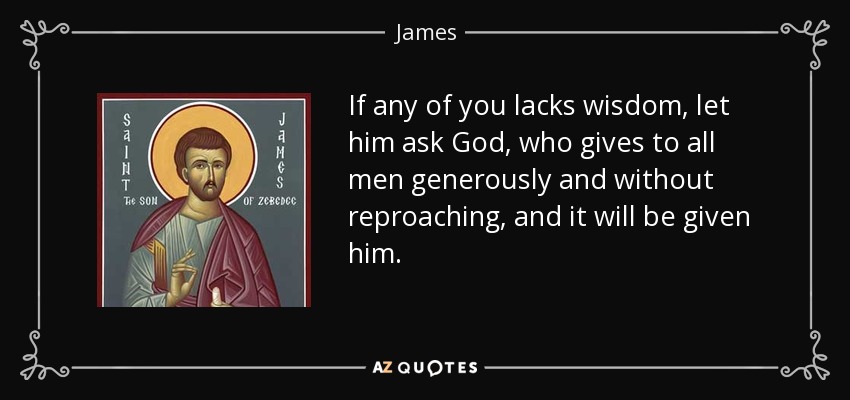
The apostle James was honored with a favored position by Jesus Christ, as one of three men in his inner circle. The others were James' brother John and Simon Peter.
James was older than John. Their father's name was Zebedee. Their mother's name was Salome.
James, his brother John, Peter and Andrew were all partners in a fishing business prior to being called by Christ Jesus to follow Him. Zebedee was, also, a partner in the business.
James and John were apparently from a higher social level than the average fisherman. Their father could afford hired servants (Mk. 1:20). John, the "beloved disciple", had connections with the high priest (Jhn. 18:15).
Jesus nicknamed the two brothers "sons of thunder" (Mk. 3:17). Two incidents reported in the
Gospels indicated that they were headstrong, hot-tempered and impulsive.
Jesus and the disciples were refused the hospitality of a Samaritan village on one occasion (Lk. 9:54ff). James and John proposed to call down fire from heaven on the offenders.
They asked Jesus for a special place of honor in the Kingdom on another occasion (Matt. 20:20-23 = Mk. 10:35-41). They were told that the place of honor is designated by the Father.
They, together with Peter, were privileged to behold the Transfiguration (Matt. 17:1 = Mk. 9:2 = Lk. 9:28), to witness the healing of Peter's mother-in-law (Mk. 1:29), to see the raising of the daughter of Jairus (Mk. 5:37 = Lk. 8:51) and to be called aside to pray with Jesus in the garden of Gethsemane on the night before His death (Matt. 26:37 = Mk. 14:33).
James is believed to have made a pilgrimage to the Iberian Peninsula. He visited the Jewish colonist and slaves in Spain within a 14 year period after the crucifixion to proclaim the gospel.
He was the first of the 12 apostles to be martyred. He was killed with the sword by the order of King Herod Agrippa I of Judea, about 44, in a general persecution of the early church. (Acts 12)
Two other men named James appear in the New Testament. James, the son of Alphaeus, was another apostle. James, the brother of the Lord, was a leader in the Jerusalem church and author of the book of James. Bar-Zebedee is often called the "Greater" to distinguish him from the other two.
The remains, or relics, of James the Greater were transported by his followers to the Iberian Peninsula. They are said to be buried in Santiago de Compostela. St James the Greater is reverenced as the patron saint of Spain.
James Zebedee
S. 吉艾姆斯齐贝迪
T. 吉艾姆斯齊貝迪
吉 Ji lucky 吉 kichi good luck Je じぇ- ジェ- Je 제 my
艾 ai mow 艾 kai moxa mu む ム im 임 being
姆 mu governess 姆 mo wet nurse zu ず ズ seu 스 switch
斯 si this 斯 shi this Ze ぜ ゼ Se 세 three
齐 Qi level 齊 sei alike be べ ベ be 베 the
贝 bei money 貝 bai shellfish de でぃ- ディ- di 디 d
迪 di enlighten 迪 teki edify
------------------------
The agent for good news went west to edify those drafted.
He was imprisoned and executed as though for rebellion he had acted.
==================
Lectionary the Apostle James
wiki James Son of Zebedee
Learn Religions Apostle James
History of the Apostle James
Bible History Famine in Acts 11
Famine
wiki First Jewish Roman War
Primitive Hebrew Church
History
Josephus, Antiquities 20:1.3-2.5
"Herod, the brother of Agrippa who had perished, was allowed to govern over Chalcis. He asked Claudius Caesar for control over the temple along with the sacred treasury, and the ability to choose the high priests, and he was given all that he had asked for.
"Around this time lived queen Helena of Adiabene, along with her son Izates. They both began to follow the Jewish way, turning away from their past lifestyle . . . Her arrival was of great help to the masses in Jerusalem; for there was a famine in the land that overtook them, and many people died of starvation.
"When it became necessary to obtain food abroad, queen Helena sent some of her attendants, with money, to the city of Alexandria to purchase as much grain as possible. She also sent others to the island of Cyprus to bring back dried figs. This whole process happened very quickly, and as soon as they had returned, they handed the provisions out to those who were in dire need of them. Because of this, she left behind a legacy and was held in great respect by the people and the nation at large. And when her son Izates became aware of this famine, he sent a large gift to the leaders in Jerusalem."
Josephus
Philo of Alexandria
Riots erupted in Alexandria in 40 CE between Jews and Greeks. Jews were accused of not honoring the emperor. Disputes occurred also in the city of Jamnia (Yavne). Yavne is in central Israel. Jews were angered by the erection of a clay altar and destroyed it.
Caligula ordered the erection of a statue of himself in the Jewish Temple of Jerusalem. The governor of Syria, Publius Petronius, feared civil war if the order were carried out. He delayed implementing it for nearly a year. Agrippa finally convinced Caligula to reverse the order.
Gaius Caligula was assassinated in Rome on January 24, 41. The Jewish Nazarenes received a great influx of new worshippers in Antioch at this time.
A message was sent to Jerusalem for help. Barnabus went to study the situation to make a report for the apostles. There was a sudden need for a teacher who understood the Greek and Roman mind to guide the new believers. Barnabus went to Tarsus and recruited Paul to come and help in this emerging ministry.
Barnabus and Paul worked together for a year (41-42). The name Christiani appeared to describe the Gentile followers of Jesus. The word was a mixture of Latin and Greek.
Peter met and baptized Cornelius in Caesaria. Cornelius was known as ‘a centurion of the cohort known as Italica.' (Acts 2) These were pious and God fearing Gentiles.
The conflict between Paul and the Nazarenes as to whether a Gentile who became a God-believer that accepted Jesus as messiah, could also become a ‘Israelite’ without embracing the complete tenets of Judaism arose after the baptism of Cornelius. Could he be a true Nazarene if he wasn't circumcised?
A Sabbatical is a 7 year cycle. The second Sabbatical Passover and Pentecost since the Crucifixion and Resurrection of Jesus took place in 41. Events were rapidly unfolding in the lives of the followers of Jesus. Persecution, trials and acts of providence had beset not only the Jewish messianic followers of Jesus but the Jewish people as a whole.
The report of the Gaius Caligula statue had announced stark realities to Jews and the Jewish Nazarenes. The signs of the times depicted events when Jesus would return for his followers for the apocalyptic philosophy.
The call went out that the “End of Time’ was at hand. The radical fringe moved into high gear. The empire became inflamed with subversive activities among the disaffected. Underground financing for weapons and supplies for rebellion went into effect.
This Passover was to be a pivotal period in the Nazarean faith. The Apostles were called to Jerusalem for this momentous occasion.
The Sabbatical Passover was always a major event with pilgrims from all over the world. James the Just, the leader of the congregation in Jerusalem was constantly praying for the safe travel of all his friends and brethren. He would officiate at the Supreme Council of the Elders and the Apostles as the Nasi or the high priest of the Nazarenes.
John was the Spokesman. He was the deputy to James (Jacob) the Just. Simon Peter was the Ab-Beth Din or the general supervisor of all the ministries. He was busy in the preparations.
Andrew, the brother to Peter, Judas of James, the brother and disciples of James and Jesus was his brother’s helper were also residents of Jerusalem. Matthew Levi was the attorney for the Nazarene and the political liaison to the Sadducee party.
Simon Zealotes still had not left the city and remained a good contact with various factions of the Zealots. Matthias who was selected by lots to fill the apostleship of Judas the Sicarii was also there.
James the Greater, the brother to John, was returning from the diaspora after six to seven years in his ministry in the country of Spain. Joseph of Arimathea returned from Avalon on the Isles of Britannia with his stories of the rapid acceptance of the message of Jesus to the Druidic high priests and the household of Argaviras of the royal family of the tribe of Siluria in Wales. Joseph was to set up residence with Philip the evangelist in the port city of Caesarea.
Bartholomew returned to Jerusalem from the Imperial city of Rome. He brought a British convert from Rome with him. Clements met the other apostles and especially Simon Peter. He detailed meeting Philip the evangelist, Joseph and the Bethany family prior to 36 in his book, Recognitions of
Clements.
Clements would be anointed as the third bishop of the ecclesia in Rome by the Apostle Peter 2 decades later. The Pharisee Saul returned from a three year spiritual retreat in the Nabotaean region of the Arabian desert. He was renamed Paul to acknowledge that he was a former enemy of the Nazarenes. He was to become one their greatest evangelists.
Herod Agrippa, grandson of Herod the Great, was tetrarch over Galilee. He had newly been proclaimed King of Judea, Samaria and Caesarea in 41 by Tiberius Claudius Caesar. He was wary of Jewish aspirations to overthrow the Roman rule.
The Herodians were looked upon by the Nazarenes as a usurper to the throne of David. Each was known as a ‘friend of Caesar’ Agrippa was scrupulous in the observance of the Jewish faith. He was known for his piety. This helped him to gain the support of the Sadducees and many Pharisees.
James had gone to Sardinia, then Spain to preach. It had been recorded by Tacitus that as early as 19 CE that 4000 youth which were “affected by the Jewish and Egyptian superstitions” (Annals, Vol. ii, c., 85) were banished from their homeland and forced to enlist as Roman soldiers and placed in Sardinia.
Josephus recognized the “4000” in his Antiquities of the Jews. (Josephus, Antiquities of the Jews, bk., xviii, c. 3) This enlistment of Jewish youth was not popular with the Jews.
James was a former disciple of John the Baptist. He felt called to go to Sardinia and Spain to preach the "Way” as a disciple of the crucified Christ. This was a source of concern to Herod Agrippa .
It was felt that the initial “4000” were probably remnants of the disciples of the slain Hasmonean aspirant, Judas the Galilean. He had led the first major revolt under direct Roman rule in 6 CE. (Acts 5:37).
James the brother of John was captured and executed. The rest of the apostles were suddenly in fear for their lives. Their preaching was being perceived as a political action against Caesar. James became the first apostle to die for the “Way.”
Agrippa’s grip over the Nazarene ecclesia was not over.
Peter was next. He was apprehended and imprisoned. Four soldiers were ordered to guard him. They were changed every three hours. The night before his trial, white clothed ‘angels’ were sent to rescue Peter. The efficient Jewish underground was at work.
While the Nazarean leadership was non-militant, their message had many sympathizers with the Zealots and members of the Fourth Philosophy. Some were capable of a daring rescue operation.
Peter stayed in the home of Mary, mother of John surnamed Mark, until he escaped town.
The next record of Peter is in Rome. He was visiting the Roman Senator Pudens, father-in-law to the Apostle Paul in his palatial estate in Viminal Hills in 44. A date of 43 for the imprisonment of Peter would be reasonable allowing for travel time and other events in his life.
The death of James the Greater sent a message to the Apostles. The hands-off policy to the Nazarean leadership was gone. The death of any Apostle could be expected.
An insurrection by the Jews broke out in the province of Judea in 46 during the reign of Claudius. The Jacob and Simon uprising was instigated by two brothers. It lasted between 46–48. The revolt was concentrated in the Galilee. It began as a sporadic insurgency. It was put down by Roman authorities in 48. Both brothers were executed.
Judgement
Rescue
Me
救我
Jiù wǒ
助けてくれ
Tasuketekure
ps7
Eripe me
The purpose for punishment is correction.
Where is correction without redemption?
The blessed son of the light from the lamp
recorded the words to exalt God's camp.
He who was healed for the Most High to set up
was set on the path for a plan that would not let up.
The LORD said 'I am going to break down what I built with my hand
to pluck up what I have planted, the whole land.
'I will give you as king your life as a prize in war.
You will be spared in any place that you attempt to score.'
The foster father, the brother of grace, was killed with a sword
as the hero sought to act as an emblem for the hand of the Lord.
The Son said, 'It is not mine for you to sit at my side
The place has been prepared by my Father to be satisfied.
I take refuge in you in whom I believe.
Deliver me from all who pursue to retrieve me.
Vindicate me from the charges pressed.
I did not do that which was said.
Rescue me from those who persecute
to destroy or reduce to servitude.
They seek to tear me to pieces like a lion
or to shoot me with an arrow from the bow of Orion.
O Lord my God, if I had done the things of which I have been accused
I would be guilty of having been the one who had abused.
If I had repaid my friend with evil
I would have called forth the penal primeval.
If I had plundered him who without cause was my enemy
then I would have been the cause of a desperate destiny.
Then you would have been right to let my opponent overtake me
to trample my life into the ground, to make me eat dust to forsake my enmity.
Rise up in your anger
against their rancor.
Let the assembly of the people gather round you
to hear the decree of justice resound as true.
Act as the judge of nations
from the height of your station.
Judge me for the right intent
to live in accord with your righteousness.
Let the malice of wickedness end
to establish the mind and heart of a friend.
God is my shield and defense.
He is the Savior of true intent.
He is a righteous judge
who sits in judgment without a grudge.
My Lord is the God
who has prepared a way for me to beat the odds.
Weapons have been prepared for defense
to preserve life from attack in the lethal or violent sense.
Look at those who labored with evil intent
to craft their lies for wickedness.
They dug a pit to make it deep.
You let them fall in it to heave and weep
You had their malice turn back on their own head
that their memory of violence may deter their action instead.
I will praise the name of the Most High.
This witness will serve what's right.
The agent for good news went west to edify those drafted.
He was imprisoned and executed as though for rebellion he had acted.
Punishment as a goal is misdirected.
Incentive corrects with benign intent.
It redirects behavior until corrected.
Punishment is a substitute for retribution.
if the offender can't pay restitution
the punishment is a kind of substitution.
Punishment only points toward redemption.
Cruelty reinforces penal inclination.
Beneficial intention is removed
to leave the punished used,
bruised, unmoved and unproved.
Correction is the name of the game.
What will it take to get the offender to seek dutiful fame?
The path to citizenship is lined with the incentive of mutual benefit.
Observe law without judgment that is punitive, prejudiced or preemptive.
--------------------------
7 Domine, Deus meus
Dominated, my God
1 O Lord my God, I take refuge in you;
save and deliver me from all who pursue me;
2 Lest like a lion they tear me in pieces
and snatch me away with none to deliver me.
3 O Lord my God, if I have done these things:
if there is any wickedness in my hands,
4 If I have repaid my friend with evil,
or plundered him who without cause is my enemy;
5 Then let my enemy pursue and overtake me,
trample my life into the ground,
and lay my honor in the dust.
6 Stand up, O Lord, in your wrath;
rise up against the fury of my enemies.
7 Awake, O my God, decree justice;
let the assembly of the peoples gather round you.
8 Be seated on your lofty throne, O Most High;
O Lord, judge the nations.
9 Give judgment for me according to my
righteousness, O Lord,
and according to my innocence, O Most High.
10 Let the malice of the wicked come to an end,
but establish the righteous;
for you test the mind and heart, O righteous God.
11 God is my shield and defense;
he is the savior of the true in heart.
12 God is a righteous judge;
God sits in judgment every day.
13 If they will not repent, God will whet his sword;
he will bend his bow and make it ready.
14 He has prepared his weapons of death;
he makes his arrows shafts of fire.
15 Look at those who are in labor with wickedness,
who conceive evil, and give birth to a lie.
16 They dig a pit and make it deep
and fall into the hole that they have made.
17 Their malice turns back upon their own head;
their violence falls on their own scalp.
18 I will bear witness that the Lord is righteous;
I will praise the Name of the Lord Most High.
------------------------
==================
------------------------
Jeremiah- Exalt Yah
Baruch- Blessed
Neriah- Lamp
Jehoiakim- Whom Yah has set up
Josiah- Healed
Judah- Praise
Jeremiah 45:1,4-5
The word that the prophet Jeremiah spoke to Baruch son of Neriah, when he wrote these words in a scroll at the dictation of Jeremiah in the fourth year of King Jehoiakim son of Josiah of Judah (605 BCE):
Thus you will say to him, 'Thus says the LORD: I am going to break down what I have built and pluck up what I have planted--that is the whole land...but I will give you your life as a prize of war in every place to which you may go.'
------------------------
The blessed son of the light from the lamp
recorded the words to exalt God's hand.
He who was healed for the Most High to set up
was set on the path for a plan that would not let up.
The LORD said 'I am going to break down what I built with my hand
to pluck up what I have planted, the whole land.
'I will give you as king your life as a prize in war.
You will be spared any place that you attempt to score.'
==================
Herod- hero
Agabus- locust
Claudius- crippled
James- supplanter (derived from Jacob)
John- Yo is gracious
year of the famine- 46 CE
Paulus Orosius (375-418) was a priest and historian from the northwestern province of Gallaecia in Spain in the 4th and 5th centuries. He was a student of Augustine of Hippo (354-430).
A copy of his historical comment on the famine was made by Alfred the Great (847-899) in the Anglo-Saxon Chronicles.
The Chronicle contains the following remarks:
“A.D. 46 . In this year, Claudius, the second Roman emperor to invade Britain, put much of the island under his control and added the Orkneys to Rome’s kingdom. This took place in the fourth year of his rule. In this same year, a great famine in Syria took place which Luke mentions in his book, “The Acts of the Apostles.”
Acts 12:1-2
King Herod laid hands upon some who belonged to the church about the time that the famine predicted by Agabus took place during the reign of Claudius. He had James, the brother of John, killed with the sword.
------------------------
The foster father, the brother of grace, was killed with a sword
as the hero sought to act as an emblem of the hand of the Lord.
==================
Matt. 20:23
He said to them, 'You will indeed drink my cup, but to sit at my right hand and at my left, this is not mine to grant, but it is for those for whom it has been prepared by my Father.'
------------------------
The Son said, 'It is not mine for you to sit at my side
The place has been prepared by my Father to be satisfied.
==================
Wisdom
James the Apostle
b. c. 3 CE Bethsaida, Galilee
d. c. 44 Jerusalem, Judea, Roman Empire
The apostle James was honored with a favored position by Jesus Christ, as one of three men in his inner circle. The others were James' brother John and Simon Peter.
James was older than John. Their father's name was Zebedee. Their mother's name was Salome.
James, his brother John, Peter and Andrew were all partners in a fishing business prior to being called by Christ Jesus to follow Him. Zebedee was, also, a partner in the business.
James and John were apparently from a higher social level than the average fisherman. Their father could afford hired servants (Mk. 1:20). John, the "beloved disciple", had connections with the high priest (Jhn. 18:15).
Jesus nicknamed the two brothers "sons of thunder" (Mk. 3:17). Two incidents reported in the
Gospels indicated that they were headstrong, hot-tempered and impulsive.
Jesus and the disciples were refused the hospitality of a Samaritan village on one occasion (Lk. 9:54ff). James and John proposed to call down fire from heaven on the offenders.
They asked Jesus for a special place of honor in the Kingdom on another occasion (Matt. 20:20-23 = Mk. 10:35-41). They were told that the place of honor is designated by the Father.
They, together with Peter, were privileged to behold the Transfiguration (Matt. 17:1 = Mk. 9:2 = Lk. 9:28), to witness the healing of Peter's mother-in-law (Mk. 1:29), to see the raising of the daughter of Jairus (Mk. 5:37 = Lk. 8:51) and to be called aside to pray with Jesus in the garden of Gethsemane on the night before His death (Matt. 26:37 = Mk. 14:33).
James is believed to have made a pilgrimage to the Iberian Peninsula. He visited the Jewish colonist and slaves in Spain within a 14 year period after the crucifixion to proclaim the gospel.
He was the first of the 12 apostles to be martyred. He was killed with the sword by the order of King Herod Agrippa I of Judea, about 44, in a general persecution of the early church. (Acts 12)
Two other men named James appear in the New Testament. James, the son of Alphaeus, was another apostle. James, the brother of the Lord, was a leader in the Jerusalem church and author of the book of James. Bar-Zebedee is often called the "Greater" to distinguish him from the other two.
The remains, or relics, of James the Greater were transported by his followers to the Iberian Peninsula. They are said to be buried in Santiago de Compostela. St James the Greater is reverenced as the patron saint of Spain.
James Zebedee
S. 吉艾姆斯齐贝迪
T. 吉艾姆斯齊貝迪
吉 Ji lucky 吉 kichi good luck Je じぇ- ジェ- Je 제 my
艾 ai mow 艾 kai moxa mu む ム im 임 being
姆 mu governess 姆 mo wet nurse zu ず ズ seu 스 switch
斯 si this 斯 shi this Ze ぜ ゼ Se 세 three
齐 Qi level 齊 sei alike be べ ベ be 베 the
贝 bei money 貝 bai shellfish de でぃ- ディ- di 디 d
迪 di enlighten 迪 teki edify
------------------------
The agent for good news went west to edify those drafted.
He was imprisoned and executed as though for rebellion he had acted.
==================
Lectionary the Apostle James
wiki James Son of Zebedee
Learn Religions Apostle James
History of the Apostle James
Bible History Famine in Acts 11
Famine
wiki First Jewish Roman War
Primitive Hebrew Church
History
Josephus, Antiquities 20:1.3-2.5
"Herod, the brother of Agrippa who had perished, was allowed to govern over Chalcis. He asked Claudius Caesar for control over the temple along with the sacred treasury, and the ability to choose the high priests, and he was given all that he had asked for.
"Around this time lived queen Helena of Adiabene, along with her son Izates. They both began to follow the Jewish way, turning away from their past lifestyle . . . Her arrival was of great help to the masses in Jerusalem; for there was a famine in the land that overtook them, and many people died of starvation.
"When it became necessary to obtain food abroad, queen Helena sent some of her attendants, with money, to the city of Alexandria to purchase as much grain as possible. She also sent others to the island of Cyprus to bring back dried figs. This whole process happened very quickly, and as soon as they had returned, they handed the provisions out to those who were in dire need of them. Because of this, she left behind a legacy and was held in great respect by the people and the nation at large. And when her son Izates became aware of this famine, he sent a large gift to the leaders in Jerusalem."
Josephus
Philo of Alexandria
Riots erupted in Alexandria in 40 CE between Jews and Greeks. Jews were accused of not honoring the emperor. Disputes occurred also in the city of Jamnia (Yavne). Yavne is in central Israel. Jews were angered by the erection of a clay altar and destroyed it.
Caligula ordered the erection of a statue of himself in the Jewish Temple of Jerusalem. The governor of Syria, Publius Petronius, feared civil war if the order were carried out. He delayed implementing it for nearly a year. Agrippa finally convinced Caligula to reverse the order.
Gaius Caligula was assassinated in Rome on January 24, 41. The Jewish Nazarenes received a great influx of new worshippers in Antioch at this time.
A message was sent to Jerusalem for help. Barnabus went to study the situation to make a report for the apostles. There was a sudden need for a teacher who understood the Greek and Roman mind to guide the new believers. Barnabus went to Tarsus and recruited Paul to come and help in this emerging ministry.
Barnabus and Paul worked together for a year (41-42). The name Christiani appeared to describe the Gentile followers of Jesus. The word was a mixture of Latin and Greek.
Peter met and baptized Cornelius in Caesaria. Cornelius was known as ‘a centurion of the cohort known as Italica.' (Acts 2) These were pious and God fearing Gentiles.
The conflict between Paul and the Nazarenes as to whether a Gentile who became a God-believer that accepted Jesus as messiah, could also become a ‘Israelite’ without embracing the complete tenets of Judaism arose after the baptism of Cornelius. Could he be a true Nazarene if he wasn't circumcised?
A Sabbatical is a 7 year cycle. The second Sabbatical Passover and Pentecost since the Crucifixion and Resurrection of Jesus took place in 41. Events were rapidly unfolding in the lives of the followers of Jesus. Persecution, trials and acts of providence had beset not only the Jewish messianic followers of Jesus but the Jewish people as a whole.
The report of the Gaius Caligula statue had announced stark realities to Jews and the Jewish Nazarenes. The signs of the times depicted events when Jesus would return for his followers for the apocalyptic philosophy.
The call went out that the “End of Time’ was at hand. The radical fringe moved into high gear. The empire became inflamed with subversive activities among the disaffected. Underground financing for weapons and supplies for rebellion went into effect.
This Passover was to be a pivotal period in the Nazarean faith. The Apostles were called to Jerusalem for this momentous occasion.
The Sabbatical Passover was always a major event with pilgrims from all over the world. James the Just, the leader of the congregation in Jerusalem was constantly praying for the safe travel of all his friends and brethren. He would officiate at the Supreme Council of the Elders and the Apostles as the Nasi or the high priest of the Nazarenes.
John was the Spokesman. He was the deputy to James (Jacob) the Just. Simon Peter was the Ab-Beth Din or the general supervisor of all the ministries. He was busy in the preparations.
Andrew, the brother to Peter, Judas of James, the brother and disciples of James and Jesus was his brother’s helper were also residents of Jerusalem. Matthew Levi was the attorney for the Nazarene and the political liaison to the Sadducee party.
Simon Zealotes still had not left the city and remained a good contact with various factions of the Zealots. Matthias who was selected by lots to fill the apostleship of Judas the Sicarii was also there.
James the Greater, the brother to John, was returning from the diaspora after six to seven years in his ministry in the country of Spain. Joseph of Arimathea returned from Avalon on the Isles of Britannia with his stories of the rapid acceptance of the message of Jesus to the Druidic high priests and the household of Argaviras of the royal family of the tribe of Siluria in Wales. Joseph was to set up residence with Philip the evangelist in the port city of Caesarea.
Bartholomew returned to Jerusalem from the Imperial city of Rome. He brought a British convert from Rome with him. Clements met the other apostles and especially Simon Peter. He detailed meeting Philip the evangelist, Joseph and the Bethany family prior to 36 in his book, Recognitions of
Clements.
Clements would be anointed as the third bishop of the ecclesia in Rome by the Apostle Peter 2 decades later. The Pharisee Saul returned from a three year spiritual retreat in the Nabotaean region of the Arabian desert. He was renamed Paul to acknowledge that he was a former enemy of the Nazarenes. He was to become one their greatest evangelists.
Herod Agrippa, grandson of Herod the Great, was tetrarch over Galilee. He had newly been proclaimed King of Judea, Samaria and Caesarea in 41 by Tiberius Claudius Caesar. He was wary of Jewish aspirations to overthrow the Roman rule.
The Herodians were looked upon by the Nazarenes as a usurper to the throne of David. Each was known as a ‘friend of Caesar’ Agrippa was scrupulous in the observance of the Jewish faith. He was known for his piety. This helped him to gain the support of the Sadducees and many Pharisees.
James had gone to Sardinia, then Spain to preach. It had been recorded by Tacitus that as early as 19 CE that 4000 youth which were “affected by the Jewish and Egyptian superstitions” (Annals, Vol. ii, c., 85) were banished from their homeland and forced to enlist as Roman soldiers and placed in Sardinia.
Josephus recognized the “4000” in his Antiquities of the Jews. (Josephus, Antiquities of the Jews, bk., xviii, c. 3) This enlistment of Jewish youth was not popular with the Jews.
James was a former disciple of John the Baptist. He felt called to go to Sardinia and Spain to preach the "Way” as a disciple of the crucified Christ. This was a source of concern to Herod Agrippa .
It was felt that the initial “4000” were probably remnants of the disciples of the slain Hasmonean aspirant, Judas the Galilean. He had led the first major revolt under direct Roman rule in 6 CE. (Acts 5:37).
James the brother of John was captured and executed. The rest of the apostles were suddenly in fear for their lives. Their preaching was being perceived as a political action against Caesar. James became the first apostle to die for the “Way.”
Agrippa’s grip over the Nazarene ecclesia was not over.
Peter was next. He was apprehended and imprisoned. Four soldiers were ordered to guard him. They were changed every three hours. The night before his trial, white clothed ‘angels’ were sent to rescue Peter. The efficient Jewish underground was at work.
While the Nazarean leadership was non-militant, their message had many sympathizers with the Zealots and members of the Fourth Philosophy. Some were capable of a daring rescue operation.
Peter stayed in the home of Mary, mother of John surnamed Mark, until he escaped town.
The next record of Peter is in Rome. He was visiting the Roman Senator Pudens, father-in-law to the Apostle Paul in his palatial estate in Viminal Hills in 44. A date of 43 for the imprisonment of Peter would be reasonable allowing for travel time and other events in his life.
The death of James the Greater sent a message to the Apostles. The hands-off policy to the Nazarean leadership was gone. The death of any Apostle could be expected.
An insurrection by the Jews broke out in the province of Judea in 46 during the reign of Claudius. The Jacob and Simon uprising was instigated by two brothers. It lasted between 46–48. The revolt was concentrated in the Galilee. It began as a sporadic insurgency. It was put down by Roman authorities in 48. Both brothers were executed.
Friday, July 5, 2019
Hate
7.6.19
Maggie Q
Hate
Your
Iniquity
恨你的罪孽
Hèn nǐ de zuìniè
あなたの不法行為を憎む
Anata no fuhō kōi o nikumu
ps119.113+
Odite iniquitas tua!
I hate the iniquity I had or might have had.
Divine law refrains from evil and avoids the bad.
Justice is my refuge, shield and sanctity.
The Word is my hope, yield and sanity.
The Church is the body of Christ.
Incarnate leadership is the divine device.
Natural or social influence can sway one's heart.
Keeping the commandments rules my part.
Choose simplicity with respect for foreign influence
for the conservative reform of policy drawn from natural inference.
Sustain me with your promise
that I may live with hope that is honest.
Hold me up to keep me safe.
Your concern extends to redeem the dutiful waif.
Those who strayed from your joyful way
deceived themselves as to what to say.
Success with deceit is like the mineral dross
that disfigures the surface on a value embossed.
Something of worth was shaped to admire
but the intent to deceive discolored the artistic fire.
My flesh trembles with the dread of condemnation.
You are the goodness in organization for the nation.
Agree with God to define your peace.
Good will come that may never cease.
Remember what's right about what you heard and received
to avoid the consequence that strikes like a thief.
The righteous blood that was shed on earth
has to account for redemption in remembrance worked.
Choose simplicity with respect for foreign influence
for the conservative reform of policy drawn from natural inference.
-----------------------
Samekh
Samekh is the fifteenth letter of the Hebrew alphabet.
The root of the word means to "to lean upon," "to uphold" or "to support." The root is found in the concept of semikhah, the laying of the hands on the sacrificial animal in a blood ritual in the Jewish Temple. A priest is consecrated or a rabbi is ordained in a ceremony with the same name.
Iniquos odio habui
I hate iniquity had
113 I hate those who have a divided heart,
but your law do I love.
114 You are my refuge and shield;
my hope is in your word.
115 Away from me, you wicked!
I will keep the commandments of my God.
116 Sustain me according to your promise, that I may live,
and let me not be disappointed in my hope.
117 Hold me up, and I shall be safe,
and my delight shall be ever in your statutes.
118 You spurn all who stray from your statutes;
their deceitfulness is in vain.
119 In your sight all the wicked of the earth are but dross;
therefore I love your decrees.
120 My flesh trembles with dread of you;
I am afraid of your judgments.
-------------------------
==================
Job 22:21
Agree with God and be at peace.
Good will come to you in this way.
-------------------------
Agree with God to define your peace.
Good will come that may never cease.
==================
Rev. 3:3
Remember what you received and heard. Obey it and repent. If you do not wake up, I will come like a thief. You will not know at what hour I will come to you.
-------------------------
Remember what you heard and received
to avoid the consequence that strikes like a thief.
==================
Matt. 23:34-35
I send you prophets, sages and scribes. Some you will kill and crucify. Some you will flog in your synagogues and pursue from town to town. All the righteous blood shed on earth from that of the righteous Abel to that of Zechariah, son of Barachiah, whom you murdered between the sanctuary and the altar may come upon you.
-------------------------
The righteous blood that was shed on earth
has been for accountability in remembrance worked.
==================
Europe was a serf-based society through the Middle Ages. Serfdom was an Egyptian form for governance and land management. Slavery was not legal.
Most people were serfs. There was some opportunity to move up in the social hierarchy, but there was the risk that someone from the higher class would stop the climb with the imposition of consequence.
The political organization for European society was called the Holy Roman Empire. Agreement to retain all kingdoms in the empire was lost with the reintroduction of slavery as a legal institution.
Luther protested indulgences, but the implication of the protest extended further. The Lutheran and Anglican Reformation was opposed to the reintroduction of slavery to the empire for imperial expansion.
Calvinists supported slavery as a way for poor traders to move up in society by marketing people as property. The Puritans took control of Parliament before the slave trade was tolerated as legal by Great Britain for their colonies.
While the Puritans were English, they had political ties with the Dutch republic and the general movement to replace monarchy with republican government.
Spain had been instrumental in the re-introduction of slavery to Roman government. They had been invaded by Muslims. The Muslims were using slavery in their imperial expansion.
It can be observed that Cyrus, who had been named Christ by Jews and Christians for the release of the Jews from captivity in Babylon, had a strong association with opposition to slavery as supported by the cult of Sin, the moon goddess. She was replacing Marduk at the head of Middle Eastern parthenon of gods and the regents for the young king had an ambitious plan for construction.
Cyrus was the model for Mohammed's government as well. He had organized a sufficient military force at a critical time to ride into the capital of the Babylonian empire to achieve a bloodless coup.
The political association between Cyrus, Christ and Mohammed was the position against slavery. The ministry of Jesus was for the law, against rebellion, against cruelty in punishment and his title as Christ had a long standing opposition to slavery.
The Muslim and Christian empires had regressed to the tolerance of the slave trade and slavery as an institution despite these strong political associations.
The monarchy in Spain had allied with Portugal to expel the invaders. The Spanish monarchy rose in prominence to assume the authority of the emperor within the Roman empire. Spain would go on to colonize South America and parts of Africa.
They extended their trade to Asia by sea. The emperor had written against slavery in his position of king in his Spanish kingdom. His queen did as well, but both the Muslim and Christian realms had re-instated slavery as an imperial imperative against primitive society.
While opposition to slavery was not explicitly expressed as a cause of the Reformation, the issue was related to the protest against indulgences. The slave trade and slavery were a particular form of indulgence.
John Huss embodied a number of principles in events that preceded the Reformation. He was for the translation of the Bible into the language of the people. He was for leadership that promoted the good news of salvation with Jesus as Christ. He was for worship that recognized the real presence of Christ in the Eucharist.
He was excommunicated for insubordination and executed as a heretic.
Art
John Huss
b. c.1369, Husniec, Kingdom of Bohemia, Holy Roman Empire (Czech Republic)
d. 7.6.1415, Konstanz, Bishopric of Constance, Holy Roman Empire (Germany)
John Huss is the English form for the name Jan Hus. He was about 46 years old when he was executed.
Huss was Bohemian. Bohemia was located in the land occupied by the current Czech republic. The kingdom of Bohemia had attained imperial status by the time he was ordained as a priest. It was recognized by the Holy Roman Empire as a kingdom.
Kingdom of Bohemia
The first decade of the 14th century saw the demise of two long-established indigenous dynasties in eastern Europe. The Magyar line of the Arpads flickered out after more than three centuries in Hungary with the death of Andrew III. Slav rule by the Premyslid family in Bohemia was brought to a more abrupt end by the assassination of Wenceslas III in 1306.
The event ended the ethnic link between the ruling dynasty and the people in each case. Both kingdoms now took their place in the patchwork quilt of medieval European dynasties. Hungarian and Czech nobles insisted upon the right to choose their kings. Tempting alliances were offered to support claims.
The Czechs chose wisely though force proved to be an important factor in the choice. European power had recently shifted to the house of Luxembourg. A count from the house was elected Holy Roman emperor in 1308 as Henry VII.
One of the Czech factions seized its chance. The hand of princess Elizabeth, the sister of the late Wenceslas III, was offered to Henry's son, John of Luxembourg. It was understood that a German imperial army would escort the bridal couple into Prague.
John and Elizabeth married in August 1310. They reached Prague in December. Their joint army of Germans and Bohemians captured the city and evicted a rival claimant to the throne.
The Luxembourg dynasty ruled in Prague for more than a century. Both the city and kingdom enjoyed a period of unprecedented growth under Charles IV, the son of John and Elizabeth. Growth was achieved even though the early years of his reign coincided with the horrors of the Black Death.
Charles was elected German king in 1346. He succeeded his father as king of Bohemia later in the same year. He was crowned emperor in Rome in 1355. The alliance with the Luxembourg dynasty had brought imperial power to Bohemia.
Charles made Prague his imperial city. It was already a prosperous center at the intersection of important trade routes. It benefited more from the emperor's patronage.
Many prominent historic sites in Prague date back to the Golden Age that began with the reign of Charles IV. He was a manager of building projects. He knew how to support the construction of new buildings and infrastructure especially in Prague.
The construction was meaningful and profitable for the kingdom as a whole. He often declared contests or tenders to see who was able to build something quickly. Marketplaces were actively managed. Timing was important.
He founded Charles University in 1348. He built the New Town neighborhood, the Charles Bridge, the initial stages of the St. Vitus Cathedral, the Karlštejn Castle and other things. Prague was upgraded from a diocese to an arch-episcopate.
The Papal Schism
The success of the early Crusades added prestige to the pope as the secular leader of Christendom. Monarchs like those of England, France and the Roman Empire acted as marshals for the pope by leading "their" armies.
This state of affairs culminated in the declaration of papal supremacy as a doctrine. The Unam sanctam was issued in November 1302. Pope Boniface VIII decreed that "it is necessary to salvation that every human creature be subject to the Roman pontiff" in the papal bull.
Clement V was elected Pope in 1305. He was French. Clement declined to move to Rome. He remained in France. He moved his court to the papal enclave at Avignon in 1309. The seat for the office remained there for the next 67 years.
Southern France had a culture that was independent from the north at that time. Most of the advisers to the King were based in the north. The Kingdom of Arles was still independent. It was officially a part of the Roman Empire.
The literature produced by the troubadours in the Languedoc is unique and strongly distinct from that of Royal circles in the north. The power of the French King in this region was uncontested by the time of the Avignon papacy, but it was not legally bound.
Europe 1378
A total of seven popes reigned at Avignon. All were French. They increasingly fell under the influence of the French crown. Finally, Gregory XI abandoned Avignon and moved his court to Rome on September 13, 1376. He arrived on January 17, 1377, officially ending the Avignon Papacy.
The Avignon Papacy had developed a reputation for corruption that estranged parts of Western Christendom. This reputation can be attributed to the perception of excessive favor for the predominant French influence.
The papal curia's efforts to extend its powers of patronage and increase its revenues by selling indulgences was a controversial policy. Indulgences allowed offenders to buy forgiveness from the church without affecting repairs for offenses to those who were offended. It was a way to increase revenue to build an army to compete for dominance.
The Romans rioted to ensure the election of a Roman for pope after Pope Gregory XI died in 1378. The cardinals elected a Neapolitan when no viable Roman candidates presented themselves on April 8, 1378.
Urban VI was elected. He had been born with the name Bartolomeo Prignano. He had been elevated as the Archbishop of Bari prior to his election as pope. Urban had been a respected administrator in the papal chancery at Avignon, but as pope he proved suspicious in his reform.
He was prone to violent outbursts of temper. Many of the cardinals who had elected him soon regretted their decision. The majority removed themselves from Rome to Anagni.
They elected Robert of Geneva as a rival pope on September 20 of the same year even though Urban was still reigning. Robert took the name Clement VII and reestablished a papal court in Avignon. The second election threw the Church into turmoil.
The time to question the authority of the papacy was ripe.
The papacy with the college of cardinals had been modeled on the Roman republic in terms of elected leadership. It differed from republic insofar as the leader was elected for the duration of his life. A line of succession was prevented by the requirement of celibacy in the office. The Roman republic had a one year term limit for the office of consul.
The office of the pope was dedicated to the preservation of Roman culture as a monotheistic expression with respect for Jesus as the Christ.
The papacy with the college of cardinals had been modeled on the Roman republic in terms of elected leadership. It differed from republic insofar as the leader was elected for the duration of his life. The Roman republic had a one year term limit for the office of consul.
The office of the pope was dedicated to the preservation of Roman culture as a monotheistic expression with respect for Jesus as the Christ.
Judaic culture had been characterized by respect for law. The law against murder and the liberation of slaves after 50 years of servitude distinguished Jewish law from the code of Hammurabi. Cruelty in punishment was treated as a normal form of law enforcement.
Roman law was similar insofar as they had manumission. They had liberation by success as a gladiator as a form to attain freedom from slavery as well. Killing in war was part of the competition for leadership in the republic, but there was a law against murder. Table IX forbid putting any unconvicted man to death.
Roman culture started as a republic. Voting had been adopted from the Greeks as a way to elect leaders, but monarchy with hereditary succession was not regarded as an acceptable form of executive authority. This was where the Roman and Judaic hierarchies differed.
Debate was a method for presenting argument that represented the best interest for the people. There were two consuls who had to work out a position that represented the Patricians in the Senate. The consuls represented the end of the ascent in the line of offices for the Roman republic.
Rome had provisionally formed their alliance with the Maccabees based on the agreement between Roman and Judaic law. Eventually, the knowledge that the Maccabees had allied with Rome to overthrow Seleucid leadership was used to replace the Hasmonean dynasty with the Herodians.
The Herodian dynasty would eventually be eliminated to favor elected leadership in the newly established province of Syria Palestine. The city of Jerusalem was destroyed as the final emblem of Judean monarchy.
The republic became an empire when Julius Caesar laid claim to his property in Rome by marching his army over the Rubicon river. This act allowed him to take the title of dictator as a representative for the Populares.
Sulla was with the Optimates. He had been the first to declare himself dictator in Rome. The title had an association with the threat of execution for disagreement as a means to discourage rebellion. The story about cruelty in punishment was released to the public to frighten people into a state of submission. There was also an implication for the subversive use of tax money in the promotion of insurrection against foreign influences.
Caesar operated with respect for establishing hereditary succession as a part of his executive leadership. His assassination looked like a predicted event that would help to achieve the desired end.
The Optimates had declared him a tyrant. The institution of his hereditary succession was viewed as a violation of the Republic. Octavian became the next emperor anyway. The position for the emperor was developed from the title of dictator in Roman government.
Sicarii
The Sicarii were assassins that were used to infiltrate and undermine Jewish law by Rome. Josephus mentions the appearance of the Sicarii as a new phenomenon during the procuratorships of Felix (52–60) in The War of the Hebrews (2:254–7).
The assassins played on the desire for independence as a ploy. Their advocacy proposed that rebellion was the way to attain independence as a kingdom. Rebellion proved to be the justification for the destruction of Jerusalem by Titus, the son of Vespasian in 70 CE.
Odoacer
Rome fell to Odoacer, the leader of an east German tribe known as the Scirii in 476. Traditional Romans blamed the fall of Rome on the monotheism of the Christians.
Augustine had written the "City of God" as a defense of Christianity against the same charge after Alaric and the Visigoths had invaded in 410. Rome would have fallen to the invaders irrespective of the Christian religion. Christians were moral in the support of civil authority. The idea of a 'just war' was most likely posited to support a standing army for defense.
Scirii
The Scirii were a Germanic tribe from Eastern Europe. Their existence was affirmed in historical works between the 2nd century BCE and 5th century CE. If the Scirii were hired as Sicarii, then returned to eastern Europe after the failed rebellion, it could be argued that Rome fell victim to their own subversive design.
Gregory the Great
Gregory became the first monastic pope of Rome in 590 CE. He became the political leader of Rome with his organizational skill.
Papal supremacy was claimed to establish administrative authority over secular brutality. It was part of the transition from a polytheistic society. When the pope had appealed to the patriarch of Constantinople for help in defense against invasion, the appeal was not answered.
The pope became a secular leader over the Roman Christian state. The Vatican became a city state in its own right. Only those who agreed with the change fell under their authority at first.
The extension of the claim to supremacy in practice was limited to negotiation with princes and kings, but it came to acquire a claim over other churches, including the Byzantine Church. The pope was not first among equals as had been the precedent for ecclesiastical leadership. He became the universal ruler of Church affairs. He would come to claim power over all the churches.
This claim to authority came to gain an extension over the decisions in monarchy. The Crusades were initiated by the pope. The Inquisition was conducted for the pope. Cruelty in punishment became a device of the church. War became an instrument for claiming authority over people for the church.
The Church that Jesus had established by faith in love without the promotion of violence or cruelty had been turned upside down.
Taking money from those convicted of crime and those conquered in war was regarded as 'legal' for the formation of private armies. These were sanctioned ways of raising revenue in addition to taxation. Taxes were collected by the army for the rule of the Patrician class.
Those who conceded to the claim of supremacy agreed not to protest torture or killing in the name of the “Lord.” They were allowed to organize in order to compete for dominance. Whoever was still standing when the dust cleared was declared victor. History was being written by the victors. Papal supremacy made this a social as well as a political concession.
While Byzantium had prohibited the death penalty, the church with papal supremacy opened the door to increasing power with wealth taken by the “sacrifice” of respect for the law against murder. A bishop or a prince could find a competitor guilty of heresy if it was convenient to the accumulation of wealth or territory for power.
The death penalty was applied to condemn the error. Trial before a judge was based on witness testimony. The witness testimony was not substantiated with physical proof. It was in breach of due process. The murder by conviction of crime was convenient to the elimination of opposition.
These concerns were historical. This was the time when criticism of the office of pope itself was started as an antecedent to the Protestant Reformation in the 16th century.
John Huss
John Huss was born to peasant parents in Husinec, Bohemia, c. 1369. Husinec or "Goosetown" is in the south of today's Czech Republic. He shortened his name to Hus or "Goose" in his twenties.
His friends delighted in making puns on his name. It was a tradition that was continued even with Luther. The Protestant reformer reminded his followers of the "goose" who had been "cooked" for defying the pope.
He traveled to Prague at an early age. He supported himself by singing and serving in Churches. His conduct was positive. His commitment to his studies was remarkable.
Huss earned the degree of Bachelor of Arts at the University of Prague in 1393. He earned his master's degree in 1396. He was ordained as a priest in 1400.
He began preaching inside the city. He called for the reformation of the Church in 1402. He served as rector of the University of Prague in 1402–03. He was appointed a preacher at the newly built Bethlehem Chapel around the same time.
He was influenced by the writings of John Wycliffe. He translated Trialogus into Czech. He helped to distribute the translation even though Church authorities banned many of Wycliffe’s works in 1403. Huss is considered the first Church reformer after John Wycliffe insofar as he came before Luther, Calvin and Zwingli.
This made him a key predecessor to Protestantism. His teaching had a strong influence on the states of Western Europe. There was the approval of reform in Bohemia. There was the influence on Martin Luther more than a century later.
The University of Prague was already split between Czechs and Germans. Wycliffe's teachings only divided them more. Early debates hinged on fine points of philosophy. The Czechs were realists with Wycliffe. The Germans were nominalists.
The Czechs warmed up to the idea of reform. They had no intention of altering traditional doctrines, but they wanted to place more emphasis on the Bible, expand the authority of church councils, lessen that of the pope and promote the moral reform of clergy.
Huss was a strong advocate for the Czechs and the Realists. It is from realism that he drew his teaching on the eucharist. He taught impanation. The body and blood of Jesus Christ are embodied in the elements without change in the material substance. The elements are still bread and wine.
Impanation
It is the meaning of their consumption with the words of institution that affects communion in the celebration of thanksgiving in the eucharist. Take eat. This is my body broken for you for forgiveness. Take drink. This is my blood offered to you for redemption.
Transubstantiation
The teaching is contrasted with consubstantiation and transubstantiation. Consubstantiation was taught by Lutherans. The body and blood coexist with the bread and wine. Transubstantiation is taught by the Roman Catholic Church to promote belief in the real presence of Christ. It is believed that the elements are transformed into the body and blood.
European politics complicated the dispute between the realists and nominalists. Two popes vied to rule all of Christendom. A church council was called at Pisa in 1409 to settle the matter. It deposed both popes and elected Alexander V as the legitimate pontiff. The other popes repudiated this election and continued to rule their factions.
Alexander was soon "persuaded" or bribed to side with the Bohemian church authorities who were against Huss. He was excommunicated and forbidden to preach on paper. The local Bohemians backed him. He continued to preach and minister at Bethlehem Chapel.
The antipope John XXIII was Alexander V's successor. This John is not to be confused with the modern pope by the same name. He authorized the selling of indulgences to raise funds for his crusade against one of his rivals. Huss was scandalized.
He was horrified at the idea of selling political favor to finance a war between two claimants to the title "Servant of the Servants of God." He said so. The pope was acting in mere self-interest. The pope's moral authority could not be justified. Huss leaned even more heavily on the bible. He proclaimed the Bible as the final authority for the church.
He further argued that the Czech people were being exploited by the pope's indulgences. This was read as a not-so-veiled attack on the Bohemian king who had a stake in alliance with the papal office.
Huss lost the support of his king. His excommunication was now revived. An interdict was put upon the city of Prague. No citizen could receive Communion or be buried on church grounds as long as Huss continued his ministry with them. He withdrew to the countryside toward the end of 1412 to spare the city.
He spent the next two years in feverish literary activity. He composed a number of treatises. The most important was “The Church,” which he sent to Prague to be read publicly. He argued that Christ alone is head of the church. A pope can make many mistakes "through ignorance and love of money.” To argue against an erring pope was to obey Christ.
The custom of restricting the chalice to the celebrant alone at the celebration of the Lord's Supper had arisen. The consecrated bread was distributed to all Christians in the form of a wafer of unleavened bread. Huss denounced this restriction as contrary to Holy Scripture and the ancient tradition of the Church.
He also held that Church officials ought to exercise spiritual powers only. He opposed their claim as earthly governors. His archbishop excommunicated him in 1412 for insubordination. Heresy was not used to justify the severance.
The Council of Constance was assembled in November 1414. Huss was urged by Holy Roman Emperor Sigismund, the son of Charles IV, to come and give an account of his doctrine. The Emperor guaranteed his personal safety even if found guilty.
The council also promised to provide significant church reforms. He was immediately arrested when he arrived, however. He remained imprisoned for months. He was eventually hauled before authorities in chains.
He was tried and ordered to recant certain heretical doctrines. He replied that he had never held or taught the doctrine in question. Grandstanding with straw man accusations was part of the appeal to the uneducated public.
Huss was willing to declare the doctrines false, but not willing to declare on oath that he had once taught them. The one point on which he could be said to have a doctrinal difference with the Council was that he taught that the office of the pope did not exist by Divine command.
He argued that the office was established by the Church that things might be done in an orderly fashion. This was a view that he shared with Thomas More. The Council had just narrowly succeeded in uniting Western Christendom under a single pope after years of chaos. They were not about to have their work undone.
When he saw that he wasn't to be given a fair hearing, he finally said, "I appeal to Jesus Christ, the only judge who is almighty and completely just. In his hands I plead my cause, not on the basis of false witnesses and erring councils, but on truth and justice."
His appeal to Jesus was significant insofar as the legal status for the church as the religion for the empire with the pope in a position of supremacy had resulted in a transformation of belief to faith in an imperial Christ who sanctified indulgences for raising armies for war and the imposition of the death penalty.
He was taken to his cell. Many pleaded with him to recant. He was taken to the cathedral, dressed in his priestly garments, then stripped of them one by one on July 6, 1415. He refused one last chance to recant.
He was burned at the stake for heresy against the doctrines of the Catholic Church, including those on ecclesiology, the Eucharist and other theological topics. He was heard reciting the psalms as he burned.
----------------------------
The followers of his religious teaching, known as Hussites, rebelled against their Roman Catholic rulers after the execution. The Hussites defeated five consecutive papal crusades between 1420 and 1431 in what became known as the Hussite Wars.
As many as 90% of inhabitants of the Czech lands were non-Catholic a century later. Some still follow the teachings of Huss and his successors. The Moravian Church claims descent from his instruction.
A pact was signed by which the Church in Bohemia was authorized to administer the Chalice as well as the Host to all communicants in 1436. The followers of John Huss and his fellow martyr Jerome of Prague became known as the Czech Brethren and later as the Moravians.
The Moravian Church survives to this day. It has had a considerable influence on the Lutheran movement. When Luther suddenly became famous after the publication of his 95 Theses, cartoons and graffiti began to appear implying that Luther was the spiritual heir of John Huss.
When Luther encountered the Pope's representative Johannes Eck, in a crucial debate, Eck sidestepped the questions of indulgences and justification by faith. He asked Luther whether the Church had been right to condemn Huss. When Luther said that he had been unjustly condemned, the whole question of the authority of Popes and Councils was raised.
Embodied
What happens in the celebration of the Eucharist?
Impanation- embodied in the bread and wine
Consubstantiation - along with the elements
Transubstantiation - into the body and blood of Jesus the Christ
---------------------------
The Moravian Church
This Church community is one of the oldest Protestant denominations in the world. The heritage dates back to the Bohemian Reformation in the fifteenth century.
The name by which the Church is commonly known comes from the original exiles who fled to Saxony in 1722 from Moravia to escape religious persecution. This region today is part of the Czech Republic.
The modern Unitas Fratrum has about 750,000 members worldwide. It continues to draw on traditions established during the eighteenth century. The success of the mission work is reflected in their broad global distribution. The Church places a high value on ecumenism, personal piety, missions and music.
The Hussite Movement
Huss had objected to a number of the practices of the Catholic Church. He wanted the liturgy to be celebrated in Czech and lay people to receive communion in both kinds (bread and wine). He insisted that priests should be allowed to marry. He wanted to eliminate indulgences and the idea of Purgatory
There was not a single town without a Protestant school in the Bohemia crown lands by the middle of the 16th century . Many had more than one, mostly with two to six teachers each. There were five major schools in Jihlava, a principal Protestant center in Moravia: two German, one Czech, one for girls and one that taught Latin.
John Huss
S. 简·胡斯
T. 簡·胡斯
简 Jian to choose 簡 kan simplicity Jon じょん ジョン Jon 존 zone
胡 Hu why 胡 u foreign Ha は ハ Hu 후 after
斯 si this 斯 shi this su す ス seu 스 switch
-------------------------
Choose simplicity with respect for foreign influence
for the conservative reform of policy drawn from natural inference.
==================
https://en.wikipedia.org/wiki/Jan_Hus
http://www.satucket.com/lectionary/jan_hus.htm
Maggie Q
Your
Iniquity
恨你的罪孽
Hèn nǐ de zuìniè
あなたの不法行為を憎む
Anata no fuhō kōi o nikumu
ps119.113+
Odite iniquitas tua!
I hate the iniquity I had or might have had.
Divine law refrains from evil and avoids the bad.
Justice is my refuge, shield and sanctity.
The Word is my hope, yield and sanity.
The Church is the body of Christ.
Incarnate leadership is the divine device.
Natural or social influence can sway one's heart.
Keeping the commandments rules my part.
Choose simplicity with respect for foreign influence
for the conservative reform of policy drawn from natural inference.
Sustain me with your promise
that I may live with hope that is honest.
Hold me up to keep me safe.
Your concern extends to redeem the dutiful waif.
Those who strayed from your joyful way
deceived themselves as to what to say.
Success with deceit is like the mineral dross
that disfigures the surface on a value embossed.
Something of worth was shaped to admire
but the intent to deceive discolored the artistic fire.
My flesh trembles with the dread of condemnation.
You are the goodness in organization for the nation.
Agree with God to define your peace.
Good will come that may never cease.
Remember what's right about what you heard and received
to avoid the consequence that strikes like a thief.
The righteous blood that was shed on earth
has to account for redemption in remembrance worked.
Choose simplicity with respect for foreign influence
for the conservative reform of policy drawn from natural inference.
-----------------------
Samekh
Samekh is the fifteenth letter of the Hebrew alphabet.
The root of the word means to "to lean upon," "to uphold" or "to support." The root is found in the concept of semikhah, the laying of the hands on the sacrificial animal in a blood ritual in the Jewish Temple. A priest is consecrated or a rabbi is ordained in a ceremony with the same name.
Iniquos odio habui
I hate iniquity had
113 I hate those who have a divided heart,
but your law do I love.
114 You are my refuge and shield;
my hope is in your word.
115 Away from me, you wicked!
I will keep the commandments of my God.
116 Sustain me according to your promise, that I may live,
and let me not be disappointed in my hope.
117 Hold me up, and I shall be safe,
and my delight shall be ever in your statutes.
118 You spurn all who stray from your statutes;
their deceitfulness is in vain.
119 In your sight all the wicked of the earth are but dross;
therefore I love your decrees.
120 My flesh trembles with dread of you;
I am afraid of your judgments.
-------------------------
==================
Job 22:21
Agree with God and be at peace.
Good will come to you in this way.
-------------------------
Agree with God to define your peace.
Good will come that may never cease.
==================
Rev. 3:3
Remember what you received and heard. Obey it and repent. If you do not wake up, I will come like a thief. You will not know at what hour I will come to you.
-------------------------
Remember what you heard and received
to avoid the consequence that strikes like a thief.
==================
Matt. 23:34-35
I send you prophets, sages and scribes. Some you will kill and crucify. Some you will flog in your synagogues and pursue from town to town. All the righteous blood shed on earth from that of the righteous Abel to that of Zechariah, son of Barachiah, whom you murdered between the sanctuary and the altar may come upon you.
-------------------------
The righteous blood that was shed on earth
has been for accountability in remembrance worked.
==================
Europe was a serf-based society through the Middle Ages. Serfdom was an Egyptian form for governance and land management. Slavery was not legal.
Most people were serfs. There was some opportunity to move up in the social hierarchy, but there was the risk that someone from the higher class would stop the climb with the imposition of consequence.
The political organization for European society was called the Holy Roman Empire. Agreement to retain all kingdoms in the empire was lost with the reintroduction of slavery as a legal institution.
Luther protested indulgences, but the implication of the protest extended further. The Lutheran and Anglican Reformation was opposed to the reintroduction of slavery to the empire for imperial expansion.
Calvinists supported slavery as a way for poor traders to move up in society by marketing people as property. The Puritans took control of Parliament before the slave trade was tolerated as legal by Great Britain for their colonies.
While the Puritans were English, they had political ties with the Dutch republic and the general movement to replace monarchy with republican government.
Spain had been instrumental in the re-introduction of slavery to Roman government. They had been invaded by Muslims. The Muslims were using slavery in their imperial expansion.
It can be observed that Cyrus, who had been named Christ by Jews and Christians for the release of the Jews from captivity in Babylon, had a strong association with opposition to slavery as supported by the cult of Sin, the moon goddess. She was replacing Marduk at the head of Middle Eastern parthenon of gods and the regents for the young king had an ambitious plan for construction.
Cyrus was the model for Mohammed's government as well. He had organized a sufficient military force at a critical time to ride into the capital of the Babylonian empire to achieve a bloodless coup.
The political association between Cyrus, Christ and Mohammed was the position against slavery. The ministry of Jesus was for the law, against rebellion, against cruelty in punishment and his title as Christ had a long standing opposition to slavery.
The Muslim and Christian empires had regressed to the tolerance of the slave trade and slavery as an institution despite these strong political associations.
The monarchy in Spain had allied with Portugal to expel the invaders. The Spanish monarchy rose in prominence to assume the authority of the emperor within the Roman empire. Spain would go on to colonize South America and parts of Africa.
They extended their trade to Asia by sea. The emperor had written against slavery in his position of king in his Spanish kingdom. His queen did as well, but both the Muslim and Christian realms had re-instated slavery as an imperial imperative against primitive society.
While opposition to slavery was not explicitly expressed as a cause of the Reformation, the issue was related to the protest against indulgences. The slave trade and slavery were a particular form of indulgence.
John Huss embodied a number of principles in events that preceded the Reformation. He was for the translation of the Bible into the language of the people. He was for leadership that promoted the good news of salvation with Jesus as Christ. He was for worship that recognized the real presence of Christ in the Eucharist.
He was excommunicated for insubordination and executed as a heretic.
Art
John Huss
b. c.1369, Husniec, Kingdom of Bohemia, Holy Roman Empire (Czech Republic)
d. 7.6.1415, Konstanz, Bishopric of Constance, Holy Roman Empire (Germany)
John Huss is the English form for the name Jan Hus. He was about 46 years old when he was executed.
Huss was Bohemian. Bohemia was located in the land occupied by the current Czech republic. The kingdom of Bohemia had attained imperial status by the time he was ordained as a priest. It was recognized by the Holy Roman Empire as a kingdom.
Kingdom of Bohemia
The first decade of the 14th century saw the demise of two long-established indigenous dynasties in eastern Europe. The Magyar line of the Arpads flickered out after more than three centuries in Hungary with the death of Andrew III. Slav rule by the Premyslid family in Bohemia was brought to a more abrupt end by the assassination of Wenceslas III in 1306.
The event ended the ethnic link between the ruling dynasty and the people in each case. Both kingdoms now took their place in the patchwork quilt of medieval European dynasties. Hungarian and Czech nobles insisted upon the right to choose their kings. Tempting alliances were offered to support claims.
The Czechs chose wisely though force proved to be an important factor in the choice. European power had recently shifted to the house of Luxembourg. A count from the house was elected Holy Roman emperor in 1308 as Henry VII.
One of the Czech factions seized its chance. The hand of princess Elizabeth, the sister of the late Wenceslas III, was offered to Henry's son, John of Luxembourg. It was understood that a German imperial army would escort the bridal couple into Prague.
John and Elizabeth married in August 1310. They reached Prague in December. Their joint army of Germans and Bohemians captured the city and evicted a rival claimant to the throne.
The Luxembourg dynasty ruled in Prague for more than a century. Both the city and kingdom enjoyed a period of unprecedented growth under Charles IV, the son of John and Elizabeth. Growth was achieved even though the early years of his reign coincided with the horrors of the Black Death.
Charles was elected German king in 1346. He succeeded his father as king of Bohemia later in the same year. He was crowned emperor in Rome in 1355. The alliance with the Luxembourg dynasty had brought imperial power to Bohemia.
Charles made Prague his imperial city. It was already a prosperous center at the intersection of important trade routes. It benefited more from the emperor's patronage.
Many prominent historic sites in Prague date back to the Golden Age that began with the reign of Charles IV. He was a manager of building projects. He knew how to support the construction of new buildings and infrastructure especially in Prague.
The construction was meaningful and profitable for the kingdom as a whole. He often declared contests or tenders to see who was able to build something quickly. Marketplaces were actively managed. Timing was important.
He founded Charles University in 1348. He built the New Town neighborhood, the Charles Bridge, the initial stages of the St. Vitus Cathedral, the Karlštejn Castle and other things. Prague was upgraded from a diocese to an arch-episcopate.
The Papal Schism
The success of the early Crusades added prestige to the pope as the secular leader of Christendom. Monarchs like those of England, France and the Roman Empire acted as marshals for the pope by leading "their" armies.
This state of affairs culminated in the declaration of papal supremacy as a doctrine. The Unam sanctam was issued in November 1302. Pope Boniface VIII decreed that "it is necessary to salvation that every human creature be subject to the Roman pontiff" in the papal bull.
Clement V was elected Pope in 1305. He was French. Clement declined to move to Rome. He remained in France. He moved his court to the papal enclave at Avignon in 1309. The seat for the office remained there for the next 67 years.
Southern France had a culture that was independent from the north at that time. Most of the advisers to the King were based in the north. The Kingdom of Arles was still independent. It was officially a part of the Roman Empire.
The literature produced by the troubadours in the Languedoc is unique and strongly distinct from that of Royal circles in the north. The power of the French King in this region was uncontested by the time of the Avignon papacy, but it was not legally bound.
Europe 1378
A total of seven popes reigned at Avignon. All were French. They increasingly fell under the influence of the French crown. Finally, Gregory XI abandoned Avignon and moved his court to Rome on September 13, 1376. He arrived on January 17, 1377, officially ending the Avignon Papacy.
The Avignon Papacy had developed a reputation for corruption that estranged parts of Western Christendom. This reputation can be attributed to the perception of excessive favor for the predominant French influence.
The papal curia's efforts to extend its powers of patronage and increase its revenues by selling indulgences was a controversial policy. Indulgences allowed offenders to buy forgiveness from the church without affecting repairs for offenses to those who were offended. It was a way to increase revenue to build an army to compete for dominance.
The Romans rioted to ensure the election of a Roman for pope after Pope Gregory XI died in 1378. The cardinals elected a Neapolitan when no viable Roman candidates presented themselves on April 8, 1378.
Urban VI was elected. He had been born with the name Bartolomeo Prignano. He had been elevated as the Archbishop of Bari prior to his election as pope. Urban had been a respected administrator in the papal chancery at Avignon, but as pope he proved suspicious in his reform.
He was prone to violent outbursts of temper. Many of the cardinals who had elected him soon regretted their decision. The majority removed themselves from Rome to Anagni.
They elected Robert of Geneva as a rival pope on September 20 of the same year even though Urban was still reigning. Robert took the name Clement VII and reestablished a papal court in Avignon. The second election threw the Church into turmoil.
The time to question the authority of the papacy was ripe.
The papacy with the college of cardinals had been modeled on the Roman republic in terms of elected leadership. It differed from republic insofar as the leader was elected for the duration of his life. A line of succession was prevented by the requirement of celibacy in the office. The Roman republic had a one year term limit for the office of consul.
The office of the pope was dedicated to the preservation of Roman culture as a monotheistic expression with respect for Jesus as the Christ.
The papacy with the college of cardinals had been modeled on the Roman republic in terms of elected leadership. It differed from republic insofar as the leader was elected for the duration of his life. The Roman republic had a one year term limit for the office of consul.
The office of the pope was dedicated to the preservation of Roman culture as a monotheistic expression with respect for Jesus as the Christ.
Judaic culture had been characterized by respect for law. The law against murder and the liberation of slaves after 50 years of servitude distinguished Jewish law from the code of Hammurabi. Cruelty in punishment was treated as a normal form of law enforcement.
Roman law was similar insofar as they had manumission. They had liberation by success as a gladiator as a form to attain freedom from slavery as well. Killing in war was part of the competition for leadership in the republic, but there was a law against murder. Table IX forbid putting any unconvicted man to death.
Roman culture started as a republic. Voting had been adopted from the Greeks as a way to elect leaders, but monarchy with hereditary succession was not regarded as an acceptable form of executive authority. This was where the Roman and Judaic hierarchies differed.
Debate was a method for presenting argument that represented the best interest for the people. There were two consuls who had to work out a position that represented the Patricians in the Senate. The consuls represented the end of the ascent in the line of offices for the Roman republic.
Rome had provisionally formed their alliance with the Maccabees based on the agreement between Roman and Judaic law. Eventually, the knowledge that the Maccabees had allied with Rome to overthrow Seleucid leadership was used to replace the Hasmonean dynasty with the Herodians.
The Herodian dynasty would eventually be eliminated to favor elected leadership in the newly established province of Syria Palestine. The city of Jerusalem was destroyed as the final emblem of Judean monarchy.
The republic became an empire when Julius Caesar laid claim to his property in Rome by marching his army over the Rubicon river. This act allowed him to take the title of dictator as a representative for the Populares.
Sulla was with the Optimates. He had been the first to declare himself dictator in Rome. The title had an association with the threat of execution for disagreement as a means to discourage rebellion. The story about cruelty in punishment was released to the public to frighten people into a state of submission. There was also an implication for the subversive use of tax money in the promotion of insurrection against foreign influences.
Caesar operated with respect for establishing hereditary succession as a part of his executive leadership. His assassination looked like a predicted event that would help to achieve the desired end.
The Optimates had declared him a tyrant. The institution of his hereditary succession was viewed as a violation of the Republic. Octavian became the next emperor anyway. The position for the emperor was developed from the title of dictator in Roman government.
Sicarii
The Sicarii were assassins that were used to infiltrate and undermine Jewish law by Rome. Josephus mentions the appearance of the Sicarii as a new phenomenon during the procuratorships of Felix (52–60) in The War of the Hebrews (2:254–7).
The assassins played on the desire for independence as a ploy. Their advocacy proposed that rebellion was the way to attain independence as a kingdom. Rebellion proved to be the justification for the destruction of Jerusalem by Titus, the son of Vespasian in 70 CE.
Odoacer
Rome fell to Odoacer, the leader of an east German tribe known as the Scirii in 476. Traditional Romans blamed the fall of Rome on the monotheism of the Christians.
Augustine had written the "City of God" as a defense of Christianity against the same charge after Alaric and the Visigoths had invaded in 410. Rome would have fallen to the invaders irrespective of the Christian religion. Christians were moral in the support of civil authority. The idea of a 'just war' was most likely posited to support a standing army for defense.
Scirii
The Scirii were a Germanic tribe from Eastern Europe. Their existence was affirmed in historical works between the 2nd century BCE and 5th century CE. If the Scirii were hired as Sicarii, then returned to eastern Europe after the failed rebellion, it could be argued that Rome fell victim to their own subversive design.
Gregory the Great
Gregory became the first monastic pope of Rome in 590 CE. He became the political leader of Rome with his organizational skill.
Papal supremacy was claimed to establish administrative authority over secular brutality. It was part of the transition from a polytheistic society. When the pope had appealed to the patriarch of Constantinople for help in defense against invasion, the appeal was not answered.
The pope became a secular leader over the Roman Christian state. The Vatican became a city state in its own right. Only those who agreed with the change fell under their authority at first.
The extension of the claim to supremacy in practice was limited to negotiation with princes and kings, but it came to acquire a claim over other churches, including the Byzantine Church. The pope was not first among equals as had been the precedent for ecclesiastical leadership. He became the universal ruler of Church affairs. He would come to claim power over all the churches.
This claim to authority came to gain an extension over the decisions in monarchy. The Crusades were initiated by the pope. The Inquisition was conducted for the pope. Cruelty in punishment became a device of the church. War became an instrument for claiming authority over people for the church.
The Church that Jesus had established by faith in love without the promotion of violence or cruelty had been turned upside down.
Taking money from those convicted of crime and those conquered in war was regarded as 'legal' for the formation of private armies. These were sanctioned ways of raising revenue in addition to taxation. Taxes were collected by the army for the rule of the Patrician class.
Those who conceded to the claim of supremacy agreed not to protest torture or killing in the name of the “Lord.” They were allowed to organize in order to compete for dominance. Whoever was still standing when the dust cleared was declared victor. History was being written by the victors. Papal supremacy made this a social as well as a political concession.
While Byzantium had prohibited the death penalty, the church with papal supremacy opened the door to increasing power with wealth taken by the “sacrifice” of respect for the law against murder. A bishop or a prince could find a competitor guilty of heresy if it was convenient to the accumulation of wealth or territory for power.
The death penalty was applied to condemn the error. Trial before a judge was based on witness testimony. The witness testimony was not substantiated with physical proof. It was in breach of due process. The murder by conviction of crime was convenient to the elimination of opposition.
These concerns were historical. This was the time when criticism of the office of pope itself was started as an antecedent to the Protestant Reformation in the 16th century.
John Huss
John Huss was born to peasant parents in Husinec, Bohemia, c. 1369. Husinec or "Goosetown" is in the south of today's Czech Republic. He shortened his name to Hus or "Goose" in his twenties.
His friends delighted in making puns on his name. It was a tradition that was continued even with Luther. The Protestant reformer reminded his followers of the "goose" who had been "cooked" for defying the pope.
He traveled to Prague at an early age. He supported himself by singing and serving in Churches. His conduct was positive. His commitment to his studies was remarkable.
Huss earned the degree of Bachelor of Arts at the University of Prague in 1393. He earned his master's degree in 1396. He was ordained as a priest in 1400.
He began preaching inside the city. He called for the reformation of the Church in 1402. He served as rector of the University of Prague in 1402–03. He was appointed a preacher at the newly built Bethlehem Chapel around the same time.
He was influenced by the writings of John Wycliffe. He translated Trialogus into Czech. He helped to distribute the translation even though Church authorities banned many of Wycliffe’s works in 1403. Huss is considered the first Church reformer after John Wycliffe insofar as he came before Luther, Calvin and Zwingli.
This made him a key predecessor to Protestantism. His teaching had a strong influence on the states of Western Europe. There was the approval of reform in Bohemia. There was the influence on Martin Luther more than a century later.
The University of Prague was already split between Czechs and Germans. Wycliffe's teachings only divided them more. Early debates hinged on fine points of philosophy. The Czechs were realists with Wycliffe. The Germans were nominalists.
The Czechs warmed up to the idea of reform. They had no intention of altering traditional doctrines, but they wanted to place more emphasis on the Bible, expand the authority of church councils, lessen that of the pope and promote the moral reform of clergy.
Huss was a strong advocate for the Czechs and the Realists. It is from realism that he drew his teaching on the eucharist. He taught impanation. The body and blood of Jesus Christ are embodied in the elements without change in the material substance. The elements are still bread and wine.
Impanation
It is the meaning of their consumption with the words of institution that affects communion in the celebration of thanksgiving in the eucharist. Take eat. This is my body broken for you for forgiveness. Take drink. This is my blood offered to you for redemption.
Transubstantiation
The teaching is contrasted with consubstantiation and transubstantiation. Consubstantiation was taught by Lutherans. The body and blood coexist with the bread and wine. Transubstantiation is taught by the Roman Catholic Church to promote belief in the real presence of Christ. It is believed that the elements are transformed into the body and blood.
European politics complicated the dispute between the realists and nominalists. Two popes vied to rule all of Christendom. A church council was called at Pisa in 1409 to settle the matter. It deposed both popes and elected Alexander V as the legitimate pontiff. The other popes repudiated this election and continued to rule their factions.
Alexander was soon "persuaded" or bribed to side with the Bohemian church authorities who were against Huss. He was excommunicated and forbidden to preach on paper. The local Bohemians backed him. He continued to preach and minister at Bethlehem Chapel.
The antipope John XXIII was Alexander V's successor. This John is not to be confused with the modern pope by the same name. He authorized the selling of indulgences to raise funds for his crusade against one of his rivals. Huss was scandalized.
He was horrified at the idea of selling political favor to finance a war between two claimants to the title "Servant of the Servants of God." He said so. The pope was acting in mere self-interest. The pope's moral authority could not be justified. Huss leaned even more heavily on the bible. He proclaimed the Bible as the final authority for the church.
He further argued that the Czech people were being exploited by the pope's indulgences. This was read as a not-so-veiled attack on the Bohemian king who had a stake in alliance with the papal office.
Huss lost the support of his king. His excommunication was now revived. An interdict was put upon the city of Prague. No citizen could receive Communion or be buried on church grounds as long as Huss continued his ministry with them. He withdrew to the countryside toward the end of 1412 to spare the city.
He spent the next two years in feverish literary activity. He composed a number of treatises. The most important was “The Church,” which he sent to Prague to be read publicly. He argued that Christ alone is head of the church. A pope can make many mistakes "through ignorance and love of money.” To argue against an erring pope was to obey Christ.
The custom of restricting the chalice to the celebrant alone at the celebration of the Lord's Supper had arisen. The consecrated bread was distributed to all Christians in the form of a wafer of unleavened bread. Huss denounced this restriction as contrary to Holy Scripture and the ancient tradition of the Church.
He also held that Church officials ought to exercise spiritual powers only. He opposed their claim as earthly governors. His archbishop excommunicated him in 1412 for insubordination. Heresy was not used to justify the severance.
The Council of Constance was assembled in November 1414. Huss was urged by Holy Roman Emperor Sigismund, the son of Charles IV, to come and give an account of his doctrine. The Emperor guaranteed his personal safety even if found guilty.
The council also promised to provide significant church reforms. He was immediately arrested when he arrived, however. He remained imprisoned for months. He was eventually hauled before authorities in chains.
He was tried and ordered to recant certain heretical doctrines. He replied that he had never held or taught the doctrine in question. Grandstanding with straw man accusations was part of the appeal to the uneducated public.
Huss was willing to declare the doctrines false, but not willing to declare on oath that he had once taught them. The one point on which he could be said to have a doctrinal difference with the Council was that he taught that the office of the pope did not exist by Divine command.
He argued that the office was established by the Church that things might be done in an orderly fashion. This was a view that he shared with Thomas More. The Council had just narrowly succeeded in uniting Western Christendom under a single pope after years of chaos. They were not about to have their work undone.
When he saw that he wasn't to be given a fair hearing, he finally said, "I appeal to Jesus Christ, the only judge who is almighty and completely just. In his hands I plead my cause, not on the basis of false witnesses and erring councils, but on truth and justice."
His appeal to Jesus was significant insofar as the legal status for the church as the religion for the empire with the pope in a position of supremacy had resulted in a transformation of belief to faith in an imperial Christ who sanctified indulgences for raising armies for war and the imposition of the death penalty.
He was taken to his cell. Many pleaded with him to recant. He was taken to the cathedral, dressed in his priestly garments, then stripped of them one by one on July 6, 1415. He refused one last chance to recant.
He was burned at the stake for heresy against the doctrines of the Catholic Church, including those on ecclesiology, the Eucharist and other theological topics. He was heard reciting the psalms as he burned.
----------------------------
The followers of his religious teaching, known as Hussites, rebelled against their Roman Catholic rulers after the execution. The Hussites defeated five consecutive papal crusades between 1420 and 1431 in what became known as the Hussite Wars.
As many as 90% of inhabitants of the Czech lands were non-Catholic a century later. Some still follow the teachings of Huss and his successors. The Moravian Church claims descent from his instruction.
A pact was signed by which the Church in Bohemia was authorized to administer the Chalice as well as the Host to all communicants in 1436. The followers of John Huss and his fellow martyr Jerome of Prague became known as the Czech Brethren and later as the Moravians.
The Moravian Church survives to this day. It has had a considerable influence on the Lutheran movement. When Luther suddenly became famous after the publication of his 95 Theses, cartoons and graffiti began to appear implying that Luther was the spiritual heir of John Huss.
When Luther encountered the Pope's representative Johannes Eck, in a crucial debate, Eck sidestepped the questions of indulgences and justification by faith. He asked Luther whether the Church had been right to condemn Huss. When Luther said that he had been unjustly condemned, the whole question of the authority of Popes and Councils was raised.
Embodied
What happens in the celebration of the Eucharist?
Impanation- embodied in the bread and wine
Consubstantiation - along with the elements
Transubstantiation - into the body and blood of Jesus the Christ
---------------------------
The Moravian Church
This Church community is one of the oldest Protestant denominations in the world. The heritage dates back to the Bohemian Reformation in the fifteenth century.
The name by which the Church is commonly known comes from the original exiles who fled to Saxony in 1722 from Moravia to escape religious persecution. This region today is part of the Czech Republic.
The modern Unitas Fratrum has about 750,000 members worldwide. It continues to draw on traditions established during the eighteenth century. The success of the mission work is reflected in their broad global distribution. The Church places a high value on ecumenism, personal piety, missions and music.
The Hussite Movement
Huss had objected to a number of the practices of the Catholic Church. He wanted the liturgy to be celebrated in Czech and lay people to receive communion in both kinds (bread and wine). He insisted that priests should be allowed to marry. He wanted to eliminate indulgences and the idea of Purgatory
There was not a single town without a Protestant school in the Bohemia crown lands by the middle of the 16th century . Many had more than one, mostly with two to six teachers each. There were five major schools in Jihlava, a principal Protestant center in Moravia: two German, one Czech, one for girls and one that taught Latin.
John Huss
S. 简·胡斯
T. 簡·胡斯
简 Jian to choose 簡 kan simplicity Jon じょん ジョン Jon 존 zone
胡 Hu why 胡 u foreign Ha は ハ Hu 후 after
斯 si this 斯 shi this su す ス seu 스 switch
-------------------------
Choose simplicity with respect for foreign influence
for the conservative reform of policy drawn from natural inference.
==================
https://en.wikipedia.org/wiki/Jan_Hus
http://www.satucket.com/lectionary/jan_hus.htm
Labels:
bad,
condemnation,
conservative,
evil,
inference,
influence,
iniquity,
nation,
promise,
refuge,
sanctity,
shield,
simplicity,
thief
Wednesday, April 10, 2019
Constitute
4.11.19
Tricia Helfer
Constitute
Liberty in Law
构成法律自由
Gòuchéng fǎlǜ zìyóu
法における自由の憲法
Hō ni okeru jiyū no kenpō
ps28
Leadership is my strength and security.
My heart trusts what's best for maturity.
I am helped by faith. My heart exults.
My song gives thanks. It calms the tumult.
I will respect that which is worthy by faith.
Attempts to damage will be corrected with grace.
Family will be blessed for the human race.
The Lord is the strength for people.
He is the refuge in deliverance from evil.
The anointed are saved by divine grace
to shine as light for your place in space.
You were without God in the world of relation
before the world was seen as an act of creation.
Different groups have found peace in the Christ of Jesus.
Hostility has been reduced by his sacrifice to induce belief in us.
He was resurrected to raise faith in his body.
We are the world that aspires to be godly.
The highness of the royal call to service in Christ
lifts the individual into personhood with the height
of insight.
Save your people. Bless your inheritance.
Let your relevance find reverence in evidence.
If the house is worthy of respect,
let your peace rest with all that is correct.
If it is not worthy of your consent
let it suffer correction until it has met respect.
When an inference is falsely derived
it is called an error of thought in mind.
To treat the error as truth is an absurdity
that could cause an emergency
in your mental circuitry.
Absurdity results from a lack of method
in the definition of words for a protected progression.
Words are the fruits in the tree of knowledge.
Meaning is inferred as logic or symbolic.
You can disagree with the utility of happiness in two ways.
Disagreement can be constant as in the ascetic always
or it can be occasional as with a maze of games.
Find agreement in essential things
for the consistency that the constant brings.
The Constitution is a record of liberty in law
that lends a sense of measure to the public draw.
---------------------------------
ps28.7+
The Lord is my strength and my shield;
in him my heart trusts;
so I am helped, and my heart exults,
and with my song I give thanks to him.
The Lord is the strength of his people;
he is the saving refuge of his anointed.
O save your people, and bless your heritage;
be their shepherd, and carry them for ever.
Gen. 12:3
I will bless those who bless you
and the one who curses you I will curse;
and in you all the families of the earth shall be blessed.
----------------------------------
I will respect that which is worthy by faith.
Attempts to damage will be corrected with grace.
Family will be blessed for the human race.
=========================
Eph. 2:12,14
Remember that you were at that time without Christ, being aliens from the commonwealth of Israel and strangers to the covenant of promise. You had no hope. You were without God in the world.
Christ is our peace; in his flesh he has made both groups into one.
He has broken down the dividing wall, that is, the hostility between us.
----------------------------------
You were without God in the world of relation
before the world was seen as an act of creation.
Different groups have found peace in the Christ of Jesus.
Hostility has been reduced by his sacrifice to induce belief in us.
He was resurrected to raise faith in his body.
We are the world that aspires to be godly.
=========================
Matt. 10:13
If the house is worthy let your peace come upon it; but if it is not worthy, let your peace return to you.
----------------------------------
If the house is worthy of respect,
let your peace rest with all that is correct.
If it is not worthy of your consent
let it suffer correction until it has met respect.
=========================
Thomas Hobbes
Leviathan
1651
Text
"...when we Reason in Words of generall signification, and fall upon a generall inference which is false; though it be commonly called Error, it is indeed an ABSURDITY, or senseless Speech. For Error is but a deception, in presuming that somewhat is past, or to come; of which, though it were not past, or not to come; yet there was no impossibility discoverable...
"The first cause of Absurd conclusions I ascribe to the want of Method; in that they begin not their Ratiocination from Definitions; that is, from settled significations of their words: as if they could cast account, without knowing the value of the numerall words, One, Two, and Three."
----------------------------------
When an inference is falsely derived
it is called an error of thought in mind.
To treat the error as truth is an absurdity
that could cause an emergency
in your mental circuitry.
Absurdity results from a lack of method
in the definition of words for a protected progression.
=========================
George Berkeley
Principles of Human Knowledge
1710
Text
"I shall be sure to get clear of all controversies PURELY VERBAL--the springing up of which weeds in almost all the sciences has been a main hindrance to the growth of true and sound knowledge...we need only draw the curtain of words, to hold the fairest tree of knowledge, whose fruit is excellent, and within the reach of our hand.
"Whoever therefore designs to read the following sheets, I entreat him to make my words the occasion of his own thinking, and endeavour to attain the same train of thoughts in reading that I had in writing them. By this means it will be easy for him to discover the truth or falsity of what I say. He will be out of all danger of being deceived by my words, and I do not see how he can be led into an error by considering his own naked, undisguised ideas."
----------------------------------
Words are the fruits in the tree of knowledge.
Meaning is inferred as logical or symbolic.
=========================
Jeremy Bentham
Principles of Morals and Legislation
1823
Text
"A principle may be different from that of utility in two ways: 1. By being constantly opposed to it: this is the case with a principle which may be termed the principle of asceticism. 2. By being sometimes opposed to it, and sometimes not, as it may happen: this is the case with another, which may be termed the principle of sympathy and antipathy."
----------------------------------
You can disagree with the utility of happiness in two ways.
Disagreement can be constant as in the ascetic always
or it can be occasional as with a maze of games.
=========================
Voltaire had stated that the Holy Roman Empire was not holy, Roman or an empire.
The empire wasn't defined as catholic, apostolic or christian either. Why was it called the Holy Roman Empire? The simple answer was that it wasn't just Christian. It wasn't just Catholic. It was monotheistic for simple moral expression in public.
The Latin read Sacrum Romanum Imperium. It was used to describe the varying complex of lands in western and central Europe ruled over first by Frankish then by German kings for 10 centuries (800–1806).
My study of the bible has led me to theorize that Vespasian and Josephus had agreed to elevate a relatively unknown monotheistic sect in the Roman empire to the status of the official faith for the realm. This hypothesis was drawn from the careful consideration of the relation between the scriptures, Josephus, classical literature and Roman history.
While Christianity eventually became the official state religion in the 4th century, the designation of Holy Roman was intended to imply what is referred to as common law in the UK and the US. It was no small accomplishment that the pope and the college of cardinals had managed to sanctify the royalty for Europe in a way that suggested the existence of a unified collection of kingdoms as a 'holy' entity with a common law.
It is not difficult to imagine that the designation as Roman was intended to include other non-rebellious monotheistic and polytheistic sects. The competition between the kingdoms for the leadership position as the imperial leader both facilitated and hampered unity. The different languages at play in the competition was an inhibitor to unity as well.
The competition with the Ottomans and the revival of the classical literature in the Renaissance prompted a reconsideration of slavery with respect for republican government. Parliament had been designated as a legislative institution with the higher purpose of evaluating punishments for criminal activity in an empire. The issue was to prove more significant in that it had not been outlawed. Neither had the severity of punishments of crimes lesser than murder in offense been diminished.
The crucifixion of Jesus for having been declared a king by some of his followers didn't exactly read as a just punishment for the success of his ministry. He had not promoted insurrection. He didn't tell his followers to steal. He had advised his followers to pay taxes, to live justly and morally with mercy. He was not deserving of the tortured suffering that hanging on a cross entailed.
Slavery had been an issue for Cyrus with respect for his liberation of the captives from Babylon.
There was an indication that the captives would never be allowed to advance in Babylonian society or return to their homelands. A young king in a relatively unknown sect that worshiped the moon goddess Sin was appointed.
His regents had indicated a desire to expand the construction projects. The public didn't know what to expect, but Cyrus had organized an army that entered Babylon during the instability of the transition. He was declared a Christ by the Judaic community.
It is my belief that it was the reinstitution of slavery in addition to the Inquisition that prompted Martin Luther to protest indulgences as a sign of corruption in the empire. Slavery was more than a regressive policy. It signaled a return to the polytheistic republican government of Rome where slavery was used to compete with kingdoms for economic power.
Jan Huss had already perpetuated Wycliff's proposal that the Bible and liturgical services should be translated to the language of the people. It was reported that he had been put to death for his advocacy.
Latin was the language for the Church and the official communications of the empire. Colleges and universities had to teach the language for those who hoped to serve as officials of the Church or state.
Henry VIII had already had the Bible translated into English before James I, but it was translated again into the King James version.
British and Russian missionaries made a point of translating the Bible into the native language of the people whom they hoped to convert to Christianity as an emblem of the will to become civilized in the imperial enterprise that was no longer regarded as officially Roman.
The Puritans and the Calvinists made strong political campaigns to make Reformed Christianity the only uncorrupted religion for empire.
It became apparent to the young bishop Selwyn that communication with the natives would be necessary for progress by the time he was appointed to the mission in New Zealand in the 19th century. It was the most likely requirement for his appointment to the position.
Proclaim the Good News
George Augustus Selwyn
b. 4.5.1809, Hempstead, London, United Kingdom
d. 4.11.1878, Lichfield, UK
London
The Frankfurt banker Nathan Mayer Rothschild arrived in London in 1798 and set up a banking house in the city. He had been given a large sum of money by his father, Amschel Mayer Rothschild.
The Rothschilds also had banks in Paris and Vienna. The bank financed numerous large-scale projects. Railways were financed around the world. Funding for the Suez Canal was organized.
The 19th century was the start of modern times. London was to become the world's largest city as the capital for the British empire. The population would grow from 1 million in 1800 to 6.7 million a century later.
The accessibility of London was transformed by the railways. A new network of metropolitan railways allowed for the development of suburbs in neighboring counties. Middle-class and wealthy people could commute to the center of the city. This spurred massive outward growth. Poor people were left to inhabit the inner city as as the wealthier classes emigrated to the suburbs.
The original Theatre Royal, Covent Garden was destroyed by fire on 20 September 1808. Most of the scenery, costumes and scripts were lost. Rebuilding began in December.
The Theatre Royal, Drury Lane was also destroyed by fire on 24 February 1809.
The new Covent Garden theater opened on 18 September 1809 with a performance of Macbeth. The increase in ticket prices caused riots that lasted for 64 days. LIttle damage was done to the theater.
The rioters protested the prices. They covered the theater with banners of slogans after half-price time. They called themselves the OP's, short for Old Pricers. The event came to be called the Old Price Riots. The prices were finally returned to what they had been.
Hampstead is an area in the north central part of London. It is known for its intellectual, liberal, artistic, musical and literary associations. Hampstead Heath is noteworthy as a large, hilly expanse of parkland. The area has some of the most expensive housing in the London area.
George Augustus Selwyn
George was born at Church Row, Hampstead. He was the son of William, a legal author, and Laetitia Frances Kynaston. He went to Great Ealing School at the age of 7. Great Ealing had a reputation as the best private school in England. The future Cardinal Newman and his brother Francis were among his schoolfellows.
He went to Eton College. Eton had been established by King Henry VI in 1440 as the sister to King's College, Cambridge. George distinguished himself as an athlete and scholar.
He became scholar of St John's College, Cambridge in 1827. He came out second in the Classical Tripos in 1831. He graduated with a Bachelor of Arts () degree in the same year. He was awarded the Cambridge Master of Arts (MA Cantab) in 1834 and Doctor of Divinity (DD) in 1842. He was a fellow of St John's from 1833 to 1840.
Selwyn worked at Eton College after graduation from Cambridge. He was the assistant master and tutor to the sons of Edward Herbert, 2nd Earl of Powis. He was ordained a deacon in 1833 and a priest in 1934. He acted as curate to Isaac Gosset, the vicar of St John's, Windsor from 1833 until 1841.
An episcopal council held at Lambeth had recommended the appointment of a bishop for New Zealand in 1841. Charles James Blomfield, Bishop of London, offered the post to Selwyn. He was willing to learn the language of the people to preach the gospel.
Bishop Selwyn was consecrated at Lambeth on 17 October 1841. He embarked for his new missionary diocese on 26 December.
He appointed William Charles Cotton as his chaplain. The 23 member missionary party set sail from Plymouth late in December 1841 on board the barque Tomatin. A barque is a three masted sailing vessel.
The missionaries brought various animals and four hives of bees in addition to their luggage. Selwyn studied the Māori language with the help of a Māori boy returning from England on the outbound voyage. He was able to preach in that language on his arrival. He also acquired enough seamanship to enable him to be his own sailing master among the dangerous waters of the Pacific. The Tomatin arrived in Sydney in April 1842.
The boat hit a rock on landing. Some of the party, including Selwyn and Cotton, set sail for New Zealand on the brig Bristolian on 19 May. They arrived in Auckland on 30 May. They spent some time as guests of Captain William Hobson, the first Governor of New Zealand. Selwyn and Cotton set sail on 6 June on the schooner Wave to visit the mission stations on the Hauraki Gulf. They moved north to the Bay of Islands. Selwyn arrived on 20 June.
Selwyn clashed with Archdeacon Henry Williams, the leader of the Church Missionary Society (CMS) in New Zealand. Land purchases by Williams became controversial at the time of the Flagstaff War. The flagstaff had been given to the British as a gift after the Treaty of Waitangi had been signed on 6 February 1840.
Feelings of distrust were stirred up among the Maori regarding the meaning of the treaty. The Maori felt that they had signed a document that agreed to their independence. The taxation of the whaling industry cost one of their tribes revenue in lost trade. The first Maori War was called the Flagstaff War because it was fought after the gift had been chopped down.
Williams refused to give up the land that he bought during the war. He was dismissed from the CMS. Selwyn reconsidered the position he had taken. Williams was reinstated to the CMS after the bishop supported his return to membership in 1854.
The CMS missionaries held the low church beliefs that were common among Evangelical members of the Anglican Church. There was often a wide gap between the views of the CMS missionaries and the bishops and other clergy of the high church traditions of the Oxford Movement as to the form of ritual for religious practice.
Selwyn held high church (Tractarian) views although he appointed CMS missionaries to positions in the Anglican Church of New Zealand. William Williams was appointed as the first Bishop of Waiapu.
Selwyn managed to keep the confidence of both sides in the 10 year war between the Maoris and the European colonists. He ultimately secured the adoption of a Constitution that established the principle of full participation by Maori Christians at all levels of Church government at the first general synod of the Church in New Zealand in 1859.
Selwyn was pressured to accept appointment as Bishop of Lichfield in 1867. Reluctantly, he returned to England. He was consecrated the 91st Bishop of Lichfield on 9 January 1868. He paid a farewell visit to New Zealand later that year. He governed Lichfield till his death on 11 April 1878. He was 69 years old.
The presence of mind displayed by the man was extraordinary for missionary work. He developed a model for civil government with the constitutional organization for the Church. His work circumvented the difficulty that was incurred by static models of evangelical organization that didn't allow for the assimilation of natives into civilized culture.
The Maori had a viable invitation to work with the British government in New Zealand as members of the Church.
---------------------------
George Selwyn
乔治塞尔温
喬治塞爾溫
乔 Qiao tall 喬 kyo high Jo じょ- ジョ- Jo 조 article
治 zhi to punish 治 ji reign ji じ ジ ji 지 ge
塞 Se stop up 塞 sai close Se せ セ Sel 셀 cell
尔 er you 爾 ore you ru る ル win 윈 win
温 wen warm 溫 on warm uin うぃん ウィン
----------------------------------
The highness of the royal call to service in Christ
lifts the individual into personhood with the height
of insight.
=========================
http://satucket.com/lectionary/GA_Selwyn.htm
https://en.wikipedia.org/wiki/George_Selwyn_(bishop_of_Lichfield)
Tricia Helfer
Constitute
Liberty in Law
构成法律自由
Gòuchéng fǎlǜ zìyóu
法における自由の憲法
Hō ni okeru jiyū no kenpō
ps28
Leadership is my strength and security.
My heart trusts what's best for maturity.
I am helped by faith. My heart exults.
My song gives thanks. It calms the tumult.
I will respect that which is worthy by faith.
Attempts to damage will be corrected with grace.
Family will be blessed for the human race.
He is the refuge in deliverance from evil.
The anointed are saved by divine grace
to shine as light for your place in space.
You were without God in the world of relation
before the world was seen as an act of creation.
Different groups have found peace in the Christ of Jesus.
Hostility has been reduced by his sacrifice to induce belief in us.
He was resurrected to raise faith in his body.
We are the world that aspires to be godly.
The highness of the royal call to service in Christ
lifts the individual into personhood with the height
of insight.
Save your people. Bless your inheritance.
Let your relevance find reverence in evidence.
If the house is worthy of respect,
let your peace rest with all that is correct.
If it is not worthy of your consent
let it suffer correction until it has met respect.
When an inference is falsely derived
it is called an error of thought in mind.
To treat the error as truth is an absurdity
that could cause an emergency
in your mental circuitry.
Absurdity results from a lack of method
in the definition of words for a protected progression.
Words are the fruits in the tree of knowledge.
Meaning is inferred as logic or symbolic.
You can disagree with the utility of happiness in two ways.
Disagreement can be constant as in the ascetic always
or it can be occasional as with a maze of games.
Find agreement in essential things
for the consistency that the constant brings.
The Constitution is a record of liberty in law
that lends a sense of measure to the public draw.
---------------------------------
ps28.7+
The Lord is my strength and my shield;
in him my heart trusts;
so I am helped, and my heart exults,
and with my song I give thanks to him.
The Lord is the strength of his people;
he is the saving refuge of his anointed.
O save your people, and bless your heritage;
be their shepherd, and carry them for ever.
Gen. 12:3
I will bless those who bless you
and the one who curses you I will curse;
and in you all the families of the earth shall be blessed.
----------------------------------
I will respect that which is worthy by faith.
Attempts to damage will be corrected with grace.
Family will be blessed for the human race.
=========================
Eph. 2:12,14
Remember that you were at that time without Christ, being aliens from the commonwealth of Israel and strangers to the covenant of promise. You had no hope. You were without God in the world.
Christ is our peace; in his flesh he has made both groups into one.
He has broken down the dividing wall, that is, the hostility between us.
----------------------------------
You were without God in the world of relation
before the world was seen as an act of creation.
Different groups have found peace in the Christ of Jesus.
Hostility has been reduced by his sacrifice to induce belief in us.
He was resurrected to raise faith in his body.
We are the world that aspires to be godly.
=========================
Matt. 10:13
If the house is worthy let your peace come upon it; but if it is not worthy, let your peace return to you.
----------------------------------
If the house is worthy of respect,
let your peace rest with all that is correct.
If it is not worthy of your consent
let it suffer correction until it has met respect.
=========================
Thomas Hobbes
Leviathan
1651
Text
"...when we Reason in Words of generall signification, and fall upon a generall inference which is false; though it be commonly called Error, it is indeed an ABSURDITY, or senseless Speech. For Error is but a deception, in presuming that somewhat is past, or to come; of which, though it were not past, or not to come; yet there was no impossibility discoverable...
"The first cause of Absurd conclusions I ascribe to the want of Method; in that they begin not their Ratiocination from Definitions; that is, from settled significations of their words: as if they could cast account, without knowing the value of the numerall words, One, Two, and Three."
----------------------------------
When an inference is falsely derived
it is called an error of thought in mind.
To treat the error as truth is an absurdity
that could cause an emergency
in your mental circuitry.
Absurdity results from a lack of method
in the definition of words for a protected progression.
=========================
George Berkeley
Principles of Human Knowledge
1710
Text
"I shall be sure to get clear of all controversies PURELY VERBAL--the springing up of which weeds in almost all the sciences has been a main hindrance to the growth of true and sound knowledge...we need only draw the curtain of words, to hold the fairest tree of knowledge, whose fruit is excellent, and within the reach of our hand.
"Whoever therefore designs to read the following sheets, I entreat him to make my words the occasion of his own thinking, and endeavour to attain the same train of thoughts in reading that I had in writing them. By this means it will be easy for him to discover the truth or falsity of what I say. He will be out of all danger of being deceived by my words, and I do not see how he can be led into an error by considering his own naked, undisguised ideas."
----------------------------------
Words are the fruits in the tree of knowledge.
Meaning is inferred as logical or symbolic.
=========================
Jeremy Bentham
Principles of Morals and Legislation
1823
Text
"A principle may be different from that of utility in two ways: 1. By being constantly opposed to it: this is the case with a principle which may be termed the principle of asceticism. 2. By being sometimes opposed to it, and sometimes not, as it may happen: this is the case with another, which may be termed the principle of sympathy and antipathy."
----------------------------------
You can disagree with the utility of happiness in two ways.
Disagreement can be constant as in the ascetic always
or it can be occasional as with a maze of games.
=========================
Voltaire had stated that the Holy Roman Empire was not holy, Roman or an empire.
The empire wasn't defined as catholic, apostolic or christian either. Why was it called the Holy Roman Empire? The simple answer was that it wasn't just Christian. It wasn't just Catholic. It was monotheistic for simple moral expression in public.
The Latin read Sacrum Romanum Imperium. It was used to describe the varying complex of lands in western and central Europe ruled over first by Frankish then by German kings for 10 centuries (800–1806).
My study of the bible has led me to theorize that Vespasian and Josephus had agreed to elevate a relatively unknown monotheistic sect in the Roman empire to the status of the official faith for the realm. This hypothesis was drawn from the careful consideration of the relation between the scriptures, Josephus, classical literature and Roman history.
While Christianity eventually became the official state religion in the 4th century, the designation of Holy Roman was intended to imply what is referred to as common law in the UK and the US. It was no small accomplishment that the pope and the college of cardinals had managed to sanctify the royalty for Europe in a way that suggested the existence of a unified collection of kingdoms as a 'holy' entity with a common law.
It is not difficult to imagine that the designation as Roman was intended to include other non-rebellious monotheistic and polytheistic sects. The competition between the kingdoms for the leadership position as the imperial leader both facilitated and hampered unity. The different languages at play in the competition was an inhibitor to unity as well.
The competition with the Ottomans and the revival of the classical literature in the Renaissance prompted a reconsideration of slavery with respect for republican government. Parliament had been designated as a legislative institution with the higher purpose of evaluating punishments for criminal activity in an empire. The issue was to prove more significant in that it had not been outlawed. Neither had the severity of punishments of crimes lesser than murder in offense been diminished.
The crucifixion of Jesus for having been declared a king by some of his followers didn't exactly read as a just punishment for the success of his ministry. He had not promoted insurrection. He didn't tell his followers to steal. He had advised his followers to pay taxes, to live justly and morally with mercy. He was not deserving of the tortured suffering that hanging on a cross entailed.
Slavery had been an issue for Cyrus with respect for his liberation of the captives from Babylon.
There was an indication that the captives would never be allowed to advance in Babylonian society or return to their homelands. A young king in a relatively unknown sect that worshiped the moon goddess Sin was appointed.
His regents had indicated a desire to expand the construction projects. The public didn't know what to expect, but Cyrus had organized an army that entered Babylon during the instability of the transition. He was declared a Christ by the Judaic community.
It is my belief that it was the reinstitution of slavery in addition to the Inquisition that prompted Martin Luther to protest indulgences as a sign of corruption in the empire. Slavery was more than a regressive policy. It signaled a return to the polytheistic republican government of Rome where slavery was used to compete with kingdoms for economic power.
Jan Huss had already perpetuated Wycliff's proposal that the Bible and liturgical services should be translated to the language of the people. It was reported that he had been put to death for his advocacy.
Latin was the language for the Church and the official communications of the empire. Colleges and universities had to teach the language for those who hoped to serve as officials of the Church or state.
Henry VIII had already had the Bible translated into English before James I, but it was translated again into the King James version.
British and Russian missionaries made a point of translating the Bible into the native language of the people whom they hoped to convert to Christianity as an emblem of the will to become civilized in the imperial enterprise that was no longer regarded as officially Roman.
The Puritans and the Calvinists made strong political campaigns to make Reformed Christianity the only uncorrupted religion for empire.
It became apparent to the young bishop Selwyn that communication with the natives would be necessary for progress by the time he was appointed to the mission in New Zealand in the 19th century. It was the most likely requirement for his appointment to the position.
Proclaim the Good News
George Augustus Selwyn
b. 4.5.1809, Hempstead, London, United Kingdom
d. 4.11.1878, Lichfield, UK
London
The Frankfurt banker Nathan Mayer Rothschild arrived in London in 1798 and set up a banking house in the city. He had been given a large sum of money by his father, Amschel Mayer Rothschild.
The Rothschilds also had banks in Paris and Vienna. The bank financed numerous large-scale projects. Railways were financed around the world. Funding for the Suez Canal was organized.
The 19th century was the start of modern times. London was to become the world's largest city as the capital for the British empire. The population would grow from 1 million in 1800 to 6.7 million a century later.
The accessibility of London was transformed by the railways. A new network of metropolitan railways allowed for the development of suburbs in neighboring counties. Middle-class and wealthy people could commute to the center of the city. This spurred massive outward growth. Poor people were left to inhabit the inner city as as the wealthier classes emigrated to the suburbs.
The original Theatre Royal, Covent Garden was destroyed by fire on 20 September 1808. Most of the scenery, costumes and scripts were lost. Rebuilding began in December.
The Theatre Royal, Drury Lane was also destroyed by fire on 24 February 1809.
The new Covent Garden theater opened on 18 September 1809 with a performance of Macbeth. The increase in ticket prices caused riots that lasted for 64 days. LIttle damage was done to the theater.
The rioters protested the prices. They covered the theater with banners of slogans after half-price time. They called themselves the OP's, short for Old Pricers. The event came to be called the Old Price Riots. The prices were finally returned to what they had been.
Hampstead is an area in the north central part of London. It is known for its intellectual, liberal, artistic, musical and literary associations. Hampstead Heath is noteworthy as a large, hilly expanse of parkland. The area has some of the most expensive housing in the London area.
George Augustus Selwyn
George was born at Church Row, Hampstead. He was the son of William, a legal author, and Laetitia Frances Kynaston. He went to Great Ealing School at the age of 7. Great Ealing had a reputation as the best private school in England. The future Cardinal Newman and his brother Francis were among his schoolfellows.
He went to Eton College. Eton had been established by King Henry VI in 1440 as the sister to King's College, Cambridge. George distinguished himself as an athlete and scholar.
He became scholar of St John's College, Cambridge in 1827. He came out second in the Classical Tripos in 1831. He graduated with a Bachelor of Arts () degree in the same year. He was awarded the Cambridge Master of Arts (MA Cantab) in 1834 and Doctor of Divinity (DD) in 1842. He was a fellow of St John's from 1833 to 1840.
Selwyn worked at Eton College after graduation from Cambridge. He was the assistant master and tutor to the sons of Edward Herbert, 2nd Earl of Powis. He was ordained a deacon in 1833 and a priest in 1934. He acted as curate to Isaac Gosset, the vicar of St John's, Windsor from 1833 until 1841.
An episcopal council held at Lambeth had recommended the appointment of a bishop for New Zealand in 1841. Charles James Blomfield, Bishop of London, offered the post to Selwyn. He was willing to learn the language of the people to preach the gospel.
Bishop Selwyn was consecrated at Lambeth on 17 October 1841. He embarked for his new missionary diocese on 26 December.
He appointed William Charles Cotton as his chaplain. The 23 member missionary party set sail from Plymouth late in December 1841 on board the barque Tomatin. A barque is a three masted sailing vessel.
The missionaries brought various animals and four hives of bees in addition to their luggage. Selwyn studied the Māori language with the help of a Māori boy returning from England on the outbound voyage. He was able to preach in that language on his arrival. He also acquired enough seamanship to enable him to be his own sailing master among the dangerous waters of the Pacific. The Tomatin arrived in Sydney in April 1842.
The boat hit a rock on landing. Some of the party, including Selwyn and Cotton, set sail for New Zealand on the brig Bristolian on 19 May. They arrived in Auckland on 30 May. They spent some time as guests of Captain William Hobson, the first Governor of New Zealand. Selwyn and Cotton set sail on 6 June on the schooner Wave to visit the mission stations on the Hauraki Gulf. They moved north to the Bay of Islands. Selwyn arrived on 20 June.
Selwyn clashed with Archdeacon Henry Williams, the leader of the Church Missionary Society (CMS) in New Zealand. Land purchases by Williams became controversial at the time of the Flagstaff War. The flagstaff had been given to the British as a gift after the Treaty of Waitangi had been signed on 6 February 1840.
Feelings of distrust were stirred up among the Maori regarding the meaning of the treaty. The Maori felt that they had signed a document that agreed to their independence. The taxation of the whaling industry cost one of their tribes revenue in lost trade. The first Maori War was called the Flagstaff War because it was fought after the gift had been chopped down.
Williams refused to give up the land that he bought during the war. He was dismissed from the CMS. Selwyn reconsidered the position he had taken. Williams was reinstated to the CMS after the bishop supported his return to membership in 1854.
The CMS missionaries held the low church beliefs that were common among Evangelical members of the Anglican Church. There was often a wide gap between the views of the CMS missionaries and the bishops and other clergy of the high church traditions of the Oxford Movement as to the form of ritual for religious practice.
Selwyn held high church (Tractarian) views although he appointed CMS missionaries to positions in the Anglican Church of New Zealand. William Williams was appointed as the first Bishop of Waiapu.
Selwyn managed to keep the confidence of both sides in the 10 year war between the Maoris and the European colonists. He ultimately secured the adoption of a Constitution that established the principle of full participation by Maori Christians at all levels of Church government at the first general synod of the Church in New Zealand in 1859.
Selwyn was pressured to accept appointment as Bishop of Lichfield in 1867. Reluctantly, he returned to England. He was consecrated the 91st Bishop of Lichfield on 9 January 1868. He paid a farewell visit to New Zealand later that year. He governed Lichfield till his death on 11 April 1878. He was 69 years old.
The presence of mind displayed by the man was extraordinary for missionary work. He developed a model for civil government with the constitutional organization for the Church. His work circumvented the difficulty that was incurred by static models of evangelical organization that didn't allow for the assimilation of natives into civilized culture.
The Maori had a viable invitation to work with the British government in New Zealand as members of the Church.
---------------------------
George Selwyn
乔治塞尔温
喬治塞爾溫
乔 Qiao tall 喬 kyo high Jo じょ- ジョ- Jo 조 article
治 zhi to punish 治 ji reign ji じ ジ ji 지 ge
塞 Se stop up 塞 sai close Se せ セ Sel 셀 cell
尔 er you 爾 ore you ru る ル win 윈 win
温 wen warm 溫 on warm uin うぃん ウィン
----------------------------------
The highness of the royal call to service in Christ
lifts the individual into personhood with the height
of insight.
=========================
http://satucket.com/lectionary/GA_Selwyn.htm
https://en.wikipedia.org/wiki/George_Selwyn_(bishop_of_Lichfield)
Subscribe to:
Posts (Atom)