Showing posts with label evidence. Show all posts

Tuesday, May 21, 2019

Respect

5.20.19

U.S. Border


Respect
Borders
尊重边界
Zūnzhòng biānjiè
尊敬の境界線 
Sonkei no kyōkai-sen

Respectu termini
ps112

Respect for borders honors rights. 
Lack of respect loses sight.

Happy are those who revere the Lord
with reverence for the commandments accord.

Their descendents will be mighty in the land.
The generation of the upright will be at hand.

Health and wealth will be in their house with order.
Relations will show respect for borders.

Sight is divined in the dark for those with faith.
The reflection of light is low but visible for those who wait.

The righteous don't race to punish.
Evidence is sorted to correct or admonish. 

Time is generous in lending for goodness.
Affairs are managed for practical fulfillment.

Wisdom in mercy is kept in remembrance.
Benign judgment is the entrance to temperance.

The humble heart is opened to prayer
to ask pardon for sin as the way  to avoid error.

Judgment is like a net that is thrown into the sea.
Good fish are saved. The bad are thrown back to flee.

The Lord will share counsel to show knowledge
in the removal of ignorance as some form of blockage.

Wisdom will be shown from what has been learned
for the glory of the law in the covenant discerned.

Rumors deceive those who are needful.
Disagreement with false statement turns away the deceitful. 

Faith that will not shrink is established with heart
until correction is attained as a new start.

The poor will find the way to produce value.
The productive will maintain belief in the 'can do' attitude.

Those who harm to inflict damage
will be alarmed to see how they mismanaged vantage.

--------------------------


112 Beatus vir
Blessed are they

1 Hallelujah!
Happy are they who fear the Lord
and have great delight in his commandments!
2 Their descendants will be mighty in the land;
the generation of the upright will be blessed.
3 Wealth and riches will be in their house,
and their righteousness will last for ever.
4 Light shines in the darkness for the upright;
the righteous are merciful and full of compassion.
5 It is good for them to be generous in lending
and to manage their affairs with justice.
6 For they will never be shaken;
the righteous will be kept in everlasting remembrance.
7 They will not be afraid of any evil rumors;
their heart is right;
they put their trust in the Lord.
8 Their heart is established and will not shrink,
until they see their desire upon their enemies.
9 They have given freely to the poor,
and their righteousness stands fast for ever;
they will hold up their head with honor.
10 The wicked will see it and be angry;
they will gnash their teeth and pine away;
the desires of the wicked will perish.

--------------------------

Sirach 39:5,7-8

He opens his heart to prayer
and asks pardon for his sin.

The Lord will direct his counsel and knowledge
as he meditates on his mysteries.
He will show the wisdom of what has been learned
for the glory in the law of the Lord's covenant.

---------------------------

The humble heart is opened to prayer
to ask pardon for sin as the way  to avoid error.
The Lord will share counsel to show knowledge
in the removal of ignorance as some form of blockage.
Wisdom will be shown from what has been learned
for the glory of the law in the covenant discerned.

====================

Matt. 13:47

The kingdom of heaven is like a net that was thrown into the sea and caught fish of every kind. When it was full, they drew it ashore and sat down. They put the good into baskets but threw out the bad.

------------------------------

Judgment is like a net that is thrown into the sea.
Good fish are saved. The bad are thrown back to flee.

======================

Una Voce
Non Uno Ore
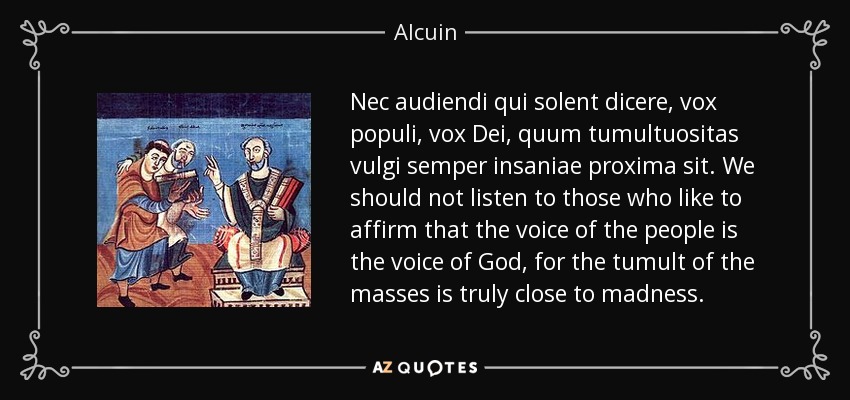
Alcuin of York
c. 735,  York, Northumbria
d. 19 May 804, Tours, Carolingian Empire

Alcuin of York was an English scholar, clergyman, poet and teacher from York, Northumbria. He became a leading scholar and teacher at the Carolingian court at the invitation of Charlemagne. He was made Abbot of Tours in 796 where he remained until his death. He is counted among the most important architects of the Carolingian Renaissance.

Charlemagne

When Pepin the Short became king in 752 it ended the Merovingian dynasty and started the Carolingian. He was succeeded by his son Charlemagne in 768.

Charlemagne expanded the borders of the kingdom to defend the Pope. He conquered the Lombards in northern Italy. He took an area in northern Spain that became known as the Spanish March to protect his southern borders from the Muslims in Spain.

He conquered the Saxons  to stop their raids from the Saxons. He took some territory from the South Slavs and the Avars to protect his eastern border as well. This became known as the Eastern March  or Ostmark. Ostmak would eventually become Austria.

Charlemagne became the first person since the fall of Rome to control the majority of continental Europe due to his military success.

York

York is located in the northern part of the kingdom of England.

The city was founded in 71 CE when the Ninth Legion conquered the Brigantes and constructed a wooden military fortress on flat ground above the River Ouse close to its confluence with the River Foss.

The fortress walls were rebuilt in stone by the VI legion. It was inhabited by 6,000 legionary soldiers and covered an area of 50 acres (20 ha). The site of the principia (HQ) of the fortress lies under the foundations of York Minster. Excavations in the undercroft have revealed part of the Roman structure and columns.

The Emperors Hadrian, Septimius Severus and Constantius I all held court there during their various campaigns.   The Emperor Severus proclaimed York capital of the province of Britannia Inferior during his stay 207–211. It is likely that it was he who granted York the privileges of a 'colonia' or city.

Constantius I died in 306 during his stay in York. His son Constantine the Great was proclaimed Emperor by the troops based in the fortress in 306. A bishop from York attended the Council at Arles in 314 to represent Christians from the province.

While the Roman colonia and fortress were located on high ground, the town was victim to occasional flooding from the Rivers Ouse and Foss by 400. The population was reduced. York declined in the post-Roman era. It was taken and settled by the Angles in the 5th century.

Reclamation of parts of the town was initiated in the 7th century under King Edwin of Northumbria. York became his chief city. The first wooden minster church was built for the baptism of Edwin in 627 according to the Venerable Bede. Edwin ordered that the small wooden church be rebuilt in stone. He was killed in 633 and the task of completing the stone minster fell to his successor Oswald.

Alcuin

Alcuin was an Englishman from York. He was born into a noble family about 730. He was educated by a pupil of Bede.

He was made a teacher of the cathedral school at York. He was made the director of St. Peter's School around 770 after he was ordained as a deacon. He was asked by the Emperor Charlemagne to become his minister of education in 781.

Charlemagne realized that he needed educated people to administer his kingdom given the size. He decided that he would start an education program headed by the finest scholar he could find.

The church in York had been founded by Irish missionaries. It was a major center for education. Alcuin had been educated by Archbishop Egbert, the student of the Venerable Bede. He had played an important role in reviving the late Roman classical arts in the school.

He was welcomed at the Palace School of Charlemagne in Aachen (Urbs Regale) in 782. It had been founded by the king's ancestors as a place for the education of the royal children. They were educated mostly in manners and the ways of the court but Charlemagne wanted to include classical education and the study of the religion.

Alcuin taught Charlemagne, his sons Pepin and Louis, the young men sent to be educated at court and the young clerics attached to the palace chapel from 782 to 790. He brought his assistants Pyttel, Sigewulf and Joseph with him from York.

Alcuin revolutionised the educational standards of the Palace School. He introduced Charlemagne to the liberal arts. He created a personalised atmosphere of scholarship to the extent that the institution came to be known as the 'school of Master Albinus'.

Many ancient writings had been lost in the preceding years of constant wars and invasions. Alcuin established the scriptorium as a place to the copy and preserve ancient manuscripts, both pagan and Christian. That we have as much as we do of the writings of classical Roman authors is largely due to Alcuin and his scribes.

He is credited with the invention of cursive script. The letters were connected for greater speed of writing. Much of the credit for the  revision and organisation of the Latin liturgy, the preservation of many of the ancient prayers and the development of plainchant belongs to Alcuin backed by Charlemagne.

He disagreed with the emperor over his policy of forcing pagans to be baptised on pain of death. He argued, "Faith is a free act of the will, not a forced act. We must appeal to the conscience, not compel it by violence. You can force people to be baptised, but you cannot force them to believe." His arguments seem to have prevailed. Charlemagne abolished the death penalty for paganism in 797.

Third Council of Aachen
5 November 809 -810

He and his fellow theologians at Charlemagne's capital of Aachen (or Aix-le-Chappelle) were important advocates of the doctrine that the Holy Ghost proceeds from the Father and the Son jointly.

The Filioque clause was the object of this Council. It was a subtle addition to the Holy Trinity dogma. Filioque means Son. It was added to the end of the Niceo-Constantinopolitan creed ("The Holy Spirit proceeds from the Father and the Son").

Italian and Frankish priests discovered the clause during the 8th century and started using it. Pope Leo III was against the idea. It was regarded as heretical in the East. He tasked Charlemagne with the organization of a Council to regulate it.

The Council was held in Aachen, Frankish capital, at the end of 809. Frankish bishops based their discussions on the works of Theodulf of Orleans and Alcuin of York. They declared the Filioque legitimate.

The Roman Empire adopted it despite opposition from both the Byzantine Emperor and the Pope. The addition would not be endorsed by Rome until 1014 even after it had been adopted by the western empire.

The Filioque clause would come to create friction with the Investiture controversy. Bishops and kings compete for authority over territory and authority.

It wouldn't take long before the Carolingian dynasty would suffer from both overreach at the  borders for the empire and in the competition to expand the claims between kings in the empire. The clause lacked distinctiveness for different roles.

The addition of the clause was political. It challenged the Pope's authority as well as the Byzantine Empire's orthodoxy. Charlemagne had chosen his title to challenge the sovereignty from Constantinople.

He was crowned Imperator Romanorum, Emperor of the Romans. When the barbarian Odoacer had become the king of Italy in 476 he deposed the last Western Roman Emperor.

The Western Empire was not eradicated. It was merged it with the Eastern Empire by way of the title, Emperor of the Romans. This was the title that Charlemagne claimed. It denied the authority claimed by Empress Irene of Constantinople.

Provocations put Charlemagne in a position of strength while negotiating the Pax Nicephori with Nikephoros I (803-811), but the advantage was for his advantage, not that of the empire. The Byzantine emperor had enough problems with Arabs and internal issues. He could not afford an open confrontation against the Franks. It can also be seen as an answer to Nikephoros' pro-iconoclast religious politics.

The East regarded the Emperor at Byzantium as the sole Emperor for the Romans. They resented Charlemagne's assumption of the title. This hardened their opposition to the aforesaid doctrine and contributed to the rift between East and West.

A collection of mathematical and logical word problems entitled Propositiones ad acuendos juvenes ("Problems to Sharpen Youths") is attributed to Alcuin. The scholar claimed to have sent "certain figures of arithmetic for the joy of cleverness" to Charlemagne in a letter dated in 799.

Some scholars have identified this reference with the Propositiones. The text contains about 53 mathematical word problems with solutions in no particular pedagogical order.

Alcuin made the abbey school into a model of excellence. Many students flocked to it. He had many manuscripts copied using outstandingly beautiful calligraphy, the Carolingian minuscule based on round and legible uncial letters.

He wrote letters to his English friends, to Arno, bishop of Salzburg and above all to Charlemagne. There are 311 letters that are extant. These communications are filled mainly with pious meditations, but they form an important source of information as to the literary and social conditions of the time. They are the most reliable authority for the history during the Carolingian age.

Alcuin trained  numerous monks of the abbey in piety. It was in the midst of these pursuits that he died in May 804.

https://en.wikipedia.org/wiki/Alcuin
http://www.breakpoint.org/2011/10/alcuin-york-c-735-804/
http://satucket.com/lectionary/Alcuin.htm
https://en.wikipedia.org/wiki/York


Wednesday, April 10, 2019

Constitute

4.11.19
Tricia Helfer

Constitute
Liberty in Law
构成法律自由 
Gòuchéng fǎlǜ zìyóu
法における自由の憲法 
Hō ni okeru jiyū no kenpō
ps28

Leadership is my strength and security.
My heart trusts what's best for maturity.

I am helped by faith. My heart exults.
My song gives thanks. It calms the tumult.

I will respect that which is worthy by faith.
Attempts to damage will be corrected with grace.
Family will be blessed for the human race.

The Lord is the strength for people.
He is the refuge in deliverance from evil.

The anointed are saved by divine grace
to shine as light for your place in space.

You were without God in the world of relation
before the world was seen as an act of creation.

Different groups have found peace in the Christ of Jesus.
Hostility has been reduced by his sacrifice to induce belief in us.

He was resurrected to raise faith in his body.
We are the world that aspires to be godly.

The highness of the royal call to service in Christ
lifts the individual into personhood with the height 
of insight. 

Save your people. Bless your inheritance.
Let your relevance find reverence in evidence.


If the house is worthy of respect,
let your peace rest with all that is correct.

If it is not worthy of your consent
let it suffer correction until it has met respect. 

When an inference is falsely derived
it is called an error of thought in mind.

To treat the error as truth is an absurdity
that could cause an emergency 
in your mental circuitry.

Absurdity results from a lack of method
in the definition of words for a protected progression.

Words are the fruits in the tree of knowledge.
Meaning is inferred as logic or symbolic.

You can disagree with the utility of happiness in two ways.
Disagreement can be constant as in the ascetic always
or it can be occasional as with a maze of games.

Find agreement in essential things 
for the consistency that the constant brings.

The Constitution is a record of liberty in law
that lends a sense of measure to the public draw.

---------------------------------

ps28.7+

The Lord is my strength and my shield;
   in him my heart trusts;
so I am helped, and my heart exults,
   and with my song I give thanks to him.
 The Lord is the strength of his people;
   he is the saving refuge of his anointed.
 O save your people, and bless your heritage;
   be their shepherd, and carry them for ever.

Gen. 12:3
I will bless those who bless you
and the one who curses you I will curse;
and in you all the families of the earth shall be blessed.

----------------------------------

I will respect that which is worthy by faith.
Attempts to damage will be corrected with grace.
Family will be blessed for the human race.

=========================

Eph. 2:12,14
Remember that you were at that time without Christ, being aliens from the commonwealth of Israel and strangers to the covenant of promise. You had no hope. You were without God in the world.

Christ is our peace; in his flesh he has made both groups into one.
He has broken down the dividing wall, that is, the hostility between us.

----------------------------------

You were without God in the world of relation
before the world was seen as an act of creation.

Different groups have found peace in the Christ of Jesus.
Hostility has been reduced by his sacrifice to induce belief in us.

He was resurrected to raise faith in his body.
We are the world that aspires to be godly.

=========================

Matt. 10:13
If the house is worthy let your peace come upon it; but if it is not worthy, let your peace return to you.

----------------------------------

If the house is worthy of respect,
let your peace rest with all that is correct.
If it is not worthy of your consent
let it suffer correction until it has met respect.

=========================

Thomas Hobbes
Leviathan
1651
Text

"...when we Reason in Words of generall signification, and fall upon a generall inference which is false; though it be commonly called Error, it is indeed an ABSURDITY, or senseless Speech. For Error is but a deception, in presuming that somewhat is past, or to come; of which, though it were not past, or not to come; yet there was no impossibility discoverable...

"The first cause of Absurd conclusions I ascribe to the want of Method; in that they begin not their Ratiocination from Definitions; that is, from settled significations of their words: as if they could cast account, without knowing the value of the numerall words, One, Two, and Three."

----------------------------------

When an inference is falsely derived
it is called an error of thought in mind.

To treat the error as truth is an absurdity
that could cause an emergency
in your mental circuitry.

Absurdity results from a lack of method
in the definition of words for a protected progression.

=========================

George Berkeley
Principles of Human Knowledge
1710
Text

"I shall be sure to get clear of all controversies PURELY VERBAL--the springing up of which weeds in almost all the sciences has been a main hindrance to the growth of true and sound knowledge...we need only draw the curtain of words, to hold the fairest tree of knowledge, whose fruit is excellent, and within the reach of our hand.

"Whoever therefore designs to read the following sheets, I entreat him to make my words the occasion of his own thinking, and endeavour to attain the same train of thoughts in reading that I had in writing them. By this means it will be easy for him to discover the truth or falsity of what I say. He will be out of all danger of being deceived by my words, and I do not see how he can be led into an error by considering his own naked, undisguised ideas."

----------------------------------

Words are the fruits in the tree of knowledge.
Meaning is inferred as logical or symbolic.

=========================

Jeremy Bentham
Principles of Morals and Legislation
1823
Text

"A principle may be different from that of utility in two ways: 1. By being constantly opposed to it: this is the case with a principle which may be termed the principle of asceticism. 2. By being sometimes opposed to it, and sometimes not, as it may happen: this is the case with another, which may be termed the principle of sympathy and antipathy."

----------------------------------

You can disagree with the utility of happiness in two ways.
Disagreement can be constant as in the ascetic always
or it can be occasional as with a maze of games.

=========================

Voltaire had stated that the Holy Roman Empire was not holy, Roman or an empire.


The empire wasn't defined as catholic, apostolic or christian either. Why was it called the Holy Roman Empire? The simple answer was that it wasn't just Christian. It wasn't just Catholic. It was monotheistic for simple moral expression in public.

The Latin read Sacrum Romanum Imperium. It was used to describe the varying complex of lands in western and central Europe ruled over first by Frankish then by German kings for 10 centuries (800–1806).

My study of the bible has led me to theorize that Vespasian and Josephus had agreed to elevate a relatively unknown monotheistic sect in the Roman empire to the status of the official faith for the realm. This hypothesis was drawn from the careful consideration of the relation between the scriptures, Josephus, classical literature and Roman history.

While Christianity eventually became the official state religion in the 4th century, the designation of Holy Roman was intended to imply what is referred to as common law in the UK and the US. It was no small accomplishment that the pope and the college of cardinals had managed to sanctify the royalty for Europe in a way that suggested the existence of a unified collection of kingdoms as a 'holy' entity with a common law.

It is not difficult to imagine that the designation as Roman was intended to include other non-rebellious monotheistic and polytheistic sects. The competition between the kingdoms for the leadership position as the imperial leader both facilitated and hampered unity. The different languages at play in the competition was an inhibitor to unity as well.

The competition with the Ottomans and the revival of the classical literature in the Renaissance prompted a reconsideration of slavery with respect for republican government. Parliament had been designated as a legislative institution with the higher purpose of evaluating punishments for criminal activity in an empire. The issue was to prove more significant in that it had not been outlawed. Neither had the severity of punishments of crimes lesser than murder in offense been diminished.

The crucifixion of Jesus for having been declared a king by some of his followers didn't exactly read as a just punishment for the success of his ministry. He had not promoted insurrection. He didn't tell his followers to steal. He had advised his followers to pay taxes, to live justly and morally with mercy. He was not deserving of the tortured suffering that hanging on a cross entailed.

Slavery had been an issue for Cyrus with respect for his liberation of the captives from Babylon.
There was an indication that the captives would never be allowed to advance in Babylonian society or return to their homelands. A young king in a relatively unknown sect that worshiped the moon goddess Sin was appointed.

His regents had indicated a desire to expand the construction projects. The public didn't know what to expect, but Cyrus had organized an army that entered Babylon during the instability of the transition. He was declared a Christ by the Judaic community.

It is my belief that it was the reinstitution of slavery in addition to the Inquisition that prompted Martin Luther to protest indulgences as a sign of corruption in the empire. Slavery was more than a regressive policy. It signaled a return to the polytheistic republican government of Rome where slavery was used to compete with kingdoms for economic power.

Jan Huss had already perpetuated Wycliff's proposal that the Bible and liturgical services should be translated to the language of the people. It was reported that he had been put to death for his advocacy.

Latin was the language for the Church and the official communications of the empire. Colleges and universities had to teach the language for those who hoped to serve as officials of the Church or state. 

Henry VIII had already had the Bible translated into English before James I, but it was translated again into the King James version.

British and Russian missionaries made a point of translating the Bible into the native language of the people whom they hoped to convert to Christianity as an emblem of the will to become civilized in the imperial enterprise that was no longer regarded as officially Roman.

The Puritans and the Calvinists made strong political campaigns to make Reformed Christianity the only uncorrupted religion for empire.

It became apparent to the young bishop Selwyn that communication with the natives would be necessary for progress by the time he was appointed to the mission in New Zealand in the 19th century. It was the most likely requirement for his appointment to the position.

Proclaim the Good News


George Augustus Selwyn
b. 4.5.1809, Hempstead, London, United Kingdom
d. 4.11.1878, Lichfield, UK

London

The Frankfurt banker Nathan Mayer Rothschild arrived in London in 1798 and set up a banking house in the city. He had been given a large sum of money by his father, Amschel Mayer Rothschild.

The Rothschilds also had banks in Paris and Vienna. The bank financed numerous large-scale projects. Railways were financed around the world.  Funding for the Suez Canal was organized.

The 19th century was the start of modern times. London was to become the world's largest city as the capital for the British empire. The population would grow from 1 million in 1800 to 6.7 million a century later.

The accessibility of London was transformed by the railways. A new network of metropolitan railways allowed for the development of suburbs in neighboring counties. Middle-class and wealthy people could commute to the center of the city. This spurred massive outward growth. Poor people were left to inhabit the inner city as as the wealthier classes emigrated to the suburbs.

The original Theatre Royal, Covent Garden was destroyed by fire on 20 September 1808. Most of the scenery, costumes and scripts were lost. Rebuilding began in December.

The Theatre Royal, Drury Lane was also destroyed by fire on 24 February 1809.

The new Covent Garden theater opened on 18 September 1809 with a performance of Macbeth. The increase in ticket prices caused riots that lasted for 64 days. LIttle damage was done to the theater.

The rioters protested the prices. They covered the theater with banners of slogans after half-price time. They called themselves the OP's, short for Old Pricers. The event came to be called the Old Price Riots. The prices were finally returned to what they had been.

Hampstead is an area in the north central part of  London. It is known for its intellectual, liberal, artistic, musical and literary associations. Hampstead Heath is noteworthy as a large, hilly expanse of parkland. The area has some of the most expensive housing in the London area.

George Augustus Selwyn

George was born at Church Row, Hampstead. He was the son of William, a legal author, and Laetitia Frances Kynaston. He went to Great Ealing School at the age of 7. Great Ealing had a reputation as the best private school in England. The future Cardinal Newman and his brother Francis were among his schoolfellows.

He went to Eton College. Eton had been established by King Henry VI in 1440 as the sister to King's College, Cambridge. George distinguished himself as an athlete and scholar.

He became scholar of St John's College, Cambridge in 1827. He came out second in the Classical Tripos in 1831. He graduated with a Bachelor of Arts () degree in the same year. He was awarded the  Cambridge Master of Arts (MA Cantab) in 1834 and Doctor of Divinity (DD) in 1842. He was a fellow of St John's from 1833 to 1840.

Selwyn worked at Eton College after graduation from Cambridge. He was the assistant master and tutor to the sons of Edward Herbert, 2nd Earl of Powis. He was ordained a deacon in 1833 and a priest in 1934. He acted as curate to Isaac Gosset, the vicar of St John's, Windsor from 1833 until 1841.

An episcopal council held at Lambeth had recommended the appointment of a bishop for New Zealand in 1841. Charles James Blomfield, Bishop of London, offered the post to Selwyn. He was willing to learn the language of the people to preach the gospel.

Bishop Selwyn was consecrated at Lambeth on 17 October 1841. He embarked for his new missionary diocese on 26 December.

He appointed William Charles Cotton as his chaplain. The 23 member missionary party set sail from Plymouth late in December 1841 on board the barque Tomatin. A barque is a three masted sailing vessel.

The missionaries brought various animals and four hives of bees in addition to their luggage. Selwyn studied the Māori language with the help of a Māori boy returning from England on the outbound voyage. He was able to preach in that language on his arrival. He also acquired enough seamanship to enable him to be his own sailing master among the dangerous waters of the Pacific. The Tomatin arrived in Sydney in April 1842.

The boat hit a rock on landing. Some of the party, including Selwyn and Cotton, set sail for New Zealand on the brig Bristolian on 19 May. They arrived in Auckland on 30 May. They spent some time as guests of Captain William Hobson, the first Governor of New Zealand. Selwyn and Cotton set sail on 6 June on the schooner Wave to visit the mission stations on the Hauraki Gulf. They moved north to the Bay of Islands. Selwyn arrived on 20 June.

Selwyn clashed with Archdeacon Henry Williams, the leader of the Church Missionary Society (CMS) in New Zealand. Land purchases by Williams became controversial at the time of the Flagstaff War. The flagstaff had been given to the British as a gift after the Treaty of Waitangi had been signed on 6 February 1840.

Feelings of distrust were stirred up among the Maori regarding the meaning of the treaty. The Maori felt that they had signed a document that agreed to their independence. The taxation of the whaling industry cost one of their tribes revenue in lost trade. The first Maori War was called the Flagstaff War because it was fought after the gift had been chopped down.

Williams refused to give up the land that he bought during the war. He was dismissed from the CMS. Selwyn reconsidered the position he had taken.  Williams was reinstated to the CMS after the bishop supported his return to membership in 1854.

The CMS missionaries held the low church beliefs that were common among Evangelical members of the Anglican Church. There was often a wide gap between the views of the CMS missionaries and the bishops and other clergy of the high church traditions of the Oxford Movement as to the form of ritual for religious practice.

Selwyn held high church (Tractarian) views although he appointed CMS missionaries to positions in the Anglican Church of New Zealand. William Williams was appointed as the first Bishop of Waiapu.

Selwyn managed to keep the confidence of both sides in the 10 year war between the Maoris and the European colonists. He ultimately secured the adoption of a Constitution that established the principle of full participation by Maori Christians at all levels of Church government at the first general synod of the Church in New Zealand in 1859.

Selwyn was pressured to accept appointment as Bishop of Lichfield in 1867. Reluctantly, he returned to England. He was consecrated the 91st Bishop of Lichfield on 9 January 1868.  He paid a farewell visit to New Zealand later that year. He governed Lichfield till his death on 11 April 1878. He was 69 years old.

The presence of mind displayed by the man was extraordinary for missionary work. He developed a model for civil government with the constitutional organization for the Church. His work circumvented the difficulty that was incurred by static models of evangelical organization that didn't allow for the assimilation of natives into civilized culture.

The Maori had a viable invitation to work with the British government in New Zealand as members of the Church.

---------------------------

George Selwyn
乔治塞尔温
喬治塞爾溫

乔 Qiao   tall                  喬  kyo   high            Jo   じょ-     ジョ-          Jo   조 article     
治  zhi      to punish       治  ji        reign          ji     じ           ジ              ji     지  ge                 
塞  Se       stop up          塞  sai      close         Se  せ          セ                 Sel  셀  cell   
尔  er        you                爾  ore     you           ru   る           ル                win 윈  win                   
温  wen    warm              溫  on      warm       uin  うぃん  ウィン     

----------------------------------

The highness of the royal call to service in Christ
lifts the individual into personhood with the height
of insight.

=========================

http://satucket.com/lectionary/GA_Selwyn.htm
https://en.wikipedia.org/wiki/George_Selwyn_(bishop_of_Lichfield)