8.11.19
Kylie Jenner
Defend
Your
Property
保卫你的财产
Bǎowèi nǐ de cáichǎn
あなたの財産を守る
Anata no zaisan o mamoru
ps50
Rem defendam
I prayed for the preservation of private property
to prevent it or me being taken by some improper lottery.
The earth has been called from the dawn to twilight.
Time and the world are ever in flight.
Divine light is revealed in glory.
It is perfect in the beauty of the celestial story.
A consuming flame precedes the raging storm.
Purification in redemption is the symbolic norm
for ritual to perform.
Wash yourselves
from the decadent self.
Make yourselves clean
from the wrong you have seen.
Remove evil from your action.
Your goodness will find satisfaction.
Don't let evil return
or in shame you will burn.
Learn from the observation of goodness.
Things work best for functional sureness.
Seek justice
for augustness.
Defend the oppressed
from oppressing the rest.
Support the grateful orphan
to earn a portion of importance.
Grant the widow a place in the community
that she may continue to value opportunity.
Argue your position
to learn from opposition.
The analysis of language has a history
that describes the special meaning of word mystery.
If your sins were as red as scarlet
your conscience will become as clean as snow white carpet.
If they had the shade of crimson
your soul will be cleansed of shame like wool from Lisbon.
We understand by faith that what is seen was made from things that are not visible.
Worlds were prepared by the word of God with a providence that is divisible.
Abraham set out for a place
that he was to receive by faith.
Ziggurat of Ur
He moved forward to receive his estate
like a wraith with a date from heaven's gate.
Heaven and earth are called to witness
the wealth in health from forgiveness
for fitness.
Gather those who have sealed the covenant with sacrifice
to celebrate the wonders of paradise.
Heaven will declare the rightness of cause
as the basis from which to draw a reason to pause
to form a clause for the judgment of law.
The offering of praise is presented to find
the blessing in sacrifice for the Giver divined.
Spirit does not require meat for existence.
The divine nature does not require food for subsistence.
The beasts of the forest are wild in nature.
Herds of any kind find freedom with feeding for labor.
Birds in the sky defy gravity with flight.
Creatures of the field travel mostly at night.
Would I drink the blood of goats?
I wouldn’t even put that in quotes.
Offer a sacrifice of thanksgiving to the Most High.
Gratitude is satisfying to the source of sight for your eye.
Call on me in the day of trouble.
I will deliver you from the misperception bubble.
Do not state my covenant with your words
and live in a way that makes life look absurd.
When you refuse to govern your own actions,
it doesn’t work for public satisfaction.
When you make a thief your friend
it doesn’t work as a legal end.
When you cast your lot with the destructive
you help that which is obstructive and corruptive.
Don’t speak to cause evil to another.
Speech can motivate some to damage others.
You thought that these things made you like me.
You didn’t have the right way to see.
I have put my case before your eyes.
Don’t use it to justify lies.
Redemption is at hand
when the request for forgiveness has been asked.
Consider the value of goodness in law.
You are an advocate for the public draw in awe.
Be ready to protect your house from theft.
Security asks you to be ready for defense even while at rest.
The Son did not come to condemn humanity or nature.
The Word became incarnate to improve natural stature.
Those who walk with faith will see salvation
as a cause of thanksgiving for station in the nation.
The promise of entering into divine rest is open.
Take care to prevent your part from being broken.
-------------------------
50 Deus deorum
God of gods
1 The Lord, the God of gods, has spoken;
he has called the earth from the rising of the sun to its setting.
2 Out of Zion, perfect in its beauty,
God reveals himself in glory.
3 Our God will come and will not keep silence;
before him there is a consuming flame,
and round about him a raging storm.
4 He calls the heavens and the earth from above
to witness the judgment of his people.
5 "Gather before me my loyal followers,
those who have made a covenant with me and sealed it with sacrifice."
6 Let the heavens declare the rightness of his cause;
for God himself is judge.
7 Hear, O my people, and I will speak:
"O Israel, I will bear witness against you;
for I am God, your God.
8 I do not accuse you because of your sacrifices;
your offerings are always before me.
9 I will take no bull-calf from your stalls,
nor he-goats out of your pens;
10 For all the beasts of the forest are mine,
the herds in their thousands upon the hills.
11 I know every bird in the sky,
and the creatures of the fields are in my sight.
12 If I were hungry, I would not tell you,
for the whole world is mine and all that is in it.
13 Do you think I eat the flesh of bulls,
or drink the blood of goats?
14 Offer to God a sacrifice of thanksgiving
and make good your vows to the Most High.
15 Call upon me in the day of trouble;
I will deliver you, and you shall honor me."
16 But to the wicked God says:
"Why do you recite my statutes,
and take my covenant upon your lips;
17 Since you refuse discipline,
and toss my words behind your back?
18 When you see a thief, you make him your friend,
and you cast in your lot with adulterers.
19 You have loosed your lips for evil,
and harnessed your tongue to a lie.
20 You are always speaking evil of your brother
and slandering your own mother's son.
21 These things you have done, and I kept still,
and you thought that I am like you."
22 "I have made my accusation;
I have put my case in order before your eyes.
23 Consider this well, you who forget God,
lest I rend you and there be none to deliver you.
24 Whoever offers me the sacrifice of thanksgiving honors me;
but to those who keep in my way will I show the salvation of God."
-----------------------
Isa. 1:16-18
Wash yourselves. Make yourselves clean.
Remove the evil of your action
from before my eyes.
Cease to do evil.
Learn to do good.
Seek justice.
Rescue the oppressed.
Defend the orphan.
Plead for the widow.
Come now. Let us argue it out
says the LORD:
Though your sins are like scarlet,
they shall be like snow.
Though they are red like crimson,
they shall become like wool.
------------------------
Wash yourselves
from the decadent self.
Make yourselves clean
from the wrong you have seen.
Remove evil from your action.
Your goodness will find satisfaction.
Don't let evil return
or in shame you will burn.
Learn from the observation of goodness.
Things work best for functional sureness.
Seek justice
for augustness.
Defend the oppressed
from oppressing the rest.
Support the grateful orphan
to earn a portion of importance.
Grant the widow a place in the community
that she may continue to value opportunity.
Argue your position
to learn from opposition.
If your sins were as red as scarlet
your conscience will become as clean as snow white carpet.
If they had the shade of crimson
your soul will be cleansed of shame like wool from Lisbon.
==================
Hebrews 11:3,8
We understand by faith that the worlds were prepared by the word of God, so what is seen was made from things that are not visible.
Abraham obeyed when he was called to set out for a place that he was to receive as an inheritance by faith. He set out not knowing where he was going.
------------------------
We understand by faith that what is seen was made from things that are not visible.
Worlds were prepared by the word of God with a providence that is divisible.
Abraham set out for a place
that he was to receive by faith.
He moved forward to receive his estate
like a wraith with a date from heaven's gate.
==================
Luke 12:39
Know this: If the owner of the house had known at what hour the thief would come, he would have protected his house from theft. You also must be ready. The Son of Man is coming at an unexpected hour.'
------------------------
Be ready to protect your house from theft.
Security asks you to be ready for defense even while at rest.
==================
Meaning and Language
Scott Soames
b. 8.11.1946
Scott Soames is is a professor of philosophy at the University of Southern California in Los Angeles. He specializes in the philosophy of language and the history of analytic philosophy.
He is well known for defending and expanding on the program in the philosophy of language started by Saul Kripke as well as being a major critic of two-dimensionalist theories of meaning. David Chalmers is a leading representative of this kind of theory.
The philosophy of language is derived from the history of analytic philosophy. Analytic philosophy can be traced back to the beginning of the 20th century. Central figures in the development are Bertrand Russell (1872-1970), Ludwig Wittgenstein (1889-1951), G.E. Moore (1873-1958), Gottlob Frege (1848-1925) and the logical positivists (1920-1960).
It is characterized by an emphasis on argumentative clarity and precision. Formal logic, conceptual analysis, mathematics and the natural sciences are used in analysis. John Locke had described his work as that of an "underlabourer" to the achievements of natural scientists such as Newton. The most influential advocate of the continuity of philosophy with science in the 20th century was Willard Van Orman Quine.
Analysis is directed by the principle that the clarification of thought can only be achieved in the form of propositions. Russell distinguished modern analytic empiricism from that of Locke, Berkeley and Hume by its incorporation of mathematics and its development of a powerful logical technique.
It is able to achieve definite answers in regard to certain problems in a series of propositions that have the quality of science rather than of philosophy. It does not attempt to invent a block theory of the whole universe at one stroke.
The method resembles that of science, but it doesn't require the expertise of a scientist. It analyzes the conceptual propositions used to explain the object of a scientific inquiry.
The majority of university philosophy departments in the United Kingdom, United States, Canada, Australia, New Zealand and Scandinavia identify themselves as "analytic" departments. This is contrasted most notably with continental philosophies such as existentialism, phenomenology, Thomism and Marxism.
The philosophy of language explores logic, meaning and accounts of mind in the analytic tradition. The scope of the inquiry may extend into the origins of language, the nature of meaning, the usage and cognition of language. The study investigates the relationship between language and reality more broadly.
Frege and Russell were pivotal figures. They were followed by Wittgenstein, the Vienna Circle. other positivists and Quine.
Interest in language extends back to the 5th century BCE in the west with Socrates, Plato, Aristotle and the Stoics. Medieval philosophers were concerned with the subtleties of language and its usage.
This interest was provoked by the necessity of translating Greek texts into Latin for many scholastics. The trivium was the template for the investigation of Latin. Peter Abelard anticipated the modern ideas of sense and reference.
William of Ockham's Summa Logicae brought forward one of the first serious proposals for codifying a mental language. Ockham and John Duns Scotus considered logic to be a scientia sermocinalis (science of language).
Linguists of the Renaissance and Baroque periods were infatuated with the idea of a philosophical language reversing the confusion of tongues. The fascination was fueled by the discovery of Chinese characters and Egyptian hieroglyphs. This thought was paralleled by the idea that there may be a universal language in music. The music of Bach has be recognized for the mathematical phrases in form.
The German philosopher Gottlob Frege brought the philosophy of language to the modern era. His work in logic in the late 19th century influenced the work of 20th-century analytic philosophers Bertrand Russell and Ludwig Wittgenstein.
The philosophy of language became so pervasive that for a time in analytic circles, the discipline as a whole was understood to be an analysis of language.
Scott Soames was born on August 11, 1946. He did his undergraduate work in philosophy at Stanford University. He completed his graduate work at the Massachusetts Institute of Technology (MIT) in linguistics and philosophy. He received his Ph.D. in philosophy from MIT in 1976.
Soames taught briefly at Yale University (from 1976–1980). He moved to Princeton University from 1980 to 2004. His departure from Princeton in 2004 was seen as a major loss at the philosophy department.
He has been a professor at the University of Southern California, Department of Philosophy since 2004. He was elected a Fellow of the American Academy of Arts and Sciences in 2010.
Soames specializes in the philosophy of language and the history of analytic philosophy. He has published books and articles primarily on issues concerning meaning, reference and truth.
He and Nathan Salmon edited a book entitled Propositions and Attitudes (1989) fairly early in his career. This was a collection of readings that investigates philosophical issues surrounding the nature of propositions.
Soames has been known for expanding on the anti-descriptivist position developed by Saul Kripke in Naming and Necessity (1972/1980) later in his career. His work Beyond Rigidity: The Unfinished Semantic Agenda of 'Naming and Necessity' (2002) developed the position.
He is also a major critic of two-dimensionalist theories of semantics. He wrote Reference and Description: The Case against Two-Dimensionalism (2005) to express this criticism.
Philosophical Analysis in the Twentieth Century (2003) is his two-volume history. It was developed from a lecture course regularly given at Princeton. It has been the subject of significant controversy among historians of the topic.
Exchanges on the Notre Dame Philosophical Review, Brian Weatherson's blog, the journal The Philosophical Quarterly and Soames's own web page have often been heated.
Scott Soames
S. 斯科特索姆斯
T. 斯科特索姆斯
斯 Si this 斯 shi this Su す ス Seu 스 switch
科 ke rules 科 ka department ko こっ コッ kos 콧 nose
特 te special 特 toku special to と ト So 소 small
索 Suo to exact 索 saku cord So そ- ソ- me 메 me
姆 mu governess 姆 mo wet nurse mu む ム jeu 즈 the
斯 si this 斯 shi this zu ず ズ
-----------------------------
The analysis of language has a history
that describes the special meaning of word mystery.
=====================
wiki Scott Soames
USC Soames
USC Soames against Chalmers 2 dimensionalism
USC History of Analytic Philosophy in US
Showing posts with label judgment. Show all posts
Sunday, August 4, 2019
Defend
Labels:
absurd,
analysis,
clause,
existence,
goats,
judgment,
Justice,
nature,
obstructive,
pause,
property,
sacrifice,
stature,
subsistence,
Thanksgiving,
theft
Tuesday, May 21, 2019
Respect
5.20.19
U.S. Border
Respect
Borders
尊重边界
Zūnzhòng biānjiè
尊敬の境界線
Sonkei no kyōkai-sen
Respectu termini
ps112
Respect for borders honors rights.
Lack of respect loses sight.
Happy are those who revere the Lord
with reverence for the commandments accord.
Their descendents will be mighty in the land.
The generation of the upright will be at hand.
Health and wealth will be in their house with order.
Relations will show respect for borders.
Sight is divined in the dark for those with faith.
The reflection of light is low but visible for those who wait.
The righteous don't race to punish.
Evidence is sorted to correct or admonish.
Time is generous in lending for goodness.
Affairs are managed for practical fulfillment.
Wisdom in mercy is kept in remembrance.
Benign judgment is the entrance to temperance.
The humble heart is opened to prayer
to ask pardon for sin as the way to avoid error.
Judgment is like a net that is thrown into the sea.
Good fish are saved. The bad are thrown back to flee.
The Lord will share counsel to show knowledge
in the removal of ignorance as some form of blockage.
Wisdom will be shown from what has been learned
for the glory of the law in the covenant discerned.
Rumors deceive those who are needful.
Disagreement with false statement turns away the deceitful.
Faith that will not shrink is established with heart
until correction is attained as a new start.
The poor will find the way to produce value.
The productive will maintain belief in the 'can do' attitude.
Those who harm to inflict damage
will be alarmed to see how they mismanaged vantage.
--------------------------
112 Beatus vir
Blessed are they
1 Hallelujah!
Happy are they who fear the Lord
and have great delight in his commandments!
2 Their descendants will be mighty in the land;
the generation of the upright will be blessed.
3 Wealth and riches will be in their house,
and their righteousness will last for ever.
4 Light shines in the darkness for the upright;
the righteous are merciful and full of compassion.
5 It is good for them to be generous in lending
and to manage their affairs with justice.
6 For they will never be shaken;
the righteous will be kept in everlasting remembrance.
7 They will not be afraid of any evil rumors;
their heart is right;
they put their trust in the Lord.
8 Their heart is established and will not shrink,
until they see their desire upon their enemies.
9 They have given freely to the poor,
and their righteousness stands fast for ever;
they will hold up their head with honor.
10 The wicked will see it and be angry;
they will gnash their teeth and pine away;
the desires of the wicked will perish.
--------------------------
Sirach 39:5,7-8
He opens his heart to prayer
and asks pardon for his sin.
The Lord will direct his counsel and knowledge
as he meditates on his mysteries.
He will show the wisdom of what has been learned
for the glory in the law of the Lord's covenant.
---------------------------
The humble heart is opened to prayer
to ask pardon for sin as the way to avoid error.
The Lord will share counsel to show knowledge
in the removal of ignorance as some form of blockage.
Wisdom will be shown from what has been learned
for the glory of the law in the covenant discerned.
====================
Matt. 13:47
The kingdom of heaven is like a net that was thrown into the sea and caught fish of every kind. When it was full, they drew it ashore and sat down. They put the good into baskets but threw out the bad.
------------------------------
Judgment is like a net that is thrown into the sea.
Good fish are saved. The bad are thrown back to flee.
======================
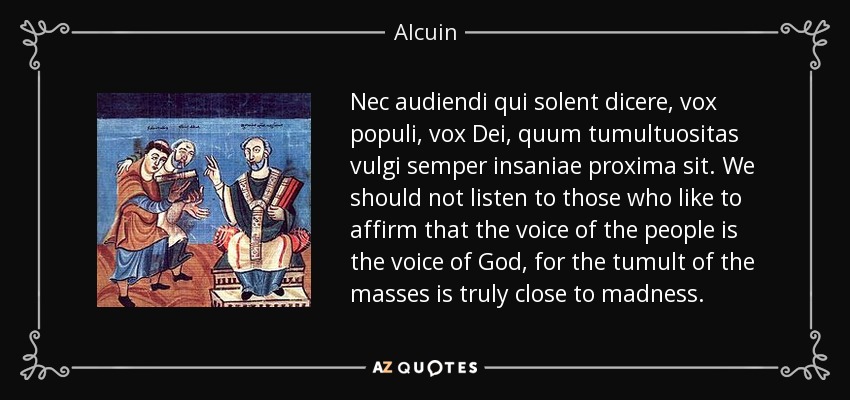
Una Voce
Non Uno Ore
Alcuin of York
c. 735, York, Northumbria
d. 19 May 804, Tours, Carolingian Empire
Alcuin of York was an English scholar, clergyman, poet and teacher from York, Northumbria. He became a leading scholar and teacher at the Carolingian court at the invitation of Charlemagne. He was made Abbot of Tours in 796 where he remained until his death. He is counted among the most important architects of the Carolingian Renaissance.
Charlemagne
When Pepin the Short became king in 752 it ended the Merovingian dynasty and started the Carolingian. He was succeeded by his son Charlemagne in 768.
Charlemagne expanded the borders of the kingdom to defend the Pope. He conquered the Lombards in northern Italy. He took an area in northern Spain that became known as the Spanish March to protect his southern borders from the Muslims in Spain.
He conquered the Saxons to stop their raids from the Saxons. He took some territory from the South Slavs and the Avars to protect his eastern border as well. This became known as the Eastern March or Ostmark. Ostmak would eventually become Austria.
Charlemagne became the first person since the fall of Rome to control the majority of continental Europe due to his military success.
York
York is located in the northern part of the kingdom of England.
The city was founded in 71 CE when the Ninth Legion conquered the Brigantes and constructed a wooden military fortress on flat ground above the River Ouse close to its confluence with the River Foss.
The fortress walls were rebuilt in stone by the VI legion. It was inhabited by 6,000 legionary soldiers and covered an area of 50 acres (20 ha). The site of the principia (HQ) of the fortress lies under the foundations of York Minster. Excavations in the undercroft have revealed part of the Roman structure and columns.
The Emperors Hadrian, Septimius Severus and Constantius I all held court there during their various campaigns. The Emperor Severus proclaimed York capital of the province of Britannia Inferior during his stay 207–211. It is likely that it was he who granted York the privileges of a 'colonia' or city.
Constantius I died in 306 during his stay in York. His son Constantine the Great was proclaimed Emperor by the troops based in the fortress in 306. A bishop from York attended the Council at Arles in 314 to represent Christians from the province.
While the Roman colonia and fortress were located on high ground, the town was victim to occasional flooding from the Rivers Ouse and Foss by 400. The population was reduced. York declined in the post-Roman era. It was taken and settled by the Angles in the 5th century.
Reclamation of parts of the town was initiated in the 7th century under King Edwin of Northumbria. York became his chief city. The first wooden minster church was built for the baptism of Edwin in 627 according to the Venerable Bede. Edwin ordered that the small wooden church be rebuilt in stone. He was killed in 633 and the task of completing the stone minster fell to his successor Oswald.
Alcuin
Alcuin was an Englishman from York. He was born into a noble family about 730. He was educated by a pupil of Bede.
He was made a teacher of the cathedral school at York. He was made the director of St. Peter's School around 770 after he was ordained as a deacon. He was asked by the Emperor Charlemagne to become his minister of education in 781.
Charlemagne realized that he needed educated people to administer his kingdom given the size. He decided that he would start an education program headed by the finest scholar he could find.
The church in York had been founded by Irish missionaries. It was a major center for education. Alcuin had been educated by Archbishop Egbert, the student of the Venerable Bede. He had played an important role in reviving the late Roman classical arts in the school.
He was welcomed at the Palace School of Charlemagne in Aachen (Urbs Regale) in 782. It had been founded by the king's ancestors as a place for the education of the royal children. They were educated mostly in manners and the ways of the court but Charlemagne wanted to include classical education and the study of the religion.
Alcuin taught Charlemagne, his sons Pepin and Louis, the young men sent to be educated at court and the young clerics attached to the palace chapel from 782 to 790. He brought his assistants Pyttel, Sigewulf and Joseph with him from York.
Alcuin revolutionised the educational standards of the Palace School. He introduced Charlemagne to the liberal arts. He created a personalised atmosphere of scholarship to the extent that the institution came to be known as the 'school of Master Albinus'.
Many ancient writings had been lost in the preceding years of constant wars and invasions. Alcuin established the scriptorium as a place to the copy and preserve ancient manuscripts, both pagan and Christian. That we have as much as we do of the writings of classical Roman authors is largely due to Alcuin and his scribes.
He is credited with the invention of cursive script. The letters were connected for greater speed of writing. Much of the credit for the revision and organisation of the Latin liturgy, the preservation of many of the ancient prayers and the development of plainchant belongs to Alcuin backed by Charlemagne.
He disagreed with the emperor over his policy of forcing pagans to be baptised on pain of death. He argued, "Faith is a free act of the will, not a forced act. We must appeal to the conscience, not compel it by violence. You can force people to be baptised, but you cannot force them to believe." His arguments seem to have prevailed. Charlemagne abolished the death penalty for paganism in 797.
Third Council of Aachen
5 November 809 -810
He and his fellow theologians at Charlemagne's capital of Aachen (or Aix-le-Chappelle) were important advocates of the doctrine that the Holy Ghost proceeds from the Father and the Son jointly.
The Filioque clause was the object of this Council. It was a subtle addition to the Holy Trinity dogma. Filioque means Son. It was added to the end of the Niceo-Constantinopolitan creed ("The Holy Spirit proceeds from the Father and the Son").
Italian and Frankish priests discovered the clause during the 8th century and started using it. Pope Leo III was against the idea. It was regarded as heretical in the East. He tasked Charlemagne with the organization of a Council to regulate it.
The Council was held in Aachen, Frankish capital, at the end of 809. Frankish bishops based their discussions on the works of Theodulf of Orleans and Alcuin of York. They declared the Filioque legitimate.
The Roman Empire adopted it despite opposition from both the Byzantine Emperor and the Pope. The addition would not be endorsed by Rome until 1014 even after it had been adopted by the western empire.
The Filioque clause would come to create friction with the Investiture controversy. Bishops and kings compete for authority over territory and authority.
It wouldn't take long before the Carolingian dynasty would suffer from both overreach at the borders for the empire and in the competition to expand the claims between kings in the empire. The clause lacked distinctiveness for different roles.
The addition of the clause was political. It challenged the Pope's authority as well as the Byzantine Empire's orthodoxy. Charlemagne had chosen his title to challenge the sovereignty from Constantinople.
He was crowned Imperator Romanorum, Emperor of the Romans. When the barbarian Odoacer had become the king of Italy in 476 he deposed the last Western Roman Emperor.
The Western Empire was not eradicated. It was merged it with the Eastern Empire by way of the title, Emperor of the Romans. This was the title that Charlemagne claimed. It denied the authority claimed by Empress Irene of Constantinople.
Provocations put Charlemagne in a position of strength while negotiating the Pax Nicephori with Nikephoros I (803-811), but the advantage was for his advantage, not that of the empire. The Byzantine emperor had enough problems with Arabs and internal issues. He could not afford an open confrontation against the Franks. It can also be seen as an answer to Nikephoros' pro-iconoclast religious politics.
The East regarded the Emperor at Byzantium as the sole Emperor for the Romans. They resented Charlemagne's assumption of the title. This hardened their opposition to the aforesaid doctrine and contributed to the rift between East and West.
A collection of mathematical and logical word problems entitled Propositiones ad acuendos juvenes ("Problems to Sharpen Youths") is attributed to Alcuin. The scholar claimed to have sent "certain figures of arithmetic for the joy of cleverness" to Charlemagne in a letter dated in 799.
Some scholars have identified this reference with the Propositiones. The text contains about 53 mathematical word problems with solutions in no particular pedagogical order.
Alcuin made the abbey school into a model of excellence. Many students flocked to it. He had many manuscripts copied using outstandingly beautiful calligraphy, the Carolingian minuscule based on round and legible uncial letters.
He wrote letters to his English friends, to Arno, bishop of Salzburg and above all to Charlemagne. There are 311 letters that are extant. These communications are filled mainly with pious meditations, but they form an important source of information as to the literary and social conditions of the time. They are the most reliable authority for the history during the Carolingian age.
Alcuin trained numerous monks of the abbey in piety. It was in the midst of these pursuits that he died in May 804.
https://en.wikipedia.org/wiki/Alcuin
http://www.breakpoint.org/2011/10/alcuin-york-c-735-804/
http://satucket.com/lectionary/Alcuin.htm
https://en.wikipedia.org/wiki/York
Thursday, November 1, 2018
Shape
Royal Crown of Hungary
Shape
Yourself
あなた自身を形作る
Anata jishin o katachidzukuru
ps 24
Yourself
あなた自身を形作る
Anata jishin o katachidzukuru
ps 24
Why shape anything?
Isn't nature amazing?
The world is created from the earth.
A person starts to live with birth.
The world is everything that is the case.
It is something that we make as a place.
What is that which always is and has no becoming?
Space is the place for the race of galactic running.
What is that which is always becoming and never is?
Lightning is the track for a crack through the subatomic.
The ground for it is chronically chthonic.
That which is perceived remains in the same state.
Apperception exists, but it evaluates.
It does not generate or abate
reality as the state for the slate.
Lightning is the track for a crack through the subatomic.
The ground for it is chronically chthonic.
That which is perceived remains in the same state.
Apperception exists, but it evaluates.
It does not generate or abate
reality as the state for the slate.
That which is conceived by opinion without reason
is always in disagreement with the season.
It is becoming or perishing that does not have agreement
with that which already exists in material completion.
Everything that becomes or is created
must be caused by something that can be dated.
Nothing material can be created without a cause.
The immaterial is that which gives us pause.
The work of the creator who creates something to last
shapes form as an unchangeable pattern to cast.
Was the world always in existence and without a start?
It was created as tangible; as sensible as your heart.
All sensible things are apprehended by sense
to inform opinion as the seat for judgment.
Sensibility is created by sense with the meaning lent.
Facts are not to be ambition bent.
to inform opinion as the seat for judgment.
Sensibility is created by sense with the meaning lent.
Facts are not to be ambition bent.
The Maker of the universe is beyond determination as a
fact.
Belief in said existence is an opinion which finds substance in an act.
How someone acts has an impact on tact
in the relational track.
Belief in said existence is an opinion which finds substance in an act.
How someone acts has an impact on tact
in the relational track.
Love built a house and added a garden
Fortune made the home in the frame that had been started.
Adversity tried to sweep the home away.
The family had to overcome the melee
to defend their say during their stay.
The family had to overcome the melee
to defend their say during their stay.
Leaves from the tree of immortality
provided shade from heat as a probability.
The roof was held by walls of wood and stone
but time worked to wear the house as home.
Heat and pressure worked steadily and more
to fell the walls. Winter and summer cleft and tore
at the doors and everything else above the floor.
but time worked to wear the house as home.
Heat and pressure worked steadily and more
to fell the walls. Winter and summer cleft and tore
at the doors and everything else above the floor.
Grace shored the structure to cut adversity as it grew
until decay combined with the force of death in a firm bond renewed
to raze the building to the floor's mildew.
until decay combined with the force of death in a firm bond renewed
to raze the building to the floor's mildew.
Love and grace took glory by the hand
and built a braver palace than the one that did not stand.
The builder had to look at what did and didn't work
in order to build a stronger place above the earth.
The sculptor learned to look into the future with his
craft.
He worked with bronze to shape birds and bats.
The flight of his imagination based on the past
shaped the prediction for the event as it had been cast.
When pain had asked what brought this plan,
the decision to act in anger against the device of man
kept the moths from death in the flame that spans
the length of time in the view that scans
the pattern in the alluvial fan.
the decision to act in anger against the device of man
kept the moths from death in the flame that spans
the length of time in the view that scans
the pattern in the alluvial fan.
The strength to work beyond what was learned from pain
prayed for judgment from the experience of agriculture with the angular vein
to right the wrong from righting wrong for dwelling long in too much or too little gain.
prayed for judgment from the experience of agriculture with the angular vein
to right the wrong from righting wrong for dwelling long in too much or too little gain.
The battle between the fort and the phalanx forge was on.
Siege machines would reach beyond
the wall as the protective phenomenon.
Siege machines would reach beyond
the wall as the protective phenomenon.
The world is the totality of facts.
Apprehension includes the interpretation of acts.
Many years were tossed by storms
in the journey from the fortification of forms
to the state of law with procedural norms.
in the journey from the fortification of forms
to the state of law with procedural norms.
Time, toil and length of labor
were required to construct forts to savor.
Such length of labor for so vast a frame
earned leadership and labor a place in lasting fame.
Ships from the fallen fort were now a scarce affair.
Lack in foreign language made finding direction rare.
They rarely landed in a place where
they had been before for trade that was fair.
The praiseworthy had to show his care
by learning to navigate by the stars way up there.
Her youth moved angrily in the night
when she appeared between war and leadership's might.
She was a product of destruction in her own right.
She labored with endless discontent as her targeted plight.
This heart of hearth and heaven was hell bent in sight
to let her fury vent for blight.
when she appeared between war and leadership's might.
She was a product of destruction in her own right.
She labored with endless discontent as her targeted plight.
This heart of hearth and heaven was hell bent in sight
to let her fury vent for blight.
Worthiness moved past the anger
to live in the peace of an objective manner.
Spring stopped at the start of summer.
The beauty of the season still lives in wonder
like the joy of the newcomer.
The beauty of the season still lives in wonder
like the joy of the newcomer.
The world is determined by the facts
and all the acts for different tracks.
The totality determines that which is and is not the case
for the face of the human race.
The world that in my thinking lies
is the home for truth in paradise.
My life’s fair visions are unfurled
within the shell in which I rest or labor still.
You can drive my car on the road
that holds the fold in the leveled low
to the sand on the beach you know.
that holds the fold in the leveled low
to the sand on the beach you know.
Mindful of the outer skies
this darkness of the mind
seeks sunrise with its spokes of light to find.
this darkness of the mind
seeks sunrise with its spokes of light to find.
The 'rude' pattern of the quiet mind
gave restraint a luxuriant black shine.
The glittering arrows that the shine dispersed
nature's aspect and the design that works.
Nothing from nothing has not been born,
yet this appearance has been worn and torn.
When once we know from nothing still
we will divine design with human will.
Those elements from which things are created
increase the bonds to that which had been stated
as weighted.
increase the bonds to that which had been stated
as weighted.
The increase will conserve its kind
in the law that conserves and binds
until from it release unwinds.
in the law that conserves and binds
until from it release unwinds.
All begotten things abide in change
in the changeless stuff that defines our range
in the begotten name.
There are more abounding crops indeed.
The earth bears the primordial germ of things seen
which the ploughshare turns in fruitful rings keen
as clods make room for seeds to sing as plants to be.
in the changeless stuff that defines our range
in the begotten name.
There are more abounding crops indeed.
The earth bears the primordial germ of things seen
which the ploughshare turns in fruitful rings keen
as clods make room for seeds to sing as plants to be.
She kneads the mold
that quickens life's hold.
Since all must have their seeds wherefrom to grow
to reach the gentle fields of air to sow more to know
it also comes that nature dissolves the sown
into primal bodies again unknown
as an entity shown.
to reach the gentle fields of air to sow more to know
it also comes that nature dissolves the sown
into primal bodies again unknown
as an entity shown.
The facts in logical space are the world.
Creation was formed above the shiny sphere of the pearl.
A thing is called finite after its kind
when it finds a place in your mind.
A body is not limited to thought,
not the thought by the body wrought.
That which is in itself is a substance.
A change in electric current is inductance.
An attribute constitutes the essence of substance.
The ratio of the current to resistance is conductance.
That which exists in something other than itself is a
mode.
The essence of existence is an absolutely infinite node.
The world divides into facts
with the mental force of an axe.
Desire does not always attain the perception for which it
strives.
It gets what it can and reaches for different drives.
The cause of perception is the external body
that presses the organ to each sense as haji.
That which touch, smell, taste, sight or hearing has
discerned
is a pressure for the mediation of nerve.
The impulse that is sent meets reception in the head.
The brain and heart read the signals that the senses sent to be read.
The eye sees light or color.
The ear hears sound bounce from another.
The nostrils smell the unseen odor.
The tongue tastes flavor to savor.
The body feels the sense that substance tailors.
The ear hears sound bounce from another.
The nostrils smell the unseen odor.
The tongue tastes flavor to savor.
The body feels the sense that substance tailors.
All the qualities known as sensible
come from objects as detectable.
The object sensed is one thing.
The impression left brings an experiential ring.
Sense is subject to the fancy
of the vigilante chimpanzee.
Aristotle taught that the cause of vision
is sent from the object as a signaled provision.
Light does bounce from thing to sight,
but the thought that the thing sent a signal is not right.
A sound is sent by waves from a source.
A smell is an admission of emission that floats through air of course.
Sense is essential to safety.
Awareness smells the flower and dodges the crazy.
Experience plays a part in what an individual thinks to
say.
The fancy chimpanzee has a role to play.
Education lends perspective to perception.
Learning from others can avoid deception.
The cognition of culture is a corporate experience.
This is something an individual should take as serious.
The natural and moral have an empirical course.
The laws of nature concern the experience of force.
Redemption is a course of will that overcomes remorse.
This is something an individual should take as serious.
The natural and moral have an empirical course.
The laws of nature concern the experience of force.
Redemption is a course of will that overcomes remorse.
The rule of law is in accord with what ought to occur.
When what ought to happen does not, it is a metaphysical spur
to which the thought of justice must refer.
When what ought to happen does not, it is a metaphysical spur
to which the thought of justice must refer.
Experience is the ground for the empirical.
Faith is the substance for the miracle.
If you won't see beyond the past
expectation remains downcast.
Logic must reason to shape the frame for mind.
Nature and morality have a metaphysic drawn from design.
Physics has a rational part.
Morality has a sensible ground in the heart.
The hospital raised to God in the desert town
has been razed to the level of the ground.
The town is still known by the name of El Paso.
It is the place to cross the river without much hassle.
The crown for the town is the crossroad culture.
It's a Tex-Mex chest to escape fear of the vulture.
The souls of the righteous escape the fear of death.
No such torment prevents them from doing their best.
A saint is a person who lives with the unction
that love for others increases the ability to function.
Such as these work with heaven
to make the world like bread with leaven.
The Living Bread saw how others grieve.
He raised the dead to help them to believe.
Belief in life can be a miracle
when the fear of death drives the empirical.
Death is part of life when it is natural.
When imposed outside defense, it is not legally contractual.
Legal contract is the basis for law.
Without literacy, flaws are prolonged.
The tail of the scorpion causes pain with fever.
Delusion becomes a place for the deceiver.
Literate knowledge becomes the healer
from deception by the double dealer.
Who can ascend the height of the hill?Who can stand in the essence of our existential thrill?Who is there who has the will?
Whosever has clean hands and an honest mind,
they may ascend to the height of the climb.
They will receive the blessing of leadership.
They may join friendliness in dealer's quip.
They carried the ark of the covenant with a new heart.
They came to the house of will on the hill for their start.
Such is the generation of those who seek love,
of those who seek peace from the eternal dove.
Lift your eyes to the arch of the gate.
Open the doors to investigate.
Let the ring of glory into your story.
What is this ring of glory?
The essence of our existence
has a ring for our subsistence
The essence of our existence
overcomes all resistance
to subsistence.
overcomes all resistance
to subsistence.
You are the one for me.
Your love helps me to see
how to be.
You are my moral philosophy.
You received spiritual blessing from this heavenly place.
You have drawn love from the empirical base.
Your love helps me to see
how to be.
You are my moral philosophy.
You received spiritual blessing from this heavenly place.
You have drawn love from the empirical base.
This unique blessing shows special favor.
Restraint became the savior to savor flavor.
Shape yourself as a duty.
It's your part in nature's beauty.
Ps 24 Domini
est terra
1 The earth is the Lord's and all that is in it,
the world and all who dwell therein.
2 For it is he who founded it upon the seas
and made it firm upon the rivers of the deep.
3 "Who can ascend the hill of the Lord?
and who can stand in his holy place?"
4 "Those who have clean hands and a pure heart,
who have not pledged themselves to falsehood,
nor sworn by what is a fraud.
5 They shall receive a blessing from the Lord
and a just reward from the God of their salvation."
6 Such is the generation of those who seek him,
of those who seek your face, O God of Jacob.
7 Lift up your heads, O gates;
lift them high, O everlasting doors;
and the King of glory shall come in.
8 "Who is this King of glory?"
"The Lord, strong and mighty,
the Lord, mighty in battle."
9 Lift up your heads, O gates;
lift them high, O everlasting doors;
and the King of glory shall come in.
10 "Who is he, this King of glory?"
"The Lord of hosts,
he is the King of glory."
lift them high, O everlasting doors;
and the King of glory shall come in.
8 "Who is this King of glory?"
"The Lord, strong and mighty,
the Lord, mighty in battle."
9 Lift up your heads, O gates;
lift them high, O everlasting doors;
and the King of glory shall come in.
10 "Who is he, this King of glory?"
"The Lord of hosts,
he is the King of glory."
Stephen- Crown
November 1- All Saints' Day
La Hotel Dieu
El Paso, Texas
November 1- All Saints' Day
La Hotel Dieu
El Paso, Texas
Wisdom 3:1-4
The souls of the righteous are in the hand of God,
and no torment will ever touch them.
In the eyes of the foolish they seemed to have died,
and their departure was thought to be a disaster,
and their going from us to be their destruction;
but they are at peace.
For though in the sight of others they were punished,
their hope is full of immortality.
Rev. 21:1
Then I saw a new heaven and a new earth; for the first heaven and the first earth had passed away, and the sea was no more.
John 11:33-35
When Jesus saw her
weeping, and the Jews who came with her also weeping, he was greatly disturbed
in spirit and deeply moved. He said, ‘Where have you laid him?’ They said
to him, ‘Lord, come and see.’ Jesus began to weep.
Subscribe to:
Posts (Atom)