Showing posts with label storms. Show all posts

Friday, August 16, 2019

Shine

8.17
Fused Glass Bowl

Shine
Bright
闪耀着光芒 
Shǎnyàozhe guāngmáng
明るく輝く
Akaruku kagayaku
ps107
Clare splendere

The broken bowl bell 
held food quite well 
until it fell. 

The squeaking squeal from the wheel 
yields wealth in health appeal 
from the way the appeal feels. 

Mop up the mess.
It's part of the test.

Sweep up the ceramic.
You won't have to panic.

This piece was shaped like a diamond. 
My mind looked to the horizon. 

A diamond shines bright 
with the facets of light’s life 
in a mind with insight. 

She smiles for miles
with the delight of her sight.

Diamonds start as coal.
Earth is the source for the intense force that cajoles
the carbon in its moles to make tiny holes
extol less space for lex taste holding the philosopher’s stone 
as a blown tome now known
as the most remarkable clone.

Opaque matter, darker than night,
becomes transparent, shining sparkles in light.

Hardship hardens your core for sure
to make your heart shine as pure.
Purity is the cure that lures.

Performers stay healthy 
so their products are wealthy.

The best work smart with rested heart
for the next test to start.

These followed their food.
These chopped what the beaver chewed.

These grew what they could.
These shot from where they stood.

These worked in mines.
These hunted from blinds.

These worked in fields.
These negotiated deals.
These squealed for appeals.

These worked in a factory.
These made customers happy.

These worked in the field.
'No mind' was their shield.

Mugwort and hemp 
healed that which was bent.

The redeemer’s redemption came
by correction in detention for those who lost their way to fame
and became lame with respect for the rules of the game

These formed conception with education
to avoid the deception of perception 
by the sensation of the senses.

All these weathered the storm;
while these struggled through thorns.

These strengthened their homes
while these burned diseased bones.

When the mist came with Spring.
these felt they had to travel and sing.

When they strayed from the path
they became children of wrath.

They rode and they fought.
They forgot what they had been taught.

Some went to the sea to travel in ships
to ply their trade without loose lips.

They moved straight on the ocean
when the crab didn't make the motion.

They beheld the wonders of the deep.
Things went so well they felt that they could weep.

Then a storm bossed the wind and the waves of the sea.
They rose so high they tossed the ship like a flea on a sheep.

The ship mounted the heavens then fell back to the depths.
Their hearts melted groan. Some actually wept.

They staggered and fell like the most practiced of drunkards.
They looked to the sky and prayed for their mothers.

The wind carried their prayer to the height of the sky.
They were delivered from the storm as if by their cry.

The storm was stilled to a whispering purr.
The sea felt so soft she seemed like the cure.
They all felt glad because of the calm of the sea.

The harbor they made soothed them like the balm of morality.
Let them give thanks for the love of sweet mercy.
The sailors were saved from wet death with the thirst for eternity.

The Redeemer redeemed lost time as the story.
Joy was embraced as a parcel of glory.

The weather is the greatest of friends
or the worst to offend.

We accomplish all things with the goodness of weather.
Natural disaster destroys anything, but buh-bling or bird feathers.

A silver cord streams 
from the container of dreams.

We were made to be loved
with light from above.

A nation without borders isn't secure.
The strength of security gives length to endure.

Citizens carry rights that are earned as learned.
Participation in the media tests substance affirmed.

Legal immigration is a start on the path
to the blessing that heaven grants beyond wrath. 

Conservative policy insists on a balance
between foreign and domestic investment in talents.

The ethics of morality in law 
has a measure in the observation of what you draw.

Drink truth deep from your heart before sleep.
It will help you keep what you seek
looking sleek.

Shine like a diamond.
You will be alive then.
You won’t feel like a siren 
on an island off the horizon.

------------------------

Psalm 107
Part I

Confitemini Domino
Acknowledge Mastery

1 Give thanks to the Lord, for he is good,
and his mercy endures for ever.
2 Let all those whom the Lord has redeemed proclaim
that he redeemed them from the hand of the foe.
3 He gathered them out of the lands;
from the east and from the west,
from the north and from the south.
4 Some wandered in desert wastes;
they found no way to a city where they might dwell.
5 They were hungry and thirsty;
their spirits languished within them.
6 Then they cried to the Lord in their trouble,
and he delivered them from their distress.
7 He put their feet on a straight path
to go to a city where they might dwell.
8 Let them give thanks to the Lord for his mercy
and the wonders he does for his children.
9 For he satisfies the thirsty
and fills the hungry with good things.
10 Some sat in darkness and deep gloom,
bound fast in misery and iron;
11 Because they rebelled against the words of God
and despised the counsel of the Most High.
12 So he humbled their spirits with hard labor;
they stumbled, and there was none to help.
13 Then they cried to the Lord in their trouble,
and he delivered them from their distress.
14 He led them out of darkness and deep gloom
and broke their bonds asunder.
15 Let them give thanks to the Lord for his mercy
and the wonders he does for his children.
16 For he shatters the doors of bronze
and breaks in two the iron bars.
17 Some were fools and took to rebellious ways;
they were afflicted because of their sins.
18 They abhorred all manner of food
and drew near to death's door.
19 Then they cried to the Lord in their trouble,
and he delivered them from their distress.
20 He sent forth his word and healed them
and saved them from the grave.
21 Let them give thanks to the Lord for his mercy
and the wonders he does for his children.
22 Let them offer a sacrifice of thanksgiving
and tell of his acts with shouts of joy.
23 Some went down to the sea in ships
and plied their trade in deep waters;
24 They beheld the works of the Lord
and his wonders in the deep.
25 Then he spoke, and a stormy wind arose,
which tossed high the waves of the sea.
26 They mounted up to the heavens and fell back to the depths;
their hearts melted because of their peril.
27 They reeled and staggered like drunkards
and were at their wits' end.
28 Then they cried to the Lord in their trouble,
and he delivered them from their distress.
29 He stilled the storm to a whisper
and quieted the waves of the sea.
30 Then were they glad because of the calm,
and he brought them to the harbor they were bound for.
31 Let them give thanks to the Lord for his mercy
and the wonders he does for his children.
32 Let them exalt him in the congregation of the people
and praise him in the council of the elders.

-----------------------

David - beloved
Ziba- army
Mephibosheth- mouth of shame

2 Samuel 16:3-4

The king said, 'Where is your master's son?'
Ziba said to the king, 'He remains in Jerusalem. He said, "Today the house of Israel will give me back my grandfather's kingdom."

The king said to Ziba, 'All that belonged to Mephibosheth is now yours.' Ziba said, 'I do obeisance. Let me find favor in your sight, my lord the king.'

-----------------------

A nation without borders isn't secure.
The strength of security gives length to endure.

Conservative policy insists on a balance
between foreign and domestic investment in talents.

=================

Acts 22:27-29

The tribune came and asked Paul, 'Tell me, are you a Roman citizen?' He said, 'Yes.' The tribune answered, 'It cost me a large sum of money to get my citizenship.' Paul said, 'I was born a citizen.' Immediately those who were about to examine him drew back from him. The tribune was also afraid for he realized that Paul was a Roman citizen and he had bound him.

-----------------------

Citizens carry rights that are earned as learned.
Participation in the media tests substance affirmed.

=================

Mark 11:7-10

They brought the colt to Jesus and threw their cloaks on it. He sat on it. Many people spread their cloaks on the road. Others spread leafy branches that they had cut in the fields. Then those who went ahead and those who followed were shouting,

'Hosanna! Blessed is he who comes in the name of the Lord!
Blessed is the coming kingdom of our ancestor David!
Hosanna in the highest heaven!'

-----------------------

Legal immigration is a start on the path
to the blessing that heaven grants beyond wrath.

=================

Posterity
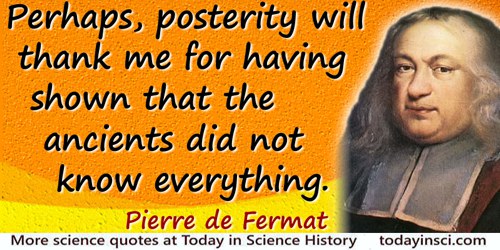
Pierre de Fermat (fair-ma)
b. 10.31.1607  Beaumont-de-Lomagne, France
d. 1.12.1665 Castres, France

Pierre de Fermat was a French lawyer at the Parlement of Toulouse, France. He was also an amateur mathematician.

His exploration of mathematics as a hobby resulted in some major developments for the field of study. He has been given credit for early developments that led to infinitesimal calculus.

He presented the notion of adequality as an approximate equivalence. This broadened the practical application for calculation.

He is recognized for his discovery of an original method of finding the greatest and the smallest ordinates of curved lines. Finding the maxima and minuma is used in differential calculus today.
He made notable contributions to analytic geometry, probability and optics.

He is best known for his principle for light propagation and his Last Theorem in number theory.
His largest contributions to mathematics as a field were in analytic geometry and number theory.

His theorem led to the consideration of the development of exponential notation as a key contribution in either application.

------------------------ 

It is helpful to consider the state of education during the 17th century to understand how significant Fermat's contributions were.

Grammar, logic and rhetoric were essential to a classical education as explained in Plato's dialogues. The three subjects together were denoted by the word trivium during the Middle Ages. The trivium was fundamental to education in Latin,  but the tradition of first learning those three subjects was established in ancient Greece.

The quadrivium consisted of arithmetic, geometry, music and astronomy. These followed the preparatory work of the trivium. The quadrivium was considered the foundation for the study of philosophy (sometimes called the "liberal art par excellence") and theology.

The trivium and the quadrivium comprised the seven liberal arts. The liberal arts presented instruction in the skill of thought. It was distinguished from the practical arts (such as medicine and architecture).

The Renaissance brought an increased emphasis on mathematics and science to Europe. There was period of transition from a sectarian feudal and ecclesiastical culture. There was an increase in the emphasis on a non-sectarian society.

Early Renaissance figures added mathematics to their other occupations. Luca Pacioli was a Franciscan friar who founded accounting. Niccolò Fontana Tartaglia was an invalid with a speech impediment who became a notable engineer and bookkeeper.

Gerolamo Cardano was a doctor of medicine who was also the earliest founder of probability and binomial expansion. Robert Recorde was a physician. François Viète was a lawyer.

Descartes was originally trained as a lawyer, but he acquired greater instruction in mathematics when he studied military engineering in the Netherlands.

The modern form of exponential notation was introduced by Rene Descartes in his text titled La Géométrie early in the 17th century.

Descartes is also widely regarded as one of the founders of modern philosophy. He differed from Aristotle and the revived Stoicism of the 16th century on two major points.

He rejected the splitting of corporeal substance into matter and form. Form and matter are intrinsically interconnected in substance. Aristotle had used the distinction between the two to suggest the difference between the idea of the object and the thing itself. Descartes also rejected any appeal to final ends, divine or natural, in explaining natural phenomena.

His dualism embraced the idea that mind and body are distinct but closely joined. While many contemporary readers of Descartes found the distinction between mind and body difficult to grasp, he thought it was entirely straightforward.

He employed the concept of modes as the ways in which substances exist. He explained in Principles of Philosophy that we cannot understand the mode apart from the substance. The perception of a modal form apart from its substance requires an intellectual abstraction.

Two substances are distinct when each of them can exist apart from the other.

Descartes laid the foundation for the continental rationalism that was later advocated by Spinoza and Leibniz. This was later opposed by the empiricist school of thought consisting of Hobbes, Locke, Berkeley and Hume.

Leibniz, Spinoza and Descartes were well-versed in mathematics as well as philosophy. Descartes and Leibniz contributed greatly to science as well. Spinoza presented an axiomatic argument for constitutional monarchy.

Rene Descartes was born in La Haye en Touraine (now Descartes, Indre-et-Loire), France, on 31 March 1596. His mother, Jeanne Brochard, died soon after giving birth to him. He was not expected to survive. His father, Joachim, was a member of the Parlement of Brittany at Rennes.

René lived with his grandmother and with his great-uncle. Their family was Roman Catholic, but the Poitou region was controlled by the Protestant Huguenots.

The Swiss politician Besançon Hugues had been allied with John Calvin in Geneva. They sought an alliance between the city-state of Geneva and the Swiss Confederation. The label Huguenot was purportedly first applied in France to those conspirators who were involved in the Amboise (am-bwas) plot of 1560 to wrest power from the Catholic House of Guise (gees) in France.

Descartes entered the Jesuit Collège Royal Henry-Le-Grand at La Flèche (flesh) in 1607. It was late because of his fragile health. He was introduced to mathematics and physics. This included Galileo's work.

He studied for two years (1615–16) at the University of Poitiers after graduation in 1614. He earned a Baccalauréat and Licence in canon and civil law in 1616 in accordance with his father's wishes that he should become a lawyer.  He moved to Paris from there.

He abandoned the study of letters. He resolved to seek knowledge from himself and the "great book of the world." He spent the rest of his youth traveling, visiting courts and armies, mixing with people of diverse temperaments and ranks, gathering various experiences, testing himself in the situations that fortune offered to reflect upon whatever came his way in order to derive the profit from it.

His ambition was to become a professional military officer. He joined the Protestant Dutch States Army in Breda under the command of Maurice of Nassau as a mercenary  in 1618. He undertook the study of military engineering as established by Simon Stevin.

This is the period where he began to gain distinction as a mathematician. The study did not produce mathematicians as such. The field was subordinate to logic or physics at the time. He  received much encouragement in Breda to advance his knowledge of mathematics.

He became acquainted with Isaac Beeckman, the principal of a Dordrecht school, in this way. He wrote the Compendium of Music (written 1618, published 1650) for Beeckman. Together they worked on free fall, catenary, conic section and fluid statics. Both believed that it was necessary to create a method that thoroughly linked mathematics and physics.

Descartes was present at the Battle of the White Mountain outside Prague while in the service of the Catholic Duke Maximilian of Bavaria in November 1620. He shut himself in a room with an "oven" (probably a cocklestove) to escape the cold while stationed in Neuburg an der Donau on the night of 10–11 November 1619 (St. Martin's Day).

He had three dreams and believed that a divine spirit revealed to him a new philosophy in the room. He had formulated analytical geometry and the idea of applying the mathematical method to philosophy.

He concluded from these visions that the pursuit of science would prove to be the pursuit of true wisdom and a central part of his life's work. He saw that all truths were linked with one another. The use of logic from the discovery of a fundamental truth would open the way to all science.

He expressed the Latin "Cogito ergo sum" in his native French. It is translated to English as "I think, therefore I am."

He left the army and returned to France in 1620. He was present at the siege of La Rochelle by Cardinal Richelieu in 1627.

He went to listen to a lecture by an alchemist about a new philosophy at the residence of the papal nuncio in the fall of the same year. Cardinal Bérulle urged him to write an exposition of his own new philosophy in some location beyond the reach of the inquisition.

Descartes returned to the Dutch Republic in 1628. He joined the University of Franeker in April 1629. He enrolled at the Leiden University to study mathematics the next year under the name "Poitevan."

He wrote all his major work during his 20-plus years in the Netherlands despite frequent moves.  Galileo was condemned by the Italian Inquisition in 1633. Descartes abandoned plans to publish Treatise on the World. He had been working on the publication for the previous four years.

He published parts of this work in three essays in 1637. "Les Météores" (The Meteors), "La Dioptrique" (Dioptrics) and "La Géométrie" (Geometry) took the first important steps in the description of science with math. These essays were preceded by an introduction, his famous Discours de la méthode (Discourse on the Method).

"La Geometrie" laid out the principles and mechanics for the development of analytic geometry.  The base definitions and mechanics for his discovery are taught in high school algebra courses in the US. The work included the explanation of exponential notation.

Exponents are shorthand for repeated multiplication of the same thing by itself. The shorthand for multiplying three copies of the number 5 for instance is shown on the right-hand side of the "equals" sign in (5)(5)(5) = 5^3. The notation is read as 5 to the 3d power.

The "exponent" is 3 in this example. It stands for however many times the value is being multiplied. The thing that's being multiplied is 5. It is called the "base".

Analytic geometry would become dependent upon algebraic notation with exponents to formulate the curves that were to be drawn on graphs.

Knowledge of conics had developed the first forms with exponential equations. These forms for open and closed figures were adapted for functions. Functions are graphs of equations that depict growth or diminishment.

The vertices, co-vertices and foci are related by the equation c^ 2 = a^ 2 − b^ 2. When we are given the coordinates of the foci and vertices of an ellipse, we can use the relationship to find the equation of the ellipse in standard form.

An ellipse is a modular form.

Number Theory
Fermat's Last Theorem

No three positive integers a, b and c satisfy the equation a^n + b^n = c^n for any integer value of n greater than 2.

The Note in the Margin

It is not possible for a cube to be the sum of two cubes, a fourth power to be the sum of two fourth powers or in general for any number that is a power greater than the second to be the sum of two like powers. Fermat wrote, "I have discovered a truly marvelous demonstration of this proposition that this margin is too narrow to contain."

The (Not) Proof

A centuries old math mystery may have been cracked by a Princeton professor. His colleagues estimate that only one-tenth of 1 percent of mathematicians could understand his explanation.

Did Fermat have the solution? His skill in mathematics was largely limited to his letters to friends and associates. He didn't write for the public much. His writing about math lacked exposition in certain important regards. He helped define analytic geometry with a work on the topic published before Descartes. 

Fermat wrote his marginal note on exponents around 1630 when he first studied Diophantus's Arithmetica. All his other theorems were stated and restated in challenge problems that he sent to other mathematicians. He knew how to answer the special cases of n = 3 and n = 4 as challenges.The general theorem was never mentioned again by Fermat.

No one came up with an example wherein the sum of two cubes resulted in another cube. The sum of two lines can result in a sum with the same power as a line: 1^1 + 2^1 = 3^1. Any addition problem satisfies the condition. The first power is usually not written. 

The sum of two squares isn't as easy, unless you count 0^2 as an option: 0^2 + 2^2 = 2^2. Any number of examples can be produced with this device. There are other solutions:

5^2 = 3^2 + 4^2
or
25^2 = 7^2 + 24^2 = 15^2 + 20^2.   

There are cases where the sum of three or more cubes equals another cube, but a cube simply can't be divided in two and retain an equal length to the sides around the two halfs of the divided cube.

The lines for the object have to be equal in length by definition. The length of the divided lines will always be half of the distance for the lines that are not divided.

The consideration of geometric solids helped Fermat to rule out the possibility of higher exponential equations. The act of dividing a cube in half demonstrates that two cubes can't be added together to equal another cube. It can't be done.

While it is conceivable that the volume for two cubes could possibly be added together to equal the volume for another, such an equation hasn't been discovered. While this explanation doesn't fit the general criteria for a theoretical proof, it has yet to be disproved.

The proof has only been proved insofar as it remains in a state that has not been disproved.

Godel would eventually argue that this kind of incompleteness is the case with proofs in general. There is always some element in any argument that can not be completely proven. It justifies the attachment of the word 'theoretical' to the argument that qualifies as logically consistent enough to be called a proof.

There is something in the description of reality that defies completeness. It is as though the incompleteness is a challenge to come as close to completeness as possible without working too hard at it.

Pierre de Fermat
S. 皮埃尔德费马
T. 皮埃爾德費馬

皮 Pi      skin                  皮  hi       pelt              Pie  ぴえ-   ピエ-         Pi   피   blood           
埃 ai      dust                   埃  ai       dust              ru    る          ル            e    에   on                   
尔 er      you                   爾  ji        you              do    ど           ド           leu  르  porn               
德  De    ethics               德  toku   morality       Fe    ふぇ      フェ        de   데  place                   
费  Fei   expenses          費 hi        expense        ru     る          ル            Pe   페  fe               
马  ma   horse                 馬 ba       horse           ma    ま-       マ-             leu  르  porn 
                                                                                                                   ma  마  hemp               
-----------------------

The ethics of morality in law
has a measure in the observation of what you draw.

=================

When the sum of cubes equals a cube
Sum of Cubes equal to a Cube
wiki Trivium
wiki Quadrivium
Equations of Ellipses
wiki Pierre de Fermat
wiki History of Exponential Notation
Wolfram Fermat's Last Theorem
wiki F's Last Theorem
History of F's Last Theorem
Wiles Solution to F's Last Theorem

Wednesday, May 29, 2019

Transcend

5.30.19
Ascension Day

Transcend
Inhibition
超越抑制
Chāoyuè yìzhì
トランセンド抑制
Toransendo yokusei
ps47
transcende inhibitionis

Transcend your limits with the management
of  creation for enfranchisement.

What is the measure
for your household treasure?

What do you need to do
to produce a value for more than you?

Recognize what's right about your achievement
in the production of service with the power at your finger tip.

Applaud the ascension you people.
Shout to God with joy that is regal.

The providence of mind imitates design
for the conservation of goodness for the date line.

Divine design subdues prejudice to increase productivity
to leave appreciation for objectivity.

Inheritance is a model for conservation
in the management of property for station
in relations.

The Son has gone up in a cloud.
He has risen with authority endowed.

See the future of your leadership in him.
You will develop the ability to play to win. 

Sing praise with your voice
to make beautiful music a choice.

The light of love shines for all the earth.
Sing praise for all that you are worth.

The law of nations governs the world.
The standard for divine authority has been unfurled. 

Nobility has grown in behalf of people
with the Father of nations reincarnate sequel.

Rulers heed the power of the Spirit.
Real presence is exalted near it. 

Scripture shows the path to hoe
based on precedent that has been known
to grow service from that which we have sown.

Reform of punishment in the legal code
is documentation of what our ancestors bestowed.

Classical consciousness was the unstated objective for circumstance.
Justice with Iesu Christus  was the straight on check for the determined stand.  

Christ ascended to rule with authority
in the individual expression of uniformity.

Apostolic power bears witness to God in the temple with peace
with work and prayer in the effort to improve ease
despite the storms that cause damage to material increase.

----------------------------

47 Omnes gentes, plaudite
All people, clap

1 Clap your hands, all you peoples;
shout to God with a cry of joy.
2 For the Lord Most High is to be feared;
he is the great King over all the earth.
3 He subdues the peoples under us,
and the nations under our feet.
4 He chooses our inheritance for us,
the pride of Jacob whom he loves.
5 God has gone up with a shout,
the Lord with the sound of the ram's-horn.
6 Sing praises to God, sing praises;
sing praises to our King, sing praises.
7 For God is King of all the earth;
sing praises with all your skill.
8 God reigns over the nations;
God sits upon his holy throne.
9 The nobles of the peoples have gathered together
with the people of the God of Abraham.
10 The rulers of the earth belong to God,
and he is highly exalted.

---------------------------

Acts 1:1,6-9

I wrote about all that Jesus did and taught in the first book, Theophilus. The book was from the beginning until the day when he was taken up to heaven after giving instructions through the Holy Spirit to the apostles whom he had chosen.

When the apostles had come together, they asked him, 'Lord, is this the time when you will restore the kingdom of Israel?' He replied, 'It is not for you to know the times or periods that the Father has set by his own authority. You will receive power when the Holy Spirit has come upon you. You will be my witnesses in Jerusalem, all Judea, Samaria and to the ends of the earth.' When he had said this as they were watching, he was lifted up and a cloud took him out of their sight.

---------------------------

Scripture shows the path to hoe
based on precedent that has been known
to grow service from that which we have sown.

Reform of punishment in the legal code
is documentation of what our ancestors bestowed.

====================

Ephesians 1:20-21

God put this power to work in Christ when he raised him from the dead and seated him at his right hand in the heavenly places far above all rule, authority, power, dominion and above every name that is named not only in this age but also in the ages to come.

---------------------------

Christ ascended to the rule with authority
in the individual expression of uniformity.

====================

Luke 24:51-53

While he was blessing them, he withdrew from them and was carried up into heaven. They worshiped him and returned to Jerusalem with great joy and they were continually in the temple blessing God.

---------------------------

Apostolic power bears witness to God in the temple with peace
with work and prayer in the effort to increase ease.

====================

Fully Human Nature

Ascension of Jesus

The ascension provides another element of the royalty in the authority of Jesus. The resurrection had demonstrated that his instruction had to be lived to perpetuate the Church.

It was to take on the incarnation of faith in the people as testimony to the real presence of Christ in Jesus. This makes the Eucharist a sacramental element in the expression of the Christian faith. It is a perpetuation of the transformation of Roman society from polytheism to monotheism.

The ascension is not just a titular exaltation. He is not just seated on the throne of glory to support an empty expression of elitest theism. He has risen above the partiality of prejudice for the benefit of the public.  He is the executive authority for the Church as a model for civilized life.

The gospel of Luke and the Acts of the Apostles is presented as a single work from the same  author. It provides the only narrative account of the ascension. Luke chapter 24 tells how Jesus led the eleven disciples to Bethany, a village on the Mount of Olives, where he instructed them to remain in Jerusalem until the coming of the Holy Spirit: "It came to pass while he blessed them, he parted from them and was carried up into heaven. They worshiped him and returned to Jerusalem with great joy."

Acts 1 describes a meal at which Jesus commanded the apostles to await the coming of the Holy Spirit. A cloud took him upward from sight. Two men in white appeared to tell the disciples that he will return "in the same way you have seen him go into heaven."

Luke and Acts appear to describe the same event, but present different chronologies. Luke placed it on the same day as the resurrection. The Acts had it forty days afterwards. Various proposals have been put forward to resolve the contradiction, but the question remains open.

The Gospel of John has three references to ascension in Jesus' own words: "No one has ascended into heaven but he who descended from heaven, the son of man" (John 3:13); "What if you (the disciples) were to see the son of man ascending where he was before?" (John 6:62); and to Mary Magdalene after his resurrection, "Do not hold me, for I have not yet ascended to my father..." (John 20:17).

Jesus is claimed to be the apocalyptic "one like a son of man" of Daniel 7 in the first and second statements.  The last has a curious element. Why should Mary be told not to hold the risen but not yet ascended Christ, while Thomas was later invited to touch his wound?

Various epistles (Romans 8:34, Ephesians 1:19-20, Colossians 3:1, Philippians 2:9-11, 1 Timothy 3:16, and 1 Peter 3:21-22) also refer to the ascension like Luke-Acts and John. It is equated with the post-resurrection "exaltation" of Jesus to the right hand of God.

There is a consensus among scholars that the brief ascension account in the Gospel of Mark (Mark 16:19) is a later addition to the original version of that gospel.

Ascension stories were fairly common around the time of Jesus. These were known to the gospel-authors. The stories signified the deification of a noteworthy person. The Romans adapted stories about ascension for their emperor.

The ascension of the son of man in Judaism was an indication of divine approval. Another function of heavenly ascent was as a mode of divine revelation reflected in Greco-Roman, early Jewish and early Christian literary sources. Particular individuals with prophetic or revelatory gifts were thought to have experienced a heavenly journey during which they learned cosmic and divine secrets.

Figures familiar to Jews would have included Enoch from the Book of Genesis and a popular non-Biblical work called 1 Enoch; the 5th-century sage Ezra; Baruch the companion of the prophet Jeremiah (from a work called 2 Baruch, in which Baruch is promised he will ascend to heaven after 40 days); Levi the ancestor of priests; the Teacher of Righteousness from the Qumran community; the prophet Elijah (from 2 Kings); Moses, who was deified on entering heaven; and the children of Job, who according to the Testament of Job ascended heaven following their resurrection from the dead.

Non-Jewish readers would have been familiar with the case of the emperor Augustus whose ascent was witnessed by Senators; Romulus the founder of Rome, who, like Jesus, was taken to heaven in a cloud; the Greek hero Heracles (Hercules); and others.

The common thread linking all the New Testament ascension references reflected in the major Christian creeds and confessional statements is the exaltation of Jesus. It is by his ascension that Christ, the Son, took his seat at the right hand of God, the Father, in Heaven: "He ascended into heaven, and is seated at the right hand of God the Father almighty." (Apostles' Creed)

It implies that the fully human nature of the Son was taken into Heaven. It marked the beginning of Christ's heavenly rule.  its hold on the Christian imagination is evidenced by its importance in Christian art through the centuries.

The Feast of the Ascension is one of the ecumenical feasts of the Christian liturgical year. It is celebrated along with the Passion, Easter, Pentecost and Christmas. Ascension Day is traditionally celebrated on the sixth Thursday after Easter Sunday, the fortieth day from Easter. Some Roman Catholic provinces have moved the observance to the following Sunday to facilitate the obligation to attend Mass.

Jerome held that it was of Apostolic origin, but the ascension was originally part of the liturgical celebration of Pentecost as the coming of the Holy Spirit. It developed as a separate celebration only slowly from the late 4th century onward.

It begins with a three-day "rogation" to ask for God's mercy in Catholic tradition. The feast itself includes a procession of torches and banners, the extinguishing of the Paschal candle and an all-night vigil. White is the liturgical color. The procession represents Christ's journey to the Mount of Olives and entry into heaven.

The orthodox tradition has a different calendar. Easter is called Pascha. Pascha is celebrated in consonance with the Jewish Passover. It is determined by the lunar cycle. It can be celebrated up to a month later than in the Western tradition. The ascension is also celebrated 40 days after Pascha in accord with the biblical account.

The Anglican communion continues to observe the feast, but most Protestant churches have abandoned the traditional Christian calendar of feasts.

wiki on Ascension of Jesus

Modes for Perception

G.K. Chesterton
b. 5.29.1874 Kensington, London, UK
d. 6.14.1936 Beaconsfield, UK

Gilbert Keith Chesterton was an English journalist, writer, poet, lay theologian and literary critic. He has been called the "prince of paradox". Time magazine has observed of his writing style: "Whenever possible Chesterton made his points with popular sayings, proverbs, allegories—first carefully turning them inside out."

He is well known for his fictional priest-detective Father Brown and for his reasoned apologetics. Even some of those who disagree with him have recognized the wide appeal of such works as Orthodoxy and The Everlasting Man.

He routinely referred to himself as an "orthodox" Christian. He came to identify this position more and more with Catholicism. He eventually converted from High Church Anglicanism.

Kensington, London

Campden Hill is located in Kensington, West London. The hill contains  the former deer-park of Holland House. The remains of the important mansion stands on the south-west corner of the hill. The south-west side of the hill is to the east of Holland House. It is characterized by large Victorian houses which are part of the Phillimore estate.

Kensington is an affluent area in general. This is a trait that it shares with Chelsea, its neighbor to the south. The area has some of London's most expensive streets and garden squares. The Holland Park neighborhood became particularly high-status at about the turn of the 21st century.

G.K. Chesterton

Gilbert was born in Campden Hill in Kensington, London, the son of Marie Louise, née Grosjean, and Edward Chesterton. He was baptised at the age of one month into the Church of England. His family was irregular in the practice of the Unitarian religion.

Chesterton was educated at St Paul's School. He then attended the Slade School of Art to become an illustrator. The Slade is a department of University College London where Chesterton also took classes in literature. He did not complete a degree in either subject.

He married Frances Blogg in 1901. The marriage lasted the rest of his life. He credited Frances with leading him back to Anglicanism. He later considered the form to be a "pale imitation" of Christianity. He entered full communion with the Catholic Church in 1922.

He began working for the London publisher Redway in September 1895. He remained there for just over a year. He moved to the publishing house T. Fisher Unwin in October 1896 where he remained until 1902.

He undertook his first journalistic work as a freelance art and literary critic during this period. The Daily News gave him a weekly opinion column in 1902. This was followed in 1905 by a weekly column in The Illustrated London News. He continued to write there for the next 30 years.

He showed a talent for art early in his career. He had planned to become an artist. His writing shows a vision that clothed abstract ideas in concrete and memorable images.

Even his fiction contained carefully concealed parables. Father Brown is perpetually correcting the incorrect vision of the bewildered folks at the scene of the crime and wandering off at the end with the criminal to exercise his priestly role of recognition and repentance.

Father Brown entreated the character Flambeau to give up his life of crime in the story "The Flying Stars" for example. His was told that he still had youth and honor, but these would not last in the trade.  Men may stay on a level of good, but no one was able to stay on one level of evil. That kind of road led down. "Many a man I've known started like you to be an honest outlaw, a merry robber of the rich, and ended stamped into slime."

Chesterton loved to debate. He often engaging in friendly public disputes with such men as George Bernard Shaw, H. G. Wells, Bertrand Russell and Clarence Darrow.

He was a large man. He stood  6 feet 4 inches (1.93 m) and weighed around 286 lbs (130 kg). His girth gave rise to a famous anecdote.

He remarked to his friend George Bernard Shaw, "To look at you, anyone would think a famine had struck England." Shaw retorted, "To look at you, anyone would think you had caused it."

A lady in London asked why he was not "out at the Front" during the First World War. He replied, "If you go round to the side, you will see that I am."

Chesterton wrote around 80 books, several hundred poems, some 200 short stories, 4000 essays and several plays.

The priest-detective Father Brown appeared only in short stories. He was depicted as "shabby and shapeless." His face was "round and expressionless, his manners clumsy." He dropped typical Chestertonian quips as he solved ghastly transgressions not with Holmes-sharp logic but "by 'getting inside' the criminal mind."

He based his conclusions on his knowledge of human nature rather than using deductive methods to discover the perpetrator of a crime. This knowledge was drawn in part from his experience in the confessional box, but also from his recognition of his own capacity for evil.

The mystery story became less a portrait of the detective's personality and more a puzzle that the detective and the reader could both solve under the influence of Chesterton's Father Brown.

The Man Who Was Thursday is arguably his best-known novel.

His political thought divided the various parties into dominant trends. The whole modern world has divided itself into Conservatives and Progressives. The business of Progressives was to go on making mistakes. The business of Conservatives was to prevent mistakes from being corrected.

He was a convinced Christian long before he was received into the Catholic Church. Christian themes and symbolism appear in much of his writing.

The Church of England presented a dilemma to Roman Catholics. Catholics defined the pope as the vicar for Christ and the head of the Church. English law has declared the sovereign for the state to be the head of the Church in England. Papal claims to power over secular authority had raised opposition to the same.

The Renaissance was a resurgence of interest in classical culture. This included art, literature and philosophy. The culture had an emphasis on construction with the attendant artistic forms. Statues and paintings adorned buildings that had structural geometric expressions in style. Writing came closer to mass distribution due to the invention of the printing press.

Classical literature was surprisingly progressive in the sense that Homer had written the Iliad and the Odyssey to protest war. Virgil wrote in a way that asserted that war was a fate established by the gods. While Plato and Aristotle had conceded to slavery as an institution, other philosophers did not.

This adaptive aspect of classical culture gave European society a justification for seeking change in the established political and social conventions.

Inventions were entertained for practical application. The value of the inventions extended into the common household when industrial production was to become one of the evolved conventions.

Science was looking to define the elements as a productive feature in design when they weren't used to justify violent aggression or cruelty in punishment. The Reformation touted itself as more scientific than the superstition promoted by the rites and rituals associated with traditional Roman religion.

Classical culture also entertained slavery and cruelty in punishment as means to accomplish goals in construction, art and government. This aspect of the competition between Catholicism and Protestantism was entertained by both sides of the argument. Royal families made statements to distance themselves from slavery and the mistreatment of natives in foreign lands.

It can't be said that the Roman Church maintained neutrality when it came to the Royal Act of Supremacy. While the Romans had allowed for monarchy in the secular leadership of kingdoms, the election of the pope was a development of a republican political form.

Monarchy was a developmental step beyond the primitive state of tribal life. The republicans considered their form of government to be more civilized, but certain actions were massively destructive according to descriptions of the events.

The Church of England had to battle insurgents from the Roman Catholic Church and the Calvinist Reformation. The battle was such that the Calvinists were allowed success if only to maintain the right to a national church. Prejudice against Roman Catholicism became a norm for a long time.

The Royalism of Hobbes and the Oxford Movement paved the way for the Anglo-Catholicism of writers like G.K. Chesterton (1874-1936), T.S. Eliot (1888-1965) and C.S. Lewis (1898-1963).
The recognition that baptism and the eucharist were rites instituted by Jesus defined the rites as sacraments.

This allowed the Anglican Church to reincorporate liturgical forms that had been rejected as papist inventions to promote superstition. Research into Ecumenical documents affirmed that there was a long standing connection between the Church of England and the doctrine espoused by the ecumenical councils.

The notion that Christianity was a cultural entity that looked at Roman Catholic and Protestant developments of a single religious view suggested that impartial judgment regarding faith was the mark of a good Christian.

Chesterton's apologetic works were key in the conversion of C.S. Lewis. His playful style was adopted by that writer. Poet T.S. Eliot remarked that he "did more than any man in his time … to maintain the existence of the [Christian] minority in the modern world."

Chesterton's first published books were of poetry. Poetry is usually distinct from journalism. There is a close connection between his poetry and his everyday journalism. T. S. Eliot described  Chesterton's poetry as 'first-rate journalistic balladry.'

The Rolling English Road

The description turns out to have been particularly perceptive since it is a reminder about his essential characteristic as a writer. His first aim was to comment on the political and social questions of the day in his verse as in all his written work.

C.S. Lewis and T.S. Eliot managed to avoid the disparagement of other religious views.

Chesterton faced accusations of anti-Semitism during his lifetime that continued posthumously. He had been an early supporter of Captain Dreyfus in France, but he turned into an anti-dreyfusard by 1906. His fictional work included caricatures of Jews, stereotyping them as greedy, cowardly, disloyal, communists from the early 20th century.

Chesterton considered the royal decree of 1290 by which Edward I expelled Jews from England in a work of 1917 titled A Short History of England. The policy remained in place until 1655. He wrote that the popular perception of Jewish moneylenders could well have led Edward I's subjects to regard him as a "tender father of his people" for "breaking the rule by which the rulers had hitherto fostered their bankers' wealth."

He felt that Jews were "a sensitive and highly civilized people" who "were the capitalists of the age, the men with wealth banked ready for use."

These might legitimately complain that Christian kings, nobles, popes and bishops had used for 'Christian' purposes such as the Crusades and the cathedrals "the money that could only be accumulated in such mountains by a usury they inconsistently denounced as unchristian; and then, when worse times came, gave up the Jew to the fury of the poor."

It looks like at least some of his Semitic statements were made in order to criticize that Christianity which was Christian in name only.

Chesterton made it clear that he believed that there was a "Jewish Problem" in Europe in The New Jerusalem. He believed that Jewish culture, not  ethnicity, separated itself from the nationalities of Europe.

He blasted German race theories. He wrote: "the essence of Nazi Nationalism is to preserve the purity of a race in a continent where all races are impure." Then he turned his perspective and defined Hitlerism as "almost entirely of Jewish origin" in the Judaism of Hitler.

The BBC invited Chesterton to give a series of radio talks in 1931. He accepted. He delivered over 40 talks per year from 1932 until his death. He was encouraged to improvise on the scripts. This allowed his talks to maintain an intimate character as did the decision to allow his wife and secretary to sit with him during his broadcasts.

The talks were very popular. A BBC official remarked, after Chesterton's death, that "in another year or so, he would have become the dominating voice from Broadcasting House."

Chesterton died of congestive heart failure on the morning of 14 June 1936 at his home in Beaconsfield, Buckinghamshire. His last known words were a greeting spoken to his wife.

Gilbert Chesterton
吉尔伯特切斯特顿
吉爾伯特切斯特頓

吉 Ji        lucky              吉  kichi     joy                     Gi   ぎ       ギ          Gil   길   way             
尔 er       you                  爾  ji          you                     ru   る       ル          beo   버   bur     
伯 bo      elder                伯  haku    chief                   ba   ば-    バ-           teu    트   the               
特 te       unique             特  toku     special                to    と        ト        Che   체   sieve                 
切  Qie   tangent            切  setsu    cut                      Che ちぇ  チェ       seu   스    switch           
斯  si        this                斯  shi       this                      su    す       ス          teo   터    foundation 
特  te       special            特  toku    special                 ta     た                    teon  턴   turn                 
顿  dun   arrange            頓  ton      suddenly             ton  とん   タトン                                               

---------------------------

Classical consciousness was the unstated objective for circumstance.
Justice with Jesu Christus was the straight on check for the determined stand.

====================

GKC Poetry Foundation
GKC org
Lectionary GKC
JKC Christianity Today 

Thursday, November 1, 2018

Shape


Royal Crown of Hungary


Shape
Yourself

あなた自身を形作る

Anata jishin o katachidzukuru
ps 24

Why shape anything?
Isn't nature amazing?

The world is created from the earth.
A person starts to live with birth.

The world is everything that is the case.
It is something that we make as a place.

What is that which always is and has no becoming?
Space is the place for the race of galactic running.

What is that which is always becoming and never is?
Lightning is the track for a crack through the subatomic.
The ground for it is chronically chthonic.

That which is perceived remains in the same state.
Apperception exists, but it evaluates.
It does not generate or abate
reality as the state for the slate.

That which is conceived by opinion without reason
is always in disagreement with the season.
It is becoming or perishing that does not have agreement
with that which already exists in material completion.

Everything that becomes or is created
must be caused by something that can be dated.

Nothing material can be created without a cause.
The immaterial is that which gives us pause.

The work of the creator who creates something to last
shapes form as an unchangeable pattern to cast.

Was the world always in existence and without a start?
It was created as tangible; as sensible as your heart.

All sensible things are apprehended by sense
to inform opinion as the seat for judgment.
Sensibility is created by sense with the meaning lent.
Facts are not to be ambition bent.

The Maker of the universe is beyond determination as a fact.
Belief in said existence is an opinion which finds substance in an act.
How someone acts has an impact on tact
in the relational track.

Love built a house and added a garden
Fortune made the home in the frame that had been started.

Adversity tried to sweep the home away.
The family had to overcome the melee
to defend their say during their stay.

Leaves from the tree of immortality
provided shade from heat as a probability.

The roof was held by walls of wood and stone
but time worked to wear the house as home.

Heat and pressure worked steadily and more
to fell the walls. Winter and summer cleft and tore
at the doors and everything else above the floor.

Grace shored the structure to cut adversity as it grew
until decay combined with the force of death in a firm bond renewed
to raze the building to the floor's mildew.

Love and grace took glory by the hand
and built a braver palace than the one that did not stand.

The builder had to look at what did and didn't work
in order to build a stronger place above the earth.

The sculptor learned to look into the future with his craft.
He worked with bronze to shape birds and bats.

The flight of his imagination based on the past
shaped the prediction for the event as it had been cast.

When pain had asked what brought this plan,
the decision to act in anger against the device of man
kept the moths from death in the flame that spans
the length of time in the view that scans
the pattern in the alluvial fan.

The strength to work beyond what was learned from pain
prayed for judgment from the experience of agriculture with the angular vein
to right the wrong from righting wrong for dwelling long in too much or too little gain.

The battle between the fort and the phalanx forge was on.
Siege machines would reach beyond
the wall as the protective phenomenon.

The world is the totality of facts.
Apprehension includes the interpretation of acts.

Many years were tossed by storms
in the journey from the fortification of forms
to the state of law with procedural norms.

Time, toil and length of labor
were required to construct forts to savor.

Such length of labor for so vast a frame
earned leadership and labor a place in lasting fame.

Ships from the fallen fort were now a scarce affair.
Lack in foreign language made finding direction rare.

They rarely landed in a place where
they had been before for trade that was fair.

The praiseworthy had to show his care
by learning to navigate by the stars way up there.

Her youth moved angrily in the night
when she appeared between war and leadership's might.
She was a product of destruction in her own right.
She labored with endless discontent as her targeted plight.
This heart of hearth and heaven was hell bent in sight
to let her fury vent for blight.

Worthiness moved past the anger
to live in the peace of an objective manner.

Spring stopped at the start of summer.
The beauty of the season still lives in wonder
like the joy of the newcomer.

The world is determined by the facts
and all the acts for different tracks.

The totality determines that which is and is not the case
for the face of the human race.

The world that in my thinking lies
is the home for truth in paradise.

My life’s fair visions are unfurled
within the shell in which I rest or labor still.

You can drive my car on the road
that holds the fold in the leveled low
to the sand on the beach you know.

Mindful of the outer skies
this darkness of the mind
seeks sunrise with its spokes of light to find.


The 'rude' pattern of the quiet mind
gave restraint a luxuriant black shine.

The glittering arrows that the shine dispersed
nature's aspect and the design that works.


Nothing from nothing has not been born,
yet this appearance has been worn and torn.

When once we know from nothing still
we will divine design with human will.


Those elements from which things are created
increase the bonds to that which had been stated
as weighted.

The increase will conserve its kind
in the law that conserves and binds
until from it release unwinds.

All begotten things abide in change
in the changeless stuff that defines our range
in the begotten name.

There are more abounding crops indeed.
The earth bears the primordial germ of things seen
which the ploughshare turns in fruitful rings keen
as clods make room for seeds to sing as plants to be.

She kneads the mold
that quickens life's hold.

Since all must have their seeds wherefrom to grow
to reach the gentle fields of air to sow more to know
it also comes that nature dissolves the sown
into primal bodies again unknown
as an entity shown.

The facts in logical space are the world.
Creation was formed above the shiny sphere of the pearl.

A thing is called finite after its kind
when it finds a place in your mind.

A body is not limited to thought,
not the thought by  the body wrought.

That which is in itself is a substance.
A change in electric current is inductance.
An attribute constitutes the essence of substance.
The ratio of the current to resistance is conductance.

That which exists in something other than itself is a mode.
The essence of existence is an absolutely infinite node.

The world divides into facts
with the mental force of an axe.

Desire does not always attain the perception for which it strives.
It gets what it can and reaches for different drives.

The cause of perception is the external body
that presses the organ to each sense as haji.

That which touch, smell, taste, sight or hearing has discerned
is a pressure for the mediation of nerve.

The impulse that is sent meets reception in the head.
The brain and heart read the signals that the senses sent to be read.

The eye sees light or color.
The ear hears sound bounce from another.
The nostrils smell the unseen odor.
The tongue tastes flavor to savor.
The body feels the sense that substance tailors.

All the qualities known as sensible
come from objects as detectable.
The object sensed is one thing.
The impression left brings an experiential ring.

Sense is subject to the fancy
of the vigilante chimpanzee.

Aristotle taught that the cause of vision
is sent from the object as a signaled provision.

Light does bounce from thing to sight,
but the thought that the thing sent a signal is not right.

A sound is sent by waves from a source.
A smell is an admission of emission that floats through air of course.

Sense is essential to safety.
Awareness smells the flower and dodges the crazy.

Experience plays a part in what an individual thinks to say.
The fancy chimpanzee has a role to play.

Education lends perspective to perception.
Learning from others can avoid deception.

The cognition of culture is a corporate experience.
This is something an individual should take as serious.

The natural and moral have an empirical course.
The laws of nature concern the experience of force.
Redemption is a course of will that overcomes remorse.

The rule of law is in accord with what ought to occur.
When what ought to happen does not, it is a metaphysical spur
to which the thought of justice must refer.

Experience is the ground for the empirical.
Faith is the substance for the miracle.

If you won't see beyond the past
expectation remains downcast.

Logic must reason to shape the frame for mind.
Nature and morality have a metaphysic drawn from design.

Physics has a rational part.
Morality has a sensible ground in the heart.

The hospital raised to God in the desert town
has been razed to the level of the ground.

The town is still known by the name of El Paso.
It is the place to cross the river without much hassle.

The crown for the town is the crossroad culture.
It's a Tex-Mex chest to escape fear of the vulture.

The souls of the righteous escape the fear of death.
No such torment prevents them from doing their best.

A saint is a person who lives with the unction
that love for others increases the ability to function.

Such as these work with heaven
to make the world like bread with leaven.

The Living Bread saw how others grieve.
He raised the dead to help them to believe.

Belief in life can be a miracle
when the fear of death drives the empirical.

Death is part of life when it is natural.
When imposed outside defense, it is not legally contractual.

Legal contract is the basis for law.
Without literacy, flaws are prolonged.

The tail of the scorpion causes pain with fever.
Delusion becomes a place for the deceiver.

Literate knowledge becomes the healer
from deception by the double dealer.

Who can ascend the height of the hill?
Who can stand in the essence of our existential thrill?Who is there who has the will?

Whosever has clean hands and an honest mind,
they may ascend to the height of the climb.

They will receive the blessing of leadership.
They may join friendliness in dealer's quip.

They carried the ark of the covenant with a new heart.
They came to the house of will on the hill for their start.

Such is the generation of those who seek love,
of those who seek peace from the eternal dove.

Lift your eyes to the arch of the gate.
Open the doors to investigate.

Let the ring of glory into your story.
What is this ring of glory?

The essence of our existence
has a ring for our subsistence
The essence of our existence
overcomes all resistance
to subsistence.

You are the one for me.
Your love helps me to see
how to be.
You are my moral philosophy.

You received spiritual blessing from this heavenly place.
You have drawn love from the empirical base.

This unique blessing shows special favor.
Restraint became the savior to savor flavor.

Shape yourself as a duty.
It's your part in nature's beauty.


Ps 24 Domini est terra

1 The earth is the Lord's and all that is in it,
the world and all who dwell therein.

2 For it is he who founded it upon the seas
and made it firm upon the rivers of the deep.

3 "Who can ascend the hill of the Lord?
and who can stand in his holy place?"

4 "Those who have clean hands and a pure heart,
who have not pledged themselves to falsehood,
nor sworn by what is a fraud.

5 They shall receive a blessing from the Lord
and a just reward from the God of their salvation."

6 Such is the generation of those who seek him,
of those who seek your face, O God of Jacob.
7 Lift up your heads, O gates;
lift them high, O everlasting doors;
and the King of glory shall come in.

8 "Who is this King of glory?"
"The Lord, strong and mighty,
the Lord, mighty in battle."

9 Lift up your heads, O gates;
lift them high, O everlasting doors;
and the King of glory shall come in.

10 "Who is he, this King of glory?"
"The Lord of hosts,
he is the King of glory."

Stephen- Crown

November 1- All Saints' Day
La Hotel Dieu
El Paso, Texas

Wisdom 3:1-4

The souls of the righteous are in the hand of God,
and no torment will ever touch them. 
In the eyes of the foolish they seemed to have died,
and their departure was thought to be a disaster, 
and their going from us to be their destruction;
but they are at peace. 
For though in the sight of others they were punished,
their hope is full of immortality. 

Rev. 21:1

Then I saw a new heaven and a new earth; for the first heaven and the first earth had passed away, and the sea was no more.

John 11:33-35
When Jesus saw her weeping, and the Jews who came with her also weeping, he was greatly disturbed in spirit and deeply moved. He said, ‘Where have you laid him?’ They said to him, ‘Lord, come and see.’ Jesus began to weep.