Showing posts with label nobility. Show all posts

Wednesday, May 29, 2019

Transcend

5.30.19
Ascension Day

Transcend
Inhibition
超越抑制
Chāoyuè yìzhì
トランセンド抑制
Toransendo yokusei
ps47
transcende inhibitionis

Transcend your limits with the management
of  creation for enfranchisement.

What is the measure
for your household treasure?

What do you need to do
to produce a value for more than you?

Recognize what's right about your achievement
in the production of service with the power at your finger tip.

Applaud the ascension you people.
Shout to God with joy that is regal.

The providence of mind imitates design
for the conservation of goodness for the date line.

Divine design subdues prejudice to increase productivity
to leave appreciation for objectivity.

Inheritance is a model for conservation
in the management of property for station
in relations.

The Son has gone up in a cloud.
He has risen with authority endowed.

See the future of your leadership in him.
You will develop the ability to play to win. 

Sing praise with your voice
to make beautiful music a choice.

The light of love shines for all the earth.
Sing praise for all that you are worth.

The law of nations governs the world.
The standard for divine authority has been unfurled. 

Nobility has grown in behalf of people
with the Father of nations reincarnate sequel.

Rulers heed the power of the Spirit.
Real presence is exalted near it. 

Scripture shows the path to hoe
based on precedent that has been known
to grow service from that which we have sown.

Reform of punishment in the legal code
is documentation of what our ancestors bestowed.

Classical consciousness was the unstated objective for circumstance.
Justice with Iesu Christus  was the straight on check for the determined stand.  

Christ ascended to rule with authority
in the individual expression of uniformity.

Apostolic power bears witness to God in the temple with peace
with work and prayer in the effort to improve ease
despite the storms that cause damage to material increase.

----------------------------

47 Omnes gentes, plaudite
All people, clap

1 Clap your hands, all you peoples;
shout to God with a cry of joy.
2 For the Lord Most High is to be feared;
he is the great King over all the earth.
3 He subdues the peoples under us,
and the nations under our feet.
4 He chooses our inheritance for us,
the pride of Jacob whom he loves.
5 God has gone up with a shout,
the Lord with the sound of the ram's-horn.
6 Sing praises to God, sing praises;
sing praises to our King, sing praises.
7 For God is King of all the earth;
sing praises with all your skill.
8 God reigns over the nations;
God sits upon his holy throne.
9 The nobles of the peoples have gathered together
with the people of the God of Abraham.
10 The rulers of the earth belong to God,
and he is highly exalted.

---------------------------

Acts 1:1,6-9

I wrote about all that Jesus did and taught in the first book, Theophilus. The book was from the beginning until the day when he was taken up to heaven after giving instructions through the Holy Spirit to the apostles whom he had chosen.

When the apostles had come together, they asked him, 'Lord, is this the time when you will restore the kingdom of Israel?' He replied, 'It is not for you to know the times or periods that the Father has set by his own authority. You will receive power when the Holy Spirit has come upon you. You will be my witnesses in Jerusalem, all Judea, Samaria and to the ends of the earth.' When he had said this as they were watching, he was lifted up and a cloud took him out of their sight.

---------------------------

Scripture shows the path to hoe
based on precedent that has been known
to grow service from that which we have sown.

Reform of punishment in the legal code
is documentation of what our ancestors bestowed.

====================

Ephesians 1:20-21

God put this power to work in Christ when he raised him from the dead and seated him at his right hand in the heavenly places far above all rule, authority, power, dominion and above every name that is named not only in this age but also in the ages to come.

---------------------------

Christ ascended to the rule with authority
in the individual expression of uniformity.

====================

Luke 24:51-53

While he was blessing them, he withdrew from them and was carried up into heaven. They worshiped him and returned to Jerusalem with great joy and they were continually in the temple blessing God.

---------------------------

Apostolic power bears witness to God in the temple with peace
with work and prayer in the effort to increase ease.

====================

Fully Human Nature
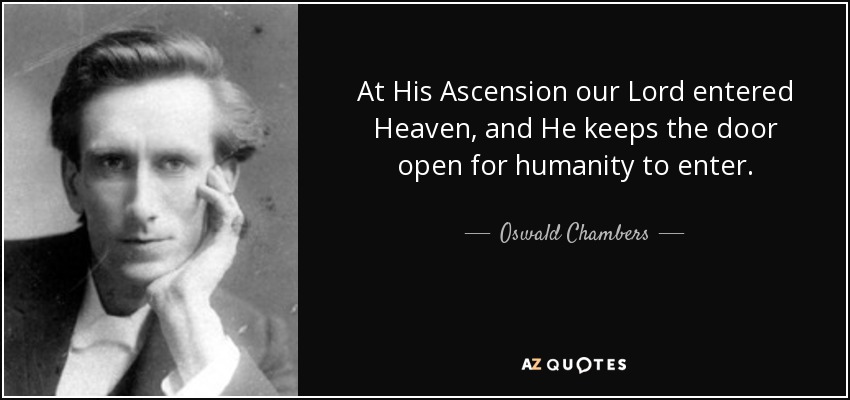
Ascension of Jesus

The ascension provides another element of the royalty in the authority of Jesus. The resurrection had demonstrated that his instruction had to be lived to perpetuate the Church.

It was to take on the incarnation of faith in the people as testimony to the real presence of Christ in Jesus. This makes the Eucharist a sacramental element in the expression of the Christian faith. It is a perpetuation of the transformation of Roman society from polytheism to monotheism.

The ascension is not just a titular exaltation. He is not just seated on the throne of glory to support an empty expression of elitest theism. He has risen above the partiality of prejudice for the benefit of the public.  He is the executive authority for the Church as a model for civilized life.

The gospel of Luke and the Acts of the Apostles is presented as a single work from the same  author. It provides the only narrative account of the ascension. Luke chapter 24 tells how Jesus led the eleven disciples to Bethany, a village on the Mount of Olives, where he instructed them to remain in Jerusalem until the coming of the Holy Spirit: "It came to pass while he blessed them, he parted from them and was carried up into heaven. They worshiped him and returned to Jerusalem with great joy."

Acts 1 describes a meal at which Jesus commanded the apostles to await the coming of the Holy Spirit. A cloud took him upward from sight. Two men in white appeared to tell the disciples that he will return "in the same way you have seen him go into heaven."

Luke and Acts appear to describe the same event, but present different chronologies. Luke placed it on the same day as the resurrection. The Acts had it forty days afterwards. Various proposals have been put forward to resolve the contradiction, but the question remains open.

The Gospel of John has three references to ascension in Jesus' own words: "No one has ascended into heaven but he who descended from heaven, the son of man" (John 3:13); "What if you (the disciples) were to see the son of man ascending where he was before?" (John 6:62); and to Mary Magdalene after his resurrection, "Do not hold me, for I have not yet ascended to my father..." (John 20:17).

Jesus is claimed to be the apocalyptic "one like a son of man" of Daniel 7 in the first and second statements.  The last has a curious element. Why should Mary be told not to hold the risen but not yet ascended Christ, while Thomas was later invited to touch his wound?

Various epistles (Romans 8:34, Ephesians 1:19-20, Colossians 3:1, Philippians 2:9-11, 1 Timothy 3:16, and 1 Peter 3:21-22) also refer to the ascension like Luke-Acts and John. It is equated with the post-resurrection "exaltation" of Jesus to the right hand of God.

There is a consensus among scholars that the brief ascension account in the Gospel of Mark (Mark 16:19) is a later addition to the original version of that gospel.

Ascension stories were fairly common around the time of Jesus. These were known to the gospel-authors. The stories signified the deification of a noteworthy person. The Romans adapted stories about ascension for their emperor.

The ascension of the son of man in Judaism was an indication of divine approval. Another function of heavenly ascent was as a mode of divine revelation reflected in Greco-Roman, early Jewish and early Christian literary sources. Particular individuals with prophetic or revelatory gifts were thought to have experienced a heavenly journey during which they learned cosmic and divine secrets.

Figures familiar to Jews would have included Enoch from the Book of Genesis and a popular non-Biblical work called 1 Enoch; the 5th-century sage Ezra; Baruch the companion of the prophet Jeremiah (from a work called 2 Baruch, in which Baruch is promised he will ascend to heaven after 40 days); Levi the ancestor of priests; the Teacher of Righteousness from the Qumran community; the prophet Elijah (from 2 Kings); Moses, who was deified on entering heaven; and the children of Job, who according to the Testament of Job ascended heaven following their resurrection from the dead.

Non-Jewish readers would have been familiar with the case of the emperor Augustus whose ascent was witnessed by Senators; Romulus the founder of Rome, who, like Jesus, was taken to heaven in a cloud; the Greek hero Heracles (Hercules); and others.

The common thread linking all the New Testament ascension references reflected in the major Christian creeds and confessional statements is the exaltation of Jesus. It is by his ascension that Christ, the Son, took his seat at the right hand of God, the Father, in Heaven: "He ascended into heaven, and is seated at the right hand of God the Father almighty." (Apostles' Creed)

It implies that the fully human nature of the Son was taken into Heaven. It marked the beginning of Christ's heavenly rule.  its hold on the Christian imagination is evidenced by its importance in Christian art through the centuries.

The Feast of the Ascension is one of the ecumenical feasts of the Christian liturgical year. It is celebrated along with the Passion, Easter, Pentecost and Christmas. Ascension Day is traditionally celebrated on the sixth Thursday after Easter Sunday, the fortieth day from Easter. Some Roman Catholic provinces have moved the observance to the following Sunday to facilitate the obligation to attend Mass.

Jerome held that it was of Apostolic origin, but the ascension was originally part of the liturgical celebration of Pentecost as the coming of the Holy Spirit. It developed as a separate celebration only slowly from the late 4th century onward.

It begins with a three-day "rogation" to ask for God's mercy in Catholic tradition. The feast itself includes a procession of torches and banners, the extinguishing of the Paschal candle and an all-night vigil. White is the liturgical color. The procession represents Christ's journey to the Mount of Olives and entry into heaven.

The orthodox tradition has a different calendar. Easter is called Pascha. Pascha is celebrated in consonance with the Jewish Passover. It is determined by the lunar cycle. It can be celebrated up to a month later than in the Western tradition. The ascension is also celebrated 40 days after Pascha in accord with the biblical account.

The Anglican communion continues to observe the feast, but most Protestant churches have abandoned the traditional Christian calendar of feasts.

wiki on Ascension of Jesus

Modes for Perception

G.K. Chesterton
b. 5.29.1874 Kensington, London, UK
d. 6.14.1936 Beaconsfield, UK

Gilbert Keith Chesterton was an English journalist, writer, poet, lay theologian and literary critic. He has been called the "prince of paradox". Time magazine has observed of his writing style: "Whenever possible Chesterton made his points with popular sayings, proverbs, allegories—first carefully turning them inside out."

He is well known for his fictional priest-detective Father Brown and for his reasoned apologetics. Even some of those who disagree with him have recognized the wide appeal of such works as Orthodoxy and The Everlasting Man.

He routinely referred to himself as an "orthodox" Christian. He came to identify this position more and more with Catholicism. He eventually converted from High Church Anglicanism.

Kensington, London

Campden Hill is located in Kensington, West London. The hill contains  the former deer-park of Holland House. The remains of the important mansion stands on the south-west corner of the hill. The south-west side of the hill is to the east of Holland House. It is characterized by large Victorian houses which are part of the Phillimore estate.

Kensington is an affluent area in general. This is a trait that it shares with Chelsea, its neighbor to the south. The area has some of London's most expensive streets and garden squares. The Holland Park neighborhood became particularly high-status at about the turn of the 21st century.

G.K. Chesterton

Gilbert was born in Campden Hill in Kensington, London, the son of Marie Louise, née Grosjean, and Edward Chesterton. He was baptised at the age of one month into the Church of England. His family was irregular in the practice of the Unitarian religion.

Chesterton was educated at St Paul's School. He then attended the Slade School of Art to become an illustrator. The Slade is a department of University College London where Chesterton also took classes in literature. He did not complete a degree in either subject.

He married Frances Blogg in 1901. The marriage lasted the rest of his life. He credited Frances with leading him back to Anglicanism. He later considered the form to be a "pale imitation" of Christianity. He entered full communion with the Catholic Church in 1922.

He began working for the London publisher Redway in September 1895. He remained there for just over a year. He moved to the publishing house T. Fisher Unwin in October 1896 where he remained until 1902.

He undertook his first journalistic work as a freelance art and literary critic during this period. The Daily News gave him a weekly opinion column in 1902. This was followed in 1905 by a weekly column in The Illustrated London News. He continued to write there for the next 30 years.

He showed a talent for art early in his career. He had planned to become an artist. His writing shows a vision that clothed abstract ideas in concrete and memorable images.

Even his fiction contained carefully concealed parables. Father Brown is perpetually correcting the incorrect vision of the bewildered folks at the scene of the crime and wandering off at the end with the criminal to exercise his priestly role of recognition and repentance.

Father Brown entreated the character Flambeau to give up his life of crime in the story "The Flying Stars" for example. His was told that he still had youth and honor, but these would not last in the trade.  Men may stay on a level of good, but no one was able to stay on one level of evil. That kind of road led down. "Many a man I've known started like you to be an honest outlaw, a merry robber of the rich, and ended stamped into slime."

Chesterton loved to debate. He often engaging in friendly public disputes with such men as George Bernard Shaw, H. G. Wells, Bertrand Russell and Clarence Darrow.

He was a large man. He stood  6 feet 4 inches (1.93 m) and weighed around 286 lbs (130 kg). His girth gave rise to a famous anecdote.

He remarked to his friend George Bernard Shaw, "To look at you, anyone would think a famine had struck England." Shaw retorted, "To look at you, anyone would think you had caused it."

A lady in London asked why he was not "out at the Front" during the First World War. He replied, "If you go round to the side, you will see that I am."

Chesterton wrote around 80 books, several hundred poems, some 200 short stories, 4000 essays and several plays.

The priest-detective Father Brown appeared only in short stories. He was depicted as "shabby and shapeless." His face was "round and expressionless, his manners clumsy." He dropped typical Chestertonian quips as he solved ghastly transgressions not with Holmes-sharp logic but "by 'getting inside' the criminal mind."

He based his conclusions on his knowledge of human nature rather than using deductive methods to discover the perpetrator of a crime. This knowledge was drawn in part from his experience in the confessional box, but also from his recognition of his own capacity for evil.

The mystery story became less a portrait of the detective's personality and more a puzzle that the detective and the reader could both solve under the influence of Chesterton's Father Brown.

The Man Who Was Thursday is arguably his best-known novel.

His political thought divided the various parties into dominant trends. The whole modern world has divided itself into Conservatives and Progressives. The business of Progressives was to go on making mistakes. The business of Conservatives was to prevent mistakes from being corrected.

He was a convinced Christian long before he was received into the Catholic Church. Christian themes and symbolism appear in much of his writing.

The Church of England presented a dilemma to Roman Catholics. Catholics defined the pope as the vicar for Christ and the head of the Church. English law has declared the sovereign for the state to be the head of the Church in England. Papal claims to power over secular authority had raised opposition to the same.

The Renaissance was a resurgence of interest in classical culture. This included art, literature and philosophy. The culture had an emphasis on construction with the attendant artistic forms. Statues and paintings adorned buildings that had structural geometric expressions in style. Writing came closer to mass distribution due to the invention of the printing press.

Classical literature was surprisingly progressive in the sense that Homer had written the Iliad and the Odyssey to protest war. Virgil wrote in a way that asserted that war was a fate established by the gods. While Plato and Aristotle had conceded to slavery as an institution, other philosophers did not.

This adaptive aspect of classical culture gave European society a justification for seeking change in the established political and social conventions.

Inventions were entertained for practical application. The value of the inventions extended into the common household when industrial production was to become one of the evolved conventions.

Science was looking to define the elements as a productive feature in design when they weren't used to justify violent aggression or cruelty in punishment. The Reformation touted itself as more scientific than the superstition promoted by the rites and rituals associated with traditional Roman religion.

Classical culture also entertained slavery and cruelty in punishment as means to accomplish goals in construction, art and government. This aspect of the competition between Catholicism and Protestantism was entertained by both sides of the argument. Royal families made statements to distance themselves from slavery and the mistreatment of natives in foreign lands.

It can't be said that the Roman Church maintained neutrality when it came to the Royal Act of Supremacy. While the Romans had allowed for monarchy in the secular leadership of kingdoms, the election of the pope was a development of a republican political form.

Monarchy was a developmental step beyond the primitive state of tribal life. The republicans considered their form of government to be more civilized, but certain actions were massively destructive according to descriptions of the events.

The Church of England had to battle insurgents from the Roman Catholic Church and the Calvinist Reformation. The battle was such that the Calvinists were allowed success if only to maintain the right to a national church. Prejudice against Roman Catholicism became a norm for a long time.

The Royalism of Hobbes and the Oxford Movement paved the way for the Anglo-Catholicism of writers like G.K. Chesterton (1874-1936), T.S. Eliot (1888-1965) and C.S. Lewis (1898-1963).
The recognition that baptism and the eucharist were rites instituted by Jesus defined the rites as sacraments.

This allowed the Anglican Church to reincorporate liturgical forms that had been rejected as papist inventions to promote superstition. Research into Ecumenical documents affirmed that there was a long standing connection between the Church of England and the doctrine espoused by the ecumenical councils.

The notion that Christianity was a cultural entity that looked at Roman Catholic and Protestant developments of a single religious view suggested that impartial judgment regarding faith was the mark of a good Christian.

Chesterton's apologetic works were key in the conversion of C.S. Lewis. His playful style was adopted by that writer. Poet T.S. Eliot remarked that he "did more than any man in his time … to maintain the existence of the [Christian] minority in the modern world."

Chesterton's first published books were of poetry. Poetry is usually distinct from journalism. There is a close connection between his poetry and his everyday journalism. T. S. Eliot described  Chesterton's poetry as 'first-rate journalistic balladry.'

The Rolling English Road

The description turns out to have been particularly perceptive since it is a reminder about his essential characteristic as a writer. His first aim was to comment on the political and social questions of the day in his verse as in all his written work.

C.S. Lewis and T.S. Eliot managed to avoid the disparagement of other religious views.

Chesterton faced accusations of anti-Semitism during his lifetime that continued posthumously. He had been an early supporter of Captain Dreyfus in France, but he turned into an anti-dreyfusard by 1906. His fictional work included caricatures of Jews, stereotyping them as greedy, cowardly, disloyal, communists from the early 20th century.

Chesterton considered the royal decree of 1290 by which Edward I expelled Jews from England in a work of 1917 titled A Short History of England. The policy remained in place until 1655. He wrote that the popular perception of Jewish moneylenders could well have led Edward I's subjects to regard him as a "tender father of his people" for "breaking the rule by which the rulers had hitherto fostered their bankers' wealth."

He felt that Jews were "a sensitive and highly civilized people" who "were the capitalists of the age, the men with wealth banked ready for use."

These might legitimately complain that Christian kings, nobles, popes and bishops had used for 'Christian' purposes such as the Crusades and the cathedrals "the money that could only be accumulated in such mountains by a usury they inconsistently denounced as unchristian; and then, when worse times came, gave up the Jew to the fury of the poor."

It looks like at least some of his Semitic statements were made in order to criticize that Christianity which was Christian in name only.

Chesterton made it clear that he believed that there was a "Jewish Problem" in Europe in The New Jerusalem. He believed that Jewish culture, not  ethnicity, separated itself from the nationalities of Europe.

He blasted German race theories. He wrote: "the essence of Nazi Nationalism is to preserve the purity of a race in a continent where all races are impure." Then he turned his perspective and defined Hitlerism as "almost entirely of Jewish origin" in the Judaism of Hitler.

The BBC invited Chesterton to give a series of radio talks in 1931. He accepted. He delivered over 40 talks per year from 1932 until his death. He was encouraged to improvise on the scripts. This allowed his talks to maintain an intimate character as did the decision to allow his wife and secretary to sit with him during his broadcasts.

The talks were very popular. A BBC official remarked, after Chesterton's death, that "in another year or so, he would have become the dominating voice from Broadcasting House."

Chesterton died of congestive heart failure on the morning of 14 June 1936 at his home in Beaconsfield, Buckinghamshire. His last known words were a greeting spoken to his wife.

Gilbert Chesterton
吉尔伯特切斯特顿
吉爾伯特切斯特頓

吉 Ji        lucky              吉  kichi     joy                     Gi   ぎ       ギ          Gil   길   way             
尔 er       you                  爾  ji          you                     ru   る       ル          beo   버   bur     
伯 bo      elder                伯  haku    chief                   ba   ば-    バ-           teu    트   the               
特 te       unique             特  toku     special                to    と        ト        Che   체   sieve                 
切  Qie   tangent            切  setsu    cut                      Che ちぇ  チェ       seu   스    switch           
斯  si        this                斯  shi       this                      su    す       ス          teo   터    foundation 
特  te       special            特  toku    special                 ta     た                    teon  턴   turn                 
顿  dun   arrange            頓  ton      suddenly             ton  とん   タトン                                               

---------------------------

Classical consciousness was the unstated objective for circumstance.
Justice with Jesu Christus was the straight on check for the determined stand.

====================

GKC Poetry Foundation
GKC org
Lectionary GKC
JKC Christianity Today 

Wednesday, May 8, 2019

Don't

5.9.19

Don't
Worry
别担心
Bié dānxīn
心配しないで 
Shinpaishinaide
ps37

Do not worry when you lose.
The loss is a marker for how to choose.

The confidence that you can win is important to begin.
Adjustment to conditions is a variant form to avoid loss to sin. 

Remember the skill that was used to beat what you had.
See capacity as the benefit in relation to other contests in the dyad.

Build your skill with drills that aspire to better performance.
Develop what you can. The results will be enormous.  

The memory of the opposition will wither like grass.
Like the green of the plant the sense of loss will fade and pass.

Trust in your Leadership and do your best.
Enjoy the privilege of reasonable tests.

Own your responsibility.
It will enhance your ability. 

Delight in what was given by Providence.
You are a valued member in the larger populace.

Establish a goal that you can achieve.
Challenge yourself to actually believe.
Commit to your goal to make it succeed.

Cultivated land produces a surplus of grain.
Storage makes the product last beyond drought or hunger pain.

Substance defines a unit as unique as a grain of wheat.
Quantity allows equitability to repeat.  

Your honor in nobility will be made as clear as light.
Loyalty to royalty is a state that exists in your mind.

Be still.
Watch your will.

Listen for the power of faith.
Wait for the feeling that you can be great.

Watch to see what moves your body.
Move with that which seeks to embody
goodness as a vocation, not just a hobby.

Don't measure yourself against those who prosper.
The prosperous have moved into what they have to offer.

Don't feel jealous of those who profit from fraud.
They did not prosper in a way you should applaud.

They are liable for the harm caused by their theft.
Liability hinders the ability to achieve that which is best.

The detriment will consume the place where they dwell.
Their will to succeed will suffer more as well.

Pray for the abused and the abuser.
Redemption for prevention is the prime mover.

Refrain from anger aimed at destruction. 
Keep your eye on the prize to build your production.

Organize for economy as the efficiency clause.
There is so much to manage. Don't damage your cause.

Enslavement to success is a loss in itself.
Your achievement must be governed by self-regulation to excel or do well.

Those who own responsibility with action will manage their land.
Violent aggression will be transcended with a productive hand. 

The energy of anger will be redirected to reconstructing yourself.
Shaping the body anticipates action for improving where you dwell.

Nature has a law to govern it.
Speech is allowed to utter this.

The physical comes first.
Then the spiritual is nursed.

The gospel has a beautiful reach into history.
Good news has become less of a mystery.

The mystery of beauty was hidden in the bells of the wisteria.
Happiness bloomed with unusual radiance and no hysteria. 

No one ought to cause damage to the health or property of another.
Wishing harm precedes damage unless the wish is replaced by something other.

The management of labor for production from private property
employs those who might otherwise have been unemployed and living in poverty.

Management is a principle of knowledge
that can be applied for organization after college.

Principle can be applied in organization 
for government, business, society or household station.

The market is the measure for service to the public.
Supply is built for sales to meet the convenience need has structured.

The market is a measure
for pleasure to treasure. 

The ownership of responsibility 
is applicable to each at any level of ability.

Logic and metaphysics suppose existence for abstraction.
Abstraction is framed as a quality for attention's attraction.

Days are numbered to count.
The numbers on a scale give an amount.
Division allows equal portions to account.
Calculation helps the administrative fount. 

The report of good news is a form of recognition.
Offering a good report for trade is negotiation. 

Prediction is a kind of pre-cognition
that anticipates a desirable condition.

Personal existence plus my circumstance equals me.
I am my experience with the addition of that which I will see.

There is sin that is not mortal.
This is the area where liberty is the portal
for the negotiation between the moral and the immortal
for the elimination or reduction of the immoral.

------------------------

Psalm 37

Part I Noli æmulari
Do not fret

1 Do not fret yourself because of evildoers;
do not be jealous of those who do wrong.
2 For they shall soon wither like the grass,
and like the green grass fade away.
3 Put your trust in the Lord and do good;
dwell in the land and feed on its riches.
4 Take delight in the Lord,
and he shall give you your heart's desire.
5 Commit your way to the Lord and put your trust in him,
and he will bring it to pass.
6 He will make your righteousness as clear as the light
and your just dealing as the noonday.
7 Be still before the Lord
and wait patiently for him.
8 Do not fret yourself over the one who prospers,
the one who succeeds in evil schemes.
9 Refrain from anger, leave rage alone;
do not fret yourself; it leads only to evil.
10 For evildoers shall be cut off,
but those who wait upon the Lord shall possess the land.
11 In a little while the wicked shall be no more;
you shall search out their place, but they will not be there.
12 But the lowly shall possess the land;
they will delight in abundance of peace.
13 The wicked plot against the righteous
and gnash at them with their teeth.
14 The Lord laughs at the wicked,
because he sees that their day will come.
15 The wicked draw their sword and bend their bow
to strike down the poor and needy,
to slaughter those who are upright in their ways.
16 Their sword shall go through their own heart,
and their bow shall be broken.
17 The little that the righteous has
is better than great riches of the wicked.
18 For the power of the wicked shall be broken,
but the Lord upholds the righteous.

-----------------------

Mene, Mene, Tekel, Peres

The fall of Babylon involved a complex set of circumstances. Nabonidus was the last king of the Neo-Babylonian Empire. He reigned from 556-539 BCE. He was not from the royal line.

Nebuchadnezzar II had been the ruler of Babylon from 605-562. He had the longest reign in the Neo-Babylonian empire. His daughter bore Labashi-Marduk. He was selected as the successor when he was a child.

Nabonidus seized power by having the child killed. He elevated the moon goddess Sin to a status over that of Marduk. This angered the priests and commoners of Babylon. Nabonidus left the capital to build and restore temples, mostly to Sin, for 10 years. He left Belshazzar in charge of Babylon.

The book of Daniel reduces the narrative to the interpretation of a vision of Belshazzar. The finger of a hand was seen to write words upon the wall at a banquet where cups used for worship in Jerusalem were used to drink wine at a feast in Babylon.

The finger wrote, MENE, MENE, TEKEL, PARSIN. (Dan.5:25) Belshazzar offered gifts for anyone who could explain the meaning. He had been overcome with fear when he saw the inscription.

Dan. 5:26-8, 30

This is the interpretation of the matter: MENE, God has numbered the days of your kingdom and brought it to an end; TEKEL, you have been weighed on the scales and found wanting; PERES, your kingdom is divided and given to the Medes and  Persians.

That very night Belshazzar, the Chaldean king, was killed.

----------------------------

These words are known Aramaic names of measures of currency: MENE, a mina (from the root meaning "to count"), TEKEL, a spelling of shekel (from the root meaning "to weigh"), PERES, half a mina (from the root meaning "to divide," but additionally resembling the word for "Persia").

Cyrus had organized the Medes and Persians. He had popular support in Babylon due to his respect for the worship of Marduk as the chief deity for the empire. His entry into Babylon is remembered as a bloodless conquest. Leadership for the city as the capital for the empire was handed to him without armed conflict.

---------------------------

Days are numbered to count.
The numbers on a scale give an amount.
Division allows equal portions to account.
Calculation helps the administrative fount.

====================

Article Mene Tekel Upsharin

1 John 5:17

All wrongdoing is sin, but there is sin that is not mortal.

---------------------------

There is sin that is not mortal.
This is the area where liberty is the portal
for the negotiation between the moral and the immortal
for the elimination or reduction of the immoral.

====================

Luke 5:9,10

Simon Peter and all who were with him were amazed at the catch of fish that they had taken. Then Jesus said, 'Do not be afraid; from now on you will be catching people.'

---------------------------

The report of good news is a form of recognition.
Offering a good report for trade is negotiation.

Prediction is a kind of pre-cognition
that anticipates a desirable condition.

====================

Revolution
Wiki

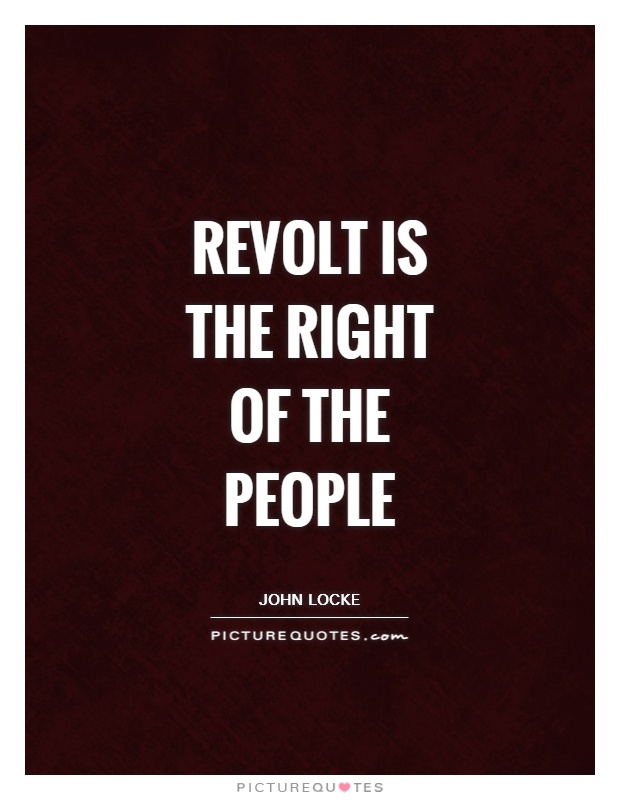
Locke declared that under natural law people have the right to life, liberty and estate. The social contract gave people the right to instigate a revolution against the government when it acted against the interests of citizens. He attempted to justify the Puritan and Calvinist rebellion against the crown with this argument.

Second Treatise s.149 (1689)
Text

"Though in a Constituted Commonwealth, standing upon its own Basis, and acting according to its own Nature, that is, acting for the preservation of the Community, there can be but one Supream Power, which is the Legislative, to which all the rest are and must be subordinate, yet the Legislative being only a Fiduciary Power to act for certain ends, there remains still in the People a Supream Power to remove or alter the Legislative, when they find the Legislative act contrary to the trust reposed in them."

----------------------------

Rebellion could be used to replace the government with one that served the interests of citizens. Locke deemed revolution an obligation in some cases. The right of revolution was claimed as a safeguard against 'tyranny.'

Tyranny is a highly volatile subjective topic however that can be used to overthrow that which is functional in the incumbent government to replace the incumbents with others who aggressively believe that they can benefit from their belief in aggression.

Insofar as the social contract represents the right to a stable government with conservative reform, a balance of powers is a necessary part of the stability. Locke rejected the balance of power in the nation state in its existence among other nations with the assertion of supreme power for the legislature.

He attempted to justify the claim with the right to rebellion as the supreme power of the people. The executive and judicial branches of government are subordinate expressions in this definition of government. It was an unstable definition that was used to invade foreign territories that didn't agree with the Puritan formulation for moral government and allowed for invasion by foreigners who agreed that the legislative authority was supreme.

This was done at the expense of the people with taxation. Taxation was used to support  invasion or insurrection in foreign relations that implicitly allowed foreign powers the opportunity to promote the same within the borders of nation. Apparently, liberal officials and the lobbies that supported their legacy figured that they would benefit most from the instability.

Constitutional authority that allows for representative participation doesn't need to be overthrown by revolution. Free speech with the freedom of assembly to form protest or petition with protection by due process in law from punitive action or the the threat of punishment is a large part of the path to citizenship that Locke and his liberal compatriots essentially discarded with the claim to supreme authority.

They essentially subordinated the people to liberal expenditure for invasion or insurrection with the claim that they had the right to rebellion. Liberal expenditure was used to undermine the stability of foreign governments and to enslave tribal people as a part of colonial expansion.

The conservative reform promoted by Hobbes and those who agree with him actually supports the development of stability in government. Defense from attack was stipulated as the primary element in common law. This principle supports the balance of power in each nation as a cooperative entity in the balance of power among other nations.   

Personal Existence plus Circumstance

Jose Ortega y Gasset
b. 5.9.1883    Madrid, Spain
d. 10.18.1955 Madrid, Spain

Madrid

Madrid is the capital and the largest city of Spain. The capital holds the seat of government and the residence for the monarch. It is the political, economic and cultural center for the country.

The city has almost 3.3 million inhabitants and a metropolitan area population of approximately 6.5 million. It is the third-largest city in the European Union (EU). It is smaller than only London and Berlin. The monocentric metropolitan area is the third-largest in the EU. This is smaller only than those of London and Paris.

The Madrid urban agglomeration has the third-largest GDP in the European Union. Its influence in politics, education, entertainment, environment, media, fashion, science, culture and the arts all contribute to its status as one of the world's major global cities.

The first documented reference to the city was recorded in Andalusi Arabic during the al-Andalus period. The name Magerit was retained in Medieval Spanish. The most ancient recorded name of the city "Magerit" comes from the name of a fortress built on the Manzanares River in the 9th century. It means "Place of abundant water" in Arabic.

Madrid lies on the River Manzanares in the center of both the country and the autonomous community.

The Peninsular War (1807–1814) was a military conflict between Napoleon's empire and Bourbon Spain for control of the Iberian Peninsula during the Napoleonic Wars. Spain was assisted by the United Kingdom of Great Britain and Ireland and its allied Kingdom of Portugal.

The war began when the French and Spanish armies invaded and occupied Portugal in 1807. The conflict escalated in 1808 when France turned on Spain, previously its ally. The war on the peninsula lasted until the Sixth Coalition defeated Napoleon in 1814. It is regarded as one of the first wars of national liberation. It was significant for the emergence of large-scale guerrilla warfare.

A  new country with a liberal and bourgeois character was born during the reign of Ferdinand VII. The culture opened to influences coming from the rest of Europe. Madrid experienced the changes caused by this openness like no other city. It was filled with theaters, cafés and newspapers.

The Spanish Revolution of 1854 was led by General Leopoldo O'Donnell. This was known by the name Vicalvarada. It started with a confrontation between rebel troops under General O'Donnell, 1st Duke of Tetuan, and government troops near the village of Vicálvaro. This incident was followed by a military coup and a popular uprising which occurred between June 28 and July 28, 1854.

The Spanish Revolution ended the moderate decade (Década moderada) (1844-1854). The moderate party was in power during that time. It started the progressive biennium (Bienio progresista) (1854-1856). The Progressive Party attempted to reform the political system of the reign of Isabella II (1833-68).

The Cementerio de Nuestra Señora de La Almudena (Our Lady of Almudena Cemetery) is a cemetery in Madrid. It was started in 1884. It is the largest for the city and one of the largest in Western Europe.

The number of people buried is estimated to be about five million. It is larger than the current population since it was the main cemetery for the entire city from 1884 to 1973. It was almost the only one for the majority of the population from the 1920's.

The late 19th century saw the introduction of the electric power distribution. The city council could not concede an industrial monopoly to any company by law. The city experienced a huge competition among the companies in the electricity sector. The competition led to an overlapping of distribution networks. Five different networks could travel through the same street in the center of the city.

The city featured access to water, a central status in the rail network, a cheap workforce and access to financial capital by the end of the 19th century.  With the onset of the new century, The Ensanche Sur, a neighborhood in the capital, started to grow to become the main industrial area of the municipality along the first half of the 20th century.

Jose Ortega y Gasset

José Ortega y Gasset was born 9 May 1883 in Madrid. His father was director of the newspaper El Imparcial. The publication belonged to the family of his mother, Dolores Gasset. The family was part of Spain's end-of-the-century liberal and educated bourgeoisie. The liberal tradition and journalistic engagement of his family had a profound influence in Ortega y Gasset's activism in politics.

Ortega was first schooled by the Jesuit priests of San Estanislao in Miraflores del Palo, Málaga (1891–1897). He attended the University of Deusto, Bilbao (1897–98) and the Faculty of Philosophy and Letters at the Central University of Madrid (now Complutense University of Madrid) (1898–1904). He received a doctorate in Philosophy.

He continued his studies in Germany at Leipzig, Nuremberg, Cologne, Berlin and, above all Marburg from 1905 to 1907. He was influenced by the neo-Kantianism of Hermann Cohen and Paul Natorp, among others at Marburg.

He was appointed professor of Psychology, Logic and Ethics at the Escuela Superior del Magisterio de Madrid on his return to Spain. in 1908. He was named full professor of Metaphysics at Complutense University of Madrid in October 1910. The vacant seat had previously been held by Nicolás Salmerón.

Philosophy had a critical duty to lay siege to beliefs in order to promote new ideas and to explain reality for Ortega y Gasset. The philosopher was charged as Husserl proposed to leave behind prejudices and previously existing beliefs to accomplish such tasks. Wisdon had to investigate the essential reality of the universe.

Ortega y Gasset proposed that philosophy must overcome the limitations of both idealism and medieval realism. Reality in idealism centered around the ego. Reality was outside the subject in ancient-medieval realism.

Both had to be rejected to focus on the only truthful reality. The personal perception of  "my life" was the meaningful reality for the life of each individual. He suggested that there is no "me" without things. Things have no meaning for me without me.

"I" (human being) cannot be detached from "my circumstance" (world). This led Ortega y Gasset to pronounce his famous maxim "Yo soy yo y mi circunstancia" ("I am I and my circumstance") (Meditaciones del Quijote, 1914). He placed this maxim at the core of his philosophy.

The Cartesian 'cogito ergo sum' was as insufficient to explain reality for Ortega y Gasset as it was for Husserl. The Spanish philosopher proposed a system wherein the basic or "radical" reality is "my life."

The first yo consisted of "I" and the second yo was composed by "my circumstance" (mi circunstancia). This circunstancia was oppressive. There was a continual dialectical interaction between the person and his or her circumstances. Life was a drama that exists between necessity and freedom as a result.

Ortega y Gasset wrote that life is at the same time fate and freedom in this sense. Freedom "is being free inside of a given fate." Fate gave us an inexorable repertory of determinate possibilities. We were given different destinies in order to choose one destiny.

Active choice in fate decided and created a "project of life" to avoid being like those who live a conventional life of customs with given structures in deference to an unconcerned and imperturbable life out of fear of choosing a project.

He became a contributor to the newspaper El Sol in 1917. He published his two principal works as a series of essays: España invertebrada (Invertebrate Spain) and La rebelión de las masas (The Revolt of the Masses). The latter made him internationally famous.

The Revolt of the Masses is Ortega's best known work. He defends the values of meritocratic liberalism in a way that is reminiscent of John Stuart Mill in his defense against attacks from both communists and right-wing populists.

Ortega likewise shared Mill's fears of the "tyranny of the majority" and the "collective mediocrity" of the masses. Aggression or complacency threatens individuality, free thought and protections for minorities. Ortega characterized liberalism as a politics of "magnanimity."

Ortega's rejection of the Spanish Conservative Party under Antonio Cánovas del Castillo and his successors was unequivocal. His distrust of the Spanish monarchy and Catholic Church was competitive.

Ortega was open-minded toward certain socialists and non-Marxist forms of socialism, and even complimented Pablo Iglesias Posse as a "lay saint." He adopted a communitarian ontology under the influence of German social democrats such as Paul Natorp and Hermann Cohen.

He could be critical of capitalism, particularly the laissez-faire variant. He declared that "nineteenth-century capitalism has demoralized humanity." It had "impoverished the ethical consciousness of man."

He founded the Revista de Occidente in 1923. He remained its director until 1936. This publication promoted the translation of and commentary upon the most important figures and tendencies in philosophy. These included Oswald Spengler, Johan Huizinga, Edmund Husserl, Georg Simmel, Jakob von Uexküll, Heinz Heimsoeth, Franz Brentano, Hans Driesch, Ernst Müller, Alexander Pfänder and Bertrand Russell.

He was elected deputy for the Province of León in the constituent assembly of the Second Spanish Republic. He became the leader of a parliamentary group of intellectuals known as Agrupación al Servicio de la República ("The Grouping at the Service of the Republic"). The group supported the platform of Socialist Republican candidates. He soon abandoned politics, disappointed.

He left Spain at the outbreak of the Civil War to spend years of exile in Buenos Aires, Argentina. He moved back to Europe in 1942. He settled in Portugal by mid-1945 and slowly began to make short visits to Spain. He returned to Madrid in 1948.

He founded the Institute of Humanities at which he lectured. He often privately expressed his hostility to the Franco regime upon his return to Spain. He stated that the government did not deserve anyone's confidence and that his beliefs were "incompatible with Franco."

He died in Madrid on 18 October 1955 at the age of 72.

Jose Ortega y Gasset
S. 或者哦尔泰钟啊义加塞特
T. 或者哦爾泰鐘啊義加塞特

或 Huo     possibly          或  koku    some               
者 zhe      that which       者  sha      person                 
哦 O         oh                    哦  ga        sing   
尔 er         like that           爾  ore       you                   
泰 tai        most                泰  tai        calm               
钟 zhong  bell                  鐘  sho       bell 
啊 a          ah                    啊  a           ah   
义 yi          justice             義  gi          honor           
加 Jia       add to             加   ka         increase           
塞  se       block               塞  sai        obstruct         
特  te        unusual            特  toku     special                           

----------------------------

Personal existence plus my circumstance equals me.
I am my experience with the addition of that which I will see.

================           

Wiki bio
SUEP: Stanford U Encyclopedia of Philosophy

5.13.19
New Deal
The Republic is within you.
The ‘free market’ and the ‘people’ present a contrast to the idea of ‘executive authority’ in republic. Success in sales in a competitive market suggests the formulation of an organization that can last as a business entity.
Success in the struggle to produce a value for people in the market presents something that seems more objective than the judgment of a central authority figure in political office.
When government officials get involved in negotiation that determines outcomes in the marketplace, the freedom in ethical competition is reduced.
The ancient Roman republic imposed a single year term in office on two leading officials in order to oppose the belief that monarchy would always make leadership choices that were most beneficial to the single executive for the government.
This imposition of a term limit placed a great deal of pressure on officials to control the world in a way that allowed for a free market in commerce. It also presented a strong contrast with the conservative benefit in the line of royal succession.
The royal family was conservative insofar as they inherited property and leadership principles with education in the succession.
Once a political leader had passed through the line of offices to become a consul, he would become a patrician dedicated to making the world safe for Roman commerce.
Maintaining the increase in liberal expenditure became part of the pressure for acting patricians. This pressure in terms of public perception were misdirected with stories about overcoming ‘barbarian’ or competitor influence as the enemy.
The military was originally designed to provide protection. The pressure of building success with commerce became less profitable than taking plunder from defeating the enemy in battle.
The implication of entitlement was such that after Julius Caesar had achieved success against the Gauls whose ancestors had invaded Rome centuries earlier, it was assumed that he was coming to take leadership of the Senate for a family line of succession when he crossed the Rubicon with his army.
Sulla had declared himself a dictator when he was consul. Cicero had investigated classical literature in his rise through the line of offices. He had found the story of the sword of Damocles in his research. Cicero reportedly had a number of insurgents put to death when he was elected as consul.
The story indicated that the radical element in the public had to be dissuaded from rebellion with the threat of death penalty.
When Sulla claimed to be the dictator for the Optimates, then stories about the assassination of competitors in the opposition party, the Populares, were not denied. This created a difficulty with the objective assessment of the official communication.
The risk in telling the public that you were a tyrant may have been aimed at reducing blood shed, but there is a consequence to the public image for the story teller.
The consul system in the republic had become the kind of nightmare that had been used to reject monarchy. Monarchy had been rejected as an unnecessary form of institutional tyranny for the benefit of the royal family not the public.
Now the consul was telling the public that opposition positions in the political theater could be punished with death. This was largely a consequence of the lack of border strength for the republic. There were boundaries, but the patricians had become dedicated to beating the competitors whether tribal or monarchical with or without democratic elections.
The holy Roman Empire had been organized with the help of the pope in the Vatican. The rise of the college of cardinals reflected the political organization for the Patrician class, but the cardinals were supposed to be celibate.
The Renaissance led to a redistribution of classical literature. The classical literature promoted republican ideas of government.
The Reformation opposed the reincarnation of the republic. The reformed Protestant reform pressed for democracy by local council, republican government with a chief elected official or monarchy with elected officials in parliamentary government.
This particular reform welcomed the mass production of firearms as a technological advance. While the application to rebellion was seditious, there was a hope that the right to bear arms would be instituted as a constitutional right for people in defense from attack.
The Counter-Reformation required allegiance to the pope with that which was infallible in the authority of the office.
Colonialism allowed for the invasion of foreign territory, insurrection against foreign government and the enslavement of tribal people as a part of the competition with the success of the Ottoman empire.
The United States was a product that claimed independence from the parent government in the United Kingdom with the alliance with the republican form for government that was taking place in France.
The people of the US were mostly Protestant. Most of these were from the reformed Protestant movement. The Great Awakening movements played a significant role in the amendment of the US Constitution.
Preaching was presented with the Calvinist emphasis on the total depravity of man. Hellfire and brimstone were presented in a manner that reflected the ancient use of the sword of Damocles.
There was moral theme to the evangelism, but there was also a coercive element in the threat of damnation. There was a competition between the different denominations that suggested a limit to the threat. The evangelists had to win converts with the promise of something other than damnation.
The First Great Awakening contributed to the addition of the bill of rights to the US Constitution. The Second Great Awakening was for outlawing slavery and the right to vote for people of color. White women had yet to be explicitly recognized by the amendments to the constitution.
Adam Smith had proposed a free market economy in the 18th century. His proposal corresponded with the birth of the United States. Karl Marx defined capitalism as the cause of economic inequity in the 19th century. He predicted a proletarian revolution as the next and last stage in the formation of new government by violent rebellion.
He implied that government had to regulate the success of capitalists in order to represent the will of the people. The political aspect of his economic theory implied that government had to meet the demands of labor for this representation. It placed political leadership in a frame that compete to represent the interests of labor or management, not the middle class, independent business or competitive free market industrialists. Third Great Awakening
The Third Great Awakening acquired a socialist element with the activism of the Social Gospel Movement. Pietistic Protestant denominations had a strong element of this social or political activism. The movement garnered strength from the postmillennial belief that the Second Coming of Christ occur after mankind had reformed the earth.
There was a correspondence between the Marxist and the millennialist belief in the end of time. New groupings emerged from the worldwide missionary effort. The Holiness and Nazarene groups were organized along with Christian Science.
Prohibition and voting rights for women were added along with a general support for the demands of labor. Prohibition was found to be too prohibitive.
Women’s right to vote was an expression of modern republic that was added in the 19th amendment ratified in 1920.
Violent rebellion to force management and government to meet demand in ‘negotiation’ was a violation of common law.
Herbert Hoover had celebrated capitalism with his administration. This was before the Great Depression started in 1929. While the US had established republican government before France did with the French revolution, common law was adapted from the UK. The amendments to the Constitution were an abstracted modification of the English bill of rights from 1698. The US had taken the idea of balance with the separation of powers from the French. This is how democracy has been defined in school. John Locke had claimed that the legislature was the supreme authority in the second of his Two Treatises on Government. This claim was used to perpetuate the precipitation of profit from military operations as determined by judgment for taxation by the House of Commons. This policy had been established under King Edward I sometime near the start of the 14th century. It isn’t out of the realm of possibility that the world wide depression was orchestrated to promote the claim to the supremacy of the legislature over executive authority. The legislature itself was shifting in a competition between the lower and upper houses. The assertion of success for capitalism by executive authority was interpreted as a threat to the organization of labor as it influenced election results for Parliament or Congress. Democrat leadership adopted the policy of appeasement by agreement with the populist, socialist or liberal elements in the legislature. The institution of the New Deal took place during the time period for the Third Awakening. New Deal The New Deal was a series of programs enacted in the US between 1933 and 1938. The programs were established by laws passed by Congress as well as presidential executive orders during the first term (1933-37) of Franklin D. Roosevelt. The programs were enacted to establish the government as an employer in order to relieve the economic distress of the depression. They focused on what historians refer to as the 3 R’s: Relief, Recovery and Reform. Relief was for the unemployed and poor. Recovery was for the economy to normal levels. Reform was for the financial system to prevent a repeat depression.
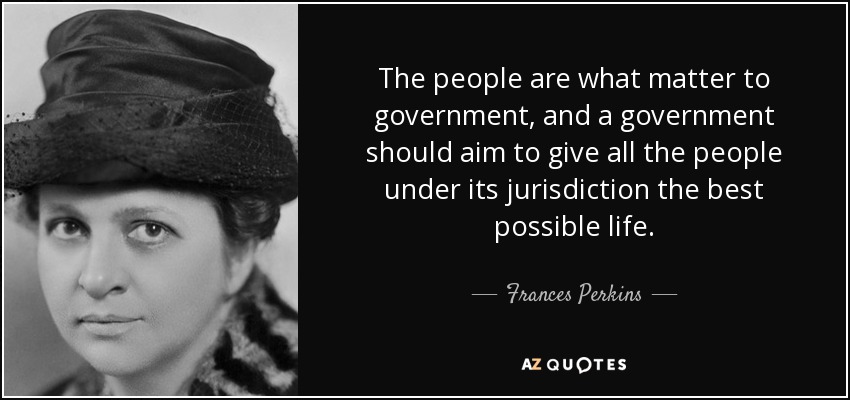
The New Deal was instituted by FDR and his secretary of labor, Frances Perkins Wilson.
Frances Perkins Wilson (April 10, 1880– May 14, 1965)
Wiki Bio
Frances Perkins Wilson was the US Secretary of Labor from 1933 to 1945. She was the first woman appointed to the US Cabinet and the longest serving person in that position. She helped pull the labor movement into the New Deal coalition as a supporter of her friend, FDR.
She and Interior Secretary Harold L. Ickes were the only original members of the Roosevelt cabinet to remain in office for his entire presidency. She administered a number of the more characteristic organizations during her term as Secretary. The Civilian Conservation Corps, the Public Works Administration, its successor the Federal Works Agency and the labor portion of the National Industrial Recovery Act. She established unemployment benefits, pensions for many uncovered elderly Americans and welfare for the poorest Americans. She pushed to reduce workplace accidents and helped craft laws against child labor. She established the first minimum wage and overtime laws for American workers. She defined the standard for the 40 hour work week. She formed governmental policy for working with labor unions and helped to alleviate strikes by way of the US Conciliation Service. Perkins dealt with many labor questions during World War II when skilled manpower was vital and women were moving into formerly male jobs. The list of accomplishment is jaded by the executive agreement with the claim to legislative supremacy. It seems that Congress like Parliament wanted to establish itself as the authority over the executive authority, labor and the middle class by the legislative organization for the economy with special respect for labor. Social security was established presumably as a government insurance policy for those who were employed as labor by any legal employment agency. If the money taken from paychecks for social security is re-routed to some other agency or activity like payment for invasion, occupancy, insurrection or terrorist action in the promotion of insurrection against a foreign power, then social security is not being represented by the misappropriation. This is a major infraction against the social contract. Term Limits Term limits for the president were ratified in the 21st amendment in 1951. This amendment was unique to the US. European nations don’t have term limits. Only those nations who followed the US in the practice have them. The limits are a throwback to the ancient Roman republic. The justification for the limits is probably grounded in the assumption that the free market is a better determinant for the will of the people than a central authority figure. Whether the figure is a king or an elected official is only relevant to the view that the executive authority is not necessary to the assessment regarding the will of the people. This argument for this assumption has ruled out the importance that an executive authority plays in providing direction for the government with respect for national security. The executive authority in republic represents the monarch in monarchy. He or she is a representative of conservative leadership with respect for communication, ceremony and historical perspective. The greatest difficulty with the 21st amendment is that the claim to legislative supremacy has been used to harass any president who has not agreed to speak in behalf of liberal Congressional consensus. The harassment has also been used to entertain invasion, occupation and the promotion of insurrection as directed by the liberal element in Congress. This policy has instituted increased expenditure as a requirement for the taxpaying public. Republic was instituted as though it were a better form of government than even parliamentarian monarchy. When the concept of improvement is limited to paying more for government policy that is destructive to market competition, private or public property or respect for border strength in national security, it hasn’t really been an improvement. Congressional leadership has to impose conservative constraints on engagement in covert and official actions in foreign policy or they have to accept the recommendation of the executive authority to restrain their expenditure. While the ‘aim’ of social security was established for the best possible life for the people, the use of social security to pay for damage to foreign government is a misappropriation.

Thursday, January 18, 2018

Be


Linda Blair
Clinical Psychologist
Help Yourself


Be
Responsible
責任を負う 
Sekininwoou
ps.119

Invisibility
cannot be seen.


Light is for sight.
Less at night increases fright.

Sound is a seashell mound 
to walk around.

Smell is a ship’s bell.
It’s hard to tell
from where it swelled.

Taste saves face
 for the bouillabaisse.

Touch is a friction clutch
for your double dutch.

Feel too much?
Shift your stuff
to find your rush.

Hello. Is anybody there?
I feel so transparent on the stairs.

Whatever begins to exist has a cause.
The universe began to exist after a pause.
The bang began like a heartfelt law
that draws that which is from that which was drawn.

The experience of existence forms an idea of being.
Being exists as more than the idea of seeing.
The experience of existence exists for dreaming
about more than the idea and the streaming deemed.

Nothing greater than the greatest idea of life
can be conceived to be greater in mind. 
If majesty exists beyond strife, 
it also exists in reality as ripe.  
Nobility exists in reality 
as well as in the mind as seen.

Greatness is not defined by causing destruction or damage with cruelty or violence. 
It is not defined by deception or the accumulation of capital irrespective of the law to silence.  
It is better to oppose war and the death penalty, than to believe in the 'right' to destroy people and property to try this 
as though there were divine approval for the blitz. 

Opposition cannot be destroyed by killing people. 
Opposition to killing is reinforced to feed the will. 
Is war to be preferred to peace? 
Is any religion to be defined by an 'anti-Islamic' crease?
No.
It just won't go. 

How are statutes an expression of law?
General authority lies between the specific draw
and absolute simplicity without flaw

My conception
will guide perception 
to value objective perspective 
in the midst of subjective reflection.

How is law related to morality?
The goal of responsible totality
prevents the perpetuation of harm to anyone's substantiality

My judgment will reject the condemnation
of people who accept celebration
and reject deception for the destruction of character by allegation 
to keep that responsibility which is my transparent gem.

Each person has liberty in responsibility.
All people have the entitlement to be free
with protection against exploitation's decree.
Everyone is responsible for respect to be seen.

How is morality defined by rights?
It is not defined by money's blight. 
It is not limited to the special interest 
of increasing advantage for unfinished business
for the rich in accumulating capital to increase their assets. 
It is not subordinate to the authority of access
to declare war to protect invasion, occupation 
and genocide as ‘defense.’

Rights are for people by design 
and as the functional product defined
by taxation for government that is benign. 
Goodness obtains objective standing
by the design of the natural handling 
of providence for basic entanglement
with needs being met.

Morality is for goodness sent
as an expression of balance lent
as rights for people wrent.

Government may not dictate
law by war for the profit of few or many in the state.

How do rights direct executive authority?
Executive authority may not claim absolute power for any degree of the majority.
No one is above the law. Not even all are above it with seniority.
The law is for each and all. The executive corrects error even by consensual deformity.

Executive authority overrides Congressional or Judicial abnormality 
for the rights of people in moral congeniality.

No one is above the law. 
Not even all are above that which is beyond flaw.
The law is for each and all from what was drawn.


Ps.119:25-48
He Legem pone

33 Teach me, O Lord, the way of your statutes, *
and I shall keep it to the end.

34 Give me understanding, and I shall keep your law; *
I shall keep it with all my heart.

35 Make me go in the path of your commandments, *
for that is my desire.

36 Incline my heart to your decrees *
and not to unjust gain.

37 Turn my eyes from watching what is worthless; *
give me life in your ways.

38 Fulfill your promise to your servant, *
which you make to those who fear you.

39 Turn away the reproach which I dread, *
because your judgments are good.

40 Behold, I long for your commandments; *
in your righteousness preserve my life.
Waw Et veniat super me

41 Let your loving-kindness come to me, O Lord, *
and your salvation, according to your promise.

42 Then shall I have a word for those who taunt me, *
because I trust in your words.

43 Do not take the word of truth out of my mouth, *
for my hope is in your judgments.
44 I shall continue to keep your law; *
I shall keep it for ever and ever.

45 I will walk at liberty, *
because I study your commandments.

46 I will tell of your decrees before kings *
and will not be ashamed.

47 I delight in your commandments, *
which I have always loved.

48 I will lift up my hands to your commandments, *
and I will meditate on your statutes.


4 Cum invocarem

1 Answer me when I call, O God, defender of my cause; *
you set me free when I am hard-pressed;
have mercy on me and hear my prayer.

2 "You mortals, how long will you dishonor my glory; *
how long will you worship dumb idols
and run after false gods?"

3 Know that the Lord does wonders for the faithful; *
when I call upon the Lord, he will hear me.

4 Tremble, then, and do not sin; *
speak to your heart in silence upon your bed.

5 Offer the appointed sacrifices *
and put your trust in the Lord.

6 Many are saying, "Oh, that we might see better times!" *
Lift up the light of your countenance upon us, O Lord.

7 You have put gladness in my heart, *
more than when grain and wine and oil increase.

8 I lie down in peace; at once I fall asleep; *
for only you, Lord, make me dwell in safety.