Showing posts with label design. Show all posts

Sunday, March 29, 2020

Own

4.6.20

Hayley Atwell
as Agent Carter


Own
Knowledge
自己的知识
Zìjǐ de zhīshì
自分の知識
Jibun no chishiki
ps117
Scientia sua

Sing praise for goodness all you nations.
Let your song be heard by every station.

Merciful kindness is great toward us.
Truth in design affords accordance.

That which has been learned 
is a word that has been earned
as heard.

The tongue of a teacher knows how to sustain
the weary with the hope to avoid pain.

Each morning awakens the ear 
to the knowledge of another year.

What has been heard
is the word that has been lured
beyond the absurd
to that which has been opened to movement
away from rebellion to improvement
without revolution.


The 4th month of the year
says the spring has started here.

Love desired and requited 
called for favor in time as sighted.

Grace had jested about loftier themes.
Would you speak of wounds when you could not sing?

What wicked wit would you make about my wound?
I do what I can with or without a tune.

Will the sixth wit please take a number 
to have his wound witted from slumber? 

What is it to be witted?
You must be fitted 
to be permitted
to be witted.

Your pleasure has been the task I set
each time the sight of sky is met.

I sing the season and the cause
that starry signs may be seen with awe.

I drew my lore from annals old.
The evening star had risen and shown 
when time had opened her floral bows.

Sovereign Master of our hearts,
you know the way you set our parts.

Spirit gave you breath to sing
that we might imitate beauty's ring.

Each was chosen to sing the sound
in the harmony of good news found.

You road the colt over fronds of palm
that framed your grace with reverent calm.

You accepted anointment 
with the ointment 
as you sat to eat
your bread with meat.

You kept the passover meal with your disciples
to tell them of the impending trial.

You invoked the rite of thanks
for a communion beyond the Jordan's banks.

You took bread, blessed and broke it
to denote the body that would be broken.

You took wine in the cup raised with gratitude
to signify the blood of the new testament attitude.

The Son of Man was given to the hands of sinners.
He was offered in sacrifice for our redemption as winners. 

Faith in gods had become belief in One.
Classical consciousness had found direction in the continuum.

Materialism pronounced fate as a condition of nature.
The immaterial mind outlawed enslavement to matter as the maker.  

Humanity endures only so much discontinuity.
The elements are organized for functional unity.

The body is made with spirit and blood
for worship in the temple built with wood and hardened mud.

Let the same mind be in you
that was in Christ Jesus for goodness in truth.

He did not regard equality with the Father 
as a claim for exploitation to garner. 

He took on human form in likeness for the form of duty
to humble himself to death on the cross for beauty.

He was exalted with a name for the power of authority
that worked for the public in truth for posteriority.

Greatness in form is organized against misfortune. 
The ideal is made real when the form for function is tuned.

Education develops in the context of concepts placed.
Thought governs action in feeling for satisfaction traced.

Should Christ decide to hold his peace
let your celebration in song never cease.

The angels sing around his throne in glory.
The stars and planets shine to tell time's wistful story.

Flowers grow to celebrate the earth.
Stones rest in the darkness of the dirt
that his Name will be blessed for true worth.

Let his praise be sung
by every musical tongue
with well played instruments
to integrate the elements
while those who have not been trained
may listen well to the divine refrains.

Let your power and mercy show
goodness to this world below
to breathe the breath of life infused
into the noble things that found vile use.

Waken into sound divine
the pavement of your shrine
that we on the haven of heaven's floor
may give praise to you whom we adore.

Childlike though our voices may sound
with poorly tuned choices found,
let the tunable nature of the parts
flow with grace from grateful hearts.

------------------------

Psalm 117
King James Version (KJV)

1 O praise the Lord, all ye nations: praise him, all ye people.
2 For his merciful kindness is great toward us: and the truth of the Lord endureth for ever. Praise ye the Lord.

---------------------
===============
----------------------

Ovid
"Fasti"

Introduction to April

“O gracious Mother of the Twin Loves,(Cupid and Anteros)” said I, “grant me thy favour.” The goddess looked back at the poet. “What wouldst thou with me?” she said, “surely thou wast wont to sing of loftier themes. Has thou an old wound rankling in thy tender breast?” “Goddess,” I answered, “thou wottest of my wound.” She laughed, and straightway the sky was serene in that quarter. “Hurt or whole, did I desert thy standards? Thou, thou hast ever been the task I set myself. In my young years I toyed with themes to match, and gave offence to none; now my steeds treat a larger field. I sing the seasons, and their causes, and the starry signs that set beneath the earth and rise again, drawing my lore from annals old. We have come to the fourth month in which thou art honoured above all others, and thou knowest, Venus that both the poet and the month are thine.”

---------------------

Love desired and requited
called for favor in time as sighted.

Grace had jested about loftier themes.
Would you speak of wounds when you could not sing?

Would you make wit about my wound?
I do what I can with or without a tune.

Your pleasure has been the task I set
each time the serene sky is met.

I sing the season and the cause
that starry signs may be seen with awe.

I drew my lore from annals old.
The evening star had rose and shown
when time had opened her floral bows.

================

April


The Romans thought that the name Aprilis derived from aperio, aperire or apertus, a verb meaning "to open". The Fasti Praenestini offered the expanded explanation that fruits, flowers, animals, seas and lands open in this time.

April was marked by a series of festivals devoted to aspects of rural life. It was a busy month for farmers.

The Parilia was an archaic pastoral festival that celebrated the "birthday" (dies natalis) or founding day of Rome. The festivities opened with the Feast of Venus on the Kalends, the first day of the month.

April was the second month of the earliest Roman calendar. This was before Ianuarius and Februarius were added by King Numa Pompilius about 700 BCE.

It became the fourth month of the calendar year during the time of the decemvirs. This was about 450 BCE. It was given 29 days.

The 30th day was added during the reform of the calendar undertaken by Julius Caesar in the mid-40s BCE. This produced the Julian calendar.

Psalm 117


This  is the shortest of the 150 psalms. It is the 595th of the 1,189 chapters of the King James Version of the Bible. That places it in the middle of the version.

The Gentiles are invited to join in praise of God in this psalm.  Christians view this as a fulfillment of the divine promise of mercy that all nations would be blessed in the seed of Abraham.

Galatians 3:16 says "The promises were spoken to Abraham and to his seed. The use of the singular refers to Christ.

The musical setting is known the opening words in Latin as "Laudate dominum".  William Byrd, Johann Sebastian Bach 'Lobet den Herrn alle Heiden' (BWV 230), Michel Richard Delalande, Robert Strassburg and Wolfgang Amadeus Mozart have arranged the words in classical themes.

Marc-Antoine Charpentier composed 7 settings (H 177, H 152, H 159, H 182, H 214, H 223, H 227).

It has been set by the Swedish composer Fredrik Sixten more recently.The Taizé community has also made a popular arrangement.

----------------------

Will the sixth wit please take a number to have his wound wotted? What? Watted? Wottled? Waddled?

Chn. 第六位机智的人请打个电话弄伤口吗? 什么? 瓦了? 昏昏欲睡? 蹒跚?
           Dì liù wèi jīzhì de rén qǐng dǎ gè diànhuà nòng shāngkǒu ma? Shénme? Wǎle? Hūn hūn
           yù shuì? Pánshān?
Jpn.   6番目のウィットは、彼の傷を書き留めるために数字をとってくれませんか? 何? ワッ
       ト? むらがある? ぐちゃぐちゃ?
            6-Banme no u~itto wa, kare no kizu o kakitomeru tame ni sūji o totte kuremasen ka?
            Nani? Watto? Mura ga aru? Guchagucha?
Krn.   여섯 번째 위트가 상처를 입었을 때 숫자를 가져 가겠습니까? 뭐? 와트? Wottled? 싸
            여?
             yeoseos beonjjae witeuga sangcheoleul ib-eoss-eul ttae susjaleul gajyeo
             gagessseubnikka? mwo? wateu? Wottled? ssayeo?
Ltn.    Et sextus ingenii placet in vulnus suum, et in numero accipies wotted? Quid? Watted?
            Wottled? Waddled?
Itln.    Il sesto ingegno prenderà un numero per far cancellare la sua ferita? Che cosa? Watted?
             Wottled? Dondolando?
Spn.   ¿El sexto ingenio, por favor, tomará un número para que su herida sea eliminada?
            ¿Qué? Watted? Wottled? Waddled?
Frn.    Le sixième esprit prendra-t-il un numéro pour faire sa blessure? Quelle? Watté?
             Tacheté? Waddled?
Gmn.  Wird der sechste Witz bitte eine Nummer nehmen, damit seine Wunde verwischt
             wird? Was? Watted? Wottled? Watschelte?
Dtch.   Wil de zesde geest een nummer nemen om zijn wond te laten wrijven? Wat? Watted?
              Gevlekt? Waggelde?
Czch.  Vezme si šestý vtip, prosím, číslo, aby se mu zranila jeho rána? Co? Watted? Wottled?
             Waddled?
Hng.   Kérem, hogy a hatodik szellem számot szerezzen, hogy a sebét kiszáradjon? Mit?
             Watted? Wottled? Totyogott?
Trk.     Altıncı zekâ, yarasının zayıflaması için lütfen bir sayı alacak mı? Ne? Watted? Wottled?
             Waddled?
Grk.    Το έκτο πνεύμα παρακαλώ να πάρει έναν αριθμό για να έχει πληγεί το τραύμα του; Τι?
             Watted; Εμφιαλωμένο; Μπερδεμένη;
             To ékto pnévma parakaló na párei énan arithmó gia na échei pligeí to trávma tou? Ti?
              Watted? Emfialoméno? Berdeméni?
Rsn.    Будет ли шестое остроумие, пожалуйста, взять число, чтобы иметь его рану
             wotted? Какие? Watted? Wottled? Переваливаясь?
             Budet li shestoye ostroumiye, pozhaluysta, vzyat' chislo, chtoby imet' yego ranu
             wotted? Kakiye? Watted? Wottled? Perevalivayas'?

Will the sixth wit please take a number
to have his wound witted from slumber?

What is it to be witted?
You must be fitted
to be permitted
to be witted.

-----------------------

John Keble
Palm Sunday
The Christian Year
---------------------
===============
---------------------

Speech from what has been learned is the tongue of the Learned. It is the language of education.


Second Isaiah was an anonyous 6th century BCE author who wrote during the exile in Babylon.
He echoed the words of the first in his declaration of having been called from the womb.
He referred to the weapons of war as symbols of his word.

The prophecy described how Jerusalem would be restored to become the worldwide center for worship. The Messiah (Cyrus) would set the captives free to bring about the rule of Yahweh.

This prophet also wrote against corrupt leadership. He spoke for the disadvantaged. Righteousness was associated with holiness. Isaiah 44:6 used the start and end of time to declare the sovereignty of one God. He said, I am the first and the last. Beside me there is no other.

This separated the deity from the parthenon of gods from whom the One had been drawn. The punishment of Israel was a prelude to the redemptive deeds for the exiles and Zion.

Monotheism became the defining characteristic of post-Exilic Judaism. It was used as the template for Christianity and Islam. Judah still sang about being a kingdom even though it was a province of the Achaemenid empire with a governor.

Isaiah 50:4-5

The Lord GOD has given me
the tongue of a teacher
that I may know how to sustain
the weary with a word.
Morning by morning he wakens--
wakens my ear
to listen as those who are taught.
The Lord GOD has opened my ear
and I was not rebellious.
I did not turn backwards.

---------------------

That which has been learned
is a word that has been earned
as heard.

The tongue of a teacher knows how to sustain
the weary with hope as to how to avoid pain.

Each morning awakens the ear
to the knowledge of another year.

What has been heard
is the word that has been lured
beyond the absurd
to that which has been opened to movement
away from rebellion to improvement
without revolution.

================

For Goodness that Lasts


Map of Philippi

Philippi

Colonists from the island of Thasos established a settlement at Krenides (springs) in Thrace in 360 BCE.

Thasos had been colonised at an early date by Phoenicians. Gold had been discovered. Thasos was said to have been the leader of the Phoenicians. It was his name that had been given to the island.
Greeks from Paros founded a colony on Thasos around 650 BCE.

Thasians owned gold mines even more valuable than those of the island on the mainland.

The settlement at Krenides was located near the head of the Aegean Sea at the foot of Mt. Orbelos, now called Mt. Lekani, about 13 km (8.1 mi) north-west of Kavalla. It was past the northern border of the marsh that covered the plain that separated it from the Pangaion Hills to the south.

King Philip II of Macedon conquered the city and renamed it Philippi in 356 BCE. The Macedonians conquered the town to take control of the gold mines.

A garrison was established to control the strategic passage. The post was located on the route between Amphipolis and Neapolis. This was part of the great royal road which ran east-west across Macedonia. It would later be made into a part of the via Egnatia by the Romans.

The population preserved its autonomy within the kingdom of Macedon with the assembly of the demos.  The discovery of new gold mines near the city, at Asyla, contributed to the wealth of the kingdom. Philip put a mint there.

Antigonus I Monophthalmus ("the One-eyed") was one of Alexander's generals. He ruled over Asia Minor and northern Syria, but his territory extended to Philippi.

When the Romans destroyed the Antigonid dynasty of Macedon in the Third Macedonian War (168 BCE), they divided the kingdom into four separate states (merides). Amphipolis became the capital of the eastern Macedonian state rather than Philippi.

Archeological remains include walls, the Greek theatre, the foundations of a house under the Roman forum and a little temple dedicated to a hero cult. This monument covers the tomb of a certain Exekestos.

Mark Antony and Octavian confronted the forces of the assassins Marcus Junius Brutus and Gaius Cassius Longinus at the Battle of Philippi on the plain to the west of the city during October in 42 BCE. Antony and Octavian won this final battle against the partisans of the Republic.

They released some of their veteran soldiers, probably from Legion XXVIII, to colonize the city. It was refounded as Colonia Victrix Philippensium.

Octavian established his control of the Roman state from 30 BCE. He became the emperor in 27 BCE. Veterans (possibly from the Praetorian Guard) and other Italians were given a place to live.

The city was renamed Colonia Iulia Philippensis. It was renamed yet again as Colonia Augusta Iulia Philippensis after January, 27 BC, when Octavian received the title Augustus from the Roman Senate.

The land was centuriated or divided into squares of land. It was distributed to the colonists. The city kept its Macedonian walls. The general plan was modified only partially by the construction of a forum, a little to the east of the site of Greek agora.

It was a "miniature Rome". It was governed by two military officers, the duumviri, who were appointed directly from the capital. This placed it under the municipal law of the imperial city.

The New Testament recorded a visit to the city by the apostle Paul during his second missionary journey (49 or 50 CE)(Acts 16:9-10). Early Christians concluded that Paul had founded their community on the basis of the Acts and the letter to the Philippians.

Paul had preached for the first time on European soil in Philippi accompanied by Silas, Timothy and Luke.

The Epistle to the Philippians is dated to the time when Paul was renting a house in Rome (61-62 CE). The development of Christianity in Philippi is indicated by a letter from Polycarp of Smyrna addressed to the community in Philippi around 160 CE.

Many of the Philippians were retired military men who had been given land in the vicinity and who in turn served as a military presence in this frontier city. There were not enough Jews there to permit the establishment of a synagogue. The letter does not contain citations of the Judaic scripture.

The apostle extended his greetings, thanksgiving and a prayer for the Philippians. He explained his personal circumstances. He exhorted the congregants to live a life worthy of the gospel.

He defined himself as in chains and under watch by the palace guard. He distinguished between preaching the gospel from envy and good will. Those who preached from envy did so for selfish ambition. Those who preached from good will did so from love in order to increase the knowledge of benefit in truth.

He said that to live was Christ and to die was gain for him.

The attitude for the mind of Christ was posited in the second chapter as that of a servant to appeal to the sense of duty.

Philippians 2:5-10

Let the same mind be in you that was in Christ Jesus
who, though he was in the form of God
did not regard equality with him
as something to be exploited,
but emptied himself
taking the form of a servant
being born in human likeness.
Being found in human form,
he humbled himself
and became obedient to the point of death
even death on a cross.

God highly exalted him
and gave him the name
that is above every other
so in devotion to Jesus
every knee should bend
in heaven, on earth and under the earth.

---------------------

Let the same mind be in you
that was in Christ Jesus for goodness in truth.

He did not regard equality with the Father
as a claim for exploitation to garner.

He emptied himself to excess demand for privilege
as something by which the sons of Eli were driven.

He took on human form in likeness to the form for duty
to humble himself to death on the cross for beauty.

He was exalted with a name for the power of authority
that worked for the public in the truth of goodness for posteriority.

================

Blood of the Covenant

The gospel of Matthew hasn't been used in the Sunday readings since March 1, 2020. That reading was from the 4th chapter.

It was about Jesus being led by the Spirit into the wilderness. It reminded the Church that Jesus had left the world to consider how natural law applied to the kingdom of Judah as a model for any political form anywhere in the world.

It was read at the start of Lent as encouragment to consider the value of fasting and prayer in the household and the community as it related to the kingdom of heaven.

Jesus was tempted to test God with the reckless endangerment of his body. He stated that he would not test God. This was the same thing that Ahaz had said to the prophet Isaiah (Isaiah 7:12). Isaiah had told him to ask for a sign.

Isaiah was the prophet who had first had the vision of the one God seated on a throne in the heavenly kingdom.

The selection for Palm Sunday on April 5, 2020 is about Jesus in the garden of Gethsemane. The timeline in Matthew, Mark and Luke differs from that offered by John. The synoptic gospels drew their material from the 'sayings of Jesus.' The existence of the 'Q' source is presumed to have existed at the time due to the common material in those 3 gospels.

The intent of John's gospel was to establish the Eucharist as the basis for liturgical celebration. Jesus was identified with the Son as the Word of God who preceded the existence of time in the creation of the world.

Palm Sunday celebrates the triumphant procession of Jesus as prophet and king into Jerusalem. It was testimony as to the popularity of allowing non-Jews to accept the benefit of monotheistic belief in a way that was similar to the Jewish community.

This reading is for the last Sunday before Easter. The story of the betrayal of Jesus is necessary in the Sunday cycle of services. Jesus is remembered for his prayer to let the cup of his sacrifice pass from him.

This was a reference to the elements of the Last Supper as the template for the institution of the Eucharist. Giving thanks in remembrance of the life of Jesus was to serve as the call for the community to gather together in communion to worship.

The crucifixion had been predicted by scripture as the means to transform the celebration of animal sacrifice in expiation to the gods to the ritual reinactment of the one sacrifice of the Son as the emblem for human nature for the rest of time.

Jesus asked that the cup be taken from him, but he offered himself that the Father's will be done.

He had asked his disciples to stay awake to watch him with prayer. Peter and the two sons of Zebedee witnessed his agitation, but they fell asleep. When Jesus found Peter somnolent, he asked him to watch and pray.

He prayed more and found the others asleep again. He prayed one more time. When he woke the disciples he told them that the time had come. The Son of man had been betrayed for trial.

This gospel recounts the detail that 'one of those with Jesus' drew his sword and struck the ear of the slave to the high priest. He instructed the follower to put his sword back.

The course of these events had been determined for a purpose. Jesus could have asked for 12 legions of angels, but the scriptures would not have been fulfilled.

The Son of Man was cursed to hang on a tree that the Gentiles might see the inheritance of the promise of salvation allowed for the atonement of sin by the one sacrifice of God as man for the redemption of human nature.

The selection alerts the participants that Good Friday and the crucifixion will be commemorated at the end of the work week.

The resurrection is to be celebrated late Saturday night or early Sunday morning.

Matt. 26:45-46

Then he came to the disciples and said to them, 'Are you sleeping and taking your rest? See. The hour is at hand. The Son of Man is betrayed into the hands of sinners. Get up. Let us go. My betrayer is at hand.'

---------------------

The Son of Man had been betrayed into the hands of sinners.
He was offered in sacrifice for our redemption as winners.

================

Epictetus

 
Epictetus was born a slave at Hierapolis, Phrygia (present day Pamukkale, Turkey). He lived from 55 to 135 CE. He became a Greek Stoic philosopher during that time.

He lived in Rome until his banishment. He went to Nicopolis in northwestern Greece for the rest of his life. His teachings were written down and published by his pupil Arrian in his Discourses and Enchiridion.

The Stoics had a dangerous problem with their view of physics. They described the world  in terms of (a) monism, (b) materialism and (c) dynamism to present a coherent picture.

The materialism was overextended in a way that overstated the relation of matter to the immaterial in the physical world. There was an implicit aggression that sought to force agreement with their definition of how it created change.

Statements recorded in the Discourses presented a disturbing view of reality. He argued that the irrational was unendurable to reason. Only the rational was endurable.

Suicide was presented as an example of the unendurable. If someone were to see it as reasonable however, he would kill himself.

This sounded like it was going to result in a justification for reason, but it ended up as an argument against it. Rationality was an excuse to impose change by force.

The materialism of the Stoic belief suggested that pantheism was the order for things. Each began from all. Each returned to all that is. Egalitarian economics was the natural order for human relations.

When Epictetus referred to God it was in the context of the will. Humans were given faculties to bear any event without being broken or bent, but a leader (prince or father) placed the exercise of the faculties above restraint, compulsion or hindrance without control.

Death, exile, pain or anything of this kind was not the real cause of our doing or not doing any action. It was our inward opinions and principles that caused action.

The pantheistic context made opinions and principles into things that were inviable. They were not subject to tests to determine truth or falsity.

They were positions that had to be used to hammer the opposition into submission. If that didn't work, then the other side had won.

The materialist dilemma was such that it both cursed and sanctioned slavery. All were equal in the pantheist view. Society imposed hierarchy as a deceit. Those in a higher station were asked if the claim to superiority made tyranny endurable.

This was something of a counter-force to the  belief that the force of will was that which created change. Materialism accepted fate as a condition of nature.

The human condition was such that people were in perpetual conflict due to oppositional positions. It was this that was viewed as immutably true. The only way to escape the cycle of conflict was philosophy.

Habit could make a change for the better, but it required enslavement to the habit to achieve improvement.

The greatest happiness principle would have met with disfavor as something that got in the way of the ascetic struggle to use the will to overcome the fear death with persistent denial.

Stoics were supposed to cheer their children to endure the lash of a whip with joy according to Seneca. This was an admission of guilt as far as the abuse of power was concerned. Abuse was an opinion that would happily endure the pain of being whipped.

Epictetus might have disagreed, but that would have just been his opinion. 

It was the materialism of the pantheistic belief that placed the Stoic in a battle to overcome human nature by the force of will.

The current government reaction to the report of the 'coronavirus' shows distinct agreement with Stoic materialism. The iteration of numbers has been used to reinforce the presumption of pandemic. The presumption has reinforced the imposition of quarantine on the public.

------------------

Materialism pronounced fate as a condition of nature.
The immaterial mind outlawed enslavement to matter as the maker.

==============

Doubletalk
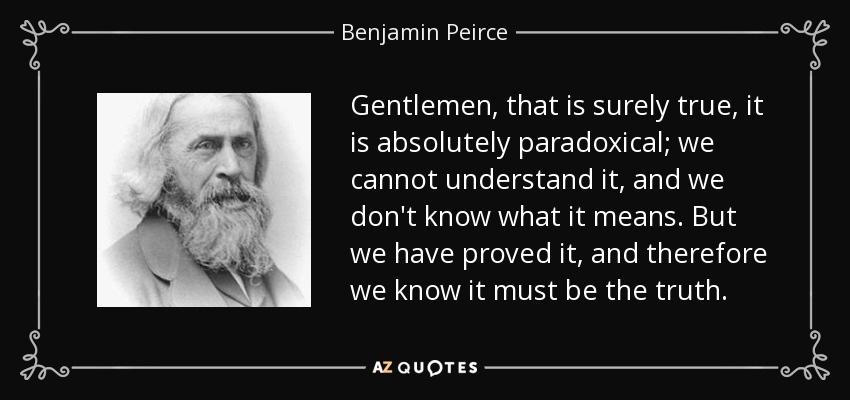

A slave class was not needed for the educated to prosper.

The goal of describing things as they are is motivation for the continual refinement of science with mathematics.

Benjamin Peirce
b. 4.4.1809  Salem, Massachusetts
d. 10.6.1880  Cambridge, MA

Benjamin Peirce was an American mathematician who taught at Harvard University for approximately 50 years. He became a major figure in mathematics and the physical sciences during a period when the U.S. was still a minor country in these areas.

He saw mathematics as a study of creation in recognition of the creatures. He identified himself as a Christian, but he was an apologist for slavery. He thought that it should be condoned if it was used to allow an elite to pursue scientific enquiry.

The theology was more Stoic than it was Christian. Materialism was the philosophical justification for enslavement.

The observation of evidence as limited to the world pressed  argument into a pressurized containment for the victory of the will over nature. What was 'known' was subordinated to that which could be controlled.

He became known for the statement that "Mathematics is the science that draws necessary conclusions". He is often regarded as the earliest American scientist whose research was recognized as world class.

He was director of the U.S. Coast Survey from 1867 to 1874. The survey drew maps.

Benjamin Peirce had interests in celestial mechanics, applications of plane and spherical trigonometry to navigation, number theory and algebra as a professor at Harvard.

Salem, Massachusetts

Salem was settled in 1626. It was one of the most significant seaports in early American history. It is about 22 miles or 35 km northeast of Boston.

Puritans had settled in the location to base their settlement on religious freedom. They were ruled by their ascetic inclinations as their political view ruled out most of biblical history except for the support for local councils.

One of the most widely known aspects of Salem is its history of allegations about witchcraft. Witchcraft was defined as a sin that was punishable by death in the Babylonian empire.

Just as the advocates for the one God argued for refinement of the belief in the God of gods, the Babylonians were pressing for an advance in polytheism that ruled out more primitive forms of belief.

These primitive forms were viewed as a form of treason. They argued for reformation that accepted the god of gods as a justification for the ascription of divine status to their leadership. The Puritans were a branch of Calvinists who held that the monarchy was corrupt.

They left England to test their reduced ascetic form of political order in the new world. Every man would get to be part of the government through church in the original plans for the government of the settlement.

William Hathorne was a prosperous businessman in early Salem. He became one of its leading citizens. He led troops to victory in King Philip's War (1675-1678) against the natives.

He had served as a magistrate on the highest court and was chosen as the first speaker of the House of Deputies. He was a zealous advocate of the personal rights of freemen against royal emissaries and agents.

His son Judge John Hathorne came to prominence in the late 17th century when witchcraft was a serious felony.

The accusations started when Abigail Williams, Betty Parris and their friends were observed  playing with a Venus glass (mirror) and egg. The infamous witch trials began in 1692. It was reported that 19 people were executed by hanging as a result of the false accusations.

Judge Hathorne was the best known of the witch trial judges. He became known as the "Hanging Judge" for sentencing accused witches to death.

The town became a center for privateers during the American Revolutionary War. About 1,700 Letters of Marque were granted during that time.

A lettre de marque was a government license in the Age of Sail (c.1550-c.1850) that authorized a private person, known as a privateer or corsair, to attack and capture vessels of a nation at war with the issuer.

The case for that prize could be brought before their own admiralty court for condemnation and transfer of ownership to the privateer once captured.  A letter of marque and reprisal would include permission to cross an international border to conduct some action against an attack or injury.

Cruising for enemy prizes with a letter of marque was considered an honorable calling that combined patriotism and profit. Such privateering contrasted with attacks and captures of random ships.

Unlicensed attack was not authorized. It was known as piracy. Piracy was almost universally reviled.
Nearly 800 vessels were commissioned as privateers and are credited with capturing or destroying about 600 British ships during the Revolutionary War.

Many ships used as privateers were too large for short voyages in the coasting trade after the revolution. Their owners determined to open new avenues of trade to distant countries.

The Empress of China, formerly a privateer, was refitted as the first American ship to sail from New York to China starting in 1784.

Salem had become the sixth largest city in the country and a world-famous seaport by 1790.

Salem Seal


The China Trade, along with exporting codfish to Europe and the West Indies, importing sugar and molasses from the West Indies and the products depicted on the city seal from the East Indies was part of the global reach.

Salem ships also visited Zanzibar in Africa, Russia, Japan and Australia.

Benjamin Peirce

Benjamin was born in Salem, Massachusetts on April 4, 1809.

His father was also named Benjamin (1778-1831). His mother was Lydia Ropes Nichols Peirce (1781–1868). The elder Benjamin would later be appointed as the librarian for Harvard.

The younger became a student at that school. He was appointed tutor there in 1829. Two  years later he became Professor of Mathematics at the University. The post was changed to include astronomy in 1842. He held it until his death in 1880.

He played a prominent role in the development of the science curriculum at the university. He also acted as the librarian for a time.

He wrote some introductory textbooks in mathematics and something more advanced in mechanics (Peirce 1855).

His definition of mechanics was anti-paradisiacal with respect for the occurence of perpetual motion in nature. If design had made providence purely perpetual without incident in destructiveness it would have proved destructive to human belief in the spiritual origin of force.

The First Cause was of necessity superior to matter. If everything were made for the perpetual production of providence for everyone, there would not have been any reason to appeal to authority for help in understanding benevolence in free will. Capriciousness in judgment would result as a consequence toward the functional application of mechanics.

'Ideality' connoted the 'ideal-ism' in the certain knowledge that served as the foundation for mathematics.

Berkeley had qualified idealism as a criticism of materialism. He warned against too much abstraction, but it was with the renunciation of it.

Peirce qualified idealism with respect for free will in the mechanics of necessity. He set the frame for the work in pragmatism that followed.

His son,  Charles Sanders Peirce (1839–1914), became a remarkable though maverick polymath. He would become a mathematician, chemist, logician and historian with a strength of mind that reflected that of his father.

Opportunity was incentive to organize thought for the production of a product for the public.

The most important among Benjamin's other appointments was his post as the Director of the U.S. Coast Survey from 1867 to 1874. His son would work for him there in the production of maps to aid travelers.

Benjamin was like George Boole (1815-1864) in that he believed that mathematics could be used to study logic. These ideas were further developed by his son Charles. He noted that logic also includes the study of faulty reason.

Benjamin maintained that mathematics could be used to analyse logic. The analytical philosophy of Frege would (1848-1925) derive logic from arithmetic. Russell (1872-1970) would derive logic from all mathematics in the 1900's. 

There is a chain of command implicit in the idealism of pragmatism. Ideals are firmly anchored in the production of providential value for the public in the market or government.

While there is great importance in the capital for production, organization has to order work with the understanding that disaster could destroy the means for production.

Endowment was not just for the arts. It is support for the means of production in the face of threat from the incidence of destructive crisis.

Support for slavery ran contrary to the operation of free will in society. It wasn't a necessity. It was an obstruction to the solicitation of voluntary cooperation in the management of labor. His support was conditioned by the spirit of the times.

Benjamin married Sarah Hunt Mills, the daughter of U.S. Senator Elijah Hunt Mills. They had 4 children. James Mills also taught mathematics at Harvard. He succeeded to his father's professorship.

Charles Sanders became a famous logician, polymath and philosopher. Benjamin Mills worked as a mining engineer. His death came early. Helen Huntington married William Roger Ellis. Herbert Henry Davis pursued a career in the Foreign Service.

His philosophy was characterized by his love for geometry. Geometry uses reason to establish proofs.

He argued that geometry provided more proof with reason than any other  science. The world that has been alloted to us can be adapted by mind to promote intellectual progress.

Progress with the plan for defense against destruction requires functional respect for the public. The order for the world might have been otherwise transposed to a complicated system that our finite power could not unravel.

He died in Cambridge, Massachusetts on October 6, 1880.

Benjamin Peirce
S. 本杰明·普厄斯
T.  本傑明·普厄斯

本 Ben      this                    本  hon     book                         Ben  べん  ベン       Ben  벤  Ben     
杰 jie        jay                     傑  ketsu   greatness                  ja      じゃ   ジャ       ja     자  character
明 ming   bright                 明  mei      bright                      min   みん  ミン       min   민  min           
普 Pu        general              普  fu         universal                Pu     ぷ        プ          Pu     푸   fu             
厄 e          hey                     厄  yaku    unlucky                   ru      る        ル          eo    어  uh 
斯 si         span                    斯  shi       this                           se      せ       セ 

---------------------

Greatness in form is organized against the unlucky.
The ideal is made real when the form for function is plucky.

===============

wiki Benjamin Peirce
SOPE: BP
Salem's History

The Band Perry - If I Die Young
Music Video

Assimilation


Assimilation is a major feature in the acquisition of new knowledge. The attainment of one new fact or technology can drastically effect the existence of an industry.

The song that said, "Video killed the radio star" wasn't completely true, but there was a dramatic drop in the public perception of the importance of radio when tv and movies added the visual element to broadcasts.

Existing industry has historical justification for concern in the fear of being replaced. The public has a legitimate concern insofar as replacement presents itself as a costly consequence.

If the US were to jettison nuclear and hydro-power for the sake of other renewable sources, it would cost the public to have the former industries reduced to relative insignificance.

Solar power presents itself as an element which could be added to the network of services provided it isn't assumed to be the 'new' source of energy.

The solar industry currently stands as a pig in the poke. You could buy the apparatus to install in your yard in the hope that it will reduce the cost for the others in the result of a total decrease in cost, but if it doesn't work the buyer is left with what amounts to useless aparatus in the yard.

Chances are great that the new industry will charge the individual users for the cost of having risked the change in the larger industry. While the consumer may assume reasonable risk in the investment, the new industry may be assuming that the risk has to be transferred to the consumer in order to establish the industry.

The apparatus has to justify the cost for the risk in purchase, but lobbies for industry work their influence in the context of 'buyer beware' maxim.

C.S. Peirce

C.S. Peirce defined synechism in terms of what it does not say. A synechist cannot say, “I am altogether myself, and not at all you.” No one is an island.

Only the liberal solipsist that argues for him or herself as "the people" views self in terms of absolute individuality.

The Continuity of Being
Article: Synechism

Benjamin Peirce had argued against government as the source of paradise. He indicated that this was the source of delusion with respect for the expectation of perpetual motion in a socialist utopia.

His son, C.S. Peirce, argued that humankind cannot tolerate too much discontinuity in providence.

When good faith providers are treated as delusional it is a disincentive to the production of a service. This adversely effects industry in general.

Together the Peirces argued for pragmatism as a form of correction of the materialism in Stoic philosophy. Idealism had to be qualified by something observably beneficial in practical value.

This supported Berkeley's criticism of materialism with his advocacy for the immaterial operation of mind.

Insofar as leading non-conformist Protestants felt the compunction to provide the principles for conservative reform in monarchy to republican government there was a synechist type of agreement in the formation of reasonable expectation for cooperation with leadership.

---------------------

Humanity endures only so much discontinuity.
The elements are organized for functional unity.

The body is made with spirit and blood
for worship in the temple built with wood and hardened mud.

================

Sunday, October 27, 2019

Act

11.3.19
Thandie Newton

Act for
the Moral Code
为道德守则行事 
Wèi dàodé shǒuzé xíngshì
道徳規範のために行動する
Dōtoku kihan no tame ni kōdō suru
ps119.129
Actum de moribus conveniebat

Act in a way that you could will as law 
for the benefit of overcoming error or flaw.

The context for law is legal polity
in defense of national autonomy.

Naturalism offers no reason for ethical principles.
It colludes to delude the acceptance of false victuals
as typically invincible.

The corruption of leadership was declared as the cause for rebellion.
Tyranny was the most pronounced claim for the benefit of the hellion.

It was proclaimed as factually actual despite evidence to the contrary.
Conservative reform was viewed as too legendary and arbitrary.

Bureaucratic benefit from the repression of counter-attack
was implied as the reason for government in fact.

The social contract was broken 
to achieve representation that was less than token.

The bureaucrat assumed a position as the power
that grew in the repression of people by the hour.

The equation of perfection with reality
carries consequence like a swarm of killer bees.

A massive assault is conducted on the senses.
The condition of the body is reduced to autonomic defenses. 

Progress is constrained to the leap from rags to riches.
The state of the nation is left to wallow in vicious twitches.

Restitution is a form of reparation
that compensates for damage prior to restoration.

One official offered restitution
to the crowd to request his absolution.

The chief marvel for legal polity is happiness in freedom
without excess in success with respect for treason.

I look to the design of nature as the plan for government.
The economy of the household is for the production of wonderment.

Education in the classics leads to a stately mind
when you scour definitions for the analytical find.

Term limits for executive authority don't promote conservative reform.
The subordination of profit to demand has been pressed like a storm.

The larger body declares loyalty to their cause.
The leader is expected to concede without pause.

When the word for reform goes forth in historical context
it makes sense for the simple conservation of content in the contest.

I open my mouth to exhale
that reason with joy may prevail.

The commandment to love automates thought for duty
to increase speed in performance for constitutional beauty.

Probability is a logical inference for application in science with the measure of math. 
It has grown toward the prediction of self-reliance as the reasonable path.

Analytic philosophy analyzes the logic of statements
for scientific measure in application for various places.

The preservation of culture in conservation by design
allows for surplus in production as naturally benign.

The laws of arithmetic are analytic judgments
drawn from a priori abundance.

The application of arithmetic to physical science
raises calculation to the level of deductive appliance.

Surplus is sold to feed consumer need or desire
that the royal priesthood of believers may believe in what's higher. 

Tower Bridge, London

The love of our God is the highest of powers.
It feeds our delight in the beauty of flowers and towers.

Turn to mercy when pressured to cruelty in punishment.
Divine correction is designed to renew faith in the covenant.

I will let no iniquity have dominion over me.
My footsteps will walk in your word as the way for me to see.

The light of your word will deliver me from oppression.
I will keep your commandments to avoid moral regression.

Your countenance will shine while I study your law
as it has in the past when you helped me to overcome my flaws.

My eyes have shed anxiety in the stream of my tears
for those who denied the value of constitutional peers.

Look at the proud. Their spirit is not right.
The righteous live by faith in what is right about sight.

May you fulfill by faith every good resolve in the name of Jesus
that Christ may be glorified in you by the grace of God for your freedom.

---------------------

Pe
Pe is the 17th letter of the Semitic Abjads.

It represents the number 80 in the alphanumeric code known as gematria. Its final form represents 800 but this is rarely used.

The Pe Kefulah is written as a small Pe scribed within a larger. When the letter is written in the form of a Doubled Pe, this adds a layer of deeper meaning to the Biblical text. This atypical letter appears in Torah scrolls, manuscripts and some modern printed Hebrew Bibles.

Mirabilia
Marvels

129 Your decrees are wonderful;
therefore I obey them with all my heart.
130 When your word goes forth it gives light;
it gives understanding to the simple.
131 I open my mouth and pant;
I long for your commandments.
132 Turn to me in mercy,
as you always do to those who love your Name.
133 Steady my footsteps in your word;
let no iniquity have dominion over me.
134 Rescue me from those who oppress me,
and I will keep your commandments.
135 Let your countenance shine upon your servant
and teach me your statutes.
136 My eyes shed streams of tears,
because people do not keep your law.

Sadhe
Justus es, Domine
You are righteous

137 You are righteous, O Lord,
and upright are your judgments.
138 You have issued your decrees
with justice and in perfect faithfulness.
139 My indignation has consumed me,
because my enemies forget your words.
140 Your word has been tested to the uttermost,
and your servant holds it dear.
141 I am small and of little account,
yet I do not forget your commandments.
142 Your justice is an everlasting justice
and your law is the truth.
143 Trouble and distress have come upon me,
yet your commandments are my delight.
144 The righteousness of your decrees is everlasting;
grant me understanding, that I may live.

------------------------


The name Habakkuk means 'embrace' in Hebrew. He was the 8th of the 12 minor prophets. He embraced the truth of faith.

He identified himself as "Habakkuk the prophet." (Hab.1:1; Hab.3:1) The term indicates that he was a professional who was trained in the Law of Moses in a school.

Samuel's leadership of a group of prophets is recorded in 1 Sam. 19:20. His death is approximated at 1010 BCE. The event was placed not far from Jerusalem. Ramah is located 8 km (5 mi.)north of the capital.

Elisha's involvement with another group was cited in 2 Kings 4:38.His death is dated to 832 BCE in Samaria or the northern kingdom of Israel.

It is conceivable that there was community level cultural organization that featured concern for the salvation of Jerusalem in Judah as the province for Judaic law in the time of Habakkuk.

He may have also been a priest involved in the worship of God in the temple. He gave instructions to the choir director on his stringed instruments (Hab.3:19).

Temple prophets are described in 1 Chronicles 25:1 as using lyres, harps and cymbals. The instruction to the choir director indicates that Habakkuk may have been a Levite involved in the orchestration of music in the Temple.

The date of the book is associated with the references to an imminent Babylonian invasion (Hab. 1:6; 2:1; 3:16). The event took place on a small scale in 605 BCE. It was before the total destruction of Judah’s capital city, Jerusalem, in 586 BCE.

Habakkuk likely prophesied in the first five years of Jehoiakim’s reign (609–598 BCE).

The book of Habakkuk consists of 5 oracles about the Chaldeans (Babylonians) in 3 chapters. The Chaldean rise to power is dated circa 612 BC, it is assumed he was active about that time. This made him an early contemporary of Jeremiah and Zephaniah.

The final chapter of his book is a song, it is sometimes assumed that he was a member of the tribe of Levi, which served as musicians in Solomon's Temple.

The first chapter is a complaint about the success of evil men. The second chapter is testimony attributed to God for divine action. Habakkuk was told to write his vision on a tablet so a runner could read it.

The message that the just will live by faith is important in Christian thought. It is used in Romans, Galatians and Hebrews as the starting point for the concept of faith. 

Habakkuk 2:1-4 

I will stand at my watch-post
and station myself on the rampart.
I will keep watch to see what he will say to me
and what he will answer concerning my complaint.

Then the LORD answered me and said:
Write the vision.
Make it plain on tablets
so a runner may read it.
There is still a vision for the appointed time.
It speaks of the end and does not lie.
Wait for it.
It will surely come.
Look at the proud!
Their spirit is not right.
The righteous live by faith.

---------------------

Look at the proud. Their spirit is not right.
The righteous live by faith in what is right about sight.

================

2 Thessalonians
Map

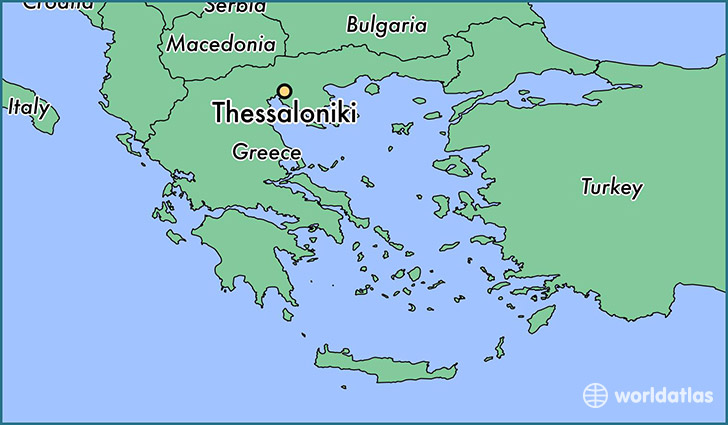
Thessalonica was the second city in Europe where Paul helped to create an organized Christian community. The city is located on the Thermaic Gulf at the northwest corner of the Aegean Sea.
It was founded around 315 BCE by the King Cassander of Macedon. It was located on or near the site of the ancient town of Therma and 26 other local villages.

He named it after his wife Thessalonike. She was princess of Macedonia as daughter of Philip II and a half-sister of Alexander the Great. The city retained its own autonomy and parliament in the kingdom. It evolved to become the most important city in Macedonia.

Thessalonica was made the capital of the Roman province of Macedonia after the fall of the kingdom in 168 BCE. It became a free city of the Roman Republic under Mark Antony in 41 BCE.

It grew to be an important trade-hub located on the Via Egnatia, the road connecting Dyrrhachium with Byzantium. The location facilitated trade between Thessaloniki and great centers of commerce such as Rome and Byzantium.

Thessaloniki also lay at the southern end of the main north-south route through the Balkans along the valleys of the Morava and Axios river valleys. This linked the Balkans with the rest of Greece. The city became the capital of one of the four Roman districts of Macedonia.

It came to be named the capital of all the Greek provinces of the Roman Empire because of the city's importance in the Balkan peninsula.

It became one of the early centers for Christianity around 50 CE during the time of the Roman Empire.  Paul the Apostle visited this city's chief synagogue on three Sabbaths and sowed the seeds for Thessaloniki's first Christian church while on his second missionary journey.

Two letters attributed to Paul were sent to the new church at Thessaloniki. These epistles are preserved in the Biblical canon as First and Second Thessalonians. Some scholars hold that the First Epistle to the Thessalonians is the first written book of the New Testament.

The Thessalonicans grew concerned over whether those who had died would share in the parousia sometime after the first letter had been written. They were faced with a false teaching that said that Christ had already returned.

Modern biblical scholarship is divided on whether the epistle was written by Paul; many scholars reject its authenticity based on what they see as differences in style and theology between this and the first epistle.

2 Thessalonians 1:11-12

We always pray for you asking that God will make you worthy of his call and will fulfill by his power every good resolve and work of faith to the name of our Lord Jesus may be glorified in you and you in him according to the grace of our God and the Lord Jesus Christ.

---------------------

May you fulfill by faith every good resolve in the name of Jesus
that Christ may be glorified in you by the grace of God for your freedom.

================


Luke 19
Sycamore Tree, Jericho

The 19th chapter in the gospel of Luke begins in Jericho. Jesus was on his way to Jerusalem.
The city is located in the Jordan Valley. The Jordan River lies to the east and Jerusalem to the west.

Copious springs in and around the city have attracted human habitation for thousands of years. Archaeologists have unearthed the remains of more than 20 successive settlements in Jericho, the first of which dates back to about 9000 BCE.

Jericho is described in the Hebrew Bible as the "city of palm trees" (Deuteronomy 34:3). The road from Jericho to Jerusalem winds through the badlands of the Judean wilderness. The route climbs more than 3,000 feet in less than 20 miles. The location has an elevation that is 825 ft. below sea level. It is the lowest city in the world.

The location was established as a garden city by the Hasmoneans in the 2d century after the rule of the Seleucid, Antiochus IV was rejected.

The Hasmonean dynasty was from a priestly group (kohanim) from the tribe of Levi. They rose to power in the Maccabean Revolt (167-160 BCE). They became independent from 110 BCE. They ruled until the Roman invasion in 63 BCE.

Two of the great grandson's of the first king in the line became involved in a proxy war between Julius Caesar and Pompey after the Roman occupation. The deaths of Pompey (48 BCE) and Caesar (44 BCE) temporarily relaxed Rome's grip on the Hasmonean kingdom.

There was a brief reassertion of autonomy backed by the Parthian Empire. This short independence was rapidly crushed by the Romans under Mark Antony and Octavian.

The Hasmonean dynasty had survived for 103 years before yielding to the Herodian dynasty in 37 BCE. The installation of Herod the Great (an Idumean) as king made Judea a Roman client state and marked the end of the Hasmonean rule.  Herod tried to bolster the legitimacy of his reign even then by marrying a Hasmonean princess, Mariamne.

Herod the Great had died in 4 BCE. The kingdom was divided as a tetrachy among his sons. Herod Archelaus, son of Herod and Malthace the Samaritan, was given Judea, Edom and Samaria. He ruled for ten years until 6 CE.

Herod Antipas, another son of Herod and Malthace, was made ruler of the Galilee and Perea. He ruled there until he was exiled to Spain by emperor Caligula in 39 CE.

Herod Antipas is the person referenced in the gospels. He played a role in the death of John the Baptist and the trial of Jesus. Pontius Pilate sent Jesus to Antipas for judgment. Antipas sent Jesus back to Pilate's court.

The city of Jericho is remembered for the story in the Book of Joshua. The city has the oldest known protective wall in the world. The story about its destruction was probably a reference to how worn the wall looked at the time that the story was told. 

It was located in the Roman province of Judea. Pilate was the governor when Jesus traveled to the city.

Luke

The gospel tells the story that Zaccheus (Innocent) was the publican for the area. He collected the taxes. He was the chief official.

Tax collectors were known to 'mine' the public for extra money. They could become quite wealthy as a result. The chief among them was most likely the wealthiest.

Clement of Alexandria suggested an identification with Matthew the Apostle.

The lucrative production and export of balsam was centered in Jericho. The product was used as a perfume. Zaccheus was probably quite wealthy as a result.

He was short in stature. He was unable to see Jesus through the crowd (Luke 19:3). He had heard that Jesus had restored sight to the blind there (Matt. 20:30; Mark 10:46; Luke 18:35).

He was so excited to see the Healer that he climbed a sycamore tree along Jesus's path. When Jesus reached the spot he looked up at the man in the tree and addressed him by name.  He invited himself to the tax collector's home. The invitation was honored.

There were those who were present at the banquet who complained about how the rabbi consorted with a tax collector.

Luke 19:8

Zaccheus stood there and said, 'Look, half of my possessions, Lord, I will give to the poor. If I have defrauded anyone of anything, I will pay back four times as much.'

---------------------

Restitution is a form of reparation
that compensates for damage prior to restoration.

The official offered restitution
to the crowd to request his absolution.

================

Probability
Pierre-Simon Laplace (1749-1827)
Thomas Bayes (1701-1761)

Analysis

分析
Chn. Fenxi
Pronunciation
分析
Jpn. Bunseki
분석
Krn. Bunseog

Analytic philosophy analyzes statements for scientific verification in thought.

Chn.    分析哲学分析陈述,以进行思想上的科学验证。
Fēnxī zhéxué fēnxī chénshù, yǐ jìnxíng sīxiǎng shàng de kēxué yànzhèng.

Jpn.    分析哲学は、科学的検証のための発言を分析します。
Bunseki tetsugaku wa, kagaku-teki kenshō no tame no hatsugen o bunseki shimasu.

Krn.     분석 철학은 과학적 검증을위한 진술을 분석합니다.
Bunseog cheolhag-eun gwahagjeog geomjeung-eul-wihan jinsul-eul bunseoghabnida.

Analytic Philosophy

The term for the field refers to certain developments in early 20th-century philosophy that were the historical antecedents to the current practice. Central figures in this historical development are Bertrand Russell, Ludwig Wittgenstein, G.E. Moore, Gottlob Frege and the logical positivists.

Analytic philosophy differs from the empiricism of Locke, Berkeley and Hume in the incorporation of mathematics for the development of a powerful logical technique. Frege had proposed that there was a logic to arithmetic. He was in agreement with Hobbes that this logic was a tool to guage agreement or disagreement with proposals for change in precedent.

Russell affirmed that such a procedure could be part of that which was scientific in public discourse. It was an argument for forensics with a certain admission of limitation to arithmetic at least until the public were to grow in mathematical literacy.

He developed mathematics as a system in British education that could divert liberal excess in government expenditure at public expense or grow in knowledge with the addition of elaboration or discovery.

The logical-positivists posited that there are not any specifically philosophical facts. The object of philosophy is the logical clarification of thoughts. Traditional foundationalism considered the discipline to be a special science. It was the discipline of knowledge that investigated the fundamental reasons and principles for anything.

Analytic philosophers have considered their inquiries as subordinate to those of the natural sciences. This attitude began with John Locke. He described his work as that of an "underlabourer" to the achievements of natural scientists such as Newton. The most influential advocate of the continuity of philosophy with science was Willard Van Orman Quine during the 20th century.

This particular aspect of the orientation encounters problems when science is defined as a way to deceive the public into the acceptance of expertise as the sole basis for authority. It lends itself to bureaucratic implementation.


George Boole established the means to include probability into objective analysis. It was a necessary step in the direction of the development of the larger school.

Boole was a largely self-taught English mathematician, philosopher and logician. Most of his short career was spent as the first professor of mathematics at Queen's College, Cork in Ireland.

He worked in the fields of differential equations and algebraic logic. He is best known as the author of The Laws of Thought (1854). Boolean logic is credited with laying the foundations for the information age.

Boole reduced the four propositional forms of Aristotle's logic to formulas in the form of equations. This was a revolutionary idea by itself. The four propositional forms could then be logically expressed as universal affirmation, universal negation, particular affirmation or particular negation.

Universal affirmation: All S are P.
U. negation: No S are P.
Particular affirmation: Some S are P.
P. negation: Some S are not P. 

Second, Boole argued that Aristotle’s rules of inference (the “perfect syllogisms”) must be supplemented by rules for solving equations.

Third, Boole’s system could handle multi-term propositions and arguments whereas Aristotle could handle only two-termed subject-predicate propositions and arguments.

Boole could be viewed as typically precocious in his Irish mindset. He didn't limit his goals to arithmetic, logic and science for public discourse. He looked to Calculus as a way to correct the limitations of logic as defined by Aristotle.

George Boole (1815-1864)
The Laws of Thought (1854)
Text

"The history of the theory of Probabilities, on the other hand, has presented far more of that character of steady growth which belongs to science. In its origin the early genius of Pascal, in its maturer stages of development the most recondite of all the mathematical speculations of Laplace, -were directed to its improvement; to omit here the mention of other names scarcely less distinguished than these. As the study of Logic has been remarkable for the kindred questions of Metaphysics to which it has given occasion, so that of Probabilities also has been remarkable for the impulse which it has bestowed upon the higher departments of mathematical science."

-------------------------

Probability is a logical inference for application in science with the measure of math.
It has grown toward the prediction of self-reliance as the reasonable path.

Analytic philosophy analyzes the logic of statements
for scientific measure in application for various places.

===================


Gottlob Frege (1848-1925) was a German philosopher, mathematician and logician. He worked as a professor of mathematics at the University of Jena. He concentrated on the philosophy of language, logic and mathematics.

He is understood by many to be the father of analytic philosophy. Giuseppe Peano (1858–1932) and Bertrand Russell (1872–1970) introduced his work to later generations of philosophers.

His contributions include the development of modern logic and work in the foundations of mathematics. His book the Foundations of Arithmetic is the seminal text for the symbolic representation of mathematics as logic.

His work represents a fundamental break between the contemporary approach and the older, Aristotelian tradition. He invented modern quantificational logic, created the first fully axiomatic system for logic complete in its treatment of propositional and first-order logic and  represented the first treatment of higher-order logic.

He developed an analysis of quantified statements and formalized the notion of a ‘proof’ in terms that are still accepted today. He demonstrated that one could use his system to resolve theoretical mathematical statements in terms of simpler logical and mathematical notions.

He is often called the founder of modern logic and is sometimes even heralded as the father of analytic philosophy.

The Foundations of Arithmetic was published in 1884. He refutes other theories and develops his own theory of numbers.  He makes a distinction between particular numerical statements such as 1 + 1 = 2 and general statements such as a + b = b + a. The latter are statements that are as true of numbers as the former.

A definition of the concept of number is called into question. Numbers function in language  as adjectives. The drawers of a desk can be described in terms of color or number. The drawers are brown or 5 in number.

That the drawers are objects with a color is an observation drawn from the external world. It is a visually perceptive observation. Every object has the same color, but each drawer is not 5. Color is visual. Number is conceptual.

The sentence "the number of horses in the barn is four" means that four objects fall under the concept 'horse in the barn.' He explains our grasp of numbers through a contextual definition of the operation of cardinality. The number is a count of the objects.  (Nx:Fx).

He constructs the content of a judgment involving numerical identity by relying on Hume's principle. This states that the number of F's equals the number of G's, if and only if F and G are equinumerous. There is in one-one correspondence between different objects. Frege rejects this definition because it doesn't fix the truth value of identity statements.

He argues that numbers are concepts that assert something about an object. He defines numbers as extensions of unit concepts. 'The number of F's' is defined as the extension of the concept G as a concept that is equinumerous to F.

The concept in question leads to an equivalence class of all concepts that have the number F. Zero is the extension of the concept of being not self-identical.

The number of this concept is the extension of the concept of all concepts that have no objects falling under them.  One is the number of the extension that is identical with 0. 0 and 0 alone falls into this concept. This is the basic foundation for the monas as the universal unity.

Zero is the foundation for the theory of numbers. It is uniquely conceptual insofar as it doesn't represent a corresponding identification in unity with objects.

Gottlob Frege (1848-1925)
The Foundations for Arithmetic (1884)
Text

"I hope I may claim in the present work to have made it probable that the laws of arithmetic are analytic judgments and consequently a priori. Arithmetic thus becomes simply a development of logic, and every proposition of arithmetic a law of logic, albeit a derivative one. To apply arithmetic in the physical sciences is to bring logic to bear on observed facts; calculation becomes deduction." (p.99)

------------------------

The laws of arithmetic are analytic judgments
drawn from a priori abundance.

The application of arithmetic to physical science
makes raises calculation to the level of deductive appliance.

==================


Bertrand Russell was a British logician. He is given credit as one of the founders of analytic philosophy. He was preceded by Gottlob Frege, contemporary with G. E. Moore and followed by Ludwig Wittgenstein.

He led the British "revolt against idealism" in the early 20th century. He wrote Principia Mathematica with A.N. Whitehead to create a logical basis for mathematics. His work has had a considerable influence on mathematics, logic, set theory, linguistics, artificial intelligence, cognitive science, computer science and philosophy.

He expressed agreement with socialism, but he disagreed with the idealism of Hegel and the theory according to Marx. He saw the war against Hitler's Germany as a necessary evil. He was critical of Stalinist totalitarianism. He was like Dewey in the strong association between democracy and socialist economic theory.

It is likely that he viewed capitalism as the motive force for imperialism and war.
Russell's basic idea for defending logicism was like that of Frege. Numbers may be identified with classes of classes.

Number-theoretic statements may be explained in terms of quantifiers and identity. The number 1 would be identified with the class of all unit classes, the number 2 with the class of all two-membered classes and so on. Statements such as "there are two books" would be recast as "there is a book, x, and there is a book, y; x is not identical to y".

It followed that numbers could be explained in terms of the operations of set theory. The union, intersection, difference of sets organized numbers in fields for analysis. The complement illustrated that which was outside the sets in a larger frame.

Russell is remembered for his work using first-order logic.  First order logic introduces the use of variables to propositions. It shows that a broad range of denoting phrases could be recast in terms of predicates and quantified variables.

He is also remembered for his emphasis upon the importance of logical form for the resolution of many related philosophical problems. Statements could be expanded or contracted depending upon purpose.

Spinoza's moral code presented a set of axiomatic statements to define the code. There was allowance for metaphysical expression. The statements allowed for the analysis of the morality that was being advocated. They were objects of language with which to agree or disagree with stated reason.

The difficulty of certain expressions recommended translation into easier language. Spinoza had equated reality with perfection. He subordinated the good to the real with the equation.

The proof of perfection was only dependent upon that which was determined to be real. It was like saying that whatever happened took place because it was willed to be so by God.

It rules out free will as a factor in the producton of goodness or evil. It is a kind of fatalism packaged as naturalism. This was adopted by Locke in his proposal that the state of nature was perfect freedom. Freedom in Locke's view allowed for slavery and colonial exploitation for global domination.

When the success of the British empire is identified with liberal power rather than the protection of legal trade, the goodness of the commonwealth is diminished by the absurdity.

Spinoza would develop his argument for the love of God. He argued the love was connected with the affections of the body. The affections are innately ordered to cherish the love. It ought to occupy the mind above everything else.

Descartes had followed Spinoza in time. Both were rational. Leibniz was as well. The Dutch bet was the kind of result that stemmed from the Apollonian sense of order.

The government official was the business agent. The business agent had to be a government official.
Private property was a subordinated clause to official regulation. Private property didn't have a real existence of its own.  It was only a manifestation of support for the election and bureaucratic perpetuation of the official.

Russell was more clever in his refutation. He attacked the equation of reality with perfection as the logical foundation for the rest of the argument. He stated that it would be just as easy to equate green cheese with reality. He found the proof that the love of God occupies the mind above all else to be false.

Bertrand Russell (1872-1970)
Spinoza's Moral Code (1907)
Text: Review of Spinoza

"Much of the moral teaching of the Ethics, being inspired by a general tolerant largeheartedness, remains valid, whether we accept or reject the metaphysic by which it is “proved”; but the more interesting and characteristic portions stand or fall with that metaphysic, and remain unconvincing to readers who are not pantheists."

------------------------

The equation of perfection with reality
carries the implication of a swarm of killer bees.

A massive assault is conducted on the senses.
The condition of the body is reduced to autonomic defenses.

Progress is constrained to leap from rags to riches.
The state of the nation is left to wallow in vicious twitches.

==================

Socialism and the liberal power that it endorses are the entities that ought to be refuted as false. Education is a largely a non-profit enterprise by legal definition in the US.

There are privately funded schools that compete with the tax support for the non-profits, but there is a strong sense of association with state regulation as an expression of official public ownership that lends itself to socialism as an interpretation.

While standards have to be set and observed to test to make sure that student achievement in learning the language is sufficient for continued financial support from the public as a source, agreement with the standards has to be determined at local levels with the oversight of the district.

The importance of using the incentive of a good report as motivation for student achievement cannot be overstated. The harmful effect of group punishment by a no pass policy as the replacement for incentive doesn't justify the continuation of the policy.

------------------------

Bertrand Russell: Biography with Links to Resources
Online Books and Articles by Bertrand Russell

------------------------

Certain enthusiasts saw Herbert Spenser's work as the potential to tame Darwin's aggressive naturalism. G.E. Moore was critical of both Spenser and Darwin. 


G.E. Moore
b. 11.4.1873 Upper Norwood, London, United Kingdom
d. 10.24.1958  Cambridge, UK (Cambridge is 102 km (63 mi.) north of London)

G.E. Moore was an important British philosopher in the first half of the 20th century.He was one of the trinity at Trinity College Cambridge whom made Cambridge one of the centers for analytical philosophy.

The others were Bertrand Russell and Ludwig Wittgenstein. The group was associated with Gottlob Frege. Russell had objected to the fifth law, but respected the logic of mathematics for analysis.

Moore's work embraced themes and concerns that reach beyond a single philosophical program. He argued against hedonism as meta-ethical naturalism in Principia Ethica.

Herbert Spencer attached an ethical view to Darwin's evolution. His definition of both terms was vague.

Moore wrote, "Mr Spencer's connection of Evolution with Ethics seems to shew the influence of the naturalistic fallacy..."

Much like the utility of happiness is sustained with favor for pleasure to reduce pain, the value of freedom favors that which sustains the best choice.

Choice that selects force with the threat of damage to exploit accident does not respect freedom for others. It is not sustainable socially. It is not favored as natural selection.

Upper Norwood, London

The name "Norwood" is a contraction of "North Wood".
Upper Norwood is an area of south-east London within the London Boroughs of Bromley, Croydon, Lambeth and Southwark. It is north of Croydon and is synonymous with the Crystal Palace.

The area is one of the highest in London. It was occupied for centuries by the Great North Wood, an extension of natural oak forest which formed a wilderness close to the southern edge of the ever-expanding city of London.

Upper Norwood is situated along the London clay ridge known as Beulah Hill. Most housing dates from the 19th and 20th centuries. There are large detached properties along the ridge and smaller, semi-detached and terraced dwellings on the slopes. 

G.E. Moore

George Edward Moore was born in Upper Norwood, Croydon, London on November 4, 1873. His parents were Dr. Daniel Moore and Henrietta Sturge.

His grandfather was the author Dr. George Moore. His eldest brother was Thomas Sturge Moore, a poet, writer and engraver who worked as an illustrator for W.B. Yeats.

He was the middle child of the 7 children that Daniel had with Henrietta. Daniel had a daughter from another marriage. The daughter was the oldest child.

His father taught him reading, writing and music. His mother taught him French. He was more than competent as a pianist and composer. He was enrolled at Dulwich College when he was 8 years old. He studied Greek, Latin, French, German and mathematics.

He entered Trinity College Cambridge at 18 where he started in Classics. He made the acquaintance there of Bertrand Russell who was two years ahead of him.

He also met  J. M. E. McTaggart who was then a charismatic young Philosophy Fellow. The two friends encouraged him to add the study of Philosophy.

Moore was impressed by the conversations that were derived from Plato's work. The significance of the discussion made the study relevant for contemporary society.

The dialog that was discussed wasn't just an exercise in understanding words on a page from an irrelevant historical time and place. It became an example of how logic in dialog and dialectic could shed light on  the analysis of modern issues.

Russell convinced Moore to study Moral Science, a division of philosophy in the British University system. He graduated in 1896 with a First Class degree in Classics.

He turned his energies towards attempting to follow in the footsteps of McTaggart and Russell by winning a ‘Prize’ Fellowship at Trinity College. The prize would enable him to continue the study of philosophy there.

Moore acknowledged the influence of McTaggert. He had followed the work of F.H. Bradley into British idealism. When he made his first attempt to win a Prize Fellowship at Trinity in 1897 he submitted a dissertation on ‘The Metaphysical Basis of Ethics’ in which he acknowledged his indebtedness to Bradley. He presented an idealist ethical theory.

One element of this theory is what he called ‘the fallacy involved in all empirical definitions of the good’.  This theory essentially rejected any definition of goodness as derived from empirical experience.

Empiricism suffered from an excessive emphasis on induction. People were encouraged to entertain perception with simple ideas. Complex ideas were to be left to liberal power in elected government.

Idealism was characterized by excessive subjectivity in the subject and object distinction. The two together blocked agreement on essential matters in the elected legislation.

The Renaissance had revived the consideration of republic as a form of government. The revival refused to consider monarchy as a form.

It threatened to prevent the modern republic from advance into improvement as a governed state.

Liberal power declared election as superior to monarchy. The royal line of succession was almost abolished in Great Britain. Slavery came to be tolerated in colonial expansion by parliamentarian influence. It wasn't allowed in the United Kingdom.

The Abolition of the Slave Trade Act was passed in 1807. Slavery was abolished for the British empire in 1833. The 13th amendment to the US Constitution abolished the institution in 1865.

The United Kingdom negotiated a number of treaties to abolish the trade and the institution. The Brussels Conference was an assembly of 17 nations in 1890. It included the US and the UK. The participating nations enacted an agreement to abolish the trade on land and sea.

The League of Nations established a convention to suppress slavery and the slave trade in 1926. This convention was pressed globally. The Slavery Convention of 1926 was last ratified in Kazakhstan in 2008. Slavery was criminalized in Chad in 2017.

While slavery wasn't protected by legislation through this period. It was not outlawed. Locke had expressed personal distaste, but conceded to the institution as a part of empire, if not elected government. Leading monarchs had written against slavery.

The right to vote was given to people of color in the US before it was granted to women. Women could vote when the 19th amendment was ratified in 1920.  The UK allowed women to be elected to Parliament in 1918.

This was before women were given the right to vote in  the Representation of the People Act on 1928. Women in France weren't given the right to vote until 1945.

Naturalism had been a development from Empiricism. It was supported by Darwin's theory of evolution. The Origin of Species was published in 1859. 

Moore's criticism of goodness in empiricism was the precursor to his famous claim in Principia Ethica that there is a ‘naturalistic fallacy’ in all naturalist definitions of goodness.

A substantial part of his early dissertation was devoted to a critical discussion of Kant's moral philosophy.  Moore endorsed the kind of idealism advanced by Bradley in his general approach and conclusions, but he was already critical of Kant's conception of practical reason.

He argued that Kant's use of this conception blurred the distinction between psychology and truth. The psychological faculty of making judgments and inferences obscured the perception of the ‘true and objective’. Moore maintained that the distinction cannot be removed.

Kant's conception of morality as founded on a priori principles of practical reason was untenable. This line of thought was extended to a general criticism of Kant's conception of the a priori. It was this generalization that Moore undertook in his successful 1898 dissertation.

He identified his previous enthusiasm for Bradley's idealism as not well founded. He turned decisively against idealist philosophy both in its Kantian and Bradleian forms. He succeeded in 1898 on his second attempt.

He came to reject the idealist philosophy of Bradley and McTaggart, but he held that their criticisms of empiricism as represented by J. S. Mill's philosophy were sound. He carried this objection to empiricism forward into his mature philosophy.

He argued that truth differs in no respect from the reality to which it was supposed merely to correspond. The truth that I exist differs in no respect from the corresponding reality of my existence.

He matured as a dynamic young philosopher over the next 6 years. He began to act as a “professional”.  He participated in groups such as the Aristotelian Society and the Moral Sciences Club. His work was published. Many of his best known and most influential works date from this period. 

He actually led Russell away from the idealism of McTaggart and others. Absolute Idealism was then dominant in Britain. This would prove to be the first step toward the rise of analytic philosophy.

Moore left Cambridge for a period of 7 years, but he continued to write. The basic theme of his paper, ‘The Refutation of Idealism’ (1903), was that sense-experience is an extension of objective truth. The strong distinction between the subject and its objects which we have encountered in connection with meaning divides perception from reality.

He concentrated here on the case of a ‘sensation of blue’ and maintained that this experience is a kind of ‘diaphanous’ consciousness or awareness of blue which is not a ‘content’ of experience at all. It is something real whose existence is not dependent on experience.

His common sense realism was set against ethical naturalism in Principia Ethica (1903).

"My objections to Naturalism are then, in the first place, that it offers no reason at all, far less any valid reason, for any ethical principle whatever; and in this it already fails to satisfy the requirements of Ethics, as a scientific study. But in the second place I contend that, though it gives a reason for no ethical principle, it is a cause of the acceptance of false principles—it deludes the mind into accepting ethical principles, which are false; and in this it is contrary to every aim of Ethics." (p.20)

G. E. Moore
Principia Ethica (1903)
Ch. 1: The Subject-Matter of Ethics
Text

------------------------

Naturalism offers no reason for ethical principles.
It colludes to delude the acceptance of false victuals
as typically invincible.

==================

He wrote Ethics in 1912. His work promoted a view that has come to be called Ideal Utilitarianism. He argued that there is no important difference in meaning between concepts like “duty”, “right” or “virtue” and “expedient” or “useful”.

Duty selects pleasant experience in order to maintain happiness with goodness. Bentham's bent was against the legislation of asceticism. Slavery was an imposition acetic rigor on the enslaved.

Even though there wasn't written legislation that declared it legal, the need to outlaw it became apparent with the greatest happiness principle. The greatest number of people included the population of slaves.

The utility of treaties against the trade and institution became apparent. The prohibition of alcohol was to become an example of legislation that imposed ascetic abstinence on others.

The right to vote was extended to women and people of color as included in the greatest number. The definition for republic was revised for the modern age.

Ideal utilitarianism posited that the definition for goodness or happiness is not restricted to the experience of pleasure. Actions should be ordered to those states of affairs possessing the highest degree of good. It could be directed toward an ideal state in this way. 

Moore lived in Edinburgh and Richmond, Surrey after he left London. He worked independently on various philosophical projects.

He returned to Cambridge in 1911 as a lecturer in Moral Science. He remained there for the majority of his career and his life.

Russell  and Whitehead were finishing off their massive project of exhibiting the logical foundations of mathematics , Principia Mathematica, by the time Moore returned to his lectureship there. 

Moore was one of the first people to grasp that Russell's new logical theory was an essential tool for philosophy even though he was neither a mathematician nor a logical theorist.

Propositions were defined as the ‘objects’ of thought. This definition provided the object that was to be analyzed.

Moore earned a Litt.D. in 1913. He married Dorothy Ely in 1916 and together had two sons: the poet Nicholas Moore, and composer Timothy Moore. He was elected a fellow of the British Academy in 1918.

He became editor of Mind, the leading British philosophical journal, in 1921. He was chosen as James Ward's successor as Professor of Philosophy and Logic at Cambridge in 1925. 

These two appointments confirmed his position as the most highly respected British philosopher of the time. When Wittgenstein returned to Cambridge after 1929, the college became the most important center of philosophy in the world.

Moore occupied that position until 1939. When he retired he was succeeded by Wittgenstein. Moore was a visiting professor at several universities in the United States from 1940 to 1944.
When he retired as the editor of Mind in 1944, it marked the end of the golden age of Cambridge philosophy. 

He died in Cambridge on October 24, 1958.


George Moore
S. 乔治·摩尔
T. 喬治·摩爾

乔 Qiao  stately       喬  kyo    high         Jyo  じょ-   ジョ-      Jo    조  article                           
治  zhi     govern     治  ji        reign         ji     じ          ジ         ji    지  g         
摩  Mo    scour        摩  ma     rub            Mu  む-       ム-        Mo  무 radish             
尔  er       you          爾  ni       you            a      あ         ア         eo    어  uh   

------------------------

Education in the classics leads to a stately mind
when you scour definitions for the analytical find.

==================

wiki G.E. Moore
IEP: G.E. Moore
SEP: G.E. Moore
OUPBlog: G.E. Moore