9.8.19
Alecia Beth Moore aka Pink
Do
Your
Best
尽你所能
Jǐn nǐ suǒ néng
がんばってね
Ganbatte ne
ps139
Festina
Listen to hear.
Hear to steer clear
of too much fear.
Your body is a temple.
It helps you to build upon the level.
You have been separated to be crowned.
The savior will add to your health, wealth and renown.
Reason requires context in time for meaning.
Meaning is the gleaning of conceptual healing.
Higher powers are competing for control.
They rig each poll to tax the whole.
It feels right to appeal to the highest power.
The flower for the hour looks above the tower.
Legolas Figure
This invokes transcendent self.
The twelfth elf stands on the shelf.
Transcendence can detach from the will to work.
Ego can't shirk the will to exact an act or the clerk will irk the kirk.
Perspective on perception works an immediate bent
to accomplish what is necessary in the present
or the descent of dissent will be lent to ill intent.
The sense of imminent presence
provides comfort with confidence.
Presence, intelligence and creativity
are enhanced with faith in ingenuity
to avoid superfluity.
You have heard my plea.
You have searched me.
You know when I sit or stand.
I don't let things get out of hand.
You discerned my thought.
I have not been taught to damage the tot.
You observe my work and rest.
I do my best to bless those who need to be blessed.
You are acquainted with my ways.
I raise praise to avoid the dazed haze of brazen plays.
There was not a word on my lips as a token
that you did not know before it was spoken.
That which was spoken is a token of the unbroken.
Your presence guides me to the future
to avoid the shot from the shooter
to block the boot from the booter
or to lock the lock against the looter.
This is the rule of protection from the fool as ruler.
Your reach is felt into the past.
I was urged to learn from what crashed,
smashed, trashed or was slashed.
This is the craft
from the ark of the past.
He who was formerly useless
has become useful to those who knew this.
Your transcendence is heaven sent.
It lies beyond the wonderment of the thunderous.
It is so high that I feel overwhelmed.
That which was overwhelmed is compelled
to excel.
Can I escape Spirit?
The farthest reach doesn't steer it,
but the will to reach is always near it.
Can I run from presence?
It is the essence of the present.
If I climb to heaven, you are there.
This leaven shows you care.
If I make my bed a grave, you are there also.
No hollow follows the bravo of Apollo.
If I were to take a flight
in the morning light
and stop
the hop
at the farthest reaches of the sea
even there, the essence of your presence will be with me.
Your security will hold me fast.
Your courage will make me last.
If I say, "The darkness will cover me."
I will not be seen by those not near enough to see.
The light around me will turn to night.
I will be kept out of sight.
The darkness is not dark to you.
The queue is not too new to be true.
The night is as bright as day.
Even the fray has something to say.
Darkness and light are both alike in a way.
The fringe of the fray shows the rate of decay.
Search me.
I am free.
Know my heart.
It provides a recurring start.
Settle my restless thoughts.
I only need that which keeps my mind taut.
Look for wrong.
It won't stay long.
Lead me in the way that is true.
It will keep me from feeling blue.
Who does not estimate the cost for a project
to see if he has enough to afford the concept?
The shape of the clay was destroyed in the potter's hands.
The clay was reshaped into a vessel that would hold water or grain from the land.
The reduction of the group to the individual body
is the same as the elevation of the mythical to the godly.
There is a distortion of proportion in the elevation
that loses ethical verity in the moral revelation.
While neither the slave nor serf is free,
there is a right to serve to earn a fee.
-----------------------
Psalm 139
Domine, probasti
The Latent probe
To the leader. Of David. A Psalm.
1 O Lord, you have searched me and known me.
2 You know when I sit down and when I rise up;
you discern my thoughts from far away.
3 You search out my path and my lying down,
and are acquainted with all my ways.
4 Even before a word is on my tongue,
O Lord, you know it completely.
5 You hem me in, behind and before,
and lay your hand upon me.
6 Such knowledge is too wonderful for me;
it is so high that I cannot attain it.
7 Where can I go from your spirit?
Or where can I flee from your presence?
8 If I ascend to heaven, you are there;
if I make my bed in Sheol, you are there.
9 If I take the wings of the morning
and settle at the farthest limits of the sea,
10 even there your hand shall lead me,
and your right hand shall hold me fast.
11 If I say, ‘Surely the darkness shall cover me,
and the light around me become night’,
23 Search me, O God, and know my heart;
test me and know my thoughts.
24 See if there is any wicked* way in me,
and lead me in the way everlasting.
---------------------
Jeremiah 18:4
The vessel the potter was making of clay was spoiled in his hands. He reworked it into another vessel as seemed good to him.
---------------------
The shape of the clay was destroyed in the potter's hands.
He reshaped a vessel that would hold water or grain from the land.
================
Onesimus- useful
Philemon 1:11
He was useless to you formerly. Now he is useful to both you and me.
---------------------
He who was formerly useless
has become useful to those who knew this.
================
Luke 14:27
Which of you intending to build a tower does not sit down and estimate the cost to see whether or not he has enough to complete it?
---------------------
Who does not estimate the cost for a project
to see if he has enough to afford the concept?
================
There are passages in the bible that warn against favor for the rich or the poor.
Some would say that capitalism favors the rich and socialism the poor.
Kierkegaard is an example of someone who was rich who favored the poor. He displayed a remarkable capacity for empathy in his writing, but he struggled with depression. His writing was existentialist and Christian, but the end result was an advocacy for Christian socialism.
I don't agree that capitalism favors the rich. It uses incentive to organize the production of a product or service.
Socialism uses the threat of violence or the constant criticism of capitalism to push for the increase in government spending.
Fooled
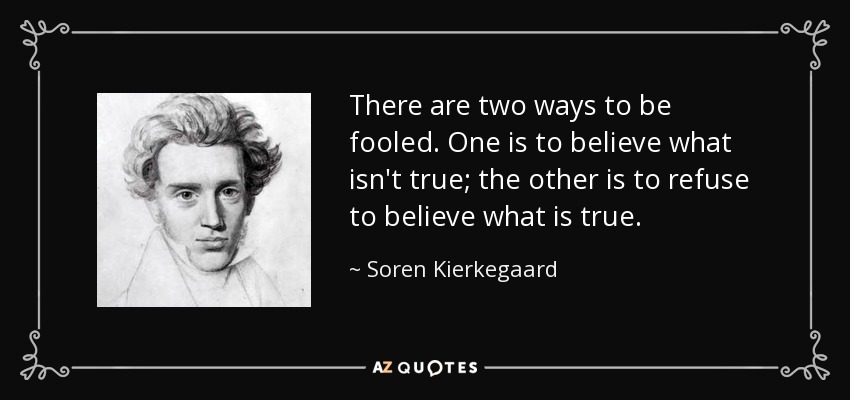
Soren Kierkegaard
b. 5.5.1813 Copenhagen, Denmark
d. 11.11.1855 Copenhagen, Denmark
Soren Kierkegaard was a Danish philosopher, theologian, poet, social critic and religious author. He wrote in the Danish “golden age” of intellectual and artistic activity. He is considered to be the first existentialist.
He wrote critical texts on organized religion, Christendom, morality, ethics, psychology and the philosophy of religion. He displayed a fondness for metaphor, irony and parables. Much of his philosophical work dealt with the issue of how one lives as a "single individual." He highlighted the importance of personal choice and commitment in giving priority to human reality over abstract thought.
He was a Lutheran Protestant. He decided not to become a pastor or a professor because if he had he would have had to write under the authority of the State or the Church. He wrote on Christian ethics, the institution of the Church, the differences between purely objective proofs of Christianity, the infinite qualitative distinction between man and God and the individual's subjective relationship to the God-Man Jesus the Christ which came through faith.
He was critical of the practice of Christianity as a state religion primarily in the Church of Denmark. His psychological work explored the emotions and feelings of individuals when faced with life choices.
He wrote that science and scholarship want to teach that objectivity is the way to live life. He argued that Christianity teaches that the way is to become subjective to become a subject. Scientists learn from the world by observation, but observation could not reveal the inner workings of the world of the spirit.
His key ideas included the concept of "subjective and objective truths", the knight of faith, the recollection and repetition dichotomy, angst, the infinite qualitative distinction, faith as a passion and the three stages on life's way.
His core goal in social criticism was to renew faith within Christendom.
He wrote in Danish. The reception of his work was initially limited to Scandinavia, but by the turn of the 20th century his writings were translated into French, German and other major European languages. His thought exerted a substantial influence on philosophy, theology and Western culture.
He was born in Denmark in the 19th century.
Copenhagen
Copenhagen is located mostly on the eastern shore of the island of Zealand and partly on the island of Amager. The Oresund or the Sound lies to the east. It is the strait of water that separates Denmark from Sweden and connects the North Sea with the Baltic Sea. The Oresund Bridge connects the city to Malmo, Sweden.
Copenhagen is the capital and most populous city of Denmark. It was originally a Viking fishing village established in the 10th century in the vicinity of what is now Gammel Strand in the center of the city. It became the capital of Denmark in the early 15th century. It consolidated its position as a regional center of power with its institutions, defenses and armed forces beginning in the 17th century.
The city underwent a period of redevelopment after the outbreak of a plague and a fire in the 18th century. This included the construction of the prestigious district of Frederiksstaden under Frederick V. The district is regarded as one of the most important Rococo districts in Europe. Cultural institutions as the Royal Theatre and the Royal Academy of Fine Arts were founded during this period.
The British naval officer, Horatio Nelson, attacked the Dano-Norwegian fleet and bombarded the city in the early 19th century. Rebuilding during the Danish Golden Age brought a Neoclassical look to Copenhagen's architecture. Hans Christian Andersen was a leader of the literary movement with his rendition of the modern fairy tale.
Soren Kierkegaard
Kierkegaard was born to an affluent family in Copenhagen. His mother, Ane Sørensdatter Lund, had served as a maid in the household before marrying his father, Michael Pedersen Kierkegaard.
She was quiet, plain and not formally educated, but she protected her sons, Soren and Peter. Peter later said that his brother preserved many of their mother's words in his written work.
His father was a well-to-do wool merchant from Jutland. He was stern, dry and prosaic in appearance, but he concealed an active imagination which he held into his old age. He was interested in philosophy and often hosted intellectuals at his home.
The young Kierkegaard read the philosophy of Christian Wolff. Wolff was the most eminent German philosopher between Leibniz and Kant. His main achievement was a complete commentary on almost every scholarly subject of his time. He displayed and unfolded knowledge according to his demonstrative-deductive, mathematical method. He represented the peak of Enlightenment rationality in Germany.
Kierkegaard led a somewhat uneventful life. He rarely left his hometown of Copenhagen. He traveled abroad only five times. He went to Berlin four times and once to Sweden.
His prime recreational activities were attending the theater, walking the streets to chat with ordinary people and taking brief carriage jaunts into the surrounding countryside.
He was educated at a prestigious boys’ school (Borgerdydskolen), then attended Copenhagen University where he studied philosophy and theology. He refused to define himself as a philosopher.
He felt that he would constrain himself to speculative knowledge. He wanted to live his life by doing something. He declined to become a Lutheran minister. The Church of Denmark was the official state religion. He was critical of official religion.
Church of Denmark
Lutheran Christianity was established as the state religion with the Reformation in Denmark in 1536. When religious wars swept Europe the harsh persecution of other faiths followed for the next century. Exceptions were granted only to foreign diplomats.
Small circles of clandestine Catholicism prevailed for at least a period in the 16th century. Roman Catholic, Reformed and Jewish congregations were allowed in the new town of Fredericia in Denmark from 1683.
Reformed and Jewish congregations were also allowed in Copenhagen. Non-Lutherans were also allowed in Friedrichstadt and on Nordstrand in Slesvig and in Glückstadt in Holstein. Freedom of religion was introduced in Denmark, but Lutheranism remained the state church with the constitution of 1849.
The Church of Denmark recognizes only two sacraments as in other Lutheran churches. Baptism and the Lord's Supper are the sacraments. These are usually included in the Communion Service. Formerly, individual or shared confession was a condition to receive the Lord's Supper. An official confession ritual still exists, but is now used very rarely.
The reigning monarch is the supreme secular authority in the church.
A religious community does not need any state approval in order to enjoy the freedom of religion granted by the constitution. State-approved congregations (godkendte trossamfund) enjoy several privileges.
They may conduct legal weddings, establish cemeteries and get residence permits for foreign priests. They are exempt from corporate and property tax, may apply for means from the state lottery fund and members may tax-deduct membership fees and presents to the congregation.
Career
Kierkegaard became a writer. He published some of his works using pseudonyms. He signed his own name as author for others. Whether being published under pseudonym or not, Kierkegaard's central writings on religion have included Fear and Trembling and Either/Or, the latter of which is considered to be his magnum opus.
Either/Or was published 20 February 1843. It was mostly written during Kierkegaard's stay in Berlin where he took notes on Schelling's Philosophy of Revelation.
Schelling's Natural Philosophy
Schelling had been the roomate to Hegel during their time of instruction at the university at Tubinger Stift. They later became rivals.
Schelling had been a Lutheran, but he shifted to philosophy to address the larger issue of faith as a perspective on the Absolute. He sought to develop the axioms of Spinoza in a manner meaningful to his society. He had written the Philosophy of Mythology prior to that of revelation. It was part of his thought about how the ideal sprang from the real.
He defined nature as visible Spirit and Spirit as invisible nature. History was a progressive gradually self disclosing revelation of the Absolute. Freedom is in the revelation of evolution as a process.
The Absolute separates itself into conscious and unconscious for the sake of appearance in consciousness. It dwells in the inaccessible light as Eternal Identity for the harmony between the states of mind.
It is interesting speculatively, but there is an aversion to the application of the thought to reality.
Reality is simply the ground for the revelation of the ideal. The power of the individual could be placed over the state or religion for immoral ends. Schelling wasn't as bad as Hegel, but there was at least an indirect connection to the promotion of revolution to obtain political change.
Kierkegaard's Either/Or includes essays of literary and music criticism. There is a set of romantic-like-aphorisms as part of his larger theme of examining the reflective and philosophical structure of faith.
The book was edited by "Victor Eremita." It contained the papers of an unknown "A" and "B" which the pseudonymous author claimed to have discovered in a secret drawer of his secretary.
Eremita had a hard time putting the papers of "A" in order because they were not straightforward. "B"'s papers were arranged in an orderly fashion. Both of these characters were trying to become religious individuals.
Each approached the idea of first love from an esthetic and an ethical point of view. The book is basically an argument about faith and marriage with a short discourse at the end telling them they should stop the argument.
Eremita thinks "B", a judge, makes the most sense. Was "A" code for Schelling and "B" for Fichte? Fichte was the more abstract and intellectual of the two.
The inner and the outer work at odds to conceal the secret joy of why things make sense in the consideration of what the purpose for life is.
Kierkegaard stressed the "how" of Christianity as well as the "how" of book reading in his works rather than the "what". He sought to make philosophy a practical application for the perspective of the individual.
He published three more books about love and faith and several more discourses on 16 October 1843. Fear and Trembling was published under the pseudonym Johannes de Silentio. It was an examination of the anxiety of Abraham with respect for the sacrifice of Isaac.
Repetition is about a Young Man (Søren Kierkegaard) who has anxiety and depression because he feels he has to sacrifice his love for a girl (Regine Olsen) to God. He tries to see if the new science of psychology can help him understand himself. Constantin Constantius, who is the pseudonymous author of that book, is the psychologist.
He published Three Upbuilding Discourses, 1843 under his own name. This dealt specifically with how love can be used to hide things from yourself or others. His writing was an expression of his method for indirect communication.
He questioned whether an individual can know if something is a good gift from God or not. It does not depend upon what one sees, but what one sees depends upon how one sees it. Observation is not just a receiving, a discovering, but also a bringing forth. How the observer is constituted is decisive. God's love is imparted indirectly just as our own.
Finding faith in Christ and putting the understanding to use stops speculation. It is then that one begins to exist in an ethical way that can be defined as religious. The Church should not try to prove Christianity or even defend it. It should help the individual to make a leap of faith. Faith has a place for the person in the love of God.
Kierkegaard's final years were taken up with a sustained attack on the Church of Denmark by means of newspaper articles published in The Fatherland (Fædrelandet) and a series of self-published pamphlets called The Moment (Øjeblikket).
These were also translated as "The Instant". These pamphlets are now included in Kierkegaard's Attack Upon Christendom. The Instant, was translated into German as well as other European languages in 1861 and again in 1896.
He collapsed on the street before the 10th issue ofhis periodical The Moment could be published. He stayed in the hospital for over a month and refused communion. He regarded pastors as mere political officials at the time. They were a niche in society who were clearly not representative of the divine.
He died in Copenhagen in 1855 at 42 years of age. He had been in Frederik's Hospital for over a month. It was thought that complications from a fall he had taken from a tree in his youth may have manifested in illness. It has been suggested by some professors that he died from Pott disease, a form of tuberculosis.
He had thought that the congregation kept the individual from taking responsibility for his or her own relation to God. He defined Christianity as the individual. He felt that the state's control of the Church gave it the mission to increase membership with more power for clergy. This he believed was a corruption of the ideal.
He had felt that Christianity's true purpose was to stress the importance of the individual, not the whole group. The state-church political structure was offensive and detrimental to individuals. Anyone could become a Christian without knowing the meaning of what it was to be Christian.
Unbelieving believers formed a herd mentality in the population without respect for conscience.
His existentialism served as a basis in the formation of Chrisitan socialism. It's a degenerative societal position.
Soren Kierkegaard
S. 索伦柯克亚尔
T. 索倫柯克亞爾
索 Suo cable 索 saku cord So そ ソ So 소 small
伦 lun order 倫 rin ethics ren れん レン len 렌 wren
柯 Ke stem 柯 ka handle Ki き キ Ki 키 key
克 ke to restrain 克 koku overcome ru る ル eo 어 uh
亚 qu send away 亞 a rank ke け ケ ke 케 ke
尔 er you 爾 ji you go ご- ゴ- ga 가 end
ru る ル deu 드 de
--------------------------
The reduction of the group to the individual body
is the same as the elevation of the mythical to the godly.
There is a distortion of proportion in the elevation
that loses ethical verity in the moral revelation.
===================
Lectionary: Soren Kierkegaard
wiki Soren Kierkegaard
IEP SK
SEP SK
Theology of SK
wiki Copenhagen
Text for Either/Or
Showing posts with label perception. Show all posts
Sunday, September 1, 2019
Wednesday, August 28, 2019
Find
8.28.19
Find
Refuge
找到避难所
Zhǎodào bìnàn suǒ
避難所を探す
Hinansho o sagasu
ps71
I have taken refuge in my faith.
I look to find reality as the actual case.
Let reality for me act as a guide
to produce a service that will shine as a find.
Let me never be afraid of sensible reason.
Courage uses the light of truth as a beacon.
Responsibility sets me free from fear of the unseen
to seek help in assimilating what has already been seen
as the mean for what's keen.
There is a context in perception beyond personal vision
that shapes perspective for the service of the versatile given.
Knowledge is solid until it finds a better form.
Assimilation or accommodation are resilient norms.
I know what can be known in the way that was shown,
but the shown has to be owned to be as solid as stone.
Organization for automation builds action for success.
Producing a service for others serves as the real test for what's best.
You were known before you were formed in the womb.
Speech was consecrated by maturity to reach beyond the tomb.
Information for nations requires translation to escape doom.
Knowledge of language is a task to be assumed.
If I speak without love,
I am a loud noise from above.
When I speak with love from above
the word is fulfilled with blessing from the heavenly dove.
Principle is used in the search for truth with knowledge.
Proximity to a word develops thought for college.
False principles are to be avoided, not acknowledged.
Wealth is associated with labor for a nation.
Commerce in the world is a subject for international relations.
Private ownership versus government control is a public policy implication.
The graceful darkness reached out to gain prestige
with a self-criticism that challenged the socialist intrigue.
The hemp on the edge of the pasture
served as a meal for the horse that bordered on rapture.
Let reality for me act as a guide
to produce a service that will shine as a find.
I have taken refuge in my faith.
I look to find reality as the actual case.
--------------------------
71 In te, Domine, speravi
In you, Sir, trust
1 In you, O Lord, have I taken refuge;
let me never be ashamed.
---------------------------------
I have taken refuge in my faith.
I look to find reality as the actual case.
========================
2 In your righteousness, deliver me and set me free;
incline your ear to me and save me.
3 Be my strong rock, a castle to keep me safe;
you are my crag and my stronghold.
4 Deliver me, my God, from the hand of the wicked,
from the clutches of the evildoer and the oppressor.
5 For you are my hope, O Lord God,
my confidence since I was young.
6 I have been sustained by you ever since I was born;
from my mother's womb you have been my strength;
my praise shall be always of you.
7 I have become a portent to many;
but you are my refuge and my strength.
8 Let my mouth be full of your praise
and your glory all the day long.
9 Do not cast me off in my old age;
forsake me not when my strength fails.
10 For my enemies are talking against me,
and those who lie in wait for my life take counsel together.
11 They say, "God has forsaken him;
go after him and seize him;
because there is none who will save."
12 O God, be not far from me;
come quickly to help me, O my God.
13 Let those who set themselves against me be put to shame and be disgraced;
let those who seek to do me evil be covered with scorn and reproach.
14 But I shall always wait in patience,
and shall praise you more and more.
15 My mouth shall recount your mighty acts
and saving deeds all day long;
though I cannot know the number of them.
16 I will begin with the mighty works of the Lord God;
I will recall your righteousness, yours alone.
17 O God, you have taught me since I was young,
and to this day I tell of your wonderful works.
18 And now that I am old and gray-headed, O God, do not forsake me,
till I make known your strength to this generation
and your power to all who are to come.
19 Your righteousness, O God, reaches to the heavens;
you have done great things;
who is like you, O God?
20 You have showed me great troubles and adversities,
but you will restore my life
and bring me up again from the deep places of the earth.
21 You strengthen me more and more;
you enfold and comfort me,
22 Therefore I will praise you upon the lyre for your
faithfulness, O my God;
I will sing to you with the harp, O Holy One of Israel.
23 My lips will sing with joy when I play to you,
and so will my soul, which you have redeemed.
24 My tongue will proclaim your righteousness all day long,
for they are ashamed and disgraced who sought to do me harm.
-----------------------
9.8
Experience
The search for knowledge from the experience of others extends into knowledge beyond personal experience.
John Locke
b. 8.29.1632 Wrington, Somerset, England
d. 10.28.1704 High Laver, Essex, England
John Locke was an English philosopher and physician. He grew up and lived through one of the most extraordinary centuries of English political and intellectual history.
It was a century in which conflicts between the Crown and Parliament overlapped with those between Protestants, Anglicans and Catholics. The conflicts swirled into civil war in the 1640's.
He is considered one of the first of the British empiricists. He is commonly known as the Father of Liberalism. His writings on social contract theory influenced Voltaire, Jean-Jacques Rousseau, many Scottish Enlightenment thinkers and the American revolutionaries.
Locke's theory of mind has been cited as the origin of modern conceptions of identity and the self. These concepts figured prominently in the work of later philosophers such as David Hume, Rousseau and Immanuel Kant.
Locke was the first to define the self through a continuity of consciousness. The mind was a blank slate or tabula rasa at birth. He maintained that we are born without innate ideas. This ran contrary to Cartesian philosophy based on pre-existing concepts. Knowledge was instead determined only by experience derived from sense perception.
He has not only been identified as the founder of British empiricism, he has been thought to be the most influential of Enlightenment thinkers.
Wrington
Wrington is a village in North Somerset, England. It is in the south west corner of the island.
Somerset is a rural county with rolling hills and large flat expanses of land.
The Church of All Saints has 13th-century foundations. It was remodelled with the addition of a west tower about 1450. There was a restoration in 1859 and further restoration of the tower in 1948.
The church includes stone busts to John Locke and Hannah More on either side of the door dating from the early 19th century.
John Locke
John Locke was born on 29 August 1632, in a small thatched cottage by the church in Wrington, Somerset, about 12 miles from Bristol. He was baptised the same day.
The family moved to the market town of Pensford about 7 miles south of Bristol soon after Locke's birth. He grew up in a rural Tudor house in Belluton.
John Locke was born to Puritan parents of modest means. His mother was Agnes Keene.
His father was a country lawyer who served in a cavalry company on the Puritan side in the early stages of the English Civil War.
His father’s commander, Alexander Popham, became the local MP. It was his patronage which allowed the young John to gain an excellent education. He went to Westminster School in London in 1647.
John went to Christ Church, Oxford from Westminster in the autumn of 1652 at the age of 20. Just as Westminster school was the most important English school, Christ Church was the most important Oxford college.
Locke was awarded a bachelor's degree in February 1656, a master's degree in June 1658 and a bachelor of medicine in February 1675. He studied medicine extensively during his time at Oxford and worked with such noted scientists and thinkers as Robert Boyle and Robert Hooke.
He met Lord Anthony Ashley Cooper, 1st Earl of Shaftesbury in 1666. Cooper had come to Oxford seeking treatment for a liver infection. He was impressed with Locke and persuaded him to become part of his retinue.
Locke had been looking for a career. He moved into Shaftesbury's home at Exeter House in London to serve as Lord Ashley's personal physician in 1667. He resumed his medical studies under the tutelage of Thomas Sydenham in London.
Sydenham had a major effect on Locke's natural philosophical thought. The effect would become evident in An Essay Concerning Human Understanding. Sydenham would eventually come to be called the English Hippocrates.
The essay was one of the principal sources of empiricism in modern philosophy. The first book refuted the rationalist notion of innate ideas. The second set forth the theory of ideas.
A distinction was drawn between simple and complex ideas. Simple qualities such as "red," "sweet," "round," etc were used to build complex abstractions such as numbers, causes and effects, abstract ideas, ideas of substances, identity and diversity.
The primary qualities of bodies like shape, motion and the arrangement of minute particles are distinct from the secondary qualities that produce various sensations like sweetness. Secondary qualities are dependent upon the primary.
Locke considered personal identity or the self to be founded on consciousness by way of memory. It was not the substance of either the soul or the body.
Book III is concerned with language. Book IV describes knowledge in intuition, mathematics, moral philosophy, natural philosophy ("science"), faith and opinion.
Locke's medical knowledge was put to the test when Shaftesbury's life was threatened by the liver infection. Locke coordinated the advice of several physicians.
He was probably instrumental in persuading Shaftesbury to undergo surgery to remove the cyst. Surgery was life-threatening itself. Shaftesbury survived and prospered. He credited Locke with saving his life.
Locke served as Secretary of the Board of Trade and Plantations during this time. He was the Secretary to the Lords Proprietors of Carolina. It helped to shape his ideas on international trade and economics.
Shaftesbury was a founder of the Whig movement, exerted great influence on Locke's political ideas. The Whigs' origin lay in constitutional monarchism and opposition to absolute monarchy. The position against Hobbes as an advocate for absolute monarchy was a straw man fallacy.
The Whigs played a central role in the Glorious Revolution of 1688. They were the standing enemies of the Stuart kings who were Roman Catholic. They supported the slave trade and slavery for the colonies.
Locke became involved in politics when Shaftesbury became Lord Chancellor in 1672. He spent some time traveling across France as tutor and medical attendant to Caleb Banks following Shaftesbury's fall from favor in 1675.
He returned to England in 1679 when Shaftesbury's political fortunes took a brief positive turn. Locke composed the bulk of the Two Treatises of Government around this time most likely at Shaftesbury's recommendation.
The First Treatise attacks patriarchalism in the form of a refutation of Robert Filmer's Patriarcha. The Second Treatise outlines Locke's ideas for a more civilized society based on natural rights and contract theory.
Two Treatises was first published, anonymously, in December 1689. It was translated into French by David Mazzel in 1691. Mazzel was a French Huguenot living in the Netherlands. The translation left out Locke's "Preface," all of the First Treatise and the first chapter of the Second Treatise which summarized Locke's conclusions in the First Treatise.
It was in this form that Locke's work was reprinted during the 18th century in France. Montesquieu, Voltaire and Rousseau were exposed to this translation.
The only American edition from the 18th century was printed in 1773 in Boston. It left out the same sections. There were no other American editions until the 20th century.
The First Treatise is focused on the refutation of the Patriarcha of Sir Robert Filmer. Filmer had argued that civil society was founded on a divinely sanctioned patriarchalism.
Locke proceeded through Filmer's arguments, contested his proofs from Scripture and ridiculed them as senseless. He concluded that no government can be justified by an appeal to the divine right of kings.
Filmer and Locke represented their incarnation of the debate based on the differences of Plato and Aristotle. Plato favored the description of the deity as Absolute, whereas Aristotle concerned himself with universal conditions that explicitly tolerated slavery as an elevation of civilized over primitive society.
The Second Treatise outlined a theory of civil society. Locke began by describing the state of nature with a picture that was more stable than that presented by Thomas Hobbes. Hobbes had described nature without government as a state of "war of every man against every man."
Locke argued that all men are created equal by God in the state of nature. He explained from this the rise of property and civilization. The only legitimate governments are those that have the consent of the people. Any government that rules without the consent can be overthrown as had been the case in the "Glorious Revolution."
While Locke presented an argument that sounded like it was more reasonable, he made some radically liberal statements that are still used to influence foreign and domestic policy in contemporary western society.
The "consent of the people" was a perception that could be manipulated with media expression. Stories could be told to 'inform' the public that other governments did not satisfy the condition of consent.
The claim of the violation of civil or human rights was used to suggest that the government was not civil. If it was not civil, it was tyrannical and warranted rebellion towards the end of regime change.
The media expression was made to 'check' to see if the public would protest taxation to overthrow the foreign power.
This was where the doctrine for destruction became especially devisive.
The State of War
https://oll.libertyfund.org/pages/john-locke-two-treatises-1689
Locke used an argument against somebody else to implicate Hobbes as an advocate for absolute monarchy.
Louis XIV had used the statement "I am the state" to manage the affairs of France for 72 years. He instituted some changes in his rule that refused to delegate authority in the customary way.
It is probably more appropriate to associate the idea of the absolute with the philosophy of Plato and the universal with that of Aristotle, than with the political philosophy of Hobbes.
It is appropriate to question the particular use of the concepts of absolute or universal authority with respect to human application.
The law against murder is still regarded as an absolute. The prohibition of killing someone else is not absolute or universal insofar as lethal defense against a deadly attack is regarded as an exception to the general prohibition.
Locke documented a number of reasonable provisions with respect for government for the Earl of Shaftesbury. The Whigs were the political forum for the Puritans.
They enacted the English Bill of Rights for their demographic representation. The expression is much too particular for modern standards of legality, but there were advances in legislative initiatives that have come to be be recognized as standard for constitutional government for monarchy or republic.
When Locke wrote about the state of war, he made the statement that he had the right to destroy anyone who had the intent to destroy him.
State of War S.16
Two Treatises on Civil Government: 2d Treatise
"THE state of war is a state of enmity and destruction...I should have a right to destroy that which threatens me with destruction: for, by the fundamental law of nature, man being to be preserved as much as possible, when all cannot be preserved, the safety of the innocent is to be preferred: and one may destroy a man who makes war upon him, or has discovered an enmity to his being..."
--------------------------
The statement in itself alludes to something that is correct, but the assertion that there is a right to destroy implied a proposal to enslave those who had yet to adopt settlement and private property as manifestations of civil society. The proposal was used in a general application to subject primitive people to slavery with respect for universal law.
The primitive lifestyle was taken to represent a threat to the extension of civilized society into primitive territories. Natives in invaded lands were given the 'choice' to work as slaves, or the suffer indefinite war against any indication of opposition to expansion.
The Whig support for slavery, aristocracy and serfdom was documented in the Carolina Constitutions. The document was co-authored by Locke. The extension of civilized society would not have been as rapid without the provisions, but it would not have been as offensive with respect for the inclusion of primitive people into civilized society.
Locke fled to the Netherlands in 1683. He had time to return to his writing. He spent time re-writing the Essay on Human Understanding and composing the Letter on Toleration. Locke did not return home until after the Glorious Revolution.
King James II of England (VII of Scotland) was overthrown in 1688 by a union of Parliamentarians and the stadtholder of the Dutch Republic William III of Oranje-Nassau (William of Orange).
The decision to retain a monarch a resulted in his ascension to the English throne as William III of England. He ruled jointly with Mary II, as Protestants. Mary was the daughter of James II. She had a strong claim the English Throne.
Locke claimed in the "Preface" to the Two Treatises that its purpose was to justify William III's ascension to the throne.
Locke's close friend Lady Masham invited him to join her at Otes, the Mashams' country house in Essex. His time there was marked by variable health from asthma attacks. He became an intellectual hero of the Whigs nevertheless. He discussed matters with such figures as John Dryden and Isaac Newton during this time.
He died on 28 October 1704 at HIgh Laver in Essex at 72 years of age. He was buried in the churchyard of the village of High Laver, east of Harlow in Essex, where he had lived in the household of Sir Francis Masham since 1691. Locke never married nor had children.
Events that happened during Locke's lifetime include the English Restoration, the Great Plague of London and the Great Fire of London. He did not quite see the Act of Union of 1707, though the thrones of England and Scotland were held in personal union throughout his life. Constitutional monarchy and parliamentary democracy were in their infancy during his time.
John Locke
wiki John Locke
IEP Locke
SEP Locke Political Philosophy
Text: Two Treatises on Civil Government
Liberty Fund txt
Adelaide E-Books
Commentary
SparkNotes
Locke Library
Liberty Fund
Felons in Sanctuary Cities
Convicted felons who have crossed the border illegally ought to be deported.
The restriction of the purchase of a gun for an illegal immigrant is not secure enough as a measure for law enforcement.
The idea of sanctuary from prosecution extends back to questionable belief in the sanctity of providing sanctuary for the enemy of my enemy. It was allowed for local administration by the Catholic Church, but the notion of universal law was attached by way of overstatement.
Locke expressed an argument for sanctuary that was overextended as well.
He wrote in his Second Treatise "I doubt not but this will seem a very strange doctrine to some men: but before they condemn it, I desire them to resolve me, by what right any prince or state can put to death, or punish an alien, for any crime he commits in their country."
(https://oll.libertyfund.org/pages/john-locke-two-treatises-1689, S.9)
The expression "their country" is ambiguous. It suggests that law enforcement can't even punish a felon seeking sanctuary in their homeland. The felon could commit a crime in his own country, then immigrate to another to escape prosecution where the liberal ethic would protect him from prosecution for further criminal action.
This liberal doctrine has been aggressively promoted by leading Democrats who seek to tax citizens to pay for the prevention of extradition or deportation.
Find
Refuge
找到避难所
Zhǎodào bìnàn suǒ
避難所を探す
Hinansho o sagasu
ps71
I have taken refuge in my faith.
I look to find reality as the actual case.
Let reality for me act as a guide
to produce a service that will shine as a find.
Let me never be afraid of sensible reason.
Courage uses the light of truth as a beacon.
Responsibility sets me free from fear of the unseen
to seek help in assimilating what has already been seen
as the mean for what's keen.
There is a context in perception beyond personal vision
that shapes perspective for the service of the versatile given.
Knowledge is solid until it finds a better form.
Assimilation or accommodation are resilient norms.
I know what can be known in the way that was shown,
but the shown has to be owned to be as solid as stone.
Organization for automation builds action for success.
Producing a service for others serves as the real test for what's best.
You were known before you were formed in the womb.
Speech was consecrated by maturity to reach beyond the tomb.
Information for nations requires translation to escape doom.
Knowledge of language is a task to be assumed.
If I speak without love,
I am a loud noise from above.
When I speak with love from above
the word is fulfilled with blessing from the heavenly dove.
Principle is used in the search for truth with knowledge.
Proximity to a word develops thought for college.
False principles are to be avoided, not acknowledged.
Wealth is associated with labor for a nation.
Commerce in the world is a subject for international relations.
Private ownership versus government control is a public policy implication.
The graceful darkness reached out to gain prestige
with a self-criticism that challenged the socialist intrigue.
The hemp on the edge of the pasture
served as a meal for the horse that bordered on rapture.
Let reality for me act as a guide
to produce a service that will shine as a find.
I have taken refuge in my faith.
I look to find reality as the actual case.
--------------------------
71 In te, Domine, speravi
In you, Sir, trust
1 In you, O Lord, have I taken refuge;
let me never be ashamed.
---------------------------------
I have taken refuge in my faith.
I look to find reality as the actual case.
========================
2 In your righteousness, deliver me and set me free;
incline your ear to me and save me.
3 Be my strong rock, a castle to keep me safe;
you are my crag and my stronghold.
4 Deliver me, my God, from the hand of the wicked,
from the clutches of the evildoer and the oppressor.
5 For you are my hope, O Lord God,
my confidence since I was young.
6 I have been sustained by you ever since I was born;
from my mother's womb you have been my strength;
my praise shall be always of you.
7 I have become a portent to many;
but you are my refuge and my strength.
8 Let my mouth be full of your praise
and your glory all the day long.
9 Do not cast me off in my old age;
forsake me not when my strength fails.
10 For my enemies are talking against me,
and those who lie in wait for my life take counsel together.
11 They say, "God has forsaken him;
go after him and seize him;
because there is none who will save."
12 O God, be not far from me;
come quickly to help me, O my God.
13 Let those who set themselves against me be put to shame and be disgraced;
let those who seek to do me evil be covered with scorn and reproach.
14 But I shall always wait in patience,
and shall praise you more and more.
15 My mouth shall recount your mighty acts
and saving deeds all day long;
though I cannot know the number of them.
16 I will begin with the mighty works of the Lord God;
I will recall your righteousness, yours alone.
17 O God, you have taught me since I was young,
and to this day I tell of your wonderful works.
18 And now that I am old and gray-headed, O God, do not forsake me,
till I make known your strength to this generation
and your power to all who are to come.
19 Your righteousness, O God, reaches to the heavens;
you have done great things;
who is like you, O God?
20 You have showed me great troubles and adversities,
but you will restore my life
and bring me up again from the deep places of the earth.
21 You strengthen me more and more;
you enfold and comfort me,
22 Therefore I will praise you upon the lyre for your
faithfulness, O my God;
I will sing to you with the harp, O Holy One of Israel.
23 My lips will sing with joy when I play to you,
and so will my soul, which you have redeemed.
24 My tongue will proclaim your righteousness all day long,
for they are ashamed and disgraced who sought to do me harm.
-----------------------
9.8
Experience
The search for knowledge from the experience of others extends into knowledge beyond personal experience.
John Locke
b. 8.29.1632 Wrington, Somerset, England
d. 10.28.1704 High Laver, Essex, England
John Locke was an English philosopher and physician. He grew up and lived through one of the most extraordinary centuries of English political and intellectual history.
It was a century in which conflicts between the Crown and Parliament overlapped with those between Protestants, Anglicans and Catholics. The conflicts swirled into civil war in the 1640's.
He is considered one of the first of the British empiricists. He is commonly known as the Father of Liberalism. His writings on social contract theory influenced Voltaire, Jean-Jacques Rousseau, many Scottish Enlightenment thinkers and the American revolutionaries.
Locke's theory of mind has been cited as the origin of modern conceptions of identity and the self. These concepts figured prominently in the work of later philosophers such as David Hume, Rousseau and Immanuel Kant.
Locke was the first to define the self through a continuity of consciousness. The mind was a blank slate or tabula rasa at birth. He maintained that we are born without innate ideas. This ran contrary to Cartesian philosophy based on pre-existing concepts. Knowledge was instead determined only by experience derived from sense perception.
He has not only been identified as the founder of British empiricism, he has been thought to be the most influential of Enlightenment thinkers.
Wrington
Wrington is a village in North Somerset, England. It is in the south west corner of the island.
Somerset is a rural county with rolling hills and large flat expanses of land.
The Church of All Saints has 13th-century foundations. It was remodelled with the addition of a west tower about 1450. There was a restoration in 1859 and further restoration of the tower in 1948.
The church includes stone busts to John Locke and Hannah More on either side of the door dating from the early 19th century.
John Locke
John Locke was born on 29 August 1632, in a small thatched cottage by the church in Wrington, Somerset, about 12 miles from Bristol. He was baptised the same day.
The family moved to the market town of Pensford about 7 miles south of Bristol soon after Locke's birth. He grew up in a rural Tudor house in Belluton.
John Locke was born to Puritan parents of modest means. His mother was Agnes Keene.
His father was a country lawyer who served in a cavalry company on the Puritan side in the early stages of the English Civil War.
His father’s commander, Alexander Popham, became the local MP. It was his patronage which allowed the young John to gain an excellent education. He went to Westminster School in London in 1647.
John went to Christ Church, Oxford from Westminster in the autumn of 1652 at the age of 20. Just as Westminster school was the most important English school, Christ Church was the most important Oxford college.
Locke was awarded a bachelor's degree in February 1656, a master's degree in June 1658 and a bachelor of medicine in February 1675. He studied medicine extensively during his time at Oxford and worked with such noted scientists and thinkers as Robert Boyle and Robert Hooke.
He met Lord Anthony Ashley Cooper, 1st Earl of Shaftesbury in 1666. Cooper had come to Oxford seeking treatment for a liver infection. He was impressed with Locke and persuaded him to become part of his retinue.
Locke had been looking for a career. He moved into Shaftesbury's home at Exeter House in London to serve as Lord Ashley's personal physician in 1667. He resumed his medical studies under the tutelage of Thomas Sydenham in London.
Sydenham had a major effect on Locke's natural philosophical thought. The effect would become evident in An Essay Concerning Human Understanding. Sydenham would eventually come to be called the English Hippocrates.
The essay was one of the principal sources of empiricism in modern philosophy. The first book refuted the rationalist notion of innate ideas. The second set forth the theory of ideas.
A distinction was drawn between simple and complex ideas. Simple qualities such as "red," "sweet," "round," etc were used to build complex abstractions such as numbers, causes and effects, abstract ideas, ideas of substances, identity and diversity.
The primary qualities of bodies like shape, motion and the arrangement of minute particles are distinct from the secondary qualities that produce various sensations like sweetness. Secondary qualities are dependent upon the primary.
Locke considered personal identity or the self to be founded on consciousness by way of memory. It was not the substance of either the soul or the body.
Book III is concerned with language. Book IV describes knowledge in intuition, mathematics, moral philosophy, natural philosophy ("science"), faith and opinion.
Locke's medical knowledge was put to the test when Shaftesbury's life was threatened by the liver infection. Locke coordinated the advice of several physicians.
He was probably instrumental in persuading Shaftesbury to undergo surgery to remove the cyst. Surgery was life-threatening itself. Shaftesbury survived and prospered. He credited Locke with saving his life.
Locke served as Secretary of the Board of Trade and Plantations during this time. He was the Secretary to the Lords Proprietors of Carolina. It helped to shape his ideas on international trade and economics.
Shaftesbury was a founder of the Whig movement, exerted great influence on Locke's political ideas. The Whigs' origin lay in constitutional monarchism and opposition to absolute monarchy. The position against Hobbes as an advocate for absolute monarchy was a straw man fallacy.
The Whigs played a central role in the Glorious Revolution of 1688. They were the standing enemies of the Stuart kings who were Roman Catholic. They supported the slave trade and slavery for the colonies.
Locke became involved in politics when Shaftesbury became Lord Chancellor in 1672. He spent some time traveling across France as tutor and medical attendant to Caleb Banks following Shaftesbury's fall from favor in 1675.
He returned to England in 1679 when Shaftesbury's political fortunes took a brief positive turn. Locke composed the bulk of the Two Treatises of Government around this time most likely at Shaftesbury's recommendation.
The First Treatise attacks patriarchalism in the form of a refutation of Robert Filmer's Patriarcha. The Second Treatise outlines Locke's ideas for a more civilized society based on natural rights and contract theory.
Two Treatises was first published, anonymously, in December 1689. It was translated into French by David Mazzel in 1691. Mazzel was a French Huguenot living in the Netherlands. The translation left out Locke's "Preface," all of the First Treatise and the first chapter of the Second Treatise which summarized Locke's conclusions in the First Treatise.
It was in this form that Locke's work was reprinted during the 18th century in France. Montesquieu, Voltaire and Rousseau were exposed to this translation.
The only American edition from the 18th century was printed in 1773 in Boston. It left out the same sections. There were no other American editions until the 20th century.
The First Treatise is focused on the refutation of the Patriarcha of Sir Robert Filmer. Filmer had argued that civil society was founded on a divinely sanctioned patriarchalism.
Locke proceeded through Filmer's arguments, contested his proofs from Scripture and ridiculed them as senseless. He concluded that no government can be justified by an appeal to the divine right of kings.
Filmer and Locke represented their incarnation of the debate based on the differences of Plato and Aristotle. Plato favored the description of the deity as Absolute, whereas Aristotle concerned himself with universal conditions that explicitly tolerated slavery as an elevation of civilized over primitive society.
The Second Treatise outlined a theory of civil society. Locke began by describing the state of nature with a picture that was more stable than that presented by Thomas Hobbes. Hobbes had described nature without government as a state of "war of every man against every man."
Locke argued that all men are created equal by God in the state of nature. He explained from this the rise of property and civilization. The only legitimate governments are those that have the consent of the people. Any government that rules without the consent can be overthrown as had been the case in the "Glorious Revolution."
While Locke presented an argument that sounded like it was more reasonable, he made some radically liberal statements that are still used to influence foreign and domestic policy in contemporary western society.
The "consent of the people" was a perception that could be manipulated with media expression. Stories could be told to 'inform' the public that other governments did not satisfy the condition of consent.
The claim of the violation of civil or human rights was used to suggest that the government was not civil. If it was not civil, it was tyrannical and warranted rebellion towards the end of regime change.
The media expression was made to 'check' to see if the public would protest taxation to overthrow the foreign power.
This was where the doctrine for destruction became especially devisive.
The State of War
https://oll.libertyfund.org/pages/john-locke-two-treatises-1689
Locke used an argument against somebody else to implicate Hobbes as an advocate for absolute monarchy.
Louis XIV had used the statement "I am the state" to manage the affairs of France for 72 years. He instituted some changes in his rule that refused to delegate authority in the customary way.
It is probably more appropriate to associate the idea of the absolute with the philosophy of Plato and the universal with that of Aristotle, than with the political philosophy of Hobbes.
It is appropriate to question the particular use of the concepts of absolute or universal authority with respect to human application.
The law against murder is still regarded as an absolute. The prohibition of killing someone else is not absolute or universal insofar as lethal defense against a deadly attack is regarded as an exception to the general prohibition.
Locke documented a number of reasonable provisions with respect for government for the Earl of Shaftesbury. The Whigs were the political forum for the Puritans.
They enacted the English Bill of Rights for their demographic representation. The expression is much too particular for modern standards of legality, but there were advances in legislative initiatives that have come to be be recognized as standard for constitutional government for monarchy or republic.
When Locke wrote about the state of war, he made the statement that he had the right to destroy anyone who had the intent to destroy him.
State of War S.16
Two Treatises on Civil Government: 2d Treatise
"THE state of war is a state of enmity and destruction...I should have a right to destroy that which threatens me with destruction: for, by the fundamental law of nature, man being to be preserved as much as possible, when all cannot be preserved, the safety of the innocent is to be preferred: and one may destroy a man who makes war upon him, or has discovered an enmity to his being..."
--------------------------
The statement in itself alludes to something that is correct, but the assertion that there is a right to destroy implied a proposal to enslave those who had yet to adopt settlement and private property as manifestations of civil society. The proposal was used in a general application to subject primitive people to slavery with respect for universal law.
The primitive lifestyle was taken to represent a threat to the extension of civilized society into primitive territories. Natives in invaded lands were given the 'choice' to work as slaves, or the suffer indefinite war against any indication of opposition to expansion.
The Whig support for slavery, aristocracy and serfdom was documented in the Carolina Constitutions. The document was co-authored by Locke. The extension of civilized society would not have been as rapid without the provisions, but it would not have been as offensive with respect for the inclusion of primitive people into civilized society.
Locke fled to the Netherlands in 1683. He had time to return to his writing. He spent time re-writing the Essay on Human Understanding and composing the Letter on Toleration. Locke did not return home until after the Glorious Revolution.
King James II of England (VII of Scotland) was overthrown in 1688 by a union of Parliamentarians and the stadtholder of the Dutch Republic William III of Oranje-Nassau (William of Orange).
The decision to retain a monarch a resulted in his ascension to the English throne as William III of England. He ruled jointly with Mary II, as Protestants. Mary was the daughter of James II. She had a strong claim the English Throne.
Locke claimed in the "Preface" to the Two Treatises that its purpose was to justify William III's ascension to the throne.
Locke's close friend Lady Masham invited him to join her at Otes, the Mashams' country house in Essex. His time there was marked by variable health from asthma attacks. He became an intellectual hero of the Whigs nevertheless. He discussed matters with such figures as John Dryden and Isaac Newton during this time.
He died on 28 October 1704 at HIgh Laver in Essex at 72 years of age. He was buried in the churchyard of the village of High Laver, east of Harlow in Essex, where he had lived in the household of Sir Francis Masham since 1691. Locke never married nor had children.
Events that happened during Locke's lifetime include the English Restoration, the Great Plague of London and the Great Fire of London. He did not quite see the Act of Union of 1707, though the thrones of England and Scotland were held in personal union throughout his life. Constitutional monarchy and parliamentary democracy were in their infancy during his time.
John Locke
wiki John Locke
IEP Locke
SEP Locke Political Philosophy
Text: Two Treatises on Civil Government
Liberty Fund txt
Adelaide E-Books
Commentary
SparkNotes
Locke Library
Liberty Fund
Felons in Sanctuary Cities
Convicted felons who have crossed the border illegally ought to be deported.
The restriction of the purchase of a gun for an illegal immigrant is not secure enough as a measure for law enforcement.
The idea of sanctuary from prosecution extends back to questionable belief in the sanctity of providing sanctuary for the enemy of my enemy. It was allowed for local administration by the Catholic Church, but the notion of universal law was attached by way of overstatement.
Locke expressed an argument for sanctuary that was overextended as well.
He wrote in his Second Treatise "I doubt not but this will seem a very strange doctrine to some men: but before they condemn it, I desire them to resolve me, by what right any prince or state can put to death, or punish an alien, for any crime he commits in their country."
(https://oll.libertyfund.org/pages/john-locke-two-treatises-1689, S.9)
The expression "their country" is ambiguous. It suggests that law enforcement can't even punish a felon seeking sanctuary in their homeland. The felon could commit a crime in his own country, then immigrate to another to escape prosecution where the liberal ethic would protect him from prosecution for further criminal action.
This liberal doctrine has been aggressively promoted by leading Democrats who seek to tax citizens to pay for the prevention of extradition or deportation.
Friday, August 16, 2019
Shine
8.17
Fused Glass Bowl
Shine
Bright
闪耀着光芒
Shǎnyàozhe guāngmáng
明るく輝く
Akaruku kagayaku
ps107
Clare splendere
The broken bowl bell
held food quite well
until it fell.
The squeaking squeal from the wheel
yields wealth in health appeal
from the way the appeal feels.
Mop up the mess.
It's part of the test.
Sweep up the ceramic.
You won't have to panic.
This piece was shaped like a diamond.
My mind looked to the horizon.
A diamond shines bright
with the facets of light’s life
in a mind with insight.
She smiles for miles
with the delight of her sight.
Diamonds start as coal.
Earth is the source for the intense force that cajoles
the carbon in its moles to make tiny holes
extol less space for lex taste holding the philosopher’s stone
as a blown tome now known
as the most remarkable clone.
Opaque matter, darker than night,
becomes transparent, shining sparkles in light.
Hardship hardens your core for sure
to make your heart shine as pure.
Purity is the cure that lures.
Performers stay healthy
so their products are wealthy.
The best work smart with rested heart
for the next test to start.
These followed their food.
These chopped what the beaver chewed.
These grew what they could.
These shot from where they stood.
These worked in mines.
These hunted from blinds.
These worked in fields.
These negotiated deals.
These squealed for appeals.
These worked in a factory.
These made customers happy.
These worked in the field.
'No mind' was their shield.
Mugwort and hemp
healed that which was bent.
The redeemer’s redemption came
by correction in detention for those who lost their way to fame
and became lame with respect for the rules of the game
These formed conception with education
to avoid the deception of perception
by the sensation of the senses.
All these weathered the storm;
while these struggled through thorns.
These strengthened their homes
while these burned diseased bones.
When the mist came with Spring.
these felt they had to travel and sing.
When they strayed from the path
they became children of wrath.
They rode and they fought.
They forgot what they had been taught.
Some went to the sea to travel in ships
to ply their trade without loose lips.
They moved straight on the ocean
when the crab didn't make the motion.
They beheld the wonders of the deep.
Things went so well they felt that they could weep.
Then a storm bossed the wind and the waves of the sea.
They rose so high they tossed the ship like a flea on a sheep.
The ship mounted the heavens then fell back to the depths.
Their hearts melted groan. Some actually wept.
They staggered and fell like the most practiced of drunkards.
They looked to the sky and prayed for their mothers.
The wind carried their prayer to the height of the sky.
They were delivered from the storm as if by their cry.
The storm was stilled to a whispering purr.
The sea felt so soft she seemed like the cure.
They all felt glad because of the calm of the sea.
The harbor they made soothed them like the balm of morality.
Let them give thanks for the love of sweet mercy.
The sailors were saved from wet death with the thirst for eternity.
The Redeemer redeemed lost time as the story.
Joy was embraced as a parcel of glory.
The weather is the greatest of friends
or the worst to offend.
We accomplish all things with the goodness of weather.
Natural disaster destroys anything, but buh-bling or bird feathers.
A silver cord streams
from the container of dreams.
We were made to be loved
with light from above.
A nation without borders isn't secure.
The strength of security gives length to endure.
Citizens carry rights that are earned as learned.
Participation in the media tests substance affirmed.
Legal immigration is a start on the path
to the blessing that heaven grants beyond wrath.
Conservative policy insists on a balance
between foreign and domestic investment in talents.
The ethics of morality in law
has a measure in the observation of what you draw.
Drink truth deep from your heart before sleep.
It will help you keep what you seek
looking sleek.
Shine like a diamond.
You will be alive then.
You won’t feel like a siren
on an island off the horizon.
------------------------
Psalm 107
Part I
Confitemini Domino
Acknowledge Mastery
1 Give thanks to the Lord, for he is good,
and his mercy endures for ever.
2 Let all those whom the Lord has redeemed proclaim
that he redeemed them from the hand of the foe.
3 He gathered them out of the lands;
from the east and from the west,
from the north and from the south.
4 Some wandered in desert wastes;
they found no way to a city where they might dwell.
5 They were hungry and thirsty;
their spirits languished within them.
6 Then they cried to the Lord in their trouble,
and he delivered them from their distress.
7 He put their feet on a straight path
to go to a city where they might dwell.
8 Let them give thanks to the Lord for his mercy
and the wonders he does for his children.
9 For he satisfies the thirsty
and fills the hungry with good things.
10 Some sat in darkness and deep gloom,
bound fast in misery and iron;
11 Because they rebelled against the words of God
and despised the counsel of the Most High.
12 So he humbled their spirits with hard labor;
they stumbled, and there was none to help.
13 Then they cried to the Lord in their trouble,
and he delivered them from their distress.
14 He led them out of darkness and deep gloom
and broke their bonds asunder.
15 Let them give thanks to the Lord for his mercy
and the wonders he does for his children.
16 For he shatters the doors of bronze
and breaks in two the iron bars.
17 Some were fools and took to rebellious ways;
they were afflicted because of their sins.
18 They abhorred all manner of food
and drew near to death's door.
19 Then they cried to the Lord in their trouble,
and he delivered them from their distress.
20 He sent forth his word and healed them
and saved them from the grave.
21 Let them give thanks to the Lord for his mercy
and the wonders he does for his children.
22 Let them offer a sacrifice of thanksgiving
and tell of his acts with shouts of joy.
23 Some went down to the sea in ships
and plied their trade in deep waters;
24 They beheld the works of the Lord
and his wonders in the deep.
25 Then he spoke, and a stormy wind arose,
which tossed high the waves of the sea.
26 They mounted up to the heavens and fell back to the depths;
their hearts melted because of their peril.
27 They reeled and staggered like drunkards
and were at their wits' end.
28 Then they cried to the Lord in their trouble,
and he delivered them from their distress.
29 He stilled the storm to a whisper
and quieted the waves of the sea.
30 Then were they glad because of the calm,
and he brought them to the harbor they were bound for.
31 Let them give thanks to the Lord for his mercy
and the wonders he does for his children.
32 Let them exalt him in the congregation of the people
and praise him in the council of the elders.
-----------------------
David - beloved
Ziba- army
Mephibosheth- mouth of shame
2 Samuel 16:3-4
The king said, 'Where is your master's son?'
Ziba said to the king, 'He remains in Jerusalem. He said, "Today the house of Israel will give me back my grandfather's kingdom."
The king said to Ziba, 'All that belonged to Mephibosheth is now yours.' Ziba said, 'I do obeisance. Let me find favor in your sight, my lord the king.'
-----------------------
A nation without borders isn't secure.
The strength of security gives length to endure.
Conservative policy insists on a balance
between foreign and domestic investment in talents.
=================
Acts 22:27-29
The tribune came and asked Paul, 'Tell me, are you a Roman citizen?' He said, 'Yes.' The tribune answered, 'It cost me a large sum of money to get my citizenship.' Paul said, 'I was born a citizen.' Immediately those who were about to examine him drew back from him. The tribune was also afraid for he realized that Paul was a Roman citizen and he had bound him.
-----------------------
Citizens carry rights that are earned as learned.
Participation in the media tests substance affirmed.
=================
Mark 11:7-10
They brought the colt to Jesus and threw their cloaks on it. He sat on it. Many people spread their cloaks on the road. Others spread leafy branches that they had cut in the fields. Then those who went ahead and those who followed were shouting,
'Hosanna! Blessed is he who comes in the name of the Lord!
Blessed is the coming kingdom of our ancestor David!
Hosanna in the highest heaven!'
-----------------------
Legal immigration is a start on the path
to the blessing that heaven grants beyond wrath.
=================
Posterity
Pierre de Fermat (fair-ma)
b. 10.31.1607 Beaumont-de-Lomagne, France
d. 1.12.1665 Castres, France
Pierre de Fermat was a French lawyer at the Parlement of Toulouse, France. He was also an amateur mathematician.
His exploration of mathematics as a hobby resulted in some major developments for the field of study. He has been given credit for early developments that led to infinitesimal calculus.
He presented the notion of adequality as an approximate equivalence. This broadened the practical application for calculation.
He is recognized for his discovery of an original method of finding the greatest and the smallest ordinates of curved lines. Finding the maxima and minuma is used in differential calculus today.
He made notable contributions to analytic geometry, probability and optics.
He is best known for his principle for light propagation and his Last Theorem in number theory.
His largest contributions to mathematics as a field were in analytic geometry and number theory.
His theorem led to the consideration of the development of exponential notation as a key contribution in either application.
------------------------
It is helpful to consider the state of education during the 17th century to understand how significant Fermat's contributions were.
Grammar, logic and rhetoric were essential to a classical education as explained in Plato's dialogues. The three subjects together were denoted by the word trivium during the Middle Ages. The trivium was fundamental to education in Latin, but the tradition of first learning those three subjects was established in ancient Greece.
The quadrivium consisted of arithmetic, geometry, music and astronomy. These followed the preparatory work of the trivium. The quadrivium was considered the foundation for the study of philosophy (sometimes called the "liberal art par excellence") and theology.
The trivium and the quadrivium comprised the seven liberal arts. The liberal arts presented instruction in the skill of thought. It was distinguished from the practical arts (such as medicine and architecture).
The Renaissance brought an increased emphasis on mathematics and science to Europe. There was period of transition from a sectarian feudal and ecclesiastical culture. There was an increase in the emphasis on a non-sectarian society.
Early Renaissance figures added mathematics to their other occupations. Luca Pacioli was a Franciscan friar who founded accounting. Niccolò Fontana Tartaglia was an invalid with a speech impediment who became a notable engineer and bookkeeper.
Gerolamo Cardano was a doctor of medicine who was also the earliest founder of probability and binomial expansion. Robert Recorde was a physician. François Viète was a lawyer.
Descartes was originally trained as a lawyer, but he acquired greater instruction in mathematics when he studied military engineering in the Netherlands.
The modern form of exponential notation was introduced by Rene Descartes in his text titled La Géométrie early in the 17th century.
Descartes is also widely regarded as one of the founders of modern philosophy. He differed from Aristotle and the revived Stoicism of the 16th century on two major points.
He rejected the splitting of corporeal substance into matter and form. Form and matter are intrinsically interconnected in substance. Aristotle had used the distinction between the two to suggest the difference between the idea of the object and the thing itself. Descartes also rejected any appeal to final ends, divine or natural, in explaining natural phenomena.
His dualism embraced the idea that mind and body are distinct but closely joined. While many contemporary readers of Descartes found the distinction between mind and body difficult to grasp, he thought it was entirely straightforward.
He employed the concept of modes as the ways in which substances exist. He explained in Principles of Philosophy that we cannot understand the mode apart from the substance. The perception of a modal form apart from its substance requires an intellectual abstraction.
Two substances are distinct when each of them can exist apart from the other.
Descartes laid the foundation for the continental rationalism that was later advocated by Spinoza and Leibniz. This was later opposed by the empiricist school of thought consisting of Hobbes, Locke, Berkeley and Hume.
Leibniz, Spinoza and Descartes were well-versed in mathematics as well as philosophy. Descartes and Leibniz contributed greatly to science as well. Spinoza presented an axiomatic argument for constitutional monarchy.
Rene Descartes was born in La Haye en Touraine (now Descartes, Indre-et-Loire), France, on 31 March 1596. His mother, Jeanne Brochard, died soon after giving birth to him. He was not expected to survive. His father, Joachim, was a member of the Parlement of Brittany at Rennes.
René lived with his grandmother and with his great-uncle. Their family was Roman Catholic, but the Poitou region was controlled by the Protestant Huguenots.
The Swiss politician Besançon Hugues had been allied with John Calvin in Geneva. They sought an alliance between the city-state of Geneva and the Swiss Confederation. The label Huguenot was purportedly first applied in France to those conspirators who were involved in the Amboise (am-bwas) plot of 1560 to wrest power from the Catholic House of Guise (gees) in France.
Descartes entered the Jesuit Collège Royal Henry-Le-Grand at La Flèche (flesh) in 1607. It was late because of his fragile health. He was introduced to mathematics and physics. This included Galileo's work.
He studied for two years (1615–16) at the University of Poitiers after graduation in 1614. He earned a Baccalauréat and Licence in canon and civil law in 1616 in accordance with his father's wishes that he should become a lawyer. He moved to Paris from there.
He abandoned the study of letters. He resolved to seek knowledge from himself and the "great book of the world." He spent the rest of his youth traveling, visiting courts and armies, mixing with people of diverse temperaments and ranks, gathering various experiences, testing himself in the situations that fortune offered to reflect upon whatever came his way in order to derive the profit from it.
His ambition was to become a professional military officer. He joined the Protestant Dutch States Army in Breda under the command of Maurice of Nassau as a mercenary in 1618. He undertook the study of military engineering as established by Simon Stevin.
This is the period where he began to gain distinction as a mathematician. The study did not produce mathematicians as such. The field was subordinate to logic or physics at the time. He received much encouragement in Breda to advance his knowledge of mathematics.
He became acquainted with Isaac Beeckman, the principal of a Dordrecht school, in this way. He wrote the Compendium of Music (written 1618, published 1650) for Beeckman. Together they worked on free fall, catenary, conic section and fluid statics. Both believed that it was necessary to create a method that thoroughly linked mathematics and physics.
Descartes was present at the Battle of the White Mountain outside Prague while in the service of the Catholic Duke Maximilian of Bavaria in November 1620. He shut himself in a room with an "oven" (probably a cocklestove) to escape the cold while stationed in Neuburg an der Donau on the night of 10–11 November 1619 (St. Martin's Day).
He had three dreams and believed that a divine spirit revealed to him a new philosophy in the room. He had formulated analytical geometry and the idea of applying the mathematical method to philosophy.
He concluded from these visions that the pursuit of science would prove to be the pursuit of true wisdom and a central part of his life's work. He saw that all truths were linked with one another. The use of logic from the discovery of a fundamental truth would open the way to all science.
He expressed the Latin "Cogito ergo sum" in his native French. It is translated to English as "I think, therefore I am."
He left the army and returned to France in 1620. He was present at the siege of La Rochelle by Cardinal Richelieu in 1627.
He went to listen to a lecture by an alchemist about a new philosophy at the residence of the papal nuncio in the fall of the same year. Cardinal Bérulle urged him to write an exposition of his own new philosophy in some location beyond the reach of the inquisition.
Descartes returned to the Dutch Republic in 1628. He joined the University of Franeker in April 1629. He enrolled at the Leiden University to study mathematics the next year under the name "Poitevan."
He wrote all his major work during his 20-plus years in the Netherlands despite frequent moves. Galileo was condemned by the Italian Inquisition in 1633. Descartes abandoned plans to publish Treatise on the World. He had been working on the publication for the previous four years.
He published parts of this work in three essays in 1637. "Les Météores" (The Meteors), "La Dioptrique" (Dioptrics) and "La Géométrie" (Geometry) took the first important steps in the description of science with math. These essays were preceded by an introduction, his famous Discours de la méthode (Discourse on the Method).
"La Geometrie" laid out the principles and mechanics for the development of analytic geometry. The base definitions and mechanics for his discovery are taught in high school algebra courses in the US. The work included the explanation of exponential notation.
Exponents are shorthand for repeated multiplication of the same thing by itself. The shorthand for multiplying three copies of the number 5 for instance is shown on the right-hand side of the "equals" sign in (5)(5)(5) = 5^3. The notation is read as 5 to the 3d power.
The "exponent" is 3 in this example. It stands for however many times the value is being multiplied. The thing that's being multiplied is 5. It is called the "base".
Analytic geometry would become dependent upon algebraic notation with exponents to formulate the curves that were to be drawn on graphs.
Knowledge of conics had developed the first forms with exponential equations. These forms for open and closed figures were adapted for functions. Functions are graphs of equations that depict growth or diminishment.
The vertices, co-vertices and foci are related by the equation c^ 2 = a^ 2 − b^ 2. When we are given the coordinates of the foci and vertices of an ellipse, we can use the relationship to find the equation of the ellipse in standard form.
An ellipse is a modular form.
Number Theory
Fermat's Last Theorem
No three positive integers a, b and c satisfy the equation a^n + b^n = c^n for any integer value of n greater than 2.
The Note in the Margin
It is not possible for a cube to be the sum of two cubes, a fourth power to be the sum of two fourth powers or in general for any number that is a power greater than the second to be the sum of two like powers. Fermat wrote, "I have discovered a truly marvelous demonstration of this proposition that this margin is too narrow to contain."
The (Not) Proof
A centuries old math mystery may have been cracked by a Princeton professor. His colleagues estimate that only one-tenth of 1 percent of mathematicians could understand his explanation.
Did Fermat have the solution? His skill in mathematics was largely limited to his letters to friends and associates. He didn't write for the public much. His writing about math lacked exposition in certain important regards. He helped define analytic geometry with a work on the topic published before Descartes.
Fermat wrote his marginal note on exponents around 1630 when he first studied Diophantus's Arithmetica. All his other theorems were stated and restated in challenge problems that he sent to other mathematicians. He knew how to answer the special cases of n = 3 and n = 4 as challenges.The general theorem was never mentioned again by Fermat.
No one came up with an example wherein the sum of two cubes resulted in another cube. The sum of two lines can result in a sum with the same power as a line: 1^1 + 2^1 = 3^1. Any addition problem satisfies the condition. The first power is usually not written.
The sum of two squares isn't as easy, unless you count 0^2 as an option: 0^2 + 2^2 = 2^2. Any number of examples can be produced with this device. There are other solutions:
5^2 = 3^2 + 4^2
or
25^2 = 7^2 + 24^2 = 15^2 + 20^2.
There are cases where the sum of three or more cubes equals another cube, but a cube simply can't be divided in two and retain an equal length to the sides around the two halfs of the divided cube.
The lines for the object have to be equal in length by definition. The length of the divided lines will always be half of the distance for the lines that are not divided.
The consideration of geometric solids helped Fermat to rule out the possibility of higher exponential equations. The act of dividing a cube in half demonstrates that two cubes can't be added together to equal another cube. It can't be done.
While it is conceivable that the volume for two cubes could possibly be added together to equal the volume for another, such an equation hasn't been discovered. While this explanation doesn't fit the general criteria for a theoretical proof, it has yet to be disproved.
The proof has only been proved insofar as it remains in a state that has not been disproved.
Godel would eventually argue that this kind of incompleteness is the case with proofs in general. There is always some element in any argument that can not be completely proven. It justifies the attachment of the word 'theoretical' to the argument that qualifies as logically consistent enough to be called a proof.
There is something in the description of reality that defies completeness. It is as though the incompleteness is a challenge to come as close to completeness as possible without working too hard at it.
Pierre de Fermat
S. 皮埃尔德费马
T. 皮埃爾德費馬
皮 Pi skin 皮 hi pelt Pie ぴえ- ピエ- Pi 피 blood
埃 ai dust 埃 ai dust ru る ル e 에 on
尔 er you 爾 ji you do ど ド leu 르 porn
德 De ethics 德 toku morality Fe ふぇ フェ de 데 place
费 Fei expenses 費 hi expense ru る ル Pe 페 fe
马 ma horse 馬 ba horse ma ま- マ- leu 르 porn
ma 마 hemp
-----------------------
The ethics of morality in law
has a measure in the observation of what you draw.
=================
When the sum of cubes equals a cube
Sum of Cubes equal to a Cube
wiki Trivium
wiki Quadrivium
Equations of Ellipses
wiki Pierre de Fermat
wiki History of Exponential Notation
Wolfram Fermat's Last Theorem
wiki F's Last Theorem
History of F's Last Theorem
Wiles Solution to F's Last Theorem
Fused Glass Bowl
Shine
Bright
闪耀着光芒
Shǎnyàozhe guāngmáng
明るく輝く
Akaruku kagayaku
ps107
Clare splendere
The broken bowl bell
held food quite well
until it fell.
The squeaking squeal from the wheel
yields wealth in health appeal
from the way the appeal feels.
Mop up the mess.
It's part of the test.
Sweep up the ceramic.
You won't have to panic.
This piece was shaped like a diamond.
My mind looked to the horizon.
A diamond shines bright
with the facets of light’s life
in a mind with insight.
She smiles for miles
with the delight of her sight.
Diamonds start as coal.
Earth is the source for the intense force that cajoles
the carbon in its moles to make tiny holes
extol less space for lex taste holding the philosopher’s stone
as a blown tome now known
as the most remarkable clone.
Opaque matter, darker than night,
becomes transparent, shining sparkles in light.
Hardship hardens your core for sure
to make your heart shine as pure.
Purity is the cure that lures.
Performers stay healthy
so their products are wealthy.
The best work smart with rested heart
for the next test to start.
These followed their food.
These chopped what the beaver chewed.
These grew what they could.
These shot from where they stood.
These worked in mines.
These hunted from blinds.
These worked in fields.
These negotiated deals.
These squealed for appeals.
These worked in a factory.
These made customers happy.
These worked in the field.
'No mind' was their shield.
Mugwort and hemp
healed that which was bent.
The redeemer’s redemption came
by correction in detention for those who lost their way to fame
and became lame with respect for the rules of the game
These formed conception with education
to avoid the deception of perception
by the sensation of the senses.
All these weathered the storm;
while these struggled through thorns.
These strengthened their homes
while these burned diseased bones.
When the mist came with Spring.
these felt they had to travel and sing.
When they strayed from the path
they became children of wrath.
They rode and they fought.
They forgot what they had been taught.
Some went to the sea to travel in ships
to ply their trade without loose lips.
They moved straight on the ocean
when the crab didn't make the motion.
They beheld the wonders of the deep.
Things went so well they felt that they could weep.
Then a storm bossed the wind and the waves of the sea.
They rose so high they tossed the ship like a flea on a sheep.
The ship mounted the heavens then fell back to the depths.
Their hearts melted groan. Some actually wept.
They staggered and fell like the most practiced of drunkards.
They looked to the sky and prayed for their mothers.
The wind carried their prayer to the height of the sky.
They were delivered from the storm as if by their cry.
The storm was stilled to a whispering purr.
The sea felt so soft she seemed like the cure.
They all felt glad because of the calm of the sea.
The harbor they made soothed them like the balm of morality.
Let them give thanks for the love of sweet mercy.
The sailors were saved from wet death with the thirst for eternity.
The Redeemer redeemed lost time as the story.
Joy was embraced as a parcel of glory.
The weather is the greatest of friends
or the worst to offend.
We accomplish all things with the goodness of weather.
Natural disaster destroys anything, but buh-bling or bird feathers.
A silver cord streams
from the container of dreams.
We were made to be loved
with light from above.
A nation without borders isn't secure.
The strength of security gives length to endure.
Citizens carry rights that are earned as learned.
Participation in the media tests substance affirmed.
Legal immigration is a start on the path
to the blessing that heaven grants beyond wrath.
Conservative policy insists on a balance
between foreign and domestic investment in talents.
The ethics of morality in law
has a measure in the observation of what you draw.
Drink truth deep from your heart before sleep.
It will help you keep what you seek
looking sleek.
Shine like a diamond.
You will be alive then.
You won’t feel like a siren
on an island off the horizon.
------------------------
Psalm 107
Part I
Confitemini Domino
Acknowledge Mastery
1 Give thanks to the Lord, for he is good,
and his mercy endures for ever.
2 Let all those whom the Lord has redeemed proclaim
that he redeemed them from the hand of the foe.
3 He gathered them out of the lands;
from the east and from the west,
from the north and from the south.
4 Some wandered in desert wastes;
they found no way to a city where they might dwell.
5 They were hungry and thirsty;
their spirits languished within them.
6 Then they cried to the Lord in their trouble,
and he delivered them from their distress.
7 He put their feet on a straight path
to go to a city where they might dwell.
8 Let them give thanks to the Lord for his mercy
and the wonders he does for his children.
9 For he satisfies the thirsty
and fills the hungry with good things.
10 Some sat in darkness and deep gloom,
bound fast in misery and iron;
11 Because they rebelled against the words of God
and despised the counsel of the Most High.
12 So he humbled their spirits with hard labor;
they stumbled, and there was none to help.
13 Then they cried to the Lord in their trouble,
and he delivered them from their distress.
14 He led them out of darkness and deep gloom
and broke their bonds asunder.
15 Let them give thanks to the Lord for his mercy
and the wonders he does for his children.
16 For he shatters the doors of bronze
and breaks in two the iron bars.
17 Some were fools and took to rebellious ways;
they were afflicted because of their sins.
18 They abhorred all manner of food
and drew near to death's door.
19 Then they cried to the Lord in their trouble,
and he delivered them from their distress.
20 He sent forth his word and healed them
and saved them from the grave.
21 Let them give thanks to the Lord for his mercy
and the wonders he does for his children.
22 Let them offer a sacrifice of thanksgiving
and tell of his acts with shouts of joy.
23 Some went down to the sea in ships
and plied their trade in deep waters;
24 They beheld the works of the Lord
and his wonders in the deep.
25 Then he spoke, and a stormy wind arose,
which tossed high the waves of the sea.
26 They mounted up to the heavens and fell back to the depths;
their hearts melted because of their peril.
27 They reeled and staggered like drunkards
and were at their wits' end.
28 Then they cried to the Lord in their trouble,
and he delivered them from their distress.
29 He stilled the storm to a whisper
and quieted the waves of the sea.
30 Then were they glad because of the calm,
and he brought them to the harbor they were bound for.
31 Let them give thanks to the Lord for his mercy
and the wonders he does for his children.
32 Let them exalt him in the congregation of the people
and praise him in the council of the elders.
-----------------------
David - beloved
Ziba- army
Mephibosheth- mouth of shame
2 Samuel 16:3-4
The king said, 'Where is your master's son?'
Ziba said to the king, 'He remains in Jerusalem. He said, "Today the house of Israel will give me back my grandfather's kingdom."
The king said to Ziba, 'All that belonged to Mephibosheth is now yours.' Ziba said, 'I do obeisance. Let me find favor in your sight, my lord the king.'
-----------------------
A nation without borders isn't secure.
The strength of security gives length to endure.
Conservative policy insists on a balance
between foreign and domestic investment in talents.
=================
Acts 22:27-29
The tribune came and asked Paul, 'Tell me, are you a Roman citizen?' He said, 'Yes.' The tribune answered, 'It cost me a large sum of money to get my citizenship.' Paul said, 'I was born a citizen.' Immediately those who were about to examine him drew back from him. The tribune was also afraid for he realized that Paul was a Roman citizen and he had bound him.
-----------------------
Citizens carry rights that are earned as learned.
Participation in the media tests substance affirmed.
=================
Mark 11:7-10
They brought the colt to Jesus and threw their cloaks on it. He sat on it. Many people spread their cloaks on the road. Others spread leafy branches that they had cut in the fields. Then those who went ahead and those who followed were shouting,
'Hosanna! Blessed is he who comes in the name of the Lord!
Blessed is the coming kingdom of our ancestor David!
Hosanna in the highest heaven!'
-----------------------
Legal immigration is a start on the path
to the blessing that heaven grants beyond wrath.
=================
Posterity
Pierre de Fermat (fair-ma)
b. 10.31.1607 Beaumont-de-Lomagne, France
d. 1.12.1665 Castres, France
Pierre de Fermat was a French lawyer at the Parlement of Toulouse, France. He was also an amateur mathematician.
His exploration of mathematics as a hobby resulted in some major developments for the field of study. He has been given credit for early developments that led to infinitesimal calculus.
He presented the notion of adequality as an approximate equivalence. This broadened the practical application for calculation.
He is recognized for his discovery of an original method of finding the greatest and the smallest ordinates of curved lines. Finding the maxima and minuma is used in differential calculus today.
He made notable contributions to analytic geometry, probability and optics.
He is best known for his principle for light propagation and his Last Theorem in number theory.
His largest contributions to mathematics as a field were in analytic geometry and number theory.
His theorem led to the consideration of the development of exponential notation as a key contribution in either application.
------------------------
It is helpful to consider the state of education during the 17th century to understand how significant Fermat's contributions were.
Grammar, logic and rhetoric were essential to a classical education as explained in Plato's dialogues. The three subjects together were denoted by the word trivium during the Middle Ages. The trivium was fundamental to education in Latin, but the tradition of first learning those three subjects was established in ancient Greece.
The quadrivium consisted of arithmetic, geometry, music and astronomy. These followed the preparatory work of the trivium. The quadrivium was considered the foundation for the study of philosophy (sometimes called the "liberal art par excellence") and theology.
The trivium and the quadrivium comprised the seven liberal arts. The liberal arts presented instruction in the skill of thought. It was distinguished from the practical arts (such as medicine and architecture).
The Renaissance brought an increased emphasis on mathematics and science to Europe. There was period of transition from a sectarian feudal and ecclesiastical culture. There was an increase in the emphasis on a non-sectarian society.
Early Renaissance figures added mathematics to their other occupations. Luca Pacioli was a Franciscan friar who founded accounting. Niccolò Fontana Tartaglia was an invalid with a speech impediment who became a notable engineer and bookkeeper.
Gerolamo Cardano was a doctor of medicine who was also the earliest founder of probability and binomial expansion. Robert Recorde was a physician. François Viète was a lawyer.
Descartes was originally trained as a lawyer, but he acquired greater instruction in mathematics when he studied military engineering in the Netherlands.
The modern form of exponential notation was introduced by Rene Descartes in his text titled La Géométrie early in the 17th century.
Descartes is also widely regarded as one of the founders of modern philosophy. He differed from Aristotle and the revived Stoicism of the 16th century on two major points.
He rejected the splitting of corporeal substance into matter and form. Form and matter are intrinsically interconnected in substance. Aristotle had used the distinction between the two to suggest the difference between the idea of the object and the thing itself. Descartes also rejected any appeal to final ends, divine or natural, in explaining natural phenomena.
His dualism embraced the idea that mind and body are distinct but closely joined. While many contemporary readers of Descartes found the distinction between mind and body difficult to grasp, he thought it was entirely straightforward.
He employed the concept of modes as the ways in which substances exist. He explained in Principles of Philosophy that we cannot understand the mode apart from the substance. The perception of a modal form apart from its substance requires an intellectual abstraction.
Two substances are distinct when each of them can exist apart from the other.
Descartes laid the foundation for the continental rationalism that was later advocated by Spinoza and Leibniz. This was later opposed by the empiricist school of thought consisting of Hobbes, Locke, Berkeley and Hume.
Leibniz, Spinoza and Descartes were well-versed in mathematics as well as philosophy. Descartes and Leibniz contributed greatly to science as well. Spinoza presented an axiomatic argument for constitutional monarchy.
Rene Descartes was born in La Haye en Touraine (now Descartes, Indre-et-Loire), France, on 31 March 1596. His mother, Jeanne Brochard, died soon after giving birth to him. He was not expected to survive. His father, Joachim, was a member of the Parlement of Brittany at Rennes.
René lived with his grandmother and with his great-uncle. Their family was Roman Catholic, but the Poitou region was controlled by the Protestant Huguenots.
The Swiss politician Besançon Hugues had been allied with John Calvin in Geneva. They sought an alliance between the city-state of Geneva and the Swiss Confederation. The label Huguenot was purportedly first applied in France to those conspirators who were involved in the Amboise (am-bwas) plot of 1560 to wrest power from the Catholic House of Guise (gees) in France.
Descartes entered the Jesuit Collège Royal Henry-Le-Grand at La Flèche (flesh) in 1607. It was late because of his fragile health. He was introduced to mathematics and physics. This included Galileo's work.
He studied for two years (1615–16) at the University of Poitiers after graduation in 1614. He earned a Baccalauréat and Licence in canon and civil law in 1616 in accordance with his father's wishes that he should become a lawyer. He moved to Paris from there.
He abandoned the study of letters. He resolved to seek knowledge from himself and the "great book of the world." He spent the rest of his youth traveling, visiting courts and armies, mixing with people of diverse temperaments and ranks, gathering various experiences, testing himself in the situations that fortune offered to reflect upon whatever came his way in order to derive the profit from it.
His ambition was to become a professional military officer. He joined the Protestant Dutch States Army in Breda under the command of Maurice of Nassau as a mercenary in 1618. He undertook the study of military engineering as established by Simon Stevin.
This is the period where he began to gain distinction as a mathematician. The study did not produce mathematicians as such. The field was subordinate to logic or physics at the time. He received much encouragement in Breda to advance his knowledge of mathematics.
He became acquainted with Isaac Beeckman, the principal of a Dordrecht school, in this way. He wrote the Compendium of Music (written 1618, published 1650) for Beeckman. Together they worked on free fall, catenary, conic section and fluid statics. Both believed that it was necessary to create a method that thoroughly linked mathematics and physics.
Descartes was present at the Battle of the White Mountain outside Prague while in the service of the Catholic Duke Maximilian of Bavaria in November 1620. He shut himself in a room with an "oven" (probably a cocklestove) to escape the cold while stationed in Neuburg an der Donau on the night of 10–11 November 1619 (St. Martin's Day).
He had three dreams and believed that a divine spirit revealed to him a new philosophy in the room. He had formulated analytical geometry and the idea of applying the mathematical method to philosophy.
He concluded from these visions that the pursuit of science would prove to be the pursuit of true wisdom and a central part of his life's work. He saw that all truths were linked with one another. The use of logic from the discovery of a fundamental truth would open the way to all science.
He expressed the Latin "Cogito ergo sum" in his native French. It is translated to English as "I think, therefore I am."
He left the army and returned to France in 1620. He was present at the siege of La Rochelle by Cardinal Richelieu in 1627.
He went to listen to a lecture by an alchemist about a new philosophy at the residence of the papal nuncio in the fall of the same year. Cardinal Bérulle urged him to write an exposition of his own new philosophy in some location beyond the reach of the inquisition.
Descartes returned to the Dutch Republic in 1628. He joined the University of Franeker in April 1629. He enrolled at the Leiden University to study mathematics the next year under the name "Poitevan."
He wrote all his major work during his 20-plus years in the Netherlands despite frequent moves. Galileo was condemned by the Italian Inquisition in 1633. Descartes abandoned plans to publish Treatise on the World. He had been working on the publication for the previous four years.
He published parts of this work in three essays in 1637. "Les Météores" (The Meteors), "La Dioptrique" (Dioptrics) and "La Géométrie" (Geometry) took the first important steps in the description of science with math. These essays were preceded by an introduction, his famous Discours de la méthode (Discourse on the Method).
"La Geometrie" laid out the principles and mechanics for the development of analytic geometry. The base definitions and mechanics for his discovery are taught in high school algebra courses in the US. The work included the explanation of exponential notation.
Exponents are shorthand for repeated multiplication of the same thing by itself. The shorthand for multiplying three copies of the number 5 for instance is shown on the right-hand side of the "equals" sign in (5)(5)(5) = 5^3. The notation is read as 5 to the 3d power.
The "exponent" is 3 in this example. It stands for however many times the value is being multiplied. The thing that's being multiplied is 5. It is called the "base".
Analytic geometry would become dependent upon algebraic notation with exponents to formulate the curves that were to be drawn on graphs.
Knowledge of conics had developed the first forms with exponential equations. These forms for open and closed figures were adapted for functions. Functions are graphs of equations that depict growth or diminishment.
The vertices, co-vertices and foci are related by the equation c^ 2 = a^ 2 − b^ 2. When we are given the coordinates of the foci and vertices of an ellipse, we can use the relationship to find the equation of the ellipse in standard form.
An ellipse is a modular form.
Number Theory
Fermat's Last Theorem
No three positive integers a, b and c satisfy the equation a^n + b^n = c^n for any integer value of n greater than 2.
The Note in the Margin
It is not possible for a cube to be the sum of two cubes, a fourth power to be the sum of two fourth powers or in general for any number that is a power greater than the second to be the sum of two like powers. Fermat wrote, "I have discovered a truly marvelous demonstration of this proposition that this margin is too narrow to contain."
The (Not) Proof
A centuries old math mystery may have been cracked by a Princeton professor. His colleagues estimate that only one-tenth of 1 percent of mathematicians could understand his explanation.
Did Fermat have the solution? His skill in mathematics was largely limited to his letters to friends and associates. He didn't write for the public much. His writing about math lacked exposition in certain important regards. He helped define analytic geometry with a work on the topic published before Descartes.
Fermat wrote his marginal note on exponents around 1630 when he first studied Diophantus's Arithmetica. All his other theorems were stated and restated in challenge problems that he sent to other mathematicians. He knew how to answer the special cases of n = 3 and n = 4 as challenges.The general theorem was never mentioned again by Fermat.
No one came up with an example wherein the sum of two cubes resulted in another cube. The sum of two lines can result in a sum with the same power as a line: 1^1 + 2^1 = 3^1. Any addition problem satisfies the condition. The first power is usually not written.
The sum of two squares isn't as easy, unless you count 0^2 as an option: 0^2 + 2^2 = 2^2. Any number of examples can be produced with this device. There are other solutions:
5^2 = 3^2 + 4^2
or
25^2 = 7^2 + 24^2 = 15^2 + 20^2.
There are cases where the sum of three or more cubes equals another cube, but a cube simply can't be divided in two and retain an equal length to the sides around the two halfs of the divided cube.
The lines for the object have to be equal in length by definition. The length of the divided lines will always be half of the distance for the lines that are not divided.
The consideration of geometric solids helped Fermat to rule out the possibility of higher exponential equations. The act of dividing a cube in half demonstrates that two cubes can't be added together to equal another cube. It can't be done.
While it is conceivable that the volume for two cubes could possibly be added together to equal the volume for another, such an equation hasn't been discovered. While this explanation doesn't fit the general criteria for a theoretical proof, it has yet to be disproved.
The proof has only been proved insofar as it remains in a state that has not been disproved.
Godel would eventually argue that this kind of incompleteness is the case with proofs in general. There is always some element in any argument that can not be completely proven. It justifies the attachment of the word 'theoretical' to the argument that qualifies as logically consistent enough to be called a proof.
There is something in the description of reality that defies completeness. It is as though the incompleteness is a challenge to come as close to completeness as possible without working too hard at it.
Pierre de Fermat
S. 皮埃尔德费马
T. 皮埃爾德費馬
皮 Pi skin 皮 hi pelt Pie ぴえ- ピエ- Pi 피 blood
埃 ai dust 埃 ai dust ru る ル e 에 on
尔 er you 爾 ji you do ど ド leu 르 porn
德 De ethics 德 toku morality Fe ふぇ フェ de 데 place
费 Fei expenses 費 hi expense ru る ル Pe 페 fe
马 ma horse 馬 ba horse ma ま- マ- leu 르 porn
ma 마 hemp
-----------------------
The ethics of morality in law
has a measure in the observation of what you draw.
=================
When the sum of cubes equals a cube
Sum of Cubes equal to a Cube
wiki Trivium
wiki Quadrivium
Equations of Ellipses
wiki Pierre de Fermat
wiki History of Exponential Notation
Wolfram Fermat's Last Theorem
wiki F's Last Theorem
History of F's Last Theorem
Wiles Solution to F's Last Theorem
Monday, April 29, 2019
Construct
4.29.19
Construct
Security
建立安全
Jiànlì ānquán
セキュリティを構築する
Sekyuriti o kōchiku suru
ps2
Why do people clamor against authority?
Does the nation want to hammer the majority?
Why do rebels rise up in revolt?
Why do terrorists seek to control
government like it was some kind of remote?
They say, "Let us break off their yoke"
as though what they would do is not a joke.
Repentance from error was a start in the process of redemption.
Cleansing presented the perception of experience as the variable inception.
Purely verbal disputes have inhibited the growth of knowledge
when paradox was urged as a necessary start to conceptual blockage.
Agreement with the over extension of abstraction has also been an encumbrance
when abstraction is extended to the universal beyond the general detection of substance.
When I confine my mind to the consideration of objects I know
I discern disagreement between ideas to my understanding shown.
Sentinels lift up their voices with gladness
when the return of their Leader releases them from sadness.
The work of ministry is for building the body of Christ
with the unity of faith for knowledge in the full measure of maturity for his height.
Education stimulates the growth of knowledge for the body of mind.
Consciousness is developed as the thing for cognition to define.
Reality lies outside the inside as that which determines what we find.
The empyrean is the throne that lies above atmosphere in sky.
The height of objectivity is a majesty we hope to refine.
The truth of reality is that which sets the course for our climb.
The Lord is the king who already sits enthroned on high.
"I myself have set my leader on the hill in Zion."
Let me announce the word of the Lord as the science of the lion.
"You are my Son. I have begotten you.
I have given you to know that which is true.
I give you the earth as your possession.
Your inheritance will be to renounce obsession."
Be warned you rulers of the earth.
Incompleteness must be reworked for functional worth.
Happy are those who take refuge in national security.
This is not a claim to the attainment of purity.
Security is defined by border strength for defense
in league with alliance and cooperation for international sense.
----------------------------
2 Quare fremuerunt gentes?
Why do the nations roar?
1 Why are the nations in an uproar?
Why do the peoples mutter empty threats?
2 Why do the kings of the earth rise up in revolt,
and the princes plot together,
against the Lord and against his Anointed?
3 "Let us break their yoke," they say;
"let us cast off their bonds from us."
4 He whose throne is in heaven is laughing;
the Lord has them in derision.
5 Then he speaks to them in his wrath,
and his rage fills them with terror.
6 "I myself have set my king
upon my holy hill of Zion."
7 Let me announce the decree of the Lord:
he said to me, "You are my Son;
this day have I begotten you.
8 Ask of me, and I will give you the nations for
your inheritance
and the ends of the earth for your possession.
9 You shall crush them with an iron rod
and shatter them like a piece of pottery."
10 And now, you kings, be wise;
be warned, you rulers of the earth.
11 Submit to the Lord with fear,
and with trembling bow before him;
12 Lest he be angry and you perish;
for his wrath is quickly kindled.
13 Happy are they all
who take refuge in him!
---------------------------
Isaiah 52:8-9
Your sentinels lift up their voices.
Together they sing for joy
for in plain sight they see
the return of the LORD to Zion.
---------------------------
Sentinels lift up their voices with gladness
when the return of their Leader releases them from sadness.
====================
Ephesians 4:11-13
The gifts he gave were that some would be apostles, some prophets, some evangelists, some pastors and teachers to equip the saints for the work of ministry for building up the body of Christ until all of us come to the unity of faith and knowledge of the Son of God to maturity in the full measure of the full stature of Christ.
---------------------------
The work of ministry is for building the body of Christ
for the unity of faith with knowledge for the full measure of maturity in his height.
====================
Mark 1:4
John the Baptizer appeared in the wilderness proclaiming a baptism of repentance for the forgiveness of sins.
---------------------------
Repentance from error was a start in the process of redemption.
The cleansing of baptism presented the perception of experience as the variable inception.
====================
Berkeley defined the value of abstraction in learning the language earlier in the text. Then he argued against abstract ideas. I think that it was his way of opposing the over extension of abstraction into the world of forms or into universals. The former could be called the world of ideas as related to the absolute.
Education was not as widely spread as an organization in the 18th century as it is today. Much of the education that preceded the college or university level of instruction was obtained through the church.
Monastics often provided instruction in grammar, music and mathematics prior to the dissolution of monasteries. Local parishes offered some kind of elementary or secondary education after the dissolution. There were only a few public schools at the time.
The Puritans put the existing system under the authority of a local council so the Church of England would not be in a position of authority. The Anglicans had retained the classical model established by Patricians for their youths and re-constituted by monastics. The Puritans were largely limited to the bible by the Calvinist convention.
The empiricists didn't reject all of scholastic authority as had Descartes, but Berkeley established a position against the errors of Plato and Aristotle with his opposition to abstract ideas. Locke had opposed the absolute as a justification for the monarchy, but he insisted on a universal extension of his 'right to destroy.'
George Berkeley
Principles of Human Knowledge
1710
Text
"FIRST, I shall be sure to get clear of all controversies PURELY VERBAL--the springing up of which weeds in almost all the sciences has been a main hindrance to the growth of true and sound knowledge. SECONDLY, this seems to be a sure way to extricate myself out of that fine and subtle net of ABSTRACT IDEAS which has so miserably perplexed and entangled the minds of men; and that with this peculiar circumstance, that by how much the finer and more curious was the wit of any man, by so much the deeper was he likely to be ensnared and faster held therein. THIRDLY, so long as I confine my thoughts to my own ideas divested of words, I do not see how I can easily be mistaken. The objects I consider, I clearly and adequately know. I cannot be deceived in thinking I have an idea which I have not. It is not possible for me to imagine that any of my own ideas are alike or unlike that are not truly so. To discern the agreements or disagreements there are between my ideas, to see what ideas are included in any compound idea and what not, there is nothing more requisite than an attentive perception of what passes in my own understanding."
---------------------------
Purely verbal disputes have inhibited the growth of knowledge
when paradox was urged as a necessary start to conceptual blockage.
Agreement with the over extension of abstraction has also been an encumbrance
when abstraction is extended to the universal beyond the general detection of substance.
When I confine my mind to the consideration of objects I know
to discern disagreement between ideas to my understanding shown.
====================
Abstraction is commonly held to be a problem in cognitive development in the education of children. Jean Piaget is well known for his work on cognitive development.
He proposed a distinction between the development of knowledge and the problem of education.
Jean Piaget
Cognitive Development
1964
Text
"The development of knowledge is a spontaneous process, tied to...embryogenesis...It is a total developmental process which we must re-situate in its general biological and psychological context. [It] concerns the totality of the structures of knowledge.
"Learning presents the opposite case...[L]earning is provoked by situations provoked by a psychological experimenter; or by a teacher with respect to some didactic point...It is provoked in general as opposed to spontaneous....[I]t is limited to a single...structure.
"So I think that development explains learning and this...is contrary to the widely held opinion that development is a sum of discrete learning experiences."
---------------------------
Education stimulates the growth of knowledge for the body of mind.
Consciousness is developed as the thing for cognition to define.
====================
God's Family
Mark the Evangelist
Lectionary Life
Wiki
The book of Acts mentions a Mark, or John Mark, a kinsman of Barnabas (Col 4:10).
The Gospel of Mark speaks of a young man who followed the arresting party wearing only a linen cloth in describing the arrest of Jesus (14:51f). The arresting party tried to seize the young man. He left the cloth in their hands and fled naked. It is speculated that this young man was the writer himself since the detail is hardly worth mentioning if he were not.
The Apostle Peter had a co-worker whom he refers to as "my son Mark" (1 Peter 5:13). Papias, an early second century writer, described the origins of the Gospels. He said that Mark was the "interpreter" of Peter. He wrote down ("but not in order") the stories that he had heard Peter tell in his preaching about the life and teachings of Jesus.
Herod Agrippa I killed James, son of Zebedee, and arrested Peter in his first year of reign over the whole of Judea (41 CE). He planned to kill him after the Passover. Peter was saved miraculously by angels and escaped out of the realm (Acts 12:1–19).
Peter went to Antioch. He traveled through Asia Minor visiting the churches in Pontus, Galatia, Cappadocia, Asia and Bithynia (1 Peter 1:1). He arrived in Rome in the second year of Emperor Claudius (42 CE; Eusebius, Eccl, Hist. 2.14.6).
Peter encountered Mark somewhere on the way and took him as travel companion and interpreter. Mark the Evangelist wrote down the sermons of Peter before he left for Alexandria in the third year of Claudius (43). The record composed the Gospel according to Mark (Eccl. Hist. 15–16).
The house of Mark's mother Mary was a meeting place for Christians in Jerusalem (Acts 12:12). When Paul and Barnabas, who had been in Antioch, came to Jerusalem, they brought Mark back to Antioch with them (Acts 12:25). He accompanied them on their first missionary journey (13:5), but left them prematurely and returned to Jerusalem (13:13).
When Paul and Barnabas were about to set out on a second missionary journey, Barnabas proposed to take Mark, but Paul thought him unreliable. Mark went to Cyprus with Barnabas after the Council of Jerusalem (Acts 15:39). Paul went on another journey with Silas (15:36-40).
Mark is not mentioned again in Acts. It appears that he became more reliable for Paul mentions him as a trusted assistant in Colossians 4:10 and again in 2 Timothy 4:11.
Mark left Rome after the death of Peter. He travelled to Egypt and founded the Church of Alexandria according to tradition. It was about 19 years after the Ascension of Jesus in 49 CE. Mark was eventually martyred there.
Today, the Coptic Orthodox Church, the Greek Orthodox Church of Alexandria and the Coptic Catholic Church claim to be successors to this original community.
Aspects of the Coptic liturgy can be traced to the gospel of Mark. He became the first bishop of Alexandria. He is honored as the founder of Christianity in Africa
Construct
Security
建立安全
Jiànlì ānquán
セキュリティを構築する
Sekyuriti o kōchiku suru
ps2
Why do people clamor against authority?
Does the nation want to hammer the majority?
Why do rebels rise up in revolt?
Why do terrorists seek to control
government like it was some kind of remote?
They say, "Let us break off their yoke"
as though what they would do is not a joke.
Repentance from error was a start in the process of redemption.
Cleansing presented the perception of experience as the variable inception.
Purely verbal disputes have inhibited the growth of knowledge
when paradox was urged as a necessary start to conceptual blockage.
Agreement with the over extension of abstraction has also been an encumbrance
when abstraction is extended to the universal beyond the general detection of substance.
When I confine my mind to the consideration of objects I know
I discern disagreement between ideas to my understanding shown.
Sentinels lift up their voices with gladness
when the return of their Leader releases them from sadness.
The work of ministry is for building the body of Christ
with the unity of faith for knowledge in the full measure of maturity for his height.
Education stimulates the growth of knowledge for the body of mind.
Consciousness is developed as the thing for cognition to define.
Reality lies outside the inside as that which determines what we find.
The empyrean is the throne that lies above atmosphere in sky.
The height of objectivity is a majesty we hope to refine.
The truth of reality is that which sets the course for our climb.
The Lord is the king who already sits enthroned on high.
"I myself have set my leader on the hill in Zion."
Let me announce the word of the Lord as the science of the lion.
"You are my Son. I have begotten you.
I have given you to know that which is true.
I give you the earth as your possession.
Your inheritance will be to renounce obsession."
Be warned you rulers of the earth.
Incompleteness must be reworked for functional worth.
Happy are those who take refuge in national security.
This is not a claim to the attainment of purity.
Security is defined by border strength for defense
in league with alliance and cooperation for international sense.
----------------------------
2 Quare fremuerunt gentes?
Why do the nations roar?
1 Why are the nations in an uproar?
Why do the peoples mutter empty threats?
2 Why do the kings of the earth rise up in revolt,
and the princes plot together,
against the Lord and against his Anointed?
3 "Let us break their yoke," they say;
"let us cast off their bonds from us."
4 He whose throne is in heaven is laughing;
the Lord has them in derision.
5 Then he speaks to them in his wrath,
and his rage fills them with terror.
6 "I myself have set my king
upon my holy hill of Zion."
7 Let me announce the decree of the Lord:
he said to me, "You are my Son;
this day have I begotten you.
8 Ask of me, and I will give you the nations for
your inheritance
and the ends of the earth for your possession.
9 You shall crush them with an iron rod
and shatter them like a piece of pottery."
10 And now, you kings, be wise;
be warned, you rulers of the earth.
11 Submit to the Lord with fear,
and with trembling bow before him;
12 Lest he be angry and you perish;
for his wrath is quickly kindled.
13 Happy are they all
who take refuge in him!
---------------------------
Isaiah 52:8-9
Your sentinels lift up their voices.
Together they sing for joy
for in plain sight they see
the return of the LORD to Zion.
---------------------------
Sentinels lift up their voices with gladness
when the return of their Leader releases them from sadness.
====================
Ephesians 4:11-13
The gifts he gave were that some would be apostles, some prophets, some evangelists, some pastors and teachers to equip the saints for the work of ministry for building up the body of Christ until all of us come to the unity of faith and knowledge of the Son of God to maturity in the full measure of the full stature of Christ.
---------------------------
The work of ministry is for building the body of Christ
for the unity of faith with knowledge for the full measure of maturity in his height.
====================
Mark 1:4
John the Baptizer appeared in the wilderness proclaiming a baptism of repentance for the forgiveness of sins.
---------------------------
Repentance from error was a start in the process of redemption.
The cleansing of baptism presented the perception of experience as the variable inception.
====================
Berkeley defined the value of abstraction in learning the language earlier in the text. Then he argued against abstract ideas. I think that it was his way of opposing the over extension of abstraction into the world of forms or into universals. The former could be called the world of ideas as related to the absolute.
Education was not as widely spread as an organization in the 18th century as it is today. Much of the education that preceded the college or university level of instruction was obtained through the church.
Monastics often provided instruction in grammar, music and mathematics prior to the dissolution of monasteries. Local parishes offered some kind of elementary or secondary education after the dissolution. There were only a few public schools at the time.
The Puritans put the existing system under the authority of a local council so the Church of England would not be in a position of authority. The Anglicans had retained the classical model established by Patricians for their youths and re-constituted by monastics. The Puritans were largely limited to the bible by the Calvinist convention.
The empiricists didn't reject all of scholastic authority as had Descartes, but Berkeley established a position against the errors of Plato and Aristotle with his opposition to abstract ideas. Locke had opposed the absolute as a justification for the monarchy, but he insisted on a universal extension of his 'right to destroy.'
George Berkeley
Principles of Human Knowledge
1710
Text
"FIRST, I shall be sure to get clear of all controversies PURELY VERBAL--the springing up of which weeds in almost all the sciences has been a main hindrance to the growth of true and sound knowledge. SECONDLY, this seems to be a sure way to extricate myself out of that fine and subtle net of ABSTRACT IDEAS which has so miserably perplexed and entangled the minds of men; and that with this peculiar circumstance, that by how much the finer and more curious was the wit of any man, by so much the deeper was he likely to be ensnared and faster held therein. THIRDLY, so long as I confine my thoughts to my own ideas divested of words, I do not see how I can easily be mistaken. The objects I consider, I clearly and adequately know. I cannot be deceived in thinking I have an idea which I have not. It is not possible for me to imagine that any of my own ideas are alike or unlike that are not truly so. To discern the agreements or disagreements there are between my ideas, to see what ideas are included in any compound idea and what not, there is nothing more requisite than an attentive perception of what passes in my own understanding."
---------------------------
Purely verbal disputes have inhibited the growth of knowledge
when paradox was urged as a necessary start to conceptual blockage.
Agreement with the over extension of abstraction has also been an encumbrance
when abstraction is extended to the universal beyond the general detection of substance.
When I confine my mind to the consideration of objects I know
to discern disagreement between ideas to my understanding shown.
====================
Abstraction is commonly held to be a problem in cognitive development in the education of children. Jean Piaget is well known for his work on cognitive development.
He proposed a distinction between the development of knowledge and the problem of education.
Jean Piaget
Cognitive Development
1964
Text
"The development of knowledge is a spontaneous process, tied to...embryogenesis...It is a total developmental process which we must re-situate in its general biological and psychological context. [It] concerns the totality of the structures of knowledge.
"Learning presents the opposite case...[L]earning is provoked by situations provoked by a psychological experimenter; or by a teacher with respect to some didactic point...It is provoked in general as opposed to spontaneous....[I]t is limited to a single...structure.
"So I think that development explains learning and this...is contrary to the widely held opinion that development is a sum of discrete learning experiences."
---------------------------
Education stimulates the growth of knowledge for the body of mind.
Consciousness is developed as the thing for cognition to define.
====================
God's Family
Mark the Evangelist
Lectionary Life
Wiki
The book of Acts mentions a Mark, or John Mark, a kinsman of Barnabas (Col 4:10).
The Gospel of Mark speaks of a young man who followed the arresting party wearing only a linen cloth in describing the arrest of Jesus (14:51f). The arresting party tried to seize the young man. He left the cloth in their hands and fled naked. It is speculated that this young man was the writer himself since the detail is hardly worth mentioning if he were not.
The Apostle Peter had a co-worker whom he refers to as "my son Mark" (1 Peter 5:13). Papias, an early second century writer, described the origins of the Gospels. He said that Mark was the "interpreter" of Peter. He wrote down ("but not in order") the stories that he had heard Peter tell in his preaching about the life and teachings of Jesus.
Herod Agrippa I killed James, son of Zebedee, and arrested Peter in his first year of reign over the whole of Judea (41 CE). He planned to kill him after the Passover. Peter was saved miraculously by angels and escaped out of the realm (Acts 12:1–19).
Peter went to Antioch. He traveled through Asia Minor visiting the churches in Pontus, Galatia, Cappadocia, Asia and Bithynia (1 Peter 1:1). He arrived in Rome in the second year of Emperor Claudius (42 CE; Eusebius, Eccl, Hist. 2.14.6).
Peter encountered Mark somewhere on the way and took him as travel companion and interpreter. Mark the Evangelist wrote down the sermons of Peter before he left for Alexandria in the third year of Claudius (43). The record composed the Gospel according to Mark (Eccl. Hist. 15–16).
The house of Mark's mother Mary was a meeting place for Christians in Jerusalem (Acts 12:12). When Paul and Barnabas, who had been in Antioch, came to Jerusalem, they brought Mark back to Antioch with them (Acts 12:25). He accompanied them on their first missionary journey (13:5), but left them prematurely and returned to Jerusalem (13:13).
When Paul and Barnabas were about to set out on a second missionary journey, Barnabas proposed to take Mark, but Paul thought him unreliable. Mark went to Cyprus with Barnabas after the Council of Jerusalem (Acts 15:39). Paul went on another journey with Silas (15:36-40).
Mark is not mentioned again in Acts. It appears that he became more reliable for Paul mentions him as a trusted assistant in Colossians 4:10 and again in 2 Timothy 4:11.
Mark left Rome after the death of Peter. He travelled to Egypt and founded the Church of Alexandria according to tradition. It was about 19 years after the Ascension of Jesus in 49 CE. Mark was eventually martyred there.
Today, the Coptic Orthodox Church, the Greek Orthodox Church of Alexandria and the Coptic Catholic Church claim to be successors to this original community.
Aspects of the Coptic liturgy can be traced to the gospel of Mark. He became the first bishop of Alexandria. He is honored as the founder of Christianity in Africa
Subscribe to:
Posts (Atom)