9.8.19
Alecia Beth Moore aka Pink
Do
Your
Best
尽你所能
Jǐn nǐ suǒ néng
がんばってね
Ganbatte ne
ps139
Festina
Listen to hear.
Hear to steer clear
of too much fear.
Your body is a temple.
It helps you to build upon the level.
You have been separated to be crowned.
The savior will add to your health, wealth and renown.
Reason requires context in time for meaning.
Meaning is the gleaning of conceptual healing.
Higher powers are competing for control.
They rig each poll to tax the whole.
It feels right to appeal to the highest power.
The flower for the hour looks above the tower.
Legolas Figure
This invokes transcendent self.
The twelfth elf stands on the shelf.
Transcendence can detach from the will to work.
Ego can't shirk the will to exact an act or the clerk will irk the kirk.
Perspective on perception works an immediate bent
to accomplish what is necessary in the present
or the descent of dissent will be lent to ill intent.
The sense of imminent presence
provides comfort with confidence.
Presence, intelligence and creativity
are enhanced with faith in ingenuity
to avoid superfluity.
You have heard my plea.
You have searched me.
You know when I sit or stand.
I don't let things get out of hand.
You discerned my thought.
I have not been taught to damage the tot.
You observe my work and rest.
I do my best to bless those who need to be blessed.
You are acquainted with my ways.
I raise praise to avoid the dazed haze of brazen plays.
There was not a word on my lips as a token
that you did not know before it was spoken.
That which was spoken is a token of the unbroken.
Your presence guides me to the future
to avoid the shot from the shooter
to block the boot from the booter
or to lock the lock against the looter.
This is the rule of protection from the fool as ruler.
Your reach is felt into the past.
I was urged to learn from what crashed,
smashed, trashed or was slashed.
This is the craft
from the ark of the past.
He who was formerly useless
has become useful to those who knew this.
Your transcendence is heaven sent.
It lies beyond the wonderment of the thunderous.
It is so high that I feel overwhelmed.
That which was overwhelmed is compelled
to excel.
Can I escape Spirit?
The farthest reach doesn't steer it,
but the will to reach is always near it.
Can I run from presence?
It is the essence of the present.
If I climb to heaven, you are there.
This leaven shows you care.
If I make my bed a grave, you are there also.
No hollow follows the bravo of Apollo.
If I were to take a flight
in the morning light
and stop
the hop
at the farthest reaches of the sea
even there, the essence of your presence will be with me.
Your security will hold me fast.
Your courage will make me last.
If I say, "The darkness will cover me."
I will not be seen by those not near enough to see.
The light around me will turn to night.
I will be kept out of sight.
The darkness is not dark to you.
The queue is not too new to be true.
The night is as bright as day.
Even the fray has something to say.
Darkness and light are both alike in a way.
The fringe of the fray shows the rate of decay.
Search me.
I am free.
Know my heart.
It provides a recurring start.
Settle my restless thoughts.
I only need that which keeps my mind taut.
Look for wrong.
It won't stay long.
Lead me in the way that is true.
It will keep me from feeling blue.
Who does not estimate the cost for a project
to see if he has enough to afford the concept?
The shape of the clay was destroyed in the potter's hands.
The clay was reshaped into a vessel that would hold water or grain from the land.
The reduction of the group to the individual body
is the same as the elevation of the mythical to the godly.
There is a distortion of proportion in the elevation
that loses ethical verity in the moral revelation.
While neither the slave nor serf is free,
there is a right to serve to earn a fee.
-----------------------
Psalm 139
Domine, probasti
The Latent probe
To the leader. Of David. A Psalm.
1 O Lord, you have searched me and known me.
2 You know when I sit down and when I rise up;
you discern my thoughts from far away.
3 You search out my path and my lying down,
and are acquainted with all my ways.
4 Even before a word is on my tongue,
O Lord, you know it completely.
5 You hem me in, behind and before,
and lay your hand upon me.
6 Such knowledge is too wonderful for me;
it is so high that I cannot attain it.
7 Where can I go from your spirit?
Or where can I flee from your presence?
8 If I ascend to heaven, you are there;
if I make my bed in Sheol, you are there.
9 If I take the wings of the morning
and settle at the farthest limits of the sea,
10 even there your hand shall lead me,
and your right hand shall hold me fast.
11 If I say, ‘Surely the darkness shall cover me,
and the light around me become night’,
23 Search me, O God, and know my heart;
test me and know my thoughts.
24 See if there is any wicked* way in me,
and lead me in the way everlasting.
---------------------
Jeremiah 18:4
The vessel the potter was making of clay was spoiled in his hands. He reworked it into another vessel as seemed good to him.
---------------------
The shape of the clay was destroyed in the potter's hands.
He reshaped a vessel that would hold water or grain from the land.
================
Onesimus- useful
Philemon 1:11
He was useless to you formerly. Now he is useful to both you and me.
---------------------
He who was formerly useless
has become useful to those who knew this.
================
Luke 14:27
Which of you intending to build a tower does not sit down and estimate the cost to see whether or not he has enough to complete it?
---------------------
Who does not estimate the cost for a project
to see if he has enough to afford the concept?
================
There are passages in the bible that warn against favor for the rich or the poor.
Some would say that capitalism favors the rich and socialism the poor.
Kierkegaard is an example of someone who was rich who favored the poor. He displayed a remarkable capacity for empathy in his writing, but he struggled with depression. His writing was existentialist and Christian, but the end result was an advocacy for Christian socialism.
I don't agree that capitalism favors the rich. It uses incentive to organize the production of a product or service.
Socialism uses the threat of violence or the constant criticism of capitalism to push for the increase in government spending.
Fooled
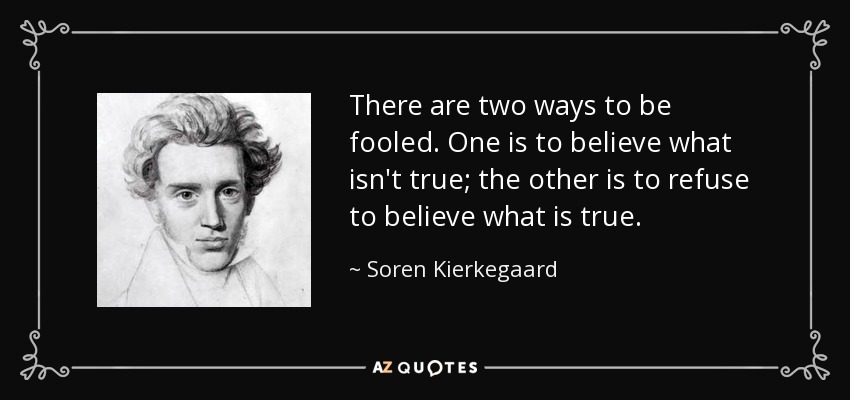
Soren Kierkegaard
b. 5.5.1813 Copenhagen, Denmark
d. 11.11.1855 Copenhagen, Denmark
Soren Kierkegaard was a Danish philosopher, theologian, poet, social critic and religious author. He wrote in the Danish “golden age” of intellectual and artistic activity. He is considered to be the first existentialist.
He wrote critical texts on organized religion, Christendom, morality, ethics, psychology and the philosophy of religion. He displayed a fondness for metaphor, irony and parables. Much of his philosophical work dealt with the issue of how one lives as a "single individual." He highlighted the importance of personal choice and commitment in giving priority to human reality over abstract thought.
He was a Lutheran Protestant. He decided not to become a pastor or a professor because if he had he would have had to write under the authority of the State or the Church. He wrote on Christian ethics, the institution of the Church, the differences between purely objective proofs of Christianity, the infinite qualitative distinction between man and God and the individual's subjective relationship to the God-Man Jesus the Christ which came through faith.
He was critical of the practice of Christianity as a state religion primarily in the Church of Denmark. His psychological work explored the emotions and feelings of individuals when faced with life choices.
He wrote that science and scholarship want to teach that objectivity is the way to live life. He argued that Christianity teaches that the way is to become subjective to become a subject. Scientists learn from the world by observation, but observation could not reveal the inner workings of the world of the spirit.
His key ideas included the concept of "subjective and objective truths", the knight of faith, the recollection and repetition dichotomy, angst, the infinite qualitative distinction, faith as a passion and the three stages on life's way.
His core goal in social criticism was to renew faith within Christendom.
He wrote in Danish. The reception of his work was initially limited to Scandinavia, but by the turn of the 20th century his writings were translated into French, German and other major European languages. His thought exerted a substantial influence on philosophy, theology and Western culture.
He was born in Denmark in the 19th century.
Copenhagen
Copenhagen is located mostly on the eastern shore of the island of Zealand and partly on the island of Amager. The Oresund or the Sound lies to the east. It is the strait of water that separates Denmark from Sweden and connects the North Sea with the Baltic Sea. The Oresund Bridge connects the city to Malmo, Sweden.
Copenhagen is the capital and most populous city of Denmark. It was originally a Viking fishing village established in the 10th century in the vicinity of what is now Gammel Strand in the center of the city. It became the capital of Denmark in the early 15th century. It consolidated its position as a regional center of power with its institutions, defenses and armed forces beginning in the 17th century.
The city underwent a period of redevelopment after the outbreak of a plague and a fire in the 18th century. This included the construction of the prestigious district of Frederiksstaden under Frederick V. The district is regarded as one of the most important Rococo districts in Europe. Cultural institutions as the Royal Theatre and the Royal Academy of Fine Arts were founded during this period.
The British naval officer, Horatio Nelson, attacked the Dano-Norwegian fleet and bombarded the city in the early 19th century. Rebuilding during the Danish Golden Age brought a Neoclassical look to Copenhagen's architecture. Hans Christian Andersen was a leader of the literary movement with his rendition of the modern fairy tale.
Soren Kierkegaard
Kierkegaard was born to an affluent family in Copenhagen. His mother, Ane Sørensdatter Lund, had served as a maid in the household before marrying his father, Michael Pedersen Kierkegaard.
She was quiet, plain and not formally educated, but she protected her sons, Soren and Peter. Peter later said that his brother preserved many of their mother's words in his written work.
His father was a well-to-do wool merchant from Jutland. He was stern, dry and prosaic in appearance, but he concealed an active imagination which he held into his old age. He was interested in philosophy and often hosted intellectuals at his home.
The young Kierkegaard read the philosophy of Christian Wolff. Wolff was the most eminent German philosopher between Leibniz and Kant. His main achievement was a complete commentary on almost every scholarly subject of his time. He displayed and unfolded knowledge according to his demonstrative-deductive, mathematical method. He represented the peak of Enlightenment rationality in Germany.
Kierkegaard led a somewhat uneventful life. He rarely left his hometown of Copenhagen. He traveled abroad only five times. He went to Berlin four times and once to Sweden.
His prime recreational activities were attending the theater, walking the streets to chat with ordinary people and taking brief carriage jaunts into the surrounding countryside.
He was educated at a prestigious boys’ school (Borgerdydskolen), then attended Copenhagen University where he studied philosophy and theology. He refused to define himself as a philosopher.
He felt that he would constrain himself to speculative knowledge. He wanted to live his life by doing something. He declined to become a Lutheran minister. The Church of Denmark was the official state religion. He was critical of official religion.
Church of Denmark
Lutheran Christianity was established as the state religion with the Reformation in Denmark in 1536. When religious wars swept Europe the harsh persecution of other faiths followed for the next century. Exceptions were granted only to foreign diplomats.
Small circles of clandestine Catholicism prevailed for at least a period in the 16th century. Roman Catholic, Reformed and Jewish congregations were allowed in the new town of Fredericia in Denmark from 1683.
Reformed and Jewish congregations were also allowed in Copenhagen. Non-Lutherans were also allowed in Friedrichstadt and on Nordstrand in Slesvig and in Glückstadt in Holstein. Freedom of religion was introduced in Denmark, but Lutheranism remained the state church with the constitution of 1849.
The Church of Denmark recognizes only two sacraments as in other Lutheran churches. Baptism and the Lord's Supper are the sacraments. These are usually included in the Communion Service. Formerly, individual or shared confession was a condition to receive the Lord's Supper. An official confession ritual still exists, but is now used very rarely.
The reigning monarch is the supreme secular authority in the church.
A religious community does not need any state approval in order to enjoy the freedom of religion granted by the constitution. State-approved congregations (godkendte trossamfund) enjoy several privileges.
They may conduct legal weddings, establish cemeteries and get residence permits for foreign priests. They are exempt from corporate and property tax, may apply for means from the state lottery fund and members may tax-deduct membership fees and presents to the congregation.
Career
Kierkegaard became a writer. He published some of his works using pseudonyms. He signed his own name as author for others. Whether being published under pseudonym or not, Kierkegaard's central writings on religion have included Fear and Trembling and Either/Or, the latter of which is considered to be his magnum opus.
Either/Or was published 20 February 1843. It was mostly written during Kierkegaard's stay in Berlin where he took notes on Schelling's Philosophy of Revelation.
Schelling's Natural Philosophy
Schelling had been the roomate to Hegel during their time of instruction at the university at Tubinger Stift. They later became rivals.
Schelling had been a Lutheran, but he shifted to philosophy to address the larger issue of faith as a perspective on the Absolute. He sought to develop the axioms of Spinoza in a manner meaningful to his society. He had written the Philosophy of Mythology prior to that of revelation. It was part of his thought about how the ideal sprang from the real.
He defined nature as visible Spirit and Spirit as invisible nature. History was a progressive gradually self disclosing revelation of the Absolute. Freedom is in the revelation of evolution as a process.
The Absolute separates itself into conscious and unconscious for the sake of appearance in consciousness. It dwells in the inaccessible light as Eternal Identity for the harmony between the states of mind.
It is interesting speculatively, but there is an aversion to the application of the thought to reality.
Reality is simply the ground for the revelation of the ideal. The power of the individual could be placed over the state or religion for immoral ends. Schelling wasn't as bad as Hegel, but there was at least an indirect connection to the promotion of revolution to obtain political change.
Kierkegaard's Either/Or includes essays of literary and music criticism. There is a set of romantic-like-aphorisms as part of his larger theme of examining the reflective and philosophical structure of faith.
The book was edited by "Victor Eremita." It contained the papers of an unknown "A" and "B" which the pseudonymous author claimed to have discovered in a secret drawer of his secretary.
Eremita had a hard time putting the papers of "A" in order because they were not straightforward. "B"'s papers were arranged in an orderly fashion. Both of these characters were trying to become religious individuals.
Each approached the idea of first love from an esthetic and an ethical point of view. The book is basically an argument about faith and marriage with a short discourse at the end telling them they should stop the argument.
Eremita thinks "B", a judge, makes the most sense. Was "A" code for Schelling and "B" for Fichte? Fichte was the more abstract and intellectual of the two.
The inner and the outer work at odds to conceal the secret joy of why things make sense in the consideration of what the purpose for life is.
Kierkegaard stressed the "how" of Christianity as well as the "how" of book reading in his works rather than the "what". He sought to make philosophy a practical application for the perspective of the individual.
He published three more books about love and faith and several more discourses on 16 October 1843. Fear and Trembling was published under the pseudonym Johannes de Silentio. It was an examination of the anxiety of Abraham with respect for the sacrifice of Isaac.
Repetition is about a Young Man (Søren Kierkegaard) who has anxiety and depression because he feels he has to sacrifice his love for a girl (Regine Olsen) to God. He tries to see if the new science of psychology can help him understand himself. Constantin Constantius, who is the pseudonymous author of that book, is the psychologist.
He published Three Upbuilding Discourses, 1843 under his own name. This dealt specifically with how love can be used to hide things from yourself or others. His writing was an expression of his method for indirect communication.
He questioned whether an individual can know if something is a good gift from God or not. It does not depend upon what one sees, but what one sees depends upon how one sees it. Observation is not just a receiving, a discovering, but also a bringing forth. How the observer is constituted is decisive. God's love is imparted indirectly just as our own.
Finding faith in Christ and putting the understanding to use stops speculation. It is then that one begins to exist in an ethical way that can be defined as religious. The Church should not try to prove Christianity or even defend it. It should help the individual to make a leap of faith. Faith has a place for the person in the love of God.
Kierkegaard's final years were taken up with a sustained attack on the Church of Denmark by means of newspaper articles published in The Fatherland (Fædrelandet) and a series of self-published pamphlets called The Moment (Øjeblikket).
These were also translated as "The Instant". These pamphlets are now included in Kierkegaard's Attack Upon Christendom. The Instant, was translated into German as well as other European languages in 1861 and again in 1896.
He collapsed on the street before the 10th issue ofhis periodical The Moment could be published. He stayed in the hospital for over a month and refused communion. He regarded pastors as mere political officials at the time. They were a niche in society who were clearly not representative of the divine.
He died in Copenhagen in 1855 at 42 years of age. He had been in Frederik's Hospital for over a month. It was thought that complications from a fall he had taken from a tree in his youth may have manifested in illness. It has been suggested by some professors that he died from Pott disease, a form of tuberculosis.
He had thought that the congregation kept the individual from taking responsibility for his or her own relation to God. He defined Christianity as the individual. He felt that the state's control of the Church gave it the mission to increase membership with more power for clergy. This he believed was a corruption of the ideal.
He had felt that Christianity's true purpose was to stress the importance of the individual, not the whole group. The state-church political structure was offensive and detrimental to individuals. Anyone could become a Christian without knowing the meaning of what it was to be Christian.
Unbelieving believers formed a herd mentality in the population without respect for conscience.
His existentialism served as a basis in the formation of Chrisitan socialism. It's a degenerative societal position.
Soren Kierkegaard
S. 索伦柯克亚尔
T. 索倫柯克亞爾
索 Suo cable 索 saku cord So そ ソ So 소 small
伦 lun order 倫 rin ethics ren れん レン len 렌 wren
柯 Ke stem 柯 ka handle Ki き キ Ki 키 key
克 ke to restrain 克 koku overcome ru る ル eo 어 uh
亚 qu send away 亞 a rank ke け ケ ke 케 ke
尔 er you 爾 ji you go ご- ゴ- ga 가 end
ru る ル deu 드 de
--------------------------
The reduction of the group to the individual body
is the same as the elevation of the mythical to the godly.
There is a distortion of proportion in the elevation
that loses ethical verity in the moral revelation.
===================
Lectionary: Soren Kierkegaard
wiki Soren Kierkegaard
IEP SK
SEP SK
Theology of SK
wiki Copenhagen
Text for Either/Or
Showing posts with label transcendence. Show all posts
Sunday, September 1, 2019
Thursday, May 30, 2019
Revere
6.1.19
Revere
Life
反抗生活
Fǎnkàng shēnghuó
リヴィア生活
Rivu~ia seikatsu
ps116
revere vitae
I love that I found help when I needed it.
Salvation came and I heeded it.
I felt desperate. My mind cried for direction.
Choice was compressed to this bit. I had to select protection
from the danger of dereliction.
I found what I needed before the moment of crisis.
The rightness in choice was decisive.
The cords of death had entangled me.
My sight was so strangled, I had to get free.
The grip of the grave grapple grabbed
until my adam's apple gagged
while seeing the sensible source sag
from the sense perception had.
Sorrow drove sadness to the threshold of pain.
The horror drove madness to enfold the insane.
Then I cried for help
after yapping a yelp,
“What do I have to do to find safety?
I need it now. I need it greatly.”
The success of salvation is gracious.
It was so efficacious, it was almost salacious.
Nothing else is quite so profound
as wonder in the world once it has been found.
Defense is granted to the watchful
if only because the thoughtful
watch for the goodness of the gospel.
I felt that I fell very low, but I was helped.
I exempted contempt for what I was dealt.
It is time to rest
now that I have been blessed
with the quest to sing of salvation with zest.
Stress from the test has worn my torn soul.
I will do my best to celebrate life as a whole.
I was rescued from death.
Help was given in the test.
My eyes shed natural tears.
I was grateful for my years.
My feet did not stumble
though I felt glad and humble.
I will walk in the presence
of the divine essence
in the land of the living
to give thanks for the giving.
I believed even when
I had been brought to a bend.
Then I said,
“No one can be trusted
when your trust has been busted.”
False prophets lead those who believe them astray.
Truth is the safeguard against fake news for the day.
How will I repay my debt
without regret
for all the good things
carried by angel wings?
I will lift up the cup of salvation
and hold it high as a libation.
I will fulfill my promise to live
with reverence for life as a gift
in the rule of law that we win
in transcending sin.
Precious in the sight of divine Light
is the death of those who defended rights.
They lived good lives.
The transcendence of punishment for false conviction was celebrated
when Christ as the power of God on the cross was elevated.
The reward for agreement with the commandment to love is eternal life.
The Son spoke as the Father had granted inheritance to overcome strife.
I am a defender of rights.
I have been resurrected as a good life
by the experience that brought me past strife.
I tasted a glimpse of the abyss.
It was black and gray with white lights in the tryst.
I have been freed from the world of discrimination
to recount deliverance by narration.
My ear has been opened.
I hear sounds that are spoken.
From the same mouth come blessing and curse.
Speech should be the garden ground for verse.
Who do you say that I am?
You are anointed to pass the exam.
I was not rebellious,
reckless or helpless.
I did not turn backwards.
I spoke in exact words.
Bravery is most bold when prepared.
Faith looks for benign design to be shared.
Traditional revival celebrates regression to the legal process.
Conservative reform pushes for manageable progress.
Time starts to grow bold.
The word shares the beauty of hope.
Hope desires goodness
to add to the fullness.
Measure the base
to secure great restraint.
The bug pulls this stem.
You straighten the hem.
The water's edge reached up onto the sand
in resignation to the limit allowed by gravity and land.
The bridge to love leads the way
to the right thing to do or say.
We are among those who have faith with courage.
We don't shrink back to be lost or discouraged.
I will offer thanksgiving as my sacrifice.
I will give thanks to the Giver of life.
The faithful abide in love with truth.
Grace and mercy act like salve that soothes.
I will speak with reason for the reasonable acceptance
of benefit for people in the presence
of the divine essence
in the assembly in public
in the city of peace that is love lit
by the waters near where the dove sits.
Yea Yah!
You fill me with awe!
---------------------------
116 Dilexi, quoniam
I love, because
1 I love the Lord, because he has heard the voice of
my supplication,
because he has inclined his ear to me whenever
I called upon him.
2 The cords of death entangled me;
the grip of the grave took hold of me;
I came to grief and sorrow.
3 Then I called upon the Name of the Lord:
"O Lord, I pray you, save my life."
4 Gracious is the Lord and righteous;
our God is full of compassion.
5 The Lord watches over the innocent;
I was brought very low, and he helped me.
6 Turn again to your rest, O my soul.
for the Lord has treated you well.
7 For you have rescued my life from death,
my eyes from tears, and my feet from stumbling.
8 I will walk in the presence of the Lord
in the land of the living.
9 I believed, even when I said,
"I have been brought very low."
In my distress I said, "No one can be trusted."
10 How shall I repay the Lord
for all the good things he has done for me?
11 I will lift up the cup of salvation
and call upon the Name of the Lord.
12 I will fulfill my vows to the Lord
in the presence of all his people.
13 Precious in the sight of the Lord
is the death of his servants.
14 O Lord, I am your servant;
I am your servant and the child of your handmaid;
you have freed me from my bonds.
15 I will offer you the sacrifice of thanksgiving
and call upon the Name of the Lord.
16 I will fulfill my vows to the Lord
in the presence of all his people,
17 In the courts of the Lord's house,
in the midst of you, O Jerusalem.
Hallelujah!
------------------------
1 Corinth. 1:22-24
Jews demand signs. Greeks seek wisdom, but we proclaim Christ crucified. The crucifixion is a stumbling block to Jews and foolishness to Gentiles. Christ is the power and wisdom of God to those who are called. both Jews and Greeks.
--------------------------
The transcendence of punishment for false conviction was celebrated
when Christ as the power of God on the cross was elevated.
===============
John 12:50
I know that his commandment is eternal life. What I speak, therefore, I speak as the Father has told me.
----------------------------
The reward for agreement with the commandment to love is eternal life.
The Son spoke as the Father had granted inheritance to overcome strife.
================
Impartial Judgement
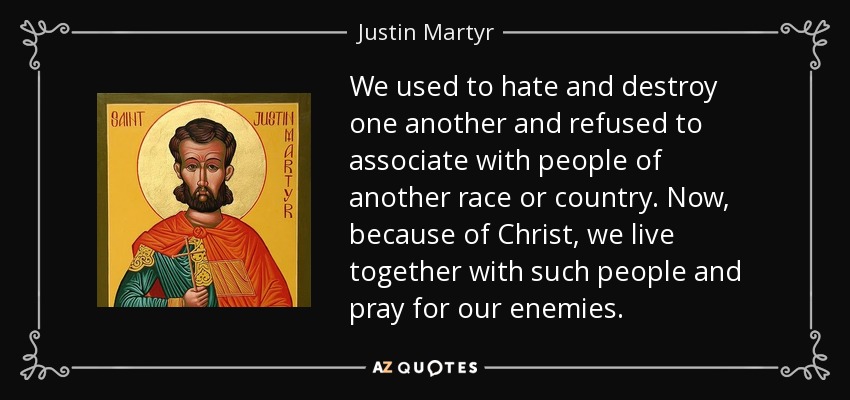
Justin Martyr
b. 100 Flavia Neapolis, Judea
d. 165 Rome, Roman Empire
Justin was an early Christian apologist. He is regarded as the foremost interpreter of the theory of the Logos in the 2nd century. He was martyred alongside some of his students. He is respected as a saint by the Roman Catholic, Anglican, Eastern Orthodox and Oriental Orthodox Churches.
Two of his apologies and a dialogue survived. The First Apology defended the morality of the Christian life. Various ethical and philosophical arguments were expressed to convince the Roman emperor, Antoninus, to abandon the persecution of the Church.
He also indicated that the "true religion" predated Christianity. The "seeds of Christianity" actually came before Christ's incarnation. These were manifestations of the Logos acting in history.
This notion allowed him to claim that historical Greek philosophers including Socrates and Plato were pre-Christians. The philosophical expression showed respect for moral standards that anticipated the morality of the Christian religion.
Flavia Neapolis
Flavia Neapolis translates from Latin as the "new city of the emperor Flavius." It was named in 72 CE by the Roman emperor Vespasian (r. 69-79). The name took the place of an older Samaritan village, variously called Mabartha ("the passage") or Mamorpha.
The settlement was located between Mount Ebal and Mount Gerizim. The new city lay 2 kilometers (1.2 mi) west of the Biblical city of Shechem which was destroyed by the Romans that same year during the First Jewish-Roman War.
Joseph's Tomb and Jacob's Well were holy places in the city. Neapolis prospered due to the city's strategic geographic position and the abundance of water from nearby springs. Territory was accumulated including the former Judean toparchy of Acraba.
The city was built on a Roman grid plan insofar as the hilly topography of the site would allow. It was settled with veterans who fought in the victorious legions. Other foreign colonists immigrated there as well.
Trajan became the emperor of Rome in 98. Trajan is remembered as a soldier-emperor who presided over the largest military expansion in Roman history. The empire attained its maximum territorial extent by the time of his death (117).
Emperor Hadrian (r.117-138) built a grand theater in Neapolis that could seat up to 7,000 people in the 2nd century CE.
Coins found in Nablus dating to this period depict Roman military emblems and gods and goddesses of the Greek pantheon such as Zeus, Artemis, Serapis, and Asklepios. Neapolis was entirely pagan at this time.
He is also known for his philanthropic rule. He had public building programs and implemented social welfare policies. He was the second of the Five Good Emperors who presided over an era of peace and prosperity in the Mediterranean world.
Justin
Justin was born into a pagan family in Flavius Neapolis, Samaria (now Nables) in 100. He defined himself as a Gentile. His grandfather, Bacchius, had a Greek name, while his father, Priscus, bore a Latin name.
The names support the speculation that his ancestors settled in Neapolis soon after its establishment. They may have been descended from a Roman "diplomatic" community that had been sent there.
He sought to find life's meaning in the philosophies of his day. This brought a series of disappointments, but he established a connection between Christian and Greek apologetic.
His first teacher was a Stoic who "knew nothing of God and did not even think knowledge of him to be necessary." There followed a Peripatetic (itinerant philosopher), who seemed most interested in getting his fees.
Then came a Pythagorean, but his required course of music, astronomy and geometry seemed far too slow. Finally, Platonism, though intellectually demanding, proved unfulfilling for Justin's hungry heart.
His life was transformed at last after a conversation with an old man around 130: "A fire was suddenly kindled in my soul. I fell in love with the prophets and these men who had loved Christ; I reflected on all their words and found that this philosophy alone was true and profitable. That is how and why I became a philosopher. And I wish that everyone felt the same way that I do."
Justin continued to wear his philosopher's cloak. He sought to reconcile faith and reason. His teaching ministry took him first to Ephesus (c. 132) where he held a disputation with Trypho, a Jew, about the true interpretation of Scripture.
The Dialogue with Trypho teaches three main points. The Old Covenant is passing away to make place for the New. The Logos is the God of the Old Testament and the Gentiles are the new Israel.
These points were conceptually clear with respect for Christian reason, but they presented a problem to the status of the Jewish homeland. Jerusalem had been destroyed in 70. Jews were forbidden to live there.
The Jewish and Roman cultures began to overlap in the centuries just before the Christian Era.
Jews migrated to Rome and Roman Europe from the Land of Israel, Asia Minor, Babylon and Alexandria as part of the diaspora. The migration was stimulated by economic hardship and incessant warfare over the land of Israel between the Ptolemaic and Seleucid empires.
The Roman general Pompey in his eastern campaign established the Roman province of Syria in 64 BCE and conquered Jerusalem in 63. Julius Caesar conquered Alexandria c. 47 and defeated Pompey in 45. Judaism was officially recognized as a legal religion under Julius Caesar. The policy was followed by the first Roman emperor, Augustus.
Herod the Great was designated 'King of the Jews' by the Roman Senate in c. 40. The Roman province of Egypt was established in 30. Judea proper, Samaria and Idumea (biblical Edom) were converted to the Roman province of Iudaea in 6 CE.
Jewish–Roman tensions resulted in several Jewish–Roman wars from 66–135. These battles resulted in the destruction of Jerusalem and the Second Temple. The Jewish Tax was instituted in 70. Hadrian's attempted to create a new Roman colony named Aelia Capitolina c. 130.
Christianity was being developed from Second Temple Judaism by this time.
Jewish communities enjoyed privileges and thrived economically in Rome. They became a significant part of the Empire's population. The size may have grown to as much as ten percent. The Roman Twelve tables were a summary of the law. The Romans had seen that the Jews had a respect for law. They were educated enough to see that the ten commandments represented a better summary.
They also knew that they were willing to modify the code that had been established in Sumeria, Assyria, Babylon and Persia.
It is difficult to say when the plan to convert Roman culture to monotheism was formed, but it is conceivable that Vespasian and Josephus agreed to formulate a biblical canon for a Gentile monotheism after Vespasian had adopted Josephus as his historian.
Justin moved to Rome and founded a Christian school. He engaged the Cynic philosopher Crescens in debate. He was arrested on the charge of practicing an unauthorized religion.
He wrote two bold apologies (i.e., defenses—from the Greek apologia). Justin's First Apology, addressed to Emperor Antoninus Pius, was published in 155. It attempted to explain the faith.
Christianity was not a threat to the state. It should be treated as a legal religion. He wrote "on behalf of men of every nation who are unjustly hated and reviled."
Antoninus Pius was Roman emperor from 138 to 161. Hadrian (r.117-138) adopted him as his son and successor shortly before his death. His reign is notable for the peaceful state of the Empire with no major revolts or military incursions during this time. He governed the empire without ever leaving Italy.
Antoninus portrayed himself as a magistrate of the res publica. He is credited with the splitting of the imperial treasury, the Fiscus. This splitting had to do with the division of imperial properties into two parts. The patrimonium were the properties of the "Crown."
The hereditary properties of each succeeding person that sat on the throne were transmitted to his successors in office regardless of their membership in the imperial family. Secondly, the res privata were the "private" properties tied to the personal maintenance of the Emperor and his family.
The res privata lands could be sold and/or given away. The patrimonium properties were regarded as public. It was a way of declaring that the Imperial function and most properties attached to it was public. It was formally subject to the authority of the Senate and the Roman people.
Antoninus introduced the important principle that accused persons are not to be treated as guilty before trial. It was to Antonius that the Christian apologist Justin Martyr addressed his defense of the Christian faith. Justin reminded him of his father's (Emperor Hadrian's) rule that accusations against Christians required proof.
He also asserted the principle that the trial was to be held and the punishment inflicted in the place where the crime had been committed. He mitigated the use of torture in examining slaves by stipulating certain limitations.
He prohibited the application of torture to children under 14 years though this rule had exceptions. Other limitations were applied to the use of torture and slavery.
Antoninus favored the principle of favor libertatis. This principle gave the putative freedman the benefit of the doubt when the claim to freedom was not clearcut.
Justin defended Christianity as a rational creed. He included an account of the Christian ceremonies of Baptism and the Eucharist.
Justin discussed the principal criticisms of contemporary Christians. These criticisms were presented as charges. The charges were atheism, immorality and disloyalty to the Empire.
He first argued that “the name” of Christianity by itself was not reason enough to punish or persecute. He urged the Empire to only punish evil actions instead. He wrote, “For from a name neither approval nor punishment could fairly come, unless something excellent or evil in action can be shown about it.”
He then addressed the charges more directly. He argued that they were “atheists” toward Roman gods, but not to the “most true God.” He acknowledged that some Christians had performed immoral acts, but urged officials to punish the individuals as evildoers rather than Christians.
Justin demonstrated his desire to separate the Christian name from the evil acts performed by certain individuals with this claim. He lamented how criminals tarnished the name of Christianity and were not true “Christians.”
He addressed the alleged disloyalty to the Empire. Christians do seek to be members of another kingdom, but this kingdom is “of that with God” rather than a “human one.”
He remarked that Christianity provides moral teaching for its followers. Many of the Christian teachings paralleled similar stories in pagan mythology. It was irrational for contemporary pagans to persecute Christians.
One of Justin’s most important themes involved his description of the logos. The word was a philosophical concept of order in reason with knowledge expressed by Heraclitus. Justin argued that Jesus Christ is the incarnation of the Logos.
This led him to the proof that any individual who had spoken with reason even those who lived before Christ are connected with the logos in the form of Christ are Christian in fact.
This theme was paramount to understanding Justin’s defense of Christianity. It was a groundbreaking statement in Christian apologetic. The use of the term “logos” indicated the use of prior philosophical teachings, but these teachings represented partial truth. They possessed and were connected with part of the overall logos.
Christianity represented the full truth (logos). Faith was not only a meaningful philosophy, it also completed and corrected prior thought to achieve the highest level of knowledge with reason.
The Second Apology was addressed to the Roman Senate. It was chiefly concerned with the rebuttal to specific charges of immorality that had been made against the Christians. He argued that good Christians make good citizens. The notion that Christianity undermined the foundations of a good society was based on slander.
Justin recounted the story of a certain woman who on hearing the teaching of Jesus and having become a Christian refused to comply with the immoral practices of her husband. The disagreements were so severe that she desired to be divorced. She was not encouraged to do so.
She continued in that relationship until it became ethically unlivable. She gave him a bill of divorce. The husband retaliated by bringing accusations against her before the Emperor. When he couldn't do anything to have her punished, he turned against the Christian leaders. The prefect Urbicus began a persecution.
It was the fallen angels and demons who incited such hatred and evil against the people of God. This view was in accord with the Book of Enoch (1 Enoch), which Justin viewed as scripture.
These demons are the spirits of those offspring born through the union of fallen angels and women before the Flood. They control humans through magic arts, libations and intimidating systems that hold people in bondage. They are exorcised by the Christians in the name of Jesus. All those in whom the Word dwells have been hated. Heraclitus and Musonius are examples.
The Christians were being accused of cannibalism and sexual immorality. Justin asked that if the Christians were pleasure-mongers, then why would they be fearless in the face of death for faithfulness to what they believe. Their faithfulness to Christ when threatened with torture or death proved that they are not pleasure seekers.
It was the accusers who had a system of religion in which humans were sacrificed to gods such as Saturn. Sexual immorality was openly practiced by them without shame.
Justin argued that if any group were to be persecuted, it should be the homosexuals that should be charged with sexual immorality. The replacement group argument for persecution was morally misdirected. It was implemented for centuries whenever the Roman government felt the people needed a group from whom to draw material wealth for the 'empire.'
He was confident that his teaching was that of the Church at large. He knows of a division among the orthodox only on the question of the millennium and on the attitude toward the milder Jewish Christianity.
He personally was willing to tolerate the division as long as its professors in their turn did not interfere with the liberty of the Gentile converts. His millenarianism seems to have no connection with Judaism, but he believes firmly in a millennium in the Christian eschatology.
Justin saw himself as a scholar, but his skills in Hebrew were either non-existent or minimal. He published an attack on Judaism after collaborating with a Jewish convert to assist him with Hebrew. The criticism was based upon a no-longer-extant text of a Midrash.
Opposition to Judaism was typical of church leaders in his day. Justin was particularly antagonistic towards Jews and regarded them as a cursed people. His anti-Judaic polemics have been cited as an origin of Christian antisemitism. He was the first to argue that the Romans had no responsibility for the death of Jesus. He supported the idea of Jewish deicide.
Justin referred to written sources consisting of narratives of the life of Jesus and quotations of the sayings of Jesus as "memoirs of the apostles" and less frequently as gospels. He said the texts were read every Sunday in the church at Rome. The "memoirs of the apostles or the writings of the prophets are being read as long as it is allowable." (1 Apol. 67.3)
He was denounced by the cynic philosopher Crescens to the authorities after a debate with him in the reign of Marcus Aurelius according to Tatian (Address to the Greeks 19) and Eusebius (HE IV 16.7–8). Justin was tried together with six companions by Junius Rusticus the urban prefect from 163–167. His execution can reasonably be dated by the prefectoral term of Rusticus.
The prefect told the accused to approach to make a sacrifice to the gods. Justin said, "No one in his right mind gives up piety for impiety." The prefect warned them that they would be tortured without mercy if they did not obey.
Justin replied that it was their desire to be tortured for Jesus Christ. Sacrifice for him would result in salvation. They would be given firm confidence at the more terrible universal tribunal of their Lord and Savior. All the martyrs said, "Do as you wish." They were Christians. They did not sacrifice to idols.
Rusticus read the sentence, "Those who do not wish to sacrifice to the gods and to obey the emperor will be scourged and beheaded according to the laws."
The martyrs were beheaded to consummate their confession of faith in their Savior.
Justin Martyr
S. 贾斯汀殉道者
T. 賈斯汀殉道者
贾 Jia trade 賈 ko buy Ja じゃ ジャ Jeo 저 moth
斯 si this 斯 shi this su す ス seu 스 switch
汀 ting sandbank 汀 tei water's edge tin てぃん ティン tin 틴 tin
殉 Xun martyr 殉 jun resignation Jun 殉 殉 Sun 순 the
道 dao way 道 do road-way kyo 教 教 gyo 교 school
者 zhe he who 者 sha someone mono 者 者 ja 자 character
--------------------------
The water's edge reached up onto the sand
in resignation to the limit allowed by gravity and land.
===============
Lectionary Justin M
wiki Justin M
wiki Nablus Flavius Neapolis
Christianity Today Justin M
Revere
Life
反抗生活
Fǎnkàng shēnghuó
リヴィア生活
Rivu~ia seikatsu
ps116
revere vitae
I love that I found help when I needed it.
Salvation came and I heeded it.
I felt desperate. My mind cried for direction.
Choice was compressed to this bit. I had to select protection
from the danger of dereliction.
I found what I needed before the moment of crisis.
The rightness in choice was decisive.
The cords of death had entangled me.
My sight was so strangled, I had to get free.
The grip of the grave grapple grabbed
until my adam's apple gagged
while seeing the sensible source sag
from the sense perception had.
Sorrow drove sadness to the threshold of pain.
The horror drove madness to enfold the insane.
Then I cried for help
after yapping a yelp,
“What do I have to do to find safety?
I need it now. I need it greatly.”
The success of salvation is gracious.
It was so efficacious, it was almost salacious.
Nothing else is quite so profound
as wonder in the world once it has been found.
Defense is granted to the watchful
if only because the thoughtful
watch for the goodness of the gospel.
I felt that I fell very low, but I was helped.
I exempted contempt for what I was dealt.
It is time to rest
now that I have been blessed
with the quest to sing of salvation with zest.
Stress from the test has worn my torn soul.
I will do my best to celebrate life as a whole.
I was rescued from death.
Help was given in the test.
My eyes shed natural tears.
I was grateful for my years.
My feet did not stumble
though I felt glad and humble.
I will walk in the presence
of the divine essence
in the land of the living
to give thanks for the giving.
I believed even when
I had been brought to a bend.
Then I said,
“No one can be trusted
when your trust has been busted.”
False prophets lead those who believe them astray.
Truth is the safeguard against fake news for the day.
How will I repay my debt
without regret
for all the good things
carried by angel wings?
I will lift up the cup of salvation
and hold it high as a libation.
I will fulfill my promise to live
with reverence for life as a gift
in the rule of law that we win
in transcending sin.
Precious in the sight of divine Light
is the death of those who defended rights.
They lived good lives.
The transcendence of punishment for false conviction was celebrated
when Christ as the power of God on the cross was elevated.
The reward for agreement with the commandment to love is eternal life.
The Son spoke as the Father had granted inheritance to overcome strife.
I am a defender of rights.
I have been resurrected as a good life
by the experience that brought me past strife.
I tasted a glimpse of the abyss.
It was black and gray with white lights in the tryst.
I have been freed from the world of discrimination
to recount deliverance by narration.
My ear has been opened.
I hear sounds that are spoken.
From the same mouth come blessing and curse.
Speech should be the garden ground for verse.
Who do you say that I am?
You are anointed to pass the exam.
I was not rebellious,
reckless or helpless.
I did not turn backwards.
I spoke in exact words.
Bravery is most bold when prepared.
Faith looks for benign design to be shared.
Traditional revival celebrates regression to the legal process.
Conservative reform pushes for manageable progress.
Time starts to grow bold.
The word shares the beauty of hope.
Hope desires goodness
to add to the fullness.
Measure the base
to secure great restraint.
The bug pulls this stem.
You straighten the hem.
The water's edge reached up onto the sand
in resignation to the limit allowed by gravity and land.
The bridge to love leads the way
to the right thing to do or say.
We are among those who have faith with courage.
We don't shrink back to be lost or discouraged.
I will offer thanksgiving as my sacrifice.
I will give thanks to the Giver of life.
The faithful abide in love with truth.
Grace and mercy act like salve that soothes.
I will speak with reason for the reasonable acceptance
of benefit for people in the presence
of the divine essence
in the assembly in public
in the city of peace that is love lit
by the waters near where the dove sits.
Yea Yah!
You fill me with awe!
---------------------------
116 Dilexi, quoniam
I love, because
1 I love the Lord, because he has heard the voice of
my supplication,
because he has inclined his ear to me whenever
I called upon him.
2 The cords of death entangled me;
the grip of the grave took hold of me;
I came to grief and sorrow.
3 Then I called upon the Name of the Lord:
"O Lord, I pray you, save my life."
4 Gracious is the Lord and righteous;
our God is full of compassion.
5 The Lord watches over the innocent;
I was brought very low, and he helped me.
6 Turn again to your rest, O my soul.
for the Lord has treated you well.
7 For you have rescued my life from death,
my eyes from tears, and my feet from stumbling.
8 I will walk in the presence of the Lord
in the land of the living.
9 I believed, even when I said,
"I have been brought very low."
In my distress I said, "No one can be trusted."
10 How shall I repay the Lord
for all the good things he has done for me?
11 I will lift up the cup of salvation
and call upon the Name of the Lord.
12 I will fulfill my vows to the Lord
in the presence of all his people.
13 Precious in the sight of the Lord
is the death of his servants.
14 O Lord, I am your servant;
I am your servant and the child of your handmaid;
you have freed me from my bonds.
15 I will offer you the sacrifice of thanksgiving
and call upon the Name of the Lord.
16 I will fulfill my vows to the Lord
in the presence of all his people,
17 In the courts of the Lord's house,
in the midst of you, O Jerusalem.
Hallelujah!
------------------------
1 Corinth. 1:22-24
Jews demand signs. Greeks seek wisdom, but we proclaim Christ crucified. The crucifixion is a stumbling block to Jews and foolishness to Gentiles. Christ is the power and wisdom of God to those who are called. both Jews and Greeks.
--------------------------
The transcendence of punishment for false conviction was celebrated
when Christ as the power of God on the cross was elevated.
===============
John 12:50
I know that his commandment is eternal life. What I speak, therefore, I speak as the Father has told me.
----------------------------
The reward for agreement with the commandment to love is eternal life.
The Son spoke as the Father had granted inheritance to overcome strife.
================
Impartial Judgement
Justin Martyr
b. 100 Flavia Neapolis, Judea
d. 165 Rome, Roman Empire
Justin was an early Christian apologist. He is regarded as the foremost interpreter of the theory of the Logos in the 2nd century. He was martyred alongside some of his students. He is respected as a saint by the Roman Catholic, Anglican, Eastern Orthodox and Oriental Orthodox Churches.
Two of his apologies and a dialogue survived. The First Apology defended the morality of the Christian life. Various ethical and philosophical arguments were expressed to convince the Roman emperor, Antoninus, to abandon the persecution of the Church.
He also indicated that the "true religion" predated Christianity. The "seeds of Christianity" actually came before Christ's incarnation. These were manifestations of the Logos acting in history.
This notion allowed him to claim that historical Greek philosophers including Socrates and Plato were pre-Christians. The philosophical expression showed respect for moral standards that anticipated the morality of the Christian religion.
Flavia Neapolis
Flavia Neapolis translates from Latin as the "new city of the emperor Flavius." It was named in 72 CE by the Roman emperor Vespasian (r. 69-79). The name took the place of an older Samaritan village, variously called Mabartha ("the passage") or Mamorpha.
The settlement was located between Mount Ebal and Mount Gerizim. The new city lay 2 kilometers (1.2 mi) west of the Biblical city of Shechem which was destroyed by the Romans that same year during the First Jewish-Roman War.
Joseph's Tomb and Jacob's Well were holy places in the city. Neapolis prospered due to the city's strategic geographic position and the abundance of water from nearby springs. Territory was accumulated including the former Judean toparchy of Acraba.
The city was built on a Roman grid plan insofar as the hilly topography of the site would allow. It was settled with veterans who fought in the victorious legions. Other foreign colonists immigrated there as well.
Trajan became the emperor of Rome in 98. Trajan is remembered as a soldier-emperor who presided over the largest military expansion in Roman history. The empire attained its maximum territorial extent by the time of his death (117).
Emperor Hadrian (r.117-138) built a grand theater in Neapolis that could seat up to 7,000 people in the 2nd century CE.
Coins found in Nablus dating to this period depict Roman military emblems and gods and goddesses of the Greek pantheon such as Zeus, Artemis, Serapis, and Asklepios. Neapolis was entirely pagan at this time.
He is also known for his philanthropic rule. He had public building programs and implemented social welfare policies. He was the second of the Five Good Emperors who presided over an era of peace and prosperity in the Mediterranean world.
Justin
Justin was born into a pagan family in Flavius Neapolis, Samaria (now Nables) in 100. He defined himself as a Gentile. His grandfather, Bacchius, had a Greek name, while his father, Priscus, bore a Latin name.
The names support the speculation that his ancestors settled in Neapolis soon after its establishment. They may have been descended from a Roman "diplomatic" community that had been sent there.
He sought to find life's meaning in the philosophies of his day. This brought a series of disappointments, but he established a connection between Christian and Greek apologetic.
His first teacher was a Stoic who "knew nothing of God and did not even think knowledge of him to be necessary." There followed a Peripatetic (itinerant philosopher), who seemed most interested in getting his fees.
Then came a Pythagorean, but his required course of music, astronomy and geometry seemed far too slow. Finally, Platonism, though intellectually demanding, proved unfulfilling for Justin's hungry heart.
His life was transformed at last after a conversation with an old man around 130: "A fire was suddenly kindled in my soul. I fell in love with the prophets and these men who had loved Christ; I reflected on all their words and found that this philosophy alone was true and profitable. That is how and why I became a philosopher. And I wish that everyone felt the same way that I do."
Justin continued to wear his philosopher's cloak. He sought to reconcile faith and reason. His teaching ministry took him first to Ephesus (c. 132) where he held a disputation with Trypho, a Jew, about the true interpretation of Scripture.
The Dialogue with Trypho teaches three main points. The Old Covenant is passing away to make place for the New. The Logos is the God of the Old Testament and the Gentiles are the new Israel.
These points were conceptually clear with respect for Christian reason, but they presented a problem to the status of the Jewish homeland. Jerusalem had been destroyed in 70. Jews were forbidden to live there.
The Jewish and Roman cultures began to overlap in the centuries just before the Christian Era.
Jews migrated to Rome and Roman Europe from the Land of Israel, Asia Minor, Babylon and Alexandria as part of the diaspora. The migration was stimulated by economic hardship and incessant warfare over the land of Israel between the Ptolemaic and Seleucid empires.
The Roman general Pompey in his eastern campaign established the Roman province of Syria in 64 BCE and conquered Jerusalem in 63. Julius Caesar conquered Alexandria c. 47 and defeated Pompey in 45. Judaism was officially recognized as a legal religion under Julius Caesar. The policy was followed by the first Roman emperor, Augustus.
Herod the Great was designated 'King of the Jews' by the Roman Senate in c. 40. The Roman province of Egypt was established in 30. Judea proper, Samaria and Idumea (biblical Edom) were converted to the Roman province of Iudaea in 6 CE.
Jewish–Roman tensions resulted in several Jewish–Roman wars from 66–135. These battles resulted in the destruction of Jerusalem and the Second Temple. The Jewish Tax was instituted in 70. Hadrian's attempted to create a new Roman colony named Aelia Capitolina c. 130.
Christianity was being developed from Second Temple Judaism by this time.
Jewish communities enjoyed privileges and thrived economically in Rome. They became a significant part of the Empire's population. The size may have grown to as much as ten percent. The Roman Twelve tables were a summary of the law. The Romans had seen that the Jews had a respect for law. They were educated enough to see that the ten commandments represented a better summary.
They also knew that they were willing to modify the code that had been established in Sumeria, Assyria, Babylon and Persia.
It is difficult to say when the plan to convert Roman culture to monotheism was formed, but it is conceivable that Vespasian and Josephus agreed to formulate a biblical canon for a Gentile monotheism after Vespasian had adopted Josephus as his historian.
Justin moved to Rome and founded a Christian school. He engaged the Cynic philosopher Crescens in debate. He was arrested on the charge of practicing an unauthorized religion.
He wrote two bold apologies (i.e., defenses—from the Greek apologia). Justin's First Apology, addressed to Emperor Antoninus Pius, was published in 155. It attempted to explain the faith.
Christianity was not a threat to the state. It should be treated as a legal religion. He wrote "on behalf of men of every nation who are unjustly hated and reviled."
Antoninus Pius was Roman emperor from 138 to 161. Hadrian (r.117-138) adopted him as his son and successor shortly before his death. His reign is notable for the peaceful state of the Empire with no major revolts or military incursions during this time. He governed the empire without ever leaving Italy.
Antoninus portrayed himself as a magistrate of the res publica. He is credited with the splitting of the imperial treasury, the Fiscus. This splitting had to do with the division of imperial properties into two parts. The patrimonium were the properties of the "Crown."
The hereditary properties of each succeeding person that sat on the throne were transmitted to his successors in office regardless of their membership in the imperial family. Secondly, the res privata were the "private" properties tied to the personal maintenance of the Emperor and his family.
The res privata lands could be sold and/or given away. The patrimonium properties were regarded as public. It was a way of declaring that the Imperial function and most properties attached to it was public. It was formally subject to the authority of the Senate and the Roman people.
Antoninus introduced the important principle that accused persons are not to be treated as guilty before trial. It was to Antonius that the Christian apologist Justin Martyr addressed his defense of the Christian faith. Justin reminded him of his father's (Emperor Hadrian's) rule that accusations against Christians required proof.
He also asserted the principle that the trial was to be held and the punishment inflicted in the place where the crime had been committed. He mitigated the use of torture in examining slaves by stipulating certain limitations.
He prohibited the application of torture to children under 14 years though this rule had exceptions. Other limitations were applied to the use of torture and slavery.
Antoninus favored the principle of favor libertatis. This principle gave the putative freedman the benefit of the doubt when the claim to freedom was not clearcut.
Justin defended Christianity as a rational creed. He included an account of the Christian ceremonies of Baptism and the Eucharist.
Justin discussed the principal criticisms of contemporary Christians. These criticisms were presented as charges. The charges were atheism, immorality and disloyalty to the Empire.
He first argued that “the name” of Christianity by itself was not reason enough to punish or persecute. He urged the Empire to only punish evil actions instead. He wrote, “For from a name neither approval nor punishment could fairly come, unless something excellent or evil in action can be shown about it.”
He then addressed the charges more directly. He argued that they were “atheists” toward Roman gods, but not to the “most true God.” He acknowledged that some Christians had performed immoral acts, but urged officials to punish the individuals as evildoers rather than Christians.
Justin demonstrated his desire to separate the Christian name from the evil acts performed by certain individuals with this claim. He lamented how criminals tarnished the name of Christianity and were not true “Christians.”
He addressed the alleged disloyalty to the Empire. Christians do seek to be members of another kingdom, but this kingdom is “of that with God” rather than a “human one.”
He remarked that Christianity provides moral teaching for its followers. Many of the Christian teachings paralleled similar stories in pagan mythology. It was irrational for contemporary pagans to persecute Christians.
One of Justin’s most important themes involved his description of the logos. The word was a philosophical concept of order in reason with knowledge expressed by Heraclitus. Justin argued that Jesus Christ is the incarnation of the Logos.
This led him to the proof that any individual who had spoken with reason even those who lived before Christ are connected with the logos in the form of Christ are Christian in fact.
This theme was paramount to understanding Justin’s defense of Christianity. It was a groundbreaking statement in Christian apologetic. The use of the term “logos” indicated the use of prior philosophical teachings, but these teachings represented partial truth. They possessed and were connected with part of the overall logos.
Christianity represented the full truth (logos). Faith was not only a meaningful philosophy, it also completed and corrected prior thought to achieve the highest level of knowledge with reason.
The Second Apology was addressed to the Roman Senate. It was chiefly concerned with the rebuttal to specific charges of immorality that had been made against the Christians. He argued that good Christians make good citizens. The notion that Christianity undermined the foundations of a good society was based on slander.
Justin recounted the story of a certain woman who on hearing the teaching of Jesus and having become a Christian refused to comply with the immoral practices of her husband. The disagreements were so severe that she desired to be divorced. She was not encouraged to do so.
She continued in that relationship until it became ethically unlivable. She gave him a bill of divorce. The husband retaliated by bringing accusations against her before the Emperor. When he couldn't do anything to have her punished, he turned against the Christian leaders. The prefect Urbicus began a persecution.
It was the fallen angels and demons who incited such hatred and evil against the people of God. This view was in accord with the Book of Enoch (1 Enoch), which Justin viewed as scripture.
These demons are the spirits of those offspring born through the union of fallen angels and women before the Flood. They control humans through magic arts, libations and intimidating systems that hold people in bondage. They are exorcised by the Christians in the name of Jesus. All those in whom the Word dwells have been hated. Heraclitus and Musonius are examples.
The Christians were being accused of cannibalism and sexual immorality. Justin asked that if the Christians were pleasure-mongers, then why would they be fearless in the face of death for faithfulness to what they believe. Their faithfulness to Christ when threatened with torture or death proved that they are not pleasure seekers.
It was the accusers who had a system of religion in which humans were sacrificed to gods such as Saturn. Sexual immorality was openly practiced by them without shame.
Justin argued that if any group were to be persecuted, it should be the homosexuals that should be charged with sexual immorality. The replacement group argument for persecution was morally misdirected. It was implemented for centuries whenever the Roman government felt the people needed a group from whom to draw material wealth for the 'empire.'
He was confident that his teaching was that of the Church at large. He knows of a division among the orthodox only on the question of the millennium and on the attitude toward the milder Jewish Christianity.
He personally was willing to tolerate the division as long as its professors in their turn did not interfere with the liberty of the Gentile converts. His millenarianism seems to have no connection with Judaism, but he believes firmly in a millennium in the Christian eschatology.
Justin saw himself as a scholar, but his skills in Hebrew were either non-existent or minimal. He published an attack on Judaism after collaborating with a Jewish convert to assist him with Hebrew. The criticism was based upon a no-longer-extant text of a Midrash.
Opposition to Judaism was typical of church leaders in his day. Justin was particularly antagonistic towards Jews and regarded them as a cursed people. His anti-Judaic polemics have been cited as an origin of Christian antisemitism. He was the first to argue that the Romans had no responsibility for the death of Jesus. He supported the idea of Jewish deicide.
Justin referred to written sources consisting of narratives of the life of Jesus and quotations of the sayings of Jesus as "memoirs of the apostles" and less frequently as gospels. He said the texts were read every Sunday in the church at Rome. The "memoirs of the apostles or the writings of the prophets are being read as long as it is allowable." (1 Apol. 67.3)
He was denounced by the cynic philosopher Crescens to the authorities after a debate with him in the reign of Marcus Aurelius according to Tatian (Address to the Greeks 19) and Eusebius (HE IV 16.7–8). Justin was tried together with six companions by Junius Rusticus the urban prefect from 163–167. His execution can reasonably be dated by the prefectoral term of Rusticus.
The prefect told the accused to approach to make a sacrifice to the gods. Justin said, "No one in his right mind gives up piety for impiety." The prefect warned them that they would be tortured without mercy if they did not obey.
Justin replied that it was their desire to be tortured for Jesus Christ. Sacrifice for him would result in salvation. They would be given firm confidence at the more terrible universal tribunal of their Lord and Savior. All the martyrs said, "Do as you wish." They were Christians. They did not sacrifice to idols.
Rusticus read the sentence, "Those who do not wish to sacrifice to the gods and to obey the emperor will be scourged and beheaded according to the laws."
The martyrs were beheaded to consummate their confession of faith in their Savior.
Justin Martyr
S. 贾斯汀殉道者
T. 賈斯汀殉道者
贾 Jia trade 賈 ko buy Ja じゃ ジャ Jeo 저 moth
斯 si this 斯 shi this su す ス seu 스 switch
汀 ting sandbank 汀 tei water's edge tin てぃん ティン tin 틴 tin
殉 Xun martyr 殉 jun resignation Jun 殉 殉 Sun 순 the
道 dao way 道 do road-way kyo 教 教 gyo 교 school
者 zhe he who 者 sha someone mono 者 者 ja 자 character
--------------------------
The water's edge reached up onto the sand
in resignation to the limit allowed by gravity and land.
===============
Lectionary Justin M
wiki Justin M
wiki Nablus Flavius Neapolis
Christianity Today Justin M
Friday, April 26, 2019
Dare
4.27.19
London Dungeon
Dare
to Care
敢于关心
Gǎnyú guānxīn
大事にする
Daiji ni suru
ps118
Dare to have mercy.
Mercy endures in memory
with certainty.
Remember this you nations.
This will last for generations.
That which is legal about law is regal
from the eagle to the beetle, you people.
Mercy endures in memory at length.
It is the foundation for love with strength.
Love secures endurance.
Endurance with education and allurance
yields wisdom and knowledge for insurance
with perspective on perception that yields assurance.
Let the vote denote the number
for policy that does not encumber
people as the hunter
for the state between slumber
and wonder.
Let the vote connote opposition to policies that harm the public.
Let freedom ring for people in kingdom or republic.
Allow defense when police protection is not at hand;
free trade so plutocracy does not rule the land;
construction for protection from the elements and man;
communication with people in foreign nations;
travel to experience different sensations
in various locations.
Beauty is in the strength of the song.
Success rings long with the bong
of the gong.
Smoke drifts slowly from the echo of dreams.
Things are not as certain as they seem.
The fragrant mist from the hyacinth
drifts in through the open window inch
to give a pinch of the aromatic labyrinth.
The odor of nard had filled the room
where the bottle broke before the tomb
and the maiden resumed work before the loom.
The earth's sweet being in the beginning in the garden of Eden
was not ended by sinning for eternal winning in freedom.
The penalty of death is not meant to kill
those with the right intent and execution of will.
Jesus carried the beam to Golgotha's peak.
Christ died from the pain the cross had wreaked.
The Word rose again as resurrected speech.
The legal code has since been asked
to consider the role that justice has tasked
to punishment as correction cast.
Jesus was not guilty of a plan.
for rebellion. He murdered no man.
Cruelty or violence do not belong in the legal span.
Mary remembered her barren womb
as she stood by the open tomb
and felt the memory of the empty room.
What were you and I until we loved?
Were we not to become products of the love
from above?
All pleasures are fancied true.
Any earthly beauty that I saw to sooth
was desired and got as the dream of you.
Good news was proclaimed with energy from God.
The message was confirmed with signs that beat the odds.
Man lost income as the leaders compete to build the taller tower.
He was raised to walk when faith in Christ became his power.
The stone wall reduced traffic through the fertile field.
The rights of man and woman were protected for the yield.
The golden eagle watches noh theater.
The lover appeals to his love as a reasoner
in the palace yard as the fantasy sphere
below the cypress as the seat for the seer.
Spring flows in a streaming state
while young grass grows near the gate
where there had been snow of late.
The tea ceremony doesn't wait
for the cherry tree 桜 to blossom late.
The fate of a mate is made great
with the dish that is set upon a plate.
Like a drifting cloud
bound by nothing loud
I let go of feeling proud.
I allowed myself to wander around
to hear the whim of the wind wound
above ground with this wooshing sound.
Saki is sipped slowly by evening.
The light lets dark reveal her reason.
She sips her cup to test
her best
with zest
for the west
in the zodiac crest
in the quest for rest.
The east edge of the milky way
is the abode for his astral play.
There is no partiality with justice.
Each day has a candle lit for us.
The stone stands alone unaltered thus
as an altar for trust
that looks beyond the dust
and the rust.
I will draw the inference
that reason affirms with assurance.
I will live to declare the art of the seen
that the knowledge of science has drawn for me.
Open the gates of perspective on perception for consciousness.
I will see light with the sight that is given to perceive more of the less
evident with tests.
I will rejoice in the increase of fruit on trees by the lake.
I will sing for the third quarter moon as a turn in orbit for heaven's sake.
The transcendence of excess individual or social limitation
is more beautiful than self-degradation.
Dare to have mercy.
Mercy endures in memory
for surety.
Mercy endures in memory at length.
It is the foundation for love with strength.
science 科学 kagaku
beauty 美しさ utsukushi-sa
==============
118 Confitemini Domino
Acknowledge the Dominator
1 Give thanks to the Lord, for he is good;
his mercy endures for ever.
2 Let Israel now proclaim,
"His mercy endures for ever."
3 Let the house of Aaron now proclaim,
"His mercy endures for ever."
4 Let those who fear the Lord now proclaim,
"His mercy endures for ever."
5 I called to the Lord in my distress;
the Lord answered by setting me free.
6 The Lord is at my side, therefore I will not fear;
what can anyone do to me?
7 The Lord is at my side to help me;
I will triumph over those who hate me.
8 It is better to rely on the Lord
than to put any trust in flesh.
9 It is better to rely on the Lord
than to put any trust in rulers.
10 All the ungodly encompass me;
in the name of the Lord I will repel them.
11 They hem me in, they hem me in on every side;
in the name of the Lord I will repel them.
12 They swarm about me like bees;
they blaze like a fire of thorns;
in the name of the Lord I will repel them.
13 I was pressed so hard that I almost fell,
but the Lord came to my help.
14 The Lord is my strength and my song,
and he has become my salvation.
15 There is a sound of exultation and victory
in the tents of the righteous:
16 "The right hand of the Lord has triumphed!
the right hand of the Lord is exalted!
the right hand of the Lord has triumphed!"
17 I shall not die, but live,
and declare the works of the Lord.
18 The Lord has punished me sorely,
but he did not hand me over to death.
19 Open for me the gates of righteousness;
I will enter them;
I will offer thanks to the Lord.
20 "This is the gate of the Lord;
he who is righteous may enter."
21 I will give thanks to you, for you answered me
and have become my salvation.
22 The same stone which the builders rejected
has become the chief cornerstone.
23 This is the Lord's doing,
and it is marvelous in our eyes.
24 On this day the Lord has acted;
we will rejoice and be glad in it.
25 Hosannah, Lord, hosannah!
Lord, send us now success.
26 Blessed is he who comes in the name of the Lord;
we bless you from the house of the Lord.
27 God is the Lord; he has shined upon us;
form a procession with branches up to the horns of the altar.
28 "You are my God, and I will thank you;
you are my God, and I will exalt you."
29 Give thanks to the Lord, for he is good;
his mercy endures for ever.
------------------------------
Acts 4:14
When they saw the man who had been cured standing beside them, they had nothing to say in opposition.
--------------------------------
Man lost income as the leaders compete to build the taller tower.
He was raised to walk when faith in Christ became his power.
==================
Mark 16:20
They went out and proclaimed the good news everywhere while the Lord worked with them and confirmed the message by the signs that accompanied it.
----------------------------------
Good news was proclaimed with energy from God.
The message was confirmed with signs that beat the odds.
===================
She pursued the ideas she had outlined in A Vindication of the Rights of Woman (1792). This was her
most famous and influential work. She proposed that women's rights ought to be on the same footing as
men’s.
London Dungeon
Dare
to Care
敢于关心
Gǎnyú guānxīn
大事にする
Daiji ni suru
ps118
Dare to have mercy.
Mercy endures in memory
with certainty.
Remember this you nations.
This will last for generations.
That which is legal about law is regal
from the eagle to the beetle, you people.
Mercy endures in memory at length.
It is the foundation for love with strength.
Love secures endurance.
Endurance with education and allurance
yields wisdom and knowledge for insurance
with perspective on perception that yields assurance.
Let the vote denote the number
for policy that does not encumber
people as the hunter
for the state between slumber
and wonder.
Let the vote connote opposition to policies that harm the public.
Let freedom ring for people in kingdom or republic.
Allow defense when police protection is not at hand;
free trade so plutocracy does not rule the land;
construction for protection from the elements and man;
communication with people in foreign nations;
travel to experience different sensations
in various locations.
Beauty is in the strength of the song.
Success rings long with the bong
of the gong.
Smoke drifts slowly from the echo of dreams.
Things are not as certain as they seem.
The fragrant mist from the hyacinth
drifts in through the open window inch
to give a pinch of the aromatic labyrinth.
The odor of nard had filled the room
where the bottle broke before the tomb
and the maiden resumed work before the loom.
The earth's sweet being in the beginning in the garden of Eden
was not ended by sinning for eternal winning in freedom.
The penalty of death is not meant to kill
those with the right intent and execution of will.
Jesus carried the beam to Golgotha's peak.
Christ died from the pain the cross had wreaked.
The Word rose again as resurrected speech.
The legal code has since been asked
to consider the role that justice has tasked
to punishment as correction cast.
Jesus was not guilty of a plan.
for rebellion. He murdered no man.
Cruelty or violence do not belong in the legal span.
Mary remembered her barren womb
as she stood by the open tomb
and felt the memory of the empty room.
What were you and I until we loved?
Were we not to become products of the love
from above?
All pleasures are fancied true.
Any earthly beauty that I saw to sooth
was desired and got as the dream of you.
Good news was proclaimed with energy from God.
The message was confirmed with signs that beat the odds.
Man lost income as the leaders compete to build the taller tower.
He was raised to walk when faith in Christ became his power.
The stone wall reduced traffic through the fertile field.
The rights of man and woman were protected for the yield.
The golden eagle watches noh theater.
The lover appeals to his love as a reasoner
in the palace yard as the fantasy sphere
below the cypress as the seat for the seer.
Spring flows in a streaming state
while young grass grows near the gate
where there had been snow of late.
The tea ceremony doesn't wait
for the cherry tree 桜 to blossom late.
The fate of a mate is made great
with the dish that is set upon a plate.
Like a drifting cloud
bound by nothing loud
I let go of feeling proud.
I allowed myself to wander around
to hear the whim of the wind wound
above ground with this wooshing sound.
Saki is sipped slowly by evening.
The light lets dark reveal her reason.
She sips her cup to test
her best
with zest
for the west
in the zodiac crest
in the quest for rest.
The east edge of the milky way
is the abode for his astral play.
There is no partiality with justice.
Each day has a candle lit for us.
The stone stands alone unaltered thus
as an altar for trust
that looks beyond the dust
and the rust.
I will draw the inference
that reason affirms with assurance.
I will live to declare the art of the seen
that the knowledge of science has drawn for me.
Open the gates of perspective on perception for consciousness.
I will see light with the sight that is given to perceive more of the less
evident with tests.
I will rejoice in the increase of fruit on trees by the lake.
I will sing for the third quarter moon as a turn in orbit for heaven's sake.
The transcendence of excess individual or social limitation
is more beautiful than self-degradation.
Dare to have mercy.
Mercy endures in memory
for surety.
Mercy endures in memory at length.
It is the foundation for love with strength.
science 科学 kagaku
beauty 美しさ utsukushi-sa
==============
118 Confitemini Domino
Acknowledge the Dominator
1 Give thanks to the Lord, for he is good;
his mercy endures for ever.
2 Let Israel now proclaim,
"His mercy endures for ever."
3 Let the house of Aaron now proclaim,
"His mercy endures for ever."
4 Let those who fear the Lord now proclaim,
"His mercy endures for ever."
5 I called to the Lord in my distress;
the Lord answered by setting me free.
6 The Lord is at my side, therefore I will not fear;
what can anyone do to me?
7 The Lord is at my side to help me;
I will triumph over those who hate me.
8 It is better to rely on the Lord
than to put any trust in flesh.
9 It is better to rely on the Lord
than to put any trust in rulers.
10 All the ungodly encompass me;
in the name of the Lord I will repel them.
11 They hem me in, they hem me in on every side;
in the name of the Lord I will repel them.
12 They swarm about me like bees;
they blaze like a fire of thorns;
in the name of the Lord I will repel them.
13 I was pressed so hard that I almost fell,
but the Lord came to my help.
14 The Lord is my strength and my song,
and he has become my salvation.
15 There is a sound of exultation and victory
in the tents of the righteous:
16 "The right hand of the Lord has triumphed!
the right hand of the Lord is exalted!
the right hand of the Lord has triumphed!"
17 I shall not die, but live,
and declare the works of the Lord.
18 The Lord has punished me sorely,
but he did not hand me over to death.
19 Open for me the gates of righteousness;
I will enter them;
I will offer thanks to the Lord.
20 "This is the gate of the Lord;
he who is righteous may enter."
21 I will give thanks to you, for you answered me
and have become my salvation.
22 The same stone which the builders rejected
has become the chief cornerstone.
23 This is the Lord's doing,
and it is marvelous in our eyes.
24 On this day the Lord has acted;
we will rejoice and be glad in it.
25 Hosannah, Lord, hosannah!
Lord, send us now success.
26 Blessed is he who comes in the name of the Lord;
we bless you from the house of the Lord.
27 God is the Lord; he has shined upon us;
form a procession with branches up to the horns of the altar.
28 "You are my God, and I will thank you;
you are my God, and I will exalt you."
29 Give thanks to the Lord, for he is good;
his mercy endures for ever.
------------------------------
Acts 4:14
When they saw the man who had been cured standing beside them, they had nothing to say in opposition.
--------------------------------
Man lost income as the leaders compete to build the taller tower.
He was raised to walk when faith in Christ became his power.
==================
Mark 16:20
They went out and proclaimed the good news everywhere while the Lord worked with them and confirmed the message by the signs that accompanied it.
----------------------------------
Good news was proclaimed with energy from God.
The message was confirmed with signs that beat the odds.
===================
The difference between the rights of man or woman is different from the right of people in the law of
nations. It can be argued that 'people' don't account for difference in sex, but the concept can be used
with respect for the denial of increase in taxes.
When it comes to the vote, education, defense, due process in law or the political principle of anything
in the self-regulation of government administration, rights for people are to be held as better than one
or the other by the goal of equality.
This is a conservative policy when it is administered as such. Liberal expenditure is reckless when it
comes to any reasonable measure of progress. Each nation state has to seek progress with respect
for the balance of power in alliance or cooperation in building the wealth of nations.
Power
Mary Wollstonecraft
b. 4.27.1759 Spitalfields, London, England
d. 9.10.1797 Somers Town, London, England
Spitalfields
The area is located near the center of London in the southeastern part of England. It was covered with
fields and nursery gardens until late in the 17th century when streets were laid out for Irish and
Huguenot silk weavers.
The name Spitalfields appears in the form Spittellond in 1399. It was labeled as The spitel Fyeld on the
"Woodcut" map of London of c.1561 and as Spyttlefeildes also in 1561.
The land belonged to St Mary Spital as a priory or hospital. It was a lodging for travellers run by a
religious order. The lodge was erected on the east side of the Bishopsgate thoroughfare in 1197.
The full name for the priory was "The New Hospital of St Mary without Bishopsgate". It was shortened
later to St Mary Spital. It was founded by Walter Brunus and his wife Roisia. It was built on the site of
the cemetery.
later to St Mary Spital. It was founded by Walter Brunus and his wife Roisia. It was built on the site of
the cemetery.
It was one of the biggest hospitals in medieval England. It had a large cemetery with a stone charnel
house and mortuary chapel. The chapel has been uncovered by archaeologists and preserved for the
public. The priory and hospital were dissolved in 1539 under Henry VIII.
house and mortuary chapel. The chapel has been uncovered by archaeologists and preserved for the
public. The priory and hospital were dissolved in 1539 under Henry VIII.
The chapel and monastic buildings were mostly demolished. The area of the inner precinct of the priory
maintained an autonomous administrative status as the Liberty of Norton Folgate. The adjacent outer
precincts were re-used as an artillery ground to the south.
maintained an autonomous administrative status as the Liberty of Norton Folgate. The adjacent outer
precincts were re-used as an artillery ground to the south.
The land was placed under the special jurisdiction of the Tower of London as one of its Tower liberties.
Other parts of the priory area were used for residential purposes by London dwellers seeking a rural
retreat. Further development extended eastward into the erstwhile open farmland of the Spital Field by
the mid-17th century.
Other parts of the priory area were used for residential purposes by London dwellers seeking a rural
retreat. Further development extended eastward into the erstwhile open farmland of the Spital Field by
the mid-17th century.
Spitalfields' historic association with the silk industry was established by French Protestant refugees.
The Huguenots settled in the area after the Revocation of the Edict of Nantes in 1685. They hoped to
avoid the restrictive legislation of the City Guilds by settling outside the bounds of the City of London.
The Huguenots settled in the area after the Revocation of the Edict of Nantes in 1685. They hoped to
avoid the restrictive legislation of the City Guilds by settling outside the bounds of the City of London.
The Huguenots brought with them little apart from their skills. An Order in Council of 16 April 1687
raised £200,000 to relieve their poverty. The first report of the committee set up to administer the funds
stated that 13,050 French refugees were settled in London in December 1687 primarily around
Spitalfields.
There was also settlement reported in nearby Bethnal Green, Shoreditch, Whitechapel and Mile End
New Town.
raised £200,000 to relieve their poverty. The first report of the committee set up to administer the funds
stated that 13,050 French refugees were settled in London in December 1687 primarily around
Spitalfields.
There was also settlement reported in nearby Bethnal Green, Shoreditch, Whitechapel and Mile End
New Town.
The late 17th and 18th centuries saw an estate of well-appointed terraced houses. The structures were
built to accommodate the master weavers controlling the silk industry. Grand urban mansions were built
around the newly created Bishops Square which adjoins the short section of the main east-west street
known as Spital Square.
built to accommodate the master weavers controlling the silk industry. Grand urban mansions were built
around the newly created Bishops Square which adjoins the short section of the main east-west street
known as Spital Square.
Christ Church on Fournier Street was designed by the architect Nicholas Hawksmoor. It was built during
the reign of Queen Anne to demonstrate the power of the established church to the dissenting Huguenots.
They had built ten chapels in the area.
the reign of Queen Anne to demonstrate the power of the established church to the dissenting Huguenots.
They had built ten chapels in the area.
Irish weavers came from the 1730's after a decline in the Irish linen industry to take up work in the silk
trade. The 18th century saw periodic crises in the silk industry brought on by imports of French silk and
imports of printed calicos. There was a lull between the wars between the two rivals.
trade. The 18th century saw periodic crises in the silk industry brought on by imports of French silk and
imports of printed calicos. There was a lull between the wars between the two rivals.
The depression in the trade and the prices paid to weavers led to protests. The Spitalfield riots occurred
in 1769 when attempts were made to break up meetings of weavers called to discuss the threat to wages
caused by another downturn in the market for silk. An Irish and a Huguenot weaver were hanged in front
of the Salmon and Ball public house at Bethnal Green.
in 1769 when attempts were made to break up meetings of weavers called to discuss the threat to wages
caused by another downturn in the market for silk. An Irish and a Huguenot weaver were hanged in front
of the Salmon and Ball public house at Bethnal Green.
Mary Wollstonecraft
Mary was born on 27 April 1759 in Spitalfields, London. She was the second of the seven children of
Elizabeth Dixon and Edward John Wollstonecraft.
Her family had a comfortable income when she was a child. Her father overinvested in speculative projects.
The family were frequently forced to move during Mary's youth. The family's financial situation eventually
became so dire that her father compelled her to turn over money that she would have inherited at her
maturity.
The family were frequently forced to move during Mary's youth. The family's financial situation eventually
became so dire that her father compelled her to turn over money that she would have inherited at her
maturity.
Two friendships shaped Wollstonecraft's early life. The first was with Jane Arden in Beverley. She was a
British school mistress and grammarian. She was the daughter of John Arden, a scholar and lecturer. His
interests centered on natural philosophy (science) and belles lettres (literature). He taught his daughter
when he had time.
British school mistress and grammarian. She was the daughter of John Arden, a scholar and lecturer. His
interests centered on natural philosophy (science) and belles lettres (literature). He taught his daughter
when he had time.
Jane began teaching early. She left home in her mid-teens to take up a position as governess to the
daughters of Lady Martin in north Norfolk. She opened a boarding school for girls in Beverly in 1784. She
directed the school by herself for thirteen years. This facility provided a home for her aging parents and
invalid younger sister.
daughters of Lady Martin in north Norfolk. She opened a boarding school for girls in Beverly in 1784. She
directed the school by herself for thirteen years. This facility provided a home for her aging parents and
invalid younger sister.
Mary and Jane frequently read books together. They attended lectures presented by Arden's father. Mary
reveled in the intellectual atmosphere of the Arden household. She valued her friendship with Jane
greatly. When the Wollstonecraft family moved away in 1774, the girls wrote letters to one another
throughout their teens and early twenties.
reveled in the intellectual atmosphere of the Arden household. She valued her friendship with Jane
greatly. When the Wollstonecraft family moved away in 1774, the girls wrote letters to one another
throughout their teens and early twenties.
The relationship had encouraged her to become emotionally possessive. Mary wrote to Jane: "I have
formed romantic notions of friendship ... I am a little singular in my thoughts of love and friendship; I must
have the first place or none." She reveals the volatile and depressive emotions that would haunt her
throughout her life in some of her letters.
formed romantic notions of friendship ... I am a little singular in my thoughts of love and friendship; I must
have the first place or none." She reveals the volatile and depressive emotions that would haunt her
throughout her life in some of her letters.
The second and more important friendship was with Fanny (Frances) Blood. Mary credited Blood with
opening her mind.
opening her mind.
Mary was unhappy with her home life. She struck out on her own in 1778 and accepted a job as a lady's
companion to Sarah Dawson, a widow living in Bath. She had trouble getting along with the irascible
woman. She drew from the experience to describe the drawbacks of such a position in Thoughts on the
Education of Daughters, 1787.
companion to Sarah Dawson, a widow living in Bath. She had trouble getting along with the irascible
woman. She drew from the experience to describe the drawbacks of such a position in Thoughts on the
Education of Daughters, 1787.
She returned home in 1780. She was called back to care for her dying mother. Mary moved in with the
Bloods rather than return to Dawson's employ after the death of her mother. She realized during the two
years she spent with the family that she had idealized Fanny. She was more invested in traditional
feminine values than Mary.
Bloods rather than return to Dawson's employ after the death of her mother. She realized during the two
years she spent with the family that she had idealized Fanny. She was more invested in traditional
feminine values than Mary.
Fanny had been paid by the botanist William Curtis to paint wildflowers for his book Flora Londinensis.
This created an income for her family. She was engaged to Hugh Skeys, but her fiancé had gone to sea
to establish money that would finance their marriage.
This created an income for her family. She was engaged to Hugh Skeys, but her fiancé had gone to sea
to establish money that would finance their marriage.
Mary had envisioned living in a female utopia with Fanny. They made plans to rent rooms together and
support each other emotionally and financially. This dream collapsed under economic realities.
Fanny and her brother, Lieutenant George Blood, were good friends with Mary. They met in 1774 after
introductions by common friends, the Clares. William Godwin wrote that Mary "contracted a friendship
so fervent, as for years to have constituted the ruling passion of her mind."
introductions by common friends, the Clares. William Godwin wrote that Mary "contracted a friendship
so fervent, as for years to have constituted the ruling passion of her mind."
Fanny, together with Mary and her sisters, Eliza and Everina, opened a school in Islington. The enterprise
soon failed. Another was opened in Newington Green, a dissenting community. The school was combined
with a boarding house for women and their children.
soon failed. Another was opened in Newington Green, a dissenting community. The school was combined
with a boarding house for women and their children.
Fanny married Hugh Skeys (born ca. 1758), a wine merchant of Dublin on February 24, 1785. Hugh took
her to Lisbon, Portugal, to improve her health, which had always been precarious. Fanny's health
deteriorated further when she became pregnant despite the change in environment.
her to Lisbon, Portugal, to improve her health, which had always been precarious. Fanny's health
deteriorated further when she became pregnant despite the change in environment.
Mary left the school in 1785 to nurse Fanny, but to no avail. She died in childbirth on November 29, 1785.
The school failed in Mary's absence. Fanny's death devastated Mary. The experience inspired her first
novel, Mary: A Fiction (1788)
The school failed in Mary's absence. Fanny's death devastated Mary. The experience inspired her first
novel, Mary: A Fiction (1788)
Mary's friends helped her obtain a position as governess to the daughters of the Anglo-Irish Kingsborough
family in Ireland. The children found her an inspiring instructor even though she could not get along with
Lady Kingsborough.
family in Ireland. The children found her an inspiring instructor even though she could not get along with
Lady Kingsborough.
Margaret King, a daughter, would later say she "had freed her mind from all superstitions." Some of her
experiences during this year would make their way into her only children's book, Original Stories from
Real Life (1788).
experiences during this year would make their way into her only children's book, Original Stories from
Real Life (1788).
Mary decided to embark upon a career as an author after working as a governess for a year with Lady
Kingsborough. This was a radical choice. Few women could support themselves as a writer. She wrote
to her sister Everina in 1787 that she was trying to become "the first of a new genus."
Kingsborough. This was a radical choice. Few women could support themselves as a writer. She wrote
to her sister Everina in 1787 that she was trying to become "the first of a new genus."
She moved to London. She found a place to live and work with the help of the liberal publisher Joseph
Johnson. She learned French and German to translate texts. Her most notable translations were Of the
Importance of Religious Opinions by Jacques Necker and Elements of Morality, for the Use of Children
by Christian Gotthilf Salzmann.
Johnson. She learned French and German to translate texts. Her most notable translations were Of the
Importance of Religious Opinions by Jacques Necker and Elements of Morality, for the Use of Children
by Christian Gotthilf Salzmann.
She also wrote reviews of novels for Johnson's periodical, the Analytical Review. Her intellectual
universe expanded during this time, not only from the reading that she did for her reviews but also from
the company she kept. She attended Johnson's famous dinners and met such luminaries as the radical
pamphleteer Thomas Paine and the philosopher William Godwin.
universe expanded during this time, not only from the reading that she did for her reviews but also from
the company she kept. She attended Johnson's famous dinners and met such luminaries as the radical
pamphleteer Thomas Paine and the philosopher William Godwin.
The first time Godwin and Wollstonecraft met, they were disappointed in each other. Godwin had come to
hear Paine, but Wollstonecraft assailed him all night long. She disagreed with him on nearly every subject.
Johnson himself, however, became much more than a friend. She described him in her letters as a father
and a brother.
hear Paine, but Wollstonecraft assailed him all night long. She disagreed with him on nearly every subject.
Johnson himself, however, became much more than a friend. She described him in her letters as a father
and a brother.
Reflections on the Revolution in France was published on 1 November 1790 as a rebuttal to Whig MP
Edmund Burke's conservative critique of the French Revolution. Burke saw the French Revolution as a
movement which would inevitably fail. Society needed traditional structures such as inherited positions
and property in order to strengthen it.
Edmund Burke's conservative critique of the French Revolution. Burke saw the French Revolution as a
movement which would inevitably fail. Society needed traditional structures such as inherited positions
and property in order to strengthen it.
She had spent the rest of the month writing her rebuttal. She argued in favor of parliamentary reform. She
stated that religious and civil liberties were part of a man’s birthright. Corruption was caused in the main
by ignorance. A Vindication of the Rights of Men, in a Letter to the Right Honourable Edmund Burke was
published on 29 November 1790. Initially it was anonymous.
stated that religious and civil liberties were part of a man’s birthright. Corruption was caused in the main
by ignorance. A Vindication of the Rights of Men, in a Letter to the Right Honourable Edmund Burke was
published on 29 November 1790. Initially it was anonymous.
The second edition was published on 18 December. This time the publisher revealed Wollstonecraft as
the author. She became famous overnight. She was compared with such leading lights as the theologian
and controversialist Joseph Priestley and Thomas Paine.
the author. She became famous overnight. She was compared with such leading lights as the theologian
and controversialist Joseph Priestley and Thomas Paine.
Paine's Rights of Man (1791) would prove to be the most popular of the responses to Burke.
She pursued the ideas she had outlined in A Vindication of the Rights of Woman (1792). This was her
most famous and influential work. She proposed that women's rights ought to be on the same footing as
men’s.
Female education needed reform to better befit women for their role as companions for men. A second
edition appeared that same year. It was sold as volume 1 of the work, but Wollstonecraft never wrote any
subsequent volumes.
edition appeared that same year. It was sold as volume 1 of the work, but Wollstonecraft never wrote any
subsequent volumes.
Her fame extended across the English channel. When the French statesmen Charles Maurice de
Talleyrand-Périgord visited London in 1792. She asked that French girls be given the same right to an
education that French boys were being offered by the new regime in France during his visit.
Talleyrand-Périgord visited London in 1792. She asked that French girls be given the same right to an
education that French boys were being offered by the new regime in France during his visit.
Wollstonecraft had pursued a relationship with the artist Henry Fuseli while in London. He was already
married. She wrote that she was enraptured by his genius, "the grandeur of his soul, that quickness of
comprehension, and lovely sympathy". She proposed a platonic living arrangement with Fuseli and his
wife, but his wife was appalled. He broke off the relationship with Wollstonecraft.
married. She wrote that she was enraptured by his genius, "the grandeur of his soul, that quickness of
comprehension, and lovely sympathy". She proposed a platonic living arrangement with Fuseli and his
wife, but his wife was appalled. He broke off the relationship with Wollstonecraft.
She decided to travel to France to escape the humiliation of the incident. She also wanted to participate
in the revolutionary events that she had just celebrated in her recent publications.
Wollstonecraft left for Paris in December 1792. She arrived about a month before Louis XVI was guillotined.
Britain and France were on the brink of war when she left for Paris. Many advised her not to go. France
was in turmoil. She sought out other British visitors such as Helen Maria Williams and joined the circle of
expatriates then in the city.
Britain and France were on the brink of war when she left for Paris. Many advised her not to go. France
was in turmoil. She sought out other British visitors such as Helen Maria Williams and joined the circle of
expatriates then in the city.
Wollstonecraft saw the former king, Louis XVI, being taken to be tried before the National Assembly on 26
December 1792. Much to her own surprise she found the sight of Louis riding down the streets as a
prisoner in a wagon "made the tears flow insensibly from my eyes, when I saw Louis sitting, with more
dignity than I expected from his character, in a hackney coach going to meet death, where so many of his
race have triumphed."
December 1792. Much to her own surprise she found the sight of Louis riding down the streets as a
prisoner in a wagon "made the tears flow insensibly from my eyes, when I saw Louis sitting, with more
dignity than I expected from his character, in a hackney coach going to meet death, where so many of his
race have triumphed."
Wollstonecraft associated mostly with the moderate Girondins rather than the more radical Jacobins
during her time in Paris.
France declared war on Britain in February 1793. Wollstonecraft attempted to leave France for Switzerland,
but was declined permission. The Jacobin-dominated Committee of Public Safety came to power in France
in March 1793. A totalitarian regime was instituted to mobilise France for the first "total war." Life became
very difficult for foreigners in France.
but was declined permission. The Jacobin-dominated Committee of Public Safety came to power in France
in March 1793. A totalitarian regime was instituted to mobilise France for the first "total war." Life became
very difficult for foreigners in France.
All foreigners living in France were put under police surveillance. They had to produce six written
statements from Frenchmen testifying to their loyalty to the republic in order to be granted residency
permits. All foreigners were forbidden to leave France on 12 April 1793.
statements from Frenchmen testifying to their loyalty to the republic in order to be granted residency
permits. All foreigners were forbidden to leave France on 12 April 1793.
Life for Wollstonecraft become very uncomfortable despite her sympathy for the revolution. The Girondins
had lost out to the Jacobins. Some of Wollstonecraft's French friends lost their heads to the guillotine as
the Jacobins set out to annihilate all of their enemies.
had lost out to the Jacobins. Some of Wollstonecraft's French friends lost their heads to the guillotine as
the Jacobins set out to annihilate all of their enemies.
She met and fell passionately in love with Gilbert Imlay, an American adventurer. Wollstonecraft put her
own principles in practice by sleeping with Imlay despite not being married. This was not something that
was considered acceptable behavior from a "respectable" British woman at the time. Whether or not she
was interested in marriage, he was not. She appears to have fallen in love with an idealized portrait of the
man.
own principles in practice by sleeping with Imlay despite not being married. This was not something that
was considered acceptable behavior from a "respectable" British woman at the time. Whether or not she
was interested in marriage, he was not. She appears to have fallen in love with an idealized portrait of the
man.
Wollstonecraft was disillusioned by what she saw in France. She wrote that the people under the republic
still behaved slavishly to those who held power while the government remained "venal" and "brutal".
She wrote: "I cannot yet give up the hope, that a fairer day is dawning on Europe, though I must hesitatingly
observe, that little is to be expected from the narrow principle of commerce, which seems everywhere to
be shoving aside the point of honour of the noblesse."
observe, that little is to be expected from the narrow principle of commerce, which seems everywhere to
be shoving aside the point of honour of the noblesse."
The same pride of office, the same desire for power were still visible with this aggravation. The fear of
return to obscurity after having but just acquired a relish for distinction was added. Each hero or philosopher
of the revolution was dubbed with new titles. but they endeavored to "make hay while the sun shines."
It cost the society more as a whole.
return to obscurity after having but just acquired a relish for distinction was added. Each hero or philosopher
of the revolution was dubbed with new titles. but they endeavored to "make hay while the sun shines."
It cost the society more as a whole.
She was offended by the way that the Jacobins refused to grant French women equal rights, denounced
"Amazons" and made it clear the role of women was to conform to Rousseau's ideal of as a helper to
men.
"Amazons" and made it clear the role of women was to conform to Rousseau's ideal of as a helper to
men.
Marie Antoinette was guillotined on 16 October 1793. One of the charges for which she had been
convicted was for having had incest with her son. Wollstonecraft disliked the former queen, but she was
troubled by the way that the Jacobins had made Marie Antoinette's alleged perversion a reason for why
the French people should hate her.
convicted was for having had incest with her son. Wollstonecraft disliked the former queen, but she was
troubled by the way that the Jacobins had made Marie Antoinette's alleged perversion a reason for why
the French people should hate her.
Most of the Girondin leaders were guillotined on 31 October 1793. Wollstonecraft faint when Imlay broke
the news to her. Imlay registered her as his wife to protect her, even though they were not married.
France was blockaded by the Royal Navy after declaring war on Britain. The blockade caused shortages
that worsened the problem of inflation. Imlay engaged in blockade-running. He chartered ships to bring in
food and soap from America into France. He and Wollstonecraft were not arrested during the Reign of
Terror.
that worsened the problem of inflation. Imlay engaged in blockade-running. He chartered ships to bring in
food and soap from America into France. He and Wollstonecraft were not arrested during the Reign of
Terror.
Arrests and executions occurred daily as the Terror began in France. Wollstonecraft came under suspicion
as someone from a nation that was at war with France. She was known to be a friend of leading Girondins.
Imlay made a false statement to the U.S. embassy in Paris that he had married her. The statement of
marriage made her an American citizen in order to protect her from arrest.
as someone from a nation that was at war with France. She was known to be a friend of leading Girondins.
Imlay made a false statement to the U.S. embassy in Paris that he had married her. The statement of
marriage made her an American citizen in order to protect her from arrest.
Wollstonecraft soon became pregnant by Imlay. She gave birth to her first child on 14 May 1794 in LeHavre
in northern France. The girl was named Fanny after her closest friend.
Wollstonecraft was overjoyed. She wrote to a friend: "My little Girl begins to suck so MANFULLY that her
father reckons saucily on her writing the second part of the R[igh]ts of Woman" (emphasis hers).
She continued to write avidly, despite the growing tumult of the French Revolution. She wrote a history of
the early revolution while at Le Havre in northern France. The work was titled An Historical and Moral
View of the French Revolution. It was published in London in December 1794.
the early revolution while at Le Havre in northern France. The work was titled An Historical and Moral
View of the French Revolution. It was published in London in December 1794.
Imlay was unhappy with the domestic-minded and maternal Wollstonecraft. He eventually left her. He
promised that he would return to Le Havre, but his delays in writing to her and his long absences convinced
Wollstonecraft that he had found another woman.
promised that he would return to Le Havre, but his delays in writing to her and his long absences convinced
Wollstonecraft that he had found another woman.
Her letters to him are full of needy expostulations. Critics explained the laments as the expression of a
deeply depressed woman. Others saw her depression as a result of her circumstance. She was alone
with an infant in the middle of a revolution.
deeply depressed woman. Others saw her depression as a result of her circumstance. She was alone
with an infant in the middle of a revolution.
Wollstonecraft welcomed the fall of the Jacobins in July 1794. She predicted this would be followed with
a restoration of freedom of press in France. She returned to Paris. Imlay departed for London in August
1794 and promised to return soon.
a restoration of freedom of press in France. She returned to Paris. Imlay departed for London in August
1794 and promised to return soon.
The winter of 1794–95 was the coldest winter in Europe for over a century. Wollstonecraft and Fanny
were reduced to desperate circumstances. The river Seine froze that winter. It was impossible for ships to
bring food and coal to Paris. Widespread starvation and deaths resulted from the cold in that city.
were reduced to desperate circumstances. The river Seine froze that winter. It was impossible for ships to
bring food and coal to Paris. Widespread starvation and deaths resulted from the cold in that city.
Wollstonecraft continued to write to Imlay. She asked him to return to France at once. She declared that
she still had faith in the revolution and did not wish to return to Britain.
The British government began a crackdown on radicals in 1793. Civil liberties were suspended. Drastic
censorship was imposed. Treason was charged for all suspected of sympathy with the revolution.
Wollstonecraft feared she would be imprisoned if she returned. She continued to refer to herself as "Mrs
Imlay" after she left France on 7 April 1795, even to her sisters in order to bestow legitimacy upon her
child.
Imlay" after she left France on 7 April 1795, even to her sisters in order to bestow legitimacy upon her
child.
An Historical and Moral View of the French Revolution was first published in London in 1794. A second
edition did not appear until 1989. The historian Furniss called this her "best work."
Wollstonecraft was not trained as a historian, but she used all sorts of journals, letters and documents
recounting how ordinary people in France reacted to the Revolution in an attempt to counter-act what
Furniss called the "hysterical" anti-revolutionary mood in Britain. This mood depicted the Revolution as
due to the entire French nation apparently all going mad.
recounting how ordinary people in France reacted to the Revolution in an attempt to counter-act what
Furniss called the "hysterical" anti-revolutionary mood in Britain. This mood depicted the Revolution as
due to the entire French nation apparently all going mad.
Wollstonecraft argued that the revolution was not due to the French people all going insane in 1789 as
popular opinion in Britain held, but was due to a set of social, economic and political conditions that left
no other way out of the crisis that gripped France in 1789.
popular opinion in Britain held, but was due to a set of social, economic and political conditions that left
no other way out of the crisis that gripped France in 1789.
An Historical and Moral View of the French Revolution presented a difficult balancing act for Wollstonecraft.
She condemned the Jacobin regime and the Reign of Terror, but she continued to argue that revolution
was a great achievement. She stopped her history in late 1789 rather than write about the Terror of 1793–
94.
She condemned the Jacobin regime and the Reign of Terror, but she continued to argue that revolution
was a great achievement. She stopped her history in late 1789 rather than write about the Terror of 1793–
94.
Burke had ended the Reflections with reference to the events of 5–6 October 1789. A group of women from
Paris had forced the French royal family from the Palace of Versailles to Paris. He called the women
"furies from hell" while Wollstonecraft called them ordinary housewives who were angry about a lack of
bread to feed their families.
Paris had forced the French royal family from the Palace of Versailles to Paris. He called the women
"furies from hell" while Wollstonecraft called them ordinary housewives who were angry about a lack of
bread to feed their families.
Burke had portrayed Marie Antoinette as a noble victim of a mob. Wollstonecraft characterized the queen
as a femme fatale, a seductive, scheming and dangerous woman. She argued that the values of the
aristocracy were corruptive for women. The main purpose for a woman in monarchy was to bear sons to
continue the house. This essentially reduced a woman's value down to her womb.
as a femme fatale, a seductive, scheming and dangerous woman. She argued that the values of the
aristocracy were corruptive for women. The main purpose for a woman in monarchy was to bear sons to
continue the house. This essentially reduced a woman's value down to her womb.
Wollstonecraft argued that most queens were consorts. This meant a woman exercised influence via her
husband or son. This encouraged manipulative behavior. The value of a woman's body and her ability to
charm was placed over the value of her mind and character. This had encouraged women like Marie
Antoinette to be manipulative and ruthless. The queen was a corrupted and corrupting product of the
ancien régime.
husband or son. This encouraged manipulative behavior. The value of a woman's body and her ability to
charm was placed over the value of her mind and character. This had encouraged women like Marie
Antoinette to be manipulative and ruthless. The queen was a corrupted and corrupting product of the
ancien régime.
Wollstonecraft returned to London in April 1795 to re-unite with Imlay, but he rejected her. She attempted
to commit suicide probably with laudanum in May 1795. Imlay saved her life (although it is unclear how).
She embarked upon some business negotiations for Imlay in Scandinavia in a final attempt to win him
back. She tried to recoup some of his losses. She undertook this hazardous trip with her young daughter
and a maid.
back. She tried to recoup some of his losses. She undertook this hazardous trip with her young daughter
and a maid.
She recounted her travels and thoughts in letters to Imlay, many of which were eventually published as
Letters Written During a Short Residence in Sweden, Norway, and Denmark in 1796. When she returned
to England and came to the full realization that her relationship with Imlay was over, she attempted suicide
for the second time.
Letters Written During a Short Residence in Sweden, Norway, and Denmark in 1796. When she returned
to England and came to the full realization that her relationship with Imlay was over, she attempted suicide
for the second time.
She went out on a rainy night and "to make her clothes heavy with water." She walked back and forth
about half an hour before jumping into the River Thames. A stranger saw her jump and rescued her.
She returned to her literary life, became involved with Joseph Johnson's circle again in particular with Mary
Hays, Elizabeth Inchbald and Sarah Siddons through William Godwin. Godwin and Wollstonecraft's unique
courtship began slowly, but it eventually became a passionate love affair.
Hays, Elizabeth Inchbald and Sarah Siddons through William Godwin. Godwin and Wollstonecraft's unique
courtship began slowly, but it eventually became a passionate love affair.
Godwin had read her Letters Written in Sweden, Norway, and Denmark. He wrote that "If ever there was
a book calculated to make a man in love with its author, this appears to me to be the book." She spoke
of her sorrow in a way that filled the reader with sadness that dissolved in tenderness. She displayed a
genius which commands admiration.
a book calculated to make a man in love with its author, this appears to me to be the book." She spoke
of her sorrow in a way that filled the reader with sadness that dissolved in tenderness. She displayed a
genius which commands admiration.
They decided to marry so that their child would be legitimate after she became pregnant. Their marriage
revealed that Wollstonecraft had never been married to Imlay. She and Godwin lost many friends as a
result.
revealed that Wollstonecraft had never been married to Imlay. She and Godwin lost many friends as a
result.
Godwin received further criticism because he had advocated the abolition of marriage in his philosophical
treatise Political Justice. Godwin and Wollstonecraft moved to 29 The Polygon, Somers Town after their
marriage on 29 March 1797.
treatise Political Justice. Godwin and Wollstonecraft moved to 29 The Polygon, Somers Town after their
marriage on 29 March 1797.
Godwin rented an apartment 20 doors away at 17 Evesham Buildings in Chalton Street as a study, so
they could both still retain their independence. They often communicated by letter. Theirs was a happy
and stable, though brief, relationship.
they could both still retain their independence. They often communicated by letter. Theirs was a happy
and stable, though brief, relationship.
Wollstonecraft gave birth to her second daughter, Mary, on 30 August 1797. The delivery seemed to go
well initially, but the placenta broke apart during the birth and became infected. Childbed fever was a
common and often fatal occurrence in the 18th century. She died of septicaemia on 10 September after
several days of agony.
well initially, but the placenta broke apart during the birth and became infected. Childbed fever was a
common and often fatal occurrence in the 18th century. She died of septicaemia on 10 September after
several days of agony.
Mary Wollstonecraft
玛丽·沃斯通克拉夫特
瑪麗·沃斯通克拉夫特
玛 Ma agate 瑪 me agate Ma めあ メア Me 메 moth
丽 li beautiful 麗 rei lovely ri り- リ- li 리 lee
沃 Wo fertile 沃 yo fertility Uo うぉ ウォ Ul 울 fence
斯 si this 斯 shi this ru る ル seu 스 switch
通 tong through 通 tsu traffic su す ス ton 톤 ton
克 ke overcome 克 koku overcome ton と-ん ト-ン ka 카 car
拉 la to pull 拉 ratsu crush ku く ク la 라 la
夫 fu husband 夫 fu husband ra ら ラ ta 타 get
特 toku special 特 toku special fu ふ フ
to と ト
--------------------------------
The stone wall reduced traffic through the fertile field.
The rights of man and woman were protected by the yield.
==================
Spitalfields appendix
Price controls on amounts master weavers could pay journeymen for each piece were established in the
19th century. The incentive to pay higher wages during good times was removed. Workers had no work
during bad times. There was no incentive for using machinery. The price was per piece. The master
would have to pay for the machine and still pay the same price per piece to journeymen.
19th century. The incentive to pay higher wages during good times was removed. Workers had no work
during bad times. There was no incentive for using machinery. The price was per piece. The master
would have to pay for the machine and still pay the same price per piece to journeymen.
Labor rates were so far above market labor rates by 1822 that much of the employment in silk manufacture
had moved away. Remaining manufacture focused on expensive fashion items. The prices required proximity
to court and had higher margins.
had moved away. Remaining manufacture focused on expensive fashion items. The prices required proximity
to court and had higher margins.
The silk industry had entered a long decline by the Victorian era. The old merchant dwellings had
degenerated into multi-occupied slums. A treaty with France in 1860 allowed the import of cheaper
French silks. This left the many weavers in Spitalfields and neighboring Bethnal Green and Shoreditch
indigent.
degenerated into multi-occupied slums. A treaty with France in 1860 allowed the import of cheaper
French silks. This left the many weavers in Spitalfields and neighboring Bethnal Green and Shoreditch
indigent.
New trades such as furniture and boot making came to the area. The large windowed Huguenot houses
were found suitable for tailors. A new population of Jewish refugees was drawn to live and work in the
textile industry.
were found suitable for tailors. A new population of Jewish refugees was drawn to live and work in the
textile industry.
Inner Spitalfields had eclipsed rival claimants to the dubious distinction of being the worst criminal rookery
in London by the late 19th century. Common lodging-houses in the Flower and Dean Street area were a
focus for the activities of robbers and prostitutes. It was "perhaps the foulest and most dangerous street
in the metropolis" in 1881.
in London by the late 19th century. Common lodging-houses in the Flower and Dean Street area were a
focus for the activities of robbers and prostitutes. It was "perhaps the foulest and most dangerous street
in the metropolis" in 1881.
Another claimant to the distinction of being the worst street in London was Dorset Street. The notoriety
was highlighted by the brutal killing and mutilation of a young woman, Mary Kelly. She was murdered in
her lodgings by the serial killer, Jack the Ripper in the autumn of 1888. The crime was the climax of a
series of slayings of prostitutes that became known as the Whitechapel Murders.
was highlighted by the brutal killing and mutilation of a young woman, Mary Kelly. She was murdered in
her lodgings by the serial killer, Jack the Ripper in the autumn of 1888. The crime was the climax of a
series of slayings of prostitutes that became known as the Whitechapel Murders.
The sanguinary activities of "Jack" was one of the factors which prompted the demolition of some of the
worst streets in the area 1891–94. Deprivation continued.
The condition for the area was brought to notice by social commentators such as Jack London in his The
People of the Abyss (1903). He highlighted 'Itchy Park', next to Christ Church, Spitalfields, as a notorious
rendezvous for homeless vagrants.
Spital from Aqualung for the Fields was just too long. They had to shorten it to Spitalfields. ;)
Jethro Tull - Aqualung
People of the Abyss (1903). He highlighted 'Itchy Park', next to Christ Church, Spitalfields, as a notorious
rendezvous for homeless vagrants.
Spital from Aqualung for the Fields was just too long. They had to shorten it to Spitalfields. ;)
Jethro Tull - Aqualung
Subscribe to:
Posts (Atom)