6.1.19
Revere
Life
反抗生活
Fǎnkàng shēnghuó
リヴィア生活
Rivu~ia seikatsu
ps116
revere vitae
I love that I found help when I needed it.
Salvation came and I heeded it.
I felt desperate. My mind cried for direction.
Choice was compressed to this bit. I had to select protection
from the danger of dereliction.
I found what I needed before the moment of crisis.
The rightness in choice was decisive.
The cords of death had entangled me.
My sight was so strangled, I had to get free.
The grip of the grave grapple grabbed
until my adam's apple gagged
while seeing the sensible source sag
from the sense perception had.
Sorrow drove sadness to the threshold of pain.
The horror drove madness to enfold the insane.
Then I cried for help
after yapping a yelp,
“What do I have to do to find safety?
I need it now. I need it greatly.”
The success of salvation is gracious.
It was so efficacious, it was almost salacious.
Nothing else is quite so profound
as wonder in the world once it has been found.
Defense is granted to the watchful
if only because the thoughtful
watch for the goodness of the gospel.
I felt that I fell very low, but I was helped.
I exempted contempt for what I was dealt.
It is time to rest
now that I have been blessed
with the quest to sing of salvation with zest.
Stress from the test has worn my torn soul.
I will do my best to celebrate life as a whole.
I was rescued from death.
Help was given in the test.
My eyes shed natural tears.
I was grateful for my years.
My feet did not stumble
though I felt glad and humble.
I will walk in the presence
of the divine essence
in the land of the living
to give thanks for the giving.
I believed even when
I had been brought to a bend.
Then I said,
“No one can be trusted
when your trust has been busted.”
False prophets lead those who believe them astray.
Truth is the safeguard against fake news for the day.
How will I repay my debt
without regret
for all the good things
carried by angel wings?
I will lift up the cup of salvation
and hold it high as a libation.
I will fulfill my promise to live
with reverence for life as a gift
in the rule of law that we win
in transcending sin.
Precious in the sight of divine Light
is the death of those who defended rights.
They lived good lives.
The transcendence of punishment for false conviction was celebrated
when Christ as the power of God on the cross was elevated.
The reward for agreement with the commandment to love is eternal life.
The Son spoke as the Father had granted inheritance to overcome strife.
I am a defender of rights.
I have been resurrected as a good life
by the experience that brought me past strife.
I tasted a glimpse of the abyss.
It was black and gray with white lights in the tryst.
I have been freed from the world of discrimination
to recount deliverance by narration.
My ear has been opened.
I hear sounds that are spoken.
From the same mouth come blessing and curse.
Speech should be the garden ground for verse.
Who do you say that I am?
You are anointed to pass the exam.
I was not rebellious,
reckless or helpless.
I did not turn backwards.
I spoke in exact words.
Bravery is most bold when prepared.
Faith looks for benign design to be shared.
Traditional revival celebrates regression to the legal process.
Conservative reform pushes for manageable progress.
Time starts to grow bold.
The word shares the beauty of hope.
Hope desires goodness
to add to the fullness.
Measure the base
to secure great restraint.
The bug pulls this stem.
You straighten the hem.
The water's edge reached up onto the sand
in resignation to the limit allowed by gravity and land.
The bridge to love leads the way
to the right thing to do or say.
We are among those who have faith with courage.
We don't shrink back to be lost or discouraged.
I will offer thanksgiving as my sacrifice.
I will give thanks to the Giver of life.
The faithful abide in love with truth.
Grace and mercy act like salve that soothes.
I will speak with reason for the reasonable acceptance
of benefit for people in the presence
of the divine essence
in the assembly in public
in the city of peace that is love lit
by the waters near where the dove sits.
Yea Yah!
You fill me with awe!
---------------------------
116 Dilexi, quoniam
I love, because
1 I love the Lord, because he has heard the voice of
my supplication,
because he has inclined his ear to me whenever
I called upon him.
2 The cords of death entangled me;
the grip of the grave took hold of me;
I came to grief and sorrow.
3 Then I called upon the Name of the Lord:
"O Lord, I pray you, save my life."
4 Gracious is the Lord and righteous;
our God is full of compassion.
5 The Lord watches over the innocent;
I was brought very low, and he helped me.
6 Turn again to your rest, O my soul.
for the Lord has treated you well.
7 For you have rescued my life from death,
my eyes from tears, and my feet from stumbling.
8 I will walk in the presence of the Lord
in the land of the living.
9 I believed, even when I said,
"I have been brought very low."
In my distress I said, "No one can be trusted."
10 How shall I repay the Lord
for all the good things he has done for me?
11 I will lift up the cup of salvation
and call upon the Name of the Lord.
12 I will fulfill my vows to the Lord
in the presence of all his people.
13 Precious in the sight of the Lord
is the death of his servants.
14 O Lord, I am your servant;
I am your servant and the child of your handmaid;
you have freed me from my bonds.
15 I will offer you the sacrifice of thanksgiving
and call upon the Name of the Lord.
16 I will fulfill my vows to the Lord
in the presence of all his people,
17 In the courts of the Lord's house,
in the midst of you, O Jerusalem.
Hallelujah!
------------------------
1 Corinth. 1:22-24
Jews demand signs. Greeks seek wisdom, but we proclaim Christ crucified. The crucifixion is a stumbling block to Jews and foolishness to Gentiles. Christ is the power and wisdom of God to those who are called. both Jews and Greeks.
--------------------------
The transcendence of punishment for false conviction was celebrated
when Christ as the power of God on the cross was elevated.
===============
John 12:50
I know that his commandment is eternal life. What I speak, therefore, I speak as the Father has told me.
----------------------------
The reward for agreement with the commandment to love is eternal life.
The Son spoke as the Father had granted inheritance to overcome strife.
================
Impartial Judgement
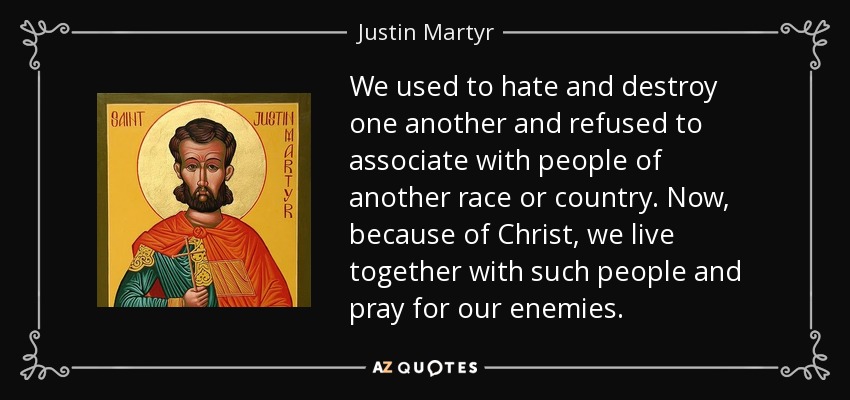
Justin Martyr
b. 100 Flavia Neapolis, Judea
d. 165 Rome, Roman Empire
Justin was an early Christian apologist. He is regarded as the foremost interpreter of the theory of the Logos in the 2nd century. He was martyred alongside some of his students. He is respected as a saint by the Roman Catholic, Anglican, Eastern Orthodox and Oriental Orthodox Churches.
Two of his apologies and a dialogue survived. The First Apology defended the morality of the Christian life. Various ethical and philosophical arguments were expressed to convince the Roman emperor, Antoninus, to abandon the persecution of the Church.
He also indicated that the "true religion" predated Christianity. The "seeds of Christianity" actually came before Christ's incarnation. These were manifestations of the Logos acting in history.
This notion allowed him to claim that historical Greek philosophers including Socrates and Plato were pre-Christians. The philosophical expression showed respect for moral standards that anticipated the morality of the Christian religion.
Flavia Neapolis
Flavia Neapolis translates from Latin as the "new city of the emperor Flavius." It was named in 72 CE by the Roman emperor Vespasian (r. 69-79). The name took the place of an older Samaritan village, variously called Mabartha ("the passage") or Mamorpha.
The settlement was located between Mount Ebal and Mount Gerizim. The new city lay 2 kilometers (1.2 mi) west of the Biblical city of Shechem which was destroyed by the Romans that same year during the First Jewish-Roman War.
Joseph's Tomb and Jacob's Well were holy places in the city. Neapolis prospered due to the city's strategic geographic position and the abundance of water from nearby springs. Territory was accumulated including the former Judean toparchy of Acraba.
The city was built on a Roman grid plan insofar as the hilly topography of the site would allow. It was settled with veterans who fought in the victorious legions. Other foreign colonists immigrated there as well.
Trajan became the emperor of Rome in 98. Trajan is remembered as a soldier-emperor who presided over the largest military expansion in Roman history. The empire attained its maximum territorial extent by the time of his death (117).
Emperor Hadrian (r.117-138) built a grand theater in Neapolis that could seat up to 7,000 people in the 2nd century CE.
Coins found in Nablus dating to this period depict Roman military emblems and gods and goddesses of the Greek pantheon such as Zeus, Artemis, Serapis, and Asklepios. Neapolis was entirely pagan at this time.
He is also known for his philanthropic rule. He had public building programs and implemented social welfare policies. He was the second of the Five Good Emperors who presided over an era of peace and prosperity in the Mediterranean world.
Justin
Justin was born into a pagan family in Flavius Neapolis, Samaria (now Nables) in 100. He defined himself as a Gentile. His grandfather, Bacchius, had a Greek name, while his father, Priscus, bore a Latin name.
The names support the speculation that his ancestors settled in Neapolis soon after its establishment. They may have been descended from a Roman "diplomatic" community that had been sent there.
He sought to find life's meaning in the philosophies of his day. This brought a series of disappointments, but he established a connection between Christian and Greek apologetic.
His first teacher was a Stoic who "knew nothing of God and did not even think knowledge of him to be necessary." There followed a Peripatetic (itinerant philosopher), who seemed most interested in getting his fees.
Then came a Pythagorean, but his required course of music, astronomy and geometry seemed far too slow. Finally, Platonism, though intellectually demanding, proved unfulfilling for Justin's hungry heart.
His life was transformed at last after a conversation with an old man around 130: "A fire was suddenly kindled in my soul. I fell in love with the prophets and these men who had loved Christ; I reflected on all their words and found that this philosophy alone was true and profitable. That is how and why I became a philosopher. And I wish that everyone felt the same way that I do."
Justin continued to wear his philosopher's cloak. He sought to reconcile faith and reason. His teaching ministry took him first to Ephesus (c. 132) where he held a disputation with Trypho, a Jew, about the true interpretation of Scripture.
The Dialogue with Trypho teaches three main points. The Old Covenant is passing away to make place for the New. The Logos is the God of the Old Testament and the Gentiles are the new Israel.
These points were conceptually clear with respect for Christian reason, but they presented a problem to the status of the Jewish homeland. Jerusalem had been destroyed in 70. Jews were forbidden to live there.
The Jewish and Roman cultures began to overlap in the centuries just before the Christian Era.
Jews migrated to Rome and Roman Europe from the Land of Israel, Asia Minor, Babylon and Alexandria as part of the diaspora. The migration was stimulated by economic hardship and incessant warfare over the land of Israel between the Ptolemaic and Seleucid empires.
The Roman general Pompey in his eastern campaign established the Roman province of Syria in 64 BCE and conquered Jerusalem in 63. Julius Caesar conquered Alexandria c. 47 and defeated Pompey in 45. Judaism was officially recognized as a legal religion under Julius Caesar. The policy was followed by the first Roman emperor, Augustus.
Herod the Great was designated 'King of the Jews' by the Roman Senate in c. 40. The Roman province of Egypt was established in 30. Judea proper, Samaria and Idumea (biblical Edom) were converted to the Roman province of Iudaea in 6 CE.
Jewish–Roman tensions resulted in several Jewish–Roman wars from 66–135. These battles resulted in the destruction of Jerusalem and the Second Temple. The Jewish Tax was instituted in 70. Hadrian's attempted to create a new Roman colony named Aelia Capitolina c. 130.
Christianity was being developed from Second Temple Judaism by this time.
Jewish communities enjoyed privileges and thrived economically in Rome. They became a significant part of the Empire's population. The size may have grown to as much as ten percent. The Roman Twelve tables were a summary of the law. The Romans had seen that the Jews had a respect for law. They were educated enough to see that the ten commandments represented a better summary.
They also knew that they were willing to modify the code that had been established in Sumeria, Assyria, Babylon and Persia.
It is difficult to say when the plan to convert Roman culture to monotheism was formed, but it is conceivable that Vespasian and Josephus agreed to formulate a biblical canon for a Gentile monotheism after Vespasian had adopted Josephus as his historian.
Justin moved to Rome and founded a Christian school. He engaged the Cynic philosopher Crescens in debate. He was arrested on the charge of practicing an unauthorized religion.
He wrote two bold apologies (i.e., defenses—from the Greek apologia). Justin's First Apology, addressed to Emperor Antoninus Pius, was published in 155. It attempted to explain the faith.
Christianity was not a threat to the state. It should be treated as a legal religion. He wrote "on behalf of men of every nation who are unjustly hated and reviled."
Antoninus Pius was Roman emperor from 138 to 161. Hadrian (r.117-138) adopted him as his son and successor shortly before his death. His reign is notable for the peaceful state of the Empire with no major revolts or military incursions during this time. He governed the empire without ever leaving Italy.
Antoninus portrayed himself as a magistrate of the res publica. He is credited with the splitting of the imperial treasury, the Fiscus. This splitting had to do with the division of imperial properties into two parts. The patrimonium were the properties of the "Crown."
The hereditary properties of each succeeding person that sat on the throne were transmitted to his successors in office regardless of their membership in the imperial family. Secondly, the res privata were the "private" properties tied to the personal maintenance of the Emperor and his family.
The res privata lands could be sold and/or given away. The patrimonium properties were regarded as public. It was a way of declaring that the Imperial function and most properties attached to it was public. It was formally subject to the authority of the Senate and the Roman people.
Antoninus introduced the important principle that accused persons are not to be treated as guilty before trial. It was to Antonius that the Christian apologist Justin Martyr addressed his defense of the Christian faith. Justin reminded him of his father's (Emperor Hadrian's) rule that accusations against Christians required proof.
He also asserted the principle that the trial was to be held and the punishment inflicted in the place where the crime had been committed. He mitigated the use of torture in examining slaves by stipulating certain limitations.
He prohibited the application of torture to children under 14 years though this rule had exceptions. Other limitations were applied to the use of torture and slavery.
Antoninus favored the principle of favor libertatis. This principle gave the putative freedman the benefit of the doubt when the claim to freedom was not clearcut.
Justin defended Christianity as a rational creed. He included an account of the Christian ceremonies of Baptism and the Eucharist.
Justin discussed the principal criticisms of contemporary Christians. These criticisms were presented as charges. The charges were atheism, immorality and disloyalty to the Empire.
He first argued that “the name” of Christianity by itself was not reason enough to punish or persecute. He urged the Empire to only punish evil actions instead. He wrote, “For from a name neither approval nor punishment could fairly come, unless something excellent or evil in action can be shown about it.”
He then addressed the charges more directly. He argued that they were “atheists” toward Roman gods, but not to the “most true God.” He acknowledged that some Christians had performed immoral acts, but urged officials to punish the individuals as evildoers rather than Christians.
Justin demonstrated his desire to separate the Christian name from the evil acts performed by certain individuals with this claim. He lamented how criminals tarnished the name of Christianity and were not true “Christians.”
He addressed the alleged disloyalty to the Empire. Christians do seek to be members of another kingdom, but this kingdom is “of that with God” rather than a “human one.”
He remarked that Christianity provides moral teaching for its followers. Many of the Christian teachings paralleled similar stories in pagan mythology. It was irrational for contemporary pagans to persecute Christians.
One of Justin’s most important themes involved his description of the logos. The word was a philosophical concept of order in reason with knowledge expressed by Heraclitus. Justin argued that Jesus Christ is the incarnation of the Logos.
This led him to the proof that any individual who had spoken with reason even those who lived before Christ are connected with the logos in the form of Christ are Christian in fact.
This theme was paramount to understanding Justin’s defense of Christianity. It was a groundbreaking statement in Christian apologetic. The use of the term “logos” indicated the use of prior philosophical teachings, but these teachings represented partial truth. They possessed and were connected with part of the overall logos.
Christianity represented the full truth (logos). Faith was not only a meaningful philosophy, it also completed and corrected prior thought to achieve the highest level of knowledge with reason.
The Second Apology was addressed to the Roman Senate. It was chiefly concerned with the rebuttal to specific charges of immorality that had been made against the Christians. He argued that good Christians make good citizens. The notion that Christianity undermined the foundations of a good society was based on slander.
Justin recounted the story of a certain woman who on hearing the teaching of Jesus and having become a Christian refused to comply with the immoral practices of her husband. The disagreements were so severe that she desired to be divorced. She was not encouraged to do so.
She continued in that relationship until it became ethically unlivable. She gave him a bill of divorce. The husband retaliated by bringing accusations against her before the Emperor. When he couldn't do anything to have her punished, he turned against the Christian leaders. The prefect Urbicus began a persecution.
It was the fallen angels and demons who incited such hatred and evil against the people of God. This view was in accord with the Book of Enoch (1 Enoch), which Justin viewed as scripture.
These demons are the spirits of those offspring born through the union of fallen angels and women before the Flood. They control humans through magic arts, libations and intimidating systems that hold people in bondage. They are exorcised by the Christians in the name of Jesus. All those in whom the Word dwells have been hated. Heraclitus and Musonius are examples.
The Christians were being accused of cannibalism and sexual immorality. Justin asked that if the Christians were pleasure-mongers, then why would they be fearless in the face of death for faithfulness to what they believe. Their faithfulness to Christ when threatened with torture or death proved that they are not pleasure seekers.
It was the accusers who had a system of religion in which humans were sacrificed to gods such as Saturn. Sexual immorality was openly practiced by them without shame.
Justin argued that if any group were to be persecuted, it should be the homosexuals that should be charged with sexual immorality. The replacement group argument for persecution was morally misdirected. It was implemented for centuries whenever the Roman government felt the people needed a group from whom to draw material wealth for the 'empire.'
He was confident that his teaching was that of the Church at large. He knows of a division among the orthodox only on the question of the millennium and on the attitude toward the milder Jewish Christianity.
He personally was willing to tolerate the division as long as its professors in their turn did not interfere with the liberty of the Gentile converts. His millenarianism seems to have no connection with Judaism, but he believes firmly in a millennium in the Christian eschatology.
Justin saw himself as a scholar, but his skills in Hebrew were either non-existent or minimal. He published an attack on Judaism after collaborating with a Jewish convert to assist him with Hebrew. The criticism was based upon a no-longer-extant text of a Midrash.
Opposition to Judaism was typical of church leaders in his day. Justin was particularly antagonistic towards Jews and regarded them as a cursed people. His anti-Judaic polemics have been cited as an origin of Christian antisemitism. He was the first to argue that the Romans had no responsibility for the death of Jesus. He supported the idea of Jewish deicide.
Justin referred to written sources consisting of narratives of the life of Jesus and quotations of the sayings of Jesus as "memoirs of the apostles" and less frequently as gospels. He said the texts were read every Sunday in the church at Rome. The "memoirs of the apostles or the writings of the prophets are being read as long as it is allowable." (1 Apol. 67.3)
He was denounced by the cynic philosopher Crescens to the authorities after a debate with him in the reign of Marcus Aurelius according to Tatian (Address to the Greeks 19) and Eusebius (HE IV 16.7–8). Justin was tried together with six companions by Junius Rusticus the urban prefect from 163–167. His execution can reasonably be dated by the prefectoral term of Rusticus.
The prefect told the accused to approach to make a sacrifice to the gods. Justin said, "No one in his right mind gives up piety for impiety." The prefect warned them that they would be tortured without mercy if they did not obey.
Justin replied that it was their desire to be tortured for Jesus Christ. Sacrifice for him would result in salvation. They would be given firm confidence at the more terrible universal tribunal of their Lord and Savior. All the martyrs said, "Do as you wish." They were Christians. They did not sacrifice to idols.
Rusticus read the sentence, "Those who do not wish to sacrifice to the gods and to obey the emperor will be scourged and beheaded according to the laws."
The martyrs were beheaded to consummate their confession of faith in their Savior.
Justin Martyr
S. 贾斯汀殉道者
T. 賈斯汀殉道者
贾 Jia trade 賈 ko buy Ja じゃ ジャ Jeo 저 moth
斯 si this 斯 shi this su す ス seu 스 switch
汀 ting sandbank 汀 tei water's edge tin てぃん ティン tin 틴 tin
殉 Xun martyr 殉 jun resignation Jun 殉 殉 Sun 순 the
道 dao way 道 do road-way kyo 教 教 gyo 교 school
者 zhe he who 者 sha someone mono 者 者 ja 자 character
--------------------------
The water's edge reached up onto the sand
in resignation to the limit allowed by gravity and land.
===============
Lectionary Justin M
wiki Justin M
wiki Nablus Flavius Neapolis
Christianity Today Justin M
Showing posts with label libation. Show all posts
Thursday, May 30, 2019
Thursday, May 16, 2019
Revere
Weedon Island Preserve
Pinellas County, Florida
Revere
Life
反抗生活
Fǎnkàng shēnghuó
リヴィア生活
Rivu~ia seikatsu
ps116
I love that I found help when I needed it.
Salvation came and I heeded it.
I felt desperate. My mind cried for direction.
Choice was compressed to this bit. I had to select protection
from the danger of dereliction.
I found what I needed before the moment of crisis.
The rightness in choice was decisive.
The cords of death had entangled me.
My sight was so strangled, I had to get free.
The grip of the grave grapple grabbed
until my adam's apple gagged
while seeing the sensible source sag
from the sense perception had.
Sorrow drove sadness to the threshold of pain.
The horror drove madness to enfold the insane.
Then I cried for help
after yapping a yelp,
“What do I have to do to find safety?
I need it now. I need it greatly.”
The success of salvation is gracious.
It was so efficacious, it was almost salacious.
Nothing else is quite so profound
as wonder in the world once it has been found.
Defense is granted to the watchful
if only because the cautious
watch for the goodness of the gospel.
I felt that I fell very low, but I was helped.
I exempted contempt for what I was dealt.
It is time to rest
now that I have been blessed
with the quest to sing of salvation with zest.
Stress from the test has worn my torn soul.
I will do my best to celebrate life as a whole.
I was rescued from death.
Help was given in the test.
My eyes shed natural tears.
I was grateful for my years.
My feet did not stumble
though I felt glad and humble.
I will walk in the presence
of the divine essence
in the land of the living
to give thanks for the giving.
I believed even when
I had been brought to a bend.
Then I said, “No one can be trusted
when your trust has been busted.”
False prophets lead those who believe them astray.
Truth is the safeguard against fake news for the day.
How will I repay my debt
without regret
for all the good things
carried by angel wings?
I will lift up the cup of salvation
and hold it high as a libation.
I will fulfill my promise to live
with reverence for life as a gift
in the rule of law that we win
in transcending sin.
Precious in the sight of divine Light
is the death of those who defended rights.
They lived good lives.
I am a defender of rights.
I have been resurrected as a good life
by the experience that brought me past strife.
I tasted a glimpse of the abyss.
It was black and gray with white lights in the tryst.
I have been freed from the world of discrimination
to recount deliverance by narration.
My ear has been opened.
I hear sounds that are spoken.
From the same mouth come blessing and curse.
Speech should be the garden ground for verse.
Who do you say that I am?
You are anointed to pass the exam.
I was not rebellious,
reckless or helpless.
I did not turn backwards.
I spoke in exact words.
Weedon Island Preserve Sunrise
Bravery is most bold when prepared.
Faith looks for benign design to be shared.
Traditional revival celebrates regression to the legal process.
Conservative reform pushes for manageable progress.
Time starts to grow bold.
The word shares the beauty of hope.
Hope desires goodness
to add to the fullness.
LARS Modern Pyramid
Measure the base
to secure great restraint.
The bug pulls this stem.
You straighten the hem.
Rumi
The bridge to love leads the way
to the right thing to do or say.
We are among those who have faith with courage.
We don't shrink back to be lost or discouraged.
I will offer thanksgiving as my sacrifice.
I will give thanks to the Giver of life.
The faithful abide in love with truth.
Grace and mercy act like salve that soothes.
I will speak with reason for the reasonable acceptance
of benefit for people in the presence
of the divine essence
in the assembly in public
in the city of peace that is love lit
by the waters near where the dove sits.
Yea Yah!
You fill me with awe!
---------------------------
116 Dilexi, quoniam
I love, because
1 I love the Lord, because he has heard the voice of
my supplication,
because he has inclined his ear to me whenever
I called upon him.
2 The cords of death entangled me;
the grip of the grave took hold of me;
I came to grief and sorrow.
3 Then I called upon the Name of the Lord:
"O Lord, I pray you, save my life."
4 Gracious is the Lord and righteous;
our God is full of compassion.
5 The Lord watches over the innocent;
I was brought very low, and he helped me.
6 Turn again to your rest, O my soul.
for the Lord has treated you well.
7 For you have rescued my life from death,
my eyes from tears, and my feet from stumbling.
8 I will walk in the presence of the Lord
in the land of the living.
9 I believed, even when I said,
"I have been brought very low."
In my distress I said, "No one can be trusted."
10 How shall I repay the Lord
for all the good things he has done for me?
11 I will lift up the cup of salvation
and call upon the Name of the Lord.
12 I will fulfill my vows to the Lord
in the presence of all his people.
13 Precious in the sight of the Lord
is the death of his servants.
14 O Lord, I am your servant;
I am your servant and the child of your handmaid;
you have freed me from my bonds.
15 I will offer you the sacrifice of thanksgiving
and call upon the Name of the Lord.
16 I will fulfill my vows to the Lord
in the presence of all his people,
17 In the courts of the Lord's house,
in the midst of you, O Jerusalem.
Hallelujah!
------------------------
Wisdom 3:9
Those who trust in the Lord will understand truth.
The faithful will abide with him in love
because grace and mercy are upon his holy ones
and he watches over his elect.
------------------------
The faithful abide in love with truth.
Grace and mercy act like salve that sooths.
==============
Hebrews 10:39
We are not among those who shrink back and are lost.
We are among those who have faith and are saved.
------------------------
We are among those who have faith with courage.
We don't shrink back to be lost or discouraged.
==============
Matt. 24:11
False prophets will arise and lead those who believe them astray.
------------------------
False prophets lead those who believe them astray.
Truth is the safeguard against fake news for the day.
==============
South Sudan
Martyrs of Sudan
Sudan
Sudan is situated in the eastern part of northern Africa. The coastline extends for 853 km (530 mi) along the Red Sea.
The country has land borders with Egypt, Eritrea, Ethiopia, South Sudan, the Central African Republic, Chad and Libya. It is the third-largest country on the continent after Algeria and Democratic Republic of the Congo. It is the sixteenth-largest in the world. The land has an area of 1,886,068 km2 (728,215 sq mi).
The terrain is generally flat plains. It is broken by several mountain ranges. Sudan lies between latitudes 8° and 23°N. The Deriba Caldera is 3,042 m (9,980 ft) in height. It is located in the Marrah Mountains in the west. It is the highest point in Sudan. The Red Sea Hills are in the east.
The Blue and White Nile rivers meet in Khartoum to form the Nile. The river flows northwards through Egypt to the Mediterranean Sea. The Blue Nile's course through Sudan is nearly 800 km (497 mi) long. It is joined by the Dinder and Rahad Rivers between Sennar and Khartoum. The White Nile within Sudan has no significant tributaries.
The politics of Sudan takes place in the framework of a federal presidential representative democratic republic. The President of Sudan is head of state, head of government and commander-in-chief of the Sudan People's Armed Forces in a multi-party system.
Legislative power is vested in both the government and the bicameral parliament. The parlament is the legislature with its National Assembly (lower chamber) and the Council of States (upper chamber). The judiciary is independent and obtained by the Constitutional Court.
Al-Bashir was a candidate in the 2010 Sudanese presidential election. This was the first democratic election with multiple political parties participating in twenty-four years. Sudanese pro-democracy activists say they faced intimidation by the government.
The International Crisis Group reported that the ruling party had gerrymandered electoral districts. The main opposition candidate, Yasir Arman from the SPLM, withdrew from the race a few days before the vote.
The U.S.-based Carter Center helped monitor the elections. It described the vote tabulation process as "highly chaotic, non-transparent and vulnerable to electoral manipulation." Al-Bashir was declared the winner of the election with sixty-eight percent of the vote.
The legal system in Sudan is based on Islamic Sharia law. The 2005 Naivasha Agreement ending the civil war between north and south Sudan established some protections for non-Muslims in Khartoum. Sudan's application of Sharia law is geographically inconsistent.
Sharia Law
Islamic or Sharia law is a religious law forming part of the Muslim tradition. It is derived from the religious precepts of Islam. The precepts are drawn from the Quran and the Hadith.
The term sharīʿah refers to God's immutable divine law in Arabic. It is contrasted with fiqh. This refers to its human scholarly interpretations. The manner of its application in modern times has been a subject of dispute between Muslim fundamentalists and modernists.
Traditional theory in Islamic jurisprudence recognizes four sources: the Quran, sunnah (authentic hadith), qiyas (analogical reasoning), and ijma (juridical consensus).
The most prominent legal schools are Hanafi, Maliki, Shafi'i, Hanbali and Jafari. The schools developed methodologies for deriving rulings from scriptural sources using a process known as ijtihad.
Traditional jurisprudence (fiqh) distinguishes two principal branches of law, ʿibādāt (rituals) and muʿāmalāt (social relations). Together these branches comprise a wide range of topics.
Rulings are concerned with ethical standards as well as legal norms. Actions are assigned to one of five categories: mandatory, recommended, neutral, abhorred and prohibited. Some areas of sharia overlap with the Western notion of law while others correspond more broadly to living life in accordance with God’s will.
Classical jurisprudence was elaborated by private religious scholars, largely through legal opinions (fatwas) issued by qualified jurists (muftis). It was historically applied in sharia courts by ruler-appointed judges. The judges dealt mainly with civil disputes and community affairs.
Islam is more tolerant of nomadic or tribal life than western society. There is difficulty with the primitive identification of cruelty in punishment with justice in law. There is also a stronger tolerance for gang violence or vigilante justice in tribal society. The threat of rebellion or terrorist activity is stronger.
Liberals in western government provide support for the threat to the native government.
Traditional laws in the Muslim world have been widely replaced by statutes inspired by European models in the modern era. Judicial procedures and legal education were likewise brought in line with European practice.
While the constitutions of most Muslim-majority states contain references to sharia classical rules were largely retained only in personal status (family) laws. Legislators who codified these laws sought to modernize them without abandoning their foundations in traditional jurisprudence.
The Islamic revival of the late 20th century brought along calls by Islamist movements for full implementation of traditional Islamic law. This included hudud corporal punishments such as stoning.
Traditionalist legal reform took place in some cases. Other countries witnessed juridical reinterpretation of sharia as advocated by progressive reformers.
Stoning remains a judicial punishment in Sudan. Several women were sentenced to death by stoning between 2009 and 2012.
Flogging is a legal punishment. Many people were sentenced to 40-100 lashes between 2009 and 2014. Several Sudanese men died in custody after being flogged in August 2014. Fifty three Christians were flogged in 2001. Sudan's public order law allows police officers to publicly whip women who are accused of indecency.
Crucifixion is a legal punishment. Eighty eight people were sentenced to death for crimes relating to murder, armed robbery and participating in ethnic clashes in 2002. Amnesty International wrote that they could be executed by either hanging or crucifixion.
Christianity has a long history in the region that is now Sudan and South Sudan. Ancient Nubia was reached by Coptic Christianity by the 2nd century. The Coptic Church was later influenced by Greek Christianity during the Byzantine era.
The Christian Nubian kingdoms were threatened by the Islamic expansion from the 7th century. The southernmost of these kingdoms, Alodia, survived until 1504.
Southern Sudan remained long dominated by traditional (tribal) religions of the Nilotic peoples. Significant conversion to Anglicanism (Episcopal Church of Sudan) happened during the 20th century.
British missionaries re-introduced the Christian faith into South Sudan during the 19th century. British imperial authorities limited missionary activity to the multi-ethnic southern region.
The Church of England and other parts of the Anglican Communion continued to send missionaries and other assistance after the country became independent in 1956. Decades of civil war and persecution followed.
South Sudan split from the north at the 2011 division. Over 97% of the population remaining in the north adheres to Islam. The South Sudanese included traditional indigenous religions, Christianity and Islam. The last census to mention the religion of southerners dates back to 1956 where a majority were classified as following traditional beliefs or were Christian while 18% were Muslim.
The Christian bishops, chiefs, commanders, clergy and people of Sudan declared on May 16, 1983 that they would not abandon their faith as God had revealed himself to them under threat of Shariah Law imposed by the fundamentalist Islamic government in Khartoum.
The Episcopal Church of the Province of the Sudan suffered from persecution and devastation through 22 years of civil war until a peace treaty was signed on January 9, 2005. Members of the church were killed along with other people who died due to violent action. Clergy and lay leaders were singled out because of their religious leadership in their communities.
People have been internally displaced. Many are scattered around Africa and beyond in the Sudanese Diaspora. Twenty-two of the twenty-four dioceses exist in exile in Uganda or Kenya.
Most of the region of six million people in South Sudan are now mostly Episcopalian or Roman Catholic thanks to missionary support from foreign church fund drives and the dedication of the local Christian clergy.
A faith rooted deeply in the mercy of God has renewed their spirits through out the years of strife and sorrow.
Deficit spending to pay for the invasion of the Middle East organized by liberal leaders has increased the tax burden for people in western nations.
Prices have been increased in the market to maintain independence from socialist practice in government. Taxation and higher prices have decreased the amount of money available for charity.
Martyrs of Sudan
S. 苏丹烈士
T. 蘇丹烈士
------------------------
Traditional revival celebrates regression to the legal process.
Conservative reform pushes for manageable progress.
==============
Christianity in Sudan Wiki
Sudan Lectionary
Sharia Wiki
Non-Muslim nations have a concern about Sharia law. One way of expressing the concern is that Sharia is too prohibitive where prohibition is not the best legal action.
Bentham identified asceticism as an objection to utilitarian happiness. The inclination is addressed to oppose pleasure as though it were the cause of lawlessness.
The objection to ascetic austerity as an imposition of law is associated with opposition to theocracy in government. It is felt that religion and the religious control of legal authority is aimed at making choices for people that people should be allowed to make for themselves.
While crime has a strong association with the excess consumption of alcohol, prohibition is not accepted as a healthy remedy. It promotes a general disrespect for law.
Sharia Law
The argument in this article looks like a 'back door' entrance to popular support for sharia.
Five Myths
Washington Post
"... sharia isn’t even “law” in the sense that we in the West understand it. And most devout Muslims who embrace sharia conceptually don’t think of it as a substitute for civil law."
Another objection to Sharia is that the punishment is cruel.
Brutal Punishment
BBC News
"Sharia law divides offences into two general categories: "hadd" offences, which are serious crimes with set penalties, and "tazir" crimes, where the punishment is left to the discretion of the judge.
"Hadd offences include theft, which can be punishable by amputating the offender's hand, and adultery, which can carry the penalty of death by stoning."
-------------------------
There are 'Muslims' who would have Sharia supplant the law that has been developed in relation to European legal standards.
Political Controversy
NBC News
"During 2017, 14 states introduced some kind of anti-Shariah law bill, with Texas and Arkansas enacting the legislation, according to the Southern Poverty Law Center."
There is a distinction between immutable and interpretative law based on consensus. This distinction can be blurred to favor tribal prejudice.
There is the aspect of morality that is directed towards the limitation of government overreach. This said, there is a consensus among Muslim nation states that respects the boundaries of the nations. The Ottomans changed that kind of consensus in the past.
Sharia law poses a threat to western borders, but the liberal push to define national security as something that isn't worried about border strength is a more immediate problem.
It is likely that liberals from the west are pushing Muslim governments into declaring the supremacy of the legislature as sharia law.
Pinellas County, Florida
Revere
Life
反抗生活
Fǎnkàng shēnghuó
リヴィア生活
Rivu~ia seikatsu
ps116
I love that I found help when I needed it.
Salvation came and I heeded it.
I felt desperate. My mind cried for direction.
Choice was compressed to this bit. I had to select protection
from the danger of dereliction.
I found what I needed before the moment of crisis.
The rightness in choice was decisive.
The cords of death had entangled me.
My sight was so strangled, I had to get free.
The grip of the grave grapple grabbed
until my adam's apple gagged
while seeing the sensible source sag
from the sense perception had.
Sorrow drove sadness to the threshold of pain.
The horror drove madness to enfold the insane.
Then I cried for help
after yapping a yelp,
“What do I have to do to find safety?
I need it now. I need it greatly.”
The success of salvation is gracious.
It was so efficacious, it was almost salacious.
Nothing else is quite so profound
as wonder in the world once it has been found.
Defense is granted to the watchful
if only because the cautious
watch for the goodness of the gospel.
I felt that I fell very low, but I was helped.
I exempted contempt for what I was dealt.
It is time to rest
now that I have been blessed
with the quest to sing of salvation with zest.
Stress from the test has worn my torn soul.
I will do my best to celebrate life as a whole.
I was rescued from death.
Help was given in the test.
My eyes shed natural tears.
I was grateful for my years.
My feet did not stumble
though I felt glad and humble.
I will walk in the presence
of the divine essence
in the land of the living
to give thanks for the giving.
I believed even when
I had been brought to a bend.
Then I said, “No one can be trusted
when your trust has been busted.”
False prophets lead those who believe them astray.
Truth is the safeguard against fake news for the day.
How will I repay my debt
without regret
for all the good things
carried by angel wings?
I will lift up the cup of salvation
and hold it high as a libation.
I will fulfill my promise to live
with reverence for life as a gift
in the rule of law that we win
in transcending sin.
Precious in the sight of divine Light
is the death of those who defended rights.
They lived good lives.
I am a defender of rights.
I have been resurrected as a good life
by the experience that brought me past strife.
I tasted a glimpse of the abyss.
It was black and gray with white lights in the tryst.
I have been freed from the world of discrimination
to recount deliverance by narration.
My ear has been opened.
I hear sounds that are spoken.
From the same mouth come blessing and curse.
Speech should be the garden ground for verse.
Who do you say that I am?
You are anointed to pass the exam.
I was not rebellious,
reckless or helpless.
I did not turn backwards.
I spoke in exact words.
Weedon Island Preserve Sunrise
Bravery is most bold when prepared.
Faith looks for benign design to be shared.
Traditional revival celebrates regression to the legal process.
Conservative reform pushes for manageable progress.
Time starts to grow bold.
The word shares the beauty of hope.
Hope desires goodness
to add to the fullness.
LARS Modern Pyramid
Measure the base
to secure great restraint.
The bug pulls this stem.
You straighten the hem.
Rumi
The bridge to love leads the way
to the right thing to do or say.
We are among those who have faith with courage.
We don't shrink back to be lost or discouraged.
I will offer thanksgiving as my sacrifice.
I will give thanks to the Giver of life.
The faithful abide in love with truth.
Grace and mercy act like salve that soothes.
I will speak with reason for the reasonable acceptance
of benefit for people in the presence
of the divine essence
in the assembly in public
in the city of peace that is love lit
by the waters near where the dove sits.
Yea Yah!
You fill me with awe!
---------------------------
116 Dilexi, quoniam
I love, because
1 I love the Lord, because he has heard the voice of
my supplication,
because he has inclined his ear to me whenever
I called upon him.
2 The cords of death entangled me;
the grip of the grave took hold of me;
I came to grief and sorrow.
3 Then I called upon the Name of the Lord:
"O Lord, I pray you, save my life."
4 Gracious is the Lord and righteous;
our God is full of compassion.
5 The Lord watches over the innocent;
I was brought very low, and he helped me.
6 Turn again to your rest, O my soul.
for the Lord has treated you well.
7 For you have rescued my life from death,
my eyes from tears, and my feet from stumbling.
8 I will walk in the presence of the Lord
in the land of the living.
9 I believed, even when I said,
"I have been brought very low."
In my distress I said, "No one can be trusted."
10 How shall I repay the Lord
for all the good things he has done for me?
11 I will lift up the cup of salvation
and call upon the Name of the Lord.
12 I will fulfill my vows to the Lord
in the presence of all his people.
13 Precious in the sight of the Lord
is the death of his servants.
14 O Lord, I am your servant;
I am your servant and the child of your handmaid;
you have freed me from my bonds.
15 I will offer you the sacrifice of thanksgiving
and call upon the Name of the Lord.
16 I will fulfill my vows to the Lord
in the presence of all his people,
17 In the courts of the Lord's house,
in the midst of you, O Jerusalem.
Hallelujah!
------------------------
Wisdom 3:9
Those who trust in the Lord will understand truth.
The faithful will abide with him in love
because grace and mercy are upon his holy ones
and he watches over his elect.
------------------------
The faithful abide in love with truth.
Grace and mercy act like salve that sooths.
==============
Hebrews 10:39
We are not among those who shrink back and are lost.
We are among those who have faith and are saved.
------------------------
We are among those who have faith with courage.
We don't shrink back to be lost or discouraged.
==============
Matt. 24:11
False prophets will arise and lead those who believe them astray.
------------------------
False prophets lead those who believe them astray.
Truth is the safeguard against fake news for the day.
==============
South Sudan
Martyrs of Sudan
Sudan
Sudan is situated in the eastern part of northern Africa. The coastline extends for 853 km (530 mi) along the Red Sea.
The country has land borders with Egypt, Eritrea, Ethiopia, South Sudan, the Central African Republic, Chad and Libya. It is the third-largest country on the continent after Algeria and Democratic Republic of the Congo. It is the sixteenth-largest in the world. The land has an area of 1,886,068 km2 (728,215 sq mi).
The terrain is generally flat plains. It is broken by several mountain ranges. Sudan lies between latitudes 8° and 23°N. The Deriba Caldera is 3,042 m (9,980 ft) in height. It is located in the Marrah Mountains in the west. It is the highest point in Sudan. The Red Sea Hills are in the east.
The Blue and White Nile rivers meet in Khartoum to form the Nile. The river flows northwards through Egypt to the Mediterranean Sea. The Blue Nile's course through Sudan is nearly 800 km (497 mi) long. It is joined by the Dinder and Rahad Rivers between Sennar and Khartoum. The White Nile within Sudan has no significant tributaries.
The politics of Sudan takes place in the framework of a federal presidential representative democratic republic. The President of Sudan is head of state, head of government and commander-in-chief of the Sudan People's Armed Forces in a multi-party system.
Legislative power is vested in both the government and the bicameral parliament. The parlament is the legislature with its National Assembly (lower chamber) and the Council of States (upper chamber). The judiciary is independent and obtained by the Constitutional Court.
Al-Bashir was a candidate in the 2010 Sudanese presidential election. This was the first democratic election with multiple political parties participating in twenty-four years. Sudanese pro-democracy activists say they faced intimidation by the government.
The International Crisis Group reported that the ruling party had gerrymandered electoral districts. The main opposition candidate, Yasir Arman from the SPLM, withdrew from the race a few days before the vote.
The U.S.-based Carter Center helped monitor the elections. It described the vote tabulation process as "highly chaotic, non-transparent and vulnerable to electoral manipulation." Al-Bashir was declared the winner of the election with sixty-eight percent of the vote.
The legal system in Sudan is based on Islamic Sharia law. The 2005 Naivasha Agreement ending the civil war between north and south Sudan established some protections for non-Muslims in Khartoum. Sudan's application of Sharia law is geographically inconsistent.
Sharia Law
Islamic or Sharia law is a religious law forming part of the Muslim tradition. It is derived from the religious precepts of Islam. The precepts are drawn from the Quran and the Hadith.
The term sharīʿah refers to God's immutable divine law in Arabic. It is contrasted with fiqh. This refers to its human scholarly interpretations. The manner of its application in modern times has been a subject of dispute between Muslim fundamentalists and modernists.
Traditional theory in Islamic jurisprudence recognizes four sources: the Quran, sunnah (authentic hadith), qiyas (analogical reasoning), and ijma (juridical consensus).
The most prominent legal schools are Hanafi, Maliki, Shafi'i, Hanbali and Jafari. The schools developed methodologies for deriving rulings from scriptural sources using a process known as ijtihad.
Traditional jurisprudence (fiqh) distinguishes two principal branches of law, ʿibādāt (rituals) and muʿāmalāt (social relations). Together these branches comprise a wide range of topics.
Rulings are concerned with ethical standards as well as legal norms. Actions are assigned to one of five categories: mandatory, recommended, neutral, abhorred and prohibited. Some areas of sharia overlap with the Western notion of law while others correspond more broadly to living life in accordance with God’s will.
Classical jurisprudence was elaborated by private religious scholars, largely through legal opinions (fatwas) issued by qualified jurists (muftis). It was historically applied in sharia courts by ruler-appointed judges. The judges dealt mainly with civil disputes and community affairs.
Islam is more tolerant of nomadic or tribal life than western society. There is difficulty with the primitive identification of cruelty in punishment with justice in law. There is also a stronger tolerance for gang violence or vigilante justice in tribal society. The threat of rebellion or terrorist activity is stronger.
Liberals in western government provide support for the threat to the native government.
Traditional laws in the Muslim world have been widely replaced by statutes inspired by European models in the modern era. Judicial procedures and legal education were likewise brought in line with European practice.
While the constitutions of most Muslim-majority states contain references to sharia classical rules were largely retained only in personal status (family) laws. Legislators who codified these laws sought to modernize them without abandoning their foundations in traditional jurisprudence.
The Islamic revival of the late 20th century brought along calls by Islamist movements for full implementation of traditional Islamic law. This included hudud corporal punishments such as stoning.
Traditionalist legal reform took place in some cases. Other countries witnessed juridical reinterpretation of sharia as advocated by progressive reformers.
Stoning remains a judicial punishment in Sudan. Several women were sentenced to death by stoning between 2009 and 2012.
Flogging is a legal punishment. Many people were sentenced to 40-100 lashes between 2009 and 2014. Several Sudanese men died in custody after being flogged in August 2014. Fifty three Christians were flogged in 2001. Sudan's public order law allows police officers to publicly whip women who are accused of indecency.
Crucifixion is a legal punishment. Eighty eight people were sentenced to death for crimes relating to murder, armed robbery and participating in ethnic clashes in 2002. Amnesty International wrote that they could be executed by either hanging or crucifixion.
Christianity has a long history in the region that is now Sudan and South Sudan. Ancient Nubia was reached by Coptic Christianity by the 2nd century. The Coptic Church was later influenced by Greek Christianity during the Byzantine era.
The Christian Nubian kingdoms were threatened by the Islamic expansion from the 7th century. The southernmost of these kingdoms, Alodia, survived until 1504.
Southern Sudan remained long dominated by traditional (tribal) religions of the Nilotic peoples. Significant conversion to Anglicanism (Episcopal Church of Sudan) happened during the 20th century.
British missionaries re-introduced the Christian faith into South Sudan during the 19th century. British imperial authorities limited missionary activity to the multi-ethnic southern region.
The Church of England and other parts of the Anglican Communion continued to send missionaries and other assistance after the country became independent in 1956. Decades of civil war and persecution followed.
South Sudan split from the north at the 2011 division. Over 97% of the population remaining in the north adheres to Islam. The South Sudanese included traditional indigenous religions, Christianity and Islam. The last census to mention the religion of southerners dates back to 1956 where a majority were classified as following traditional beliefs or were Christian while 18% were Muslim.
The Christian bishops, chiefs, commanders, clergy and people of Sudan declared on May 16, 1983 that they would not abandon their faith as God had revealed himself to them under threat of Shariah Law imposed by the fundamentalist Islamic government in Khartoum.
The Episcopal Church of the Province of the Sudan suffered from persecution and devastation through 22 years of civil war until a peace treaty was signed on January 9, 2005. Members of the church were killed along with other people who died due to violent action. Clergy and lay leaders were singled out because of their religious leadership in their communities.
People have been internally displaced. Many are scattered around Africa and beyond in the Sudanese Diaspora. Twenty-two of the twenty-four dioceses exist in exile in Uganda or Kenya.
Most of the region of six million people in South Sudan are now mostly Episcopalian or Roman Catholic thanks to missionary support from foreign church fund drives and the dedication of the local Christian clergy.
A faith rooted deeply in the mercy of God has renewed their spirits through out the years of strife and sorrow.
Deficit spending to pay for the invasion of the Middle East organized by liberal leaders has increased the tax burden for people in western nations.
Prices have been increased in the market to maintain independence from socialist practice in government. Taxation and higher prices have decreased the amount of money available for charity.
Martyrs of Sudan
S. 苏丹烈士
T. 蘇丹烈士
------------------------
Traditional revival celebrates regression to the legal process.
Conservative reform pushes for manageable progress.
==============
Christianity in Sudan Wiki
Sudan Lectionary
Sharia Wiki
Non-Muslim nations have a concern about Sharia law. One way of expressing the concern is that Sharia is too prohibitive where prohibition is not the best legal action.
Bentham identified asceticism as an objection to utilitarian happiness. The inclination is addressed to oppose pleasure as though it were the cause of lawlessness.
The objection to ascetic austerity as an imposition of law is associated with opposition to theocracy in government. It is felt that religion and the religious control of legal authority is aimed at making choices for people that people should be allowed to make for themselves.
While crime has a strong association with the excess consumption of alcohol, prohibition is not accepted as a healthy remedy. It promotes a general disrespect for law.
Sharia Law
The argument in this article looks like a 'back door' entrance to popular support for sharia.
Five Myths
Washington Post
"... sharia isn’t even “law” in the sense that we in the West understand it. And most devout Muslims who embrace sharia conceptually don’t think of it as a substitute for civil law."
Another objection to Sharia is that the punishment is cruel.
Brutal Punishment
BBC News
"Sharia law divides offences into two general categories: "hadd" offences, which are serious crimes with set penalties, and "tazir" crimes, where the punishment is left to the discretion of the judge.
"Hadd offences include theft, which can be punishable by amputating the offender's hand, and adultery, which can carry the penalty of death by stoning."
-------------------------
There are 'Muslims' who would have Sharia supplant the law that has been developed in relation to European legal standards.
Political Controversy
NBC News
"During 2017, 14 states introduced some kind of anti-Shariah law bill, with Texas and Arkansas enacting the legislation, according to the Southern Poverty Law Center."
There is a distinction between immutable and interpretative law based on consensus. This distinction can be blurred to favor tribal prejudice.
There is the aspect of morality that is directed towards the limitation of government overreach. This said, there is a consensus among Muslim nation states that respects the boundaries of the nations. The Ottomans changed that kind of consensus in the past.
Sharia law poses a threat to western borders, but the liberal push to define national security as something that isn't worried about border strength is a more immediate problem.
It is likely that liberals from the west are pushing Muslim governments into declaring the supremacy of the legislature as sharia law.
Law is Prohibitive
The argument against Sharia law suggests that it is too prohibitive and too punitive.
Law is prohibitive against crime. The law of Hammurabi had more anti-magical elements than that of Moses. While it is true that punishment for criminal behavior was cruel for millennia the provision against cruelty in punishment started a shift which eliminated the use of torture and diminished the application of the death penalty.
When Sharia law is called too prohibitive it is in the sense that the prohibition of alcohol is still entertained as legal and moral. The choice to limit alcohol consumption as an ethical application of a moral principle is removed by legal precept. That makes people too dependent upon the government regulation of law.
When sharia is called too punitive it means that the mutilation of the body is entertained as punishment when a hand can be dismembered for theft. It's not as cruel as the death penalty, but it still prohibits someone accused and convicted of theft from making an honest living after the punishment of dismemberment has been enacted.
It can be asserted in counter-point that western law is too intolerant of primitive and nomadic existence. It is also too tolerant of invasion, insurrection and terrorist insurgency.
Invasion had been ruled out after WWII by international law. The liberal manipulation of mass media expression worked to overrule that standard.
Whether you admit to the use of genocide or say that the native population in the US was reduced by 'disease', the population has been reduced to 1% in the official census counts. This suggests prejudice against tribal and nomadic forms of life.
I don't support illegal immigration, but liberals are using this part of US history to oppose conservative measures in immigration reform. They support the invasion of foreign nations and military maneuvers on the borders of 'non-allied' nations as a way of showing the capacity to invade to force regime change.
They also have indicated the intent to tax Americans to pay for the residency of illegal or legal immigrants. Their definition of national security lacks border strength and the rule of law for non-citizens.
This means that western law has been too permissive when it comes to covert and official policy in foreign relations. This policy is not only harmful to foreign people, it has increased deficit spending for increased taxation. It has also increased prices for goods and services in the market.
It is sensible to argue that we are looking for law that is not too punitive, not too prohibitive and not too permissive. This abstraction has to maintain historical perspective or it becomes too conceptually removed from experience.
There difference between Democrat and Republican liberals is the kind of socialism that is used to justify their use of invasion, insurrection or terrorist insurgency.
Labels:
cautious,
curse,
direction,
efficacious,
gracious,
helpless,
libation,
process,
progress,
protection,
rebellious,
salacious,
verse
Wednesday, April 17, 2019
Revere
4.18.19
Last Supper
Revere
Life
反抗生活
Fǎnkàng shēnghuó
リヴィア生活
Rivu~ia seikatsu
ps116
I love that I found help when I needed it.
Salvation came and I heeded it.
I had fallen to the place of shades
the distress beyond bad dreams had made.
The grip of the grave grapple grabbed
until my adam's apple gagged
while seeing the sensible source sag
from the sense perception had.
I said, "Though I have been driven from your sight,
I hope to look on your temple again with delight."
I felt desperate. My mind cried for direction.
Choice was compressed to this bit. I had to select protection
from the danger of dereliction.
I found what I needed before the moment of crisis.
The rightness in choice was decisive.
The cords of death had entangled me.
My sight was so strangled, I had to get free.
Sorrow drove sadness to the threshold of pain.
The horror drove madness to enfold the insane.
Human being is not made holy by work
but faith lives for grace when responsibility is not shirked.
I remembered to pray
when my life was fading away.
My prayer reached you in your holy place.
You heard my cry for help with grace.
I will sacrifice to you with thanksgiving.
I will give a portion from what I am given to make a living.
Salvation spoke to me through a whale and fish.
The sea spit me out on dry land to answer my wish.
The success of salvation is gracious.
It was so efficacious, it was almost salacious.
Nothing else is quite so profound
as wonder in the world once it has been found.
Defense is granted to the watchful
if only because the thoughtful
watch for the goodness of the gospel.
I felt that I fell very low, but I was helped.
I exempted contempt for the hand I was dealt.
I was rescued from death.
Help was given in the test.
My eyes shed natural tears.
I was grateful for my years.
My feet did not stumble
though I felt very humble.
I will walk in the presence
of the divine essence
in the land of the living
to give thanks for the giving.
Brooker Creek Preserve Trail
I believed even when
I had been brought to a bend.
Then I had said,
“No one can be trusted
when trust has been busted.”
How will I repay my debt
without regret
for all the good things
carried by angel wings?
I will lift up the cup of salvation
and hold it high as a libation.
I will fulfill my promise to live
with reverence for life as a gift
in the rule of law that we win
by transcending sin.
We had been told that your lamb will be a sheep or a goat.
It will be a year old male intended to connote
a sacrifice from providence as a promissory note.
Now the sacrifice is a donation to service
to consecrate thanksgiving with purpose.
Precious in the sight of divine Light
is the death of those who defended rights.
They lived good lives.
I am a defender of rights.
I have been resurrected as a good life
by the experience that brought me past strife.
I tasted this glimpse of the abyss.
It was black and gray with white lights in the tryst.
I have been freed from the world of discrimination
to recount deliverance by narration.
I listen to hear.
I have not rebelled in fear.
I did not turn back the years.
My ear has been opened.
I hear sounds that are spoken.
Blessing and curse come from the same mouth.
This ought not to be so for the north or the south.
From the same tongue comes curses or worse.
Speech should be the garden ground for statement and verse.
Who do you say that I am?
You are anointed to pass the exam.
Christ stood near the water anointed by the sun.
Peter said, "You are the Messiah of the holy One."
I was not rebellious,
reckless or helpless.
I did not turn backwards.
I spoke in exact words.
Bravery is most bold when prepared.
Faith looks for benign design to be shared.
Time starts to grow bold.
The word shares the beauty of hope.
Hope desires goodness
to add to the fullness.
Measure the base of an object
to secure restraint in the prospect
for the project.
The bug pulls this stem.
You straighten the hem.
The bridge to love leads the way
to the right thing to do or say.
I will offer thanksgiving with my sacrifice.
I will give thanks to the Giver of life.
Jesus said
after he broke the bread,
'Take eat. This is my body broken for you.
This is my blood offered for redemption in truth.
Do this in remembrance of my gift to guide your youth.'
He poured water to clean his disciples' feet.
He washed and dried each foot to make the task complete.
I will speak with reason for the reasonable acceptance
of benefit for people in the presence
of the divine essence
in the assembly in public
in the city of peace that is love lit
by the waters near where the dove sits.
It is time to rest
now that I have been blessed
with the quest to sing of salvation with zest.
Stress from the test has worn my torn soul.
I will do my best to celebrate life as a whole.
Yea Yah!
You fill me with awe!
---------------------------
116 Dilexi, quoniam
I love because
1 I love the Lord, because he has heard the voice of
my supplication,
because he has inclined his ear to me whenever
I called upon him.
2 The cords of death entangled me;
the grip of the grave took hold of me;
I came to grief and sorrow.
3 Then I called upon the Name of the Lord:
"O Lord, I pray you, save my life."
4 Gracious is the Lord and righteous;
our God is full of compassion.
5 The Lord watches over the innocent;
I was brought very low, and he helped me.
6 Turn again to your rest, O my soul.
for the Lord has treated you well.
7 For you have rescued my life from death,
my eyes from tears, and my feet from stumbling.
8 I will walk in the presence of the Lord
in the land of the living.
9 I believed, even when I said,
"I have been brought very low."
In my distress I said, "No one can be trusted."
10 How shall I repay the Lord
for all the good things he has done for me?
11 I will lift up the cup of salvation
and call upon the Name of the Lord.
12 I will fulfill my vows to the Lord
in the presence of all his people.
13 Precious in the sight of the Lord
is the death of his servants.
14 O Lord, I am your servant;
I am your servant and the child of your handmaid;
you have freed me from my bonds.
15 I will offer you the sacrifice of thanksgiving
and call upon the Name of the Lord.
16 I will fulfill my vows to the Lord
in the presence of all his people,
17 In the courts of the Lord's house,
in the midst of you, O Jerusalem.
Hallelujah!
-----------------------
Exodus 12:5
Your lamb shall be without blemish, a year-old male; you may take it from the sheep or from the goats.
--------------------------------
Your lamb will be a sheep or a goat.
It will be a year old male intended to connote
a sacrifice from providence as a promissary note.
==================
1 Corinth. 11:24
When he had given thanks, he broke it and said, 'This is my body that is broken for you. Do this in remembrance of me.'
--------------------------------
Take eat. This is my body broken for you.
This is my blood offered for redemption in truth.
Do this in remembrance of my gift to guide your youth.
==================
John 13:5
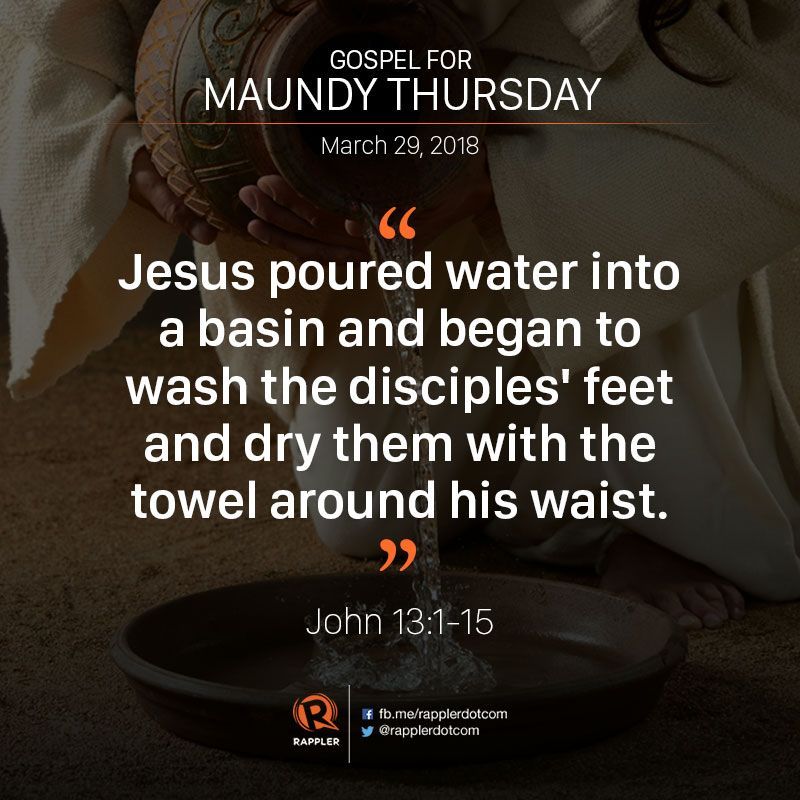
He poured water into a basin and began to wash the disciples' feet and to wipe them with the towel that was tied around him.
--------------------------------
His command was to love each other as a service.
He washed the disciples' feet to show that he heard us
as having heard his purpose.
==================
Washing Feet
Maundy Thursday
Law is a system of rules that regulates the members of a body. Enforcement by the imposition of punishment is to be limited to cases where damage was caused by a party charged with a crime.
Maundy Thursday is the name given to the day on which Jesus celebrated the Passover with his disciples. The event is known as the Last Supper. It occurred the night before the day on which he was crucified. The Last Supper is used for the celebration of the Eucharist or Communion.
Communion and Baptism are regarded as key rites in the institution of the Christian religion. Baptism is performed once for initiation into membership in the Church. Communion is offered repeatedly to commune with the Christ of Jesus as the Son of God. Leadership in the Church is respected as sanctified for the administration of the sacraments.
The word Maundy is derived from the Latin word for command, mandatum. Jesus gave a command to his disciples at the Last Supper to love and serve one another.
Maundy Thursday is the Christian holy day that falls on the Thursday before Easter. It commemorates the Last Supper and foot washing of Jesus Christ with the apostles as described in the canonical gospels. It is the fifth day of Holy Week. It is preceded by Holy Wednesday and followed by Good Friday.
The term Holy Thursday is associated with the celebration of the Ascension throughout the Anglican Communion. The Eastern Orthodox Church uses the term for the day before Good Friday.
When a church observes the rite associated with Maundy Thursday, it includes the enactment of the foot washing ceremony. The act is performed in remembrance of how Christ humbled himself.
Have this mind which is yours in Christ Jesus. He did not count equality with God a thing to be taken. He emptied himself by being born in the likeness of men and took the form of a servant. (Philippians 2:5)
A new commandment was given. Love each other as you have been loved that you may serve each other. (John 13:34)
Maundy Thursday initiates the Easter Triduum. This is the period which commemorates the passion, death and resurrection of Jesus. The Easter celebration starts on Saturday before midnight. Thursday, Friday and Saturday are the three days in the triduum.
The commemoration of the crucifixion of Christ serves as a symbolic reminder to reject or 'put to death' false beliefs. We believe in our Savior as the author of salvation, but that which is false about belief in God does not serve the Church, the world or us.
Law is absolute in the identification of murder as a capital offense. When the charge of murder is proven in a court of law, it warrants life in prison or death as the penalty. The severity of the punishment is dependent upon the certainty of proof in the evidence.
Since it is conceivable that a person who was not guilty of murder could be convicted for the charge of that crime, proof of guilt has to be beyond the shadow of a doubt for the imposition of death as the penalty.
The prohibition of things that don't necessarily, but could cause harm represents an over-extension of legislative authority.
The prohibition of alcohol serves as an example. Alcohol causes physical damage to bodily health when consumed in excess, but it can be used recreationally for the medicinal property of relaxation. Driving while drunk can be prohibited by law, but the prohibition of alcohol was an example of overreach.
https://www.gotquestions.org/Maundy-Thursday.html
https://en.wikipedia.org/wiki/Maundy_Thursday
https://www.christianity.com/christian-life/what-is-maundy-thursday-11628350.html
Last Supper
Revere
Life
反抗生活
Fǎnkàng shēnghuó
リヴィア生活
Rivu~ia seikatsu
ps116
I love that I found help when I needed it.
Salvation came and I heeded it.
I had fallen to the place of shades
the distress beyond bad dreams had made.
The grip of the grave grapple grabbed
until my adam's apple gagged
while seeing the sensible source sag
from the sense perception had.
I said, "Though I have been driven from your sight,
I hope to look on your temple again with delight."
I felt desperate. My mind cried for direction.
Choice was compressed to this bit. I had to select protection
from the danger of dereliction.
I found what I needed before the moment of crisis.
The rightness in choice was decisive.
The cords of death had entangled me.
My sight was so strangled, I had to get free.
Sorrow drove sadness to the threshold of pain.
The horror drove madness to enfold the insane.
Human being is not made holy by work
but faith lives for grace when responsibility is not shirked.
I remembered to pray
when my life was fading away.
My prayer reached you in your holy place.
You heard my cry for help with grace.
I will sacrifice to you with thanksgiving.
I will give a portion from what I am given to make a living.
Salvation spoke to me through a whale and fish.
The sea spit me out on dry land to answer my wish.
The success of salvation is gracious.
It was so efficacious, it was almost salacious.
Nothing else is quite so profound
as wonder in the world once it has been found.
Defense is granted to the watchful
if only because the thoughtful
watch for the goodness of the gospel.
I felt that I fell very low, but I was helped.
I exempted contempt for the hand I was dealt.
I was rescued from death.
Help was given in the test.
My eyes shed natural tears.
I was grateful for my years.
My feet did not stumble
though I felt very humble.
I will walk in the presence
of the divine essence
in the land of the living
to give thanks for the giving.
Brooker Creek Preserve Trail
I believed even when
I had been brought to a bend.
Then I had said,
“No one can be trusted
when trust has been busted.”
How will I repay my debt
without regret
for all the good things
carried by angel wings?
I will lift up the cup of salvation
and hold it high as a libation.
I will fulfill my promise to live
with reverence for life as a gift
in the rule of law that we win
by transcending sin.
We had been told that your lamb will be a sheep or a goat.
It will be a year old male intended to connote
a sacrifice from providence as a promissory note.
Now the sacrifice is a donation to service
to consecrate thanksgiving with purpose.
Precious in the sight of divine Light
is the death of those who defended rights.
They lived good lives.
I am a defender of rights.
I have been resurrected as a good life
by the experience that brought me past strife.
I tasted this glimpse of the abyss.
It was black and gray with white lights in the tryst.
I have been freed from the world of discrimination
to recount deliverance by narration.
I listen to hear.
I have not rebelled in fear.
I did not turn back the years.
My ear has been opened.
I hear sounds that are spoken.
Blessing and curse come from the same mouth.
This ought not to be so for the north or the south.
From the same tongue comes curses or worse.
Speech should be the garden ground for statement and verse.
Who do you say that I am?
You are anointed to pass the exam.
Christ stood near the water anointed by the sun.
Peter said, "You are the Messiah of the holy One."
I was not rebellious,
reckless or helpless.
I did not turn backwards.
I spoke in exact words.
Bravery is most bold when prepared.
Faith looks for benign design to be shared.
Time starts to grow bold.
The word shares the beauty of hope.
Hope desires goodness
to add to the fullness.
Measure the base of an object
to secure restraint in the prospect
for the project.
The bug pulls this stem.
You straighten the hem.
The bridge to love leads the way
to the right thing to do or say.
I will offer thanksgiving with my sacrifice.
I will give thanks to the Giver of life.
Jesus said
after he broke the bread,
'Take eat. This is my body broken for you.
This is my blood offered for redemption in truth.
Do this in remembrance of my gift to guide your youth.'
He poured water to clean his disciples' feet.
He washed and dried each foot to make the task complete.
I will speak with reason for the reasonable acceptance
of benefit for people in the presence
of the divine essence
in the assembly in public
in the city of peace that is love lit
by the waters near where the dove sits.
It is time to rest
now that I have been blessed
with the quest to sing of salvation with zest.
Stress from the test has worn my torn soul.
I will do my best to celebrate life as a whole.
Yea Yah!
You fill me with awe!
---------------------------
116 Dilexi, quoniam
I love because
1 I love the Lord, because he has heard the voice of
my supplication,
because he has inclined his ear to me whenever
I called upon him.
2 The cords of death entangled me;
the grip of the grave took hold of me;
I came to grief and sorrow.
3 Then I called upon the Name of the Lord:
"O Lord, I pray you, save my life."
4 Gracious is the Lord and righteous;
our God is full of compassion.
5 The Lord watches over the innocent;
I was brought very low, and he helped me.
6 Turn again to your rest, O my soul.
for the Lord has treated you well.
7 For you have rescued my life from death,
my eyes from tears, and my feet from stumbling.
8 I will walk in the presence of the Lord
in the land of the living.
9 I believed, even when I said,
"I have been brought very low."
In my distress I said, "No one can be trusted."
10 How shall I repay the Lord
for all the good things he has done for me?
11 I will lift up the cup of salvation
and call upon the Name of the Lord.
12 I will fulfill my vows to the Lord
in the presence of all his people.
13 Precious in the sight of the Lord
is the death of his servants.
14 O Lord, I am your servant;
I am your servant and the child of your handmaid;
you have freed me from my bonds.
15 I will offer you the sacrifice of thanksgiving
and call upon the Name of the Lord.
16 I will fulfill my vows to the Lord
in the presence of all his people,
17 In the courts of the Lord's house,
in the midst of you, O Jerusalem.
Hallelujah!
-----------------------
Exodus 12:5
Your lamb shall be without blemish, a year-old male; you may take it from the sheep or from the goats.
--------------------------------
Your lamb will be a sheep or a goat.
It will be a year old male intended to connote
a sacrifice from providence as a promissary note.
==================
1 Corinth. 11:24
When he had given thanks, he broke it and said, 'This is my body that is broken for you. Do this in remembrance of me.'
--------------------------------
Take eat. This is my body broken for you.
This is my blood offered for redemption in truth.
Do this in remembrance of my gift to guide your youth.
==================
John 13:5
He poured water into a basin and began to wash the disciples' feet and to wipe them with the towel that was tied around him.
--------------------------------
His command was to love each other as a service.
He washed the disciples' feet to show that he heard us
as having heard his purpose.
==================
Washing Feet
Maundy Thursday
Law is a system of rules that regulates the members of a body. Enforcement by the imposition of punishment is to be limited to cases where damage was caused by a party charged with a crime.
Maundy Thursday is the name given to the day on which Jesus celebrated the Passover with his disciples. The event is known as the Last Supper. It occurred the night before the day on which he was crucified. The Last Supper is used for the celebration of the Eucharist or Communion.
Communion and Baptism are regarded as key rites in the institution of the Christian religion. Baptism is performed once for initiation into membership in the Church. Communion is offered repeatedly to commune with the Christ of Jesus as the Son of God. Leadership in the Church is respected as sanctified for the administration of the sacraments.
The word Maundy is derived from the Latin word for command, mandatum. Jesus gave a command to his disciples at the Last Supper to love and serve one another.
Maundy Thursday is the Christian holy day that falls on the Thursday before Easter. It commemorates the Last Supper and foot washing of Jesus Christ with the apostles as described in the canonical gospels. It is the fifth day of Holy Week. It is preceded by Holy Wednesday and followed by Good Friday.
The term Holy Thursday is associated with the celebration of the Ascension throughout the Anglican Communion. The Eastern Orthodox Church uses the term for the day before Good Friday.
When a church observes the rite associated with Maundy Thursday, it includes the enactment of the foot washing ceremony. The act is performed in remembrance of how Christ humbled himself.
Have this mind which is yours in Christ Jesus. He did not count equality with God a thing to be taken. He emptied himself by being born in the likeness of men and took the form of a servant. (Philippians 2:5)
A new commandment was given. Love each other as you have been loved that you may serve each other. (John 13:34)
Maundy Thursday initiates the Easter Triduum. This is the period which commemorates the passion, death and resurrection of Jesus. The Easter celebration starts on Saturday before midnight. Thursday, Friday and Saturday are the three days in the triduum.
The commemoration of the crucifixion of Christ serves as a symbolic reminder to reject or 'put to death' false beliefs. We believe in our Savior as the author of salvation, but that which is false about belief in God does not serve the Church, the world or us.
Law is absolute in the identification of murder as a capital offense. When the charge of murder is proven in a court of law, it warrants life in prison or death as the penalty. The severity of the punishment is dependent upon the certainty of proof in the evidence.
Since it is conceivable that a person who was not guilty of murder could be convicted for the charge of that crime, proof of guilt has to be beyond the shadow of a doubt for the imposition of death as the penalty.
The prohibition of things that don't necessarily, but could cause harm represents an over-extension of legislative authority.
The prohibition of alcohol serves as an example. Alcohol causes physical damage to bodily health when consumed in excess, but it can be used recreationally for the medicinal property of relaxation. Driving while drunk can be prohibited by law, but the prohibition of alcohol was an example of overreach.
https://www.gotquestions.org/Maundy-Thursday.html
https://en.wikipedia.org/wiki/Maundy_Thursday
https://www.christianity.com/christian-life/what-is-maundy-thursday-11628350.html
Subscribe to:
Posts (Atom)