Showing posts with label anointed. Show all posts

Wednesday, August 21, 2019

Mediate

8.22.19
Ark of the Covenant

Mediate
Profit
调解利润 
Tiáojiě lìrùn
利益を仲介する 
Rieki o chūkai suru
ps131, 132
Mediata prodest

The priest is not proud
when with objectivity endowed.

The cleric is a detective
when research is the objective.

Simple expression is the task that matters
to explain the elements of the pattern.

"I still my soul to make it quiet.
I release my thought for mental silence.

"My soul is made quiet with this request
like a child upon its mother's breast."

Wait upon the test of science
to show the way to self-reliance.

Remember what the priest endured
to show how hardship made the feast secure. 

The horse ran to overcome the halter.
It passed the inn. It did not falter. 

The elder made a promise that he vowed to keep.
He would not allow his eyes to sleep.

"I will not lay my head on my pillow to rest
until I find the place to build a temple to be divinely blessed." 

We heard that the ark of the covenant was in a fruitful place.
We found it in the fields of the forest in a beautiful state.

Let us go stand near the symbol of the divine presence
that we may enjoy the feeling of the essential essence.

Arise to shine on your resting place
between the wings of the cherubim by your grace.

The wings have become an open book
where those who seek faith may come to look.

Let your pastor be clothed with the rightness of faith.
Let your faithful people sing with joy in the sacred space.

Do not turn away the face of your Anointed.
The love of the beloved uses oil as the ointment.

The beloved was true to the law insofar as he was able.
He did not punish non-lethal sin in a way that was fatal.

The humble citizen defended himself against charges that were false.
Success detained him without cruelty to check reports for embellished faults.

The Lord has sworn an oath in faith to love
for those who are true to the spirit of the dove.

Love God with your heart, understanding and strength.
Love your relations as yourself with attention to length.

You are not far from the kingdom of heaven in law.
Your faith is the leaven to overcome difficulty caused by flaws.

The fruit of your labor 
will be seen with favor
as long as it serves
the network of nerves.

If your children keep my covenant
with the testimony of love in it
they will retain your power in governance
for strength in sustenance.

Zion is the sacred space between the wings of the pages.
It is the habitation for which we sing with the sages.

"I will delight in this place forever.
I will dwell in this state with pleasure."

The economy will be blessed with employment.
Earned income will be by self-appointment
in the service of public enjoyment.

Your priesthood will be clothed with salvation.
The faithful will help to build a productive nation.

The fruit of the harvest will bless the table with provision.
The light for the Anointed is prepared to share wisdom.

Those loyal to the royal priesthood will shine.
Their achievement will be a share in the divine.

--------------------------

Psalm 131

Domine, non est
Dominated, is not

1 O Lord, I am not proud;
I have no haughty looks.
2 I do not occupy myself with great matters,
or with things that are too hard for me.
3 But I still my soul and make it quiet,
like a child upon its mother's breast;
my soul is quieted within me.
4 O Israel, wait upon the Lord,
from this time forth for evermore.

132 Memento, Domine
Remember, Dominated

1 Lord, remember David,
and all the hardships he endured;
2 How he swore an oath to the Lord
and vowed a vow to the Mighty One of Jacob:
3 "I will not come under the roof of my house,
nor climb up into my bed;
4 I will not allow my eyes to sleep,
nor let my eyelids slumber;
5 Until I find a place for the Lord,
a dwelling for the Mighty One of Jacob."
6 "The ark! We heard it was in Ephratah; (fruitful)
we found it in the fields of Jearim. (forest)
7 Let us go to God's dwelling place;
let us fall upon our knees before his footstool."
8 Arise, O Lord, into your resting-place,
you and the ark of your strength.
9 Let your priests be clothed with righteousness;
let your faithful people sing with joy.
10 For your servant David's sake,
do not turn away the face of your Anointed.
11 The Lord has sworn an oath to David;
in truth, he will not break it:
12 "A son, the fruit of your body
will I set upon your throne.
13 If your children keep my covenant
and my testimonies that I shall teach them,
their children will sit upon your throne for evermore."
14 For the Lord has chosen Zion;
he has desired her for his habitation:
15 "This shall be my resting-place for ever;
here will I dwell, for I delight in her.
16 I will surely bless her provisions,
and satisfy her poor with bread.
17 I will clothe her priests with salvation,
and her faithful people will rejoice and sing.
18 There will I make the horn of David flourish;
I have prepared a lamp for my Anointed.
19 As for his enemies, I will clothe them with shame;
but as for him, his crown will shine."

-------------------------

Shimei- my reputation
Gera- dove
Abishai- father of a gift
Zeruiah- pain

2 Samuel 19:18b-23

Shimei son of Gera fell down before the king as he was about to cross he Jordan. He said, 'May my lord not hold me guilty or remember how your servant did wrong on the day my lord the king left Jerusalem. May the king not bear it in mind. Your servant knows that I have sinned. I have come this day, the first of the house of Joseph to come down to meet my lord the king.'

Abishai son of Zeruiah answered, 'Shall not Shimei be put to death for this because he cursed the LORD's anointed?' David said, 'What have I to do with you, you sons of Zeruiah, that you should today become adversary to me? Shall anyone be put to death in Israel this day? Do I not know that I am this day king over Israel?' The king said to Shimei, 'You shall not die.' He gave him his oath.

-------------------------

The beloved was true to the law insofar as he was able.
He did not punishment non-lethal sin in a way that was fatal.

===================

Felix- lucky
Lysias- destroyer

Acts 24:22-23

Felix, who was rather well informed about the Way, adjourned the hearing with the comment, 'When Lysias the tribune comes down, I will decide your case.' Then he ordered the centurion to keep him in custody, but to let him have some liberty and not to prevent any of his friends from taking care of his needs.

-------------------------

The humble citizen defended himself against the charges as false.
He was detained without cruelty to check reports for embellished faults.

===================

Mark 12:32-34

The scribe said to him, 'You are right, Teacher. You have said that "He is one. Beside him there is no other" and "love him with all the heart, the understanding and the strength" and "love one's neighbor as oneself." This is much more important than all whole burnt offerings and sacrifices.' When Jesus saw that he answered wisely, he said to him, 'You are not far from the kingdom of God.' After that no one dared to ask him any question.

-------------------------

Love God with your heart, understanding and strength.
Love your relations as your self with attention to length.

You are not far from the kingdom of heaven in this law.
Your faith is the leaven to overcome difficulty caused by flaws.

===================

German idealism lent itself to socialism. American idealism has been used for what is right about capitalism.

Devaluations

Max Scheler
b. 8.22.1874 Munich, Germany
d. 5.19.1928 Frankfurt, Germany

Max Ferdinand Scheler was a German philosopher known for his work in phenomenology, ethics and philosophical anthropology. He developed the method of the founder of phenomenology, Edmund Husserl.

Martin Heidegger praised him with Ortega y Gasset as "the strongest philosophical force in... contemporary Europe" after his death in 1928.

Karol Wojtyła, later Pope John Paul II, defended his doctoral thesis in 1954 on the evaluation of the possibility of "Constructing Christian Ethics" based on the system of Max Scheler.

Munich

Munich lies on the elevated plains of Upper Bavaria. Bavaria is in the southeastern corner of Germany. The city is about 50 km (31 mi) north of the northern edge of the Alps at an altitude of about 520 m (1,706 ft) above sea level. The local rivers are the Isar and the Würm. Munich is situated in the Northern Alpine Foreland.

It is the capital and most populous city of Bavaria, the second most populous German federal state. It is the third-largest city in Germany with a population of around 1.5 million. It comes after Berlin and Hamburg in size. It is the 12th-largest city in the European Union. The city's metropolitan region is home to 6 million people.

The name of the city is derived from the Old/Middle High German term Munichen, meaning "by the monks".  The Benedictine order ran a monastery at the place that was later to become the Old Town of Munich. A monk is depicted on the city's coat of arms.

The city became the capital of the new Kingdom of Bavaria in 1806. The state's parliament (the Landtag) and the new archdiocese of Munich and Freising were located in the city.

Landshut University was moved to Munich 20 years later. Many of the city's finest buildings belong to this period. They were built under the first Bavarian kings.

Ludwig I rendered outstanding services to Munich's status as a center of the arts. He attracted numerous artists and enhanced the city's architectural substance with grand boulevards and buildings.

Ludwig II came to be known the world over as the fairytale king. He was mostly aloof from his capital and focused more on his fanciful castles in the Bavarian countryside. His patronage of Richard Wagner secured his posthumous reputation, as do his castles, which still generate significant tourist income.

Max Scheler

Max Scheler was born in Munich, Germany on 22 August 1874 to a Lutheran father and an Orthodox Jewish mother.

He was not a particularly strong student, but he showed an interest in the works of Nietzsche. He identified himself as a social democrat and an enthusiastic Marxist.

He turned to Catholicism as an adolescent. He became non-committal prior about 1921. He disassociated from Catholicism and the Judeo-Christian God in public after 1921. He chose to invest in philosophical anthropology.

He started to study medicine at the University of Munich in 1894. He enrolled at the University of Berlin in 1895 for the philosophy and sociology. He attended the lectures of Dilthey and Simmel.
Berlin is 585 km (365 mi.) north of Munich.

Dilthey’s research interests revolved around questions of scientific methodology, historical evidence and the science of history. His view contrasted with the idealism in Germany at the time by his experiential reference differed from British empiricism in basic assumptions. He drew his references from German literary and philosophical traditions.

Simmel was a first generation German sociologist. His approach was neo-Kantian. It laid the foundation for his sociological anti-positivism. He asked the question ‘What is society?’ as a reflection of Kant’s question, ‘What is nature?’ Individuality was a fragmentation of social identity.

The cultivation of individuals through the agency of external forms was conducted by the course of history. He was a forerunner to the structuralist style of reasoning in the social sciences. Urban sociology, symbolic interactionism and social network analysis contributed to the formation of the metropolis.

He transferred to Jena in 1896 to finish his studies with Eucken.

Jena is 260 km (160 mi.) southwest of Berlin.

Eucken advocated for ethical activism as the application for practical idealism. The philosophy of life is for the development of a new culture, not mere intellectualism. It is an application of vital religious inspiration to the practical problems of society.

It was Eucken’s ideas regarding the inner quest for a spiritual life of every human being that drew Scheler’s attention.

It was through this interest in practical idealism that Scheler developed a relationship with the American pragmatism of William James. The two exchanged letters in correspondence.

Scheler received his doctorate on the determination of the relations between logical and ethical principles at the University of Jena in 1897. He worked for his habilitation there as well.

He took a trip to Heidelberg in 1898 and met Max Weber. Weber had an impact on his thought.

Scheler met Husserl at a party in Jena in 1901. He read Husserl’s Logical Investigations a year later. The remainder of this life would be dedicated to the progress of phenomenology.

Scheler was reading French philosophy during this period. He was a major factor in introducing Henri Bergson’s work to German intellectual circles.

Scheler moved his family to Munich in 1906 to start his position there as Privatdozent. A number of students working with the psychologist Theodor Lipps at the University of Munich had founded the Psychologische Verein ("Psychological Association") in 1895.

Lipps was known for the theory of aesthetics that framed the concept of empathy. His work opened a new branch of interdisciplinary research in psychology and philosophy.

Psychology was a discipline on the rise at the turn of the 20th century. The relation between philosophy and psychology was intensely debated. The debate concerned whether psychology is a philosophical discipline or whether philosophy is based on psychology.

The position that logical concepts are psychological have been labeled as “psychologism.” The logical law of the excluded middle has to be interpreted in terms which state that it is impossible for a subject to judge at the same time that p and not-p are true.

Psychologism was contested by a competing approach within the “anti-psychologist” strand.  There are different views as to how logical concepts and laws have to be positively defined. They agreed that logic does not depend on psychology.

Husserl's Logical Investigations (1900/01) was critical of the psychologism. A number of participants in the Psychological Association at Munich decided to align themselves with Husserl. They became the Munich Circle of phenomenologists. Scheler joined this group.

The Munich circle included students from both the Psychological Association and the phenomenological group.

A number of Lipps' students followed the lead of Daubert in 1905. They left Munich for the University of Gottingen to work with Husserl. The arrival of students from Munich eventually led to the establishment of a similar student group in Göttingen circa 1910, known as the Göttingen Circle.

Scheler taught at the University of Munich from 1907 to 1910. He lost his teaching privileges due to controversies surrounding the separation from his first wife and reported affairs with students.

He earned his living as a private scholar, lecturer and freelance writer from 1910 to 1919. He  joined the circle after the invitation in 1912 to give private lectures in Göttingen.

He was forbidden to teach at a German university so his lectures would often have to be held in hotel rooms rented by his close friend Dietrich von Hildebrand.

The first volume of the Yearbook for Philosophy and Phenomenological Research appeared in 1913. Scheler was a co-editor with 3 others and Husserl.

He published major works such as Phenomenology and Theory of the Feeling of Sympathy and of Love and Hate (1913), Formalism in Ethics and Non-Formal Ethics of Value (Part 1 1913, Part 2 1916), The Genius of War and the German War (1915).

Scheler conceptualized the nation as an intellectual collective entity, which discovers and recognizes itself through war in his famous 1915 essay. The German nation, purified through the war, had the political mission of pushing Russia back into Asia and unifying Europe.

He tried to demonstrate a fundamental difference between Europe and Asia by analysing music, language, religion, gender roles and thought.

He attempted to explain this phenomenon of an all-pervading hate towards Germany in a lecture in Frankfurt in 1916. This prompted his essay “The Causes of Hatred Against Germans”, which was first published in 1917 and again in 1919.

The strongest motivation of the hate laid in the newly established unique German work ethic. The ethic was intensified by political, economic and social requirements. The ancient characteristic pursuit of the infinite which expressed itself in idealism coalesced with the work ethic.

Transcendental phenomenlogy posited a necessary correlation between reality and consciousness. A thing in itself is never one with which consciousness has nothing to do.

Edith Stein became a student of Husserl. She wrote her dissertation on the problem of empathy. It was finished in 1916. She became his teaching assistant.

Scheler had voluntarily enrolled to serve in the war for the airship battalion of the reserve in Cologne, but was not accepted due to his astigmatism. The State Department  sent him to Switzerland, Austria and the Netherlands from 1917 to 1918 to influence Catholic circles. He was to give lectures to sick and wounded German soldiers, interned in the neutral Netherlands.

This phase of his war philosophy coincided with the period in which the philosopher developed his theory of value. This theory proceeds on the assumption of the existence of an objective hierarchy of values which can be accessed through intentional feeling of values.

Scheler also composed several articles next to his book on formalism. He was accepted into the Catholic Church. He worked on the prominent Catholic magazine Hochland.

He finally took a strong position against nationalism entirely and committed himself to Europeanism in his lecture “On Europe’s Cultural Reconstruction” in 1917-1918. His Europeanism primarily encompassed continental Europe, but he suggested that England should also be included. This new Europe should be open towards Asia culturally.

Europe was now a “community of intellect and love” in his definition of nation. The unity of Europe was the reference point for a post-war order. He used the term “Europeanism” in an affirmative manner to show a third possibility of forming unity beyond nationalism and internationalism.

Europe was not defined by its geography. It was a concept that connoted a unified, spiritual structure. The collective enemy was the capitalistic, liberal, bourgeois, nationalistic and imperialistic ethos. Europeanism and anti-capitalistic criticism can be identified as constants in his war philosophy.

Scheler received an invitation in 1918 to join the faculty of the newly founded research institute for the social sciences in Cologne. He became professor of philosophy and sociology at the University of Cologne.

He wrote his major work on religion, On the Eternal in Man (1921) during his time at Cologne. He stayed there until 1928.  He accepted a new position at the University of Frankfurt early that year.

Scheler was the only scholar of rank of the then German intelligentsia who gave warning in public speeches delivered as early as 1927 of the dangers of the growing National Socialist movement.

'Politics and Morals' and 'The Idea of Eternal Peace and Pacifism' were subjects of talks he delivered in Berlin in 1927. He argued that capitalism was a calculating, globally growing 'mind-set', rather than an economic system in his analysis.

While economic capitalism may have had some roots in ascetic Calvinism, its very mind-set had its origin in modern, subconscious angst as expressed in increasing needs for financial and other securities for protection and personal safeguards as well as for rational manageability of all entities.

The subordination of the value of the individual person to this mind-set was sufficient reason to denounce it and to predict a whole new era of culture and values which he called 'The World-Era of Adjustment'.

Scheler advocated for an international university to be set up in Switzerland. He was at that time supportive of programs such as 'continuing education' and of what he seems to have been the first to call a 'United States of Europe'.

He deplored the gap existing in Germany between power and mind, a gap which he regarded as the very source of an impending dictatorship and the greatest obstacle to the establishment of German democracy.

He died in Frankfurt, Germany at the age of 53 on 19 May 1928. The Nazi dictatorship (1933–1945) suppressed Scheler's work 5 years after his death.

The Germans were like the French in their idealism. They were for socialism in that it was opposed to British and American capitalism. They started to criticize Marx, but they maintained his criticism against Adam Smith.

Marx had used the prediction of proletariat revolution to deflect attention from national dependence upon socialist government. Labor had made such progress in gaining benefits that they had a better quality of life than much of the middle class.

Now socialists subscribe to populist media stories in order to suggest that there is unity in opposition to economic success.

The middle class still has a presumption of professionalism with education for business enterprise. Socialist government was subverting the value of education by the implication that the applicants for higher education had to support the criticism of capitalism. 

Liberals made funding for research look like it was entirely dependent upon the government as a source. This lent itself to the perception that the intellectual had to blame the success of the business world for economic inequality.

Capitalism maintains a position for the production of value for the public with products or services. Education and the limitation of political overreach contribute to the production of value.

Organization can be developed when liberals in the national government are not claiming to be the answer to things like gun violence, racism, sexism and capitalism with legislation and increased taxation.   

Max Scheler
S. 马克斯舍勒
T. 馬克斯舍勒

马  Ma    horse                   馬 ba         horse                     Ma  まっ  マッ          Maeg  맥  vein   
克  ke      gram                   克  koku   overcome               ku    く       ク             seu     스  s         
斯  si        this                     斯 shi        this                        su     す      ス             Chel   첼  cell     
舍  She    house                 舍  seki     inn                         She  しぇ  シェ           leo     러   naughty
勒  lei      to force               勒   roku   halter                     ra     ら-   ラ-                         

-------------------------

The horse ran to overcome the halter.
It passed the inn. It did not falter.

===================

wiki Max Scheler
SEP Scheler
SEP Phenomenology
wiki Munich

Absolute Self

Kant was Prussian. His philosophy has been used to promote universal disarmament. It is too idealistic in this regard.

Berkeley used the concept of the immaterial as a contrast to material reality. His idealism was conditioned by the search to define knowledge. He was opposed to the liberal implications of Locke's empiricism.

Consider the use of the term absolute with respect to objective judgment. When judgment is restrained by reason to realistic truth, it is guided by impartial considerations. It is not subjectively for prejudice.

The sun shines and the rain falls on people irrespective of prejudiced beliefs conditioned by race, creed or color.

Wednesday, April 17, 2019

Revere

4.18.19

Last Supper

Revere
Life
反抗生活 
Fǎnkàng shēnghuó
リヴィア生活
Rivu~ia seikatsu
ps116

I love that I found help when I needed it.
Salvation came and I heeded it.

I had fallen to the place of shades
the distress beyond bad dreams had made.

The grip of the grave grapple grabbed
until my adam's apple gagged
while seeing the sensible source sag 
from the sense perception had.

I said, "Though I have been driven from your sight,
I hope to look on your temple again with delight."

I felt desperate. My mind cried for direction.
Choice was compressed to this bit. I had to select protection 
from the danger of dereliction.

I found what I needed before the moment of crisis.
The rightness in choice was decisive. 

The cords of death had entangled me.
My sight was so strangled, I had to get free.

Sorrow drove sadness to the threshold of pain.
The horror drove madness to enfold the insane.

Human being is not made holy by work
but faith lives for grace when responsibility is not shirked.

I remembered to pray
when my life was fading away.

My prayer reached you in your holy place.
You heard my cry for help with grace.

I will sacrifice to you with thanksgiving.
I will give a portion from what I am given to make a living.

Salvation spoke to me through a whale and fish.
The sea spit me out on dry land to answer my wish.

The success of salvation is gracious.
It was so efficacious, it was almost salacious.

Nothing else is quite so profound
as wonder in the world once it has been found.

Defense is granted to the watchful
if only because the thoughtful 
watch for the goodness of the gospel.

I felt that I fell very low, but I was helped.
I exempted contempt for the hand I was dealt.

I was rescued from death.
Help was given in the test.

My eyes shed natural tears.
I was grateful for my years.

My feet did not stumble
though I felt very humble.

I will walk in the presence 
of the divine essence
in the land of the living
to give thanks for the giving.

Brooker Creek Preserve Trail

I believed even when 
I had been brought to a bend.
Then I had said, 
“No one can be trusted
when trust has been busted.”

How will I repay my debt
without regret 
for all the good things 
carried by angel wings?

I will lift up the cup of salvation 
and hold it high as a libation.

I will fulfill my promise to live
with reverence for life as a gift
in the rule of law that we win
by transcending sin.

We had been told that your lamb will be a sheep or a goat.
It will be a year old male intended to connote
a sacrifice from providence as a promissory note.

Now the sacrifice is a donation to service
to consecrate thanksgiving with purpose.

Precious in the sight of divine Light
is the death of those who defended rights.
They lived good lives.

I am a defender of rights. 
I have been resurrected as a good life
by the experience that brought me past strife. 

I tasted this glimpse of the abyss.
It was black and gray with white lights in the tryst.

I have been freed from the world of discrimination
to recount deliverance by narration.

I listen to hear.
I have not rebelled in fear.
I did not turn back the years.

My ear has been opened.
I hear sounds that are spoken.

Blessing and curse come from the same mouth.
This ought not to be so for the north or the south.

From the same tongue comes curses or worse.
Speech should be the garden ground for statement and verse.

Who do you say that I am?
You are anointed to pass the exam.

Christ stood near the water anointed by the sun.
Peter said, "You are the Messiah of the holy One."

I was not rebellious,
reckless or helpless.

I did not turn backwards.
I spoke in exact words.

Bravery is most bold when prepared.
Faith looks for benign design to be shared.

Time starts to grow bold.
The word shares the beauty of hope.

Hope desires goodness
to add to the fullness.

Measure the base of an object
to secure restraint in the prospect 
for the project.

The bug pulls this stem.
You straighten the hem.

The bridge to love leads the way
to the right thing to do or say.

I will offer thanksgiving with my sacrifice.
I will give thanks to the Giver of life.

Jesus said
after he broke the bread,
'Take eat. This is my body broken for you.

This is my blood offered for redemption in truth.
Do this in remembrance of my gift to guide your youth.'

He poured water to clean his disciples' feet.
He washed and dried each foot to make the task complete.


I will speak with reason for the reasonable acceptance
of benefit for people in the presence 
of the divine essence
in the assembly in public
in the city of peace that is love lit
by the waters near where the dove sits.

It is time to rest
now that I have been blessed
with the quest to sing of salvation with zest.

Stress from the test has worn my torn soul.
I will do my best to celebrate life as a whole. 

Yea Yah!
You fill me with awe!


---------------------------

116 Dilexi, quoniam
I love because

1 I love the Lord, because he has heard the voice of
my supplication,
because he has inclined his ear to me whenever
I called upon him.
2 The cords of death entangled me;
the grip of the grave took hold of me;
I came to grief and sorrow.
3 Then I called upon the Name of the Lord:
"O Lord, I pray you, save my life."
4 Gracious is the Lord and righteous;
our God is full of compassion.
5 The Lord watches over the innocent;
I was brought very low, and he helped me.
6 Turn again to your rest, O my soul.
for the Lord has treated you well.
7 For you have rescued my life from death,
my eyes from tears, and my feet from stumbling.
8 I will walk in the presence of the Lord
in the land of the living.
9 I believed, even when I said,
"I have been brought very low."
In my distress I said, "No one can be trusted."
10 How shall I repay the Lord
for all the good things he has done for me?
11 I will lift up the cup of salvation
and call upon the Name of the Lord.
12 I will fulfill my vows to the Lord
in the presence of all his people.
13 Precious in the sight of the Lord
is the death of his servants.
14 O Lord, I am your servant;
I am your servant and the child of your handmaid;
you have freed me from my bonds.
15 I will offer you the sacrifice of thanksgiving
and call upon the Name of the Lord.
16 I will fulfill my vows to the Lord
in the presence of all his people,
17 In the courts of the Lord's house,
in the midst of you, O Jerusalem.
Hallelujah!

-----------------------

Exodus 12:5

Your lamb shall be without blemish, a year-old male; you may take it from the sheep or from the goats.

--------------------------------

Your lamb will be a sheep or a goat.
It will be a year old male intended to connote
a sacrifice from providence as a promissary note.

==================

1 Corinth. 11:24

When he had given thanks, he broke it and said, 'This is my body that is broken for you. Do this in remembrance of me.'

--------------------------------

Take eat. This is my body broken for you.
This is my blood offered for redemption in truth.
Do this in remembrance of my gift to guide your youth.

==================

John 13:5

He poured water into a basin and began to wash the disciples' feet and to wipe them with the towel that was tied around him.

--------------------------------

His command was to love each other as a service.
He washed the disciples' feet to show that he heard us
as having heard his purpose.

==================

Washing Feet

Maundy Thursday

Law is a system of rules that regulates the members of a body. Enforcement by the imposition of punishment is to be limited to cases where damage was caused by a party charged with a crime.
Maundy Thursday is the name given to the day on which Jesus celebrated the Passover with his disciples. The event is known as the Last Supper. It occurred the night before the day on which he was crucified. The Last Supper is used for the celebration of the Eucharist or Communion.

Communion and Baptism are regarded as key rites in the institution of the Christian religion. Baptism is performed once for initiation into membership in the Church. Communion is offered repeatedly to commune with the Christ of Jesus as the Son of God. Leadership in the Church is respected as sanctified for the administration of the sacraments.

The word Maundy is derived from the Latin word for command, mandatum. Jesus gave a command to his disciples at the Last Supper to love and serve one another.

Maundy Thursday is the Christian holy day that falls on the Thursday before Easter. It commemorates the Last Supper and foot washing of Jesus Christ with the apostles as described in the canonical gospels. It is the fifth day of Holy Week. It is preceded by Holy Wednesday and followed by Good Friday.

The term Holy Thursday is associated with the celebration of the Ascension throughout the Anglican Communion. The Eastern Orthodox Church uses the term for the day before Good Friday.
When a church observes the rite associated with Maundy Thursday, it includes the enactment of the foot washing ceremony. The act is performed in remembrance of how Christ humbled himself.

Have this mind which is yours in Christ Jesus. He did not count equality with God a thing to be taken. He emptied himself by being born in the likeness of men and took the form of a servant. (Philippians 2:5)

A new commandment was given. Love each other as you have been loved that you may serve each other. (John 13:34)

Maundy Thursday initiates the Easter Triduum. This is the period which commemorates the passion, death and resurrection of Jesus. The Easter celebration starts on Saturday before midnight. Thursday, Friday and Saturday are the three days in the triduum.

The commemoration of the crucifixion of Christ serves as a symbolic reminder to reject or 'put to death' false beliefs. We believe in our Savior as the author of salvation, but that which is false about belief in God does not serve the Church, the world or us.

Law is absolute in the identification of murder as a capital offense. When the charge of murder is proven in a court of law, it warrants life in prison or death as the penalty. The severity of the punishment is dependent upon the certainty of proof in the evidence.

Since it is conceivable that a person who was not guilty of murder could be convicted for the charge of that crime, proof of guilt has to be beyond the shadow of a doubt for the imposition of death as the penalty.

The prohibition of things that don't necessarily, but could cause harm represents an over-extension of legislative authority.

The prohibition of alcohol serves as an example. Alcohol causes physical damage to bodily health when consumed in excess, but it can be used recreationally for the medicinal property of relaxation. Driving while drunk can be prohibited by law, but the prohibition of alcohol was an example of overreach.

https://www.gotquestions.org/Maundy-Thursday.html
https://en.wikipedia.org/wiki/Maundy_Thursday
https://www.christianity.com/christian-life/what-is-maundy-thursday-11628350.html

Wednesday, April 10, 2019

Constitute

4.11.19
Tricia Helfer

Constitute
Liberty in Law
构成法律自由 
Gòuchéng fǎlǜ zìyóu
法における自由の憲法 
Hō ni okeru jiyū no kenpō
ps28

Leadership is my strength and security.
My heart trusts what's best for maturity.

I am helped by faith. My heart exults.
My song gives thanks. It calms the tumult.

I will respect that which is worthy by faith.
Attempts to damage will be corrected with grace.
Family will be blessed for the human race.

The Lord is the strength for people.
He is the refuge in deliverance from evil.

The anointed are saved by divine grace
to shine as light for your place in space.

You were without God in the world of relation
before the world was seen as an act of creation.

Different groups have found peace in the Christ of Jesus.
Hostility has been reduced by his sacrifice to induce belief in us.

He was resurrected to raise faith in his body.
We are the world that aspires to be godly.

The highness of the royal call to service in Christ
lifts the individual into personhood with the height 
of insight. 

Save your people. Bless your inheritance.
Let your relevance find reverence in evidence.


If the house is worthy of respect,
let your peace rest with all that is correct.

If it is not worthy of your consent
let it suffer correction until it has met respect. 

When an inference is falsely derived
it is called an error of thought in mind.

To treat the error as truth is an absurdity
that could cause an emergency 
in your mental circuitry.

Absurdity results from a lack of method
in the definition of words for a protected progression.

Words are the fruits in the tree of knowledge.
Meaning is inferred as logic or symbolic.

You can disagree with the utility of happiness in two ways.
Disagreement can be constant as in the ascetic always
or it can be occasional as with a maze of games.

Find agreement in essential things 
for the consistency that the constant brings.

The Constitution is a record of liberty in law
that lends a sense of measure to the public draw.

---------------------------------

ps28.7+

The Lord is my strength and my shield;
   in him my heart trusts;
so I am helped, and my heart exults,
   and with my song I give thanks to him.
 The Lord is the strength of his people;
   he is the saving refuge of his anointed.
 O save your people, and bless your heritage;
   be their shepherd, and carry them for ever.

Gen. 12:3
I will bless those who bless you
and the one who curses you I will curse;
and in you all the families of the earth shall be blessed.

----------------------------------

I will respect that which is worthy by faith.
Attempts to damage will be corrected with grace.
Family will be blessed for the human race.

=========================

Eph. 2:12,14
Remember that you were at that time without Christ, being aliens from the commonwealth of Israel and strangers to the covenant of promise. You had no hope. You were without God in the world.

Christ is our peace; in his flesh he has made both groups into one.
He has broken down the dividing wall, that is, the hostility between us.

----------------------------------

You were without God in the world of relation
before the world was seen as an act of creation.

Different groups have found peace in the Christ of Jesus.
Hostility has been reduced by his sacrifice to induce belief in us.

He was resurrected to raise faith in his body.
We are the world that aspires to be godly.

=========================

Matt. 10:13
If the house is worthy let your peace come upon it; but if it is not worthy, let your peace return to you.

----------------------------------

If the house is worthy of respect,
let your peace rest with all that is correct.
If it is not worthy of your consent
let it suffer correction until it has met respect.

=========================

Thomas Hobbes
Leviathan
1651
Text

"...when we Reason in Words of generall signification, and fall upon a generall inference which is false; though it be commonly called Error, it is indeed an ABSURDITY, or senseless Speech. For Error is but a deception, in presuming that somewhat is past, or to come; of which, though it were not past, or not to come; yet there was no impossibility discoverable...

"The first cause of Absurd conclusions I ascribe to the want of Method; in that they begin not their Ratiocination from Definitions; that is, from settled significations of their words: as if they could cast account, without knowing the value of the numerall words, One, Two, and Three."

----------------------------------

When an inference is falsely derived
it is called an error of thought in mind.

To treat the error as truth is an absurdity
that could cause an emergency
in your mental circuitry.

Absurdity results from a lack of method
in the definition of words for a protected progression.

=========================

George Berkeley
Principles of Human Knowledge
1710
Text

"I shall be sure to get clear of all controversies PURELY VERBAL--the springing up of which weeds in almost all the sciences has been a main hindrance to the growth of true and sound knowledge...we need only draw the curtain of words, to hold the fairest tree of knowledge, whose fruit is excellent, and within the reach of our hand.

"Whoever therefore designs to read the following sheets, I entreat him to make my words the occasion of his own thinking, and endeavour to attain the same train of thoughts in reading that I had in writing them. By this means it will be easy for him to discover the truth or falsity of what I say. He will be out of all danger of being deceived by my words, and I do not see how he can be led into an error by considering his own naked, undisguised ideas."

----------------------------------

Words are the fruits in the tree of knowledge.
Meaning is inferred as logical or symbolic.

=========================

Jeremy Bentham
Principles of Morals and Legislation
1823
Text

"A principle may be different from that of utility in two ways: 1. By being constantly opposed to it: this is the case with a principle which may be termed the principle of asceticism. 2. By being sometimes opposed to it, and sometimes not, as it may happen: this is the case with another, which may be termed the principle of sympathy and antipathy."

----------------------------------

You can disagree with the utility of happiness in two ways.
Disagreement can be constant as in the ascetic always
or it can be occasional as with a maze of games.

=========================

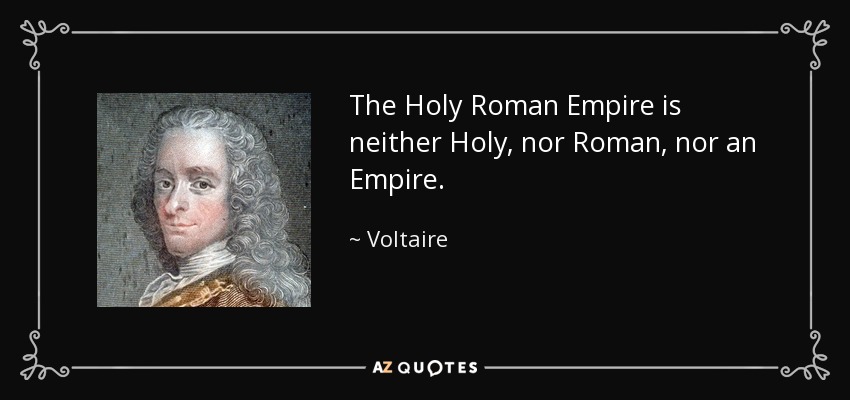
Voltaire had stated that the Holy Roman Empire was not holy, Roman or an empire.


The empire wasn't defined as catholic, apostolic or christian either. Why was it called the Holy Roman Empire? The simple answer was that it wasn't just Christian. It wasn't just Catholic. It was monotheistic for simple moral expression in public.

The Latin read Sacrum Romanum Imperium. It was used to describe the varying complex of lands in western and central Europe ruled over first by Frankish then by German kings for 10 centuries (800–1806).

My study of the bible has led me to theorize that Vespasian and Josephus had agreed to elevate a relatively unknown monotheistic sect in the Roman empire to the status of the official faith for the realm. This hypothesis was drawn from the careful consideration of the relation between the scriptures, Josephus, classical literature and Roman history.

While Christianity eventually became the official state religion in the 4th century, the designation of Holy Roman was intended to imply what is referred to as common law in the UK and the US. It was no small accomplishment that the pope and the college of cardinals had managed to sanctify the royalty for Europe in a way that suggested the existence of a unified collection of kingdoms as a 'holy' entity with a common law.

It is not difficult to imagine that the designation as Roman was intended to include other non-rebellious monotheistic and polytheistic sects. The competition between the kingdoms for the leadership position as the imperial leader both facilitated and hampered unity. The different languages at play in the competition was an inhibitor to unity as well.

The competition with the Ottomans and the revival of the classical literature in the Renaissance prompted a reconsideration of slavery with respect for republican government. Parliament had been designated as a legislative institution with the higher purpose of evaluating punishments for criminal activity in an empire. The issue was to prove more significant in that it had not been outlawed. Neither had the severity of punishments of crimes lesser than murder in offense been diminished.

The crucifixion of Jesus for having been declared a king by some of his followers didn't exactly read as a just punishment for the success of his ministry. He had not promoted insurrection. He didn't tell his followers to steal. He had advised his followers to pay taxes, to live justly and morally with mercy. He was not deserving of the tortured suffering that hanging on a cross entailed.

Slavery had been an issue for Cyrus with respect for his liberation of the captives from Babylon.
There was an indication that the captives would never be allowed to advance in Babylonian society or return to their homelands. A young king in a relatively unknown sect that worshiped the moon goddess Sin was appointed.

His regents had indicated a desire to expand the construction projects. The public didn't know what to expect, but Cyrus had organized an army that entered Babylon during the instability of the transition. He was declared a Christ by the Judaic community.

It is my belief that it was the reinstitution of slavery in addition to the Inquisition that prompted Martin Luther to protest indulgences as a sign of corruption in the empire. Slavery was more than a regressive policy. It signaled a return to the polytheistic republican government of Rome where slavery was used to compete with kingdoms for economic power.

Jan Huss had already perpetuated Wycliff's proposal that the Bible and liturgical services should be translated to the language of the people. It was reported that he had been put to death for his advocacy.

Latin was the language for the Church and the official communications of the empire. Colleges and universities had to teach the language for those who hoped to serve as officials of the Church or state. 

Henry VIII had already had the Bible translated into English before James I, but it was translated again into the King James version.

British and Russian missionaries made a point of translating the Bible into the native language of the people whom they hoped to convert to Christianity as an emblem of the will to become civilized in the imperial enterprise that was no longer regarded as officially Roman.

The Puritans and the Calvinists made strong political campaigns to make Reformed Christianity the only uncorrupted religion for empire.

It became apparent to the young bishop Selwyn that communication with the natives would be necessary for progress by the time he was appointed to the mission in New Zealand in the 19th century. It was the most likely requirement for his appointment to the position.

Proclaim the Good News


George Augustus Selwyn
b. 4.5.1809, Hempstead, London, United Kingdom
d. 4.11.1878, Lichfield, UK

London

The Frankfurt banker Nathan Mayer Rothschild arrived in London in 1798 and set up a banking house in the city. He had been given a large sum of money by his father, Amschel Mayer Rothschild.

The Rothschilds also had banks in Paris and Vienna. The bank financed numerous large-scale projects. Railways were financed around the world.  Funding for the Suez Canal was organized.

The 19th century was the start of modern times. London was to become the world's largest city as the capital for the British empire. The population would grow from 1 million in 1800 to 6.7 million a century later.

The accessibility of London was transformed by the railways. A new network of metropolitan railways allowed for the development of suburbs in neighboring counties. Middle-class and wealthy people could commute to the center of the city. This spurred massive outward growth. Poor people were left to inhabit the inner city as as the wealthier classes emigrated to the suburbs.

The original Theatre Royal, Covent Garden was destroyed by fire on 20 September 1808. Most of the scenery, costumes and scripts were lost. Rebuilding began in December.

The Theatre Royal, Drury Lane was also destroyed by fire on 24 February 1809.

The new Covent Garden theater opened on 18 September 1809 with a performance of Macbeth. The increase in ticket prices caused riots that lasted for 64 days. LIttle damage was done to the theater.

The rioters protested the prices. They covered the theater with banners of slogans after half-price time. They called themselves the OP's, short for Old Pricers. The event came to be called the Old Price Riots. The prices were finally returned to what they had been.

Hampstead is an area in the north central part of  London. It is known for its intellectual, liberal, artistic, musical and literary associations. Hampstead Heath is noteworthy as a large, hilly expanse of parkland. The area has some of the most expensive housing in the London area.

George Augustus Selwyn

George was born at Church Row, Hampstead. He was the son of William, a legal author, and Laetitia Frances Kynaston. He went to Great Ealing School at the age of 7. Great Ealing had a reputation as the best private school in England. The future Cardinal Newman and his brother Francis were among his schoolfellows.

He went to Eton College. Eton had been established by King Henry VI in 1440 as the sister to King's College, Cambridge. George distinguished himself as an athlete and scholar.

He became scholar of St John's College, Cambridge in 1827. He came out second in the Classical Tripos in 1831. He graduated with a Bachelor of Arts () degree in the same year. He was awarded the  Cambridge Master of Arts (MA Cantab) in 1834 and Doctor of Divinity (DD) in 1842. He was a fellow of St John's from 1833 to 1840.

Selwyn worked at Eton College after graduation from Cambridge. He was the assistant master and tutor to the sons of Edward Herbert, 2nd Earl of Powis. He was ordained a deacon in 1833 and a priest in 1934. He acted as curate to Isaac Gosset, the vicar of St John's, Windsor from 1833 until 1841.

An episcopal council held at Lambeth had recommended the appointment of a bishop for New Zealand in 1841. Charles James Blomfield, Bishop of London, offered the post to Selwyn. He was willing to learn the language of the people to preach the gospel.

Bishop Selwyn was consecrated at Lambeth on 17 October 1841. He embarked for his new missionary diocese on 26 December.

He appointed William Charles Cotton as his chaplain. The 23 member missionary party set sail from Plymouth late in December 1841 on board the barque Tomatin. A barque is a three masted sailing vessel.

The missionaries brought various animals and four hives of bees in addition to their luggage. Selwyn studied the Māori language with the help of a Māori boy returning from England on the outbound voyage. He was able to preach in that language on his arrival. He also acquired enough seamanship to enable him to be his own sailing master among the dangerous waters of the Pacific. The Tomatin arrived in Sydney in April 1842.

The boat hit a rock on landing. Some of the party, including Selwyn and Cotton, set sail for New Zealand on the brig Bristolian on 19 May. They arrived in Auckland on 30 May. They spent some time as guests of Captain William Hobson, the first Governor of New Zealand. Selwyn and Cotton set sail on 6 June on the schooner Wave to visit the mission stations on the Hauraki Gulf. They moved north to the Bay of Islands. Selwyn arrived on 20 June.

Selwyn clashed with Archdeacon Henry Williams, the leader of the Church Missionary Society (CMS) in New Zealand. Land purchases by Williams became controversial at the time of the Flagstaff War. The flagstaff had been given to the British as a gift after the Treaty of Waitangi had been signed on 6 February 1840.

Feelings of distrust were stirred up among the Maori regarding the meaning of the treaty. The Maori felt that they had signed a document that agreed to their independence. The taxation of the whaling industry cost one of their tribes revenue in lost trade. The first Maori War was called the Flagstaff War because it was fought after the gift had been chopped down.

Williams refused to give up the land that he bought during the war. He was dismissed from the CMS. Selwyn reconsidered the position he had taken.  Williams was reinstated to the CMS after the bishop supported his return to membership in 1854.

The CMS missionaries held the low church beliefs that were common among Evangelical members of the Anglican Church. There was often a wide gap between the views of the CMS missionaries and the bishops and other clergy of the high church traditions of the Oxford Movement as to the form of ritual for religious practice.

Selwyn held high church (Tractarian) views although he appointed CMS missionaries to positions in the Anglican Church of New Zealand. William Williams was appointed as the first Bishop of Waiapu.

Selwyn managed to keep the confidence of both sides in the 10 year war between the Maoris and the European colonists. He ultimately secured the adoption of a Constitution that established the principle of full participation by Maori Christians at all levels of Church government at the first general synod of the Church in New Zealand in 1859.

Selwyn was pressured to accept appointment as Bishop of Lichfield in 1867. Reluctantly, he returned to England. He was consecrated the 91st Bishop of Lichfield on 9 January 1868.  He paid a farewell visit to New Zealand later that year. He governed Lichfield till his death on 11 April 1878. He was 69 years old.

The presence of mind displayed by the man was extraordinary for missionary work. He developed a model for civil government with the constitutional organization for the Church. His work circumvented the difficulty that was incurred by static models of evangelical organization that didn't allow for the assimilation of natives into civilized culture.

The Maori had a viable invitation to work with the British government in New Zealand as members of the Church.

---------------------------

George Selwyn
乔治塞尔温
喬治塞爾溫

乔 Qiao   tall                  喬  kyo   high            Jo   じょ-     ジョ-          Jo   조 article     
治  zhi      to punish       治  ji        reign          ji     じ           ジ              ji     지  ge                 
塞  Se       stop up          塞  sai      close         Se  せ          セ                 Sel  셀  cell   
尔  er        you                爾  ore     you           ru   る           ル                win 윈  win                   
温  wen    warm              溫  on      warm       uin  うぃん  ウィン     

----------------------------------

The highness of the royal call to service in Christ
lifts the individual into personhood with the height
of insight.

=========================

http://satucket.com/lectionary/GA_Selwyn.htm
https://en.wikipedia.org/wiki/George_Selwyn_(bishop_of_Lichfield)

Tuesday, September 11, 2018

Revere


Revere
Life
リヴィア生活
Rivu~ia seikatsu
ps116

I love that I found help when I needed it.
Salvation came and I heeded it.

I felt desperate. My mind cried for direction.
Choice was compressed to this bit. I had to select protection 
from the danger of dereliction.

I found what I needed before the moment of crisis.
The rightness in choice was decisive. 

The cords of death had entangled me.
My sight was so strangled, I had to get free.

The grip of the grave grapple grabbed
until my adam's apple gagged
while seeing the sensible source sag 
from the sense perception had.

Sorrow drove sadness to the threshold of pain.
The horror drove madness to enfold the insane.

Then I cried for help
after yapping a yelp,
“What do I have to do to find safety?
I need it now. I need it greatly.”

The success of salvation is gracious.
It was so efficacious, it was almost salacious.

Nothing else is quite so profound
as wonder in the world once it has been found.

Defense is granted to the watchful
if only because the watchful 
watch for the goodness of the gospel.

I felt that I fell very low, but I was helped.
I exempted contempt for what I was dealt.

It is time to rest
now that I have been blessed
with the quest to sing of salvation with zest.

Stress from the test has worn my torn soul.
I will do my best to celebrate life as a whole.

I was rescued from death.
Help was given in the test.

My eyes shed natural tears.
I was grateful for my years.

My feet did not stumble
though I felt glad and humble.

I will walk in the presence 
of the divine essence
in the land of the living
to give thanks for the giving.

I believed even when 
I had been brought to a bend
when I said, 
“No one can be trusted
when your trust has been busted.”

How will I repay my debt
without regret 
for all the good things 
carried by angel wings?

I will lift up the cup of salvation 
and hold it high as a libation.

I will fulfill my promise to live
with reverence for life as a gift
in the rule of law that we win
in transcending sin.

Precious in the sight of divine Light
is the death of those who defended rights.

They lived good lives.
I am a defender of rights. 

I have been resurrected as a good life
by the experience that brought me past strife. 

I tasted a glimpse of the abyss.
It was black and gray with white lights in the tryst.

I have been freed from the world of discrimination
to recount deliverance by narration.

My ear has been opened.
I hear sounds that are spoken.

From the same mouth come blessing and curse.
Speech should be the garden ground for verse.

Who do you say that I am?
You are anointed to pass the exam.

I was not rebellious,
reckless or helpless.

I did not turn backwards.
I spoke in exact words.


Bravery is most bold when prepared.
Faith looks for benign design to be shared.

Time starts to grow bold.
The word shares the beauty of hope.

Hope desires goodness
to add to the fullness.


Measure the base 
to secure great restraint
by improving drainage for rain.


The bug pulls the stem.
You straighten the hem.

The bridge to love leads the way
to the right thing to do or say.


I will offer thanksgiving as my sacrifice.
I will give thanks to the Giver of life.

I will speak with reason for the reasonable acceptance
of benefit for people in the presence 
of the divine essence
in the assembly in public
in the city of peace that is love lit
by the waters near where the dove sits. 

Yea Yah!
You fill me with awe!


116 Dilexi, quoniam

1 I love the Lord, because he has heard the voice of
my supplication, *
because he has inclined his ear to me whenever
I called upon him.
2 The cords of death entangled me;
the grip of the grave took hold of me; *
I came to grief and sorrow.
3 Then I called upon the Name of the Lord: *
"O Lord, I pray you, save my life."
4 Gracious is the Lord and righteous; *
our God is full of compassion.
5 The Lord watches over the innocent; *
I was brought very low, and he helped me.
6 Turn again to your rest, O my soul. *
for the Lord has treated you well.
7 For you have rescued my life from death, *
my eyes from tears, and my feet from stumbling.
8 I will walk in the presence of the Lord *
in the land of the living.
9 I believed, even when I said,
"I have been brought very low." *
In my distress I said, "No one can be trusted."
10 How shall I repay the Lord *
for all the good things he has done for me?
11 I will lift up the cup of salvation *
and call upon the Name of the Lord.
12 I will fulfill my vows to the Lord *
in the presence of all his people.
13 Precious in the sight of the Lord *
is the death of his servants.
14 O Lord, I am your servant; *
I am your servant and the child of your handmaid;
you have freed me from my bonds.
15 I will offer you the sacrifice of thanksgiving *
and call upon the Name of the Lord.
16 I will fulfill my vows to the Lord *
in the presence of all his people,
17 In the courts of the Lord's house, *
in the midst of you, O Jerusalem.
Hallelujah!


Isa. 50:5
The Lord God has opened my ear,
   and I was not rebellious,
   I did not turn backwards.

James 3:10
From the same mouth come blessing and cursing. My brothers and sisters, this ought not to be so.

Mk. 8:29
Jesus asked them, ‘But who do you say that I am?’ Peter answered him, ‘You are the Messiah.’

9.16.18

Birth sign Virgo
Close approach of moon to Jupiter 9/14, Saturn 9/18 and Mars 9/20
Moon at First Quarter 9/16
Mars at perihelion (closest to sun) in Capricorn

Order to rise in sky
PM Moon, Saturn, Mars
AM Mercury, Venus, Jupiter

Birthdays

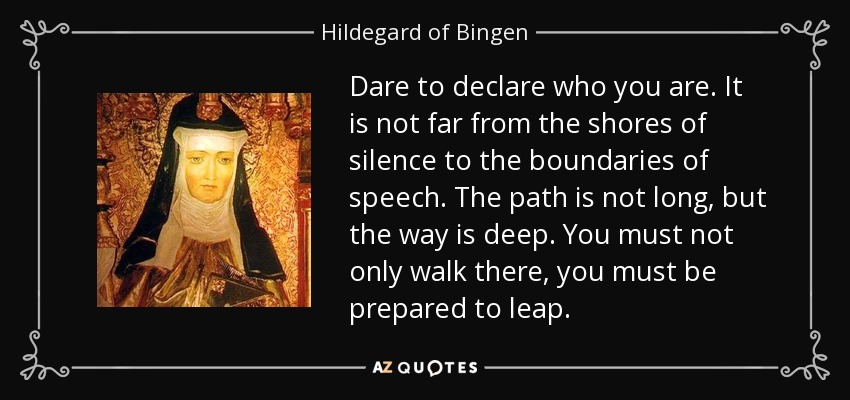
Dare to declare who you are.


Hildegard of Bingen 9.16.1098 Bermersheim vor de Horhe, Rhineland-Palatinate
希尔德加德

希  Xi   hope                mari       rare                    Hi   ひ   ヒ          Hi  힐  heel
尔  er   you                  no kanji                             ru  る   ル            de  데  place
德  de  goodness        toku       benevolence       de  で   デ            ga  가  end
加   jia  plus                  ka          increase             ga  が   ガ           leu  르  le
德  de  Germany          no kanji                             ru  る    ル           teu  트  the
                                                                              to   と     ト

Bermersheim vor der Höhe lies in Germany’s biggest winegrowing district. It is the winegrowing center in the middle of Rhine Hesse.

People settled there before the Romans came because the location favored trade with the convenience of a transportion hub.  It is located on the confluence of the Nahe and Rhine rivers. It is at the Rhine's entry into the gorge in the area. A Celtic (Gaulish) settlement by the name of Binge – meaning "rift" was established.

Roman troops were stationed in Bingen on the Rhine Valley Road in the early first century CE. They changed the location's name to Bingium. There the Romans erected a wooden bridge across the Nahe and constructed a bridgehead castrum. A castrum was a fortified military camp.

A Roman Mithraic monument which included a mutilated sculpture representing the nativity of Mithra was discovered in Bingen. One of its inscriptions is dated 236.

Mithras is sculpted as being born from a rock. He is shown as emerging already in his youth with a dagger in one hand and a torch in the other. He is nude, standing with his legs together emergent from the stone. He is wearing a Phrygian cap.

Another sculpture of Mithras shows him in an Anatolian costume. He is wearing a Phrygian cap in this depiction as well. He is kneeling on a bull which had been exhausted by being ridden. He is holding it by the nostrils with his left hand and stabbing it in the neck with his right. He looks to Sol with whom he will share the meat of the beast in a feast.

The sculpture distinguishes Mithraism from that part of the Hindi religion that will not sacrifice cows. The creatures are believed to be sacred.

The cult of Mithra represented another step in the direction of a monotheistic religion for Rome. The image of the sun represented the rise of one leader to power.

A Christian community was established in Bingen between 335 and 360 by the presbyter Aetherius of Bingen. Bearing witness to this time is Aetherius's gravestone. The stone can still be seen in Saint Martin's Basilica.

The town became a Frankish royal estate and passed in 983 by the Donation of Verona from Otto II to Archbishop Willigis of Mainz. The Binger Kammerforst (forest) came into being with Otto III. A stone bridge (Drususbrücke) was built some way up the river Nahe under Willigis.

The inhabitants of Bingen strove time and again for independence.The dispute between the Archbishop of Mainz and the Emperor led to destruction in 1165.

 Hildegard was born around the year 1098. Her parents were Mechtild of Merxheim-Nahet and Hildebert of Bermersheim. They were a family of the free lower nobility in the service of the Count Meginhard of Sponheim.

Hildegard was sickly from birth. She is traditionally considered to have been their youngest and tenth child, but there are records of seven older siblings. Hildegard states in her Vita that from a very young age she had experienced visions.

She was a German Benedictine abbess, writer, composer, philosopher, Christian mystic, visionary and polymath. She is considered to be the founder of scientific natural history in Germany.
Hildegard was elected magistra by her fellow nuns in 1136. She founded the monasteries of Rupertsberg in 1150 and Eibingen in 1165. One of her works as a composer, the Ordo Virtutum, is an early example of liturgical drama. It is arguably the oldest surviving morality play.

She wrote theological, botanical and medicinal texts as well as letters, liturgical songs and poems. She supervised miniature illuminations in the Rupertsberg manuscript of her first work, Scivias. She is also noted for the invention of a constructed language known as Lingua Ignota.
Pope Benedict XVI named her a Doctor of the Church in 2012.


Micky Rourke  9.16.52  Schenectady, NY
米基罗克
FB Fan

米  Mi    meter            meetoru     meter              Mi   み      ミ           Mi    미   beauty   
基  ji      base              moto          source            kki  っき-  ッキ-      ki     키   key
罗  Luo  catch            no kanji                              Ro  ろ-    ロ-           Lu    루   sack
克  ke    restrain          koku          restraint           ku    く      ク           keu   크  greater

The city is near the confluence of the Mohawk and Hudson rivers in eastern New York. It is in the same metropolitan area as the state capital, Albany. The capital is about 15 miles (24 km) southeast.
The name "Schenectady" is derived from a Mohawk word, skahnéhtati. It means "beyond the pines".
The city was founded on the south side of the Mohawk River by Dutch colonists in the 17th century.

Many moved from the Albany area. They were prohibited from the fur trade by the Albany monopoly. The monopoly kept its control after the English takeover in 1664.

Residents of the new village developed farms on strip plots along the river. Trade and travel was connected to the west via the Mohawk River and Erie Canal. The city developed rapidly in the 19th century as part of the Mohawk Valley trade, manufacturing and transportation corridor.

More people worked in manufacturing than agriculture or trade by 1824. The city had a cotton mill. It processed cotton from the Deep South. Numerous mills in New York had such ties with the South.
Nationally influential companies and industries developed in Schenectady through the 19th century.

General Electric and American Locomotive Company (ALCO) were included as powers into the mid-20th century. The city became part of emerging technologies with GE collaborating in the production of nuclear-powered submarines. It has been working on developing other forms of renewable energy in the 21st century.

Micky was named Philip Andre Rourke Jr. at birth. He was born on September 9, 1952 in Schenectady, New York. He was the son of Annette (née Cameron) and Philip Andre Rourke, Sr. His father was of Irish and German descent. His mother had Scottish, French, English and German ancestry.

He was raised Roman Catholic and still practices his faith. His father was an amateur body builder. He left the family when Mickey was six years old. His mother married Eugene Addis, a Miami Beach police officer with five sons after his parents divorced. He moved Rourke, his younger brother (Joey) and their sister (Patricia) to South Florida. There, he graduated from Miami Beach Senior High School in 1971.

He had a short career as a boxer. His amateur boxing record was 27 wins and 3 losses.

Mickey Rourke is an American actor and screenwriter who has appeared primarily as a leading man in drama, action and thriller films.

Rourke starred in the comedy-drama Diner (1982), the drama Rumble Fish (1983), the crime-black comedy film The Pope of Greenwich Village (1984) and the erotic drama 9½ Weeks (1986) during the 1980's. He received critical praise for his work in the Charles Bukowski biopic Barfly and the horror mystery Angel Heart (both 1987).

Rourke teamed up with Don Johnson and Tom Sizemore in the cult classic action film Harley Davidson and the Marlboro Man in 1991. Rourke had trained as a boxer in his early years. He left acting and became a professional boxer for a time in 1991.

Rourke returned to acting and had supporting roles in several films after retiring from boxing in 1994. He was in the drama The Rainmaker (1997), the comedy-drama Buffalo '66 (1998), the thriller-remake of Get Carter (2000), the mystery film The Pledge (2001), the crime dark comedy-drama Spun (2002), the action film Once Upon a Time in Mexico (2003) and the action thriller Man on Fire (2004). He played the role of a corrupt lawyer in the last film.

Rourke made his comeback in mainstream Hollywood circles with a lead role in the neo-noir action thriller Sin City in 2005. He won awards for his role from the Chicago Film Critics Association, the Irish Film and Television Awards and the Online Film Critics Society. He portrayed a past-his-prime wrestler in the 2008 film The Wrestler. He received a 2009 Golden Globe award, a BAFTA award and an Academy Award nomination for his work in the film.

He has appeared in several commercially successful films since then. These films included Iron Man 2 and The Expendables in 2010. He played the mortal king Hyperion in the 2011 film Immortals.


Sarah Steele 9.16.88 Philadelphia, PA
莎拉斯蒂尔
FB

莎  Sha  insect        sha        sedge              Sa    さ      サ           Sa   사    four
拉  la      pull            ramen    noodles           ra     ら      ラ              la     라    la
斯  Si     this            kou         in this way       Su    す     ス             Seu  스  switch
蒂  di     stem          no kanji                           ti      てぃ- ティ-          til     틸   till
尔  er     you            no kanji                           ru     る     ル

The Move of the Spirit was the unofficial name of a non-denominational charismatic Christian group that was started in the 1960's in Florida by Sam Fife, a former Baptist preacher.

Sam Fife used elements of charismatic ministry in his ministry in the early 1960's. He started at his church in New Orleans, then in his prayer group in Miami, Florida. His theology has been related to the Body of Christ movement. Free-spirited thinkers were craving answers. It was in the heart of the drug era. Sam Fife claimed that he would never die. His movement was presented as a non-denominational, non-profit charismatic international Christian organization.

Fife was considered an apostle by way of the five-fold ministry. A passage from Ephesians (Eph.4:11) was used to define the different ministries. It says Jesus gave some to be apostles, prophets, evangelists, pastors and teachers.

Fife established ‘farms’ in Columbia, Canada and Alaska within a few years. Thousands of members still live on communal farms all over the world. Each member handed over half of their income to the 'farm'.

Pastors collected the income and acted as investment advisors. Move members dressed conservatively. Women were required to wear long skirts and shorter hair. They needed permission to go anywhere. Advice was given to members by elders in a life or death situation. Family visits had to be approved by elders.

Sources have shared reports of the organization's involvement with the horrifying torture technique of "waterboarding." It was performed on members who “didn't listen.” Some ex-members reported suffering physical, sexual and psychological abuse by leaders and elders while involved with this group.

Non-communal congregations also exist as “city bodies.” No one knows what became of Fife. It was claimed that he died in a plane wreck in South America, but no one could ever find proof.

Fife's teachings lived on through another minister named Buddy Cobb after his death. He published his own booklets and founded the Covenant Life College in 1982 in Fitzgerald, Georgia. Cobb has developed the concept that the goal of the Christian is "sinless perfection." He cites it as a requirement to be saved. Cobb stresses that we shall be saved by his (Christ's) life. He defines his life as reaching sinless perfection in living as "Dead to Sin."

A group named MOVE was established in Philadelphia in 1972. This was a black liberation group founded in Philadelphia, Pennsylvania by John Africa (born Vincent Leaphart) in 1972. The name is not an acronym. The group lived in a communal setting in West Philadelphia. The communal setting makes the group similar to the Move of the Spirit. This group lived by philosophies of anarcho-primitivism. The group combined revolutionary ideology similar to that of the Black Panthers with work for animal rights.

The group is particularly known for two major conflicts with the Philadelphia Police Department. A standoff resulted in the death of one police officer, injuries to several other people and life sentences for nine members. These members were convicted of killing the officer in 1978.

Another confrontation ended when a police helicopter dropped a bomb on the MOVE compound in 1985. The compound was a row house in the middle of the 6200 block of Osage Avenue. The resulting fire killed eleven MOVE members. The total included five children. Sixty five houses were destroyed in the neighborhood. No civil official was charged with an offense. The survivors later filed a civil suit against the city and the police department. They were awarded $1.5 million dollars in a 1996 settlement.

One Liberty Place was completed in 1987 in Philadelphia. It is a 61-story, 945-foot (288 m) skyscraper. It is part of a complex called Liberty Place. The complex has another 58 story skyscraper, a two-story shopping mall called the Shops at Liberty Place and the 14-story Westin Philadelphia Hotel. Building the skyscrapers ended the 'gentleman's agreement' to not build anything taller than the statue of William Penn on Philadelphia City Hall. Construction on the complex started in 1985 and ended in 1987.

Sarah Steele was born in Philadelphia, Pennsylvania on September 16, 1988. Her mother, Katherine A. High, is a hematology oncology physician at the University of Pennsylvania. Her father, George Steele, is an internal medicine physician specializing in nutrition who was on the faculty of the University of Pennsylvania School of Medicine.

Steele graduated with the class of 2006 from The Episcopal Academy, a private school in southeast Pennsylvania. She graduated from Columbia University in 2011 with a B.A. in comparative literature.

Sarah is an American actress. She is best known for her role as Marissa Gold on the CBS legal drama The Good Wife and its spinoff series The Good Fight. She has appeared in a number of successful films and TV series as well.


Takahashi Ai 9.14.86 Sakai, Fukui, Japan
高橋愛
UpFront
Black Dance

高  gao    high           Taka    quantity         Ai  あい  アイ       Ai   아이  child   
橋  qiao   bridge         hashi   bridge           Ta  た     タ         Ta   타    other
愛  ai       love            Ai         love               ka  か     カ         ka    카   car
                                                                    ha   は   ハ         ha    하   ha
                                                                    shi   し    シ         si     시   city 

Sakai is located in far northern Fukui Prefecture.  It is bordered by the city of Awara to the north, the Ishikawa Prefecture to the east and the Sea of Japan to the west, The city of Fukui borders the city to the south. The Kuzuryū River flows through the city. It is about 750 km (465 miles) to S. Korea.

The town of Maruoka was consolidated into the city of Sakai . The town’s main claim to fame is the historic treasure at its heart: Maruoka Castle. The castle was completed in 1576. It is one of just 12 across Japan that still have their original tenshu or main tower.

The wooden structure collapsed during the 1948 Fukui earthquake, but the subsequent restoration work managed to rescue about 80% of the original material.  A scale model inside the main tower shows what the castle and the surrounding town looked like during the Edo Period. Virtually nothing but the tenshu has survived to the present day.

The semi-legendary Kofun period Emperor Keitai is said to have come from the area that is now the Maruoka neighbourhood of Sakai. The area was divided between the holdings of Maruoka Domain, Fukui Domain and tenryō holdings directly under control of the Tokugawa shogunate during the Edo period.

The area was organised into part of Sakai District in Fukui Prefecture following the Meiji restoration. The epicentre of the 1948 Fukui earthquake was in Maruoka.

Takahashi Ai was born on September 14, 1986 in Sakai, Fukui Prefecture. She practiced ballet during her childhood. She is a Japanese singer, actress and model managed by UP-FRONT CREATE. She is best known as a former leader of Morning Musume and Hello! Project.

She first joined Morning Musume in 2001 through the 5th generation auditions. She replaced Mari Yaguchi in Mini Moni in 2003.

She became the leader of Morning Musume and Hello! Project in 2007. Risa Niigaki and Ai Takahashi became the first members to remain in Morning Musume for eight years on August 26, 2009.They were  the longest-serving members in Morning Musume history. They had broken the four-year-old record set by Kaori Iida.

Ai-chan passed both leadership positions to fellow 5th generation member Niigaki Risa when she graduated on September 30, 2011. She was one of the longest-serving Morning Musume leaders.

Yuko. Llida and Ai served for four years each. Ai was in Morning Musume for ten years when she graduated. She added an element of playful sexiness to the joyful persona that had been displayed by the leadership. She enjoys singing and dancing with character.

Takashi has focused on acting and modeling. She has become known as a "fashion icon" since her graduation from Hello! Project. She has teamed up with Tanaka Reina, Morning Musume and Risa Niigaki for different musical performances on video.

Leaders
Morning Musume

Yuko Nakazawa      1997-2001
Kaori Llida               2001-2005
Hitomi Yoshizawa   2005-2007
Ai Takahashi            2007-2011
Risa Niigaki              2011-2012
    Tanaka Reina
Sayumi Michishige   2012-2014
Mizuki Fukumura      2014- present