Showing posts with label labor. Show all posts

Wednesday, August 28, 2019

Find

8.28.19

Find
Refuge
找到避难所
Zhǎodào bìnàn suǒ
避難所を探す
Hinansho o sagasu
ps71

I have taken refuge in my faith.
I look to find reality as the actual case.

Let reality for me act as a guide
to produce a service that will shine as a find.

Let me never be afraid of sensible reason.
Courage uses the light of truth as a beacon. 

Responsibility sets me free from fear of the unseen
to seek help in assimilating what has already been seen
as the mean for what's keen.

There is a context in perception beyond personal vision
that shapes perspective for the service of the versatile given.

Knowledge is solid until it finds a better form.
Assimilation or accommodation are resilient norms.

I know what can be known in the way that was shown,
but the shown has to be owned to be as solid as stone.

Organization for automation builds action for success.
Producing a service for others serves as the real test for what's best.

You were known before you were formed in the womb.
Speech was consecrated by maturity to reach beyond the tomb.

Information for nations requires translation to escape doom.
Knowledge of language is a task to be assumed.

If I speak without love,
I am a loud noise from above.
When I speak with love from above
the word is fulfilled with blessing from the heavenly dove.

Principle is used in the search for truth with knowledge.
Proximity to a word develops thought for college.
False principles are to be avoided, not acknowledged.

Wealth is associated with labor for a nation.
Commerce in the world is a subject for international relations.
Private ownership versus government control is a public policy implication.

The graceful darkness reached out to gain prestige
with a self-criticism that challenged the socialist intrigue.

The hemp on the edge of the pasture
served as a meal for the horse that bordered on rapture.

Let reality for me act as a guide
to produce a service that will shine as a find.

I have taken refuge in my faith.
I look to find reality as the actual case.

--------------------------

71 In te, Domine, speravi
In you, Sir, trust

1 In you, O Lord, have I taken refuge;
let me never be ashamed.

---------------------------------

I have taken refuge in my faith.
I look to find reality as the actual case.

========================

2 In your righteousness, deliver me and set me free;
incline your ear to me and save me.
3 Be my strong rock, a castle to keep me safe;
you are my crag and my stronghold.
4 Deliver me, my God, from the hand of the wicked,
from the clutches of the evildoer and the oppressor.
5 For you are my hope, O Lord God,
my confidence since I was young.
6 I have been sustained by you ever since I was born;
from my mother's womb you have been my strength;
my praise shall be always of you.
7 I have become a portent to many;
but you are my refuge and my strength.
8 Let my mouth be full of your praise
and your glory all the day long.
9 Do not cast me off in my old age;
forsake me not when my strength fails.
10 For my enemies are talking against me,
and those who lie in wait for my life take counsel together.
11 They say, "God has forsaken him;
go after him and seize him;
because there is none who will save."
12 O God, be not far from me;
come quickly to help me, O my God.
13 Let those who set themselves against me be put to shame and be disgraced;
let those who seek to do me evil be covered with scorn and reproach.
14 But I shall always wait in patience,
and shall praise you more and more.
15 My mouth shall recount your mighty acts
and saving deeds all day long;
though I cannot know the number of them.
16 I will begin with the mighty works of the Lord God;
I will recall your righteousness, yours alone.
17 O God, you have taught me since I was young,
and to this day I tell of your wonderful works.
18 And now that I am old and gray-headed, O God, do not forsake me,
till I make known your strength to this generation
and your power to all who are to come.
19 Your righteousness, O God, reaches to the heavens;
you have done great things;
who is like you, O God?
20 You have showed me great troubles and adversities,
but you will restore my life
and bring me up again from the deep places of the earth.
21 You strengthen me more and more;
you enfold and comfort me,
22 Therefore I will praise you upon the lyre for your
faithfulness, O my God;
I will sing to you with the harp, O Holy One of Israel.
23 My lips will sing with joy when I play to you,
and so will my soul, which you have redeemed.
24 My tongue will proclaim your righteousness all day long,
for they are ashamed and disgraced who sought to do me harm.

-----------------------

9.8

Experience

The search for knowledge from the experience of others extends into knowledge beyond personal experience.

John Locke
b. 8.29.1632 Wrington, Somerset, England
d. 10.28.1704 High Laver, Essex, England

John Locke was an English philosopher and physician. He grew up and lived through one of the most extraordinary centuries of English political and intellectual history.

It was a century in which conflicts between the Crown and Parliament overlapped with those between Protestants, Anglicans and Catholics. The conflicts swirled into civil war in the 1640's.

He is considered one of the first of the British empiricists. He is commonly known as the Father of Liberalism. His writings on social contract theory influenced Voltaire, Jean-Jacques Rousseau, many Scottish Enlightenment thinkers and the American revolutionaries.

Locke's theory of mind has been cited as the origin of modern conceptions of identity and the self. These concepts figured prominently in the work of later philosophers such as David Hume, Rousseau and Immanuel Kant.

Locke was the first to define the self through a continuity of consciousness. The mind was a blank slate or tabula rasa at birth. He maintained that we are born without innate ideas. This ran contrary to Cartesian philosophy based on pre-existing concepts. Knowledge was instead determined only by experience derived from sense perception.

He has not only been identified as the founder of British empiricism, he has been thought to be the most influential of Enlightenment thinkers.

Wrington

Wrington is a village in North Somerset, England. It is in the south west corner of the island.
Somerset is  a rural county with rolling hills and large flat expanses of land.

The Church of All Saints has 13th-century foundations. It was remodelled with the addition of a west tower about 1450. There was a restoration in 1859 and further restoration of the tower in 1948.

The church includes stone busts to John Locke and Hannah More on either side of the door dating from the early 19th century.

John Locke

John Locke was born on 29 August 1632, in a small thatched cottage by the church in Wrington, Somerset, about 12 miles from Bristol. He was baptised the same day.

The family moved to the market town of Pensford about 7 miles south of Bristol soon after Locke's birth. He grew up in a rural Tudor house in Belluton.

John Locke was born to Puritan parents of modest means. His mother was Agnes Keene.
His father was a country lawyer who served in a cavalry company on the Puritan side in the early stages of the English Civil War.

His father’s commander, Alexander Popham, became the local MP. It was his patronage which allowed the young John to gain an excellent education. He went to Westminster School in London in 1647.

John went to Christ Church, Oxford from Westminster in the autumn of 1652 at the age of 20. Just as Westminster school was the most important English school, Christ Church was the most important Oxford college.

Locke was awarded a bachelor's degree in February 1656, a master's degree in June 1658 and a bachelor of medicine in February 1675. He studied medicine extensively during his time at Oxford and worked with such noted scientists and thinkers as Robert Boyle and Robert Hooke.

He met Lord Anthony Ashley Cooper, 1st Earl of Shaftesbury in 1666. Cooper had come to Oxford seeking treatment for a liver infection. He was impressed with Locke and persuaded him to become part of his retinue.

Locke had been looking for a career. He moved into Shaftesbury's home at Exeter House in London to serve as Lord Ashley's personal physician in 1667. He resumed his medical studies under the tutelage of Thomas Sydenham in London.

Sydenham had a major effect on Locke's natural philosophical thought. The effect would become evident in An Essay Concerning Human Understanding. Sydenham would eventually come to be called the English Hippocrates.

The essay was one of the principal sources of empiricism in modern philosophy. The first book refuted the rationalist notion of innate ideas. The second set forth the theory of ideas.

A distinction was drawn between simple and complex ideas. Simple qualities such as "red," "sweet," "round," etc were used to build complex abstractions such as numbers, causes and effects, abstract ideas, ideas of substances, identity and diversity.

The primary qualities of bodies like shape, motion and the arrangement of minute particles are distinct from the secondary qualities that produce various sensations like sweetness. Secondary qualities are dependent upon the primary.

Locke considered personal identity or the self to be founded on consciousness by way of memory. It was not the substance of either the soul or the body.

Book III is concerned with language. Book IV describes knowledge in intuition, mathematics, moral philosophy, natural philosophy ("science"), faith and opinion.

Locke's medical knowledge was put to the test when Shaftesbury's life was threatened by the liver infection. Locke coordinated the advice of several physicians.

He was probably instrumental in persuading Shaftesbury to undergo surgery to remove the cyst. Surgery was life-threatening itself. Shaftesbury survived and prospered. He credited Locke with saving his life.

Locke served as Secretary of the Board of Trade and Plantations during this time. He was the Secretary to the Lords Proprietors of Carolina. It helped to shape his ideas on international trade and economics.

Shaftesbury was a founder of the Whig movement, exerted great influence on Locke's political ideas. The Whigs' origin lay in constitutional monarchism and opposition to absolute monarchy. The position against Hobbes as an advocate for absolute monarchy was a straw man fallacy.

The Whigs played a central role in the Glorious Revolution of 1688. They were the standing enemies of the Stuart kings who were Roman Catholic. They supported the slave trade and slavery for the colonies.

Locke became involved in politics when Shaftesbury became Lord Chancellor in 1672. He spent some time traveling across France as tutor and medical attendant to Caleb Banks following Shaftesbury's fall from favor in 1675.

He returned to England in 1679 when Shaftesbury's political fortunes took a brief positive turn. Locke composed the bulk of the Two Treatises of Government around this time most likely at Shaftesbury's recommendation.

The First Treatise attacks patriarchalism in the form of a refutation of Robert Filmer's Patriarcha. The Second Treatise outlines Locke's ideas for a more civilized society based on natural rights and contract theory.

Two Treatises was first published, anonymously, in December 1689. It was translated into French by David Mazzel in 1691. Mazzel was a French Huguenot living in the Netherlands. The translation left out Locke's "Preface," all of the First Treatise and the first chapter of the Second Treatise which summarized Locke's conclusions in the First Treatise.

It was in this form that Locke's work was reprinted during the 18th century in France. Montesquieu, Voltaire and Rousseau were exposed to this translation.

The only American edition from the 18th century was printed in 1773 in Boston. It left out the same sections. There were no other American editions until the 20th century.

The First Treatise is focused on the refutation of the Patriarcha of Sir Robert Filmer. Filmer had argued that civil society was founded on a divinely sanctioned patriarchalism.

Locke proceeded through Filmer's arguments, contested his proofs from Scripture and ridiculed them as senseless. He concluded that no government can be justified by an appeal to the divine right of kings.

Filmer and Locke represented their incarnation of the debate based on the differences of Plato and Aristotle. Plato favored the description of the deity as Absolute, whereas Aristotle concerned himself with universal conditions that explicitly tolerated slavery as an elevation of civilized over primitive society.

The Second Treatise outlined a theory of civil society. Locke began by describing the state of nature with a picture that was more stable than that presented by Thomas Hobbes. Hobbes had described nature without government as a state of "war of every man against every man."

Locke argued that all men are created equal by God in the state of nature. He explained from this the rise of property and civilization. The only legitimate governments are those that have the consent of the people. Any government that rules without the consent can be overthrown as had been the case in the "Glorious Revolution."

While Locke presented an argument that sounded like it was more reasonable, he made some radically liberal statements that are still used to influence foreign and domestic policy in contemporary western society.

The "consent of the people" was a perception that could be manipulated with media expression. Stories could be told to 'inform' the public that other governments did not satisfy the condition of consent.

The claim of the violation of civil or human rights was used to suggest that the government was not civil. If it was not civil, it was tyrannical and warranted rebellion towards the end of regime change.

The media expression was made to 'check' to see if the public would protest taxation to overthrow the foreign power.

This was where the doctrine for destruction became especially devisive.     

The State of War
https://oll.libertyfund.org/pages/john-locke-two-treatises-1689

Locke used an argument against somebody else to implicate Hobbes as an advocate for absolute monarchy.

Louis XIV had used the statement "I am the state" to manage the affairs of France for 72 years. He instituted some changes in his rule that refused to delegate authority in the customary way.

It is probably more appropriate to associate the idea of the absolute with the philosophy of Plato and the universal with that of Aristotle, than with the political philosophy of Hobbes.

It is appropriate to question the particular use of the concepts of absolute or universal authority with respect to human application.

The law against murder is still regarded as an absolute. The prohibition of killing someone else is not absolute or universal insofar as lethal defense against a deadly attack is regarded as an exception to the general prohibition.

Locke documented a number of reasonable provisions with respect for government for the Earl of Shaftesbury. The Whigs were the political forum for the Puritans.

They enacted the English Bill of Rights for their demographic representation. The expression is much too particular for modern standards of legality, but there were advances in legislative initiatives that have come to be be recognized as standard for constitutional government for monarchy or republic.

When Locke wrote about the state of war, he made the statement that he had the right to destroy anyone who had the intent to destroy him.

State of War S.16
Two Treatises on Civil Government: 2d Treatise
"THE state of war is a state of enmity and destruction...I should have a right to destroy that which threatens me with destruction: for, by the fundamental law of nature, man being to be preserved as much as possible, when all cannot be preserved, the safety of the innocent is to be preferred: and one may destroy a man who makes war upon him, or has discovered an enmity to his being..."

--------------------------

The statement in itself alludes to something that is correct, but the assertion that there is a right to destroy implied a proposal to enslave those who had yet to adopt settlement and private property as manifestations of civil society. The proposal was used in a general application to subject primitive people to slavery with respect for universal law.

The primitive lifestyle was taken to represent a threat to the extension of civilized society into primitive territories. Natives in invaded lands were given the 'choice' to work as slaves, or the suffer indefinite war against any indication of opposition to expansion.

The Whig support for slavery, aristocracy and serfdom was documented in the Carolina Constitutions. The document was co-authored by Locke. The extension of civilized society would not have been as rapid without the provisions, but it would not have been as offensive with respect for the inclusion of primitive people into civilized society.

Locke fled to the Netherlands in 1683. He had time to return to his writing. He spent time re-writing the Essay on Human Understanding and composing the Letter on Toleration. Locke did not return home until after the Glorious Revolution.

King James II of England (VII of Scotland) was overthrown in 1688 by a union of Parliamentarians and the stadtholder of the Dutch Republic William III of Oranje-Nassau (William of Orange).

The decision to retain a monarch a resulted in his ascension to the English throne as William III of England. He ruled jointly with Mary II, as Protestants. Mary was the daughter of James II. She had a strong claim the English Throne.

Locke claimed in the "Preface" to the Two Treatises that its purpose was to justify William III's ascension to the throne.

Locke's close friend Lady Masham invited him to join her at Otes, the Mashams' country house in Essex. His time there was marked by variable health from asthma attacks. He became an intellectual hero of the Whigs nevertheless. He discussed matters with such figures as John Dryden and Isaac Newton during this time.

He died on 28 October 1704 at HIgh Laver in Essex at 72 years of age. He was buried in the churchyard of the village of High Laver, east of Harlow in Essex, where he had lived in the household of Sir Francis Masham since 1691. Locke never married nor had children.

Events that happened during Locke's lifetime include the English Restoration, the Great Plague of London and the Great Fire of London. He did not quite see the Act of Union of 1707, though the thrones of England and Scotland were held in personal union throughout his life. Constitutional monarchy and parliamentary democracy were in their infancy during his time.

John Locke
wiki John Locke
IEP Locke
SEP Locke Political Philosophy
Text: Two Treatises on Civil Government
Liberty Fund txt
Adelaide E-Books
Commentary
SparkNotes
Locke Library
Liberty Fund

Felons in Sanctuary Cities
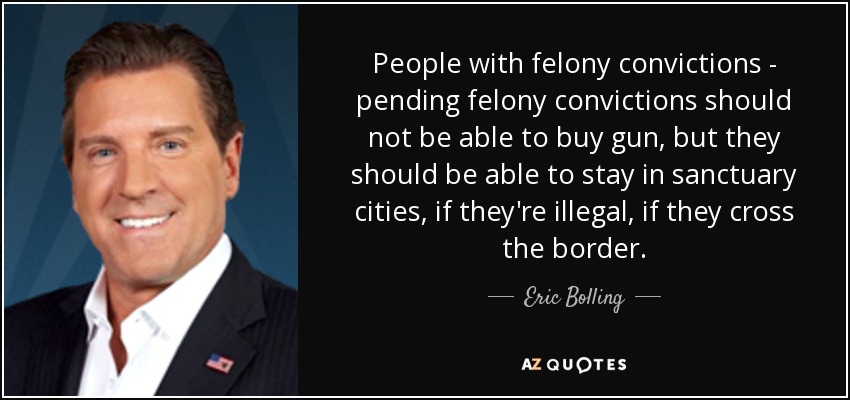
Convicted felons who have crossed the border illegally ought to be deported.

The restriction of the purchase of a gun for an illegal immigrant is not secure enough as a measure for law enforcement.

The idea of sanctuary from prosecution extends back to questionable belief in the sanctity of providing sanctuary for the enemy of my enemy. It was allowed for local administration by the Catholic Church, but the notion of universal law was attached by way of overstatement.

Locke expressed an argument for sanctuary that was overextended as well.

He wrote in his Second Treatise "I doubt not but this will seem a very strange doctrine to some men: but before they condemn it, I desire them to resolve me, by what right any prince or state can put to death, or punish an alien, for any crime he commits in their country."
(https://oll.libertyfund.org/pages/john-locke-two-treatises-1689, S.9)

The expression "their country" is ambiguous. It suggests that law enforcement can't even punish a felon seeking sanctuary in their homeland. The felon could commit a crime in his own country, then immigrate to another to escape prosecution where the liberal ethic would protect him from prosecution for further criminal action.

This liberal doctrine has been aggressively promoted by leading Democrats who seek to tax citizens to pay for the prevention of extradition or deportation.


Wednesday, August 21, 2019

Mediate

8.22.19
Ark of the Covenant

Mediate
Profit
调解利润 
Tiáojiě lìrùn
利益を仲介する 
Rieki o chūkai suru
ps131, 132
Mediata prodest

The priest is not proud
when with objectivity endowed.

The cleric is a detective
when research is the objective.

Simple expression is the task that matters
to explain the elements of the pattern.

"I still my soul to make it quiet.
I release my thought for mental silence.

"My soul is made quiet with this request
like a child upon its mother's breast."

Wait upon the test of science
to show the way to self-reliance.

Remember what the priest endured
to show how hardship made the feast secure. 

The horse ran to overcome the halter.
It passed the inn. It did not falter. 

The elder made a promise that he vowed to keep.
He would not allow his eyes to sleep.

"I will not lay my head on my pillow to rest
until I find the place to build a temple to be divinely blessed." 

We heard that the ark of the covenant was in a fruitful place.
We found it in the fields of the forest in a beautiful state.

Let us go stand near the symbol of the divine presence
that we may enjoy the feeling of the essential essence.

Arise to shine on your resting place
between the wings of the cherubim by your grace.

The wings have become an open book
where those who seek faith may come to look.

Let your pastor be clothed with the rightness of faith.
Let your faithful people sing with joy in the sacred space.

Do not turn away the face of your Anointed.
The love of the beloved uses oil as the ointment.

The beloved was true to the law insofar as he was able.
He did not punish non-lethal sin in a way that was fatal.

The humble citizen defended himself against charges that were false.
Success detained him without cruelty to check reports for embellished faults.

The Lord has sworn an oath in faith to love
for those who are true to the spirit of the dove.

Love God with your heart, understanding and strength.
Love your relations as yourself with attention to length.

You are not far from the kingdom of heaven in law.
Your faith is the leaven to overcome difficulty caused by flaws.

The fruit of your labor 
will be seen with favor
as long as it serves
the network of nerves.

If your children keep my covenant
with the testimony of love in it
they will retain your power in governance
for strength in sustenance.

Zion is the sacred space between the wings of the pages.
It is the habitation for which we sing with the sages.

"I will delight in this place forever.
I will dwell in this state with pleasure."

The economy will be blessed with employment.
Earned income will be by self-appointment
in the service of public enjoyment.

Your priesthood will be clothed with salvation.
The faithful will help to build a productive nation.

The fruit of the harvest will bless the table with provision.
The light for the Anointed is prepared to share wisdom.

Those loyal to the royal priesthood will shine.
Their achievement will be a share in the divine.

--------------------------

Psalm 131

Domine, non est
Dominated, is not

1 O Lord, I am not proud;
I have no haughty looks.
2 I do not occupy myself with great matters,
or with things that are too hard for me.
3 But I still my soul and make it quiet,
like a child upon its mother's breast;
my soul is quieted within me.
4 O Israel, wait upon the Lord,
from this time forth for evermore.

132 Memento, Domine
Remember, Dominated

1 Lord, remember David,
and all the hardships he endured;
2 How he swore an oath to the Lord
and vowed a vow to the Mighty One of Jacob:
3 "I will not come under the roof of my house,
nor climb up into my bed;
4 I will not allow my eyes to sleep,
nor let my eyelids slumber;
5 Until I find a place for the Lord,
a dwelling for the Mighty One of Jacob."
6 "The ark! We heard it was in Ephratah; (fruitful)
we found it in the fields of Jearim. (forest)
7 Let us go to God's dwelling place;
let us fall upon our knees before his footstool."
8 Arise, O Lord, into your resting-place,
you and the ark of your strength.
9 Let your priests be clothed with righteousness;
let your faithful people sing with joy.
10 For your servant David's sake,
do not turn away the face of your Anointed.
11 The Lord has sworn an oath to David;
in truth, he will not break it:
12 "A son, the fruit of your body
will I set upon your throne.
13 If your children keep my covenant
and my testimonies that I shall teach them,
their children will sit upon your throne for evermore."
14 For the Lord has chosen Zion;
he has desired her for his habitation:
15 "This shall be my resting-place for ever;
here will I dwell, for I delight in her.
16 I will surely bless her provisions,
and satisfy her poor with bread.
17 I will clothe her priests with salvation,
and her faithful people will rejoice and sing.
18 There will I make the horn of David flourish;
I have prepared a lamp for my Anointed.
19 As for his enemies, I will clothe them with shame;
but as for him, his crown will shine."

-------------------------

Shimei- my reputation
Gera- dove
Abishai- father of a gift
Zeruiah- pain

2 Samuel 19:18b-23

Shimei son of Gera fell down before the king as he was about to cross he Jordan. He said, 'May my lord not hold me guilty or remember how your servant did wrong on the day my lord the king left Jerusalem. May the king not bear it in mind. Your servant knows that I have sinned. I have come this day, the first of the house of Joseph to come down to meet my lord the king.'

Abishai son of Zeruiah answered, 'Shall not Shimei be put to death for this because he cursed the LORD's anointed?' David said, 'What have I to do with you, you sons of Zeruiah, that you should today become adversary to me? Shall anyone be put to death in Israel this day? Do I not know that I am this day king over Israel?' The king said to Shimei, 'You shall not die.' He gave him his oath.

-------------------------

The beloved was true to the law insofar as he was able.
He did not punishment non-lethal sin in a way that was fatal.

===================

Felix- lucky
Lysias- destroyer

Acts 24:22-23

Felix, who was rather well informed about the Way, adjourned the hearing with the comment, 'When Lysias the tribune comes down, I will decide your case.' Then he ordered the centurion to keep him in custody, but to let him have some liberty and not to prevent any of his friends from taking care of his needs.

-------------------------

The humble citizen defended himself against the charges as false.
He was detained without cruelty to check reports for embellished faults.

===================

Mark 12:32-34

The scribe said to him, 'You are right, Teacher. You have said that "He is one. Beside him there is no other" and "love him with all the heart, the understanding and the strength" and "love one's neighbor as oneself." This is much more important than all whole burnt offerings and sacrifices.' When Jesus saw that he answered wisely, he said to him, 'You are not far from the kingdom of God.' After that no one dared to ask him any question.

-------------------------

Love God with your heart, understanding and strength.
Love your relations as your self with attention to length.

You are not far from the kingdom of heaven in this law.
Your faith is the leaven to overcome difficulty caused by flaws.

===================

German idealism lent itself to socialism. American idealism has been used for what is right about capitalism.

Devaluations

Max Scheler
b. 8.22.1874 Munich, Germany
d. 5.19.1928 Frankfurt, Germany

Max Ferdinand Scheler was a German philosopher known for his work in phenomenology, ethics and philosophical anthropology. He developed the method of the founder of phenomenology, Edmund Husserl.

Martin Heidegger praised him with Ortega y Gasset as "the strongest philosophical force in... contemporary Europe" after his death in 1928.

Karol Wojtyła, later Pope John Paul II, defended his doctoral thesis in 1954 on the evaluation of the possibility of "Constructing Christian Ethics" based on the system of Max Scheler.

Munich

Munich lies on the elevated plains of Upper Bavaria. Bavaria is in the southeastern corner of Germany. The city is about 50 km (31 mi) north of the northern edge of the Alps at an altitude of about 520 m (1,706 ft) above sea level. The local rivers are the Isar and the Würm. Munich is situated in the Northern Alpine Foreland.

It is the capital and most populous city of Bavaria, the second most populous German federal state. It is the third-largest city in Germany with a population of around 1.5 million. It comes after Berlin and Hamburg in size. It is the 12th-largest city in the European Union. The city's metropolitan region is home to 6 million people.

The name of the city is derived from the Old/Middle High German term Munichen, meaning "by the monks".  The Benedictine order ran a monastery at the place that was later to become the Old Town of Munich. A monk is depicted on the city's coat of arms.

The city became the capital of the new Kingdom of Bavaria in 1806. The state's parliament (the Landtag) and the new archdiocese of Munich and Freising were located in the city.

Landshut University was moved to Munich 20 years later. Many of the city's finest buildings belong to this period. They were built under the first Bavarian kings.

Ludwig I rendered outstanding services to Munich's status as a center of the arts. He attracted numerous artists and enhanced the city's architectural substance with grand boulevards and buildings.

Ludwig II came to be known the world over as the fairytale king. He was mostly aloof from his capital and focused more on his fanciful castles in the Bavarian countryside. His patronage of Richard Wagner secured his posthumous reputation, as do his castles, which still generate significant tourist income.

Max Scheler

Max Scheler was born in Munich, Germany on 22 August 1874 to a Lutheran father and an Orthodox Jewish mother.

He was not a particularly strong student, but he showed an interest in the works of Nietzsche. He identified himself as a social democrat and an enthusiastic Marxist.

He turned to Catholicism as an adolescent. He became non-committal prior about 1921. He disassociated from Catholicism and the Judeo-Christian God in public after 1921. He chose to invest in philosophical anthropology.

He started to study medicine at the University of Munich in 1894. He enrolled at the University of Berlin in 1895 for the philosophy and sociology. He attended the lectures of Dilthey and Simmel.
Berlin is 585 km (365 mi.) north of Munich.

Dilthey’s research interests revolved around questions of scientific methodology, historical evidence and the science of history. His view contrasted with the idealism in Germany at the time by his experiential reference differed from British empiricism in basic assumptions. He drew his references from German literary and philosophical traditions.

Simmel was a first generation German sociologist. His approach was neo-Kantian. It laid the foundation for his sociological anti-positivism. He asked the question ‘What is society?’ as a reflection of Kant’s question, ‘What is nature?’ Individuality was a fragmentation of social identity.

The cultivation of individuals through the agency of external forms was conducted by the course of history. He was a forerunner to the structuralist style of reasoning in the social sciences. Urban sociology, symbolic interactionism and social network analysis contributed to the formation of the metropolis.

He transferred to Jena in 1896 to finish his studies with Eucken.

Jena is 260 km (160 mi.) southwest of Berlin.

Eucken advocated for ethical activism as the application for practical idealism. The philosophy of life is for the development of a new culture, not mere intellectualism. It is an application of vital religious inspiration to the practical problems of society.

It was Eucken’s ideas regarding the inner quest for a spiritual life of every human being that drew Scheler’s attention.

It was through this interest in practical idealism that Scheler developed a relationship with the American pragmatism of William James. The two exchanged letters in correspondence.

Scheler received his doctorate on the determination of the relations between logical and ethical principles at the University of Jena in 1897. He worked for his habilitation there as well.

He took a trip to Heidelberg in 1898 and met Max Weber. Weber had an impact on his thought.

Scheler met Husserl at a party in Jena in 1901. He read Husserl’s Logical Investigations a year later. The remainder of this life would be dedicated to the progress of phenomenology.

Scheler was reading French philosophy during this period. He was a major factor in introducing Henri Bergson’s work to German intellectual circles.

Scheler moved his family to Munich in 1906 to start his position there as Privatdozent. A number of students working with the psychologist Theodor Lipps at the University of Munich had founded the Psychologische Verein ("Psychological Association") in 1895.

Lipps was known for the theory of aesthetics that framed the concept of empathy. His work opened a new branch of interdisciplinary research in psychology and philosophy.

Psychology was a discipline on the rise at the turn of the 20th century. The relation between philosophy and psychology was intensely debated. The debate concerned whether psychology is a philosophical discipline or whether philosophy is based on psychology.

The position that logical concepts are psychological have been labeled as “psychologism.” The logical law of the excluded middle has to be interpreted in terms which state that it is impossible for a subject to judge at the same time that p and not-p are true.

Psychologism was contested by a competing approach within the “anti-psychologist” strand.  There are different views as to how logical concepts and laws have to be positively defined. They agreed that logic does not depend on psychology.

Husserl's Logical Investigations (1900/01) was critical of the psychologism. A number of participants in the Psychological Association at Munich decided to align themselves with Husserl. They became the Munich Circle of phenomenologists. Scheler joined this group.

The Munich circle included students from both the Psychological Association and the phenomenological group.

A number of Lipps' students followed the lead of Daubert in 1905. They left Munich for the University of Gottingen to work with Husserl. The arrival of students from Munich eventually led to the establishment of a similar student group in Göttingen circa 1910, known as the Göttingen Circle.

Scheler taught at the University of Munich from 1907 to 1910. He lost his teaching privileges due to controversies surrounding the separation from his first wife and reported affairs with students.

He earned his living as a private scholar, lecturer and freelance writer from 1910 to 1919. He  joined the circle after the invitation in 1912 to give private lectures in Göttingen.

He was forbidden to teach at a German university so his lectures would often have to be held in hotel rooms rented by his close friend Dietrich von Hildebrand.

The first volume of the Yearbook for Philosophy and Phenomenological Research appeared in 1913. Scheler was a co-editor with 3 others and Husserl.

He published major works such as Phenomenology and Theory of the Feeling of Sympathy and of Love and Hate (1913), Formalism in Ethics and Non-Formal Ethics of Value (Part 1 1913, Part 2 1916), The Genius of War and the German War (1915).

Scheler conceptualized the nation as an intellectual collective entity, which discovers and recognizes itself through war in his famous 1915 essay. The German nation, purified through the war, had the political mission of pushing Russia back into Asia and unifying Europe.

He tried to demonstrate a fundamental difference between Europe and Asia by analysing music, language, religion, gender roles and thought.

He attempted to explain this phenomenon of an all-pervading hate towards Germany in a lecture in Frankfurt in 1916. This prompted his essay “The Causes of Hatred Against Germans”, which was first published in 1917 and again in 1919.

The strongest motivation of the hate laid in the newly established unique German work ethic. The ethic was intensified by political, economic and social requirements. The ancient characteristic pursuit of the infinite which expressed itself in idealism coalesced with the work ethic.

Transcendental phenomenlogy posited a necessary correlation between reality and consciousness. A thing in itself is never one with which consciousness has nothing to do.

Edith Stein became a student of Husserl. She wrote her dissertation on the problem of empathy. It was finished in 1916. She became his teaching assistant.

Scheler had voluntarily enrolled to serve in the war for the airship battalion of the reserve in Cologne, but was not accepted due to his astigmatism. The State Department  sent him to Switzerland, Austria and the Netherlands from 1917 to 1918 to influence Catholic circles. He was to give lectures to sick and wounded German soldiers, interned in the neutral Netherlands.

This phase of his war philosophy coincided with the period in which the philosopher developed his theory of value. This theory proceeds on the assumption of the existence of an objective hierarchy of values which can be accessed through intentional feeling of values.

Scheler also composed several articles next to his book on formalism. He was accepted into the Catholic Church. He worked on the prominent Catholic magazine Hochland.

He finally took a strong position against nationalism entirely and committed himself to Europeanism in his lecture “On Europe’s Cultural Reconstruction” in 1917-1918. His Europeanism primarily encompassed continental Europe, but he suggested that England should also be included. This new Europe should be open towards Asia culturally.

Europe was now a “community of intellect and love” in his definition of nation. The unity of Europe was the reference point for a post-war order. He used the term “Europeanism” in an affirmative manner to show a third possibility of forming unity beyond nationalism and internationalism.

Europe was not defined by its geography. It was a concept that connoted a unified, spiritual structure. The collective enemy was the capitalistic, liberal, bourgeois, nationalistic and imperialistic ethos. Europeanism and anti-capitalistic criticism can be identified as constants in his war philosophy.

Scheler received an invitation in 1918 to join the faculty of the newly founded research institute for the social sciences in Cologne. He became professor of philosophy and sociology at the University of Cologne.

He wrote his major work on religion, On the Eternal in Man (1921) during his time at Cologne. He stayed there until 1928.  He accepted a new position at the University of Frankfurt early that year.

Scheler was the only scholar of rank of the then German intelligentsia who gave warning in public speeches delivered as early as 1927 of the dangers of the growing National Socialist movement.

'Politics and Morals' and 'The Idea of Eternal Peace and Pacifism' were subjects of talks he delivered in Berlin in 1927. He argued that capitalism was a calculating, globally growing 'mind-set', rather than an economic system in his analysis.

While economic capitalism may have had some roots in ascetic Calvinism, its very mind-set had its origin in modern, subconscious angst as expressed in increasing needs for financial and other securities for protection and personal safeguards as well as for rational manageability of all entities.

The subordination of the value of the individual person to this mind-set was sufficient reason to denounce it and to predict a whole new era of culture and values which he called 'The World-Era of Adjustment'.

Scheler advocated for an international university to be set up in Switzerland. He was at that time supportive of programs such as 'continuing education' and of what he seems to have been the first to call a 'United States of Europe'.

He deplored the gap existing in Germany between power and mind, a gap which he regarded as the very source of an impending dictatorship and the greatest obstacle to the establishment of German democracy.

He died in Frankfurt, Germany at the age of 53 on 19 May 1928. The Nazi dictatorship (1933–1945) suppressed Scheler's work 5 years after his death.

The Germans were like the French in their idealism. They were for socialism in that it was opposed to British and American capitalism. They started to criticize Marx, but they maintained his criticism against Adam Smith.

Marx had used the prediction of proletariat revolution to deflect attention from national dependence upon socialist government. Labor had made such progress in gaining benefits that they had a better quality of life than much of the middle class.

Now socialists subscribe to populist media stories in order to suggest that there is unity in opposition to economic success.

The middle class still has a presumption of professionalism with education for business enterprise. Socialist government was subverting the value of education by the implication that the applicants for higher education had to support the criticism of capitalism. 

Liberals made funding for research look like it was entirely dependent upon the government as a source. This lent itself to the perception that the intellectual had to blame the success of the business world for economic inequality.

Capitalism maintains a position for the production of value for the public with products or services. Education and the limitation of political overreach contribute to the production of value.

Organization can be developed when liberals in the national government are not claiming to be the answer to things like gun violence, racism, sexism and capitalism with legislation and increased taxation.   

Max Scheler
S. 马克斯舍勒
T. 馬克斯舍勒

马  Ma    horse                   馬 ba         horse                     Ma  まっ  マッ          Maeg  맥  vein   
克  ke      gram                   克  koku   overcome               ku    く       ク             seu     스  s         
斯  si        this                     斯 shi        this                        su     す      ス             Chel   첼  cell     
舍  She    house                 舍  seki     inn                         She  しぇ  シェ           leo     러   naughty
勒  lei      to force               勒   roku   halter                     ra     ら-   ラ-                         

-------------------------

The horse ran to overcome the halter.
It passed the inn. It did not falter.

===================

wiki Max Scheler
SEP Scheler
SEP Phenomenology
wiki Munich

Absolute Self

Kant was Prussian. His philosophy has been used to promote universal disarmament. It is too idealistic in this regard.

Berkeley used the concept of the immaterial as a contrast to material reality. His idealism was conditioned by the search to define knowledge. He was opposed to the liberal implications of Locke's empiricism.

Consider the use of the term absolute with respect to objective judgment. When judgment is restrained by reason to realistic truth, it is guided by impartial considerations. It is not subjectively for prejudice.

The sun shines and the rain falls on people irrespective of prejudiced beliefs conditioned by race, creed or color.

Sunday, April 28, 2019

Excel

5.5.19
Empty Chair

Excel
in
Faith
信仰闪耀
Xìnyǎng shǎnyào
信仰の中で最高 
Shinkō no naka de saikō
ps30

Why should I applaud?
How do I know you're not a fraud?

What if you were to draw a gun?
That wouldn't be very much fun.

Yo Yo Girl Cop

If you were to shoot me in the head
I would very likely end up dead.

That would not be good for you my friend.
Your freedom would begin to end.

Your candor would start to sour
as you began to lose your power.

Everything would become a show
that your ignorance refused to know.

Rika Ishikawa 

Your optimism would be misguided
to undo consequence that the grave has decided.

Speech transfers thought into verbal expression.
What happens to impulse control after violent aggression?

You don't want to know. Don't attempt to find out.
It won't be a test that has legal clout.
Liability exists whether recognized or not.

Redemption becomes a comfort sought
but not wrought without admission of what was lost.

You have the right to own a weapon as a possession.
It's for defense, not illegal convention.

You have the right to stand your ground.
The protection of self from lethal attack is profound.

Your point of view is a place in space.
Defense is for spirit not for waste.

A monad is a point with no dimension, but time.
It has no extension or shape. It is totally sublime.

The point forms the basis for extension with shape.
Each form is a unit with uncounted points in the ghost for the frame.

Simple existence is formed with an amount.
The compound is mixed with parts too small to count.

Quality is needed to determine existence.
Difference contrasts the perception of the consistent.

When change happens there is a pause 
that shows the cognition of cause.

When political unity doesn't allow for existence to change, 
there is no recognition of difference in how things are arranged.

This is called oppression. It forms ground for contention.
More trouble is found in rebellion as a regression
or progression to an even greater state of subjection.

When difference is the only thing that is promoted 
unity is not recognized as a value to be connoted. 

Soul is the projection of monad into your body and mind.
The integration of energy with substance is what your life defines.

Self is conditioned by life as we know it.
The earth shapes environment in a way that shows it.

Evolution allows for manageable change
so the political and physical can adapt within range.

That which is human acknowledges individual being
as a part of the whole that contributes to seeing
and retrieving knowledge from our believing
for what salvation is achieving.

I was blind when I thought myself enlightened.
The darkness made my heart feel frightened.

I was on the road to religious sight
as though it were a western fight.

Sound became my only guide.
I followed those who could see what I could not find.

You are the projection of life as soul
as a part of the whole that can be known.

A train of thought uses words to convey an impression.
Speech is a way to express internal procession.

The first use of names served as notes for remembrance. 
It was a step beyond the acceptance of essence.

The same words signify what is thought, felt or believed
with respect for desire, fear, passion or disease. 

Rhetoric uses inequality to express a symbol of speech. 
The sign is extended for listeners to reach.

Language predicts the future in the creation of art.
The market for commerce gives incentive to start.

Science is knowledge for the instruction of self.
Words make will or purpose known with the intention to help.

The disciples did not know the man on shore.
They cast their net to the other side of the boat once more.
Their catch was filled with luck galore. 

Speech is for insight or delight in ourselves 
in the way that we play for pleasure as well.

There are two kinds of regulated thought.
Cause defines purpose in that which is sought.
Probability is imagined by what time has wrought.

Leibniz was born before the Peace of Westphalia. 
The peace was a contract that resolved religious regalia.

The nation state was allowed independence from empire.
The monarch would choose the particular hell fire. 

Protestant or Catholic was left to the choice
of the principle leader as the popular voice.

Sweden was active as a Protestant power.
The Thirty Years War contested the Roman Habsburg hour.
France was Catholic, but Habsburg sour.

The Eighty Years War was for Dutch independence
from Spain as the sovereign reach for ascendence.

Leibniz approached the problem of evil
as something that faith could transcend with the primevally legal.

He developed the monad established by Euclid
in a way that Democritus would not find putrid.

The relation of the unseeably small to the infinitely large
was promoted as the range for the political charge.

We live between the certainty
of immeasurable uncertainties.

Mind is a spear for morality with law.
Scripture provides incentive to anticipate the correction of flaw.
Faith is the attitude to produce products with awe.

Voltaire lampooned Leibniz with satirical expression
in a way that contributed to political digression,
but his artistry found a place in irreverent contention.

One criticism takes form in the perpetual "underachiever.” 
The existence of evil counters the power of the omnipotent believer
that talks himself out of all work as an achiever.

Another is found in the "holiness” of the creator.
When nature destroys, it is read as power by the dictator.

People are expected to see the Creator as the instigator
to the detriment of the 'holiness' in the communication of the imitator.

The law against murder is for the right to life.
Defense is against the lethal and imminent threat by a gun or knife.

There is the right to stand your ground. 
This is for legislated law to expound.
A duty to retreat exists when it is the better option found. 

This allows the assailed to withdraw
to give law enforcement a call.

Prudence is presumption of the future
based on the judgment of what part of the past to suture.

History reviews by what courses and degrees
the state came to civil war in certainty
with the sight of ruin contrived for any other state
from an experience that was defined as fate
but wan't so necessary to define as great.

There is no other act of mind remembered
that can reach beyond the sense dismembered
without study and industry tendered.

Speech developed by the course of instruction
may be improved to lift humans above destruction.

That which is imagined is finite with respect for the vocation of station.
Infinite magnitude lies beyond the imagination,
but not our calculation.

The name God is not used to define divine being.
Deity cannot be controlled by a way of seeing.
Fluxion can be calculated to improve conceptual measure.

Calculus helps to see the pleasure of the immeasured treasure
of existence between the uncertainties in leisure.

No thing can be conceived outside of space.
It has to be seen as residing in some place
with a size and shape that can be divided into parts
by a measure that describes magnitude as an art.

Quality describes essential form
so a listener can imagine the object as a norm.

There are those who would deceive by description. 
The con artist depends upon the generation of fiction.

Words are used as the tool for trolls
as they seek to counterfeit or steal your 'gold.'

The invention of printing developed the genius of letters.
Language evolved for the better.

Red leader. Red leader. This is heroic purple. Over.
'He who excels' brought letters to the grey-eek people for Homer.

Agenor was king of Phoenicia.
His son Cadmus took letters to Keisha
in Greece  by sea well before Caesar.

Letters formed the alphabet so people who never met
could say something in writing with meaning they could get.

Transcription was labor. It gained a transcriber favor.
Reproduction and distribution generated consensus to savor.

Market potential was grown 
by memory and the conjunction shown.

The world in time became the reach for mind.
The technology was quite a find.

The most profitable invention was speech.
Written or verbal it gave thought extension to reach
with names and connections to teach
mutual utility for each. 

The Word was the author of the reach for speech
to society with contracts and peace
with more organization than bears, wolves and geese.

Adam was the man that gave names to each.
Eve was the one who shared the reach.

Scripture was something profound to read.
Language gained names as the readership had need.

Perpetual ecstasy waited for the paper 
to fall to the floor as easily as sleeves slip down the arms of the heron player
with vapor beholding the eye as the throne of the pupil's pupil as the shaper of layers
as destitute as ashes from charcoal in the carbon of the grilled favor for labor.

A loud boom shook the room with the shake that loud sound makes
when impacted by the force of pressure moving outward to take
the chimney with the wind across the lake that makes fish feel like saints
that don't faint when the force crosses across  the water saving the shake of fish mates.

An empty cup of rest with relaxation sits as if an Eagle has landed 
upon the magic carpet beneath where my now housed homeless feet stand
before the plasma screen image lived as livid with desert sedition that can
linger like the Nile where the hawk head of Horus wears the man as a plan.

The immediacy of your ghost presence startles me.
I see again how one beautiful sunny day in May can be
a place near the far end of the lake where the shade hides our heads from the heat
and our bikes from the beat of the street as we cool our bones in the watery retreat.

Tell me you stones. Speak you past particles of a towering palace!
Say a word as the oracle for that beneath our feet in the street as the maker of callus
that forms the chalice of toe for the now forgotten groan from the base of body balance.

Cool clean water is the spirit of eternal Rome.
Who will whisper to me from what window in what home?

Will I see some sweet thing who'll kindle me now to quicken my heart?
I'm gazing at a church, palace, ruin, columns and a stone street for a drawn cart. 
I wonder as a wanderer looking to make sense of the journey from the start.

Soon it will happen. There will be one vast temple of love to receive the initiate.
Though you’re a whole world, the world isn't whole without the ability to hydrate.

When gods and goddesses loved in heroic ages, desire followed a look.
Joy followed desire. Talk came as from a book. Joy flowed like a brook. 

I was stolen from distant shores and beaten by misfortune.
“What did I do to be cast into chains by the god of fortune?"

Am I not part of his creation? Is my sin the color of my skin?
Am I not also created for happiness? I loved the one I could win.

She had all my tenderness. Her smile made my heart beat true.
I was to become a father to the fruit of our love's swoon.

Dear child, do you still live to console your mother
or did you perish without knowing touch from another?

My humble prayers are offered in church for you.
I pray that my love will guide your spirit to live true.

I saw you near the altar by chance.
Your beloved face turned to meet my glance.

Enchantment held fast my gaze in wonder.
Your smile spoke softly, like a quiet slumber.

I asked for words with immortal charm,
"Lull to a timely rest the works of war and harm.
Let them stop forever that children may grow to learn
the power that morality for public peace will earn.
Let each body be filled with energy from above.
Pour from those lips soft syllables distilled with love.
Grant peace to our people, glorious lady,
in the heat of this season as troubled as a hungry baby.
Let the illustrious branch from this house of labor
not neglect the civic cause of our Savior."

Amaryllis 

The six tepal petals form a funnel of flame that fans out as flower. 
The amaryllis bloom looms over the ground game with her green tower.
The base is a bulb that loves the bitter taste of sandy soil as the nutrient power.
She stands like a beauty whose affection has not been returned by the heroic coward.

Creeping Thyme

The creeping thyme became the means to hold and shade the dirt
as the green grass of lawn was known to dry and die as it shied from the work.

Mottled Duck 

The slightly smaller than average mottled duck took flight
at a low height in anticipation of the path of sight.

Erin strolled on the emerald isle as it rose from the sea
to explode in forty shades of green.

Water filled the glass until it overflowed.
The men ran across the isle to behold
the rainbow that promised security for home. 

A myriad of angels sang around the throne.
They praised the sacrifice of the Lamb as honor shown.

Bonsai sculpting came from penzai in China.
Korea had a form to combat angina. ;)

The stately pine tree did not grow free.
It was shaped for art to increase beauty.

Himeji Castle

A cool breeze blows in the month of May.
The air is charged for independence some would say.

The Himeji castle appears in sight
to be a palace of great delight.

The sakura surround the base.
The castle structure reaches up in space.

The labyrinthian approach from the Hishi Gate
leads along walled paths that run straight
through multiple gates and baileys to create
delay in access to the attacking force of gait. 

The great rock walls are on the hill.
The white heron walls rise higher still.

A smaller size floor reaches one flight higher.
The A frame roof curves like a flame of fire.
The spirit of the sky inquires, "What height does your reach desire?"

"Would you harvest gold from the blue in the curve of sky?
You'll be surprised at what you can do when you believe and try."

The main keep is a wooden structure.
It has six floors filled with the charm of Japanese culture.

She stood in the entrance to the lower floor.
We climbed a series of steep narrow stairs without doors.

They were as steep as the stairs in a ship off the shore.
The stairs were steady but the pitch required the use of handrails for sure.
Each room on the next floor was smaller than the one before.

We stood on the top floor in the shrine
and looked out in the direction of each side.
The maze provided places for soldiers to hide.
My companion looked at the land with the pride of a bride
married to the countryside. 

I will exalt in my Savior
because I savor 
salvation's favor.

I cried for help without wealth.
I was restored to good health.

I was brought up from the dead.
I learned from what was said.

Sing with thanks for salvation.
Feel the value of exaltation.

Wrath lasts for a moment in time.
Providence rings the perpetual chime.

Tears cleanse the soul.
Joy lets the body extol as whole.

Your favor made me feel strong.
I felt that I could right every wrong.

All things were created to exist.
Generation makes the soul persist.

Construction is a goal that helps us
to avoid destruction as the security bus
for the bust 
of trust.

Faith inspires excellence in effort and achievement.
Wisdom loves knowledge, speech, kindness and productive disagreement.

Reconciliation is the goal to contrive
the best answer to secure the means to survive.

Nations need to work together
to form the bonds that will not sever.

The jack of clubs overstated the value of the state official for law
to overcome skepticism against excess regulation to rule out moral flaw.  

You have turned struggle into a dance
that shows that grace works with chance.

Leadership finds a reasoned judgement
that balances security with risk in the budget.

-------------------------------

30 Exaltabo te, Domine
Exalt you, Dominated

1 I will exalt you, O Lord,
because you have lifted me up
and have not let my enemies triumph over me.
2 O Lord my God, I cried out to you,
and you restored me to health.
3 You brought me up, O Lord, from the dead;
you restored my life as I was going down to the grave.
4 Sing to the Lord, you servants of his;
give thanks for the remembrance of his holiness.
5 For his wrath endures but the twinkling of an eye,
his favor for a lifetime.
6 Weeping may spend the night,
but joy comes in the morning.
7 While I felt secure, I said,
"I shall never be disturbed.
You, Lord, with your favor, made me as strong as
the mountains."
8 Then you hid your face,
and I was filled with fear.
9 I cried to you, O Lord;
I pleaded with the Lord, saying,
10 "What profit is there in my blood, if I go down to the Pit?
will the dust praise you or declare your faithfulness?
11 Hear, O Lord, and have mercy upon me;
O Lord, be my helper."
12 You have turned my wailing into dancing;
you have put off my sack-cloth and clothed me with joy.
13 Therefore my heart sings to you without ceasing;
O Lord my God, I will give you thanks for ever.

---------------------------

Acts 9:3-6

When Saul was approaching Damascus a light from heaven flashed around him.  He fell to the ground and heard a voice saying, "Saul, Saul, why do you persecute me? He asked, 'Who are you Lord?' The reply came, 'I am the Jesus whom you have persecuted. Get up and enter the city. You will be told what you are to do.'

--------------------------------

I was blind when I thought myself enlightened.
The darkness made my heart feel frightened.

I was on the road to religious sight
as though it were a western fight.

Sound became my only guide.
I followed those who could see what I could not find.

=======================

Rev. 5:12

Then I looked and heard the voice of many angels surrounding the throne, the living creatures and the elders. They numbered myriads of myriads. They sang with full voice,

'Worthy is the Lamb that was slaughtered
to receive power, wealth, wisdom, might, honor, glory and blessing!'

--------------------------------

A myriad of angels sang around the throne.
They praised the sacrifice of the Lamb as honor shown.

=======================

John 21:4-6

Jesus stood on the beach after daybreak, but the disciples did not know that it was him. He said to them, 'Children, you have no fish, have you?' They answered him, 'No.' He said to them, 'Cast the net to the right side of the boat and you will find some.' So they cast it and they were not able to haul it in because there were so many fish.

--------------------------------

The disciples did not know the man on shore.
They cast their net to the other side of the boat once more.
Their luck was filled with fish galore.

=======================

Socialism

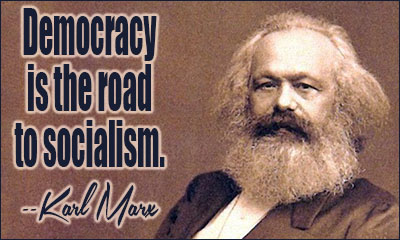
Karl Marx was trained in law in Germany. He had wanted to study literature, but his father insisted that law was more practical. Karl adopted Hegelian philosophy. Hegel had been a student when Napoleon was extending the Republican revolution from France through Europe. He supported revolution as a means to achieve political change.

The Republican component of the change was against monarchy. It was supported in no small part by the influence of John Calvin. He had advocated for democracy by local council.
Monarchy was viewed as the primary element of corruption in a human nature that was defined as totally depraved. Monarchy with aristocracy was not included in this model for government.

Marx came to write about economic theory after he met Engels. Engels convinced him that the working class would be the agency for the final revolution in history.  The holy Roman empire had been ruled by kings. The next order was to be governed by elected officials. Election was presumed to be an expression of the will of the people.

The English Civil War and the French Revolution were used to place parliament over executive leadership.  The British managed to maintain the monarchy, but it was defined as subject to parliament. The French moved back and forth between military, elected and monarchical leadership.
Marx and Engels took aim at business leadership as the cause of social malady.

Capitalism was categorized as the cause of income inequality and suffering for the poor. Marx predicted that the proletariat or working class would rise up in rebellion against capitalist leadership to establish government that was controlled by the demands of labor. This was presented within the context of the belief that this was the final stage in the development of society.

This economic model however did not recognized education as a requirement for leadership in labor. Labor leaders led by experience in their respective industry. They didn't have  requirements for the knowledge of language, history, law, negotiation or management. They operated under the principle that management had to concede to demands from labor because industry could not operate without workers.   

The middle class was not seen as an area of concern for representation in government. They were identified as part of the problem. This analysis gave the advantage in class warfare to labor and the uneducated. Social organization of any other kind than that for labor was not regarded as worthy of consideration.

This effectively placed labor over the socialist government that was in charge of leadership for the society. The socialist government could not be criticized because they were the ones who had identified monarchy and business leadership as the agencies of the capitalism that had caused corruption.

This disrespect for education and leadership made the economic model de-generative for society. There wasn't anything that monarchy or executive authority could do that wasn't subject to rebellion.

Marx and Engels sought to implicate themselves and those who agreed with them as the master negotiators for the new world order. A giant inefficient bureaucracy was created to distribute wealth, often insufficiently. No new wave of rebellion could be tolerated as this dictatorship was the end of history. 

The idea that everything could be run by capitalist leadership is not being presented here. There is so much socialist agency in government in the world that such a change would require another rebellion.

Rebellions have proven to be remarkably insufficient in terms of instituting improvement. Change has been the goal. The goal has been too easy to attain. The change has most often been for the worst.

The basic mechanism for achieving this change has been to identify commerce, education and executive authority as the cause of corruption. This is what liberals do with vigor.

The problem with this mechanism is that it has replaced something identified as being bad with something that regarded itself as worse, but didn't hold itself accountable as being the greater agent for corruption.

The worst thing is that the wealthy corporation executives who promote liberal expenditure for the corporation on government influence through media expression or campaign finance are less likely to support sponsorship for small business or the self-employed.

They actually fit the definition of a corrupt business executive according to Marxist analysis. They are the socialists and liberals in the middle class.

Education is the better instrument for improvement. Instruction in language and application helps people to negotiate solutions that don’t default to corruption.

Godel might have called improvement a system that seeks to repair the faults of incompleteness. Elements of completeness are being reworked for a complete system of representation.

Karl Marx
b. 5.5.1818 Trier, Germany
d. 3.14.1883 London, United Kingdom

Karl Marx
卡尔·马克思
卡爾·馬克思

--------------------------------

卡 Ka    card                       卡 ka         card                   Ka    か-    カ-          Ka   카  car     
尔 er     you                        爾 ore       you                     ru    る       ル           leul 를  to             
马 Ma   horse                    馬 ba         horse                  Ma  ま       マ            Ma   마  hemp               
克 ke     restrain                克 koku    overcome             ru    る        ル          leu  르   le                     
思 si      think                     思 shi        think                   ku    く         ク        keu  크  big         
                                                                                        su    す        ス          seu   스  switch
--------------------------

The jack of hearts overstated the value of the state official for law
to overcome skepticism against excess regulation to rule out moral flaw.                       

===================

Empty Chair