Seek
Value
寻求价值
Xúnqiú jiàzhí
値を探す
Atai o sagasu
ps96
Agreement in essential things
is a blessing that constancy sings.
Sing a song for the nation.
Sing thanks for the gift of salvation.
Sing to celebrate the whole earth.
Sing to conserve things of essential worth.
Sing to the Creator to consecrate and refine
knowledge incarnate of the design which is divine.
Sing a new song for consecration.
That which is incarnate is great for the celebration of station.
The search for worth in old or new things
increases the value for seeking knowledge with a clarity that rings.
Declare divine glory to all the people.
Let your glory shine to avoid that which is evil.
Even the wealth of the labor for all the nations
does not shine as bright as the sun in the heavenly oblation.
The majesty of the divine presence is
magnificent.
It enhances your ability to work as a participant.
The splendor of the sanctified sanctuary emits power.
Eternity honors the intricate division of each hour.
Ascribe honor and power to the sacred Name.
Offer your products to show reverence as a claim.
Worship divine essence in the beauty of holiness.
Association will rejoice in each melodious associate.
Revolution will not rock the reign of deity.
Insurrection will not rule the faithful society.
Plots of murder will not be seen as acts of piety.
Ascribe to Leadership responsibility for due
diligence in representation.
The management of government is for social gestation.
Let the heavens rejoice. Let the sea be glad.
Let the earth be the third part of the joyous triad.
Let the rain fall on all the earth
that plant and animal life may grow and flourish.
Then will the trees of the wood sing with joy
before the Leader comes to see what resources can be employed.
Letters form sound for words. Words make
sentences.
The enlightened crow only reads threat in that which menaces.
The legal code is the measure for knowledge of
law.
Let your vision penetrate beyond the edge of greatness to avoid tragic flaw.
When the Judge comes to review the earth,
the world will be evaluated for worth.
96 Cantate Domino
1 Sing to the Lord a new song; *
sing to the Lord, all the whole earth.
2 Sing to the Lord and bless his Name; *
proclaim the good news of his salvation from day
to day.
3 Declare his glory among the nations *
and his wonders among all peoples.
4 For great is the Lord and greatly to be
praised; *
he is more to be feared than all gods.
5 As for all the gods of the nations, they are
but idols; *
but it is the Lord who made the heavens.
6 Oh, the majesty and magnificence of his
presence! *
Oh, the power and the splendor of his sanctuary!
7 Ascribe to the Lord, you families of the
peoples; *
ascribe to the Lord honor and power.
8 Ascribe to the Lord the honor due his Name; *
bring offerings and come into his courts.
9 Worship the Lord in the beauty of holiness; *
let the whole earth tremble before him.
10 Tell it out among the nations: "The Lord
is King! *
he has made the world so firm that it cannot be
moved;
he will judge the peoples with equity."
11 Let the heavens rejoice, and let the earth be
glad;
let the sea thunder and all that is in it; *
let the field be joyful and all that is therein.
12 Then shall all the trees of the wood shout for
joy
before the Lord when he comes, *
when he comes to judge the earth.
13 He will judge the world with righteousness *
and the peoples with his truth.
Eph.3:7
I have become a servant of this gospel according to the gift of God's grace
that was given to me by the working of his power.
------------------------------------
I have become the servant of the gospel by grace.
Good news will influence how you choose the method for your pace
in the human race.
==========================
Mark 16:15
Jesus said to them, 'Go into the world and proclaim the good news to the whole
creation.'
------------------------------------
The Savior said, 'Go into the world to proclaim
the word for creation.'
The gospel will generate significant sensation.
==========================
Cyril and Methodius
Cyril was born as Constantine in about 826 CE.
Methodius was given the name Michael. He was born about 828 CE.
The ethnic origins of the brothers are unknown.
There is controversy as to whether they were of Slavic, Byzantine Greek or
both. Their mission suggests that they were born in the Thessalonica of Slavic
descent.
Their father, Leo, was an officer of the
Byzantine theme in Thessalonica. Their mother was named Maria.
Their uncle was a powerful minister. Theoktistos
became their protector after their father died. He was responsible for postal
services and diplomatic relations in the empire. He started the educational
program along with Bardas that culminated in the establishment of the College
of Magnaura in the Imperial University of Constantinople.
The University had been founded in 425 by
Theodosius II. It lasted until the 15th century.
The Magnaura was a large building that housed the
Senate. This was located near Hagia Sophia, the Augustaion and the Chalke gate
of the Great Palace. The school associated with the building did not last long,
but it was instrumental in outreach through missionary work.
Theoktistos invited Constantine to Constantinople
to continue his studies at the university. Constantine was ordained as a deacon
while he was in the city. He was knowledgeable in theology and had a good
command of the Arabic and Hebrew languages. He adopted the name Cyril when he
was ordained as a priest.
His first state mission was in the Abbasid
Caliphate. He was sent to discuss the principle of the Holy Trinity with Arab
theologians selected by Al-Mutawakkil. The mission was intended to improve
diplomatic relations with the Abbasid Caliphate.
Theoktistos also arranged a position as an
official for Michael in the Slavic administration of the empire. He soon
traveled to the monastery at Mount Olympus where he was tonsured with the name
Methodius. He later became the governor for Macedonia and the abbot for the
monastery.
Cyril was sent on a missionary expedition to the
Khagan of the Khazars by Emperor Michael III and Patriarch Photius in 860. He
was given the task to use his knowledge of foreign languages to forestall the
Khagan from embracing Judaism.
The Latin “Legenda” states that he learned the
Khazar language while he stayed in Cherson on the Crimean peninsula. The
mission was unsuccessful. The Khagan chose Judaism for his people. There were
those who welcomed Christianity though.
Cyril was appointed as the professor of
philosophy in the university upon his return.
The Moravian Prince Ratislav requested that
Michael III send missionaries to Moravia to explain Christianity in “their own
language.” Cyril and Methodius were sent. The two had developed a reputation as
thinkers and administrators.
The people of Moravia had already accepted the
Christian religion with the Roman Church with the influence of the Frankish
King Louis the Pious. Ratislav was seeking to assert independence by what
amounted to a request for translators from the Byzantine Empire.
The Glagolithic alphabet was devised to be used
for translation into the Slavic language. The descendant script is called
Cyrillic. It is used by a number of languages today.
The brothers started by training assistants. They
started to translate the Bible into what is now known as Old Church Slavonic.
Then they traveled to Great Moravia to promote the translation of the liturgy
into Slavonic. The brothers wrote the Civil Code in Slavic for use in Great
Moravia.
They ran into trouble with German missionaries
who opposed their efforts to create a specifically Slavic liturgy.
The missionaries to the East and South Slavs had
success in part because they used the people’s native language rather than
Latin or Greek. Cyril and Methodius encountered Frankish missionaries from
Germany who represented the Latin branch of the Church.
The western church represented the Holy Roman
Empire as founded by Charlemagne. These Franks were committed to linguistic and
cultural uniformity. They insisted on the use of the Latin liturgy. They
regarded Moravia and the Slavic people as part of their missionary
jurisdiction.
When friction developed, the brothers were
invited to Rome to see Pope Nicholas in 867. They were not willing to be the
cause of dissention among Christians. They sought to make an agreement that
would avoid quarreling between the missionaries in the field. Pope Nicholas
died before the issue was resolved.
Pope Adrian II gave Methodius the title of
Archbishop of Sirmium in 868. Sirmium is now Sremska Mitrovica in Serbia. Cyril
died in Rome. Methodius was given jurisdiction over Moravia and Pannonia. He
was authorized to use the Slavonic liturgy.
He continued the work among the Slavs alone in
Pannonia. Great Moravia was in a state of transition. Ratislav was taken
captive by his nephew Syatopluk. He was delivered to Carloman and condemned in
a diet of the empire at the end of 870.
The activity in Pannonia made a conflict with the
German episcopate and especially the bishop of Salzburg inevitable. Pannonia
had been in the jurisdiction of Salzburg for 75 years.
Bishop Adalwin was found exercising rights there
in 865. The administration under him was in the hands of the archpriest
Riehbald. The archpriest was obliged to retire to Salzburg, but his superior
was naturally not inclined to abandon his claims.
Methodius sought support from Rome. Friendly
relations had been established with Kocef on the journey to Rome. Kocef sent
him back with an escort to receive Episcopal consecration.
When Pope Adrian named Methodius archbishop of Sirmium with jurisdiction
over Great Moravia and Pannonia, the older title superseded the claims of
Salzburg. Adrian had consecrated him as archbishop with jurisdiction not only
in Great Moravia and Pannonia, but Serbia as well.
When Ratislav died in 870, his successor did not
support Methodius. The Frankish king Louis and his bishops convened a synod at
Ratisbon that deposed Methodius. He was imprisoned for a little over two years.
Methodius was summoned to Rome on charges of
heresy and for using Slavonic in 878. Pope John VIII secured his release with
permission to use the Slavonic liturgy. He was sent back cleared of the
charges.
Pope Stephen V reversed John VIII’s ruling and
forbade the use of the Slavonic liturgy after Methodius’ death. Wiching,
Methodius’ successor, drove the disciples of Cyril and Methodius into exile.
Many found refuge with Boris of Bulgaria under whom they re-organized a Slavic
speaking Church.
Pope John’s successors adopted a Latin-only
policy that lasted for centuries.
------------------------
Cyril and Methodius
S.西里尔和的迪乌斯
T.西里爾和的迪烏斯
西 Xi west 西 nishi west Ki
き キ Si 시 city
里 li inside 里 ri village ri
り リ lil 릴 reel
尔 er you 爾 ore you ru
る ル gwa 과 and
和 he and 和 wa
and to と と Me
메 me
的 De truly 的 teki target Me め メ de 데 place
迪 di enlighten
迪 susumu edify
to と ト ti
티 tea
乌 wu crow 烏 karasu crow di
で デ u
우 right
斯 si Slovakia 斯 shi this i
ぃ ィ seu 스 switch
u う ウ
su す ス
------------------------------------
Letters form sound for words. Words make
sentences.
The enlightened crow only reads threat in that which menaces.
==========================
Max Horkheimer
2.14.1895, Stuttgart, Germany
7.7.1973, Nuremberg, Germany
Stuttgart-Zuffenhausen
Stuttgart went by the name of Zuffenhausen. The
name was changed when Zuffenhausen incorporated with Zazenhausen in 1931. The
towns were united due to the depression.
The etymological roots for
"Zuffenhausen" are traced to the name used for an Alemanni settler,
"uffo" or "offo." It
translates as the 'house of settlement' in the upper Rhine dialect.
The Alemanni were a confederation of tribes
located near the upper Rhine River in southern Germany. The confederation was first mentioned by
Cassius Dio in the context of the campaign of Caracalla of 213. Caracalla was a
Roman emperor also known as Antoninus. He ruled from 198 to 217 CE. He was a
member of the Severan dynasty.
The Alemanni captured the Agri Decumates in 260.
The Agri Decumates included the Black Forest and the areas between the Rhine,
Main and Danube rivers in southwestern Germany.
They later expanded to present-day Alsace and
northern Switzerland. The Old High German language was used in the expanded
territory. The region was named Alammania by the 8th century.
The Alemanni were conquered by Frankish leader
Clovis in 496. They were incorporated into his dominions. They retained their
status as pagan allies until the 7th century. They were gradually Christianized
over this one hundred year period of time.
The Lex Alamannorum recorded the customary law
for the Alemanni. Frankish suzerainty over Alamannia was mostly nominal until
the 8th century. Carloman, aka Charlemagne, executed the Alamannic nobility and
installed Frankish dukes after an uprising by Theudebald, Duke of Alamannia.
The Alemannic counts became almost independent
during the later and weaker years of the Carolingian Empire. A struggle for
supremacy took place between them and the religious leadership that would later
become the Bishopric of Constance. This was an imperial state in the Holy Roman
Empire from the mid-12th century until its secularization in 1802-3.
The oldest official denotation of Zuffenhausen
was when it was documented as a property of Bebenhausen Abbey by Pope Innocent
III on May 18, 1204.
The city is located in a river valley that was
carved into existence by the Feuerbach River. There are two distinct elevations
with a difference of 3 m (10 ft.). There is the level at 255 m (837 ft.). There
is the other level at 252 m (827 ft.).
A vast stretch of rolling hills extends to the
north and northwest on a height of over 300 m (980 ft.). The hills rise to a
peak of 327 m (1,073 ft.) near Neuwirthshaus. The Stuttgart mountains rise in
the south. The Nekar valley is situated to the east.
People have considerably changed the geographical features of Zuffenhausen
since the 19th century. The development of railway lines and roads have altered
the landscape. The excavated material was used to fill depressions and drained
ponds.
There was an expansion of the settlement beyond
the Feuerback valley to the west and to the east during the second half of the
19th century.
The flora and fauna are diverse. Animal life has
decreased in number since the introduction of sealed roads after World War II.
Birds were less affected by the loss of habitat. Generously sized home gardens
and the preservation of primoridal forest in the Hofkammer Wald.
Larger forests and different types of semi-arid
grassland are located west of Zuffenhausen. Fields are increasingly marginal.
Pastures and orchards are almost totally absent. Agriculture was the most
important part of the economy until 1907.
Zuffenhausen is the headquarters for the Porsche
car manufacturing company.
Max Horkheimer
Max was born in Zuffenhausen on February 14,
1895. He was the only son of Moriz and Babetta Horkheimer. Moritz was a successful businessman who owned
several textile factories. He expected his son to follow in his footsteps. He
wanted him to own the family business.
Max was taken out of school to work in the family
business in 1910. He eventually became a junior manager. He started two
relationships during this period that would last for the rest of his life.
He met Friedrich Pollock. He would later become a
close academic colleague. He also met Rose Riekher. She was his father's
personal secretary. She was eight years older than Max, a gentile and from an
economically lower class.
Max called her Maidon. She was not considered to
be a suitable match by Moritz. Max and Maidon married in 1926. They remained
together until her death in 1969.
His manufacturing career ended when he was
drafted for World War I. His chances for taking over the family business were
interrupted. He was denied enlistment on medical grounds. He failed the army
physical in the spring of 1919.
He enrolled at Munich University. He was mistaken
for the revolutionary playwright Ernst Toller while living in Munich. He was
arrested and imprisoned. He moved to Frankfurt am Main after his release.
He studied philosophy and psychology under the
respectable Hans Cornelius. He met Theodor Adorno. Theodor was his junior by
several years, but the two formed a lasting friendship and a collaborative
relationship.
Max completed his dissertation The Antinomy of
Teleological Judgment with Cornelius's direction. He was habilitated for
professorship with Kant's Critique of Judgement as Mediation between Practical
and Theoretical Philosophy in 1925.
The Institute for Social Research was founded by
Felix Weil in 1923. It was intended to be an independent academy for Marxism to
rival any University in the standards of scholarship.
The institute carried out important research on
the history and condition of the German workers' movement. It was possibly the
first body to use opinion polls as a research tool.
Max Horkheimer, Theodor Adorno, Leo Lowenthal,
Raymond Aron, Erich Fromm, Herbert Marcuse, Walter Benjamin and Ernst Krenek
were associated with the Institute.
The German Revolution was defeated in 1923.
Horkheimer and other members of the Institute drew the conclusion that the
working class could never be the vehicle for social change as a result of
participation in the production process. The development of theory itself could
be the cause of liberation.
Horkheimer co-authored the Dialectic of
Enlightenment with Odorno in the the 1940's while they were in the US.
The Power of Society
"Enlightenment as Mass Deception"
Horkheimer defined the power of society as
irrational in "Enlightenment as Mass Deception" (1944):
"While
the mechanism [of intuition] is to all appearances planned by those who serve
up the data of experience, that is, by the culture industry, it is in fact
forced upon the latter by the power of society, which remains irrational,
however we may try to rationalize it; and this inescapable force is processed
by commercial agencies so that they give an artificial impression of being in
command."
It would be more optimistic to define knowledge
of custom, language and people as the power of society. The definition of the
power as irrational is the logical consequence of pulling back from Marxism
into Hegelian dialectic.
Horkheimer wrote the Critique of Instrumental
Reason in 1949.
He returned to Frankfurt to re-establish the
Institute for Social Research in the same year.
He retired to Switzerland in 1958.
Jeremy Bentham
2.15.1748 London, England
6.6.1832 London, England
London
Early 18th Century
Parliament
The Parliament of Great Britain was formed in
1707. The ratification of the Acts of Union by both the Parliaments of England
and Scotland created a new government called the Kingdom of Great Britain. The
English and Scottish parliaments were dissolved.
The government was housed in
the former home for the English parliament in the Palace of Westminster near
the city of London.
The union lasted nearly a century. The Act of
Union in 1800 merged the separate British and Irish Parliaments into a single
body for the United Kingdom.
George II
(1683-1760)
George II was the King of Great Britain and
Ireland, Duke of Brunswick-Lunesberg (Hanover) and prince-elector for the Holy
Roman Empire from 11 June 1727 until his death in 1760.
George was the last British monarch born outside
of Great Britain. He was born and raised in northern Germany. His grandmother,
Sophia of Hanover, became second in line to the British throne after about 50
Catholics higher in line were excluded by the Act of Settlement 1701 and the
Acts of Union 1707. The royal line of succession was limited to Protestants.
His father George I, Elector of Hanover,
inherited the British throne after the deaths of Sophia and Anne, Queen of
Great Britain, in 1714. George II was associated with opposition politicians in
the first years of his father’s reign as king. The opposition rejoined the
governing party in 1720.
George II exercised little control over British
domestic policy after he became king in 1727. The policy was largely controlled
by the Parliament of Great Britain. He spent 12 summers in Hanover.
He had more
influence over government policy as elector there. He also had a difficult
relationship with his eldest son. Frederick supported the parliamentary
opposition.
Henry Pelham
(1694-1754)
Henry Pelham served as Prime Minister of Great
Britain from 27 August 1743 until his death in 1754. He was the younger brother
of Thomas Pelham-Holles, 1st Duke of Newcastle. Thomas served in
Henry’s government and succeeded him as Prime Minister.
Henry is generally considered to have been
Britain’s third Prime Minister after Sir Robert Walpole and the Earl of
Wilmington.
Henry Pelham’s premiership was relatively
uneventful in domestic affairs except for the tumult of the Jacobite uprising
in 1745. The Jacobite Rebellion was an attempt by Charles Edward Stuart to
regain the British throne for his father, James Francis Edward Stuart.
It took place during the War of the Austrian
Succession. The bulk of the British Army was fighting in mainland Europe. It
proved to be the last in a series of revolts that began in 1689. There were
major outbreaks in 1708, 1715 and 1719.
Jacobus was the Latin form for James. James
Stuart was known as the second for the throne of England and Ireland. He was
known as the seventh for the kingdom of Scotland. He went into exile after the
Revolution in 1688.
The Jacobites supported the restoration of James
as the monarch from the House of Stuart to the thrones of England, Scotland and
Ireland. They supported the divine right of kings and tolerance for Catholics.
Charles had launched the rebellion on 19 August
1745 at Glenfinnan in the Scottish Highlands. Edinburgh was captured. The
Battle of Prestonpans was won in September. The Scots agreed to invade England
after Charles assured them of substantial support from English Jacobites with a
simultaneous French landing in southern England. The Jacobite army entered
England in early November. They reached Derby on 4 December, but decided to
turn back.
The promised English support failed to
materialize. The Scottish Jacobites were in danger of having their retreat cut
off. Another victory was won at Falkirk Muir in January 1746, but the Battle of
Culloden ended the rebellion in April.
Backing for the Stuart cause was lost. Charles escaped to France. He
failed to win support for another attempt. He died in Rome in 1788.
1748
A fire in the city caused over a million
pounds of damage on 28 March.
The Bow Street Runners were established
by Henry Fielding in 1748. Fielding is known as the author of the novel Tom
Jones. Law enforcement was in the hands
of private citizens and single individuals prior to the founding of the force.
Henry Fielding was the Bow Street
magistrate. Six men were selected by him for law enforcement. The judge decided
to legalize their activity due to high rates of mistaken arrests based on
malicious reports. The men represented a formalization of existing police
methods.
The men were paid by the magistrate's
office with funds from the central government. They did not patrol the streets.
They served writs of notice from the magistrates. They would travel nationwide
to apprehend those charged with criminal acts.
The George and Vulture pub was built in
London in 1748. The pub was mentioned at least 20 times in The Pickwick Papers
(1836-7) by Charles Dickens. He was a patron there.
It was reputed to be the meeting place
for the notorius Hellfire Club. The members of the club often dressed up like
characters from the bible to offer satirical commentary on the Puritan
influence over society.
The pub was the headquarters for the city
chapter of the Pickwick Club from its foundation.
Realism in Dickens questioned the justice of the
legal system. The full title for the Pickwick Papers is The Posthumous Papers
of the Pickwick Club.
The club was an actual social organization that
met in the George and Vulture pub. The leader for the club was the central
character, Samuel Pickwick. He led the organization in the consideration of
social injustice in their time.
There was always something to discuss, but the
focus on injustice in society can have a detrimental affect. When it is used to
challenge Parliament or Congress to promote conservative measures for progress
in reconstruction it is a good thing. When it is used to reject those who
promote conservative progression, it is counter-productive.
The reinstatement of slavery as an institution
was actually a liberal policy when it was first introduced to imperial
government. It allowed merchants in the slave trade to move up the social
ladder while it prohibited advance by those who were enslaved.
Once it was reinstated as a legal institution
however, the defense for the same may have been adopted by 'conservatives.'
It was a liberal policy nevertheless. The
government used tax money as the resource to defend the institution for those
who profited from the trade. Government officials participated in the trade in
order to increase their power. Such was the case with John Locke.
Locke had argued against absolute power for the
monarch as though it were the cause for all crime by officials, but his
doctrine for destruction was used to support war and enslavement. He was
largely responsible for 'legally' establishing the slave trade in the southern
British colonies in that which is now the US.
The overall effect for the trade was detrimental
to the representation of liberty in the law for people.
The proposal for a constitutional monarchy
promotes the policy for entertaining democracy within the monarchy.
People simply vote for the leaders who serve in
the Parliament that was established by the monarchy so the people could govern
themselves. This was accepted by the European world as the first step in the
reconstruction of classical consciousness.
The opposition of democracy and monarchy was not
the case when Pericles and Protagoras
introduced the form to Athens. Votes reduced the guesswork regarding what
people supported.
Pickwick Papers
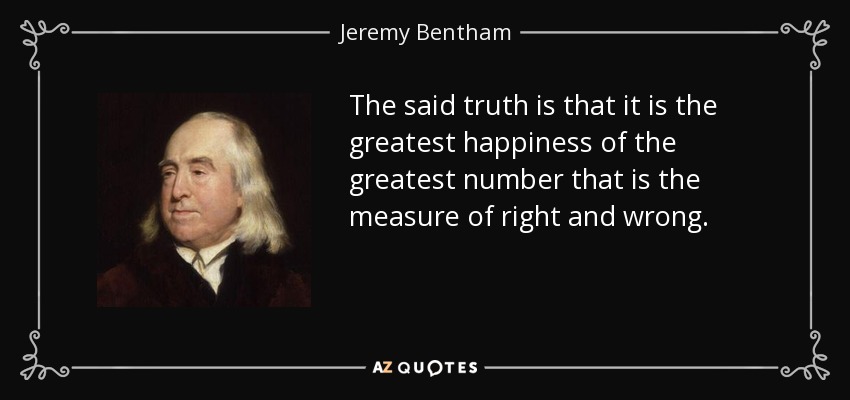
Jeremy Bentham was an advocate for utilitarianism.
Pain and pleasure were presented as the primary principles for the regulation
of utility. It was an alignment of natural with legislated law in terms of the
principles.
He had agreement with Locke and Hume. This had
good and bad consequences. He stated opposition against legislation against
slavery as an institution, but he did so with respect for decrease in cruelty
in punishment.
Legislated law had a heavy reliance on reports to
the public about torture and the death penalty as punitive measures for
infraction in the law. The English bill of rights had stated opposition to
cruelty in punishment, but Locke had made his statement for the right to
destroy those who intended to destroy him. His argument was also presented in
the context of opposition to the divine right of kings as an expression of
absolute power.
The divine right was intended to defend the
existence of monarchy in the multi-lingual Roman Empire. It was paired with the
‘sword of Damocles’ as a template for public communications.
The ‘sword’
essentially allowed for fictional descriptions of events with the intent of
deterring insurrection, subversion, terrorism or assassination. The trouble
with the ‘sword’ as a basis for deterrence was the confusion that was caused
with the public record.
When the sword was attached to precipitation for
profit from war by contract with the government and forced emigration, the
result was a cause of international mayhem.
Bentham repeats the word “sanctions” as a
political tool repeatedly.
This strikes contemporary relevance as a kind of
excess. When constitutional governments that differ from that of the US with
respect for term limits are defined as authoritarian regimes, the liberal
element for spending tax dollars has used the sword with fake news or extreme
prejudice for invasion, occupation, air strikes or economic sanction to express opposition.
The context for the repetition however was to
decrease dependency upon telling the public that opposition to precipitation or
the sword in government policy would result in being defined as an ‘enemy to
the state.’ Enemies were deposed, deported or actually executed.
Sanction by fine or imprisonment represented a lesser form of punishment. It was actually a step in the direction of decreasing cruelty in punishment. The value of the step was obscured by Bentham's support for revolution.
Bentham expressed distaste for slavery, but he didn't argue to have it outlawed. He proposed the confidence that the greatest happiness principle would build consensus against it to eliminate it by statistical inference. If the institution were seen as the establishment of misery, it would not be recognized as having a social value for happiness.
Slavery was not an effective deterrent to
rebellion.
The threat of abuse to the enslaved was not an effective tool for voluntary persuasion. Thus, it was not good for voluntary participation in government. This made it bad for the state.
William Wilberforce had lobbied parliament for 18 years to have the trade, then the institution abolished. He finally saw his proposal enacted in 1833, the year of his death. The organization established by him would direct parliament to abolish slavery for the British empire. They proceeded to negotiate treaties with foreign powers to have the trade, then the institute outlawed. It was an impressive accomplishment as a political action that started with the conviction of one man.
Locke, Hume and Bentham were models for modern
liberalism in terms of their policy. The goal of reducing cruelty in punishment
or deceptive news reports was relatively reasonable in terms of increasing
education for the public for building consensus in agreement in
self-government.
The re-institution of slavery however did not
present a reasonable model for democracy in political reason. It made the
advocacy for private property look like a promotion of slavery through tyranny in the republican form for government.
Locke and Bentham increased their wealth and
power by not arguing for legislation against slavery in the British
colonies. Hume opened the door for prejudice with his declaration of support
for passion.
Jeremy Bentham
(1748-1832)
Jeremy Bentham was born in Houndsditch, London.
His parents supported the Tory party. Samuel Bentham was his one surviving
sibling.
He attended Westminster School. He was sent by
his father to Queen's College, Oxford at age 12 in 1760. He completed his
bachelor's degree in 1763. He was awarded his master's degree in 1766.
He was trained as a lawyer. He was called to the
bar in 1769, but declined the association. He had become frustrated with the
complexity of the English legal code. He called it the "Demon of
Chicane."
When the American colonial government published
the Declaration of Independence in July 1776, the British parliament did not
issue an official response. They secretly commissioned London pamphleteer John
Lind to publish a rebuttal.
His 130 page tract was distributed in the
colonies. It contained an essay entitled "Short Review of the
Declaration" by Bentham, a friend of Lind. The essay mocked American
political philosophy and attacked the ideas expressed in the document.
He proposed the Panopticon as the basis for the
design of building prisons. He spent 16 years developing the design in the hope
that he would be appointed as contractor-governor for a national penitentiary.
The concept had an influence on later generations of thinkers. The 20th century
French philosopher, Michel Foucault, argued that the Panopticon was
paradigmatic for several 19th century "disciplinary" institutions.
While detention in prison is oppressive when
sentencing is severe, it is not as cruel as the use of the death penalty for
crimes lesser in severity than murder. Bentham argued that his plan for
Panopticon was thwarted by the King and the aristocratic elite. He developed a
position against the "sinister interest" of those who opposed his
broader arguments for reform.
He was
more successful in his cooperation with Patrick Colquhoun in tackling the
corruption in the Pool of London. The Pool was the stretch of the River Thames
on the south side of London. It was vitally important to the city for
centuries.
Bede called it the reason for the existence of
the port in the 7th century. The quays for the area had extended into the
wharves along both banks by the time that it reached the peak of importance in
the 18th century. Hundreds of ships moored in the rivers or along side quays.
Smuggling,
theft and vandalism of cargoes were rife on both the busy open wharves and in
the crowded warehouses. Bentham and Colquhoun sponsored the Thames Police Bill
of 1798. The bill was passed in 1800. It created the Thames River Police. It
was the first preventive police force in the country. It was a precedent for
Robert Peel's reforms 30 years later.
Bentham
corresponded with a number of influential people. He shared correspondence with
the aging Adam Smith in the 1780's. He was unsuccessful in the attempt to
convince Smith that interest rates should be allowed to float freely.
His
correspondence with Mirabeau and other leaders of the French Revolution
resulted in his declaration as an honorary citizen of France. This was the case
even though he was an outspoken critic of the revolutionary discourse on
natural rights and of the violence that arose after the Jacobins took power (1792).
Bentham
held a personal friendship with the precursor to Latin American independence
Francisco de Miranda between 1808 and 1810. He paid visits to Miranda's
house on Grafton Street.
Miranda
was a Venezuelan who lived in London from 1803 until 1810. His family had been
banished during the Spanish Inquisition at the end of the 15th century. He had
taken part in the Spanish involvement in the American Revolution (1776-81).
Miranda
was actively involved with the French revolution (1791-98). He led an expedition
to liberate Venezuela (1806-1808). He had been a subject of the Inquisition
throughout. He was imprisoned after Bolivar handed him over to the Spanish
Royal Army in 1812. He died in prison before any trial.
Bentham
co-founded The Westminster Review with James Mill as a journal for
"Philosophical Radicals" in 1823. John Bowring was appointed the
political editor and eventually the literary executor. Edwin Chadwick wrote about hygiene,
sanitation and police work. He was a major contributor to the Poor Law
Amendment Act.
The
Poor Law Amendment Act was passed by the Whig government of Earl Grey in 1834.
It replaced earlier legislation based on the Poor Law of 1601. It attempted to
fundamentally change the poverty relief system in England and Wales. Similar
changes were made to the poor law for Scotland in 1845. The system essentially
required that the poor vote for Whigs and support Whig initiatives in order to
get benefits.
Chadwick
was also employed as a secretary. He was left a substantial legacy.
Bentham
died on 6 June 1832 at the age of 84 in his residence at Queen Square Place in
Westminster, London, England.
He had continued to write up to a month before
his death. He had made careful preparations for the dissection of his body and
its preservation as an auto-icon after his death. A paper dated 30 May 1832
instructing Thomas Southwood Smith to create the auto-icon was attached to his
last will.
Jeremy Bentham
杰里米边沁
傑里米邊沁
杰 Jie heroic 傑 ketsu
greatness Ji~e じぇ ジェ je 제 my
里 li
internal 里 ri
village re れ レ le 레 re
米 mi
meter 米 mai
meter mi- み- ミ- mi 미 beauty
边 Bian
edge 邊 hen
edge Ben べん ベン Ben 벤 Ben
沁 qin
percolate 沁 shin
penetrate samu さむ haem 햄 ham
------------------------------
The legal code is the measure for knowledge of
law.
Let your vision penetrate beyond the edge of greatness to avoid tragic flaw.
======================