Showing posts with label worth. Show all posts

Sunday, December 8, 2019

Produce

12.15.19


Vanessa Hudgens

Produce
Surplus
Value
产生剩余价值
Chǎnshēng shèngyú jiàzhí
余剰価値を生み出す
Yojō kachi o umidasu
ps41
Facite ergo superfluum pretii

Produce surplus worth
but consume product for limited girth.

What is this supposed to do?
It will grant a happy peace to you.

The desire to consume want as need
induces the generation of greed.

The consumption of need as the want
inhibits the impulse to flaunt your vaunt.

It is right to produce to antecede.
It makes it possible to proceed 
to believe that we can feed need 
when the time of trouble has recurred indeed.

Leadership in providence has kept us alive.
It has preserved our ability to survive.

It has produced happiness in the land
that has allowed us to stand
against enemies, foreign or close at hand.

Hope sustains the ill on their bed
for recovery from illness' stead.  

I said, "Lord, be merciful and heal me.
I have sinned against you in thought, word and deed."

My enemies hold wicked things to cherish.
They say, "When will he die and his name perish?"

They speak empty words
for proposals that are absurd.

Rumor is used for allegation
Their heart is stirred against successful station
to have their dictate control the nation.

My enemies stage events against me
to attack my social image with immense intensity.

"Something deadly," they say, "has taken hold of him.
He has fallen ill and will never get up again."

Even one whom I had trusted
turned his heel as though I had been busted.

I had broken bread with him 
and he had the nerve to turn grim.

Be merciful and let me heal.
Their contempt is no deal.

By this I will know that you are pleased.
I did not succumb to this disease.

You hold me fast in integrity.
You help me see pedigree in identity.

The potential of the promise
calls for respect for the value of profit.

The wilderness will be glad.
The dry land will no longer be sad.

The desert shall rejoice and blossom. 
The crocus will bloom as a symbol of promise.

Autumn Crocus

John the Baptist was not dressed in royal robes in the wilderness.
He was a prophet of cleanliness against pathogenic microbes for the villainous.

No one was greater among those born of women
yet the fire of heaven cleanses the sin that was taken as given.

The trees will produce wood and paper.
The majesty of mountain and plain will be savored. 
The glory of production from substance will be seen.
The greatness of stateliness will be gleaned.

The farmer waits for rain to water the precious crop.
You also must be patient for the return from the top
before the final stop.


The mulberry tree grew beneath the tower.
It cast a shadow that didn't touch the tower at any hour.
It shaded the grass so practical benefit wouldn't sour.

Thought or feeling doesn't cause an external event by will alone.
The mountain that is moved is the image of expectation grown.

It has to be considered to be known.
It has to be known to be owned. 
It has to be owned to be honed or blown.
It has to be honed to be shown.

Remembrance is a mental event that tenders thought about change.
Pragmatic evolution becomes a state for which there exists a range.

The elegant grace for the resultant condition 
self-governs for reasonable ambition.

The Lord God of Israel is good.
The goodness of duty is understood.

-----------------------

41 Beatus qui intelligit
Blessed who knows

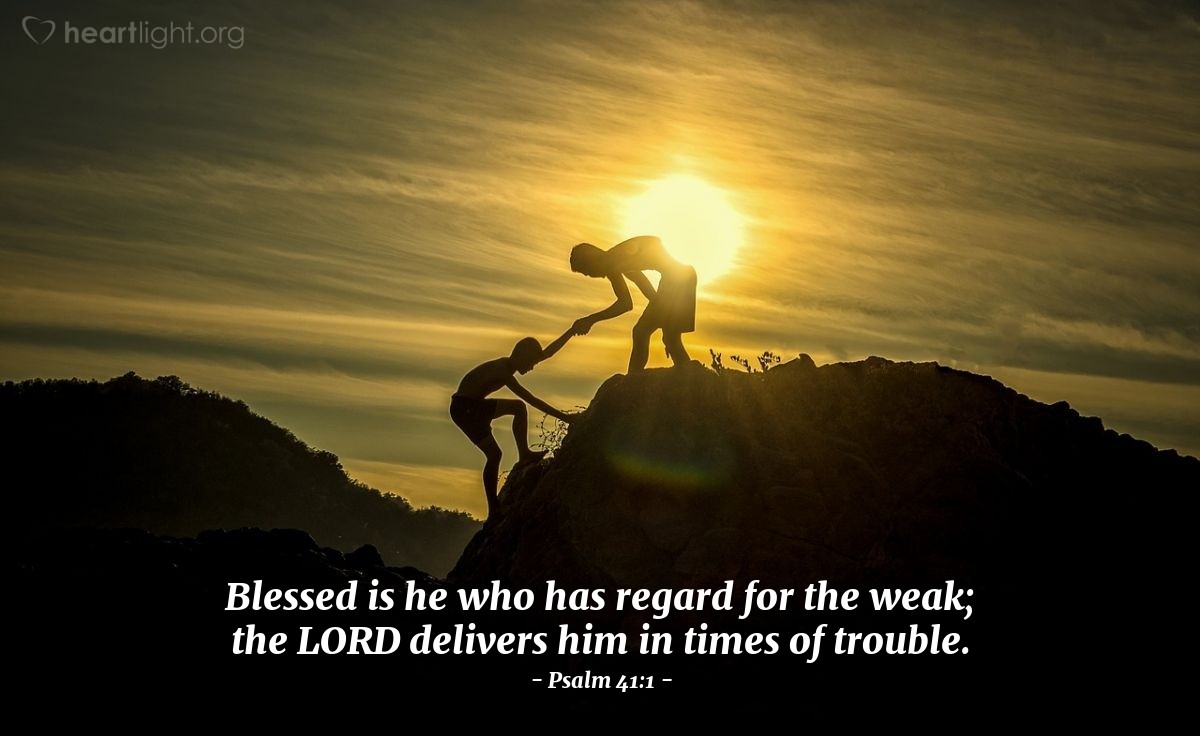
1 Happy are they who consider the poor and needy!
the Lord will deliver them in the time of trouble.
2 The Lord preserves them and keeps them alive,
so that they may be happy in the land;
he does not hand them over to the will of their enemies.
3 The Lord sustains them on their sickbed
and ministers to them in their illness.
4 I said, "Lord, be merciful to me;
heal me, for I have sinned against you."
5 My enemies are saying wicked things about me:
"When will he die, and his name perish?"
6 Even if they come to see me, they speak empty words;
their heart collects false rumors;
they go outside and spread them.
7 All my enemies whisper together about me
and devise evil against me.
8 "A deadly thing," they say, "has fastened on him;
he has taken to his bed and will never get up again."
9 Even my best friend, whom I trusted,
who broke bread with me,
has lifted up his heel and turned against me.
10 But you, O Lord, be merciful to me and raise me up,
and I shall repay them.
11 By this I know you are pleased with me,
that my enemy does not triumph over me.
12 In my integrity you hold me fast,
and shall set me before your face for ever.
13 Blessed be the Lord God of Israel,
from age to age. Amen. Amen.

-------------------------
==================
------------------------

Eng. What is this supposed to do?

Chn.  这应该怎么办?           
            Zhè yīnggāi zěnme bàn?

Jpn.    これは何をすることになっていますか?                                         
            Korehanani o suru koto ni natte imasu ka?

Krn.   이것은 무엇을해야합니까?                                                               
            igeos-eun mueos-eulhaeyahabnikka?                             

Ltn.    Hoc est quod volo facere?                   
Itn.     Cosa dovrebbe fare questo?                                                     

Grk.    Τι πρέπει να κάνει αυτό;
             Ti prépei na kánei aftó?                                                     

Spn.    ¿Qué se supone que debe hacer esto?                                     
Frn.      Qu'est-ce que c'est censé faire?                             
Gmn.   Was soll das tun? 
Hng.     Mit kell tennie?       
Trk.       Bu ne yapmalı?               

Rsn.      Что это должно делать?
               Chto eto dolzhno delat'?

------------------------

Reward

Psalm 41

The psalm is addressed to the director of music for the temple as one that is 'of David.' It is possible that there was a standard musical form for the type of song.
It is an individual lament with a petition to be healed from illness. Individual laments are the most common type.

The last verse is not part of the individual expression itself. It represents a liturgical conclusion of the first segment of the Book of Psalms.

The parts are not equally divided of the 150 psalms in the book.

------------------------

Faith


First Isaiah contains the prophecies of the 8th-century prophet of Judah. These words were written either by himself or his contemporary followers in Jerusalem (from c. 740 to 700 BCE). There were some later additions such as chapters 24–27 and 33–39.

Second Isaiah (ch. 40–55) is the work of an anonymous 6th-century author who wrote during the Exile. Third Isaiah (ch. 56–66) was composed after the return from Exile.

Chapters 1-12 in Proto-Isaiah expressed oracles against Judah. These were from the prophet's early years. The theme of judgment is followed by the promise of restoration for the righteous.

The divine plan is to be realized on the "Day of the LORD". Jerusalem will be a model for the worldwide rule. The nations of the world will look to Zion (Jerusalem) for instruction. Israel is invited to join the plan.

Chapters 5-12 explain the significance of the Assyrian judgment against Israel. Chapters 13-23 presented oracles against foreign nations. The preparation of the nations for Yahweh's world rule is announced. These were from the middle years of the prophet.

The vision of the Apocalypse in chapters 24-27 was added at a later date.

Chapters 28-33 announce that a royal saviour (a messiah) will emerge in the aftermath of Jerusalem's punishment and the destruction of her oppressor. These oracles were from Isaiah's later ministry.
Chapters 34-35 tell how the redeemed exiles will be returned to Jerusalem.

Crocus

Isaiah 35:1-2

The wilderness and the dry land will be glad.
The desert shall rejoice and blossom.
It will blossom abundantly like the crocus
to rejoice in song.

The glory of Lebanon shall be given to it,
the majesty of Carmel and Sharon.
They will see the glory of the LORD,
the majesty of our God.

-------------------------

The wilderness will be glad.
The dry land will no longer be sad.

The desert shall rejoice and blossom.
The crocus will bloom as a symbol of promise.

The trees will produce wood and paper.
The majesty of mountain and plain will be savored.

The glory of production from substance will be seen.
The greatness of stateliness will be gleaned.

==================

Pray. Sing. Organize Order.


The epistle to James provides the counter-argument to salvation by grace. It doesn't argue that salvation doesn't come by the grace of God. The proposal is that good works are an expression of the faith by which salvation is rendered.

The person to whom this letter is ascribed is not held to be one of the two members of the Twelve who bore the name James (see Mt 10:2–3; Mk 3:17–18; Lk 6:14–15). He didn't identify himself as an apostle. He described himself as a servant of God and the Lord Jesus Christ. (James 1:1).

James, the brother of John, was killed by Herod Agrippa I (Acts 12:1–2). James, the son of Alphaeus, was not identified as a leader by scripture or tradition.

Another James is identified as a half-brother to Jesus (Matt.13:55). Paul went to visit this James in Jerusalem (Acts 21:18). Paul called this James, the brother of the Lord (Gal.1:19). Paul said that this person had received a visit from Jesus before the other apostles after the crucifixion (1 Cor.15:7 ). This was presented as evidence of the resurrection.

Paul wrote that it was James, Peter and John who recognized the grace that had been given to him (Gal.2:9).

This James was not a follower before Jesus died according to John 7:2-5. The gospel states that not even his brothers believed in him during his life.

He was executed in 62 CE according to Josephus. The apostle James was beheaded by order of King Herod Agrippa (Acts 12:1-2) is dated at 44 CE.

The letter was written prior to the meeting of the Jerusalem Council (Acts 15). James, along with Peter and Paul, affirmed the decision to take the gospel message to the Gentiles at that council. This council met in 49. This places the date for writing the letter between 45–48.

Such a significant event as the Jerusalem Council would have warranted comment from James, as he was writing to a Jewish Christian audience.

The letter is drawn from the Hebrew Bible and the sayings of Jesus. The letter is filled with offhand references, parallels and echoes of the sayings of Jesus. There are perhaps as many as 34. This suggests a composition before the sayings of Jesus were fixed and before authors used formal citations.

The letter is addressed to “the twelve tribes in the dispersion.” The term “twelve tribes” designates the people of Israel in Judaic scripture. The “dispersion” or “diaspora” refers to the non-Palestinian Jews who had settled throughout the Greco-Roman world (Jhn. 7:35).

The church is the new Israel in Christian thought. The address probably designates the Jewish Christian churches located in Palestine, Syria and elsewhere.

It is possible that the letter is meant more generally for all Christian communities. The “dispersion” has the symbolic meaning of exile from our true home as it has in the address of 1 Peter (1 Pt 1:1).

The Epistle of James is noteworthy because it makes no explicit reference to the death, resurrection or divine sonship of Jesus.  The Protestant reformer Martin Luther denied it was the work of an apostle and termed it an "epistle of straw".

James is a letter only in the most conventional sense. It has none of the characteristic features of a real letter except the address. It belongs rather to the genre of parenesis or exhortation. It is concerned almost exclusively with ethical conduct. It therefore falls within the tradition of Jewish wisdom literature like Proverbs or Sirach.

It consists of sequences of didactic proverbs to many passages in Sirach and to sequences of sayings in the synoptic gospels. Numerous passages in the letter treat of subjects that also appear in the synoptic sayings of Jesus, especially in Matthew’s Sermon on the Mount. James railed against the hypocritical believer who says one thing but does another.

James encouraged his readers to rejoice in trials, speak with restraint, keep the royal law of love and prove their faith by good works. He exclaimed that God exalts the humble to warn against unchecked desire and judgmentalism.

There is an ascetic tone to the epistle that warns against favor for the rich in order to express compassion for the poor.

The correspondence is too general to establish literary dependence. James represents a type of early Christianity that emphasized sound teaching and responsible moral behavior. Ethical norms are derived from a concept of salvation that involves conversion, baptism, forgiveness of sin and expectation of judgment (Jas 1:17; 4:12).

The Jewish work was written in an excellent Greek style which ranks among the best in the New Testament. It appears to be the work of a trained Hellenistic writer. It was not written by a Jerusalem Jew. It was either recorded by a secretary or re-written in Greek at a later time.

James placed a spotlight on the necessity for believers to act in accordance with our faith. Believers are to pray, sing, speak with reserve, give alms and behave in accord with the moral code.

James 5:7-8

Be patient until the coming of the Lord, beloved. The farmer waits for the precious crop from the earth with patience until it receives the early and the late rains. You also must be patient. Strengthen your hearts for the coming of the Lord is near.

-------------------------

The farmer waits for rain to water the precious crop.
You also must be patient for the return from the top
before the final stop.

==================

Love

The gospel of Mark begins with the baptism and temptation of Jesus. Matthew introduces a family tree that traces the origins of Jesus back to Abraham to show him as a fulfillment of Messianic prophecies. The genealogy in Luke draws the line back to Adam.

The title Son of David identifies Jesus as the healing and miracle-working Messiah of Israel. He was sent to work miracles for faith in salvation by the love of God. As Son of Man he will return to judge the world.

There are about 15 instances in which Matthew interprets some event in the life of Jesus as a fulfillment of a prophecy. Christianity was not a definite break with the Jewish religion.

It was a development that allowed for the extension of the invitation to Gentiles to join. Christianity is a continuation and fulfillment of that which had been set forth in the scriptures as the history of salvation.

The gospel reflects the struggle with the conflicts between the evangelist community and other Jews. There is sharp criticism for the scribes, Pharisees and Sadducees.

Chapters 1-4 in Matthew mainly deal with the miracle birth of Jesus and the events surrounding His early life. This primarily involves the commonly told Christmas story but also includes the genealogy.

The infancy narrative tells of the massacre of the innocents, the flight into Egypt and the journey to Nazareth. This material is unique to Matthew. It is one of the elements that demonstrates that the gospel was written for  a Jewish community.

The author was a male Jew that stood on the margin between traditional and non-traditional Jewish values. He was familiar with the technical legal aspects of scripture that were being debated in his time. The gospel was documented in a polished Semitic "synagogue Greek" that established the work as Hellenistic.

There are 5 sections after the infancy story. Each begins with a narrative that is followed by a discourse. Each section ends with the words "When Jesus had finished saying these things..."

The first narrative section begins when a man in a loincloth who lives by eating wild honey and locusts begins to prophesy of one who will come to baptize with the Holy Spirit and fire (3:11).

This prophet is John. He is likely a member of the ascetic Jewish Essene community. He eventually meets the one whom he believes to be the fulfillment of his prophesy.

Jesus receives the blessing of God with his baptism. A voice from heaven is heard to say, “This is my Son, the Beloved” (3:17).

He is led into the wilderness for forty days without food or water to be tested by Satan. Jesus emerges unscathed and triumphant. He begins to preach his message: “Repent! For the kingdom of heaven has come near” (4:17). His ministry begins.

His early ministry by word and deed in Galilee meets with success. The success leads to the Sermon on the Mount, the first discourse.

While the author of the Gospel of Mark emphasized the wonderful deeds that Jesus performed, Matthew places the major emphasis on the marvelous things that Jesus taught.

Some of the teachings were spoken directly to the inner group of disciples, but at different times and places Jesus addressed the 'multitude.'

Matt. 11:2-11

Jesus began to speak to the crowds about John after he sent the disciples from prison to speak to him: 'What did you go out in the wildersness to see? A reed shaken by the wind? What was it then? Someone dressed in soft robes? Look, those who wear robes are in royal palaces.

'Did you go to see a prophet? Yes, I tell you this is the one about whom it is written,

"See, I am sending my messenger ahead of you
to prepare your way before you."

'Truly I tell you no one has risen greater than John the Baptist among those born of women, yet the least in the kingdom of heaven is greater than he.'

-------------------------

John the Baptist was not dressed in royal robes in the wilderness.
He was a prophet of cleanliness against pathogenic microbes for the villainous.

No one was greater among those born of women
yet the fire of heaven cleanses the sin that was taken as given.

==================

Remembrance
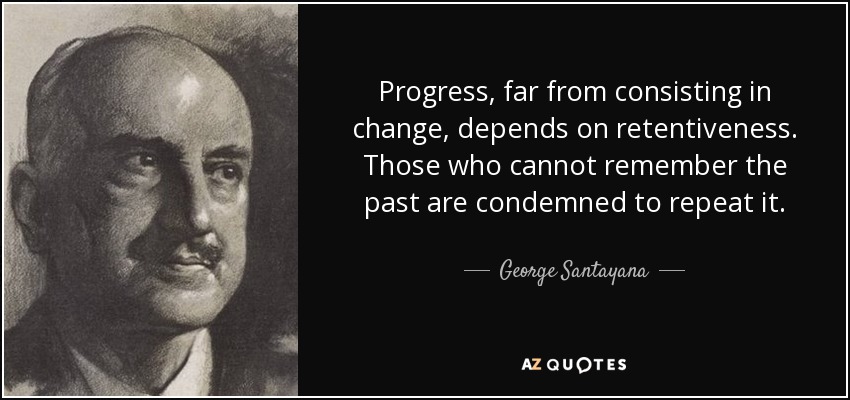
George Santayana
b. 12.16.1863 Madrid, Spain
d. 9.26.1952  Rome, Italy

George Santayana was a philosopher, essayist, poet and novelist. He was born in Spain, but moved to the USA when he was 8 years old. He was educated in the country and wrote in English. He is generally considered an American man of letters.

His heritage is rooted in the Spanish diplomatic society with its stress on high education and familiarity with the world community. His father, Agustín Santayana, was born in 1812. He had studied law and practiced for a short time before entering the colonial service for a posting to the Philippines.

He served an apprenticeship to a professional painter of the school of Goya while studying law. A number of his paintings remain in the private possession of the family.

His wife, Josefina, was born in Scotland. She was the daughter of a Spanish diplomat.  Josefina met Agustín while on vacation in Spain. They had met previously in the Philippines where Augustin had become the governor of Batang in 1845.

They were married in 1861. She moved to Boston to fulfill a promise she had made to her deceased husband, George Sturgis, to raise their children there. Augustin moved there later  for the education of George. Augustin didn't stay long due to the cold Puritanical climate. Jorge stayed and changed his name to George.

Santayana would become a principal figure in Classical American Philosophy. He went to Boston Latin school. Then he went to Harvard at the undergraduate and a graduate levels.

He was a student of William James and Josiah Royce. He added naturalism to their pragmatism. His emphasis on creative imagination was a harbinger of important intellectual turns on both sides of the Atlantic.

He was a naturalist before naturalism grew popular. He appreciated multiple perfections before multiculturalism became an issue. He thought of philosophy as literature before it became a theme in American and European scholarly circles.

He managed to naturalize Platonism, update Aristotle, fight off idealisms and provide a striking and sensitive account of the spiritual life without being a religious believer.

Santayana was both a literary and a philosophical figure. John Dewey praised his Life of Reason in 1907 as a contribution to moral philosophy that rivaled that of Emerson.

His one novel, The Last Puritan, was a  bildungsroman. The story was centered on the personal growth of its protagonist, Oliver Alden. Alden confronted the inevitable end of his Puritan belief.
Santayana was committed to metaphysical naturalism insofar as it tempered evolutionary theory with classical pragmatism.

He believed that human cognition, cultural practice and social institution have evolved so as to harmonize with the conditions present in their environment. Their value may then be adjudged by the extent to which they facilitate human happiness.

The position for evolutionary pragmatism is too optimistic in relation to liberal power, but his advocacy for classical reconstruction included the consideration of education for meritocracy. The openness to rebellion, revolution, world war or terrorism characterized the flaw for this kind of power.

He treasured the Spanish Catholic values, practices and worldview in which he was raised even though he was a self-declared atheist. He was a broad-ranging cultural critic. His critique spanned many disciplines.

He was profoundly influenced by Spinoza's life and thought. He was a devoted Spinozist in many respects.

Madrid
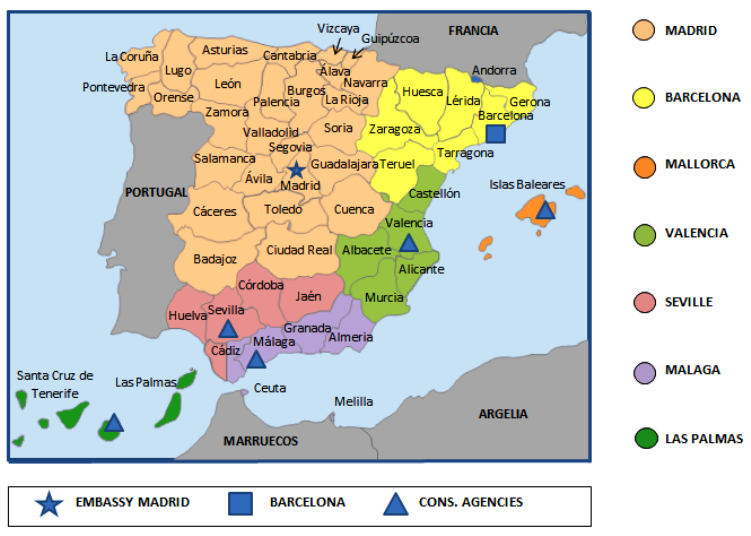
Madrid is the center of roads in Spain. It lies on the River Manzanares in the centre of both the country and the Community of Madrid.

It is the capital and most populous city of Spain. It is the seat of government and the residence for the monarchy. The crown is constitutionally instituted as the highest office of the country. Felipe VI from the house of Bourbon is the current monarch.

Madrid has preserved the look and feel of many of its historic neighborhoods and streets. Its landmarks include the Plaza Mayor, the Royal Palace, the Royal Theatre, the Buen Retiro Park, the 19th-century National Library, national museums and the Golden Triangle of Art.

The Peninsular War (1807-1814) against Napoleon during the reign of Ferdinand VII gave birth to a new country with a liberal and bourgeois character. Madrid experienced like no other city the changes caused by this openness.

The Spanish Revolution of 1854 was also known by the name Vicalvarada. It started with a confrontation between rebel troops under General Leopoldo O'Donnell, 1st Duke of Tetuan and government troops near the village of Vicálvaro.

This incident was followed by a military coup and a popular rebellion which occurred between June 28 and July 28, 1854 during the reign of Isabella II.

The Spanish Revolution ended the moderate decade (Década moderada) (1844-1854) and started the progressive biennium (Bienio progresista) (1854-1856).

George Santayana

Jorge Santayana was born on December 16, 1863 in Madrid and spent his early childhood in Ávila, Spain.

His mother, Josefina Borrás, had moved with her three surviving children to live in Madrid in 1861. She met Agustín Ruiz de Santayana, an old friend from her years in the Philippines. They married in 1862.

Josefina returned to Boston with her three Sturgis children in 1869. She had promised her first husband to raise their children in the United States.  She left the six-year-old Jorge with his father in Spain. Jorge and his father followed her to Boston in 1872.

Augustin soon returned alone to Ávila. He remained there the rest of his life. Jorge did not see him again until he entered Harvard College and began to take his summer vacations in Spain.

Jorge changed his name to George in Boston. He attended Boston Latin School and Harvard University. He studied under the philosophers William James and Josiah Royce. He was involved in eleven clubs as an alternative to athletics.

He was founder and president of the Philosophical Club, a member of the literary society known as the O.K., an editor and cartoonist for The Harvard Lampoon and co-founder of the literary journal The Harvard Monthly.

He studied for two years in Berlin after graduating Phi Betta Kappa in 1886. He returned to Harvard to write his dissertation on Hermann Lotze.

Lotze was a German philosopher and logician. He had a medical degree and was well versed in biology. He argued that if the physical world is governed by mechanical laws, developments in the universe could be explained as the function of a world mind. His medical studies pioneered work in scientific psychology.

Santayana taught philosophy while he worked on his dissertation. He became part of the Golden Age of the Harvard philosophy department. A number of his students became famous. T. S. Eliot, Robert Frost, Gertrude Stein, Horace Kallen, Walter Lippmann and W. E. B. Du Bois were among them. He became friends with Wallace Stevens.

He studied at King's College, Cambridge from 1896 to 1897. He received his Ph.D. from Harvard in 1889 and became a faculty member at Harvard University (1889–1912).

He would remain there until his departure at the zenith of academic success.

Santayana cherished academic life for its freedom to pursue intellectual interests and curiosity, but he found that certain aspects infringed on that freedom. Faculty meetings and university committees seemed primarily to be partisan heat over false issues. He rarely attended them.

The general corporate and businesslike adaptation of universities was increasingly less conducive to intellectual development and growth. He expressed concern about the evolving Harvard goal of producing muscular intellectuals to lead America as statesmen in business and government. Were not delight and celebration also a central aspect of education?

He experienced a metanoia or change of heart in 1893. He gradually altered his style of life from that of an active student turned professor to one focused on the imaginative celebration of life.

He began planning for his early retirement. He found university life increasingly less conducive to intellectual pursuits and delight in life.

He wrote the Life of Reason during this emotional crisis. It was published in 1906.

Life of Reason (5 Vol.'s)
Text

He integrated the impractical notion of perfection into an unheard of application to biology for his pragmatic theory of evolution. He argued that the ideal has a natural basis and everything natural has an ideal development.

Happiness is that which sanctions life. Existence is a mad and lamentable experiment without it. Progress does not depend upon the relentless drive to change. It requires retentiveness. When the drive to change is absolute, there are no grounds for improvement.

Experience is not retained. Consciousness remains in cognitive infancy as among savage primitives. Those who don't remember the past are condemned to repeat it.

Fanaticism is the redoubling of effort after the aim for it has been forgotten. It's like Wile E. Coyote in his efforts to stop the Road Runner.

His thought on religion did not assume a position of perpetual aggression towards theism. He repeated Bacon's maxim. A little philosophy provides the inclination to atheism. Depth brings consideration to religion. The God to whom depth in philosophy brings thought is different from the one from whom a little philosophy has estranged the common antagonist.

Santayana was an early adherent of epiphenomenalism. This is a position on the mind–body problem which holds that physical and biochemical events within the human body (sense organs, neural impulses and muscle contractions) are causal with respect to mental events (thought, consciousness and cognition).

Subjective mental events are completely dependent for their existence on corresponding physical and biochemical events within the body. There is no causal efficacy on physical events without action.

The appearance that a subjective mental state (such as intention) influences physical events is an illusion. Fear seems to make the heart beat faster, but the biochemical secretions of the brain and nervous system (such as adrenaline), not the experience of fear, is what raises the heartbeat. The position is a kind of mental tightrope for watching internal causation in somatic reaction.

Mental events are a kind of overflow that cannot cause anything physical. It's the counter to the claim to the existence of paranormal phenomena.

It provided the basis for the definition presented by Ducasse. A paranormal event does not have a physical cause. It's the basis for the description of belief in 'magical' things like telekenesis, clairvoyance or teleportation.

Satayana admired the classical materialism of Democritus and Lucretius. He was most favorable towards Lucretius of the three authors on whom he wrote in Three Philosophical Poets. He held Spinoza's writings in high regard. He called him his "master and model."

Santayana took advantage of a modest inheritance from the death of his mother to retire from Harvard and left for Europe indefinitely.

He divided his life into three phases in his autobiography, Persons and Places (1944).  The background (1863–1886) encompassed his childhood in Spain through his undergraduate years at Harvard.

The second period (1886–1912) was that of the Harvard graduate student and professor with a trans-Atlantic penchant for traveling to Europe. The third period (1912–1952) was as the retired professor writing and traveling in Europe who would eventually establish Rome as his home.

He lived eight years in Spain, forty years in Boston and forty years in Europe. He died in Rome at 88 years of age.

George Santayana
S. 乔治·桑塔亚娜
T. 喬治·桑塔亞娜

乔 Qiao   tall, stately            喬  kyo    high                Jo      じょ-  ジョ-       Jo   조  article   
治 zhi       to punish              治  ji       reign                ji       じ         ジ           ji    지  g     
桑 Sang   mulberry               桑  so      mulberry         San   さん    サン        San 산  mountain     
塔 ta         tower                    塔  to      pagoda             ta      た        タ            ta    타   ta           
亚 ya         second                 亞  a       rank                  ya     や        ヤ            ya   야  ha           
娜 na         elegant                 娜  da    graceful             na     な         ナ           na   나  I                               

------------------------

The mulberry tree grew beneath the tower.
It cast a shadow that didn't touch the tower at any hour.
It shaded the grass so practical benefit wouldn't sour.

Thought or feeling doesn't cause an external event by will alone.
The mountain that is moved is the image of expectation grown as known.

Remembrance is a mental event that tenders thought about change.
Pragmatic evolution becomes a state for which there exists a range.

It has to be considered to be known.
It has to be known to be owned.
It has to be owned to be honed or blown.
It has to be honed to be shown.

The elegant grace for the resultant condition
self-governs for reasonable ambition.

==================

Pure Experience

William James
Varieties of Religious Experience
Text

The Varieties of Religious Experience was written about natural theology from a medical point of view. William James was trained as a physician. He taught anatomy at Harvard, but never practiced medicine. He developed his interest in psychology and philosophy. He has been called the Father of American psychology.

His view of religion wasn't limited to the Christian perspective, but it was informed by it. This opened the door to the integration of the Christian and classical societies. This classically Christian position has room for development with the reformed epistemology of Plantinga and Craig.

James looked at the religious experience as an encounter with pure perception. There is the theme of individual contact with the manifest reality of the personal character of the oneness of the universe in the reports of this pure experience.

Cognition was minimized in relation to consciousness. The sense of benign purpose was identified by major representatives of  this phenomenal involvement with the Designer of the design for existence.

The subtitle for the book is A Study in Human Nature. This is significant in itself insofar as that which is human can be defined by way of contrast. Berkeley's emphasis on the immaterial was promoted to consider the mental view of material reality.

That which is common to the conceptions of the human and divine natures is the capacity to create. The difference is a matter of scale. The divine nature is held to have created the universe. This is beyond the capacity of human nature.

Humans create that which we are able to produce with our knowledge of materials. The knowledge is a relatively 'immaterial' memory of tests that involve components of substance.

The religious experience has produced written testimony regarding the special nature of the communion with that which was personal about the union with that which exists outside of the ordinary perspective on perception.

While this is interesting insofar as it is unusual, there is the question of practical value. Religion was developed with functional regard for religious awe. It is a system for organization that allows for personal and social applications.

The interaction between religion in government finds expression in respect for freedom, but this freedom is contained within the parameters of legal polity.

That which is legal about polity finds agreement with the medical paradigm defined by the goal against harm. The goal is presented with respect for the practical application against damage.

James developed this medical concern in relation to the warning against action in compliance to command hallucination. If someone 'hears' a voice that tells him to kill someone else, it is categorized as a hallucination due to the contradiction with the law against murder.

The command of the hallucination holds proximity to the antiquated definition of republic. When Cicero stated that insurrection was the chief concern for the security of the republic, he stated a legal opinion. When reported that the 'rebels' were executed without a trial, he reported an illegal action as though it were validated by his authority as consul.

His position was presented after Sulla had claimed dictator as a title in his consulship. He had taken Rome by armed force with his military leadership twice to promote his campaign against the Mithridates.

The story about the sword of Damocles was known to Cicero. It was most likely a case of fake news in the formation of Roman republic.

It set a bad precedent for reports on government action. If the leadership reports action in contradiction to the legal application of habeus corpus, it is presenting the image of being above the law. This may win some notoriety with respect for the special nature of leadership in government, but it loses credibility in legal authority as a consequence.

The collateral damage is such that the leadership is then compelled to use surveillance to watch for criminal reaction to the report of criminal action.

Where is the line for punishment to be drawn? Is the presumably 'false' report to be followed by violent law enforcement against objection to report of the action as a precedent for political policy? That would almost guarantee partisan partiality in judgment.

There is this consideration as well. Suppose people chose to assemble in the streets to protest the 'action.' What is law enforcement supposed to do? Are they to meet fire with fire to punish protest with violent action that could range from assault to summary execution?

The collateral damage of anger in reaction to the report would have produced more collateral damage with cruel punishment as the means to repress the protest. If the protest was non-violent the punishment would be cruel by virtue of the excess force used to put down the protest as a 'rebellion.'

Did Cicero produce security as the result of his report or did he antagonize the opposition with his defiance of regard for legal polity? He provoked a volatile reaction to invite the treatement of protest as riot with his report of execution without a trial.

Cicero provided an historical example of how not to act as consul.

William James was aware that his treatment of the topic of variety in religious experience had to be informed by his recognition of logical investigation.

His application of logic asked the question about the propensities of the experience. This addressed the psychological aspect of the inquiry. He also asked about the philosophical significance. The questions addressed the distinction between perception and conception in empirical investigation as it could be found in documentation.

The perceptual is existential. The conception is noetic or spiritual in judgment. Existential and spiritual judgments are combined after the separate experience of them. They can be synthesized for practical value.

He wrote, "In the matter of religions it is particularly easy to distinguish the two orders of question. Every religious phenomenon has its history and its derivation from natural antecedents. What is nowadays called the higher criticism of the Bible is only a study of the Bible from this existential point of view, neglected too much by the earlier church."  (p.005)

------------------------

The experience of existence is qualified by immaterial judgment.
Aesthetics avoid the abundance of pungence in indulgence.

The judgment of material by that which immaterial in mind
is established by test that qualifies the knowledge that we find.

==================

The religious literature for monotheism was organized in the category of the 'fear of God' by writers like Sirah. What was the biographic condition for this proposition? He was acutely aware that the predominant social view was conditioned by polytheistic stories.

What did those who agreed with the proposition have in mind with the intent of agreement? Aren't there a variety of experiences that can be categorized as fear or the fear of God?

These are manifestly questions of historical fact. The answer to them can decide the further question of the use of religious literature as a guide to life with the vicarious or literary experience of revelation.

The value of the revelation is not found in a work without error. Our theory allows that the book is a document of religious experience despite the errors and contradictions expressed by the different views expressed in it.

Royce would have called in the expression of a community. It is a true record of the inner experience of individuals who were wrestling with the crisis of their condition.

Existential facts are insufficient for determining value by themselves. Higher criticism doesn't confound the existential with the spiritual. It seeks to select the best expression of the spiritual with respect for the existential.  It could be called an immaterialist view of material existence.

The study has to be opposed to the pathological aspects of religion's existential conditions particularly with regard to the consideration of visions. There is an inclination to refrain from the analysis of something that is regarded as an area for devotion.

Error in over or under generalization presents itself as a problem in any categorization. An individual doesn't want to be categorized with generalization when the generality threatens to distort unique value.

A crab would probably be filled with a sense of personal offense at being categorized as a crustacean without apology. It is not difficult to imagine the creature saying, "I am no such thing." It might well say, "I am myself and myself alone." Generalization is the consequence for the question of the nature of a thing nonetheless.

Crustaceans are aquatic arthopods. They have shells. A crab is a crustacean, because it has a shell and lives mostly in water. Likewise the command hallucination to kill someone who doesn't present the threat of deadly force in an imminent way has to be judged as pathological.

The action of the 'new man' wasn't legal counsel because he reported an illegal punishment as his official reaction to the threat of a condition that he antagonized with his report. It was an open door to the perpetuation of abuse by the use of excess force.

---------------------------

Justice is the product of the union represented by good government.


John Jay was one of the statesmen who wrote as Publius to persuade the public to accept the United States Constitution. He became an important leader of the Federalist Party after the ratification of the Constitution in 1788.

He had been born into a wealthy family of merchants and statesmen in the New York city government. The family was of French and Dutch descent. They organized opposition to British policies in the time preceding the American Revolution.

He served as the ambassador to Spain after he helped ratify the US Constitution with the Federalist Papers (1788). Spain was persuaded to provide financial aid to the fledgling United States. He presented the persuasion during his term from 1779 to 1782.

He was a negotiator of the Treaty of Paris in which Britain recognized American independence.
He was an advocate for centralized government. He served as the first Chief Justice for the US when George Washington was president. He negotiated the highly controversial Jay Treaty with Britain.

It facilitated 10 years of peaceful trade between the United States and Britain in the midst of the French Revolutionary Wars. The wars began in 1792.

The treaty was designed by Alexander Hamilton and supported by President George Washington. It was signed in 1794.

It angered France and divided Americans. It inflamed the new growth of two opposing parties in every state. The pro-Treaty Federalists were opposed by the anti-Treaty Jeffersonian Republicans.

The Jeffersonians feared that closer economic or political ties with Great Britain would strengthen Hamilton's Federalist Party, promote aristocracy and undercut republicanism.

The Federalists favored the British and the Jeffersonian republicans supported France in the First Party System. The treaty was not replaced by another after it expired.

He was an opponent to slavery. When he served as Governor of New York from 1795 to 1801 he helped enact a law that provided for the gradual emancipation of slaves. The institution of slavery was abolished in New York in Jay's lifetime.

Jay wrote 5 of the 85 Federalist papers. The second one was his. It was about how the union provided protection from the dangers of foreign power.

The Federalist Papers #2
Text

He promoted the propriety of serious consideration for the Constitution. He argued that the government is an indispensable necessity.

People must cede to it some of their natural rights in order to vest it with requisite powers. The type of government was what the people were being asked to consider.

Did they want a single federal government or did they want separate confederacies?

Prosperity was dependent upon union. The wisest citizens were directed to obtain that objective.The division of the union would reduce the security of the nation.  It would not be wise to divide without thought about whether their proposal was better.

Independent America was not composed of detached and distant territories. It was one connected, fertile, widespread country whose portion was for liberty.

Providence had blessed it with a variety of productions from soil and toil. It has been watered with innumerable streams for the delight and accommodation of its inhabitants.

Navigable water formed a kind of chain round its borders as if to bind it together. The rivers ran at convenient distances. They were used as highways for the communication of aid, transportation and the exchange of commodities.

Providence had also been pleased to give this connected country to a united people with the same language and principles of government.

Many of her ancestors were driven from their homelands to favor factional power. Joint counsel in war established law for independence.

The inheritance of the union appears to be by the design of Providence. It should not be split into alien sovereignties.  We have been one with each citizen having the same rights, privileges and protection.

The nation sought peace, formed alliances, made treaties, entertained contacts with foreign states and won war.  Federal government was formed for political existence.

Habitations were in flames, citizens were bleeding, desolation progressed with hostility in a way that left little room for the organization of a reasonable and balanced government for the freedom of the people.

Liberty was the product of the convention in Philadelphia. The convention spent months in daily consultation for the love of the country to produce a plan for the people with their council.

The apprehension of imminent danger induced the formation of the Congress of 1774. A plan was recommended for ratification by officials elected by vote.

The body recommended measures for their constituents, but the media was flushed with stories of opposition from officials who sought the dictate of personal interest. This assault on sensibility happened soon after the recommendation was made to the public.

Ambition aimed at objects which did not correspond with the public good. Their pride demanded the rejection of advice for patriotic unity.

The majority of the people reasoned judiciously despite the bad press. They considered that the Congress was composed of officials from different parts of the country who were experienced in the formation of policy for the interests of the nation.

Members from that same Congress who have grown old in acquiring political information had carried their accumulated knowledge and experience through subsequent conventions in thinking that the prosperity of America is dependent upon union.

The convention was formed by election with the vote of the people. It has in turn voted to recommend the people adopt the proposal  for union with the Constitution.

Are more confederacies better than one? Those who are against the recommendation have opposed the continuance of security for the union.

Jay saw national government as necessary for negotiation with foreign states for the security and prosperity of the people in the country. He believed that division into confederacies would result in the loss of greatness.     

The union of the nation
is for the prosperity of the united station
in negotiation with foreign states
and protection from alien hates.


The problem with student loan debt was created by national intervention.

Student loans are offered as financial aid. National aid should be facilitated through state government.

National intervention for government control of school district policy has promoted local prejudice to hire or fire instructors and administrators with grant money for schools with lower incomes.

The populations for all the schools in our district were changed by the order for forced busing. The number of poor students was increased by the action.  .

Employees not qualified by instruction are favored over those with instruction and experience in education.

How many with instruction and experience in education have not been hired or have not been retained BECAUSE they got financial aid as a loan?

How many schools that have received a government grant (Title I) for the school have had to deal with a no pass policy even for students who have been doing their work?

The national government isn't supposed to make demands on local school administration, but the assumption of prejudice in the majority group has been used to force local administrators to adopt national 'guidelines.'

The no-pass policy has created major problems with student behavior, but national intervention won't allow the refusal of a bathroom pass to be limited to students who refuse to do their work.

The policy won't allow students who act like undocumented immigrants to be expelled for the disruption of class instruction.

Sunday, May 19, 2019

Like

5.26.19

Helena Bonham Carter

Like
Water
像水一样 
Xiàng shuǐ yīyàng
水のような
Mizu no yōna
ps67

Space is 
gracious.

Raise praise
like a wave.

Last quarter moon. 
What's your tune?


Tides are pulled with the lunar day.
Water gives the moon a greater say.

The tidal force is strongest when the moon comes between the sun and earth.
The tide extends to the fullness of height when the moon's movement gives birth.

The ebb and flow cycles twice
though it's not that precise
it is quite nice.

Watch the tides.
Two high and low shadow the day by size
They rise by twelfths in the experience of the eyes.
One, two, three then another three twelfths by the fourth hour are spied.
Two, then one. The first and the sixth times were despised
in the size of the rise. ;)

Storms, wind and fractional moon produce a change in range.
Gravitational force made the range look strange
in the way it changed.

Energy for life, be gracious to us.
Let your face shine in space for trust.

May your way be shown upon earth.
Your saving power gave nations birth.

The water was as clear as crystal in the river that flowed from the throne of light.
The crystal flow cleansed perception to develop perspective for the bold in sight.

The tree of life was tended by the Son to produce fruit of different kinds.
Twelve kinds were produced for distinctive runs of productive fun in luminescent climes.

The leaves of the tree are for the healing of nations.
Eternity is shaped for the creation of key innovations.

The dealer in purple cloth listened to our humble speech.
She invited us to stay at her home to show respect for those who teach.

Let the people raise praise for all it's worth.
Let earned equity say "We have tidal girth."

Raise praise
like a wave.

The earth has yielded increase.
The moon displayed fractional peace.
Love will not cease.

May divine grace bless us.
The ebb makes less wetness. ;)

The Father has sent the Spirit in the name of the Son
to teach you everything to shape your point of view as one.

Contract morality is an inference from the experience of the applicability
of law for credibility.

The inference to the best explanation includes plausibility.
The report includes factual verity for accountability.

Let the ends of the earth show reverence.
for love as the evidence for divine presence.

----------------------

Psalm 67
To the leader: with stringed instruments. A Psalm. A Song.

1 May God be gracious to us and bless us
   and make his face to shine upon us,
          Selah
2 that your way may be known upon earth,
   your saving power among all nations.
3 Let the peoples praise you, O God;
   let all the peoples praise you.
4 Let the nations be glad and sing for joy,
   for you judge the peoples with equity
   and guide the nations upon earth.
          Selah
5 Let the peoples praise you, O God;
   let all the peoples praise you.
6 The earth has yielded its increase;
   God, our God, has blessed us.
7 May God continue to bless us;
   let all the ends of the earth revere him.

-----------------------

Acts 16:14-15

A certain woman named Lydia, a worshipper of God, was listening to us; she was from the city of Thyatira and a dealer in purple cloth. The Lord opened her heart to listen eagerly to what was said by Paul. When she and her household were baptized, she urged us saying, 'If you have judged me to be faithful to the Lord, come and stay at my home.' She prevailed upon us.

Lydia- Noble one
Thyatira- daughter; one of the 7 churches in Revelations
Paul- humble

------------------------

The dealer in purple cloth listened to our humble speech.
She invited us to stay at her home to show respect for those who teach.

==================

Rev. 22:1-2

Then the angel showed me the river of the water of life, bright as crystal, flowing from the throne of God and of the Lamb through the middle of the street of the city. On either side of the river is the tree of life with its twelve kinds of fruit, producing its fruit each month; and the leaves of the tree are for the healing of the nations.

------------------------

The water was as clear as crystal in the river that flowed from the throne of light.
The crystal flow cleansed perception to develop perspective for the bold in sight.
The tree of life planted by the Father is tended by the Son to produce fruit of different kinds.
Twelve kinds were produced for distinctive runs of productive fun in luminescent climes.

The leaves of the tree are for the healing of nations.
Eternity is shaped for the creation of key innovations.

==================

John 14:26

The Advocate, the Holy Spirit, whom the Father will send in my name, will teach you everything, and remind you of all that I have said to you.

------------------------

The Father has sent the Spirit in the name of the Son
to teach you everything to shape your point of view as one.

==================

Life Without Common Law


Gilbert Harman
b. 5.26.1938 East Orange, NJ

Gilbert Harman is an American philosopher. He taught at Princeton University. He has published widely in the philosophy of language, cognitive science, philosophy of mind, ethics, moral psychology, epistemology, statistical learning theory and metaphysics.

Gilbert Helms Harman was born in East Orange, New Jersey.

East Orange

East Orange is a city in Essex County New Jersey. Essex is located in the northeastern part of the state.

The city was named after William of Orange. He was the prince for the principality located north of Avignon in south-eastern France.

William was prince of Orange from birth, Stadtholder of 5 districts in the Dutch Republic from 1672 and King of England, Ireland and Scotland from 1689 until his death in 1702. He became the King of the United Kingdom after James II was removed.

William's Catholic uncle and father-in-law, James II, became king of England, Scotland and Ireland in 1685. James's reign was unpopular with the Protestant majority. William invaded England with the support of a group of influential British political and religious leaders in what became known as the Glorious Revolution.

He landed at the southern English port of Brixham on 5 November 1688. James II was deposed. William became the third ruler with his name in England. William III and his wife became joint sovereigns. William and Mary reigned together until Mary's death on 28 December 1694.

William III ruled as sole monarch. His reign in Britain marked the beginning of the transition from the House of Stuart to the Parliament-centered rule of the House of Hanover.

East Orange is most likely Protestant, but white people only make up about 4% of the population. It is nearly 90% black or African American. Democrat Barack Obama received 98.5% of the vote in the 2012 presidential election.

Gilbert Harman

Gilbert Harman was born on May 26, 1938 in East Orange. He is the son of William Henry and Marguerite Variel (Page) Harman.

Harman has a BA from Swarthmore College and a Ph.D. from Harvard University. He was supervised by Willard Van Orman Quine. He taught at Princeton from 1963 until his retirement in 2017 as the James S. McDonnell Distinguished University Professor in Philosophy.

He has been named a Fellow of the Cognitive Science Society and a Fellow of the Association for Psychological Science. He is also a Fellow of the American Academy of Arts & Sciences.

He received the Jean Nicod Prize in Paris in 2005. He received Princeton University's Behrman award for distinguished achievement in the humanities in 2009. His acceptance speech was titled "We need a linguistics department."

Some of his well-known PhD students include Graham Oppy, Stephen Stich, Joshua Greene, Joshua Knobe, David Wong, Richard Joyce, R. Jay Wallace, James Dreier and Nicholas Sturgeon.
Harman's 1965 account of the role of "inference to the best explanation" has been very influential. Inference is distinguished from causation. Causation is physical. Inference is a mental process that applies reason.

A good explanation of an event requires three conditions. The explanation has to have causation, inference and plausibility to satisfy the quality of goodness. A good explanation is not always true.

The best explanation of observable phenomena is inferred from the existence of that which we need. Inference or reasoning should be conceived as rational to "change in view".

Conservatism is balanced against coherence. Simplicity and explanatory considerations are relevant to positive coherence. Avoiding inconsistency is relevant to negative coherence.

He has expressed doubts about appeals to a priori knowledge. He has argued that logic and decision theory are for implication and consistency.

Concepts such as time, space, matter, energy, light and the like are metaphysical insofar as the ideas were drawn from experience.

Knowledge is generally defined as measurable with the formulation of an equation of variables drawn from a priori categories, but that which is known is not drawn from a mental process that preceded experience. The notion of a priori knowledge is something that warrants skepticism.

The speed of light was defined as a constant with the Michelson/ Morley experiment. This experiment broke a ray of light with a spinning mirror in order to measure the effect of the break. The speed was calculated as the ratio of distance to time with respect for the light.

This constant was used to formulate an equation that defined energy in the theory of relativity. The observation of an event is minutely effected by acceleration as an element in the conditions in which an event is observed. This special case for observation was used for consistency in general.

Albert Einstein determined that the laws of physics are the same for all non-accelerating observers in his theory of special relativity. He showed that the speed of light within a vacuum is the same no matter the speed at which an observer travels. This established the constancy of light for sight as an element in observation.

He found that space and time were interwoven into a single continuum known as space-time as a result. An event that occurs at the same time for one observer could occur at a different time for another. He was establishing the basis for objectivity in scientific observation.

Relativity was defined with respect for the special concern for the behavior of even sub-atomic particulates and the general interest in astronomical phenomena. The scientific observer seeks to understand reality as it is, but this is done with respect for the significance of how to use the knowledge for the benefit of human kind.

This presents a frame for the consideration of the production of electrical energy. Is solar energy better because it is safer, less costly and easier to manage than the nuclear form? If so, how is the production to be managed for the benefit of people in the market?

Will the state allow free market competition? Will the national government work to prevent competition for one of the major lobbies for political office? How is a transition from nuclear energy to be managed?

The method of inference to the best explanation says that you should infer the hypothesis that best explains an event. Abductive reason uses eliminative induction or theoretical inference to arrive at that which is best.

Harman argued that intuitions about knowledge are useful in thinking about inference in Thought and Change in View. He and Brett Sherman have suggested that knowledge can rest on assumptions that are not themselves known. He and Sanjeev Kulkarni have suggested that elementary statistical learning theory offers a kind of response to the philosophical problem of induction.

Harman has also argued that perceptual experience has "intentional content." It is important not to confuse qualities of the intentional object of experience with qualities of the experience.

Perceivers are only aware of qualities that are presented to them in experience. These presented qualities are distinct from properties of experience that represent what we experience as a kind of mental paint.

He has also proposed that perceptual and other psychological states are self-reflective. The content of perceptual experience might be the result of direct perception as opposed to one that is formed by description with language. The content of an intention might be to lead me to go home by six o'clock.

Harman relied on inference to the best explanation The Nature of Morality. He argued that there are no objective moral facts. We do not need such facts to explain our judgments about morality.

Moral relativism allows the individual to participate in contract morality. Choice is a key element in relativism.

Harman has rejected attempts to base moral theory on conceptions of human flourishing and character traits. He has expressed skepticism about the need for a good person to be susceptible to moral guilt or shame. Shame can be self-defeating. Guilt can be applied objectively to avoid the repetition of risky behavior that may result in damage to self or others.

Harman proposed contract morality, contractarianism, as the unifying motive force for moral relativism.

Contractarianism

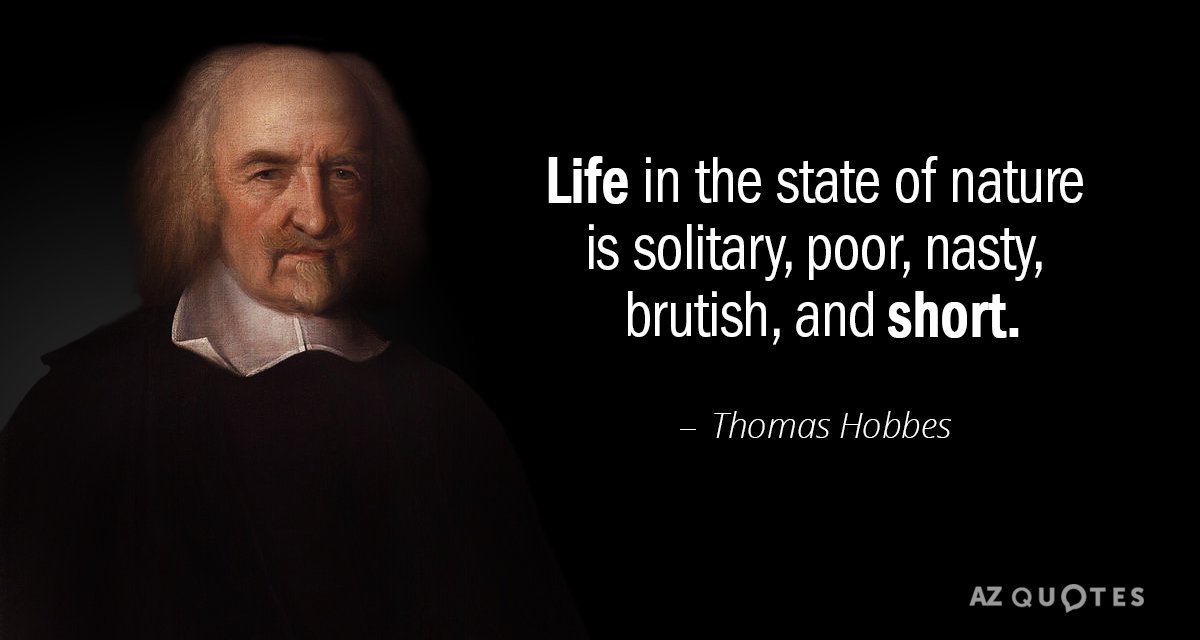
Hobbes had looked at the English Civil War in terms of the conceptual implications. Conflict is a social manifestation of disagreement regarding rights. Each was engaged in the struggle against each. Why did he define social relations in terms of conflict?

He was arguing against the state of nature as life without organized government for law. He was also attempting to draw a lesson from the civil war. Defense from attack became the elementary motivation for agreement with the the social contract for the state.

The social contract admit that the sovereign was the unity for the realm. This unity represented the manifestation of the absolute with respect for agreement with that which is right about common law.

The elementary motivation for unity implies agreement to refrain from criminal action. Criminal action was defined by the law of Moses in a manner that was not only more monotheistic, but it was less aggressive in the enforcement of punishment than the code of Hammurabi.

Punishment entertained torture and the death penalty but the punishments weren't unique to Judaism. They were standard for the time. It is plausible that they weren't enforced as aggressively in the Judaic community.

The ten commandments weren't explicitly anti-magical. The code of Hammurabi had defined necromancy and witchcraft as crimes. While magic was included in the bible as an undesirable act that could be severely punished, the references were anecdotal. The stories were included as the documentation of standards of social conventions for the Middle East. 

Hobbes didn't actually propose constitutional monarchy as explicitly as Spinoza had, but the implication was inherent to the social contract. Monarchy was organized elementally for defense from attack. Legislative authority was charged with the task of reforming the legal code with special attention to the elimination of cruelty in punishment in written law.

The global competition for colonial expansion made the reform an exercise in liberal expenditure for the establishment of legislative legacy. The more liberal members of the House of Commons acted as the aggressor in both the deportation of dissent and the taxation of citizens to the diminishment of economic power in civil rights.

The reform of legislation was the greatest need for constitutional monarchy or republic, but it was also exploited at the greatest cost to the taxpayers for the maximum benefit of aggression for state officials. Classical reconstruction had actually placed the House of Commons over that of the Lords in parliament.

It was as though the plebians were put over the patricians in the Roman Senate. The investment in the study of history as a basis for the consideration of reconstruction was inhibited by the change. The liberal use of the 'sword of Damocles' was also a deterrent to reasonable measure regarding public policy. When fake news is peddled to deceive the public on a regular basis, accountability for legislative decision making is reduced.

This degeneration in reform was assisted by Locke's claim to the supreme authority of the legislature. Locke had essentially overridden the conservatism recommended by Hobbes for the liberal benefit afforded to those who agreed with him in his liberal reform. This factionalized representation.

The English bill of rights was written with the strong indication that Puritans were the English Protestants and Presbyterians were the Scottish alliance.  It was the male members of these groups who had the civil rights.

Locke had listed the people as the greater supreme authority over the legislature, but he invited the people to overthrow the government wih the force of arms rather than to build political consensus with the use of rights. He was deceptive in his argument.

The alliance that William III had with his part of the Dutch Republic suggested a supply of arms that would work for the benefit of the parliamentarian monarchy. The House ruled in favor of Locke's gambit. The risk for his claim wasn't limited to the English speaking world.

Revolution would be used to establish republican government in France and the colonial world. Parliamentarian monarchy or republic was already designated as a part of the future for Europe, the colonies.

Contract morality addresses the voluntary cooperation of people with the common law. Socialism has been used to grant state officials an excess of favor in the competition to obtain advantage in the struggle to build prosperity for an open and just society.

The inference of the best explanation carried the value of reducing deceit in description. When an event is described in terms of causation, inference and plausibility it allows for factual explanation for the institution of public policy that is accountable to the public that pays for government with tax money.

------------------------

Gilbert Harman
S. 吉尔伯特哈曼
T. 吉爾伯特哈曼

吉 Ji         lucky                 吉  kichi    joy                        Gi    ぎ    ギ         Gil     길  way     
尔 er        you                    爾  ore      you                         ru    る     ル        beo     버  bur   
伯  bo      senior                伯  haku   official                    ba    ば-  バ-        teu      트  the             
特  te       special               特  toku    special                    to    と      ト       Ha       하  ha             
哈  Ha      ha                     哈  go       school of fish          Ha    は-   ハ-      meon  먼   distant
曼  man   handsome          曼  ban     wide                       man まん マン               

------------------------

Contract morality is an inference from the experience of the applicability
of law for credibility.
The inference to the best explanation includes plausibility.
The report includes factual verity for accountability.

==================

https://en.wikipedia.org/wiki/Gilbert_Harman
https://philpapers.org/rec/HARMRE
https://psychology.wikia.org/wiki/Gilbert_Harman
https://reasonandmeaning.com/2015/04/11/gilbert-harmans-contractarianism/ http://faculty.arts.ubc.ca/rjohns/ibe.pdf
http://www.informationphilosopher.com/knowledge/best_explanation.html

Friday, March 29, 2019

Praise

3.30.19
Sunrise, Florida

Praise
God
赞美神
Zànměi shén
神を賛美する
Kami o sanbi suru
ps148

Yeah Yah! 
You fill me with awe!

Help me see your revelation
with the gift of sensation.

Guide others also to see your design
with instruction both transcendent and sublime.

Recognize the value of light
for your sight!

Applaud the radiance of heaven.
Appreciate matter as creation with essence.

Shine like the sun and moon.
Let the beauty of stars be seen in the flowers that bloom.

Celebrate heaven as the essence of sky.
Let the brightness of highness shine in your inner light.

Let water fall on the face of the earth.
Let life be blessed with the grace of worth.

The cedar and pine will go in the wilderness.
The cypress will grow near water in the desert emptiness.

All may consider and understand
that this was done by the LORD's hand.

The Holy One has created this
as an expression of creative bliss.

Let creation praise the name of the Most High.
Let your heart sing with everything under the sky. 

The Word spoke and everything began to be.
The morning broke and this vision began to see.

The law was written into the fabric of life
to help us to live without excessive strife.

Grace was given to amend disgrace.
Test correction with respect for place.

Follow your lead 
in those who succeed.

That which you need 
should not cause you to bleed.

Cheer achievement
to leave bereavement
from disagreement.

The waves surge between distant shores.
Language stirs for the heart to roar.


Praise the Lord from the sea
you creatures that plumb the deep.

Praise God as Creator of fire, hail, snow, fog 
and tempestuous winds that stir the bog
with turtles and frogs.

Mountains and hills
support divine will.
Fruit, nut, olive and avocado trees
give variety to a diet of milk and honey.
Grains of all kinds 
bestow the blessing of peace in mind.
Wild beasts and domestic cattle
dodge or trample the snakes that rattle.
Creeping things feed the birds
that fly from branches with leaves like words.
Men, women, old and young together
sing your praises no matter what the weather.

Praise the divine name
with heart aflame.

A multitude sought salvation through the rolling hills.
They came from outside the state to seek divine will.

Jesus preached the love of God
as the path to life on which to trod.

I pray with joy for all of you.
You have shared good news 
for the bliss of truth
to guide your youth. 

Strength has raised the faith
to see faithfulness as something great.

Ignorance of the law is not wisdom.
Knowledge of concepts shapes vision.
Morality guides behavior away from destructive decision.

The study of an abstract general idea
shows false principles to cease as reasonable media. 


Take note of thought in contemplation.
Climb the ladder of letters to consummation 
in concentration.

The dexterity of the worker improves the quantity of work
with respect for skill developed in the production of a well defined cirque.

The principle of utility approves or disapproves of every action
for the happiness of the individual or government rejection of faction.

Yeah Yah!
You draw
goodness in awe
for justice in law.

----------------------------

148 Laudate Dominum
Laud the Masterful

1 Hallelujah!
Praise the Lord from the heavens;
praise him in the heights.
2 Praise him, all you angels of his;
praise him, all his host.
3 Praise him, sun and moon;
praise him, all you shining stars.
4 Praise him, heaven of heavens,
and you waters above the heavens.
5 Let them praise the Name of the Lord;
for he commanded, and they were created.
6 He made them stand fast for ever and ever;
he gave them a law which shall not pass away.
7 Praise the Lord from the earth,
you sea-monsters and all deeps;
8 Fire and hail, snow and fog,
tempestuous wind, doing his will;
9 Mountains and all hills,
fruit trees and all cedars;
10 Wild beasts and all cattle,
creeping things and winged birds;
11 Kings of the earth and all peoples,
princes and all rulers of the world;
12 Young men and maidens,
old and young together.
13 Let them praise the Name of the Lord,
for his Name only is exalted,
his splendor is over earth and heaven.
14 He has raised up strength for his people
and praise for all his loyal servants,
the children of Israel, a people who are near him.
Hallelujah!

----------------------------

Isaiah 41:19-20
I will put in the wilderness the cedar,
the acacia, the myrtle and the olive.
I will set in the desert the cypress,
the plane and the pine together
so all may see and know.
All may consider and understand
that the hand of the LORD has done this.
The Holy One of Israel has created it.

----------------------------------

The cedar and pine will go in the wilderness.
The cypress will grow by water in the desert emptiness.
All may consider and understand
that this was done by the LORD's hand.
The Holy One has created this
as an expression of creative bliss.

=========================

Phil. 1:3-5
I thank my God every time I remember you. I constantly pray with joy in every one of my prayers for all of you because of your sharing in the gospel from the first day until now.

----------------------------------

I pray with joy for all of you.
You have shared good news
for the bliss of truth
to guide your youth.

=========================

Mark 3:7-8
Jesus departed with his disciples to the lake. A great multitude from Galilee followed him. They had heard what he had done. They came to him in great numbers from Judea, Jerusalem, Idumea, beyond the Jordan and the region around Tyre and Sidon.

----------------------------------

A multitude sought salvation through the rolling hills.
They came from outside the state to seek divine will.
Jesus preached the love of God
as the path to life on which to trod.

=========================

George Berkeley
Principles of Human Knowledge
1710
Text

There is an advantage to investigating the doctrine of abstract general ideas.

"When men consider the great pains, industry, and parts that have for so many ages been laid out on the cultivation and advancement of the sciences, and that notwithstanding all this the far greater part of them remains full of darkness and uncertainty, and disputes that are like never to have an end, and even those that are thought to be supported by the most clear and cogent demonstrations contain in them paradoxes which are perfectly irreconcilable to the understandings of men, and that, taking all together, a very small portion of them does supply any real benefit to mankind, otherwise than by being an innocent diversion and amusement--I say the consideration of all this is apt to throw them into a despondency and perfect contempt of all study. But this may perhaps cease upon a view of the false principles that have obtained in the world, amongst all which there is none, methinks, has a more wide and extended sway over the thoughts of speculative men than this of abstract general ideas."

-----------------------------------------

The study of an abstract general idea
shows false principles to cease as reasonable media.

========================

Adam Smith
Wealth of Nations
1776
Text

"First, the improvement of the dexterity of the workmen, necessarily increases the quantity of the work he can perform; and the division of labour, by reducing every man's business to some one simple operation, and by making this operation the sole employment of his life, necessarily increases very much the dexterity of the workman. A common smith, who, though accustomed to handle the hammer, has never been used to make nails, if, upon some particular occasion, he is obliged to attempt it, will scarce, I am assured, be able to make above two or three hundred nails in a day, and those, too, very bad ones. A smith who has been accustomed to make nails, but whose sole or principal business has not been that of a nailer, can seldom, with his utmost diligence, make more than eight hundred or a thousand nails in a day. I have seen several boys, under twenty years of age, who had never exercised any other trade but that of making nails, and who, when they exerted themselves, could make, each of them, upwards of two thousand three hundred nails in a day. The making of a nail, however, is by no means one of the simplest operations. The same person blows the bellows, stirs or mends the fire as there is occasion, heats the iron, and forges every part of the nail: in forging the head, too, he is obliged to change his tools."

----------------------------------

The dexterity of the worker improves the quantity of work
with respect for skill developed in the production of a well defined cirque.

=========================

Jeremy Bentham
Principles of Morals and Legislation
1789

"The principle of utility is the foundation of the present work: it will be proper therefore at the outset to give an explicit and determinate account of what is meant by it. By the principle of utility is meant that principle which approves or disapproves of every action whatsoever, according to the tendency it appears to have to augment or diminish the happiness of the party whose interest is in question: or, what is the same thing in other words, to promote or to oppose that happiness. I say of every action whatsoever, and therefore not only of every action of a private individual, but of every measure of government."

----------------------------------

The principle of utility approves or disapproves of every action
for the happiness of the individual or the government rejection of faction.

=========================

The Egyptian influence on classical Christian society was  ascetic, academic and social, but it lacked training in weapons for defense. It's a significant deficit with respect for the self-defense of citizens.

Persevere
https://i.pinimg.com/originals/2d/ff/cb/2dffcb5f0a1b31d9e941e4fba7a89598.jpg

John Climacus
b. 579 Syria
d. 649 Mount Sinai, Egypt

John moved to the Vatos Monastery at Mount Sinai when he was 16 years old. The location now holds St. Catherine's Monastery. He became a novice. He was taught about the spiritual life by the elder monk Martyrius.

John withdrew to a hermitage at the foot of the mountain after the death of Martyrius to practice greater asceticism. He lived in isolation for about 20 years. He studied the lives of the saints. His study helped him to become a leader of the monastic lay community. The monks of Sinai persuaded him to become their Igumen when he was about 75 years of age.

He wrote Κλῖμαξ in the early 7th century in response to a request from John, the Abbot of Raithu. Raithu was a monastery situated on the shores of the Red Sea.

Κλῖμαξ is the completed form for κλίμακα. It means to climb or scale. The climax is the height of the climb in this metaphor for the ascetic life. The monk was directed to carry a notebook to record his thoughts during contemplation. The title was translated to Scala Paradisi in Latin. It is usually translated as the Ladder of Divine Ascent in English.

The advice was offered to monks if they wanted to stay at the monastery despite the hardship associated with self-denial. It has been viewed as an aid to prayer and living as conservatively as possible for life in the "world." Confession to an elder monk was practiced to communicate strategy for living as an individual in the community.

The Ladder describes how to raise one's soul to God through the acquisition of virtue for the body. John Climacus used the analogy of Jacob's Ladder as the framework for this instruction. Each chapter is referred to as a "step" and treats a separate subject.

There are 30 steps in the ladder. The number corresponds to the age of Jesus at the beginning of his ministry with his baptism. The first 7 steps concern virtues necessary for the struggle to climb the ladder. The next 19 steps give instruction in how to avoid vice. The final 4 steps concern the higher virtues.

The final rung of the ladder lies beyond prayer (προσευχή / prosefchi), stillness (ἡσυχία / isychia ) and even dispassion (ἀπάθεια / apatheia). The last step is love (ἀγάπη / agape).

The book was originally written for the monks of a neighboring monastery. It became one of the most widely read books of Byzantine asceticism. The Ladder is recommended reading for the season of Lent that precedes Pascha (Easter).

It is often read in the trapeza (refectory) in Orthodox monasteries. Some places have it read in church as part of the Daily Office on Lenten weekdays as prescribed in the Triodion.

John Climacus died at Mt. Sinai in March 649. He was about 70 years old.

John Climacus
S. 约翰规模
T. 約翰規模

約  Yue       approximately       約   yaku   about          Jon   じょん   ジョン      Jon    존   zone 
翰   han      letters                    翰    kan     letters         Ku    く             ク            Keul  클   big     
規   Gui       regulation            規    chi       rule            ri       り            リ            li        리   lee     
模   mo        mold                    模    mo      pattern       ma    ま           マ              ma      마   hemp 
                                                                                      ka     か           カ              ku       쿠   ku   
                                                                                      su     す            ス             seu     스   switch   
-------------------------------

Take note of thought in contemplation.
Climb the ladder of letters to consummation
in concentration.

=======================

Self-Denial
https://i.pinimg.com/originals/74/06/2f/74062f28f150b2d23fa5be36bf0b0d16.jpg
   

Innocent of Alaska
b. August 26, 1797, Anginskoye, Irkutsk Oblast, Russia
d. April 12, 1879, Moscow, Russia

Anginskoye

Anginskoye is a city in the Irkutsk province of Russia. The province is in the district of Siberia. It is shown on the map as about 100 km (60 mi.) north from the border with China and 825 km (515 mi.) east of Irkutsk, the capital for the province. The capital is about 5200 km east of Moscow.

Map Russia
http://billbaroni.com/wp-content/uploads/2018/11/impressive-ideas-map-of-eastern-europe-and-russia-russia-russian-uplands-and-eastern-europe-google-search-social.gif

Anginskoye was probably a company town in 1797. Russian presence in the area dates from the 17th century. The Tsardom expanded east following the defeat of the Khanate of Sibir in 1582. Irkutsk had become a town by the end of the 17th century. A monastery was being built. Agricultural settlement was growing into what would eventually become suburbs outside of the town.

Trades and crafts began to develop in the 18th century. Gold and silver smiths appeared. The city became the capital of an enormous territory from the Yenisey River to the Pacific Ocean as the Russian state expanded. The capital played an important role in securing Eastern Siberian and Far Eastern territories.

Research expeditions were sent to the Kamchatka peninsula with Vitus Bering. His first expedition to the area took place from 1725 to 1730. The second was from 1733 to 1743.

The Russian Orthodox Church established the Irkutsk Eparchy in 1727.

Schools, technical colleges, science museums, libraries, theaters and book printers developed to promote culture for trade. The first school in Eastern Siberia was attached to the Voznesensky monastery (1672). It opened in 1725.

Irkutsk gained importance as the transportation and trade center for Eastern Siberia. Trade routes extended to Kamchatka, Mongolia and China. It became a center for a fifth of the provinces in Siberia. The Irkutsk Governorate was established in 1764.

Navigation and secondary schools were opened in 1754.

The 1780's saw the opening of the second public library in provincial towns in Russia, as well as a regional museum and an amateur theater.

The merchant class developed in the second half of the 18th century. Industrial and merchant companies began to explore the Aleutian Islands. The exploration extended to Alaska later.

The merchant companies formed the Russian-American Company in 1799 for trade in the Aleutian and Kuril islands along with the rest of the North-Eastern sea. Grigorii Ivanovich Shelikov was an accomplished seafarer. He founded the first colonies of Russian American with the Shelikov-Golikov Company.

Aginskoye was founded in 1781.

Innocent of Alaska

Innocent was a Russian Orthodox missionary priest. He was ordained the first bishop and arch-bishop in America. He was elevated to the Metropolitan of Moscow and all Russia. His missionary work included his ability as a scholar, linguist and administrator.

He wrote many of the earliest scholarly works about the native peoples of Alaska. He compiled dictionaries and grammars for their languages to develop a writing system. He translated parts of the Bible and religious works in the native language.

He was born in Anginskoye as Ivan Evseyevich Popov on August 26, 1797. His father Evsey Popov was a church server. He died when Ivan was 6. Ivan went to live with his uncle the parish deacon in Anga. He entered the Irkutsk Theological Seminary in 1807 when he was 10. The rector renamed him Veniaminov in honor of the recently deceased Bishop Veniamin of Irkutsk.

He married a local priest's daughter named Catherine in 1817. Ivan Veniaminov was made a deacon in the Church of the Annunciation on May 18 that same year. Veniaminov was appointed a teacher in a parish school after completing his studies in 1818.

He was ordained a priest in the same church on May 18, 1821. He was known as Father Ioann. Ioann was the Greek root for Ivan. It is same root for the English name John.

Bishop Michael of Irkutsk received instructions to send a priest to the island of Unalaska in the Aleutian Islands of Alaska at the beginning of 1823. Father Ioann volunteered to go.  He departed from Irkutsk accompanied by his aging mother, his wife, his infant son Innocent and his brother Stefan on May 7, 1823.

His travels over the islands greatly enhanced Father Ioann's familiarity with the local dialects. He devised an alphabet of Cyrillic letters for the Unagan dialect of Aleut. It was the most widely spoken. He translated portions of the Bible and other church material into that dialect in 1828.

Father Ioann was transferred to Sitka Island in 1834. He devoted himself to the Tlingit people and studied their language and customs. His studies there produced the scholarly works Notes on the Kolushchan and Kodiak Tongues and Other Dialects of the Russo-American Territories. The text had a Russian-Kolushchan Glossary.

Father Ioann journeyed to St. Petersburg, Moscow and Kiev in 1838 to report on his activities. He requested an expansion of Church activities in Russian America.  He received notice that his wife had died while he was there. It was suggested that he take vows as a monk.

Father Ioann at first ignored these suggestions, but, on November 29, 1840 he was tonsured a monk. He chose the name Innocent in honor of the first bishop of Irkutsk. He was elevated to the rank of Archimandrite.

Archimandrite Innocent was consecrated Bishop of Kamchatka and Kuril Islands in Russia and the Aleutian Islands in Russian America on December 15, 1840.  Bishop Innocent was elevated to Archbishop on April 21, 1850.

Map of Russia and North America
http://geocurrents.info/wp-content/uploads/2012/05/Proposed-RussiaNorth-America-Rail-Connectionm.jpg

Archbishop Innocent took up permanent residence in the town of Yakutsk. He devoted much energy to the translation of the scriptures and service books into the Yakut (Sakha) language.

He was appointed the Metropolitan of Moscow on November 19, 1867. He replaced his friend and mentor, Filaret, who had died.  He undertook revisions of many church texts that contained errors as metropolitan. He also raised funds to improve the living conditions of impoverished priests and established a retirement home for clergy.

Mission work by the Russian Church followed the pattern established by Cyril and Methodius for the Byzantines. The Bible was translated into the native language. The liturgy was expressed in Slavonic until enough support was generated for translation.

Innocent died on March 31, 1879. He was buried on April 5, 1879 at Trinity-St. Sergius Lavra outside of Moscow.

http://www.satucket.com/lectionary/innocent_alaska.htm  https://en.wikipedia.org/wiki/Innocent_of_Alaska https://i.pinimg.com/originals/74/06/2f/74062f28f150b2d23fa5be36bf0b0d16.jpg

Innocent Popov
伊宁斯波波夫
伊寧斯波波夫

伊   Yi             he                       伊  i         that one            Ino    いの  イノ      Ino 이노 Inno   
宁   ning        peaceful          寧  nei    rather                sen    せん    セン    sen 센    sen                   
斯   si              this                    斯  shi     this                     to       と           ト         teu  트   the     
波   Bo            surge                波   ha     waves                Po       ぽ        ポ        Po    포   artillery   
波    bo           surge                波   ha     waves                po       ぽ        ポ        po    포   artillery
夫    fu            husband          夫  fu       husband           fu        ふ        フ        peu  프   the       

----------------------------

The waves surge between distant shores.
The language stirs for the heart to roar.

=====================             

Self-Instruction
https://www.azquotes.com/picture-quotes/quote-we-each-decide-whether-to-make-ourselves-learned-or-ignorant-compassionate-or-cruel-maimonides-146-77-62.jpg
             
Moses Maimonides
b. 1135, Cordoba, Spain
d. December 13, 1204, Fustat, Egypt

Cordoba

The Iberian Peninsula is located in the southwestern corner of Europe. It is principally divided between Portugal and Spain. It also includes the small principality, Andorra, small areas of France and the British territory of Gibraltar. It is the second largest peninsula by area. It is smaller than Scandinavia. It is the second largest by population. The Balkan peninsula has more people.

The expanding Roman Republic took control of Carthaginian trading colonies along the Mediterranean coast during the Second Punic War (210-205). It took nearly two centuries to complete the conquest of Iberia, but control was retained for over six centuries.

The cultures of the Celtic and Iberian populations were gradually Romanized at different rates. Local leaders were admitted into the Roman aristocratic class. Hispania served as a granary for the Roman market. Gold, wool, olive oil and wine were exported from Hispanic harbors.

Germanic Suebi and Vandals together with the Sarmatian Alans entered the peninsula at the invitation of a Roman usurper in 409. This weakened the western Roman Empire's jurisdiction in Hispania.
The tribes had crossed the Rhine River in 407 to ravage Gaul. The Suebi established a kingdom in what is today modern Galicia and northern Portugal. The Vandals established themselves in southern Spain by 420. They crossed over to North Africa in 429. They took Carthage in 439.

The western Roman Empire was in a state of transition to a cultural entity. The political structure collapsed, but the laws and the Christian religion were retained.  The Byzantines had established Spania as an occidental province in southern Iberia with the intention to revive Roman rule throughout the peninsula, but the Visigoths or 'western horses' united Hispania after the sack of Rome by Alaric in 410.

Athaulf (411-415) took the northeastern portion. Wallia (415-418) extended Visigothic rule over most of the peninsula. The Suebians were restricted to Galicia. Theodoric I (418-451) allied with the Franks and the Romans to defeat Attila in the Battle of the Catalaunian Plains (451). Euric (466-484) ended Roman rule in the peninsula. He was the first king to give written laws to the Visigoths.

The kings of France intervened as protectors for the Hispano Roman Catholics against the Arianism of the Visigoths in the wars that followed. Alaric II (484-507) and Amalaric (511-531) lost their lives in battle.

Agila (549-554) became king after the death of Amalaric, but Athanagild (554-567) rose to challenge his succession. While Athangild prevailed, Agila seded maritime ports in the southeast to the Byzantines for assistance.

Liuvigild (568-586) restored political unity with a code that asserted equal rights for Visgoths and Hispano-Romans. Religous divisions led to civil war. Hermengild, the king's son, led a rebellion in 579 after he converted to Chalcedonian Christianity.

He was defeated and taken prisoner. He was put to death after refusing communion with the Arians. Recared (586-601) accepted the Catholic faith at the Third Council of Toledo (589).

Religious unity was the basis for the mixture of Hispano-Romans and Goths in Spanish blood. Sisebut (612-621) and Suintila (621-631) expelled the Byzantines from Spain. 

Nearly all the Iberian peninsula was conquered by Moorish Muslim armies from North Africa (711-718). The conquest was part of the expansion of the Umayyid Caliphate. Christians and Jews were given subordinate status as dhimmi or 'protected' under Islamic law.

The status allowed the practice of religion as people of the Book but they were required to pay a special tax. Their rights were inferior to those of Muslims.

Muslim Spain was known as al-Andalus. It was a succession of different rules that lasted from 711 until 1492.

Map of the Caliphate of Cordoba
https://upload.wikimedia.org/wikipedia/commons/thumb/f/f8/Califato_de_C%C3%B3rdoba_-_1000-en.svg/1200px-Califato_de_C%C3%B3rdoba_-_1000-en.svg.png

Cordoba was a Roman settlement that was taken over by the Visigoths until the Muslim invasion. It was made the capital of the Muslim emirate. The Caliphate of Cordoba encompassed most of the Ibernian peninsula. It was a center for education and culture. It grew in size to become possibly the largest city in Europe in the 10th century.

Moses Maimonides
(1135-1204)

Maimonides was born in Cordoba in the Almoravid Empire on Passover Eve near the end of March sometime before 1140. The Moors had taken control of the Iberian peninsula. Jewish culture had experienced a golden age. He was one of the last representatives of the expression.

He developed an interest in science and philosophy at an early age. He read the Greek philosophers accessible in Arabic translations. He was deeply immersed in the education facilitated by Islamic culture.

Talmud scholarship had grown in Sura and Pembedita, two cities in the territory that had been Babylon. The Gaon was the head of the academy for the research. His authority was influential with respect for understanding the Talmud in the Judaic legal tradition.

Maimonides or Rambam was Gaonic with respect for Almohad legal thought. He was a Sephardic Jewish philosopher. He became one of the most prolific Torah scholars in the Middle Ages. He studied the Torah under his father Maimon. Maimon had studied under Rabbi Joseph ibn Migash, a student of Isaac Alfasi.

The Almohads were a Berber dynasty. They had conquered Cordoba in 1148. They abolished the dhimmi status. The loss of the status left Jewish and Christian communities with conversion to Islam, death or exile. Many were forced to convert, but due to suspicion of fake conversion, the new converts had to wear clothing that set them apart for public scrutiny.

Maimonides' family chose exile. Maimonides moved about southern Spain for the next ten years. He settled in Fez, Morocco eventually. He wrote his commentary on the Mishnah during the years 1166-1168.

There is no established formulation for the principles of faith that is recognized by all the branches of Judaism. Rambam wrote 13 principles that describe Judaic belief.

God
1. existence
2. unity
3. incorporeality
4. eternity
5. the sole object for worship
6. revelation through prophets

Moses
7. preeminent prophet
8. given Torah on Mt. Sinai
9. permanent law

Morality
10. divine awareness of human action
11. good rewarded; evil punished
12. Messiah
13. resurrection 

These principles have become widely held as the cardinal principals of faith for Orthodox Jews.

He traveled to the Holy Land with his two sons before settling in Fustat, Egypt around 1169. He prayed at the Temple Mount during his visit. He said that it was a day of holiness for him and his descendents.

Maimonides was instrumental in helping rescue Jews taken captive during the Christian King Amalric's siege of the Egyptian town of Bilbays. He sent five letters to the Jewish communities of Lower Egypt asking them to pool money together to pay the ransom. The money was collected and  given to two judges. These were sent to Palestine to negotiate with the Crusaders. The captives were eventually released.

Maimonides was appointed the Nagid of the Egyptian Jewish community around 1171. The leadership he displayed during the ransoming of the Crusader captives led to this appointment.

His brother David drowned on a trip to India.  Maimonides assumed the vocation of physician with the loss of the family funds tied up in David's business venture. He had trained in medicine in both Córdoba and in Fez. He was appointed court physician to the Grand Vizier Al Qadi al Fadil, then to Sultan Saladin.  He remained a physician to the royal family after the death of the Sultan.

Maimonides described many conditions, including asthma, diabetes, hepatitis and pneumonia in his medical literature. He emphasized moderation and a healthy lifestyle. His treatises became influential for generations of physicians. He was knowledgeable about Greek and Arabic medicine. He followed the principles of humorism in the tradition of Galen.

He did not blindly accept authority but used his own observation and experience. His medical writing sought to interpret works of authority so that they could become acceptable. He displayed respect for the patient's autonomy in his interactions in a way that today would be called intercultural awareness.

He wrote of his longing for solitude in order to come closer to God and to extend his reflections on the prophetic experience, but he gave over most of his time to caring for others.

Maimonides described his daily routine in a letter. He would arrive home exhausted and hungry after visiting the Sultan's palace where "I would find the antechambers filled with gentiles and Jews … I would go to heal them, and write prescriptions for their illnesses … until the evening … and I would be extremely weak."

He would receive members of the community even on the Sabbath. It is remarkable that he managed to write extended treatises, including not only medical and other scientific studies but some of the most systematically thought-through and influential treatises on halakha (rabbinic law) and Jewish philosophy of the Middle Ages.

Maimonides wrote his Iggeret Teman (Epistle to Yemen) in 1173.

He wrote The Guide for the Perplexed (1190) to reconcile the philosophy of Aristotle with Hebrew Bible theology by finding rational explanations for many events in the text.

It was written in Judeo-Arabic in the form of a three part letter to his student, Rabbi Joseph ben Judah of Ceuta, the son of Rabbi Judah. It is the main source of the Rambam's philosophical views as opposed to his opinion on Jewish law.

It is a systematic exposition on the theology of creation from Genesis and the chariot passage in Ezekiel. These were the two mystical texts in the Tanakh (Hebrew Bible).

The first book begins with the thesis against anthropomorphism. There are many expressions in the Bible that refer to God in human terms. The "hand" of God is an example. He argued that it was an error to view the divine nature as corporeal.

The second book contains an exposition of the physical structure of the universe with the spherical earth in the center surrounded by heavenly spheres in accord with the Aristotle's description.

Aristotle's view of the eternity of the universe however is rejected. He uses an exposition of creation as outlined in Genesis to place the prophecy of Moses at the highest level. Subsequent lower levels reduce the immediacy between God and prophet.

Prophecies through increasingly external and indirect factors such as angels and dreams are allowed. The language and nature of the prophetic books of the Bible are described to conclude the book.

The third book presents a rational explanation of the mysticism in the chariot passage in Ezekiel. Jewish law did not allow the interpretation of the passage to be expressed explicitly.

The teacher was expected to give hints from which the student would acquire knowledge indirectly. Rabbinic writing on the subject often crossed the line from hints into explicit detail about the instruction.

Maimonides explained basic mystical concepts with Biblical terms that shared proximity to knowledge with heavenly spheres, elements and intelligence.  This was followed by an analysis of the moral aspects of the universe.

He deals with the problem of evil, free will, tests, trials, omniscience and providence. He argues that evil has no positive existence. It is a privation of goodness that proceeds from God. When scripture described evil as being sent by God it was an allegorical description.

He explained the reasons for the 613 laws in the 5 books of Moses in the Torah. His exposition departed from traditional Rabbinic explanation to favor a practical and physical approach. He concluded the work with the notion of a harmonious life founded on the correct worship of God.

The Guide influenced Christian thought. Thomas Aquinas and Duns Scotus made use of it. The negative theology contained in it also influenced mystics such as Meister Eckhart. It was also read and commented on in Islamic circles and remains in print in Arab countries. While it is not regarded as definitively Judaic by all of Judaism, it is respected for the philosophical intent.

Maimonides died on December 12, 1204 (20th of Tevet 4965) in Fustat.

Moses Maimonides
摩西迈蒙尼德
摩西邁蒙尼德

摩  Mo      rub                摩   ma   polish              Mo  も-     モ-       Mo 모  mother                 
西  xi         west             西   sei    west                se    せ       セ          se  세   three                   
迈  Mai      pass             邁   mai   excel              Mai  まい  マイ     Ma  마   hemp               
蒙  meng  cover             蒙   mo    ignorance       mo   も       モ         i      이    this       
尼  ni          nun              尼   ni      nun                ni      に       ニ        mo 모   mother               
德  de         morality       德  toku  ethics              de    で       デ        ni    니   nee                 
                                                                              su     す      ス        de   데   place
                                                                                                            seu   스  switch
-----------------------------

Ignorance of the law is not wisdom.
Knowledge of concepts shapes vision.
Morality guides behavior away from destructive decision.

======================                             

Well-Regulated Defense

https://www.azquotes.com/picture-quotes/quote-a-well-regulated-militia-composed-of-the-body-of-the-people-trained-in-arms-is-the-best-james-madison-18-35-70.jpg

Education and Arms

A well-regulated defense requires education and arms.

Calvin was extreme in his definition of government. He limited the organization of authority to the local council as directly under God.

The Reformed movement however contributed to the achievement of two major changes to western society. Education became a public institution. It has been paid for mainly with local and state taxes.

The right to bear arms was also a significant advance. It was initially used to achieve the overthrow of both the monarchy and parliament, but there is the more significant development in terms of the right to defense for citizens.

This element had been proposed by Hobbes as the right to defense against attack. It is his most significant philosophical contribution to political science.

This is a critical definition for the purpose of government. Law enforcement officials cannot always be where they are needed at the time of need. People have the right to defend themselves from attack. The right to bear arms is a fundamental advance in constitutional law.

Dominance
https://i.pinimg.com/originals/8f/a1/bc/8fa1bc995f89918f275d79d454747459.jpg


Augustine summarized the neo-Platonic view for his day with his definition of good and evil with respect for the political sphere. Neo-Platonism was popular as a philosophy because it could entertain the debate between monotheists and polytheists.

Slavery was still a social institution. Monarchy was regarded as the de facto case for leadership in the empire. The line of succession wasn't regarded as royal by the Romans.

There was still the longstanding resentment against aristocracy as the flagrantly corrupt social dimension of the political institution.

Augustine wrote the City of God to defend Christians from the view that they were responsible for the first downfall of Rome since the Gauls had ransacked the city sometime around 390 BCE.. Alaric had invaded the city in 410 CE. It was his third attack in Italian territory.

Ravenna had been made the capital of the western Roman empire in 402.

The optimists in Rome were looking at a long period to re-build the dominance of the city as a political power.

The college of cardinals and the papacy would eventually organize the Vatican to negotiate the organization of European tribal society into royal houses that would serve the unity of Christendom.

This was managed without slavery as an institution. It is conceivable that the status of serfdom was managed severely in order to justify organization without slavery, but the Christian Roman empire had managed to quietly abolish the institution.

There was most likely implicit cooperation with the eastern Roman empire to accomplish the achievement. The Byzantines occupied a position between the Europeans and the more eastern part of the Middle East.

John Chrysostom had complained about the mistreatment of slaves when he was the Patriarch of Constantinople (398-404). The Byzantine empire probably allowed the ownership of slaves or there was a translation issue.

The distinction between a slave and a serf was conceptually subtle. A serf was regarded as part of the staff who cared for the property. They were treated as part of the responsibility for managing the property. They were in this sense part of the property.

A slave was owned as property. Even in Rome some slaves were caretakers and others were trained as gladiators. The difference in lifestyle among slaves was significant. Those who were trained as gladiators could be used as soldiers in private armies.

The size of a private army could make the difference with respect for who beat whom in a report regarding the outcome of a conflict.

When it came to the competition between kingdoms in empire or the contest between empires, the distinction could be easily blurred to make it a non-issue for debate.

Slavery had to be outlawed because the categorization of a human as a piece of property allowed for shackles in the trade, whips to induce labor while enslaved, torture when accused of criminal behavior or the death penalty when found to be too troublesome. Slavery could not be allowed as legal or moral in a civilized society.