Showing posts with label promise. Show all posts

Sunday, February 9, 2020

Test

2.16.20


Elizabeth Olsen 

Test
Thought
测试思想 
Cèshì sīxiǎng
テスト思考 
Tesuto shikō
ps94
Test thought

Creator of the forces of the universe
You have organized the elements against curse
to affirm the units that concur with what's incurred
with that which is benign in design as deserved
when by the management of labor it is earned
as a value for others discerned.

Help us to live in Your image
to perceive the wonders of Your visage.

Bless us with growth in Your likeness
for the discovery of that which is righteous.

Rise to shine for judgement with reason
to grant just deserts for good decisions in due season.

The third week for the second month is here.
Help us with resolutions made for the new year.

Help to correct errors incurred in opposition
to develop the resolution for a productive position.

When their charge of corruption was turned back on them
they told a story of greater corruption as though it were a diadem.

Their tale of great destruction
was followed by the threat of more of that induction.

They said, "The God of Jacob took no notice"
when it was against his votive.

Did you form a question in response to a crisis?
Submit it to prayer to see if align an answer to this.

Does the One who shaped the ear
not listen to hear?

Does he who formed the eye
not see what is or is not a lie?

Will he who admonishes the nations
not punish those of criminal or terrorist station?

Organize your thought to form a test for truth.
A good theory of nature will make you a sleuth.

Put your question in the form of a statement.
Test for credibility among those who will rate it.

Does he who teaches with the divine word
have no knowledge of how the human in nature is cured?

Human thought is tested for theory
that will bear weight as a mode of inquiry.

Happy are those who receive instruction from the Word.
The mystery of law in nature doesn't seem to be absurd.

They can find rest in the day of crisis.
They will make decisions that are incisive
to avoid policy that reaches for the heights of the divisive.

The goodness of the descendants
is a tower for ethical amendment.

The Maker will not forsake the promise.
He will not abandon those who are honest
in making a profit.

The true of heart will stand for justice
in judgment that doesn't bust us. 

Who had the military trained for defense?
Who organized perspective for the perception of sense?

I would have dwelt in the land of silence
had I not spoken against the threat of violence.

As often as my foot had slipped
I found myself with natural balance equipped. 

When many cares fill my mind
the consolation of relaxation I seek to find.

Is greater corruption the platform for the populist position?
Haven't they used  corruption as the tomb for the vision
of their mission?

Existential facts alone won't determine worth for youth.
Thought in theory can form tests of value for truth.


Good judgment 
provides defense 
against bad sense.

Good judgment won't condemn the innocent to death.
The Holy Spirit provides the breath for rest 
in experience.

The Father is the source of my strength.
The Son is the rock for truth at length.

Wickedness 
produces sickness 
as consequence.

Truth destroys falsehood in conception.
Without malice it exposes deception.
The Christ of Jesus gives perspective in perception. 

We were like infants to Christ. 
You were taught to live as victims to the poltergeist.

You were  immature with respect for the Spirit.
You so feared the One that you refused to draw near it.

Was there not quarrelling due to jealousy among you?
Were you not divided by the causes that you knew?

One planted. Another watered for growth in the field. 
Your community was cultivated for the spiritual yield.

Murder is a capital crime.
Punishment for it is defined for the rest of time.

A capital offense is not the only concern for law.
Were that the case any other degree would not be flaw.

Avoid causing offense as much as possible
so the definition of you as the cause stands as improbable.

Anger is not wrong in itself,
but physical harm leaves a welt.

Hatred of sin is only honorable
when anger is managed for the functionally operable.

The act of expiation with a gift at the altar
needs to reform the will that causes behavior to faulter.

 A priest can only receive the gift and pray for the reception.
It is not a promise to show indulgence to honor deception.

Each worked together for our beneficial yield
to build the temple for the word that we wield.

You can keep the commandments of the law if you choose.
When you don't choose to act faithfully you choose to lose.

Fire and water have been placed before you.
Stretch out your hand to one of the two.

Life and death are set before each person.
Whichever is chosen will make better or worsen.

Wisdom from the Source is great.
He is mighty in power for the weight of the state.

His eyes are on those who fear him.
He knows the actions that will draw near his win.

He has not commanded anyone to be wicked. 
No one was given permission to thicken sin for the afflicted.

-------------------

94 Deus ultionum
Light avenge

1 O Lord God of vengeance,
O God of vengeance, show yourself.
2 Rise up, O Judge of the world;
give the arrogant their just deserts.
3 How long shall the wicked, O Lord,
how long shall the wicked triumph?
4 They bluster in their insolence;
all evildoers are full of boasting.
5 They crush your people, O Lord,
and afflict your chosen nation.
6 They murder the widow and the stranger
and put the orphans to death.
7 Yet they say, "The Lord does not see,
the God of Jacob takes no notice."
8 Consider well, you dullards among the people;
when will you fools understand?
9 He that planted the ear, does he not hear?
he that formed the eye, does he not see?
10 He who admonishes the nations, will he not punish?
he who teaches all the world, has he no knowledge?
11 The Lord knows our human thoughts;
how like a puff of wind they are.
12 Happy are they whom you instruct, O Lord!
whom you teach out of your law;
13 To give them rest in evil days,
until a pit is dug for the wicked.
14 For the Lord will not abandon his people,
nor will he forsake his own.
15 For judgment will again be just,
and all the true of heart will follow it.
16 Who rose up for me against the wicked?
who took my part against the evildoers?
17 If the Lord had not come to my help,
I should soon have dwelt in the land of silence.
18 As often as I said, "My foot has slipped,"
your love, O Lord, upheld me.
19 When many cares fill my mind,
your consolations cheer my soul.
20 Can a corrupt tribunal have any part with you,
one which frames evil into law?
21 They conspire against the life of the just
and condemn the innocent to death.
22 But the Lord has become my stronghold,
and my God the rock of my trust.
23 He will turn their wickedness back upon them
and destroy them in their own malice;
the Lord our God will destroy them.

---------------------
================
---------------------

ps115
1 Not to us, O Lord, not to us, but to your name give glory,
    for the sake of your steadfast love and your faithfulness.
2 Why should the nations say,
    “Where is their God?”
3 Our God is in the heavens;
    he does whatever he pleases.
4 Their idols are silver and gold,
    the work of human hands.
5 They have mouths, but do not speak;
    eyes, but do not see.
6 They have ears, but do not hear;
    noses, but do not smell.
7 They have hands, but do not feel;
    feet, but do not walk;
    they make no sound in their throats.
8 Those who make them are like them;
    so are all who trust in them.
9 O Israel, trust in the Lord!
    He is their help and their shield.
10 O house of Aaron, trust in the Lord!
    He is their help and their shield.
11 You who fear the Lord, trust in the Lord!
    He is their help and their shield.
12 The Lord has been mindful of us; he will bless us;
    he will bless the house of Israel;
    he will bless the house of Aaron;
13 he will bless those who fear the Lord,
    both small and great.
14 May the Lord give you increase,
    both you and your children.
15 May you be blessed by the Lord,
    who made heaven and earth.
16 The heavens are the Lord’s heavens,
    but the earth he has given to human beings.
17 The dead do not praise the Lord,
    nor do any that go down into silence.
18 But we will bless the Lord
    from this time on and forevermore.
Praise the Lord!

--------------------

Psalm 94

Consolation



The first verse for psalm 94 in the New Revised Standard Version says:

O Lord, you God of vengeance,
    you God of vengeance, shine forth!

---------------------

The attribution of vengeance to deity or populism as an agency of natural selection is implied by the expression.

The first verse for the same selection in the King James Version reads:

O Lord God, to whom vengeance belongeth;
O God, to whom vengeance belongeth, shew thyself.

------------------------

Vengeance is attributed to deity or royalty by the translation.

The complications involved in this can be summarized. King James was from the House of Stuart in Scotland. He inherited the Acts of Royal Supremacy. One included Ireland.

Scotland and England had yet to be united in Great Britain. That wouldn't happen until the reign of Queen Anne in the early 18th century. Ireland had yet to be united with England and Scotland in the United Kingdom.

John Locke would open the door to the local institution of liberal power with his argument to civil government, but his argument contained partiality for Puritans as the non-professional representation of the Whig party. The implication was that Puritans could take the law into their own hands, but Anglicans and others could not.

The European struggle for imperial power was led by the King of Spain and the Pope. Spain had risen to the task of driving the Muslims out of their European territory, but they had agreed to host the Inquisition, indulgences for Spanish Catholicism and slavery in their colonization.

The attritubtion of vengeance to deity in this context was a request to reduce vigilante justice and the threat of rebellion to institute a different monarch for the throne of national sovereignty.

Administration for justice was royal and legislatively administrative. Magistrates had to answer disputes in the context of different loyalties. While the question of whether the complaint came from a Protestant or a Catholic had sectarian overtones even the higher loyaty according the sovereignty of the state was to the security of the land.

The Latin vulgate attributes the psalm to David. The attribution makes it royal or imperial. Royalty or the leadership of the Republic were allowed to report acts of vengeance as agents of divine justice in the context of the Christianity in Europe.

The Spanish had a claim to the defense of Europe insofar as the kingdom had been invaded by Muslims from North Africa. The Pope was concerned with the defense of Vatican city in terms of the new threat that Islam presented to Italy.

The polytheists had impugned papal authority until the office organized the college of cardinals and started to bless tribal chiefs as kings. A king of kings was the imperial authority based on the biblical record.

Charlemagne was the first polytheist king to convert to Christianity with the papal blessing. He became the king of kings for Europe implicitly by virtue of being first. 

Vengeance is defined as punishment inflicted for a wrong. Retribution for damage caused by the wrong has monetary or physical dimensions in the form of reparation for correction.

The spoils of war or spoils gained by indulgences created problems with respect for liability in overcorrection. National sovereignty evolved as the adminstrative standard for justice in the system of election that was developed with respect for opposing loyalties.

The US Constitution was one of the first political expressions for constitutional law in the world. Cicero had spoken of a constitution written on the hearts of Romans. There was a polytheistic system of festivals that helped households to adjust to adversity that was adapted by Christian monotheism.

The competiton between the Protestant and Roman Catholic sects contributed to the provision for freedom of religion in the US. The first Chief Justice for the US, John Jay, proposed that Christianity was for the security of national sovereignty. It wasn't as though he was against Roman Catholics. He was for Christians that were for national security.

The fledgling nation turned to alliance with Great Britain to help with the issue of establishing a navy to protect trade routes and an army for land based operations. Explicit legislation for the standing military has yet to be enacted. 

The Smith–Mundt Act of 1948 is the basic legislative authorization for propaganda activities conducted by the U.S. Department of State. This was implicitly for the maintenance of armed forces in the world after the second world war. There is difficulty with this implication.

Illegal immigration had been one problem that was left poorly defined. The war on terror however offered an opportunity to defend a professionally trained fighting force as a deterrant to terrorism foreign or domestic.

While illegal immigration stands as a criminal threat to the domestic population, it hasn't been defined as terrorist problem by the US State Department as yet.   

The official title for Smith-Mundt was the US Information and Educational Exchange Act. The long title declared that the purpose for the act was to promote the better understanding of the United States among the peoples of the world and to strengthen cooperative international relations.

The Act was modernized in 2012 with  the Foreign Relations Authorization Act of 1987 in the National Defense Authorization Act for fiscal year 2013. A leading implication of this legislation is that a professionally trained fighting force is a deterrent to terrorism.

This was the legislature's effort to legitimize propaganda or the 'official story' as told by the US State Department.

Interpretation becomes an act in avoiding national level deception. There is the one distinct sense that the War Power article for Congress in the Constitution and the role of the President as the Commander in Chief have the task to justify the standing military as a representative force for national security. 

The NDAA has become the legislative tool that has ascribed authority for telling a story to justify military action as the basis for having a military force.

Psalm 94 is not used in the regular Christian liturgy. This was taken from the reading for Charles Todd Quintard, a doctor who converted to the chaplaincy for the South during the Civil War.

The concept of vengeance as an agency for correction has to be qualifed with respect for physical damage to the health of the body in the medical profession. An 'eye for an eye' was a metaphorical allusion to restitution at best.

Damage to someone's private property is another element of the same issue, but claims to restitution are worked through the civil court system.

-------------------

Choice


The Wisdom of Sirach is also known as the Book of Ecclesiasticus or Ben Sira.
It  is a work of ethical teachings from approximately 200 to 175 BCE. It was written by the Jewish scribe Ben Sira of Jerusalem with inspiration from his father, Joshua.

The author was a Hellenistic Jewish scribe, sage and allegorist from Seleucid-controlled Jerusalem of the Second Temple period. The work was written in Hebrew.

The Seleucid Empire was established following the division of the Macedonian Empire that had been vastly expanded by Alexander the Great (d.323).

Seleucus I Nicator received Babylonia (321 BC) and from there expanded his dominions to include much of Alexander's near-eastern territories. The Empire included central Anatolia, Persia, the Levant, Mesopotamia and what is now Kuwait and Afghanistan with parts of Pakistan and Turkmenistan at the height of its power.

The Seleucid Empire became a major center of Hellenistic culture. It maintained the preeminence of Hellenist customs where a Greek political elite dominated, mostly in the urban areas. The Greek population of the cities who formed the dominant elite were reinforced by immigration from Greece.

The Macedonians most likely operated differently from the Athenians or Spartans. They were probably 'federal' in the sense that the leadership was allowed to chose something in between the democratically artistic culture of Athens and the militarily economic order of Sparta. Both cultures entertained the instruction of youth in gymnasiums.

Antiochus III  ruled over the region of Syria and large parts of the rest of western Asia towards the end of the 3rd century BCE. He rose to the throne at the age of eighteen in 222 BCE. His early campaigns against the Ptolemaic Kingdom were unsuccessful, but in the following years Antiochus gained several military victories and substantially expanded the empire's territory.

The Selucid king wrested Palestine away from Ptolemaic control in 198 BCE.

Antiochus declared himself the champion of Greek freedom against Roman domination. He waged a four-year war against the Roman Republic beginning in mainland Greece in the autumn of 192 BCE.

His force was decisively defeated at the Battle of Magnesia on the plains of Lydia in Asia Minor. He died 3 years later on a campaign in the east.

The Second Temple was originally a rather modest structure constructed by a number of Jewish exile groups returning to the Levant from Babylon under the Achaemenid-appointed governor Zerubbabel.

The structure was the religious identification of Jerusalem as the capital for Judea as a province in the Persian empire.

Language was the most prominent difference between the eastern and western forms of empire as different gods were often renamed to tell the story about their place in the calendar in the host language. Astrology told the story of the gods with respect for the implication of the science of astronomy as it related to the expression of time in the calendar. 

The clash between eastern and western polytheistic cultures was summarized as the 'fear of God' in the wisdom of Sirach. The author was looking to move Judaic culture forward in a transcendent view of polytheistic structures. The first two chapters share reflections on wisdom and the fear of God to provide the theological framework for the integration of 10 different themes.

He wrote about Simon the High Priest (reigned 219-196 BCE) in the past tense. He didn't mention anything about the insurrection of the high priesthood orchestrated by Jason, the youngest son of Simon.

This was a time of prosperity in Jerusalem. The world was changing. There were Jews who supported more Hellenization by the adoption of the Greek way of life insofar as it would bring more opportunities for trade and political interaction.

Simon was succeeded by his son, Onias, who reigned from 196-175 BCE. Onias was renowned for being observant of the Torah. Obedience to it was the priority of Jewish life.

When Antiochus IV took the throne in 175 BCE, he immediately replaced Onias with his brother, Jason. He had promised to promote more Hellenization. Jason had obtained his position by offering Antiochus a high price for the priesthood.

This was different from the normal course of succession. The difference was significant in that it increased the fissure among those Jews who believed in the sanctity of succession and those who wanted a more Hellenized city.

Ben Sira wrote his book of wisdom to encouage the Jewish youth to retain the study of the Torah in the face of the pressure to adopt Greek customs.

He was concerned with guiding the youth in how to make their way in the world with a happy and honorable life both domestically and professionally. He maintained that this could only happen if one adhered to the covenant with the God of Israel.

The stories of the gods in polytheism were characterized by violence in conflict and the destruction of opposition to control the government for the land. The threat of death was used as a tool to threaten compliance from the general population.

Sirach 14:20-15:10 expressed concern with the pursuit of wisdom and the blessings that accrue to those do so. The end of this section emphasized that wisdom is withheld from sinners (15:7-9). 

The search for wisdom or the concession to sin involve free will, so Sirach began to focus on this in part 2 (Sir 15:11-20). This section began by rejecting the idea that sin was caused by the Creator. It emphasized the power to choose good rather than evil.

The commandments in the Torah were presented as the way to life by contrast to the threat of death. 

Sirach 15:15-20

You can keep the commandments if you choose
to act faithfully as a matter of your own choice.

He has placed before you fire and water.
Stretch out your hand for whichever.

Life and death are before each person.
Whichever is chosen will be given.

The wisdom of the Lord is great.
He is mighty in power and sees everything.

His eyes are on those who fear him.
He knows every human action.

He has not commanded anyone to be wicked.
He has not given anyone permission to sin.

-------------------

You can keep the commandments of the law if you choose.
When you don't choose to act faithfully you choose to lose.

Fire and water have been placed before you.
Stretch out your hand to one of the two.

Life and death are set before each person.
Whichever is chosen will make better or worsen.

Wisdom from the Source is great.
He is mighty in power for the weight of the state.

His eyes are on those who fear him.
He knows the actions that will draw near his win.

He has not commanded anyone to be wicked.
No one was given permission to thicken sin for the afflicted.

==============

The book of Sirach is part of what is considered the Apocrypha/Deuterocanonical scripture and appears in the Old Testament of Catholic Bible.

Sirach and other books of the Apocrypha do not appear in Protestant Bibles except in Anglican, Episcopalian and Lutheran bibles. Apocrypha means “hidden” and deuterocanonical means “second-listed.”

Books of the Apocrypha were generally written in the intertestimental period. This period was roughly 400 years between the composition of the books in the Old and New Testaments.

----------------------

Cultivating the Field of God


Paul addressed the challenge to his apostleship in the salutation to the letter. He had received his authority by a revelation from Christ.

His agreement with the apostolic community was qualified by his call to evangelize for the gospel by the message of the cross to the Gentiles.

The emphasis of this letter differs from that offered to the expostion against circumcison as a requirement in Galatians. He speaks against the excess of indulgence to the impulse to sin as presented in the stories about the gods in polytheistic culture. 

He offered a thanksgiving after the salutation that was typical of Hellenistic letters, but he thanked the one God for good health, a safe journey and deliverance from danger in his petition for good fortune.

Charismata (personal giftedness) and gnosis (knowledge) were introduced as topics for development later in the letter.

The second chapter explains division based on agreement with the sinfulness of human nature as the cause for error.

The third chapter started with a discription of the causes of divisions and includes the theological remedy for the division.

The temple to Aprhodite on the Acrocorinth was characterized by temple prostitution. Temple prostitution was defined as a form for fornication as a means to promote division from communion with the one God.

The initial argument against the causes for division was offered to suggest that unity was to be found in the community as the temple for the Spirit of God. The author compares the community of faith to a field, then a structure to prepare them for identification as the temple.

1 Corinthians 3:1-9

I could not speak to you as spiritual people brothers and sisters, but rather as people of the flesh who are infants in Christ. I fed you with milk, not solid food. You were not ready for anything solid. Even now you are still not ready. You are still of the flesh. Are you not immature as long as there is jealousy and quarrelling among you?

Are you not behaving with human inclinations? When one says, "I belong to Paul" and another, "I belong to Apollos" are you not merely human?

What is Apollos? What is Paul? We are servants through whom you came to believe as the Lord assigned to each. I planted. Apollos watered, but God gave the growth. Neither the one who plants nor the one who waters is as important as the God who gives the growth.

The one who plants and the one who waters have a common purpose. Each will receive wages according to the labor of each. We are God's servants working together. You are God's field, God's building.

-------------------

We were like infants to Christ.
You were taught to live as victims to the poltergeist.

You were  immature with respect for the Spirit.
You so feared the One that you refused to draw near it.

Was there not quarrelling due to jealousy among you?
Were you not divided by the causes that you knew?

One planted. Another watered for growth in the field.
Your community was cultivated for the spiritual yield.

Each worked together for our beneficial yield
to build the temple for the word that we wield.

==============

Gehenna

Jesus spoke to his disciples on the mountain about the commandments according to the gospel of Matthew. Much of the material is unique to Matthew. Rhetoric is used to warn against overconfidence in agreement.

The commandments warn against breaking the law. The author of the gospel is interested in deterring offense prior to the law being broken. The intent of the argument is justifiable in this sense. There are details in the expression however that are prone to error in the overstatement.

The argument is too concessionary to those who take offense at anything in order to coerce compliance from those who desire to keep the peace.

There is something to be said for apology when you have offended someone in a significant way. When you know in your heart that you did something that would have offended you had it been done to you by another in similar circumstances, there is cause to petition for reconciliation.

The rhetoric in Matthew's argument conveys the impression that you have to seek reconciliation with those who would have you apologize for your existence or if you felt angered by an offense that was done to you.

The larger sense of the truth for the gospel speaks against the will to cause harm or to do damage to another in an emotional state that precedes an offense that may qualify as a crime. 

Were you angry enough with someone for a petty misdeed to falsely accuse him of a capital crime? That kind of anger would require redirection with respect for the law.

It seems that the expression in the passage needs to have some qualification added. If you find yourself to be angry without due cause, then let go of your anger before you cause offense. The association of anger with sin however is not the basis for the conviction of crime.

When you insult someone to defend an offensive action, it compounds the error.

When an insult is expressed in defense against a barrage of insults, it isn't something that requires apology.

If the standards of this passage were applied to the Senate for not calling more witnesses, apology would be expressed for not conducting a fair trial when the trial itself was not fair in the first place.

There wasn't probable cause for investigation. There wasn't an impeachable offense.
Impeachment was won in the House based on partisan prejudice for the unfettered expression of unlettered power.

The majority in the house wanted to win the next election or obtain convictions in court based on opposition to the theoretical abuse of power by the president, his party or the majority of the general public.

If the traditional appeal to the authority figure to apologize for a theoretical offense were to have resulted in an apology, then the authority for the office would have been undermined for the sake of partiality to the partisan majority in the House of Representatives. 

Matthew 5:21-26

Jesus said, "You have heard that it was said to those of ancient times, 'You shall not murder' and 'Whoever murders will be liable for judgment.' I say to you that if you are angry with a brother or sister you will be liable to judgment. If you insult a brother or a sister you will be liable to the council.

If you remember that you have offended a brother or a sister when you are offering a gift at the altar, seek reconciliation first. Then offer your gift.

Come to terms with your accuser before you get to court when you are at fault. If you are wrong your accuser may hand you over to the judge, the judge to the guard and you will be thrown in jail. You will never get out of debt until you have paid the last penny.

-------------------

Murder is a capital crime.
Punishment is defined for the rest of time.

A capital offense is not the only concern for law.
Were that the case any other degree would not be flaw.

Avoid causing offense as much as possible
so the definition of you as the cause stands as improbable.

Anger is not wrong in itself,
but physical harm leaves a welt.

Hatred of sin is only honorable
when anger is managed for the functionally operable.

The act of expiation with a gift at the altar
needs to reform the will that causes behavior to faulter.

 A priest can only receive the gift and pray for the reception.
It is not a promise to show indulgence to honor deception.

==============

Oxford Movement

Make a Difference

Charles Todd Quintard
b. 12.22.1824 Stamford, CT.
d. 2.15.1898  Darien, GA

Charles Todd Quintard was an American physician and clergyman.

He became the second bishop of the Episcopal Diocese of Tennessee even though he wasn't born as an Episcopalian. He was  first Vice-Chancellor of the University of the South at Sewanee.

He was a religious leader who used his influence to build community in his area and the broader region with relations for alliance with the Church in the United Kingdom and France.

Charles was born to a family descended from the Huguenots in Stamford, Connecticut.

He was probably tutored in his youth. The Quintard line was wealthy and extended back in history to before the birth of the nation. Isaac was a soldier in the Revolutionary War. He was the son of a wealthy and respected citizen in Stamford (also named Isaac).

Congregationalism was the predominant religious trend in Connecticut.

The war veteran was the father to 3 sons, George William, Charles Todd and Edward Augustus. He often traveled abroad. His sons were home-schooled by tutors to avoid the conflicts in a public education.

Charles Todd attended school in New York City to become a physician.  His medical studies were conducted at University Medical College, New York University and Bellevue Hospital. He graduated in 1847.

He moved south to Athens, Georgia to take up a medical practice in 1848. He relocated to Memphis in 1851 to teach physiology and pathological anatomy at Memphis Medical College.

Dr. Quintard's 1854 report on Memphis mortality statistics was covered in The New York Times. It included his assessment of the city as being the first considerable place to be outside the range of yellow fever.

The condition of the city had changed by the 1870's when Memphis experienced several yellow fever epidemics.

Medical training allowed for the observation of the number of incidents of a particular disease. It didn't direct observation to the conditions that allowed for pathogens to reproduce.

Historical study suggests that the incidence for the fever is increased with poor sanitation. Even now there the evidence is epidemeological. Does the place where the epidemic occurs have sufficient sanitation treatment to eliminate the reproduction of the viral agent?

The incidence of the diseases has been eliminated in locations where human waste is treated in order to convert the waste to fertilizer for soil.

Quintard became friends with James Hervey Otey when he was in Memphis. Otey was the first bishop of the Episcopal Diocese of Tennessee.

He gave up  the medical profession for the priesthood. He studied for holy orders in 1854, was ordained in 1856 and subsequently served as the rector of Calvary Church in Memphis and at the Church of the Advent in Nashville.

Quintard described himself as a "high churchman" and a "ritualist". This made him an adherent of the Oxford Movement (1833-1845). He was one of those Anglicans who were reviving ritual practices associated with Roman Catholicism in popular perception.

The ritualists were theoretical at the time. The Tractarians were engaged in an effort to revive practices that were reported as having existed in England prior to the Calvinist reformation.

Some liturgical practices associated with the Roman rite had been identified as based in superstition regarding the priesthood as a holy order.  A procession with a cross with clerics dressed in liturgical garments was regarded as Roman.

The consumption of the bread with wine in the Eucharist each Sunday wasn't Roman, but it was something that had been advocated by John Huss in terms of his agreement with John Wycliffe. This suggested that the celebration of the Eucharist was regular in England by the time of Wycliffe.

The Roman rite had reduced the consumption of the wine to the priest. The people were allowed to consume wafers of bread as the body of Christ.

The translation of the Bible into the venacular language was the major proposal in this effort to give the religion a meaning that people could understand. Prayer, bible study and fasting were encouraged to promote the personal dimension of religious convention.

Anglican practice after the Calvinist reform had stopped the celebration of the Eucharist for each Sunday. Some places celebrated on Christmas and Easter. Others were each month. It had also reduced the time spent on sermons about the readings from the Bible.

The reform had reduced symbolic expressions to contemporary conventions with respect for clothing, art and song. 

Priests were renamed ministers, but they were directed by convention to act as though they were not ministers to the community in the celebration of the liturgy.

The political reform of the Church of England was accomplished by rebellion against the king as the corrupt representative of absolute authority, but the investment of historical investigation was limited by Locke's agreement with Aristotle.

Monarchy was ruled out from the rule of the state as a corruption. The rule of the state was subordinated to the dictate determined by consensus in the House of Commons in the British Parliament or the House of Representatives in the US Congress. 

Sermons came to be characterized by the personal experience of biblical precepts as seen in family, but not extended to community participation in national politics.

The seperation of Church and State as a principle of freedom of religion was used to exclude the Christian religion, Protestants included, from explicit participation in national, state or local level debate.

Quintard joined the Southern branch of the old High Church. These were the Hobartian group of Episcopalians that were like Bishop Otey for the Tractarian view.

The leaders of the Oxford Movement were also called "Tractarians." They had published ninety Tracts for the Times. They rediscovered the Church of the Creed as more than an institution or an arm of civil power.

Quintard and his generation were deeply moved by the writings of faithful and brilliant Christian intellectuals. John Keble (d. 1866), Edward Pusey (d. 1882) and John Henry Newman (d. 1890) guided many Anglicans into a deeper appreciation of the Church as a God-made phenomenon. The Church was the Body mystical of Christ in this world.

Quintard's religion was "Catholic and Reformed" for the most solid of Anglicans. He assumed  a manner which did not transcend his culture, but the Church of England and her offspring were in fact the historic Catholic Church for English-speaking peoples.

He joined the Rock City Guards militia for Nashville as the chaplain after the outbreak of the American Civil War.

He was subsequently nominated by soldiers in the Confederate 1st Tennessee Infantry Regiment to serve as their chaplain. He accepted this invitation despite his initial pro-Union stance. He  also served as a regimental surgeon.

He came to be known as the Chaplain for the Confederacy informally. He was the compiler of the Confederate Soldiers' Pocket Manual of Devotions (Charleston, 1863).

Bishop Otey died in 1863, but the Diocese of Tennessee was unable to elect a new leader until after the war. Quintard was selected as the second bishop on September 7, 1865. The bishops and lay leaders of the national Episcopal Church confirmed his election the next month at the General Convention in Philadelphia.

The subsequent consecration of the South's first post-war bishop was viewed as a sign of healing within the church. The service of consecration marked the first step toward that reunion in the Church that was consequent upon the rapid march of events.

It was hoped that the occasion would strengthen that harmony which prevailed in the convention for the production of beneficial results.

He received honorary doctorates from Columbia College (Doctor of Divinity, 1866) and Cambridge (Doctor of Laws, 1867). 

He launched rebuilding efforts in his diocese. The area had suffered physical and emotional distress during the war. He also led the efforts to ensure the post-war survival of the fledgling University of the South at Sewanee, Tennessee.

The university is commonly known as Sewanee. It is  a private Episcopal liberal arts college that is owned by 28 southern dioceses of the Episcopal Church. The School of Theology is an official seminary of the church.

Delegates from ten dioceses of the Episcopal Church in the United States were led up Monteagle Mountain by Bishop Leonidas Polk for the founding of their denominational college for the region on July 4, 1857. Alabama, Arkansas, Florida, Georgia, Louisiana, Mississippi, North Carolina, South Carolina, Tennessee and Texas sent the delegates for the event.

Quintard's friend, Bishop James Otey of Tennessee, was one of the founders. He had stated that the new university would materially aid the South to resist and repel the "fanatical domination" that sought to rule over the region.

The university's first convocation was held on September 18, 1868, with nine students and four faculty members present. The Rt. Rev. Charles Todd Quintard, Vice Chancellor (chief academic officer) of the University, presided.

Quintard sponsored the establishment of a training school for clergy there in 1866. He laid the cornerstone for St. Augustine's Chapel in 1867. He traveled to northern U.S. dioceses to raise funds for the university. 

He attended the first Lambeth Conference in England in 1868. He went to England three times to request funds. He received financial support from clergy and laity of the Church of England to rebuild the school. He returned with a large sum of money to purchase many books for the school's library. Quintard came to be known as the "Re-Founder" for the University of the South.

The bishop  was presented with the first Episcopal cathedral in the South at the beginning of 1871. The parish of St. Mary in Memphis symbolically presented him with keys to the Church.

He continued to live in Sewanee with his family while he retained his ecclesiastical seat in Memphis. 

He ceded the "Bishop's House" on the close of the cathedral to the sisters of the Community of St. Mary for their educational and humanitarian missions.

Quintard believed that his mission was to make the Episcopal Church in Tennessee a refuge for all. The lame, halt and blind were offered social help in the hope to win converts.  He opposed parish pew rents and fostered a ministry on behalf of the disadvantaged.

He established a refuge for the poor in Memphis in 1869 to help with the industrialization of workers. He advocated for a plan to assist people lacking food, housing and education in 1873.

He started missions for the laborers at foundries in South Pittsburg (1876) and in Chattanooga (1880).

He opposed plans to segregate the black congregations of the denomination and assisted in the founding of Hoffman Hall, a seminary for African Americans adjacent to Fisk University in Nashville to expand evangelistic work among African Americans.

He got involved in the Gallican movement in France. This started with an 1875 trip. The trip was a gift of his friend Sam Noble to enroll his son George at a private school in Paris. The bishop was also commissioned to lead Sam's children Ned and Addie around England, France, Switzerland and Germany.

The Gallican Church had been the eccesiastical authority from the time of the Declaration of the Clergy of France in 1682 to that of the Civil Constitution of the Clergy (1790) during the French Revolution.

It held the belief that national sovereignty was more important than Roman Catholic regulation. National customs were given preference in ecclesiastical authority. The doctrine spread to the Low Countries, especially the Netherlands, in the 18th century.

Gallicanism favored the authority of the monarch, the bishops and the people's representatives in the state over the Pope's claim to supremacy. The application to republic favored the authority of the chief elected official and the others.

The French influence on the Irish is evident in the republic's independence from legislative dictates from the cardinals in the country. 

That Bishop Quintard had gotten involved in the movement in the 19th century meant that there was still a French form even after the Revolution.

Quintard had died in February 1898 in Meridian, Georgia. He had traveled to stay there in an effort to improve his health.

He had done what he could to develop the Episcopalian community as a paricipant in the Anglican communion. He developed social supports for the poor in the industiraliztion of labor for the benefit of his state, the region and the country.

Charles Quintard
S. 查尔斯·昆塔德
T. 查爾斯·昆塔德

查  Cha    check                  查  No Kanji                        Cha  ちゃ-    チャ-     Chal   찰   the       
尔  er        you                     爾  ji          you                     ru     る           ル        seu    스   s             
斯  si         this                     斯  shi       this                     zu     ず          ズ         Kwin 퀸  queen     
昆  Kun     Quinn                昆  kon      descendants       Kin    きん     キン      ta       타   ta         
塔  ta         tower                 塔  to         tower                  ta      た-       タ-         deu   드    de           
德  de        goodness           德  toku      ethics                do     ど           ド                                       

--------------------

The goodness of the descendants
was a tower for ethical amendment.

===============

wiki Charle Todd Quintard bio
Episcopal Church of America: CTQ bio
Text: Balm for the Wounded and Weary, Chaplain Quintard
Anglican History: Charles Todd Quintard
Anglican History: Memphis, TN

----------------------

Why does the US have a Constitution? Why is there a national government?

Federalist Paper #6 argued that dissension between the states would be dangerous to the security that could be formed by their union.

Dangers of Dissension
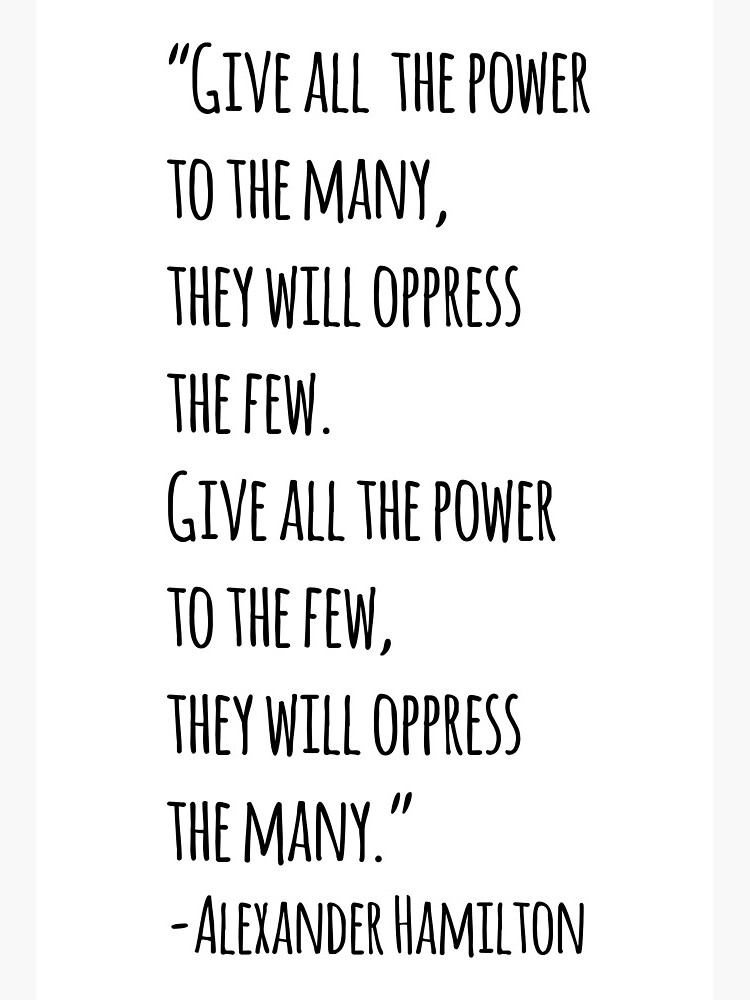

Alexander Hamilton suggested that the foremost danger of the dissension between the states was the division that would inhibit the security inherent in national unity in Federalist Paper # 6.

He supported a general criticism of utopian views with historical examples of cause for dissension. Duty compels disagreement with that which is wrong with dissent, but the security of the union insists on functional agreement.

Hamilton defined the Utopian speculation as that which believed that the states should either be wholly disunited or only united in partial confederacies.

Whether it was better that the subdivisions should have  frequent and violent contests with each other or a continuation of the 'rapacious' harmony between a number of independent, unconnected sovereignties in the same neighborhood was left as a matter for speculation.

The causes of hostility among nations were used to advocate for the unified effort to look for the mutual benefit through alliance for trade and security.

Hamilton's reference to Plutarch's Pericles was the most problematic of his examples. It admit that the declaration of Independence had identified the corruption of authority by the crown was the basis for declaing independence from Great Britain.

The taxation that was not sufficiently beneficial for the alliance of the American colonists in the British colonies had come from parliament. It was a case wherein the stories about the corruption of Pericles' duty as the king were used to institute the system of election in republic without a monarch.

The argument reduced to the claim that the greater corruption was better than the incumbent. The authors of the Federalist Papers judiciously sidestepped the argument in the declaration in order to favor trade and national security as the basis for re-establishing the alliance with the British government. 

The implication of Thomas More's Utopia lent itself to disagreement with Cardinal Wosley's effort to claim what Hamilton called the Triple Crown, authority over the monarchy, the Church and the legislature for England.

Belief in the principle of freedom of religion had been advocated by Roger Williams in Rhode Island. This principle was intended to deny any religious claim to authority over national sovereignty.

It wasn't just a question of the Roman Catholic claim to papal supremacy and the Anglican counter of royal supremacy over the Church of England, there was the issue of bigotry as an even greater corruption. 

Hamilton added the question of debt as a means to subordinate the petition for benefit by disagreement with error for the functional agreement for trade and security. 

He said that Shays would not have had reason to rebel had he not been put in the position of a desperate debtor by the government in Massachusetts. Hamilton argued for the means to remedy debt as the basis for reasonable financial policy in a different text.

He didn't rule out the use of debt to discourage pride for the expansion of power by the claims to supremacy.

He asked if it was not well known that determinations were often governed by a few individuals in whom confidence was placed. Wasn't the claim to power liable to be tinctured by the passions and views of those individuals? He expressed his disagreement with giving all the power to either a few people or to the many.

Had commerce done anything more than change the objects of war in commercial republics? Was the love of wealth the domineering and enterprising passion for power or glory?

Had there not been many wars founded upon commercial motives since that had become the prevailing system for nations? Were there more than when war was occasioned by the cupidity of territory or dominion over the land?

The Jeffersonian Republic view established a line of dissent as the basis for forming 'American' policy. It was an antecedent to socialist economics as the basis for populist political policy.

The dangers of dissension between the states particularly in the US House of Representatives is found in the division inhibits agreement for the security inherent in national unity.

The Utopian view, the cardinal claim to authority over national sovereignty, the claim that the greater corruption would be better and no mutual benefit represented disagreement with functional unity for security.

Disagreement with what is wrong is necessary, but dissent is not the purpose for government. There has to be agreement with commerical trade for mutual benefit but there also has to be a default to the need for professional military and law enforcement agency to represent the force against criminal or terrorist infraction.

He questioned the motives for the republics known to history with respect for the cause of war. Was it commerical enterprise or opposition to the expansion of power by virtue of the competition for imperial alliance?

The ambition of Venice was defeated by a league organized by Pope Julius II. The provinces of Holland had taken a leading role in the wars of Europe until they were overwhelmed with debts and taxes.

The representatives of the people composed one branch of the national legislature in the government of Britain. Commerce was the chief goal for the nation, but this didn't stop the country from participation in many wars. The wars in which that kingdom had engaged had in numerous instances proceeded from the government that claimed to represent the people.

The rival houses of Austria and Bourbon had long kept Europe in flame with royal wars that laid claim to the cries of the nation and the importunities of their representatives.

The antipathies of the English, the French and the Germans had in great measure grown out of commercial considerations that countered the desire of supplanting against the fear of being supplanted either in particular branches of traffic or in the general advantages of trade and navigation.

Did the Utopian view of confederacies not present inducement to greater dangers of dissension among the smaller states with the conflicts of larger nations, than the proposal for union with a Constitution?  Revolt had already transpired in North Carolina and Massachusetts. Menacing disturbances had occurred in Pennsylvania.

Neighboring nations were naturally enemies to each other unless the recognition of common weakness induced a league in a confederate Republic. The constitution of the union would prevent the differences that neighborhood occasioned and extinguish that secret jealousy which disposed all states to aggrandize themselves at the expense of their neighbors.

Unity against the threat of evil provided the recommendation for remedy.

The Utopian view, the cardinal claim to authority over national sovereignty, the claim that the greater story about corruption is better than the incumbent authority and opposition to mutual benefit represented dangers that would disagree with functional unity for security.

Disagreement with what is wrong is necessary, but dissent is not the purpose for government. There has to be agreement with commerical trade for mutual benefit but there also has to be a default to the need for professional military and law enforcement agency to represent the force against criminal or terrorist infraction.

-------------------

Value


William James
The Varieties of Religious Experience 5
Text: Varieties

When James looked at religious experience he asked two key questions. 'What are the propensities of religion?' and 'What is the significance for the variability for the propensities?'

There is a logical distinction between the two questions that warrants recognition. The logic for his time had arrived at the primary principles for the inquiry into anything. The first principle asks, 'What is the nature of the thing?' The second inquires, 'What is the meaning of the nature in terms of significance?'

The answer to the first question results in an existential judgment regarding the object being evaluated. A chief characteristic of the thing is drawn regarding its existence.

The answer to the other is a propostion of value. James called it a spiritual judgment, but the mental component of spirit is the cognitive element that is concerned with communication.

It is cognition that sells or persuades the audience that the value of the object is worthy of consideration, if not agreement. The word existential can be contrasted with mental. The judgment is less suspect for being thrown of court.

Neither judgment is immediately deduced from the other. The mental operations used in the formulation are different. The mind combines them only by making them first separately, then by adding them together.

The religion being considered is defined by contrast or comparison with other religions. Distinction is easily formed in the two orders of question in the matter of religions.

Christianity is the most prominent religion derived from the Roman tradition. Judaism was used by the Romans as a template of the first monotheistic form in order to convert the culture from polytheism to monotheism. 

A chief characteristic of this shift was to stop the use of animal sacrifice for expiation in the temple at the capital city. Scripture was instituted for the consideration of religious experience in a parish community associated with the Church as documented in the Judaic then the Christian traditions.

The Tanakh was the main collection of written works for Judaism. The Bible became the Book of books for Christianity. The Synagogue was the name for the community temple for Jewish people. The church became the constructed symbol for the body of Christ in any community.

The assembled body has been dedicated to finding the definition of goodness in relations.
The higher criticism of the Bible is the study of the scripture from an existential point of view. The literary parts which aren't exactly optimal in terms of narrative flow are identified according to probable sources.

The two names for the One deity made for two different sources. Elohim, the God of gods, was most likely first in terms of general application with cultural acceptance. Yahweh, of the Great I am whose true name can never be spoken, was a distinctively monotheistic entity. 

This name suggested the next stage in organizational development for the official religion of the culture. 

The consideration of the influence of worship in the course of political events was documented by the Deuteronomic historian. Deuteronomy stands for the second law or the next stage in the movement to monotheistic organization in the society for the culture.

The Priestly source was concerned with the customs and practices of worship in the temple. The first two sources are abbreviated as E for Elohim and J for Jehovah or Yahweh. These names pointed to God as the object for worship. The other two sources are abbreviated as D for Deuteronomic and P for Priestly.

The 4 sources represent perspectives that documented the experience of existence with faith in the historical frame for the documentation. These sources are used in literary analysis to draw out the meaning of the text with respect for repetition with variance. 

Biblical criticism is usually reserved for seminary instruction to prepare students for ministry in the priesthood, but it can be applied to bible study for personal edification.

The analysis of the text asks the question regarding the biographic conditions for the writers of the written works. The biographic conditions were defined in terms of political, social and personal roles as elements in human nature.

How was the faith of the writer shaped by the purpose for documentation with respect for the different social perspective?

While the E source was drawing out the importance of the One as drawn from the relative significance of the others, the J source made statements that indicated that the other gods were false.

The combined value of the two was to recommend a conversion of the calendar value for each god into some aspect of time and practice related to the worship of the One.

The consideration of the value for the worship of the Word was illustrated with reference to historical fact rather than the mythologically astrological reflections of astronomy in the formation of the calendar.

Detachment from human relations to determine scientific objectivity was modified to include the significance of human relations with faith in the context of reality.

What use should such a volume with its manner of coming into existence defined in historical fact be to us as a guide to revelation with respect for life? There must be some sort of a general theory as to what the peculiarities in a thing should be which give it value for the purpose of revelation.

This theory itself would be what was called a judgment. Combining it with our existential evaluation, we might indeed deduce another judgment as to the Bible's worth.

If the theory of revelation-value were to affirm that any book must have been composed automatically without the will of the writer in such a way that it must exhibit no scientific or historic error with regard for local or personal passion, the Bible would probably fare ill.

If our theory should allow that a book may well be a revelation despite the error and passion characteristic of deliberate human composition insofar as it is the record of the inner experience of the struggle with the crises of the call to destiny, then the verdict will be more favorable.
James wrote,

Those adept with higher criticism accordingly don't confound the existential with the mental problem.

Some take one view and some another of the Bible's value as a revelation according to their judgment as to the foundation of values differs. There is allowance for varity in non-essential considerations particularly with regard to certain customs.

The official religion for a state should allow variance for different faith traditions. It is conceivable that the Church of England allows official recognition for Judaism, Islam or other religions as legal.

Even though the Islam of Iran is younger with respect for the state as a republic, it can develop standards for the official recognition of Christianity, Judaism or other religions. 

Republics that have freedom of religion listed as a civil right have to have legislation that rules out crime, riot, terrorism, rebellion, revolution or war for religious as well as political causes.

---------------------

Existential facts alone don't determine worth.
Thought in theory can form tests of value for truth.

================

Sunday, January 12, 2020

Rise

1.19.20


Rika Ishikawa

Rise
Above 
升起
Shēng qǐ
上に上昇
Ue ni jōshō
ps44
Supergreditur

We have heard the story of salvation with our ears.
The lesson has been drawn from the instruction of the years.

Our parents told us of the work You did in their days.
They spoke of how You cultivated the investigation of good ways.

You planted our ancestors with knowledge of the land.
You granted protection with the promise of Your providential hand.

When tribes were appointed the role in instruction
family taught their children as students of function.

Instructors are now trained in fields of investigation.
Students are praised for research on stations for the nation. 

Ignorance is used as the motivation to acquire knowledge.
Procedures are written so policy will be acknowledged. 

Possession came by responsible ownership.
Responsibility was grown with statecraft in sponsorship.

A posteriori thought was the basis for the metaphysical.
It was not so mysterious as statistically inferential.

A whole was left in the soul of philosophy 
with the removal of conceptual virtuosity.

Theory provides a context for factuality.
No theory results in too much detachment from reality.

When I had no theory I felt like I had been sold for nought.
The facts did not sit with what had been drawn as taught.

Reproach from the crazy neighbor was not dismissed.
Derision was entertained like truth with a twist.

Theism became a byword among the atheists.
Haters shook their heads like we were extraneous.

Confusion moved like a cloud before me.
Shame from disgrace disfigured my facial esprit.

The voice of him that reproached me for blasphemy 
was leveled by the 'avenger' for the sake of the enemy.

When all this had fallen on me,
faith was not rejected as a fatality.

The faithful heart was not turned back
though my steps had been placed under attack.

We had been taken to the place of dragons
where the smoke from the artillery cannons 
had darkened the blackened 
after the fire had blasted.


My soul was bowed down to the dust.
Like the serpent my belly met the earth's crust.

We counted ourselves as sheep for the slaughter.
The micropest rode the flea on the rat that threatened the altar.  

If we had forgotten the One that had risen from the many
or lifted our hands to a strange god for the promise offered by the enemy,
would the knowledge of God not find out what we had done out of envy?

Would the Author of the covenant not know the secrets of the heart?
Would that not be the place where the trouble would start?

Awake my soul. How is it you have fallen?
You need to rise up to defeat the problem.

It is time to meet the destiny of your name.
Falling to fate would be such a shame.

Belief in the covenant has to be preserved
for the sake of the love that has been deserved.

You are our Leader, the Christ.
Deliver Your truth seekers from blight.

The consideration of the mystical experience of awe
has to be tempered by caution toward the ascetic fever drawn.

What is the name for the first month of the year?
January is the English word that we hear.

The time for review has past.
Resolve for improvement has been cast.

Rise above habit to find the better way.
The right change will improve how you behave.  

We will rise to defeat the challenge from our adversaries.
We will leave behind the error from the centuries.

We will deflect the attacks from our attackers
to focus on policy that really matters.

Administration with faith in service to the public
is a model that admits that defense is an element in justice.

God help our enemies feel shame for their hatred.
The promise of salvation is an encounter with the sacred. 

We welcome your love throughout the day
and praise your name for the economy of Your way.

Negotiation has been favored over invasion 
as fated predestination.

The art of the deal 
preceded the invention of the wheel.

We turned back
from making an attack.

The system of voting for election 
was better than the force of enacted malediction.

Employment from the spoils of victory in the vote
did not reward merit by experience with education to note.  

The children of Israel had been scattered among the polymorphs
with the unstable as the staple for the drones enforced.

We felt like sheep designated as the meal
for the wolves of appetite unfettered and real.

I was called to rise above this before I was born. 
This witness is for heaven as a robe that is worn.

My mouth was prepared to deliver the symbolic word.
I was hidden until a time when the message could take flight like a bird.

I was polished by instruction in history, poetry and politics.
I was taught in a group that prepared to present the promise fixed.

I was told you are Israel reborn.
I felt like my performance was torn with the forlorn.

I had labored in vain.
My work had ended in pain. 

My loss in battle had resulted in resignation to the higher call.
The promise of reward was foretold by the Father of all.

This person was formed within my mother's womb
to bring Jacob to Israel as one who transcended the tomb.

The kingdom of heaven is a light for all the nations
to the ends of the earth for the promise of salvation.

The Redeemer of Israel was seen as the cause of pain.
They didn't see that he became incarnate for the Name. 

The Lamb of God takes away the sin of the world.
He ranks ahead of me because before me he was as barley pearled.

I baptized with water that he might be revealed.
The Light descended like a dove that he might the Spirit wield.

He upon whom the dove descended
baptized with the Holy Spirit so love will be apprehended.  

I have seen his wonderful work and have testified 
that Jesus is the divine person whose body was crucified.

Grace to you who believe with peace from our Father
by whom you were called in love with the Son as author.

You have been enriched in him by speech and knowledge of every kind
but the way to avoid particular sins by his gospel is a gift that some have yet to find.

The testimony of Christ has been strengthened among you
as a spiritual gift to wait until the revelation of Jesus as Lord has rung true.

Statistics are the modern form for augury.
Categorical counts provide terms for the prediction glossary.


Flock of Birds

Flights of birds through a field of vision
had provided a visual example of group indecision.

The entrails of an animal sacrificed for expiation
had demonstrated striations in the functional station.

The collection of data for a categorical description
has to be organized for display to form a position on subscription.

Let God arise for our help
to redeem us all for our higher self. 

-----------------------

Psalm 44

1 We have heard with our ears, O God, our fathers have told us, what work thou didst in their days, in the times of old.
2 How thou didst drive out the heathen with thy hand, and plantedst them; how thou didst afflict the people, and cast them out.
3 For they got not the land in possession by their own sword, neither did their own arm save them: but thy right hand, and thine arm, and the light of thy countenance, because thou hadst a favour unto them.
4 Thou art my King, O God: command deliverances for Jacob.
5 Through thee will we push down our enemies: through thy name will we tread them under that rise up against us.
6 For I will not trust in my bow, neither shall my sword save me.
7 But thou hast saved us from our enemies, and hast put them to shame that hated us.
8 In God we boast all the day long, and praise thy name for ever. Selah.
9 But thou hast cast off, and put us to shame; and goest not forth with our armies.
10 Thou makest us to turn back from the enemy: and they which hate us spoil for themselves.
11 Thou hast given us like sheep appointed for meat; and hast scattered us among the heathen.
12 Thou sellest thy people for nought, and dost not increase thy wealth by their price.
13 Thou makest us a reproach to our neighbours, a scorn and a derision to them that are round about us.
14 Thou makest us a byword among the heathen, a shaking of the head among the people.
15 My confusion is continually before me, and the shame of my face hath covered me,
16 For the voice of him that reproacheth and blasphemeth; by reason of the enemy and avenger.
17 All this is come upon us; yet have we not forgotten thee, neither have we dealt falsely in thy covenant.
18 Our heart is not turned back, neither have our steps declined from thy way;
19 Though thou hast sore broken us in the place of dragons, and covered us with the shadow of death.
20 If we have forgotten the name of our God, or stretched out our hands to a strange god;
21 Shall not God search this out? for he knoweth the secrets of the heart.
22 Yea, for thy sake are we killed all the day long; we are counted as sheep for the slaughter.
23 Awake, why sleepest thou, O Lord? arise, cast us not off for ever.
24 Wherefore hidest thou thy face, and forgettest our affliction and our oppression?
25 For our soul is bowed down to the dust: our belly cleaveth unto the earth.
26 Arise for our help, and redeem us for thy mercies' sake.

--------------------
===============
---------------------

What is the name for the first month of the year?
January is the English word.

Chn.  今年第一个月的名字是什么?
            Jīnnián dì yī gè yuè de míngzì shì shénme?
            一月是中国字
             Yī yuè shì zhōngguó zì.
Jpn.    年の最初の月の名前は何ですか?
             Toshi no saisho no tsuki no namae wa nanidesu ka?
              1月は日本語です
              Ich tsuki wa nihongodesu.     
Krn.    연도의 첫 달의 이름은 무엇입니까? 
             yeondoui cheos dal-ui ileum-eun mueos-ibnikka?
             1 월은 한국어입니다.
             I wol-eun hangug-eoibnida.
Ltn.     Quod nomen est primus mensis anni?
             January sit habitantibus terram.
Itln.    Qual è il nome per il primo mese dell'anno?
             Gennaio è la parola italiana.
Spn.    ¿Cómo se llama el primer mes del año?
             Enero es la palabra española.
Frn.     Quel est le nom du premier mois de l'année?
              Janvier est le mot français.
Gmn.  Wie heißt der erste Monat des Jahres?
              Januar ist das deutsche Wort.
Dtch.   Wat is de naam voor de eerste maand van het jaar?
               Januari is het Nederlandse woord.
Czch.    Jak se jmenuje první měsíc v roce?
               Leden je české slovo.
Hng.     Mi a neve az év első hónapjának?
               Január a magyar szó.
Grk.      Ποιο είναι το όνομα για τον πρώτο μήνα του έτους;
               Poio eínai to ónoma gia ton próto mína tou étous?
               Ο Ιανουάριος είναι η ελληνική λέξη.
               O Ianouários eínai i ellinikí léxi.
Trk.      Yılın ilk ayının adı nedir?
              Ocak Türkçe kelime.

What is the name for the first month of the year?
January is the English word we hear.

-------------------------

Psalm 44

The 44th psalm was composed by the sons of Korah. It is classified in the series of lamentations of the people.

The first verse is an empirical acknowledgement that lessons were drawn from what was heard from the experience of the parents in the discernment of ancestral wisdom. Instruction by family participation in a tribal service to the kingdom had been the means for education.

Instruction in fields of service is a modern extraction with development.

Verses 2 to 9 qualify as a historical review of success with faith. Verses 10-23 described the disaster that gave cause for the lament.  The last 3 verses (24-26) request help in rescue from the crisis.

------------------------

My Palms


"Deutero-Isaiah" dates from the time of the Israelites' exile in Babylon. Chapter 49 includes the second of the songs of the "Suffering Servant".

The servant songs are four poems within the Book of Isaiah written about a certain "servant of YHWH". God calls the servant to lead the nations, but the servant is horribly repressed. He is rewarded in the end.

The second poem was written from the Servant's point of view. It is an account of his pre-natal calling to lead both Israel and the nations. The call was probably drawn from the description made by Jeremiah. (Jer.1:5)

The Servant is now portrayed as the prophet equipped and called to restore the nation to God. This was a development in the history of Judah. Israel had identified with Elohim. This was standard for the Middle Eastern movement toward monotheism.

The self-identification with the independent tribalism however led to the alliance with Syria that attempted to force Judah to fight against the Assyrians.

Judah favored the One with the unspoken Name. It stood as a symbol that the larger victory would be won by identification with the one deity. The work of this kingdom was to persuade people that this faith could be true.

The second anticipated the fourth song. The Servant was without success. Taken with the picture in the first song, his success will come not by political or military action, but by becoming a light to the Gentiles. This victory was ultimately in God's hands.

Much of the imagery of what Christians call the Old Testament was drawn from the weapons of an army, but it represented a movement within the New Covenant. The new is simply a development away from savage primitivism as an emblem of independent leadership in the individuality of defiance toward unity.

The new promise is grounded in conservative reform toward reasonable preparation for defense with the lessons drawn from the history of faith for personal participation in responsible ownership. The prenatal calling is an expression of the inheritance of the promise.

Isaiah 49:1-7

Listen to me, O coastlands,
pay attention, you people from far away!

The LORD called me before I was born,
while I was in my mother's womb he named me.
He made my mouth like a sharp sword,
in the shadow of his hand he hid me;
he made be a polished arrow
in his quiver he hid me away.
He said to me, 'You are my servant,
Israel, in whom I will be glorified.'

I said, 'I have labored in vain.
I have spent my strength for nothing and vanity;
yet surely my cause is with the LORD.

My reward is with my God.'
The LORD who formed me in the womb to be his servant,
to bring Jacob back to him
that Israel might be gathered to him
has honored me in his sight.
My God has become my strength.

He said,
"It is too light a thing that you should be my servant
to raise up the tribes of Jacob
and to restore the survivors of Israel.
I will give you as a light to the nations
that my salvation may reach to the end of the earth.'
The Redeemer of Israel and his Holy One
to one deeply despised, abhorred by the nations
the slave of rulers said,
'Kings shall see and stand up.
Princes shall prostrate themselves
because the LORD, who is faithful,
the Holy One of Israel, has chosen you.'

---------------------

I was called before I was born.
This kingdom is for heaven as a robe that is worn.

My mouth was prepared to deliver the prophetic word.
I was hidden until a time when the message could take flight like a bird.

I was polished by instruction in history, poetry and politics.
I was taught in a group that prepared to present the promise fixed.

I was told you are Israel reborn.
I felt like my performance was torn with the forlorn.

I had labored in vain.
My work had ended in pain.

My loss in battle had resulted in resignation to the higher call.
The promise of reward was foretold by the Father of all.

This servant was formed within my mother's womb
to bring Jacob to Israel as one who transcended the tomb.

The kingdom of heaven is a light for all the nations
to the ends of the earth for the promise of salvation.

The Redeemer of Israel was seen as the cause of pain.
They didn't see that he became incarnate for the Name.

================

Corinth


Horace (65-8 BCE)

Poseidon was the patron god for Corinth. He was one of the Twelve Olympians in ancient Greek religion and myth. He was the god of the sea, storms, earthquakes and horses.

Poseidon supported the Greeks against the Trojans during the Trojan War in Homer's Iliad.

The Greek hero Odysseus provoked Poseidon's fury by blinding his son, the Cyclops Polyphemus, in the sea voyage from Troy back to Ithaca in the Odyssey. Poseidon punished him with storms, the complete loss of his ship and companions and a ten-year delay.

The island of Atlantis was Poseidon's domain in Plato's Timaeus and Critias.

He was venerated as a chief deity at Pylos and Thebes before he was chosen as the patron for Corinth.

The city is is located in south-central Greece. It is about 78 kilometres (48 mi) west of Athens. The Oneia Mountains and the monolithic rock of Acrocorinth where the medieval acropolis was built are natural features that surround the area.

The leadership was able to control the only land access to the Peloponnese. The control of the location dominated the trade in both the Saronic gulf (to the east) and the gulf of Corinth (to the west).

The city was known as "Wealthy Corinth." The control of the location was the reason for the wealth.
An oligarchical government seized power around 550 BCE. This government allied with Sparta within the Peloponnesian League.

Corinth participated in the Persian Wars and the Peloponnesian War as an ally of Sparta. The two allies fell out with one another after Sparta's victory in the Peloponnesian war.

Corinth pursued an independent policy in the various wars of the early 4th century BCE. The Acrocorinth was the seat of a Macedonian garrison after the Macedonian conquest of Greece until 243 BCE. The city was liberated and joined the Achaean League.

The strategic port was captured and completely destroyed by the Roman army in 146 BCE nearly a century later.

Corinth flourished as a newly rebuilt Roman colony in 44 BCE and became the administrative capital of the Roman province of Achaea. The official name for Poseidon became Neptune.

First Letter

The apostle Paul traveled from Athens to Corinth about 50 CE during his second missionary journey. The trip took him from the seclusion of an ancient university in a provincial town to the seat of government and trade.

There had been a time when Athens had been politically greater than Corinth. Athens had only the memory of its preeminence. Corinth held the keys of commerce and swarmed with a crowded population. Paul founded the Church there.

Chapter 18 of the Acts of the Apostles records the final part of the second missionary journey of Paul together with Silas and Timothy. The beginning of the third journey starts before the end of the chapter.

Gallio was proconsul of Achaia from 50-52 CE. Paul first met with Aquila and Priscilla (Acts 18:2). They were to become his important associates. They were well known to the Corinthian church (1 Corinth. 16:19; cf. Romans 16:3-4).

References to the command of Roman Emperor Claudius (r. 41-54) for "all the Jews to depart from Rome" appeared in the writings of Roman historians Suetonius (c.69 – c.122) and Cassius Dio (c.150 – c. 235) as well as Acts 18:2.

Paul waited until Silas and Timothy had come from Macedonia before he testified to the Jews that Jesus was the Christ. (Acts 18:5)

Lucius Junius Gallio Annaeanus or Gallio was a Roman senator and brother of famous writer Seneca. The Jews had taken Paul to the judgment seat and accused him of persuasion to worship contrary to the law. Gallio judged that the accusation was concerned with words and names in Jewish law. He refused to judge Paul for wicked crimes.

Sosthenes was the chief ruler of the synagogue. He was seized and beaten by the mob in the presence of Gallio according to the Acts of the Apostles. Some manuscripts added that the mob was composed of Greeks, others of Jews.

Sosthenes is identified as a co-author to the first letter to the Corinthians. (1Corinth.1:1)

The apostle had spent eighteen months in Corinth, so he was intimately familiar with the church and many of its congregants 4 years prior to writing the letter now known as the first. The letter refers to another that preceded it. (1 Corinth.5:10-11)

Paul had been in Ephesus for more than two years on his third missionary journey when he received a disturbing report of quarreling within the Corinthian church. He received the report from people associated with one of its members, Chloe (1 Corinth. 1:11).

The church he had founded so recently (Acts 18:1–17) had already developed deep divisions. The situation required immediate action. Paul wrote his letter in  c.55, just as he was planning to leave Ephesus for Macedonia (1 Corinth. 16:5–8).

First Corinthians contains a frank discussion of the church and the issues that impacted the people in the first century. The Corinthian church was corrupted by a variety of sins.  Paul provided an important model for how the church should handle the problem of sin.

The letter challenged believers to examine every area of life through the lens of the gospel.

1 Corinth.1:9


--------------------

1 Corinth. 1:3-6,9

Grace to you and peace from God our Father and the Lord Jesus Christ.

I give thanks for you because of the grace of God that has been given you in Christ Jesus. You have been enriched in him in speech and knowledge of every kind just as the testimony of Christ has been strengthened among you so you are not lacking in any spiritual gift as you wait for the revelation of our Lord Jesus Christ.

God is faithful. You were called into fellowship with his Son, Jesus Christ.

---------------------

Grace to you and peace from our Father
by whom you were called into fellowship with the Son as author.

You have been enriched in him by speech and knowledge of every kind
but the way to avoid particular sins by his gospel is a gift that some have yet to find.

The testimony of Christ has been strengthened among you
as a spiritual gift to wait until the revelation of Jesus as Lord has rung true.

================

Testimony


The opening to the gospel of John echoed that to the book of Genesis (Gen 1:1), but whereas Genesis refered to God's activity at the beginning of creation, here the reader was told of a being who existed before creation took place.

The Word already was before the beginning of everything. This association had literary associations with Greeks and Jews. The Greeks held that the cosmos was the order of the universe that is ordered by reason.

Reason is this sense is more concerned with knowledge of order outside the experience of human nature though. Our nature is defined by the search to see truth outside of our own existence.

The Jews believed that  creation took place by God's speech (Gen 1; Ps 33:6). The concept of incarnation however seemed like a product of polytheism in the deification of the emperor. It was not accepted as a theological tenet.

The divine nature was not only outside of the human, he was outside of nature as that which was totally other.

Christianity would assert that the nature which was believed to be totally other was somehow united in the divine person of the Son.

The Romans were practical in their anthropomorphism. They used the deification of the emperor as the central derivative of polytheism, but the office of the emperor and his line of succession was viewed as something that was contrary to the rule of law in the republic.

The belief in Saturn was a symbol of time's consumption of the experience of itself in the cursus honorum and the imperial line of succession. The emperor had to reconcile the will of the plebians with that of the patricians for the benefit of the republic in the competition with other governments.

The emperor usually had a building project which in general supported the construction of roads as needed, an aquaduct, a theater and a public bath. The office sponsored public games in the form of gladitorial contests. Chariot racing was added.

Polythesim as a religious form was only one step beyond the superstition of totemism.

People organized their community social lives around the belief in the main deity. Fear and prejudice were divined as that which drove the formation of a mob. The mob had to be appeased by the judgment of a magistrate.

Stories about the cruelty of the emperor seemed to act as a deterrent to the expectation of reasonable judgment. This deterrence was supported by the stories of immoral behavior on the part of the gods.

The republic was a system of election which could somehow plumb the will of the people in terms of practical administration with stories and festivals that favored the consideration of the calendar with respect for harvest and special components of time in the year.

The festivals were ordered with respect for the movement of constellations in the night sky.

Leading patricians and at least some emperors must have looked at the monotheism of the Jews as an advancement that their system wasn't ready to accept at the time. It may have looked like it was too well ordered by comparison.

There were those in the first century however who must have seen that the future for the official religion of Rome would have to adopt faith in one God eventually.

John the Baptist had been described as a witness to the Light of the world. He did not claim to be the light for the world from which he had withdrawn.

The statement that the Word became flesh and dwelt among us was a summary of the major themes for the other gospels. There were grounds for agreement from Greeks, Jews and Romans in the appeal to the Logos or the Word as the means to order social reality.

Mark traced the origin of Jesus to Nazareth to show that he was the Servant for mankind. Matthew drew the lineage back to Abraham to state that he was the promised Messiah for the nations. Luke illustrated that he was the Son of Adam and fulfillment of the Perfect Man.

John declared that Jesus had come from heaven as the Son of the Father. He described 7 miracles to show the glory of his divine person. Six of the miracles did not appear in the other gospels.

His theology was dedicated to the reconciliation of different worlds. Jesus was the author of this reconciliation with the atonement made by his sacrifice on the cross.

---------------------------

John 1:29-34

The next day he saw Jesus coming towards him and declared, 'Here is the Lamb of God who takes away the sin of the world! This is he of whom I said, "After me comes a man who ranks ahead of me because he was before me." I myself did not know him, but I am baptizing with water for this reason that he might be revealed to Israel.'  John testified, 'I saw the Spirit descending from heaven like a dove and it remained on him. I myself did not know him, but the one who sent me to baptize with water said to me, "He on whom you see the Spirit descend and remain is the one who baptizes with the Holy Spirit." I myself have seen and have testified that this is the Son of God.'

---------------------

The Lamb of God takes away the sin of the world.
He ranks ahead of me because before me he was as barley pearled.

I baptized with water that he might be revealed.
The Light descended like a dove that he might the Spirit wield.

He upon whom the dove descended
will baptize with the Holy Spirit so love will be apprehended.

I have seen and have testified
that Jesus is the divine person whose body was crucified.

================

Statistics


Statistics is the modern form of augury. The analysis of data is used to predict future outcomes. Instead of looking at the flight of birds through a field of vision or evaluating the entrails of an animal that had been sacrificed for expatiation, numbers that represent categorical counts are examined to assess behavioral or physical trends.

------------------------

Statistics is the modern form for augury.
Categorical counts provide terms for the prediction glossary.

Flights of birds through a field of vision
had provided a visual example of group indecision.

The entrails of an animal sacrificed for expiation
had demonstrated striations in station.

The collection of data for a categorical description
is organized for display to form a position on subscription.

=================

The study of the subject  concerns the collection, organization, analysis, interpretation and presentation of data.

Mathematical analysis uses quantified models to represent synopses for a given set of experimental data or real-life study.

The evolution of statistics has been intimately connected with the development of sovereign states by imitation of what had been practiced by the office of the Roman censor.

European states that followed the peace of Westphalia (1648) employed statistical data to describe sovereignty and to predict costs for the future.

Probability theory put statistics in a firm theoretical base.

The capacity for modern technology to process large amounts of data have made statistical concepts a key concern for application in computer science.

A number of statistical concepts have an important impact on a wide range of sciences. These include the design of experiments and approaches to statistical interpretation such as Bayesian inference.

Experimental design is the organization for any task that aims to describe and explain the variation of information under conditions that are hypothesized to reflect the variation.

Bayes’s theorem describes the probability of an event based on prior knowledge of conditions that might be related to the occurence or incidence of the event. If the probability that someone has cancer is related to their age for example, the theorem provides that the age can be used to more accurately infer the probability of cancer than can be done without knowledge of the age.

Experiment and the inference of probability can be considered to have their own sequence in the development of the ideas underlying modern statistics.

Statistics
wiki History of Statistics

Literacy and Censorship


The word censor has an unfortunate affiliation with the act of censorship.  The more practical application is concerned with the act of compiling statistics as a descriptive anaylsis of how people are.

Inferences on what to do to improve the state of things can be drawn, but the inference is drawn from observed phenomena as opposed to an unreal ideal.

Roman Censor

The censor was a magistrate in ancient Rome who was responsible for maintaining the census and overseeing certain aspects of the government's finances.

A census is taken to make a count about the members of a given population. The procedure of taking the count systematically acquired and records information about the population. Categorical qualities were enumerated to describe the size of particular characteristics.

This term is used mostly in connection with national population and residency for each household.  Other common types include traditional culture, business, supplies and traffic censuses.

The word had a Latin origin during the Roman Republic. The census was a list that kept track of all adult males fit for military service. It was first instituted by Servius Tullius, sixth king of Rome, c. 575–535 BCE.

The consuls had responsibility for the census after the Republic was founded in 509. No consuls were elected in 442. The plebeians wanted to attain higher magistracies. Only patricians could be elected consuls. Some military tribunes were plebeians.

Tribunes with consular power were appointed to take the census in 443. The patricians removed the right to take the census from the consuls and tribunes. Two magistrates called censores were elected by the Patricians in Rome.

Patrician consulars of the early republic interspersed public office with agricultural labor. Cicero remarked in the first century BCE "in agris erant tum senatores, id est senes."

Senators were in the fields. It was the custom for the senior officials. Senior senators would live on their farms in those days. The custom would become obsolete by the 2d century.

The magistracy continued to be controlled by patricians until Gaius Marcius Rutilus was appointed the first plebeian censor in 351 BCE. One of the Publilian laws required that one censor had to be a plebeian 12 years later (339). No plebeian censor performed the solemn purification of the people despite this until 280 BCE.

The celebration of purification was known as the "lustrum". The lustration was originally a sacrifice for expiation and purification offered by one of the censors in the name of the Roman people at the close of the taking of the census.

The expiatory offering was often made in the form of an animal sacrifice, known as a suovetaurilia. Lustratio was an ancient Greek and ancient Roman purification ceremony. It included a procession and in some circumstances the sacrifice of a pig (sus), a ram (ovis) and a bull (taurus) (suovetaurilia).

Certain records documented the sacrifice of dogs to indicate that the dog days were over. Predation by hunting was being turned on the wolves who took livestock from their owners. Armies witnessed this kind of sacrifice as a symbolic association intended to end the human 'predation' defended by an opposing army.

Lupercalia


Instructions on the Lustratio performed for the Roman town of Iguvium illustrate that the ceremony consisted of a procession of priests, sacrificial victims and people around the town's citadel.

The procession stopped at the three gates to the citadel where the sacrifices were made. The gates were considered to be weak points which required strength.

Lustratio ceremonies were also used to bless crops, farm animals, new colonies and armies before going into battle or passing into review. It is likely that the purification element in the public ceremony included the sharing of incense with a censor and the sprinkling of water with a straw whisk.

These censuses were taken at five-year intervals. A lustrum came to refer to the five-year inter-census period.

Both censors were plebeians for the first time in 131 BCE.

The purification of the Roman people was performed by one of the censors in the Campus Martius (Field of Mars) after the taking of the census was over. The Campo Marzio was a publicly owned area of ancient Rome about 2 square kilometres (0.8 sq. miles/ 490 acres) in extent.

Mars was an agricultural guardian as well as the god of war. He was a part of the Archaic Triad along with Jupiter and Quirinus.

Quirinus had no Greek equivalent. He was the guardian of the Roman people. His name may be derived from the Sabine word quiris "spear". He was  the oak-god (quercus). The quirites were the men of the oaken spear.

The Aeneid of Virgil was written under Augustus. He claimed ancestry through Julius Caesar and his mother Venus. The survivors from the fallen city of Troy banded together under Aeneas according to the Aeneid.

They underwent a series of adventures around the Mediterranean Sea. They journey included a stop at newly founded Carthage under the rule of Queen Dido. They eventually reached the Italian coast.

Aeneas married Lavinia, the daughter of King Latinus. Turnus had been betrothed to Lavinia. He started a war after the marriage to Aeneas. Aeneas won the war.  He won the right to assimilate with the local people.

The area that would become Rome was covered with forest at the time. The Aeneid said that the race of men came from the tree trunks. They were as hard as oak. They had no settled life, no arts, no skill at yoking oxen. They gathered their provisions or from the hunt. It said that they got their food from oaken bough spears and the wild game that was hunted.

Satre was known as the one who hurled lightning bolts (the spear chucker). This ability was put with Satus (sowing) to represent the leadership of the Latins.

Sterculius derived from stercus, "dung" or "manure". It referred to the odor of re-emergence from death to life associated with the fertilization of the field was manure. It was Saturn who had given the people laws and bestowed the name Latium upon them.

The agricultural aspect of Saturn was secondary to his primary relation with time and seasons. Time consumes all things. The name Saturn comes from the Latin word satis which means to fill or to satisfy.

Saturn was an anthropomorphic representation of Time as filled or satiated by all things or generations. This would become an argument against the royal line of succession for the Romans.

Octavian Augustus revived the argument for it for the value of the inheritance preserved by the family line of succession with the addition of the option of adoption for the selection of an heir.

The young son of Aeneas, Ascanius, also known as Iulus, went on to found Alba Longa and the line of Alban kings. This line filled the chronological gap between the Trojan saga and the traditional founding of Rome in the 8th century BCE.

King Procas was the father of Numitor and Amulius toward the end of this line. Numitor became king of Alba Longa at the death of Procas, but Amulius captured him and sent him to prison. He also forced Numitor's daughter Rhea Silvia to become a virgin priestess among the Vestals.

Rhea Silva gave birth to the twins, Romulus and Remus. The Italian myth identified the twins as the sons of the vestal virgin and Mars, the god of war. They were abandoned at birth, because of a prophecy that they would overthrow their great-uncle Amulius.

He had overthrown Rhea Silvia's father Numitor. The twins were abandoned on the river Tiber by servants who took pity on the infants despite their orders to let them die of exposure.

The twins were nurtured by a she-wolf until a shepherd named Faustulus found them and took them as his sons. Faustulus and his wife Acca Larentia raised the boys. When Remus and Romulus became adults, they killed Amulius and restored Numitor.

They decided to establish a city but, they quarreled over the location. Romulus was on Palatine Hill. Remus wanted to found the city on Aventine Hill. Remus attacked. He was killed by Romulus. The fratricide was later taken to represent the city's history of internecine political strife and bloodshed.

The Roman Empire deposed Herod Archelaus from his rule of Judea as a Roman client king in 6 CE. His territory was converted into the Roman province of Judea.

Publius Sulpicius Quirinius, the newly-appointed Imperial Legate (governor) of the province of Roman Syria, was assigned to carry out a tax census of the new province. The Census of Quirinius was as symbolic as it was practical.

The Gospel of Luke placed the birth of Jesus during the reign of Herod the Great (Luke 1:5) as the first registration and was taken while Quirinius was governor of Syria. Herod had died nine years before the earliest possible date of the census.

Luke's gospel was written after that of Matthew. The element regarding the census was a symbolic addition that had been made to appeal to the knowledge of a Greco-Roman audience.

The Roman Censore had the practical task to count the people in the Republic. The task was given a festival to celebrate the documentation of numbers by the event. The descriptive task was given a moral connotation that has since been associated with the censorship of media expression.

The liberal media has taken the president's criticism of fake news as an offense to their 'freedom', but they have gone so far to the political left that they seek to censor the criticism by their support for impeachment.

----------------------

Prosody of Poetry

Al-Khalil
b. 718  Oman
d. 791  Basra

Oman is an Arab country on the southeastern coast of the Arabian Peninsula in Western Asia. Its official religion is Islam.

It holds a strategically important position at the mouth of the Persian Gulf, The country shares land borders with the United Arab Emirates to the northwest, Saudi Arabia to the west and Yemen to the southwest. Marine borders are held in common with Iran and Pakistan.

The coast is formed by the Arabian Sea on the southeast and the Gulf of Oman on the northeast. The Madha and Musandam exclaves are surrounded by the UAE on their land borders with the Strait of Hormuz and Gulf of Oman forming Musandam's coastal boundaries.

Al Khalil was born in Oman in 718 CE.

Al-Khalīl was given the name Aḫmad al-Farāhīdī at birth. He was the first scholar to subject the prosody of Classical Arabic poetry to a detailed phonological analysis. Prosody is the observation of the patterns of rhythm and sound used in poetry.

The primary data he listed and categorized in meticulous detail was extremely complex to master and utilize. Later theorists have developed simpler formulations with greater coherence and general utility.

He was also a pioneer in the field of cryptography who influenced the work of Al-Kindi.
Al-Farahidi's "Book of Cryptographic Messages", was the first book on cryptography for the analysis of the codification of text written by a linguist.

The lost work contains many "firsts". The use of permutations and combinations to list all possible Arabic words with and without vowels is one of them.

Permutations and combinations are the various ways in which objects from a set may be selected to form subsets generally without replacement.

This selection of subsets is called a permutation when the order of selection is a factor. It is a combination when order is not a factor.

The calculation of permutations or combinations is used in probability theory to enumerate possibilities in expression. The determination of probability is essential in the limitation of what is possible in cryptography. Further limitation to what is probable is a refinement.

Elementary exercises in this type of calculation can be introduced at the grade level. It is generally investigated as a Middle Grade introduction to probability.

Later Arab cryptographers explicitly resorted to al-Farahidi's phonological analysis for calculating letter frequency in their own works. His work on cryptography influenced Al-Kindi (c. 801–873). He discovered the method of frequency analysis for the decryption of code..

Truth


Al-Kindi
b. 801 Kufa, Abbasid Caliphate
d. 873  Baghdad, Abbasid Caliphate

Kufa is a city in Iraq about 170 kilometres (110 mi) south of Baghdad. It is 10 kilometres (6.2 mi) northeast of Najaf. It is located on the banks of the Euphrates River. It is one of five Iraqi cities that are of great importance to Shi'ite Muslims.

The Abbasids under al-Hasan ibn Qahtaba took Kufa and made it their capital in 749. They moved their seat to Baghdad in 762. Kufa's importance gradually shifted from caliphal politics to Islamic theory and practice under the Umayyad and early Abbasid decades.

There was no unbroken Muslim or Ishmaelite population dating back to the prophet Muhammad's time in Iraq.

Al-Kindi was born in Kufa and educated in Baghdad. He became a prominent figure in the House of Wisdom. A number of Abbasid Caliphs appointed him to oversee the translation of Greek scientific and philosophical texts into the Arabic language.

Hellenistic wisdom was often called the "philosophy of the ancients" by Muslim scholars. It had a profound effect on al-Kindi. He synthesized, adapted and promoted Hellenistic and Peripatetic philosophy in the Muslim world.

He subsequently wrote hundreds of original treatises of his own on a range of subjects ranging from metaphysics, ethics, logic and psychology, to medicine, pharmacology, mathematics, astronomy, astrology and optics.

His study extended further afield to more practical topics like perfumes, swords, jewels, glass, dyes, zoology, tides, mirrors, meteorology and earthquakes.

Al-Kindi played an important role in introducing Indian numerals to the Islamic world in the field of mathematics. Arabic numerals were subsequently introduced to the Christian world along with Al-Khwarizmi.

Al-Kindi was one of the fathers of cryptography. He built on the work of Al-Khalil (717–786). Al-Kindi's book entitled Manuscript on Deciphering Cryptographic Messages gave rise to the birth of cryptanalysis. It was the earliest known use of statistical inference.

Several new methods for breaking ciphers were presented. Frequency analysis was notably among them.

Frequency analysis is also known as counting letters. It is the study of the frequency of letters or groups of letters in a ciphertext.

A ciphertext is the product of  encryption performed on plaintext using an algorithm called a cipher.

The text is known as encrypted or encoded information because it contains a form of the original plaintext that is unreadable by a human or computer without the proper cipher to decrypt it.

Decryption is the inverse of encryption. It is the process of turning ciphertext into readable plaintext.

There is a characteristic distribution of letters that is roughly the same for almost all samples of that language. E, T, A and O are the most common given a section of English language for instance. Z, Q and X are rare. TH, ER, ON and AN are the most common pairs of letters. These pairs are called bigrams or digraphs. SS, EE, TT, and FF are the most common repeats.

The nonsense phrase "ETAOIN SHRDLU" represents the 12 most frequent letters in typical English language text.

Al-Kindi's mathematical and medical expertise developed a scale that would allow doctors to quantify the potency of their medication.

Bills of Mortality


John Graunt
b. 4.24.1620  London, England
d. 4.18.1674  London

Stuart London

The house of Stuart faced the difficulty of managing the British Reformation with monarchs from the kingdom of Scotland. The Scots were mainly Presbyterians, but the royal house maintained alliance with the Catholic Church. The Irish maintained the same alliance.

The King of England had become the head of the Church according to the Royal Act of Supremacy. Henry VIII's basic observation was that a house divided in loyalties resulted  in a house divided against itself.

The papal office  had claimed papal supremacy and authority for investiture presumably with the support of the college of cardinals. The claim to supremacy was used to call for the Crusades and to institute the Inquisition.

The movement toward republican government and global colonialism threatened to institute slavery and the exploitation of natural resources on countries that lacked centralized government due to tribal organization in primitive society.

The beginning of the 17th century in the kingdom of England  was characterized by the Guy Fawkes incident, the plague and the Great Fire of London. 

This was a period that saw the beginnings of the press (newspapers), the first stirrings of scientific discourse and the city’s great chroniclers such as Pepys, Evelyn and, latterly, Defoe.

The preparations for the coronation of King James I were interrupted by a severe plague epidemic.
James VI of Scotland ascended to the English throne as the first Stuart monarch when Queen Elizabeth I died on March 24, 1603. He traveled to London from Scotland and was crowned king as James I of England on July 25, 1603.

His ceremonial procession through the city of London was postponed until March 15, 1604 due to the report of the plague.

James's reign in Scotland was the longest of any Scottish monarch (~58 yrs.). He achieved most of his aims in Scotland but faced great difficulties in England, including the Gunpowder Plot in 1605 and repeated conflicts with the English Parliament.

The plot was reported as a  failed assassination attempt against King James I by a group of provincial English Catholics led by Robert Catesby.

The plan was to blow up the House of Lords during the State Opening of Parliament on 5 November 1605. This event was to be the prelude to a popular revolt in the Midlands during which James's nine-year-old daughter, Elizabeth, was to be installed as the Catholic head of state.

The Midlands was the central part of England. It was the cultural and geographical area located between Northern and Southern England.

Catesby embarked on the scheme after hopes of securing greater religious tolerance under King James had faded. A number of English Catholics were disappointed. There were 12 fellow plotters.

Fawkes had 10 years of military experience fighting in the Spanish Netherlands in the failed suppression of the Dutch Revolt. He was given charge of the explosives according to the report about the plot.

Many have made life-size effigies of the Catholic Yorkshireman every year since, then set it on fire for the delight of anti-Catholic sentiment.

This was the man who plotted not just to bring down the system, but to blow up the king and his government. His actions were branded as treachery and treason in 1605. He was heralded as the first terrorist in British society.

The Lord Mayor's Show was revived by order of the king in 1609 after it had been discontinued for years. The dissolved monastery of the Charterhouse was purchased by Thomas Sutton for £13,000 in 1611. The new hospital, chapel and schoolhouse were begun in the same year.

Charterhouse School was to be one of the principal public schools in London until it moved to Surrey in the Victorian era. The site is still used as a medical school.

Charles I ascended to the throne in 1625. Aristocrats began to inhabit the West End in large numbers during his reign. Increasing numbers of country landowners and their families lived in London for part of the year simply for the social life in addition to those who had specific business at court.

King Charles I raised his banner at Nottingham in 1642. London took the side of the parliament during the English Civil War. The king had the upper hand in military terms initially. He won the Battle of Brentford a few miles to the west of London in November.

The City organised a makeshift army and Charles hesitated and retreated. An extensive system of fortifications was built subsequently to protect London from a renewed attack by the Royalists.

This comprised a strong earthen rampart, enhanced with bastions and redoubts. It was well beyond the City walls and encompassed the whole urban area, including Westminster and Southwark.

London was not seriously threatened by the royalists again, and the financial resources of the City made an important contribution to the parliamentarians victory in the war.

The civil war ended in defeat for the Royalists. The execution of King Charles on 30 January 1649, heralded Oliver Cromwell's short lived Commonwealth.

Cromwell allowed Jews to return to London in 1655. This ended a 365-year banishment. They built their first Synagogue in 1657 at Creechurch Lane.

The Commonwealth quickly collapsed after Cromwell's death in 1658 and in 1660 the monarchy was restored under Charles II.

The unsanitary and overcrowded City of London had suffered from numerous outbreaks of the plague many times over the centuries, but in Britain it is the eighth and last outbreak of plague in the 17th century which is remembered as the "Great Plague".

The plague first raged in the Netherlands in 1663. English authorities imposed a quarantine on Dutch shipping to prevent the spread of the disease to Britain. Illicit shipping continued despite this.

Cases of plague were reported in the port of Yarmouth by November. The severely cold winter of 1664-65 curtailed the flea population from reproduction. Cases of plague did not occur to any noticeable extent until the spring of 1665.

The outbreak flared up dramatically around London in June as the flea population exploded in warm weather. The plague moved into the City itself and casualties peaked in August.

Hygiene was not maintained in the overcrowded tenements and garrets in the poorer parts of the city. There was inadequate sanitation. Pen drains flowed along the center of winding streets.

The cobbles were slippery with animal dung, rubbish and the slops thrown out of the houses. The streets were muddy and buzzing with flies in summer and awash with sewage in winter.

The City Corporation employed "rakers" to remove the worst of the filth and it was transported to mounds outside the walls where it accumulated and continued to decompose.

The stench was so bad people walked around with handkerchiefs or nosegays pressed against their nostrils.

It is first necessary to know how big the population was in which it occurred in order to judge the severity of an epidemic. There was no official census of the population to provide this figure.

The best contemporary count comes from the work of John Graunt (1620–1674). He was one of the earliest Fellows of the Royal Society and one of the first demographers to bring a scientific approach to the collection of statistics.

Graunt became interested in mortality statistics despite his lack of formal education.

He got the idea to write the book that was to make him famous from having thought a great deal about the Bills of Mortality (lists of the dead) that had been published in England beginning in the late sixteenth century.

The full title for his book was Natural and Political Observations mentioned in a following index, and made upon the Bills of Mortality With reference to the Government, Religion, Trade, Growth, Ayre, diseases, and the several Changes of the said City.

The Bills of Mortality were the vital statistics about the citizens of London collected over a 70-year period. Graunt explained in his book hereafter referred to as Observations that the accounts were kept as the number of deaths rose from the plague.

The plague was a catastrophic illness whose germs were carried by fleas that lived as parasites on rats.  The number of deaths from the illness led it to be categorized as an epidemic. One-fourth of England's population died in 1625 alone, many from the plague.

The recording of the London statistics first began in the year 1592 according to Graunt. It was a time of great Mortality. Documentation was resumed again in the year 1603 after the great Plague happened.

His Observations used analysis of the bills of mortality in early modern London. Charles II and other officials attempted to create a system to warn of the onset and spread of bubonic plague in the city.

He estimated that 384,000 people lived in the City of London, the Liberties, Westminster and the out-parishes in 1662. The estimate was based on figures taken from the bills of mortality published each week in the capital.

These different districts with different administrations constituted the officially recognized extent of London as a whole. He revised his estimate in 1665 to 'not above 460,000'. Other contemporaries put the figure higher, but with no mathematical basis to support their estimates. The French Ambassador, for example, suggested 600,000.

The erudition of the Observations led Graunt to the Royal Society, where he presented his work and was subsequently elected a fellow in 1662 with the endorsement of the King.

Graunt founded the science of demography, the statistical study of human populations. This was also the start for the measure of epidemiology based on statistics for the incidence for disease.

The institution of demographics in Britain in the 17th century was a movement to improve on the statistics that had been kept by the office of the Censor in the Roman Republic.

The emphasis on the mortality lists served as a catch for public attention with respect for constructing the means to count the population.

The mortality angle was reported with the publication of Graunt's Observations. A summary of the information was of interest for the public through the newspapers as well.

The count of deaths that resulted from the plague pointed the poor among the population to the importance of public and private sanitation. Hygiene was also recommended as an avenue to prolong the quality of life.

The estimate of the population for the previous year was adjusted with respect for the number of deaths. The incidence of the plague was seen as a motivation to keep more accurate records.

The difficulty with the emphasis on mortality was that it didn't include a report about births or naturalized citizens.

An accurate account would have to add new members and subtract the deceased to the estimate of the population from the previous year.

----------------------

The incidence of the plague was motivation to keep accurate records.
The estimate of the population was adjusted with afferent wards.

================


Statistics don't lie. Mathematicians do? Oh! That is so wrong.


Sir John Sinclair
b. 5.10.1754   Thurso Castle, Caithness, Scotland
d. 12.21.1835 Edinburgh, Scotland

John Sinclair was a proponent of parliamentary reform. He wrote several tracts on the matter.  The anonymous Lucubrations published in 1782 was a notable contribution. He was not for annual elections even to the lower house.

His experience with education in law and in parliament was such that he knew that more time was needed to represent the constituency.

He went on a tour of Europe after his first wife died in 1785. He started in Paris and traveled through northern Europe as far as Moscow.

He set about managing and implementing improvements on his Scottish estates upon his return in 1787.

Sinclair had gotten particularly engaged in the improvement of sheep-breeding and wool production. He wrote several tracts on the matter and in 1791 founded an society in Edinburgh for the purpose.

He received a baronetcy from Pitt the Younger in 1786 and a doctorate in law from the University of Glasgow in 1788.

He devised a plan to conduct an extensive empirical survey of Scotland.  He prevailed on the General Assembly of the Kirk of Scotland to provide the means and information to compile his massive, twenty-one volume Statistical Account of Scotland in 1791.

This was the most extensive use of the the term "statistics" in English for the time.  It was an anglicized form of the German word "statistik". Gottingen professor Gottfried Achenwall had used it to denote the "science of the State" in 1749.

Sinclair's use of the term went beyond the narrow State-centric political definition.
There were those who were surprised that he adopted the terms Statistics and Statistical. They thought that some term in English might have expressed the same intent.

Sinclair explained that  his tour through the northern parts of Europe led him to place in Germany where he found that they were engaged in a species of political inquiry to which the name Statistics had been given.

His use of the term was different. Statistics meant a statistical inquiry for the purpose of ascertaining the political strength of a country or questions respecting matters of state in Germany.

The idea he annexed to the term was an inquiry into the state of the country for the purpose of ascertaining the quantum of happiness enjoyed by its inhabitants or the means of its future improvement.

He thought that a new word might attract more public attention, so he resolved to adopt it. He expressed the hope would completely become naturalized and incorporated within the English language.

The distinction between the strength of the political state and the quantum happiness of the inhabitants could be argued as different ways to describe the same thing, but the explicit expression of concern for the inhabitants could result in the difference between winning and losing an election.

Sinclair collected his data by sending out original questionnaires to parish ministers. This method of collection was followed by visits from his army of "statistical missionaries". It was unlike older "political arithmeticians" who relied on existing records.

Sinclair's results were published in 21 large volumes between 1791 and 1799.  His census was sometimes called the "Old Statistical Account". It was the most comprehensive census to date and continued to serve until a new account was done in the mid-19th C.

While he was still in Parliament, he persuaded the Pitt government to establish a Board of Agriculture and Internal Improvement in 1793. He was appointed its first director.  He encouraged the dissemination of "scientific agriculture" and new husbandry techniques throughout Britain.

He essentially made himself into the modern form of a Roman patrician with his application of his legal education to the administrative reform of his position in Parliament.

-------------------------

Statistics was used to measure the quantum of happiness
for people in the realm of sovereign champions.

===================

wiki Sir John Sinclair 1st Baronet
wiki Statistical Accounts of Scotland
Sinclair biography

John Sinclair went on a tour of Europe before he returned to Great Britain to write an extensive statistical account of Scotland.

The print at the time lacked frequency in production for the letter 's' as a typeset. The letter 'f' was inserted where an 's' was intended with some exception. It was also used where 'f' was appropriate to the communication.

The following statement becomes intelligible in the light of this condition.

Lucubrations
Text

"If any alteration might be wifhed or fuggefted in the prefent frame of Parliaments, it fhould be in favour of a more complete Reprefentation of the people."

-----------------------

Theory


Auguste Comte
b. 1.19.1798 Montpelier, France
d. 9.5.1857  Paris, France

Auguste Comte was a French philosopher and writer who formulated the doctrine of positivism.  This theory posited that certain or "positive" knowledge was based on natural phenomena, their properties and relations.

Information derived from sensory experience and interpreted through reason and logic formed the exclusive source of all certainty in knowledge. Positivism held that valid knowledge (certitude or truth) was found only in this a posteriori knowledge.

Verified data (positive facts) received from the senses was known as empirical evidence. The theory was a development of empiricism.

Positivism also held that society, like the physical world, operates according to general laws. Introspective and intuitive knowledge was rejected, as was metaphysics and theology. Metaphysical and theological claims could not be verified by sense experience.

Comte is often regarded as the first philosopher of science in the modern sense of the term and the founder of the academic discipline of sociology. He was influenced by the utopian socialist Henri Saint-Simon.

Comte developed the positive philosophy in an attempt to remedy the social malaise of the French Revolution. He called for a new social doctrine based on the sciences.

He was a major influence on 19th-century thought through his influence on the work of social thinkers such as Karl Marx, John Stuart Mill and George Eliot.

His concept of sociologie and social evolutionism set the tone for early social theorists and anthropologists such as Harriet Martineau and Herbert Spencer. This evolved into the modern academic sociology presented by Émile Durkheim in practical and objective social research.

Comte's social theories culminated in his "Religion of Humanity". This presaged the development of non-theistic religious humanist and secular humanist organization.

The emphasis on objectivity was so strong that it negated the value of human values. It was like Nietzsche's claim to a perspective that was 'beyond good and evil.'

The negation of goodness however resulted in an environment that was rife for anti-Christian, anti-religious and atheistic humanism that supported the destruction of old forms to make way for those new forms that were 'revolutionary.'

Unethical ventures into scientific experiment would be entertained for the benefit of 'humanity.' It was an antecedent to the Nazi experiments on Jews as 'lab rats' in concentration camps for the field of 'positive' investigation.

Auguste Comte
S. 奥古斯特·孔戴
T. 奧古斯特·孔戴         

奥 Ao     mysterious        奧  oku     heart             O      お-     オ-         O    오   five                     
古 gu      ancient              古  ko        old               gyu  ぎゅ  ギュ       gwi  귀   ear                     
斯 si        this                   斯  shi       this               su     す       ス          seu   스  s                         
特 te       special               特  toku    special           to     と         ト        teu    트  t                     
孔 Kong  hole                  孔   ko       cavity           Kon  こん   コン     Kong  콩  bean             
戴 dai      support             戴   tai       crowned       to     と         ト         te       테  rim                                               
---------------------

A posteriori thought is metaphysical.
It's not so mysterious as it is statistically inferential.

A whole is left in the soul of philosophy
with the removal of conceptual virtuosity.

Theory provides a context for factuality.
No theory results in too much detachment from reality.

================

William James (1842-1910)
The Varieties of Religious Experience (1902)
Text

The Varieties of Religious Experience was written to promote healthy minded religion. This healthiness of mind was contrasted with the sick soul.

James was psychological about medicine and religion. The Principles of Psychology was twice the length of the Varieties.

His study was directed to that part of human nature that was related to the religious experience.  Healthy-mindedness was informed by reverence for goodness in life. Walt Whitman was cited as an example.

His openness to the varieties of religious experience wasn't as focused on the value of loyalty as Royce. If you consider the expansiveness of constitutional experiment in freedom of religion there is no legislated recognition of an official religion.

The first Chief Justice of the US, John Jay, had expressed his opinion that elected officials should be Christian, but the opinion was dependent upon the will of the people in the context of election.  He had defined unity with respect for national security, but the classical view was contrasted with the biblical for the negotiation of trade in international relations.

James did recommend the consideration of the value of truth in the context of logical coherence from the perspective of the experience selected by the cultural context. The value of other religious traditions was meant to qualify agreement with what is true and beneficial in Christianity.

Countries with an official religion have a similar difficulty from a different angle. How is a nation to trade with other nations if agreement in religion is taken as the basis for trust?

National trends and cultural context were tabled as a consideration in religious life for the sake of the mystical experience of the 'trend-setters.' This brought the consideration to the ascetics insofar as the mystical experience was considered to be the objective for the ascetic practice.

James brushed aside the conventional observances of the religious believer in his country. This religion had been made by others, communicated by tradition, determined by imitation in custom and retained by the habit of practice.

James said,

 
---------------------

The consideration of the mystical experience of awe
has to be tempered by caution towards the ascetic fever drawn.

================

While the onus for this choice contradicted the greatest happiness principle for morals and legislation as advocated by Jeremy Bentham, it provided the logical designation for not harming self or others as a defining characteristic for mental health in the observance of the law. It was a pragmatic distinction in judgment regarding free speech.

If someone were to say that human rights are women's rights, it could qualify as an overstatement that wasn't representative of the whole constituency, but offered a complaint toward the public perception of male domination in society.

If the statement were made by a leading official prior to a series of media stories about men being accused of sexual assault by unsubstantiated allegations, the opinion was not offered as a criticism. It was the basis for a national policy supported by covert agency and media reports.

The perception of male domination became more pronounced in republic than it was in kingdoms. The British kingdom has had a number of female monarchs as a testimony to the substance of women's leadership in western society.

Another might make the statement that "White people are the cause of all the problems in the world" with reference to the institution of the slave trade in the European expansion of global influence.

This would ascribe the action of a limited portion of the particular population to the whole group, when a considerable effort to outlaw the trade and the institution was organized in Great Britain with a majority white population.

British officials then negotiated an impressive array of treaties to persuade other governments to adopt legislation against the trade and the institution.

The statement against white people could also be taken as an overstatement to express frustration with the mechanisms of change in a democratic republic. When it is supported by government policy under the advisement of Rawls theory of justice, it is aimed at the institution of minority prejudice against the majority.

The policy is guided by the judgment that the majority is always at fault with respect for institutional prejudice while a minority group can never be held accountable for such. This policy is harmful in terms of social and political institutions.

While these statements were related to public policy issues as opposed to specifically religious concerns, religion plays a role in the moral decisions made by political leadership.

Slavery was more a matter of republican government seeking to use it as a tool to compete with monarchies that had adopted the practice. Monarchies probably allowed the practice to compete with the rise of republican government, but it reduces to a limitation of the right to own private property in any case.

When the controversy was active however, there were those that claimed that the Apostle Paul approved of the institution. There were also those who cited Plato or Aristotle as having authorized it with their opinions. It has been outlawed on moral grounds whatever was used to justify it in the past.

The right for women to vote is also a movement in the direction of correcting errors with respect for the perception of male domination, but the reproductive and nurturing roles of women doesn't dictate that they have to have a majority in all branches of the national government to 'correct' the problem.   
The Rights of the American People


The constitution was not written for rich white men.

Spinoza proposed a constitutional monarchy to support law that didn't concede to partiality in judgment. His family had been forced from Portugal by the Inquisition. They found refuge in the Dutch Republic.

The Inquisition was only part of the increased demand to accept papal supremacy as the authority for Europe and quite possibly, the world.

The claim came first, then the authority to invest bishops as papal representatives in civil authority for all the kingdoms throughout the Roman Empire.

The Crusades and the Inquisition were proximate. Indulgences and the threat to legislate the subordination of royal authority to papal decrees were part of the picture.

Spinoza saw the need to document the principles for law for the public in order to increase literacy in law for national unity in security with impartial judgment..People had to be able to participate in government according to the rules for the action.

He was the one who proposed a Constitution for the sovereignty of national law.