Vanessa Hudgens
Produce
Surplus
Value
产生剩余价值
Chǎnshēng shèngyú jiàzhí
余剰価値を生み出す
Yojō kachi o umidasu
ps41
Facite ergo superfluum pretii
Produce surplus worth
but consume product for limited girth.
What is this supposed to do?
It will grant a happy peace to you.
The desire to consume want as need
induces the generation of greed.
The consumption of need as the want
inhibits the impulse to flaunt your vaunt.
It is right to produce to antecede.
It makes it possible to proceed
to believe that we can feed need
when the time of trouble has recurred indeed.
Leadership in providence has kept us alive.
It has preserved our ability to survive.
It has produced happiness in the land
that has allowed us to stand
against enemies, foreign or close at hand.
Hope sustains the ill on their bed
for recovery from illness' stead.
I said, "Lord, be merciful and heal me.
I have sinned against you in thought, word and deed."
My enemies hold wicked things to cherish.
They say, "When will he die and his name perish?"
They speak empty words
for proposals that are absurd.
Rumor is used for allegation
Their heart is stirred against successful station
to have their dictate control the nation.
My enemies stage events against me
to attack my social image with immense intensity.
"Something deadly," they say, "has taken hold of him.
He has fallen ill and will never get up again."
Even one whom I had trusted
turned his heel as though I had been busted.
I had broken bread with him
and he had the nerve to turn grim.
Be merciful and let me heal.
Their contempt is no deal.
By this I will know that you are pleased.
I did not succumb to this disease.
You hold me fast in integrity.
You help me see pedigree in identity.
The potential of the promise
calls for respect for the value of profit.
The wilderness will be glad.
The dry land will no longer be sad.
The desert shall rejoice and blossom.
The crocus will bloom as a symbol of promise.

John the Baptist was not dressed in royal robes in the wilderness.
He was a prophet of cleanliness against pathogenic microbes for the villainous.
No one was greater among those born of women
yet the fire of heaven cleanses the sin that was taken as given.
The trees will produce wood and paper.
The majesty of mountain and plain will be savored.
The glory of production from substance will be seen.
The greatness of stateliness will be gleaned.
The farmer waits for rain to water the precious crop.
You also must be patient for the return from the top
before the final stop.
The mulberry tree grew beneath the tower.
It cast a shadow that didn't touch the tower at any hour.
It shaded the grass so practical benefit wouldn't sour.
Thought or feeling doesn't cause an external event by will alone.
The mountain that is moved is the image of expectation grown.
It has to be considered to be known.
It has to be known to be owned.
It has to be owned to be honed or blown.
It has to be honed to be shown.
Remembrance is a mental event that tenders thought about change.
Pragmatic evolution becomes a state for which there exists a range.
The elegant grace for the resultant condition
self-governs for reasonable ambition.
The Lord God of Israel is good.
The goodness of duty is understood.
-----------------------
41 Beatus qui intelligit
Blessed who knows
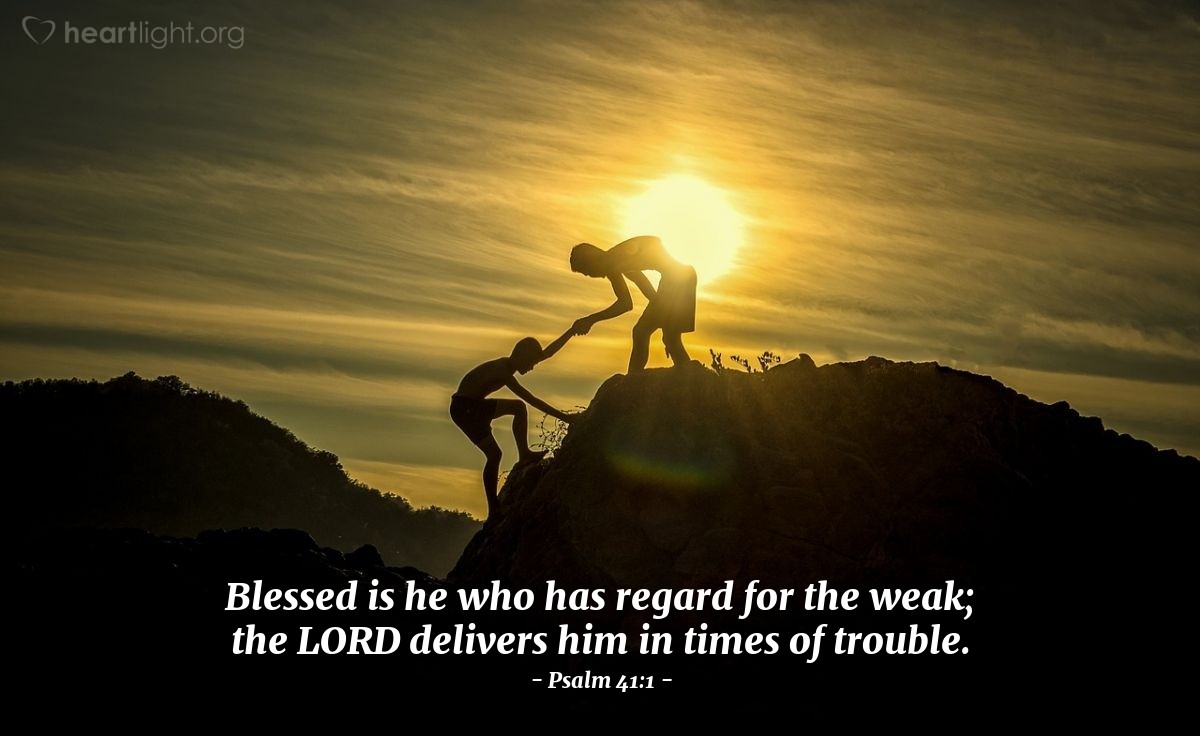
1 Happy are they who consider the poor and needy!
the Lord will deliver them in the time of trouble.
2 The Lord preserves them and keeps them alive,
so that they may be happy in the land;
he does not hand them over to the will of their enemies.
3 The Lord sustains them on their sickbed
and ministers to them in their illness.
4 I said, "Lord, be merciful to me;
heal me, for I have sinned against you."
5 My enemies are saying wicked things about me:
"When will he die, and his name perish?"
6 Even if they come to see me, they speak empty words;
their heart collects false rumors;
they go outside and spread them.
7 All my enemies whisper together about me
and devise evil against me.
8 "A deadly thing," they say, "has fastened on him;
he has taken to his bed and will never get up again."
9 Even my best friend, whom I trusted,
who broke bread with me,
has lifted up his heel and turned against me.
10 But you, O Lord, be merciful to me and raise me up,
and I shall repay them.
11 By this I know you are pleased with me,
that my enemy does not triumph over me.
12 In my integrity you hold me fast,
and shall set me before your face for ever.
13 Blessed be the Lord God of Israel,
from age to age. Amen. Amen.
-------------------------
==================
------------------------
Eng. What is this supposed to do?
Chn. 这应该怎么办?
Zhè yīnggāi zěnme bàn?
Jpn. これは何をすることになっていますか?
Korehanani o suru koto ni natte imasu ka?
Krn. 이것은 무엇을해야합니까?
igeos-eun mueos-eulhaeyahabnikka?
Ltn. Hoc est quod volo facere?
Itn. Cosa dovrebbe fare questo?
Grk. Τι πρέπει να κάνει αυτό;
Ti prépei na kánei aftó?
Spn. ¿Qué se supone que debe hacer esto?
Frn. Qu'est-ce que c'est censé faire?
Gmn. Was soll das tun?
Hng. Mit kell tennie?
Trk. Bu ne yapmalı?
Rsn. Что это должно делать?
Chto eto dolzhno delat'?
------------------------
Reward
Psalm 41
The psalm is addressed to the director of music for the temple as one that is 'of David.' It is possible that there was a standard musical form for the type of song.
It is an individual lament with a petition to be healed from illness. Individual laments are the most common type.
The last verse is not part of the individual expression itself. It represents a liturgical conclusion of the first segment of the Book of Psalms.
The parts are not equally divided of the 150 psalms in the book.
------------------------
Faith

First Isaiah contains the prophecies of the 8th-century prophet of Judah. These words were written either by himself or his contemporary followers in Jerusalem (from c. 740 to 700 BCE). There were some later additions such as chapters 24–27 and 33–39.
Second Isaiah (ch. 40–55) is the work of an anonymous 6th-century author who wrote during the Exile. Third Isaiah (ch. 56–66) was composed after the return from Exile.
Chapters 1-12 in Proto-Isaiah expressed oracles against Judah. These were from the prophet's early years. The theme of judgment is followed by the promise of restoration for the righteous.
The divine plan is to be realized on the "Day of the LORD". Jerusalem will be a model for the worldwide rule. The nations of the world will look to Zion (Jerusalem) for instruction. Israel is invited to join the plan.
Chapters 5-12 explain the significance of the Assyrian judgment against Israel. Chapters 13-23 presented oracles against foreign nations. The preparation of the nations for Yahweh's world rule is announced. These were from the middle years of the prophet.
The vision of the Apocalypse in chapters 24-27 was added at a later date.
Chapters 28-33 announce that a royal saviour (a messiah) will emerge in the aftermath of Jerusalem's punishment and the destruction of her oppressor. These oracles were from Isaiah's later ministry.
Chapters 34-35 tell how the redeemed exiles will be returned to Jerusalem.
Crocus

Isaiah 35:1-2
The wilderness and the dry land will be glad.
The desert shall rejoice and blossom.
It will blossom abundantly like the crocus
to rejoice in song.
The glory of Lebanon shall be given to it,
the majesty of Carmel and Sharon.
They will see the glory of the LORD,
the majesty of our God.
-------------------------
The wilderness will be glad.
The dry land will no longer be sad.
The desert shall rejoice and blossom.
The crocus will bloom as a symbol of promise.
The trees will produce wood and paper.
The majesty of mountain and plain will be savored.
The glory of production from substance will be seen.
The greatness of stateliness will be gleaned.
==================
Pray. Sing. Organize Order.

The epistle to James provides the counter-argument to salvation by grace. It doesn't argue that salvation doesn't come by the grace of God. The proposal is that good works are an expression of the faith by which salvation is rendered.
The person to whom this letter is ascribed is not held to be one of the two members of the Twelve who bore the name James (see Mt 10:2–3; Mk 3:17–18; Lk 6:14–15). He didn't identify himself as an apostle. He described himself as a servant of God and the Lord Jesus Christ. (James 1:1).
James, the brother of John, was killed by Herod Agrippa I (Acts 12:1–2). James, the son of Alphaeus, was not identified as a leader by scripture or tradition.
Another James is identified as a half-brother to Jesus (Matt.13:55). Paul went to visit this James in Jerusalem (Acts 21:18). Paul called this James, the brother of the Lord (Gal.1:19). Paul said that this person had received a visit from Jesus before the other apostles after the crucifixion (1 Cor.15:7 ). This was presented as evidence of the resurrection.
Paul wrote that it was James, Peter and John who recognized the grace that had been given to him (Gal.2:9).
This James was not a follower before Jesus died according to John 7:2-5. The gospel states that not even his brothers believed in him during his life.
He was executed in 62 CE according to Josephus. The apostle James was beheaded by order of King Herod Agrippa (Acts 12:1-2) is dated at 44 CE.
The letter was written prior to the meeting of the Jerusalem Council (Acts 15). James, along with Peter and Paul, affirmed the decision to take the gospel message to the Gentiles at that council. This council met in 49. This places the date for writing the letter between 45–48.
Such a significant event as the Jerusalem Council would have warranted comment from James, as he was writing to a Jewish Christian audience.
The letter is drawn from the Hebrew Bible and the sayings of Jesus. The letter is filled with offhand references, parallels and echoes of the sayings of Jesus. There are perhaps as many as 34. This suggests a composition before the sayings of Jesus were fixed and before authors used formal citations.
The letter is addressed to “the twelve tribes in the dispersion.” The term “twelve tribes” designates the people of Israel in Judaic scripture. The “dispersion” or “diaspora” refers to the non-Palestinian Jews who had settled throughout the Greco-Roman world (Jhn. 7:35).
The church is the new Israel in Christian thought. The address probably designates the Jewish Christian churches located in Palestine, Syria and elsewhere.
It is possible that the letter is meant more generally for all Christian communities. The “dispersion” has the symbolic meaning of exile from our true home as it has in the address of 1 Peter (1 Pt 1:1).
The Epistle of James is noteworthy because it makes no explicit reference to the death, resurrection or divine sonship of Jesus. The Protestant reformer Martin Luther denied it was the work of an apostle and termed it an "epistle of straw".
James is a letter only in the most conventional sense. It has none of the characteristic features of a real letter except the address. It belongs rather to the genre of parenesis or exhortation. It is concerned almost exclusively with ethical conduct. It therefore falls within the tradition of Jewish wisdom literature like Proverbs or Sirach.
It consists of sequences of didactic proverbs to many passages in Sirach and to sequences of sayings in the synoptic gospels. Numerous passages in the letter treat of subjects that also appear in the synoptic sayings of Jesus, especially in Matthew’s Sermon on the Mount. James railed against the hypocritical believer who says one thing but does another.
James encouraged his readers to rejoice in trials, speak with restraint, keep the royal law of love and prove their faith by good works. He exclaimed that God exalts the humble to warn against unchecked desire and judgmentalism.
There is an ascetic tone to the epistle that warns against favor for the rich in order to express compassion for the poor.
The correspondence is too general to establish literary dependence. James represents a type of early Christianity that emphasized sound teaching and responsible moral behavior. Ethical norms are derived from a concept of salvation that involves conversion, baptism, forgiveness of sin and expectation of judgment (Jas 1:17; 4:12).
The Jewish work was written in an excellent Greek style which ranks among the best in the New Testament. It appears to be the work of a trained Hellenistic writer. It was not written by a Jerusalem Jew. It was either recorded by a secretary or re-written in Greek at a later time.
James placed a spotlight on the necessity for believers to act in accordance with our faith. Believers are to pray, sing, speak with reserve, give alms and behave in accord with the moral code.
James 5:7-8
Be patient until the coming of the Lord, beloved. The farmer waits for the precious crop from the earth with patience until it receives the early and the late rains. You also must be patient. Strengthen your hearts for the coming of the Lord is near.
-------------------------
The farmer waits for rain to water the precious crop.
You also must be patient for the return from the top
before the final stop.
==================
Love

The gospel of Mark begins with the baptism and temptation of Jesus. Matthew introduces a family tree that traces the origins of Jesus back to Abraham to show him as a fulfillment of Messianic prophecies. The genealogy in Luke draws the line back to Adam.
The title Son of David identifies Jesus as the healing and miracle-working Messiah of Israel. He was sent to work miracles for faith in salvation by the love of God. As Son of Man he will return to judge the world.
There are about 15 instances in which Matthew interprets some event in the life of Jesus as a fulfillment of a prophecy. Christianity was not a definite break with the Jewish religion.
It was a development that allowed for the extension of the invitation to Gentiles to join. Christianity is a continuation and fulfillment of that which had been set forth in the scriptures as the history of salvation.
The gospel reflects the struggle with the conflicts between the evangelist community and other Jews. There is sharp criticism for the scribes, Pharisees and Sadducees.
Chapters 1-4 in Matthew mainly deal with the miracle birth of Jesus and the events surrounding His early life. This primarily involves the commonly told Christmas story but also includes the genealogy.
The infancy narrative tells of the massacre of the innocents, the flight into Egypt and the journey to Nazareth. This material is unique to Matthew. It is one of the elements that demonstrates that the gospel was written for a Jewish community.
The author was a male Jew that stood on the margin between traditional and non-traditional Jewish values. He was familiar with the technical legal aspects of scripture that were being debated in his time. The gospel was documented in a polished Semitic "synagogue Greek" that established the work as Hellenistic.
There are 5 sections after the infancy story. Each begins with a narrative that is followed by a discourse. Each section ends with the words "When Jesus had finished saying these things..."
The first narrative section begins when a man in a loincloth who lives by eating wild honey and locusts begins to prophesy of one who will come to baptize with the Holy Spirit and fire (3:11).
This prophet is John. He is likely a member of the ascetic Jewish Essene community. He eventually meets the one whom he believes to be the fulfillment of his prophesy.
Jesus receives the blessing of God with his baptism. A voice from heaven is heard to say, “This is my Son, the Beloved” (3:17).
He is led into the wilderness for forty days without food or water to be tested by Satan. Jesus emerges unscathed and triumphant. He begins to preach his message: “Repent! For the kingdom of heaven has come near” (4:17). His ministry begins.
His early ministry by word and deed in Galilee meets with success. The success leads to the Sermon on the Mount, the first discourse.
While the author of the Gospel of Mark emphasized the wonderful deeds that Jesus performed, Matthew places the major emphasis on the marvelous things that Jesus taught.
Some of the teachings were spoken directly to the inner group of disciples, but at different times and places Jesus addressed the 'multitude.'
Matt. 11:2-11
Jesus began to speak to the crowds about John after he sent the disciples from prison to speak to him: 'What did you go out in the wildersness to see? A reed shaken by the wind? What was it then? Someone dressed in soft robes? Look, those who wear robes are in royal palaces.
'Did you go to see a prophet? Yes, I tell you this is the one about whom it is written,
"See, I am sending my messenger ahead of you
to prepare your way before you."
'Truly I tell you no one has risen greater than John the Baptist among those born of women, yet the least in the kingdom of heaven is greater than he.'
-------------------------
John the Baptist was not dressed in royal robes in the wilderness.
He was a prophet of cleanliness against pathogenic microbes for the villainous.
No one was greater among those born of women
yet the fire of heaven cleanses the sin that was taken as given.
==================
Remembrance
George Santayana
b. 12.16.1863 Madrid, Spain
d. 9.26.1952 Rome, Italy
George Santayana was a philosopher, essayist, poet and novelist. He was born in Spain, but moved to the USA when he was 8 years old. He was educated in the country and wrote in English. He is generally considered an American man of letters.
His heritage is rooted in the Spanish diplomatic society with its stress on high education and familiarity with the world community. His father, Agustín Santayana, was born in 1812. He had studied law and practiced for a short time before entering the colonial service for a posting to the Philippines.
He served an apprenticeship to a professional painter of the school of Goya while studying law. A number of his paintings remain in the private possession of the family.
His wife, Josefina, was born in Scotland. She was the daughter of a Spanish diplomat. Josefina met Agustín while on vacation in Spain. They had met previously in the Philippines where Augustin had become the governor of Batang in 1845.
They were married in 1861. She moved to Boston to fulfill a promise she had made to her deceased husband, George Sturgis, to raise their children there. Augustin moved there later for the education of George. Augustin didn't stay long due to the cold Puritanical climate. Jorge stayed and changed his name to George.
Santayana would become a principal figure in Classical American Philosophy. He went to Boston Latin school. Then he went to Harvard at the undergraduate and a graduate levels.
He was a student of William James and Josiah Royce. He added naturalism to their pragmatism. His emphasis on creative imagination was a harbinger of important intellectual turns on both sides of the Atlantic.
He was a naturalist before naturalism grew popular. He appreciated multiple perfections before multiculturalism became an issue. He thought of philosophy as literature before it became a theme in American and European scholarly circles.
He managed to naturalize Platonism, update Aristotle, fight off idealisms and provide a striking and sensitive account of the spiritual life without being a religious believer.
Santayana was both a literary and a philosophical figure. John Dewey praised his Life of Reason in 1907 as a contribution to moral philosophy that rivaled that of Emerson.
His one novel, The Last Puritan, was a bildungsroman. The story was centered on the personal growth of its protagonist, Oliver Alden. Alden confronted the inevitable end of his Puritan belief.
Santayana was committed to metaphysical naturalism insofar as it tempered evolutionary theory with classical pragmatism.
He believed that human cognition, cultural practice and social institution have evolved so as to harmonize with the conditions present in their environment. Their value may then be adjudged by the extent to which they facilitate human happiness.
The position for evolutionary pragmatism is too optimistic in relation to liberal power, but his advocacy for classical reconstruction included the consideration of education for meritocracy. The openness to rebellion, revolution, world war or terrorism characterized the flaw for this kind of power.
He treasured the Spanish Catholic values, practices and worldview in which he was raised even though he was a self-declared atheist. He was a broad-ranging cultural critic. His critique spanned many disciplines.
He was profoundly influenced by Spinoza's life and thought. He was a devoted Spinozist in many respects.
Madrid
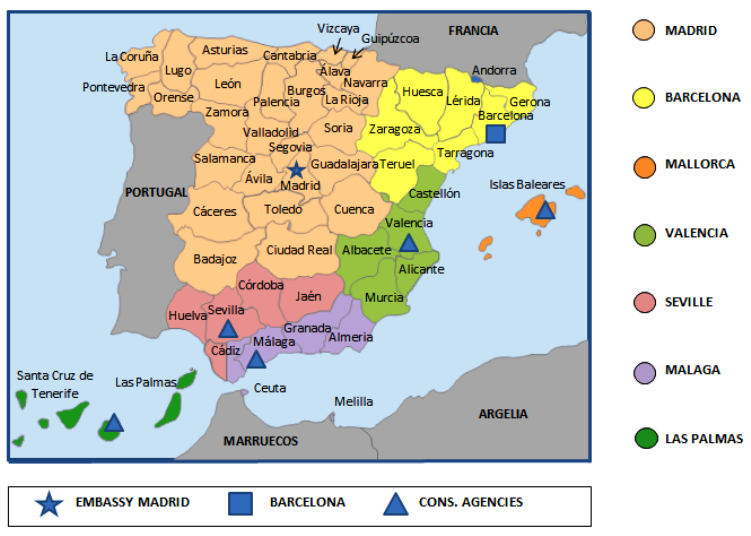
Madrid is the center of roads in Spain. It lies on the River Manzanares in the centre of both the country and the Community of Madrid.
It is the capital and most populous city of Spain. It is the seat of government and the residence for the monarchy. The crown is constitutionally instituted as the highest office of the country. Felipe VI from the house of Bourbon is the current monarch.
Madrid has preserved the look and feel of many of its historic neighborhoods and streets. Its landmarks include the Plaza Mayor, the Royal Palace, the Royal Theatre, the Buen Retiro Park, the 19th-century National Library, national museums and the Golden Triangle of Art.
The Peninsular War (1807-1814) against Napoleon during the reign of Ferdinand VII gave birth to a new country with a liberal and bourgeois character. Madrid experienced like no other city the changes caused by this openness.
The Spanish Revolution of 1854 was also known by the name Vicalvarada. It started with a confrontation between rebel troops under General Leopoldo O'Donnell, 1st Duke of Tetuan and government troops near the village of Vicálvaro.
This incident was followed by a military coup and a popular rebellion which occurred between June 28 and July 28, 1854 during the reign of Isabella II.
The Spanish Revolution ended the moderate decade (Década moderada) (1844-1854) and started the progressive biennium (Bienio progresista) (1854-1856).
George Santayana
Jorge Santayana was born on December 16, 1863 in Madrid and spent his early childhood in Ávila, Spain.
His mother, Josefina Borrás, had moved with her three surviving children to live in Madrid in 1861. She met Agustín Ruiz de Santayana, an old friend from her years in the Philippines. They married in 1862.
Josefina returned to Boston with her three Sturgis children in 1869. She had promised her first husband to raise their children in the United States. She left the six-year-old Jorge with his father in Spain. Jorge and his father followed her to Boston in 1872.
Augustin soon returned alone to Ávila. He remained there the rest of his life. Jorge did not see him again until he entered Harvard College and began to take his summer vacations in Spain.
Jorge changed his name to George in Boston. He attended Boston Latin School and Harvard University. He studied under the philosophers William James and Josiah Royce. He was involved in eleven clubs as an alternative to athletics.
He was founder and president of the Philosophical Club, a member of the literary society known as the O.K., an editor and cartoonist for The Harvard Lampoon and co-founder of the literary journal The Harvard Monthly.
He studied for two years in Berlin after graduating Phi Betta Kappa in 1886. He returned to Harvard to write his dissertation on Hermann Lotze.
Lotze was a German philosopher and logician. He had a medical degree and was well versed in biology. He argued that if the physical world is governed by mechanical laws, developments in the universe could be explained as the function of a world mind. His medical studies pioneered work in scientific psychology.
Santayana taught philosophy while he worked on his dissertation. He became part of the Golden Age of the Harvard philosophy department. A number of his students became famous. T. S. Eliot, Robert Frost, Gertrude Stein, Horace Kallen, Walter Lippmann and W. E. B. Du Bois were among them. He became friends with Wallace Stevens.
He studied at King's College, Cambridge from 1896 to 1897. He received his Ph.D. from Harvard in 1889 and became a faculty member at Harvard University (1889–1912).
He would remain there until his departure at the zenith of academic success.
Santayana cherished academic life for its freedom to pursue intellectual interests and curiosity, but he found that certain aspects infringed on that freedom. Faculty meetings and university committees seemed primarily to be partisan heat over false issues. He rarely attended them.
The general corporate and businesslike adaptation of universities was increasingly less conducive to intellectual development and growth. He expressed concern about the evolving Harvard goal of producing muscular intellectuals to lead America as statesmen in business and government. Were not delight and celebration also a central aspect of education?
He experienced a metanoia or change of heart in 1893. He gradually altered his style of life from that of an active student turned professor to one focused on the imaginative celebration of life.
He began planning for his early retirement. He found university life increasingly less conducive to intellectual pursuits and delight in life.
He wrote the Life of Reason during this emotional crisis. It was published in 1906.
Life of Reason (5 Vol.'s)
Text
He integrated the impractical notion of perfection into an unheard of application to biology for his pragmatic theory of evolution. He argued that the ideal has a natural basis and everything natural has an ideal development.
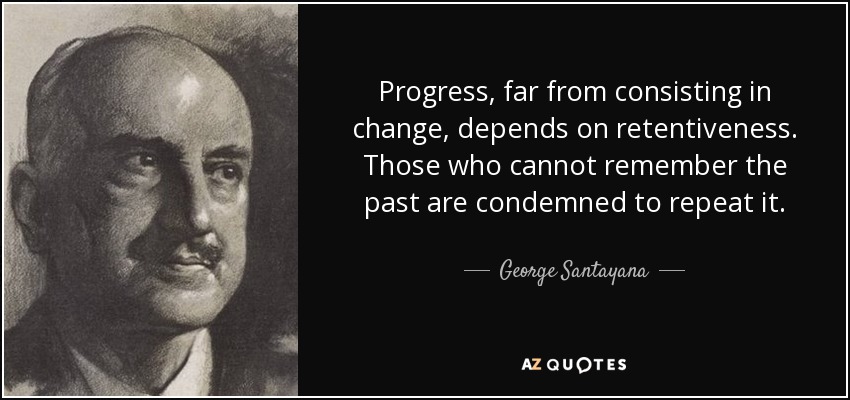
Happiness is that which sanctions life. Existence is a mad and lamentable experiment without it. Progress does not depend upon the relentless drive to change. It requires retentiveness. When the drive to change is absolute, there are no grounds for improvement.
Experience is not retained. Consciousness remains in cognitive infancy as among savage primitives. Those who don't remember the past are condemned to repeat it.
Fanaticism is the redoubling of effort after the aim for it has been forgotten. It's like Wile E. Coyote in his efforts to stop the Road Runner.
His thought on religion did not assume a position of perpetual aggression towards theism. He repeated Bacon's maxim. A little philosophy provides the inclination to atheism. Depth brings consideration to religion. The God to whom depth in philosophy brings thought is different from the one from whom a little philosophy has estranged the common antagonist.
Santayana was an early adherent of epiphenomenalism. This is a position on the mind–body problem which holds that physical and biochemical events within the human body (sense organs, neural impulses and muscle contractions) are causal with respect to mental events (thought, consciousness and cognition).
Subjective mental events are completely dependent for their existence on corresponding physical and biochemical events within the body. There is no causal efficacy on physical events without action.
The appearance that a subjective mental state (such as intention) influences physical events is an illusion. Fear seems to make the heart beat faster, but the biochemical secretions of the brain and nervous system (such as adrenaline), not the experience of fear, is what raises the heartbeat. The position is a kind of mental tightrope for watching internal causation in somatic reaction.
Mental events are a kind of overflow that cannot cause anything physical. It's the counter to the claim to the existence of paranormal phenomena.
It provided the basis for the definition presented by Ducasse. A paranormal event does not have a physical cause. It's the basis for the description of belief in 'magical' things like telekenesis, clairvoyance or teleportation.
Satayana admired the classical materialism of Democritus and Lucretius. He was most favorable towards Lucretius of the three authors on whom he wrote in Three Philosophical Poets. He held Spinoza's writings in high regard. He called him his "master and model."
Santayana took advantage of a modest inheritance from the death of his mother to retire from Harvard and left for Europe indefinitely.
He divided his life into three phases in his autobiography, Persons and Places (1944). The background (1863–1886) encompassed his childhood in Spain through his undergraduate years at Harvard.
The second period (1886–1912) was that of the Harvard graduate student and professor with a trans-Atlantic penchant for traveling to Europe. The third period (1912–1952) was as the retired professor writing and traveling in Europe who would eventually establish Rome as his home.
He lived eight years in Spain, forty years in Boston and forty years in Europe. He died in Rome at 88 years of age.
George Santayana
S. 乔治·桑塔亚娜
T. 喬治·桑塔亞娜
乔 Qiao tall, stately 喬 kyo high Jo じょ- ジョ- Jo 조 article
治 zhi to punish 治 ji reign ji じ ジ ji 지 g
桑 Sang mulberry 桑 so mulberry San さん サン San 산 mountain
塔 ta tower 塔 to pagoda ta た タ ta 타 ta
亚 ya second 亞 a rank ya や ヤ ya 야 ha
娜 na elegant 娜 da graceful na な ナ na 나 I
------------------------
The mulberry tree grew beneath the tower.
It cast a shadow that didn't touch the tower at any hour.
It shaded the grass so practical benefit wouldn't sour.
Thought or feeling doesn't cause an external event by will alone.
The mountain that is moved is the image of expectation grown as known.
Remembrance is a mental event that tenders thought about change.
Pragmatic evolution becomes a state for which there exists a range.
It has to be considered to be known.
It has to be known to be owned.
It has to be owned to be honed or blown.
It has to be honed to be shown.
The elegant grace for the resultant condition
self-governs for reasonable ambition.
==================
Pure Experience

William James
Varieties of Religious Experience
Text
The Varieties of Religious Experience was written about natural theology from a medical point of view. William James was trained as a physician. He taught anatomy at Harvard, but never practiced medicine. He developed his interest in psychology and philosophy. He has been called the Father of American psychology.
His view of religion wasn't limited to the Christian perspective, but it was informed by it. This opened the door to the integration of the Christian and classical societies. This classically Christian position has room for development with the reformed epistemology of Plantinga and Craig.
James looked at the religious experience as an encounter with pure perception. There is the theme of individual contact with the manifest reality of the personal character of the oneness of the universe in the reports of this pure experience.
Cognition was minimized in relation to consciousness. The sense of benign purpose was identified by major representatives of this phenomenal involvement with the Designer of the design for existence.
The subtitle for the book is A Study in Human Nature. This is significant in itself insofar as that which is human can be defined by way of contrast. Berkeley's emphasis on the immaterial was promoted to consider the mental view of material reality.
That which is common to the conceptions of the human and divine natures is the capacity to create. The difference is a matter of scale. The divine nature is held to have created the universe. This is beyond the capacity of human nature.
Humans create that which we are able to produce with our knowledge of materials. The knowledge is a relatively 'immaterial' memory of tests that involve components of substance.
The religious experience has produced written testimony regarding the special nature of the communion with that which was personal about the union with that which exists outside of the ordinary perspective on perception.
While this is interesting insofar as it is unusual, there is the question of practical value. Religion was developed with functional regard for religious awe. It is a system for organization that allows for personal and social applications.
The interaction between religion in government finds expression in respect for freedom, but this freedom is contained within the parameters of legal polity.
That which is legal about polity finds agreement with the medical paradigm defined by the goal against harm. The goal is presented with respect for the practical application against damage.
James developed this medical concern in relation to the warning against action in compliance to command hallucination. If someone 'hears' a voice that tells him to kill someone else, it is categorized as a hallucination due to the contradiction with the law against murder.
The command of the hallucination holds proximity to the antiquated definition of republic. When Cicero stated that insurrection was the chief concern for the security of the republic, he stated a legal opinion. When reported that the 'rebels' were executed without a trial, he reported an illegal action as though it were validated by his authority as consul.
His position was presented after Sulla had claimed dictator as a title in his consulship. He had taken Rome by armed force with his military leadership twice to promote his campaign against the Mithridates.
The story about the sword of Damocles was known to Cicero. It was most likely a case of fake news in the formation of Roman republic.
It set a bad precedent for reports on government action. If the leadership reports action in contradiction to the legal application of habeus corpus, it is presenting the image of being above the law. This may win some notoriety with respect for the special nature of leadership in government, but it loses credibility in legal authority as a consequence.
The collateral damage is such that the leadership is then compelled to use surveillance to watch for criminal reaction to the report of criminal action.
Where is the line for punishment to be drawn? Is the presumably 'false' report to be followed by violent law enforcement against objection to report of the action as a precedent for political policy? That would almost guarantee partisan partiality in judgment.
There is this consideration as well. Suppose people chose to assemble in the streets to protest the 'action.' What is law enforcement supposed to do? Are they to meet fire with fire to punish protest with violent action that could range from assault to summary execution?
The collateral damage of anger in reaction to the report would have produced more collateral damage with cruel punishment as the means to repress the protest. If the protest was non-violent the punishment would be cruel by virtue of the excess force used to put down the protest as a 'rebellion.'
Did Cicero produce security as the result of his report or did he antagonize the opposition with his defiance of regard for legal polity? He provoked a volatile reaction to invite the treatement of protest as riot with his report of execution without a trial.
Cicero provided an historical example of how not to act as consul.
William James was aware that his treatment of the topic of variety in religious experience had to be informed by his recognition of logical investigation.
His application of logic asked the question about the propensities of the experience. This addressed the psychological aspect of the inquiry. He also asked about the philosophical significance. The questions addressed the distinction between perception and conception in empirical investigation as it could be found in documentation.
The perceptual is existential. The conception is noetic or spiritual in judgment. Existential and spiritual judgments are combined after the separate experience of them. They can be synthesized for practical value.
He wrote, "In the matter of religions it is particularly easy to distinguish the two orders of question. Every religious phenomenon has its history and its derivation from natural antecedents. What is nowadays called the higher criticism of the Bible is only a study of the Bible from this existential point of view, neglected too much by the earlier church." (p.005)
------------------------
The experience of existence is qualified by immaterial judgment.
Aesthetics avoid the abundance of pungence in indulgence.
The judgment of material by that which immaterial in mind
is established by test that qualifies the knowledge that we find.
==================
The religious literature for monotheism was organized in the category of the 'fear of God' by writers like Sirah. What was the biographic condition for this proposition? He was acutely aware that the predominant social view was conditioned by polytheistic stories.
What did those who agreed with the proposition have in mind with the intent of agreement? Aren't there a variety of experiences that can be categorized as fear or the fear of God?
These are manifestly questions of historical fact. The answer to them can decide the further question of the use of religious literature as a guide to life with the vicarious or literary experience of revelation.
The value of the revelation is not found in a work without error. Our theory allows that the book is a document of religious experience despite the errors and contradictions expressed by the different views expressed in it.
Royce would have called in the expression of a community. It is a true record of the inner experience of individuals who were wrestling with the crisis of their condition.
Existential facts are insufficient for determining value by themselves. Higher criticism doesn't confound the existential with the spiritual. It seeks to select the best expression of the spiritual with respect for the existential. It could be called an immaterialist view of material existence.
The study has to be opposed to the pathological aspects of religion's existential conditions particularly with regard to the consideration of visions. There is an inclination to refrain from the analysis of something that is regarded as an area for devotion.
Error in over or under generalization presents itself as a problem in any categorization. An individual doesn't want to be categorized with generalization when the generality threatens to distort unique value.
A crab would probably be filled with a sense of personal offense at being categorized as a crustacean without apology. It is not difficult to imagine the creature saying, "I am no such thing." It might well say, "I am myself and myself alone." Generalization is the consequence for the question of the nature of a thing nonetheless.
Crustaceans are aquatic arthopods. They have shells. A crab is a crustacean, because it has a shell and lives mostly in water. Likewise the command hallucination to kill someone who doesn't present the threat of deadly force in an imminent way has to be judged as pathological.
The action of the 'new man' wasn't legal counsel because he reported an illegal punishment as his official reaction to the threat of a condition that he antagonized with his report. It was an open door to the perpetuation of abuse by the use of excess force.
---------------------------
Justice is the product of the union represented by good government.

John Jay was one of the statesmen who wrote as Publius to persuade the public to accept the United States Constitution. He became an important leader of the Federalist Party after the ratification of the Constitution in 1788.
He had been born into a wealthy family of merchants and statesmen in the New York city government. The family was of French and Dutch descent. They organized opposition to British policies in the time preceding the American Revolution.
He served as the ambassador to Spain after he helped ratify the US Constitution with the Federalist Papers (1788). Spain was persuaded to provide financial aid to the fledgling United States. He presented the persuasion during his term from 1779 to 1782.
He was a negotiator of the Treaty of Paris in which Britain recognized American independence.
He was an advocate for centralized government. He served as the first Chief Justice for the US when George Washington was president. He negotiated the highly controversial Jay Treaty with Britain.
It facilitated 10 years of peaceful trade between the United States and Britain in the midst of the French Revolutionary Wars. The wars began in 1792.
The treaty was designed by Alexander Hamilton and supported by President George Washington. It was signed in 1794.
It angered France and divided Americans. It inflamed the new growth of two opposing parties in every state. The pro-Treaty Federalists were opposed by the anti-Treaty Jeffersonian Republicans.
The Jeffersonians feared that closer economic or political ties with Great Britain would strengthen Hamilton's Federalist Party, promote aristocracy and undercut republicanism.
The Federalists favored the British and the Jeffersonian republicans supported France in the First Party System. The treaty was not replaced by another after it expired.
He was an opponent to slavery. When he served as Governor of New York from 1795 to 1801 he helped enact a law that provided for the gradual emancipation of slaves. The institution of slavery was abolished in New York in Jay's lifetime.
Jay wrote 5 of the 85 Federalist papers. The second one was his. It was about how the union provided protection from the dangers of foreign power.
The Federalist Papers #2
Text
He promoted the propriety of serious consideration for the Constitution. He argued that the government is an indispensable necessity.
People must cede to it some of their natural rights in order to vest it with requisite powers. The type of government was what the people were being asked to consider.
Did they want a single federal government or did they want separate confederacies?
Prosperity was dependent upon union. The wisest citizens were directed to obtain that objective.The division of the union would reduce the security of the nation. It would not be wise to divide without thought about whether their proposal was better.
Independent America was not composed of detached and distant territories. It was one connected, fertile, widespread country whose portion was for liberty.
Providence had blessed it with a variety of productions from soil and toil. It has been watered with innumerable streams for the delight and accommodation of its inhabitants.
Navigable water formed a kind of chain round its borders as if to bind it together. The rivers ran at convenient distances. They were used as highways for the communication of aid, transportation and the exchange of commodities.
Providence had also been pleased to give this connected country to a united people with the same language and principles of government.
Many of her ancestors were driven from their homelands to favor factional power. Joint counsel in war established law for independence.
The inheritance of the union appears to be by the design of Providence. It should not be split into alien sovereignties. We have been one with each citizen having the same rights, privileges and protection.
The nation sought peace, formed alliances, made treaties, entertained contacts with foreign states and won war. Federal government was formed for political existence.
Habitations were in flames, citizens were bleeding, desolation progressed with hostility in a way that left little room for the organization of a reasonable and balanced government for the freedom of the people.
Liberty was the product of the convention in Philadelphia. The convention spent months in daily consultation for the love of the country to produce a plan for the people with their council.
The apprehension of imminent danger induced the formation of the Congress of 1774. A plan was recommended for ratification by officials elected by vote.
The body recommended measures for their constituents, but the media was flushed with stories of opposition from officials who sought the dictate of personal interest. This assault on sensibility happened soon after the recommendation was made to the public.
Ambition aimed at objects which did not correspond with the public good. Their pride demanded the rejection of advice for patriotic unity.
The majority of the people reasoned judiciously despite the bad press. They considered that the Congress was composed of officials from different parts of the country who were experienced in the formation of policy for the interests of the nation.
Members from that same Congress who have grown old in acquiring political information had carried their accumulated knowledge and experience through subsequent conventions in thinking that the prosperity of America is dependent upon union.
The convention was formed by election with the vote of the people. It has in turn voted to recommend the people adopt the proposal for union with the Constitution.
Are more confederacies better than one? Those who are against the recommendation have opposed the continuance of security for the union.
Jay saw national government as necessary for negotiation with foreign states for the security and prosperity of the people in the country. He believed that division into confederacies would result in the loss of greatness.
The union of the nation
is for the prosperity of the united station
in negotiation with foreign states
and protection from alien hates.

The problem with student loan debt was created by national intervention.
Student loans are offered as financial aid. National aid should be facilitated through state government.
National intervention for government control of school district policy has promoted local prejudice to hire or fire instructors and administrators with grant money for schools with lower incomes.
The populations for all the schools in our district were changed by the order for forced busing. The number of poor students was increased by the action. .
Employees not qualified by instruction are favored over those with instruction and experience in education.
How many with instruction and experience in education have not been hired or have not been retained BECAUSE they got financial aid as a loan?
How many schools that have received a government grant (Title I) for the school have had to deal with a no pass policy even for students who have been doing their work?
The national government isn't supposed to make demands on local school administration, but the assumption of prejudice in the majority group has been used to force local administrators to adopt national 'guidelines.'
The no-pass policy has created major problems with student behavior, but national intervention won't allow the refusal of a bathroom pass to be limited to students who refuse to do their work.
The policy won't allow students who act like undocumented immigrants to be expelled for the disruption of class instruction.