Showing posts with label Messiah. Show all posts

Sunday, December 15, 2019

Reach

12.22.19

Katie Holmes

Reach
Higher
达到更高
Dádào gèng gāo
より高く到達する
Yori takaku tōtatsu suru
ps61
Altius semoto

I have hiked into the highlands through rocky terrain.
I saw from a height that gave me a vision of the plains.


Sinai Wilderness

I had been lowered into the mud at the bottom of the cistern.
Deliverance from hunger was not a liberation that I could discern.


Ancient Cistern

I felt my feet slip into the deep dark waters from the mire 
but I was saved with help that made me feel honored with desire.


Dark Waters

I had called for help and was delivered.
I stood on rock with a gratitude that shivered.

Listen to my prayer for salvation with insight, benign Divine Light.
I request your help as darkness increases the length of night.

I will call to you from the heaviness of my heart
from the ends of the earth with a chart for the path of my part.

You set me on a rock that was higher than me
after I cried to you whom I could not see. 

You have been a strong tower against the enemy.
You have provided the remedies for adversity to my destiny.

The flag for the settlement was raised above the dust
to announce the measure of grain for exchange against the rush
for going bust.  

I will dwell in your house forever.
Your help makes my burden feel as light as a feather.

I will hide beneath the cover of your wings
to rejoice in the blessed favor that sings.

How do I get there from here
if I don't offer holiday cheer?

Goodness in life has been an answer to my prayers.
The preservation of your promise has strengthened my care.

The heritage of those who revere your Name
has granted me the capacity to tame ridicule and shame.

You will be given a sign to see the word as witness.
A young woman will bear a son and call him 'God with us.'

The birth of Jesus as the Messiah took place in the conception.
Mary was found to be with child by the Holy Spirit in the creative inception.

The gospel was promised through the prophets in the scriptures done.
Grace to you and peace from the Father and Jesus Christ, the Son.

The gospel needs the Church to nurture growth.
The Church needs the gospel to grow in significance and size to show.

Science holds an elegant place in faith.
It is like a spear thrust that defines a point in space.

Add length of days to life in the line of political succession
that public policy may become an expression of progression.

Let the leadership sit enthroned by grace
to be mindful of kindness for the human race.

Bid love to watch decision with faithfulness
that others may decide to work with gratefulness.

I will sing praise with respect for your Name
that my vows may be fulfilled for success in fair games.

-------------------------

61 Exaudi, Deus
Answer, Light

1 Hear my cry, O God,
and listen to my prayer.
2 I call upon you from the ends of the earth
with heaviness in my heart;
set me upon the rock that is higher than I.
3 For you have been my refuge,
a strong tower against the enemy.
4 I will dwell in your house for ever;
I will take refuge under the cover of your wings.
5 For you, O God, have heard my vows;
you have granted me the heritage of those who fear your Name.
6 Add length of days to the king's life;
let his years extend over many generations.
7 Let him sit enthroned before God for ever;
bid love and faithfulness watch over him.
8 So will I always sing the praise of your Name,
and day by day I will fulfill my vows.

----------------------
=============
----------------------

How do I get there?

Chn.   我如何到达那里?
           Wǒ rúhé dàodá nàlǐ?
Jpn.   どうやってそこまで行くの?
           Dō yatte soko made iku no?
Krn.   내가 거기 어떻게?
           Naega geogi eotteohge?
Ltn.    Quomodo illuc?
Itn.     Come ci arrivo?
Grk.    Πως πάω εκεί?
            Pos páo ekeí?
Spn.    ¿Como llego hasta ahí?
Frn.     Comment puis-je y arriver?
Gmn.   Wie komme ich dort hin?
Hng.     Hogyan jutok oda?
Trk.      Oraya nasıl giderim?
Rsn.     Как туда попасть?
            Kak tuda popast'?

How do I get there from here
if I don't offer holiday cheer?

-------------------------

Abridged Individual Lament of Jeremiah

Higher Ground


Psalm 61

The psalm is in the second of the three sections for the book.

It is addressed to the musical director of the temple. It specifies the use of a stringed instrument (Neginah). It is identified as a psalm of David, but it shares a similarity with the individual lament attributed to Jeremiah when he was thrown into the empty well.

Psalm 40:2

He lifted me up from the pit of destruction, my feet from the miry clay. He set my feet on a rock and made my footsteps firm.

-------------------------

The rock was higher than the depth of the cistern. It was higher than him.

Does the designation psalm of David indicate that there were times when the monarch participated in singing the song in religious devotion in the house dedicated to worship?

There is the distinct possibility that the designation was the reminder of the king's existence, even if he was not physically present. He was present in his absence by virtue of the reference to the name for the first in the line of royal succession.

All the kings in the line were loved by God with respect for the promise of the inheritance.

The prophet Jeremiah had predicted the destruction of Jerusalem. A number of officials were offended by the prediction. They wanted to have him put to death. The king allowed him to be punished by the officials according to their choice. They cast him into an empty well. It was probably no more than 12 feet in depth, but it was higher than his ability to climb out of it.

Jeremiah 38:6

They took Jeremiah and put him into the cistern of Malkijah, the king's son. It was in the courtyard of the guard. They lowered him into the empty well by ropes. There was only mud at the bottom. Jeremiah sank into the mire.

----------------------

The king was Zedekiah. He had said, "Here he is. He is in your hands since the king can do nothing to stop you." (Jer. 38:5)

Zedekiah had been made the king of Judah by Nebuschnezzar, king of Babylon (Jer.37:1). The Babylonians were attacking Jerusalem even though their king of kings had appointed the monarch for Judah.

Their army withdrew when they heard the Pharaoh's army had set out from Egypt. Jeremiah warned that the Babylonians would return. They would not stop the attack until they had destroyed the city and taken the leadership captive. (Jer.37:10)

Jeremiah went to the land of Benjamin to tend to the collection of his inheritance. He was charged with desertion to the Babylonians and detained in a house as a prison. He was taken to the king after some time.

He asked the king what his crime was. How was it that the prediction that the Babylonians would not attack was acceptable?

He asked that he not be returned to the location where he had been detained. He felt that he would be allowed to die. The king had him kept in the courtyard of the guard with orders that he be fed. (Jer.37:21)

The officials argued that Jeremiah should be put to death for his prophesy. They said it discouraged the soldiers and the people with his predicition that Jerusalem would be destroyed. He had also predicted that those who stayed would die by the sword, famine or plague (Jer.38:2). They said that he was not for the people. He was for their ruin.

Jeremiah was put in the muddy cistern indefinitely. Ebed-Melek, an official of the palace, heard of what happened. He petitioned the king for Jeremiah's release. He argued that the prophet would be left to starve. The king sent him with 30 men to pull him out of the cistern before he died. (Jer.38:10)

The king had an honest discussion with the prophet about the predicted outcomes. Jeremiah told him that he would be spared if he surrendered. The women and children would be taken captive, but he would be killed or captured, if not. (Jer.38:23)

Jeremiah was detained in the courtyard of the guard until Jerusalem was taken. (Jer.38:28)

There are a number of references in the psalms regarding the struggle with mire. This verse appears to be a direct reference to the experience of Jeremiah as the prophet. He saw his predicament as a portend of what was to happen to Judah.

The time in captivity would be followed by deliverance. Unsure footing would be replaced with rock as the terra firma.

It was not explicitly predicted that the appointed king would be replaced by a govenor or that the kingdom would become a province in the empire.

Psalm 40:2

He lifted me up from the pit of destruction, my feet from the miry clay. He set my feet on a rock and made my footsteps firm.

----------------------

This statement was modified in another psalm to allude to the sense that the experience of the mire felt like it was coming before something even worse. The reader is asked to imagine the sensation of sinking from mud into deep water where there is no sensation of firmness beneath his feet.

Psalm 69:2

I have sunk into the miry depths where there is no footing. I have drifted into deep waters where the floods have engulfed me.

----------------------

If you can swim, the experience isn't as frightening as it would be for someone who hasn't been taught. Being able to swim could make the difference between making it to safety and drowning in the depth of water. Fear is a determinant factor.

Psalm 69:14

Rescue me from the mire and do not let me sink. Deliver me from my foes and from deep waters.

----------------------

Knowledge of how to swim allows for the confidence that solid ground will be found. Fear contributes to panic. Panic is likely to result in unconsciousness or death due to water being taken into the lungs. 

The lungs aren't able to extract oxygen from the water. They can take it from the air.

Psalm 61 is short. It is not as descriptive as other laments. It anticipates deliverance efficiently. It anticipates it anywhere in the world.

The suggestion offered by the statement that he will cry from the end of the earth suggests that prayer for salvation can be offered from any location at any time that the heart feels overwhelmed.

The request to be led to the rock that is higher than I is based on the experience of standing on solid ground.

Anyone who has hiked to higher terrain can tell you that height gives you the ability to see the surrounding area. The sight of that which exists below gives perspective, provided that there is enough light to see.

The higher rock became a metaphor for defense. Build a castle on the highest ground in the area and you can visually anticipate the movement of an army.

This metaphor represented the vision of that which could be constructed, but it was based on the relation of the thought of the brain as higher than the feelings of the heart.

--------------------

Ask for a sign


The Assyrians invaded the Northern Kingdom in 737 BCE. King Menahem of Israel (743-738) became a vassal of the Assyrians.

He made two tribute payments to Assyrian King Tiglath-Pileser III according to Assyrian annals. He paid the tribute for the political support of Assyria to continue to rule with "a thousand talents of silver" (2 Kgs. 15:19-20).

Menahem was succeeded by his son Pekahiah (2 Kgs. 15:23-26). He was assassinated by Pekah son of Remaliah (737).

Pekah decided to resist the Assyrians. He made an alliance with Razon, the king of Damascus. When King Ahaz refused to join the alliance they joined forces to attack Judah. Modern historians call attack the Syro-Ephraimite War (735-734).

Judah was faced with invasion by its northern neighbors, Israel (Ephraim) and Aram-Damascus (Syria).

Isaiah took his young son with him to meet King Ahaz. Isaiah's son's name was Shear-Jashub. It meant "a remnant will return." The boy was a visual reminder of God's mercy in His promise of the preservation of a faithful remnant.

The destruction of Judah's enemies was prophesied by Isaiah prior to the conquest of Syria by Assyria in 733 BCE. (Isa. 7:1-10)

Isaiah delivered a message to Ahaz that invited him to ask for a sign to test the truth of the prophesy. (Isa. 7:11) Ahaz refused. He said that he would not test God. Isaiah replied that his sign would be the birth of a child.

The mother would call the child Immanuel, meaning "God with us." (Isa. 7:13-14)  It was predicted that by the time he was eating curds with honey with the knowledge to reject the bad, Ephraim and Syria would be destroyed.

The word almah in the original Hebrew of Isaiah 7:14 meant a young woman of childbearing age who had not yet given birth, however the Greek translation in the Septuagint rendered it as parthenos.

The word means 'virgin.' Jesus was interpreted as the fulfillment of the Immanuel prophesy in the gospel of Matthew. (Matt.1:23)

Isaiah 7:14

Therefore the Lord himself will give you a sign. Look, the young woman is with child and shall bear a son. She will name him Immanuel.

-----------------------

You will be given a sign to see the word as witness.
A young woman will bear a son and call him 'God with us.'

=================

Grace to you

The  expression "son of man" (ben-'adam) appears 107 times in the Hebrew Bible. This is the most common construction for the singular reference to human nature. It appears 93 times in the Book of Ezekiel alone. It is used only 14 times elsewhere.

The phrase appears in intermediate plural form "sons of men" in 32 cases. As generally interpreted by Jews, The title "son of man" denotes humanity in contrast to deity or godhead. There is special reference to weakness and frailty by contrast.

The title is used by "God" in reference to Ezekiel in the book that goes by the name of the prophet. Ezekiel was the prophet in the sense that he was the representative of being human.

The title takes on greater significance in the Book of Daniel. One like the son of man came to the Ancient of Days and  was presented before him. He was given dominion, glory and a kingdom that the people of all nations and languages were to serve.  His kingdom was indestructible.

The imperial title "son of god" wasn't regarded as acceptable to Judaic monotheism. Opposition to the concept of the god-man marks the distinction between the Judaic and Islamic religions with Christianity.

It is conceivable that the notion of the emperor as the son of heaven started with the Chinese, moved to the Middle East and was adopted by the Romans by way of the Greeks.

The expression "son of man" occurs 81 times in the Greek text of the four Canonical gospels. The Son of Man had the power to heal with the forgiveness of sin. He came to serve and to give his life as a ransom for many.

Jesus came from humble circumstance. He was like Gautama Siddhartha after he left his royal station.

The use of the definite article for the Son of man in the Koine Greeek of the Christian gospels is original. There are not records of its use in any of the surviving documents of antiquity.

The title was shortened to the Son during the time of the apostles. The development of the theology for the Son of God would not be officially developed and accepted as Christian until the Council of Nicea in 324 CE.

When Jesus used a title to describe himself, he spoke of the Son of Man. When he was called the Son of God it was ascribed to him by others. He simply said that you had so stated it.

The profession of Jesus as the Son of God has been an essential element of Christian creeds since the end of the Apostolic age when Constantine embraced the Christian faith as the official religion for the empire.

Such professions were not applied to the acceptance of Jesus as the Son of Man. The expression was taken as Jesus self-designation as a continuation of the revelation of the truth of the law and the prophets.

It is likely that the preamble to the greeting to "all God's beloved in Rome" was added after Christian scripture was officially designated as the text for the imperial religion.  Religion did not present as a problem in society until the official form was treated as the only legal kind.

Such treatment was sectarian. It suggested that other forms were officially interpreted as an indication of rebellion or treason. The emphasis of the reformed epistemology is such that Christianity can be favored in debate, but the free will defense allows for other forms as legal provided they don't organize for riot, rebellion, revolution, world war or terrorism.

Romans 1:1-7

Paul, a servant of Jesus Christ, called to be an apostle, set apart for the gospel of God, which was promised beforehand through his prophets in the holy scriptures, the gospel concerning his Son, who was descended from David according to the flesh and was declared to be Son of God with power according to the spirit of holiness by resurrection from the dead, Jesus Christ our Lord, through whom we have received grace and apostleship to bring about the obedience of faith among all the Gentiles for the sake of his name, including yourselves who are called to belong to Jesus Christ,

To all God's beloved in Rome, who are called to be saints:
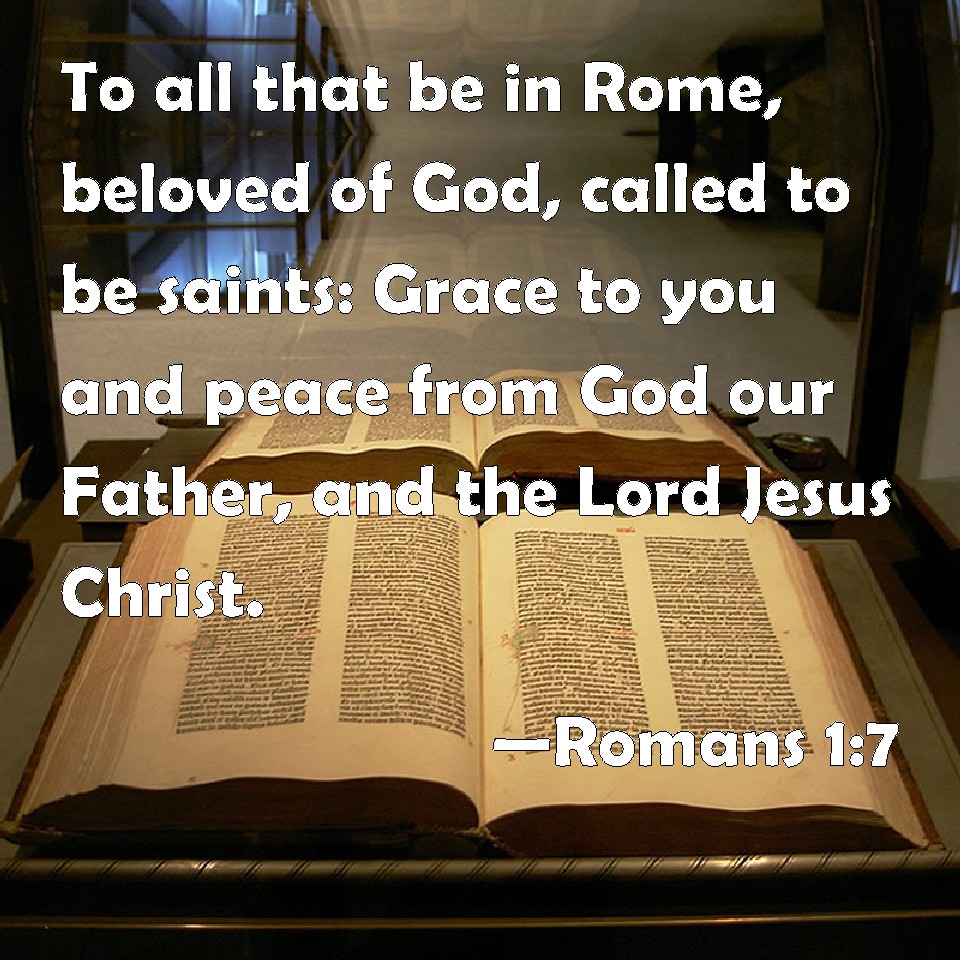
Grace to you and peace from God our Father and the Lord Jesus Christ.

-----------------------

The gospel was promised through the prophets in the scriptures done.
Grace to you and peace from the Father and Jesus Christ, the Son.

==============

God Saves

The word almah occurs 9 times in the Hebrew Bible.

The prophesy in Isaiah 7:14 is one of those. The examples that precede that period of the timeline give an indication of the role of women in the society. They also lend meaning to the definition for almah.

Abraham had sent a servant to seek a wife in his former homeland. The servant told his master how he had prayed that should an almah provide his camel and him with water from the well, he would take that as a sign that she was to be the wife of Isaac. Rebecca was the young unmarried woman. (Gen.24:14)

The heading for Psalm 46 notes that the song is to be played on alamot. It could have been a reference to a special selection of women's voices or an instrument made in the city of "Alameth". It is likely that women in Hebrew culture celebrated life with music.

The alamot are listed in Psalm 68:25 as participants in a victory parade. They are listed after the singers and musicians. They were designated as the players with cymbals or tambourines.

A man with a young woman was described as something difficult to understand in Proverbs 30:19. The Septuagint translated the text to the way of a man in his youth. Proverbs was probably written after the time of Ahaz, but the sense of unpredictability was associated with youth and the future.

Isaiah 7:14 tells how the pregnancy of an almah will be the sign that the enemies of Judah will be destroyed before the son of the virgin grows much in age. Israel and Syria fell to Assyria within a few years.

Aram-Damascus, under Rezin, and Israel, under Pekah, attempted to depose Ahaz through an invasion in 735.

Judah was being defeated according to 2 Chronicles. Officials were killed including the king's son. Others were taken away as slaves. The Second Book of Kings states that Rezin and Pekah besieged Jerusalem but failed to capture it. (2 Kgs.16:5 )

The Assyrians defended Judah.  Israel, Aram-Damascus and the Philistines were defeated in a number of years after the start of the assault (736-732). The post-war alliance brought trouble to the king of Judah.

Ahaz had to pay tribute to Tiglath-Pileser III with treasures from the Temple in Jerusalem and the royal treasury. He also built idols of Assyrian gods in Judah to find favor with his new ally.

The Northern Kingdom of Israel was conquered by the Neo-Assyrian monarchs, Tiglath-Pileser III (Pul) and Shalmaneser V. The later Assyrian rulers Sargon II and his son, Sennacherib, were responsible for finishing the 20 year demise of Israel's northern ten-tribe kingdom. These would come to be known as the Ten Lost Tribes.

Forced relocation for captivity began about 740 BCE. The ruling city of the Northern Kingdom, Samaria, was finally taken in 722 by Sargon II after a three-year siege started by Shalmaneser V.

The Fall of Assyria is conventionally dated between 613 and 611. The year in between is the most supported date. An allied army that combined the forces of Medes and the Babylonians with Scythians and Cimmerians besieged Nineveh in 612.

The fall of Nineveh led to the destruction of the Neo-Assyrian Empire over the next three years as the dominant state in the Ancient Near East.

Babylon became the imperial center of Mesopotamia for the first time in over a 1000 years. The Neo-Babylonian Empire claimed imperial continuity as a new dynasty.

The prediction that Assyria would fall as one of the enemies took place over a longer period in time. It took over a century for fulfillment. Babylon would fall to the Achaemenid empire in 539 well after the destruction of Jerusalem in 587 BCE.

The prophesy of Isaiah had relied on the predictability of success in forming alliance with the dominant power for the time.

The image of the almah had acquired a great deal of power in the time between the Assyrian and Roman dominance.

If Isaiah had meant that the young woman had not had sexual relations, the word betulah was more common. There here are two types of betulot in the Hebrew scriptures. The true virgin and the “betrothed virgin” (betulah m’orashah) are both cited.

The state of betrothal was as serious as the married state. The difference between the two in certain cases was treated as a formality.

The Greek translation of the Jewish text made in pre-Christian Alexandria took almah to mean “virgin”.

The author for the gospel of Matthew carefully explains that Mary had been engaged to Joseph before they lived together. The conception of Jesus as Christ was described as from the Holy Spirit.

This was to become the Roman theological preservation of respect for the psychological and social values associated with polytheistic mythology. Faith in one God preserves retentiveness about the historical development of society from the primitive to the civilized state.

Matt. 1:18

Now the birth of Jesus the Messiah took place in this way. When his mother Mary had been engaged to Joseph, but before they lived together, she was found to be with child from the Holy Spirit.

-----------------------

The birth of Jesus as the Messiah took place in the conception.
Mary was found to be with child by the Holy Spirit in the creative inception.

===============

Science and Religion


Ruth Elaine Younger
b. 10.1.1897  New York City, New York
d. 12.22.1986 New York, NY

Ruth Elaine Younger was an Anglican nun, organizer and educator. Her dedication to the faith was an example to others. She searched for knowledge to overcome adversity with pleasantness. She provided instruction for the good life justified by faith with grace.

The book of Ruth provided her with a model for choice. Ruth chose to work with pleasantness despite the adversity that she experienced.

It was in the time when her life was unorganized in a society that had replaced tribalism with ethnic nationalism. She traveled to a different country to learn to cope with the life in which she had been raised.

People organized in relation to the political leader who had a plan to respond to the reported crisis.

Life in New York was ordered by ethnic dominance.

The ethnicity of the predominant political leader determined a hierarchy of favor in relation to the appearance of likeness in the social structure.

Sister Ruth used her religious discipline to consider what was best for education in religious values for the public.  This was her emphasis on community organization for the benefit of the state.

She founded a school in New York before she organized a religious community.  Her name was changed from Sister to Mother Ruth after she was made the Reverend Mother for the community.

Her life was dedicated to instruction in the faith with pleasantness.

New York City

When New York was named New Amsterdam it was a test case for a colony of the Dutch Republic in the new world. The monarchy had been defined as corrupt in imitation of what the Romans had done in order to promote their republic.

The 'Dutch bet' was based on the control of political administration by an organization that was designated for business.

The consequence was that the business administrator was the state official who made public decisions for the benefit of his trade. The "official" wore hats for the control of trade and municipality in the competition for dominance in the world.

The British eventually purchased the city as it was surrounded by a number of their larger territorial claims.

The British had retained a monarch, but the government decisions regarding the people were largely determined by the House of Commons and the liberal power of the Whig alliance with French and Dutch Protestants for Republic.

The population for the Protestant Republic was more largely uneducated than the Roman kind had been.

Bible study was supposed to be informed by the logic of Aristotle, but most Calvinists were not well educated. They held little interest in the cultural wealth of knowledge or higher knowledge. They had the distinct sense that Calvinism put the control of government in the hands of the local council.

Stories about witch hunts were replaced by those of the threat of savagery from the natives or a foreign power. The competition between kingdoms and republics made the threat more real than it had been. Dictatorship by the barely literate prevailed as democracy. 

Politics in New York City in the 19th century was controlled by the Tammany Society. This group wasn't limited to NYC.

The defining purpose of the Tammany Societies was to delight in all things Native American. Titles, seasons, rituals, language, costumes and so forth were viewed as tribal and democratic. Those who joined the society were self-identified as pure Americans.

Fernando Wood was the son of Quakers. Quakers were usually of German descent. His father failed at business. Fernando attempted to establish a number of businesses from 13 years of age.

He became a member of the Tammany Society at the age of 24. He won an election to the US House of Representatives in 1841, but lost the next one 2 years later. He won the election for mayor in 1854.

This instituted the Hall as a dominant social force in the political order. The new mayor declared that his goal was the same as his predecessor. He wanted to fight the corruption of the police force.

Many Irish families were forced to emigrate from the country as a result of the Great Famine in Ireland (1845-1849). The famine was caused by a potato blight. Between 1.5 and 2 million Irish had left their country by 1854. 

Most became city dwellers. They had little money so they often settled where the ships landed.
The Irish came to make up about a quarter of the population for the major port cities of Boston, New York, Philadelphia and Baltimore.

Boston currently has the largest percentage of Irish Americans whereas New York City has the most in raw numbers.

The popular vote in elections doesn't have a way to correct for error when it comes to lack of qualifications for office.

Tammany Hall celebrated tribal organization, but there wasn't anything to speak of with respect for educational attainment in law, political science or history.

Employment experience in relation to political office was not a consideration. Partisan party politics became the name of the game. The best candidates could be defeated by bad press, stage events and claims of corruption.

William Boss Tweed was of Scottish descent. He was most likely a Presbyterian, but he didn't have the education to prepare him to serve as a political leader. He had his participation in the Odd Fellows, the Masons and Tammany Hall and his efforts at establishing a business.

He won a 2 year term of office for the US House of Representatives in 1852. He was declared an attorney by a judge despite his lack of training in law.

He became a member of the New York State Senate (4th D.) from 1868 to 1873.

He became very wealthy after he was elected mayor for the city in 1869. He sold favor for his office while in power. Tweed's downfall became after riots broke out between Irish Catholics and Protestants over a parade that celebrated a historical victory against Catholicism. 

The Irish became a dominant ethnic group in the city through the political machinery of the Democratic Party in Tammany Hall.

Two Irish born men were elected as mayor before the turn of the century. William Russell Grace was elected from 1885-1886. Thomas F. Gilroy served for a year from 1895-1894.

The Democratic machinery hired a number of Irish to work as police by way of participation in Tammany Hall.

The Irish Democrats were mainly Catholics.

Life
Mother Ruth

Ruth Elaine Younger was born on October 1, 1897 as the third child of an interracial marriage in New York City.

The influx of Irish Catholics after the potato blight may have influenced her decision to seek a life of religious devotion. She moved from New York to Canada to join a monastic order. She entered the Canadian Sisterhood of St. John the Divine in Toronto and was Life Professed on Dec. 29, 1922.

The Sisterhood was founded in Toronto on September 8th, 1884. They have been a prayer and gospel-centered monastic community that answered the call to live their baptismal covenant with the vows of poverty, chastity and obedience.

Her discipline with prayer and the life of devotion helped her to develop the discipline to enter higher education.

She chose to study science as an undergraduate in Canada. She was a graduate of St. Hilda's College, University of Toronto. She received her B.A. degree with honors in natural science.

She obtained her teaching degree at the Ontario College of Education and taught for several years at the Qu'Appelle Diocesan College of Education and at the Bishop Bethune College in Oshawa. She returned to Toronto upon her appointment as treasurer of St. John's Surgical Hospital, she returned to Toronto.

It was prior to her selection of a statement by which she could investigate relevant documents on research for her graduate investigation.

Sister Ruth and Sister Edith Margaret were granted a leave of absence by their Community to begin new work in New York in 1949. They opened St. Hilda's School on Morningside Heights with a class of eight preschool children on February 2, 1950.

The school encouraged and maintained a fully integrated faculty and student body. Sister Ruth was the Headmistress.

The school expanded grade by grade. Co-educational academic training was eventually offered from nursery through grade 12 under the name St. Hilda's and St. Hugh's School.

The Community of the Holy Spirit was formally instituted on Aug. 27, 1952, when their vows were transferred from the Sisterhood of St. John the Divine. Sister Ruth was elected the Reverend Mother of the new Community. She held the office until 1976.

The Community of the Holy Spirit also founded the Melrose School, a country-day school near Brewster, N.Y. and St. Cuthbert's Retreat House also in Brewster. Mother Ruth's direction was necessary for the foundation.

Mother Ruth pursued a course of studies in education at the graduate level at Columbia University in New York. She was awarded Masters and Doctorate degrees.

A life dedicated to investigation is characterized by vision and revision. Assimilation and accommodation to new information contributes to the modification of acquired knowledge.

Mother Ruth applied her knowledge to the administration of her organizational duties. She served as Headmistress of St. Hilda's and St. Hugh's School until her retirement in 1985.

A critical question in the application of scientific inquiry to a life of faith includes the limitation of the investigation to the search for material cause as an expression of the Creator. Theism allows for the contrast of the immaterial with the material universe.

Prayer and faith factor into the search for truth, but it is not generally regarded as an area for evangelical expression.

It is taken as a matter of faith that the investigator is dedicated to finding the truth as an expression of the divine will for how things work in the natural world. Practical value in social or personal dimensions was treated as a goal for the search for objectivity in judgement.

The language used in science is dedicated to the exposition of the state of nature. What is true irrespective of the social or political conditions in the world?

A hypothesis is formed to test the general state of things for a specific outcome. The explanation of determination from the study can be so technical that the meaning defies ordinary levels of comprehension.

A more practical level of application may require tests for personal cognition in an ordinary place like a household.

There is an advantage to the scientific method in the step that is taken outside of partial judgment, but there is a consequence in the level of abstraction for practical benefit.

The study of education includes a survey of literature. The assessment of what others have found with respect for research is helpful in the determination of practical value.

An individual's quest for knowledge can serve as a source of information that can be shared in the context of community life.

Ruth Elaine Younger was dedicated to helping her students grow into responsible adults as faithful citizens in Christ.

Mother Ruth died on Dec. 22, 1986, after a two-month illness.

----------------------

Ruth Younger
S. 露丝·雅戈尔
T. 露絲·雅戈爾

露 Lu   expose       露  ro    dew                                Ru  る-      ル-          Lu     루   sack         
丝 si    thread         絲  shi   thread                            su    す       ス           seu     스  s         
雅 Ya   elegant       雅  ga    gracious                        Yan  やん ヤン       Yeong  영  spirit   
戈  ge  spear          戈  ka    battleaxe w spear           gu    ぐ       グ                                         
尔  er   you             爾  ji     you                                             

----------------------

Science holds an elegant place in faith.
It is like a spear thrust that defines a point in space.

================

Lectionary: Ruth Younger
Episcopal Archives
NY Times Obit.: Mother Ruth
Cliff Notes: Raisin in the Sun, Ruth Younger?
Schmoop: Raisin in the Sun: Ruth Younger

-----------------------

The debate between Brunner and Barth defined the direction for the Church in the 20th century.

Brunner was neo-orthodox. Barth was liberal. They both had a strong influence on German theology.

Barth was more popular. Brunner was better for the Church with respect for participation in the nation state.

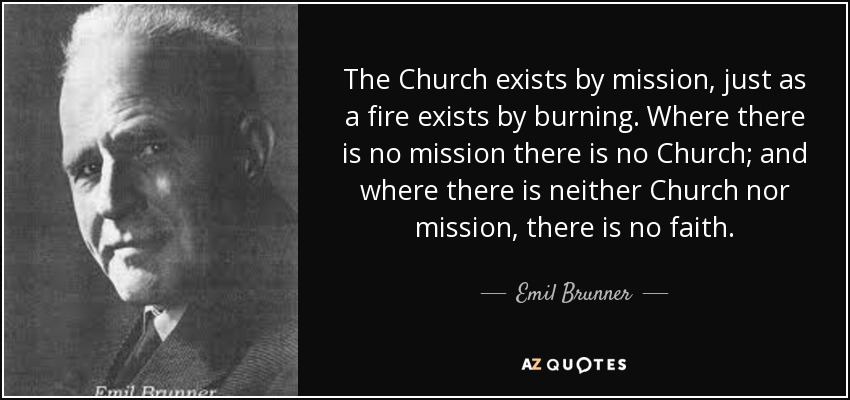
The Gospel needs the Church to nurture growth.
The Church needs the Gospel to grow in enough significance to show.

Inspiration

Brunner is significant as a Reform theologian because his neo-Orthodoxy was drawn from the gospel. It was presented with respect for the return of Republic as a form for government.

He wasn't just concerned with the authority of local councils. His respect for statecraft and citizenship extended into international relations through the federal level.

The Protestant Reformation had suggested a movement towards science as the means to clarify reconstruction for public benefit.

Calvin's reform movement was bible-based in science for democracy in local councils, but it was antiquated with respect for the political norms documented by the bible.  It entertained sectarian and partisan superstition as a means to make decisions.

Brunner was part of the Swiss Reformed Church started by Zwingli. Zwingli allowed for federation in his political organization. His reform was republican as well as democratic in this sense. It also allowed for monarchy as a form.

The movement towards science as a means for making decisions in the public realm became so pronounced that it facilitated the growth of socialism towards communism.

Science-speak used Greek levels of specificity for the public. Scientific communication could become too obscure for general comprehension or retention.

Government officials came to develop a method of communication that suggested that their responsibilities were too complicated for the public to understand.

Expertise in knowledge of the language regarding particulars was so pronounced that the general public was used to reject concern for the religious population of the nation state.

Political causes were used to divide the general public into factions that could not lay claim to the representation of the constituency.

The extent of the extension of science in the Church denied Christ as God. This was true with respect for Counter-Reformation politics in society as well. The concern for the population outside the Church became so pronounced that the title Son of God was just used to promote secular socialism or populism. Jesus was defined as just a man.

The theology that supported this movement toward communism came to be called liberal by leading Lutherans.

Reason and Revelation
Ch.VII Gifford Lectures Reason and Belief

"Brunner was more interested than Barth in ethics and social movements. Brunner was a steadfast opponent of communism, while Barth, to the indignation of political thinkers like Reinhold Niebuhr, was strangely complaisant toward it."

The debate presented a strange contrast in neo-Lutheran Orthodoxy.

Communism was an atheist state. It was the Marxist extension of liberal Protestant or Counter Reformation theology. The communists sought to replace religion with science. There was an unexpected benefit in the application of dialectic in a scientific and conservative way in order to promote responsible statecraft and citizenship with reasonable political theory.

Winterthur

Winterthur reached 100,000 residents in 2008. It is located near Zurich. It is considered to be a satellite within the municipality. It is about 20 kilometres (12 mi) to northeast of downtown Zürich. It is the sixth largest population in the country.

The population is currently estimated to be over 108,000. The economy is oriented to service and high tech industrial products.

The official language is the Swiss variety of standard German. The main spoken language is a variant of the Alemannic Swiss German dialect.

Napoleonic troops liberated the city from the control of Zurich in 1798.  Winterthur lies at the junction of seven cross-roads near Zürich.  The army that held the town held the access to most of Switzerland and points crossing the Rhine into southern Germany.

The forces involved were small, but the ability of the Austrians to sustain an 11-hour assault against the French line on the plateau north of Zürich resulted in the consolidation of three Austrian forces. This led to the French defeat a few days later.

The area became an industrial town when companies like Sulzer, Rieter and SLM built large industrial plants in the 19th century.

The town suffered from investments and loans to the National Railway as a private enterprise. A guarantee for the loan of nine million francs was made in 1874 with three other towns. The co-guarantor towns were unable to pay their share.

The entire burden fell on Winterthur. It had to sell its shares in the line in 1878. There were difficulties from 1881 to 1885 as the town struggled to meet its liabilities. It was helped by loans from the cantonal and federal governments.

The City Council (Stadtrat) constitutes the executive government of the City of Winterthur and operates as a collegiate authority. It is composed of seven councilors. Each presides over a department.

Emil Brunner

Emil Brunner was born in Winterthur in 1889.

He studied at the universities of Zurich and Berlin. He received his doctorate in theology from Zurich in 1913. His dissertation was on The Symbolic Element in Religious Knowledge.

Brunner served as pastor from 1916 to 1924 in the mountain village of Obstalden in the Swiss Canton of Glarus. In 1919–1920 he spent a year in the United States studying at Union Theological Seminary in New York.

He studied at the universities of Zurich and Berlin, receiving his doctorate in theology from Zurich in 1913, with a dissertation on The Symbolic Element in Religious Knowledge.

He served as pastor from 1916 to 1924 in the mountain village of Obstalden in the Swiss Canton of Glarus.  He spent a year in the United States studying at Union Theological Seminary in New York in 1919–1920.

Brunner published his Habilitationsschrift in 1921. This was a post-doctoral dissertation traditionally required in many countries in order to attain the position of a fully tenured professor. His paper was on Experience, Knowledge and Faith. He was appointed a Privatdozent at the University of Zurich in 1922.

Another book followed soon after. Mysticism and the Word (1924) was a critique of the liberal theology of Friedrich Schleiermacher. Brunner was appointed Professor of Systematic and Practical Theology at the University of Zurich in 1924.

He held the post until his retirement in 1953. He published The Philosophy of Religion from the Standpoint of Protestant Theology and The Mediator in 1927.

Brunner published God and Man in 1930 after accepting various invitations to deliver lectures across Europe and the United States. The Divine Imperative was published in 1932. Brunner continued his theological output with Man in Revolt and Truth as Encounter in 1937.

He was a substantial contributor to the World Conference on Church, Community, and State in Oxford in the same year. This position reflected his continued involvement in the ecumenical movement.  He returned to the United States for a year as a visiting professor at Princeton Theological Seminary in 1937–1938.

Brunner's ecclesiastical positions varied at differing points in his career. He returned to Europe before the outbreak of the war with the young Scottish theologian Thomas F. Torrance. Torrance had studied under Karl Barth in Basel. He had been teaching at Auburn Theological Seminary, New York.

He would subsequently go on to distinguish himself as a professor at the University of Edinburgh.
Brunner delivered the prestigious Gifford Lectures at the University of St Andrews, Scotland in 1946–1947 on Christianity and Civilisation following the war.

He retired from his post at the University of Zurich in 1953. He was invited to take a position as a Visiting Professor at the recently founded International Christian University in Tokyo, Japan (1953–1955).

The first two of his three volume magnum opus Dogmatics were published before he accepted the position. Volume one was The Christian Doctrine of God (1946). Volume two was The Christian Doctrine of Creation and Redemption (1950). Volume three was published in 1960 as The Christian Doctrine of the Church, Faith, and Consummation.

Brunner suffered a cerebral hemorrhage and was physically impaired while returning to Europe. It weakened his ability to work. There were times when his condition would improve, but he suffered further strokes. He finally died in 1966.

Heinrich Emil Brunner was a Swiss Protestant (Reformed) theologian. He is commonly associated with neo-orthodoxy or the dialectical theology movement with Karl Barth.

Brunner holds a place of prominence in Protestant theology in the 20th century. He was one of the four or five leading systematicians. He rejected liberal theology's portrait of Jesus as merely a highly respected human being. He insisted that Jesus was God incarnate and central to salvation.

Brunner and his compatriots in the neo-orthodox movement rejected in toto Pelagian concepts of human cooperation with God in the act of salvation. Pelagian concepts had an association with slavery in republic.

These kind of concepts were prominent in other humanist conceptions of Christianity in the late 19th century. Brunner and associates embraced Augustine's views, especially as refracted through Martin Luther.

Brunner re-emphasized the centrality of Christ. Evangelical and fundamentalist theologians mainly from America and Great Britain have usually rejected Brunner's dismissal of certain miraculous elements within the Scriptures.

Arch-conservatives afforded others in the neo-orthodox movement such as Barth and Paul Tillich a similar treatment. Some conservatives have viewed neo-orthodox theology as simply a more moderate form of liberalism.  They rejected its claims as a legitimate expression of the Protestant tradition.

---------------------

Emil Brunner
S. 埃米尔·布鲁纳
T. 埃米爾·布魯納

埃 Ai     dust                        埃  ai      dust                    E     エ    え              E     에  on       
米 mi    rice                         米  bei   meter                   mi   ミ    み              mil  밀  wheat       
尔 er     you                         爾  ji      you                      ru    ル   る              Beu  브  bro               
布 Bu    to announce           布  fu     cloth                    Bu    ブ    ぶ            lu     루 sack           
鲁 lu     stupid                      魯 ro     foolish                 ru     ル   る              neo  너  you               
纳 na    admit                       納  no   settlement            na    ナ-  な-                                       

-----------------------

The flag for the settlement was raised above the dust
to announce the measure of grain for exchange against the rush
for going bust.

================

Josiah Royce
Idealistic Pragmatism
for
Conservative Policy

Josiah Royce was the only major American philosopher who spent a significant period of his life studying and writing history. He taught a course on the history of German thought at John Hopkins after he had studied with Herman Lotze in Germany.

The concept of God lends itself to the interpretation of meaning in time. The analysis of this concept allows for credence in the value of the consideration of the reality of the divine existence.

He offered a lecture on The Conception of God to the Philosophical Union at Berkeley in 1897. He chose to define the concept with respect to the attribute of omniscience. It was knowledge that was presented as a derivative of the predication.

He said, "An Omniscient Being would be one who simply found presented to him, not by virtue of fragmentary and gradually completed processes of inquiry, but by virtue of an all-embracing, direct, and transparent insight into his own truth, — who found thus presented to him, I say, the complete, the fulfilled answer to every genuinely rational question."
(wiki: The Conception of God, Ch.1 text)

-----------------------

Omniscience is not the knowledge of all that will happen before it does.
Free will allows for change in the variable range with respect for what was.

=================

This provides a Being who can answer any question offered for investigation. This was not only Aristotle's favorite attribute. It lent itself to consideration of Christ as the Logos or more abstractly, reason. This was the basis for what Royce called the "religion of loyalty" and any individual's search for knowledge with wisdom.

The will for this paradigm was the inner dynamism that reached beyond itself into a possible future and acted upon an acknowledged past. Space and the abstract descriptions that are appropriate to it are a falsification of the materialistic description of the universe proposed by the Stoics.

Metaphysical error proceeded from taking the abstraction of the material universe literally. The Stoic realism that was later adopted by Locke and the liberal Whigs who represented the Puritans in particular and Calvinists in general served as the motive force for the deception of the public into the support of excessive force in colonialism for slavery with the threat of genocide. 

Idealism without the criticism of this deceptive or fictional story line for dominance held a supporting role in the perpetuation.

The will to act for a practically realistic and possible future based on the acknowledge past was compromised in the process. The demotic populism promoted by liberal power was the greater tyrant who blamed some foreign agent as the greater threat.

The Democrats demonstrated that their majority rule of both the executive branch and Congress defined success in terms of opposition of conservative management policy. Overtures were made toward the elimination of opposition via association with socialist principles derived from the Marxist economic position. 


Oops!
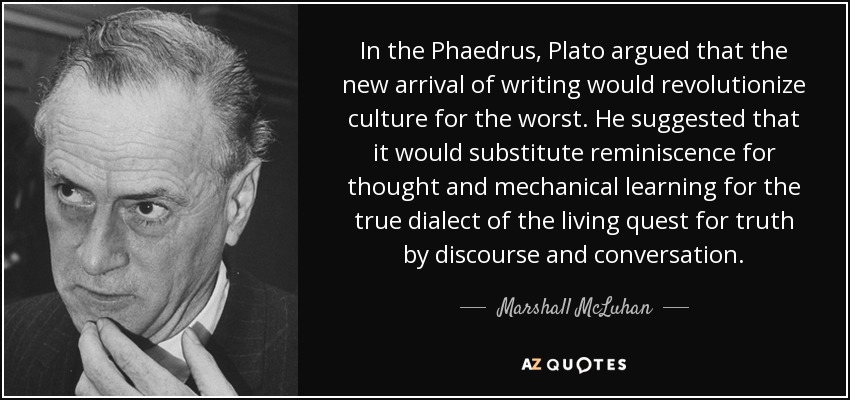

The criticism of writing wasn't the only gaffe in the Phaedrus. Plato set up a false dichotomy behind the main topic of the discourse.

Socrates and Phaedrus spoke about whether or not passionate love was best, but the subtext was about democracy.

Pericles and Protagoras had increased the emphasis on the vote in Athenian society. This was countered by the Spartans with the emphasis on the Persian threat. This was the position that Plato supported.

His argument set up the reader to think that the choice of passion or dispassion in individual feeling regarding partnership defaulted to the choice of dictatorship.

Passionate love supported hormonal consent whereas dispassion resulted in cognitive concession to dependency on the economic providence of the dominant partner. 

All men had the right to vote. That which was presented for the measure of the will of the constituency by election was chosen by the leadership.

The leadership had the advantage of experience in administration, military organization and education.

The problem with this paradigm as Plato described it was that the women chose to associate and agree with women, because they weren't given authority in the decision making process. Men chose to get intimate with other men in order to defend their power.

Octavian chose to place an emphasis on the family when he attained to the august position as the Caesar. This position was added to the republic. The republic was more developed in terms of how citizens could rise to the power of a patrician in Roman society. .

Monarchy had been demonized in the process of making the republic look more desirable than monarchical democracy. Even the executive leadership of the emperor was highly conditioned upon the will of the patricians with significant concession to the demands of the plebians.

The emperor had to rise through the ranks of the patricians, the military or the plebians in the effort to satisfy the public as a constituent body.

One was drawn to lead out of the many. That one had the power to promote a line of succession by adoption as Julius Caesar had done or by family succession. This was the case after Octavian.

While the emperor wasn't elected by the vote of the Senate, he still had to represent the interests of the patricians and plebians or he would suffer assassination or defeat in battle with organizational support from other patricians.
\
There was high risk in volatility that duty tempered by religious devotion to the gods helped to manage.

The Pax Romana offered to assimilate the worship of other gods, but the volatility of the system led to reports of sectarian judgment against monotheistic religion.

The power of the emperor was already thought to be an offense to the authority of the Senate by traditional republicans, but the position was tolerated insofar as it was necessary for competition.

Empire in the Middle East had made more progress in the movement towards adopting monotheism as the form for the official religion. It was the form for the official religion that didn't outlaw other legal types.

Progress in this development could not be successfully dictated by imperial or legislative decree. The primitive tribes in Europe were polytheistic. They were developed into monarchies, because it was regarded as the next stage in organizational development.

This political evolution managed to be successful in the prevention of legislation for the slave trade or slavery. The institution was regarded as an offense to the liberation of the captives as a political achievement by Cyrus as the Christ or Messiah.

Rebellion and revolution were used to re-institute slavery and republic. This was a major regression for European society, but the greatest happiness for the greatest number of people principle for legislation or judgment helped to outlaw slavery and legislate the right to vote for people of color and women.

Constitutional monarchy still represents a more conservative form in terms of cost for executive leadership to the public. Republican leadership has to keep an eye on this form of government in order to stay competitive in the world.

Democrats are currently stuck in Plato's Athenian model for democracy as dictatorship. Organization for the winning the vote is constrained to setting different factions of the public against each other. The only way that they felt that they could win public support was to agree to impeach the president.

They have been operating under the delusion that this action will help them to win executive authority based on concession to the House of Representatives. It has been a developmental delay in the evolution of republic.

The Democrats need to admit that the public is the constituent body for national security. Their staged events for media attacks for the impeachment of the president only factionalizes representation.

Sunday, November 17, 2019

Find

11.24.19


Mariel Hemingway
Idaho Valley


Find
Refuge 
寻找避难所
Xúnzhǎo bìnàn suo
避難所を探す
Hinansho o sagasu
ps46
Find confugerunt

My house is my home. 
Respect protects me when i roam.

Security is dependent upon defense.
The space between things is something sensed.

A thrust can be blocked, dodged or countered.
Standing your ground isn't locked, lodged or outwardly powered.

Light is my refuge when darkness is unsafe.
Darkness is better when being seen is a mistake.

Though the earth be moved to shake the tree,
we will hold faith in divine existence as our reason to be.

Though the mountains lose rocks that roll to the depths of the sea,
we will believe that God has a plan to work with that which can be seen.


Though the water rages while the land trembles with tumult,
we will rejoice in the One who helps us rebuild as a result. 

The unity for existence holds diversity in unitary forms
Affordable production with quality as the norm
builds the economy to reconstruct that which was damaged by the storm.  

There is an elevation whose streams make the river glad.
The flow of water is a reminder of the experience humanity had.

The water flows downward by the pull of gravity.
The city was built for the security of shelter's sanity.

The habitation of the Most High lies in the heart.
Adoration is the ardor that harbors the craft in any art.

God is in the midst of her.
The lonely heart hears the stir.

She will not be overthrown.
The break of day will renew the light as known.

We are not alone
though each is allowed his own.

Nations have made much ado
but they have been happy too.

Kingdoms have been shaken to the core.
Republic has to mind conservative reform.

When God had spoken, the earth seemed to melt away
to leave faith as the power to rebuild that which fell to the fray.

The fire of divine desire is with us.
Redemption with truth trusts in what's just.

Free will is the greatest gift
but it has to be managed with thrift.

Those who took payment for a service, but didn't provide one in return
are liable for the broken contract as the cause of the dispersion that burned. 

The liberal claim to power over executive authority
has been used as a support for prejudice against the majority.

The accusation of corruption invoked the charge of tyranny
to punish the larger body as the cause of criminal conspiracy.

Look upon the works that are best
to see the awesome things that passed the test.

The divinity of deity has made war to cease.
It was this that let the falsely convicted captives free. 

One criminal on the cross asked 'Are you not the Messiah?
Why do you hang there like a pariah?

'Save yourself and us!
Is this something we need to discuss?'

The other rebuked him and said,
'Do you not fear judgment from the living and dead?

'You are under the same sentence of condemnation
but you will be seen as guilty for generations.'

The thief who defended Jesus as Christ
was told that he would reside in paradise.

That the Son would hang on the cross is theology
that has been known to invoke controversial apology.

That One with the divine nature would die for our sins
was viewed as absurd monotheistic din.

The self sacrifice of the body of the divine person
was offered once for the cleansing from human incursion.

It was an expression of love for our conversion
that offered the promise of salvation with baptismal immersion.  

May you be made strong with the glorious power
that prepares you to endue anything with patience beyond the trifling hours.

Give thanks to the Father who enabled you to share in the inheritance of the light.
He rescued us for redemption by faith from the darkness of power for sight.

His Son is the firstborn of all creation for our faith.
The Christ of Jesus is the image of the invisible God portrayed.

We have been advised to view Christ as the center of reality
to invest in a faith that promotes freedom in tactically factual actuality.

Religion was not meant to impose ascetic law on all people.
Devotion is an emotion to cultivate goodness for redemption from error or evil.

Be free and know the stillness of divinity.
The spirit of love will exalt the peace of infinity.

The fire of divine desire is with us.
Redemption in truth trusts in what's just.

---------------------

46 Deus noster refugium
Light is our refuge

1 God is our refuge and strength,
a very present help in trouble.
2 Therefore we will not fear, though the earth be moved,
and though the mountains be toppled into the depths of the sea;
3 Though its waters rage and foam,
and though the mountains tremble at its tumult.
4 The Lord of hosts is with us;
the God of Jacob is our stronghold.
5 There is a river whose streams make glad the city of God,
the holy habitation of the Most High.
6 God is in the midst of her;
she shall not be overthrown;
God shall help her at the break of day.
7 The nations make much ado, and the kingdoms are shaken;
God has spoken, and the earth shall melt away.
8 The Lord of hosts is with us;
the God of Jacob is our stronghold.
9 Come now and look upon the works of the Lord,
what awesome things he has done on earth.
10 It is he who makes war to cease in all the world;
he breaks the bow, and shatters the spear,
and burns the shields with fire.
11 "Be still, then, and know that I am God;
I will be exalted among the nations;
I will be exalted in the earth."
12 The Lord of hosts is with us;
the God of Jacob is our stronghold.


Psalm 46

The 46th psalm is addressed to the chief Musician for the Sons of Korah according to alamoth.

The note for alamoth is unique to this psalm. It may refer to a high pitched instrument. It could be a reference to the soprano voices of young girls who went out to dance in celebration of David's victory over the Philistines.

The Midrash Tehillim comments on the psalms. It parses the word alamot (Hebrew: עלמות‎) as referring to the "hidden things" that God does for his people.

The office for the chief Musician was established by David. He appointed a man named Heman as the main musician or singer.

Asaph was made Heman’s right hand assistant and the Merarites were at his left hand (1 Chron.6:39). The Asaphites were one of the guilds of musicians in the First Temple.

The Korahites were the sons of Moses' cousin. Korah had led a revolt against Moses. He died after a fire was sent from heaven to consume the entire force. It was reported that the children of Korah did not die. (Num. 26:11)

The Korahites were counted with the Kohathites among the Levites. Both groups are documented as having offered praise with volume. (2 Chron. 20:19)

The Kohathites cared for the vessels and objects within the sanctuary - the Ark of the Covenant, Menorah, Table of Showbread, etc.

Several psalms are described in their opening verses as being by the Sons of Korah. The numbers for these psalms are 42, 44–49, 84, 85, 87 and 88.

Some of the Korahites were also "porters" of the temple (1 Chron. 9:17–19). One of them was over "things that were made in the pans" (v31), i.e. the baking in pans for the meat-offering (Lev. 2:5).

There is a tradition that the prophet Samuel was descended from Korah.

Martin Luther wrote and composed a hymn which paraphrases Psalm 46. "Ein feste Burg ist unser Gott" translates as "A Mighty Fortress Is Our God." Johann Sebastian Bach based his chorale cantata Ein feste Burg ist unser Gott, BWV 80, on Luther's hymn.

=================

Eng.  My house is my home.
Ch.    我的房子是我的家。
           Wǒ de fángzi shì wǒ de jiā.
Jpn.   私の家は私の家です。
            Watashinoie wa watashinoiedesu.
Krn.    내 집은 내 집이야
             nae jib-eun nae jib-iya
Ltn.     Mea domus mea est in domum suam.
Itln.    La mia casa è la mia casa.
Spn.    Mi casa es mi hoga
Frn.     Ma maison est ma maison.
Grk.     Το σπίτι μου είναι το σπίτι μου.
              To spíti mou eínai to spíti mou.
Rsn.      Мой дом мой дом.
              Moy dom moy dom.
Gmn.   Mein Haus ist mein Zuhause.
Trk.      Benim evim benim evim.

------------------------

Pastors

Jeremiah (650-570 BCE)


Jeremiah was the son of Hilkiah, a kohen from the Benjamite village of Anathoth.

Kohen is the Hebrew word for "priest". It is used in reference to the Aaronic priesthood. Levitical priests or kohanim were in direct patrilineal descent from the biblical Aaron, brother of Moses.

Kohanim performed the daily and holiday (Yom Tov) duties of sacrificial offerings during the existence of the Temple in Jerusalem.

The sacrifices were not limited to the offering of animals.

Hygenic kosher practice in the preparation of food products for market still fall under the province of kohanim.

Anathoth  is the name of one of the Levitical cities given to "the children of Aaron" in the tribe of Benjamin (Josh. 21:13–18; 1 Chron. 6:54–60).

The Israelites often did not change the names of the towns they found in Canaan, the name of this town may be derived from a Canaanite goddess, `Anat.

Anathoth seems to be a plural form of the name. It could be the shortened form for bêt ‘anātôt 'House of the ‘Anats'. This was either a reference to many shrines of the goddess or a plural of intensification.

‘Anat is a war-goddess in the Ugaritic Baal cycle. She is the maiden sister to Ba'al Hadad, the maker of storms. Ba‘al is usually called the son of Dagan, the father of fertility. Ba'al is also named as the son of El at times.

The name El is a general form that indicated the highest rank. It is a Northwest Semitic word meaning "god". It was attached to a proper name as a title that indicated the supreme status for a deity.

Ugarit map


Ugarit is a city of ruins located near Ras Shamra, Syria. Ugaritic is the western form for the extinct Amorite language. It is the only Amorite dialect known to be preserved as written. The Ugaritic texts discovered by French archaeologists in 1929.

The Book of Jeremiah is the second of the Latter Prophets in the Hebrew Bible and the second of the Prophets in the Christian Old Testament. His book is intended as a message to the Jews in exile in Babylon. It explains the disaster of exile as God's response to Israel's pagan worship.

The people are described as an unfaithful wife and rebellious children. Their infidelity and rebelliousness made judgement inevitable. Restoration and a new covenant are foreshadowed to perpetuate the promise of reward for fidelity. 

Judgment had been pronounced against a number of the kings of Judah in the previous chapter. Other leaders were included in the judgment with the use of the term 'shepherds.'

There was the distinct implication of argument against what had been done to Israel and what was threatened against Judah. Priests were implicated in the perpetuation of harmful primitive practice as associated with polytheism.

Jeremiah 23:1

Woe to the shepherds who destroy and scatter the sheep of my pasture! says the LORD.

-------------------------

Those who take payment for a service, but don't provide one
are liable for the broken contract as the cause of dispersion.

The liberal claim to power over executive authority
has been used as a support for prejudice against the majority.

==================

Colossians 1:15


The epistle to the Colossians was addressed to the Christians in Colossae.

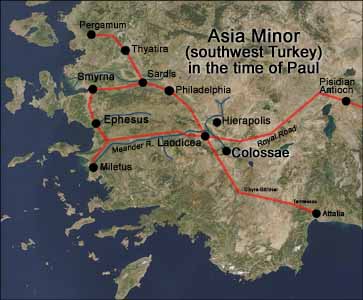
Colossae map

Colossae was one of the most celebrated cities of southern Anatolia (modern Turkey). It was located in Phyrgia in Asia Minor.

It was an ancient city about 161 km (100 mi.) east of the cosmopolitan capital city of Ephesus, located in the Roman province of Asia.

It was 15 km (9.3 mi.) southeast of Laodicea on the road through the valley near the Lycus River at the foot of Mt. Cadmus, the highest mountain in Turkey's western Aegean Region.

It was between the cities Sardeis and Celaenae southeast of the ancient city of Hierapolis.

The 5th Century geographer Herodotus first mentioned Colossae by name and as a "great city in Phrygia" which accommodated the Persian King Xerxes I en route to wage war against the Greeks.

The city had already reached a certain level of wealth and size by this time. Xenophon refered to Colossae as a populous and wealthy city of considerable magnitude in the 5th century (Anabasis).

Strabo (63 BCE-24 CE) was a historian who lived in Asia Minor during the period of transition from the Roman republic to the empire. He noted that the city drew revenue from the flocks in the wool trade. The wool of Colossae gave its name to the color colossinus.

The location had importance as a mercantile center in the Hellenistic period, but it had diminished in size by the 1st century CE. It was known for its fusion of religious influences (syncretism). It included Jewish and Gnostic groups.

There was also an angel-cult in the pagan tradition. The unorthodox cult venerated the archangel Michael who is said to have caused a curative spring to gush from a fissure in the Earth.

Epaphras seems to have been a person of some importance in the Christian community in Colossae (Col. 1:7; 4:12). Tradition presents him as its first bishop.

The epistle speaks of Paul as having "heard" of the Colossians' faith (Col. 1:4). The letter to Philemon speaks of Paul's hope to visit Colossae upon being freed from prison (Philemon 1:22). Philemon was the second bishop of the see according to tradition.

The Colossians were encouraged to see Jesus as the center of reality in order to avoid the pressures from other religions. The problems of the Church were described. Believers were encouraged to remain devoted to Jesus as Christ.

Colossians 1:11-15

May you be made strong with all the strength that comes from his glorious power and may you be prepared to endure everything with patience while joyfully giving thanks to the Father who has enabled you to share in the inheritance of the saints in the light. He has rescued us from the power of darkness and transferred us into the kingdom of his beloved Son in whom we have redemption, the forgiveness of sins.

He is the image of the invisible God, the firstborn of all creation.

-------------------------

May you be made strong with the glorious power
that prepares you to endue anything with patience beyond the trifling hours.

Give thanks to the Father who enabled you to share in the inheritance of the light.
He rescued us for redemption by faith from the darkness of power for sight.

His Son is the firstborn of all creation for our faith.
The Christ of Jesus is the image of the invisible God portrayed.

==================

The Criminal on the Cross


The priests and teachers of the law had been made the council of the elders for the people of Judah with the approval of the Roman government.

Jesus was questioned by this body about his instruction about the Messiah. His testimony was used to send him to Pontius Pilate.

He was questioned by Pilate as the Roman governor. When the governor found that he was a Galilean, he was sent to Herod as the tetrarch of Galilee. The tetrarch returned Jesus to the governor.

Pilate convened an assembly of the chief priests, the rulers and people to release Jesus from conviction for the death penalty. He said that he would chastise and release him as the prisoner to satisfy the offering at the time of the feast for the Passover.

The governor was confronted with angry cries when the outspoken yelled for crucifixion. They insisted that Barabbas be released instead. Pilate said that he would chastise Jesus two more times. The angry voices that threatened riot would not relent.

He released Barabbas who had been imprisoned for sedition and murder, but delivered Jesus to their will. He was nailed to the cross with two others who had been convicted of crime.

Luke 23:35

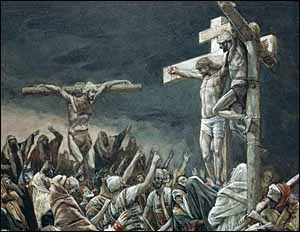
One of the criminals who were hanged there kept deriding him and saying, 'Are you not the Messiah? Save yourself and us! The other rebuked him, saying, 'Do you not fear God since you are under the same sentence of condemnation?'

-------------------------

The criminal asked 'Are you not the Messiah?
Why do you hang there like a pariah?

'Save yourself and us!
Is this something we need to discuss?'

The other rebuked him and said,
'Do you not fear judgment from the living and dead?

'You are under the same sentence of condemnation
but you will be seen as guilty by following generations.'

The thief who defended Jesus as Christ
was told that he would reside in paradise.

That the Son would hang on the cross is theology
that has been known to invoke great controversy.

That One with the divine nature would die for our sins
was viewed as absurd monotheistic din.

The self sacrifice of the body of the divine person
was offered once for the cleansing from human incursion.

It was an expression of love for our conversion
that offered the promise of salvation with baptismal immersion.

==================

Cicero (106-43 BCE)


Rebellion

Legend has it that in the city-state's earliest days, Romulus, the founder and first king of Rome, picked the 100 best men, or patricians, in the city to be members of his Senate for as long as they lived.

While the seven kings of the monarchy ruled, the Roman Senate made the laws and elected the kings. The last king was an Etruscan who had a reputation for severity.

His son, Sextus Tarquinius, reportedly raped the wives and daughters of powerful Roman nobles. A group of nobles led by Lucius Junius Brutus, with the support of the Roman Army, expelled Tarquinius and his family from Rome in 509 BCE.

When the Roman Kingdom, which lasted from 759-509 BC, came to an end, Rome transitioned into a republic with executive offices who served as generals and judges and built public works.

The Roman constitution was not a single written document. It was the system of government that had evolved from the kingdom and a senate of patricians without term limits into a republic.

The Romans referred to Greek culture with respect for written expression on matters of importance.

Constitutional Traditions in the Republic

Two consuls always served together at any one time after Rome became a republic. They were the chairmen of the Senate.

Both had to agree to enact a proposed action. Each was able to overrule the other. They had to request any money from the Senate for their office.

They commanded the Roman army. Both had two legions. They came to exercise the highest juridical power. The two consuls had to belong to the Patriciate, the Roman aristocracy. The office was opened for plebeians in the 360's.

The Lex Licinia Sextia provided that at least one consul each year should be plebeian in 367 BCE. Lucius Sextius was elected as the first plebian consul the following year.

Only fifteen novi homines, "new men" with no consular background, were elected to the consulship until the election of Cicero in 63 BCE.

The Comitia centuriata was an assembly of the richest Romans. The comitia elected the consuls. The term was 1 year in length.

Once elected, they took orders from the Roman Senate. When their terms were up, both consuls were given governorships of provinces outside of Italy.

The comitia became more powerful after the Conflict of the Orders. This conflict was a class struggle between the wealthy patricians and the poor plebeians that lasted from 494-287 BCE.

The Plebians forced the patricians to accept a new office that was independent of the consuls and the Senate during the dispute. The office was named the Tribune of the People. The comitia acquired the power to make laws, ratify treaties and declare war as a result of a series of laws.

Cicero argued that the constitution was a law that was written on our hearts. The unwritten law alluded to the state of the social contract as a development beyond tribal organization with respect for primitive concepts of freedom in nature. There was a question regarding the benefit of the state of society as preferable to local council alone.

Cicero's contribution to Rome as a consul was to override due process of law in order to put down a 'rebellion.' It was reported to the public that the rebels who threatened the peace of Rome were executed without a trial.

The idea that the majority should not rule has been used to undermine the legal authority of the social contract. Consider the 'protection' proposed for undocumented immigrants by liberals.

Liberals want to subsidize living expense for the undocumented. They want to give them the right to vote. These two proposals give those who refuse to register favor over citizens and documented immigrants.

J.S. Mill also expressed a warning about the tyranny of the majority. Too much of this type of concern promotes the tyranny of the undocumented.

Not Majority Rule


I have investigated the civil rights movement with particular interest for the claim of majority prejudice in the south.

I found that Rawls' argument against the Utilitarian principle of the greatest happiness for the greatest number was an endorsement for partial judgment as the veil of ignorance.

He had argued that limited participation in organized politics would induce objectivity as the necessary standard for judgement regarding observable events.

The Clintons have used ignorance to promote decisions against the majority interest with the endorsement of socialism and radical feminism.

If you didn't directly perceive a case of sexual assault, how are you to form a judgment on a claim to the same that was reported to have happened over a decade ago? Do you rely on the testimony of the accuser or the accused?

Their media reports supported the testimony of the accuser with the defamation of character against the accused. LBJ did a similar sort of thing with Dr. King.

Mohammad Ali was loud in his endless self-promotion. He explicitly complained about the racism of white people. He stated that he would not fight in a war against people who had not done anything to him. He had the right to refuse the draft, but it was reported that he served time for it.

Dr. King was more aggressive in the promotion that white people were prejudiced against the employment of black people in industry. Civil rights were reduced to the state of affairs for black people in his negotiation with the US government.

Ali used religion for his success in sport. King used socialism for his success in political intervention. King's argument was dependent upon the reports of prejudice against blacks in the South.

Rawls wasn't the only Harvard professor who helped to promote the belief that majority prejudice was the only real social problem in institutional form. Cavell was a participant as well.

Roman Constitution

Freedom

Baruch Spinoza
b. 11.24.1632 Amsterdam, Netherlands
d. 2.21.1677  The Hague, Netherlands

Independence has to be guided by responsibility or it is not being led to productive value.

Nature is the expression of the universe. The universe is the product of the Creator.

Causality regulates change. Chance is irregularity in causality.

Spinoza

Philosophy
Ethics
wiki Baruch Spinoza philosophy

Spinoza's philosophy held an attraction for late 18th-century Europeans. It provided an alternative to materialism, atheism and deism.  He provided a conceptual frame for the Enlightenment philosophy as it related to the government of law.

Three of Spinoza's ideas held a strong appeal.

The unity of all exists.

Regularity is a function of the unity.

The energy of nature expresses the spirit for the identity of the unity.

Both Descartes and Spinoza lived in the Dutch Republic (1581-1795). Descartes (31 March 1596 – 11 February 1650) preceded Spinoza (24 November 1632 – 21 February 1677).

Kingdom of the Netherlands
wiki

The current Kingdom of the Netherlands is a constitutional monarchy. Spinoza had proposed this form of government as best with his Tractatus Theologico-Politicus.

Constitutional monarchy has the potential to exceed a constitutional republic in democracy by virtue of the conservatism in the dynastic succession.

The resurrection of republic as a form of government required the application of reason to define the purpose of government, commerce and society.

Rosseau's ideas of education are limited according to contemporary standards, but his social contract provided the essential factor for the determination of law. The government is obliged to serve the people who pay for functional operations.

If the US does not limit commerce to a legal free market, it has lost ground in terms of using reason to reflect on the history of the republic.

The people have risen up repeatedly to define republic as a democratic institution, but socialists have used their advantage in influencing government with knowledge about campaign finance, lobbying and media expression to institute policy that claimed to be for the people, but was for liberal officials in fact.

Law is being defined as an exercise in using the state to act as a criminal force that regulates the existence of threat from outside the sphere of influence for the accumulation of wealth by state officials.

This doesn't mean that law has to be rejected as though that leaves only grace. It means that grace provides sanction for amending the law.

Dutch Republic
17th Century

The Dutch rebelled against Philip II of Spain and his successors in the 16th century. The main reasons for the uprising were the imposition of new taxes, the tenth penny and the religious persecution of Protestants by the newly introduced Inquisition.

The revolt escalated into the Eighty Years' War. The protracted conflict ultimately led to Dutch independence.

The Dutch Republic was officially known as the Republic of the Seven United Netherlands. It was a a confederal republic formally established by the formal creation of a confederacy in 1581 by several Dutch provinces that seceded from Spanish rule. The republic lasted until the Batavian Revolution of 1795.

The small republic of around 1.5 million inhabitants distinguished itself by world trade through the Dutch East India Company (VOC) and the Dutch West India Company (WIC). The state sustained military success against larger and presumably stronger nations such as Spain and England.

The naval fleet of 2,000 ships was larger than that of England and France combined. The fleet was assembled with the shipping industry with respect for the knowledge of the size of the competitive nations.

The organization of production for the culture was managed in the arts and sciences. Painters such as Rembrandt (1606-1669), Johannes Vermeer (1632-1675) and others achieved widespread recognition.

Hugo Grotius (1583-1645) built the conceptual frame for political science with the foundations for international relations based on natural law.

Antonie van Leeuwenhoek (1632-1723) used the relatively new development of the microscope to study biological microbes. This made him the first recognized micro-biologist.

Jan Swammerdam (1637-1680) used the microscope to study insects. He made important discoveries regarding the life of bees.

He demonstrated that there are various phases in the life of an insect. The egg, larva, pupa and adult stages are different forms of the same animal.

He also carried out experiments on muscle contraction as part of his anatomical research.  He used dissections for examination. He observed and described red blood cells.

The relatively tolerant atmosphere towards different religions and ideas contributed to the success of free thought in establishing republic as a competitive form to monarchy in Europe.

The Union of Utrecht in 1579 is regarded as the foundation of the Republic of the Seven United Provinces, which was not recognized by the Spanish Empire until the Peace of Westphalia in 1648.

Holland and Zeeland were granted the right to accept Calvinism as the one religion in practice. Every other province had the freedom to regulate the religious question as it wished.

The Republic dominated world trade, conquered a vast colonial empire and operated the largest fleet of merchantmen of any nation during the late 16th and 17th centuries.

Slavery was included in the competition for global expansion, but Spinoza would question whether a state that allowed slavery could be regarded as free.

Amsterdam

Amsterdam flourished, largely from trade with the Hanseatic League from the 14th century.
The 17th century is considered Amsterdam's Golden Age.

It became the wealthiest city in the western world. Ships sailed from the port to the Baltic Sea, North America, Africa, present-day Indonesia, India, Sri Lanka and Brazil.

It was the central hub for a worldwide trading network. Amsterdam's merchants had the largest share in both the Dutch East India Company and the Dutch West India Company. These companies acquired overseas possessions that later became Dutch colonies.

Amsterdam was Europe's most important point for the shipment of goods. It was the leading Financial center of the western world.

The Amsterdam office of the international trading Dutch East India Company became the world's first stock exchange by trading in its own shares in 1602.

The Bank of Amsterdam started operations in 1609. It acted as a full service bank for Dutch merchant bankers and as a reserve bank.

Peace is a virtue

Jewish Philosophy

When the Romans conquered the Jewish nation in 70 CE, much of the Jewish population was sent into exile throughout the Roman Empire. Many were sent to the Iberian Peninsula.

The approximately 750,000 Jews living in Spain in the year 1492 were banished from the country by royal decree of Ferdinand and Isabella. The Jews of Portugal, were banished several years later.

Spinoza's ancestors were of Sephardic Jewish descent. They were a part of the community of Portuguese Jews that had settled in the city of Amsterdam in the wake of the Portuguese Inquisition (1536). The Inquisition had resulted in forced conversions and expulsions from the Iberian Peninsula

Baruch Spinoza (1632-1677) argued that people would not be superstitious if they could govern their circumstances with set rules or if they were always favored by fortune.

Humans are driven into circumstances where rules are useless. The fluctuation between hope and fear is driven by the uncertainty of fortune. The variability of chance leaves them with the consideration of credulity.

He wrote, "The human mind is readily swayed this way or that in times of doubt, especially when hope and fear are struggling for the mastery, though usually it is boastful, over-confident, and vain." (Tractatus Theologico-Politicus)

The chief victims of superstition are those who covet temporal advantage too aggressively. Superstition is engendered, preserved and fostered by fear. 

The essential mystery of despotic statecraft is to hoodwink the citizens into subservience to the credulity of cause that men may fight as bravely for slavery as for safety and count it not as shame but the highest honor to risk their blood and their lives for the vainglory of tyranny.

No such expedient could be planned or attempted in a free state.

The habits of mind differ. Some more readily embrace one form of faith, some another. What moves one to pray may move another to scoff,

Everyone should be free to choose for himself the foundations of his creed. Faith should be judged only by its fruits. Each would then obey God freely with his whole heart. Nothing would be publicly honored save justice and charity.

The ultimate aim of government is not to rule by fear nor to exact obedience. The purpose is to free each from fear for all possible security. Law is to be legislated to strengthen the natural right to exist and work without injury to self or others.

Tractatus Theologica-Politicus

Spinoza put forth his most systematic critique of religion in the treatise Tractatus Theologica-Politicus. He argued that reason should not be subordinated to scripture. Reason should reflect upon scripture for the consideration of Constitutional law.

When reason has been made subservient to scripture, then, Spinoza argued, "the prejudices of a common people of long ago... will gain a hold on his understanding and darken it."

He reinterpreted the belief that there were occurrences of objective miracles or supernatural events. He argued that God acts solely by the law of "his own nature". He rejected the view that the divine nature has a predetermined course of events.

Spinoza was not only the real father of modern metaphysics and moral philosophy for politics, but also of the higher criticism of the Bible.

His Tractatus Theologico-Politicus undertook to show that Scripture gave no authority for those who sought to impose the rule of law with cruelty in punishment or violent aggression.

Spinoza had to show what was meant by a proper understanding of the Bible to achieve this object. This gave him occasion to apply criticism to interpretation.

There have been cases where the scientific use of DNA evidence has exonerated someone convicted of the charge of murder. It was demonstrated that the rape associated with the murder was not done by the one who had been convicted for the crime.

This type of exoneration justifies the application of a life sentence in cases where the evidence was strong, but not conclusive. The convict could be released from his sentence prior to his death.

It is reasonable to assume that if some were released from the death sentence, there were others who have been wrongly put to death. This is another form of murder.

The state isn't put to death for the error, but it suffers a loss of credibility among the taxpayers who pay for the legal system to form judgments for justice.

When the story of Jesus with the woman accused of adultery is considered, it can be seen that the legal system has been right to shift standards of punishment to decrease the incidence of cruelty due to false conviction. The death penalty used to be applied to those convicted of a number of crimes lesser in severity than murder.

The act of adultery is not in itself life threatening. There have been adulterers who have sought to kill their spouses.

There have also been those who were seeking sexual gratification outside of the marriage without homicidal intent. The punishment for adultery then should not include the death penalty unless the spouse was murdered by the adulterer.

Jesus told those who asked him about what to do with respect for the woman to examine their conscience. He said, "Let him who is without sin cast the first stone."

Justice in the legal system was not regarded as something that was open to debate for those who were not in line to become a magistrate in the kingdom or Roman republic. The Romans didn't have a public system for education.

Spinoza saw the importance of introducing his metaphysics for ethics in order to raise the thought of the common citizen to reasonable application in the new republic. This included the tract on the theology associated with politics.

Tractatus Theologico-Politicus
wiki quotes

Spinoza was a sephardic Jew. His family moved to the Dutch Republic to escape persecution from the Inquisition in Spain. He was a rational philosopher. He was one of the most important and radical thinkers of the early modern period.

His thought combines a commitment to a number of Cartesian metaphysical and epistemological principles with elements from Euclidean geometry, ancient Stoicism, Hobbes and medieval Jewish rationalism. The respective principles are grafted into an original system.

His naturalistic view on God, the world, human being and knowledge served to ground a moral philosophy centered on the control of the passions. Self-control was the leading virtue in the pursuit of happiness.

These principles also lay the foundations for democratic political thought. Pretensions regarding the dogmatic interpretation of Scripture and sectarian religion were criticized.

Spinoza was issued the harshest writ of herem or excommunication ever pronounced by the Sephardic community of Amsterdam on July 27, 1656.

It was never rescinded. We do not know for certain what Spinoza’s “monstrous deeds” and “abominable heresies” were alleged to have been. An educated guess comes quite easily.

He was expressing those ideas that would soon appear in his philosophical treatises. He denies the immortality of the soul; rejects the notion of deity as having an existence completely distinct from creation and claims that the Law was not specifically given to the Jews nor was it binding in every aspect of the ancient expression.

It has since been shown that the Hebrew texts contain elements from the ancient codes of law in the Middle East. The law against murder as expressed in the second commandment was in the code of Ur Nammu.

The law that punished killing with a lesser penalty than death was expressed in the story of Cain and Abel. The code of Hammurabi punished killing with a fine if the killer said that he killed without malice.

Spinoza was banished from his community. He was content to have an excuse to depart. His community and religious commitment were gone by this point.

He was interested in writing something modern. He wanted it to have an impact on the European world. He left Amsterdam altogether within a few years.

He began writing in 1661. He was living in Rijnsburg, not far from Leiden. He worked on the “Treatise on the Emendation of the Intellect,” an essay on philosophical method.

He also wrote the “Short Treatise on God, Man and His Well-Being.” This was an initial but aborted effort to lay out his metaphysical, epistemological and moral views.

His critical exposition of Descartes’s “Principles of Philosophy” was the only work he published under his own name in his lifetime. It was completed in 1663 after he had moved to Voorburg outside the Hague.

He was also working on what would eventually be called “The Ethics” by this time. This was his philosophical masterpiece.

When he saw the principles of toleration in Holland being threatened by reactionary forces however, he put it aside to complete his scandalous “Theological-Political Treatise.”

This was published anonymously and to great alarm in 1670. One overwrought critic called it “a book forged in hell by the devil himself”.

When Spinoza died in 1677, he was still at work on his “Political Treatise’” This was soon published by his friends along with his other unpublished writing which included a “Compendium to Hebrew Grammar.”

“The Ethics” was written in the form of a geometric proof. It was modeled on Euclid’s “Elements.” The basic definition for a point is a location. It has no length or extension.

It is used as a metaphor for the “self” as the “essence of existence” in “The Ethics.” A line is a continuity of points. It has length. It extends in space. It is comparable to what Descartes identifies as thought.

The proof is written to prove the existence of goodness as the cause for ethics. God is posited as the absolute infinite. Divine existence is the essence of substance. This substance permeates existence. Infinity is used to contrast the finite.

The finite contains the substance of matter. Substance has attributes. The extension of substance however does not pertain to the essence of deity. This denies the notion of Platonic ideals with respect for destructiveness as an extension of the divine will through the elements.

Will is a particular mode of thought. It is a necessary cause. It is the search to draw function from purpose. Knowledge is the awareness of the cause of change.

Freedom is the image. Creativity is the likeness. Each person is the agent of personal will. Ethics is the discovery of functional benefit. It does not conflict with the law of causation.

Free Will
The Likeness of Accomplishment
American Philosophy in the 20th Century

Spinoza's influence found its way to the US through the French philosophy that agreed with his proposal for Constitutional law.

The Constitution was largely composed by James Madison. He borrowed from Locke, but he had to re-write a considerable amount of the material to make it apply to the whole public. It was an anticipation of a future republic in important respects.

The Bill of Rights was added to show the ability to amend law for the people.

Education in the country was not necessarily aimed toward this purpose. Institutions for higher education were organized to promote interest among the general population.

Only a few seminaries like Andover or Union offered post-graduate education before 1860. Yale awarded the first Ph.D. degree in 1861. Pennsylvania (1870); Harvard (1872); Johns Hopkins (1878); Princeton (1879) and Cornell (1880) followed.

Johns Hopkins was founded for graduate students in 1876. The first true professors of philosophy holding an American PhD were G. Stanley Hall (Harvard 1878) and Josiah Royce (Johns Hopkins 1878). Both of them had German educations.

Philosophers were scattered across the landscape during the Reconstruction era and the beginnings of the Gilded age. They were found only at the best colleges. Most of those granted the title of Professor of Philosophy were presidents of their colleges.

Not all of them had doctorates. Some held a bachelors of divinity degree. They taught the senior classes in denominational theology and religious ethics.

G. Stanley Hall reported that perhaps 40 of these professors actually had serious philosophical training in "Philosophy in the United States" in 1879.

Much of the important philosophical creativity was still generated by theologians. Those who responded to the issues of workers' rights or to the challenge of evolution were especially instrumental in shifting the focus from theology to political and social policy.

Social Science provided another fertile source for philosophical thinking. Thought was valued in the identification of social problems for cure.

Hundreds of scholars attended German universities during 1870-1900 for their higher prestige and lower cost. That trend would reverse by 1900. American universities would come to swell with graduate students.

The Calvinist tradition continued at Princeton, Yale, Union and innumerable smaller colleges. There was special attention to the history of religion in the US. Unitarian Harvard, Liberal Andover, Humanist Chicago and Personalist Boston had strong counter-balancing theological movements. Historicism, biblical hermeneutics and evolution became acceptable.

American theology was also re-energized by the new holiness churches. The Third Great Awakening would seek to make an impact on the 1880’s and 90’s.

Everyone was called to take notice of the Social Gospel and Christian Progressive movements that demanded new religious activism.

The focus for the awakening was on the consequences of unrestrained capitalism, industrialism and immigration. The religious movement had a strong association with socialist doctrine.

Evolution was accepted before Darwin even by clergy, but only as a theory of divine providence aiming at the eventual productivity of mankind.

Only a few daring thinkers embraced the theory of natural selection by random mutation after the publication of Darwin's Origin of the Species, (1859). Some applied evolution to metaphysics and cosmology. Others applied evolution to the human mind.

The philosophical category of "mental science" popularized by the Scottish realists was the original home to those who called themselves psychologists. Experiments for nerve and brain physiology trained subjects to track mental processes.

Some were eager to apply the new biological theories of evolution. The Scottish realist James McCosh, pragmatists Charles Peirce and William James belong to the early evolutionary philosophers.

The contrast between evolution and fundamentalism could not have been sharper than at Princeton in the 1860’s and 70’s. McCosh taught an evolutionary philosophy and Charles Hodge taught anti-Darwinian fundamentalism.

Many universities harbored such conflict during this period. The relations between philosophy and psychology were similarly contentious. Physiological and experimental methods challenged traditional introspection into the mind's operations.

Transcendentalism was evolving into Pragmatism's commitment to the notion that an idea is true if it a makes a practical difference in the life of the person who thinks it. Truth is not some abstract certainty that exists outside of human experience. It is a manifestation of practical reason.

The Cambridge Metaphysical club had its origins in James's 1868 proposal to Oliver Wendell Holmes Jr. (1841-1935). He proposed that they establish 'a philosophical society to have regular meetings and discuss none but the very tallest and broadest questions' (Kuklick 1974: 47).

The club was underway by 1871. It centered around six men with Harvard degrees: James, Holmes, Charles Peirce (1839-1914), Chauncey Wright (1830-75), Nicholas St. John Green and Joseph Bangs Warner.

Green, a Boston attorney, introduced the thought of the British psychologist and philosopher Alexander Bain (1818-1903) to the group. Bain’s definition of belief as 'that upon which a man is prepared to act' was highlighted.

Wright was a mathematician employed by the Nautical Almanac as a 'calculator.' He was also an occasional lecturer in psychology and physics at Harvard.

He applied Darwin's evolutionary theory to the development of consciousness in such publications as the “Evolution of Consciousness” (1873).

He maintained that consciousness comes about not from anything new but from the use of an old capacity. The forming of images in a new way shapes the structure of thought.

Josiah Royce
b. 11.20.1855  Grass Valley, CA
d. 9.14.1916 Cambridge, MA

Josiah Royce (1855-1916) was raised in the California gold rush town of Grass Mountain. He studied English at the University of California at Berkeley. He explored philosophy in Germany.

He studied with George Sylvester Morris at Johns Hopkins from 1876-8. Morris was a scholar of German philosophy and a proponent T. H. Green. Royce received his Ph. D. in 1878.

Royce taught English at Berkeley. Then he moved to Harvard to teach philosophy. He became a mainstay of the department. Royce introduced formal logic into the curriculum. He was a respected idealist opponent of James's more naturalistic, open-ended pragmatism.

Royce's early philosophical writing is in accord with his lifelong interests both in the history of philosophy and in developing his own version of metaphysical idealism.

His first book,”The Religious Aspect of Philosophy” (1885) argued for an Absolute Mind that contains all thoughts and their objects.

He traced 'the rediscovery of the inner life' from Spinoza to Kant in “The Spirit of Modern Philosophy: An Essay in the Form of Lectures” (1892). Special emphasis was given to Fichte for his 'beautiful waywardness,'

He revisited the Romantic School including Goethe, Novalis, Schelling and Hegel. Royce argued, however, that the inner life is essentially public. We live in the coherence of our relationships with other people.

Dewey's educational philosophy took shape in the 1890’s. He was a professor not only of philosophy, but of psychology and pedagogy. He also learned from German idealism.

He worked with high school faculty in Michigan and with the Laboratory School at Chicago. He argued that interest is a complex of felt worth and incipient action in 'Interest in Relation to the Training of the Will.'

When we are genuinely interested in something, we don't have to will to do it. It becomes automated in action. Only genuine interest 'marks the annihilation of the distance between the person and the materials and results of his action.'

The will is effectively trained by interest. (Dewey 1896: 122). He maintained that education is 'a process of living and not a preparation for future living,' in 'My Pedagogic Creed' (1897). Therefore inquiry must seek 'forms of life that are worth living for their own sake' (Dewey 1897: 87).

Materialism
American Materialism

The threats of scientific evolution and materialistic psychology had encouraged many scholars to study Kant and Hegel after the Civil War. Many took refuge in some form of idealism.

Idealism ranged from personal to the absolute. The comfortable alliance with Christianity put many idealists in charge of philosophy.

College presidents were fearful of evolution and materialism.

Idealism had dominated American philosophy and its professionalization from 1880 to 1920. The Hegelian and personalist themes for idealism were nearly extinguished during the second half of the 20th Century. The themes have been continued by some pragmatists, phenomenologists and pantheists.

Psychology departments had mostly split off from philosophy by 1920. Dewey's social behaviorism and Watson's reductionist behaviorism ensured evolution's dominance in philosophy.

Mid to late Victorian-age philosophy had its wild side also. It supplied many members for the American Society for Psychical Research.

Philosophers had been trained almost exclusively as ministers and theologians until 1880. Theological seminaries and their journals were still the center of philosophical energy.

The influence of denominational colleges and theological seminaries declined in prominence. The next generation of academic philosophers like Dewey, Baldwin, Royce, Santayana found their positions in the 1880's and 90's without a theological degree.

Their degrees were from German universities or from a handful of American universities like Harvard, Princeton, Cornell (founded 1865) and Johns Hopkins (founded 1876). These offered the new Ph.D.

The professionalization of philosophy was swiftly achieved in the 1890’s and early 1900’s. Enlarged universities separated the various social sciences and psychology from philosophy.

The philosophy departments were inflated by hiring the new graduates from Harvard, Princeton, Yale, Cornell, Columbia and Johns Hopkins.

Royce had formulated an American form of idealism. While continental Europeans were anti-capitalists, he was for industry broadly understood as the willful expression of community.

He wasn't as limited in terms of organization as the Calvinists. He had agreement with the pragmatists, but didn't identify himself as such. His philosophy expressed favor for practical idealism.

Dewey was the lone giant of pragmatism by 1920. He was supported in the next decades by second and third generation thinkers across the social sciences. The philosophy provided a forum for reconciliation in the conflict between ideals.

Pragmatism would not be eclipsed until the 1950’s. Philosophy departments would come to be consumed by reductive materialism and language analysis.

Theory of Justice


The moral philosophy of John Rawls looks inspired at first, but it results in a socialist form of materialism.

His philosophy was that which spoke most highly of the American experience during the Clinton presidency.

There was something about the experience of democracy in action that spoke volumes about potential. His looked like a true integration of moral and political philosophy.

The summation of the different ideas in his work however represents the monstrosity of the neo-liberalism that is being inflicted upon the world and the nation.

The two elements that contribute to the deviant abstraction are the doctrines of destruction and total depravity.

It is a mixture of the deviant elements from Locke and Calvin that we are given the basis for a foreign policy that uses the claim of human rights abuse as the justification for the greater abuse of human rights.

This is where the philosophy of Spinoza comes into play in the modern world. Here we find criticism of the deviant norms that have plagued the development of civilization since the inception.

Rawls is the optimist that requires the pessimism of the others. It is the abuse of great potential that inhibits our development more than the criticism of societal failure.

Spinoza may look like the father of neo-liberalism, but his philosophy promotes a conservatism for government intervention. Government is limited by the rights that are extended to the people by the social contract.

Look at all the amendments to the US except for the term limits for the president. Authority in the organization of political power is defined by representation for civil rights.

Conservatism in spending tax money is that which allows business and social organization to develop in relation to the free market. The free market is defined as legal commerce that isn't directed toward the continual increase in benefit for government officials.

SEP John Rawls
IEP Rawls