
Showing posts with label virility. Show all posts

Sunday, September 8, 2019

Have

9.15.19
Alexis Bledel

Have
Mercy
怜悯 
Liánmǐn
どうかご慈悲を
Dō ka go jihi o
ps.51
Miserere

Have mercy on me according to your love. 
Grant me compassion from above.

Wash me from the wickedness of violence and cruelty. 
Cleanse me from the evil of tyranny, terrorism and usury.

Allow me the freedom to think, learn, organize, speak,
write, 
assemble, petition, work, play and worship for happiness with what's for my peak. 

Give me a vote to support due process in law for justice. 
Protect my right to defense for what's just about us. 

Education is the best asset for my social role.
Conservative reform for government is my greatest goal. 

I know my transgression. 
The memory of false impression 
helps me to find a better way than violent aggression. 

I look for a better way than what was wrong 
with what didn't belong for long 
in the last play along to grow strong. 

Autocratic authority by liberal rule 
is not the path to redemption as the tool 
for building an economy for the people as the vestibule.

Reveal divine will through design 
as shown in nature to my mind. 

Put your law within my heart.
Let the right to life run to the final part.

Cast me not away from your presence.
Let my prayers take me to the truth of your divine essence.

Do not bring disaster on your community.
They have been working to build opportunity.

This group has been dedicated to establishing a state
that remembers your promise of inheritance as great.

The remarkable thing about the allegiance of this people
is the devotion to defense against the threat of attacks that are lethal.

The commitment to build national security
deterred the risk of destruction that was building in their immaturity.

The time has come for your joy.
Beauty and reason will be employed.

I am grateful to Christ Jesus as the teacher who taught me with his instruction.
I was deceived by my lack of belief in faith with love as defense against self-destruction.

The inside track will till fertility.
The soil will hide the seed's virility.
Hurricane Lily

The hurricane lily goes dormant in spring.
The flower blooms in September when it's time to sing.

The runner runs to feel agility.
The driver drives to wield tactility.

There will be great joy for those who repent from the lack of concern for security.
They will join the stability that comes with the generation of growth in maturity.

Purgation includes expiation in relation to the divine
to find the way to the jade of the jewel with this mind of mine.  

Socialism demands the defense of liberal expenditure
as though the competitor were the cause of the global rise in temperature.

Wash me from the wickedness of violence and cruelty.
Cleanse me from the evil of tyranny, terrorism and usury.

Create a clean heart within me.
Reveal the truth to help me see.

Have mercy on me according to your love.
Grant me compassion from above.

---------------------------

あなたの愛に応じて私を憐れませてください。
Anata no ai ni ōjite watashi o awarema sete kudasai.
Have mercy on me according to your love.

Grant me compassion from above.
Ue kara omoiyari o ataete keihatsu pai.
上から思いやりを与えて啓発パイ。

--------------------------

51 Miserere mei, Deus
Have mercy on me, Light

1 Have mercy on me, O God, according to your loving-kindness;
in your great compassion blot out my offenses.

2 Wash me through and through from my wickedness
and cleanse me from my sin.

3 For I know my transgressions,
and my sin is ever before me.
.
4 Against you only have I sinned
and done what is evil in your sight.

5 And so you are justified when you speak
and upright in your judgment.

6 Indeed, I have been wicked from my birth,
a sinner from my mother's womb.

7 For behold, you look for truth deep within me,
and will make me understand wisdom secretly.

8 Purge me from my sin, and I shall be pure;
wash me, and I shall be clean indeed.

9 Make me hear of joy and gladness,
that the body you have broken may rejoice.

10 Hide your face from my sins
and blot out all my iniquities.
11 Create in me a clean heart, O God,
and renew a right spirit within me.

12 Cast me not away from your presence
and take not your holy Spirit from me.

13 Give me the joy of your saving help again
and sustain me with your bountiful Spirit.

------------------------

Exodus 32:12

'Why should the Egyptians say, "It is with evil intent that he brought them out to kill them in the mountains and to consume them from the face of the earth?" Turn from your fierce wrath; change your mind and do not bring disaster on your people. Remember Abraham, Isaac and Israel, your servants, how you swore to them by your own self, saying to them, "I will multiply your descendents like the stars of heaven and all this land that I have promised I will give to  your descendents. They will inherit it forever."'

The LORD changed his mind about the disaster that he planned to bring on his people.

------------------------

Do not bring disaster on your community.
They have been working to build opportunity.

This group has been dedicated to establishing a state
that remembers your promise of inheritance as great.

The remarkable thing about the allegiance of this people
is the devotion to defense against the threat of attacks that are lethal.

The commitment to build national security
deterred the risk of destruction that was building in their immaturity.

=================

1 Timothy 1:12-14

I am grateful to Christ Jesus our Lord who has strengthened me. He judged me faithful and appointed me to his service even though I was formerly a blasphemer, a persecutor and a man of violence. I received mercy because I had acted ignorantly in unbelief. The grace of our Lord overflowed for me with the faith and love that are in Christ Jesus.

------------------------

I am grateful to Christ Jesus as the teacher who taught me with his instruction.
I was deceived by my lack of belief in faith with love as defense against self-destruction.

=================

Luke 15:6-7

'When he comes home, he calls together his friends and neighbors, saying "Rejoice with me for I have found my sheep that was lost." Just so, I tell you, there will be more rejoicing in heaven over one sinner who repents than over ninety-nine righteous people who need no repentance.'

------------------------

There will be great joy for those who repent from the lack of concern for security.
They will join the stability that comes with the generation of growth in maturity.

=================

Mystical Experience
Catherine of Genoa
b. 1447 Genoa, Italy
d. 9.15.1510 Genoa, Italy

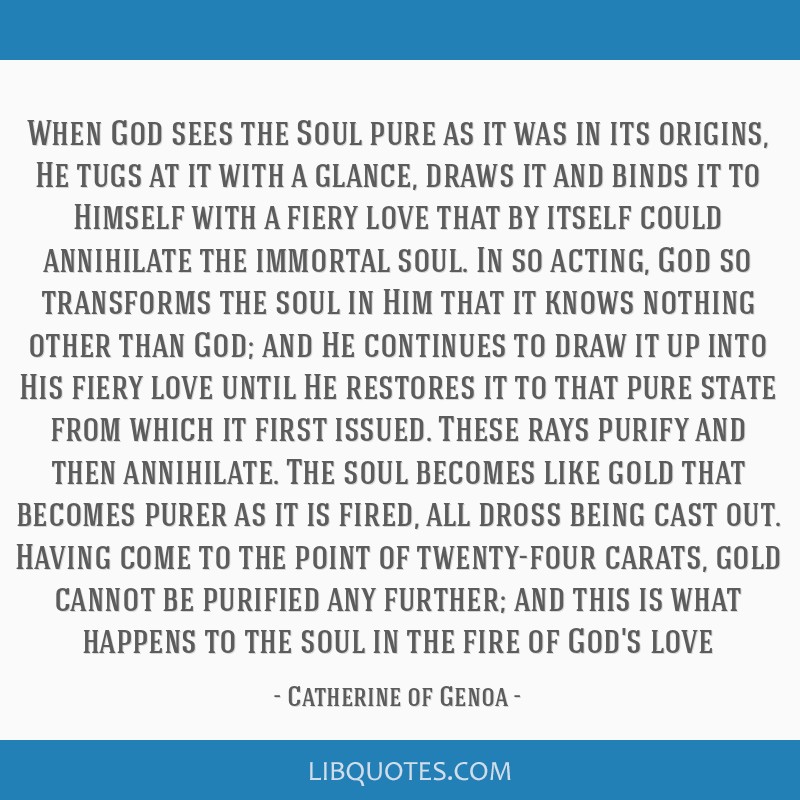
Catherine of Genoa was an Italian mystic and social worker in the Roman Catholic Church.
She wrote the Spiritual Dialogue and a Treatise on Purgatory. She is noted as an authority regarding the doctrine of purgatory.

She is remembered for her work among the sick and the poor. She served the sick during the plague which ravaged Genoa in 1497 and 1501.

She was a member of the noble Fieschi family.  Her fame outside her native city is connected with the publication in 1551 of the book known in English as the Life and Doctrine of Saint Catherine of Genoa.

She and her teaching were the subject of Baron Friedrich von Hügel's classic work The Mystical Element of Religion (1908).

Genoa

The city of Genoa is located between the Apennine Mountains and the Ligurian Sea.

The Apennine are a mountain range of parallel smaller chains extending about 1,200 km (750 mi) along the length of peninsular Italy. They join with the Ligurian Alps at Altare in the northwest.

The Ligurian is part of the Mediterranean Sea between the Italian Riviera (Liguria) and the island of Corsica.

Genoa is the capital of the Italian region of Liguria. It is the sixth-largest city in Italy.

The port is located on the Gulf of Genoa in the Ligurian Sea. It has historically been one of the most important ports on the Mediterranean.  it is currently the busiest in Italy.

It is the birthplace of Christopher Columbus, Niccolò Paganini and Grimaldo Canella, founder of the House of Grimaldi, among others.

 The Bank of Saint George was founded in 1407. It is among the oldest in the world and has played an important role in the city's prosperity since the middle of the 15th century.

The port established  itself as the merchant capital of the newly established Republic of Genoa in 1005 and maintaining its autonomy until 1797.

The capital struggled to rule itself. Many inner conflicts among the nobility weakened the Republic. The inability to rule itself caused the state to put themselves twice under French rule. Once was in 1391. It happened again in 1458.

The Black Death hit Genoa hard in 1348 and contributed to its decline.

Caterina Fieschi Adorno

Catherine's parents were Jacopo Fieschi and Francesca di Negro. Both were of noble Italian birth.  Two popes, Innocent IV and Adrian V, had been of the Fieschi family. Jacopo himself became Viceroy of Naples.

The family were Guelphs. They were in the faction that supported the pope. The Ghibellines were for the Roman emperor

Catherine was the last of 5 children. She was born in 1447. She was described as an extraordinary child who was gifted in prayer and devotion to Christ. She wished to enter a convent when about 13.

Her sister, Limbania, was an Augustinian nun. The nuns to whom her confessor applied refused her on account of her youth. She put aside the idea without any further attempt.

Her father died when she was young. She was married to the young Genoese nobleman, Giuliano Adorno, at 16. Giuliano had returned to Genoa after several experiences in the area of trade and in the military world.

Their conjugal life was not easy. Her husband's character was worldly in affection for games of chance. They didn't produce children. She felt induced to lead a life that lacked serenity. She had a feeling of profound emptiness after 10 years of marriage. She prayed to remain sick in bed for 3 months.

She received a conversion experience as an answer.  Catherine went to the church of St. Benedict and to the monastery of Our Lady of Graces for confession on March 20, 1473.

She wrote that she was wounded in heart by the knowledge of the life she had led and the goodness of God. She did not stay to finish her confession.

She went home and entered a remote room to weep and pray. She received the sense of the immense love of God. She had a vision of Jesus bent beneath the cross. She understood that he suffered so those who suffered pain from discrimination might feel loved.

She entered into a life of profound union by faith with constant prayer and the daily reception of Communion. It was unusual for laity to receive the sacrament so often.

She sought to be taught by God with the nourishment from prayer and the eucharist for 25 years. She did not become dependent upon the priest in confession. She did not become a monastic.

The place of her ascent to mystical peaks was Pammatone Hospital, the largest hospital complex in Genoa, of which she was director.

She lived an active existence despite the depth of her inner life. A group of followers, disciples and collaborators formed around her. They felt edified by her faith and charity. Her husband was won over as well. He became a Third Order Franciscan and moved into the hospital to help his wife.

The plague hit Genoa in 1493. It was reported that it killed up to 80% of the community. Her husband died in 1497.

She resigned her position as director, although she continued working full time until 1499, when her health began to fail. She finally accepted a priest as her spiritual guide during this time. He was her successor as the head of the hospital. He would later write her biography.

She wrote the Spiritual Dialog and Treatise on Purgatory in the 10 years before her death.
Purgatory was not a place located in the bowels of the earth for her. It was an inner fire for purification. It was a movement toward full communion in the kingdom of heaven.

She died in Genoa in 1510.

Elements of Religion

The elements of religion according to Hugel are mystical, intellectual and institutional. The three work to keep religion alive and relevant. Mysticism could never be the whole of religion.

It is personal in a primitive and monotheistic way insofar as it avoids the errors of superstition and hostility, but it holds the institutional and intellectual parts in question.

Catherine used her mysticism to support that which was right about the intellectual and institutional parts. 

Hugel was engaged in theological discussions with a diverse group of scholars associated with the Modernist controversy at the start of the 20th century.

The modernists shared a belief that science had raised new questions for religious faith that undermined naïve suppositions that believers could rely purely on dogmatic authority as a source of truth.

His scholarly concerns included the relationship of Christianity to history, ecumenism, mysticism, the philosophy of religion and the rejection of much of the immanentism in nineteenth-century theology.

The anti-dogmatic position neglected to acknowledge the value that Trinitarian and Christological instruction held with respect for theology. This antagonism supported the liberal position in theology and political philosophy.

Catherine Fieschi
S. 凯瑟琳菲斯基
T. 凱瑟琳菲斯基

凯  Kai  victory             凱  gai         victory song          Ka   きゃ   キャ        Kae  캐  casserole 
瑟  se    harp                 瑟  shitsu     large koto              sa    さ        サ            seo  서  book         
琳  lin    jade                 琳  rin          jewel                     rin  りん    リン         lin    린  Lynn     
菲  Fei   poor                菲   hi           thin                        Fi    ふぃ   フィ         Pi     피  blood   
斯  si      this                 斯   shi         this                         e     え        エ             swi   쉬  wee       
基  ji       base                基  ki           fundamentals         su   す        ス                       
                                                                                         ki    き        キ                                           
-----------------------------

Purgation includes expiation in relation to the divine
to find the way to the jade of the jewel with this mind of mine.

=================

wiki Catherine of Genoa
Franciscan Media: Catherine of Genoa
Lectionary: Catherine of Genoa
Commentary: Treatise on Purgatory
Papal Podcast: Catherine of Genoa
Benedict XVI: Text St. Catherine of Genoa
wiki The Mystical Element of Religion
wiki Genoa
New Advent Encyclopedia: Catherine of Genoa
wiki Guelphs and Ghibellines

Tolerance

David Stove
b. 9.15.1927 Moree, New South Wales, Australia
d. 6.2.1994    Mulgoa, New South Wales

David Charles Stove was an Australian philosopher who argued against socialism. He was for logical probability and rational induction in reason.

Stove criticized the irrationalism that infested the modern philosophy of science. The relativist and “social constructivist” views that were current in the sociology of science and postmodernist humanities departments depicted  modern science as no better (or worse) than voodoo or astrology or reading chicken entrails. The view was made to look like the majority opinion.

Popper, Kuhn and Feyerabend were irrationalists in the philosophy of science. They denied that there was reason to believe in any theory of science. There has been no significant accumulation of relevant knowledge in recent centuries according to the position.

Stove came to be known for his opposition to socialism in college departments in Australia. The socialists made their demands the basis for making decisions for higher education. It ran contrary to the consideration of benefit in reasonable administration.

The argument against socialism seeks to reduce the detrimental affect of socialist analysis on administrative decisions, but argument against it is not enough. Socialism was a derivative of liberal politics. That means that there is another tier to be considered in the argument against non-representative judgment.

The reduction of consideration in the legitimate range of choice for representative policy in democratic society is the area of concern for political organization whether it is in republic or kingdom.

Liberals have been tolerant of socialism because the focus on the role of industrial organization on political leadership has placed their 'power' in government over industry, the middle class and the poor.

They have resorted to populist factionalism in media representation as though it were a representation of democracy. They don't promote representation. They attack it in conservative forms.

Professionalism as a product of education has suffered as a result. While Stove was critical of Popper and his error in science and economics, he wasn't critical enough of liberalism.

The aggressive error of liberalism has to be challenged for the benefit of conservative reform.

Moree, New South Wales
 

Moree is a town in northern New South Wales.

New South Wales is in the southeastern part of Australia. It sits on the banks of the May may River. The name comes from an Aboriginal word meaning "long springs."

The land is a plains region. It has been used for agriculture. The town is not heavily populated. The 2016 census numbers the population at about 7,400 people.

The first constable arrived and a police station was set up in 1865. The first church (Wesleyan) was built in 1867 when the town had a population of 43.

Agriculture emerged as a thriving industry on the fertile flood plains. Banking began in 1876 and the first local newspaper was set up in 1881. The population had grown to 295.

The Great Artesian Basin which sits under Moree was tapped in 1895. The basin yields over thirteen megalitres of water every day, but was proved unsuitable to provide enough water for the agriculture.

The railway line and service from Sydney arrived in 1897. Floods in the area caused numerous washouts of the railway in January 1910. An unknown number of livestock were drowned and at least four people drowned.

A flood cut the township in two in January 1946. Several hundred homes were flooded. The water damaged the power station and caused a black out. Roads and railway lines were damaged.

Moree railway station is situated on the Mungindi line, 665 kilometres (413 mi) from Sydney. It marks the northernmost point of passenger service on the line.

David Stove

David Stove was born in Moree, New South Wales on September 15, 1927.

His parents were Robert James Stove, schoolteacher, and his wife Ida Maude, née Hill. He was the fifth surviving child.

He went to Newcastle Boys’ High School where he excelled in running and was captain of the school track team.

He attended the University of Sydney (BA, 1950) and graduated with first-class honors in moral and political philosophy.

He was strongly influenced by the Challis professor of philosophy John Anderson.

Anderson founded the empirical brand of philosophy known as Australian realism. The central claim was that "whatever exists … is real".  That which is real is spatial and temporal in a situation or occurrence that is on the same level of reality as anything else that exists.

Any object is a fact. Every fact is situated in a complex situation. There are no simple ideas, no atomic facts, no objects which cannot be, as it were, expanded into facts.

All situations exist independently of knowledge of them. All entities are caused. Ethics is concerned with establishing and describing that which is good. It is a positive science. It is not abstractly detached from reality.

Anderson's insistence on unceasing inquiry and criticism became central to the intellectual principles of the university's Libertarian Society. This group supplanted the Free Thought Society in the early 1950's. It provided a philosophic platform for the much broader subculture known as "the Push" throughout the 1960's.

The movement was against socialism, yet he was a defender of free speech. He was critical of the Australian government's bans on certain political publications (1928). People could talk about socialism, but concession to the demands of Marxist ideology was not to be granted.

Stove was appointed a teaching fellow at the University of Sydney in 1951. He became a lecturer in philosophy at the New South Wales University of Technology (later the University of New South Wales) in 1952.

He married Jessie Amelia Leahy, a biochemist on 4 November 1959 at the registrar general’s office. The next year he returned to the University of Sydney.  He was promoted to senior lecturer in 1963 and associate professor in 1974. He would teach there until his retirement in 1987.

Stove was alarmed by the spread of radical left-wing ideas on campus in the early 1970's especially in his own department. He strongly resisted the introduction of courses in Marxism-Leninism and feminism with his colleague David Armstrong, the Challis professor of philosophy.

The subjects went ahead. The dispute resulted in a split in the department. Stove and Armstrong joined a new department of traditional and modern philosophy (colloquially ‘T & M’). Stove headed the department in 1981 and 1982. The left wing department was troubled by political schism. Stove felt that T & M was a perfect environment for serious work.

His work in philosophy mostly concerned the problem of induction. He argued that inference from the observed to the unobserved was justified for purely logical reasons in Probability and Hume’s Inductive Scepticism (1973) and The Rationality of Induction (1986).

There exists a probabilistic kind of logic which renders ‘The next swan is white’ probable, though not certain, on the evidence that all swans so far observed have been white.

His more polemical philosophical work included Popper and After: Four Modern Irrationalists (1982). The work accused leading philosophers of science such as Sir Karl Popper and Thomas Kuhn of undermining, rather than as they claimed, defending science.

Popper had concluded in his massive The Logic of Scientific Discovery (1934) that science could never establish truth.  Stove compared the conclusion to the one that had been made by the fox in Aesop's fable.

The fox had decided that the grapes must be sour, because he could not reach them. Stove added that to make the comparison complete, the sly creature would have gone on to write a long book on the progress of viticulture.

He wrote 'A Farewill to Arts' in protest to the spread of postmodernist varieties of left wing thought in 1986. He described the Faculty of Arts at the University of Sydney as a disaster area.

This disaster was like an area that had been ravaged by flood, a badly leaking nuclear reactor or an outbreak of hoof and mouth disease in cattle. His complaint was that Marxism, semiotics and feminism were being used to favor the employment of women on the faculty.

His opinion was that logically probable deduction and simple induction were the path to truth. Common sense has to be applied in practical reason for realism to work.

He was witty and irreverent in expression, but principled in thought. He was pessimistic in that he found no consolation in religion or hope for political progress.

He found some comfort in classical music, old books and nature. He enjoyed planting trees at his rural property at Mulgoa. He also liked cricket and rugby league.

He was a heavy smoker. He contracted oesophageal cancer.

He committed suicide on 1 or 2 June 1994 at Mulgoa after a period of depression following severe treatment for the disease.

While his criticism of socialism was warranted, his conservatism was pessimistic. He did not admit to room for the stable management of reform.

-----------------------

David Stove
S. 大卫斯托夫
T. 大衛斯托夫

大 Da       great              大 dai        large                   De   で     デ          De  데  place             
卫 wei     health              衛  ei        defense                bi    びっ  ビッ      i    이  this             
斯  Si         this               斯  shi       this                      Do   ど      ド        bi     비  ratio           
托  tuo      support          托   taku    requesting           su    す    ス          deu  드  de             
夫  fu        husband         夫  fu         husband              to    と-   ト-        Seu   스  s                           
                                                                                      bu    ぶ    ブ         to     토  sat     
                                                                                                                    beu  브 bro                 
-----------------------

Socialism demands the defense of liberal expenditure
as though the competitor were the cause of the global rise in temperature.

=================

wiki David Stove
James Franklin: Sydney Philosophy Disturbance
Bio David Charles Stove

Sunday, October 21, 2018

Restore Fortune


Lauren Holly

Restore
Fortune
回復フォーチュン 
Kaifuku fōchun
ps126

When fortune was restored
we were like those who had scored.

We felt like those who dream while awake.
There was the distinct feeling that this fortune was great.

Our mouths were filled with laughter.
We began a new chapter.

The rider and the fighter were twins in the sky.
They fought for the standard to know how and why.

They released many captives from the burden of plight.
The captives were freed so they could find freedom in flight.

Courage watched leadership rise with his word.
Reason was challenged to overcome the absurd.

Beauty met moon near the end of her time.
The bull surveyed the  terrain at the height of his climb.

The hunter drank the storm as it had been.
He stalked the prey that he had yet to win.

Our tongues lifted sound above vocal cords.
Our joy was profound. Our bliss was adored.

Restore our borders with the cosmic sorter for order.
Reap the harvest of stars in the heavenly quarters.

Give us virility as the light in the day time declines.
Let the leaves fall as the autumn wind unwinds time.

The start of the storm is born from the misery of earth.
Mason bees cut live leaves for the mystery of worth.

The shadow of darkness rumbles under the thunder. 
The blind eye of the sky can turn a tree into lumber.

The order of forest sings the wind like a chorus.
The starred flower of jasmine doesn't fail to adore us.

The music of hope is the will for the village.
The virtue of luck is the note for our privilege.

Let oil be squeezed from olives or corn.
Let want be pleased, not lawless or torn.

Let the mantle of praise lift up the weakness of spirit.
Feel the energy of love before you hear or go near it.

Augurs of chance read spirits as birds
to test public statements for the truth of the words.

The red of the cinnabar is vermilion from mercury.
The mummies of Chile were colored red for eternity.

Great things have been done in the strength of this time.
The length of our darkness makes the light feel primely sublime.

Those who managed to work throughout the past year
made a memory to transcend the feeling of fear.

Those who sowed seed with the toil of tears in arrears
will reap joy with music in the heavenly spheres.

Those who went weeping to water seeds for the future
have returned with wheat to fulfill needs as your nurture.

This voice is like that of the cry in the darkness
unbroken in facing the strength of the hard test. 

Restore our good fortune. Transform the harm from the past.
Let us win the bid for our portion. Give us confidence to last.


Psalm 126 In convertendo
1 When the Lord restored the fortunes of Zion,
then were we like those who dream.
2 Then was our mouth filled with laughter,
and our tongue with shouts of joy.
3 Then they said among the nations,
"The Lord has done great things for them."
4 The Lord has done great things for us,
and we are glad indeed.
5 Restore our fortunes, O Lord,
like the watercourses of the Negev.
6 Those who sowed with tears
will reap with songs of joy.
7 Those who go out weeping, carrying the seed,
will come again with joy, shouldering their sheaves.

10-28-18
Uranus reaches opposition on Oct. 23. It lies opposite to our Sun in our sky, so rises at sunset, stays up all night and sets at sunrise.

The Moon and the Beehive Cluster will make a close approach. The Beehive is in Cancer.

Birthdays

Sensical Significance


Alfred J. Ayer 10.29.10 London, England
阿爾弗雷德艾爾
阿尔弗雷德艾尔

阿  A      also         阿  kuma      shadow              A    あ    ア           Al   알   egg 
尔  er     you          爾  ore          you                     ru   る    ル          peu 프   the         
弗  fu      not          弗  fu            fluor-                   fu   ふ    フ           le    레   re
雷  lei     terrific      雷  rai           thunder              re   れ    レ           Ah   아    a       
德  de    favor         no kanji                                  ddo っど  ッド          i     이    this
艾  Ai     to cut        艾 mogusa   moxa                 A    あ    ア            eo   어    uh
尔  er     you           爾  ore          you                    e     え    エ

The years between Queen Victoria's death in 1901 and the start of the First World War in 1914 were years of growth and general prosperity. The inequalities which had characterized Victorian London continued.

One out of five Britons lived in London by 1900. The population of roughly 5 million in 1900 rose to over 7 million by 1911.

Representatives of various trade unions and of the Independent Labour Party, Fabian Society and Social Democratic Federation agreed to form a Labour Party backed by the unions and with its own whips in 1900.

The Labour Representation Committee was founded with Keir Hardie as its leader. The LRC won only two seats at the 1900 general election. The SDF disaffiliated, but more unions signed up.

The LRC affiliated to the Socialist International. The name was changed to the Labour Party in 1906. It formed an electoral pact with the Liberals. The intent was to cause maximum damage to the Unionist government at the forthcoming election. Twenty nine Labour MPs were elected to the House of Commons.

Edwardian London was characterized principally by the burgeoning Women's Suffrage movement. The nationwide movement was spearheaded by Emmeline Pankhurst and her Women's Social and Political Union. Protests and demonstrations intensified during these years. Tension reached a peak between 1912 and 1914 as the movement militarized.

The introduction of the new 'Dreadnought' class battleship and the subsequent naval arms race with Germany prompted David Lloyd George, the chancellor of the exchequer, to introduce a tax on land, to increase income tax and to propose a 'super-tax' on incomes over £5,000 per annum in 1909. He presented these increases as designed to fund social reforms.

The Conservative-dominated House of Lords broke the parliamentary convention that the upper house should not overturn a financial bill when Chancellor David Lloyd George's budget was rejected in 1909. This ensured that House of Lords reform was one of the issues at stake in the next general election.

The election precipitated by the Lords' rejection of the 'People's Budget' resulted in 275 seats for the Liberals, 273 for the Conservatives and 40 for Labour. The budget was then passed. The Irish Nationalists were now in a position to force Irish 'Home Rule' back up the agenda with 82 seats.

Edward VII died in 1910. His son, George V, ensured that the monarchy was more active than it had been in the latter years of Victoria's reign. Edward's funeral brought the royalty of Europe for the last time before war broke out in 1914. Many of the European royals were family relations.

Alfred Jules Ayer was born in St John's Wood in north west London on 29 October 1910. His family was wealthy. They were from continental Europe. His mother, Reine Citroën, was from the Dutch-Jewish family who founded the Citroën car company in France. His father, Jules Ayer, was a Swiss Calvinist financier who worked for the Rothschild family.

Ayer was educated at Ascham St Vincent's School. St. Vincent's was a former boarding preparatory school for boys in the seaside town of Eastbourne in Sussex. He started boarding at the comparatively early age of seven due to the First World War. He won a scholarship to Eaton College when he was 13.

It was at Eton that Ayer became known for his characteristic bravado and precocity. He was keen on sports, particularly rugby. He reputedly played the Eton Wall Game very well.

Ayer was ranked second in his year in the final examinations at Eton. He was first in classics. He unsuccessfully campaigned for the abolition of corporal punishment at the school as a member of Eton's senior council in his final year.

He won a classics scholarship to Christ Church College of Oxford University in 1929. There he studied Greek and philosophy. One of his tutors was Gilbert Ryle. He suggested that Ayer read Ludwig Wittgenstein’s Tractatus Logico-Philosophicus.

He traveled to Vienna in 1933 to meet with Moritz Schlick and other members of the Vienna Circle of logical positivists. He was one of only two English-speaking people to meet and study with the Vienna Circle. W. V. O. Quine was the other.

Ayer was elected to a five-year research fellowship at Christ Church in 1935. He finished writing Language, Truth and Logic in that year. The book brought some of the ideas of the Vienna Circle and the logical empiricists to the attention of the English-speaking world.

He argues for the verification principle of logical positivism. This principle is referred to as the criterion of significance or criterion for meaning. Ayer explains how the principle of verifiability may be applied to the problems of philosophy.

The metaphysical thesis that philosophy affords us knowledge of a transcendent reality was rejected. Assertions are meaningless unless logical or empirical verification is possible. Statements like "God exists" or "charity is good" are not true or untrue but meaningless.

Ayer became strongly involved in politics in the pre-WWII years. He supported the Republican side in the Spanish Civil War. He considered joining the Communist Party, but became instead an active member of the British Labour party. He joined the Welsh Guards when WWII broke out and worked for a time interrogating prisoners.

He was Grote Professor of the Philosophy of Mind and Logic at University College London from 1946 until 1959. He returned to Oxford to become Wykeham Professor of Logic at New College. He was president of the Aristotelian Society from 1951 to 1952 and knighted in 1970. He was known for his advocacy of humanism, and was the first executive director of the British Humanist Association (now known as Humanists UK).

Ayer wrote an article entitled, "What I saw when I was dead" in 1988 shortly before his death. He described an unusual near-death experience. The attending physician claimed in 2001 that Ayer had confided to him: "I saw a Divine Being. I'm afraid I'm going to have to revise all my books and opinions." His son Nick, however, said that he had never mentioned this to him. He found his father's words to be extraordinary though.


Lauren Holly 10.28.63 Bristol, Pennsylvania
T. 勞倫霍莉
S. 劳伦霍莉
 Dr. Betty Rogers in 'Motive'
Tweet


劳  Lao      labor              勞   rou        trouble           Ro  ろ-    ロ-          Lo  로  in
伦  lun       order              倫   rin         relation          ren  れん   レン        len  렌  wren
霍  Huo     quickly            霍   kaku     stroke            Ho   ほ     ホ            Hol  홀  hall
莉  li          jasmine           莉  matsu   jasmine         ri     り-     リ-          li      리  lee

Bristol Borough was settled in 1681. It was named after Bristol, England. It was originally used as a port and dock because it was located on the Delaware River. It was also next to the mainland route to New York City, Trenton and New England.

Samuel Clift received a land grant from Edmund Andros, Governor of New York. The grant became effective on March 14, 1681. William Penn's Charter from Charles II became effective at the same time. Clift was required by the grant to maintain ferry service across the Delaware River to Burlington, New Jersey. He also had to run a public house or inn. The inn later became known as the George II.

The land for the town became the center for textile mills, foundries, milling and miscellaneous manufacturing in the 18th century. It became a shipping gateway with the building of the 60 mile (96.6 km) long, forty foot wide and five foot deep Delaware Canal. Anthracite coal barges flowed from the Lehigh Canal's end terminal at Easton to Philadelphia.

Bristol Borough was chosen as the end for the Delaware Canal because it already had regular shipping connections to Philadelphia and Delaware River ports. Ships included the era's typical animal powered barges and inland shipping vessels.

Its docks also had regular ferry services to New Jersey and other points east from as early as 1681. The town would receive steamboat service when that technology came to be.

The Pennsylvania Railroad served to connect anthracite to the riverine barge and boat traffic on the canals. The railroad connection provided depot service for the manufacturers. The area was a transportation hub. This made it more attractive for industry.

Bristol Borough included companies manufacturing wall paper and carpet by the 1880's. The docks had sufficient space for a shipyard to construct twelve building slips for the construction of merchant vessels in World War I.

Averell Harriman organized the Bristol Borough shipyards in 1917. He founded the Merchant Shipbuilding Corporation. The name was changed later to Merchant-Sterling. The company would land a contract to build 40 identical cargo ships for the war given the U-boat menace.

The residential area that developed around the shipyards was soon named Harriman, Pennsylvania. Most of the housing built therein is still in use today. Harriman was annexed by Bristol Borough in 1922. Most of the shipping was finished too late to enter World War I, but some of the shipyard's output was used in post-war relief and troop support missions.

The majority of the contracts were canceled in 1919. The ship yards rapidly became excess real estate. The eighty-acres of the shipyard were let out to various concerns between the world wars. One area converted to building amphibious planes.

The flying boat technology was the heart and soul of long distance air travel until the technological advances in the middle years of World War II.

The old shipyards were used to build amphibious and other aircraft during World War II. Most of the manufacturing was not directly war related.

Bristol Borough gained national attention when the song "Bristol Stomp" by The Dovells hit #2 on the Billboard pop chart in 1961. The song remains a local favorite. It is often played at ceremonies, parades and sporting events.

Lauren Holly was born in Bristol, Pennsylvania on October 28, 1963.  Her mother, Michael Ann Holly, is the art historian at the Sterling and Francine Clark Art Institute in Williamstown, MA. Her father, Grant Holly, is a screenwriter and professor of literature at Hobart and William Smith Colleges in Geneva, NY.

She has two younger brothers: Nick and Alexander Innes Holly (1977–92). Holly was raised in Geneva, New York. She is a 1981 graduate of Geneva High School. She earned an undergraduate degree in English from Sarah Lawrence College in New York in 1985.

Lauren Michael Holly is a Canadian-American actress. She is known for her roles as Deputy Sheriff Maxine Stewart in the television series Picket Fences, Director Jenny Shepard in the series NCIS and Dr. Betty Rogers on Canadian series Motive.

She played Mary Swanson in Dumb and Dumber, Linda Lee in Dragon: The Bruce Lee Story, Darian Smalls in Beautiful Girls, Cindy Rooney in Any Given Sunday and Gigi in What Women Want.


Julia Roberts 10.28.67 Smyrna, Georgia
T. 朱莉婭羅伯茨
S. 朱莉娅罗伯茨
  FB Community
 'Homecoming' Trailer

朱  Zhu      cinnabar              朱   shu         cinnabar        Ju    じ     ジ           Jul    줄   line
莉  li           jasmine               莉   ri             jasmine         ri   ゅり ュリ         li      리   lee
娅  ya        brother in law       婭  not kanji                        a     あ     ア           a      아   ah
罗  Luo      to catch                羅  ra            la                   Ro  ろ     ロ             Lo     로   in
伯  bo        senior                   伯  haku        duke              ba   ば-   バ-           beo    버  bur
茨  ci         to thatch               茨  ibaru        thorn              tsu  つ     ツ           cheu  츠 tsu

Smyrna is located northwest of Atlanta in the inner ring of the metropolitan area.

All of the land that today comprises Smyrna and Cobb County was part of the Cherokee Nation up until 1832. The state of Georgia surveyed the Cherokee Nation and divided it into land lots of 160 acres and gold lots of 40 acres.

Gold lots were believed to possibly contain gold. The initial expectation was that a treaty would be negotiated and finalized between the Cherokee Nation and the US Government to open the land to white settlement.

White settlers first arrived in the Smyrna area to claim the land they won in the lottery in the fall of 1832. Tensions were high since the original Cherokee landowners were still living in the area. It is believed that the Cherokee left the Smyrna area by 1835.

The area began to grow after the completion of the Western and Atlantic Railroad in 1842. It was known by several names. It was called Varner's Station, Ruff's Siding, Neal Dow and Ruff's Station. The city was incorporated with the name Smyrna in 1872.

It was named by Greeks for the Biblical city of Smyrna, modern day Izmir in Turkey. It was the home of the famous Christian martyr Polycarp.

Georgia Governor Joseph E. Brown established an officer's training camp at Smyrna Camp Ground on April 23, 1861. It was selected because of its easy rail access. The training camp was named Camp Brown. The nearby Smyrna Academy was also designated as a training facility for Confederate soldiers. Volunteers quickly signed up after the Governor's request.

Two Civil War battles occurred in the area. The Battle of Smyrna Camp Ground and the Battle of Ruff's Mill were both fought on July 4, 1864. The area's businesses, homes and 1849 covered bridge were burned by Sherman's troops.

The 1890 census recorded 280 residents for the village. New technologies of the time, such as electricity, telephones and motor vehicles, were quickly adopted by the local citizenry as the town grew during the first part of the 20th century.

The Atlanta Northern Railway established trolley service to Marietta and Atlanta in 1905. AT&T opened a phone office in 1905 to serve 21 customers. The first bank was chartered in 1911. The local academy became Smyrna High School sometime on or before 1915.

Smyrna remained an agricultural area for the most part until the 1940's. The economic profile changed when construction began on the Bell Bomber aircraft plant a few miles north in Marietta in 1942. New jobs were created. Production began in the spring of 1943. Employees produced 663 B-29's for the Army Air Corps. The plant closed immediately after the war.

The 1950's were a period of rapid growth for Smyrna. The population mushroomed from 2005 residents in 1950 to more than 10,000 at the decade's end. The Bell Bomber plant was reopened as Lockheed Georgia in 1951. The resumption of aircraft production created new jobs and a demand for new housing.

Smyrna nearly doubled in size during the 1960's when the population grew to 19,157. A new 4,000 square foot public library opened in 1961. It was built at a cost of $54,000. It was later expanded in 1969 and 1973. Cobb Center Mall featured the first suburban Rich's department store. It opened on South Cobb Drive in 1963.

Julia Roberts was born on October 28, 1967, in Smyrna, Georgia. Betty Lou Bredemus (1934–2015) and Walter Grady Roberts (1933–1977) were her parents. She is of English, Scottish, Irish, Welsh, German and Swedish descent. Her father was a Baptist. Her mother was a Roman Catholic. She was raised Catholic.

Her older brother Eric Roberts (b. 1956), older sister Lisa Roberts Gillan (b. 1965) and niece, Emma Roberts, are also actors. She also had a younger half-sister named Nancy Motes (1976–2014).
Roberts' parents were one-time actors and playwrights. They met while performing in theatrical productions for the armed forces. They later co-founded the Atlanta Actors and Writers Workshop in Atlanta.

They ran a children's acting school in Decatur while they were expecting Julia. The children of Martin Luther King, Jr. and Coretta Scott King attended the school. Walter Roberts was their daughter Yolanda Denise King's acting coach. Mrs. King paid Mrs. Roberts's hospital bill when Julia was born as a thank-you for his service.

Julia is an American actress and producer. She became a Hollywood star after headlining the romantic comedy Pretty Woman (1990). She has won three Golden Globe Awards out of eight nominations. She has been nominated for four Academy Awards for her performance in films. She won the Academy Award for Best Actress for her performance in Erin Brockovich (2000).

Her most successful films include Mystic Pizza (1988), Steel Magnolias (1989), Pretty Woman (1990), Sleeping with the Enemy (1991), The Pelican Brief (1993), My Best Friend's Wedding (1997), Notting Hill (1999), Runaway Bride (1999), Ocean's Eleven (2001), Ocean's Twelve (2004), Charlie Wilson's War (2007), Valentine's Day (2010), Eat Pray Love (2010), Money Monster (2016) and Wonder (2017).


Mizuki Fukumura, 10.30.96 Tokyo, Japan
譜久村聖
米祖き福區畝啦
 Morning Musume
 R u happy?

米  Mi    rice                    譜    Fu          music         Fu     ふ   フ        Hu   후   after 
祖  zu    ancestor            久   ku             hope           ku     く    ク         ku    쿠  ku
志  zhi   will                      村  mura       village         mu   む   ム        mu   무   radish
福  Fu    luck                    聖  Mizuki      virtue          ra     ら    ラ        l a     라   la
區  qu    area                                                             Mi     み    ミ       Mi      미  beauty
畝  mu   field                                                             zu    ず    ズ      jeu     즈  the
啦  la      musical note                                               k i     き    キ       ki      키   key     

Joshi kosei (high school girls) became a leading influence with the loose socks boom in 1996.  The development of products such as fashion and makeup items, snacks and services was directed toward the joshi kosei market.

Songs by Tetsuya Komuro became big hits. Komuro was an early pioneer of dance music in Japan. He rose to stardom in the 1990's as a producer with a long string of hits.

Artists such as TRF (TK Rave Factory), Tomomi Kahala, Namie Amuro, Ami Suzuki, hitomi, Ryoko Shinohara and H Jungle with t became popular. He composed the musical score to the Japanese anime film Street Fighter II: The Animated Movie. The movie was based on the Capcom video game.

Namie Amuro’s fashion style was imitated by girls who were given the name Amurer. They wore miniskirts, thick-soled boots and long cardigans. The trend shifted from Chanelers (dressed with Chanel items) to Amurers.

Fukumura Mizuki was born on October 30, 1996 in Tokyo, Japan. She is the current leader of Morning Musume in Hello! Project. She joined Morning Musume as a 9th generation member along with Ikuta Erina, Sayashi Riho and Suzuki Kanon on January 2, 2011.

She was appointed as the new leader of Morning Musume by Michishige Sayumi in 2014. Mizu-chan's leadership has been characterized by her appreciation of artistry in different styles.

She has loved Morning Musume since she was a 1 year old.

Gemini - twins
Taurus- bull
Orion - hunter
Mars - courage
Jupiter - leadership
Mercury - reason
Venus- beauty
Castor - rider
Pollux - fighter
Uranus- rain storm
Neptune- calm sea