Why
This?
为什么这样
Wèishéme zhèyàng
なぜこれ
Naze kore
ps74
Quid est
Why this
after the bliss
of our tryst?
What happened to the congregation you bought long ago,
the tribe you redeemed for the inheritance of your ancestral tempo
and the secure foundation for the security of your escrow?
No one has been found like Abraham.
He kept the law like a histogram.
He certified the covenant in his flesh.
He became the father of the nations crest.
When he was put to the test
he substituted something lesser as better for the best.
Turn your attention to the attack on our heritage.
Liberal power has made deceptive experiment the imperative.
Socialism has laid claim to the end of time
to use the threat of revolution to meet demands across borderlines.
They were like loggers laying siege to a grove of trees.
They rejected conservative reason for various causes as idolatries.
Populist rhetoric was used to deny unity.
Factional speech declared special favor for importunity.
Media expression blared that they cared when they did not.
Opposition was attacked and detracted as though they had been caught.
Foreign policy for aggression displaced accountability
for the national security of official improbability.
How long will the adversary scoff at the utility of joy?
How long will they make aggression into the avoirdupois?
Why do you draw back your hand?
Why is your demand bidden in our land?
Some person was caught up into Paradise with Christ.
He heard things of joy beyond the ability to describe.
The royalty of his noble authority was honored by the public.
Oaths of loyalty were laid before his path by people who had felt they were loveless.
One ruler in the party of succession for the conservation of wealth
in the economics of stability for the commonweal
has been the rule of order for social and personal health
amidst the tales and travails of stealth.
When liberals from the lower house have been placed over the higher
and the agreement has been forced upon the prior
administrative qualifier
as the fire of desire for the entire official attire
the basis for civil rights has been decayed in the quagmire.
It's like the sea was divided by the elements of strife.
The heads of dragons were shattered upon the waters for life.
The head of the Leviathan was crushed
that the people of the desert might be fed enough.
Raiders were not allowed to take their stuff.

The dry earth was split by spit for spring and torrent.
The ever flowing river serves the converse as conditions warrant.
Yours is the day for work or play.
Yours also is the night to review the ways of the day.
You established the moon and sun.
Energy was made to run for fun.
The study of probability is a mental construct
that stems from the observation of variance in nature's conduct.
The boundaries of the earth have been fixed.
Summer, fall, winter and spring have conditions mixed
in the relative fix of the betwixt of each interdict.
Summer bans cold.
Winter abhors warmth as old.
Spring decreases darkness and cold for growth.
Fall is the end of growth as an oath for most.
Remember how those who listened with enmity
scoffed at the Incarnation of Memory.
Foolish people despised your Name
to defame your legacy as lame.
Do not sacrifice the dove to wild beasts.
Make sure you have enough for what your child needs.
Look upon your covenant embodied
as the ground for your governance copied.
Let legitimate complaint be heard.
Help the poor find economy with your word.
Rise to shine to maintain your cause.
Let those who revile authority find respect for law.
Show that error caused by mass deception
results in tumult for the engine of reception.
----------------------------
Dyeus- shine or sky
Zeus- Light
Deus- God
74 Ut quid, Deus?
Why, God?
1 O God, why have you utterly cast us off?
why is your wrath so hot against the sheep of your pasture?
2 Remember your congregation that you purchased long ago,
the tribe you redeemed to be your inheritance,
and Mount Zion where you dwell.
3 Turn your steps toward the endless ruins;
the enemy has laid waste everything in your sanctuary.
4 Your adversaries roared in your holy place;
they set up their banners as tokens of victory.
5 They were like men coming up with axes to a grove of trees;
they broke down all your carved work with hatchets
and hammers.
6 They set fire to your holy place;
they defiled the dwelling-place of your Name
and razed it to the ground.
7 They said to themselves, "Let us destroy them altogether."
They burned down all the meeting-places of God in the land.
8 There are no signs for us to see;
there is no prophet left;
there is not one among us who knows how long.
9 How long, O God, will the adversary scoff?
will the enemy blaspheme your Name for ever?
10 Why do you draw back your hand?
why is your right hand hidden in your bosom?
11 Yet God is my King from ancient times,
victorious in the midst of the earth.
12 You divided the sea by your might
and shattered the heads of the dragons upon the waters;
13 You crushed the heads of Leviathan
and gave him to the people of the desert for food.
14 You split open spring and torrent;
you dried up ever-flowing rivers.
15 Yours is the day, yours also the night;
you established the moon and the sun.
16 You fixed all the boundaries of the earth;
you made both summer and winter.
17 Remember, O Lord, how the enemy scoffed,
how a foolish people despised your Name.
18 Do not hand over the life of your dove to wild beasts;
never forget the lives of your poor.
19 Look upon your covenant;
the dark places of the earth are haunts of violence.
20 Let not the oppressed turn away ashamed;
let the poor and needy praise your Name.
21 Arise, O God, maintain your cause;
remember how fools revile you all day long.
22 Forget not the clamor of your adversaries,
the unending tumult of those who rise up against you.
-------------------------
===================
-------------------------
Sirach 44:19-20
Abraham was the father of a multitude of nations.
No one has been found like him in glory.
He kept the law of the Most High
when he entered into a covenant with him.
He certified the covenant in his flesh.
When he was tested he proved faithful.
-------------------------
No one has been found like Abraham.
He kept the law like a histogram.
He certified the covenant in his flesh.
He became the father of nations crest.
When he was put to the test
he substituted something better as best.
===================
2 Corinthians 12:2-4
I know a person in Christ who 14 years ago was caught up to the third heaven. Whether it was in the body or outside the body I do not know. God knows. I know that such a person was caught into Paradise and heard things that are not to be told. No mortal is permitted to repeat.
-------------------------
Some person was caught up into Paradise with Christ.
He heard things of joy beyond the ability to describe.
===================
Luke 19:39
Some of the Pharisees in the crowd said to him, 'Teacher, order your disciples to stop.' He answered, 'I tell you, if these were silent, the stones would shout out.'
-------------------------
The royalty of his noble authority was honored by the public.
Cloaks were spread before his path by people who had felt they were loveless.
===================
Probability
Bruno de Finetti
b. 6.13.1906 Innsbruck, Austria
d. 7.20.1985 Rome, Italy
Bruno de Finetti was an Italian probabilist statistician and actuary. He was noted for the "operational subjective" conception of probability.
The classic exposition of his distinctive theory is the 1937 "Prediction: Logical Laws, Subjective Sources." (La prévision: ses lois logiques, ses sources subjectives) The paper discussed probability founded on the coherence of betting odds and the consequences of exchangeability.
Exchangeability is equivalent to the concept of statistical control. This form of control has application in the manufacturing process. It ensures quality in efficient production to make more products conform to specification with less waste.
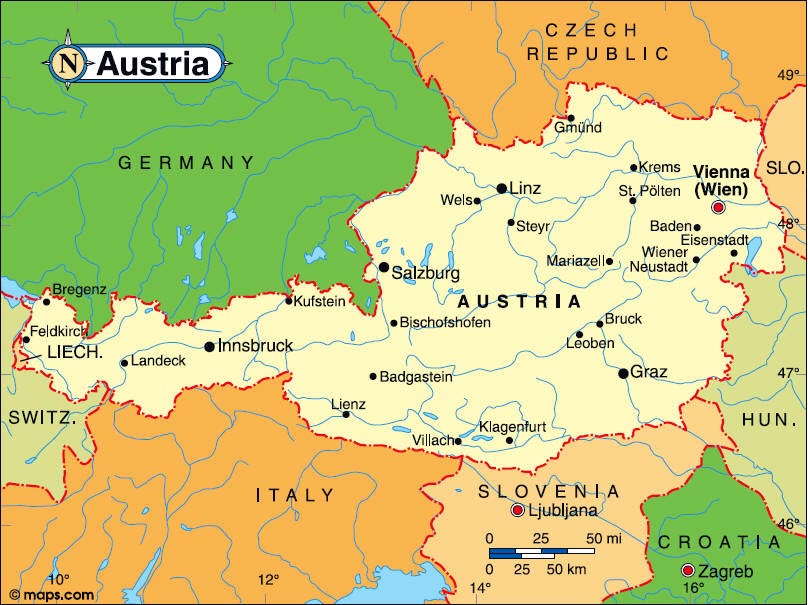
De Finetti was born in Innsbruck, Austria.

Map
The town passed into the hands of the Counts of Tyrol in 1248. The city's arms show a bird's-eye view of the Inn bridge. The design has been used since 1267.
The route over the Brenner Pass was a major transport and communications link between the north and the south of Europe. It was the easiest route across the Alps. It was part of the Via Imperii, a medieval imperial road under special protection of the king. The revenues generated by serving as a transit station on this route enabled the city to flourish.
Tyrol was ceded to Bavaria, ally of France, during the Napoleonic Wars. Andreas Hofer led a Tyrolean peasant army to victory in the Battles of Bergisel against the combined Bavarian and French forces. He made Innsbruck the center of his administration.
The combined army later overran the Tyrolean militia army. Innsbruck was part of Bavaria until 1814. Austrian rule was restored after the Vienna Congress (1814-1815). The town was part of the Austrian monarchy until 1918. It was one of the 4 autonomous towns in Tyrol.
The location in the Alps has made it a destination for winter sports. Innsbruck is also known for its Imperial and modern architecture.
Bruno de Finetti
De Finetti was born on June 13, 1906 when Innsbruck was part of Austria-Hungary. His Italian parents were Austrian citizens. His father worked as a railway constructor. He was an engineer as was his father before him.
The states of the Italian peninsula and Sicily had united as a kingdom in 1861. Victor Emmanuel II was the king. The Italian Nationalist movement held the goal of joining the modern industrialized powers.
Extensive industrialization and the building of a modern infrastructure was well underway by the 1890's. Alpine railway lines connected Italy to the French, German and Austrian rail systems. Two south-going coastal lines were also completed. Most of the larger industrial businesses were founded with considerable investment from Germany, Britain, France and others.
The de Finetti family presence in Innsbruck was a result of the expansion of the railway system.
It was no surprise when in 1923 Bruno de Finetti enrolled at Milan Polytechnic (Politecnico di Milano). He discovered his true passion for mathematics there.
He was inspired by a paper of the biologist Carlo Foà during his third year. He started research work in the field of population genetics. This led him to the first of his almost three hundred writings (1926). it was the first example of a model with overlapping generations in population genetics. He was at least forty years ahead of its time.
He moved to the recently founded University of Milan. He graduated in Applied Mathematics with a dissertation on affine geometry in 1927. Affine geometry is the study of parallel lines. He was supervised by Giulio Vivanti, a mathematician who made some noteworthy contributions to complex analysis.
A position was already waiting for him in Rome as an actuary and statistician at the Italian Central Statistical Institute, founded and directed by Corrado Gini. He remained there until 1931. He transferred to the Trieste insurance company Assicurazioni Generali from 1931.
He was one of the first mathematicians to become aware of the possibilities offered by computing machinery due to the mechanization of some actuarial services. He supplemented his work in the following years with several academic appointments, both in Trieste and Padua.
He won a competition for Chair of Financial Mathematics and Statistics in 1936, but was not nominated due to a fascist law barring access to unmarried candidates.
He concentrated on his academic activity starting from 1946. He became a full professor at the University of Trieste in 1947. He was appointed as ordinary professor at the university only in 1950. He moved to "La Sapienza" University of Rome in 1954 where he remained until the end of his career.
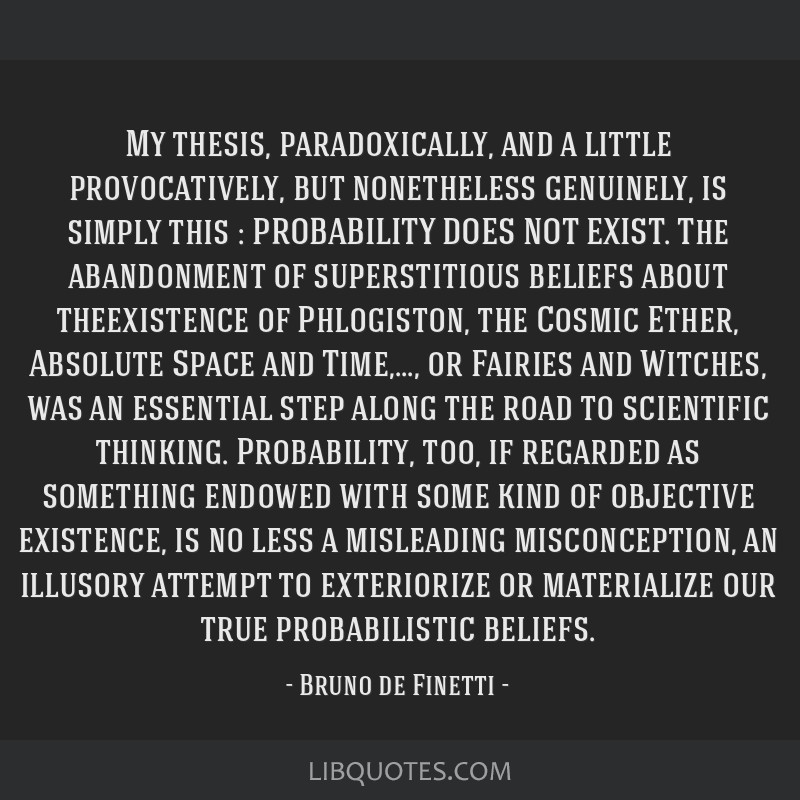
De Finetti was especially fond of the aphorism: Probability does not exist. The study of probability is an expression of the observer's view of the world. It is a mental construct as such. It has no existence of its own.
Statistical inference is no longer an empirical process that produced opinions from data as a consequence of the subjective approach. It becomes a logical-psychological process selecting opinions compatible with data among the available ones.
His contributions to probability and statistics do not reduce to his subjective approach. They include important results on finitely additive measures, processes with independent increments, sequences of exchangeable variables and associative means.
De Finetti emphasized a predictive inference approach to statistics. He proposed a thought experiment along the following lines for coherence in a philosophical gambling strategy.
You must set the price of a promise to pay $1 if there was life on Mars 1 billion years ago and $0 if there was not. The answer will be revealed tomorrow.
You know that your opponent will be able to choose either to buy such a promise from you at the price you have set or require you to buy such a promise from your opponent at the same price.
You set the odds in other words, but your opponent decides which side of the bet will be yours.
The price you set is the "operational subjective probability" that you assign to the proposition on which you place your bet. This price has to obey the probability axioms if you are not to face certain loss as you would if you set a price above $1 (or a negative price).
De Finetti could justify additivity by considering bets on more than one event. Prices or equivalent odds that do not expose you to certain loss through a Dutch book are called coherent.
A Dutch book or lock is a set of odds and bets in gambling which guarantees a profit regardless of the outcome of the gamble. It is associated with probabilities implied by the odds not being coherent.
The term usually refers to a sequence of trades that would leave one party strictly worse off and another strictly better off in economics.
His interest in economics was innate and led him during his first year at Milan Polytechnic to attend the lectures given there by Ulisse Gobbi. These confirmed him in his radical position for a collective Pareto optimum with a "fairness" criteria.
Italy's politics favored radical socialism due to a regionally fragmented right after unification. The kingdom attempted to join the Great Powers in acquiring colonies in the late 19th and early 20th centuries. The cost of colonization made the task difficult. It added to the huge debt that modernization had incurred.
Italy remained neutral at the beginning of World War I. The kingdom declared war on the Austro-Hungarian Empire in exchange for several territories. The Fascist regime grew after the end of WWI in opposition to the threat of socialist revolution by labor.
The political situation had been reduced to the competition between the different forms of socialism. This had a parallel development with the case in Spain in their civil war. The expansion of the condition for revolutionary demand was largely the result of labor union agreement with the economic theory of Engels and Marx.
De Finetti was a Fascist during his youth, then moved to Christian socialism and finally adhered to the Radical Party. His longing for social justice caused him to run as a candidate in several elections in the 1970's. He was arrested for his antimilitarist position.
He is also noted for de Finetti's theorem on exchangeable sequences of random variables. He was not the first to study exchangeability but he brought the subject to greater visibility. He started publishing on the topic in the late 1920's but the 1937 article is his most famous treatment.
He introduced the concept of infinitely divisible probability distributions in 1929.
He also introduced de Finetti diagrams for graphing genotype frequencies.
Bruno de Finetti was a honorary fellow of the Royal Statistical Society as well as a member of the International Statistical Institute and a fellow of the Institute of Mathematical Statistics at the time of his death. He died in Rome on July 20, 1985.
Extensions of de Finetti's representation theorem have been found to be useful in quantum information in topics like quantum key distribution and entanglement detection in the 21st century.
Bruno de Finetti
S. 布鲁诺·代·芬蒂
T. 布魯諾·代·芬蒂
布 Bu to announce 布 fu cloth Bu ぶ ブ Beu 브 the
鲁 lu rude 魯 ro foolish ru る- ル- lu 루 sack
诺 nuo promise 諾 daku consent no の ノ no 노 furnace
代 dai generation 代 dai substitute de で デ deu 드 de
芬 Fen perfume 芬 fun perfume Fu ふぃ フィ Pi 피 blood
蒂 di stem 蒂 tei stem of plant net ねっ ネッ ne 네 yeah
ti てぃ ティ ti 티 tea
-------------------------
The study of probability is a mental construct
that stems from the observation of variance in nature's conduct.
===================
wiki Bruno de Finetti
St. Andrews History De Finetti
Digital Papers
Medical Papers

