7.18.19
Remembrance
Find
Benefit
找到好处
Zhǎodào hǎochù
メリットを見つける
Meritto o mitsukeru
ps52
Reperio bonum
What is the error when pride becomes a sin?
It is the will to destroy as though destruction had yet to begin.
There is a place that is against God in mind
that plans to ruin the bonds of belief that believers find.
The tongue is sharpened like a razor
to work deception for brutal behavior.
Evil is esteemed more powerful than good.
Lying is tried for denying truth as understood.
Speech that hurts is thrown
when words are not owned as known.
What is the divine will
for the correction of the ill?
Conscience looks to earned reward.
until the sense of honor is ordered.
Alliance or cooperation makes a difference
in international relations as an inference.
Pride drove this one from the refuge of faith.
Deceit was that which refused to stay straight.
Truth stumbled in the public square
until honor used a measure for what's fair.
I was shown a basket of summer fruit.
Fruition was known as a metaphorical suit.
Humility is the parent to utility.
The humble mind shapes ability
to achieve productivity
where joy is a result of the activity.
Christ is the precedent for our place in everything.
The fullness of God is held like an anchor ring.
Jesus praised Mary for the gift of her attention.
Martha was urged to consider her connection to this affection.
Your Father loves you more than words can say.
You are worth more than the beauty of birds at play.
The image of the invisible deity
is the firstborn form for faith in verity.
I am like an olive tree in the house of the Word.
Divine mercy will help me to overcome the adversity of the absurd.
I will give thanks for the grace of blissful providence
to declare goodness in the presence of moral intelligence.
--------------------------
52 Quid gloriaris?
What is pride?
1 You tyrant, why do you boast of wickedness
against the godly all day long?
2 You plot ruin;
your tongue is like a sharpened razor,
O worker of deception.
3 You love evil more than good
and lying more than speaking the truth.
4 You love all words that hurt,
O you deceitful tongue.
5 Oh, that God would demolish you utterly,
topple you, and snatch you from your dwelling,
and root you out of the land of the living!
6 The righteous shall see and tremble,
and they shall laugh at him, saying,
7 "This is the one who did not take God for a refuge,
but trusted in great wealth
and relied upon wickedness."
8 But I am like a green olive tree in the house of God;
I trust in the mercy of God for ever and ever.
9 I will give you thanks for what you have done
and declare the goodness of your Name in the presence
of the godly.
---------------------------
Isa. 59:14-15
Justice was turned back.
Righteousness stood at a distance.
Truth stumbled in the public square.
Uprightness could not enter.
The LORD saw it. It displeased him
that there was no justice.
---------------------------
Truth stumbled in the public square
until honor used a measure for what's fair.
===================
Philemon 8-11
I would rather appeal to you on the basis of love though I am bold enough in Christ to command you to do your duty. I, Paul, do this as an old man and a prisoner of Christ Jesus. I am appealing to you for my child, Onesimus, whose father I have become during my imprisonment. He was useless to you formerly, but now he is useful to both you and me.
Paul - humble
Onesimus- useful
---------------------------
Humility is the parent to utility.
The humble mind shapes ability
to achieve productivity
where happiness is a result of the activity.
===================
Matt. 10:29-30
Are not two sparrows sold for a small price? Yet not one of them will fall to the ground unperceived by your Father. Even the hairs on your head are counted. Do not be afraid. You are of more worth than many sparrows.
---------------------------
Your Father loves you more than words can say.
You are worth more than the beauty of birds at play.
================
Offense Against Natives
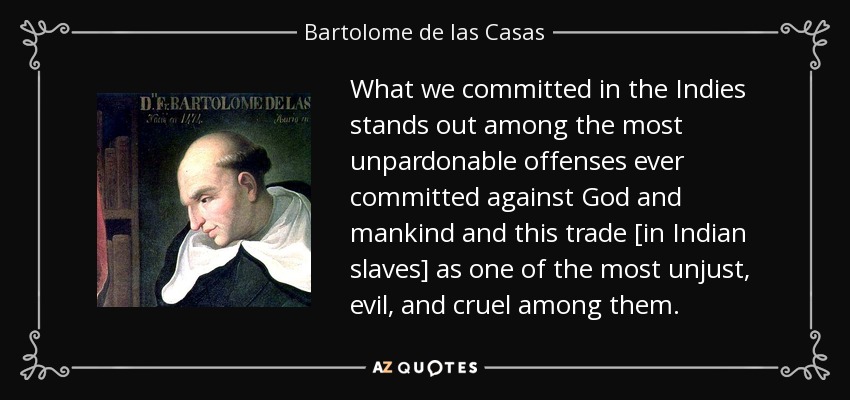
Bartolome de las Casas
b. c. 11.11.1484 Seville, Crown of Castille
d. 7.18.1566 Madrid, Crown of Castille, Spain
Las Casas was a 16th-century Spanish colonist who acted as a historian and social reformer before becoming a Dominican friar. He was appointed as the first resident Bishop of Chiapas. He was the first officially appointed "Protector of the Indians".
He wrote A Short Account of the Destruction of the Indies and Historia de Las Indias (1543) as a chronicle for the first decades of colonization of the West Indies. He described the atrocities committed by the colonizers against the indigenous peoples.
Bartolomé de las Casas spent 50 years of his life actively fighting slavery and the colonial abuse of indigenous peoples, especially by trying to convince the Spanish court to adopt a more humane policy of colonization. Unlike some other priests who sought to destroy the indigenous peoples' native books and writings, he strictly opposed this action
He was born in Seville when it was a kingdom in Castille, Spain in the 15th century.
Seville
Seville is the capital for the province of Seville in Andalusia. Andalusia is the most southern autonomous community in Spain. It is the only European region with both Mediterranean and Atlantic coastlines.
Seville is situated on the plain of the river Guadalquivir. The Guadlquivir is the second longest river with its entire length in Spain. The Guadalquivir valley has experienced some of the highest temperatures recorded in Europe, with a maximum of 46.6 °C (115.9 °F) recorded at Córdoba and Seville.
Seville was incorporated into the Christian Kingdom of Castile under Ferdinand III in 1248. Castile's name is generally thought to derive from "land of castles." Castle in Spanish is castillo. Castles were built in the area to consolidate the Christian Reconquest from the Moors.
The city's development continued after the Castilian conquest. Public buildings were constructed including churches. Many of the buildings were built in the Mudéjar and Gothic styles. The Seville Cathedral was built during the 15th century with Gothic architecture.
Other Moorish buildings were converted into Catholic edifices. Such conversion was customary for the Catholic Church during the Reconquista.The Torre del Oro was once an important Moorish naval watchtower along the Guadalquivir for example. It was converted into a cathedral by 1271.
The Moors' Palace became the Castilian royal residence. It was replaced by the Alcázar during Pedro I's rule. The upper levels are still used by the Spanish royal family as the official Seville residence.
All the synagogues in Seville were converted to churches after the 1391 pogrom. The Jewish quarter's land and shops (located in modern-day Barrio Santa Cruz) were appropriated by the church. Many were killed during the pogrom. Most were forced to convert. Converts were called converso.
The first tribunal of the Spanish Inquisition was instituted in Seville in 1478. The activity of the Inquisition was limited to the dioceses of Seville and Córdoba at first. Alonso de Ojeda had detected converso activity.
The first Auto de Fé took place in Seville on 6 February 1481 when 6 people were burned alive. An Auto de Fe was a public rite for penance for heretics and apostates. The convicted were burned at the stake, exiled or forced to become Catholic.
The Inquisition grew rapidly. The Plaza de San Francisco was the site of the 'autos de fé'.
Tribunals existed in eight Castilian cities by 1492. Ávila, Córdoba, Jaén, Medina del Campo, Segovia, Sigüenza, Toledo and Valladolid had tribunals. All Jews were forced to convert to Catholicism or be ejected from Spain by the Alhambra Decree.
Seville became one of the economic centers of the Spanish Empire after the discovery of the Americas in the late 15th century. All goods imported from the New World had to pass through the Casa de Contratación in the city before being distributed throughout the rest of Spain.
The port of Seville was unlike other harbors. Reaching the port required sailing about 80 km (50 miles) up the river Guadalquivir. The river was heavily defended with fortifications from the Middle Ages.
This made Seville the best defended port to bring the riches from the Americas. A 'golden age of development' commenced due to its being the only port awarded the royal monopoly for trade.
Bartolome de las Casas
Bartolome de las Casas was born in Seville on November 11, 1484. It was 8 years before Columbus would cross the Atlantic Ocean to discover the Americas.
His father was Pedro de las Casas. He was a merchant from one of the families that had migrated from France to found the town of Seville. His family spelled the name Casaus.
Bartolome studied for a licentiate (professional license) at Salamanca. The University of Salamanca was founded in 1218. It is the oldest university in Spain. Salmanca is about 465 km (290 miles) north of Seville.
Las Casas immigrated with his father to the island of Hispanola in the Caribbean in 1502 on the expedition of Nicolás de Ovando. Bartolome became a hacendado and slave owner. He received a piece of land in the province of Cibao in what is now known as the Dominican Republic. He participated in slave raids and military expeditions against the native Taíno population of Hispaniola.
He journeyed to Rome in 1507 as a young man to observe the Festival of Flutes. Festivals in Rome were an important part of religious life during both the Republican and Imperial eras. Festivals were one of the primary features of the Roman calendar.
Feriae were "holidays." These were holy days in the sense that some deity was celebrated. Pagan festivals were often converted to something associated with the Church after the conversion to Christianity.
Faunus was a horned god of the forest, plains and fields. He came to be equated in literature with the Greek god Pan. Either represented fertility for cattle.
Faunus is identified with Lupercus ("he who wards off the wolf"). The wolf was warded off with a flute or a staff. It is likely that the festival of flutes was a monotheistic form for the celebration that took place on 5 December. Peasants brought rustic offerings and amused themselves with flute music for dance.
He was ordained a priest in 1510. He was one of the first to be ordained in the new world.
A group of Dominican friars arrived in Santo Domingo led by Pedro de Córdoba in September 1510.
The friars were appalled by the injustices they saw committed by the slave owners against the Indians. They decided to deny slave owners the right to confession. Las Casas was among those denied confession for this reason.
A Dominican preacher Fray Antonio de Montesinos preached a fiery sermon that implicated the colonists in the genocide of the native peoples in December 1511.
He is said to have preached, "Tell me by what right of justice do you hold these Indians in such a cruel and horrible servitude? On what authority have you waged such detestable wars against these people who dealt quietly and peacefully on their own lands?"
Las Casas himself argued against the Dominicans in favor of the justice of the encomienda. The colonists dispatched a complaint against the Dominicans to the King. The Dominicans were recalled from Hispaniola.
Las Casas participated in the conquest of Cuba as a chaplain in 1513. He was involved in some of the major campaigns on the island. He witnessed the massacre of the Hatuey. He saw many atrocities committed by Spaniards against the native people.
He later wrote: "I saw here cruelty on a scale no living being has ever seen or expects to see."
He was awarded a joint encomienda with a friend which was rich in gold and slaves on the Arimao River close to Cienfuegos. He divided his time between being a colonist and his duties as an ordained priest during the next years.
Las Casas was studying a passage in the book of Sirach for a Pentecost sermon in 1514.
From something false what will be made true?
Divinations, omens and dreams are folly.
They are like the fancies of a woman in travail.
The law will be fulfilled without such deceptions.
Wisdom is made perfect in truthful lips.
(Sirach 34:4-5,8)
He was finally convinced that all the actions of the Spanish in the New World had been illegal. They constituted a great injustice. He made up his mind to give up his slaves and encomienda.
He started to preach that other colonists should do the same. When his preaching met with resistance, he realized that he would have to go to Spain to fight there against the enslavement and abuse of the native people.
He gave up his Indian slaves and encomienda in 1515. He advocated for the rights of natives before King Charles V, the Holy Roman Emperor. He advocated the use of African slaves instead of Natives in the West Indian colonies in his early written work.
He has been criticized for his role among the founders of the Atlantic slave trade in the 20th century. He retracted this position later in life. He regarded both forms of slavery as equally wrong.
He left for Spain in September 1515. He arrived in Seville in November with a plan to convince the king to end the encomienda system. This was not an easy task. Most of the people who were in positions of power were themselves either encomenderos or otherwise profiting from the influx of wealth from the Indies.
King Ferdinand was ill in Plasencia in the winter of 1515. Las Casas was able to get a letter of introduction to the king from the Archbishop of Seville, Diego de Deza. Las Casas met the monarch on Christmas Eve and discussed the situation in the Indies with him. The king agreed to hear him out in more detail at a later date.
Las Casas produced the report that he presented to the Bishop of Burgos and a secretary. These were functionaries in charge of the royal policies regarding the Indies. Both were encomenderos. They were not impressed by his account. Las Casas had to find a different avenue of change. He put his faith in his coming audience with the king, but it never came. King Ferdinand died on January 25, 1516.
The regency of Castile passed on to Ximenez Cisneros and Adrian of Utrecht. They were the guardians for the under-age Prince Charles. Las Casas was resolved to see Prince Charles who resided in Flanders. He passed Madrid and delivered to the regents a written account of the situation in the Indies and his proposed remedies on his way there.
This was his "Memorial de Remedios para Las Indias" of 1516. Las Casas advocated importing Black slaves from Africa to relieve the suffering Indians in this early work. He later retracted the stance. He became an advocate for the Africans in the colonies as well.
His first concern was not to end slavery as an institution, but to end the physical abuse of the Indians. Las Casas believed that slavery could be justified if it was the result of Just War. This was in accord with the legal and moral doctrine of the time. He assumed that the enslavement of Africans was justified. This position presumed that primitive civilization was a cause for Just War.
Cardinal Cisneros was worried by the visions that Las Casas had drawn up of the situation in the Indies. He sent a group of Hieronymite monks to take over the government of the islands. Las Casas played a role in the selection of the three monks. He also wrote the instructions by which the new government was to be run.
Las Casas himself was granted the official title of Protector of the Indians. He was given a yearly salary of one hundred pesos. He was expected to serve as an advisor to the new governors with regard to Indian issues in the new office. He was to speak the case of the Indians in court and send reports back to Spain.
Las Casas and the commissioners traveled to Santo Domingo on separate ships. The Protector arrived two weeks later than the Hieronimytes. The Hieronimytes had time to form a more pragmatic view of the situation than the one advocated by Las Casas during this time.
Their position was precarious. There were encomenderos on the Islands who were fiercely against any attempt to curtail their use of native labor. The commissioners were unable to take any radical steps towards improving the situation with the natives.
They revoked some encomiendas from the Spaniards who were living in Spain and not on the islands themselves. They even repossessed the encomienda of Fonseca, the Bishop of Burgos. They also carried out an inquiry into the Indian question. The encomenderos asserted that the Indians were quite incapable of living freely without their supervision.
Las Casas was disappointed and infuriated. When he accused the Hieronymites of being complicit in kidnapping Indians the relationship broke down. Las Casas had become a hated figure by Spaniards in the islands. He had to seek refuge in the Dominican monastery.
The Dominicans had been the first to indict the encomenderos. They continued to chastise them. The absolution of confession was refused to slave owners. They even stated that priests who took their confession were committing a mortal sin.
Las Casas was forced to travel back to Spain in May 1517 to denounce to the regent the failure of the Hieronymite reforms. The Hieronymites began to congregate Indians into towns similar to what Las Casas had wanted only after he had left.
His former protector, the regent Cardinal Ximenez Cisneros, was ill when he arrived in Spain. He had grown tired of the political tenacity. Las Casas resolved to meet instead with the young king Charles I. Ximenez died on November 8. The young King arrived in Valladolid on November 25, 1517. Las Casas managed to secure the support of the king's Flemish courtiers.
Chief among them was the powerful Chancellor Jean de la Sauvage. Las Casas's influence turned the favor of the court against Secretary Conchillos and Bishop Fonseca. Sauvage spoke highly of Las Casas to the king. The king appointed Las Casas and Sauvage to write a new plan for reforming the governmental system of the Indies.
Las Casas suggested a plan where the encomienda would be abolished. The Indians would be congregated into self-governing townships to become tribute-paying vassals of the king. He still suggested that the loss of Indian labor for the colonists could be replaced by allowing the importation of African slaves.
Another important part of the plan was to introduce a new kind of sustainable colonization. Las Casas advocated for the migration of Spanish peasants to the Indies where they would introduce small-scale farming and agriculture. It was a kind of colonization that didn't rely on resource depletion and Indian labor.
Las Casas worked to recruit a large number of peasants who would want to travel to the islands. They would be given land to farm, cash advances and the resources they needed to establish themselves there. The recruitment drive was difficult. The power relation shifted at court when Chancellor Sauvage unexpectedly died.
A much smaller number of peasant families were sent than originally planned. They were supplied with insufficient provisions. No support was secured for their arrival. Those who survived the journey were ill-received.
They had to work hard even to survive in the hostile colonies. Las Casas was devastated by the tragic result of his peasant migration scheme. He felt that it had been thwarted by his enemies.
He tried to launch a new kind of peaceful colonialism on the coast of Venezuela in 1522, but this venture failed. Las Casas entered the Dominican Order and became a friar. He left public life for a decade.
He traveled to Central America to act as a missionary among the Maya of Guatemala. He participated in debates among colonial churchmen about how best to bring the natives to the Christian faith.
He traveled back to Spain to recruit more missionaries and to lobby for the abolition of the encomienda. He gained an important victory by the passage of the New Laws in 1542. He was appointed Bishop of Chiapas.
De las Cases served only a short time as a bishop before he was forced to return to Spain. There was resistance to the New Laws by the encomenderos. There were also conflicts with Spanish settlers due to his activist religious stance with the pro-Indian policies.
He wrote a Brief Report On the Destruction of the Indies (or Tears of the Indians). It was written in 1542 and sent to Prince Philip II of Spain. It wasn't published until 1552 when he was 67 years old.
He argued that the atrocities were a display of Popery in its bloody colors. His narrative described the events as horrid and unexampled massacres, butcheries and all manner of cruelties that hell and malice could invent.
These events had been committed by the Popish Spanish party on the inhabitants of West India. Several "Kingdoms in America" had been devastated by fire and sword for the space of 42 years from the time of their discovery.
It was a fervid and exaggerated account of the atrocities of the Spanish conquerors against the Indians. It was written to persuade the Spanish king to act in response to the conquistadors' abuse of the indigenous population. Critics argue that facts and figures about the mistreatment and death toll were exaggerated for persuasion.
The book was widely translated and read. The English version was used to stir up English feeling against the Spanish as a cruel race.
Las Casas served in the Spanish court for the remainder of his life. He held great influence over Indies-related issues there. He participated in the Valladolid debate in 1550.
King Charles V called for a junta (or jury) to discuss the contrasting rights of slaves and their colonial masters. What started as a plea for mercy turned into a debate on the fundamental question of human existence. Are men created equal? Should they all be treated with equal respect and dignity? If so, what could justify the economic exploitation of a whole people by an invading force?
Juan Ginés de Sepúlveda argued that the Indians were less than human. They required Spanish masters in order to become civilized. Las Casas maintained that they were fully human. Forceful subjugation was unjustifiable.
Bartolomé de las Casas spent 50 years of his life actively fighting slavery and the colonial abuse of indigenous peoples. He did what he could to convince the Spanish court to adopt a more humane policy of colonization.
He was not like the priests who sought to destroy the indigenous peoples' native written work. He strictly opposed this action. His efforts resulted in the improvement of the legal status of the natives. There was an increased colonial focus on the ethics of colonialism.
The difference between the serf and slave based economies was the issue that ran under the debate about equality. Serfdom had been instituted as a land management practice by the Egyptians. It treated labor as part of that property that was being managed. Serfs were not legally designated as property. It was possible to obtain employment with another owner.
Slavery had a disturbing association with the rise of monotheism as an agency for political expansion even in Egypt. It became a legal norm with the Babylonian dominance in Sumerian culture. The operational principle was that the empire could take more land by conquest from those who refused to join the alliance of kingdoms.
The Persians adopted the system from the Babylonians despite the celebration of Cyrus as the Christ who had liberated the captives. The Greeks took it over after the triumph of Alexander. The Romans adapted the system to their republican variation.
Europe was largely monarchical in the 16th century. Serfdom was the operant condition for feudal society. Charles V was challenged by the success of the Ottomans in the Middle East. The Muslims had extended their reach into Spanish territory on the Iberian peninsula.
Charles wrote against slavery as the king of Castille, but allowed for the trade and the practice in the ecomenida in the imperial expansion in colonialism. It was a precedent that had preceded his ascension.
Martin Luther argued against indulgences as a practice for the Catholic Church. It is likely that slavery was implicitly regarded as an indulgence. King Henry the VIII of Great Britain opposed the religious control of his kingdom with his petition for divorce. His difficulties with marriage were at least potentially orchestrated to defend the royal line of succession.
The English and German reformation defended monarchy as the chief political form. It was known that classical literature supported republican government. The Roman classics were included in educational instruction as a standard where education was supported by monarchical, aristocratic or monastic forms in organization.
The Renaissance represented a shift from grammar and logic to rhetoric in the emphasis posited through the trivium.
Las Casas was a representative in the shift to rhetoric with his advocacy against slavery. He started out in opposition to the abuse of natives. He ended up with an advocacy for a variant on serf based society that allowed for colonization in foreign territory.
His basic defense for the advocacy was that it would cost the crown and the taxpayer less for police action, but this position was masked by the overstatement of atrocity on the part of the conquistadors.
Las Casas (1484-1566) preceded William Wilberforce (1759-1833) in the position against slavery by more than 2 centuries, but Wilberforce was able to persuade the British Parliament to outlaw the trade and the institution.
This law against slavery was used in negotiation with other foreign powers until it came to be accepted as the standard legal position in international relations.
Bartoleme de las Casas
S. 巴特德拉斯卡萨斯
T. 巴特德拉斯卡薩斯
巴 Ba to hope 巴 tomoe comma design Ba ば- バ- Ba 바 bar
特 te special 特 toku special to と ト teu 트 the
德 de favor 德 no kanji de で デ de 데 place
拉 la hold 拉 da Latin ra ら ラ la 라 la
斯 si this 斯 shi this su す ス seu 스 switch
卡 Ka card 卡 no kanji Ka か カ Ka 카 car
萨 sa sat 薩 katsu sweet potato sa さ サ sa 사 four
斯 si this 斯 shi this su す ス seu 스 the
---------------------------
Alliance or cooperation makes a difference
in international relations as an inference.
===================
Lectionary Bartolome de las Casas
wiki Bartolome de las Casas
Brief Account
wiki Seville
Showing posts with label pride. Show all posts
Wednesday, July 17, 2019
Sunday, July 14, 2019
Find
7.21.19
Maggie Lindemann
Find
Benefit
找到好处
Zhǎodào hǎochù
メリットを見つける
Meritto o mitsukeru
ps52
Reperio bonum
What is the error when pride becomes a sin?
It is the will to destroy as though destruction had yet to begin.
There is a place that is against God in mind
that plans to ruin the bonds of belief that believers find.
The tongue is sharpened like a razor
to work deception for brutal behavior.
Evil is esteemed more powerful than good.
Lying is tried for denying truth as understood.
Speech that hurts is thrown
when words are not owned as known.
The media is the message
when it isn't too aggressive.
What is the divine will
for the correction of the ill?
Conscience looks to earned reward
until the sense of honor is ordered.
Pride drove this one from the refuge of faith.
Deceit was that which refused to stay straight.
I was shown a basket of summer fruit.
Fruition was known as a metaphorical suit.
Jesus praised Mary for the gift of her attention.
Martha was urged to consider her connection to this affection.
The image of the invisible deity
is the firstborn form for faith in verity.
Christ is the precedent for our place in everything.
The fullness of God is held like an anchor ring.
I am like an olive tree in the house of the Word.
Divine mercy will help me to overcome the adversity of the absurd.
I will give thanks for the grace of blissful providence
to declare goodness in the presence of moral intelligence.
--------------------------
52 Quid gloriaris?
What is pride?
1 You tyrant, why do you boast of wickedness
against the godly all day long?
2 You plot ruin;
your tongue is like a sharpened razor,
O worker of deception.
3 You love evil more than good
and lying more than speaking the truth.
4 You love all words that hurt,
O you deceitful tongue.
5 Oh, that God would demolish you utterly,
topple you, and snatch you from your dwelling,
and root you out of the land of the living!
6 The righteous shall see and tremble,
and they shall laugh at him, saying,
7 "This is the one who did not take God for a refuge,
but trusted in great wealth
and relied upon wickedness."
8 But I am like a green olive tree in the house of God;
I trust in the mercy of God for ever and ever.
9 I will give you thanks for what you have done
and declare the goodness of your Name in the presence
of the godly.
---------------------------
====================
----------------------------
Amos 8:1-2
The Lord God showed me a basket of summer fruit. He said,
'Amos, what do you see?' I said, 'A baske of fruit.'
The LORD said to me,
'Fruition has come upon my people Israel.
I will never again pass them by.'
---------------------------
I was shown a basket of summer fruit.
Fruition was known as a metaphorical suit.
====================
Colossians 1:15-19
He is the image of the invisible God, the firstborn of all creation. All things in heaven and on earth were created in him. Things visible and invisible, whether thrones, dominions, rulers or powers have been created through him and for him. He himself is before all things. All things hold together in him and for him. He himself is before all things and in him all things hold together. He is the head of the body the church. He is the beginning, the firstborn from the dead, so he might come to have first place in everything. All the fullness of God was pleased to dwell in him.
---------------------------
The image of the invisible deity
is the firstborn form for faith in society.
Christ is the precedent for our place in everything.
The fullness of God is held like an anchor ring.
====================
Luke 10:38-42
He entered a certain village on their way where a woman named Martha welcomed him into her home. She had a sister named Mary who sat at the Lord's feet and listened to what he said. Martha was distracted by her many tasks. She came to him and said, 'Lord, do you not care that my sister has left me to do all the work by myself? Tell her then to help me.'
The Lord answered her, 'Martha, Martha, you are worried and distracted by many things. There is need for one thing. Mary, has chosen the better part which will not be taken away from her.'
---------------------------
Jesus praised Mary for the gift of her attention.
Martha was urged to consider her connection to this affection.
====================
Test for Truth in Agreement
Marshall McLuhan
b. 7.21.1911 Edmonton, Alberta, Canada
d. 12.31.1980 Toronto, Ontario, Canada
Marshall McLuhan was a Canadian philosopher. His work is one of the cornerstones in the study of media theory.
He coined the expression “the medium is the message.” The term “global village” was his. He predicted the World Wide Web almost 30 years before it was invented.
He was a fixture in media discourse in the late 1960’s. His influence began to wane in the early 1970’s.
He continued to be a controversial figure in academic circles in the years after his death.
He was born in western part of Canada in the early 20th century.
Edmonton
Edmonton is the capital city of the Canadian province of Alberta. The city is on the North Saskatchewan River. It is Alberta's second-largest city and Canada's fifth-largest municipality. It is the northernmost city in North America with a metropolitan population of over one million.
The city is among the Canadian cities with the coldest winters. Winter is milder there though than Regina, Saskatoon and Winnipeg. All of these cities are south of Edmonton. Its average daily temperatures range from a low of −10.4 °C (13.3 °F) in January to a summer peak of 17.7 °C (63.9 °F) in July.
The city hosts a year-round slate of festivals. It has the nickname "Canada's Festival City". It is home to North America's largest mall, West Edmonton Mall. It was the world's largest mall from 1981 until 2004. Fort Edmonton Park is Canada's largest living history museum.
Tracks for the Canadian Pacific Railway (CPR) were laid in southern Alberta in 1885. The railroad helped the local economy. The 1891 building of the Calgary and Edmonton (C&E) Railway resulted in the emergence of a railway townsite on the river's south side. This location was called South Edmonton or Strathcona.
Settlers and entrepreneurs from eastern Canada, Europe, U.S. and other parts of the world found it easier to move to the area with the railroad. The area's fertile soil and cheap land attracted settlers.
Some of the people who participated in the Klondike Gold Rush passed through South Edmonton/Strathcona in 1897. Strathcona was North America's northernmost railway point.
Travel to the Klondike was still very difficult for the "Klondikers." A majority of them took a steamship north to the Yukon from Vancouver, British Columbia.
The population of the city grew to 8,350 in 1904 from 700 when it was incorporated as a town in 1892. Edmonton became the capital of Alberta when the province was formed a year later, on September 1, 1905. The Candaian Northern Railway arrived in the following year.
The rapid growth led to speculation in real estate in the early 1900's.
Marshall McLuhan
McLuhan was born on July 21, 1911 in Edmonton, Alberta to Elsie Naomi (née Hall) and Herbert Ernest McLuhan. Both parents were born in Canada.
His mother was a Baptist school teacher who later became an actress. His father was a Methodist and had a real estate business in Edmonton.
His business failed when World War I broke out. He enlisted in the Canadian army. He contracted influenza after a year of service and remained in Canada away from the front lines.
The McLuhan family moved to Winnipeg, Manitoba after his discharge from the army in 1915. Marshall grew up and went to school there. He attended Kelvin Technical School before enrolling in the University of Manitoba in 1928.
McLuhan explored his conflicted relationship with religion and turned to literature to "gratify his soul's hunger for truth and beauty" at Manitoba. He later referred to the stage as agnosticism. He was awarded a BA in 1933 and an MA degree in English in 1934.
He was accepted at the University of Cambridge after he failed to obtain Rhodes Scholarship at Oxford. Cambridge required him to enroll as an undergraduate "affiliated" student with one year's credit towards a three-year bachelor's degree before entering any doctoral studies.
He entered Trinity Hall, Cambridge in the autumn of 1934 where he studied under I. A. Richards and F. R. Leavis and was influenced by New Criticism.
New Criticism was a formalist movement in literary theory that dominated American literary criticism in the middle decades of the 20th century. It emphasized close reading, particularly of poetry, to discover how a work of literature functioned as a self-contained, self-referential aesthetic object.
The work of Cambridge scholar I. A. Richards on Practical Criticism and The Meaning of Meaning offered what was claimed to be an empirical scientific approach that was important to the development of New Critical methodology.
McLuhan credited the faculty there with influencing the direction of his later work because of their emphasis on the training of perception and such concepts as Richards' notion of feedforward.
Feedforward is the concept of anticipating the effect of one's words by acting as a critic of the content. It acts as a pretest that any writer can use to anticipate the impact of their words on their audience. It works to clarify unclear concepts in a way that precedes feedback.
These studies formed an important precursor to McLuhan's later ideas on technological forms. He received the required bachelor's degree from Cambridge in 1936 to their graduate program.
He took the first steps toward his eventual conversion to Roman Catholicism in 1937 while studying the trivium at Cambridge. His study was founded on his reading of G. K. Chesterton.
He wrote to his mother in 1935: "[H]ad I not encountered Chesterton, I would have remained agnostic for many years at least." McLuhan completed what was a slow but total conversion process at the end of March 1937. He was formally received into the Roman Catholic Church.
His father accepted the decision to convert after consulting a minister. His mother, however, felt that his conversion would hurt his career. She was inconsolable. McLuhan was devout throughout his life, but his religion remained a private matter.
He returned from England to take a job as a teaching assistant at the University of Wisconsin–Madison. He held the position for the 1936–37 academic year. He had been unable to find a suitable job in Canada.
He taught in Roman Catholic institutions of higher education for the rest of his career. He taught English at Saint Louis University from 1935 to 1944.
There was an interruption from 1939–40 when he returned to Cambridge. There he taught courses on Shakespeare. He tutored and befriended Walter J. Ong.
Ong went on to write his PhD dissertation on a topic that McLuhan had called to his attention. He also became a well-known authority on communication and technology.
McLuhan met Corinne Lewis in St. Louis. She was a teacher and aspiring actress from Fort Worth, Texas. They were married on August 4, 1939. They spent 1939–40 in Cambridge where he completed his master's degree. It was awarded in January 1940.
He began to work on his doctoral dissertation on Thomas Nashe and the verbal arts. Nashe was an Elizabethan playwright, poet, satirist and a significant pamphleteer in the 16th century. His pamphlets including Pierce Penniless and numerous defenses of the Church of England.
McLuhan used the Latin trivium to explain the development of expression in Latin. The trivium was grammar, dialectic and rhetoric. It was a set of methods dating from the Greek Classical period that was used to form a curriculum for instruction.
The Late Middle Ages were characterized by the heavy emphasis on the formal study of logic for instance. The key change that led to the Renaissance was not the rediscovery of ancient texts but a shift in emphasis from the formal study of logic to rhetoric and grammar.
It's a system to produce meaning that's consistently readable. The trivium is a machine for writing and for reading the writing that's been written under its aegis. The influence of this machine was examined in the work of Thomas Nashe.
War had broken out in Europe while the McLuhans were in England. He obtained permission to complete and submit his dissertation from the United States without having to return to Cambridge for an oral defense.
The McLuhans returned to Saint Louis University in 1940. He continued teaching and they started a family. He was awarded a Ph.D. in December 1943.
He next taught at Assumption College in Windsor, Ontario from 1944 to 1946. They then moved to Toronto in 1946 where he joined the faculty of St. Michael's College, a Catholic college of the University of Toronto.
Hugh Kenner was one of his students. Canadian economist and communications scholar Harold Innis was a university colleague who had a strong influence on his work. McLuhan wrote in 1964: "I am pleased to think of my own book The Gutenberg Galaxy as a footnote to the observations of Innis on the subject of the psychic and social consequences, first of writing then of printing."
McLuhan began the Communication and Culture seminars at the University of Toronto in the early 1950's. These were funded by the Ford Foundation.
He published his first major work during this period: The Mechanical Bride (1951). The work was an examination of the effect of advertising on society and culture.
The Mechanical Bride was unique in that it was composed of a number of short essays. They can be read in any order. He styled it as the "mosaic approach" to writing a book. Each essay begins with a newspaper or magazine article or an advertisement, followed by McLuhan's analysis. The analyses bear on aesthetic considerations as well as on the implications behind the imagery and text.
McLuhan's The Gutenberg Galaxy: The Making of Typographic Man was written in 1961. It was first published in Canada by University of Toronto Press in 1962. It was a pioneering study in the fields of oral culture, print culture, cultural studies and media ecology.
He took pains throughout the book to reveal how communication technology such as alphabetic writing, the printing press and electronic media affects cognitive organization. This in turn had profound ramifications for social organization.
New ratios occur among our senses occur in a culture when new technology extends one or more of our senses outside into the social world. The result is comparable to what happens when a new note is added to a melody.
When the sense ratios are altered in a culture what had appeared lucid may become opaque. What had been vague or opaque becomes translucent.
The invention of movable type greatly accelerated, intensified and ultimately enabled cultural and cognitive changes that had already been taking place since the invention and implementation of the alphabet as phonemic orthography. The phonetic alphabet was distinguished from logographic or logogramic writing systems such as Egyptian hieroglyphs or ideograms.
Print culture was ushered in by the advance in printing during the middle of the 15th century when the Gutenberg press was invented. It brought about the cultural predominance of the visual over the aural or oral.
Print technology changed our perceptual habits in the "visual homogenizing of experience." The visual homogenization in turn affected social interactions in a way that fostered "a mentality that gradually resists all but a... specialist outlook".
This advance of print technology contributed to and made possible most of the salient trends in the Modern period in the Western world: individualism, democracy, Protestantism, capitalism and nationalism. These trends all reverberated with print technology's principle of "segmentation of actions and functions and principle of visual quantification."
McLuhan wrote in the early 1960's that the visual, individualistic print culture would soon be brought to an end by what he called "electronic interdependence". Electronic media would replace visual with aural/oral culture.
Humankind will move from individualism and fragmentation to a collective identity with a "tribal base" in this new age. McLuhan's coinage for this new social organization was the global village. Terror is the normal state for any oral society because in it everything affects everything all the time.
The effort to recover a unity of sensibility, thought and feeling for the western world did not prepare us to endure the tribal consequences of such unity any more than print culture prepared us for the fragmentation of the psyche. Technology has no per se moral content. It is a tool that shapes the individual perception of society's self-conception in realization.
Print is the technology of individualism. The modification of the lettered technology into something electronically visual shifts individual perception into aural/oral and social forms. The technology is not a moral problem. The identification of it as such would only complicate the issue. it is what it is and it does what it does.
McLuhan predicted the advent of the World Wide Web in 1962. He thought that the computer would be used for research as an instrument for communication that would enhance retrieval of stored information, mass library organization and the encyclopedic function for individuals. The terminal would be a private line to speedily tailored data of a saleable kind.
The book Understanding Media is the source of the well-known phrase "The medium is the message". The author proposes that the media, not the content that they carry, should be the focus of study. He suggests that the medium affects the society in which it plays a role mainly by the characteristics of the medium.
McLuhan uses historical quotes and anecdotes to probe the ways in which new forms of media change the perceptions of societies, with specific focus on the effects of each medium as opposed to the content that is transmitted by each.
There are differences between hot and cool media and the ways that one medium translates the content of another. This terminology does not refer to the temperature or emotional intensity, but to the degree of participation by the user.
Cool media are those that require high participation from users due to low definition. The participant must fill in missing information. The use of many senses fosters involvement. Television is a cool medium. Other things may happen. The viewer has to integrate all of the sounds and sights in the context.
Hot media are low in audience participation due to their high resolution or definition. Film is defined as a hot for example. The viewer is completely captivated in the context of a dark movie theater. The visual sense is primary. It is filled with high definition.
A medium is "any extension of ourselves", or more broadly, "any new technology." McLuhan includes the light bulb in addition to such forms as newspapers, television and radio.
A light bulb does not have content in the way that a newspaper has articles or a television has programs, yet it is a medium that has a social effect. It enables people to create a space during nighttime that would otherwise be enveloped by darkness.
He described the light bulb as a medium without content. A "light bulb creates an environment by its mere presence." Cars, speech and language fall into his definition of "media." They mediate our communication as technology. Their forms or structures affect how we perceive and understand the world around us.
McLuhan used James Joyce's Finnegans Wake as an inspiration for the study of War and Peace in the Global Village (1968). The study looked at the primitive consciousness in the global village. The Wake was written in the stream of consciousness form. It represented a breach in grammar as ordered expression.
The Wake was a cryptogram which revealed a cyclic pattern for the whole history of man through the Ten Thunders. The thunders extend from the Paleolithic period to television in the modern era.
Television was defined as a return to tribal involvement in the making of mood mud. The Industrial Revolution was characterized as an extreme development of the print process for individualism.
McLuhan was named to the Albert Schweitzer Chair in Humanities at Fordham University in the Bronx for one year (1967–68). He was diagnosed with a benign brain tumor while at Fordham. It was treated successfully. He returned to Toronto afterwards where he taught at the University of Toronto for the rest of his life.
Marshall and Corinne McLuhan had six children. Their names were Eric, twins Mary and Teresa, Stephanie, Elizabeth and Michael. The associated costs of a large family eventually drove him to advertising work. He accepted frequent consulting and speaking engagements for large corporations. IBM and AT&T were among them.
Woody Allen's Oscar-winning motion picture Annie Hall (1977) featured McLuhan in a cameo as himself. He played a pompous academic arguing with Allen in a cinema queue. Allen was silenced by McLuhan suddenly saying, "You know nothing of my work." This was one of McLuhan's most frequent statements to and about those who disagreed with him.
He suffered a stroke which affected his ability to speak in September 1979. The University of Toronto's School of Graduate Studies tried to close his research center shortly thereafter. Closure was deterred by substantial protests, most notably by Woody Allen. He never fully recovered from the stroke. He died in his sleep on December 31, 1980.
McLuhan was detailed in his exposition of classical consciousness with the trivium. It was implicit in all his work. The language machine was a medium for cognition, but the evaluation of content for goodness was discouraged. This presents a problem with respect for the prediction of primitive collectivism in the global village.
Borders and boundaries are obscured for the sake of a media without a message other than itself. The deception of perception is exploited at the expense of perspective. We are expected to look at war itself as a medium that is devoid of our moral content in judgment.
The mindset harbors the reincarnation of Roman republic in the expansion into imperial forms of order that entertain disorder for perpetuation.
The government is a medium also. The machine perpetuates itself for its self-perpetuation as the answer to power for the liberal officials that seek to profit from their authority in the organization of support from industry.
McLuhan modified Aristotle and put him in a modern form to disguise the reincarnation of his detachment for the context of apathy towards immoral extension in expansion.
Marshall McLuhan
S. 马歇尔麦克卢汉
T. 馬歇爾麥克盧漢
马 Ma horse 馬 ba horse Ma ま- マ- Ma 마 hemp
歇 xie rest 歇 ketsu exhausted sha しゃ シャ syal 샬 chalm
尔 er you 爾 ji you ru る ル maeg 맥 vein
麦 Mai grain 麥 baku wheat Ma ま マ lu 루 sack
克 ke to restrain 克 koku overcome ku く ク han 한 one
卢 lu black 盧 ro hut ru る- ル-
汉 han language 漢 kan China han はん ハン
---------------------------
The media is the message
when it isn't too aggressive.
====================
wiki Marshall McLuhan
McLuhan Predicted the Internet
Trivium Machine
wiki Edmonton
Maggie Lindemann
Find
Benefit
找到好处
Zhǎodào hǎochù
メリットを見つける
Meritto o mitsukeru
ps52
Reperio bonum
What is the error when pride becomes a sin?
It is the will to destroy as though destruction had yet to begin.
There is a place that is against God in mind
that plans to ruin the bonds of belief that believers find.
The tongue is sharpened like a razor
to work deception for brutal behavior.
Evil is esteemed more powerful than good.
Lying is tried for denying truth as understood.
Speech that hurts is thrown
when words are not owned as known.
The media is the message
when it isn't too aggressive.
What is the divine will
for the correction of the ill?
Conscience looks to earned reward
until the sense of honor is ordered.
Pride drove this one from the refuge of faith.
Deceit was that which refused to stay straight.
I was shown a basket of summer fruit.
Fruition was known as a metaphorical suit.
Jesus praised Mary for the gift of her attention.
Martha was urged to consider her connection to this affection.
The image of the invisible deity
is the firstborn form for faith in verity.
Christ is the precedent for our place in everything.
The fullness of God is held like an anchor ring.
I am like an olive tree in the house of the Word.
Divine mercy will help me to overcome the adversity of the absurd.
I will give thanks for the grace of blissful providence
to declare goodness in the presence of moral intelligence.
--------------------------
52 Quid gloriaris?
What is pride?
1 You tyrant, why do you boast of wickedness
against the godly all day long?
2 You plot ruin;
your tongue is like a sharpened razor,
O worker of deception.
3 You love evil more than good
and lying more than speaking the truth.
4 You love all words that hurt,
O you deceitful tongue.
5 Oh, that God would demolish you utterly,
topple you, and snatch you from your dwelling,
and root you out of the land of the living!
6 The righteous shall see and tremble,
and they shall laugh at him, saying,
7 "This is the one who did not take God for a refuge,
but trusted in great wealth
and relied upon wickedness."
8 But I am like a green olive tree in the house of God;
I trust in the mercy of God for ever and ever.
9 I will give you thanks for what you have done
and declare the goodness of your Name in the presence
of the godly.
---------------------------
====================
----------------------------
Amos 8:1-2
The Lord God showed me a basket of summer fruit. He said,
'Amos, what do you see?' I said, 'A baske of fruit.'
The LORD said to me,
'Fruition has come upon my people Israel.
I will never again pass them by.'
---------------------------
I was shown a basket of summer fruit.
Fruition was known as a metaphorical suit.
====================
Colossians 1:15-19
He is the image of the invisible God, the firstborn of all creation. All things in heaven and on earth were created in him. Things visible and invisible, whether thrones, dominions, rulers or powers have been created through him and for him. He himself is before all things. All things hold together in him and for him. He himself is before all things and in him all things hold together. He is the head of the body the church. He is the beginning, the firstborn from the dead, so he might come to have first place in everything. All the fullness of God was pleased to dwell in him.
---------------------------
The image of the invisible deity
is the firstborn form for faith in society.
Christ is the precedent for our place in everything.
The fullness of God is held like an anchor ring.
====================
Luke 10:38-42
He entered a certain village on their way where a woman named Martha welcomed him into her home. She had a sister named Mary who sat at the Lord's feet and listened to what he said. Martha was distracted by her many tasks. She came to him and said, 'Lord, do you not care that my sister has left me to do all the work by myself? Tell her then to help me.'
The Lord answered her, 'Martha, Martha, you are worried and distracted by many things. There is need for one thing. Mary, has chosen the better part which will not be taken away from her.'
---------------------------
Jesus praised Mary for the gift of her attention.
Martha was urged to consider her connection to this affection.
====================
Test for Truth in Agreement
Marshall McLuhan
b. 7.21.1911 Edmonton, Alberta, Canada
d. 12.31.1980 Toronto, Ontario, Canada
Marshall McLuhan was a Canadian philosopher. His work is one of the cornerstones in the study of media theory.
He coined the expression “the medium is the message.” The term “global village” was his. He predicted the World Wide Web almost 30 years before it was invented.
He was a fixture in media discourse in the late 1960’s. His influence began to wane in the early 1970’s.
He continued to be a controversial figure in academic circles in the years after his death.
He was born in western part of Canada in the early 20th century.
Edmonton
Edmonton is the capital city of the Canadian province of Alberta. The city is on the North Saskatchewan River. It is Alberta's second-largest city and Canada's fifth-largest municipality. It is the northernmost city in North America with a metropolitan population of over one million.
The city is among the Canadian cities with the coldest winters. Winter is milder there though than Regina, Saskatoon and Winnipeg. All of these cities are south of Edmonton. Its average daily temperatures range from a low of −10.4 °C (13.3 °F) in January to a summer peak of 17.7 °C (63.9 °F) in July.
The city hosts a year-round slate of festivals. It has the nickname "Canada's Festival City". It is home to North America's largest mall, West Edmonton Mall. It was the world's largest mall from 1981 until 2004. Fort Edmonton Park is Canada's largest living history museum.
Tracks for the Canadian Pacific Railway (CPR) were laid in southern Alberta in 1885. The railroad helped the local economy. The 1891 building of the Calgary and Edmonton (C&E) Railway resulted in the emergence of a railway townsite on the river's south side. This location was called South Edmonton or Strathcona.
Settlers and entrepreneurs from eastern Canada, Europe, U.S. and other parts of the world found it easier to move to the area with the railroad. The area's fertile soil and cheap land attracted settlers.
Some of the people who participated in the Klondike Gold Rush passed through South Edmonton/Strathcona in 1897. Strathcona was North America's northernmost railway point.
Travel to the Klondike was still very difficult for the "Klondikers." A majority of them took a steamship north to the Yukon from Vancouver, British Columbia.
The population of the city grew to 8,350 in 1904 from 700 when it was incorporated as a town in 1892. Edmonton became the capital of Alberta when the province was formed a year later, on September 1, 1905. The Candaian Northern Railway arrived in the following year.
The rapid growth led to speculation in real estate in the early 1900's.
Marshall McLuhan
McLuhan was born on July 21, 1911 in Edmonton, Alberta to Elsie Naomi (née Hall) and Herbert Ernest McLuhan. Both parents were born in Canada.
His mother was a Baptist school teacher who later became an actress. His father was a Methodist and had a real estate business in Edmonton.
His business failed when World War I broke out. He enlisted in the Canadian army. He contracted influenza after a year of service and remained in Canada away from the front lines.
The McLuhan family moved to Winnipeg, Manitoba after his discharge from the army in 1915. Marshall grew up and went to school there. He attended Kelvin Technical School before enrolling in the University of Manitoba in 1928.
McLuhan explored his conflicted relationship with religion and turned to literature to "gratify his soul's hunger for truth and beauty" at Manitoba. He later referred to the stage as agnosticism. He was awarded a BA in 1933 and an MA degree in English in 1934.
He was accepted at the University of Cambridge after he failed to obtain Rhodes Scholarship at Oxford. Cambridge required him to enroll as an undergraduate "affiliated" student with one year's credit towards a three-year bachelor's degree before entering any doctoral studies.
He entered Trinity Hall, Cambridge in the autumn of 1934 where he studied under I. A. Richards and F. R. Leavis and was influenced by New Criticism.
New Criticism was a formalist movement in literary theory that dominated American literary criticism in the middle decades of the 20th century. It emphasized close reading, particularly of poetry, to discover how a work of literature functioned as a self-contained, self-referential aesthetic object.
The work of Cambridge scholar I. A. Richards on Practical Criticism and The Meaning of Meaning offered what was claimed to be an empirical scientific approach that was important to the development of New Critical methodology.
McLuhan credited the faculty there with influencing the direction of his later work because of their emphasis on the training of perception and such concepts as Richards' notion of feedforward.
Feedforward is the concept of anticipating the effect of one's words by acting as a critic of the content. It acts as a pretest that any writer can use to anticipate the impact of their words on their audience. It works to clarify unclear concepts in a way that precedes feedback.
These studies formed an important precursor to McLuhan's later ideas on technological forms. He received the required bachelor's degree from Cambridge in 1936 to their graduate program.
He took the first steps toward his eventual conversion to Roman Catholicism in 1937 while studying the trivium at Cambridge. His study was founded on his reading of G. K. Chesterton.
He wrote to his mother in 1935: "[H]ad I not encountered Chesterton, I would have remained agnostic for many years at least." McLuhan completed what was a slow but total conversion process at the end of March 1937. He was formally received into the Roman Catholic Church.
His father accepted the decision to convert after consulting a minister. His mother, however, felt that his conversion would hurt his career. She was inconsolable. McLuhan was devout throughout his life, but his religion remained a private matter.
He returned from England to take a job as a teaching assistant at the University of Wisconsin–Madison. He held the position for the 1936–37 academic year. He had been unable to find a suitable job in Canada.
He taught in Roman Catholic institutions of higher education for the rest of his career. He taught English at Saint Louis University from 1935 to 1944.
There was an interruption from 1939–40 when he returned to Cambridge. There he taught courses on Shakespeare. He tutored and befriended Walter J. Ong.
Ong went on to write his PhD dissertation on a topic that McLuhan had called to his attention. He also became a well-known authority on communication and technology.
McLuhan met Corinne Lewis in St. Louis. She was a teacher and aspiring actress from Fort Worth, Texas. They were married on August 4, 1939. They spent 1939–40 in Cambridge where he completed his master's degree. It was awarded in January 1940.
He began to work on his doctoral dissertation on Thomas Nashe and the verbal arts. Nashe was an Elizabethan playwright, poet, satirist and a significant pamphleteer in the 16th century. His pamphlets including Pierce Penniless and numerous defenses of the Church of England.
McLuhan used the Latin trivium to explain the development of expression in Latin. The trivium was grammar, dialectic and rhetoric. It was a set of methods dating from the Greek Classical period that was used to form a curriculum for instruction.
The Late Middle Ages were characterized by the heavy emphasis on the formal study of logic for instance. The key change that led to the Renaissance was not the rediscovery of ancient texts but a shift in emphasis from the formal study of logic to rhetoric and grammar.
It's a system to produce meaning that's consistently readable. The trivium is a machine for writing and for reading the writing that's been written under its aegis. The influence of this machine was examined in the work of Thomas Nashe.
War had broken out in Europe while the McLuhans were in England. He obtained permission to complete and submit his dissertation from the United States without having to return to Cambridge for an oral defense.
The McLuhans returned to Saint Louis University in 1940. He continued teaching and they started a family. He was awarded a Ph.D. in December 1943.
He next taught at Assumption College in Windsor, Ontario from 1944 to 1946. They then moved to Toronto in 1946 where he joined the faculty of St. Michael's College, a Catholic college of the University of Toronto.
Hugh Kenner was one of his students. Canadian economist and communications scholar Harold Innis was a university colleague who had a strong influence on his work. McLuhan wrote in 1964: "I am pleased to think of my own book The Gutenberg Galaxy as a footnote to the observations of Innis on the subject of the psychic and social consequences, first of writing then of printing."
McLuhan began the Communication and Culture seminars at the University of Toronto in the early 1950's. These were funded by the Ford Foundation.
He published his first major work during this period: The Mechanical Bride (1951). The work was an examination of the effect of advertising on society and culture.
The Mechanical Bride was unique in that it was composed of a number of short essays. They can be read in any order. He styled it as the "mosaic approach" to writing a book. Each essay begins with a newspaper or magazine article or an advertisement, followed by McLuhan's analysis. The analyses bear on aesthetic considerations as well as on the implications behind the imagery and text.
McLuhan's The Gutenberg Galaxy: The Making of Typographic Man was written in 1961. It was first published in Canada by University of Toronto Press in 1962. It was a pioneering study in the fields of oral culture, print culture, cultural studies and media ecology.
He took pains throughout the book to reveal how communication technology such as alphabetic writing, the printing press and electronic media affects cognitive organization. This in turn had profound ramifications for social organization.
New ratios occur among our senses occur in a culture when new technology extends one or more of our senses outside into the social world. The result is comparable to what happens when a new note is added to a melody.
When the sense ratios are altered in a culture what had appeared lucid may become opaque. What had been vague or opaque becomes translucent.
The invention of movable type greatly accelerated, intensified and ultimately enabled cultural and cognitive changes that had already been taking place since the invention and implementation of the alphabet as phonemic orthography. The phonetic alphabet was distinguished from logographic or logogramic writing systems such as Egyptian hieroglyphs or ideograms.
Print culture was ushered in by the advance in printing during the middle of the 15th century when the Gutenberg press was invented. It brought about the cultural predominance of the visual over the aural or oral.
Print technology changed our perceptual habits in the "visual homogenizing of experience." The visual homogenization in turn affected social interactions in a way that fostered "a mentality that gradually resists all but a... specialist outlook".
This advance of print technology contributed to and made possible most of the salient trends in the Modern period in the Western world: individualism, democracy, Protestantism, capitalism and nationalism. These trends all reverberated with print technology's principle of "segmentation of actions and functions and principle of visual quantification."
McLuhan wrote in the early 1960's that the visual, individualistic print culture would soon be brought to an end by what he called "electronic interdependence". Electronic media would replace visual with aural/oral culture.
Humankind will move from individualism and fragmentation to a collective identity with a "tribal base" in this new age. McLuhan's coinage for this new social organization was the global village. Terror is the normal state for any oral society because in it everything affects everything all the time.
The effort to recover a unity of sensibility, thought and feeling for the western world did not prepare us to endure the tribal consequences of such unity any more than print culture prepared us for the fragmentation of the psyche. Technology has no per se moral content. It is a tool that shapes the individual perception of society's self-conception in realization.
Print is the technology of individualism. The modification of the lettered technology into something electronically visual shifts individual perception into aural/oral and social forms. The technology is not a moral problem. The identification of it as such would only complicate the issue. it is what it is and it does what it does.
McLuhan predicted the advent of the World Wide Web in 1962. He thought that the computer would be used for research as an instrument for communication that would enhance retrieval of stored information, mass library organization and the encyclopedic function for individuals. The terminal would be a private line to speedily tailored data of a saleable kind.
The book Understanding Media is the source of the well-known phrase "The medium is the message". The author proposes that the media, not the content that they carry, should be the focus of study. He suggests that the medium affects the society in which it plays a role mainly by the characteristics of the medium.
McLuhan uses historical quotes and anecdotes to probe the ways in which new forms of media change the perceptions of societies, with specific focus on the effects of each medium as opposed to the content that is transmitted by each.
There are differences between hot and cool media and the ways that one medium translates the content of another. This terminology does not refer to the temperature or emotional intensity, but to the degree of participation by the user.
Cool media are those that require high participation from users due to low definition. The participant must fill in missing information. The use of many senses fosters involvement. Television is a cool medium. Other things may happen. The viewer has to integrate all of the sounds and sights in the context.
Hot media are low in audience participation due to their high resolution or definition. Film is defined as a hot for example. The viewer is completely captivated in the context of a dark movie theater. The visual sense is primary. It is filled with high definition.
A medium is "any extension of ourselves", or more broadly, "any new technology." McLuhan includes the light bulb in addition to such forms as newspapers, television and radio.
A light bulb does not have content in the way that a newspaper has articles or a television has programs, yet it is a medium that has a social effect. It enables people to create a space during nighttime that would otherwise be enveloped by darkness.
He described the light bulb as a medium without content. A "light bulb creates an environment by its mere presence." Cars, speech and language fall into his definition of "media." They mediate our communication as technology. Their forms or structures affect how we perceive and understand the world around us.
McLuhan used James Joyce's Finnegans Wake as an inspiration for the study of War and Peace in the Global Village (1968). The study looked at the primitive consciousness in the global village. The Wake was written in the stream of consciousness form. It represented a breach in grammar as ordered expression.
The Wake was a cryptogram which revealed a cyclic pattern for the whole history of man through the Ten Thunders. The thunders extend from the Paleolithic period to television in the modern era.
Television was defined as a return to tribal involvement in the making of mood mud. The Industrial Revolution was characterized as an extreme development of the print process for individualism.
McLuhan was named to the Albert Schweitzer Chair in Humanities at Fordham University in the Bronx for one year (1967–68). He was diagnosed with a benign brain tumor while at Fordham. It was treated successfully. He returned to Toronto afterwards where he taught at the University of Toronto for the rest of his life.
Marshall and Corinne McLuhan had six children. Their names were Eric, twins Mary and Teresa, Stephanie, Elizabeth and Michael. The associated costs of a large family eventually drove him to advertising work. He accepted frequent consulting and speaking engagements for large corporations. IBM and AT&T were among them.
Woody Allen's Oscar-winning motion picture Annie Hall (1977) featured McLuhan in a cameo as himself. He played a pompous academic arguing with Allen in a cinema queue. Allen was silenced by McLuhan suddenly saying, "You know nothing of my work." This was one of McLuhan's most frequent statements to and about those who disagreed with him.
He suffered a stroke which affected his ability to speak in September 1979. The University of Toronto's School of Graduate Studies tried to close his research center shortly thereafter. Closure was deterred by substantial protests, most notably by Woody Allen. He never fully recovered from the stroke. He died in his sleep on December 31, 1980.
McLuhan was detailed in his exposition of classical consciousness with the trivium. It was implicit in all his work. The language machine was a medium for cognition, but the evaluation of content for goodness was discouraged. This presents a problem with respect for the prediction of primitive collectivism in the global village.
Borders and boundaries are obscured for the sake of a media without a message other than itself. The deception of perception is exploited at the expense of perspective. We are expected to look at war itself as a medium that is devoid of our moral content in judgment.
The mindset harbors the reincarnation of Roman republic in the expansion into imperial forms of order that entertain disorder for perpetuation.
The government is a medium also. The machine perpetuates itself for its self-perpetuation as the answer to power for the liberal officials that seek to profit from their authority in the organization of support from industry.
McLuhan modified Aristotle and put him in a modern form to disguise the reincarnation of his detachment for the context of apathy towards immoral extension in expansion.
Marshall McLuhan
S. 马歇尔麦克卢汉
T. 馬歇爾麥克盧漢
马 Ma horse 馬 ba horse Ma ま- マ- Ma 마 hemp
歇 xie rest 歇 ketsu exhausted sha しゃ シャ syal 샬 chalm
尔 er you 爾 ji you ru る ル maeg 맥 vein
麦 Mai grain 麥 baku wheat Ma ま マ lu 루 sack
克 ke to restrain 克 koku overcome ku く ク han 한 one
卢 lu black 盧 ro hut ru る- ル-
汉 han language 漢 kan China han はん ハン
---------------------------
The media is the message
when it isn't too aggressive.
====================
wiki Marshall McLuhan
McLuhan Predicted the Internet
Trivium Machine
wiki Edmonton
Labels:
adversity,
affection,
attention,
connection,
conscience,
deceit,
deity,
error,
fruition,
intelligence,
pride,
providence,
sin,
summer fruit,
verity
Sunday, July 8, 2012
Weakness
Others,
The
first "Christ" in the bible was Cyrus, an Achaemenid (Persian/Iranian)
emperor. Cyrus II liberated the Jews and other captives from Babylon. There is
archaeological evidence however that the Achaemenids had a policy for
destroying the enemy. If making a god out of stone was bad, making God into a
tyrant by destruction is worse.
The
whole apocalyptic battle between Christ and the anti-Christ is about this
policy of destruction. Empire changed hands based upon a different method for
killing the "terrorists" who threatened the empire. The Bush administration
had resurrected the beast with their "official story." We are charged
with the task of restoring constitutional democracy with the bill of rights.
This
said, the US is not the only country that struggles with authoritarian elitism.
Syria has had a dictatorship under the minority Alawite control for over forty
years. They are on record as promoters of torture. More than 200 Syrians have
defected.http://edition.cnn.com/2012/07/03/world/meast/syria-unrest/
Alawites
are associated with the Shiites (Iran). Assad's father imposed cronies on the
government after his rise to power (1970).
http://www.reuters.com/article/2012/02/02/us-syria-alawites-sect-idUSTRE8110Q720120202
Paul
had been using the law to punish Christians. He believed that the power of
destruction was the path to power. He was on the road to Damascus to report
more Christians to Roman authorities when he encountered Christ. It was there
that he found that power is made perfect in weakness.
The
situation in Syria shows that sectarian motives often underlie tyranny. This is
the reason that freedom of religion is so important as a principle for civil
government. It prohibits establishment and allows for the free exercise of
religion.
Weakness
2Corinth12
Mk6 Ps123 Ps48
I know
someone
who was on the road
to Damascus.
He was using the law
to persecute and punish.
He was devoted to destruction.
I know someone
who was on the road
to Damascus.
He was using the law
to persecute and punish.
He was devoted to destruction.
who was caught up
in the experience of Christ
on that imperial road.
The person felt paradise.
The feeling transcended
perception without leaving it.
It expanded perspective
without destroying it.
The experience was so wonderful
that the person felt all experience
prior to Christ was wrong.
Pain was gone.
Competition had no meaning.
Joy in life made sense.
The request was made
to dwell in paradise indefinitely.
The LORD said,
“Grace is sufficient for you.
Power is perfected in weakness.”
Whenever I feel weak in Christ,
then I am strong in the call
to increase strength in leadership.
Love your enemy.
Do not destroy opposition.
Walk with
Jesus as he teaches.
The law is for liberty.
It is not for destruction.
Your authority will cast out
false or harmful precedents.
You will promote truth for
liberty with justice and equity.
Happiness will meet your success.
If you are
not welcomedThe law is for liberty.
It is not for destruction.
Your authority will cast out
false or harmful precedents.
You will promote truth for
liberty with justice and equity.
Happiness will meet your success.
remember that devotion to destruction
has been attempting to control the world
from before the beginning of civilization.
Shake the dust from your sleeves
against those who support those
that are so devoted.
I lift my
eyes to the light in the skies.
As hunger looks for satisfaction;
as thirst seeks refreshment;
we look to God as our provider.
Have mercy on
us, O LORD.As hunger looks for satisfaction;
as thirst seeks refreshment;
we look to God as our provider.
Have mercy. We have had
more than enough contempt.
We have suffered
unfair treatment
from the advantage given to the elite.
There has been too much derision
handed down from indolent pride.
Safety and health are guidelines
for godliness. God is our guide
forever.
Praise the
LORD!from the advantage given to the elite.
There has been too much derision
handed down from indolent pride.
Safety and health are guidelines
for godliness. God is our guide
forever.
===================
The
statement, “Power is made perfect in weakness” has strong implications for
education. When someone works on improving areas of performance that are
regarded as weak, he or she has a lifelong relationship with personal and
social development.
What happens
though when someone else is defined as the weakness?
The Wanted -
My Weaknesshttp://www.youtube.com/watch?v=nWbAuAsRZNY&feature=related
Socrates
argued for choosing the lover rather than the non-lover in the dialog called
“Phaedrus.” He felt that while choosing the non-lover contributes to dispassion
in social relations, it is also the basis for slavery. The property owner will
choose a non-lover because that person can be controlled. When a provider
chooses someone whom he loves however, shared passion is the basis for managing
the relationship.
The argument
has merit, but if the chooser chooses someone who doesn’t want to be controlled
or doesn’t share passion, then both options are undermined. Slavery has been
outlawed but de facto enslavement still happens in abusive relations. People
who share passion are in such a hurry to consummate their sexual relations
legally that they don’t give enough thought to how they will work together to
manage a household.
The
entanglement of romantic love is not easy to untangle, nevertheless it factors
into the consideration of long term relations, whether one is for or against
passion. It is possible that a couple who doesn’t feel passion can discuss
fairness in management issues, while a passionate couple needs to slow down the
mad rush of hormones long enough to decide if they can manage a household
together. If so, what’s the plan?
Power is made
perfect in weakness,
Steve K.
Subscribe to:
Posts (Atom)