Showing posts with label fertility. Show all posts

Sunday, September 8, 2019

Have

9.15.19
Alexis Bledel

Have
Mercy
怜悯 
Liánmǐn
どうかご慈悲を
Dō ka go jihi o
ps.51
Miserere

Have mercy on me according to your love. 
Grant me compassion from above.

Wash me from the wickedness of violence and cruelty. 
Cleanse me from the evil of tyranny, terrorism and usury.

Allow me the freedom to think, learn, organize, speak,
write, 
assemble, petition, work, play and worship for happiness with what's for my peak. 

Give me a vote to support due process in law for justice. 
Protect my right to defense for what's just about us. 

Education is the best asset for my social role.
Conservative reform for government is my greatest goal. 

I know my transgression. 
The memory of false impression 
helps me to find a better way than violent aggression. 

I look for a better way than what was wrong 
with what didn't belong for long 
in the last play along to grow strong. 

Autocratic authority by liberal rule 
is not the path to redemption as the tool 
for building an economy for the people as the vestibule.

Reveal divine will through design 
as shown in nature to my mind. 

Put your law within my heart.
Let the right to life run to the final part.

Cast me not away from your presence.
Let my prayers take me to the truth of your divine essence.

Do not bring disaster on your community.
They have been working to build opportunity.

This group has been dedicated to establishing a state
that remembers your promise of inheritance as great.

The remarkable thing about the allegiance of this people
is the devotion to defense against the threat of attacks that are lethal.

The commitment to build national security
deterred the risk of destruction that was building in their immaturity.

The time has come for your joy.
Beauty and reason will be employed.

I am grateful to Christ Jesus as the teacher who taught me with his instruction.
I was deceived by my lack of belief in faith with love as defense against self-destruction.

The inside track will till fertility.
The soil will hide the seed's virility.
Hurricane Lily

The hurricane lily goes dormant in spring.
The flower blooms in September when it's time to sing.

The runner runs to feel agility.
The driver drives to wield tactility.

There will be great joy for those who repent from the lack of concern for security.
They will join the stability that comes with the generation of growth in maturity.

Purgation includes expiation in relation to the divine
to find the way to the jade of the jewel with this mind of mine.  

Socialism demands the defense of liberal expenditure
as though the competitor were the cause of the global rise in temperature.

Wash me from the wickedness of violence and cruelty.
Cleanse me from the evil of tyranny, terrorism and usury.

Create a clean heart within me.
Reveal the truth to help me see.

Have mercy on me according to your love.
Grant me compassion from above.

---------------------------

あなたの愛に応じて私を憐れませてください。
Anata no ai ni ōjite watashi o awarema sete kudasai.
Have mercy on me according to your love.

Grant me compassion from above.
Ue kara omoiyari o ataete keihatsu pai.
上から思いやりを与えて啓発パイ。

--------------------------

51 Miserere mei, Deus
Have mercy on me, Light

1 Have mercy on me, O God, according to your loving-kindness;
in your great compassion blot out my offenses.

2 Wash me through and through from my wickedness
and cleanse me from my sin.

3 For I know my transgressions,
and my sin is ever before me.
.
4 Against you only have I sinned
and done what is evil in your sight.

5 And so you are justified when you speak
and upright in your judgment.

6 Indeed, I have been wicked from my birth,
a sinner from my mother's womb.

7 For behold, you look for truth deep within me,
and will make me understand wisdom secretly.

8 Purge me from my sin, and I shall be pure;
wash me, and I shall be clean indeed.

9 Make me hear of joy and gladness,
that the body you have broken may rejoice.

10 Hide your face from my sins
and blot out all my iniquities.
11 Create in me a clean heart, O God,
and renew a right spirit within me.

12 Cast me not away from your presence
and take not your holy Spirit from me.

13 Give me the joy of your saving help again
and sustain me with your bountiful Spirit.

------------------------

Exodus 32:12

'Why should the Egyptians say, "It is with evil intent that he brought them out to kill them in the mountains and to consume them from the face of the earth?" Turn from your fierce wrath; change your mind and do not bring disaster on your people. Remember Abraham, Isaac and Israel, your servants, how you swore to them by your own self, saying to them, "I will multiply your descendents like the stars of heaven and all this land that I have promised I will give to  your descendents. They will inherit it forever."'

The LORD changed his mind about the disaster that he planned to bring on his people.

------------------------

Do not bring disaster on your community.
They have been working to build opportunity.

This group has been dedicated to establishing a state
that remembers your promise of inheritance as great.

The remarkable thing about the allegiance of this people
is the devotion to defense against the threat of attacks that are lethal.

The commitment to build national security
deterred the risk of destruction that was building in their immaturity.

=================

1 Timothy 1:12-14

I am grateful to Christ Jesus our Lord who has strengthened me. He judged me faithful and appointed me to his service even though I was formerly a blasphemer, a persecutor and a man of violence. I received mercy because I had acted ignorantly in unbelief. The grace of our Lord overflowed for me with the faith and love that are in Christ Jesus.

------------------------

I am grateful to Christ Jesus as the teacher who taught me with his instruction.
I was deceived by my lack of belief in faith with love as defense against self-destruction.

=================

Luke 15:6-7

'When he comes home, he calls together his friends and neighbors, saying "Rejoice with me for I have found my sheep that was lost." Just so, I tell you, there will be more rejoicing in heaven over one sinner who repents than over ninety-nine righteous people who need no repentance.'

------------------------

There will be great joy for those who repent from the lack of concern for security.
They will join the stability that comes with the generation of growth in maturity.

=================

Mystical Experience
Catherine of Genoa
b. 1447 Genoa, Italy
d. 9.15.1510 Genoa, Italy

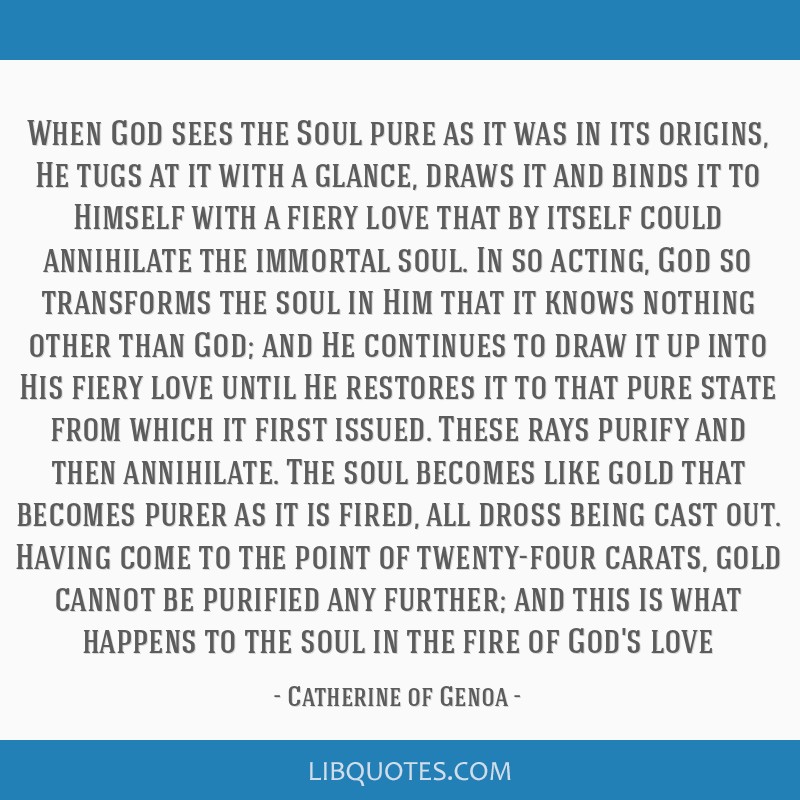
Catherine of Genoa was an Italian mystic and social worker in the Roman Catholic Church.
She wrote the Spiritual Dialogue and a Treatise on Purgatory. She is noted as an authority regarding the doctrine of purgatory.

She is remembered for her work among the sick and the poor. She served the sick during the plague which ravaged Genoa in 1497 and 1501.

She was a member of the noble Fieschi family.  Her fame outside her native city is connected with the publication in 1551 of the book known in English as the Life and Doctrine of Saint Catherine of Genoa.

She and her teaching were the subject of Baron Friedrich von Hügel's classic work The Mystical Element of Religion (1908).

Genoa

The city of Genoa is located between the Apennine Mountains and the Ligurian Sea.

The Apennine are a mountain range of parallel smaller chains extending about 1,200 km (750 mi) along the length of peninsular Italy. They join with the Ligurian Alps at Altare in the northwest.

The Ligurian is part of the Mediterranean Sea between the Italian Riviera (Liguria) and the island of Corsica.

Genoa is the capital of the Italian region of Liguria. It is the sixth-largest city in Italy.

The port is located on the Gulf of Genoa in the Ligurian Sea. It has historically been one of the most important ports on the Mediterranean.  it is currently the busiest in Italy.

It is the birthplace of Christopher Columbus, Niccolò Paganini and Grimaldo Canella, founder of the House of Grimaldi, among others.

 The Bank of Saint George was founded in 1407. It is among the oldest in the world and has played an important role in the city's prosperity since the middle of the 15th century.

The port established  itself as the merchant capital of the newly established Republic of Genoa in 1005 and maintaining its autonomy until 1797.

The capital struggled to rule itself. Many inner conflicts among the nobility weakened the Republic. The inability to rule itself caused the state to put themselves twice under French rule. Once was in 1391. It happened again in 1458.

The Black Death hit Genoa hard in 1348 and contributed to its decline.

Caterina Fieschi Adorno

Catherine's parents were Jacopo Fieschi and Francesca di Negro. Both were of noble Italian birth.  Two popes, Innocent IV and Adrian V, had been of the Fieschi family. Jacopo himself became Viceroy of Naples.

The family were Guelphs. They were in the faction that supported the pope. The Ghibellines were for the Roman emperor

Catherine was the last of 5 children. She was born in 1447. She was described as an extraordinary child who was gifted in prayer and devotion to Christ. She wished to enter a convent when about 13.

Her sister, Limbania, was an Augustinian nun. The nuns to whom her confessor applied refused her on account of her youth. She put aside the idea without any further attempt.

Her father died when she was young. She was married to the young Genoese nobleman, Giuliano Adorno, at 16. Giuliano had returned to Genoa after several experiences in the area of trade and in the military world.

Their conjugal life was not easy. Her husband's character was worldly in affection for games of chance. They didn't produce children. She felt induced to lead a life that lacked serenity. She had a feeling of profound emptiness after 10 years of marriage. She prayed to remain sick in bed for 3 months.

She received a conversion experience as an answer.  Catherine went to the church of St. Benedict and to the monastery of Our Lady of Graces for confession on March 20, 1473.

She wrote that she was wounded in heart by the knowledge of the life she had led and the goodness of God. She did not stay to finish her confession.

She went home and entered a remote room to weep and pray. She received the sense of the immense love of God. She had a vision of Jesus bent beneath the cross. She understood that he suffered so those who suffered pain from discrimination might feel loved.

She entered into a life of profound union by faith with constant prayer and the daily reception of Communion. It was unusual for laity to receive the sacrament so often.

She sought to be taught by God with the nourishment from prayer and the eucharist for 25 years. She did not become dependent upon the priest in confession. She did not become a monastic.

The place of her ascent to mystical peaks was Pammatone Hospital, the largest hospital complex in Genoa, of which she was director.

She lived an active existence despite the depth of her inner life. A group of followers, disciples and collaborators formed around her. They felt edified by her faith and charity. Her husband was won over as well. He became a Third Order Franciscan and moved into the hospital to help his wife.

The plague hit Genoa in 1493. It was reported that it killed up to 80% of the community. Her husband died in 1497.

She resigned her position as director, although she continued working full time until 1499, when her health began to fail. She finally accepted a priest as her spiritual guide during this time. He was her successor as the head of the hospital. He would later write her biography.

She wrote the Spiritual Dialog and Treatise on Purgatory in the 10 years before her death.
Purgatory was not a place located in the bowels of the earth for her. It was an inner fire for purification. It was a movement toward full communion in the kingdom of heaven.

She died in Genoa in 1510.

Elements of Religion

The elements of religion according to Hugel are mystical, intellectual and institutional. The three work to keep religion alive and relevant. Mysticism could never be the whole of religion.

It is personal in a primitive and monotheistic way insofar as it avoids the errors of superstition and hostility, but it holds the institutional and intellectual parts in question.

Catherine used her mysticism to support that which was right about the intellectual and institutional parts. 

Hugel was engaged in theological discussions with a diverse group of scholars associated with the Modernist controversy at the start of the 20th century.

The modernists shared a belief that science had raised new questions for religious faith that undermined naïve suppositions that believers could rely purely on dogmatic authority as a source of truth.

His scholarly concerns included the relationship of Christianity to history, ecumenism, mysticism, the philosophy of religion and the rejection of much of the immanentism in nineteenth-century theology.

The anti-dogmatic position neglected to acknowledge the value that Trinitarian and Christological instruction held with respect for theology. This antagonism supported the liberal position in theology and political philosophy.

Catherine Fieschi
S. 凯瑟琳菲斯基
T. 凱瑟琳菲斯基

凯  Kai  victory             凱  gai         victory song          Ka   きゃ   キャ        Kae  캐  casserole 
瑟  se    harp                 瑟  shitsu     large koto              sa    さ        サ            seo  서  book         
琳  lin    jade                 琳  rin          jewel                     rin  りん    リン         lin    린  Lynn     
菲  Fei   poor                菲   hi           thin                        Fi    ふぃ   フィ         Pi     피  blood   
斯  si      this                 斯   shi         this                         e     え        エ             swi   쉬  wee       
基  ji       base                基  ki           fundamentals         su   す        ス                       
                                                                                         ki    き        キ                                           
-----------------------------

Purgation includes expiation in relation to the divine
to find the way to the jade of the jewel with this mind of mine.

=================

wiki Catherine of Genoa
Franciscan Media: Catherine of Genoa
Lectionary: Catherine of Genoa
Commentary: Treatise on Purgatory
Papal Podcast: Catherine of Genoa
Benedict XVI: Text St. Catherine of Genoa
wiki The Mystical Element of Religion
wiki Genoa
New Advent Encyclopedia: Catherine of Genoa
wiki Guelphs and Ghibellines

Tolerance

David Stove
b. 9.15.1927 Moree, New South Wales, Australia
d. 6.2.1994    Mulgoa, New South Wales

David Charles Stove was an Australian philosopher who argued against socialism. He was for logical probability and rational induction in reason.

Stove criticized the irrationalism that infested the modern philosophy of science. The relativist and “social constructivist” views that were current in the sociology of science and postmodernist humanities departments depicted  modern science as no better (or worse) than voodoo or astrology or reading chicken entrails. The view was made to look like the majority opinion.

Popper, Kuhn and Feyerabend were irrationalists in the philosophy of science. They denied that there was reason to believe in any theory of science. There has been no significant accumulation of relevant knowledge in recent centuries according to the position.

Stove came to be known for his opposition to socialism in college departments in Australia. The socialists made their demands the basis for making decisions for higher education. It ran contrary to the consideration of benefit in reasonable administration.

The argument against socialism seeks to reduce the detrimental affect of socialist analysis on administrative decisions, but argument against it is not enough. Socialism was a derivative of liberal politics. That means that there is another tier to be considered in the argument against non-representative judgment.

The reduction of consideration in the legitimate range of choice for representative policy in democratic society is the area of concern for political organization whether it is in republic or kingdom.

Liberals have been tolerant of socialism because the focus on the role of industrial organization on political leadership has placed their 'power' in government over industry, the middle class and the poor.

They have resorted to populist factionalism in media representation as though it were a representation of democracy. They don't promote representation. They attack it in conservative forms.

Professionalism as a product of education has suffered as a result. While Stove was critical of Popper and his error in science and economics, he wasn't critical enough of liberalism.

The aggressive error of liberalism has to be challenged for the benefit of conservative reform.

Moree, New South Wales
 

Moree is a town in northern New South Wales.

New South Wales is in the southeastern part of Australia. It sits on the banks of the May may River. The name comes from an Aboriginal word meaning "long springs."

The land is a plains region. It has been used for agriculture. The town is not heavily populated. The 2016 census numbers the population at about 7,400 people.

The first constable arrived and a police station was set up in 1865. The first church (Wesleyan) was built in 1867 when the town had a population of 43.

Agriculture emerged as a thriving industry on the fertile flood plains. Banking began in 1876 and the first local newspaper was set up in 1881. The population had grown to 295.

The Great Artesian Basin which sits under Moree was tapped in 1895. The basin yields over thirteen megalitres of water every day, but was proved unsuitable to provide enough water for the agriculture.

The railway line and service from Sydney arrived in 1897. Floods in the area caused numerous washouts of the railway in January 1910. An unknown number of livestock were drowned and at least four people drowned.

A flood cut the township in two in January 1946. Several hundred homes were flooded. The water damaged the power station and caused a black out. Roads and railway lines were damaged.

Moree railway station is situated on the Mungindi line, 665 kilometres (413 mi) from Sydney. It marks the northernmost point of passenger service on the line.

David Stove

David Stove was born in Moree, New South Wales on September 15, 1927.

His parents were Robert James Stove, schoolteacher, and his wife Ida Maude, née Hill. He was the fifth surviving child.

He went to Newcastle Boys’ High School where he excelled in running and was captain of the school track team.

He attended the University of Sydney (BA, 1950) and graduated with first-class honors in moral and political philosophy.

He was strongly influenced by the Challis professor of philosophy John Anderson.

Anderson founded the empirical brand of philosophy known as Australian realism. The central claim was that "whatever exists … is real".  That which is real is spatial and temporal in a situation or occurrence that is on the same level of reality as anything else that exists.

Any object is a fact. Every fact is situated in a complex situation. There are no simple ideas, no atomic facts, no objects which cannot be, as it were, expanded into facts.

All situations exist independently of knowledge of them. All entities are caused. Ethics is concerned with establishing and describing that which is good. It is a positive science. It is not abstractly detached from reality.

Anderson's insistence on unceasing inquiry and criticism became central to the intellectual principles of the university's Libertarian Society. This group supplanted the Free Thought Society in the early 1950's. It provided a philosophic platform for the much broader subculture known as "the Push" throughout the 1960's.

The movement was against socialism, yet he was a defender of free speech. He was critical of the Australian government's bans on certain political publications (1928). People could talk about socialism, but concession to the demands of Marxist ideology was not to be granted.

Stove was appointed a teaching fellow at the University of Sydney in 1951. He became a lecturer in philosophy at the New South Wales University of Technology (later the University of New South Wales) in 1952.

He married Jessie Amelia Leahy, a biochemist on 4 November 1959 at the registrar general’s office. The next year he returned to the University of Sydney.  He was promoted to senior lecturer in 1963 and associate professor in 1974. He would teach there until his retirement in 1987.

Stove was alarmed by the spread of radical left-wing ideas on campus in the early 1970's especially in his own department. He strongly resisted the introduction of courses in Marxism-Leninism and feminism with his colleague David Armstrong, the Challis professor of philosophy.

The subjects went ahead. The dispute resulted in a split in the department. Stove and Armstrong joined a new department of traditional and modern philosophy (colloquially ‘T & M’). Stove headed the department in 1981 and 1982. The left wing department was troubled by political schism. Stove felt that T & M was a perfect environment for serious work.

His work in philosophy mostly concerned the problem of induction. He argued that inference from the observed to the unobserved was justified for purely logical reasons in Probability and Hume’s Inductive Scepticism (1973) and The Rationality of Induction (1986).

There exists a probabilistic kind of logic which renders ‘The next swan is white’ probable, though not certain, on the evidence that all swans so far observed have been white.

His more polemical philosophical work included Popper and After: Four Modern Irrationalists (1982). The work accused leading philosophers of science such as Sir Karl Popper and Thomas Kuhn of undermining, rather than as they claimed, defending science.

Popper had concluded in his massive The Logic of Scientific Discovery (1934) that science could never establish truth.  Stove compared the conclusion to the one that had been made by the fox in Aesop's fable.

The fox had decided that the grapes must be sour, because he could not reach them. Stove added that to make the comparison complete, the sly creature would have gone on to write a long book on the progress of viticulture.

He wrote 'A Farewill to Arts' in protest to the spread of postmodernist varieties of left wing thought in 1986. He described the Faculty of Arts at the University of Sydney as a disaster area.

This disaster was like an area that had been ravaged by flood, a badly leaking nuclear reactor or an outbreak of hoof and mouth disease in cattle. His complaint was that Marxism, semiotics and feminism were being used to favor the employment of women on the faculty.

His opinion was that logically probable deduction and simple induction were the path to truth. Common sense has to be applied in practical reason for realism to work.

He was witty and irreverent in expression, but principled in thought. He was pessimistic in that he found no consolation in religion or hope for political progress.

He found some comfort in classical music, old books and nature. He enjoyed planting trees at his rural property at Mulgoa. He also liked cricket and rugby league.

He was a heavy smoker. He contracted oesophageal cancer.

He committed suicide on 1 or 2 June 1994 at Mulgoa after a period of depression following severe treatment for the disease.

While his criticism of socialism was warranted, his conservatism was pessimistic. He did not admit to room for the stable management of reform.

-----------------------

David Stove
S. 大卫斯托夫
T. 大衛斯托夫

大 Da       great              大 dai        large                   De   で     デ          De  데  place             
卫 wei     health              衛  ei        defense                bi    びっ  ビッ      i    이  this             
斯  Si         this               斯  shi       this                      Do   ど      ド        bi     비  ratio           
托  tuo      support          托   taku    requesting           su    す    ス          deu  드  de             
夫  fu        husband         夫  fu         husband              to    と-   ト-        Seu   스  s                           
                                                                                      bu    ぶ    ブ         to     토  sat     
                                                                                                                    beu  브 bro                 
-----------------------

Socialism demands the defense of liberal expenditure
as though the competitor were the cause of the global rise in temperature.

=================

wiki David Stove
James Franklin: Sydney Philosophy Disturbance
Bio David Charles Stove

Wednesday, June 5, 2019

Find

6.6.19

Crape Myrtle

Take
Refuge
避难 
Binan
避難所を取る 
Hinansho o toru
ps 31

Take refuge.
Safety is your due.

I have taken refuge in you.
You help me to find that which is true.

Don't make me regret my trust.
I feel like this will last beyond the dust.

Bring me civility.
Civility cultivates fertility.

Please listen.
My sweat glistens.

The clock is ticking.
My pulse is quickening.

Time is escaping.
Reality is quaking.

Be my defense.
Let me see what is sure about sense.

You are my rock.
You walked the walk.

My foundation is sure.
My intention is pure.

Lead me in love.
Love me until I've won.

Limit weapon use to defense.
Offense is not what's meant.
Let defense be defensive in intent.

Non-violence isn't offensive
but it doesn't rule out aggression.

Aggression isn't an excuse for violence,
cruelty in punishment or violet silence.

Deliver me from the trap they have set.
I won't enter into something I have to regret.

They have been exploiting trust.
They promised protection that would not rust.

You are my strength.
The measure extends beyond length.

I commend my spirit to your care.
Your love has led me to dare
to share.

You have redeemed me with truth.
Meaning gives trust that soothes.

My time is yours.
Design divined cures.

Inside the ah of the aha experience
lies the immense pleasure of group expedience.

I saw a man on a red horse in the night.
He sat there among the myrtle trees in the moonlight.

Different colored horses of different kinds
stood behind him as the light shone through the tree lines.

I asked what it was that they were.
I was told that 'They were sent to patrol the earth.'

Help me to find independence.
Freedom in the law is sent from heaven.

Deliver me from deception and oppression.
The state created by deceit is not worthy of leaven.

The immaterial view of matter as a word
sees the particulars of general abstraction inferred.

The Healer was asked to heal the servant of the officer.
His word was enough. Faith was the power that cured her. 

Watch yourself for the sake of your prayers.
The end is near for this state of affairs.

There was one like the Son of Man seated on the cloud.
He had a crown on his head. His hand gripped a haft like a vow. 

A tree may sprout again when it is cut down.
A mortal body does not rise after it dies with or without renown.

Joseph asked Pilate for the body of Jesus. 
Pilate gave it over to entomb to protect the public from diseases.

Mary saw the light when she went to the tomb.
The body was gone. There was nothing but room.

Jesus rose from the dead as he had said.
He left the tomb that had a slab for his bed.

Let your light shine through me.
Your joy in my face will be seen.

Your kindness will redeem me.
Your redemption will be believed.

I have taken refuge in you.
You kept me from feeling blue.

Safety is your due.
Take refuge.

------------------

Psalm 31
In te, Domine, speravi
In you, Dominated, I trust

1 In you, O Lord, have I taken refuge;
let me never be put to shame;
deliver me in your righteousness.
2 Incline your ear to me;
make haste to deliver me.
3 Be my strong rock, a castle to keep me safe,
for you are my crag and my stronghold;
for the sake of your Name, lead me and guide me.
4 Take me out of the net that they have secretly set for me,
for you are my tower of strength.
5 Into your hands I commend my spirit,
for you have redeemed me,
O Lord, O God of truth.
6 I hate those who cling to worthless idols,
and I put my trust in the Lord.
7 I will rejoice and be glad because of your mercy;
for you have seen my affliction;
you know my distress.
8 You have not shut me up in the power of the enemy;
you have set my feet in an open place.
9 Have mercy on me, O Lord, for I am in trouble;
my eye is consumed with sorrow,
and also my throat and my belly.
10 For my life is wasted with grief,
and my years with sighing;
my strength fails me because of affliction,
and my bones are consumed.
11 I have become a reproach to all my enemies and
even to my neighbors,
a dismay to those of my acquaintance;
when they see me in the street they avoid me.
12 I am forgotten like a dead man, out of mind;
I am as useless as a broken pot.
13 For I have heard the whispering of the crowd;
fear is all around;
they put their heads together against me;
they plot to take my life.
14 But as for me, I have trusted in you, O Lord.
I have said, "You are my God.
15 My times are in your hand;
rescue me from the hand of my enemies,
and from those who persecute me.
16 Make your face to shine upon your servant,
and in your loving-kindness save me."
17 Lord, let me not be ashamed for having called upon you;
rather, let the wicked be put to shame;
let them be silent in the grave.
18 Let the lying lips be silenced which speak against
the righteous,
haughtily, disdainfully, and with contempt.
19 How great is your goodness, O Lord!
which you have laid up for those who fear you;
which you have done in the sight of all
for those who put their trust in you.
20 You hide them in the covert of your presence from those
who slander them;
you keep them in your shelter from the strife of tongues.
21 Blessed be the Lord!
for he has shown me the wonders of his love in a
besieged city.
22 Yet I said in my alarm,
"I have been cut off from the sight of your eyes."
Nevertheless, you heard the sound of my entreaty
when I cried out to you.
23 Love the Lord, all you who worship him;
the Lord protects the faithful,
but repays to the full those who act haughtily.
24 Be strong and let your heart take courage,
all you who wait for the Lord.

------------------------------

Zechariah was the 11th of the 12 Minor Prophets. He was a prophet in the Kingdom of Judah. He was of priestly extraction like the prophet Ezekiel.

His career began in the 2d year of Darius, King of Persia (520 BCE). His greatest concern was with the building of the Second Temple.

The Book of Zechariah recalls the history of nation in order to present a warning to the generation of the time. A series of 8 visions followed each other in a single night. The visions presented a symbolic history of Israel. Joshua was crowned to indicate that the kingdoms of the world were sanctified by the Messiah.

The purpose for the book is theological and pastoral as well as historical. God is present in good deeds like the building of the Second Temple. The deeds are accomplished by the power of the Spirit.

The story of Zechariah's vision of horses among myrtle trees is in the first chapter of his book. The flower for the myrtle tree is red. The berry that it produces is the same color.

wiki Zechariah
wiki Book of Zechariah
Zechariah and the Myrtle Tree

Zech. 1:8-10

I saw a man riding on a red horse in the night! He was standing among the myrtle trees in the glen. Behind him were red, sorrel and white horses. Then I said, 'What are these, my lord?' The angel who talked with me said to me, 'I will show you what they are.' The man who was standing among the myrtle trees answered, ‘They are those whom the LORD has sent to patrol the earth.’

--------------------------

I saw a man on a red horse in the night.
He sat there among the myrtle trees in the moonlight.

Different colored horses of different kinds
stood behind him as the light shone through the tree lines.

I asked what it was that they were.
I was told that 'They were sent to patrol the earth.'

===================

Rev. 14:14

There was a white cloud. Seated on the cloud was one like the Son of Man with a golden crown on his head and a sharp sickle in his hand!

--------------------------

There was one like the Son of Man seated on the cloud.
He had a crown on his head. His hand gripped a haft like a vow.

===================

Matt. 8:13

Jesus said to the centurion, ‘Go. Let it be done for you according to your faith.’ The servant was healed in that hour.

--------------------------

The Healer was asked to heal the servant of the officer.
His word was enough. Faith was the power that cured her.

===================

Conversion of Self

Ps.31:21

Blessed be the Lord
for he has shown me the wonders of his love
in a besieged city.

Ini Kopuria
b. 1880 Maravovo, Guadalcanal
d. 6.6.1945 Maravovo, Guadalcanal
Lectionary

Ini Kopuria was a police officer from Guadcanal in the Soloman Islands. He formed the Melanesian Brotherhood in 1925 to declare the gospel of Jesus Christ in Melanesia.

Maravovo, Guadalcanal

Ini Kopuria was born in Maravovo on Guadalcanal. He looks like a man of at least sixty in his photo.
Maravovo is a village on the northwest tip of the island. The island is mainly covered in dense tropical rainforest and has a mountainous interior.

Guadalcanal is one of the Solomon Islands. These are located in the south-western Pacific, northeast of Australia.

Guadalcanal

Guadalcanal is the principal island in the nation of Solomon Islands.

Solomon Islands

The Solomon Islands are a sovereign state made up of 6 major islands and over 900 smaller islands in Oceania.

The first European to visit the islands was the Spanish navigator Alvaro de Mendana de Neira from Peru in 1568.

Some of the earliest and most regular foreign visitors to the islands were whaling vessels from Britain, the United States and Australia. They came for food, wood and water from late in the 18th century. They took aboard islanders to serve as crewman on their ships.

Relations between the islanders and visiting seamen were not always good. Sometimes there was violence and bloodshed.

Missionaries began visiting the Solomons in the mid-19th century. They made little progress at first. ‘Blackbirding’ was the brutal recruitment or kidnapping of laborers for the sugar plantations in Queensland and Fiji.

The cruelty of the practice led to a series of reprisals and massacres. The evils of the slave trade prompted the United Kingdom to declare a protectorate over the southern Solomons in June 1893.

More outlying islands were added to the protectorate in 1898 and 1899. The remainder of the archipelago was transferred to British administration from German jurisdiction in 1900. The islands of Buka and Bougainville remained under German administration as part of German New Guinea.

Traditional trade and social intercourse between the western Solomon Islands of Mono and Alu and the traditional societies in the south of Bougainville continued without hindrance.

Missionaries settled in the Solomons under the protectorate. Several British and Australian firms began large-scale coconut planting in the early 20th century. Economic growth was slow. Islanders benefited little.

Most planters and traders were evacuated to Australia and most cultivation ceased with the outbreak of the Second World War. Some of the most intense fighting of the war occurred in the Solomons.

The most significant of the Allied Forces' operations against the Japanese Imperial Forces was launched on 7 August 1942, with simultaneous naval bombardments and amphibious landings on the Florida Islands at Tulagi[18] and Red Beach on Guadalcanal.

Oceania

Oceania includes Australia, New Zealand, Melanesia, Micronesia and Polynesia.

Maravo, Guadalcanal

The population for Maravovo is Anglican. This status was the result of the work of Bishop Selwyn and Bishop Patteson of the Anglican Church.

Bishop Selwyn established the community in New Zealand as a means to propagate the gospel to surrounding areas. The islands of Melanesia were declared to be part of the mission in 1848. The area was declared a separate See in 1854.

History
Melasian Brotherhood

Bishop Patteson founded a school for the education of native Christian workers to answer the call to evangelize the people in the area. He was adept at language. He learned twenty-three of the languages spoken in the Polynesian and Melanesian Islands of the South Pacific. He was consecrated Bishop of Melanesia in 1861.

Charles Elliot Fox was a British missionary in Melanesia. He was educated in New Zealand and graduated from the University of New Zealand in 1901. He received a degree in theology from St. John's College in Aukland in 1902.

He joined the staff of the Anglican Melanesian Mission in 1903 and was ordained the same year. Fox lived and worked in most of the islands of the Solomon chain, on the Banks and in the New Hebrides during his more than seventy years of service as a missionary and teacher.

---------------

Zech. 1:10

So the man who was standing among the myrtle trees answered, 'They are those whom the LORD has sent to patrol the earth.'

----------------

Guadalcanal is a large island. It is more easily accessible than others. Ini Kopuria was influenced to a peculiar degree by the forces shaping Melanesian history. He was baptized at Maravovo when he was a student at a small all male school. He was a dedicated and intelligent student. He possessed depth of personality and a thoughtful disposition.

His years at school were spent in daily contact with white Christian men and women. It was a racially integrated community that proved to be formative in Ini's career and character. The details of the kind of life he led there are relative to understanding his life.

S. Barnabas' School was on Norfolk Island. It was the forerunner of the later schools in the islands themselves. It had been established by Bishop Patteson as the training-ground for Melanesians who were expected to return as teachers to their own islands.

The boys who were brought by the mission ship, the Southern Cross, from the various islands, remained at school for two years. They were allowed to return home, either permanently, or for a six months' holiday before a further period of training.

History of the Brotherhood
Anglican History

Life was disciplined with respect for an Anglo-Catholic culture. The Spanish had been to the area first. They had established a cultural integration with the natives. The Anglican tradition was adapted by Bishop Patteson. The school set the stage for the formation of the Brotherhood.

The Brotherhood was reminiscent of the Franciscan movement of thirteenth century Europe given differences in time and place. It began with the great change that dedication to God made in the life of one person.

It was followed by the gathering round of a group similarly bound. Lady Poverty was taken as a wife. They took no payment for their service except for food and a night's lodging.

The Brothers went to those whom the Church had not yet been able to reach. They preached in untouched places or among those who had grown lukewarm. They brought comfort and healing for body, mind and soul with love and joy for the ideal. They visited the lepers and tended the sick.

The power of the community worked out like that in the days of the Apostles. It has continued to do so down to our own days. "Whenever Christianity has struck out a new path in her journey it has been because the personality of Jesus has again become living and a ray from His Being has once more illuminated the world." (Bossuet.)

That is because of those who see in Christ the heart and purpose of God. They have been so filled with gratitude that they have been impelled to do what they could. They have learnt to understand "down to its very depths, the theory of thanks..."(G. K. Chesterton: S. Francis) That theory extends its depth to a bottomless abyss.

Each of the seventeen daily bells demanded some action promptly carried out. There was work in the school, garden, field, house, kitchen, workshop and dairy. Labor formed part of the teaching before time was given for the students to feel as free as if they were at home.

Saturday was a holiday. They could fish or tend their own gardens. They could occupy themselves in their own residence. They could play football or cricket.

White and brown lived and worked as a community. Meals were taken in common in the hall. Patteson's plan for the education of the native mind insisted on constant contact with his white friends at work or play. This was always carried out. The students found instructors ready to help them with any problem that might arise.

A bell called for prayers morning and evening in the beautiful Patteson Memorial Chapel daily. This was unique in its place. It was not the building one would expect in the heart of the Pacific. It was also unique for the time.

The Chapel was crafted with attention to detail at a time when architecture in England was at a very low level. The materials were rich, yet used with simplicity and restraint. There was a combination of European art with native inlay work on altar and stalls which would have inspired the heart of Bishop Patteson.

He delighted in the treasures of Europe and valued the beauty inherent in the minds of his Melanesian students. It was expected that Ini on leaving school would become a teacher among his own people. He made a different choice.

His sense of duty called him to join the native police force. His life with the police was unhappy at first. The strict discipline for secular public service irked him. The conditions were foreign to his experience.

He felt cut off from his old surroundings and heritage. He had never felt as separated at school where life was as far as possible run on native lines. Native lines were run by village custom. People acted as they were taught to act by the people of the village. Customs differed.

---------------

Rev. 14:15

Another angel came out of the temple calling with a loud voice to the one who sat on the cloud, 'Use your sickle and reap. The hour has come. The harvest of the earth is fully ripe.'

----------------

Ini met with an accident in 1924 while he was new to the service. He was ill for some time in hospital at Tulagi, the government center in the Solomons. It was then that the light to which he had been groping came to him with respect for his mission.

He had been impatient and dissatisfied. He even asked the Mission authorities to secure his release from his obligations. This they refused to do. Ini showed his solid sense by settling down to earn a reputation for smartness and efficiency.

The value attached by the Police authorities to his influence is shown by an incident which occurred after he had left the service. He was asked by the Commissioner to return to the police force In 1927 at the height of the excitement caused by the murders on Mala. He was asked to return in order to go to the island  to attempt to put matters straight.

The fact that he was asked to do this shows the esteem in which he was held. His attitude to the request throws fresh light on his character. He explained that he was no longer his own master.

He had to consult the Bishop. He explained himself more clearly to the Warden of the College at Siota, "I could not refuse outright, but it would be bad for me to go to Mala with a rifle. I shall probably want to go later with the Gospel."

-------------------

Matt. 8:9

"I also am a man under authority. I have soldiers. I say to one, "Go," and he goes; to another, "Come," and he comes...

--------------------

This was the birth of the idea for the Brotherhood. He offered himself to celibacy to "feed the flock of Christ" particularly on his own island of Guadalcanal, but he knew that he would need a band of brothers to help him with this mission.

Ini was fortunate in having a bishop who understood his dreams. He saw the great possibilities in the call to service. The bishop was convinced of Ini's sincerity. He was willing to give him that sympathy and encouragement for which someone longs when he has passed through a great spiritual experience. He was willing to help him after he had come down from the mountain-top to work out his vision in terms of ordinary everyday life.

Ini went for a time to the College at Siota in 1925 for further study and experience as a teacher. Siota was the administrative center of the Diocese. Then he returned to his native village to clear the site which he had given to the Mission as Headquarters for the Brotherhood when it should come into being.

Tools for draining and clearing were provided from the school at Maravovo. Ini made an effort to get help from all the Christian villages near. He was not as successful as he had hoped in this. The people made monetary collections, but few came to help in the actual work. He was forced to attempt the task aided only by three others.

Two of these were boys who wished to go to the school but were not considered suitable. Ini found time to teach them to read in addition to the work of clearing which they carried out together.

His plan had to be modified considerably. He had to content himself with one building for the time instead of the six houses he had hoped to build. The chapel that he had longed for had to be left for the future.

The Ship needed more workers.  Ini wrote, "As to the 'Sailors,' I have written how the Captain...wants Sailors for a voyage to Guadalcanar to bring into the fold those three or four thousand sheep in the ninety villages. The Captain longs to bring those sheep into the fold. He has said, 'They must hear My Voice and there shall be one flock and One Shepherd' . . . any of you young men who can, let him come with me."

Six other young men were found to venture forth with him during the next six months. All were Solomon Islanders. Three, Moffatt Ohigita, Dudley Bale and Cecil Logathaga came from Santa Isabel. Two, Maurice Manere and Hugo Holun came from Laube. Benjamin Boko came from Guadalcanal.

The seven met together in the middle of May 1926 with the Bishop at Siota. Rules were discussed. Several names were suggested for the band. It was agreed to adopt that which most truly described the men and their mission as "the Brothers." Such has accordingly been their title. When speaking they address one another as "Brother So and So." Their writing concludes with "So and so, a Brother."

The Brotherhood was formally constituted for work in the highlands of Guadalcanal on Whitsunday, May 23d after evensong in the College Chapel at Siota. The Bishop received the vows of dedication after the Invocation and the Lord's Prayer.

The vows were binding for one year. The laying of his hands upon each admitted him into the Brotherhood. Each Brother promised to remain unmarried to receive no payment and to obey "those set in authority over them."

The Rule of the Brothers was simple, yet far-reaching. It provided great opportunity for expansion within the original framework.  The society was organized in groups from four to eight Brothers for a house. The household was supervised and directed by an Elder Brother.

The elder was chosen by the members. Each household met four times a year for discussion of the work and of any problems which may have arisen. The frank statement of opinions or grievances was encouraged. This prevented the feeling of repressed dissatisfaction which is so often a hindrance to any corporate undertaking.

An Annual Chapter of the whole Brotherhood was held when vows were to be renewed or a Brother was to leave. Questions affecting the whole community were discussed and fresh plans made. It was only at such a Chapter acting under the Presidency of the Father that changes to the Rule were allowed.

The households were subdivided for the actual work of evangelism. The brothers journeyed two by two. None were to work alone according to the Rule. Two brothers at least are always in residence at the Brotherhood House at Tabalia.

This Rule was solemnly dedicated in 1928 in the presence of numbers of white men, native clergy and boys from Maravovo. The ceremony was completed by dancing and a feast.

Even when the site of the village was known there was always the possibility that the people may not actually be living there. The government of the Solomons insisted on a permanent village being made, but the people often preferred to live on their various garden sites in temporary houses.

The Priest-in-charge of the district had to be prepared for a similar nomadic existence to get in touch with such people. This added difficulty to his already strenuous work.

The difficulties for missionary work were intensified when they had to pursue the inhabitants to their various resting places. There were times when they arrived to find the village deserted. The inhabitants were again on the move.

Ini and the Bishop of Melanesia, the Right Reverend John Manwaring Steward, realized Ini's dream by forming a band of brothers. They were known in the Mota language as 'Ira Reta Tasiu.' The band was dedicated to take the Gospel of Jesus Christ to the non-Christian areas of Melanesia.

It was reported that 7 brothers were killed in an effort to negotiate the surrender of guns from local islanders.

The Melanesian Brotherhood is a product of the Anglo-Catholic reform. The main feature of the reform was Bishop Selwyn's incorporation of the native people into the Church. Advance into leadership positions was encouraged.

Monastic organization was also allowed. The story of the execution of the 7 brothers is the tragic result of a political dispute over the ownership of weapons.

While it may seem natural to want to outlaw guns as the cause of death, weapons play an important role in the building of nations. The police can't be there to defend the weaponless at any given random crisis event.

People have to have the opportunity to work things out without violence. The use of weapons for negotiation or defense from attack is necessary whenever it is.

Guns can be owned even by a monastic community. The potential to train a band of brothers for the well-regulated use in defense is strong.

The situation in the Solomon Islands has changed since Ini Kopuria passed away.

Allied forces landed on Guadalcanal, Tulagi and Florida in the southern Solomon Islands on 7 August 1942. These were predominantly US Marines. Their objective was to deny their use by the Japanese.

Enemy use was viewed as a threat to Allied supply and communication routes between the United States, Australia and New Zealand. American and Australian naval forces supported these landings.

The Allies also intended to use Guadalcanal and Tulagi as bases in supporting a campaign to eventually capture or neutralize the major Japanese base at Rabaul on New Britain.

The Japanese defenders had occupied those islands since May 1942. They were outnumbered and overwhelmed by the Allies. The Allies captured Tulagi and Florida as well as the airfield. The airstrip was later named Henderson Field when it was under re-construction.

The Japanese made several attempts between August and November to retake Henderson Field.  Almost daily aerial battles culminated in the decisive Naval Battle of Guadalcanal in early November.

The Japanese abandoned their efforts to retake Guadalcanal in December. They evacuated their remaining forces by 7 February 1943 in the face of an offensive by the U.S. Army's XIV Corps.

The victories at Milne Bay, Buna–Gona and Guadalcanal did mark the Allied transition from defensive operations to the strategic initiative in the theater. This led to offensive campaigns in the Solomon Islands, New Guinea and the Central Pacific.

The Brotherhood
 Melanesian Brotherhood Website


Ini Kopuria
这是伙便里啊
這是夥便裡啊

这  Zhe     this                          這  sha   crawl                   Ini   いに   イニ         Ini  이니  I   
是  shi       is                             是  shi    just so                 Ko   こ        コ            Ko    코     nose
伙  Huo     group                      夥  wa    immense             pu   ぷ       プ              pu    푸     fu           
便  bian    expedient                 便  bin    convenience       ri     り        リ            li      리     lee         
里  li          inside                      裡  ri        inside                 a     あ       ア             a       아     ah 
啊  a           ah                            啊  a        ah                                                                                     

--------------------------

Inside the ah of the aha experience
lies the immense pleasure of group expedience.

===================

Melanesian Brothers Song and Dance
Melanesian BBQ

Sunday, March 10, 2019

Work

3.17.19
Gilmore Girls
Kelly Bishop, Lauren Graham, Alexis Bledel

Work
for
Health
为健康而努力
Wèi jiànkāng ér nǔlì
健康のために働く 
Kenkō no tame ni hataraku
ps27

The Lord is my light and salvation.
Faith is the strength for the nation.


Light from Light,
you grant me sight.

Outer to inner,
you make me shimmer.

Truth from Truth,
respect is due
from youth to youth. 

God from God,
you kept me from falling to the odds.

My faith will be held as dear.
I will not fall to my fear.

War was fought for supremacy.
I will put my trust in divine memory.

I have asked for one thing. 
There is one thing I seek to bring.

I wish to dwell in the relevant presence
of the elegance near the essential essence.

I hope to behold fair beauty
in the temple to which my faith drew me.

Protection will keep me safe in the day of strife.
Concealment will hide me in secrecy from sight.

My head has been lifted above my enemies.
It will remain lifted even when the tension of conflict leaves.

I will offer an oblation with great gladness.
I will sing and make music to overcome sadness.

Please listen when I call.
Have mercy with your wherewithal.

You say to my heart, "Seek my face."
I will seek your grace anyplace.

Don't hide from me.
Help the blind to see.

You have been my salvation.
Don't cast me from your relation.

Jesus is my Savior.
My transformation will be savored.

I believed that I would see your goodness.
I believed in your incarnate fullness.

Some of the separated had come to say
your adversary wants to put you away.

Deliver me from the adversity imposed by adversaries.
False witnesses have spoken against your beneficiaries.

Though adverse human relation has shaken me,
your support has sustained my family and community.

Severus raised the soldier's wage too high.
The tax burden became a battle cry.

Leadership for the city became divided.
Support for any one subsided.

Caesars were charged to serve Augustus.
Expansion was viewed as the way to fund thus for us.

Polytheism for Republic was seen as viable 
to organize groups to enslave the tribal.

The newness of respect for Christ
lifted settlement beyond slavery's divisive vice. 

The sound of the flower is a blessing that surrounds
the field that produces grain for the towns.

The procession of the Spirit
allows growth for those who hear it.

Faith in your production
will lead us from the path to destruction.


Show me your way. 
Teach me what to say 
and how to pray.

The communication of ideas is not the only purpose for language.
The experience of reception holds its own vantage.

Language can proclaim good news for faith
or it can be used to warn against doing damage as a trait.

The conjunct force of reason for principle
serves the public in the reform of that which is printable
as legislation inferred from the script that is biblical.

I believed that I would see the goodness of your word.
I believed in your incarnate fullness as a way to overcome the absurd.

Be strong and wait patiently my soul.
The Lord's pleasure will make you whole.


Ur of the Chaldeans = fire of thieves

I was brought out from the fire of thieves
to care for my land with those who believe.

Our citizenship is in heaven
for which this experience is the leaven.

Humiliation will be transformed.
To the body of glory it will conform.

We will use responsibility 
to shape our fertility with civility
for agility in facility.

Humility is not thinking less of yourself.
It is thinking of yourself less for the wealth of your health.

Capital is the ability for stock to generate revenue
from the sale of a product for a perpetually perceptive view. 

There are better things that lie ahead
than the bad that is left behind with dread
for that good which is worth the tread.


27 Dominus illuminatio
1 The Lord is my light and my salvation;
whom then shall I fear?
the Lord is the strength of my life;
of whom then shall I be afraid?

----------------------------------

The Lord is my light and salvation.
Faith is the strength for the nation.

Light from Light,
you grant sight.

Truth from Truth,
your strength is due
from our youth.

=========================

2 When evildoers came upon me to eat up my flesh,
it was they, my foes and my adversaries, who
stumbled and fell.

----------------------------------

God from God,
you kept me from falling to the odds.

=========================

3 Though an army should encamp against me,
yet my heart shall not be afraid;

----------------------------------

My faith will be held as dear.
I will not fall to my fear.

=========================

4 And though war should rise up against me,
yet will I put my trust in him.

----------------------------------

War is fought for supremacy.
I will put my trust in divine memory.

=========================

5 One thing have I asked of the Lord;
one thing I seek;
that I may dwell in the house of the Lord all the days of my life;

----------------------------------

I have asked for one thing.
There is one thing I seek to bring.
I wish to dwell in the relevant presence
of the elegance near the essential essence.

=========================

6 To behold the fair beauty of the Lord
and to seek him in his temple.

----------------------------------

I hope to behold fair beauty
in the temple to which my faith drew me.

=========================

7 For in the day of trouble he shall keep me safe in his shelter;
he shall hide me in the secrecy of his dwelling
and set me high upon a rock.

----------------------------------

Protection will keep me safe in the day of strife.
Concealment will hide me in secrecy from sight.

=========================

8 Even now he lifts up my head
above my enemies round about me.

----------------------------------

My head has been lifted above my enemies.
It will remain lifted even when the tension leaves.

=========================

9 Therefore I will offer in his dwelling an oblation
with sounds of great gladness;
I will sing and make music to the Lord.

----------------------------------

I will offer an oblation with great gladness.
I will sing and make music to overcome sadness.

=========================

10 Hearken to my voice, O Lord, when I call;
have mercy on me and answer me.

----------------------------------

Please listen when I call.
Have mercy with your wherewithal.

=========================

11 You speak in my heart and say, "Seek my face."
Your face, Lord, will I seek.

----------------------------------

You say to my heart, "Seek my face."
I will seek your face anyplace.

=========================

12 Hide not your face from me,
nor turn away your servant in displeasure.

----------------------------------

Don't hide from me.
Help the blind to see.

=========================

13 You have been my helper;
cast me not away;
do not forsake me, O God of my salvation.

----------------------------------

You have been my salvation.
Don't cast me from your relation.

=========================

14 Though my father and my mother forsake me,
the Lord will sustain me.

----------------------------------

Though adverse human relation has shaken me
your support has sustained my family and community.

=========================

15 Show me your way, O Lord;
lead me on a level path, because of my enemies.

----------------------------------

Show me your way.
Teach me what to say
and how to pray.

=========================

16 Deliver me not into the hand of my adversaries,
for false witnesses have risen up against me,
and also those who speak malice.

----------------------------------

Deliver me from the adversity imposed by my adversaries.
False witnesses have spoken against your beneficiaries.

=========================

17 What if I had not believed
that I should see the goodness of the Lord
in the land of the living!

----------------------------------

I believed that I would see your goodness.
I believed in your incarnate fullness.

=========================

18 O tarry and await the Lord's pleasure;
be strong, and he shall comfort your heart;
wait patiently for the Lord.

----------------------------------

Be strong and wait patiently my soul.
The Lord's pleasure will make you whole.

=========================

Genesis 15:7
Then he said to him, 'I am the LORD who brought you from Ur of the Chaldeans, to give you this land to possess.'

----------------------------------

Ur- fire
Chaldeans- robbers

You were brought out from the fire of thieves
to possess your land with those who believe.

=========================

Phil. 3:20-21
But our citizenship is in heaven, and it is from there that we are expecting a Saviour, the Lord Jesus Christ. He will transform the body of our humiliation so that it may be conformed to the body of his glory, by the power that also enables him to make all things subject to himself.

----------------------------------

Our citizenship is in heaven
for which this experience is the leaven.

Humiliation will be transformed
to the body of glory conformed.

We will use responsibility
to shape our fertility with civility
for agility in facility.

Jesus is my savior.
My transformation will be savored.

=========================

Luke 13:31
At that very hour some Pharisees came and said to Jesus, 'Get away from here, for Herod wants to kill you.'

----------------------------------

Pharisees-separated
Jesus- God saves
Herod- hero

Some of the separated had come to say
your adversary wants to put you away.

=========================

Rome had been sacked by the Visigoths as led by their king, Alaric, on 24 August 410 CE. Rome was no longer the capital of the western Roman empire. It had been replaced by Mediolanum (Milan) in 286. Ravenna was made the capital in 402.

The last sack of Rome had occured around 390 BCE by the Gauls. It had been almost 800 years. While the invasion did not destroy the western Roman empire, it was seen as a major step in the direction of the fall.

The Roman polytheists had blamed the calamity on Christian monotheism. Augustine's friend, Marcellinus, had asked him to write a treatise in defense of the religion.

Marcellinus had been sent to Africa by the Emperor Honorius to arrange a settlement of the differences between the Donatists and the Catholics shortly before the fall of Rome. This brought him into contact with Augustine.

He also met Volusian, the proconsul for Africa. While he was not a Christian he had an interest in the faith. Marcellinus asked Augustine to write a persuasion for him to accept Christianity as the true faith.  The City of God was the product of this request.


Aurelius Augustine
City of God
426

“For to this earthly city belong the enemies against whom I have to defend the city of God. Many of them, indeed, being reclaimed from their ungodly error, have become sufficiently creditable citizens of this city; but many are so inflamed with hatred against it, and are so ungrateful to its Redeemer for His signal benefits, as to forget that they would now be unable to utter a single word to its prejudice, had they not found in its sacred places, as they fled from the enemy's steel, that life in which they now boast themselves. Are not those very Romans, who were spared by the barbarians through their respect for Christ, become enemies to the name of Christ?”

--------------------------------

Severus raised the soldier's wage too high.
The tax burden became a battle cry.

Leadership for the city became divided.
Support for any one subsided.

Caesars were charged to serve Augustus.
Expansion was viewed as the way to fund thus for us.

Polytheism for Republic was seen as viable
to organize groups to enslave the tribal.

The newness of respect for Christ
lifted settlement beyond slavery's divisive vice.

=======================

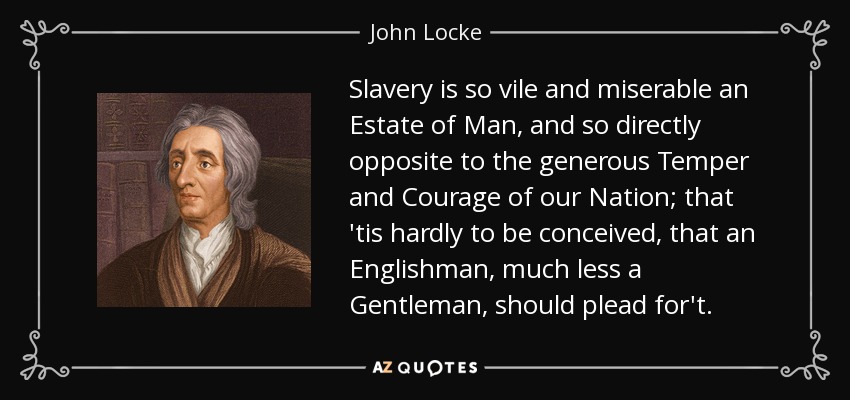
Locke was for slavery.


Locke opposed Hobbe's argument for the claim to absolute power by the monarchy. He rejected the use of absolute power for enslavement.

This was a parliamentarian issue. The English Civil War had amounted to Parliament taking the power to declare war from the monarchy. They then had the authority for taxation, legislation, deportation, colonization and to authorize military action.

The potential to increase profit from the precipitation of war had increased. This included the promotion of revolution as though it were a reform to the constancy of war. The context for perpetual war had increased to a global scale with the competition for colonialism.

The power of the monarchy was made ceremonial and communicative. Foreign monarchs were brought in when the parliament wanted a spokes person and straw man for their decisions.
The power of the monarchy as a symbol for conservative expenditure was enhanced by the large scale changes. Anti-monarchical democracy was also anti-patrician and anti-aristocratic. The liberal element for parliament pressed the case for their authority despite the implication.

Locke owned stock in slave trading companies. He was secretary of the Lords Proprietors of the Carolinas where slavery was constitutionally permitted. He flipped the argument against slavery into a proposal for it with Aristotle's justification of it as an aspect of perpetual war.
He stated that in war he had the right to destroy any who would destroy him.

Two Treatises on Government
Chapter 4 (IV)
Section 24

"This is the perfect condition of slavery, which is nothing else, but the state of war continued, between a lawful conqueror and a captive: for, if once compact enter between them, and make an agreement for a limited power on the one side, and obedience on the other, the state of war and slavery ceases, as long as the compact endures..."

---------------------

The implication of his statement is such that the reader is expected to believe that once war has been completed, slavery ceases to exist except as a drudgery. This was said with his knowledge of his support for colonialism as a force to make natives or those tribal people captured by the trade to serve as indebted to the liberal element.

There were two things that indicated that slavery was being instituted. He referred to "the perfect condition of slavery" as the "state of war continued." The global nature of the competition for colonial power was implied as a support for the institution. The slave was seen as capable of agreement to work.

Locke also asserted that the slave could end the slavery by taking his own life.
It needs to be noted that the claim to absolute power was used to justify the existence of the monarchy. It was not used to justify slavery. This type of argument can be inferred as the basis for the ancient Roman rejection of monarchy.

Berkeley's proposal for a seminary school in the Bahamas treated 'slavery' as a term of indentured service for boys to be trained to become clerical evangelists. Learning the language was essential to proclaiming the good news and living as a responsible citizen.

Manumission on completion of the course of studies was an implicit condition in the proposal. It may have been too explicit even for the time given Locke's expression of personal distasted for slavery.
It was nevertheless much less of an institution of forced labor than Locke's argument for slavery as a perfect condition to end perpetual war. Students were expected to work on a plantation while they were engaged in their education for the persuasion of the conversion of native populations.

Berkeley's immaterialism was treated as a joke that lacked sufficient force. It was a civil proposal for the government of civility though. It also looked at the experience of empire and made the least desirable aspect of it a contractually limited enterprise. The sum of his philosophy was for conservative expenditure in public policy.

George Berkeley
Principles of Human Knowledge
1710

Language

“…the communicating of ideas marked by words is not the chief and only end of language, as is commonly supposed. There are other ends, as the raising of some passion, the exciting to or deterring from an action, the putting the mind in some particular disposition--to which the former is in many cases barely subservient, and sometimes entirely omitted, when these can be obtained without it, as I think does not unfrequently happen in the familiar use of language. I entreat the reader to reflect with himself, and see if it doth not often happen, either in hearing or reading a discourse, that the passions of fear, love, hatred, admiration, disdain, and the like, arise immediately in his mind upon the perception of certain words, without any ideas coming between. At first, indeed, the words might have occasioned ideas that were fitting to produce those emotions; but, if I mistake not, it will be found that, when language is once grown familiar, the hearing of the sounds or sight of the characters is oft immediately attended with those passions which at first were wont to be produced by the intervention of ideas that are now quite omitted.”

--------------------------------

The communication of ideas is not the only purpose for language.
The experience of reception holds its own vantage.
Language can proclaim good news for faith
or it can be used to warn against doing damage as a trait.

=======================

Education

Education was gleaned from telling stories in polytheistic culture. Priests told stories about their god or goddess. This helped people to appreciate the difficulty of political leadership.

The leadership was educated by tutors.  Mothers or fathers explained words to their children insofar as they were able. Education that wasn't directed to instruction of the aristocracy was developed by the priesthood for the appreciation of their stories.

Athens and Sparta had public education. Athens prepared students to become citizens. Sparta drilled theirs to become soldiers. Schools of philosophy were developed with the help of Eastern asceticism.

There were early explorations of monotheism by the Egyptian pharaohs. These explorations resulted in monotheistic cults in ancient Persian, Israelite and Judean forms of Middle Eastern culture. China and India developed monotheistic cults as well. These were shared with their satellite kingdoms and possible some tribal societies.

Monotheism was proposed as a simplification of polytheism in Greek philosophy by Xenophanes of Colophon in the 5th century BCE.

Rome took tutors from Greece, but they did not have public education. Their priesthood also developed language learning for the appreciation of their stories. The Church developed instruction to compete with the polytheists after monotheism was adopted by the Roman leadership.

The second Roman empire in Europe developed universities out of colleges. The colleges were likely formed out of the parish level instruction that was developed in relation to royal families.
Education was still largely limited to the aristocracy and the priesthood as clerical intermediaries. Greater advances were initially made in the Byzantine empire. Similar developments were made in Russia.

The Church of Scotland became the official state religion in 1560 during the Protestant Reformation. John Knox was a leader in the reformation that established the Presbyterian  Church. They uphold Baptism and the Eucharist along with 5 other rites. It is a reformed branch that did not reject the monarchy, but did not retain the episcopacy. Church government is led by a board of elders in accord with the teaching of John Calvin.

Scotland had 4 universities (St. Andrews, Glasgow, Edinburgh and Aberdeen) compared to 2 in England by the time of the union in 1707. This was remarkable insofar as England had 5 times the population of Scotland and about 36 times the wealth. The parish system of education prepared youth for participation in the universities.

Contacts with England led to the effort to improve agriculture among the gentry and nobility. The colonization of America made a major change in the market for international trade.
Glasgow benefited from this opportunity for expansion in particular. They supplied the colonies with manufactured goods. Tobacco emerged as a cash crop for trade. It was re-exported to France. Tobacco lords dominated the city for most of the 18th century.

Adam Smith and David Hume followed Francis Hutcheson as leaders in the Scottish enlightenment. Hutcheson was the first to propose that the greatest happiness for the greatest number would become a principle for making decisions for public policy.

This principle was offered as an expression of moral philosophy. Adam Smith was a moral philosopher and the political economist. David Hume was an empiricist, but not a moral philosopher.
Smith proposed that labor was the wealth of nations. The division of labor was the means to produce a product efficiently. He defined capital as "That part of men's stock which he expects to afford him revenue."

Capitalism was an economic system wherein the government allowed capitalists to develop productive capacities in and for society. Large industry developed sponsorship for small businesses as distributors or independent agents for local communities.

Education was a generative value in this economic system. Adam Smith advocated for public education prior to the establishment of it in British society. Education wasn't legislated as mandatory for the public until the 19th century in the United Kingdom. Mississippi was the last state in the union to make education compulsory for the public in 1917.

Adam Smith
Wealth of Nations
1776

Pins and more

“In every other art and manufacture, the effects of the division of labour are similar to what they are in this very trifling one, though, in many of them, the labour can neither be so much subdivided, nor reduced to so great a simplicity of operation. The division of labour, however, so far as it can be introduced, occasions, in every art, a proportionable increase of the productive powers of labour. The separation of different trades and employments from one another, seems to have taken place in consequence of this advantage. This separation, too, is generally carried furthest in those countries which enjoy the highest degree of industry and improvement; what is the work of one man, in a rude state of society, being generally that of several in an improved one. In every improved society, the farmer is generally nothing but a farmer; the manufacturer, nothing but a manufacturer. The labour, too, which is necessary to produce any one complete manufacture, is almost always divided among a great number of hands. How many different trades are employed in each branch of the linen and woollen manufactures, from the growers of the flax and the wool, to the bleachers and smoothers of the linen, or to the dyers and dressers of the cloth! The nature of agriculture, indeed, does not admit of so many subdivisions of labour, nor of so complete a separation of one business from another, as manufactures.”

--------------------------------

Capital is the ability for stock to generate revenue.
The public is the market for the sale of a product or service as a fortitude.

=======================

Bentham was known to associate with revolutionaries. The precipitation of revolution for his profit was an offense to common law.

His contribution to the reform of the legal code is significant, but it is marred by the individually self-perpetuating increase in reward for his control of the benefit derived from the reform as that which was demonstrated by Locke.

It's not that they didn't deserve anything for the risk that they took. There is the question of their taking so much that their contribution ceased to be a value to the people of the state. The same kind of trait is seen in the advocates for liberal expenditure by government. The cost for their war, change or reform is so large that it the benefit to the public suffers damage.

History allows for compensation in the sense that the reform to the legal code that was acceptable insofar as it was beneficial to the public in word can currently be accepted with conservative expenditure by the government as well.

Jeremy Bentham
Principles and Morals in Legislation
Text
1780

“…a body of proposed law, how complete soever, would be comparatively useless and uninstructive, unless explained and justified, and that in every tittle, by a continued accompaniment, a perpetual commentary of reasons: which reasons, that the comparative value of such as point in opposite directions may be estimated, and the conjunct force, of such as point in the same direction may be felt, must be marshalled, and put under subordination to such extensive and leading ones as are termed principles. There must be therefore, not one system only, but two parallel and connected systems, running on together. the one of legislative provisions, the other of political reasons, each affording to the other correction and support.”

--------------------------------

The conjunct force of reason for principle
serves the public in the reform of that which is printable
as legislation inferred from the script that is biblical.

=======================

C.S. Lewis  (1898-1963)

C.S. Lewis was educated in classical literature at Oxford University in England. It is difficult to view his literature as Christian from the Calvinist perspective. Witches were regarded as enemies of the state along with Catholics in British Calvinism.

His contribution to Christianity in the English speaking world was to oppose prejudice against the Wiccan, Catholic and Judaic religions. He saw royalty as a bridge between the classical and contemporary worlds in a way that was similar to that of his collegial associate, J.R. Tolkien.

Puritans had entertained civil war and cruelty in punishment as the means to take the power to declare war from the monarchy. Their ability to profit for their authority by the precipitation of conflict was increased.

Parliament had already acquired legislative authority to write and enact law. It was a key reason for their institution. Taxation was added in time. Parliamentarians were actively engaged in deporting 'dissidents' to the state to populate British colonies overseas by the time the Puritans took over in the latter part of 17th century.

The Act of Royal Supremacy acquired greater significance with the help of the popular literature written by Lewis and Tolkien by the 20th century. The official state religion was not promoted as a means to punish non-Christians. It was a way to encourage social solidarity for the civility of the realm. The kind of thing that Puritans had called corrupt was recast as a public benefit.

The Hobbesian defense from attack was still regarded as a chief heroic and civic virtue. The authors of modern classical literature countered the greatest complaint to the official state religion with their fiction. The popularity of their literary efforts contributed to the transformation of English speaking society with their British style so people could view royalty as a stabilizing social virtue.

"Humility is not thinking less of yourself, but thinking of yourself less."
(Mere Christianity, C.S. Lewis)

---------------------------------

Humility is not thinking less of yourself.
It is thinking of yourself less for the wealth of your health.

========================

“There are far, far better things ahead than any we leave behind.”
(Collected Letters of C.S. Lewis)

----------------------------------

There are better things that lie ahead
than the bad that is left behind with dread
for that good which is worth the tread.

=========================

Kanon Fukuda 3.12.95 Kawagoe, Saitama, Japan
福田花音
福田凯恩

Kawagoe

Kawagoe is 20 km (12.4 mi.) northwest of the city of Saitama. The city has many historic buildings. It is called "Little Edo." Edo was the old name for Tokyo.

Kawagoe is located near the edge of the Kanto Plain in the Musashino Upland terrain. The Arakawa and Tawagawa rivers run through the city.

It is located about 30 km (25 mi.) from downtown Tokyo. The population was estimated at more than 359,000 in 2016.

Kawagoe Castle was the headquarters for the domain during the Tokugawa shogunate in the Edo period (1603-1808). 


Fukuda Kanon
S/mileage
ANGERME: Dondengaeshi

Fukuda Kanon was born on March 12, 1995 in Kawagoe. Her parents named her after "Pachelbel's Canon."

She began ballet lessons when she was 2 years old. She practiced for about 7 years. She auditioned for Hello! Project Kids in 2002, but failed.

She passed the auditions for Hello Pro Egg with 31 other girls in June 2004. The girls were trained in song and dance to prepare for stage performance. They performed as dancers behind the girl groups during concerts.

Tsunku announced in his blog on April 4, 2009 that a new group named S/mileage would become part of Hello! Project. The members listed were Wada Ayaka, Maeda Yuuka, Ogawa Saki and Fukuda Kanon. The group would produce miles of smiles.

The members of S/mileage graduated from Hello Pro Egg in May 2010 to form the new group.
She produced a number of photobooks, held birthday events and starred in a number of different groups as well.

The name S/mileage was changed to ANGERME in 2015. She announced in May that she would graduate from ANGERME and Hello! Project in the fall to pursue a career as a lyricist. She graduated on November 29 at Nippon Budokan.

Fukuda has already written a number of songs for different groups in Hello! Project. Four of her songs were produced in 2016 and 2017. She also wrote the lyrics for a soundtrack.

Kanon Fukuda 3.12.95 Kawagoe, Saitama, Japan
福田花音
福田凯恩

福 Fu        blessing              福  Fuku   blessing                  Ka           か       カ           Ka    카  car   
田 tian     field                     田  ta         rice field                non         のん ノン          non  논  field   
凯 Kai       victory               花  Ka        flower                    Fu          ふ        フ           Hu    후  after   
恩 en        kindness             音  non     sound                       ku          く          ク          ku    쿠   ku 
                                                                                              da           だ        ダ          da     다   all                                         

-----------------------------

The sound of the flower is a blessing that surrounds
the field that produces grain for the towns.

======================