Act for
the Moral Code
为道德守则行事
Wèi dàodé shǒuzé xíngshì
道徳規範のために行動する
Dōtoku kihan no tame ni kōdō suru
ps119.129
Actum de moribus conveniebat
Act in a way that you could will as law
for the benefit of overcoming error or flaw.
The context for law is legal polity
in defense of national autonomy.
Naturalism offers no reason for ethical principles.
It colludes to delude the acceptance of false victuals
as typically invincible.
The corruption of leadership was declared as the cause for rebellion.
Tyranny was the most pronounced claim for the benefit of the hellion.
It was proclaimed as factually actual despite evidence to the contrary.
Conservative reform was viewed as too legendary and arbitrary.
Bureaucratic benefit from the repression of counter-attack
was implied as the reason for government in fact.
The social contract was broken
to achieve representation that was less than token.
The bureaucrat assumed a position as the power
that grew in the repression of people by the hour.
The equation of perfection with reality
carries consequence like a swarm of killer bees.
A massive assault is conducted on the senses.
The condition of the body is reduced to autonomic defenses.
Progress is constrained to the leap from rags to riches.
The state of the nation is left to wallow in vicious twitches.
Restitution is a form of reparation
that compensates for damage prior to restoration.
One official offered restitution
to the crowd to request his absolution.
The chief marvel for legal polity is happiness in freedom
without excess in success with respect for treason.
I look to the design of nature as the plan for government.
The economy of the household is for the production of wonderment.
Education in the classics leads to a stately mind
when you scour definitions for the analytical find.
Term limits for executive authority don't promote conservative reform.
The subordination of profit to demand has been pressed like a storm.
The larger body declares loyalty to their cause.
The leader is expected to concede without pause.
When the word for reform goes forth in historical context
it makes sense for the simple conservation of content in the contest.
I open my mouth to exhale
that reason with joy may prevail.
The commandment to love automates thought for duty
to increase speed in performance for constitutional beauty.
Probability is a logical inference for application in science with the measure of math.
It has grown toward the prediction of self-reliance as the reasonable path.
Analytic philosophy analyzes the logic of statements
for scientific measure in application for various places.
The preservation of culture in conservation by design
allows for surplus in production as naturally benign.
The laws of arithmetic are analytic judgments
drawn from a priori abundance.
The application of arithmetic to physical science
raises calculation to the level of deductive appliance.
Surplus is sold to feed consumer need or desire
that the royal priesthood of believers may believe in what's higher.

The love of our God is the highest of powers.
It feeds our delight in the beauty of flowers and towers.
Turn to mercy when pressured to cruelty in punishment.
Divine correction is designed to renew faith in the covenant.
I will let no iniquity have dominion over me.
My footsteps will walk in your word as the way for me to see.
The light of your word will deliver me from oppression.
I will keep your commandments to avoid moral regression.
Your countenance will shine while I study your law
as it has in the past when you helped me to overcome my flaws.
My eyes have shed anxiety in the stream of my tears
for those who denied the value of constitutional peers.
Look at the proud. Their spirit is not right.
The righteous live by faith in what is right about sight.
May you fulfill by faith every good resolve in the name of Jesus
that Christ may be glorified in you by the grace of God for your freedom.
---------------------
Pe

It represents the number 80 in the alphanumeric code known as gematria. Its final form represents 800 but this is rarely used.
The Pe Kefulah is written as a small Pe scribed within a larger. When the letter is written in the form of a Doubled Pe, this adds a layer of deeper meaning to the Biblical text. This atypical letter appears in Torah scrolls, manuscripts and some modern printed Hebrew Bibles.
Mirabilia
Marvels
129 Your decrees are wonderful;
therefore I obey them with all my heart.
130 When your word goes forth it gives light;
it gives understanding to the simple.
131 I open my mouth and pant;
I long for your commandments.
132 Turn to me in mercy,
as you always do to those who love your Name.
133 Steady my footsteps in your word;
let no iniquity have dominion over me.
134 Rescue me from those who oppress me,
and I will keep your commandments.
135 Let your countenance shine upon your servant
and teach me your statutes.
136 My eyes shed streams of tears,
because people do not keep your law.
Sadhe
Justus es, Domine
You are righteous
137 You are righteous, O Lord,
and upright are your judgments.
138 You have issued your decrees
with justice and in perfect faithfulness.
139 My indignation has consumed me,
because my enemies forget your words.
140 Your word has been tested to the uttermost,
and your servant holds it dear.
141 I am small and of little account,
yet I do not forget your commandments.
142 Your justice is an everlasting justice
and your law is the truth.
143 Trouble and distress have come upon me,
yet your commandments are my delight.
144 The righteousness of your decrees is everlasting;
grant me understanding, that I may live.
------------------------

The name Habakkuk means 'embrace' in Hebrew. He was the 8th of the 12 minor prophets. He embraced the truth of faith.
He identified himself as "Habakkuk the prophet." (Hab.1:1; Hab.3:1) The term indicates that he was a professional who was trained in the Law of Moses in a school.
Samuel's leadership of a group of prophets is recorded in 1 Sam. 19:20. His death is approximated at 1010 BCE. The event was placed not far from Jerusalem. Ramah is located 8 km (5 mi.)north of the capital.
Elisha's involvement with another group was cited in 2 Kings 4:38.His death is dated to 832 BCE in Samaria or the northern kingdom of Israel.
It is conceivable that there was community level cultural organization that featured concern for the salvation of Jerusalem in Judah as the province for Judaic law in the time of Habakkuk.
He may have also been a priest involved in the worship of God in the temple. He gave instructions to the choir director on his stringed instruments (Hab.3:19).
Temple prophets are described in 1 Chronicles 25:1 as using lyres, harps and cymbals. The instruction to the choir director indicates that Habakkuk may have been a Levite involved in the orchestration of music in the Temple.
The date of the book is associated with the references to an imminent Babylonian invasion (Hab. 1:6; 2:1; 3:16). The event took place on a small scale in 605 BCE. It was before the total destruction of Judah’s capital city, Jerusalem, in 586 BCE.
Habakkuk likely prophesied in the first five years of Jehoiakim’s reign (609–598 BCE).
The book of Habakkuk consists of 5 oracles about the Chaldeans (Babylonians) in 3 chapters. The Chaldean rise to power is dated circa 612 BC, it is assumed he was active about that time. This made him an early contemporary of Jeremiah and Zephaniah.
The final chapter of his book is a song, it is sometimes assumed that he was a member of the tribe of Levi, which served as musicians in Solomon's Temple.
The first chapter is a complaint about the success of evil men. The second chapter is testimony attributed to God for divine action. Habakkuk was told to write his vision on a tablet so a runner could read it.
The message that the just will live by faith is important in Christian thought. It is used in Romans, Galatians and Hebrews as the starting point for the concept of faith.
Habakkuk 2:1-4
I will stand at my watch-post
and station myself on the rampart.
I will keep watch to see what he will say to me
and what he will answer concerning my complaint.
Then the LORD answered me and said:
Write the vision.
Make it plain on tablets
so a runner may read it.
There is still a vision for the appointed time.
It speaks of the end and does not lie.
Wait for it.
It will surely come.
Look at the proud!
Their spirit is not right.
The righteous live by faith.
---------------------
Look at the proud. Their spirit is not right.
The righteous live by faith in what is right about sight.
================
2 Thessalonians
Map
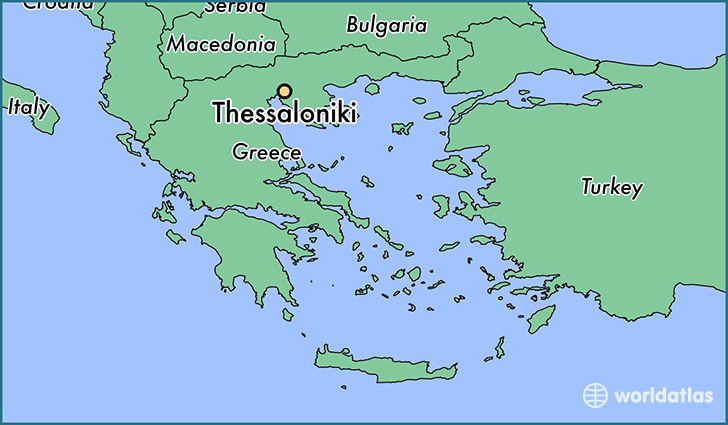
Thessalonica was the second city in Europe where Paul helped to create an organized Christian community. The city is located on the Thermaic Gulf at the northwest corner of the Aegean Sea.
It was founded around 315 BCE by the King Cassander of Macedon. It was located on or near the site of the ancient town of Therma and 26 other local villages.
He named it after his wife Thessalonike. She was princess of Macedonia as daughter of Philip II and a half-sister of Alexander the Great. The city retained its own autonomy and parliament in the kingdom. It evolved to become the most important city in Macedonia.
Thessalonica was made the capital of the Roman province of Macedonia after the fall of the kingdom in 168 BCE. It became a free city of the Roman Republic under Mark Antony in 41 BCE.
It grew to be an important trade-hub located on the Via Egnatia, the road connecting Dyrrhachium with Byzantium. The location facilitated trade between Thessaloniki and great centers of commerce such as Rome and Byzantium.
Thessaloniki also lay at the southern end of the main north-south route through the Balkans along the valleys of the Morava and Axios river valleys. This linked the Balkans with the rest of Greece. The city became the capital of one of the four Roman districts of Macedonia.
It came to be named the capital of all the Greek provinces of the Roman Empire because of the city's importance in the Balkan peninsula.
It became one of the early centers for Christianity around 50 CE during the time of the Roman Empire. Paul the Apostle visited this city's chief synagogue on three Sabbaths and sowed the seeds for Thessaloniki's first Christian church while on his second missionary journey.
Two letters attributed to Paul were sent to the new church at Thessaloniki. These epistles are preserved in the Biblical canon as First and Second Thessalonians. Some scholars hold that the First Epistle to the Thessalonians is the first written book of the New Testament.
The Thessalonicans grew concerned over whether those who had died would share in the parousia sometime after the first letter had been written. They were faced with a false teaching that said that Christ had already returned.
Modern biblical scholarship is divided on whether the epistle was written by Paul; many scholars reject its authenticity based on what they see as differences in style and theology between this and the first epistle.
2 Thessalonians 1:11-12
We always pray for you asking that God will make you worthy of his call and will fulfill by his power every good resolve and work of faith to the name of our Lord Jesus may be glorified in you and you in him according to the grace of our God and the Lord Jesus Christ.
---------------------
May you fulfill by faith every good resolve in the name of Jesus
that Christ may be glorified in you by the grace of God for your freedom.
================

Luke 19
Sycamore Tree, Jericho
The 19th chapter in the gospel of Luke begins in Jericho. Jesus was on his way to Jerusalem.
The city is located in the Jordan Valley. The Jordan River lies to the east and Jerusalem to the west.
Copious springs in and around the city have attracted human habitation for thousands of years. Archaeologists have unearthed the remains of more than 20 successive settlements in Jericho, the first of which dates back to about 9000 BCE.
Jericho is described in the Hebrew Bible as the "city of palm trees" (Deuteronomy 34:3). The road from Jericho to Jerusalem winds through the badlands of the Judean wilderness. The route climbs more than 3,000 feet in less than 20 miles. The location has an elevation that is 825 ft. below sea level. It is the lowest city in the world.
The location was established as a garden city by the Hasmoneans in the 2d century after the rule of the Seleucid, Antiochus IV was rejected.
The Hasmonean dynasty was from a priestly group (kohanim) from the tribe of Levi. They rose to power in the Maccabean Revolt (167-160 BCE). They became independent from 110 BCE. They ruled until the Roman invasion in 63 BCE.
Two of the great grandson's of the first king in the line became involved in a proxy war between Julius Caesar and Pompey after the Roman occupation. The deaths of Pompey (48 BCE) and Caesar (44 BCE) temporarily relaxed Rome's grip on the Hasmonean kingdom.
There was a brief reassertion of autonomy backed by the Parthian Empire. This short independence was rapidly crushed by the Romans under Mark Antony and Octavian.
The Hasmonean dynasty had survived for 103 years before yielding to the Herodian dynasty in 37 BCE. The installation of Herod the Great (an Idumean) as king made Judea a Roman client state and marked the end of the Hasmonean rule. Herod tried to bolster the legitimacy of his reign even then by marrying a Hasmonean princess, Mariamne.
Herod the Great had died in 4 BCE. The kingdom was divided as a tetrachy among his sons. Herod Archelaus, son of Herod and Malthace the Samaritan, was given Judea, Edom and Samaria. He ruled for ten years until 6 CE.
Herod Antipas, another son of Herod and Malthace, was made ruler of the Galilee and Perea. He ruled there until he was exiled to Spain by emperor Caligula in 39 CE.
Herod Antipas is the person referenced in the gospels. He played a role in the death of John the Baptist and the trial of Jesus. Pontius Pilate sent Jesus to Antipas for judgment. Antipas sent Jesus back to Pilate's court.
The city of Jericho is remembered for the story in the Book of Joshua. The city has the oldest known protective wall in the world. The story about its destruction was probably a reference to how worn the wall looked at the time that the story was told.
It was located in the Roman province of Judea. Pilate was the governor when Jesus traveled to the city.
Luke
The gospel tells the story that Zaccheus (Innocent) was the publican for the area. He collected the taxes. He was the chief official.
Tax collectors were known to 'mine' the public for extra money. They could become quite wealthy as a result. The chief among them was most likely the wealthiest.
Clement of Alexandria suggested an identification with Matthew the Apostle.
The lucrative production and export of balsam was centered in Jericho. The product was used as a perfume. Zaccheus was probably quite wealthy as a result.
He was short in stature. He was unable to see Jesus through the crowd (Luke 19:3). He had heard that Jesus had restored sight to the blind there (Matt. 20:30; Mark 10:46; Luke 18:35).
He was so excited to see the Healer that he climbed a sycamore tree along Jesus's path. When Jesus reached the spot he looked up at the man in the tree and addressed him by name. He invited himself to the tax collector's home. The invitation was honored.
There were those who were present at the banquet who complained about how the rabbi consorted with a tax collector.
Luke 19:8
Zaccheus stood there and said, 'Look, half of my possessions, Lord, I will give to the poor. If I have defrauded anyone of anything, I will pay back four times as much.'
---------------------
Restitution is a form of reparation
that compensates for damage prior to restoration.
The official offered restitution
to the crowd to request his absolution.
================
Probability
Pierre-Simon Laplace (1749-1827)
Thomas Bayes (1701-1761)
Analysis

分析
Chn. Fenxi
Pronunciation
分析
Jpn. Bunseki
분석
Krn. Bunseog
Analytic philosophy analyzes statements for scientific verification in thought.
Chn. 分析哲学分析陈述,以进行思想上的科学验证。
Fēnxī zhéxué fēnxī chénshù, yǐ jìnxíng sīxiǎng shàng de kēxué yànzhèng.
Jpn. 分析哲学は、科学的検証のための発言を分析します。
Bunseki tetsugaku wa, kagaku-teki kenshō no tame no hatsugen o bunseki shimasu.
Krn. 분석 철학은 과학적 검증을위한 진술을 분석합니다.
Bunseog cheolhag-eun gwahagjeog geomjeung-eul-wihan jinsul-eul bunseoghabnida.
Analytic Philosophy
The term for the field refers to certain developments in early 20th-century philosophy that were the historical antecedents to the current practice. Central figures in this historical development are Bertrand Russell, Ludwig Wittgenstein, G.E. Moore, Gottlob Frege and the logical positivists.
Analytic philosophy differs from the empiricism of Locke, Berkeley and Hume in the incorporation of mathematics for the development of a powerful logical technique. Frege had proposed that there was a logic to arithmetic. He was in agreement with Hobbes that this logic was a tool to guage agreement or disagreement with proposals for change in precedent.
Russell affirmed that such a procedure could be part of that which was scientific in public discourse. It was an argument for forensics with a certain admission of limitation to arithmetic at least until the public were to grow in mathematical literacy.
He developed mathematics as a system in British education that could divert liberal excess in government expenditure at public expense or grow in knowledge with the addition of elaboration or discovery.
The logical-positivists posited that there are not any specifically philosophical facts. The object of philosophy is the logical clarification of thoughts. Traditional foundationalism considered the discipline to be a special science. It was the discipline of knowledge that investigated the fundamental reasons and principles for anything.
Analytic philosophers have considered their inquiries as subordinate to those of the natural sciences. This attitude began with John Locke. He described his work as that of an "underlabourer" to the achievements of natural scientists such as Newton. The most influential advocate of the continuity of philosophy with science was Willard Van Orman Quine during the 20th century.
This particular aspect of the orientation encounters problems when science is defined as a way to deceive the public into the acceptance of expertise as the sole basis for authority. It lends itself to bureaucratic implementation.

George Boole established the means to include probability into objective analysis. It was a necessary step in the direction of the development of the larger school.
Boole was a largely self-taught English mathematician, philosopher and logician. Most of his short career was spent as the first professor of mathematics at Queen's College, Cork in Ireland.
He worked in the fields of differential equations and algebraic logic. He is best known as the author of The Laws of Thought (1854). Boolean logic is credited with laying the foundations for the information age.
Boole reduced the four propositional forms of Aristotle's logic to formulas in the form of equations. This was a revolutionary idea by itself. The four propositional forms could then be logically expressed as universal affirmation, universal negation, particular affirmation or particular negation.
Universal affirmation: All S are P.
U. negation: No S are P.
Particular affirmation: Some S are P.
P. negation: Some S are not P.
Second, Boole argued that Aristotle’s rules of inference (the “perfect syllogisms”) must be supplemented by rules for solving equations.
Third, Boole’s system could handle multi-term propositions and arguments whereas Aristotle could handle only two-termed subject-predicate propositions and arguments.
Boole could be viewed as typically precocious in his Irish mindset. He didn't limit his goals to arithmetic, logic and science for public discourse. He looked to Calculus as a way to correct the limitations of logic as defined by Aristotle.
George Boole (1815-1864)
The Laws of Thought (1854)
Text
"The history of the theory of Probabilities, on the other hand, has presented far more of that character of steady growth which belongs to science. In its origin the early genius of Pascal, in its maturer stages of development the most recondite of all the mathematical speculations of Laplace, -were directed to its improvement; to omit here the mention of other names scarcely less distinguished than these. As the study of Logic has been remarkable for the kindred questions of Metaphysics to which it has given occasion, so that of Probabilities also has been remarkable for the impulse which it has bestowed upon the higher departments of mathematical science."
-------------------------
Probability is a logical inference for application in science with the measure of math.
It has grown toward the prediction of self-reliance as the reasonable path.
Analytic philosophy analyzes the logic of statements
for scientific measure in application for various places.
===================

Gottlob Frege (1848-1925) was a German philosopher, mathematician and logician. He worked as a professor of mathematics at the University of Jena. He concentrated on the philosophy of language, logic and mathematics.
He is understood by many to be the father of analytic philosophy. Giuseppe Peano (1858–1932) and Bertrand Russell (1872–1970) introduced his work to later generations of philosophers.
His contributions include the development of modern logic and work in the foundations of mathematics. His book the Foundations of Arithmetic is the seminal text for the symbolic representation of mathematics as logic.
His work represents a fundamental break between the contemporary approach and the older, Aristotelian tradition. He invented modern quantificational logic, created the first fully axiomatic system for logic complete in its treatment of propositional and first-order logic and represented the first treatment of higher-order logic.
He developed an analysis of quantified statements and formalized the notion of a ‘proof’ in terms that are still accepted today. He demonstrated that one could use his system to resolve theoretical mathematical statements in terms of simpler logical and mathematical notions.
He is often called the founder of modern logic and is sometimes even heralded as the father of analytic philosophy.
The Foundations of Arithmetic was published in 1884. He refutes other theories and develops his own theory of numbers. He makes a distinction between particular numerical statements such as 1 + 1 = 2 and general statements such as a + b = b + a. The latter are statements that are as true of numbers as the former.
A definition of the concept of number is called into question. Numbers function in language as adjectives. The drawers of a desk can be described in terms of color or number. The drawers are brown or 5 in number.
That the drawers are objects with a color is an observation drawn from the external world. It is a visually perceptive observation. Every object has the same color, but each drawer is not 5. Color is visual. Number is conceptual.
The sentence "the number of horses in the barn is four" means that four objects fall under the concept 'horse in the barn.' He explains our grasp of numbers through a contextual definition of the operation of cardinality. The number is a count of the objects. (Nx:Fx).
He constructs the content of a judgment involving numerical identity by relying on Hume's principle. This states that the number of F's equals the number of G's, if and only if F and G are equinumerous. There is in one-one correspondence between different objects. Frege rejects this definition because it doesn't fix the truth value of identity statements.
He argues that numbers are concepts that assert something about an object. He defines numbers as extensions of unit concepts. 'The number of F's' is defined as the extension of the concept G as a concept that is equinumerous to F.
The concept in question leads to an equivalence class of all concepts that have the number F. Zero is the extension of the concept of being not self-identical.
The number of this concept is the extension of the concept of all concepts that have no objects falling under them. One is the number of the extension that is identical with 0. 0 and 0 alone falls into this concept. This is the basic foundation for the monas as the universal unity.
Zero is the foundation for the theory of numbers. It is uniquely conceptual insofar as it doesn't represent a corresponding identification in unity with objects.
Gottlob Frege (1848-1925)
The Foundations for Arithmetic (1884)
Text
"I hope I may claim in the present work to have made it probable that the laws of arithmetic are analytic judgments and consequently a priori. Arithmetic thus becomes simply a development of logic, and every proposition of arithmetic a law of logic, albeit a derivative one. To apply arithmetic in the physical sciences is to bring logic to bear on observed facts; calculation becomes deduction." (p.99)
------------------------
The laws of arithmetic are analytic judgments
drawn from a priori abundance.
The application of arithmetic to physical science
makes raises calculation to the level of deductive appliance.
==================

Bertrand Russell was a British logician. He is given credit as one of the founders of analytic philosophy. He was preceded by Gottlob Frege, contemporary with G. E. Moore and followed by Ludwig Wittgenstein.
He led the British "revolt against idealism" in the early 20th century. He wrote Principia Mathematica with A.N. Whitehead to create a logical basis for mathematics. His work has had a considerable influence on mathematics, logic, set theory, linguistics, artificial intelligence, cognitive science, computer science and philosophy.
He expressed agreement with socialism, but he disagreed with the idealism of Hegel and the theory according to Marx. He saw the war against Hitler's Germany as a necessary evil. He was critical of Stalinist totalitarianism. He was like Dewey in the strong association between democracy and socialist economic theory.
It is likely that he viewed capitalism as the motive force for imperialism and war.
Russell's basic idea for defending logicism was like that of Frege. Numbers may be identified with classes of classes.
Number-theoretic statements may be explained in terms of quantifiers and identity. The number 1 would be identified with the class of all unit classes, the number 2 with the class of all two-membered classes and so on. Statements such as "there are two books" would be recast as "there is a book, x, and there is a book, y; x is not identical to y".
It followed that numbers could be explained in terms of the operations of set theory. The union, intersection, difference of sets organized numbers in fields for analysis. The complement illustrated that which was outside the sets in a larger frame.
Russell is remembered for his work using first-order logic. First order logic introduces the use of variables to propositions. It shows that a broad range of denoting phrases could be recast in terms of predicates and quantified variables.
He is also remembered for his emphasis upon the importance of logical form for the resolution of many related philosophical problems. Statements could be expanded or contracted depending upon purpose.
Spinoza's moral code presented a set of axiomatic statements to define the code. There was allowance for metaphysical expression. The statements allowed for the analysis of the morality that was being advocated. They were objects of language with which to agree or disagree with stated reason.
The difficulty of certain expressions recommended translation into easier language. Spinoza had equated reality with perfection. He subordinated the good to the real with the equation.
The proof of perfection was only dependent upon that which was determined to be real. It was like saying that whatever happened took place because it was willed to be so by God.
It rules out free will as a factor in the producton of goodness or evil. It is a kind of fatalism packaged as naturalism. This was adopted by Locke in his proposal that the state of nature was perfect freedom. Freedom in Locke's view allowed for slavery and colonial exploitation for global domination.
When the success of the British empire is identified with liberal power rather than the protection of legal trade, the goodness of the commonwealth is diminished by the absurdity.
Spinoza would develop his argument for the love of God. He argued the love was connected with the affections of the body. The affections are innately ordered to cherish the love. It ought to occupy the mind above everything else.
Descartes had followed Spinoza in time. Both were rational. Leibniz was as well. The Dutch bet was the kind of result that stemmed from the Apollonian sense of order.
The government official was the business agent. The business agent had to be a government official.
Private property was a subordinated clause to official regulation. Private property didn't have a real existence of its own. It was only a manifestation of support for the election and bureaucratic perpetuation of the official.
Russell was more clever in his refutation. He attacked the equation of reality with perfection as the logical foundation for the rest of the argument. He stated that it would be just as easy to equate green cheese with reality. He found the proof that the love of God occupies the mind above all else to be false.
Bertrand Russell (1872-1970)
Spinoza's Moral Code (1907)
Text: Review of Spinoza
"Much of the moral teaching of the Ethics, being inspired by a general tolerant largeheartedness, remains valid, whether we accept or reject the metaphysic by which it is “proved”; but the more interesting and characteristic portions stand or fall with that metaphysic, and remain unconvincing to readers who are not pantheists."
------------------------
The equation of perfection with reality
carries the implication of a swarm of killer bees.
A massive assault is conducted on the senses.
The condition of the body is reduced to autonomic defenses.
Progress is constrained to leap from rags to riches.
The state of the nation is left to wallow in vicious twitches.
==================
Socialism and the liberal power that it endorses are the entities that ought to be refuted as false. Education is a largely a non-profit enterprise by legal definition in the US.
There are privately funded schools that compete with the tax support for the non-profits, but there is a strong sense of association with state regulation as an expression of official public ownership that lends itself to socialism as an interpretation.
While standards have to be set and observed to test to make sure that student achievement in learning the language is sufficient for continued financial support from the public as a source, agreement with the standards has to be determined at local levels with the oversight of the district.
The importance of using the incentive of a good report as motivation for student achievement cannot be overstated. The harmful effect of group punishment by a no pass policy as the replacement for incentive doesn't justify the continuation of the policy.
------------------------
Bertrand Russell: Biography with Links to Resources
Online Books and Articles by Bertrand Russell
------------------------
Certain enthusiasts saw Herbert Spenser's work as the potential to tame Darwin's aggressive naturalism. G.E. Moore was critical of both Spenser and Darwin.

G.E. Moore
b. 11.4.1873 Upper Norwood, London, United Kingdom
d. 10.24.1958 Cambridge, UK (Cambridge is 102 km (63 mi.) north of London)
G.E. Moore was an important British philosopher in the first half of the 20th century.He was one of the trinity at Trinity College Cambridge whom made Cambridge one of the centers for analytical philosophy.
The others were Bertrand Russell and Ludwig Wittgenstein. The group was associated with Gottlob Frege. Russell had objected to the fifth law, but respected the logic of mathematics for analysis.
Moore's work embraced themes and concerns that reach beyond a single philosophical program. He argued against hedonism as meta-ethical naturalism in Principia Ethica.
Herbert Spencer attached an ethical view to Darwin's evolution. His definition of both terms was vague.
Moore wrote, "Mr Spencer's connection of Evolution with Ethics seems to shew the influence of the naturalistic fallacy..."
Much like the utility of happiness is sustained with favor for pleasure to reduce pain, the value of freedom favors that which sustains the best choice.
Choice that selects force with the threat of damage to exploit accident does not respect freedom for others. It is not sustainable socially. It is not favored as natural selection.
Upper Norwood, London
The name "Norwood" is a contraction of "North Wood".
Upper Norwood is an area of south-east London within the London Boroughs of Bromley, Croydon, Lambeth and Southwark. It is north of Croydon and is synonymous with the Crystal Palace.
The area is one of the highest in London. It was occupied for centuries by the Great North Wood, an extension of natural oak forest which formed a wilderness close to the southern edge of the ever-expanding city of London.
Upper Norwood is situated along the London clay ridge known as Beulah Hill. Most housing dates from the 19th and 20th centuries. There are large detached properties along the ridge and smaller, semi-detached and terraced dwellings on the slopes.
G.E. Moore
George Edward Moore was born in Upper Norwood, Croydon, London on November 4, 1873. His parents were Dr. Daniel Moore and Henrietta Sturge.
His grandfather was the author Dr. George Moore. His eldest brother was Thomas Sturge Moore, a poet, writer and engraver who worked as an illustrator for W.B. Yeats.
He was the middle child of the 7 children that Daniel had with Henrietta. Daniel had a daughter from another marriage. The daughter was the oldest child.
His father taught him reading, writing and music. His mother taught him French. He was more than competent as a pianist and composer. He was enrolled at Dulwich College when he was 8 years old. He studied Greek, Latin, French, German and mathematics.
He entered Trinity College Cambridge at 18 where he started in Classics. He made the acquaintance there of Bertrand Russell who was two years ahead of him.
He also met J. M. E. McTaggart who was then a charismatic young Philosophy Fellow. The two friends encouraged him to add the study of Philosophy.
Moore was impressed by the conversations that were derived from Plato's work. The significance of the discussion made the study relevant for contemporary society.
The dialog that was discussed wasn't just an exercise in understanding words on a page from an irrelevant historical time and place. It became an example of how logic in dialog and dialectic could shed light on the analysis of modern issues.
Russell convinced Moore to study Moral Science, a division of philosophy in the British University system. He graduated in 1896 with a First Class degree in Classics.
He turned his energies towards attempting to follow in the footsteps of McTaggart and Russell by winning a ‘Prize’ Fellowship at Trinity College. The prize would enable him to continue the study of philosophy there.
Moore acknowledged the influence of McTaggert. He had followed the work of F.H. Bradley into British idealism. When he made his first attempt to win a Prize Fellowship at Trinity in 1897 he submitted a dissertation on ‘The Metaphysical Basis of Ethics’ in which he acknowledged his indebtedness to Bradley. He presented an idealist ethical theory.
One element of this theory is what he called ‘the fallacy involved in all empirical definitions of the good’. This theory essentially rejected any definition of goodness as derived from empirical experience.
Empiricism suffered from an excessive emphasis on induction. People were encouraged to entertain perception with simple ideas. Complex ideas were to be left to liberal power in elected government.
Idealism was characterized by excessive subjectivity in the subject and object distinction. The two together blocked agreement on essential matters in the elected legislation.
The Renaissance had revived the consideration of republic as a form of government. The revival refused to consider monarchy as a form.
It threatened to prevent the modern republic from advance into improvement as a governed state.
Liberal power declared election as superior to monarchy. The royal line of succession was almost abolished in Great Britain. Slavery came to be tolerated in colonial expansion by parliamentarian influence. It wasn't allowed in the United Kingdom.
The Abolition of the Slave Trade Act was passed in 1807. Slavery was abolished for the British empire in 1833. The 13th amendment to the US Constitution abolished the institution in 1865.
The United Kingdom negotiated a number of treaties to abolish the trade and the institution. The Brussels Conference was an assembly of 17 nations in 1890. It included the US and the UK. The participating nations enacted an agreement to abolish the trade on land and sea.
The League of Nations established a convention to suppress slavery and the slave trade in 1926. This convention was pressed globally. The Slavery Convention of 1926 was last ratified in Kazakhstan in 2008. Slavery was criminalized in Chad in 2017.
While slavery wasn't protected by legislation through this period. It was not outlawed. Locke had expressed personal distaste, but conceded to the institution as a part of empire, if not elected government. Leading monarchs had written against slavery.
The right to vote was given to people of color in the US before it was granted to women. Women could vote when the 19th amendment was ratified in 1920. The UK allowed women to be elected to Parliament in 1918.
This was before women were given the right to vote in the Representation of the People Act on 1928. Women in France weren't given the right to vote until 1945.
Naturalism had been a development from Empiricism. It was supported by Darwin's theory of evolution. The Origin of Species was published in 1859.
Moore's criticism of goodness in empiricism was the precursor to his famous claim in Principia Ethica that there is a ‘naturalistic fallacy’ in all naturalist definitions of goodness.
A substantial part of his early dissertation was devoted to a critical discussion of Kant's moral philosophy. Moore endorsed the kind of idealism advanced by Bradley in his general approach and conclusions, but he was already critical of Kant's conception of practical reason.
He argued that Kant's use of this conception blurred the distinction between psychology and truth. The psychological faculty of making judgments and inferences obscured the perception of the ‘true and objective’. Moore maintained that the distinction cannot be removed.
Kant's conception of morality as founded on a priori principles of practical reason was untenable. This line of thought was extended to a general criticism of Kant's conception of the a priori. It was this generalization that Moore undertook in his successful 1898 dissertation.
He identified his previous enthusiasm for Bradley's idealism as not well founded. He turned decisively against idealist philosophy both in its Kantian and Bradleian forms. He succeeded in 1898 on his second attempt.
He came to reject the idealist philosophy of Bradley and McTaggart, but he held that their criticisms of empiricism as represented by J. S. Mill's philosophy were sound. He carried this objection to empiricism forward into his mature philosophy.
He argued that truth differs in no respect from the reality to which it was supposed merely to correspond. The truth that I exist differs in no respect from the corresponding reality of my existence.
He matured as a dynamic young philosopher over the next 6 years. He began to act as a “professional”. He participated in groups such as the Aristotelian Society and the Moral Sciences Club. His work was published. Many of his best known and most influential works date from this period.
He actually led Russell away from the idealism of McTaggart and others. Absolute Idealism was then dominant in Britain. This would prove to be the first step toward the rise of analytic philosophy.
Moore left Cambridge for a period of 7 years, but he continued to write. The basic theme of his paper, ‘The Refutation of Idealism’ (1903), was that sense-experience is an extension of objective truth. The strong distinction between the subject and its objects which we have encountered in connection with meaning divides perception from reality.
He concentrated here on the case of a ‘sensation of blue’ and maintained that this experience is a kind of ‘diaphanous’ consciousness or awareness of blue which is not a ‘content’ of experience at all. It is something real whose existence is not dependent on experience.
His common sense realism was set against ethical naturalism in Principia Ethica (1903).
"My objections to Naturalism are then, in the first place, that it offers no reason at all, far less any valid reason, for any ethical principle whatever; and in this it already fails to satisfy the requirements of Ethics, as a scientific study. But in the second place I contend that, though it gives a reason for no ethical principle, it is a cause of the acceptance of false principles—it deludes the mind into accepting ethical principles, which are false; and in this it is contrary to every aim of Ethics." (p.20)
G. E. Moore
Principia Ethica (1903)
Ch. 1: The Subject-Matter of Ethics
Text
------------------------
Naturalism offers no reason for ethical principles.
It colludes to delude the acceptance of false victuals
as typically invincible.
==================
He wrote Ethics in 1912. His work promoted a view that has come to be called Ideal Utilitarianism. He argued that there is no important difference in meaning between concepts like “duty”, “right” or “virtue” and “expedient” or “useful”.
Duty selects pleasant experience in order to maintain happiness with goodness. Bentham's bent was against the legislation of asceticism. Slavery was an imposition acetic rigor on the enslaved.
Even though there wasn't written legislation that declared it legal, the need to outlaw it became apparent with the greatest happiness principle. The greatest number of people included the population of slaves.
The utility of treaties against the trade and institution became apparent. The prohibition of alcohol was to become an example of legislation that imposed ascetic abstinence on others.
The right to vote was extended to women and people of color as included in the greatest number. The definition for republic was revised for the modern age.
Ideal utilitarianism posited that the definition for goodness or happiness is not restricted to the experience of pleasure. Actions should be ordered to those states of affairs possessing the highest degree of good. It could be directed toward an ideal state in this way.
Moore lived in Edinburgh and Richmond, Surrey after he left London. He worked independently on various philosophical projects.
He returned to Cambridge in 1911 as a lecturer in Moral Science. He remained there for the majority of his career and his life.
Russell and Whitehead were finishing off their massive project of exhibiting the logical foundations of mathematics , Principia Mathematica, by the time Moore returned to his lectureship there.
Moore was one of the first people to grasp that Russell's new logical theory was an essential tool for philosophy even though he was neither a mathematician nor a logical theorist.
Propositions were defined as the ‘objects’ of thought. This definition provided the object that was to be analyzed.
Moore earned a Litt.D. in 1913. He married Dorothy Ely in 1916 and together had two sons: the poet Nicholas Moore, and composer Timothy Moore. He was elected a fellow of the British Academy in 1918.
He became editor of Mind, the leading British philosophical journal, in 1921. He was chosen as James Ward's successor as Professor of Philosophy and Logic at Cambridge in 1925.
These two appointments confirmed his position as the most highly respected British philosopher of the time. When Wittgenstein returned to Cambridge after 1929, the college became the most important center of philosophy in the world.
Moore occupied that position until 1939. When he retired he was succeeded by Wittgenstein. Moore was a visiting professor at several universities in the United States from 1940 to 1944.
When he retired as the editor of Mind in 1944, it marked the end of the golden age of Cambridge philosophy.
He died in Cambridge on October 24, 1958.

George Moore
S. 乔治·摩尔
T. 喬治·摩爾
乔 Qiao stately 喬 kyo high Jyo じょ- ジョ- Jo 조 article
治 zhi govern 治 ji reign ji じ ジ ji 지 g
摩 Mo scour 摩 ma rub Mu む- ム- Mo 무 radish
尔 er you 爾 ni you a あ ア eo 어 uh
------------------------
Education in the classics leads to a stately mind
when you scour definitions for the analytical find.
==================
wiki G.E. Moore
IEP: G.E. Moore
SEP: G.E. Moore
OUPBlog: G.E. Moore