Showing posts with label freedom. Show all posts

Sunday, October 27, 2019

Act

11.3.19
Thandie Newton

Act for
the Moral Code
为道德守则行事 
Wèi dàodé shǒuzé xíngshì
道徳規範のために行動する
Dōtoku kihan no tame ni kōdō suru
ps119.129
Actum de moribus conveniebat

Act in a way that you could will as law 
for the benefit of overcoming error or flaw.

The context for law is legal polity
in defense of national autonomy.

Naturalism offers no reason for ethical principles.
It colludes to delude the acceptance of false victuals
as typically invincible.

The corruption of leadership was declared as the cause for rebellion.
Tyranny was the most pronounced claim for the benefit of the hellion.

It was proclaimed as factually actual despite evidence to the contrary.
Conservative reform was viewed as too legendary and arbitrary.

Bureaucratic benefit from the repression of counter-attack
was implied as the reason for government in fact.

The social contract was broken 
to achieve representation that was less than token.

The bureaucrat assumed a position as the power
that grew in the repression of people by the hour.

The equation of perfection with reality
carries consequence like a swarm of killer bees.

A massive assault is conducted on the senses.
The condition of the body is reduced to autonomic defenses. 

Progress is constrained to the leap from rags to riches.
The state of the nation is left to wallow in vicious twitches.

Restitution is a form of reparation
that compensates for damage prior to restoration.

One official offered restitution
to the crowd to request his absolution.

The chief marvel for legal polity is happiness in freedom
without excess in success with respect for treason.

I look to the design of nature as the plan for government.
The economy of the household is for the production of wonderment.

Education in the classics leads to a stately mind
when you scour definitions for the analytical find.

Term limits for executive authority don't promote conservative reform.
The subordination of profit to demand has been pressed like a storm.

The larger body declares loyalty to their cause.
The leader is expected to concede without pause.

When the word for reform goes forth in historical context
it makes sense for the simple conservation of content in the contest.

I open my mouth to exhale
that reason with joy may prevail.

The commandment to love automates thought for duty
to increase speed in performance for constitutional beauty.

Probability is a logical inference for application in science with the measure of math. 
It has grown toward the prediction of self-reliance as the reasonable path.

Analytic philosophy analyzes the logic of statements
for scientific measure in application for various places.

The preservation of culture in conservation by design
allows for surplus in production as naturally benign.

The laws of arithmetic are analytic judgments
drawn from a priori abundance.

The application of arithmetic to physical science
raises calculation to the level of deductive appliance.

Surplus is sold to feed consumer need or desire
that the royal priesthood of believers may believe in what's higher. 

Tower Bridge, London

The love of our God is the highest of powers.
It feeds our delight in the beauty of flowers and towers.

Turn to mercy when pressured to cruelty in punishment.
Divine correction is designed to renew faith in the covenant.

I will let no iniquity have dominion over me.
My footsteps will walk in your word as the way for me to see.

The light of your word will deliver me from oppression.
I will keep your commandments to avoid moral regression.

Your countenance will shine while I study your law
as it has in the past when you helped me to overcome my flaws.

My eyes have shed anxiety in the stream of my tears
for those who denied the value of constitutional peers.

Look at the proud. Their spirit is not right.
The righteous live by faith in what is right about sight.

May you fulfill by faith every good resolve in the name of Jesus
that Christ may be glorified in you by the grace of God for your freedom.

---------------------

Pe
Pe is the 17th letter of the Semitic Abjads.

It represents the number 80 in the alphanumeric code known as gematria. Its final form represents 800 but this is rarely used.

The Pe Kefulah is written as a small Pe scribed within a larger. When the letter is written in the form of a Doubled Pe, this adds a layer of deeper meaning to the Biblical text. This atypical letter appears in Torah scrolls, manuscripts and some modern printed Hebrew Bibles.

Mirabilia
Marvels

129 Your decrees are wonderful;
therefore I obey them with all my heart.
130 When your word goes forth it gives light;
it gives understanding to the simple.
131 I open my mouth and pant;
I long for your commandments.
132 Turn to me in mercy,
as you always do to those who love your Name.
133 Steady my footsteps in your word;
let no iniquity have dominion over me.
134 Rescue me from those who oppress me,
and I will keep your commandments.
135 Let your countenance shine upon your servant
and teach me your statutes.
136 My eyes shed streams of tears,
because people do not keep your law.

Sadhe
Justus es, Domine
You are righteous

137 You are righteous, O Lord,
and upright are your judgments.
138 You have issued your decrees
with justice and in perfect faithfulness.
139 My indignation has consumed me,
because my enemies forget your words.
140 Your word has been tested to the uttermost,
and your servant holds it dear.
141 I am small and of little account,
yet I do not forget your commandments.
142 Your justice is an everlasting justice
and your law is the truth.
143 Trouble and distress have come upon me,
yet your commandments are my delight.
144 The righteousness of your decrees is everlasting;
grant me understanding, that I may live.

------------------------


The name Habakkuk means 'embrace' in Hebrew. He was the 8th of the 12 minor prophets. He embraced the truth of faith.

He identified himself as "Habakkuk the prophet." (Hab.1:1; Hab.3:1) The term indicates that he was a professional who was trained in the Law of Moses in a school.

Samuel's leadership of a group of prophets is recorded in 1 Sam. 19:20. His death is approximated at 1010 BCE. The event was placed not far from Jerusalem. Ramah is located 8 km (5 mi.)north of the capital.

Elisha's involvement with another group was cited in 2 Kings 4:38.His death is dated to 832 BCE in Samaria or the northern kingdom of Israel.

It is conceivable that there was community level cultural organization that featured concern for the salvation of Jerusalem in Judah as the province for Judaic law in the time of Habakkuk.

He may have also been a priest involved in the worship of God in the temple. He gave instructions to the choir director on his stringed instruments (Hab.3:19).

Temple prophets are described in 1 Chronicles 25:1 as using lyres, harps and cymbals. The instruction to the choir director indicates that Habakkuk may have been a Levite involved in the orchestration of music in the Temple.

The date of the book is associated with the references to an imminent Babylonian invasion (Hab. 1:6; 2:1; 3:16). The event took place on a small scale in 605 BCE. It was before the total destruction of Judah’s capital city, Jerusalem, in 586 BCE.

Habakkuk likely prophesied in the first five years of Jehoiakim’s reign (609–598 BCE).

The book of Habakkuk consists of 5 oracles about the Chaldeans (Babylonians) in 3 chapters. The Chaldean rise to power is dated circa 612 BC, it is assumed he was active about that time. This made him an early contemporary of Jeremiah and Zephaniah.

The final chapter of his book is a song, it is sometimes assumed that he was a member of the tribe of Levi, which served as musicians in Solomon's Temple.

The first chapter is a complaint about the success of evil men. The second chapter is testimony attributed to God for divine action. Habakkuk was told to write his vision on a tablet so a runner could read it.

The message that the just will live by faith is important in Christian thought. It is used in Romans, Galatians and Hebrews as the starting point for the concept of faith. 

Habakkuk 2:1-4 

I will stand at my watch-post
and station myself on the rampart.
I will keep watch to see what he will say to me
and what he will answer concerning my complaint.

Then the LORD answered me and said:
Write the vision.
Make it plain on tablets
so a runner may read it.
There is still a vision for the appointed time.
It speaks of the end and does not lie.
Wait for it.
It will surely come.
Look at the proud!
Their spirit is not right.
The righteous live by faith.

---------------------

Look at the proud. Their spirit is not right.
The righteous live by faith in what is right about sight.

================

2 Thessalonians
Map
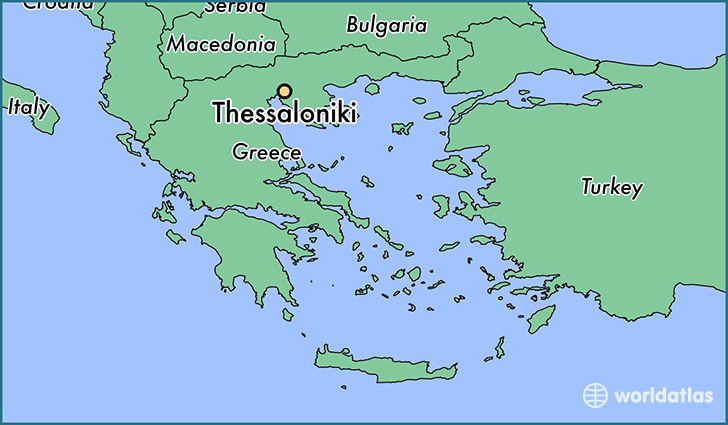
Thessalonica was the second city in Europe where Paul helped to create an organized Christian community. The city is located on the Thermaic Gulf at the northwest corner of the Aegean Sea.
It was founded around 315 BCE by the King Cassander of Macedon. It was located on or near the site of the ancient town of Therma and 26 other local villages.

He named it after his wife Thessalonike. She was princess of Macedonia as daughter of Philip II and a half-sister of Alexander the Great. The city retained its own autonomy and parliament in the kingdom. It evolved to become the most important city in Macedonia.

Thessalonica was made the capital of the Roman province of Macedonia after the fall of the kingdom in 168 BCE. It became a free city of the Roman Republic under Mark Antony in 41 BCE.

It grew to be an important trade-hub located on the Via Egnatia, the road connecting Dyrrhachium with Byzantium. The location facilitated trade between Thessaloniki and great centers of commerce such as Rome and Byzantium.

Thessaloniki also lay at the southern end of the main north-south route through the Balkans along the valleys of the Morava and Axios river valleys. This linked the Balkans with the rest of Greece. The city became the capital of one of the four Roman districts of Macedonia.

It came to be named the capital of all the Greek provinces of the Roman Empire because of the city's importance in the Balkan peninsula.

It became one of the early centers for Christianity around 50 CE during the time of the Roman Empire.  Paul the Apostle visited this city's chief synagogue on three Sabbaths and sowed the seeds for Thessaloniki's first Christian church while on his second missionary journey.

Two letters attributed to Paul were sent to the new church at Thessaloniki. These epistles are preserved in the Biblical canon as First and Second Thessalonians. Some scholars hold that the First Epistle to the Thessalonians is the first written book of the New Testament.

The Thessalonicans grew concerned over whether those who had died would share in the parousia sometime after the first letter had been written. They were faced with a false teaching that said that Christ had already returned.

Modern biblical scholarship is divided on whether the epistle was written by Paul; many scholars reject its authenticity based on what they see as differences in style and theology between this and the first epistle.

2 Thessalonians 1:11-12

We always pray for you asking that God will make you worthy of his call and will fulfill by his power every good resolve and work of faith to the name of our Lord Jesus may be glorified in you and you in him according to the grace of our God and the Lord Jesus Christ.

---------------------

May you fulfill by faith every good resolve in the name of Jesus
that Christ may be glorified in you by the grace of God for your freedom.

================


Luke 19
Sycamore Tree, Jericho

The 19th chapter in the gospel of Luke begins in Jericho. Jesus was on his way to Jerusalem.
The city is located in the Jordan Valley. The Jordan River lies to the east and Jerusalem to the west.

Copious springs in and around the city have attracted human habitation for thousands of years. Archaeologists have unearthed the remains of more than 20 successive settlements in Jericho, the first of which dates back to about 9000 BCE.

Jericho is described in the Hebrew Bible as the "city of palm trees" (Deuteronomy 34:3). The road from Jericho to Jerusalem winds through the badlands of the Judean wilderness. The route climbs more than 3,000 feet in less than 20 miles. The location has an elevation that is 825 ft. below sea level. It is the lowest city in the world.

The location was established as a garden city by the Hasmoneans in the 2d century after the rule of the Seleucid, Antiochus IV was rejected.

The Hasmonean dynasty was from a priestly group (kohanim) from the tribe of Levi. They rose to power in the Maccabean Revolt (167-160 BCE). They became independent from 110 BCE. They ruled until the Roman invasion in 63 BCE.

Two of the great grandson's of the first king in the line became involved in a proxy war between Julius Caesar and Pompey after the Roman occupation. The deaths of Pompey (48 BCE) and Caesar (44 BCE) temporarily relaxed Rome's grip on the Hasmonean kingdom.

There was a brief reassertion of autonomy backed by the Parthian Empire. This short independence was rapidly crushed by the Romans under Mark Antony and Octavian.

The Hasmonean dynasty had survived for 103 years before yielding to the Herodian dynasty in 37 BCE. The installation of Herod the Great (an Idumean) as king made Judea a Roman client state and marked the end of the Hasmonean rule.  Herod tried to bolster the legitimacy of his reign even then by marrying a Hasmonean princess, Mariamne.

Herod the Great had died in 4 BCE. The kingdom was divided as a tetrachy among his sons. Herod Archelaus, son of Herod and Malthace the Samaritan, was given Judea, Edom and Samaria. He ruled for ten years until 6 CE.

Herod Antipas, another son of Herod and Malthace, was made ruler of the Galilee and Perea. He ruled there until he was exiled to Spain by emperor Caligula in 39 CE.

Herod Antipas is the person referenced in the gospels. He played a role in the death of John the Baptist and the trial of Jesus. Pontius Pilate sent Jesus to Antipas for judgment. Antipas sent Jesus back to Pilate's court.

The city of Jericho is remembered for the story in the Book of Joshua. The city has the oldest known protective wall in the world. The story about its destruction was probably a reference to how worn the wall looked at the time that the story was told. 

It was located in the Roman province of Judea. Pilate was the governor when Jesus traveled to the city.

Luke

The gospel tells the story that Zaccheus (Innocent) was the publican for the area. He collected the taxes. He was the chief official.

Tax collectors were known to 'mine' the public for extra money. They could become quite wealthy as a result. The chief among them was most likely the wealthiest.

Clement of Alexandria suggested an identification with Matthew the Apostle.

The lucrative production and export of balsam was centered in Jericho. The product was used as a perfume. Zaccheus was probably quite wealthy as a result.

He was short in stature. He was unable to see Jesus through the crowd (Luke 19:3). He had heard that Jesus had restored sight to the blind there (Matt. 20:30; Mark 10:46; Luke 18:35).

He was so excited to see the Healer that he climbed a sycamore tree along Jesus's path. When Jesus reached the spot he looked up at the man in the tree and addressed him by name.  He invited himself to the tax collector's home. The invitation was honored.

There were those who were present at the banquet who complained about how the rabbi consorted with a tax collector.

Luke 19:8

Zaccheus stood there and said, 'Look, half of my possessions, Lord, I will give to the poor. If I have defrauded anyone of anything, I will pay back four times as much.'

---------------------

Restitution is a form of reparation
that compensates for damage prior to restoration.

The official offered restitution
to the crowd to request his absolution.

================

Probability
Pierre-Simon Laplace (1749-1827)
Thomas Bayes (1701-1761)

Analysis

分析
Chn. Fenxi
Pronunciation
分析
Jpn. Bunseki
분석
Krn. Bunseog

Analytic philosophy analyzes statements for scientific verification in thought.

Chn.    分析哲学分析陈述,以进行思想上的科学验证。
Fēnxī zhéxué fēnxī chénshù, yǐ jìnxíng sīxiǎng shàng de kēxué yànzhèng.

Jpn.    分析哲学は、科学的検証のための発言を分析します。
Bunseki tetsugaku wa, kagaku-teki kenshō no tame no hatsugen o bunseki shimasu.

Krn.     분석 철학은 과학적 검증을위한 진술을 분석합니다.
Bunseog cheolhag-eun gwahagjeog geomjeung-eul-wihan jinsul-eul bunseoghabnida.

Analytic Philosophy

The term for the field refers to certain developments in early 20th-century philosophy that were the historical antecedents to the current practice. Central figures in this historical development are Bertrand Russell, Ludwig Wittgenstein, G.E. Moore, Gottlob Frege and the logical positivists.

Analytic philosophy differs from the empiricism of Locke, Berkeley and Hume in the incorporation of mathematics for the development of a powerful logical technique. Frege had proposed that there was a logic to arithmetic. He was in agreement with Hobbes that this logic was a tool to guage agreement or disagreement with proposals for change in precedent.

Russell affirmed that such a procedure could be part of that which was scientific in public discourse. It was an argument for forensics with a certain admission of limitation to arithmetic at least until the public were to grow in mathematical literacy.

He developed mathematics as a system in British education that could divert liberal excess in government expenditure at public expense or grow in knowledge with the addition of elaboration or discovery.

The logical-positivists posited that there are not any specifically philosophical facts. The object of philosophy is the logical clarification of thoughts. Traditional foundationalism considered the discipline to be a special science. It was the discipline of knowledge that investigated the fundamental reasons and principles for anything.

Analytic philosophers have considered their inquiries as subordinate to those of the natural sciences. This attitude began with John Locke. He described his work as that of an "underlabourer" to the achievements of natural scientists such as Newton. The most influential advocate of the continuity of philosophy with science was Willard Van Orman Quine during the 20th century.

This particular aspect of the orientation encounters problems when science is defined as a way to deceive the public into the acceptance of expertise as the sole basis for authority. It lends itself to bureaucratic implementation.


George Boole established the means to include probability into objective analysis. It was a necessary step in the direction of the development of the larger school.

Boole was a largely self-taught English mathematician, philosopher and logician. Most of his short career was spent as the first professor of mathematics at Queen's College, Cork in Ireland.

He worked in the fields of differential equations and algebraic logic. He is best known as the author of The Laws of Thought (1854). Boolean logic is credited with laying the foundations for the information age.

Boole reduced the four propositional forms of Aristotle's logic to formulas in the form of equations. This was a revolutionary idea by itself. The four propositional forms could then be logically expressed as universal affirmation, universal negation, particular affirmation or particular negation.

Universal affirmation: All S are P.
U. negation: No S are P.
Particular affirmation: Some S are P.
P. negation: Some S are not P. 

Second, Boole argued that Aristotle’s rules of inference (the “perfect syllogisms”) must be supplemented by rules for solving equations.

Third, Boole’s system could handle multi-term propositions and arguments whereas Aristotle could handle only two-termed subject-predicate propositions and arguments.

Boole could be viewed as typically precocious in his Irish mindset. He didn't limit his goals to arithmetic, logic and science for public discourse. He looked to Calculus as a way to correct the limitations of logic as defined by Aristotle.

George Boole (1815-1864)
The Laws of Thought (1854)
Text

"The history of the theory of Probabilities, on the other hand, has presented far more of that character of steady growth which belongs to science. In its origin the early genius of Pascal, in its maturer stages of development the most recondite of all the mathematical speculations of Laplace, -were directed to its improvement; to omit here the mention of other names scarcely less distinguished than these. As the study of Logic has been remarkable for the kindred questions of Metaphysics to which it has given occasion, so that of Probabilities also has been remarkable for the impulse which it has bestowed upon the higher departments of mathematical science."

-------------------------

Probability is a logical inference for application in science with the measure of math.
It has grown toward the prediction of self-reliance as the reasonable path.

Analytic philosophy analyzes the logic of statements
for scientific measure in application for various places.

===================


Gottlob Frege (1848-1925) was a German philosopher, mathematician and logician. He worked as a professor of mathematics at the University of Jena. He concentrated on the philosophy of language, logic and mathematics.

He is understood by many to be the father of analytic philosophy. Giuseppe Peano (1858–1932) and Bertrand Russell (1872–1970) introduced his work to later generations of philosophers.

His contributions include the development of modern logic and work in the foundations of mathematics. His book the Foundations of Arithmetic is the seminal text for the symbolic representation of mathematics as logic.

His work represents a fundamental break between the contemporary approach and the older, Aristotelian tradition. He invented modern quantificational logic, created the first fully axiomatic system for logic complete in its treatment of propositional and first-order logic and  represented the first treatment of higher-order logic.

He developed an analysis of quantified statements and formalized the notion of a ‘proof’ in terms that are still accepted today. He demonstrated that one could use his system to resolve theoretical mathematical statements in terms of simpler logical and mathematical notions.

He is often called the founder of modern logic and is sometimes even heralded as the father of analytic philosophy.

The Foundations of Arithmetic was published in 1884. He refutes other theories and develops his own theory of numbers.  He makes a distinction between particular numerical statements such as 1 + 1 = 2 and general statements such as a + b = b + a. The latter are statements that are as true of numbers as the former.

A definition of the concept of number is called into question. Numbers function in language  as adjectives. The drawers of a desk can be described in terms of color or number. The drawers are brown or 5 in number.

That the drawers are objects with a color is an observation drawn from the external world. It is a visually perceptive observation. Every object has the same color, but each drawer is not 5. Color is visual. Number is conceptual.

The sentence "the number of horses in the barn is four" means that four objects fall under the concept 'horse in the barn.' He explains our grasp of numbers through a contextual definition of the operation of cardinality. The number is a count of the objects.  (Nx:Fx).

He constructs the content of a judgment involving numerical identity by relying on Hume's principle. This states that the number of F's equals the number of G's, if and only if F and G are equinumerous. There is in one-one correspondence between different objects. Frege rejects this definition because it doesn't fix the truth value of identity statements.

He argues that numbers are concepts that assert something about an object. He defines numbers as extensions of unit concepts. 'The number of F's' is defined as the extension of the concept G as a concept that is equinumerous to F.

The concept in question leads to an equivalence class of all concepts that have the number F. Zero is the extension of the concept of being not self-identical.

The number of this concept is the extension of the concept of all concepts that have no objects falling under them.  One is the number of the extension that is identical with 0. 0 and 0 alone falls into this concept. This is the basic foundation for the monas as the universal unity.

Zero is the foundation for the theory of numbers. It is uniquely conceptual insofar as it doesn't represent a corresponding identification in unity with objects.

Gottlob Frege (1848-1925)
The Foundations for Arithmetic (1884)
Text

"I hope I may claim in the present work to have made it probable that the laws of arithmetic are analytic judgments and consequently a priori. Arithmetic thus becomes simply a development of logic, and every proposition of arithmetic a law of logic, albeit a derivative one. To apply arithmetic in the physical sciences is to bring logic to bear on observed facts; calculation becomes deduction." (p.99)

------------------------

The laws of arithmetic are analytic judgments
drawn from a priori abundance.

The application of arithmetic to physical science
makes raises calculation to the level of deductive appliance.

==================


Bertrand Russell was a British logician. He is given credit as one of the founders of analytic philosophy. He was preceded by Gottlob Frege, contemporary with G. E. Moore and followed by Ludwig Wittgenstein.

He led the British "revolt against idealism" in the early 20th century. He wrote Principia Mathematica with A.N. Whitehead to create a logical basis for mathematics. His work has had a considerable influence on mathematics, logic, set theory, linguistics, artificial intelligence, cognitive science, computer science and philosophy.

He expressed agreement with socialism, but he disagreed with the idealism of Hegel and the theory according to Marx. He saw the war against Hitler's Germany as a necessary evil. He was critical of Stalinist totalitarianism. He was like Dewey in the strong association between democracy and socialist economic theory.

It is likely that he viewed capitalism as the motive force for imperialism and war.
Russell's basic idea for defending logicism was like that of Frege. Numbers may be identified with classes of classes.

Number-theoretic statements may be explained in terms of quantifiers and identity. The number 1 would be identified with the class of all unit classes, the number 2 with the class of all two-membered classes and so on. Statements such as "there are two books" would be recast as "there is a book, x, and there is a book, y; x is not identical to y".

It followed that numbers could be explained in terms of the operations of set theory. The union, intersection, difference of sets organized numbers in fields for analysis. The complement illustrated that which was outside the sets in a larger frame.

Russell is remembered for his work using first-order logic.  First order logic introduces the use of variables to propositions. It shows that a broad range of denoting phrases could be recast in terms of predicates and quantified variables.

He is also remembered for his emphasis upon the importance of logical form for the resolution of many related philosophical problems. Statements could be expanded or contracted depending upon purpose.

Spinoza's moral code presented a set of axiomatic statements to define the code. There was allowance for metaphysical expression. The statements allowed for the analysis of the morality that was being advocated. They were objects of language with which to agree or disagree with stated reason.

The difficulty of certain expressions recommended translation into easier language. Spinoza had equated reality with perfection. He subordinated the good to the real with the equation.

The proof of perfection was only dependent upon that which was determined to be real. It was like saying that whatever happened took place because it was willed to be so by God.

It rules out free will as a factor in the producton of goodness or evil. It is a kind of fatalism packaged as naturalism. This was adopted by Locke in his proposal that the state of nature was perfect freedom. Freedom in Locke's view allowed for slavery and colonial exploitation for global domination.

When the success of the British empire is identified with liberal power rather than the protection of legal trade, the goodness of the commonwealth is diminished by the absurdity.

Spinoza would develop his argument for the love of God. He argued the love was connected with the affections of the body. The affections are innately ordered to cherish the love. It ought to occupy the mind above everything else.

Descartes had followed Spinoza in time. Both were rational. Leibniz was as well. The Dutch bet was the kind of result that stemmed from the Apollonian sense of order.

The government official was the business agent. The business agent had to be a government official.
Private property was a subordinated clause to official regulation. Private property didn't have a real existence of its own.  It was only a manifestation of support for the election and bureaucratic perpetuation of the official.

Russell was more clever in his refutation. He attacked the equation of reality with perfection as the logical foundation for the rest of the argument. He stated that it would be just as easy to equate green cheese with reality. He found the proof that the love of God occupies the mind above all else to be false.

Bertrand Russell (1872-1970)
Spinoza's Moral Code (1907)
Text: Review of Spinoza

"Much of the moral teaching of the Ethics, being inspired by a general tolerant largeheartedness, remains valid, whether we accept or reject the metaphysic by which it is “proved”; but the more interesting and characteristic portions stand or fall with that metaphysic, and remain unconvincing to readers who are not pantheists."

------------------------

The equation of perfection with reality
carries the implication of a swarm of killer bees.

A massive assault is conducted on the senses.
The condition of the body is reduced to autonomic defenses.

Progress is constrained to leap from rags to riches.
The state of the nation is left to wallow in vicious twitches.

==================

Socialism and the liberal power that it endorses are the entities that ought to be refuted as false. Education is a largely a non-profit enterprise by legal definition in the US.

There are privately funded schools that compete with the tax support for the non-profits, but there is a strong sense of association with state regulation as an expression of official public ownership that lends itself to socialism as an interpretation.

While standards have to be set and observed to test to make sure that student achievement in learning the language is sufficient for continued financial support from the public as a source, agreement with the standards has to be determined at local levels with the oversight of the district.

The importance of using the incentive of a good report as motivation for student achievement cannot be overstated. The harmful effect of group punishment by a no pass policy as the replacement for incentive doesn't justify the continuation of the policy.

------------------------

Bertrand Russell: Biography with Links to Resources
Online Books and Articles by Bertrand Russell

------------------------

Certain enthusiasts saw Herbert Spenser's work as the potential to tame Darwin's aggressive naturalism. G.E. Moore was critical of both Spenser and Darwin. 


G.E. Moore
b. 11.4.1873 Upper Norwood, London, United Kingdom
d. 10.24.1958  Cambridge, UK (Cambridge is 102 km (63 mi.) north of London)

G.E. Moore was an important British philosopher in the first half of the 20th century.He was one of the trinity at Trinity College Cambridge whom made Cambridge one of the centers for analytical philosophy.

The others were Bertrand Russell and Ludwig Wittgenstein. The group was associated with Gottlob Frege. Russell had objected to the fifth law, but respected the logic of mathematics for analysis.

Moore's work embraced themes and concerns that reach beyond a single philosophical program. He argued against hedonism as meta-ethical naturalism in Principia Ethica.

Herbert Spencer attached an ethical view to Darwin's evolution. His definition of both terms was vague.

Moore wrote, "Mr Spencer's connection of Evolution with Ethics seems to shew the influence of the naturalistic fallacy..."

Much like the utility of happiness is sustained with favor for pleasure to reduce pain, the value of freedom favors that which sustains the best choice.

Choice that selects force with the threat of damage to exploit accident does not respect freedom for others. It is not sustainable socially. It is not favored as natural selection.

Upper Norwood, London

The name "Norwood" is a contraction of "North Wood".
Upper Norwood is an area of south-east London within the London Boroughs of Bromley, Croydon, Lambeth and Southwark. It is north of Croydon and is synonymous with the Crystal Palace.

The area is one of the highest in London. It was occupied for centuries by the Great North Wood, an extension of natural oak forest which formed a wilderness close to the southern edge of the ever-expanding city of London.

Upper Norwood is situated along the London clay ridge known as Beulah Hill. Most housing dates from the 19th and 20th centuries. There are large detached properties along the ridge and smaller, semi-detached and terraced dwellings on the slopes. 

G.E. Moore

George Edward Moore was born in Upper Norwood, Croydon, London on November 4, 1873. His parents were Dr. Daniel Moore and Henrietta Sturge.

His grandfather was the author Dr. George Moore. His eldest brother was Thomas Sturge Moore, a poet, writer and engraver who worked as an illustrator for W.B. Yeats.

He was the middle child of the 7 children that Daniel had with Henrietta. Daniel had a daughter from another marriage. The daughter was the oldest child.

His father taught him reading, writing and music. His mother taught him French. He was more than competent as a pianist and composer. He was enrolled at Dulwich College when he was 8 years old. He studied Greek, Latin, French, German and mathematics.

He entered Trinity College Cambridge at 18 where he started in Classics. He made the acquaintance there of Bertrand Russell who was two years ahead of him.

He also met  J. M. E. McTaggart who was then a charismatic young Philosophy Fellow. The two friends encouraged him to add the study of Philosophy.

Moore was impressed by the conversations that were derived from Plato's work. The significance of the discussion made the study relevant for contemporary society.

The dialog that was discussed wasn't just an exercise in understanding words on a page from an irrelevant historical time and place. It became an example of how logic in dialog and dialectic could shed light on  the analysis of modern issues.

Russell convinced Moore to study Moral Science, a division of philosophy in the British University system. He graduated in 1896 with a First Class degree in Classics.

He turned his energies towards attempting to follow in the footsteps of McTaggart and Russell by winning a ‘Prize’ Fellowship at Trinity College. The prize would enable him to continue the study of philosophy there.

Moore acknowledged the influence of McTaggert. He had followed the work of F.H. Bradley into British idealism. When he made his first attempt to win a Prize Fellowship at Trinity in 1897 he submitted a dissertation on ‘The Metaphysical Basis of Ethics’ in which he acknowledged his indebtedness to Bradley. He presented an idealist ethical theory.

One element of this theory is what he called ‘the fallacy involved in all empirical definitions of the good’.  This theory essentially rejected any definition of goodness as derived from empirical experience.

Empiricism suffered from an excessive emphasis on induction. People were encouraged to entertain perception with simple ideas. Complex ideas were to be left to liberal power in elected government.

Idealism was characterized by excessive subjectivity in the subject and object distinction. The two together blocked agreement on essential matters in the elected legislation.

The Renaissance had revived the consideration of republic as a form of government. The revival refused to consider monarchy as a form.

It threatened to prevent the modern republic from advance into improvement as a governed state.

Liberal power declared election as superior to monarchy. The royal line of succession was almost abolished in Great Britain. Slavery came to be tolerated in colonial expansion by parliamentarian influence. It wasn't allowed in the United Kingdom.

The Abolition of the Slave Trade Act was passed in 1807. Slavery was abolished for the British empire in 1833. The 13th amendment to the US Constitution abolished the institution in 1865.

The United Kingdom negotiated a number of treaties to abolish the trade and the institution. The Brussels Conference was an assembly of 17 nations in 1890. It included the US and the UK. The participating nations enacted an agreement to abolish the trade on land and sea.

The League of Nations established a convention to suppress slavery and the slave trade in 1926. This convention was pressed globally. The Slavery Convention of 1926 was last ratified in Kazakhstan in 2008. Slavery was criminalized in Chad in 2017.

While slavery wasn't protected by legislation through this period. It was not outlawed. Locke had expressed personal distaste, but conceded to the institution as a part of empire, if not elected government. Leading monarchs had written against slavery.

The right to vote was given to people of color in the US before it was granted to women. Women could vote when the 19th amendment was ratified in 1920.  The UK allowed women to be elected to Parliament in 1918.

This was before women were given the right to vote in  the Representation of the People Act on 1928. Women in France weren't given the right to vote until 1945.

Naturalism had been a development from Empiricism. It was supported by Darwin's theory of evolution. The Origin of Species was published in 1859. 

Moore's criticism of goodness in empiricism was the precursor to his famous claim in Principia Ethica that there is a ‘naturalistic fallacy’ in all naturalist definitions of goodness.

A substantial part of his early dissertation was devoted to a critical discussion of Kant's moral philosophy.  Moore endorsed the kind of idealism advanced by Bradley in his general approach and conclusions, but he was already critical of Kant's conception of practical reason.

He argued that Kant's use of this conception blurred the distinction between psychology and truth. The psychological faculty of making judgments and inferences obscured the perception of the ‘true and objective’. Moore maintained that the distinction cannot be removed.

Kant's conception of morality as founded on a priori principles of practical reason was untenable. This line of thought was extended to a general criticism of Kant's conception of the a priori. It was this generalization that Moore undertook in his successful 1898 dissertation.

He identified his previous enthusiasm for Bradley's idealism as not well founded. He turned decisively against idealist philosophy both in its Kantian and Bradleian forms. He succeeded in 1898 on his second attempt.

He came to reject the idealist philosophy of Bradley and McTaggart, but he held that their criticisms of empiricism as represented by J. S. Mill's philosophy were sound. He carried this objection to empiricism forward into his mature philosophy.

He argued that truth differs in no respect from the reality to which it was supposed merely to correspond. The truth that I exist differs in no respect from the corresponding reality of my existence.

He matured as a dynamic young philosopher over the next 6 years. He began to act as a “professional”.  He participated in groups such as the Aristotelian Society and the Moral Sciences Club. His work was published. Many of his best known and most influential works date from this period. 

He actually led Russell away from the idealism of McTaggart and others. Absolute Idealism was then dominant in Britain. This would prove to be the first step toward the rise of analytic philosophy.

Moore left Cambridge for a period of 7 years, but he continued to write. The basic theme of his paper, ‘The Refutation of Idealism’ (1903), was that sense-experience is an extension of objective truth. The strong distinction between the subject and its objects which we have encountered in connection with meaning divides perception from reality.

He concentrated here on the case of a ‘sensation of blue’ and maintained that this experience is a kind of ‘diaphanous’ consciousness or awareness of blue which is not a ‘content’ of experience at all. It is something real whose existence is not dependent on experience.

His common sense realism was set against ethical naturalism in Principia Ethica (1903).

"My objections to Naturalism are then, in the first place, that it offers no reason at all, far less any valid reason, for any ethical principle whatever; and in this it already fails to satisfy the requirements of Ethics, as a scientific study. But in the second place I contend that, though it gives a reason for no ethical principle, it is a cause of the acceptance of false principles—it deludes the mind into accepting ethical principles, which are false; and in this it is contrary to every aim of Ethics." (p.20)

G. E. Moore
Principia Ethica (1903)
Ch. 1: The Subject-Matter of Ethics
Text

------------------------

Naturalism offers no reason for ethical principles.
It colludes to delude the acceptance of false victuals
as typically invincible.

==================

He wrote Ethics in 1912. His work promoted a view that has come to be called Ideal Utilitarianism. He argued that there is no important difference in meaning between concepts like “duty”, “right” or “virtue” and “expedient” or “useful”.

Duty selects pleasant experience in order to maintain happiness with goodness. Bentham's bent was against the legislation of asceticism. Slavery was an imposition acetic rigor on the enslaved.

Even though there wasn't written legislation that declared it legal, the need to outlaw it became apparent with the greatest happiness principle. The greatest number of people included the population of slaves.

The utility of treaties against the trade and institution became apparent. The prohibition of alcohol was to become an example of legislation that imposed ascetic abstinence on others.

The right to vote was extended to women and people of color as included in the greatest number. The definition for republic was revised for the modern age.

Ideal utilitarianism posited that the definition for goodness or happiness is not restricted to the experience of pleasure. Actions should be ordered to those states of affairs possessing the highest degree of good. It could be directed toward an ideal state in this way. 

Moore lived in Edinburgh and Richmond, Surrey after he left London. He worked independently on various philosophical projects.

He returned to Cambridge in 1911 as a lecturer in Moral Science. He remained there for the majority of his career and his life.

Russell  and Whitehead were finishing off their massive project of exhibiting the logical foundations of mathematics , Principia Mathematica, by the time Moore returned to his lectureship there. 

Moore was one of the first people to grasp that Russell's new logical theory was an essential tool for philosophy even though he was neither a mathematician nor a logical theorist.

Propositions were defined as the ‘objects’ of thought. This definition provided the object that was to be analyzed.

Moore earned a Litt.D. in 1913. He married Dorothy Ely in 1916 and together had two sons: the poet Nicholas Moore, and composer Timothy Moore. He was elected a fellow of the British Academy in 1918.

He became editor of Mind, the leading British philosophical journal, in 1921. He was chosen as James Ward's successor as Professor of Philosophy and Logic at Cambridge in 1925. 

These two appointments confirmed his position as the most highly respected British philosopher of the time. When Wittgenstein returned to Cambridge after 1929, the college became the most important center of philosophy in the world.

Moore occupied that position until 1939. When he retired he was succeeded by Wittgenstein. Moore was a visiting professor at several universities in the United States from 1940 to 1944.
When he retired as the editor of Mind in 1944, it marked the end of the golden age of Cambridge philosophy. 

He died in Cambridge on October 24, 1958.


George Moore
S. 乔治·摩尔
T. 喬治·摩爾

乔 Qiao  stately       喬  kyo    high         Jyo  じょ-   ジョ-      Jo    조  article                           
治  zhi     govern     治  ji        reign         ji     じ          ジ         ji    지  g         
摩  Mo    scour        摩  ma     rub            Mu  む-       ム-        Mo  무 radish             
尔  er       you          爾  ni       you            a      あ         ア         eo    어  uh   

------------------------

Education in the classics leads to a stately mind
when you scour definitions for the analytical find.

==================

wiki G.E. Moore
IEP: G.E. Moore
SEP: G.E. Moore
OUPBlog: G.E. Moore

Wednesday, March 20, 2019

Limit

3.21.19

Limit
Freedom
限制自由 
Xiànzhì zìyóu
自由を制限する 
Jiyū o seigen suru
ps119

Limit your freedom with responsibility.
It builds ability 
with utility 
in civility.

Trust in the Word is not absurd
when value in meaning is heard.

Love with kindness develops comfort in knowledge.
Promise is made for or drawn from something solid. 

Your letters shape words to form sentences.
Sentences make premises. 

Premises establish reason with respect for difference.
Conclusion is drawn to develop progression against menace.

Judgment is drawn as a conclusion.
Correction is aimed at reducing confusion.

Let fear steer action to safety.
What did responsibility make of me?

Reason for benefit helps with repentance.
Repentance reinforces strength in forming sentences.

Emotion plays a role in the reason of morality.
Responsibility gains definition with respect for locality.

Constitutional thought is my delight.
Conservation measures utility for what is right.


Let my heart be sound in your statutes
that I may not find shame in those roots.

My soul has longed for your salvation.
I have put my hope in your generation.

I have felt like a skin suit in smoke
but I did not see the law as a joke.

Let my heart be sound in your statutes
that I may not find shame in those roots.

Let those who attempt to enslave be put to shame.
Courage shows respect for the rules of the game.

The deceptive have staged events against me.
They don't respect order in the land of the free.

They had almost made an end of my existence.
I have gone the distance without rebellion for resistance.

How long must I wait
to set the record straight?

My eyes are watching for your promise.
The search for truth helps to keep me honest.

My sight has seen the salvation
that you have prepared for the nation.

You are a light of revelation to those who don't believe.
Christ is the glorious incarnation for those who already see. 

Your security is actually factual.
You help me to be factually actual.  

If the roots of the holly are whole
then the leaves stay green even in snow.

A little yeast leavens the whole loaf. 
Once baked, the leavened loaf contributes to growth.

Agriculture is the industry of the land.
Art and manufacturing make products the band of hands expand.

Revive me with your loving kindness
that I may grow in your likeness.

What lasts forever?
The word of truth withstands inclement weather.

Faith extends beyond each generation.
The earth abides with orbital rotation.

These continue to this day.
Each moment extends time in this way.

Fate opposes destiny in the reach of time.
The transcendence of menace is sublime.

If my delight had not been in your law
I would have perished with my flaw.

The divine design in nature
is the safest bet to wager.

A word is defined with another word or words with respect for generalization.
Panopticon sees all within reasonable expectation of visual sensation.
Abstraction doesn’t extend authority beyond legal relation. 

Legislated law had threatened to use the death penalty for any crime.
The command to love adjusts punishment to work for correction as an enzyme.

The support for restraint in reform
kept the horse quiet during the storm.

I study your law to find reason for the commandments.
Flaws in constitutional law require amendment.

There is a responsibility to avoid the cause of damage.
The organization of material helps me to manage 
my vantage.

The immaterial has material value
when no thing-ness is used to reflect on the shallow.

The shallowness of perception taps perspective 
to gauge the truth of that which is detected.

The value of money is dependent upon gold.
The beauty of a jewel has a value untold.


119:73-96
Yodh Manus tuæ fecerunt me

10th letter in the Semitic abjads
Yodh- hand -
Hebrew- Yud- יוֹד - Yud - ten

73 Your hands have made me and fashioned me;
give me understanding, that I may learn your commandments.

----------------------------

Your letters have shaped words to form sentences.
Sentences made premises.
Premises established reason with respect for difference.
Conclusion was drawn to develop progression against menace.
Reason for benefit helped with repentance.
Repentance reinforced strength in forming sentences.

====================

74 Those who fear you will be glad when they see me,
because I trust in your word.

----------------------------

Trust in your word is not absurd
when value in meaning is heard.

====================

75 I know, O Lord, that your judgments are right
and that in faithfulness you have afflicted me.

----------------------------

Judgment is drawn as a conclusion.
Correction is aimed at reducing confusion.

====================

76 Let your loving-kindness be my comfort,
as you have promised to your servant.

----------------------------

Love with kindness develops comfort in knowledge.
Promise is made for or drawn from something solid.

====================

77 Let your compassion come to me, that I may live,
for your law is my delight.

----------------------------

Constitutional thought is my delight.
Conservation measures use for what is right.

====================

78 Let the arrogant be put to shame, for they wrong me with lies;
but I will meditate on your commandments.

----------------------------

Let those who attempt to enslave be put to shame.
Courage shows respect for the rules of the game.

====================

79 Let those who fear you turn to me,
and also those who know your decrees.

----------------------------

Let fear steer action to safety.
What did responsibility make of me?

====================

80 Let my heart be sound in your statutes,
that I may not be put to shame.

----------------------------

Let my heart be sound in your statutes
that I may not find shame in those roots.

====================

Kaph Defecit in salutare

11th abjad
Kaph- palm
Hebrew- kaf- כָּף‬  - grip

81 My soul has longed for your salvation;
I have put my hope in your word.

----------------------------

My soul has longed for your salvation.
I have put my hope in your generation.

====================

82 My eyes have failed from watching for your promise,
and I say, "When will you comfort me?"

----------------------------

My eyes are watching for your promise.
The search for truth helps to keep me honest.

====================

83 I have become like a leather flask in the smoke,
but I have not forgotten your statutes.

----------------------------

I have felt like a skin suit in smoke
but I did not see the law as a joke.

====================

84 How much longer must I wait?
when will you give judgment against those who persecute me?

----------------------------

How long must I wait
to set the record straight?

====================

85 The proud have dug pits for me;
they do not keep your law.

----------------------------

The despotic have staged events against me.
They don't respect order in the land of the free.

====================

86 All your commandments are true;
help me, for they persecute me with lies.

----------------------------

Your security is actually factual.
You help me to be factually actual.

====================

87 They had almost made an end of me on earth,
but I have not forsaken your commandments.

----------------------------

They had almost made an end of my existence.
I have gone the distance without rebellion for resistance.

====================

88 In your loving-kindness, revive me,
that I may keep the decrees of your mouth.

----------------------------

Revive me in your loving kindness
that I may grow in your likeness.

====================

Lamedh In ֶternum, Domine
12th abjad
Hebrew- Lamed- לָמֶד- student

89 O Lord, your word is everlasting;
it stands firm in the heavens.

----------------------------

What lasts forever?
The word of truth withstands inclement weather.

====================

90 Your faithfulness remains from one generation to another;
you established the earth, and it abides.

----------------------------

Faith extends beyond each generation.
The earth abides with orbital rotation.

====================

91 By your decree these continue to this day,
for all things are your servants.

----------------------------

These continue to this day.
Each moment extends time in this way.
Fate opposes destiny in the reach of time.
The transcendence of menace is sublime.

====================

92 If my delight had not been in your law,
I should have perished in my affliction.

----------------------------

If my delight had not been in your law
I would have perished with my flaw.
The divine design in nature
is the safest bet to wager.

====================

93 I will never forget your commandments,
because by them you give me life.

----------------------------

Legislated law had threatened to use the death penalty for any crime.
The command to love adjusts punishment to work for correction as a social enzyme.

====================

94 I am yours; oh, that you would save me!
for I study your commandments.

----------------------------

I study your law to find reason for the commandments.
Flaws in constitutional law require amendment.

====================

95 Though the wicked lie in wait for me to destroy me,
I will apply my mind to your decrees.

----------------------------

There is a responsibility to avoid the cause of damage.
The organization of material helps me to manage
my vantage.

====================

96 I see that all things come to an end,
but your commandment has no bounds.

----------------------------

The immaterial has material value
when no thing-ness is used to reflect on the shallow.
The shallowness of perception taps perspective
to gauge the truth of that which is detected.

====================

Rom. 11:16
If the part of the dough offered as first is holy, then the whole batch is holy. If the root is holy, then the branches also are holy.

----------------------------

A little yeast leavens the whole loaf.
Once baked, the leavened loaf contributes to growth.

If the roots of the holly are whole
then the leaves stay green in snow.

====================

Luke 2:30-32
My eyes have seen your salvation
which you have prepared in the presence of all people;
a light for revelation to the Gentiles
and for glory to your people Israel.

----------------------------

My eyes have seen the salvation
that you have prepared for the nation.

You are a light of revelation to those who don't believe.
You are the glorious incarnation for those who already see.

====================

George Berkeley
Principles of Human Knowledge
1710

“… it is thought that every name has, or ought to have, ONE ONLY precise and settled signification, which inclines men to think there are certain ABSTRACT, DETERMINATE IDEAS that constitute the true and only immediate signification of each general name; and that it is by the mediation of these abstract ideas that a general name comes to signify any particular thing. Whereas, in truth, there is no such thing as one precise and definite signification annexed to any general name, they all signifying indifferently a great number of particular ideas.”

----------------------------------

A word is defined with another word or words with respect for generalization.
Panopticon sees all within reasonable expectation of visual sensation.
Abstraction doesn’t extend authority beyond legal relation.

=====================

Adam Smith
Wealth of Nations
1776

"The policy of some nations has given extraordinary encouragement to the industry of the country; that of others to the industry of towns. Scarce any nation has dealt equally and impartially with every sort of industry. Since the down-fall of the Roman empire, the policy of Europe has been more favourable to arts, manufactures, and commerce, the industry of towns, than to agriculture, the Industry of the country."

-------------------------------------

Agriculture is the industry of the land.
Art and manufacturing make products the band of hands expand.

===========================

3.21.19
The Case for Goodness

The tree must be healthy to bring forth good fruit. People are protected by the spirit and grace of God to produce beneficial works.

Justification by Faith for Good Work


The English Reformation History

Renunciation Text

Execution: Text for the Final Renunciation


Thomas Cranmer
7.2.1489 Aslockton, Nottinghamshire, England
3.21.1556 Oxford, Oxfordshire, England

Aslockton

Aslockton is in the central part of England. It is 12 miles east of Nottingham in Nottinghamshire.
Nottinghamshire lies on the Roman Fosse Way. The Fosse Way ran from the port city of Exeter in southwest England to Lincoln in Lincolnshire. Lincolnshire is on the eastern coast in the center of England. It is about 293 km (182 m.).

It is never more than 6 miles from a straight line. The road may have started as a ditch dug by Roman soldiers. The name is derived from the Latin Fossa, meaning ditch. It marked the western border for the Romans for the first few decades after the invasion in 43 CE.

Evidence of Roman settlements and forts remain in Nottinghamshire. There are earthworks for the castle of Aslockton. The earth mound or motte that bolstered the side of the castle is about 5 m (16 ft.) high.

The county had been settled by Angles around the 5th century. It became part of the Kingdom of Mercia. Mercia became an earldom later. There is evidence of Saxon settlement at the Broxtowe Estate in Oxton near Nottingham and Tuxford, east of Sherwood Forest.

Aslockton contains the Old Norse name Aslakr. The -ton in the suffix indicates that it was a place owned by Aslakr. The name appears in the Domesday survey of 1086 as Aslachetone. There are other Norse names in the county.

The population for the town was only 1,742 in the 2011 census.

Thomas Cranmer
1489-1556

Thomas was the Archbishop of Canterbury from 1533 to 1555. He served a leader of the English Reformation with Henry VIII, Edward VI and Mary I for a short time. He helped build the case for the annulment of Henry's marriage to Catherine of Aragon. He supported the principle of Royal Supremacy as a counter to Papal Supremacy.

The Roman empire had grown to encompass Europe with the many different languages. It was looking to expand in the competition with the Ottomans in the Middle East.

Slavery was made into an issue by the resurrection of the classical philosophers in the Renaissance. The emperor of the Roman empire had documented an opinion against slavery, but it was allowed in practice.

The legal code for empire was being called into question.  Torture and the death penalty  were allowed as punishment for crime since before Babylonian times. It was too punitive to be regarded as a correction, so it was identified as a deterrent.

The death penalty for crimes like theft or adultery was both final and too severe. Something had to be done to change the code, but the parliamentary body was responsible for the change in the legislation.

The task was no easy matter. The members of parliament in respective nations had to agree to both what needed to be changed and how it needed to be amended. The role of marriage in royal succession was large enough to call for attention from the religious leader in each language group.

Cranmer's contribution was not only significant with respect for Henry's marriage. He contributed to the publication of works in the English language that would help to build consensus with respect for the code of law.

Thomas was born in Aslockton, Nottinghamshire, England on 2 July 1489. He was the son of the elder Thomas by his wife, Agnes Hatfield. His parents were minor gentry. His father only had enough land to give to the eldest son John. Thomas and his younger brother, Edmund, joined the clergy.

Thomas was given a fellowship at Jesus College, Cambridge. He lost the fellowship when he married the daughter of a local innkeeper. He was re-accepted by the college when she died in childbirth. He devoted himself to study and took holy orders in 1523. He received his doctor of divinity degree in 1526.

Cranmer had made marginal notes that expressed favor for Erasmus over Martin Luther during his period of study.

Cardinal Wolsey, the king's Lord Chancellor, selected several Cambridge scholars to be diplomats in Europe. Thomas was chosen to take a minor role in the English embassy in Spain.

Two letters written by Cranmer have recently been discovered. They describe an early encounter with the king. When the king interviewed Cranmer personally for half an hour after his return from Spain in June 1527, he was observed to be "the kindest of princes."

Henry VIII's first marriage had its origins in 1502. Arthur, his elder brother died. Henry VII, betrothed Arthur's widow, Catherine of Aragon, to the future king.

The betrothal raised questions as to the biblical injunction against marriage to a brother's wife.

Lev. 20:21
If a man takes his brother's wife, it is an unclean thing. He has uncovered his brother's nakedness. They shall remain childless.

The couple married. A daughter, Mary, was born in 1516 after a series of miscarriages.
Henry did not have a son to name as a successor by the 1520's. He took this as a sign of divine anger and made overtures to the Vatican about an annulment.

Cardinal Wolsey was given the task of prosecuting the case. Cranmer assisted with the proceedings in addition to his duties as a Cambridge don from 1527.

Cranmer stayed with relatives in Waltham Holy Cross in Essex to avoid an outbreak of the plague in Cambridge in the summer of 1529. Two of his Cambridge associates joined him.

Cranmer proposed to put aside the legal case in Rome in order to canvass opinions from university theologians around Europe.

Henry showed interest in the idea when it was presented by the two associates. Thomas More was his new Lord Chancellor. It is not known whether the two explicitly approved the plan. It was implemented eventually.

Edward Foxe was one of the associates. He led the research effort. The team produced The Sufficiently Abundant Collections and The Determinations. The works provided theological and historical evidence that supported the position that the king exercised supreme jurisdiction within his realm.

Cranmer's first contact with a Continental reformer was with Simon Grynaeus. He was a humanist based in Basel, Switzerland. Simon followed the Swiss reformers Zwingli and Oecolampadius.

Grynaeus took an extended leave to visit England to offer himself as an intermediary for the king and the Continental reformers. He started a friendship with Cranmer. This early contact initiated Cranmer's relationship with Swiss and Strasbourg reformers.

Cranmer was appointed the resident ambassador at the court of the Holy Roman Emperor Charles V in January 1532. He followed the emperor to his residence in Regensburg, Bavaria as Charles traveled through his realm.

When he passed through the Lutheran city of Nuremberg, he saw the effects of the Reformation. The Imperial Diet had been moved to Nuremberg in the summer. He met the architect of the Nuremberg reforms, Andreas Osiander. They became friends.

Cranmer married Margarete, the niece of Osiander's wife, that July. The prevailing custom was for celibate priests to take a mistress when the celibacy became too rigorous. Cranmer opted for marriage. He had moved into identification with certain Lutheran principles at this stage. Lutherans had reintroduced marriage to the priesthood.

Cranmer was not able to persuade Charles, Catherine's nephew, to support the annulment of his aunt's marriage.

When Cranmer was with Charles in Italy, he received a royal letter dated 1 October 1532. He was informed that he had been appointed as the Archbishop of Canterbury. William Warham had died.

Cranmer's appointment had been secured by the family of Anne Boleyn. She was being courted by Henry. He was directed to return to England. Henry had personally financed the papal bulls necessary for the promotion.

The promotion came as a surprise to London. Cranmer had only held minor positions of importance in the Church. He left Mantua on 19 November. He arrived in England at the beginning of January. The bulls arrived around 26 March 1533.

Thomas Cranmer was consecrated as a bishop on 30 March in St. Stephen's Chapel by John Longland, Bishop of Lincoln, John Vesey, Bishop of Exeter, and Henry Standish, Bishop of St. Asaph.

He had continued to work on the annulment proceedings even while they were waiting for the bulls. The annulment required greater urgency  after Anne announced her pregnancy.

Henry and Anne were secretly married on 25 January 1533 in the presence of a handful of witnesses. Cranmer didn't learn of the marriage until two weeks after the event.

Even though the pope had claimed supremacy over royalty in Christendom, the state of affairs in Italy was not secure. Clement VII had been elected in 1523 at the end of the Italian Renaissance.

Italy was divided between foreign interests. Spain and France were competing for influence over papal favor. The Ottoman empire had invaded eastern Europe. They were not far from Italy or the Vatican.

Charles V had inherited the crown of Aragon. The rule included the kingdoms of Naples, Sicily and Sardinia. It had controlled the Duchy of Milan a year before Charles ascended in 1519, but it was annexed by France after the Battle of Marignano in 1515.

Francis I of France had ascended in 1515. He had already gotten started in the Italian Wars that ran from 1494 to 1559. These wars included the Italian states as well France, Spain, England, the Roman Empire and the Ottomans.

Charles inherited a number of crowns in addition to Aragon. He was the heir to the House of Burgundy and the Habsburgs of Austria. Burgundy controlled the Netherlands. His holdings surrounded France.

The crown of Castille had started to expand the Spanish empire to the Americas. Charles documented disapproval for slavery, but it was allowed as a part of colonization with imperial expansion. The Spanish Inquisition was also used as a political tool.

Charles re-captured Milan in 1522 when his troops defeated the Franco-Swiss army at Bicocca. Francis crossed Lombardy where Milan along with a number of other cities fell in 1524.

Charles' forces captured Francis and crushed his army in the Battle of Pavia in Italy in 1525. Charles successfully held on to his Italian territories though they were invaded more during the wars that ran until 1559.

Charles sacked Rome in 1527 and imprisoned Clement VII. When his grandfather the emperor Maximilian died in 1530 the combined Spanish and Roman Empire for Charles was extensive. The Reformation was the only thing that stood in the way of his control of Europe.

The papal office was negotiating for peace between the Reformations and the expansion of the Spanish Empire. Clement VII was not in a position where he could honor Henry's petition for an annulment.

The pope couldn't officially celebrate the announcement of the marriage of Anne to Henry and her elevation to queen in 1533. He wanted to avoid an irreparable breach with England, but he provisionally excommunicated Henry and his advisers including Cranmer on 9 July. They could be restored to communion if Henry would repudiate Anne by the end of September.

Henry kept Anne as his wife. She gave birth to Elizabeth on 7 September. Cranmer baptized her and became one of her godparents.

Henry confirmed Thomas Cromwell as the vicegerent in April 1534. This made him the king's principal secretary and chief minister. The vicegerency instituted the reforms for England. The Act of Supremacy passed parliament in November of the same year. The king was declared the supreme head of the Church of England.

Anne miscarried a son in January 1536. The biblical prohibition that predicted childlessness as a consequence for his marriage to his brother's wife returned to haunt the king. He started to court Jane Seymour shortly after the miscarriage. Cromwell was commissioned to sue for divorce.

A number of bishops complained about Cranmer's appointment. John Stokesley, John Longland and Stephen Gardiner among others objected to his title. They argued that the Act of Supremacy did not define his role.

The break with Rome created doctrinal confusion. What did the new Church hold to be true? Ten Articles were adopted by clerical convocation in July 1536 as the first post-papal doctrinal statement of the English Church. The action attempted to appease both conservatives and reformers.

The first five articles defined doctrines that were believed to be necessary for salvation. The last five identified laudable Church ceremonies.

The core doctrine was justification by faith. Good works followed salvation by grace. This was a re-iteration of Lutheran doctrine.  Works of faith were defined as an extension of charity.

The Pilgrimage of Grace began in Yorkshire in October 1536. It spread to other parts of Northern England. Cumberland, Northumberland and north Lancashire were included.

The lawyer Robert Aske led the conservative protest of Henry VIII's break with the Roman Church, the Dissolution of Monasteries and other policies instituted by Cromwell. It was the most serious opposition to the English reform.

The government produced a forum to write a book after months of debate. The official title was The Institution of a Christian Man. It was informally known as the Bishops' Book. The book was initially proposed in 1537 in the first vicegerential synod convened by Cromwell for the Church.

Cromwell opened the proceedings. Cranmer and Foxe took on the chairmanship and the co-ordination as the synod progressed. Henry was most likely pre-occupied with the pregnancy of Jane Seymour. Edward was the first male heir. Jane died shortly after giving birth. Her funeral was held on 12 November.

Henry made amendments to the Bishops' Book later. He sent them to Cranmer, Sampson and others for comment. Cranmer's comments showed unambiguous support for reformed theology.   He endorsed justification by faith, sola fide and predestination. His argument did not convince the king.

The king and Cromwell arranged to have detailed discussions on forming a political and religious alliance in 1538. Discussions on theological differences were transferred to Lambeth Palace under Cranmer's chairmanship.

Cranmer's colleague, Edward Foxe, had died earlier in the year. He had sat on Henry's Privy Council. Henry chose Cranmer's conservative rival, Cuthbert Turnstall, to replace Foxe. The Germans sent a letter to the king expressing their three chief concerns regarding the English Reform.

The Lutherans objected to compulsory clerical celibacy, withholding the chalice from the laity and the maintenance of private masses for the dead. Turnstall intervened with the king to have him dismiss the concerns. Cranmer asked the Germans to stay, but they left on 1 October having made no substantial achievement.

Philipp Melanchthon, the Continential reformer, wrote several letters to Henry in 1539 to criticize his view of religion. He was especially critical of support for clerical celibacy. A delegation of Lutheran princes arrived in April to support Melanchthon's grievance.

Cromwell wrote a letter to support the Lutheran mission. The king did not change his position. He was dedicated to persuading the conservatives to stay with the Church of England.

Parliament met for the first time in three years on 28 April 1539. Cranmer was present. Cromwell was suffering from ill health. The House of Lords created a committee with customary religious balance between conservatives and reformers to examine and determine doctrine.

The committee didn't have enough time to do the detailed work needed for the revision. The Duke of Norfolk noted that the committee had not agreed on anything on 16 May. He proposed that the committee examine six doctrinal questions.

These questions shaped the Six Articles. The articles affirmed conservative belief in the real presence, clerical celibacy and private confession to a priest. Cranmer moved his wife and children out of England to safety as the Act of the Six Articles neared passage. The family had been kept quietly hidden up to this point in time.

Hugh Latimer and Nicholas Shaxton were forced to resign their dioceses given their outspoken opposition to the measures. The setback for the reformers was short lived. Henry was displeased with the promulgators and the results of the Acts. Cranmer and Cromwell were back in favor.

The archbishop was asked to write the preface for an English translation of the Bible. The Great Bible was first published in April 1539 with the direction of Cromwell.

Cromwell had also proposed a marriage between Henry and Anne Cleves, the sister of a German prince. The marriage could renew contacts with the Schmalkaldic League. Henry was not impressed by Anne when they first met on 1 January 1540, but he married her reluctantly on 6 January in a ceremony officiated by Cranmer.

Henry requested an annulment shortly after the ceremony. The king was in an embarassing situation. Cromwell suffered the consequences. The Duke of Norfolk took advantage of the weakened Cromwell. He was arrested on 10 June. He lost the support of his allies.

Cranmer wrote a letter to the king to defend Cromwell for his work, much like he had done for Anne Boleyn. Cromwell was removed from office.

A convocation was convened to consider the revision of the Bishops' Book in 1543. Cranmer chaired  the sub-committees, but the conservatives overturned many reform ideas including justification by faith. The unofficial title for the revision was changed to the King's Book. It was more conservative than the Bishops' Book had been.

Parliament passed the Act for the Advancement of True Religion on 10 May. It abolished "erroneous books" and restricted the reading of the Bible in English to those of noble status. Reformers were examined, forced to recant or imprisoned from May to August.

Cranmer was successful in publishing the first officially authorised service in the vernacular despite the charges leveled against him by conservatives. The prayers in the Exhortation and Litany were drawn from the work of John Chrysostom, Martin Luther and the Sarum rite and translated into English.

References to the saints were reduced. The work was published while Henry was at war with Scotland and France. The litany was penitential for procession in times of trouble. Short intercessory prayers by the priest were answered by shorter responses from the choir or congregation.

A coalition of conservatives targeted several reformers with links to Cranmer to block reforms in 1546. It is reported that some were executed. Some powerful reform minded nobles like Edward Seymour and John Dudley returned to England during the summer from overseas. They were able to turn the tide against the conservatives.

The Archbishop of Canterbury performed his final duties for the king on 28 January 1547. He gave a reformed statement of faith while holding Henry's hand. This was offered in lieu of last rites.

Cranmer grieved the death of the king. He grew a beard at this time as a demonstration of his grief. Continental reformers had grown beards to show their rejection of the old church. The significance of clerical beards was understood in England.

The Archbishop was among the executors of the king's final will that nominated Edward Seymour as Lord Protector for the boy king, Edward VI on 31 January 1547. The reformers became part of the establishment in the regency of Seymour.

Cranmer wrote four of the twelve homilies that were circulated to be read. One used the doctrine of justification to establish the primacy of faith in relation to good works. Monasticism was described as unnecessary with respect for the promotion of superstition in the devotion to images.

The Archbishop corresponded with Martin Bucer with respect for eucharistic views. Bucer condemned the corporeal real presence. This included the rejection of transubstantiation and the adoration of the elements.

The letter from Bucer was dated 18 November 1547. It was delivered by two Italian reformed theologians. Charles V's victory over the League at Muhlberg left England as the sole kingdom that gave sanctuary to persecuted reformers.

Bucer and Paul Fagius were forced to leave the city of Strasbourg in March 1549. Cranmer invited them to come to England. He promised that they would be placed in English universities.

They were wanted to train a new generation of preachers to assist in the reform of liturgy and doctrine. Jan Laski, the Polish reformer also accepted his invitation. Osiander and Melanchthon declined.

Conservatives and reformers wrote the Book of Common Prayer prior to the publication in 1548.

Cranmer publicly announced in a debate on the Eucharist in the House of Lords between 14 and 19 December that he had abandoned the doctrine of the corporeal real presence and believed the Eucharistic presence was only spiritual. He didn't win support from across the aisle.

Parliament backed the publication of the Prayer Book after Christmas by passing the Act of Uniformity in 1549. Clerical marriage was legalized as well.

The use of the new Prayer Book was made compulsory on 9 June 1549. A series of protests was triggered in Devon and Cornwall. The English language was not yet in common use. The protests are now called the Prayer Book Rebellion.

The protesters made a number of demands. The restoration of the Six Articles, the use of Latin for the mass, only the consecrated bread was to be offered to the laity, the restoration of prayers for souls in purgatory and the rebuilding of abbeys. Cranmer defended the official Church line in St. Paul's Cathedral. He wrote a letter to the regent that denounced the rebellion as evil.

Dissidents in the Privy Council banded together behind John Dudley to oust Seymour. He was initially imprisoned in the Tower of London, but was released on 6 February 1550 and returned to the Council. The archbishop was able to uproot some incumbent conservatives to replace them with reformers.

Cranmer worked on three major projects. The revision of canon law and the Prayer Book were two. He also sought to form a statement of doctrine.

He formed a committee to revise canon law in December 1551. He recruited Peter Martyr to revise the code in a way that would draw together all the reformed churches of Europe to counter the Council of Trent. This council was the Roman Catholic answer to the Protestant Reformation.

The leaders of the Continental reformers were invited to England for an ecumenical council. Melanchthon did not respond. Bullinger stated that neither could leave Germany as it was engaged in a war between the Emperor and the Lutheran princes. John Calvin said he was not able to attend.

The Prayer Book was revised again in 1552 with contributions from Bucer and Martyr. The Black Rubric was added to declare that no adoration was intended by kneeling for communion.

The statement of doctrine for the Church was recorded in the Forty-Two Articles was published in May 1553. The title page declared that the articles were agree upon by the Convocation and were published by the authority of the king.

While they were drawn up during the time of the convocation they were not published by authority of the king. The archbishop solicited subscriptions from bishops for the statement, but political events would eclipse the effort for a while.

Edward VI became will from tuberculosis. Mary, the daughter of Henry and Catherine, was Catholic. The Third Succession Act of 1543 had returned both Mary and Elizabeth to the line of succession. A number of judges proposed that Edward's cousin, Lady Jane Grey, should be crowned as queen.  Edward made it clear in his last will that Jane would succeed him. 

Cranmer was granted an audience with Edward in the presence of the councillars. Edward affirmed what he had written in his will. There were provincial revolts in Mary's favor when word of the will was spread. Support for Jane in the council fell. Mary was elevated. A number of bishops were detained. Cranmer was forced to write a recantation of his reforms.

Cranmer and four others were brought to trial for treason on 13 November 1553 and found guilty despite the recantation. The Privy Council ordered that Cranmer and others were to be transferred to Bocardo prison in Oxford to await another trial for heresy.

He was detained for 17 months. He was tried for heresy under papal jurisdiction. The verdict would come from Rome even though he was tried on English soil. Cranmer was deprived of the archbishopric. The royal authority was given permission to carry out their sentence on 4 December 1555.

Canon law allowed someone who recanted their error to be spared from punishment. Cranmer recanted Zwinglian and Lutheran doctrines and professed agreement with Catholic theology. Mary refused to grant a reprieve.

He was allowed to make a final recantation public at the University Church. He submit a speech in advance. It was published after his death. He deviated from the prepared script and renounced the recantations that he had written or signed with his own hand.

He stated that since his hand was responsible for his degradation, it should be burned first. His execution is dated to 21 March 1556. He was executed as a heretic to the Roman Catholic Church, but he died as a martyr for the principles of the English Reformation.

John Foxe put Cranmer's story into his book Acts and Monuments. It was first printed in 1563.

The Book of Common Prayer and the Thirty Nine Articles stand as a testimony to his work. When Elizabeth I rose to power she restored the Church of England with the Elizabethan Religious Settlement.

The Elizabethan Prayer Book was basically a reprint of the 1552 edition without the Black Rubric. The Forty Two Artices were never adopted by the Church, but they were altered in the area of eucharistic doctrine to form the Thirty-Nine Articles.

Cranmer was instrumental in the promotion of royal supremacy as a counter to the papal form. Henry VIII had reasonable grounds to complain that his realm was divided between his supporters and those who backed those whom the papal office favored among the other royals of the empire. The papal office had also made celibacy the standard for the priesthood.

Luther advocated for Christ as the authority for the Germanic kingdoms. He also re-instituted married clergy. He warned against rebellion from democracy. He supported monarchical leadership.

Democracy as promoted by Calvin was anti-monarchical in the placement of any local council under the direct authority of God. Had they not been so aggressive in rebellion for revolutionary change, the Calvinists would have encouraged local authority to manage local responsibility.

The English Reformation was more radical in opposition to celibacy and monasticism than the Lutherans. Royal leadership was eventually overthrown by reformed reforms, but it was re-instituted with greater authority for parliament than for the foreign king.

Parliament has been given the task of re-writing the legal code to meet modern standards for literacy.  The monarchy became native, but reforms to the legal code have not been completed.

Family succession is still favored as a social reflection of the royal family, but the status of being unmarried is not reduced to a criminal condition.

Thomas Cranmer
托马斯克兰默 
托馬斯克蘭默

托  Tuo    support         托  taku    requesting          To     と-   ト-       To   토   sat   
马   ma     horse             馬  ba        horse                ma    ま   マ          ma 마   hemp         
斯   si        this               斯  shi       this                   su      す     ス        seu 스   switch                   
克   Ke      restrain         克  koku   overcome          Ku      く      ク     Keu 크  greater                   
兰   lan     orchid            蘭  ran       orchid              ran   らん ラン     laen 랜  LAN             
默   mo     quiet              默  boku   silent                 ma    ま-    マ-       meo 머  what     

----------------------------------

The support for restraint in reform
kept the horse quiet during the storm.

=========================

Contrast
The Thirty-Nine Articles and the Westminster Confession

The Ordainment of Bishops is a significant difference. The WCF doesn't list the episcopacy as an office.

The Thirty-Nine Articles
The Church of England
1571
Text for Thirty Nine Articles

The articles were documented to express the doctrine for the Church of England. Most of the articles are summarized expressions drawn from the Ecumenical Councils. These statements of faith went through a rigorous process of scrutiny to define Christian theology.

A general concern against being too active in changing the world was expressed. Theological statements were used by aggressive activists to take property and to punish imagined offenses. The articles were written in a time when the political situation called for the consideration of the role that the claim to papal supremacy had played in shaping the competition among the royal houses.

The expansion of the Spanish Empire looked like it was going to command the entire Roman Empire. This would have been permissible in the state of affairs had it not been for the Inquisition and the return to slavery as instruments for the Spanish ascension.  The closer that the Spanish Empire got to taking over the political dimension of the alliance with Rome, the closer that the opposition got to adopting republican government.

Republican government has strength with respect for working to win election, but it suffers from liberal expenditure and deception in media expression in the competition to win. It suffered from the lack of legislation against slavery.

This is where the distinction between serfdom and slavery acquires critical importance. There was room for development with serfdom.  Slavery pretended to share the same capacity.

The conceptual distinction is subtle. Serfs were treated as part of the property whereas slaves were treated as property. There was also a trade for slaves that was not the case with serfs.

The difference in practice wasn't as subtle. Slaves were shackled with irons and whipped to induce submission or labor. Serfs were poor, but they eventually developed into a servant class in Great Britain. The class enjoyed a good deal of economic benefit by the time of Queen Victoria in the 20th century.

This said, the first of the thirty nine articles is about the Trinity. It includes a phrase that denies the incarnation of the Son. It states there "is but one living and true God, everlasting, without body, parts, or passions."

The intent may have been to discourage the passion of prejudice, but the inclusion of the phrase suggests that the incarnation of the Son as Christ in Jesus was not an event. It's worse than Docetism.

This was the doctrine that the suffering of Christ was not real. His body wasn't regarded as human. Belief in the incarnation holds that both natures were present in the second divine Person of the Trinity.

This is not just a technical point regarding something divorced from the world. It holds an important place with respect for the rate of change in political practice. The revolution that followed the Reformation did not legislate against slavery. The trade and the institution were included in the colonization of colonialism.

The liberal expenditure and deceptive media expression associated with winning elections corrupts the practice of democracy despite any nobility in intent. Parliamentarian and Congressional precipitation of profit  from war or military police action for officials and their support undermines the protection of civil rights as the intent for government. This precipitation is advanced with deceptive media expression.

While the collegial legislative bodies have done something significant in the transformation of the legal code for Constitutional law, the credibility for the achievement is negated by collateral damage whether it is accidental or intended.

There are other points that are debatable. While clergy are not commanded by God to remain single, neither should Church membership be obliged by custom to be married.  Knowledge of the Homilies is limited to those who have access.

The ordainment of women to the clergy ought to be allowed with seminary instruction as preparation for the position. This includes the position of bishop. While debate can be overly extended, it is best to limit argument to key points.

The key points of disagreement with the Roman Catholic Church are about the celibate clergy and transubstantiation. Transubstantiation lays claim to an embodiment through participation in the Eucharist that suggests too much of an impact on the world.

If the power of God is consumed and it is assumed that the power allows for the death penalty for disagreement in debate, then the overreach in palpable.  Jesus did not die on the cross to endorse tyranny at any level of society.

While the obvious disagreement was directed toward the Roman Catholic Church, there are even greater grounds for the same with Calvin's democracy and the attendant push for the revolutionary rejection of monarchy and the establishment of republican government.

Sola Scriptura


The Westminster Confession
Church of Scotland
1647
WCF with Proofs 1
With Proof Texts 2

The most striking difference between the Thirty-Nine Articles and the Westminster Confession is the emphasis on Scripture as the authority for the Church. The Anglican Communion describes ecclesiastical authority with scripture, tradition and the episcopacy. The difference is substantial.

It is necessary to note that civil authority is defined as ordained by God. While the civil magistrate has no right to interfere with preaching or the administration of sacraments, the Confession insists that the suppression of heresy and the prevention of corruption within the church as the magistrate's duty.

The Confession is more carefully written with respect for biblical justification. The Ecumenical councils used biblical justification in accord with the controversy of their time. Ecumenical statements are carefully phrased particularly with respect for theology.

There is agreement between the Articles and the Confession that the Roman Catholic tradition had become too sacramental. The Confession doesn't define a role for bishops. This creates a kind of deficiency with respect for instruction in the faith.

Self-declared charismatics are prone to rise up with a severe ascetic condition or a liberal rubric for government expenditure to take control of political or social authority.   Disruptive and disrespectful events are staged to demonstrate denominational "superiority."

The declaration of scripture as the sole authority doesn't leave room for the debate of biblical interpretation, but the challenge to civil authority entertains the threat of rebellion. Martin Luther was careful to discourage rebellion with his declaration of faith, but sola scriptura entertains rebellion against corruption. Luther crafted an inhibition against it, but the political condition for Germany still suffered in time due the excess of idealism.

The authorization for the Confession was approved by the English Parliament, but it was done at a time when Calvinism was entertained as the means to overthrow the British monarchy. It sanctioned the civil war against King Charles. Charles was  made into a victim of the time when rebellion was the prelude to revolution. It was viewed as the way to force political change upon established authority.

This mechanism undermines Common Law. If rebellion is authorized to oppose "corruption," then war, assassination, murder or terrorism are sanctioned as well. The definition for corruption becomes a tool of political convenience. Media expression is used to stir up resentment against established authority.

The Confession is well written as a carefully constructed expression of biblical scholarship, but the flaws are conducive to social unrest by the 'purity' of opposition to political corruption.

Petition and protest are subordinated to the coercion of political change with the threat of rebellion. or the socialism that seeks to institute itself as the political and social authority.

Efficient production becomes a regulatory agency that uses the market as a measure for public approval. It has a 'royal' form for democratic power insofar as it seeks excellence with respect for economic conditions.

----------------------------------------

R.M. Hare
3.21.1919 Backwell, UK
1.29.02 Ewelme, UK

Backwell

Backwell is a village with less than 5,000 people. It is 11 km (7 mi.) south of Bristol in Somerset, England. Somerset is located next to the Bristol Channel on the south coast. The channel is next to the Celtic Sea.

The name was listed in the Domesday Book in 1086 as ‘Bacoile.’ It means the ‘well on the back’ of the hill.

The parish was part of the hundred of Hartcliffe. Each hundred had a ‘fyrd’ which acted as the local defense force. The force was maintained by the frankpledge system. It was drawn from tithes to the Church. The hundreds extend back to the Anglo-Saxon era. This era preceded the Norman conquest in the 11th century.

The importance of the courts declined from the 17th century. Different administrative distinctions were drawn to define county government. Hundreds have been formerly abolished with the establishment of county courts in 1867.

The Local Government Act of 1894 was enacted by the Parliament of the United Kingdom to define county level responsibility.

R.M. Hare

Richard Mervyn was born at Backwell Down on 21 March 1919. The town is located outside Bristol. He was to be known professionally as R.M. Hare. His nickname was Dick.

His father, Charles Francis Aubone Hare, was director of the firm John Hare & Co. The company made paint and floor-cloth. His mother was Louise Kathleen Simonds. She was from a brewing and banking family.

His parents died while he was still young. He was cared for chiefly by guardians and relatives on his mother's side.

He was sent to school first at Copthorne in Sussex. He was a classical scholar at Rugby from 1932 to 1937. He was awarded a scholarship to Balliol College in 1937. He read two years of Greats before the outbreak of war.

Hare's mind was already turning towards moral philosophy despite his largely classical education. He ascribed this to conflict and guilt. There is the need to define an attitude towards fighting in relation to the feeling of guilt at living in moderate comfort.

He spent much time while still at Rugby working with the unemployed. He finally decided not to be a pacifist, but to join the Officer Training Corps.

He volunteered for service in the Royal Artillery when war broke out. He circumvented the results of a medical test in order to be permitted active service overseas.

Hare returned to Balliol to complete the four years of Greats after the war. He was offered a lectureship at Balliol even before he sat for Finals. This almost immediately became a fellowship.

He held the post of White's Professor of Moral Philosophy at the University of Oxford from 1966 until 1983. He subsequently taught for a number of years at the University of Florida. His meta-ethical theories were influential during the second half of the twentieth century.

Hare extended Immanuel Kant's Categorical Imperative by insisting that all the words used in such imperatives must be universals. There should be no specific references to the individual involved.

This was the universal part of his prescriptivism. Moral terms such as 'good', 'ought' and 'right' have two logical or semantic properties: universalizability and prescriptivity. He meant that moral judgments must identify the situation they describe according to a finite set of universal terms by the former.

Proper names are excluded, but not definite descriptions. Moral agents must perform those acts they consider themselves to have an obligation to perform whenever they are physically and psychologically able to do so.

Ignoring consequence in the application of an imperative led to nonsense. It did not make sense to say, "I ought to do X", then to fail to do it.

Another example of an absurdity was the application of the maxim "do not steal" to the discovery of terrorist plans to blow up a nuclear facility.

He was critical of John Rawls theory of justice. Rawls approached the topic from a subjective perspective, then claimed that it was objective later. His theory reduced justice to an absurdity.

Richard Hare
S.理查德哈尔
T.理查德哈爾

理 Li    reason        理 ri       logic                       Ri   り         リ                  Li   리 Lee             
查 cha  see            查 no kanji                            cha ちゃ-  チャ-               cha  차 car   
德 de   morality    德 toku    morality                 do   ど        ド                   deu  드 de
哈 Ha   yawn          哈 go      school of fish        Hea へあ ヘア                  He    헤 he
尔 er    you             爾 ore     you                                                                   eo    어 uh

-------------------------------

Emotion plays a role in the reason of morality.
Responsibility gains definition with respect for locality
and generality.

=======================

Qian Lin 3.11.1991 Hangzhou, Zhejiang, China                       
钱琳
リンリンOcean Butterflies International
Lullaby Game

Hangzhou

Hangzhou is located in the northern part of Zhejiang in China. It is the capital and the most populous city for the province. It sits at the head of Hangzhou Bay. The bay separates Shanghai from Ningbo.

The city grew to prominence as the southern end of the Grand Canal. The canal is the longest and oldest artificial river in the world. It starts in Beijing and runs 1,776 km (1100 mi.). It links the Yellow to the Yangtze River. The various sections of the canal were first connected during the Sui dynasty (581-618 CE).

Zhejiang sits on the east coast of China. It is next to the East China Sea. It is north of Fujian.
Linlin

Qian Lin was born in Hangzhou, China on March 11, 1991.

She is better known as Linlin in Japan. She joined Hello Project Egg for training in song and dance after being introduced to Tsunku. She had been scouted by a local talent agency in China as early as 1999. She was in the second grade.

It was officially announced that she would be part of the 8th generation of Morning Musume along with Junjun and Mitsui Aika on March 15, 2007.  Linlin and Junjun were the foreign students' for the Asian market.

Linlin was designated as the leader for Minimoni in 2009 by Tsunku.

She graduated from Morning Musume along with Junjun and Eri Kamei in the fall of 2010. She also graduated from Hello! Project and Minimoni.

She returned to China after graduation. Her first solo single was released in 2013.

She valued her time with Morning Musume so much that she started to produce songs for the Idol School in China in 2015 and 2016.

She revealed that she had been married since November 2014 on a Japanese TV show in June 2016. She had given birth to  a child in September 2015.

------------------------------

钱 Qian  money        琳 Rin  jewel     Rin  りん  リン     Lin 린  Lin     
琳 Lin   gem          琳 Rin  jewel      Rin  りん  リン    Lin 린  Lin

-------------------------------

The value of money is dependent upon gold.
The beauty of a jewel has a value untold.

===================