Showing posts with label commandments. Show all posts

Sunday, January 5, 2020

Clean

1.12.19
Baptism


Gemma Arterton

Clean
Yourself
清洁自己
Qīngjié zìjǐ
自分をきれいに
Jibun o kirei ni
ps119.25+
Mundus Te

When I leave the door to pass the gate
I have organized my action to avoid being late.

I obey the law to drive with safety in the relative way
or walk on the sidewalk in the not just lately case for the day 
in the maybe baby of the stately frailness of the straight path sway.

My soul abhors the dust that clings to me.
I cleanse the perception of my perspective when I clean my body.

Where is the bathroom? I need to get clean. 
I won't feel right until my hygiene can be gleaned.

When I asked for guidance I was shown a hypothesis.
Divine design in nature has made me an investigator of consequence.

Help me to understand the precepts for Your order.
I will meditate on the effects without regret for respect for borders.

When my soul melts away in sorrow
I look to your word for strength to borrow.

Let me put false ways far from me
that I may teach your law graciously.

I have chosen the way of faithfulness.
I set your rules before me with gratefulness.

I cling to the testimonies of Your truth.
Let my investigation preserve my youth.

I will rely on the energy drawn from Your commandments
when Your enhancements are enacted as advancement.

It is clear that Your authority extends beyond the fence in the yard.
I will behave in a way that defends the sense of legal power on guard.

Give me understanding to keep Your law
that I may observe it for my heart drawn dawn.

Lead me on Your path
for I delight in doing the math.

Incline my heart to Your revelation
that I may discount unsubstantiated allegation.

Let me see the worth of things
in terms that actual value brings.

Confirm Your promise to Your servant
that You may be revered for the service.

I dread damage from reproach
for adherence to the rules that I feel that You coached. 

I long for the rightness 
that the precepts for divine justice
teaches for trust with me for us. 

A good question is like a hook for investigation.
Discovery provides another piece to the puzzle of salvation.

Let your love be shown as steadfast
that I may answer those who forget the past.

I hope the rules I find by faith in You
conform to the reality created as true.

God created the heavens.
It was stretched out as testimony to the divine essence.

The Creator spread out the earth.
Matter was given form in tribute to worth.

The LORD called you in righteousness.
The light of the covenant was give to enliven us.

The light can open eyes that are blind
to the truth that life is that which we can find.

Prisoners who sat in the darkness of doubt
will be brought to see that insight can be drawn out.

Praise will be directed to the One through the name of God.
The servant will be the Son who delivers us against the odds.

New things will be declared before they spring forth.
The past has come to pass in the directions south of north.

Non-Jews were in need of faith in one God.
The Greeks, the Romans and the Parthians were at odds.

Judah made progress with respect for national security
in the name of the crown for their growth in maturity.

There were those who were ranked as good by history.
They were gratefully faithful in the work to overcome adversity.

They managed defense with respect for the law.
They led the remnant that Isaiah's vision saw.


Faith in Christ was resurrected with Jesus in Galilee
after the baptism announced by John in the Jordan's perfect sensuality.

The heavens were opened. The dove descended.
The love of God was to the nations extended.

Jesus proclaimed love in Judea and Jerusalem as well.
The Apostles ate and drank with him before they witnessed the knell
on Golgotha's tell.

He was resurrected on the third day
to deliver the command to proclaim the good way
of forgiveness for sins in his name's sake.

The Apostles received the gift of the Holy Spirit
to speak the gospel in the language in which people could hear it.


They extended the message through the known world
insofar as their ability was increased by the challenges hurled. 


I will keep Your law forever
that I may serve You in each endeavor.

The search for wisdom will increase comprehension
of the role thought plays in the apprehension 
of sensation.

I will speak of participation in legal polity
in a way that improves moral quality.

I find my delight in the law which I love;
that is the reflection of Your design from above. 

I will lift up my hands for what is divine in Your design.
I will meditate on how Your statutes are benign.

----------------------

Dalet

Daleth
4th letter
Door or gate
Adhesit pavimento
Adhered to pavement

25  My soul clings to the dust;
give me life according to your word!
 26  When I told of my ways, you answered me;
teach me your statutes!
 27  Make me understand the way of your precepts,
and I will meditate on your wondrous works.
 28  My soul melts away for sorrow;
strengthen me according to your word!
 29  Put false ways far from me
and graciously teach me your law!
 30  I have chosen the way of faithfulness;
I set your rules before me.
 31  I cling to your testimonies, O Lord;
let me not be put to shame!
 32  I will run in the way of your commandments
when you enlarge my heart!

He

He
5th letter
Fence
Legem pone mihi
Set me

33  Teach me, O Lord, the way of your statutes;
and I will keep it to the end.
 34  Give me understanding, that I may keep your law
and observe it with my whole heart.
 35  Lead me in the path of your commandments,
for I delight in it.
 36  Incline my heart to your testimonies,
and not to selfish gain!
 37  Turn my eyes from looking at worthless things;
and give me life in your ways.
 38  Confirm to your servant your promise,
that you may be feared.
 39  Turn away the reproach that I dread,
for your rules are good.
 40  Behold, I long for your precepts;
in your righteousness give me life!

Vav


Waw
6th letter
Hook
Et veniat super me
Come to me
41  Let your steadfast love come to me, O Lord,
your salvation according to your promise;
 42  then shall I have an answer for him who taunts me,
for I trust in your word.
 43  And take not the word of truth utterly out of my mouth,
for my hope is in your rules.
 44  I will keep your law continually,
forever and ever,
 45  and I shall walk in a wide place,
for I have sought your precepts.
 46  I will also speak of your testimonies before kings
and shall not be put to shame,
 47  for I find my delight in your commandments,
which I love.
 48  I will lift up my hands toward your commandments, which I love,
and I will meditate on your statutes.

---------------------
===============
---------------------

Psalm 119:25-48

The Hebrew letters used in this section of the psalm are daleth, he and waw.
Dalet is the 4th letter in the Semitic abjads. The adjads include the  Phoenician Dālet, Hebrew 'Dālet ד, Aramaic Dālath, Syriac Dālaṯ ܕ, and Arabic Dāl د .

The letter is based on a glyph of the Middle Bronze Age Proto-Sinaitic alphabets. It is based on a hieroglyph depicting a door.

The Phoenician letter gave rise to the Greek delta (Δ), Latin D and the Cyrillic letter Д.

The letter dalet along with He is used to represent the Names of God in Judaism. The letter He is used commonly. The dalet is not used as much.

The keter (crown) of a tallit or prayer shawl has the name of God usually represented by a dalet. A reason for this is that He is used as an abbreviation for HaShem "The Name". The dalet is used as a non-sacred reference.

He is the 5th letter in the Seimitic abjads. These include the  Phoenician Hē, Hebrew Hē ה, Aramaic Hē, Syriac Hē ܗ, and Arabic Hāʾ ه.

Heth means fence in the Phoenician alphabet.

The proto-Canaanite letter gave rise to the Greek Epsilon, Etruscan E 𐌄, Latin E, ֻ and Ɛ and Cyrillic Е, Ё, Є and Э. He represented a consonant like all Phoenician letters, but the Latin, Greek and Cyrillic equivalents have all come to represent vowels.

Hei is an abbreviation for Hashem in Judaism. Hashem means "the Name." It is a way to speak about the name of God without saying the name for the deity.

Waw or vav is the 6th letter of the Semitic abjads. These include the Phoenician wāw, Aramaic waw, Hebrew vav ו, Syriac waw ܘ and Arabic wāw و .

It is the origin for the Greek Ϝ (digamma) and Υ (upsilon), Cyrillic У, Latin F and V and the derived "Latin" or "Roman" alphabet letters U, W, and Y.

The letter likely originated with an Egyptian hieroglyph which represented the word mace.
The word vav is used in modern Hebrew to mean  both "hook" and the letter's name.

https://www.biblestudytools.com/commentaries/treasury-of-david/psalms-119-25.html
https://www.studylight.org/commentary/psalms/119-25.html
https://enduringword.com/bible-commentary/psalm-119/

-----------------

Where is the bathroom? I need to get clean.

Chn. 洗手间在哪里? 我要打扫
           Xǐshǒujiān zאi nǎlǐ? Wǒ yאo dǎsǎo
Jpn.  化粧室はどこですか。 きれいにする必要がある。
           Keshō-shitsu wa dokodesu ka? Kirei ni suru hitsuyō ga arimasu.
Krn.  화장실은 어디에 있습니까? 깨끗해야 해요.
           hwajangsil-eun eodie issseubnikka? kkaekkeushaeya haeyo.
Ltn.   Ubi est latrina? EGO postulo impetro mundus erit.
Itn.    Dov'ט il bagno? Ho bisogno di pulire.
Grk.   Πού είναι το μπάνιο? Πρέπει να καθαρίσω.
           Poת eםnai to bבnio? Prיpei na katharםso.
Spn.  ¿Dףnde estב el baסo? Necesito limpiarme.
Frn.   Oש se trouvent les toilettes? Je dois me nettoyer.
Gmn. Wo ist die Toilette? Ich muss sauber werden.
Dtch. Waar is het toilet? Ik moet schoon worden.
Hgn.   Hol van a frdץszoba? Meg kell tisztםtani.
Trk.    Banyo nerede? Temizlenmem gerek.
Rsn.   Где здесь ванная комната? Мне нужно очиститься.
            Gde zdes' vannaya komnata? Mne nuzhno ochistit'sya.           

Where is the bathroom? I need to get clean.
I won't feel right until my hygiene can be gleaned.

--------------------

Isa.42:5

Chapters 40-55 in the book of Isaiah are known as "Deutero-Isaiah". The chapters are dated from the time of the Israelites' exile in Babylon.

Chapter 42 contains a poem known as the first of the "Servant songs." Jewish tradition holds that Isaiah identifies the servant as either the Israelites themselves (Hebrew: אור לגויים, or l'goyim) or Cyrus.

The identification with Cyrus is contrasted with Jewish Christian and later gentile Christian tradition. Cyrus is not identified as the Suffering Servant by Islamic tradition either.

The idea of a 'servant' played a small part in the earlier chapters. It was used as a designation of the unworthy Eliakim in 22:20 and of the figure of David in 37:35.

It comes to the fore as a description of major significance in Second Isaiah. The noun is used more than 20 times in chs. 40-55.

Its first usage is obviously important in establishing the sense in which we are to understand it. Here it is clear that the community of Israel/Jacob is described.

The introduction to chapter 42 associates God with the LORD who created heaven and earth. The Creator gave breath and spirit to people. He has called those who believe to righteousness in the covenant.

The blessings of the call to agreement extend to the nations. Eyes that were 'blind' are opened. 'Prisoners' who sat in darkness are brought out to see the light.

Praise in the past was shaped in the stone or wood of idols. New things will be declared before they are seen in the new covenant.

Isaiah 42:5-9

Thus says God, the LORD,
who created the heavens and stretched them out,
who spread out the earth and what comes from it,
who gives breath to the people on it
and spirit to those who walk in it:

I am the LORD, I have called you in righteousness.
I have taken you by the hand and kept you.
I have given you as a covenant to the people,
a light to the nations,
to open the eyes that are blind,
to bring out the prisoners from the dungeon,
from the prison those who sit in darkness.

I am the LORD. That is my name.
My glory I give to no other
nor my praise to idols.
See, the former things have come to pass.
New things I now declare
before they spring forth
I tell you of them.

-----------------------

God created the heavens.
It was stretched out as testimony to the divine essence.

The Creator spread out the earth.
Matter was given form in tribute to worth.

The LORD called you in righteousness.
The light of the covenant was give to enliven us.

The light can open eyes that are blind
to the truth that value in life is that which we can find.

Prisoners who sat in the darkness of doubt
will be brought to see that insight can be drawn out.

Praise will be directed to the One through the name of God.
The servant will be the Son who delivers us against the odds.

New things will be declared before they spring forth.
The past has come to pass in the directions south of north.

=================

The Acts of the Apostles is addressed to Theophilus (God-lover). It is like the gospel of Luke in this regard.

Jesus charged  the Twelve Apostles with the mission to spread the Gospel throughout the world. Peter served as the leader of the apostles and the small congregation of the faithful in Jerusalem.  Matthias was elected to replace Judas Iscariot.

The Apostles and other followers of Jesus were gathered in the Jerusalem to celebrate the Feast of Weeks (Shavuoth).

The feast marks the all-important wheat harvest in Israel (Exodus 34:22). It commemorates the anniversary of the day when God gave the Torah to the nation of Israel assembled at Mount Sinai.

Jesus had promised that his followers would receive the “gift” of tongues (Mark 16:17). “They shall speak with new tongues.” The word “new” speaks to a newness of quality. This gift would involve a fresh or new way of speaking, not a new kind of utterance unknown to mankind.

The fulfillment of the promise began on the Day of Pentecost (Acts 2). These “tongues” were “languages” known to visitors to Jerusalem (Acts 2:2-11). “How hear we every man in our language wherein we were born?” (Acts 2:11).

The gift of tongues is the ability to speak a foreign language. The experience of communication has a religious or a miraculous quality when faith in God is communicated.

Peter preached the fear of God as a global universal. Those who act in accordance with what is right act in accord with the divine will. Legislation against criminal behavior allows for the non-criminal as good provided that it doesn't damage the property or physical safety of another's body.

God's will doesn't favor a particular group or language in an exclusive sense. The language of particular favor was addressed to Judah when it was the first to adopt monotheism as the form for the official religion.

The stories of polytheism were viewed as tribally divisive insofar as there were so many different deities who were in conflict with others based on immoral motives.

There was the sense that the immorality of the gods was an inducement for moral behavior in people, but the collateral damage in contrast to such an implied intent was prone to exponential escalation.

When morality is supposed to be extracted from a system of stories about gods with immoral behavior, it is easy to lose sight of the credibility in moral standards. If bad behavior is pereceived as the cause for societal success in civilization, how civilized is the society?

Religion can be critical of doctrine as related to practice, but it can't be sectarian particularly in an official capacity. Impartiality in practice defaults to the pragmatic proof of objective goodness in action with allowance for subjective flux in non-essential things.  Differences in custom are often conditioned by the historical development of the religion.

While there is a universal character to the promise of salvation with respect for the atonement offered by the sacrifice of the Son, there is an official purpose for religion with respect for the security of the nation.

Whether a state is a kingdom or a republic, the religion has to profess allegiance to the host country to retain legal status. A member cannot promote riot, terrorism, rebellion, revolution or world war and maintain a legally recognized status within the society.

The provision of sanctuary for criminals is not a requirement of the law.

Acts 10:34-43

Peter began to speak to them: 'I truly understand that God shows no partiality, but in every nation anyone who fears him and does what is right is acceptable to him. You know the message he sent to the people of Israel, preaching peace by Jesus Christ--he is Lord of all. That message spread throughout Judea, beginning in Galilee after the baptism that John announced: how God anointed Jesus of Nazareth with the Holy Spirit and with power; how he went about doing good and healing all who were oppressed by the devil for God was with him. We are witnesses to all that he did both in Judea and in Jerusalem. They put him to death by hanging him on a tree; but God raised him on the third day and allowed him to appear, not to all the people but to us who were chosen by God as witnesses and who ate and drank with him after he rose from the dead. He commanded us to preach to the people and to testify that he is the one ordained by God as judge of the living and the dead. All prophets testify about him that everyone who believes in him receives forgiveness of sins through his name.'

-----------------------

Non-Jews were in need of faith in one God.
The Greeks, the Romans and the Parthians were at odds.

Judah made progress with respect for national security
in the name of the crown for their growth in maturity.

There were those who were ranked as good by history.
They were gratefully faithful in the work to overcome adversity.

They managed defense with respect for the law.
They led the remnant that Isaiah's vision saw.

Faith in Christ was resurrected with Jesus in Galilee
after the baptism announced by John in the Jordan's perfect sensuality.

Jesus proclaimed the love of God in Judea and Jerusalem as well.
The Apostles ate and drank with him before they witnessed the knell
on Golgotha's tell.

He was resurrected on the third day
to deliver the command to proclaim the good way
of forgiveness for sins in his name's sake.

=================

John the Baptist baptized in the Jordan River. Scholars think that he was influenced by the Essenes, who like John, were leading an ascetic life in the wilderness of Qumran or EnGedi. One of their principal religious rituals was a daily immersion in water to regain purity.

An annual ritual of purification had been practised by the Pharaoh in Egypt to encourage the people to bathe for hygiene. This rite had specific adaptations for application in Judaism before it became a daily practice.

The Jordan River represented a natural mikva with continuously running water. Baptism as a rite represented a passage from the primitive state of existence into membership in the first monotheistic state for society in the Middle East.

The archaeological sites discovered and the associated studies carried out recently show the remains of five churches uniquely designed and built since the 5th century as memorials of Jesus baptism.

Matt. 3: 13-17

Jesus came from Galilee to John at the Jordan to be baptized by him. John would have prevented him, saying, 'I need to be baptized by you and do you come to me?' Jesus answered him, 'Let it be so now. It is proper for us in this way to fulfill all righteousness.' Then he consented.

When Jesus had been baptized, just as he came up from the water, the heavens were opened to him and he saw the Spirit of God descending like a dove and alighting on him. A voice from heaven said, 'This is by Son, the Beloved, with whom I am well pleased.'

-----------------------

Faith in Christ was resurrected with Jesus in Galilee
after the baptism announced by John in the Jordan's perfect sensuality.

=================

George Berkeley (Bar-clay) was the namesake of the city of Berkeley (Bur-kley), California, which is most famous as the home of the University of California.

Dust


George Berkeley (1685-1753)
Principles of Human Knowledge (1710)

Berkeley argued that knowledge through our senses gives us knowledge of our senses, not of unperceived things. Reason does not guarantee that there are, necessarily, unperceived objects. We encounter ideas that do not correspond to external objects in dreams and frenzies.

The argument doesn't recognize the facility of generalization. There are certain kinds of cats in Japan that are different from those common to the US, but the definition of a cat still includes those that differ from our experience with what had been seen in our country.

Japanese Cat

The empiricists were engaged in a struggle to suggest that the common citizen was capable of learning how to argue, but would have to accept Parliamentarian decisions in imperial expansion.

Berkeley accepted the possibility that slavery could be used as a tool for the expansion of civilization, but he wanted to stipulate that it was a temporary phase in the transition for a primitive to a civilized state of existence.

His emphasis was on freedom. Locke and Hume were determinists. Berkeley simply overcompensated in his opposition to the determinist error. He resorted to a form of solipsism in his argument against Locke.

Berkeley asked his audience to suppose that there were an intelligence that was not affected by external bodies. What reason would that intelligence have to believe that bodies external to the mind were exciting those sensations and ideas? None. Knowledge of external objects was actually limited to the knowledge of sensation regarding tangible existence.

He defined the dilemma in The Principles, "In short, if there were external bodies, it is impossible we should ever come to know it; and if there were not, we might have the very same reasons to think there were that we have now."

Sensations were imprinted in the order of experience with like vividness to the ideas of mind described by the person who explained what word was used to describe the sensation as an idea.

Berkeley went so far as to argue that the possibility that intelligence could exist without matter was a proof against the existence of matter.

This was a modern generalization of the monist argument presented by the Eleatics in Italy. If existence doesn't exist except in act of perception, what's the meaning in the raising of dust?

Berkeley was refuting the error in the universalism of Locke's argument. The Irish had a history of dealing with the problem of slavery at least from the time of Pelagius.

Evidence of participation in the slave trade must have increased prior to the time that Berkeley wrote "The Principles of Human Knowledge."

He didn't explicitly argue against the institution. He made the proposal for making manumission a goal during the life of the person who had been enslaved after he had been given instruction in the language and customs of British society.

Education was not recognized as a public institution at the time. The norm throughout Europe was that students were taught how to read with the classics either in Latin if there was proximity to the royal family or in a translation from the Latin texts.

Everyone who had learned to read was given instruction in the myths of Greco-Roman society prior to direct exposure to any translation of the Judeo-Christian scriptures in the Bible. Locke was a Puritan and a Whig.

The Puritans were Calvinists. The Calvinists argued against the monarchy as corrupt in order to push for the institution of republic.

Much of the administrative structure that had been developed by the monarchy with respect for tribal or parish organization was discounted with the definition of corruption. The doctrine of Sola Scriptura lent itself to the identification of classical knowledge as corrupt.

The definition of private property as expressed by the English Bill of Rights did not outlaw slavery.

The Calvinists and Puritans were ruling out large amounts of biblical and classical culture with their rebellion against the crown. The enslavement or exploitation of primitives was allowed. These actions were designated by territory.

Africa was seen as the source for slaves. The natives in the colonies could be driven from their lands with war or militia raids to claim natural resources.

Berkeley was well educated in classical and Christian knowledge. He knew that his argument against triangles was rhetorical. He knew that his argument for particulars was too particular. He knew that his position for immaterialism was subject to the errors of idealism or excess in subjectivity.

He argued against what was wrong about Empiricism because it was prone to large scale abuse in colonial expansion. He agreed with the basic principles of the philosophy because it was elemental with respect for education.

Young students can't be treated as adults who have already been instructed in the elements of the language arts. It is counterproductive to progress in learning how to read the language. They have to be taught to read so they can learn to do it for themselves. Students learn how to argue as they are exposed to argument through that which they read.

Hobbes had identified Parliament as the Leviathan in his work on political philosophy. This was interpreted as support for absolute monarchy by Locke and the Whigs.

Henry VIII, Elizabeth I, James I and Richard Hooker had not argued for absolute power for monarchs. The divine rights of monarchy was derived from the vision of Isaiah for a royal line of succession in the development of the language, culture and economics of society with political leadership. The family line of succession was a component of the royal position.

Berkeley's razor was a rule for reason that proposed to eliminate error as associated with the absolutism of Plato or the universalism of Aristotle or the subsequent scholastic developments that was characteristic of Aquinas.

Experiment played a role in the razor, but the razor suffered from an excess emphasis on the particulars of any given individual's perception.

Berkeley's argument paved the way for the passions of Hume's empiricism that came close to the denial of value in objective knowledge. Causation itself became an essentialist principle that was subject to error in association between cause and effect.

Hume wasn't a great advocate of experiment as a means to resolve dispute. His passion for history suggested that subjective demographics was the means to make determinations for people.

Eleatic monism was deft in the challenge that it presented to describe the perception of the existence of things. It was too disagreeable to any kind of agreement in terms of the refutations of error in the absolutist or universalist philosophical positions.

How were people to agree about anything when the existence of matter was denied as a reality external to mental perception?

----------------------

Providence


John Jay was a Christian. He expressed favor for Christian leadership by election. It was his opinion that the people will do better with leaders who were for the public with the help of the Christian faith.
Free will was a national entity that would best serve and be best served by the majority religion.

When Jay wrote about the dangers of foreign influence as Publius he didn't obsess on defining an enemy as far from our borders as he could. He wrote about trade relations.

His definition of the purpose for government focused on unity in relation to other nations. This unity was concerned with the negotiation of trade for the benefit of the union with respect for international relations.

The causes of war were described in the Federalist Paper #3. "Just" cause was contrasted with pretended. Personal gain by officials for their claim to absolute power was expressed in the rhetoric that justified the war for independence.

Jefferson had documented the argument against 'absolute monarchy' though it was probably known that the House of Commons was most inclined to seek personal gain for reelection by deceptive stories released to the public through the press.

Personal gain was not a just cause for war.

Broken treaties and violent attacks were regarded as a call for defense.

There were only 13 states at the time. The military was largely dedicated to the defense of the borders. The US Army has bases in foreign nations as well as in the continental borders.

Knowledge of the foreign language is necessary if the troops hope to interact with the local population in a friendly and diplomatic way. The current mission for the Army is to assist host nations in operations to counter terrorism.

The position for the support of a professional standing military is compromised by the deceit.

The defense of American citizens in the Middle East is part of that mission only insofar as the 'Christians' or members of other western organizations aren't engaged in subversive action intended to force regime change on the host country.

When political change is forced into action by the threat of the destruction of property or damage those who reside in the borders of the host nation, it is terrorism. When terrorism is used in the war on terror, it conflicts with the operations that counter the criminal offense.

The US Congress has enacted legislation against terrorism. The law includes a provision against terrorist acts in foreign nations.

The protection of property purchased by the US for embassies as well as bases is important, but there are media stories that are purchased by opponents to conservative reform that seek to increase the cost for military ops in foreign lands.

The leftists and liberals are just working to develop a consensus of agreement against reasonable expectation.

They will pay for stories that depict the destruction of property in order to frighten the public into concession to the belief that more tax money has to be spent on the protection of US property. They also want the public to pay for regime change by ISIS and related terrorist organizations.

The leftists would have the public pay for socialism as though it were for Christianity in the Middle East.

The development of a substantive navy during the time of John Jay in the infancy of the country was reflective of what had been done by Spain, the Netherlands and Great Britain. The US was looking at the success of European countries as the basis for forming the new republic.

The Navy was concerned with the protection of trade routes in addition to the defense of the eastern seaboard.

It was the opposition to reasonable development that used the media outlets of the time to rant against reasonable expectation to favor control of the public with fear.

John Jay wrote against absolute monarchy again in the fourth paper. The argument was known to be the Calvinist banner for rebellion, but it was offered by Jay as a call to work for self-determination in the US republic.

Broken treaties and violent action against the safety of the American people was defined as the justification for war. The national government needed to form realistically beneficial treaties for trade in order to avoid the invitation of hostility or insult against safety for the people.

Federalist #4
https://www.gutenberg.org/files/1404/1404-h/1404-h.htm#link2H_4_0004

Jay also argued that we didn't want to give just cause for war to other nations. A single national government would provide less cause to foreign powers than the "proposed little confederacies."

Another pretended cause for war was the supposed benefit of national gain from the war. Worse than this was personal gain from violent conflict by an absolute monarch. He didn't explicitly state it, but personal gain for the reelection of elected officials represented a more immediate but a non-explicit threat.

The power of election was advocated as the primary means to test for the will of the people, but the danger of deception by aggressive populist type media campaigns through the press was pronounced.

The "absolute monarch" was offered in literary effigy as a symbol of personal motivations such as thirst for military glory, revenge for personal affronts, ambition or a private compact to aggrandize  support for their particular families or partisans.

Competition between nations for trade was offered as preferable. France and Britain were rivals in the fisheries. Jay proposed that Americans could provide fish for their markets cheaper than they could themselves.

France, Britain and other European nations were rivals in navigation for the transportation of supplies. The US would need to develop something competitive in the shipping industry for trade as well as a navy to protect travel routes.

The development of trade with China and India would decrease that which had been a monopoly to increase the direct purchase of commodities that used to be purchased from them.

The prices for American products would be kept low to compete with products offered by foreign nations with interests near our borders. The affordability and excellence of our productions added to the circumstance of vicinity to the enterprise and address of our merchants and navigators will give us a greater share in the advantages of national unity.

Spain had excluded American vessels from the Mississippi. Britain had shut down the Saint Lawrence.

Other waters were closed to traffic in between. American advancement in union, power and consequence by land and sea would not be viewed with indifference.

The opening of vital trade routes was a consideration in the development of the national interest. A strong navy would have to be able to defend American trade.

The building of strength for the protection of the union with a good national government was necessary to other nations in a position where war would be discouraged instead of invited. Such a situation insisted on the best possible state of defense with the government, the arms, and the resources of the country.

Safety was in the interest of the whole. It wouldn't be afforded recognition as a value by 3, 4 or even 13 different governments.

One government would collect the talents and experience of the ablest men in whatever part of the Union they were to be found. Movement on uniform principles of policy was to prove purposeful. Harmony, assimilation and protection for the several parts and members was to extend the benefit of its foresight and precautions to each.

The formation of treaties was to regard the particular interests of the parts as connected with that of the whole. It would be able to apply the resources and power of the whole to the defense of any particular part more easily and expeditiously than State governments or separate confederacies.

The militia would be placed under one plan for organization. Officers were to be ordered in rank with respect for the Commander. One military corps would be more efficient than multiple entities.

Where would the unity of the British military be if the English obeyed the government of England, the Scots that of Scotland and the Welsh that of Wales? Would the 3 militias be able to operate as effectively  in defense of the British Isles against the enemy with all their respective forces?

The fleets of Britain had grown to a position of prominence in the world. The US Navy might yet grow to such a position if the nation acted to build such a force.

If one national government had not so regulated the navigation of Britain as to make it a nursery for seamen;  had it not called forth all the national means and materials for forming fleets, their prowess and their thunder would never have been celebrated.

Let England have its navigation and fleet. Let Scotland have its navigation and fleet. Let Wales have its navigation and fleet. Let Ireland have its navigation and fleet. Let those four constituent parts of the British empire be be under four independent governments and it is easy to perceive how soon they would each dwindle into comparative insignificance.

Would you have them run each to their fleets as the lost tribes of Israel had fled to their tents?

The institutional facts for union had to be applied to the consideration of the American republic. If the country remained divided in 13 different states or had they only chosen to organize into regional confederacies, the competition between the distinctive entities would create greater division.

What armies could they raise and pay? What fleets could they ever hope to have? If one was attacked, would the others fly to its support and spend their blood and money in its defense?

Would there be no danger of their being flattered into neutrality by specious promises or seduced by a too great fondness for peace to hazard their tranquility and immediate safety for the sake of neighbors?

This consideration is drawn from the knowledge of political developments documented in the Bible.

The history of a nation extends from the start to the present. The history of nations as seen by reading the Bible presents a larger picture.

Knowledge of classical society is necessary as well. The history of the states of Greece and other countries abounded with instances of alliance refused out of jealousy.  It is probable that what had so often happened as natural would happen again under similar circumstances.

What motivation would admit that they might be willing to help an invaded state or confederacy? How, when and in what proportion should military aid and money be afforded?

Who would command the allied armies? From which of them would he receive his orders? Who would settle the terms of peace?   What mediator would decide between the states and compel acquiescence in case of dispute?

Various difficulties and inconveniences would be inseparable from such a situation.  One government watching over the general and common interests to combine and direct the powers and resources of the whole without dictatorship.

The union would be free from the embarrassment of shortsightedness with a lackluster plan. The plan for a single government would conduce far more to the safety of the people.

Foreign nations will know and view the American situation as it is. They will act in accordance with  one national government or move to take advantage of multiple entities.

If they see that our national government is efficient and well administered; our trade prudently regulated; our militia properly organized and disciplined; our resources and finances discreetly managed; our credit established; and our people free, contented and united, they will be much more disposed to cultivate our friendship than provoke our resentment.

If they find us destitute of an effectual government with each State doing right or wrong as its ruler may seem convenient or split into three or four discordant republics with one inclination to Britain, another to France and a third to Spain, then the foreign powers will play each off against the other by the three.

What a poor, pitiful figure America would make in their eyes! She would become liable to their contempt or outrage. How soon would dear-bought experience proclaim that when a people or family is so divided, it never fails to be against themselves.

----------------------

Corruption

When the working assumption in a two party system is that the other party is the cause of corruption, debate becomes an exercise in futility.

The Dems have detected corruption in their policy, but they blame the president, the Republican party and the American people for representing opposition.

The charges for 'abuse of power' and 'obstruction of Congress' are vague when applied to the president. There is more evidence that Joe Biden was guilty of the abuse of power in Ukraine than Donald Trump.

The president asked for information about the situation in the country. Biden threatened to withhold a billion dollars in aid if they didn't fire the investigator who was exploring the actions of the Bidens.

The 'obstruction of Congress' charge begs the question, obstruction from what? Was the support for regime change by the action of ISIS supposed to represent democracy in the US or the Middle East? It was terrorism. There is a national law against terrorist action.

Rights


Modern republic explicitly acknowledges the right to vote for citizens. A number of amendments were added for the recognition that the right extends to women and people of color.

Republican government did not outlaw slavery in the past. Enslavement was considered a freedom for those who could afford to buy and take care of the slave.

Legislation against the trade and the institution was used to rule out the ownership of other people as a right. The push for treaties for the adoption of legislation against slavery by other nation states was promoted by the British parliament in accord with their monarchy.

Jefferson owned slaves and sent American military personnel to fight against the Berbers to defend the American slave trade. This action didn't allow for the right for slaves to be counted as full citizens.

The slaves were counted as part of the population in a way that contributed to the number of representatives that could be elected to Congress, but the 'democracy' was populist as opposed to Republican.

The term Jeffersonian republican was not representative of Republican democracy. It was populist socialism in the spirit of Plato and the Spartan influence on Athenian populism.

Republic provides concepts for debate about government with the constitution. The Demo-dictum works to overrule reasonable debate in order to establish dominance with stories in the leftist media about Republican corruption.

================

Christianity was drawn from Judaism. It was a Roman derivative.

The Romans were against monotheism as a religious form when they destroyed Jerusalem.

Polytheism as a form was tolerant of extraction from primitive tribalism. Much of the world was organized into tribal society at the time.

Kingdom was one step beyond tribalism. Republic saw itself as a step beyond that.

Vespasian sponsored Josephus to draft of a history of Judea in order to preserve a description of the actions that were taken when Judah was a province. Judah had been ahead of the power curve when it came to the adoption of monotheism.

Christianity became sectarian when the status as the official religion of the empire was used to deny legal standing to other religious forms. Polytheism and Judaism were both persecuted.

Judaism and Islam became the "other" monotheistic forms. It was sectarian religion that sought to institute prejudice against the other forms.

There is a legitimate legal concern about other religious forms in the host country. The investiture controversy sought to give the pope the right to choose the bishops for the Church in every kingdom of the empire after the monarchs had been given the right.

Religion that is used to promote riot, terrorism, rebellion, revolution or world war is not legal. It used to be the case that if some were found to be seditious towards national security, the whole group was punished.

Religion has the cultivation of law abiding behavior as a natural purpose. National law against terrorism is a better legislative action than the promotion of sectarian prejudice.

Sunday, October 27, 2019

Act

11.3.19
Thandie Newton

Act for
the Moral Code
为道德守则行事 
Wèi dàodé shǒuzé xíngshì
道徳規範のために行動する
Dōtoku kihan no tame ni kōdō suru
ps119.129
Actum de moribus conveniebat

Act in a way that you could will as law 
for the benefit of overcoming error or flaw.

The context for law is legal polity
in defense of national autonomy.

Naturalism offers no reason for ethical principles.
It colludes to delude the acceptance of false victuals
as typically invincible.

The corruption of leadership was declared as the cause for rebellion.
Tyranny was the most pronounced claim for the benefit of the hellion.

It was proclaimed as factually actual despite evidence to the contrary.
Conservative reform was viewed as too legendary and arbitrary.

Bureaucratic benefit from the repression of counter-attack
was implied as the reason for government in fact.

The social contract was broken 
to achieve representation that was less than token.

The bureaucrat assumed a position as the power
that grew in the repression of people by the hour.

The equation of perfection with reality
carries consequence like a swarm of killer bees.

A massive assault is conducted on the senses.
The condition of the body is reduced to autonomic defenses. 

Progress is constrained to the leap from rags to riches.
The state of the nation is left to wallow in vicious twitches.

Restitution is a form of reparation
that compensates for damage prior to restoration.

One official offered restitution
to the crowd to request his absolution.

The chief marvel for legal polity is happiness in freedom
without excess in success with respect for treason.

I look to the design of nature as the plan for government.
The economy of the household is for the production of wonderment.

Education in the classics leads to a stately mind
when you scour definitions for the analytical find.

Term limits for executive authority don't promote conservative reform.
The subordination of profit to demand has been pressed like a storm.

The larger body declares loyalty to their cause.
The leader is expected to concede without pause.

When the word for reform goes forth in historical context
it makes sense for the simple conservation of content in the contest.

I open my mouth to exhale
that reason with joy may prevail.

The commandment to love automates thought for duty
to increase speed in performance for constitutional beauty.

Probability is a logical inference for application in science with the measure of math. 
It has grown toward the prediction of self-reliance as the reasonable path.

Analytic philosophy analyzes the logic of statements
for scientific measure in application for various places.

The preservation of culture in conservation by design
allows for surplus in production as naturally benign.

The laws of arithmetic are analytic judgments
drawn from a priori abundance.

The application of arithmetic to physical science
raises calculation to the level of deductive appliance.

Surplus is sold to feed consumer need or desire
that the royal priesthood of believers may believe in what's higher. 

Tower Bridge, London

The love of our God is the highest of powers.
It feeds our delight in the beauty of flowers and towers.

Turn to mercy when pressured to cruelty in punishment.
Divine correction is designed to renew faith in the covenant.

I will let no iniquity have dominion over me.
My footsteps will walk in your word as the way for me to see.

The light of your word will deliver me from oppression.
I will keep your commandments to avoid moral regression.

Your countenance will shine while I study your law
as it has in the past when you helped me to overcome my flaws.

My eyes have shed anxiety in the stream of my tears
for those who denied the value of constitutional peers.

Look at the proud. Their spirit is not right.
The righteous live by faith in what is right about sight.

May you fulfill by faith every good resolve in the name of Jesus
that Christ may be glorified in you by the grace of God for your freedom.

---------------------

Pe
Pe is the 17th letter of the Semitic Abjads.

It represents the number 80 in the alphanumeric code known as gematria. Its final form represents 800 but this is rarely used.

The Pe Kefulah is written as a small Pe scribed within a larger. When the letter is written in the form of a Doubled Pe, this adds a layer of deeper meaning to the Biblical text. This atypical letter appears in Torah scrolls, manuscripts and some modern printed Hebrew Bibles.

Mirabilia
Marvels

129 Your decrees are wonderful;
therefore I obey them with all my heart.
130 When your word goes forth it gives light;
it gives understanding to the simple.
131 I open my mouth and pant;
I long for your commandments.
132 Turn to me in mercy,
as you always do to those who love your Name.
133 Steady my footsteps in your word;
let no iniquity have dominion over me.
134 Rescue me from those who oppress me,
and I will keep your commandments.
135 Let your countenance shine upon your servant
and teach me your statutes.
136 My eyes shed streams of tears,
because people do not keep your law.

Sadhe
Justus es, Domine
You are righteous

137 You are righteous, O Lord,
and upright are your judgments.
138 You have issued your decrees
with justice and in perfect faithfulness.
139 My indignation has consumed me,
because my enemies forget your words.
140 Your word has been tested to the uttermost,
and your servant holds it dear.
141 I am small and of little account,
yet I do not forget your commandments.
142 Your justice is an everlasting justice
and your law is the truth.
143 Trouble and distress have come upon me,
yet your commandments are my delight.
144 The righteousness of your decrees is everlasting;
grant me understanding, that I may live.

------------------------


The name Habakkuk means 'embrace' in Hebrew. He was the 8th of the 12 minor prophets. He embraced the truth of faith.

He identified himself as "Habakkuk the prophet." (Hab.1:1; Hab.3:1) The term indicates that he was a professional who was trained in the Law of Moses in a school.

Samuel's leadership of a group of prophets is recorded in 1 Sam. 19:20. His death is approximated at 1010 BCE. The event was placed not far from Jerusalem. Ramah is located 8 km (5 mi.)north of the capital.

Elisha's involvement with another group was cited in 2 Kings 4:38.His death is dated to 832 BCE in Samaria or the northern kingdom of Israel.

It is conceivable that there was community level cultural organization that featured concern for the salvation of Jerusalem in Judah as the province for Judaic law in the time of Habakkuk.

He may have also been a priest involved in the worship of God in the temple. He gave instructions to the choir director on his stringed instruments (Hab.3:19).

Temple prophets are described in 1 Chronicles 25:1 as using lyres, harps and cymbals. The instruction to the choir director indicates that Habakkuk may have been a Levite involved in the orchestration of music in the Temple.

The date of the book is associated with the references to an imminent Babylonian invasion (Hab. 1:6; 2:1; 3:16). The event took place on a small scale in 605 BCE. It was before the total destruction of Judah’s capital city, Jerusalem, in 586 BCE.

Habakkuk likely prophesied in the first five years of Jehoiakim’s reign (609–598 BCE).

The book of Habakkuk consists of 5 oracles about the Chaldeans (Babylonians) in 3 chapters. The Chaldean rise to power is dated circa 612 BC, it is assumed he was active about that time. This made him an early contemporary of Jeremiah and Zephaniah.

The final chapter of his book is a song, it is sometimes assumed that he was a member of the tribe of Levi, which served as musicians in Solomon's Temple.

The first chapter is a complaint about the success of evil men. The second chapter is testimony attributed to God for divine action. Habakkuk was told to write his vision on a tablet so a runner could read it.

The message that the just will live by faith is important in Christian thought. It is used in Romans, Galatians and Hebrews as the starting point for the concept of faith. 

Habakkuk 2:1-4 

I will stand at my watch-post
and station myself on the rampart.
I will keep watch to see what he will say to me
and what he will answer concerning my complaint.

Then the LORD answered me and said:
Write the vision.
Make it plain on tablets
so a runner may read it.
There is still a vision for the appointed time.
It speaks of the end and does not lie.
Wait for it.
It will surely come.
Look at the proud!
Their spirit is not right.
The righteous live by faith.

---------------------

Look at the proud. Their spirit is not right.
The righteous live by faith in what is right about sight.

================

2 Thessalonians
Map

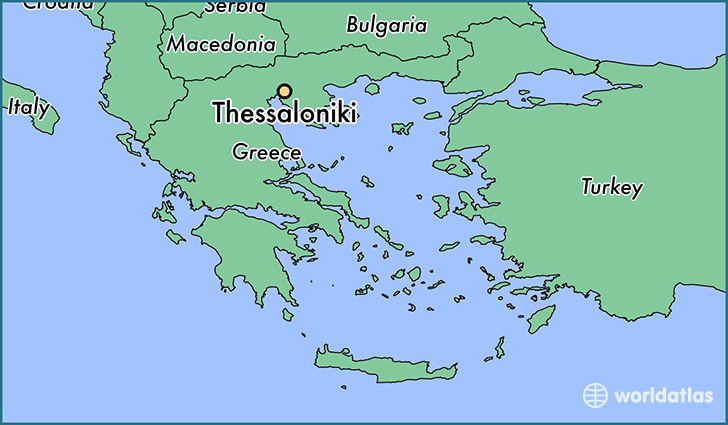
Thessalonica was the second city in Europe where Paul helped to create an organized Christian community. The city is located on the Thermaic Gulf at the northwest corner of the Aegean Sea.
It was founded around 315 BCE by the King Cassander of Macedon. It was located on or near the site of the ancient town of Therma and 26 other local villages.

He named it after his wife Thessalonike. She was princess of Macedonia as daughter of Philip II and a half-sister of Alexander the Great. The city retained its own autonomy and parliament in the kingdom. It evolved to become the most important city in Macedonia.

Thessalonica was made the capital of the Roman province of Macedonia after the fall of the kingdom in 168 BCE. It became a free city of the Roman Republic under Mark Antony in 41 BCE.

It grew to be an important trade-hub located on the Via Egnatia, the road connecting Dyrrhachium with Byzantium. The location facilitated trade between Thessaloniki and great centers of commerce such as Rome and Byzantium.

Thessaloniki also lay at the southern end of the main north-south route through the Balkans along the valleys of the Morava and Axios river valleys. This linked the Balkans with the rest of Greece. The city became the capital of one of the four Roman districts of Macedonia.

It came to be named the capital of all the Greek provinces of the Roman Empire because of the city's importance in the Balkan peninsula.

It became one of the early centers for Christianity around 50 CE during the time of the Roman Empire.  Paul the Apostle visited this city's chief synagogue on three Sabbaths and sowed the seeds for Thessaloniki's first Christian church while on his second missionary journey.

Two letters attributed to Paul were sent to the new church at Thessaloniki. These epistles are preserved in the Biblical canon as First and Second Thessalonians. Some scholars hold that the First Epistle to the Thessalonians is the first written book of the New Testament.

The Thessalonicans grew concerned over whether those who had died would share in the parousia sometime after the first letter had been written. They were faced with a false teaching that said that Christ had already returned.

Modern biblical scholarship is divided on whether the epistle was written by Paul; many scholars reject its authenticity based on what they see as differences in style and theology between this and the first epistle.

2 Thessalonians 1:11-12

We always pray for you asking that God will make you worthy of his call and will fulfill by his power every good resolve and work of faith to the name of our Lord Jesus may be glorified in you and you in him according to the grace of our God and the Lord Jesus Christ.

---------------------

May you fulfill by faith every good resolve in the name of Jesus
that Christ may be glorified in you by the grace of God for your freedom.

================


Luke 19
Sycamore Tree, Jericho

The 19th chapter in the gospel of Luke begins in Jericho. Jesus was on his way to Jerusalem.
The city is located in the Jordan Valley. The Jordan River lies to the east and Jerusalem to the west.

Copious springs in and around the city have attracted human habitation for thousands of years. Archaeologists have unearthed the remains of more than 20 successive settlements in Jericho, the first of which dates back to about 9000 BCE.

Jericho is described in the Hebrew Bible as the "city of palm trees" (Deuteronomy 34:3). The road from Jericho to Jerusalem winds through the badlands of the Judean wilderness. The route climbs more than 3,000 feet in less than 20 miles. The location has an elevation that is 825 ft. below sea level. It is the lowest city in the world.

The location was established as a garden city by the Hasmoneans in the 2d century after the rule of the Seleucid, Antiochus IV was rejected.

The Hasmonean dynasty was from a priestly group (kohanim) from the tribe of Levi. They rose to power in the Maccabean Revolt (167-160 BCE). They became independent from 110 BCE. They ruled until the Roman invasion in 63 BCE.

Two of the great grandson's of the first king in the line became involved in a proxy war between Julius Caesar and Pompey after the Roman occupation. The deaths of Pompey (48 BCE) and Caesar (44 BCE) temporarily relaxed Rome's grip on the Hasmonean kingdom.

There was a brief reassertion of autonomy backed by the Parthian Empire. This short independence was rapidly crushed by the Romans under Mark Antony and Octavian.

The Hasmonean dynasty had survived for 103 years before yielding to the Herodian dynasty in 37 BCE. The installation of Herod the Great (an Idumean) as king made Judea a Roman client state and marked the end of the Hasmonean rule.  Herod tried to bolster the legitimacy of his reign even then by marrying a Hasmonean princess, Mariamne.

Herod the Great had died in 4 BCE. The kingdom was divided as a tetrachy among his sons. Herod Archelaus, son of Herod and Malthace the Samaritan, was given Judea, Edom and Samaria. He ruled for ten years until 6 CE.

Herod Antipas, another son of Herod and Malthace, was made ruler of the Galilee and Perea. He ruled there until he was exiled to Spain by emperor Caligula in 39 CE.

Herod Antipas is the person referenced in the gospels. He played a role in the death of John the Baptist and the trial of Jesus. Pontius Pilate sent Jesus to Antipas for judgment. Antipas sent Jesus back to Pilate's court.

The city of Jericho is remembered for the story in the Book of Joshua. The city has the oldest known protective wall in the world. The story about its destruction was probably a reference to how worn the wall looked at the time that the story was told. 

It was located in the Roman province of Judea. Pilate was the governor when Jesus traveled to the city.

Luke

The gospel tells the story that Zaccheus (Innocent) was the publican for the area. He collected the taxes. He was the chief official.

Tax collectors were known to 'mine' the public for extra money. They could become quite wealthy as a result. The chief among them was most likely the wealthiest.

Clement of Alexandria suggested an identification with Matthew the Apostle.

The lucrative production and export of balsam was centered in Jericho. The product was used as a perfume. Zaccheus was probably quite wealthy as a result.

He was short in stature. He was unable to see Jesus through the crowd (Luke 19:3). He had heard that Jesus had restored sight to the blind there (Matt. 20:30; Mark 10:46; Luke 18:35).

He was so excited to see the Healer that he climbed a sycamore tree along Jesus's path. When Jesus reached the spot he looked up at the man in the tree and addressed him by name.  He invited himself to the tax collector's home. The invitation was honored.

There were those who were present at the banquet who complained about how the rabbi consorted with a tax collector.

Luke 19:8

Zaccheus stood there and said, 'Look, half of my possessions, Lord, I will give to the poor. If I have defrauded anyone of anything, I will pay back four times as much.'

---------------------

Restitution is a form of reparation
that compensates for damage prior to restoration.

The official offered restitution
to the crowd to request his absolution.

================

Probability
Pierre-Simon Laplace (1749-1827)
Thomas Bayes (1701-1761)

Analysis

分析
Chn. Fenxi
Pronunciation
分析
Jpn. Bunseki
분석
Krn. Bunseog

Analytic philosophy analyzes statements for scientific verification in thought.

Chn.    分析哲学分析陈述,以进行思想上的科学验证。
Fēnxī zhéxué fēnxī chénshù, yǐ jìnxíng sīxiǎng shàng de kēxué yànzhèng.

Jpn.    分析哲学は、科学的検証のための発言を分析します。
Bunseki tetsugaku wa, kagaku-teki kenshō no tame no hatsugen o bunseki shimasu.

Krn.     분석 철학은 과학적 검증을위한 진술을 분석합니다.
Bunseog cheolhag-eun gwahagjeog geomjeung-eul-wihan jinsul-eul bunseoghabnida.

Analytic Philosophy

The term for the field refers to certain developments in early 20th-century philosophy that were the historical antecedents to the current practice. Central figures in this historical development are Bertrand Russell, Ludwig Wittgenstein, G.E. Moore, Gottlob Frege and the logical positivists.

Analytic philosophy differs from the empiricism of Locke, Berkeley and Hume in the incorporation of mathematics for the development of a powerful logical technique. Frege had proposed that there was a logic to arithmetic. He was in agreement with Hobbes that this logic was a tool to guage agreement or disagreement with proposals for change in precedent.

Russell affirmed that such a procedure could be part of that which was scientific in public discourse. It was an argument for forensics with a certain admission of limitation to arithmetic at least until the public were to grow in mathematical literacy.

He developed mathematics as a system in British education that could divert liberal excess in government expenditure at public expense or grow in knowledge with the addition of elaboration or discovery.

The logical-positivists posited that there are not any specifically philosophical facts. The object of philosophy is the logical clarification of thoughts. Traditional foundationalism considered the discipline to be a special science. It was the discipline of knowledge that investigated the fundamental reasons and principles for anything.

Analytic philosophers have considered their inquiries as subordinate to those of the natural sciences. This attitude began with John Locke. He described his work as that of an "underlabourer" to the achievements of natural scientists such as Newton. The most influential advocate of the continuity of philosophy with science was Willard Van Orman Quine during the 20th century.

This particular aspect of the orientation encounters problems when science is defined as a way to deceive the public into the acceptance of expertise as the sole basis for authority. It lends itself to bureaucratic implementation.


George Boole established the means to include probability into objective analysis. It was a necessary step in the direction of the development of the larger school.

Boole was a largely self-taught English mathematician, philosopher and logician. Most of his short career was spent as the first professor of mathematics at Queen's College, Cork in Ireland.

He worked in the fields of differential equations and algebraic logic. He is best known as the author of The Laws of Thought (1854). Boolean logic is credited with laying the foundations for the information age.

Boole reduced the four propositional forms of Aristotle's logic to formulas in the form of equations. This was a revolutionary idea by itself. The four propositional forms could then be logically expressed as universal affirmation, universal negation, particular affirmation or particular negation.

Universal affirmation: All S are P.
U. negation: No S are P.
Particular affirmation: Some S are P.
P. negation: Some S are not P. 

Second, Boole argued that Aristotle’s rules of inference (the “perfect syllogisms”) must be supplemented by rules for solving equations.

Third, Boole’s system could handle multi-term propositions and arguments whereas Aristotle could handle only two-termed subject-predicate propositions and arguments.

Boole could be viewed as typically precocious in his Irish mindset. He didn't limit his goals to arithmetic, logic and science for public discourse. He looked to Calculus as a way to correct the limitations of logic as defined by Aristotle.

George Boole (1815-1864)
The Laws of Thought (1854)
Text

"The history of the theory of Probabilities, on the other hand, has presented far more of that character of steady growth which belongs to science. In its origin the early genius of Pascal, in its maturer stages of development the most recondite of all the mathematical speculations of Laplace, -were directed to its improvement; to omit here the mention of other names scarcely less distinguished than these. As the study of Logic has been remarkable for the kindred questions of Metaphysics to which it has given occasion, so that of Probabilities also has been remarkable for the impulse which it has bestowed upon the higher departments of mathematical science."

-------------------------

Probability is a logical inference for application in science with the measure of math.
It has grown toward the prediction of self-reliance as the reasonable path.

Analytic philosophy analyzes the logic of statements
for scientific measure in application for various places.

===================


Gottlob Frege (1848-1925) was a German philosopher, mathematician and logician. He worked as a professor of mathematics at the University of Jena. He concentrated on the philosophy of language, logic and mathematics.

He is understood by many to be the father of analytic philosophy. Giuseppe Peano (1858–1932) and Bertrand Russell (1872–1970) introduced his work to later generations of philosophers.

His contributions include the development of modern logic and work in the foundations of mathematics. His book the Foundations of Arithmetic is the seminal text for the symbolic representation of mathematics as logic.

His work represents a fundamental break between the contemporary approach and the older, Aristotelian tradition. He invented modern quantificational logic, created the first fully axiomatic system for logic complete in its treatment of propositional and first-order logic and  represented the first treatment of higher-order logic.

He developed an analysis of quantified statements and formalized the notion of a ‘proof’ in terms that are still accepted today. He demonstrated that one could use his system to resolve theoretical mathematical statements in terms of simpler logical and mathematical notions.

He is often called the founder of modern logic and is sometimes even heralded as the father of analytic philosophy.

The Foundations of Arithmetic was published in 1884. He refutes other theories and develops his own theory of numbers.  He makes a distinction between particular numerical statements such as 1 + 1 = 2 and general statements such as a + b = b + a. The latter are statements that are as true of numbers as the former.

A definition of the concept of number is called into question. Numbers function in language  as adjectives. The drawers of a desk can be described in terms of color or number. The drawers are brown or 5 in number.

That the drawers are objects with a color is an observation drawn from the external world. It is a visually perceptive observation. Every object has the same color, but each drawer is not 5. Color is visual. Number is conceptual.

The sentence "the number of horses in the barn is four" means that four objects fall under the concept 'horse in the barn.' He explains our grasp of numbers through a contextual definition of the operation of cardinality. The number is a count of the objects.  (Nx:Fx).

He constructs the content of a judgment involving numerical identity by relying on Hume's principle. This states that the number of F's equals the number of G's, if and only if F and G are equinumerous. There is in one-one correspondence between different objects. Frege rejects this definition because it doesn't fix the truth value of identity statements.

He argues that numbers are concepts that assert something about an object. He defines numbers as extensions of unit concepts. 'The number of F's' is defined as the extension of the concept G as a concept that is equinumerous to F.

The concept in question leads to an equivalence class of all concepts that have the number F. Zero is the extension of the concept of being not self-identical.

The number of this concept is the extension of the concept of all concepts that have no objects falling under them.  One is the number of the extension that is identical with 0. 0 and 0 alone falls into this concept. This is the basic foundation for the monas as the universal unity.

Zero is the foundation for the theory of numbers. It is uniquely conceptual insofar as it doesn't represent a corresponding identification in unity with objects.

Gottlob Frege (1848-1925)
The Foundations for Arithmetic (1884)
Text

"I hope I may claim in the present work to have made it probable that the laws of arithmetic are analytic judgments and consequently a priori. Arithmetic thus becomes simply a development of logic, and every proposition of arithmetic a law of logic, albeit a derivative one. To apply arithmetic in the physical sciences is to bring logic to bear on observed facts; calculation becomes deduction." (p.99)

------------------------

The laws of arithmetic are analytic judgments
drawn from a priori abundance.

The application of arithmetic to physical science
makes raises calculation to the level of deductive appliance.

==================


Bertrand Russell was a British logician. He is given credit as one of the founders of analytic philosophy. He was preceded by Gottlob Frege, contemporary with G. E. Moore and followed by Ludwig Wittgenstein.

He led the British "revolt against idealism" in the early 20th century. He wrote Principia Mathematica with A.N. Whitehead to create a logical basis for mathematics. His work has had a considerable influence on mathematics, logic, set theory, linguistics, artificial intelligence, cognitive science, computer science and philosophy.

He expressed agreement with socialism, but he disagreed with the idealism of Hegel and the theory according to Marx. He saw the war against Hitler's Germany as a necessary evil. He was critical of Stalinist totalitarianism. He was like Dewey in the strong association between democracy and socialist economic theory.

It is likely that he viewed capitalism as the motive force for imperialism and war.
Russell's basic idea for defending logicism was like that of Frege. Numbers may be identified with classes of classes.

Number-theoretic statements may be explained in terms of quantifiers and identity. The number 1 would be identified with the class of all unit classes, the number 2 with the class of all two-membered classes and so on. Statements such as "there are two books" would be recast as "there is a book, x, and there is a book, y; x is not identical to y".

It followed that numbers could be explained in terms of the operations of set theory. The union, intersection, difference of sets organized numbers in fields for analysis. The complement illustrated that which was outside the sets in a larger frame.

Russell is remembered for his work using first-order logic.  First order logic introduces the use of variables to propositions. It shows that a broad range of denoting phrases could be recast in terms of predicates and quantified variables.

He is also remembered for his emphasis upon the importance of logical form for the resolution of many related philosophical problems. Statements could be expanded or contracted depending upon purpose.

Spinoza's moral code presented a set of axiomatic statements to define the code. There was allowance for metaphysical expression. The statements allowed for the analysis of the morality that was being advocated. They were objects of language with which to agree or disagree with stated reason.

The difficulty of certain expressions recommended translation into easier language. Spinoza had equated reality with perfection. He subordinated the good to the real with the equation.

The proof of perfection was only dependent upon that which was determined to be real. It was like saying that whatever happened took place because it was willed to be so by God.

It rules out free will as a factor in the producton of goodness or evil. It is a kind of fatalism packaged as naturalism. This was adopted by Locke in his proposal that the state of nature was perfect freedom. Freedom in Locke's view allowed for slavery and colonial exploitation for global domination.

When the success of the British empire is identified with liberal power rather than the protection of legal trade, the goodness of the commonwealth is diminished by the absurdity.

Spinoza would develop his argument for the love of God. He argued the love was connected with the affections of the body. The affections are innately ordered to cherish the love. It ought to occupy the mind above everything else.

Descartes had followed Spinoza in time. Both were rational. Leibniz was as well. The Dutch bet was the kind of result that stemmed from the Apollonian sense of order.

The government official was the business agent. The business agent had to be a government official.
Private property was a subordinated clause to official regulation. Private property didn't have a real existence of its own.  It was only a manifestation of support for the election and bureaucratic perpetuation of the official.

Russell was more clever in his refutation. He attacked the equation of reality with perfection as the logical foundation for the rest of the argument. He stated that it would be just as easy to equate green cheese with reality. He found the proof that the love of God occupies the mind above all else to be false.

Bertrand Russell (1872-1970)
Spinoza's Moral Code (1907)
Text: Review of Spinoza

"Much of the moral teaching of the Ethics, being inspired by a general tolerant largeheartedness, remains valid, whether we accept or reject the metaphysic by which it is “proved”; but the more interesting and characteristic portions stand or fall with that metaphysic, and remain unconvincing to readers who are not pantheists."

------------------------

The equation of perfection with reality
carries the implication of a swarm of killer bees.

A massive assault is conducted on the senses.
The condition of the body is reduced to autonomic defenses.

Progress is constrained to leap from rags to riches.
The state of the nation is left to wallow in vicious twitches.

==================

Socialism and the liberal power that it endorses are the entities that ought to be refuted as false. Education is a largely a non-profit enterprise by legal definition in the US.

There are privately funded schools that compete with the tax support for the non-profits, but there is a strong sense of association with state regulation as an expression of official public ownership that lends itself to socialism as an interpretation.

While standards have to be set and observed to test to make sure that student achievement in learning the language is sufficient for continued financial support from the public as a source, agreement with the standards has to be determined at local levels with the oversight of the district.

The importance of using the incentive of a good report as motivation for student achievement cannot be overstated. The harmful effect of group punishment by a no pass policy as the replacement for incentive doesn't justify the continuation of the policy.

------------------------

Bertrand Russell: Biography with Links to Resources
Online Books and Articles by Bertrand Russell

------------------------

Certain enthusiasts saw Herbert Spenser's work as the potential to tame Darwin's aggressive naturalism. G.E. Moore was critical of both Spenser and Darwin. 


G.E. Moore
b. 11.4.1873 Upper Norwood, London, United Kingdom
d. 10.24.1958  Cambridge, UK (Cambridge is 102 km (63 mi.) north of London)

G.E. Moore was an important British philosopher in the first half of the 20th century.He was one of the trinity at Trinity College Cambridge whom made Cambridge one of the centers for analytical philosophy.

The others were Bertrand Russell and Ludwig Wittgenstein. The group was associated with Gottlob Frege. Russell had objected to the fifth law, but respected the logic of mathematics for analysis.

Moore's work embraced themes and concerns that reach beyond a single philosophical program. He argued against hedonism as meta-ethical naturalism in Principia Ethica.

Herbert Spencer attached an ethical view to Darwin's evolution. His definition of both terms was vague.

Moore wrote, "Mr Spencer's connection of Evolution with Ethics seems to shew the influence of the naturalistic fallacy..."

Much like the utility of happiness is sustained with favor for pleasure to reduce pain, the value of freedom favors that which sustains the best choice.

Choice that selects force with the threat of damage to exploit accident does not respect freedom for others. It is not sustainable socially. It is not favored as natural selection.

Upper Norwood, London

The name "Norwood" is a contraction of "North Wood".
Upper Norwood is an area of south-east London within the London Boroughs of Bromley, Croydon, Lambeth and Southwark. It is north of Croydon and is synonymous with the Crystal Palace.

The area is one of the highest in London. It was occupied for centuries by the Great North Wood, an extension of natural oak forest which formed a wilderness close to the southern edge of the ever-expanding city of London.

Upper Norwood is situated along the London clay ridge known as Beulah Hill. Most housing dates from the 19th and 20th centuries. There are large detached properties along the ridge and smaller, semi-detached and terraced dwellings on the slopes. 

G.E. Moore

George Edward Moore was born in Upper Norwood, Croydon, London on November 4, 1873. His parents were Dr. Daniel Moore and Henrietta Sturge.

His grandfather was the author Dr. George Moore. His eldest brother was Thomas Sturge Moore, a poet, writer and engraver who worked as an illustrator for W.B. Yeats.

He was the middle child of the 7 children that Daniel had with Henrietta. Daniel had a daughter from another marriage. The daughter was the oldest child.

His father taught him reading, writing and music. His mother taught him French. He was more than competent as a pianist and composer. He was enrolled at Dulwich College when he was 8 years old. He studied Greek, Latin, French, German and mathematics.

He entered Trinity College Cambridge at 18 where he started in Classics. He made the acquaintance there of Bertrand Russell who was two years ahead of him.

He also met  J. M. E. McTaggart who was then a charismatic young Philosophy Fellow. The two friends encouraged him to add the study of Philosophy.

Moore was impressed by the conversations that were derived from Plato's work. The significance of the discussion made the study relevant for contemporary society.

The dialog that was discussed wasn't just an exercise in understanding words on a page from an irrelevant historical time and place. It became an example of how logic in dialog and dialectic could shed light on  the analysis of modern issues.

Russell convinced Moore to study Moral Science, a division of philosophy in the British University system. He graduated in 1896 with a First Class degree in Classics.

He turned his energies towards attempting to follow in the footsteps of McTaggart and Russell by winning a ‘Prize’ Fellowship at Trinity College. The prize would enable him to continue the study of philosophy there.

Moore acknowledged the influence of McTaggert. He had followed the work of F.H. Bradley into British idealism. When he made his first attempt to win a Prize Fellowship at Trinity in 1897 he submitted a dissertation on ‘The Metaphysical Basis of Ethics’ in which he acknowledged his indebtedness to Bradley. He presented an idealist ethical theory.

One element of this theory is what he called ‘the fallacy involved in all empirical definitions of the good’.  This theory essentially rejected any definition of goodness as derived from empirical experience.

Empiricism suffered from an excessive emphasis on induction. People were encouraged to entertain perception with simple ideas. Complex ideas were to be left to liberal power in elected government.

Idealism was characterized by excessive subjectivity in the subject and object distinction. The two together blocked agreement on essential matters in the elected legislation.

The Renaissance had revived the consideration of republic as a form of government. The revival refused to consider monarchy as a form.

It threatened to prevent the modern republic from advance into improvement as a governed state.

Liberal power declared election as superior to monarchy. The royal line of succession was almost abolished in Great Britain. Slavery came to be tolerated in colonial expansion by parliamentarian influence. It wasn't allowed in the United Kingdom.

The Abolition of the Slave Trade Act was passed in 1807. Slavery was abolished for the British empire in 1833. The 13th amendment to the US Constitution abolished the institution in 1865.

The United Kingdom negotiated a number of treaties to abolish the trade and the institution. The Brussels Conference was an assembly of 17 nations in 1890. It included the US and the UK. The participating nations enacted an agreement to abolish the trade on land and sea.

The League of Nations established a convention to suppress slavery and the slave trade in 1926. This convention was pressed globally. The Slavery Convention of 1926 was last ratified in Kazakhstan in 2008. Slavery was criminalized in Chad in 2017.

While slavery wasn't protected by legislation through this period. It was not outlawed. Locke had expressed personal distaste, but conceded to the institution as a part of empire, if not elected government. Leading monarchs had written against slavery.

The right to vote was given to people of color in the US before it was granted to women. Women could vote when the 19th amendment was ratified in 1920.  The UK allowed women to be elected to Parliament in 1918.

This was before women were given the right to vote in  the Representation of the People Act on 1928. Women in France weren't given the right to vote until 1945.

Naturalism had been a development from Empiricism. It was supported by Darwin's theory of evolution. The Origin of Species was published in 1859. 

Moore's criticism of goodness in empiricism was the precursor to his famous claim in Principia Ethica that there is a ‘naturalistic fallacy’ in all naturalist definitions of goodness.

A substantial part of his early dissertation was devoted to a critical discussion of Kant's moral philosophy.  Moore endorsed the kind of idealism advanced by Bradley in his general approach and conclusions, but he was already critical of Kant's conception of practical reason.

He argued that Kant's use of this conception blurred the distinction between psychology and truth. The psychological faculty of making judgments and inferences obscured the perception of the ‘true and objective’. Moore maintained that the distinction cannot be removed.

Kant's conception of morality as founded on a priori principles of practical reason was untenable. This line of thought was extended to a general criticism of Kant's conception of the a priori. It was this generalization that Moore undertook in his successful 1898 dissertation.

He identified his previous enthusiasm for Bradley's idealism as not well founded. He turned decisively against idealist philosophy both in its Kantian and Bradleian forms. He succeeded in 1898 on his second attempt.

He came to reject the idealist philosophy of Bradley and McTaggart, but he held that their criticisms of empiricism as represented by J. S. Mill's philosophy were sound. He carried this objection to empiricism forward into his mature philosophy.

He argued that truth differs in no respect from the reality to which it was supposed merely to correspond. The truth that I exist differs in no respect from the corresponding reality of my existence.

He matured as a dynamic young philosopher over the next 6 years. He began to act as a “professional”.  He participated in groups such as the Aristotelian Society and the Moral Sciences Club. His work was published. Many of his best known and most influential works date from this period. 

He actually led Russell away from the idealism of McTaggart and others. Absolute Idealism was then dominant in Britain. This would prove to be the first step toward the rise of analytic philosophy.

Moore left Cambridge for a period of 7 years, but he continued to write. The basic theme of his paper, ‘The Refutation of Idealism’ (1903), was that sense-experience is an extension of objective truth. The strong distinction between the subject and its objects which we have encountered in connection with meaning divides perception from reality.

He concentrated here on the case of a ‘sensation of blue’ and maintained that this experience is a kind of ‘diaphanous’ consciousness or awareness of blue which is not a ‘content’ of experience at all. It is something real whose existence is not dependent on experience.

His common sense realism was set against ethical naturalism in Principia Ethica (1903).

"My objections to Naturalism are then, in the first place, that it offers no reason at all, far less any valid reason, for any ethical principle whatever; and in this it already fails to satisfy the requirements of Ethics, as a scientific study. But in the second place I contend that, though it gives a reason for no ethical principle, it is a cause of the acceptance of false principles—it deludes the mind into accepting ethical principles, which are false; and in this it is contrary to every aim of Ethics." (p.20)

G. E. Moore
Principia Ethica (1903)
Ch. 1: The Subject-Matter of Ethics
Text

------------------------

Naturalism offers no reason for ethical principles.
It colludes to delude the acceptance of false victuals
as typically invincible.

==================

He wrote Ethics in 1912. His work promoted a view that has come to be called Ideal Utilitarianism. He argued that there is no important difference in meaning between concepts like “duty”, “right” or “virtue” and “expedient” or “useful”.

Duty selects pleasant experience in order to maintain happiness with goodness. Bentham's bent was against the legislation of asceticism. Slavery was an imposition acetic rigor on the enslaved.

Even though there wasn't written legislation that declared it legal, the need to outlaw it became apparent with the greatest happiness principle. The greatest number of people included the population of slaves.

The utility of treaties against the trade and institution became apparent. The prohibition of alcohol was to become an example of legislation that imposed ascetic abstinence on others.

The right to vote was extended to women and people of color as included in the greatest number. The definition for republic was revised for the modern age.

Ideal utilitarianism posited that the definition for goodness or happiness is not restricted to the experience of pleasure. Actions should be ordered to those states of affairs possessing the highest degree of good. It could be directed toward an ideal state in this way. 

Moore lived in Edinburgh and Richmond, Surrey after he left London. He worked independently on various philosophical projects.

He returned to Cambridge in 1911 as a lecturer in Moral Science. He remained there for the majority of his career and his life.

Russell  and Whitehead were finishing off their massive project of exhibiting the logical foundations of mathematics , Principia Mathematica, by the time Moore returned to his lectureship there. 

Moore was one of the first people to grasp that Russell's new logical theory was an essential tool for philosophy even though he was neither a mathematician nor a logical theorist.

Propositions were defined as the ‘objects’ of thought. This definition provided the object that was to be analyzed.

Moore earned a Litt.D. in 1913. He married Dorothy Ely in 1916 and together had two sons: the poet Nicholas Moore, and composer Timothy Moore. He was elected a fellow of the British Academy in 1918.

He became editor of Mind, the leading British philosophical journal, in 1921. He was chosen as James Ward's successor as Professor of Philosophy and Logic at Cambridge in 1925. 

These two appointments confirmed his position as the most highly respected British philosopher of the time. When Wittgenstein returned to Cambridge after 1929, the college became the most important center of philosophy in the world.

Moore occupied that position until 1939. When he retired he was succeeded by Wittgenstein. Moore was a visiting professor at several universities in the United States from 1940 to 1944.
When he retired as the editor of Mind in 1944, it marked the end of the golden age of Cambridge philosophy. 

He died in Cambridge on October 24, 1958.


George Moore
S. 乔治·摩尔
T. 喬治·摩爾

乔 Qiao  stately       喬  kyo    high         Jyo  じょ-   ジョ-      Jo    조  article                           
治  zhi     govern     治  ji        reign         ji     じ          ジ         ji    지  g         
摩  Mo    scour        摩  ma     rub            Mu  む-       ム-        Mo  무 radish             
尔  er       you          爾  ni       you            a      あ         ア         eo    어  uh   

------------------------

Education in the classics leads to a stately mind
when you scour definitions for the analytical find.

==================

wiki G.E. Moore
IEP: G.E. Moore
SEP: G.E. Moore
OUPBlog: G.E. Moore