Showing posts with label truth. Show all posts

Sunday, January 5, 2020

Clean

1.12.19
Baptism


Gemma Arterton

Clean
Yourself
清洁自己
Qīngjié zìjǐ
自分をきれいに
Jibun o kirei ni
ps119.25+
Mundus Te

When I leave the door to pass the gate
I have organized my action to avoid being late.

I obey the law to drive with safety in the relative way
or walk on the sidewalk in the not just lately case for the day 
in the maybe baby of the stately frailness of the straight path sway.

My soul abhors the dust that clings to me.
I cleanse the perception of my perspective when I clean my body.

Where is the bathroom? I need to get clean. 
I won't feel right until my hygiene can be gleaned.

When I asked for guidance I was shown a hypothesis.
Divine design in nature has made me an investigator of consequence.

Help me to understand the precepts for Your order.
I will meditate on the effects without regret for respect for borders.

When my soul melts away in sorrow
I look to your word for strength to borrow.

Let me put false ways far from me
that I may teach your law graciously.

I have chosen the way of faithfulness.
I set your rules before me with gratefulness.

I cling to the testimonies of Your truth.
Let my investigation preserve my youth.

I will rely on the energy drawn from Your commandments
when Your enhancements are enacted as advancement.

It is clear that Your authority extends beyond the fence in the yard.
I will behave in a way that defends the sense of legal power on guard.

Give me understanding to keep Your law
that I may observe it for my heart drawn dawn.

Lead me on Your path
for I delight in doing the math.

Incline my heart to Your revelation
that I may discount unsubstantiated allegation.

Let me see the worth of things
in terms that actual value brings.

Confirm Your promise to Your servant
that You may be revered for the service.

I dread damage from reproach
for adherence to the rules that I feel that You coached. 

I long for the rightness 
that the precepts for divine justice
teaches for trust with me for us. 

A good question is like a hook for investigation.
Discovery provides another piece to the puzzle of salvation.

Let your love be shown as steadfast
that I may answer those who forget the past.

I hope the rules I find by faith in You
conform to the reality created as true.

God created the heavens.
It was stretched out as testimony to the divine essence.

The Creator spread out the earth.
Matter was given form in tribute to worth.

The LORD called you in righteousness.
The light of the covenant was give to enliven us.

The light can open eyes that are blind
to the truth that life is that which we can find.

Prisoners who sat in the darkness of doubt
will be brought to see that insight can be drawn out.

Praise will be directed to the One through the name of God.
The servant will be the Son who delivers us against the odds.

New things will be declared before they spring forth.
The past has come to pass in the directions south of north.

Non-Jews were in need of faith in one God.
The Greeks, the Romans and the Parthians were at odds.

Judah made progress with respect for national security
in the name of the crown for their growth in maturity.

There were those who were ranked as good by history.
They were gratefully faithful in the work to overcome adversity.

They managed defense with respect for the law.
They led the remnant that Isaiah's vision saw.


Faith in Christ was resurrected with Jesus in Galilee
after the baptism announced by John in the Jordan's perfect sensuality.

The heavens were opened. The dove descended.
The love of God was to the nations extended.

Jesus proclaimed love in Judea and Jerusalem as well.
The Apostles ate and drank with him before they witnessed the knell
on Golgotha's tell.

He was resurrected on the third day
to deliver the command to proclaim the good way
of forgiveness for sins in his name's sake.

The Apostles received the gift of the Holy Spirit
to speak the gospel in the language in which people could hear it.


They extended the message through the known world
insofar as their ability was increased by the challenges hurled. 


I will keep Your law forever
that I may serve You in each endeavor.

The search for wisdom will increase comprehension
of the role thought plays in the apprehension 
of sensation.

I will speak of participation in legal polity
in a way that improves moral quality.

I find my delight in the law which I love;
that is the reflection of Your design from above. 

I will lift up my hands for what is divine in Your design.
I will meditate on how Your statutes are benign.

----------------------

Dalet

Daleth
4th letter
Door or gate
Adhesit pavimento
Adhered to pavement

25  My soul clings to the dust;
give me life according to your word!
 26  When I told of my ways, you answered me;
teach me your statutes!
 27  Make me understand the way of your precepts,
and I will meditate on your wondrous works.
 28  My soul melts away for sorrow;
strengthen me according to your word!
 29  Put false ways far from me
and graciously teach me your law!
 30  I have chosen the way of faithfulness;
I set your rules before me.
 31  I cling to your testimonies, O Lord;
let me not be put to shame!
 32  I will run in the way of your commandments
when you enlarge my heart!

He

He
5th letter
Fence
Legem pone mihi
Set me

33  Teach me, O Lord, the way of your statutes;
and I will keep it to the end.
 34  Give me understanding, that I may keep your law
and observe it with my whole heart.
 35  Lead me in the path of your commandments,
for I delight in it.
 36  Incline my heart to your testimonies,
and not to selfish gain!
 37  Turn my eyes from looking at worthless things;
and give me life in your ways.
 38  Confirm to your servant your promise,
that you may be feared.
 39  Turn away the reproach that I dread,
for your rules are good.
 40  Behold, I long for your precepts;
in your righteousness give me life!

Vav


Waw
6th letter
Hook
Et veniat super me
Come to me
41  Let your steadfast love come to me, O Lord,
your salvation according to your promise;
 42  then shall I have an answer for him who taunts me,
for I trust in your word.
 43  And take not the word of truth utterly out of my mouth,
for my hope is in your rules.
 44  I will keep your law continually,
forever and ever,
 45  and I shall walk in a wide place,
for I have sought your precepts.
 46  I will also speak of your testimonies before kings
and shall not be put to shame,
 47  for I find my delight in your commandments,
which I love.
 48  I will lift up my hands toward your commandments, which I love,
and I will meditate on your statutes.

---------------------
===============
---------------------

Psalm 119:25-48

The Hebrew letters used in this section of the psalm are daleth, he and waw.
Dalet is the 4th letter in the Semitic abjads. The adjads include the  Phoenician Dālet, Hebrew 'Dālet ד, Aramaic Dālath, Syriac Dālaṯ ܕ, and Arabic Dāl د .

The letter is based on a glyph of the Middle Bronze Age Proto-Sinaitic alphabets. It is based on a hieroglyph depicting a door.

The Phoenician letter gave rise to the Greek delta (Δ), Latin D and the Cyrillic letter Д.

The letter dalet along with He is used to represent the Names of God in Judaism. The letter He is used commonly. The dalet is not used as much.

The keter (crown) of a tallit or prayer shawl has the name of God usually represented by a dalet. A reason for this is that He is used as an abbreviation for HaShem "The Name". The dalet is used as a non-sacred reference.

He is the 5th letter in the Seimitic abjads. These include the  Phoenician Hē, Hebrew Hē ה, Aramaic Hē, Syriac Hē ܗ, and Arabic Hāʾ ه.

Heth means fence in the Phoenician alphabet.

The proto-Canaanite letter gave rise to the Greek Epsilon, Etruscan E 𐌄, Latin E, ֻ and Ɛ and Cyrillic Е, Ё, Є and Э. He represented a consonant like all Phoenician letters, but the Latin, Greek and Cyrillic equivalents have all come to represent vowels.

Hei is an abbreviation for Hashem in Judaism. Hashem means "the Name." It is a way to speak about the name of God without saying the name for the deity.

Waw or vav is the 6th letter of the Semitic abjads. These include the Phoenician wāw, Aramaic waw, Hebrew vav ו, Syriac waw ܘ and Arabic wāw و .

It is the origin for the Greek Ϝ (digamma) and Υ (upsilon), Cyrillic У, Latin F and V and the derived "Latin" or "Roman" alphabet letters U, W, and Y.

The letter likely originated with an Egyptian hieroglyph which represented the word mace.
The word vav is used in modern Hebrew to mean  both "hook" and the letter's name.

https://www.biblestudytools.com/commentaries/treasury-of-david/psalms-119-25.html
https://www.studylight.org/commentary/psalms/119-25.html
https://enduringword.com/bible-commentary/psalm-119/

-----------------

Where is the bathroom? I need to get clean.

Chn. 洗手间在哪里? 我要打扫
           Xǐshǒujiān zאi nǎlǐ? Wǒ yאo dǎsǎo
Jpn.  化粧室はどこですか。 きれいにする必要がある。
           Keshō-shitsu wa dokodesu ka? Kirei ni suru hitsuyō ga arimasu.
Krn.  화장실은 어디에 있습니까? 깨끗해야 해요.
           hwajangsil-eun eodie issseubnikka? kkaekkeushaeya haeyo.
Ltn.   Ubi est latrina? EGO postulo impetro mundus erit.
Itn.    Dov'ט il bagno? Ho bisogno di pulire.
Grk.   Πού είναι το μπάνιο? Πρέπει να καθαρίσω.
           Poת eםnai to bבnio? Prיpei na katharםso.
Spn.  ¿Dףnde estב el baסo? Necesito limpiarme.
Frn.   Oש se trouvent les toilettes? Je dois me nettoyer.
Gmn. Wo ist die Toilette? Ich muss sauber werden.
Dtch. Waar is het toilet? Ik moet schoon worden.
Hgn.   Hol van a frdץszoba? Meg kell tisztםtani.
Trk.    Banyo nerede? Temizlenmem gerek.
Rsn.   Где здесь ванная комната? Мне нужно очиститься.
            Gde zdes' vannaya komnata? Mne nuzhno ochistit'sya.           

Where is the bathroom? I need to get clean.
I won't feel right until my hygiene can be gleaned.

--------------------

Isa.42:5

Chapters 40-55 in the book of Isaiah are known as "Deutero-Isaiah". The chapters are dated from the time of the Israelites' exile in Babylon.

Chapter 42 contains a poem known as the first of the "Servant songs." Jewish tradition holds that Isaiah identifies the servant as either the Israelites themselves (Hebrew: אור לגויים, or l'goyim) or Cyrus.

The identification with Cyrus is contrasted with Jewish Christian and later gentile Christian tradition. Cyrus is not identified as the Suffering Servant by Islamic tradition either.

The idea of a 'servant' played a small part in the earlier chapters. It was used as a designation of the unworthy Eliakim in 22:20 and of the figure of David in 37:35.

It comes to the fore as a description of major significance in Second Isaiah. The noun is used more than 20 times in chs. 40-55.

Its first usage is obviously important in establishing the sense in which we are to understand it. Here it is clear that the community of Israel/Jacob is described.

The introduction to chapter 42 associates God with the LORD who created heaven and earth. The Creator gave breath and spirit to people. He has called those who believe to righteousness in the covenant.

The blessings of the call to agreement extend to the nations. Eyes that were 'blind' are opened. 'Prisoners' who sat in darkness are brought out to see the light.

Praise in the past was shaped in the stone or wood of idols. New things will be declared before they are seen in the new covenant.

Isaiah 42:5-9

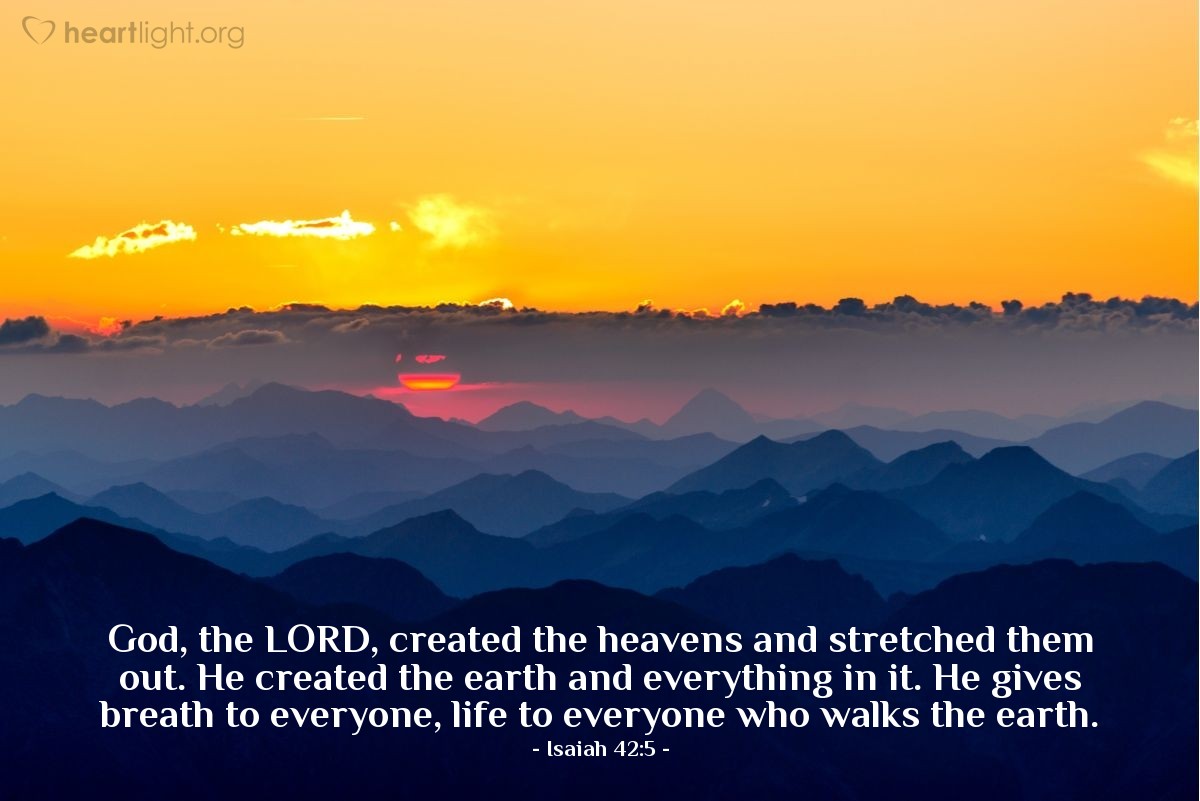
Thus says God, the LORD,
who created the heavens and stretched them out,
who spread out the earth and what comes from it,
who gives breath to the people on it
and spirit to those who walk in it:

I am the LORD, I have called you in righteousness.
I have taken you by the hand and kept you.
I have given you as a covenant to the people,
a light to the nations,
to open the eyes that are blind,
to bring out the prisoners from the dungeon,
from the prison those who sit in darkness.

I am the LORD. That is my name.
My glory I give to no other
nor my praise to idols.
See, the former things have come to pass.
New things I now declare
before they spring forth
I tell you of them.

-----------------------

God created the heavens.
It was stretched out as testimony to the divine essence.

The Creator spread out the earth.
Matter was given form in tribute to worth.

The LORD called you in righteousness.
The light of the covenant was give to enliven us.

The light can open eyes that are blind
to the truth that value in life is that which we can find.

Prisoners who sat in the darkness of doubt
will be brought to see that insight can be drawn out.

Praise will be directed to the One through the name of God.
The servant will be the Son who delivers us against the odds.

New things will be declared before they spring forth.
The past has come to pass in the directions south of north.

=================

The Acts of the Apostles is addressed to Theophilus (God-lover). It is like the gospel of Luke in this regard.

Jesus charged  the Twelve Apostles with the mission to spread the Gospel throughout the world. Peter served as the leader of the apostles and the small congregation of the faithful in Jerusalem.  Matthias was elected to replace Judas Iscariot.

The Apostles and other followers of Jesus were gathered in the Jerusalem to celebrate the Feast of Weeks (Shavuoth).

The feast marks the all-important wheat harvest in Israel (Exodus 34:22). It commemorates the anniversary of the day when God gave the Torah to the nation of Israel assembled at Mount Sinai.

Jesus had promised that his followers would receive the “gift” of tongues (Mark 16:17). “They shall speak with new tongues.” The word “new” speaks to a newness of quality. This gift would involve a fresh or new way of speaking, not a new kind of utterance unknown to mankind.

The fulfillment of the promise began on the Day of Pentecost (Acts 2). These “tongues” were “languages” known to visitors to Jerusalem (Acts 2:2-11). “How hear we every man in our language wherein we were born?” (Acts 2:11).

The gift of tongues is the ability to speak a foreign language. The experience of communication has a religious or a miraculous quality when faith in God is communicated.

Peter preached the fear of God as a global universal. Those who act in accordance with what is right act in accord with the divine will. Legislation against criminal behavior allows for the non-criminal as good provided that it doesn't damage the property or physical safety of another's body.

God's will doesn't favor a particular group or language in an exclusive sense. The language of particular favor was addressed to Judah when it was the first to adopt monotheism as the form for the official religion.

The stories of polytheism were viewed as tribally divisive insofar as there were so many different deities who were in conflict with others based on immoral motives.

There was the sense that the immorality of the gods was an inducement for moral behavior in people, but the collateral damage in contrast to such an implied intent was prone to exponential escalation.

When morality is supposed to be extracted from a system of stories about gods with immoral behavior, it is easy to lose sight of the credibility in moral standards. If bad behavior is pereceived as the cause for societal success in civilization, how civilized is the society?

Religion can be critical of doctrine as related to practice, but it can't be sectarian particularly in an official capacity. Impartiality in practice defaults to the pragmatic proof of objective goodness in action with allowance for subjective flux in non-essential things.  Differences in custom are often conditioned by the historical development of the religion.

While there is a universal character to the promise of salvation with respect for the atonement offered by the sacrifice of the Son, there is an official purpose for religion with respect for the security of the nation.

Whether a state is a kingdom or a republic, the religion has to profess allegiance to the host country to retain legal status. A member cannot promote riot, terrorism, rebellion, revolution or world war and maintain a legally recognized status within the society.

The provision of sanctuary for criminals is not a requirement of the law.

Acts 10:34-43

Peter began to speak to them: 'I truly understand that God shows no partiality, but in every nation anyone who fears him and does what is right is acceptable to him. You know the message he sent to the people of Israel, preaching peace by Jesus Christ--he is Lord of all. That message spread throughout Judea, beginning in Galilee after the baptism that John announced: how God anointed Jesus of Nazareth with the Holy Spirit and with power; how he went about doing good and healing all who were oppressed by the devil for God was with him. We are witnesses to all that he did both in Judea and in Jerusalem. They put him to death by hanging him on a tree; but God raised him on the third day and allowed him to appear, not to all the people but to us who were chosen by God as witnesses and who ate and drank with him after he rose from the dead. He commanded us to preach to the people and to testify that he is the one ordained by God as judge of the living and the dead. All prophets testify about him that everyone who believes in him receives forgiveness of sins through his name.'

-----------------------

Non-Jews were in need of faith in one God.
The Greeks, the Romans and the Parthians were at odds.

Judah made progress with respect for national security
in the name of the crown for their growth in maturity.

There were those who were ranked as good by history.
They were gratefully faithful in the work to overcome adversity.

They managed defense with respect for the law.
They led the remnant that Isaiah's vision saw.

Faith in Christ was resurrected with Jesus in Galilee
after the baptism announced by John in the Jordan's perfect sensuality.

Jesus proclaimed the love of God in Judea and Jerusalem as well.
The Apostles ate and drank with him before they witnessed the knell
on Golgotha's tell.

He was resurrected on the third day
to deliver the command to proclaim the good way
of forgiveness for sins in his name's sake.

=================

John the Baptist baptized in the Jordan River. Scholars think that he was influenced by the Essenes, who like John, were leading an ascetic life in the wilderness of Qumran or EnGedi. One of their principal religious rituals was a daily immersion in water to regain purity.

An annual ritual of purification had been practised by the Pharaoh in Egypt to encourage the people to bathe for hygiene. This rite had specific adaptations for application in Judaism before it became a daily practice.

The Jordan River represented a natural mikva with continuously running water. Baptism as a rite represented a passage from the primitive state of existence into membership in the first monotheistic state for society in the Middle East.

The archaeological sites discovered and the associated studies carried out recently show the remains of five churches uniquely designed and built since the 5th century as memorials of Jesus baptism.

Matt. 3: 13-17

Jesus came from Galilee to John at the Jordan to be baptized by him. John would have prevented him, saying, 'I need to be baptized by you and do you come to me?' Jesus answered him, 'Let it be so now. It is proper for us in this way to fulfill all righteousness.' Then he consented.

When Jesus had been baptized, just as he came up from the water, the heavens were opened to him and he saw the Spirit of God descending like a dove and alighting on him. A voice from heaven said, 'This is by Son, the Beloved, with whom I am well pleased.'

-----------------------

Faith in Christ was resurrected with Jesus in Galilee
after the baptism announced by John in the Jordan's perfect sensuality.

=================

George Berkeley (Bar-clay) was the namesake of the city of Berkeley (Bur-kley), California, which is most famous as the home of the University of California.

Dust


George Berkeley (1685-1753)
Principles of Human Knowledge (1710)

Berkeley argued that knowledge through our senses gives us knowledge of our senses, not of unperceived things. Reason does not guarantee that there are, necessarily, unperceived objects. We encounter ideas that do not correspond to external objects in dreams and frenzies.

The argument doesn't recognize the facility of generalization. There are certain kinds of cats in Japan that are different from those common to the US, but the definition of a cat still includes those that differ from our experience with what had been seen in our country.

Japanese Cat

The empiricists were engaged in a struggle to suggest that the common citizen was capable of learning how to argue, but would have to accept Parliamentarian decisions in imperial expansion.

Berkeley accepted the possibility that slavery could be used as a tool for the expansion of civilization, but he wanted to stipulate that it was a temporary phase in the transition for a primitive to a civilized state of existence.

His emphasis was on freedom. Locke and Hume were determinists. Berkeley simply overcompensated in his opposition to the determinist error. He resorted to a form of solipsism in his argument against Locke.

Berkeley asked his audience to suppose that there were an intelligence that was not affected by external bodies. What reason would that intelligence have to believe that bodies external to the mind were exciting those sensations and ideas? None. Knowledge of external objects was actually limited to the knowledge of sensation regarding tangible existence.

He defined the dilemma in The Principles, "In short, if there were external bodies, it is impossible we should ever come to know it; and if there were not, we might have the very same reasons to think there were that we have now."

Sensations were imprinted in the order of experience with like vividness to the ideas of mind described by the person who explained what word was used to describe the sensation as an idea.

Berkeley went so far as to argue that the possibility that intelligence could exist without matter was a proof against the existence of matter.

This was a modern generalization of the monist argument presented by the Eleatics in Italy. If existence doesn't exist except in act of perception, what's the meaning in the raising of dust?

Berkeley was refuting the error in the universalism of Locke's argument. The Irish had a history of dealing with the problem of slavery at least from the time of Pelagius.

Evidence of participation in the slave trade must have increased prior to the time that Berkeley wrote "The Principles of Human Knowledge."

He didn't explicitly argue against the institution. He made the proposal for making manumission a goal during the life of the person who had been enslaved after he had been given instruction in the language and customs of British society.

Education was not recognized as a public institution at the time. The norm throughout Europe was that students were taught how to read with the classics either in Latin if there was proximity to the royal family or in a translation from the Latin texts.

Everyone who had learned to read was given instruction in the myths of Greco-Roman society prior to direct exposure to any translation of the Judeo-Christian scriptures in the Bible. Locke was a Puritan and a Whig.

The Puritans were Calvinists. The Calvinists argued against the monarchy as corrupt in order to push for the institution of republic.

Much of the administrative structure that had been developed by the monarchy with respect for tribal or parish organization was discounted with the definition of corruption. The doctrine of Sola Scriptura lent itself to the identification of classical knowledge as corrupt.

The definition of private property as expressed by the English Bill of Rights did not outlaw slavery.

The Calvinists and Puritans were ruling out large amounts of biblical and classical culture with their rebellion against the crown. The enslavement or exploitation of primitives was allowed. These actions were designated by territory.

Africa was seen as the source for slaves. The natives in the colonies could be driven from their lands with war or militia raids to claim natural resources.

Berkeley was well educated in classical and Christian knowledge. He knew that his argument against triangles was rhetorical. He knew that his argument for particulars was too particular. He knew that his position for immaterialism was subject to the errors of idealism or excess in subjectivity.

He argued against what was wrong about Empiricism because it was prone to large scale abuse in colonial expansion. He agreed with the basic principles of the philosophy because it was elemental with respect for education.

Young students can't be treated as adults who have already been instructed in the elements of the language arts. It is counterproductive to progress in learning how to read the language. They have to be taught to read so they can learn to do it for themselves. Students learn how to argue as they are exposed to argument through that which they read.

Hobbes had identified Parliament as the Leviathan in his work on political philosophy. This was interpreted as support for absolute monarchy by Locke and the Whigs.

Henry VIII, Elizabeth I, James I and Richard Hooker had not argued for absolute power for monarchs. The divine rights of monarchy was derived from the vision of Isaiah for a royal line of succession in the development of the language, culture and economics of society with political leadership. The family line of succession was a component of the royal position.

Berkeley's razor was a rule for reason that proposed to eliminate error as associated with the absolutism of Plato or the universalism of Aristotle or the subsequent scholastic developments that was characteristic of Aquinas.

Experiment played a role in the razor, but the razor suffered from an excess emphasis on the particulars of any given individual's perception.

Berkeley's argument paved the way for the passions of Hume's empiricism that came close to the denial of value in objective knowledge. Causation itself became an essentialist principle that was subject to error in association between cause and effect.

Hume wasn't a great advocate of experiment as a means to resolve dispute. His passion for history suggested that subjective demographics was the means to make determinations for people.

Eleatic monism was deft in the challenge that it presented to describe the perception of the existence of things. It was too disagreeable to any kind of agreement in terms of the refutations of error in the absolutist or universalist philosophical positions.

How were people to agree about anything when the existence of matter was denied as a reality external to mental perception?

----------------------

Providence


John Jay was a Christian. He expressed favor for Christian leadership by election. It was his opinion that the people will do better with leaders who were for the public with the help of the Christian faith.
Free will was a national entity that would best serve and be best served by the majority religion.

When Jay wrote about the dangers of foreign influence as Publius he didn't obsess on defining an enemy as far from our borders as he could. He wrote about trade relations.

His definition of the purpose for government focused on unity in relation to other nations. This unity was concerned with the negotiation of trade for the benefit of the union with respect for international relations.

The causes of war were described in the Federalist Paper #3. "Just" cause was contrasted with pretended. Personal gain by officials for their claim to absolute power was expressed in the rhetoric that justified the war for independence.

Jefferson had documented the argument against 'absolute monarchy' though it was probably known that the House of Commons was most inclined to seek personal gain for reelection by deceptive stories released to the public through the press.

Personal gain was not a just cause for war.

Broken treaties and violent attacks were regarded as a call for defense.

There were only 13 states at the time. The military was largely dedicated to the defense of the borders. The US Army has bases in foreign nations as well as in the continental borders.

Knowledge of the foreign language is necessary if the troops hope to interact with the local population in a friendly and diplomatic way. The current mission for the Army is to assist host nations in operations to counter terrorism.

The position for the support of a professional standing military is compromised by the deceit.

The defense of American citizens in the Middle East is part of that mission only insofar as the 'Christians' or members of other western organizations aren't engaged in subversive action intended to force regime change on the host country.

When political change is forced into action by the threat of the destruction of property or damage those who reside in the borders of the host nation, it is terrorism. When terrorism is used in the war on terror, it conflicts with the operations that counter the criminal offense.

The US Congress has enacted legislation against terrorism. The law includes a provision against terrorist acts in foreign nations.

The protection of property purchased by the US for embassies as well as bases is important, but there are media stories that are purchased by opponents to conservative reform that seek to increase the cost for military ops in foreign lands.

The leftists and liberals are just working to develop a consensus of agreement against reasonable expectation.

They will pay for stories that depict the destruction of property in order to frighten the public into concession to the belief that more tax money has to be spent on the protection of US property. They also want the public to pay for regime change by ISIS and related terrorist organizations.

The leftists would have the public pay for socialism as though it were for Christianity in the Middle East.

The development of a substantive navy during the time of John Jay in the infancy of the country was reflective of what had been done by Spain, the Netherlands and Great Britain. The US was looking at the success of European countries as the basis for forming the new republic.

The Navy was concerned with the protection of trade routes in addition to the defense of the eastern seaboard.

It was the opposition to reasonable development that used the media outlets of the time to rant against reasonable expectation to favor control of the public with fear.

John Jay wrote against absolute monarchy again in the fourth paper. The argument was known to be the Calvinist banner for rebellion, but it was offered by Jay as a call to work for self-determination in the US republic.

Broken treaties and violent action against the safety of the American people was defined as the justification for war. The national government needed to form realistically beneficial treaties for trade in order to avoid the invitation of hostility or insult against safety for the people.

Federalist #4
https://www.gutenberg.org/files/1404/1404-h/1404-h.htm#link2H_4_0004

Jay also argued that we didn't want to give just cause for war to other nations. A single national government would provide less cause to foreign powers than the "proposed little confederacies."

Another pretended cause for war was the supposed benefit of national gain from the war. Worse than this was personal gain from violent conflict by an absolute monarch. He didn't explicitly state it, but personal gain for the reelection of elected officials represented a more immediate but a non-explicit threat.

The power of election was advocated as the primary means to test for the will of the people, but the danger of deception by aggressive populist type media campaigns through the press was pronounced.

The "absolute monarch" was offered in literary effigy as a symbol of personal motivations such as thirst for military glory, revenge for personal affronts, ambition or a private compact to aggrandize  support for their particular families or partisans.

Competition between nations for trade was offered as preferable. France and Britain were rivals in the fisheries. Jay proposed that Americans could provide fish for their markets cheaper than they could themselves.

France, Britain and other European nations were rivals in navigation for the transportation of supplies. The US would need to develop something competitive in the shipping industry for trade as well as a navy to protect travel routes.

The development of trade with China and India would decrease that which had been a monopoly to increase the direct purchase of commodities that used to be purchased from them.

The prices for American products would be kept low to compete with products offered by foreign nations with interests near our borders. The affordability and excellence of our productions added to the circumstance of vicinity to the enterprise and address of our merchants and navigators will give us a greater share in the advantages of national unity.

Spain had excluded American vessels from the Mississippi. Britain had shut down the Saint Lawrence.

Other waters were closed to traffic in between. American advancement in union, power and consequence by land and sea would not be viewed with indifference.

The opening of vital trade routes was a consideration in the development of the national interest. A strong navy would have to be able to defend American trade.

The building of strength for the protection of the union with a good national government was necessary to other nations in a position where war would be discouraged instead of invited. Such a situation insisted on the best possible state of defense with the government, the arms, and the resources of the country.

Safety was in the interest of the whole. It wouldn't be afforded recognition as a value by 3, 4 or even 13 different governments.

One government would collect the talents and experience of the ablest men in whatever part of the Union they were to be found. Movement on uniform principles of policy was to prove purposeful. Harmony, assimilation and protection for the several parts and members was to extend the benefit of its foresight and precautions to each.

The formation of treaties was to regard the particular interests of the parts as connected with that of the whole. It would be able to apply the resources and power of the whole to the defense of any particular part more easily and expeditiously than State governments or separate confederacies.

The militia would be placed under one plan for organization. Officers were to be ordered in rank with respect for the Commander. One military corps would be more efficient than multiple entities.

Where would the unity of the British military be if the English obeyed the government of England, the Scots that of Scotland and the Welsh that of Wales? Would the 3 militias be able to operate as effectively  in defense of the British Isles against the enemy with all their respective forces?

The fleets of Britain had grown to a position of prominence in the world. The US Navy might yet grow to such a position if the nation acted to build such a force.

If one national government had not so regulated the navigation of Britain as to make it a nursery for seamen;  had it not called forth all the national means and materials for forming fleets, their prowess and their thunder would never have been celebrated.

Let England have its navigation and fleet. Let Scotland have its navigation and fleet. Let Wales have its navigation and fleet. Let Ireland have its navigation and fleet. Let those four constituent parts of the British empire be be under four independent governments and it is easy to perceive how soon they would each dwindle into comparative insignificance.

Would you have them run each to their fleets as the lost tribes of Israel had fled to their tents?

The institutional facts for union had to be applied to the consideration of the American republic. If the country remained divided in 13 different states or had they only chosen to organize into regional confederacies, the competition between the distinctive entities would create greater division.

What armies could they raise and pay? What fleets could they ever hope to have? If one was attacked, would the others fly to its support and spend their blood and money in its defense?

Would there be no danger of their being flattered into neutrality by specious promises or seduced by a too great fondness for peace to hazard their tranquility and immediate safety for the sake of neighbors?

This consideration is drawn from the knowledge of political developments documented in the Bible.

The history of a nation extends from the start to the present. The history of nations as seen by reading the Bible presents a larger picture.

Knowledge of classical society is necessary as well. The history of the states of Greece and other countries abounded with instances of alliance refused out of jealousy.  It is probable that what had so often happened as natural would happen again under similar circumstances.

What motivation would admit that they might be willing to help an invaded state or confederacy? How, when and in what proportion should military aid and money be afforded?

Who would command the allied armies? From which of them would he receive his orders? Who would settle the terms of peace?   What mediator would decide between the states and compel acquiescence in case of dispute?

Various difficulties and inconveniences would be inseparable from such a situation.  One government watching over the general and common interests to combine and direct the powers and resources of the whole without dictatorship.

The union would be free from the embarrassment of shortsightedness with a lackluster plan. The plan for a single government would conduce far more to the safety of the people.

Foreign nations will know and view the American situation as it is. They will act in accordance with  one national government or move to take advantage of multiple entities.

If they see that our national government is efficient and well administered; our trade prudently regulated; our militia properly organized and disciplined; our resources and finances discreetly managed; our credit established; and our people free, contented and united, they will be much more disposed to cultivate our friendship than provoke our resentment.

If they find us destitute of an effectual government with each State doing right or wrong as its ruler may seem convenient or split into three or four discordant republics with one inclination to Britain, another to France and a third to Spain, then the foreign powers will play each off against the other by the three.

What a poor, pitiful figure America would make in their eyes! She would become liable to their contempt or outrage. How soon would dear-bought experience proclaim that when a people or family is so divided, it never fails to be against themselves.

----------------------

Corruption
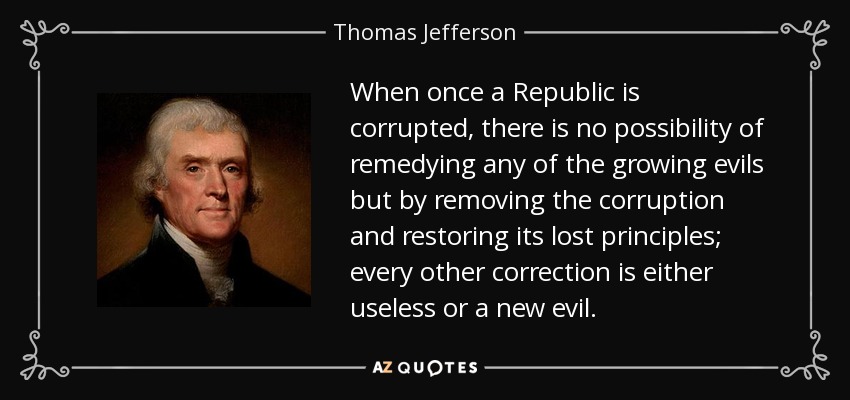

When the working assumption in a two party system is that the other party is the cause of corruption, debate becomes an exercise in futility.

The Dems have detected corruption in their policy, but they blame the president, the Republican party and the American people for representing opposition.

The charges for 'abuse of power' and 'obstruction of Congress' are vague when applied to the president. There is more evidence that Joe Biden was guilty of the abuse of power in Ukraine than Donald Trump.

The president asked for information about the situation in the country. Biden threatened to withhold a billion dollars in aid if they didn't fire the investigator who was exploring the actions of the Bidens.

The 'obstruction of Congress' charge begs the question, obstruction from what? Was the support for regime change by the action of ISIS supposed to represent democracy in the US or the Middle East? It was terrorism. There is a national law against terrorist action.

Rights


Modern republic explicitly acknowledges the right to vote for citizens. A number of amendments were added for the recognition that the right extends to women and people of color.

Republican government did not outlaw slavery in the past. Enslavement was considered a freedom for those who could afford to buy and take care of the slave.

Legislation against the trade and the institution was used to rule out the ownership of other people as a right. The push for treaties for the adoption of legislation against slavery by other nation states was promoted by the British parliament in accord with their monarchy.

Jefferson owned slaves and sent American military personnel to fight against the Berbers to defend the American slave trade. This action didn't allow for the right for slaves to be counted as full citizens.

The slaves were counted as part of the population in a way that contributed to the number of representatives that could be elected to Congress, but the 'democracy' was populist as opposed to Republican.

The term Jeffersonian republican was not representative of Republican democracy. It was populist socialism in the spirit of Plato and the Spartan influence on Athenian populism.

Republic provides concepts for debate about government with the constitution. The Demo-dictum works to overrule reasonable debate in order to establish dominance with stories in the leftist media about Republican corruption.

================

Christianity was drawn from Judaism. It was a Roman derivative.

The Romans were against monotheism as a religious form when they destroyed Jerusalem.

Polytheism as a form was tolerant of extraction from primitive tribalism. Much of the world was organized into tribal society at the time.

Kingdom was one step beyond tribalism. Republic saw itself as a step beyond that.

Vespasian sponsored Josephus to draft of a history of Judea in order to preserve a description of the actions that were taken when Judah was a province. Judah had been ahead of the power curve when it came to the adoption of monotheism.

Christianity became sectarian when the status as the official religion of the empire was used to deny legal standing to other religious forms. Polytheism and Judaism were both persecuted.

Judaism and Islam became the "other" monotheistic forms. It was sectarian religion that sought to institute prejudice against the other forms.

There is a legitimate legal concern about other religious forms in the host country. The investiture controversy sought to give the pope the right to choose the bishops for the Church in every kingdom of the empire after the monarchs had been given the right.

Religion that is used to promote riot, terrorism, rebellion, revolution or world war is not legal. It used to be the case that if some were found to be seditious towards national security, the whole group was punished.

Religion has the cultivation of law abiding behavior as a natural purpose. National law against terrorism is a better legislative action than the promotion of sectarian prejudice.

Wednesday, August 28, 2019

Build

8.28.19
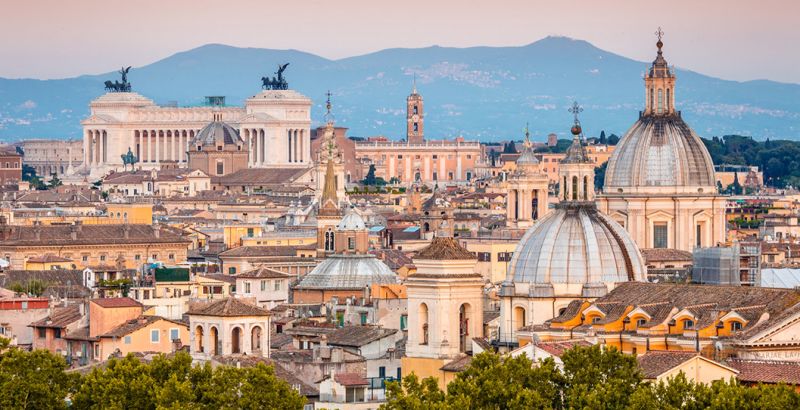
Rome, Italy

Build
Defense
建立防御 
Jiànlì fángyù
防御を構築する 
Bōgyo o kōchiku suru
ps87
Aedificare defensionis

The city was built on a mountain.
The mountain grounded that which was founded.

Height held the advantage of sight for distance.
When invaders attacked the city prepared for resistance.

Traders from different directions could be seen.
Welcome was prepared by the social machine.

The gate to the city welcomed visitors, family and friends.
It wasn't closed to ministers, misters, sisters or gems.

The gate was the way through which travelers entered.
Messengers shared word as a gift from the sender. 

Egypt and Babylon were among those who knew me.
Revelation was the gate for the truth of our history.

Philistia, Tyre and Ethiopia were partners in trade.
Weapons, wheels and cattle were the offerings they made.

The ring of fellowship is that which unites.
Power is grounded in defense of alliance.

Alliance against the destructive elements 
prepares people for defense against violence.

The military is drawn from the people.
Training in strength overcomes feeling feeble.

Search for those lost while at work or at play
lends experience to training in a beneficial way.

The source of life is love.
Rescue comes from within and above.

Zion is a lion on a hill.
Orion and Kiron match the iron will.

------------------------

Psalm 87
Fundamenta ejus

1 On the holy mountain stands the city he has founded; *
the Lord loves the gates of Zion
more than all the dwellings of Jacob.
2 Glorious things are spoken of you, *
O city of our God.
3 I count Egypt and Babylon among those who know me; *
behold Philistia, Tyre, and Ethiopia:
in Zion were they born.
4 Of Zion it shall be said, "Everyone was born in her, *
and the Most High himself shall sustain her."
5 The Lord will record as he enrolls the peoples, *
"These also were born there."
6 The singers and the dancers will say, *
"All my fresh springs are in you."

--------------------------

8.28

Freedom

Augustine was an early Roman Christian theologian and philosopher from Africa. He was born in Thagaste. He became the bishop of Hippo Regius. Both cities are in present day Algeria.

He is viewed as one of the most important Church Fathers in western Christianity. He wrote in the Patristic era. “The City of God,” “On Christian Doctrine” and “Confessions” are among his most important works.

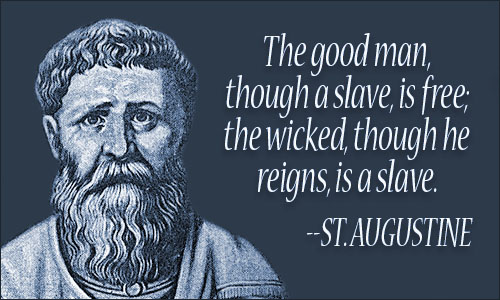
Augustine has been criticized as neo-Platonic in his philosophy and theology. His statement about the good man is a modification of what Plato had to say about slavery.

There isn't a king that wasn't descended from a slave. There is not a slave who did not have royal ancestors. When slavery was a spoil of war, the rulers who were not killed were enslaved to serve the conquering force.

He has been criticized for his philosophy because he defined human nature as totally corrupt. This had dark political implications in relation to Plato's definition of republic.

The Spartans were in the ascendance politically when he shifted the dialog of Socrates from the defense of democracy as practiced with Pericles to an advocacy for a form of government that was oppressively militaristic in aggression.

Athenian men were actively involved in the decisions made for the city state. The citizens were controlled by the destructive use of elements in the republic. Plato defined democracy as dictatorship when he overturned an earlier judgment.

Augustine's statement about the good man wasn't a rejection of slavery. It was a qualification of goodness in corrupted nature The statement was made in the "City of God." Given the postulation of a 'just war' this has dark implications in the context of a Constitution that ascribes the 'right' to declare war to an authority of the state.

Augustine said that John the Baptist did not bid soldiers to give up soldiering. He told them to do no violence and to be content with pay. This doesn't forbid soldiering or war.

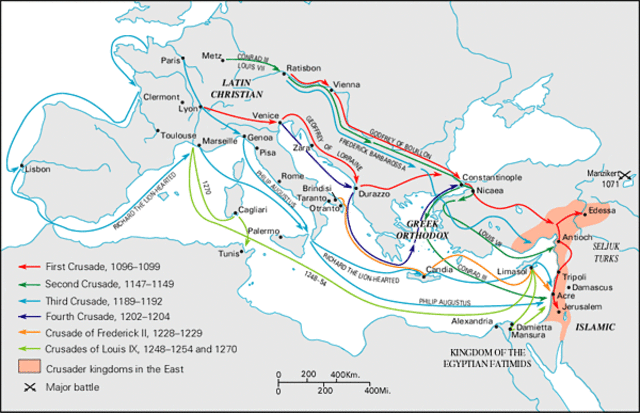
It is a ban against invasion. The crusader popes thought that reclaiming the city of Jerusalem and the surrounding territory was a just cause for invasion. The proposal wasn't well received by those who had to pay for it.

Much of the domestic political strife in Europe resulted from immoral political proposals from the papal office. The popes had had to work their way into a position of authority with the development of monotheism as the prevailing cultural force for the European homeland.

There are grounds to argue that the crusades were conducted for a defensive purpose, but there was a significant consequence that resulted from the sectarian position that promoted the policy.

The Judean homeland was redefined as 'Christian' when it was Roman. Jews in Europe weren't the only ones who suffered from the Inquisition as the aggressive policy that sought to insure victory for Christian monotheism. Those Christians, Druids and Wiccans who did not agree strongly enough with the position of the Church militant were persecuted as well.

Augustine was on the ground floor for the development of monotheism as the dominant cultural force for Europe. What was his life like? Why did he write the "City of God"? How did his life affect the future that he envisioned for Rome?

Augustine of Hippo
b. 11.13.354 Thagaste 
d. 8.28.430 Hippo Regus, Numidia

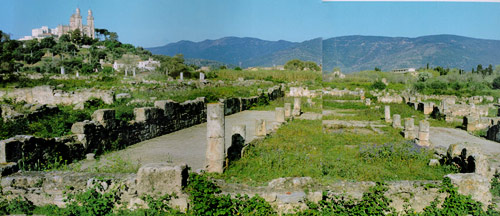
Augustine was born on November 11 in the year 354 in the municipium of Thagaste  in the Roman province of Numidia. Thagaste is now Souk Ahras, Algeria.

Tipaza, Home of the Gods

He learned about the religious differences in the Roman empire from his parents. His father was a pagan who honored the Punic gods. His mother was a zealous Christian. Augustine was not interested in religion and education in his youth.
Pigs

The adolescent Augustine was interested in sex and mischievous living. He confessed that he had joined with friends to steal pears from a neighbor's vineyard. The purpose was "not to eat them ourselves but simply to throw them to the pigs."

Ruins in Carthage

Augustine set off to school in Carthage at age 17. The country boy was in the jewel of North Africa. There the underachiever became enraptured with his studies and started to make a name for himself.

He immersed himself in the writings of Cicero and the Manichaean philosophers. He cast off the vestiges of his mother's religion.

Amphitheater in Thagaste

Augustine returned to his home town of Thagaste to teach rhetoric when his studies were completed. He taught some Manichaeism on the side.

The philosophy was based on the teachings of a Persian named Mani. Mani believed that the teachings of the Buddha, Zoroaster and Jesus were incomplete. His revelations were for the entire world. He called his teachings the "Religion of Light." He claimed to be the Paraclete for truth as promised by Jesus.

Mani

Manichaeism purported to be the true synthesis of all the religious systems then known. It composed of Zoroastrian Dualism, Babylonian folklore, Buddhist ethics and some small and superficial additions of Christian elements. It was a dualist corruption of Christianity in the western world.

Seneca on Religion

It professed to be a religion of pure reason as opposed to Christian credulity. It professed to explain the origin, the composition and the future of the universe. It had an answer for everything and despised the mysteries of Christianity. The sacraments of Christianity were developed in relation to the mystery cults of polytheism when it was an 'underground' religious development.

Manichaeism taught that the world of light and the world of darkness constantly war with each other. War caught humanity in the struggle.

The Higher Nature

Manichaeism offered Augustine a way to accommodate his conflicts. He could pursue his career and retain his partner while purging his sins through his service to the pure Elect. He could blame his sins on his lower alien nature. The lower nature had been made by the power of evil like the material world. The doctrine taught that his true self would eventually shed this alien nature.

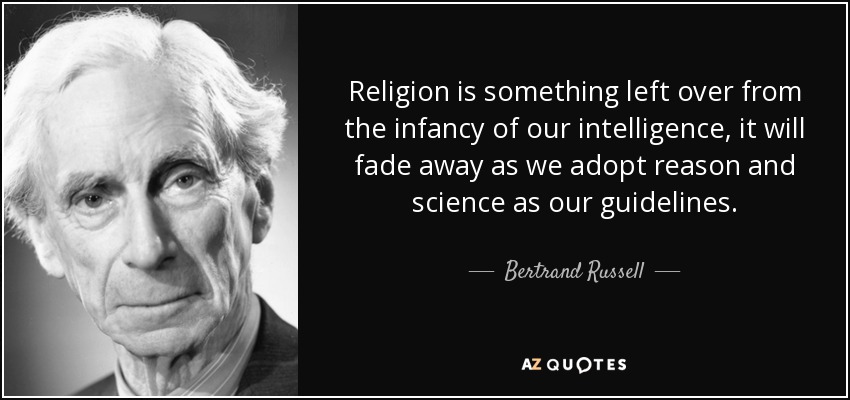
Quote Against Religion

Manichaeism also modified the need to respect the name of Christ that was instilled by his childhood. His initial distaste for the Christian scriptures was gratified. He could regard the Bible as a crude and contaminated attempt at the truth. The Manichaean scriptures offered the name of Christ and what seemed to be a profound understanding of the universe and of human life.

Slave to Pleasure

Augustine had joined the wildest young men of Carthage. They were called the "overturners" or the "destroyers." He became the delighted slave to pleasure in Carthage as a Manichee. Festivals celebrating the gods were used for drunken revelry. He took a partner. They soon were parents of a baby boy whom they named Adeodatus.

Augustine tried to hide his views from his mother, Monica. She threw him out of the house when she discovered them.

Monica had dreamed that her son would become a Christian. She continued to pray and plead for his conversion. She followed him to Carthage when he moved there to teach. She begged him not to go when Augustine was offered a professorship in Rome. He told her to go home and sleep comfortably in the knowledge that he would stay in Carthage. He boarded a ship for Rome when she left.

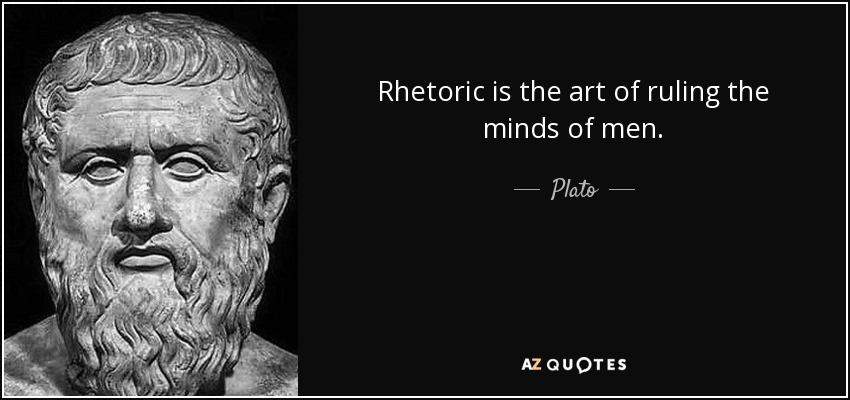
Rhetoric – Plato

Augustine moved again after a year in Rome. He became the professor of rhetoric for the city of Milan. There he began attending the cathedral to hear the impressive oratory of Ambrose the bishop.

He kept attending because of Ambrose's power as a preacher. He soon dropped his Manichaeism in favor of Neoplatonism. This was the philosophy of both Roman pagans and Milanese Christians.

Pears

Augustine was struggling with himself. This struggle added to the emotional strain of forsaking his lover and the shift in philosophies. He had sought to overcome his fleshly passions for years. Nothing seemed to help.

It seemed to him that even his smallest transgressions were weighted with meaningful consequence. When he wrote about the pear stealing of his youth he reflected, "Our real pleasure consisted in doing something that was forbidden. The evil in me was foul, but I loved it."

“Take up and read.”
Benozzo Gozzoli

He wrestled anxiously about such matters one afternoon while walking in his garden. Suddenly he heard a child's sing-song voice repeating, "Take, read." (Tolle, legge) A collection of Paul's epistles that he'd been reading laid on a table.

He picked it up and read the first thing he saw: "Not in reveling and drunkenness, not in lust and wantonness, not in quarrels and rivalries. Rather, arm yourselves with the Lord Jesus Christ, spend no more thought on nature and nature's appetites" (Romans 13:13-14)

He later wrote, "No further would I read; nor needed I: for instantly at the end of this sentence, by a light as it were of serenity infused into my heart, all the darkness of doubt vanished away."

Cassiaco

Augustine's conversion sent shockwaves through his life. He resigned his professorship, dashed off a note to Ambrose telling of his conversion and retreated to a country villa in Cassiciacum with his friends, mother and his son, Adeodato.

There he continued discussing philosophy and churning out books in a Neoplatonist vein. He wrote the “Dialogs.”  He returned to Milan after a year to be baptized by Ambrose, then headed back to Thagaste to live as a writer and thinker.

He had lost his mother, his son and one of his closest friends by the time he reached his home town. The journey was lengthened by political turmoil.

These losses propelled Augustine into a deeper, more vigorous commitment. He established a lay ascetic community in Thagaste to spend time in prayer and the study of the Scriptures with his friends.

Church Ruins Annaba (formerly Hippo)

Augustine traveled to Hippo in 391 to see about setting up a monastery in the area. His reputation went before him. The story goes that Bishop Valerius put aside his prepared sermon and preached on the urgent need for priests in Hippo when he saw the renowned layman in church one Sunday.

The crowd stared at Augustine. They pushed him forward for ordination. Augustine was made a priest against his will. The laity thought that his tears of frustration were due to his wanting to be a bishop rather than priest. They assured him that good things come to those who wait.

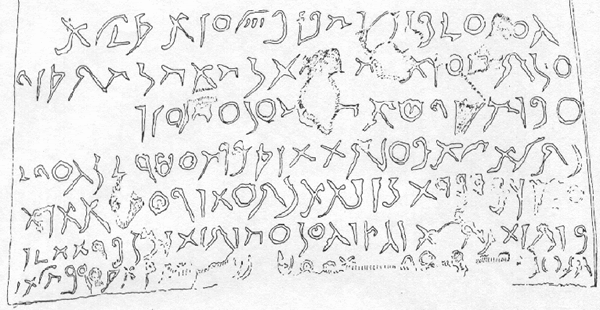
Neo-Punic from Tunisia

Valerius spoke no Punic. It was the local language from Phoenician sources. He quickly handed over teaching and preaching duties to his new priest. Augustine spoke the local language fluently. Augustine became bishop of Hippo within five years after Valerius died.

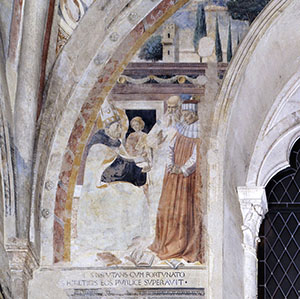
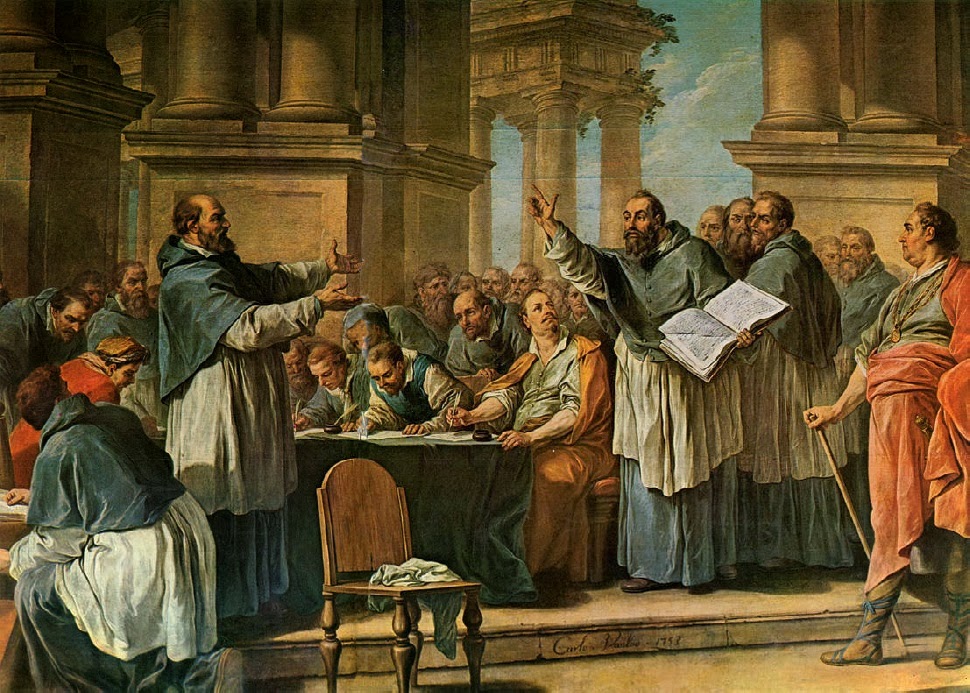
Dispute with Fortunatus
Church of St. Augustine
San Gimignano, Italy

Guarding the church from internal and external challenges topped the new bishop's agenda. The church in North Africa was in turmoil. Though Manichaeism was already on its way out, it still had a sizable following.

Augustine knew its strengths and weaknesses. He debated Fortunatus, a former schoolmate from Carthage and a leading Manichaean at the public baths. The bishop argued against the errors in the doctrine. Fortunatus left town.

Dispute with the Donatists

Donatism was more difficult to handle. It was a schismatic and separatist North African movement in the church. The Roman governor of North Africa had been lenient to the large Christian minority during his rule through the persecutions. 

“Traditors” is the root word for traitors.

He was satisfied when Christians handed over their scriptures as a token repudiation of their faith. Christians who did so were called traditors or “those who handed things over” by their critics. The critics were mainly from the lower class.

The Donatists were rigorists like the third century Novatianists. They held that the church must be a church of “saints”, not “sinners.” Sacraments administered by traditors were invalid.

No one without a past.


Donatists believed the Catholic Church had been compromised and that catholic leaders had betrayed the church during earlier persecutions. Augustine argued that catholicism was the valid continuation of the apostolic church.

He wrote scathingly, "The clouds roll with thunder, that the house of the Lord shall be built throughout the earth; and these frogs sit in their marsh and croak 'We are the only Christians!' "

None Righteous
Romans 3:10

The controversy came to a head as the imperial commissioner convened a debate in Carthage in 411 to decide the dispute. The commission had been appointed by Pope Militiades. Augustine's rhetoric refuted the Donatist doctrine. The commissioner pronounced against the group.

No Sin
1 John 1:8

The Donatists were repressed along with the Circumcellions. They condemned property and slavery. They advocated free love, canceling debt and freeing slaves.

The term "Circumcellions" was coined by others, based on "circum cellas euntes". They “go around units” because "they roved about among the peasants, living on those they sought to indoctrinate."

The condemnation of Donatism did not produce a time of rejoicing for the church. The year before the Carthage conference, the barbarian general Alaric and his troops sacked Rome.

Many upper-class Romans fled for their lives to North Africa. It was one of the few safe havens left in the empire. Augustine was given a new challenge. He wrote a defense for Christianity against claims that it had caused the empire's downfall by turning eyes away from Roman gods.

City of God

Augustine's response to the criticism came in “The City of God.” The work included 22 volumes. It took over 12 years to write. He argued that Rome was punished for past sins, not new faith.

His neo-Platonism provided a bridge to monotheism, but the convictions regarding the corruption of human nature and 'just war' allowed for the perpetuation of the fatalism that was so reflective of the polytheistic Roman order.

His lifelong obsession with original sin was fleshed out. His work formed the basis for the medieval mind. "Mankind is divided into two sorts," he wrote. "Such as live according to man, and such as live according to God. These we call the two cities… The Heavenly City outshines Rome. There, instead of victory, is truth."

Sin City

Pelagianism was another front Augustine had to fight to defend Christianity. Pelagius was an Irish monk. He gained popularity just as the Donatist controversy ended. He rejected the idea of original sin. He insisted instead that the tendency to sin is humankind's own free choice.

Jerome and Augustine saw Pelagianism as the ‘heresy of Pythagoras and Zeno.’ It amounted to the act of saying that slavery was not slavery. It was the ‘sin’ that had justified the overthrow of Babylon by Cyrus and the Achaemenid Persians.

Divine grace was not seen as necessary to do the will of God. The church excommunicated Pelagius in 417, but his banner was carried on by young Julian of Eclanum.

Julian took potshots at Augustine's character as well as his theology. He argued that Augustine and his other low-class African friends had taken over Roman Christianity. Augustine argued with the former bishop for the last ten years of his life.

Vandal Invasion

The Vandals invaded North Africa in the summer of 429. They met almost no resistance along the way. Hippo was one of the few fortified cities. It was overwhelmed with refugees.

The 76-year-old Augustine died in the third month of the siege. He was not killed by an arrow. He died from a fever.

His writings survived the Vandal takeover miraculously. His theology became one of the main pillars on which the church of the next 1,000 years was built.

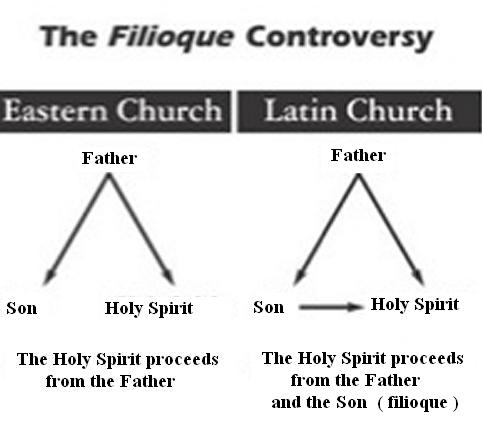
And the Son

Some of his teachings have been disputed in the East. Theologians such as John Romanides have questioned his assertion regarding the degree of depravity in human nature and the Neo-Platonic argument regarding the names of God.

Theologians like Georges Florovsky in the Eastern Orthodox Church have shown significant appropriation of his writings.  The most controversial doctrine surrounding his name is the fililoque clause.

The clause regarding the procession of the Spirit added “from the Son” to the Nicene Creed. This clause has been rejected by the Orthodox Church.

Predestined to Original Sin?

Other disputed teachings include his views on original sin, the doctrine of grace and predestination.  Though considered to be mistaken on some points, he is still considered a saint.

He has even influenced Eastern Church Fathers like Gregory Palamas. Augustine "established anew the ancient Faith" according to his contemporary Jerome.


Lectionary Augustine of Hippo
wiki Augustine of Hippo
Christianity Today: Theologian Augustine
IEP Philosopher Augustine
Augustinian Augustine
Manichaeism
Persian Religion

Sunday, August 18, 2019

Respect

8.25.19

Respect
Life
尊重生命 
Zūn chóng shēngmìng
生活を尊重する
Seikatsu o sonchō suru
ps103
Haec sane debita reverentia vitae

Bless the truth, O my soul.
Let all that is within me revere the goal.

Respect that which is benign for life.
Don't forget that love relieves strife.

Favor intelligence by design.
Don't forget what you find by faith in the divine.

There is forgiveness for error.
There is relief from that which causes terror.

There is healing from infirmities.
There is the unity in diversity.

There is redemption from fear of the grave.
The attitude of gratitude crowns our hearts for what saves.

Mercy illumines our hearts and minds.
Law binds that which would otherwise despise what investigation finds.

There is satisfaction for good things.
Your youth will rise high like the wind beneath eagle wings.

Judgement will be for education, the disabled and defense.
The poor will rise without crime for what makes sense.

Spending will be for national and social security.
Balance will be found with seasoned maturity.

Goodness is defined by meeting basic needs.
Each household heeds what it takes to feed.

Law is against cruelty or violence.
It is for justice that breaks the silence.

Accusation must be preceded by cause.
Investigation has to be done to find truth without flaws.

Conviction yields only to proof in the body of evidence.
Certainty finds substance beyond mere coincidence.

Punishment will confine for a time or charge with a fine
but life in prison is the limit for capital crime.

You have come to the heavenly Jerusalem
where angels gather like a festal array of lucidum.

The assembly of alliance for self-reliance
are enrolled for the Judge of all with the spirits of the righteous.

This is the city of the living God on Zion.
it is the home for the defiance of pious lions.

Jesus is the mediator for a new covenant
that modifies the old as a supplement. 

The daughter of Abraham whom Satan had bound for 18 years
deserved to be set free from bondage to her chain of tears.  

We have been drawn from the water of tidal surge.
We are learning from the verge of the urge to emerge
from the purge.

There has been compassion for mercy in survival.
The arrival of strength from the rival was vital.

Anger was a prelude to kindness.
The timeless mind sought to find us in life's likeness.

Respect that which is benign for life.
Don't forget that love relieves strife.

Succulent Garden

You will be like a garden by a spring
whose waters never fail the ardent pardon
from the heat of the sun's arson.

Don't forget what you find by faith in the divine.
Respect intelligence by design.

Let all that is within me bless the goal.
Bless the truth, O my soul.

-----------------------

103
Benedic, anima mea
Bless, my soul

1 Bless the Lord, O my soul,
and all that is within me, bless his holy Name.
2 Bless the Lord, O my soul,
and forget not all his benefits.
3 He forgives all your sins
and heals all your infirmities;
4 He redeems your life from the grave
and crowns you with mercy and loving-kindness;
5 He satisfies you with good things,
and your youth is renewed like an eagle's.
6 The Lord executes righteousness
and judgment for all who are oppressed.
7 He made his ways known to Moses
and his works to the children of Israel.
8 The Lord is full of compassion and mercy,
slow to anger and of great kindness.
9 He will not always accuse us,
nor will he keep his anger for ever.
10 He has not dealt with us according to our sins,
nor rewarded us according to our wickedness.
11 For as the heavens are high above the earth,
so is his mercy great upon those who fear him.
12 As far as the east is from the west,
so far has he removed our sins from us.
13 As a father cares for his children,
so does the Lord care for those who fear him.
14 For he himself knows whereof we are made;
he remembers that we are but dust.
15 Our days are like the grass;
we flourish like a flower of the field;
16 When the wind goes over it, it is gone,
and its place shall know it no more.
17 But the merciful goodness of the Lord endures for ever
on those who fear him,
and his righteousness on children's children;
18 On those who keep his covenant
and remember his commandments and do them.
19 The Lord has set his throne in heaven,
and his kingship has dominion over all.
20 Bless the Lord, you angels of his,
you mighty ones who do his bidding,
and hearken to the voice of his word.
21 Bless the Lord, all you his hosts,
you ministers of his who do his will.
22 Bless the Lord, all you works of his,
in all places of his dominion;
bless the Lord, O my soul.

-----------------------

Isa. 58:11

The LORD will guide you continually
to satisfy your needs in parched places
and make your bones strong.
You will be like a watered garden
with a spring of water
whose waters never fail.

-----------------------

You will be like a watered garden by a spring
whose waters never fail the ardent pardon
from the larceny of the heat's arson.

=================

Hebrews 12:22-24

You have come to the city of the living God on Mount Zion. It is the heavenly Jerusalem with innumerable angels in festal gathering. The assembly of the firstborn are enrolled in heaven for God the judge of all and the spirits of the righteous made perfect. Jesus is the mediator of the new covenant with sprinkled blood that speaks a better word than the blood of Abel.

-----------------------

You have come to the heavenly Jerusalem
where angels gather like a festal array of lucidum.

The assembly of alliance for self-reliance
are enrolled for the Judge of all with the spirits of the righteous.

This is the city of the living God on Zion.
it is the home for the defiance of pious lions.

Jesus is the mediator for a new covenant
that modifies the old as a supplement.

=================

Luke 13:14-16

The leader of the synagogue was indignant because Jesus had cured on the sabbath. He kept saying to the crowd, 'There are six days on which work ought to be done. Come on those days and be cured. Not on the sabbath day.'

The Lord answered him and said, 'You hypocrites! Does not each of you untie his ox or his donkey from the manger and lead it away to give it water on the sabbath? Ought not this woman, a daughter of Abraham whom Satan bound for 18 years, be set free from this bondage on the sabbath day?'

-----------------------

The daughter of Abraham whom Satan had bound for 18 years
deserved to be set free from bondage to the chain of tears.

=================

Administration

Louis IX of France
b. 4.25.1214  Poissy, France
d. 8.25.1270 French Tunis, North Africa

Louis IX was King of France in the 13th century. He is a canonized Catholic and Anglican saint.
He was a reformer who developed French royal justice. The king was the supreme judge. Anyone could appeal to him to seek the amendment of a judgment.

He banned trials by ordeal, tried to prevent the private wars that were plaguing the country and introduced the presumption of innocence in criminal procedure. He created provosts and bailiffs to enforce the application of this new legal system.

Louis IX took an active part in the Seventh Crusade following a vow he made after a serious illness. He died from dysentery during the Eighth Crusade. He was succeeded by his son Philip III.

He is the only canonized king of France.

Poissy

Poissy is located in the western suburbs of Paris. It is 23.8 km (14.8 mi) from the center of the city. It is on the Seine River.

It contains the 12th-century collegiate church of Notre Dame and the Savoye House (1929–31).
It was the birthplace for Louis IX in the early part of the 13th century.

Louis IX

Louis IX was born in Poissy on 25 April 1214. He was the son of Louis the Lion and Blanche of Castile. He was baptised in La Collégiale Notre-Dame church. His grandfather on his father's side was Philip II, king of France. His grandfather on his mother's side was Alfonso VIII, king of Castile.

Tutors of Blanche's choosing taught him most of what a king must know. He was given instruction in Latin, public speaking, writing, the military arts and government.

He was 9 years old when his grandfather Philip II died. His father ascended as Louis VIII. Louis was 12 years old when his father died on 8 November 1226. He was crowned king within the month at Reims Cathedral, the traditional location for the coronation of kings in France. His mother ruled as regent during his minority because of his youth.

French Unity

Louis was the 9th ruler in the Capetian dynasty. The Capetians ruled the Kingdom of France from 987 to 1328. Blanche dealt with the opposition of rebellious vassals and put an end to the Albigensian Crusade which had started 29 years earlier.

Inquisition

Pope Innocent III had started the Inquisition against the Cathars from the beginning of his time in office in 1198. It turned into a twenty year military campaign in southern France known as the Albigensian Crusade (1209–1229).

Louis IX forbade all forms of usury in 1230. Usury was defined at the time as any taking of interest. Louis exacted from the lenders a contribution towards the crusade which Pope Gregory was then trying to launch. Pope Gregory IX instituted the papal inquisition in 1233.

While he did not approve of the use of torture in investigation, punishments included wearing a yellow cross, the confiscation of property, life imprisonment or death. Death for heresy as a crime had been started by Justinian. Burning at the stake was the capital punishment for heresy.

He also ordered the burning of some 12,000 manuscript copies of the Talmud and other Jewish books in Paris at the urging of Pope Gregory IX in 1243. This was an example of sectarian policy as promoted by the papal office. The edict against the Talmud was overturned by Gregory IX's successor, Innocent IV, but other expressions of particular favor for Christian monotheism would follow.

The Crusades and the Inquisition may have had defense of the Roman Empire as a consideration, but the offensive nature of the sectarian statements skewed objectivity in impartial judgment.

Louis IX faced recurring conflicts with some of the most powerful nobles as an adult. Henry III of England tried to restore his continental possessions, but was defeated at the battle of Taillebourg.

Several provinces were annexed in this time. Normandy, Maine and Provence were notable examples.

Louis worked for the political unification of France amidst the competition between kingdoms in the Roman Empire. 

The empire was engaged in the effort to put Jerusalem and surrounding territory under Catholic jurisdiction. This is where the 'universal' implication of catholic Christianity threatened to be too costly with regards to expansion by military aggression.

The defense of the Holy Land made sense for Rome and Europe with respect for the threat of Muslim invasion, but it threatened the security of Muslim territory with the imposition of Christianity as the official religion for them.

The Sainte-Chapelle or ‘Holy Chapel’ was built to house Louis IX’s collection of relics of Christ. The relics included the Crown of Thorns, the image of Edessa and about thirty other items.

Louis purchased his Passion relics from Baldwin II, the Latin emperor at Constantinople, for the sum of 135,000 livres. The money was actually paid to the Venetians to whom the items had been pawned. The relics arrived in Paris in August 1238. They were carried from Venice by two Dominican friars.

La Sainte-Chapelle

Louis made a vow to lead a crusade when he was suffering from a serious illness. He took part in the Seventh Crusade in 1248 after a miraculous cure. The military action would end the Ayyubid Dynasty.

Ayyubid Empire

The Ayyubid dynasty was a Muslim dynasty of Kurdish origin. It was founded by Saladin. It was centered in Egypt. The dynasty lasted through the 12th and 13th centuries CE. It ruled much of the Middle East.

Saladin had been the vizier of Fatimid Egypt. He was a Sunni. The Fatimids claimed descent from Fatima bint Muhammad. She was the daughter of Islamic prophet Muhammad. The Fatimid caliphate was a Shia Islamic caliphate that spanned a large area of North

Saladin brought an end to Fatimid rule in 1171. He proclaimed himself sultan following the death of the Zengid ruler Nur ad-Din in 1174. The Zengids were a Muslim dynasty of Oghuz Turk origin. They ruled parts of the Levant and Upper Mesopotamia on behalf of the Seljuk Empire.

The Ayyubids spent the next decade launching conquests throughout the region. The territories under their control included Egypt, Syria, northern Mesopotamia, Hejaz, Yemen and the North African coast up to the borders of modern-day Tunisia by 1183.

Saladin took the Kingdom of Jerusalem with his victory at the Battle of Hattin in 1187. The Crusaders managed to regain control of Palestine’s coastline in the 1190’s.

Saladin’s brother al-Adil eventually established himself as sultan in 1200 after a contest with his twelve sons. The later Ayyubid sultans of Egypt descended from him.

The Ayyubid emirs of Syria attempted to assert their independence from Egypt in the 1230’s. They remained divided until Sultan as-Salih Ayyub restored Ayyubid unity by taking over Syria by 1247. Only Aleppo remained independent.

Local Muslim dynasties had driven out the Ayyubids from Yemen, the Hejaz and parts of Mesopotamia by then.

Egypt

The base of Muslim power had shifted to Egypt. Louis did not attempt to take the Holy Land. He  left for Egypt in 1248. Any war against Islam fit the definition of a Crusade by this point. The crusaders landed in Egypt on June 5, 1249. Louis began his first crusade with the rapid capture of the port of Damietta.

Map of Crusades

The Crusader fleet of 1,800 boats and ships had arrived in Cyprus with the intent of launching a Seventh Crusade against the Muslims by conquering Egypt in 1248.

King Louis IX had attempted to enlist the Mongols to launch a coordinated attack on Egypt. When this failed to materialize, the Crusader force sailed to Damietta and the local population there fled as soon as they landed.

As-Salih Ayyub was in Syria at the time. When he heard about the fall of Damietta, he rushed back to Mansurah in Egypt. He organized an army and raised a commando force to harass the Crusaders.

As-Salih Ayyub was not well. His health deteriorated further due to the mounting pressure from the Crusader offensive. The march from Damietta toward Cairo through the Nile River Delta went slowly. The rising of the Nile and the summer heat made it impossible for them to advance quickly to follow up on their success.

Ayyub’s wife, Shajar al-Durr called a meeting for the generals. She became commander-in-chief of the Egyptian forces. She ordered the fortification of Mansurah. Then she stored large quantities of provisions and concentrated her forces there.

She organized a fleet of war galleys to be scattered at various strategic points along the Nile River. The Ayyubid sultan died during this time. Shajar al-Durr set a sudden power shift in motion that would make her Queen. She would eventually place the Egyptian army of the Mamluks in power.

Louis lost his army at the Battle of Al Mansurah. He was captured by the Egyptians on April 6, 1250. His release was negotiated in return for a ransom of 400,000 livres toumois and the city of Damietta. France’s annual revenue was only about 1,250,000 livres toumois at the time. 400,000 was a king’s ransom.

Louis spent four years in the Latin kingdoms of Acre, Caesarea and Jaffa following his release from captivity. He used his wealth to assist the Crusaders in rebuilding their defenses. He also engaged in diplomacy with the Islamic powers of Syria and Egypt. He and his army returned to France in the spring of 1254.

Ayyubid power in Egypt effectively ended after the seventh crusade. They had ushered in an era of economic prosperity in the lands they ruled. The facilities and patronage provided by the Ayyubids led to a resurgence in intellectual activity in the Islamic world.

Sunni Muslim dominance had been strengthened in the region by the construction of numerous madrasas (schools of Islamic law) in their major cities.

A number of attempts by the emirs of Syria to wrest back control of Egypt failed. These attempts were led by an-Nasir Yusuf of Aleppo. The Mongols sacked Aleppo and conquered the remaining territories of the Ayyubids soon after in 1260. The Mamluks forced out the Mongols after the destruction of the Ayyubid dynasty. The Ayyubid principality of Hama remained.

Louis IX must have seen at least one of the hospitals that had been built by the Muslims when he was in the Middle East. He visited the Holy Land after his release from captivity in 1250. It is likely that he saw the hospital in Divrigi in Anatolia. The mosque and hospital are located in present day Turkey. 

Hospitals
Divrigi Hospital (1228-29)

UNESCO Heritage Site
UNESCO

The Great Mosque and Hospital of Divrigi is a building that combines a monumental hypostyle mosque with a two story hospital and a tomb. It is located on the slopes below the castle of Divrigi, Sivas Province in central eastern Turkey.

If was founded by the Mengücekide emir Ahmed Shah following the victory of the Seljuk Turks over the Byzantine army at the battle of Malazgirt in 1071.

Mengujekids
wiki Mengujekids

A medical center, or Darüşşifa, was built in 1228 by Turan Melek Sultan, daughter of the Mengujek ruler of Erzincan, Fahreddin Behram Shah.

Quinze-Vingts
1260

Louis IX built a hospital for the poor, sick and blind when he returned from the Middle East. The Quinze-Vingts or the Fifteen Score, originally sheltered 300 inmates. His reign inspired the building of Gothic cathedrals.

Robert de Sorbon, the founder of the Sorbonne University of Paris was his confessor and personal friend. Thomas Aquinas was a frequent guest at his table.

Scientific Learning

Thomas Aquinas

The kingdom of France was at its height in Europe, both politically and economically, during the so-called "golden century of Saint Louis."  Louis was regarded as "primus inter pares", first among equals, among the kings and rulers of the continent. The title clarifies the meaning for the position as king of kings.

He commanded the largest army and ruled the largest and wealthiest kingdom. Paris was the European center for the arts and intellectual thought for the time. The foundations for the famous college of theology later known as the Sorbonne were laid in Paris about the year 1257.

Thomas Aquinas was appointed regent master in theology at Paris in the spring of 1256. His tenure ran from 1256 to 1259. He wrote numerous works. He was working on one of his most famous works, Summa contra Gentiles, by the end of his regency.

It was during the time that Thomas was first in Paris that Louis signed the Treaty of Corbeil and the Treaty of Paris. Louis renounced his feudal lordship over the county of Barcelona and Roussillon in the Treaty of Corbeil with James I of Aragon in 1258.

James renounced his lordship over several counties in southern France including Provence and Languedoc. The treaty ended 100 years of conflicts between the Capetian and Plantagenet dynasties.

Louis signed the Treaty of Paris in 1259 with Henry III of England. Henry was assured of his possession of territories in southwestern France. Louis received the provinces of Anjou, Normandy, Poitou, Maine and Touraine.

The Dominican order assigned Thomas to be regent master at the University of Paris for a second time in 1268. He held the position until the Spring of 1272. The rise of ‘Averroism’ or ‘radical Aristotelianism’ in the universities was part of the reason for this reassignment.

Averroes was a Muslim scholar who wrote about his appreciation for Aristotle’s philosophy. He was Andalusian. Al-Andalus was the name for Islamic Spain or Iberia. Spain was governed by Muslims to various degrees between 711 and 1492.

The Muslim Empire had expanded across North Africa into Iberia. Cordoba Spain was multi-cultural. Averroes was commissioned to translate Aristotle. He was against the Timocracy and neo-Platonism of a number of Muslim clerics, but he disagreed with the negative opinion of women expressed by Aristotle.

He asserted that women could hold position of leadership in society. While they were not as strong in certain regards, they were better in others. He was not  as influential in the Muslim world as he was in Europe. Aristotle did not find a successor to Ibn Rushd after his death.

Aquinas wrote two works against Averroism. He argued that it was incompatible with Christian doctrine. He was particularly concerned with the “beginninglessness of the world” or the eternal existence of matter.

Aquinas was an advocate for Aristotle also. He called him “the philosopher.” He might have learned about Aristotle from the work of the Muslim.  Given the Crusades and the Inquisition, the position might have gotten him accused of heresy.

There were those in the ecclesiastical community, including the Augustinians, who were fearful that this philosophy might somehow contaminate the purity of the Christian faith.

Aquinas expressed deep concern at the spread of Averroism. He was angered when he discover Siger of Brabant had been teaching Averroistic interpretations of Aristotle to Parisian students. Did he talk with Louis IX and the Bishop of Paris about his reservations?

The Bishop of Paris, Etienne Tempier, issued an edict condemning thirteen Aristotelian and Averroistic proposition as heretical. Anyone who continued to support them after the edict was issued on December 10, 1270 was to be excommunicated.

Thomas conducted a series of disputations between 1270 and 1272 in what appears to be an attempt to counteract the growing fear of Aristotelian thought. He wrote De virtutibus in communi (On Virtues in General), De virtutibus cardinalibus (On Cardinal Virtues), De spe (On Hope) during this time.

Map

Louis IX reduced private wars among French nobles and vassals that had ravaged France before his time. He protected vassals from oppression. He required their lords to fulfill their obligations.

He reformed taxation. He improved the courts. Every man in France had a better chance of receiving justice than had previously been the case. He promoted written law to make it clear what the laws were. Major strides were made toward replacing trial by combat with trial by jury.

Louis IX was a reformer. He developed French royal justice. The king was the supreme judge to whom anyone could appeal to seek amendment for a judgement. He banned trials by ordeal. He tried to prevent the private wars that were plaguing the country.

He introduced the presumption of innocence in criminal procedure. He created provosts and bailiffs to enforce the application of the new legal system.

His rule was also characterized by the leading alliance with the papal office. He punished blasphemy, gambling, interest bearing loans and prostitution. He bought the presumed relics of Christ. He build the Sainte-Chapelle for the relics. He expanded the scope of the Inquisition and ordered the burning of Talmuds.

Burning at the Stake
The Eighth Crusade
Defeated by Disease

Louis and his three sons took up the cross in a parliament held at Paris on March 24, 1267. He resolved to land at Tunis after hearing reports from missionaries. He ordered his younger brother, Charles of Anjou, to join him there. The crusaders landed at Carthage on July 17, 1270. Prince Edward of England was among them.

Disease broke out in the camp. Many died of dysentery. Louis himself died on 25 August.
Louis IX had been invested with the mission to act as "lieutenant of God on Earth" when he was crowned in Rheims.  He took his mission seriously as a christian.

He conducted two crusades to fulfill his duty. They contributed to the prestige of the French crown with the pope even though they were unsuccessful. The seat for the papal see would eventually move to Avignon for a substantial length of time.

He was never heard to speak ill of anyone. He excelled in penance and had a great love for the Church. He was merciful even to rebels. When he was urged to put a prince to death, he refused, saying: "A son cannot refuse to obey his father.” The prince had followed his father into the rebellion.

The scope of the Inquisition was expanded during his reign in France . Southern France was most affected by this expansion. That is where the Cathars were located. The rate of  the confiscations reached its highest levels in the years before his first crusade. It slowed upon his return to France in 1254.

Louis IX tried to fulfill the duty of France, which was seen as "the eldest daughter of the Church" (la fille aînée de l'Église). This title had been instituted in the time that Charlemagne had been crowned by the Pope Leo III in Rome in 800. The official Latin title of the kings of France was Rex Francorum, i.e. "king of the Franks."

This defined the role of France in the Roman empire as the protector of the Church.

Some of the judgments made by Louis IX were twisted by Catholic devotion. The punishments were a Christian modification of the classical tradition that retained cruelty with a sectarian monotheistic base.

The punishment for blasphemy was the mutilation of the tongue and lips. Some actions that had not been criminal were redefined as such. Gambling, interest-bearing loans and prostitution became punishable offenses.

He spent exorbitant sums on presumed relics of Christ. He built the Sainte-Chapelle to house the objects for worship. He expanded the scope of the Inquisition and ordered the burning of Talmuds and other Jewish books. Some of his reforms were prohibitive, sectarian and punitive.

The modern reader is left to wonder if the Frankenstein monster was an image of the French (Franco) and German (einstein) competition to act as protectors of the resurrection of the “new” Church in the empire.

Peace


The opening statement for this presentation argues that true peace is the presence of justice. An abundance of evidence supports the contention that the Inquisition and the Crusades were sectarian devices designed to take money from people by telling them a story about how political exploitation by the invasion of foreign territory is for their protection.

The use of propaganda to justify war indicates an even broader offense. It is not just sectarian. It is partisan. If sectarian diversions were to be removed from belief in a war based economy, the partisan element would remain. Conflict in opinion is amplified by media expression to induce concession to violent aggression as though it were necessary to put down those violent aggressors.

Remove war from the equation and you still have the potential for oppression. The work of Solzhenitsyn, a dissident from Russia, argues that communism was not only instituted by violence, it was an instrument of oppression by cruelty in punishment.

The Bolshevik revolution overthrew the Russian monarchy. It was bloody. Many aristocrats were put to death. Lenin was cruel as the head of state. Stalin was worse, but subsequent premiers decreased the amount of cruelty in their oppressive measures.

Communism was inherently and indefinitely oppressive. The US and the UK argue for a capitalist economic system, but the lower house in either government uses liberal media to condemn executive leadership.

The president or the prime minister is subject to Congressional judgment for conservative policy. When the elected leader doesn't satisfy the lower house with liberal expenditure, he or she is condemned in media expression to obtain a conviction of guilt in public opinion to influence an election result that favors munition sales for violent aggression in war.

It's the way that liberals in the House define their social role. The presumption of guilt for advocates of conservative policy is presented as though it were necessary for goodness in American polity.

The statement by Jane Addams seems utopian to those who believe that war is necessary for order in society. It is nevertheless, logically sound. Even if war is removed from the equation, justice has to be shown for peace to be true and commerce to be legal around the globe.

Lectionary Louis IX
wiki Louis IX of France
wiki Medieval Inquisition
wiki Innocent III
wiki Gregory IX
wiki Albigensian Crusade
wiki Thomas Aquinas
wiki Ayyubid Dynasty
wiki Poissy

Additional Notes

The Mongol empire much like the Huns appeared to be dedicated to limiting government to police and military action in a minimalist way. They were known to be archers and swordsmen on horseback. Their horse riding skills in battle limited incursions into their territory. They found it easy to outmaneuver the Roman phalanx or any other formation.

Their empire allowed for agrarian existence. Thomas Jefferson used their vision to project a future of coexistence with native Americans. People were allowed to move around nomadically or to cultivate the land. Construction projects were not as large.

Cathedrals and castles in the west were built larger and stronger to avoid being burned to the ground by vagrant forces. While the Asian lifestyle defended nomadic living, the west became more developed in fixed locations with private property. Hostility from fear towards native populations however was all too often directed into genocide.

The Mongol Empire
wiki Mongol Empire

The Mongol Empire existed during the 13th and 14th centuries. It was the largest contiguous land empire in history. The Mongol Empire eventually stretched from Central Europe to the Sea of Japan.

It originated in the steppes of Central Asia and extended northwards into Siberia, eastwards and southwards into the Indian subcontinent, Indochina and the Iranian plateau and westwards as far as the Levant and Arabia.

The Mongol Empire emerged from the unification of nomadic tribes in the Mongols homeland under the leadership of Genghis Khan. Khan was proclaimed ruler of all Mongols in 1206.

The empire grew rapidly under his rule and his descendants. Invasions were sent in every direction. The vast transcontinental empire connected the east with the west with an enforced Pax Mongolica.

The pact allowed trade, technologies, commodities and ideologies to be disseminated and exchanged across Eurasia.

The empire began to split due to wars over succession. The grandchildren of Genghis Khan disputed whether the royal line should follow from his son and initial heir Ögedei or one of his other sons such as Tolui, Chagatai or Jochi. The Toluids prevailed after a bloody purge of Ögedeid and Chagataid factions, but disputes continued even among the descendants of Tolui.

After Möngke Khan died, rival kurultai councils simultaneously elected different successors. The brothers Ariq Böke and Kublai Khan not only fought each other in the Toluid Civil War, but also dealt with challenges from descendants of other sons of Genghis. Kublai successfully took power, but civil war ensued as Kublai sought unsuccessfully to regain control of the Chagatayid and Ögedeid families.