Showing posts with label intelligence. Show all posts

Sunday, August 18, 2019

Respect

8.25.19

Respect
Life
尊重生命 
Zūn chóng shēngmìng
生活を尊重する
Seikatsu o sonchō suru
ps103
Haec sane debita reverentia vitae

Bless the truth, O my soul.
Let all that is within me revere the goal.

Respect that which is benign for life.
Don't forget that love relieves strife.

Favor intelligence by design.
Don't forget what you find by faith in the divine.

There is forgiveness for error.
There is relief from that which causes terror.

There is healing from infirmities.
There is the unity in diversity.

There is redemption from fear of the grave.
The attitude of gratitude crowns our hearts for what saves.

Mercy illumines our hearts and minds.
Law binds that which would otherwise despise what investigation finds.

There is satisfaction for good things.
Your youth will rise high like the wind beneath eagle wings.

Judgement will be for education, the disabled and defense.
The poor will rise without crime for what makes sense.

Spending will be for national and social security.
Balance will be found with seasoned maturity.

Goodness is defined by meeting basic needs.
Each household heeds what it takes to feed.

Law is against cruelty or violence.
It is for justice that breaks the silence.

Accusation must be preceded by cause.
Investigation has to be done to find truth without flaws.

Conviction yields only to proof in the body of evidence.
Certainty finds substance beyond mere coincidence.

Punishment will confine for a time or charge with a fine
but life in prison is the limit for capital crime.

You have come to the heavenly Jerusalem
where angels gather like a festal array of lucidum.

The assembly of alliance for self-reliance
are enrolled for the Judge of all with the spirits of the righteous.

This is the city of the living God on Zion.
it is the home for the defiance of pious lions.

Jesus is the mediator for a new covenant
that modifies the old as a supplement. 

The daughter of Abraham whom Satan had bound for 18 years
deserved to be set free from bondage to her chain of tears.  

We have been drawn from the water of tidal surge.
We are learning from the verge of the urge to emerge
from the purge.

There has been compassion for mercy in survival.
The arrival of strength from the rival was vital.

Anger was a prelude to kindness.
The timeless mind sought to find us in life's likeness.

Respect that which is benign for life.
Don't forget that love relieves strife.

Succulent Garden

You will be like a garden by a spring
whose waters never fail the ardent pardon
from the heat of the sun's arson.

Don't forget what you find by faith in the divine.
Respect intelligence by design.

Let all that is within me bless the goal.
Bless the truth, O my soul.

-----------------------

103
Benedic, anima mea
Bless, my soul

1 Bless the Lord, O my soul,
and all that is within me, bless his holy Name.
2 Bless the Lord, O my soul,
and forget not all his benefits.
3 He forgives all your sins
and heals all your infirmities;
4 He redeems your life from the grave
and crowns you with mercy and loving-kindness;
5 He satisfies you with good things,
and your youth is renewed like an eagle's.
6 The Lord executes righteousness
and judgment for all who are oppressed.
7 He made his ways known to Moses
and his works to the children of Israel.
8 The Lord is full of compassion and mercy,
slow to anger and of great kindness.
9 He will not always accuse us,
nor will he keep his anger for ever.
10 He has not dealt with us according to our sins,
nor rewarded us according to our wickedness.
11 For as the heavens are high above the earth,
so is his mercy great upon those who fear him.
12 As far as the east is from the west,
so far has he removed our sins from us.
13 As a father cares for his children,
so does the Lord care for those who fear him.
14 For he himself knows whereof we are made;
he remembers that we are but dust.
15 Our days are like the grass;
we flourish like a flower of the field;
16 When the wind goes over it, it is gone,
and its place shall know it no more.
17 But the merciful goodness of the Lord endures for ever
on those who fear him,
and his righteousness on children's children;
18 On those who keep his covenant
and remember his commandments and do them.
19 The Lord has set his throne in heaven,
and his kingship has dominion over all.
20 Bless the Lord, you angels of his,
you mighty ones who do his bidding,
and hearken to the voice of his word.
21 Bless the Lord, all you his hosts,
you ministers of his who do his will.
22 Bless the Lord, all you works of his,
in all places of his dominion;
bless the Lord, O my soul.

-----------------------

Isa. 58:11

The LORD will guide you continually
to satisfy your needs in parched places
and make your bones strong.
You will be like a watered garden
with a spring of water
whose waters never fail.

-----------------------

You will be like a watered garden by a spring
whose waters never fail the ardent pardon
from the larceny of the heat's arson.

=================

Hebrews 12:22-24

You have come to the city of the living God on Mount Zion. It is the heavenly Jerusalem with innumerable angels in festal gathering. The assembly of the firstborn are enrolled in heaven for God the judge of all and the spirits of the righteous made perfect. Jesus is the mediator of the new covenant with sprinkled blood that speaks a better word than the blood of Abel.

-----------------------

You have come to the heavenly Jerusalem
where angels gather like a festal array of lucidum.

The assembly of alliance for self-reliance
are enrolled for the Judge of all with the spirits of the righteous.

This is the city of the living God on Zion.
it is the home for the defiance of pious lions.

Jesus is the mediator for a new covenant
that modifies the old as a supplement.

=================

Luke 13:14-16

The leader of the synagogue was indignant because Jesus had cured on the sabbath. He kept saying to the crowd, 'There are six days on which work ought to be done. Come on those days and be cured. Not on the sabbath day.'

The Lord answered him and said, 'You hypocrites! Does not each of you untie his ox or his donkey from the manger and lead it away to give it water on the sabbath? Ought not this woman, a daughter of Abraham whom Satan bound for 18 years, be set free from this bondage on the sabbath day?'

-----------------------

The daughter of Abraham whom Satan had bound for 18 years
deserved to be set free from bondage to the chain of tears.

=================

Administration
Louis IX of France
b. 4.25.1214  Poissy, France
d. 8.25.1270 French Tunis, North Africa

Louis IX was King of France in the 13th century. He is a canonized Catholic and Anglican saint.
He was a reformer who developed French royal justice. The king was the supreme judge. Anyone could appeal to him to seek the amendment of a judgment.

He banned trials by ordeal, tried to prevent the private wars that were plaguing the country and introduced the presumption of innocence in criminal procedure. He created provosts and bailiffs to enforce the application of this new legal system.

Louis IX took an active part in the Seventh Crusade following a vow he made after a serious illness. He died from dysentery during the Eighth Crusade. He was succeeded by his son Philip III.

He is the only canonized king of France.

Poissy

Poissy is located in the western suburbs of Paris. It is 23.8 km (14.8 mi) from the center of the city. It is on the Seine River.

It contains the 12th-century collegiate church of Notre Dame and the Savoye House (1929–31).
It was the birthplace for Louis IX in the early part of the 13th century.

Louis IX

Louis IX was born in Poissy on 25 April 1214. He was the son of Louis the Lion and Blanche of Castile. He was baptised in La Collégiale Notre-Dame church. His grandfather on his father's side was Philip II, king of France. His grandfather on his mother's side was Alfonso VIII, king of Castile.

Tutors of Blanche's choosing taught him most of what a king must know. He was given instruction in Latin, public speaking, writing, the military arts and government.

He was 9 years old when his grandfather Philip II died. His father ascended as Louis VIII. Louis was 12 years old when his father died on 8 November 1226. He was crowned king within the month at Reims Cathedral, the traditional location for the coronation of kings in France. His mother ruled as regent during his minority because of his youth.

French Unity

Louis was the 9th ruler in the Capetian dynasty. The Capetians ruled the Kingdom of France from 987 to 1328. Blanche dealt with the opposition of rebellious vassals and put an end to the Albigensian Crusade which had started 29 years earlier.

Inquisition

Pope Innocent III had started the Inquisition against the Cathars from the beginning of his time in office in 1198. It turned into a twenty year military campaign in southern France known as the Albigensian Crusade (1209–1229).

Louis IX forbade all forms of usury in 1230. Usury was defined at the time as any taking of interest. Louis exacted from the lenders a contribution towards the crusade which Pope Gregory was then trying to launch. Pope Gregory IX instituted the papal inquisition in 1233.

While he did not approve of the use of torture in investigation, punishments included wearing a yellow cross, the confiscation of property, life imprisonment or death. Death for heresy as a crime had been started by Justinian. Burning at the stake was the capital punishment for heresy.

He also ordered the burning of some 12,000 manuscript copies of the Talmud and other Jewish books in Paris at the urging of Pope Gregory IX in 1243. This was an example of sectarian policy as promoted by the papal office. The edict against the Talmud was overturned by Gregory IX's successor, Innocent IV, but other expressions of particular favor for Christian monotheism would follow.

The Crusades and the Inquisition may have had defense of the Roman Empire as a consideration, but the offensive nature of the sectarian statements skewed objectivity in impartial judgment.

Louis IX faced recurring conflicts with some of the most powerful nobles as an adult. Henry III of England tried to restore his continental possessions, but was defeated at the battle of Taillebourg.

Several provinces were annexed in this time. Normandy, Maine and Provence were notable examples.

Louis worked for the political unification of France amidst the competition between kingdoms in the Roman Empire. 

The empire was engaged in the effort to put Jerusalem and surrounding territory under Catholic jurisdiction. This is where the 'universal' implication of catholic Christianity threatened to be too costly with regards to expansion by military aggression.

The defense of the Holy Land made sense for Rome and Europe with respect for the threat of Muslim invasion, but it threatened the security of Muslim territory with the imposition of Christianity as the official religion for them.

The Sainte-Chapelle or ‘Holy Chapel’ was built to house Louis IX’s collection of relics of Christ. The relics included the Crown of Thorns, the image of Edessa and about thirty other items.

Louis purchased his Passion relics from Baldwin II, the Latin emperor at Constantinople, for the sum of 135,000 livres. The money was actually paid to the Venetians to whom the items had been pawned. The relics arrived in Paris in August 1238. They were carried from Venice by two Dominican friars.

La Sainte-Chapelle

Louis made a vow to lead a crusade when he was suffering from a serious illness. He took part in the Seventh Crusade in 1248 after a miraculous cure. The military action would end the Ayyubid Dynasty.

Ayyubid Empire

The Ayyubid dynasty was a Muslim dynasty of Kurdish origin. It was founded by Saladin. It was centered in Egypt. The dynasty lasted through the 12th and 13th centuries CE. It ruled much of the Middle East.

Saladin had been the vizier of Fatimid Egypt. He was a Sunni. The Fatimids claimed descent from Fatima bint Muhammad. She was the daughter of Islamic prophet Muhammad. The Fatimid caliphate was a Shia Islamic caliphate that spanned a large area of North

Saladin brought an end to Fatimid rule in 1171. He proclaimed himself sultan following the death of the Zengid ruler Nur ad-Din in 1174. The Zengids were a Muslim dynasty of Oghuz Turk origin. They ruled parts of the Levant and Upper Mesopotamia on behalf of the Seljuk Empire.

The Ayyubids spent the next decade launching conquests throughout the region. The territories under their control included Egypt, Syria, northern Mesopotamia, Hejaz, Yemen and the North African coast up to the borders of modern-day Tunisia by 1183.

Saladin took the Kingdom of Jerusalem with his victory at the Battle of Hattin in 1187. The Crusaders managed to regain control of Palestine’s coastline in the 1190’s.

Saladin’s brother al-Adil eventually established himself as sultan in 1200 after a contest with his twelve sons. The later Ayyubid sultans of Egypt descended from him.

The Ayyubid emirs of Syria attempted to assert their independence from Egypt in the 1230’s. They remained divided until Sultan as-Salih Ayyub restored Ayyubid unity by taking over Syria by 1247. Only Aleppo remained independent.

Local Muslim dynasties had driven out the Ayyubids from Yemen, the Hejaz and parts of Mesopotamia by then.

Egypt

The base of Muslim power had shifted to Egypt. Louis did not attempt to take the Holy Land. He  left for Egypt in 1248. Any war against Islam fit the definition of a Crusade by this point. The crusaders landed in Egypt on June 5, 1249. Louis began his first crusade with the rapid capture of the port of Damietta.

Map of Crusades
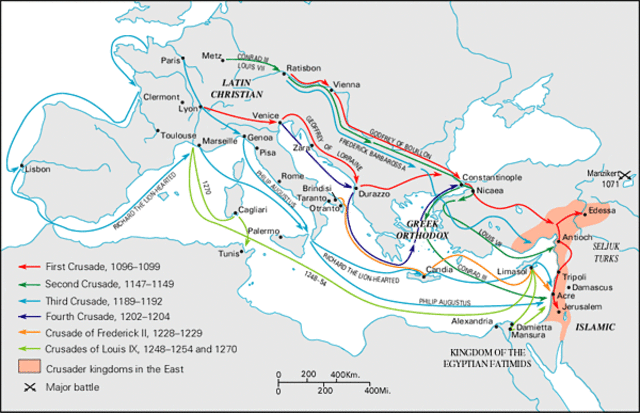
The Crusader fleet of 1,800 boats and ships had arrived in Cyprus with the intent of launching a Seventh Crusade against the Muslims by conquering Egypt in 1248.

King Louis IX had attempted to enlist the Mongols to launch a coordinated attack on Egypt. When this failed to materialize, the Crusader force sailed to Damietta and the local population there fled as soon as they landed.

As-Salih Ayyub was in Syria at the time. When he heard about the fall of Damietta, he rushed back to Mansurah in Egypt. He organized an army and raised a commando force to harass the Crusaders.

As-Salih Ayyub was not well. His health deteriorated further due to the mounting pressure from the Crusader offensive. The march from Damietta toward Cairo through the Nile River Delta went slowly. The rising of the Nile and the summer heat made it impossible for them to advance quickly to follow up on their success.

Ayyub’s wife, Shajar al-Durr called a meeting for the generals. She became commander-in-chief of the Egyptian forces. She ordered the fortification of Mansurah. Then she stored large quantities of provisions and concentrated her forces there.

She organized a fleet of war galleys to be scattered at various strategic points along the Nile River. The Ayyubid sultan died during this time. Shajar al-Durr set a sudden power shift in motion that would make her Queen. She would eventually place the Egyptian army of the Mamluks in power.

Louis lost his army at the Battle of Al Mansurah. He was captured by the Egyptians on April 6, 1250. His release was negotiated in return for a ransom of 400,000 livres toumois and the city of Damietta. France’s annual revenue was only about 1,250,000 livres toumois at the time. 400,000 was a king’s ransom.

Louis spent four years in the Latin kingdoms of Acre, Caesarea and Jaffa following his release from captivity. He used his wealth to assist the Crusaders in rebuilding their defenses. He also engaged in diplomacy with the Islamic powers of Syria and Egypt. He and his army returned to France in the spring of 1254.

Ayyubid power in Egypt effectively ended after the seventh crusade. They had ushered in an era of economic prosperity in the lands they ruled. The facilities and patronage provided by the Ayyubids led to a resurgence in intellectual activity in the Islamic world.

Sunni Muslim dominance had been strengthened in the region by the construction of numerous madrasas (schools of Islamic law) in their major cities.

A number of attempts by the emirs of Syria to wrest back control of Egypt failed. These attempts were led by an-Nasir Yusuf of Aleppo. The Mongols sacked Aleppo and conquered the remaining territories of the Ayyubids soon after in 1260. The Mamluks forced out the Mongols after the destruction of the Ayyubid dynasty. The Ayyubid principality of Hama remained.

Louis IX must have seen at least one of the hospitals that had been built by the Muslims when he was in the Middle East. He visited the Holy Land after his release from captivity in 1250. It is likely that he saw the hospital in Divrigi in Anatolia. The mosque and hospital are located in present day Turkey. 

Hospitals
Divrigi Hospital (1228-29)

UNESCO Heritage Site
UNESCO

The Great Mosque and Hospital of Divrigi is a building that combines a monumental hypostyle mosque with a two story hospital and a tomb. It is located on the slopes below the castle of Divrigi, Sivas Province in central eastern Turkey.

If was founded by the Mengücekide emir Ahmed Shah following the victory of the Seljuk Turks over the Byzantine army at the battle of Malazgirt in 1071.

Mengujekids
wiki Mengujekids

A medical center, or Darüşşifa, was built in 1228 by Turan Melek Sultan, daughter of the Mengujek ruler of Erzincan, Fahreddin Behram Shah.

Quinze-Vingts
1260

Louis IX built a hospital for the poor, sick and blind when he returned from the Middle East. The Quinze-Vingts or the Fifteen Score, originally sheltered 300 inmates. His reign inspired the building of Gothic cathedrals.

Robert de Sorbon, the founder of the Sorbonne University of Paris was his confessor and personal friend. Thomas Aquinas was a frequent guest at his table.

Scientific Learning

Thomas Aquinas

The kingdom of France was at its height in Europe, both politically and economically, during the so-called "golden century of Saint Louis."  Louis was regarded as "primus inter pares", first among equals, among the kings and rulers of the continent. The title clarifies the meaning for the position as king of kings.

He commanded the largest army and ruled the largest and wealthiest kingdom. Paris was the European center for the arts and intellectual thought for the time. The foundations for the famous college of theology later known as the Sorbonne were laid in Paris about the year 1257.

Thomas Aquinas was appointed regent master in theology at Paris in the spring of 1256. His tenure ran from 1256 to 1259. He wrote numerous works. He was working on one of his most famous works, Summa contra Gentiles, by the end of his regency.

It was during the time that Thomas was first in Paris that Louis signed the Treaty of Corbeil and the Treaty of Paris. Louis renounced his feudal lordship over the county of Barcelona and Roussillon in the Treaty of Corbeil with James I of Aragon in 1258.

James renounced his lordship over several counties in southern France including Provence and Languedoc. The treaty ended 100 years of conflicts between the Capetian and Plantagenet dynasties.

Louis signed the Treaty of Paris in 1259 with Henry III of England. Henry was assured of his possession of territories in southwestern France. Louis received the provinces of Anjou, Normandy, Poitou, Maine and Touraine.

The Dominican order assigned Thomas to be regent master at the University of Paris for a second time in 1268. He held the position until the Spring of 1272. The rise of ‘Averroism’ or ‘radical Aristotelianism’ in the universities was part of the reason for this reassignment.

Averroes was a Muslim scholar who wrote about his appreciation for Aristotle’s philosophy. He was Andalusian. Al-Andalus was the name for Islamic Spain or Iberia. Spain was governed by Muslims to various degrees between 711 and 1492.

The Muslim Empire had expanded across North Africa into Iberia. Cordoba Spain was multi-cultural. Averroes was commissioned to translate Aristotle. He was against the Timocracy and neo-Platonism of a number of Muslim clerics, but he disagreed with the negative opinion of women expressed by Aristotle.

He asserted that women could hold position of leadership in society. While they were not as strong in certain regards, they were better in others. He was not  as influential in the Muslim world as he was in Europe. Aristotle did not find a successor to Ibn Rushd after his death.

Aquinas wrote two works against Averroism. He argued that it was incompatible with Christian doctrine. He was particularly concerned with the “beginninglessness of the world” or the eternal existence of matter.

Aquinas was an advocate for Aristotle also. He called him “the philosopher.” He might have learned about Aristotle from the work of the Muslim.  Given the Crusades and the Inquisition, the position might have gotten him accused of heresy.

There were those in the ecclesiastical community, including the Augustinians, who were fearful that this philosophy might somehow contaminate the purity of the Christian faith.

Aquinas expressed deep concern at the spread of Averroism. He was angered when he discover Siger of Brabant had been teaching Averroistic interpretations of Aristotle to Parisian students. Did he talk with Louis IX and the Bishop of Paris about his reservations?

The Bishop of Paris, Etienne Tempier, issued an edict condemning thirteen Aristotelian and Averroistic proposition as heretical. Anyone who continued to support them after the edict was issued on December 10, 1270 was to be excommunicated.

Thomas conducted a series of disputations between 1270 and 1272 in what appears to be an attempt to counteract the growing fear of Aristotelian thought. He wrote De virtutibus in communi (On Virtues in General), De virtutibus cardinalibus (On Cardinal Virtues), De spe (On Hope) during this time.

Map

Louis IX reduced private wars among French nobles and vassals that had ravaged France before his time. He protected vassals from oppression. He required their lords to fulfill their obligations.

He reformed taxation. He improved the courts. Every man in France had a better chance of receiving justice than had previously been the case. He promoted written law to make it clear what the laws were. Major strides were made toward replacing trial by combat with trial by jury.

Louis IX was a reformer. He developed French royal justice. The king was the supreme judge to whom anyone could appeal to seek amendment for a judgement. He banned trials by ordeal. He tried to prevent the private wars that were plaguing the country.

He introduced the presumption of innocence in criminal procedure. He created provosts and bailiffs to enforce the application of the new legal system.

His rule was also characterized by the leading alliance with the papal office. He punished blasphemy, gambling, interest bearing loans and prostitution. He bought the presumed relics of Christ. He build the Sainte-Chapelle for the relics. He expanded the scope of the Inquisition and ordered the burning of Talmuds.

Burning at the Stake
The Eighth Crusade
Defeated by Disease

Louis and his three sons took up the cross in a parliament held at Paris on March 24, 1267. He resolved to land at Tunis after hearing reports from missionaries. He ordered his younger brother, Charles of Anjou, to join him there. The crusaders landed at Carthage on July 17, 1270. Prince Edward of England was among them.

Disease broke out in the camp. Many died of dysentery. Louis himself died on 25 August.
Louis IX had been invested with the mission to act as "lieutenant of God on Earth" when he was crowned in Rheims.  He took his mission seriously as a christian.

He conducted two crusades to fulfill his duty. They contributed to the prestige of the French crown with the pope even though they were unsuccessful. The seat for the papal see would eventually move to Avignon for a substantial length of time.

He was never heard to speak ill of anyone. He excelled in penance and had a great love for the Church. He was merciful even to rebels. When he was urged to put a prince to death, he refused, saying: "A son cannot refuse to obey his father.” The prince had followed his father into the rebellion.

The scope of the Inquisition was expanded during his reign in France . Southern France was most affected by this expansion. That is where the Cathars were located. The rate of  the confiscations reached its highest levels in the years before his first crusade. It slowed upon his return to France in 1254.

Louis IX tried to fulfill the duty of France, which was seen as "the eldest daughter of the Church" (la fille aînée de l'Église). This title had been instituted in the time that Charlemagne had been crowned by the Pope Leo III in Rome in 800. The official Latin title of the kings of France was Rex Francorum, i.e. "king of the Franks."

This defined the role of France in the Roman empire as the protector of the Church.

Some of the judgments made by Louis IX were twisted by Catholic devotion. The punishments were a Christian modification of the classical tradition that retained cruelty with a sectarian monotheistic base.

The punishment for blasphemy was the mutilation of the tongue and lips. Some actions that had not been criminal were redefined as such. Gambling, interest-bearing loans and prostitution became punishable offenses.

He spent exorbitant sums on presumed relics of Christ. He built the Sainte-Chapelle to house the objects for worship. He expanded the scope of the Inquisition and ordered the burning of Talmuds and other Jewish books. Some of his reforms were prohibitive, sectarian and punitive.

The modern reader is left to wonder if the Frankenstein monster was an image of the French (Franco) and German (einstein) competition to act as protectors of the resurrection of the “new” Church in the empire.

Peace


The opening statement for this presentation argues that true peace is the presence of justice. An abundance of evidence supports the contention that the Inquisition and the Crusades were sectarian devices designed to take money from people by telling them a story about how political exploitation by the invasion of foreign territory is for their protection.

The use of propaganda to justify war indicates an even broader offense. It is not just sectarian. It is partisan. If sectarian diversions were to be removed from belief in a war based economy, the partisan element would remain. Conflict in opinion is amplified by media expression to induce concession to violent aggression as though it were necessary to put down those violent aggressors.

Remove war from the equation and you still have the potential for oppression. The work of Solzhenitsyn, a dissident from Russia, argues that communism was not only instituted by violence, it was an instrument of oppression by cruelty in punishment.

The Bolshevik revolution overthrew the Russian monarchy. It was bloody. Many aristocrats were put to death. Lenin was cruel as the head of state. Stalin was worse, but subsequent premiers decreased the amount of cruelty in their oppressive measures.

Communism was inherently and indefinitely oppressive. The US and the UK argue for a capitalist economic system, but the lower house in either government uses liberal media to condemn executive leadership.

The president or the prime minister is subject to Congressional judgment for conservative policy. When the elected leader doesn't satisfy the lower house with liberal expenditure, he or she is condemned in media expression to obtain a conviction of guilt in public opinion to influence an election result that favors munition sales for violent aggression in war.

It's the way that liberals in the House define their social role. The presumption of guilt for advocates of conservative policy is presented as though it were necessary for goodness in American polity.

The statement by Jane Addams seems utopian to those who believe that war is necessary for order in society. It is nevertheless, logically sound. Even if war is removed from the equation, justice has to be shown for peace to be true and commerce to be legal around the globe.

Lectionary Louis IX
wiki Louis IX of France
wiki Medieval Inquisition
wiki Innocent III
wiki Gregory IX
wiki Albigensian Crusade
wiki Thomas Aquinas
wiki Ayyubid Dynasty
wiki Poissy

Additional Notes

The Mongol empire much like the Huns appeared to be dedicated to limiting government to police and military action in a minimalist way. They were known to be archers and swordsmen on horseback. Their horse riding skills in battle limited incursions into their territory. They found it easy to outmaneuver the Roman phalanx or any other formation.

Their empire allowed for agrarian existence. Thomas Jefferson used their vision to project a future of coexistence with native Americans. People were allowed to move around nomadically or to cultivate the land. Construction projects were not as large.

Cathedrals and castles in the west were built larger and stronger to avoid being burned to the ground by vagrant forces. While the Asian lifestyle defended nomadic living, the west became more developed in fixed locations with private property. Hostility from fear towards native populations however was all too often directed into genocide.

The Mongol Empire
wiki Mongol Empire

The Mongol Empire existed during the 13th and 14th centuries. It was the largest contiguous land empire in history. The Mongol Empire eventually stretched from Central Europe to the Sea of Japan.

It originated in the steppes of Central Asia and extended northwards into Siberia, eastwards and southwards into the Indian subcontinent, Indochina and the Iranian plateau and westwards as far as the Levant and Arabia.

The Mongol Empire emerged from the unification of nomadic tribes in the Mongols homeland under the leadership of Genghis Khan. Khan was proclaimed ruler of all Mongols in 1206.

The empire grew rapidly under his rule and his descendants. Invasions were sent in every direction. The vast transcontinental empire connected the east with the west with an enforced Pax Mongolica.

The pact allowed trade, technologies, commodities and ideologies to be disseminated and exchanged across Eurasia.

The empire began to split due to wars over succession. The grandchildren of Genghis Khan disputed whether the royal line should follow from his son and initial heir Ögedei or one of his other sons such as Tolui, Chagatai or Jochi. The Toluids prevailed after a bloody purge of Ögedeid and Chagataid factions, but disputes continued even among the descendants of Tolui.

After Möngke Khan died, rival kurultai councils simultaneously elected different successors. The brothers Ariq Böke and Kublai Khan not only fought each other in the Toluid Civil War, but also dealt with challenges from descendants of other sons of Genghis. Kublai successfully took power, but civil war ensued as Kublai sought unsuccessfully to regain control of the Chagatayid and Ögedeid families.


Friday, August 2, 2019

Look

8.3.19
Back to the Future
DeLorean

Look
Forward
向前看
Xiàng qián kàn
楽しみにする
Tanoshimini suru
ps143
Exspecto

I remember the past
as a prediction of the future cast.

I will appraise the value of your method
with respect for the results accepted.

I assess the product of your production
in conjunction with the assumption of function.

I offer my hands to you where you stand.
My soul thirsts for reflective recognition like an arid land.

Producer of production, hear my prayer.
Answer me near the corner of your square.
Honor my request with the rightness of your care.

Wisdom rescued those who served her.
When the man fled his brother's wrath he became a blur.

She guided him on a straight path.
He was shown how to do the math. 

He was given knowledge of holy things.
He saw the kingdom of God with practical imagining.

She prospered him in the management of his labor
to increase fruit for him to savor.

Wisdom rescued those who served her.
When the man fled his brother's wrath he became a blur.

She guided him on a straight path.
He was shown how to do the math. 

He was given knowledge of holy things.
He saw the kingdom of God with practical imagining.

She prospered him in the management of his labor
to increase fruit for him to savor.

The kingdom is not something observable as yet to be seen.
It is here among us for intelligence and faith to glean.

The royal priesthood is an investigation
that announces the benefit of resurrection.
Do not condemn me with absolute judgement.

No one living will bear the punishment 
or the bludgeon by reduction.

The destruction of an argument may leave those who argued it better off.
We act for standards to improve past performance as a redemptive cost. 

Let me find my error
so I can correct or avoid consequent terror.

Make haste to answer me.
My spirit has faltered as you can see.

Do not turn your face from my achievement
or I will fall into a state of bereavement.

Let me hear your love rise with the dawn.
My care is like a doe for her fawn.

You are the path to which I am drawn.
I lift my soul to divine phenomenon.  

I run to you like a deluge.
Please allow me to take refuge.

Teach me to learn how to provide a service.
Your Spirit will guide me to find my purpose.

Revive me for your Name's sake
that I may escape even the trouble that I make.

Bring the plans of my foes to naught
that the love of your goodness may be sought.

-------------------------

143 Domine, exaudi
Dominated, answer

5 I remember the time past;
I muse upon all your deeds;
I consider the works of your hands.
6 I spread out my hands to you;
my soul gasps to you like a thirsty land.
1 Lord, hear my prayer,
and in your faithfulness heed my supplications;
answer me in your righteousness.
2 Enter not into judgment with your servant,
for in your sight shall no one living be justified.
7 O Lord, make haste to answer me; my spirit fails me;
do not hide your face from me
or I shall be like those who go down to the Pit.
8 Let me hear of your loving-kindness in the morning,
for I put my trust in you;
show me the road that I must walk,
for I lift up my soul to you.
9 Deliver me from my enemies, O Lord,
for I flee to you for refuge.
10 Teach me to do what pleases you, for you are my God;
let your good Spirit lead me on level ground.
11 Revive me, O Lord, for your Name's sake;
for your righteousness' sake, bring me out of trouble.
(12 Of your goodness, destroy my enemies
and bring all my foes to naught,
for truly I am your servant.)

-------------------------
==================
-------------------------

Wisdom 10:9-10

Wisdom rescued from troubles those who served her.
When a righteous man fled from his brother's wrath,
she guided him on straight paths;
she showed him the kingdom of God
and gave him knowledge of holy things.
She prospered him in his labors
and increased the fruit of his toil.

-------------------------

Wisdom rescued those who served her.
When the man fled his brother's wrath he became a blur.

She guided him on a straight path.
He was shown how to do the math.

He was given knowledge of holy things.
He saw the kingdom of God with practical imagining.

She prospered him in the management of his labor
to increase fruit for him to savor.

==================

2 Corinth. 10:2, 4-5

I ask that when I am present I need not show boldness by daring to oppose those who think we are acting according to human standards.

We destroy arguments and every proud obstacle raised up against the knowledge of God.

-------------------------

The destruction of an argument may leave those who argued it better off.
We act for standards to improve past performance as a redemptive cost.

==================

Luke 17:20-21

Once Jesus was asked by the Pharisees when the kingdom of God was coming. He answered, 'The kingdom of God is not coming with things that can be observed. They will not say, "Look, here it is!" or "There it is!" The kingdom of God is among you in fact.

-------------------------

The kingdom of God is not something observable as yet to be seen.
It is here among us for intelligence and faith to glean.

==================

Priesthood

George Freeman Bragg
b. 1.25.1863, Warrenton, NC
d. 3.12.1940, Baltimore, MD

George Freeman Bragg was an African-American priest, journalist and historian. He was ordained as the twelfth African American priest in the Episcopal Church of the United States. He worked for interracial harmony both within and outside of his church.

Warrenton, North Carolina

Warrenton is a small town near the northern border of North Carolina. It was founded in 1779. It was named for Dr. Joseph Warren, a patriot and soldier who fell at the Battle of Bunker Hill during the American Revolutionary War,

It became one of the wealthiest towns in the North Carolina from 1840 to 1860. It was the trading center for an area that was rich with tobacco and cotton plantations.

The town became a busy center of commerce when the railroad was built to improve shipping of the commodities of the tobacco and cotton fields to market in the 1850's.

George Freeman Bragg

George was born into slavery in Warrenton, North Carolina on January 25, 1863 during the American Civil War. He was baptised at Emmanuel Episcopal Church.

His carpenter father was also named George Freeman Bragg. His seamstress mother was Mary. They moved their family to Petersburg, Virginia as the war ended to live with his grandmother Caroline Wiley Cain Bragg. She was a devout Episcopalian and former slave of an Episcopal priest.

Young George delivered newspapers and established relationships with the city's leaders as a child.
He was expelled for "insufficient humility" six months after Bragg began his theological studies at the Bishop Payne Divinity School. He turned his attention to politics and was appointed a page in the House of Delegates in Richmond in 1881-82.

He founded the weekly Petersburg Lancet on July 1, 1882. It was dedicated to civil rights issues.  He changed the paper's name to the Afro-American Churchman in February 1886. It became The Church Advocate later.

A change in the rector at St. Stephens, Petersburg, also allowed Bragg to resume his theological studies. He graduated in 1886.

He married the daughter of another prominent Petersburg black family, Nellie Hill, on September 20, 1887. The couple ultimately had two sons and two daughters.

Bragg was ordained a deacon on January 12, 1887. He was assigned as vicar to Holy Innocents Episcopal Church, a mission in Norfolk. He successfully challenged a rule that black deacons wait at least five years before ordination as priests.

Bishop Francis McNeece Whittle ordained Bragg as a priest at Saint Luke's Episcopal Church in Norfolk on December 19, 1888. Fr. George became the twelfth black Episcopal priest. He expanded his congregation into the fully self-supporting Grace Episcopal Church during the next 5 years.

He accepted a call in 1891 to become rector in Baltimore, MD. He became the pastor for St. James Episcopal Church. It was the oldest black Episcopal congregation in the South. The church had been founded in 1824. He served for 49 years until his death.

The struggling congregation of 63 became self-supporting again under Bragg's leadership. They tripled in size and built a new structure on Park Avenue and Preston Streets by 1901. It was among the largest black Episcopal parishes in the country by 1924. The church had over 500 parishioners.

Bragg promoted social activism both within and outside the church. He helped Booker T. Washington found the Committee of Twelve in 1902. They fought to prevent disenfranchisement of blacks in Maryland.

He later joined W. E. B. DuBois as one of the founders of the Niagara Movement. This was a precursor of the National Association for the Advancement of Colored People. He continued publishing the monthly Church Advocate, wrote several books and worked to develop black ministers. He fostered more than 20 vocations.

He fought against restricting the church's mission work to overseas activities. He argued that the denomination also needed to foster African American congregations.

He served as secretary and historiographer of the Conference of Church Workers among Colored People. The group lobbied for the election and consecration of black bishops among other things. He was interviewed twice, but was never selected for that promotion.

Fr. George Bragg died on March 12, 1940 after a short hospitalization at Baltimore's Providence Hospital. The Baltimore Sun eulogized his quiet manner, dignity and work for interracial harmony.

George Bragg
S. 乔治布拉格
T. 喬治布拉格

乔 Qiao      stately                        喬 kyo      high            Jo  じょ-  ジョ-         Jo    조 article 
治 zhi         govern                        治 ji         reign            ji   じ        ジ              ji     지  g               
布 Bu          to announce               布 fu        linen           Bu ぶ       ブ               Beu 브  the           
拉  la          to draw                       拉 ra        Latin           ra  らっ    ラッ           lae   래  ra     
格  ge         to investigate              格 go       status          gu  ぐ       グ               geu  그  that         

-------------------------

The royal priesthood is an investigation
that announces the benefit of resurrection.

==================

wiki George Bragg
Lectionary Fr. George Freeman Bragg

Friday, July 26, 2019

Respect

7.27.19
Devil's Den, Florida

Respect
the Public
尊重公众
Zūnzhòng gōngzhòng
公衆を尊重する
Kōshū o sonchō suru
ps.133
Quae secum palam

Disgraced fortune in misfortune lies
troubling heaven with proportionate cries.

I am not alone in this outcast state.
All too many bewail this desuetude fate.

Wishing to be more rich in hope
with another's art and another's scope
I am featured as one friendly to beasts
with the most joy contended least.

When I think happily upon you in my state
my spirit rises from the sullen earth to heaven's gate.

My hands gird my belt, my self almost despising.
Heart is felt like the lark song at dawn rising.

When love is remembered it brings me such health
that I scorn to exchange  my state for the richest man's wealth.

The clear water gushes
from the underground push
as it springs to light 
to sparkle for the delight 
of sight in life without plight.

The cool priceless breeze
flows with the water past cypress trees.
The feeling of youth courses with truth
past the grassy banks and the jutting roots.

The dragon fly knits blue
with side long flits that are new
to each moment of movement
with joy and amusement.

Enchantment is as delicious 
as the water is capricious. 

It gushes past flow
to a lower level of low.

Unchanging youth smiles
for miles among magical aisles
in eternal spring that blooms
to infuse the flowering wind with perfume.

New leaf is in bud.
The earth is graced with mud.

The sum of nought and ought is bought
by that sought with what the kinsman brought.
This was the least that was thought.

Cowardice flew from perch on known hand
to survey the play on the lay of the land.
This was a gesture one could understand.
The youth with brave heart moved according to plan.

Advance in adversity was a challenge to handle.
The key to success was not engaging in prattle.

The brightness of nought fought for standing with care
as running, riding and ruling directed the measure of fare.
Now good standing must keep that place there in the air
with instruction as to how they should hold safety outside of the lair.

The forward position was fortified with grace in space and no lace
until the right was alighted amid ranks to trace the space of the place for grace.

The most loyal heart of the hearth guarded with pleasure
the strength of the tenth as the confessor of treasure.

The brick thought of ought spoke back, raising the wield of the yield.
His anger was resolute in the appeal to reveal the taxed steel to the field.

"Have you read what these people had written?

The admission of administration has skewed our review of the victim.
They wish to give you tribute instead of leers from the contentious kitten.

"Poisonous points from ancient words contend against riot and war in succession.
The crow has not sown decrease in the deceased application.
It has flown on its own to know the estimation of the station for the nation
by calculation. The noble reader must be the leader of cessation.
This prattle about war will do no good in economic battle for station. 

"Herald of the brim-men, deliver this again.

Rejoice in the stem of plants for them then.

"Use first names in the smoke of conquest

as the small bird darts through the rain on this test's quest.
Give your people a pleasant report about the content of your best contest.

"Mind must grow stronger and courage more fierce as strength diminishes.

Points and the edges of pledges must reconcile grim war before the image
begins or finishes."

The last quarter of moon shines with a silvery flush
as age lays down his glasses and forgets his graph of other stuff.

Gray haired grandsires look and laugh at their youthful gruffness as fluff
in the rough and tough bluff that often left them with less than enough.

Wise men at their end know that dark is right
when their words fork no sight of lightning's flight.
The last wave bye as frail deeds might have danced bright
while wailing at the moon over the green bay at night.
Wild men caught the grave near death with the sight of blinding light.
Blind eyes blazed with rage as storm clouds faded into the dark height.

Our designs reign even in the rain
when they stand in accord with disdain for excessive pain
in the intelligence of nature's gain.

The prestige of unity in faith is a bargain
that helps to enter the Church pardon.

The Father destined us for adoption
to become children through his Son as our option.
He did this before the foundation of the world
that by the pleasure of his will we might whirl
into the redemption of grace for his glory
that we may remember the story 
of Jesus our beloved Christ,
the Son of God most high. 

Atonement was made through his blood
for the forgiveness of our trespass in the mud
of life to experience the smooth form of shining love
lavished on us from above.

The mystery of his will is revealed by the Spirit
for those who seek the real presence to dwell in it.
Wisdom and insight are set forth in Christ 
as a plan for the fullness of time sufficed
to gather to him in heaven by faith life's sacrifice.   

The Son asked not only in behalf of those with him
but on behalf of those who would come to believe with them.

As the Father was in the Son
and the Son in the Father as one,
we are also participants in the love.

The paternal with the maternal leads the fraternal.
The fraternal shows the world to respect the internal
as it shapes beneficial knowledge of the external.

The glory given to the Son by the Father
is passed by the power of the Spirit for faith to author
that we may be as one in the Trinity as they are one in our honor.

Unity by faith is testimony for the world to know
that the Son was sent to show
the love of God bestowed.

It is pleasant when people live 
together with respect for life that lives enough to give.

It is like the precious presence of agreement 
in a community living in communion in the cement 
of reason with the essential essence to our existence lent.

It is like the dew that falls 
with the exaltation of an exhaled thrall
from the heights of heaven
to the constructions of our creation in the leaven
of the most treasured and blessed essence of the divine presence.

----------------------------

Psalm 133

A Song of Ascents.
1 How very good and pleasant it is
   when kindred live together in unity!
2 It is like the precious oil on the head,
   running down upon the beard,
on the beard of Aaron,
   running down over the collar of his robes.
3 It is like the dew of Hermon,
   which falls on the mountains of Zion.
For there the Lord ordained his blessing,
   life for evermore.

-----------------------------
Ephesians 1:5-10

The Father destined us for adoption as his children through Jesus Christ before the foundation of the world to be holy and blameless before him in love according to the good pleasure of his will to the praise of the glorious grace that he freely bestowed on us in the Beloved. We have redemption in him through his blood for the forgiveness of our trespasses according to the riches of the grace that he lavished on us. He has made known to us the mystery of his will with all wisdom and insight in the good pleasure that he set forth in Christ as a plan for the fullness of time to gather all things in heaven and earth up in him.

-----------------------------

The Father destined us for adoption
to become children through his Son as our option.

He did this before the foundation of the world
that by the pleasure of his will we might whirl
into the redemption of grace for his glory
that we may remember the story
of Jesus our beloved Christ,
the Son of God most high.

Atonement was made through his blood
for the forgiveness of our trespass in the mud
of life to experience the smooth form of shining love
lavished on us from above.

The mystery of his will is revealed by the Spirit
for those who seek the real presence to dwell in it.

Wisdom and insight are set forth in Christ
as a plan for the fullness of time sufficed
to gather to him in heaven by faith life's sacrifice.

=================
John 17:20-23

I ask not only on behalf of these, but also on behalf of those who will believe in me through their word that they may all be one. As you, Father, are in me and I am in you, may they also be in us so the world may believe that you have sent me. The glory that you have given me I have given them so they may be as one as we are one in them and you in me that they may become completely united in the world that it may be known that you have sent me and have loved them even as you have loved me.

-----------------------------

The Son asked not only in behalf of those with him
but on behalf of those who would come to believe with them.

As the Father was in the Son
and the Son in the Father as one,
we are also participants in the love.

The paternal with the maternal leads the fraternal.
The fraternal shows the world to respect the internal
as it shapes beneficial knowledge of the external.

The glory given to the Son by the Father
is passed by the power of the Spirit for faith to author
that we may be as one in the Trinity as they are one in our honor.

Unity by faith is testimony for the world to know
that the Son was sent to show
the love of God bestowed.

=================

Unity

William Reed Huntington
b. 9.20.1838 Lowell, Massachusetts
d. 7.26.1909 Nahant, Massachusetts

William Huntington was an American priest and author. His analysis of the Church as an idea helped to define Christian unity as a goal. He wrote a four point articulation of the Anglican identity known as the Quadrilateral.

The Quadrilateral was passed by the Lambeth Conference in Canterbury, England in 1888. The conference is held once every ten years. The passage established the four points as the basis for dialog with other faith communions.

He was a parish priest in Massachusetts for 21 years, then in New York for 26 years. He wrote his books during this time and attended Christian conferences to promote the ideas for organization.

He was born in northern Massachusetts in the first half of the 19th century.

Lowell

Lowell is located near the northern border of Massachusetts. It was the 4th largest city in the state with an estimated population of 111,000 in 2018. It was the 2d largest in the Boston statistical area.

It sits at the confluence of the Merrimack and Concord rivers. Pawtucket Falls is a mile long set of rapids with a total drop in elevation of 32 feet. The falls end where the rivers meet.

The Pawtucket Dam was built at the top of the falls on the Merrimack. The city has a canal system that directs water from the millpond behind the dam for use in the area.

The Merrimack flows from Franklin, New Hampshire in a southerly direction to Lowell. The river turns to the east to run 40 miles (64 km) from the city. It empties in the Atlantic Ocean at Newburyport 32 miles (52 km) north of Boston.

Associates of the Boston Manufacturing Company, Nathan Appleton and Patrick Tracy Jackson, founded the city as a planned center for textiles in the 1820’s. They named the new mill town after their visionary leader, Francis Cabot Lowell. He had died 5 years before the incorporation of the town. The town grew and purchased land from neighboring towns to diversify into an urban center.

Many of the men who composed the labor force for constructing the canals and factories had immigrated from Ireland to escape the Potato Famine on the 1830’s and 1840’s. The millworkers were young single women from the farm families of New England. They were called Mill Girls.

St. Anne’s Episcopal Church was built in Lowell in 1824. It was consecrated by the Rt. Rev. Alexander Griswold in March 1825. It was the first building dedicated to religious worship in the town.

It was also the first church to have been established by a manufacturing company rather than a group of worshipers. It had been approved by a committee of the Merrimack Manufacturing Corporation in 1822.

The baptismal font for the church wasn’t procured until 1852.

William Reed Huntington

William was born in Lowell on September 20, 1838. His father was a physician and surgeon. He served as the mayor for the town a number of times. “Willy” was the youngest sibling of two much older brothers and a sister.

The family attended St. Anne’s. The rector was the high church Dr. Theodore Edson.
Mary Huntington Cooke remembered her brother as companionable and athletic. He was friendly and willing to engage in sports. He kept turtles and rabbits as pets. He developed a taste for fishing at an early age. This he kept through his adult life.

He also entertained an interest in chemistry. He spent his money on simple apparatus for experiments. He constantly engaged in making experiments of various kinds in an attempt to manufacture things.

There were some rough older boys who lived in the neighborhood who used to tease Willy. He was taught by his mother to not fight under any circumstances.

He was sent to military school at Norwich, Vermont due to his small stature. He said that he saw more wickedness there in the country, than in all his time at Cambridge.

He went to Harvard University in 1855 and graduated in 1859. He became an instructor in chemistry from 1859-1860.

He was ordained a priest in 1862. He was rector of All Saints Church, Worcester, Massachusetts, 1862-1883 and rector of Grace Church, New York City, 1883-1909. He was a member of the House of Deputies of the General Convention, 1871-1907.

The Episcopal Church at the time Huntington entered it “inherited an Anglican theological tradition that had been divided into party alignments ever since the seventeenth century. The Americans like their English predecessors fell into a grouping of latitudinarians [or broad church liberals], evangelicals and high-church theologians.”

There were also Anglo-Catholic partisans distinct from the high church theologians by the 1840's. Some high church theologians like John Henry Hopkins sympathized with the Tractarians without joining their ranks. The internal divisions in the Church were reflective of societal rifts in the Christian community.

Huntington was one of the leading advocates of church reunion, not only in his own Episcopal church, but among all the fractures of Christendom, particularly as they found expression in the American context.

He always took a prominent part in public affairs. He was active in the movement for liturgical revisions and was secretary of the Prayer-Book Revisions Committee and editor with Samuel Hart of the Standard Prayer-Book of 1892.

He took part In each of the thirteen General Conventions of the Episcopal Church during his life. These conventions were held every three years. He was a member of the House of Deputies. The conventions also have a House of Bishops.

He was committed to what he called the “principle” of Anglicanism, but he would devote most of his adult life to casting a vision for the “Church of the Reconciliation” in the American context. He had hopes that Anglicanism might be the votive motive for this reunion.

He is known for the formulation of the Chicago-Lambeth quadrilateral. The quadrilateral is an articulation of the four points for unity in Christianity. The four points were formulated in the essay “The Church Idea, An Essay Toward Unity” in 1870. They served as a postulation for Anglican identity and a basis for dialog with the Roman Catholic, Eastern Orthodox and Protestant communions.

The points were presented as a resolution to a conference of bishops in Chicago in 1886. The resolution was passed and presented to the Lambeth conference in 1888. It was modified and passed in the current form.

There should be acceptance of l) the Holy Scriptures as the Word of God; 2) the Nicene Creed as the rule of faith; 3) baptism and the eucharist as the two sacraments ordained by Christ himself and 4) the episcopate as the keystone of governmental unity in the church.

The first three points were modified.
Quadrilateral

The definition for scripture was changed from the “revealed Word of God” to the rule and standard for the faith containing all things necessary for salvation.

The Apostles’ Creed was added to the Nicene Creed in the second point.

The sacraments for Baptism and the “Supper of the Lord” were identified as ordained by “Christ Himself.” The words for institution were retained as a defining element for the Eucharist.

Adaptation is a key element in the fourth point. The local adaptation for the varying needs of the nations and peoples in the administration of the call to God in the unity of the Church is the basis for dialog between church administrations.

This "foursquare" approach became known as the "Quadrilateral." Huntington was the moving force behind its approval by the House of Bishops in Chicago.

The four points first found their way into a resolution of the House of Bishops of the American Episcopal Church meeting in Chicago in 1886. The quadrilateral statement was scaled back in 1888. The fourth point regarding the episcopate was reworded in 1920.

The four points of the Quadrilateral were listed by the Chicago statement as "inherent parts" of the sacred deposit of Christian faith and order "committed by Christ and his Apostles to the Church unto the end of the world, and therefore incapable of compromise or surrender. . . ." The Chicago statement lists the Nicene Creed as the sufficient statement of the Christian faith.

The Chicago statement calls for administration of baptism and the eucharist "with unfailing use of Christ's words of institution and of the elements ordained by Him." The Chicago version expressed the fourth part of the Quadrilateral in terms of the "Historic Episcopate, locally adapted in the methods of its administration to the varying needs of the nations and peoples called of God into the unity of His Church."

Although the Quadrilateral was not enacted by the House of Deputies at the 1886 General Convention, it was incorporated in a general plan referred for study and action by the newly created Joint Commission on Christian Reunion.

The entire General Convention of the Episcopal Church affirmed the Quadrilateral in its Lambeth form in 1895. The Chicago-Lambeth Quadrilateral has continued to serve as the primary Anglican working document and reference point for ecumenical Christian reunion. The Chicago and Lambeth versions of the Quadrilateral are included in the historical documents of the 1979 Book of Common Prayer (pp. 876-878).

The first point concerning what Anglicans call "the sufficiency of Scripture" takes its language directly from Article VI of the Thirty-Nine Articles. This has been foundational to Anglican scriptural exegesis and hermeneutics since the sixteenth century. It has been accepted as written. The second point describes the sine qua non of Catholic faith since antiquity. It has not met with much controversy.

The controversy has centered on those parts of the Communion on the other formulae. The third point has been controversial among some Anglicans as being inappropriately limited. There are Anglo-Catholics who have maintained that the five other sacraments should be included as essential marks of the Church.

The most controversial point has been the fourth. The churches in the Calvinist tradition have not required bishops as part of the ecclesiastical structure. The Calvinist influence on the Church of England has been pronounced since the Civil War when the Puritans took control of Parliament.

The Chicago-Lambeth Quadrilateral has been important to ecumenical dialogue. It had been helpful in consultations between the Anglican and Roman Catholic communions, but the 'sufficiency of scripture' has a strong historical basis for disagreement. The Anglican ecclesiastical provinces and national Lutheran organizations differ on the unstated provision regarding royal supremacy.

Lutherans recognized the right for the princes to choose the religion for the realm. Their statements regarding Christ as the authority hold a prominent place of respect in the leadership of the Church, but don't declare the sovereign as the head for the Church.

The Royal Act of Supremacy was written by parliament to designate the monarch as the protector for the Church. There is a great deal of agreement between the Anglican and Lutheran Church. There is unity in the essential things.

The fourth point of the quadrilateral has proved to be a stumbling block with other Church denominations. The discussion between the Anglican Church of Canada and the United Church of Canada; between the Church of England and the Methodist Church of Great Britain and between the Church of England and other free churches have broken down largely due to the issue of episcopacy.

The Chicago version of the Quadrilateral provides an ecumenical statement of purpose and introduction which states that the Episcopal Church is "ready in the spirit of love and humility to forego all preferences of her own" concerning things of human ordering or choice regarding modes of worship, discipline and traditional customs.

The statement of purpose warns that Christian unity "can be restored only by the return of all Christian communions to the principles of unity exemplified by the undivided Catholic Church during the first days of its existence."

The call for unity does not demand the eradication of the different churches, but it is aimed at reconciliation from schism.

Church and state relations are such that too much unity in Church communication with political organization can result in dictates that contradict the human rights granted by God. When said dictums are applied to civic law through the state, it gives the public the impression that the Church is an instrument of oppression.

Dictatorship is not in accord with human rights. The division in Church administration deters the claim over the highest level of government. The variants in organization have facilitated discrimination in the respective churches however.

Catholics overstate celibacy. Protestants overstate marriage. The Orthodox overstate male leadership in church administration. Racism is evident as a byproduct of charismatic authority in lay leadership.

The call for unity cannot be answered with another form of discrimination. The oppression of rights is not an acceptable byproduct for membership in the body of Christ.

The reconciliation of schism is still advisable as an element in the redemption of the world, but the promotion of cruel punishment in administration conflicts with civil tranquility (peace) as taken with respect for rights as an expression of the will of God.

Huntington also sought greater flexibility and accessibility in the worship of the Episcopal Church. He sought to modernize Prayer Book worship in light of the needs of the American people.

He called for a complete revision of the BCP at the 1874 General Convention. His Materia Ritualis was the working paper of the joint committee on Prayer Book revision prior to the 1883 General Convention.

The  Prayer Book revision process ultimately resulted in the 1892 BCP. Huntington also had an important role in the canonical authorization of the order of deaconesses in the Episcopal Church.

He died in Nahant, Massachusetts on July 26, 1909.

William Huntington
S. 威廉亨廷顿
T. 威廉亨廷頓

威 Wei     prestige            威  i      dignity               Wi   うぃ  ウィ       Wil   윌   will                     
廉  lian     inexpensive     廉  ren  bargain               ri     り     リ            li      리    lee               
亨  Heng  no trouble        亨  ho   pass through       a     あ    ア             eom  엄   mum                        廷   ting    court                廷  tei   courts                 mu  む    ム            Heon 헌  second
顿   dun    pause               頓  ton   suddenly           Han はん ハン       ting    팅  ting           
                                                                                 chin ちん チン       teon   턴  turn             
                                                                                  ton  とん  トン                                                                                           
-----------------------------

The prestige of unity in faith is a bargain
that helps to enter the Church pardon.

=================

The Church of Ireland
Anglican Identity blog
Lambeth Conference
Index
Lectionary WR Huntington

wiki William Reed Huntington
Quadrilateral
Memories of WRH
WRH history
ECUSA Huntington

Sunday, July 14, 2019

Find

7.21.19

Maggie Lindemann

Find
Benefit
找到好处
Zhǎodào hǎochù
メリットを見つける
Meritto o mitsukeru
ps52
Reperio bonum

What is the error when pride becomes a sin?
It is the will to destroy as though destruction had yet to begin.

There is a place that is against God in mind
that plans to ruin the bonds of belief that believers find.

The tongue is sharpened like a razor
to work deception for brutal behavior.

Evil is esteemed more powerful than good.
Lying is tried for denying truth as understood.

Speech that hurts is thrown
when words are not owned as known.

The media is the message
when it isn't too aggressive.

What is the divine will
for the correction of the ill?

Conscience looks to earned reward
until the sense of honor is ordered.

Pride drove this one from the refuge of faith.
Deceit was that which refused to stay straight.


I was shown a basket of summer fruit.
Fruition was known as a metaphorical suit.

Jesus praised Mary for the gift of her attention. 
Martha was urged to consider her connection to this affection.

The image of the invisible deity
is the firstborn form for faith in verity.

Christ is the precedent for our place in everything.
The fullness of God is held like an anchor ring.

I am like an olive tree in the house of the Word.
Divine mercy will help me to overcome the adversity of the absurd.

I will give thanks for the grace of blissful providence
to declare goodness in the presence of moral intelligence.

--------------------------

52 Quid gloriaris?
What is pride?

1 You tyrant, why do you boast of wickedness
against the godly all day long?
2 You plot ruin;
your tongue is like a sharpened razor,
O worker of deception.
3 You love evil more than good
and lying more than speaking the truth.
4 You love all words that hurt,
O you deceitful tongue.
5 Oh, that God would demolish you utterly,
topple you, and snatch you from your dwelling,
and root you out of the land of the living!
6 The righteous shall see and tremble,
and they shall laugh at him, saying,
7 "This is the one who did not take God for a refuge,
but trusted in great wealth
and relied upon wickedness."
8 But I am like a green olive tree in the house of God;
I trust in the mercy of God for ever and ever.
9 I will give you thanks for what you have done
and declare the goodness of your Name in the presence
of the godly.

---------------------------
====================
----------------------------

Amos 8:1-2

The Lord God showed me a basket of summer fruit. He said,
'Amos, what do you see?' I said, 'A baske of fruit.'
The LORD said to me,
'Fruition has come upon my people Israel.
I will never again pass them by.'

---------------------------

I was shown a basket of summer fruit.
Fruition was known as a metaphorical suit.

====================
Colossians 1:15-19

He is the image of the invisible God, the firstborn of all creation. All things in heaven and on earth were created in him. Things visible and invisible, whether thrones, dominions, rulers or powers have been created through him and for him. He himself is before all things. All things hold together in him and for him. He himself is before all things and in him all things hold together. He is the head of the body the church. He is the beginning, the firstborn from the dead, so he might come to have first place in everything. All the fullness of God was pleased to dwell in him.

---------------------------

The image of the invisible deity
is the firstborn form for faith in society.
Christ is the precedent for our place in everything.
The fullness of God is held like an anchor ring.

====================
Luke 10:38-42

He entered a certain village on their way where a woman named Martha welcomed him into her home. She had a sister named Mary who sat at the Lord's feet and listened to what he said. Martha was distracted by her many tasks. She came to him and said, 'Lord, do you not care that my sister has left me to do all the work by myself? Tell her then to help me.'

The Lord answered her, 'Martha, Martha, you are worried and distracted by many things. There is need for one thing. Mary, has chosen the better part which will not be taken away from her.'

---------------------------

Jesus praised Mary for the gift of her attention.
Martha was urged to consider her connection to this affection.

====================

Test for Truth in Agreement


Marshall McLuhan
b. 7.21.1911 Edmonton, Alberta, Canada
d. 12.31.1980 Toronto, Ontario, Canada

Marshall McLuhan was a Canadian philosopher. His work is one of the cornerstones in the study of media theory.

He coined the expression “the medium is the message.” The term “global village” was his. He predicted the World Wide Web almost 30 years before it was invented.

He was a fixture in media discourse in the late 1960’s. His influence began to wane in the early 1970’s.

He continued to be a controversial figure in academic circles in the years after his death.

He was born in western part of Canada in the early 20th century.

Edmonton

Edmonton is the capital city of the Canadian province of Alberta. The city is on the North Saskatchewan River. It is Alberta's second-largest city and Canada's fifth-largest municipality. It is the northernmost city in North America with a metropolitan population of over one million.

The city is among the Canadian cities with the coldest winters. Winter is milder there though than Regina, Saskatoon and Winnipeg. All of these cities are south of Edmonton. Its average daily temperatures range from a low of −10.4 °C (13.3 °F) in January to a summer peak of 17.7 °C (63.9 °F) in July.

The city hosts a year-round slate of festivals. It has the nickname "Canada's Festival City". It is home to North America's largest mall, West Edmonton Mall. It was the world's largest mall from 1981 until 2004. Fort Edmonton Park is Canada's largest living history museum.

Tracks for the Canadian Pacific Railway (CPR) were laid in southern Alberta in 1885. The railroad helped the local economy. The 1891 building of the Calgary and Edmonton (C&E) Railway resulted in the emergence of a railway townsite on the river's south side. This location was called South Edmonton or Strathcona.

Settlers and entrepreneurs from eastern Canada, Europe, U.S. and other parts of the world found it easier to move to the area with the railroad. The area's fertile soil and cheap land attracted settlers.

Some of the people who participated in the Klondike Gold Rush passed through South Edmonton/Strathcona in 1897. Strathcona was North America's northernmost railway point.
Travel to the Klondike was still very difficult for the "Klondikers." A majority of them took a steamship north to the Yukon from Vancouver, British Columbia.

The population of the city grew to 8,350 in 1904 from 700 when it was incorporated as a town in 1892. Edmonton became the capital of Alberta when the province was formed a year later, on September 1, 1905. The Candaian Northern Railway arrived in the following year.
The rapid growth led to speculation in real estate in the early 1900's.

Marshall McLuhan

McLuhan was born on July 21, 1911 in Edmonton, Alberta to Elsie Naomi (née Hall) and Herbert Ernest McLuhan. Both parents were born in Canada.

His mother was a Baptist school teacher who later became an actress. His father was a Methodist and had a real estate business in Edmonton.

His business failed when World War I broke out. He enlisted in the Canadian army. He contracted influenza after a year of service and remained in Canada away from the front lines.

The McLuhan family moved to Winnipeg, Manitoba after his discharge from the army in 1915.  Marshall grew up and went to school there. He attended Kelvin Technical School before enrolling in the University of Manitoba in 1928.

McLuhan explored his conflicted relationship with religion and turned to literature to "gratify his soul's hunger for truth and beauty" at Manitoba. He later referred to the stage as agnosticism.  He was awarded a BA in 1933 and an MA degree in English in 1934.

He was accepted at the University of Cambridge after he failed to obtain Rhodes Scholarship at Oxford. Cambridge required him to enroll as an undergraduate "affiliated" student with one year's credit towards a three-year bachelor's degree before entering any doctoral studies.

He entered Trinity Hall, Cambridge in the autumn of 1934 where he studied under I. A. Richards and F. R. Leavis and was influenced by New Criticism.

New Criticism was a formalist movement in literary theory that dominated American literary criticism in the middle decades of the 20th century. It emphasized close reading, particularly of poetry, to discover how a work of literature functioned as a self-contained, self-referential aesthetic object.

The work of Cambridge scholar I. A. Richards on Practical Criticism and The Meaning of Meaning offered what was claimed to be an empirical scientific approach that was important to the development of New Critical methodology.

McLuhan credited the faculty there with influencing the direction of his later work because of their emphasis on the training of perception and such concepts as Richards' notion of feedforward.

Feedforward is the concept of anticipating the effect of one's words by acting as a critic of the content. It acts as a pretest that any writer can use to anticipate the impact of their words on their audience. It works to clarify unclear concepts in a way that precedes feedback.

These studies formed an important precursor to McLuhan's later ideas on technological forms. He received the required bachelor's degree from Cambridge in 1936 to their graduate program.

He took the first steps toward his eventual conversion to Roman Catholicism in 1937 while studying the trivium at Cambridge. His study was founded on his reading of G. K. Chesterton.

He wrote to his mother in 1935: "[H]ad I not encountered Chesterton, I would have remained agnostic for many years at least." McLuhan completed what was a slow but total conversion process at the end of March 1937. He was formally received into the Roman Catholic Church.

His father accepted the decision to convert after consulting a minister. His mother, however, felt that his conversion would hurt his career. She was inconsolable. McLuhan was devout throughout his life, but his religion remained a private matter.

He returned from England to take a job as a teaching assistant at the University of Wisconsin–Madison. He held the position for the 1936–37 academic year. He had been unable to find a suitable job in Canada.

He taught in Roman Catholic institutions of higher education for the rest of his career. He taught English at Saint Louis University from 1935 to 1944.

There was an interruption from 1939–40 when he returned to Cambridge. There he taught courses on Shakespeare. He tutored and befriended Walter J. Ong.

Ong went on to write his PhD dissertation on a topic that McLuhan had called to his attention. He also became a well-known authority on communication and technology.

McLuhan met Corinne Lewis in St. Louis. She was a teacher and aspiring actress from Fort Worth, Texas. They were married on August 4, 1939. They spent 1939–40 in Cambridge where he completed his master's degree. It was awarded in January 1940.

He began to work on his doctoral dissertation on Thomas Nashe and the verbal arts. Nashe was an Elizabethan playwright, poet, satirist and a significant pamphleteer in the 16th century. His pamphlets including Pierce Penniless and numerous defenses of the Church of England.

McLuhan used the Latin trivium to explain the development of expression in Latin. The trivium was grammar, dialectic and rhetoric. It was a set of methods dating from the Greek Classical period that was used to form a curriculum for instruction.

The Late Middle Ages were characterized by the heavy emphasis on the formal study of logic for instance. The key change that led to the Renaissance was not the rediscovery of ancient texts but a shift in emphasis from the formal study of logic to rhetoric and grammar.

It's a system to produce meaning that's consistently readable. The trivium is a machine for writing and for reading the writing that's been written under its aegis. The influence of this machine was examined in the work of Thomas Nashe.

War had broken out in Europe while the McLuhans were in England. He obtained permission to complete and submit his dissertation from the United States without having to return to Cambridge for an oral defense.

The McLuhans returned to Saint Louis University in 1940. He continued teaching and they started a family. He was awarded a Ph.D. in December 1943.

He next taught at Assumption College in Windsor, Ontario from 1944 to 1946. They then moved to Toronto in 1946 where he joined the faculty of St. Michael's College, a Catholic college of the University of Toronto.

Hugh Kenner was one of his students. Canadian economist and communications scholar Harold Innis was a university colleague who had a strong influence on his work. McLuhan wrote in 1964: "I am pleased to think of my own book The Gutenberg Galaxy as a footnote to the observations of Innis on the subject of the psychic and social consequences, first of writing then of printing."

McLuhan began the Communication and Culture seminars at the University of Toronto in the early 1950's. These were funded by the Ford Foundation.

He published his first major work during this period: The Mechanical Bride (1951). The work was an examination of the effect of advertising on society and culture.

The Mechanical Bride was unique in that it was composed of a number of short essays. They can be read in any order. He styled it as the "mosaic approach" to writing a book. Each essay begins with a newspaper or magazine article or an advertisement, followed by McLuhan's analysis. The analyses bear on aesthetic considerations as well as on the implications behind the imagery and text.

McLuhan's The Gutenberg Galaxy: The Making of Typographic Man was written in 1961. It was first published in Canada by University of Toronto Press in 1962. It was a pioneering study in the fields of oral culture, print culture, cultural studies and media ecology.

He took pains throughout the book to reveal how communication technology such as alphabetic writing, the printing press and electronic media affects cognitive organization. This in turn had profound ramifications for social organization.

New ratios occur among our senses occur in a culture when new technology extends one or more of our senses outside into the social world. The result is comparable to what happens when a new note is added to a melody.

When the sense ratios are altered in a culture what had appeared lucid may become opaque. What had been vague or opaque becomes translucent.

The invention of movable type greatly accelerated, intensified and ultimately enabled cultural and cognitive changes that had already been taking place since the invention and implementation of the alphabet as phonemic orthography. The phonetic alphabet was distinguished from logographic or logogramic writing systems such as Egyptian hieroglyphs or ideograms.

Print culture was ushered in by the advance in printing during the middle of the 15th century when the Gutenberg press was invented. It brought about the cultural predominance of the visual over the aural or oral.

Print technology changed our perceptual habits in the "visual homogenizing of experience." The visual homogenization in turn affected social interactions in a way that fostered  "a mentality that gradually resists all but a... specialist outlook".

This advance of print technology contributed to and made possible most of the salient trends in the Modern period in the Western world: individualism, democracy, Protestantism, capitalism and nationalism. These trends all reverberated with print technology's principle of "segmentation of actions and functions and principle of visual quantification."

McLuhan wrote in the early 1960's that the visual, individualistic print culture would soon be brought to an end by what he called "electronic interdependence".  Electronic media would replace visual with aural/oral culture.

Humankind will move from individualism and fragmentation to a collective identity with a "tribal base" in this new age. McLuhan's coinage for this new social organization was the global village. Terror is the normal state for any oral society because in it everything affects everything all the time.

The effort to recover a unity of sensibility, thought and feeling for the western world did not prepare us to endure the tribal consequences of such unity any more than print culture prepared us for the fragmentation of the psyche. Technology has no per se moral content. It is a tool that shapes the individual perception of society's self-conception in realization.

Print is the technology of individualism. The modification of the lettered technology into something electronically visual shifts individual perception into aural/oral and social forms. The technology is not a moral problem. The identification of it as such would only complicate the issue. it is what it is and it does what it does.

McLuhan predicted the advent of the World Wide Web in 1962. He thought that the computer would be used for research as an instrument for communication that would enhance retrieval of stored information, mass library organization and the encyclopedic function for individuals. The terminal would be a private line to speedily tailored data of a saleable kind.

The book Understanding Media is the source of the well-known phrase "The medium is the message".  The author proposes that the media, not the content that they carry, should be the focus of study. He suggests that the medium affects the society in which it plays a role mainly by the characteristics of the medium.

McLuhan uses historical quotes and anecdotes to probe the ways in which new forms of media change the perceptions of societies, with specific focus on the effects of each medium as opposed to the content that is transmitted by each.

There are differences between hot and cool media and the ways that one medium translates the content of another. This terminology does not refer to the temperature or emotional intensity, but to the degree of participation by the user.

Cool media are those that require high participation from users due to low definition. The participant must fill in missing information. The use of many senses fosters involvement. Television is a cool medium. Other things may happen. The viewer has to integrate all of the sounds and sights in the context.

Hot media are low in audience participation due to their high resolution or definition. Film is defined as a hot for example. The viewer is completely captivated in the context of a dark movie theater. The visual sense is primary. It is filled with high definition.

A medium is "any extension of ourselves", or more broadly, "any new technology."  McLuhan includes the light bulb in addition to such forms as newspapers, television and radio.

A light bulb does not have content in the way that a newspaper has articles or a television has programs, yet it is a medium that has a social effect. It enables people to create a space during nighttime that would otherwise be enveloped by darkness.

He described the light bulb as a medium without content. A "light bulb creates an environment by its mere presence." Cars, speech and language fall into his definition of "media." They mediate our communication as technology. Their forms or structures affect how we perceive and understand the world around us.

McLuhan used James Joyce's Finnegans Wake as an inspiration for the study of War and Peace in the Global Village (1968). The study looked at the primitive consciousness in the global village.  The Wake was written in the stream of consciousness form. It represented a breach in grammar as ordered expression.

The Wake was a cryptogram which revealed a cyclic pattern for the whole history of man through the Ten Thunders. The thunders extend from the Paleolithic period to television in the modern era.
Television was defined as a return to tribal involvement in the making of mood mud. The Industrial Revolution was characterized as an extreme development of the print process for individualism.

McLuhan was named to the Albert Schweitzer Chair in Humanities at Fordham University in the Bronx for one year (1967–68). He was diagnosed with a benign brain tumor while at Fordham. It was treated successfully. He returned to Toronto afterwards where he taught at the University of Toronto for the rest of his life.

Marshall and Corinne McLuhan had six children. Their names were Eric, twins Mary and Teresa, Stephanie, Elizabeth and Michael. The associated costs of a large family eventually drove him to advertising work. He accepted frequent consulting and speaking engagements for large corporations. IBM and AT&T were among them.

Woody Allen's Oscar-winning motion picture Annie Hall (1977) featured McLuhan in a cameo as himself. He played a pompous academic arguing with Allen in a cinema queue. Allen was silenced by McLuhan suddenly saying, "You know nothing of my work." This was one of McLuhan's most frequent statements to and about those who disagreed with him.

He suffered a stroke which affected his ability to speak in September 1979. The University of Toronto's School of Graduate Studies tried to close his research center shortly thereafter. Closure was deterred by substantial protests, most notably by Woody Allen. He never fully recovered from the stroke. He died in his sleep on December 31, 1980.

McLuhan was detailed in his exposition of classical consciousness with the trivium. It was implicit in all his work. The language machine was a medium for cognition, but the evaluation of content for goodness was discouraged. This presents a problem with respect for the prediction of primitive collectivism in the global village.

Borders and boundaries are obscured for the sake of a media without a message other than itself. The deception of perception is exploited at the expense of perspective. We are expected to look at war itself as a medium that is devoid of our moral content in judgment.

The mindset harbors the reincarnation of Roman republic in the expansion into imperial forms of order that entertain disorder for perpetuation.

The government is a medium also. The machine perpetuates itself for its self-perpetuation as the answer to power for the liberal officials that seek to profit from their authority in the organization of support from industry.

McLuhan modified Aristotle and put him in a modern form to disguise the reincarnation of his detachment for the context of apathy towards immoral extension in expansion.

Marshall McLuhan
S. 马歇尔麦克卢汉
T. 馬歇爾麥克盧漢

马 Ma     horse                 馬  ba            horse                 Ma   ま-   マ-         Ma       마    hemp 
歇 xie     rest                    歇  ketsu       exhausted          sha   しゃ  シャ     syal     샬    chalm   
尔  er      you                   爾   ji             you                     ru      る     ル        maeg   맥    vein   
麦  Mai   grain                 麥  baku        wheat                  Ma    ま     マ         lu        루     sack 
克  ke      to restrain         克  koku        overcome           ku      く      ク        han     한     one     
卢  lu       black                盧  ro             hut                      ru     る-    ル-                     
汉  han   language            漢  kan         China                  han  はん ハン                                       

---------------------------

The media is the message
when it isn't too aggressive.

====================

wiki Marshall McLuhan
McLuhan Predicted the Internet
Trivium Machine
wiki Edmonton