Showing posts with label rebellion. Show all posts

Sunday, March 22, 2020

Prepare

3.29.20

Lucy Lawless

Prepare
Heart
准备心 
Zhǔnbèi xīn
心を整える 
Kokoro o totonoeru
ps15
Cor para

The winds in March have blown.
The seeds for plants and crops have been sown.

What is the life that lives among us?
When energy enters, it becomes a who not a what.



What is so important about having faith?
Hope for the best is that which makes us great.

Hope isn't so helpful when it isn't directed.
What is it about the unknown that asks to be selected?

The design in nature is something that can be shown in a test.
Isn't belief in the Designer of quality a personal quest?

Who may enter the sacred space?
Whoever seeks redemption in accord with divine grace.

Rebellion does not dwell within the heart.
The management of anger is an art.

Evil design is not chosen.
Contempt for creation is a broken emotion.

If the body is dead because of sin, 
the Spirit is new life by the faith of Christ within.

These bones were the house of Israel.
We were cut off from hope in the feel 
for what is real. 

Your graves will be opened. 
Promise for your land will again be spoken.

You will be returned to the place from which you came.
You will know that you were restored by the holy Name.

The cave was closed with a stone lying against it.
The body had been in state for 4 days with incensed gifts.

The stage was set to roll away the stone.
The sister complained that odor might be known.

She was told that her belief would result in the glory of God as shown.
The stone was rolled away that resurrected life would be known.

The Son extended a prayer of gratitude to the Father of lights
for the sake of the crowd that they might understand the belief in their sight.

The man was helped by the instruction to come out.
He rose. His hands and feet with strips of cloth were bound.
A linen cloth, around his face was wound. 


The captive of the tomb was set free
by the word of the Son for those who believed.
Many who saw the event saw the reward for their faith received.

The Spirit of the Father who raised Jesus from the dead lives in you.
He who raised Christ from death will give life to mortal bodies by hope in what is true.

The Church has the right to celebrate the promise of conservative reform.
The standards of the cloth represent the signs and symbols of the clerical norm.

Let love be genuine. 
Battles of attrition are not easy to win.

Hate what is evil. 
Rebellion supports upheaval.

Hate vicious action to avoid the adoption of it.
Goodness is beneficial to the public's optimal fit

Outdo one another in showing honor. 
Do not lack in the zeal that you can offer.

Be ardent in spirit.
Rejoice in hope whether or not you are near it.

Be patient in suffering pain. 
Persevere in prayer to find gain
that is not in vain.

Contribute to the needs of the ministry.
Love your enemies to avoid the consequence of partiality.

Do not fight evil with a sequel 
that is also illegal.

Overcome malice with goodness
in the intent that aspires to fullness.

Honor is shown for risk with safety.
Recklessness is viewed as crazy. 

The faithful work to do no wrong.
The word for truth is very strong.

Money is managed for posterity.
Reward for effort aims at parity.

Welcome is granted in sacred space
for those who worship for lawful grace.

----------------------

15 Domine, quis habitabit?
      Who dwells in the sacred and among us?

1 Lord, who may dwell in your tabernacle?
who may abide upon your holy hill?
2 Whoever leads a blameless life and does what is right,
who speaks the truth from his heart.
3 There is no guile upon his tongue;
he does no evil to his friend;
he does not heap contempt upon his neighbor.
4 In his sight the wicked is rejected,
but he honors those who fear the Lord.
5 He has sworn to do no wrong
and does not take back his word.
6 He does not give his money in hope of gain,
nor does he take a bribe against the innocent.
7 Whoever does these things
shall never be overthrown.

---------------------
=============

Winter was mild in our state this year.

Chn.  今年我们州的冬季温和。
            Jīnnián wǒmen zhōu de dōngjì wēnhé.
Jpn.    今年の州の冬は穏やかでした。
             Kotoshi no shū no fuyu wa odayakadeshita.
Krn.    올해는 우리 주에서 겨울이 온화했습니다.
             Olhaeneun uli jueseo gyeoul-i onhwahaessseubnida.
Ltn.     Hiems, mansuetus in statu huius anni.
Itln.    L'inverno è stato mite nel nostro stato quest'anno.
Spn.   El invierno fue suave en nuestro estado este año.
Frn.     L'hiver a été doux dans notre état cette année.
Gmn.   In unserem Bundesstaat war der Winter dieses Jahr mild.
Dtch.   De winter was dit jaar mild in onze staat.
Czch.   Zima byla letos v našem státě mírná.
Hng.    Ebben az évben enyhe tél volt a mi államunkban.
Trk.     Kış, bu yıl eyaletimizde ılımandı.
Grk.     Ο χειμώνας ήταν ήπιος στην πολιτεία μας φέτος.
             O cheimónas ítan ípios stin politeía mas fétos.
Rsn.    В этом году зима в нашем государстве была мягкой
           V etom godu zima v nashem gosudarstve byla myagkoy.

The winds in March have blown.
The seeds for plants and crops have been sown.

---------------------

Walk with Integrity

Psalm 15:1-2


Psalm 15

The King James Version of the Bible does not attribute the psalm to David in the title. Other versions do so with the standard superscription, A Psalm of David.

There are some interesting considerations that go with the ascription. The psalm is given a royal view of the priesthood that suggests respect, if not envy.

Who could enter the tabernacle or tent of the Lord? While entry to the Holy of Holies was reserved for the high priest, the people were allowed to assemble in the tent.

The priests spent more time in the space as they would enter to prepare it for worship or to offer sacrifice with prayer in behalf of the people.

There was also the question of when the psalm would have been written in David's life.
Where was the tabernacle at the time? The holy hill may have been a reference to Moriah. It was there that that Abraham had offered a ram in sacrifice instead of his son, Isaac (Gen.22:2).

David purchased the threshing floor of Araunah the Jebusite as a site to offer sacrifices after he had taken the census (2 Samuel 24:18-25) on the top of the same hill.

This purchase was made after David had become the king however. Moriah was probably not the holy hill referred to in this psalm.

Moses had been instructed at Mount Sinai to construct and transport the tabernacle with the Israelites on their journey through the wilderness (Num.4:15) and their subsequent conquest of the Promised Land.

Exodus 25–31 and 35–40 describe the tabernacle in detail. The description of the Holy of Holies, or the inner sanctuary which could only be entered by the high priest, was included.

The ark had been lost to the Philistines when the sons of Eli had instructed that it be taken into battle with them.

The remaining part of the Tabernacle was moved from Shiloh to the "great high place" in Gibeon (1 Sam. 4:1-22, 1 Chron. 21:29). The Tent was in Gibeon prior to the change of location to Mount Moriah.

The KJV described the person in terms of the character expected of priests (those from the tribe of Levi who were trained to offer mediation as elders).

The person was expected to walk uprightly. Other versions use the word 'blamelessly.' Righteousness and truth were to be characteristics of the heart. He was expected to condemn or despise evil action, but welcome a contrite heart.

The psalm has also been called an entrance liturgy. This gave it a broader application. The characteristics of the priest were extended to any who hoped to enter the space of the place for worship. The apostle Peter's reference to the 'royal priesthood' is included in this view.   

The first question of the psalm was tricky in the sense that no one but the Lord could abide in the tent for worship. The presence of the divine essence was believed to rest between the wings of the cherubim on the ark of the convenant.

----------------------

The author of the book presented himself as Ezekiel, the son of Buzzi, born into a priestly (Kohen) lineage. He gave a date for the first divine encounter "in the thirtieth year." (Ezek.1:1-2) He was born around 622 BCE if this was a reference to his age.

This was shortly after the call of Jeremiah to his prophetic ministry and about the time of Josiah's reforms (c. 626 BCE). Josiah had ordered the High Priest Hilkiah to use the tax money which had been collected over the years to renovate the temple. It was during this time that Hilkiah discovered the Book of the Law.

The book was not identified in the text as the Torah. Scholars believe this was either a copy of the Book of Deuteronomy or a text that became a part of the history known as Deuteronomic.

This may have marked a transition from reference to God as Elohim to Yahweh. The 'God of gods' had become the one God.

Josiah encouraged the exclusive worship of Yahweh. Other forms of worship were criticized and not recognized as current. There was recognition that this reform might result in invasion and conquest.

Valley of Bones


These Bones will Live


The work has the most logical arrangement of any of the prophetic books. It contains three sections, each of which addresses a different subject

Chapters 1–24 concerned the fall of Jerusalem.

Chapters 25–39 contained a series of oracles addressed to foreign nations.This concluded with a prediction in which the future of Israel was contrasted with that of the foreign nations.

The third section, Chapters 40–48, presented a plan for rebuilding the Temple and reorganizing the restored state of Israel.

Tel Abib


Ezekiel was one of the younger men taken to Babylon in the first captivity in 597 BCE. He served as a kind of religious counselor to the Hebrew exiles who were allowed to live in a colony by themselves near the banks of the Kebar River. The colony was called Tel Abib.

The book opened with a vision of YHWH (יהוה). Ezekiel was approached with a vision of God as the divine warrior riding in his battle chariot. The chariot was drawn by four living creatures each having four faces (those of a man, a lion, an ox and an eagle). Each creature had four wings.

Beside each "living creature" was a "wheel within a wheel" with "tall and awesome" rims full of eyes all around. God was then seen as enthroned in the Temple among the heavenly host.
Ezekiel was commissioned as the Son of Man, the watchman for Israel.

The book of prophecy moved on to anticipate the destruction of Jerusalem and the Temple. It closed with the promise of a new start with a new Temple.

The vision of the valley of dry bones was a prophecy for the restoration of Israel.

Ezekiel 37:11-14

Then he said to me, 'Mortal, these bones are the house of Israel. They say, "Our bones are dried up. Our hope is lost. We are cut off completely."

'Prophesy and say to them, I am going to open your graves and bring you up. I will bring you back to the land of Israel.

'You shall know that I am the LORD when I open your graves and bring you up. I will put my spirit within you. You shall live. I will place you on your own soil. Then you will know that I have spoken and will act.'

---------------------

These bones were the house of Israel.
We were cut off from hope in the feel
for what is real.

Your graves will be opened.
Promise for your land will again be spoken.

You will be returned to the place from which you came.
You will know that you were restored by the holy Name.

================

Romans 8


The letter to the Romans was a scientific expression of hope based on theological reason. It was part of the transition from polytheistic to monotheistic culture in a way that included Jews and non-Jews.

While the justification by faith started with Abraham and jumped to Jesus as Christ, more could be said about the history of monotheism in the monarchies of Israel and Judah.

Elijah sought to beat stories of destruction with reflective stories that included instruction regarding the value of faith in the God of gods.

Isaiah had predicted that the royal line of succession would be an expression of conservative reform with faith in the one God.

Ezekiel had prophesied that the kingdom would be destroyed, but the state of Israel would be restored.  A state was restored as a Persian province by Cyrus the Great.

This province was taken over by the Seleucid Greeks after Alexander had invaded the middle east. A Hasmonean dynasty was established to expel the Seleucids most likely with the help of the Romans.

The Romans replaced the Hasmoneans with the Herodians and looked for a time when the monotheistic monarchy would be replaced by a polytheistic republic.

The issue of monarchy was highly charged at the time of that the letter to the Romans was presumed to have been written.

The countdown to the destruction of the temple in Jerusalem and the replacement of the tetrarchy of Judea with the republican province of Syria Palestine was approaching the anticipated time.

The system of election in Rome was very aggressive in the development of the Patrician class as the Roman means to govern trade with the world.

Term limits for the two consuls were for one year. This was the highest office prior to becoming a senator with the knowledge of active trade interests in the known world.

Elected public officials were also expected to command armies for the protection of trade interests for the patricians. The patricians were expected to provide for the officials and their armies in turn.

The community of faith was expected to encourage the membership to trust in their officials. The Roman Republic was very aggressive in the opposition to monarchy.

The jump from Abraham to Jesus was necessary to reduce explanation of how the opposition was part of a larger transformation from polytheism to monotheism.

Family succession was added to the republic by Julius Caesar. The imperial line included adoption as a means to select subsequent emperors who could alternately claim to be a monarch or a ruler depending upon the area for public appearance (parousia).

The hope at the time was such that the Republic would come to be less superstitious by the adoption of monotheism in Christianity. There was a long tradition of support for the indirect reference to the special natue of time with the stories about the trysts and conflicts of the gods.

The prevailing morality had an inherent default to immorality as part of fallen human nature. There was an actual indication of the association of immorality with immortality that made the tradition insidiously persistent.       

Christians were advised to refrain from participation in the trysts and conflicts of the polytheists and among each other in order to perpetuate the transition to the institution of hope for something better as a certainty with particular respect for historical verity.

Romans 8:10-11

If Christ is in you, though the body is dead because of sin, the Spirit is life because of righteousness. If the Spirit of him who raised Jesus from the dead lives in you, he who raised Christ from the dead will give life to your mortal bodies through his Spirit that dwells in you.

---------------------

If the body is dead because of sin,
the Spirit is new life by the faith of Christ within.

The Spirit of the Father who raised Jesus from the dead lives in you.
He who raised Christ from death will give life to mortal bodies by hope in what is true.

================

The author to the Romans did not advise that the way to combat evil was to use evil to conquer those who initiated stories about the success of trysts and conflicts.

The fictional element of polytheism allowed for a divide between the image of the public official and his personal conduct.

Stories about the atrocities of the emperors may have been stories of deflection to deter hope for too much in the way of expectation for success in their succession.

The Roman Christians were advised to live good lives. 

Romans 12:9-13,21

Let love be genuine. Hate what is evil. Hold fast to what is good. Love one another with mutual affection. Outdo one another in showing honor. Do not lag in zeal. Be ardent in spirit. Serve the Lord.

Rejoice in hope. Be patient in suffering. Persevere in prayer. Contribute to the needs of the saints. Extend hospitality to strangers.

Do not be overcome by evil. Overcome evil with goodness.

---------------------

Let love be genuine.
Battles of attrition are not fine.

Hate what is evil.
Rebellion supports upheaval.

Hate evil action to avoid the adoption of it.
Goodness is beneficial to the public's optimal fit

Outdo one another in showing honor.
Do not lack in the zeal that you can offer.

Be ardent in spirit.
Rejoice in hope whether or not you are near it.

Be patient in suffering pain.
Persevere in prayer to find gain
that is not in vain.

Contribute to the needs of the ministry.
Love your enemies to avoid the consequence of partiality.

Do not overcome evil with a sequel
that is also illegal.

Overcome malice with goodness
in the intent that aspires to fullness.

================

Spring from the Death of Winter into New Life


The eleventh chapter of the Gospel of John in the New Testament of the Christian Bible records the raising of Lazarus from the dead. The plot to take  the life of Jesus was subsequently developed for the performance of the miracle.

Chapter 10 had ended with Jesus leaving Jerusalem as some Jews threatened to stone him. They had traveled to Perea. It was the part of Herod's kingdom that was east of the river Jordan.

The evangelist's introduction of Lazarus of Bethany at this point (John 11:1) led to the discussion of whether Jesus should return to Judea (Jerusalem) in the face of the growing plot against him.

Lazarus was introduced by reference to Martha and Mary. He may have been the youngest.

The sisters sent a message to Jesus, so his location wasn't a complete secret. They expected that he who had cured so many strangers would have come willingly to restore to health one whom he had known and loved so tenderly.

The disciples of Jesus expressed their concern over his return to Judea. He told them that the light of day was the time to work. The light of the world could be seen during the day. One could walk in the day. One stumbles at night because the world is not illumined for sight.

Bethany was identified in relation to the distance to Jerusalem. It was about 2 miles away.

Jesus met with Martha and told her that he was the resurrection and the life. Life comes to those who believe even in the face of death. Whoever lived and believed in him would never die. He asked her if she believed this.

She confessed that she believed that he was the Messiah, the Son of God who had been expected to enter the world. Peter was the only other disciple who had confessed to this belief with speech.

The story about the miracle explained the meaning for the name, Lazarus. It translates as 'God helped.'

John 11:38-45

Jesus came to the tomb. He was greatly disturbed. It was a cave with a stone lying against it.
He said, 'Take away the stone.'

Martha said to him, 'Lord, there is a stench already. He has been dead for 4 days.'
Jesus said to her, 'Did I not tell you that if you believed, you would see the glory of God?'
They took away the stone.

Jesus looked upwards and said, 'Father, I thank you for having heard me. I knew that you hear me, but I have said this for the sake of the crowd standing here so they may believe that you sent me.'

When he had said this, he cried with a loud voice, 'Lazarus, come out!'

The dead man came out. His hands and feet were bound with strips of cloth. His face was wrapped in a cloth.

Jesus said to them, 'Unbind him and let him go.'

Many of the Jews who had come with Mary and had seen what Jesus did, believed in him.

---------------------

The cave was closed with a stone lying against it.
The body had been in state for 4 days with incensed gifts.

The stage was set to roll away the stone.
The sister complained that odor might be known.

She was told that her belief would result in the glory of God as shown.
The stone was rolled away that resurrected life would be known.

The Son extended a prayer of gratitude to the Father of lights
for the sake of the crowd that they might understand the belief in their sight.

The man was helped by the instruction to come out.
He rose. His hands and feet with strips of cloth were bound.
A linen cloth, around his face was wound.

The captive of the tomb was set free
by the word of the Son for those who believed.
Many who saw the event saw the reward for their faith received.

================

Church of England
John Keble

John Keble was one of the leaders of the Oxford Movement in the 19th century. Keble College, Oxford, was named after him.

The Oxford Movement developed at the university in the 1830's in response to fears that the Whig government intended to disestablish the Church of England.

John Keble was born in Fairford, Gloucestershire where his father, the Rev. John Keble, was Vicar of Coln St. Aldwyns.

He attended Corpus Christi College, Oxford and became a Fellow of Oriel College, Oxford. He was a tutor and examiner in the University for years.

He took Holy Orders in 1815 while still at Oxford. He became first a curate to his father, and later curate of St Michael and St Martin's Church, Eastleach Martin in Gloucestershire.

He had been writing 'The Christian Year', a book of popular verse. The work appeared in 1827. The object of the text as described by the author was to bring the thoughts and feelings of the reader into unison with those exemplified in the Prayer Book.

It was well received by the public. Ninety-five editions of the devotional text were printed during his lifetime. The number had arisen to a hundred-and-nine at the end of the year following his death.

Over 375,000 copies had been sold in Britain and 158 editions had been published by the time the copyright expired in 1873.

John Henry Newman of Oriel College was the leader of the Oxford Movement. He traced the start of the movement back to Keble’s sermon on ‘national apostasy’ in the university church in 1833. Keble was a fellow of Oriel also.

The previous five years had seen radical changes to the nature of the relationship between the Church of England and the state.

The centuries-old discrimination against Protestant Dissenters was repealed in 1828. Catholic Emancipation was passed in 1829. The Pittite-Tory regime fell in 1830.

The first Whig government in a generation took office. It was dedicated to Calvinist reform.

The Puritans had never been fully formed as a religious group, but they were instrumental in the establishment of the Whig faction as the party that imposed the First English Civil War (1642–1646) on England.

The Whigs aggressively defined the monarch as corrupt. They claimed that they were opposed to absolute monarchy in favor of a constitutional form, but the English Bill of Rights was a factionalist document that sought to coerce the public into agreement with their party.

Almost all Puritan clergy left the Church of England after the restoration of the monarchy in 1660 and the 1662 Uniformity Act. Their beliefs were enshrined in the Savoy Declaration (1658), the confession of faith held by the Congregationalist churches.

Many continued to practice their faith in nonconformist denominations, especially in Congregationalist, Presbyterian and eventually the Methodist churches.

The Methodists modeled their worship on the Anglican form, but were politicallly non-conformist. This made the Whig party the representative leaders of the non-conformist sects.

The Puritans had dissolved as a religious movement by the 18th century.

Many Anglican churchmen believed that the Whigs were preparing to invade the rights and alter the constitution of the Church after the Whig triumph of the Reform Act 1832.

The Whigs passed the Church Temporalities Act in 1833. This reorganised the Church of Ireland and reduced its bishoprics from 22 to 12. The action justified Anglican fears that the government was prepared to act against Church opinion.

Keble argued that the nation had acknowledged herself as Christian in her theory of government for centuries. This acknowledgement was implicitly extended to Christ's Church.

The Church should be allowed to celebrate the monarchy just as Judaism had had theirs.

When Hooker had written about English Church tradition in the 16th century, he basically insisted that Roman customs for worship had already been in practice for hundreds of years.

National sovereignty had been the objective for the Royal Acts of Supremacy, not the complete overhaul of the Church to extinguish Roman customs.

This was basically what the non-conformists represented, the rejection and extinguishment of Church tradition. The signs and symbols for celebrating the faith were to be replaced by austerities to help their factional representation grow in power.

The Whigs may have said that they were for constitutional monarchy, but they were for the subordination of the government to non-conformist demands in order to build their partisan faction.

The tractarians appealed to the observation of Roman Catholic custom in order to reinstate the English Church tradition that had been pushed out of existence by the Whigs for their non-conformist representation.

Newman and his followers published Ninety Tracts for the Times. The publications earned them the name Tractarians. Newman joined the Roman Catholic Church in 1845 and would become cardinal, but Keble and others remained in the Church of England.

They would have have a lasting influence on the Anglican church at home and abroad as Anglo-Catholics.

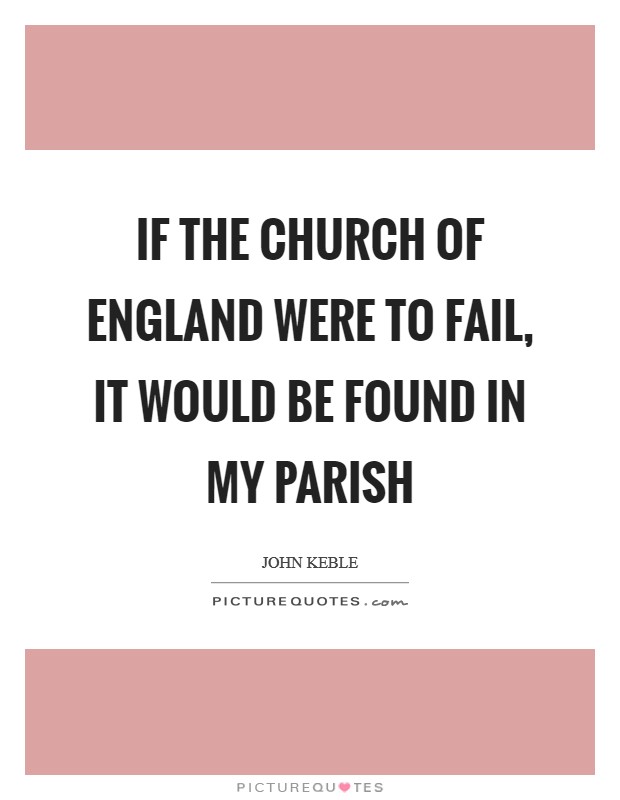
Keble retired to his country vicarage in the village of Hursley, near Winchester after 1841. He wrote tracts and hymns. He took his clerical duties so seriously that he once said that if the Church of England collapsed, it would be found in his parish.

Prayer


John Keble
S. 约翰·凯布尔
T. 約翰·凱布爾

约 Yue    about                約  yaku    promise       Jon    じょん   ジョン       Jon  존  zone         
翰 han    John                  翰  kan      letter           Ke      け          ケ               Ke    케   ke           
凯  Kai     Kay                 凱  gai       victory         bu     ぶ           ブ               beul 블   bl           
布  bu      cloth                布  fu         linen            ru      る           ル                                       
尔  er       er                     爾  ji           you                                                     
                                                                 
----------------------

The Church has the right to celebrate the promise of conservative reform.
The standards of the cloth represent the signs and symbols of the clerical norm.

==============

Lectionary John Keble
Obit. JK
wiki National Apostasy

==============

Reasonable Reason

Peter Geach
b. Chelsea, London, England  5.29.1916
d. Cambridge, England 12.23.2013

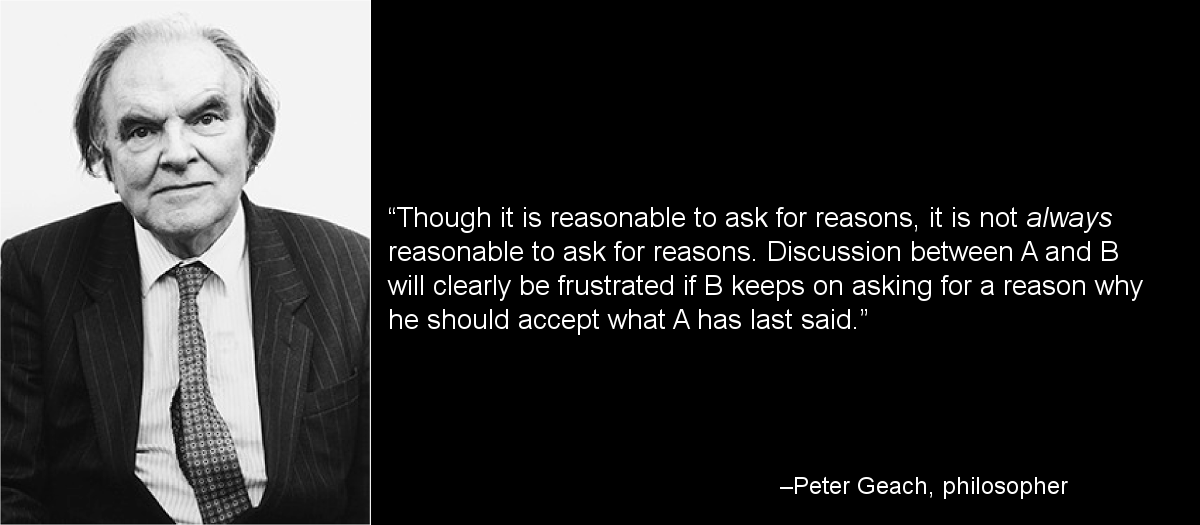
Peter Geach was a younger colleague of Ludwig Wittgenstein. He supported analytical philosophy. He was a professor of logic at the University of Leeds. His interests were logic, ethics, history, religion and identity.

He translated the works of Gottlebe Frege with Max Black in 1952.

Geach synthesized analytic philosophy with Thomism. He was one of the most  notable Catholic philosophers in the last half century.  Faith neither conflicted with reason nor trumped it.

The two dovetailed. He produced sharp gems of analytical argument that criticized relevant currents in philosophy.

-------------------------

Peter Geach was born in Chelsea, London on 29 March 1916. He was the only son of George Hender Geach and his wife Eleonora Frederyka Adolfina née Sgonina.

His father was employed in the Indian Educational Service. He would go on to work as a professor of philosophy in Lahore and later as the principal of a teacher-training college in Peshawar in Pakistan.

Geach won a scholarship to Balliol College, Oxford in 1934. He graduated with a degree in the Classics in 1938. He spent a year (1938–39) as a Gladstone Research Student based at St Deiniol's Library, Hawarden.

Geach's married Elizabeth Anscombe in 1941. Both were converts to Catholicism. Their marraige was a fertile philosophical coupling like that of Jean-Paul Sartre and Simone de Beauvoir.

They had four daughters and three sons. They were a daunting duo in philosophical debate. Each collaborated in translating Descartes and in the movement (later called Analytical Thomism)

He undertook further research at Cambridge following the end of World War II in 1945.

He was appointed to his first substantive academic post as assistant lecturer at the University of Birmingham in 1951. He became a reader in logic later.

Geach's first book was Mental Acts (1957). It became a classic in the philosophy of psychology. It argued that the acquisition of a concept was a process of becoming able to do something.

It was not a matter of having internal representations of external things or undergoing inner experiences as many philosophers since Descartes had held.

Geach criticised what he called abstractionism. The view held that we acquire the concept of red from repeated experiences of red.

It would fail to account for many of our concepts. You could not find anything in the sensible world, nor could you draw any picture that could suitably be labelled 'or' or 'not'.

The book, Mental Acts, was indebted to Wittgenstein. His paper Ascriptivism (1960) was more original and in line with his distinctive technique of using hard logic to crack problems in metaphysics and ethics.

He showed by means of "if" sentences the inadequacy of ethical theories which claimed that calling a person, act or principle good or bad was just a matter of commending or expressing disapproval of the person, act or principle, without any possibility of referring to a real quality they have or of being accurate about that quality.

The rule of modus ponens asserted that if a conditional statement (“if p then q ”) is accepted and the antecedent ( p ) holds, then the consequent ( q ) may be inferred.

He made what he called "the Frege point", and later came to be called the Frege-Geach point. The “embedding problem” was posed in his article “Assertion” (Geach, 1964), but the discussion had started back from his article “Imperatives and Deontic Logic” (Geach, 1958).

Sentences that express moral judgments can form part of semantically complex statements in a way that an expressivist view cannot easily explain.

The sentence “Telling lies is wrong” has the same meaning regardless of whether it occurs on its own or as the antecedent to “If telling lies is wrong, then getting your little brother to tell lies is also wrong”.

He recommended  attention to Frege’s distinction between assertion and predication. Assertion expressed illocutionary force, whereas predication was about propositional content.

Illocutionary force conveyed an imperative sense of caution, whereas propositional content described the modification of the subject.

The same statement "telling lies is wrong" could then express different degrees of emotional concern.

If you were emphatically telling your son that getting your little brother to torment the cat was wrong, it would be illocutionary. If you were illustrating an example of moral statements, the condition is propositional content.

Consider the embedded statements in the modus ponens:

1. If tormenting the cat is wrong, then getting your little brother to torment the cat is also wrong

2. Tormenting the cat is wrong

Therefore, getting your little brother to torment the cat is wrong.

The modus ponens gives the argument a more emphatic sense of relevance.

Geach was appointed Professor of Logic in the Department of Philosophy at the University of Leeds in 1966.

He defended the Thomistic position that human beings are essentially rational animals, each one miraculously created.

He dismissed Darwinistic attempts to regard reason as inessential to humanity.  He repudiated any capacity for language in animals as mere association of manual signs with things or performances.

He disagreed with both pragmatic and epistemic conceptions of truth. He developed the correspondence theory proposed by Aquinas.

He saw W. V. Quine and Arthur Prior as his allies, in that they held three truths. 1) There are no non-existent beings. 2) A proposition can occur in discourse without being there asserted. 3) The sense of a term does not depend on the truth of the proposition in which it occurs.

Geach retired from his chair in 1981 with the title Emeritus Professor of Logic. He held visiting professorships at the universities  of Cornell, Chicago, Michigan, Pennsylvania and Warsaw.

He was elected a Fellow of the British Academy (FBA) in 1965. He was elected an Honorary Fellow of Balliol College in 1979.

He was awarded the papal cross "Pro Ecclesia et Pontifice" by the Holy See for his philosophical work.

===============

Aquinas had defended monarchy with his dialectic imitation of Aristotle in the 13th century.

Roman Catholics that favor national sovereignty don't qualify as threats to national or international security.

Papal claims to supremacy and infallibility destablized Europe in terms of monarchical and parliamentarian government. Supremacy supported Vatican investiture as did the call for the Crusades, the Inquisition and indulgences.

The conversion of Geach to catholicism presented an interesting social quandary to the British government. Aquinas could be used to support national sovereignty, but the conversion could have suggested that the monarchy should just comply with the Vatican as had been the case prior to Henry VIII.

It is likely that his public position as a professor indicated that he was interested in promoting the Oxford movement effort to support Roman customs in Anglican Churches in service to the United Kingdom.

Catholics that supported reasonable policy for conservative expenditure by government were for national sovereignty. Their political perspective had proven to be necessary to counter liberal expenditure for Calvinist reform.

Rather than promote the prohibition of employment for Roman Catholics, the British government entertained employment as a means to consider national security in relation to the international situation.

wiki Peter Geach
Info Phil PG
Guardian Obit PG
Geach, Frege and Wittgenstein
The Frege-Geach Problem
Video


Sunday, November 3, 2019

Discern

11.10.19
Radha Mitchell

Discern
Reality
辨别现实
Biànbié xiànshí
現実を識別する 
Genjitsu o shikibetsu suru
ps17
In rebus exerceant

Help me to discern the truth of statements about reality.
Listen to the innocence of objectivity as the augur for actuality.

Let vindication come from your presence
that my eyes may see justice in relation to essence. 

Summon me to weigh my heart even at night.
Let false conceptions be melted down to form assertibles as right.

Marriage is not the sole consideration in the determination of leadership seen.
The children of the resurrection are like angels in political dealership preened. 

I don't make insulting statements to attack others for their existence.
I am working to shape my thought to discourage violent resistance.

Logic points to truth.
Science is the sleuth.

Number is a concept
that describes size inside the content.

Truth defines morality
with respect for health in reality.

My footsteps hold fast to the order of design as law.
My feet will not stumble in the avoidance of flaw.

I call upon you who will answer me.
Incline your ear to consider what is or is not to be.

Show me the wonder of kindness
as deliverance from misconception as blindness.

Keep me as an object for your affection
and an emblem of your resurrection.

I would that my words were engraved in stone
to serve as testimony for those who wish to atone.


Chrysanthemums

I know my Redeemer lives though I have been gravely afflicted.
Love is the reward that is given for faith for which thought is restricted.

The second coming of Christ will not occur until after the rebellion. 
The lawless one will be revealed when Mars is in the carnelian aphelion.

Protect me from those who would attack 
with the aggression to make me break or crack.

Their mouths speak proud things.
They have closed their heart to what the heart sings. 

They press me hard to cast me to the ground
with a roar of sound that bounces all around.


They acted like a young lion greedy for prey
lurking until leaping forth to cast stealth away. 

Arise to defend and bring them down.
Turn their smile of attack into a frown.

Let deliverance from those who add strife
be rendered to those with reverence for life.

Let those who compete to provide a service
be rewarded with surplus for the observance.

I will see the face of my vindication. 
I will be satisfied with your incorporation.

-------------------------

Psalm 17
Exaudi, Domine
Hear, Dominated

1 Hear my plea of innocence, O Lord;
give heed to my cry;
listen to my prayer, which does not come from lying lips.
2 Let my vindication come forth from your presence;
let your eyes be fixed on justice.
3 Weigh my heart, summon me by night,
melt me down; you will find no impurity in me.
4 I give no offense with my mouth as others do;
I have heeded the words of your lips.
5 My footsteps hold fast to the ways of your law;
in your paths my feet shall not stumble.
6 I call upon you, O God, for you will answer me;
incline your ear to me and hear my words.
7 Show me your marvelous loving-kindness,
O Savior of those who take refuge at your right hand
from those who rise up against them.
8 Keep me as the apple of your eye;
hide me under the shadow of your wings,
9 From the wicked who assault me,
from my deadly enemies who surround me.
10 They have closed their heart to pity,
and their mouth speaks proud things.
11 They press me hard,
now they surround me,
watching how they may cast me to the ground,
12 Like a lion, greedy for its prey,
and like a young lion lurking in secret places.
13 Arise, O Lord; confront them and bring them down;
deliver me from the wicked by your sword.
14 Deliver me, O Lord, by your hand
from those whose portion in life is this world;
15 Whose bellies you fill with your treasure,
who are well supplied with children
and leave their wealth to their little ones.
16 But at my vindication I shall see your face;
when I awake, I shall be satisfied, beholding
your likeness.
------------------------
=================
------------------------

My Redeemer Lives


The book of Job is set in the land of Uz (Job 1:1). Lamentations 4:21 places Edom in the land of Uz. Edom was southeast of the Dead Sea, toward the upper reaches of the Sinai Peninsula, east of Egypt and just north of the Red Sea.

Uz would most likely fall inside the current state of Jordan.

One of Job’s false comforters was named Eliphaz (Job 4:1). He was a Temanite. Teman was a city in Edom not far from the city of Petra.

Job appears in the 6th-century BCE book of Ezekiel as a man of antiquity renowned for his righteousness.

The books of Job, Ecclesiastes and Proverbs belong to the genre of wisdom literature. The genre was common in the ancient Near East. This included ancient Iran, Egypt, Asia Minor and the territory in-between. The Babylonian empire accounted for a large amount of the in-between area.

Map 6th c. Near East


The kingdom of Judah had been conquered by the Babylonians in the 6th century. The Siege of Jerusalem had been carried out by Nebuchadnezzar II, king of Babylon in 597 BCE.

Wisdom referred to a way of thinking about the knowledge gained by the thought expressed in literature. Wisdom literature from Sumeria and Babylonia can be dated to the second millennium BCE. Several texts from ancient Mesopotamia and Egypt offer parallels to Job.

The author of Job was the recipient of a long tradition of reflection on the existence of inexplicable suffering. The author was almost certainly an Israelite. He set his story outside Israel in southern Edom or northern Arabia. He made allusion to places as far apart as Mesopotamia and Egypt.

The language of Job stands out for the large number of words and forms not found elsewhere in the Bible.

Job is an investigation of divine justice. This problem is known in theology as the problem of evil. Why does God allow evil to harm the righteous? Human choices and actions have been found to be morally significant, but experience has demonstrated that suffering can be unmerited as retributive.

The Adversary raised the question of whether there is such a thing as disinterested righteousness. If righteousness is rewarded with prosperity, will people not act righteously from selfish motives? He asked God to test this by removing the prosperity of the most righteous of all, Job.

The book begins with the frame narrative. The reader is given a panopticon view that depicts Job as exemplary in piety and faith.

The 'fear of God' was a term used as a movement from the cause of piety as respect for any one of the gods and goddesses in the parthenon to the singularity of the divine nature. Faith had to reflect benefit for the world from the citizen's perspective in the state. Prosperity was viewed as a measure of success in piety in the imperial state.

Job's affliction was a description of the transition from polytheism. His piety would be rewarded by success in either the polytheistic or monotheistic cultural setting, but it was not motivated by selfishness or greed for the reward. He did not agree with the opinions expressed by his accusers. He carefully selected the best reasons for his faith to find his way back to prosperity. 

Satan took Job's family, possessions and health. Job praised God, yet lamented his suffering. His dialog with 3 associates demonstrates a shift from the objective view of consequence as accident to anger over the cruelty of the affliction as a punishment.

His associates were unyielding in the expression of the opinion that his suffering must have been retribution for offense. They berated him further for his refusal to agree with their judgement.

Job's argument against the presumption of divine retribution was expressed in angry opposition to the statements made by the associates who had become his accusers. Baldath made the statement that present adversities always arise because of past sins.

Job responded by saying that their punishment was much worse than any offense made by him. He felt that his accusers were assuming divine authority with their judgment. He wanted his words to be recorded as testimony against the ease with which his accusers shifted their perceptions to justify the cruelty of the affliction as though it were divine punishment.

Job 19:23-25

'O that my words were written down!
O that they were inscribed in a book!
O that with an iron pen and with lead
they were engraved on a rock for ever!
I know that my Redeemer lives.
At the last he will stand upon the earth.'

------------------------

I would that my words were engraved in stone
to serve as testimony for those who wish to atone.

I know my Redeemer lives though I have been gravely afflicted.
Love is the reward that is given for faith for which thought is restricted.

==================

Roman Influence in Thessalonica

Thessalonican Amphitheater


Cicero (106-43 BCE) was a Roman statesman, orator, lawyer and philosopher. He had never been friendly towards the first triumvirate. He was specifically against Julius Caesar and his social reform. Caesar had always been fairly cordial to Cicero despite this.

Cicero’s political views became more conservative in contrast to the social reforms being proposed by Julius Caesar, Gaius Antonius and Catiline between 66 and 63 BCE.

Cicero received the consulship of 63-62 BCE at the minimum age (42).  He was consul prior, the consul who had won by the most votes. He was also a novus homo or the first man in his family to be elected to the office.

A consul held the highest elected political office of the Roman Republic (509 to 27 BCE). Ancient Romans considered the consulship the highest level of the 'cursus honorum.' The 'course of honor' was an ascending sequence of public offices to which politicians aspired.

The citizens of Rome elected two consuls to serve jointly for a one-year term each year. The consuls alternated in holding imperium each day. A consul's imperium extended over Rome and all its provinces.

The consuls were not the highest office in Rome's republican heritage after the establishment of the Empire (27 BCE). The emperor was necessarily consul prior when elected to the office.

When the first triumvirate between Caesar, Pompey and Crassus was originally founded Caesar had made suggestions to Cicero with the possible view to include him in the alliance. It was Cicero’s principles regarding the constitution for the republic that averted any such eventuality.

Cicero stayed in Thessalonica during 58 BCE when he was exiled from Rome.

Thessaloniki's acropolis was built in 55 BCE for security reasons. It was situated in the northern hills following Thracian raids in the city's outskirts at the time. The 'high city' was a settlement in ancient Greece.

It was a citadel built upon an area of elevated ground. The elevation was frequently a hill with precipitous sides that was chosen for purposes of defense. An acropolis also had a function of a religious sanctuary. Sacred springs highlighted its religious significance.

The city contained a amphitheater where entertainment in the form of gladiatorial shows were held for the local citizens. A circus was also exhibited in the amphitheater for the amusement of the citizens. The games were held at the same time as the circus.

Cicero was under duty to govern the province of Cilicia from 51-50 BCE. When he arrived back at Rome the city was on the edge of civil war. When it finally toppled into that abyss Cicero left the city once more.

The Roman general Pompey the Great used Thessalonica as one of his chief bases during his civil war with Julius Caesar from 49-47 BCE. This put the city on the senatorial side of the war.

It was only in 47 BCE when Caesar and Pompey had finally settled their differences that he thought it safe to return to the city. Things did not exactly get better for him. This time it was for private, rather than public, reasons.

Cicero divorced his wife Terentia in 46 BCE. He had been married to her for almost thirty years. He married Publilia, who had been his ward, shortly afterwards.

The next year grief struck Cicero when his daughter Tullia died. The lack of sympathy that his second wife showed led to her also being divorced. Matters were made worse for Cicero by the fact that it was becoming ever more apparent that Caesar was not going to reinstitute the republican constitution.

Thessalonica proved loyal to the second triumvirate between Antony, Octavian and Lepidus after Caesar was murdered in 44 BCE. It was rewarded by receiving the status and privileges of a "civitas liberas" (Pliny, NH, iv.36).

The free city was granted certain tax exemptions.  It was a self-governed city during the Hellenistic and Roman Imperial eras. The status was given by the king or emperor, who supervised the city's affairs through his epistates or curator. The prosperity of Thessalonica in this period is attested by a prolific production of coinage.

Thessalonica was important, not only as a harbor with a large import and export trade, but also as the principal station on the great Via Egnatia, the highway from the Adriatic to the Hellespont.

The Roman province of Macedonia was controlled by the empire during the time of Paul's visit to Thessalonica. Each province was ruled by a Roman who was appointed as governor. Provinces were generally governed by politicians of senatorial rank, usually former consuls or former praetors.

The Latin word provincia originally meant any task or set of responsibilities assigned by the Roman Senate to an individual who held 'imperium.' The 'right of command' was often a military authority within a specified theater of operations.

Magistrates were elected to office for a period of one year under the Roman republic. Those serving outside the city of Rome such as consuls acting as generals on a military campaign, were assigned a particular provincia, the scope of authority within which they exercised their command.

The territory of a people who were defeated in war might be brought under various forms of treaty. Complete subjection (deditio) was applied in certain cases.

The formal annexation of a territory created a province in the modern sense of an administrative unit that is geographically defined. Republican-period provinces were administered in one-year terms by the consuls and praetors who had held office the previous year and who were invested with imperium.

The terms of provincial governors often had to be extended for multiple years (prorogatio), and on occasion the senate awarded imperium even to private citizens (privati). Pompey the Great was an example.

Prorogation undermined the republican constitutional principle of annual elected magistracies. The amassing of disproportionate wealth and military power by a few men through their provincial commands was a major factor in the transition from a republic to imperial autocracy.

Thessalonica was a free city which had a cosmopolitan population with a large Jewish community that was visited by the apostle Paul about 52 CE.

Paul's Second Missionary Journey


When Paul visited Thessalonica for the first time he had recently come from Philippi. He reported that he had “already suffered and been shamefully mistreated” (1 Thess. 2:2; Philppns. 1:30). It may reasonably be assumed that he had reached Macedonia by way of a journey through Galatia during which he would have founded the churches there.

Paul’s companions were Silas and Timothy. Paul’s preaching appears to have met with good success (1 Thess. 1:6-10; 2:1, 13). His message was received in spite of persecution (1 Thess. 1:6). The gentile makeup of the congregation is made evident by Paul’s recollection that they had turned from idols to serve the living and true God (1 Thess. 1:9).

Paul’s original preaching emphasized monotheism, the death and resurrection of Christ and his imminent Parousia [or coming again]. Paul presupposed in the letter their knowledge that salvation will come “through our Lord Jesus Christ, who died for us . . . ” (1 Thess. 5:9-10). Paul had probably informed them not only of the imminence of the Parousia but also of its unexpectedness (1 Thess. 5:2).

Paul probably discussed the resurrection of believers during his first visit, but neglected to explain the connection between resurrection and Parousia. He had stated the importance of the observance of moral standards and warned of persecution. He made it clear that he had delivered their moral instruction in no fewer than four places (1 Thess. 4:1, 2, 6, 11).

Paul had instructed them to be monogamous, monotheistic and to abstain from sexual immorality (1 Thess. 4:1-6). He had also charged them to be diligent in their work and to be a model of conduct to outsiders (1 Thess. 4:11-12).

Paul became removed from Thessalonica, but Silas and Timothy stayed nearby in Berea. He tried to re-visit but was stopped (1 Thes 2:18). He sent Timothy to Thessalonica (1 Thes 3:1). Timothy reported back regarding Thessalonica church health.

He wrote 1 Thessalonians shortly after his arrival in Corinth. It was not long after he left Thessalonica.

This portion of the second letter to the Thessalonians makes a reference to the rebellion as an antecedent to the parousia.

Parousia is an ancient Greek word meaning presence, arrival, or official visit. The term was used in the East as a technical expression to denote the arrival or visit of a king or emperor from the Ptolemaic period to the second century of the Common Era.

The word is mainly used in Christian theology to refer to the second coming of Christ. It is found in the New Testament 24 times. The word held a special signficance for the Thessalonians with respect for the use of the city by Pompey to rebel against the rule of Caesar.

2 Thess. 2:1-5

As to the coming of our Lord Jesus Christ and our being gathered together to him, we beg you, brothers and sisters, not to be quickly shaken in mind or alarmed, either by spirit or by word or by letter as though from us, to the effect that the day of the Lord is already here. Let no one deceive you in any way; for the day will not come unless the rebellion comes first and the lawless one is revealed, the one destined for destruction. He opposes and exalts himself above every so-called god or object of worship, that he takes his seat in the temple of God, declaring himself to be God. Do you not remember that I told you these things when I was still with you?

------------------------

The second coming of Christ will not occur until after the rebellion.
The lawless one will be revealed when Mars is in the carnelian aphelion.

==================

The Imperial Pontifex
of Constantine
Pontifex Maximus
The Highest Priest

The 'Pontifex Maximus' was the 'greatest priest' of the College of Pontiffs (Colleguim Pontificum) in Ancient Rome. The term in office for the priest was not for a fixed period. It was for life.

The College of Pontiffs was a body whose members were the highest-ranking priests of the state religion. The Romans thought of themselves as highly religious. They attributed their success as a world power to their collective piety (pietas) in maintaining good relations with the gods.

The presence of Greeks on the Italian peninsula from the beginning of the historical period influenced Roman culture. Some religious practices were introduced that became as fundamental as the cult of Apollo.

The Romans looked for common ground between their major gods and those of the Greeks (interpretatio graeca). They adapted Greek myths and iconography for Latin literature and Roman art.

The Etruscan religion was also a major influence, particularly on the practice of augury. Most of Rome's religious institutions could be traced to its founders according to legends. Numa Pompilius was the Sabine second king of Rome who negotiated directly with the gods.

This archaic religion was the foundation of the mos maiorum, "the way of the ancestors" or simply "tradition", viewed as central to Roman identity.

Roman religion was practical and contractual, based on the principle of do ut des, "I give that you might give". Religion depended on knowledge and the correct practice of prayer, ritual and sacrifice.

Latin literature preserves learned speculation on the nature of the divine and its relation to human affairs, but theology was limited to the explanation of natural phenomena. The rites did not entertain a place for a sermon.

The College of Pontiffs consisted of the Pontifex Maximus and the other pontifices, the Rex Sacrorum, the fifteen flamens, and the Vestals. The Rex Sacorum was a senatorial priesthood reserved for Patricians.

A flamen was a priest of the ancient Roman religion who was assigned to one of fifteen deities with official cults during the Roman Republic. The most important three were the flamines maiores (or "major priests"), who served the important Roman gods Jupiter, Mars and Quirinus.

Jupiter was the god of sky and administration. Mars was the god of war and the guardian of agriculture. He was the deity for the military.

The name Quirinus is derived from the Sabine word for 'spear.' He was most likely a Sabine god of war.

The Sabines had a settlement near the eventual site of Rome, and erected an altar to Quirinus on the Collis Quirinalis Quirinal Hill, one of the Seven hills of Rome. When the Romans settled in the area, the cult of Quirinus became part of their early belief system.

The Quirites were known as the men of the oaken spear. It is conceivable that they acted as a local militia or police force.

The Vestals were priestesses of Vesta, goddess of the hearth. The College of the Vestals and its well-being were regarded as fundamental to the continuance and security of Rome. They cultivated the sacred fire that was not allowed to go out.

The Vestals were freed of the usual social obligations to marry and bear children and took a 30-year vow of chastity in order to devote themselves to the study and correct observance of state rituals that were forbidden to the colleges of male priests

The College of Pontiffs was one of the four major priestly colleges; originally their responsibility was limited to supervising both public and private sacrifices, but as time passed their responsibilities increased.

The other colleges were the augurs (who read omens), the quindecimviri sacris faciundis ("fifteen men who carry out the rites"), and the Epulones (who set up feasts at festivals).

The title pontifex comes from the Latin for "bridge builder", a possible allusion to a very early role in placating the gods and spirits associated with the Tiber River, for instance.

The pontifex maximus was the most important member of the college. The pontifex maximus held the sole power in appointing members to the other priesthoods in the college until 104 BCE.

Religion was a part of daily life for ordinary Romans. Each home had a household shrine at which prayers and libations to the family's domestic deities were offered. Neighborhood shrines and sacred places such as springs and groves dotted the city.

The Roman calendar was structured around religious observances. Women, slaves, and children all participated in a range of religious activities. Some public rituals could be conducted only by the Vestals.

The main task of the pontifices was to maintain the pax deorum, the 'peace with the gods'. They gave advice to the magistrates, interpreted the omens, controlled the calendar and oversaw funerals for this goal.

The pontifex maximus was responsible for a large collection of omens (annales maximi). He wrote down the celestial and other signs each year and added the events that had followed the omens, so future generation would be able to better understand the divine will.

The pontifex maximus was elected by the comitia tributa or election tribute. The people were divided into voting districts. The taxes collected determined the vote. The ordinary pontifices were also elected after 104 BCE. They had been coopted until then.

Julius Caesar was elected pontifex maximus in 63 BCE. He kept the office until his death. The house where he spent the night before he was killed was the domus publica. Marcus Aemilius Lepidus became pontifex maximus (44-12 BCE) after his death.

When he died, the emperor Augustus became responsible for the state cult. He also put an end to the election of the pontifices. A position in the college of pontifices was a sign of special imperial favor from that point.

The pontifex maximus was recognized in public affairs by the iron knife (secespita). He killed the animal that was offered in sacrifice.

The  derivative "pontiff" later became terms used for Catholic bishops including the bishop or Rome.

Kohen Gadol
The High Priest

The High Priest or Kohen Gadol in Judaism was the religious leader for the Jewish people. He stood at the top of the chain of command tasked with running the Temple’s operations.

His role extended from Aaron in ancient times until the destruction of the Second Temple in 70 CE.
The Torah gives a detailed account of the inauguration of the first-ever High Priest. The Israelites were gathered at the Tabernacle.

Moses acted as interim Kohen Gadol. He brought a series of sacrifices, dressed Aaron and his sons in the priestly garments, anointed them with oil and smeared blood on their ears, fingers and toes. This represented the blood that the offering of animal sacrifice included.

Aaron and his sons also brought an inaugural flour offering that was to be boiled, baked and fried before being burnt on the altar.

The only parts of the ceremony that were included in subsequent High Priest inaugurations were the anointment with special oil (shemen hamishchah), being dressed with the eight garments of the High Priest and the inaugural flour offering (minchat chinuch).

The High Priest belonged to the Jewish priestly familes that traced their paternal line back to Aaron through Zadok, a leading priest in the time of David and Solomon. This tradition came to an end in the 2nd century BCE during the rule of the Hasmoneans. The position was then occupied by priestly families unrelated to Zadok.

It was the job of the High Priest to oversee the Temple service.  His most prominent responsibility was entering the Holy of Holies on Yom Kippur.

The Yom Kippur service mirrored the typical holiday service with two sacrifices, daily incense burnt twice, special holiday offerings and the lighting of the menorah. Atonement offerings were brought for the High Priest, his family, the priests and the nation as a whole.

The High Priest was required to carry out all of the services himself on Yom Kippur. An additional incense offering was also brought. This was the unique service performed in the Holy of Holies.

The political authority of the Priest grew during the times of occupation by foreign powers. Messianic sovereignty was attributed to a member of the royal house, while religious affairs were reserved to the high-priesthood, represented in the Book of Zechariah by Joshua.

The high priest also became a political chief of the congregation as the Messianic hope or even the hope of autonomy under foreign (Persian, Greek, Egyptian or Syrian) suzerainty became weaker in the course of time.

The consideration shown him by the suzerain powers and their viceroys induced the effect of the increasingly thorough acceptance of the Levitical code by pious Judeans.

The assumption of the princely authority by the Maccabean high priests during the Hasmonean dynasty was merely the final link in this development. The ideals of the politico-Messianic and the religio-Levitical were combined in one office beginning with the death of Zerubbabel.

When the brief heyday of national independence had come to an inglorious close, the high-priesthood changed again in character insofar as it ceased to be a hereditary and a life office during the Herodian dynasty in the Roman occupation.

High priests were appointed and removed with great frequency. This may account for the otherwise strange use of the title in the plural (ἀρχιερεῖς) in the New Testament and in Josephus.

The high priest was looked upon as exercising authority in all things, political, legal, and sacerdotal in the post-Maccabean period.  The presidency of the Sanhedrin was almost certainly vested in the high priest.

The major distinction between the Pharisees and the Sadducees was belief in the Resurrection. The Pharisees were a social movement and a school of thought in the Holy Land during the time of Second Temple Judaism. They were associated with the development of synagogues in post-exilic Judean society. The Sadducees were aligned with temple worship.

Josephus (37 – c. 100 CE) is believed by many historians to be a Pharisee. He estimated the total Pharisee population before the fall of the Second Temple to be around 6,000.

Josephus claimed that Pharisees received the full support and goodwill of the common people in contrast to the Sadducees who were in the upper class.

Pharisees claimed Mosaic authority for their interpretation of Jewish Laws. Sadducees represented the authority of the priesthood established since the days of Solomon when Zadok, their ancestor, officiated as High Priest.

The phrase "common people" in Josephus' writings suggests that most Jews were distinguished from the main liturgical groups.

The letter to the Hebrews attributes the title of High Priest to Jesus, but there are gospel accounts that describe his activity as a judge who made statements about important religious controversies. The following account from the gospel of Luke relates how he made a statement about the resurrection to those who did not believe that such a thing existed.

Luke 20:27-35

Some Sadducees, those who say there is no resurrection, came to him and asked him a question, 'Teacher, Moses wrote for us that if a man's brother dies, leaving a wife but no children for his brother. Now there were seven brothers; the first married and died childless; then the second. The third married her. So it was in the same way all seven died childless. Finally the woman also died. Whose wife will the woman be in the resurrection? The seven had married her.'

Jesus said to them, 'Those who belong to this age marry and are given in marriage; but those who are considered worthy of a place in that age and in the resurrection from the dead neither marry nor are given in marriage. Indeed they cannot die any more, because they are like angels and are children of God, being children of the resurrection.'

------------------------

Marriage is not the sole consideration in the determination of leadership.
The children of the resurrection are like angels in political delearship.

==================

Early analytic philosophy tended to avoid the study of philosophy of religion. It was grouped with the study of ethics by logical positivists as metaphysical and meaningless. The demise of logical positivism renewed interest in the philosophy of religion.

Philosophers like Alvin Plantinga, Richard Swinburne and Antony Flew not only introduced new topics, but returned to classical issues such as the nature of miracles, theistic arguments, the problem of evil, the rationality of faith, concepts on the nature of God and many more.

Plantinga and Flew debated the logical validity of free will to defend the choice of good despite the problem of evil. Analytic epistemology and metaphysics has formed the basis for a number of philosophically-sophisticated theistic arguments.

The philosophy of language has established the analysis of the logic of statements about reality as the objective for the discernment of meaning in communication.

This modern form for wisdom has precedents in the concepts of the Word or Logos. Reason was viewed as the way to order thought for action. Duty was ordered as automated action for happiness.

The work of Plato shows that there was a movement in philosophy to convert religion from the stories about the immorality of the gods in polytheism to the morality of the moral code in monotheism. This concern for the monad was expressed even earlier in the Eleatic school.

Nature lies within the universe. The concept of God allows for contrast with that which is within the universe and the divine being which is posited as the Creator of it.

The paradox of Zeno removed that which was pragmatic from the logical description of reality in order to demonstrate the role that language plays in the description.

Logic is the general form for reason. It has to balance the ideal with pragmatic concern in order to describe things realistically.

Logic is the general form for reason.

Chn. 逻辑是理性的一般形式.
Luójí shì lǐxìng de yībān xíngshì.

Jpn. 論理は理性のための一般的な形式です.
Ronri wa risei no tame no ippantekina keishikidesu. 

Krn. 논리는 일반적인 이유입니다.
Nonlineun ilbanjeog-in iyuibnida.

Pre-Socratic Logic

Elea, Italy
Ruins

The pre-Socratics preceded the life of Socrates (470-399 BCE). They were the forerunners of what became natural philosophy in the West. Knowledge mined from the study of nature later developed into the natural sciences (such as physics, chemistry, geology and astronomy).

Their efforts were directed to the investigation of the ultimate basis and essential nature of the external world. They sought the material principle (archê) of things and the method of their origin or disappearance.

The study of rhetoric and logic was started.

Pythagoras of Samos (an Aegean island) arrived in Croton in southern Italy in the last quarter of the 6th century. He established a community of followers who adopted his political views, which favored rule by the “better people,” and also the way of life he recommended on what seem to have been more or less philosophical bases.

There were two traditions about Pythagoras. One meshed with the traditional view and associates Pythagoras with political tyrants. Another credited him with rejecting tyrannies for aristocracies that might not have been grounded in wealth. The latter case is more likely.

The early Pythagoreans conceived of nature as a structured system ordered by number. Post-Parmenidean Pythagoreans such as Philolaus lived more than a generation after Pythagoras' death. Archytas lived in the late 5th to early 4th century.

Either held more complicated views about the relation between mathematics and cosmology than it is reasonable to suppose Pythagoras himself could have advanced.

Aristotle (384-322 BCE) attributed the discovery of the art of dialectic to Zeno the Eleatic (495-422 BCE). Dialectic is the art of discussing the truth of opinions. Zeno was third among the leaders of the Eleatic school.

The Greek colony of Elea was in southern Italy. The colony was  south of Naples. It is now known as Velia.

The Eleatics emphasized the doctrine of the One. Xenophanes (570-470 BC) declared God to be the eternal unity. The One permeated the universe and governed it by his thought.

Parmenides (510-440 BC) affirmed the one unchanging existence to be alone true and capable of being conceived. Multitude and change were defined as appearance without reality.

His investigation explored the nature of philosophical inquiry. It concentrated less on knowledge or understanding than on what can be understood with the language.

He composed a poem in Homeric hexameters that narrated the story of a young man (kouros) who was taken to a goddess who promised to teach him all things. The goddess didn't give him knowledge of the things, she gave the kouros the tools to acquire that knowledge himself. 

The goddess showed him the paths of being or opinion. The right way of thinking was to think of what-is. The wrong way was to think of both what-is and what-is-not. 

Parmenides was the inventor of metaphysics as the inquiry into the nature of being or reality. While the tenets of his thought have their home in poetry, they are expressed with the force of logic. The Parmenidean logic of being thus sparked a long lineage of inquiry into the nature of thought.

The doctrine of the One doctrine was defended by his younger countryman Zeno of Elea (490-430 BC) in a polemic against the common opinion which sees in things multitude, becoming and change.

Zeno propounded a number of celebrated paradoxes, much debated by later philosophers, which try to show that supposing that there is any change or multiplicity leads to contradictions.

Zeno paid particular attention to the contrast between the requirements of logical argument and the evidence of the senses.

He is now and in antiquity best known for the four famous paradoxes of motion. He purported to show that despite the evidence all around us the ordinary motion of everyday experience is impossible.

The paradoxes claim that motions can never be begun (the Achilles), be completed (the Dichotomy), entail contradictions (the Moving Blocks) or are altogether impossible (the Arrow). Logical argument is explicated in the description of the paradoxes.

Socrates

Socrates was a stonemason who had served as a Hoplite in the Peloponnesian War. The conflict between Athens and Sparta stretched intermittently over a period spanning 431 to 404 BCE.

Socrates was active for Athens in the battles of Amphipolis (422), Delium (424) and Potidaea (432) according to his testimony in the Apology.

Athens was a democracy whereas Sparta had two monarchs who ruled as a military dictatorship. The more aristocratic Athenian families tended to favor the rigid and restricted hierarchy of power in Sparta instead of the more widespread democratic distribution of power with free speech for the citizens in Athens.

Plato placed praise for Sparta in the mouth of his character Socrates more than once. Such praise was expressed in Protagoras, Crito and Republic.

Sparta finally defeated Athens in 404 BCE. It was just five years before Socrates’ trial and execution. They installed as rulers a small group of Athenians who were loyal to Spartan interests.

These were called "The Thirty." It was reported that they executed a number of wealthy Athenians and confiscated their property. Others were arrested or exiled for democratic sympathies.

The Thirty were led by Critias, a known associate of Socrates and a member of his circle. The Thirty were overthrown in 403 BCE by a group of democratic exiles returning to the city. It was reported that Critias was killed. The Spartans brokered an accord and installed a different government.

Plato's Meno is set in 402 BCE. It imagines a dialog between Socrates and Anytus. Anytus argues that instruction in virtue is not limited to the elite or privileged few. Socrates argued that one should consult an expert in virtue to learn about it.

The Socrates portrayed in Apology, Crito, Phaedo and Symposium concurs with description provided in other sources. The Platonic Socrates as demonstrated in these dialogs is a representation of the actual Socrates as he lived in history.

Xenophon is more reliable as a source of historical information insofar as he wrote as a historian. Plato wrote as a dramatist. He was prone to use the character Socrates as a vehicle for his ideas.

Xenophon reports that because youths were not allowed to enter the Agora, the central open space for a Greek city state, they used to gather in workshops surrounding it. Socrates frequented these shops in order to converse with the merchants.

Socrates and his contemporaries lived in a polytheistic society. The stories of the gods recounted in Hesiod, Homer and the like describe a world that was not created by the gods. They themselves were created and intervened in the affairs of humans.

Aphrodite saving Paris from death at the hands of Menelaus in the Iliad. Zeus sent Apollo to rescue the corpse of Sarpedon after his death in battle in the same epic.

They were not defined as omniscient, omnibenevolent or eternal. They were constrained to respond to what they witnessed or reports about what had been witnessed.

The story about the experience of the oracle at Delphi is well known, but there are variants with an important distinction. Whereas in Plato’s Apology the oracle tells Chaerephon that no one is wiser than Socrates, in Xenophon’s Apology Socrates claims that the oracle stated that no one was more free, just or moderate than him.

Socrates was reputed to have said, "I know that I don't know." He used this statement to question the definitions of concepts presented by those who claimed certain knowledge about something.

Certainty in the claim to knowledge was diminished, but the essential definition of key terms was analyzed and clarified. Even when it seemed that certainty regarding a definition was destroyed, logical clarity was refined with proximity to the conception of definition.

The theology expressed by Plato's Socrates was more Eleatic than conventional. The blind acceptance of dictates from the gods was not promoted. Monotheism was posited as the basis for questioning cultural conventions regarding the perception of nature. Belief in the One was the reason for analytical philosophy.

Aristotle (384-322 BCE)

Aristotle made it evident in his Organon (343) that the demand for a regulative art of scientific discourse was created by the logic of debate as influenced by the Eleatic school. The case paralleled the rise of the art of rhetoric.

Aristotle regarded Empedocles (495-435 BCE) as the originator of that art as he had referred the beginnings of dialectic to Zeno (495-425). The essential principles of logic and rhetoric were operative and effective in practice in lawsuits before Aristotle gave them their abstract formulation. The formulation of both arts in well-rounded systems came much later.

While the Pre-Socratics did not document a formal system of logic even in the Eleatic school, it is more significant that they either received from their predecessors or themselves developed the conceptions and the presuppositions on which Aristotelian logic is founded.

Bertrand Russell called Aristotle's principles of logic laws in 1912.

The identity principle is drawn from the verb 'to be'. When something exists, it is. This is expressed symbolically as p = p. If rain is heard, seen or felt, it means that it is raining. If a person exists, he or she is alive.

The non-contradiction principle says that logic can be used to distinguish one thing from another. Being alive is distinguished from not being alive. This is expressed as ~(p and ~p) where ~ means 'not.' It is not the case that a person is alive and not alive.

The principle of the excluded middle asserts that everything must either be or not be. This principle is particularly significant in that implies the logical abstraction of truth. To say that what is, is not, is false. It is also false to say that what is not, is. The truth then is p or ~p.

Some one or some thing is alive or it is not. These principles are logical operations of thought for a personal perspective, yet the principles propose there is a reality that is true. I think that is the reason the Russell called them laws of logic. The principles point to something larger in truth with respect for law.

Stoic Propositions

Stoic logic is the system of propositional logic developed by the Stoic philosophers in ancient Greece. The Stoic school was centered in Athens.

A stoa was a classical portico or roofed colonnade. It is conceivable that instruction was given in the public space under the protection of the roof over the corridor. The Athenian Agora had four, possibly five, stoas that lined the southern, western and northern sides of the public area.

The "Painted Stoa" was a building in Athens where Zeno of Citium met his followers and taught. Later adherents of this philosophical tradition were given the name "Stoic" from their association with this place.

Stoic logic was one of the two great systems that analyzed language in the classical world. It was largely built and shaped by Chrysippus (c.279-206 BCE), the third head of the Stoic school in the 3rd-century BCE.

Chrysippus's logic differed from Aristotle's  because it was based on the analysis of propositions rather than terms. The smallest unit in Stoic logic is an assertible. This was the Stoic equivalent for a proposition.

The assertible is the content of a statement such as "it is day". An assertible is “that which subsists in accordance with a rational impression.” Rational impressions are those alterations of the commanding faculty whose content can be exhibited in language.

The Stoics held that being (ὄντα) is material. Not all things (τινά) are. They accepted the distinction between abstract and concrete bodies, but rejected Aristotle's belief that purely incorporeal being exists as the Unmoved Mover.

The Stoics defined the Universe as a material, reasoning substance, known as God or Nature. This was divided into the active and passive classes.

They accepted the idea that if an object is hot, it is because some part of a universal heat body had entered the object.

Assertibles have a truth-value such that at any moment of time is either true or false. This looks like modern proposition theory, but propositions (axiômata) are one subspecies of Stoic assertibles.

It would be a mistake to assimilate this sub-class too closely to modern theories of propositions. Modern theories tend to treat propositions as untensed and time-indexed.

The statement “It’s warm  today” expresses the proposition that it is warm in a particular location at the time the statement is made. That’s different from the same statement with the use of those same words tomorrow.

If it is cold tomorrow and what is said by means of the words “It is warm today” is false, then the meaning of the proposition changed, not the truth content.

The sub-text that there is a temperature that indicates how warm or cold it is retains a constant relative value to the observation. The tenseless and time-indexed propositions allow variability in the measure of the truth value.

The modern proposition entertains the question, 'How warm is it?' or 'What is the temperature?' within the context of the statement.

Stoic axiômata are crucially different in this respect. The Stoic theory holds invariant the identity of the assertible corresponding to an utterance on different occasions, but allows its truth value to change.

Compound assertibles can be built up from simple ones through the use of logical connectives. The resulting syllogistic was grounded on five basic indemonstrable arguments to which all other syllogisms were claimed to be reducible.

Stoics outlined what we have control over categories of our own action, thoughts and reaction. The Enchiridion states that opinion, pursuit, desire, aversion and actions are under our control. Body, property, reputation, command and those actions that are not ours are not in our control.

The Stoics are especially known for teaching that "virtue is the only good" for human being. External things such as health, wealth and pleasure are not good or bad in themselves (adiaphora), but have value as "material for virtue to act upon".

Stoics such as Seneca and Epictetus emphasized that because "virtue is sufficient for happiness", a sage would be emotionally resilient to misfortune in a manner comparable to Job.

The belief that health and happiness were subordinate to virtue left the door open for excess in ascetic imposition. Seneca went so far as to recommend that parents cheer their children on for bravery when they were being beaten.

Seneca's position in the administration of Nero was suspect for the tolerance of the reports of assassination, violence and cruelty as something outside of our control even in terms of opinion.

Stoicism was esteemed more than the philosophy of Aristotle or Epicurus throughout the Roman world until the 3rd century CE. Emperor Marcus Aurelius was among its adherents. It experienced a decline after Christianity became the state religion in the 4th century. 

The Logic of Gottlob Frege

Gottlob Frege (1848—1925) played a crucial role in the emergence of modern logic and analytic philosophy. He was born on November 8, 1848 in the coastal city of Wismar in Northern Germany.

His father, Karl Alexander Frege, and his mother, Auguste (Bialloblotzsky) Frege, both worked at a girl's private school founded in part by Karl. Karl held the position until his death 1866, when Auguste took over until her death in 1878.

Gottlob studied at the Gymnasium in Wismar from 1864-1869.  He began studies at the University of Jena in the Spring of 1869. He studied chemistry, philosophy and mathematics. He transferred to the University of Göttingen after 4 semesters. He studied mathematics and physics, as well as philosophy of religion under Hermann Lotze.

Lotze’s main philosophical significance was as a contributor to an anti-Hegelian objectivist movement in German-speaking Europe. The publication of the first editions of his Metaphysics (1841) and Logic (1843) constituted the third wave of this movement.

Lotze advanced an objectivist philosophy that did not start from the subject-object opposition. He insisted that this opposition  is based on a metaphysical relation that is more fundamental. He promoted the “universal inner connection of all reality” by uniting all objects and terms in a comprehensive, ordered arrangement.

Humanity was the microcosm to the universe as the macrocosm. The fundamental metaphysical and logical problems of philosophy are to be discussed and answered through the lens of the microcosm. The specific perceptual and rational characteristics of human beings are the lens for wisdom.

Frege finished his doctoral dissertation, under the guidance of Ernst Schering in late 1873.  He received a lectureship at the University of Jena in 1874. He stayed there the rest of his intellectual life.

Concept Script (Begriffsschrift) was published as his first major work in logic in 1879. He presented his invention of a new method for the construction of a logical language.

The book was not well received. His contemporaries found its two-dimensional logical notation difficult to comprehend. They failed to see its advantages over previous approaches such as that of Boole.

The Foundations of Arithmetic was published in 1884. Frege refuted other theories of number and developed his own.


He wanted to show that all of the basic truths of arithmetic could be derived from purely logical axioms. He decided to describe his logicist views informally in ordinary language in argument against rival views on the advice of his colleague Carl Stumpf.

Frege objected to any account of mathematics based on psychologism. Math and numbers are not strictly relative to the subjective thoughts of the people who think of them. Psychological accounts appeal to what is subjective, while mathematics is objective.

Mathematical entities have objective properties regardless of whether or not they are recognized as such. He draws a fundamental distinction between logic and psychology. Logic explains things as they are. Psychology studies certain thought processes in individual minds.

He criticized Kant mainly on the grounds that numerical statements are not synthetic-a priori, but rather analytic. Kant claimed  that 7 + 5 = 12 is an unprovable synthetic statement. No matter how much the idea of 7 + 5 is analyzed, the idea of 12 will not be found. The idea of 12 is derived by application to objects in the intuition.

Frege argued that the truth of the equation can be derived without intuition. When 7 objects are added to 5, the total is 12. Mathematical calculation is consistent between smaller and larger numbers by way of analysis. Smaller sums are demonstrated with objects, until the pattern for addition is determined as a process that adds the numbers to obtain the sum.

The abstraction of addition moves from objects to units. A number line assists in the demonstration of the consistency between the two. Add 5 units to 7 on the number line and the addition results in 12. The capacity for mental math moves the abstraction further into the concept of numbers.

When this process is expressed in the general form, it means that any number of units added to a number of units results in the sum for the two numbers. That is to say a + b = c.

The truth of the equation 654,768 + 436,382 = 1,091,150 can be affirmed without the intuition of the numbers or the counting of objects.  Particular numerical statements such as 1 + 2 = 3 are distinct from general statements such as a + b = b + a, but the latter are as true as the former. The equation is the object for analysis in either case.

Frege criticized J. S. Mill's theory of number as too empirical. Mill's idea that numbers correspond to the various ways of splitting collections of objects into subcollections is inconsistent with confidence in calculations involving large numbers.

The operation of addition cannot be limited to physical quantities for the simple reason that large quantities won't be calculated if they can't be counted as physical objects. 

Frege agreed that geometry is synthetic a priori, but argued that arithmetic must be analytic. It is objective in between intuition and sense perception.

He argued that numbers are objects that assert something about a concept. Numbers are also the extensions of concepts. The number of F's' is defined as the extension of the concept G as a concept that is equinumerous to F. The concept in question leads to an equivalence class of all concepts that have the number F (including F).

The book can be considered the starting point in analytic philosophy, since it revolves mainly around the analysis of language with the goal of clarifying the concept of number.

Frege developed new and interesting theories regarding the nature of language, functions, concepts and philosophical logic in the late 1880's and early 1890's.  His views were published in influential articles such as "Funktion und Begriff" ("Function and Concept", 1891), "Über Sinn und Bedeutung" ("On Sense and Reference", 1892) and "Über Begriff und Gegenstand" ("On Concept and Object", 1892). 

Frege's logical ideas spread through the writings of his student Rudolf Carnap (1891–1970) and other admirers, particularly Bertrand Russell and Ludwig Wittgenstein (1889–1951).
He died on July 26, 1925 in Bad Kleinen, Germany.

Gottlob Frege
S. 哥德叶弗雷加
T. 哥德葉弗雷加

哥 Ge    older brother             哥 ka          big brother          Go   ごっ  ゴッ       Go 고 go                 
德 de    morality                     德 toku      morality                to     と      ト          teu 트 t                   
叶 xie   in harmony                葉  yo         leaf                       ro    ろ-   ロ-            lo  로 in               
弗 Fu    not                             弗  futsu     dollar                    bu    ぶ     ブ           beu브 bro       
雷 lei   terrific                        雷  rai         thunder                  Fu    ふ     フ           Peu프 f       
加 jia    add                             加  ka         add                        re     れ      レ           le  레  re
                                                                                                ga     が     ガ            ga 가   end

------------------------

Logic points to truth.
Science is the sleuth.

Number is a concept
that describes size inside the content.

Truth defines morality
with respect for health in reality.

=================


Peirce made extensive contributions to mathematical logic. He was an innovator in mathematics, statistics, philosophy, research methodology and various sciences, but he defined himself as a logician. He saw logic as the formal branch of semiotics or the study of signs.

The general study of signs that began in Latin with Augustine culminated with the 1632 Tractatus de Signis of John Poinsot. Peirce drew up a "new list of categories" in 1867. He aimed to base his list directly upon experience as constituted by the action of signs.

His list contrasted with the one in Aristotle's categories. Aristotle aimed to articulate within experience the dimension of being that is independent of experience and knowable as such through human comprehension. Peirce included animal life.

The estimative powers of animals interpret the environment as sensed to form a "meaningful world" of objects. The objects of this world are logically reduced to desirable (+), undesirable (--) or safe to ignore (0).

Peirce distinguished between the interpretant and the interpreter. The interpretant is the internal, mental representation that mediates between the object and its sign. The interpreter is the human who creates the interpretant.

The "interpretant" notion opened the way to understanding an action of signs beyond the realm of animal life. This was an advance over Latin Age semiotics.

The process of communication relies on the use of codes. A code may be the individual sounds or letters used to form words. Body movements are codified to show attitude or emotion. Clothing is also used to make a statement.

The community must agree on a simple meaning within the language. The word has to convey meaning within the grammatical structures and codes of the language. These codes regarding syntax in grammar, order in reason and the truth of opinion represent the values of the culture. They can add shades of connotation to any aspect of life.

Peirce wrote his paper "How to Make Our Ideas Clear" in 1878. The distinction between clear and obscure ideas is regarded as a property of modern logic.

"A clear idea is defined as one which is so apprehended that it will be recognized wherever it is met with, and so that no other will be mistaken for it. If it fails of this clearness, it is said to be obscure." (Text: How to Make Our Ideas Clear)

Clearness is qualifed as familiarity with an idea. A distinct idea is defined as one which contains nothing which is not clear. An idea is distinctly apprehended when a precise definition of it is applied in abstract terms.

Descartes challenged the practice of looking to established authority as the ultimate source of truth. The goddess had provided the young man with logic as the way to discern truth with the use of language in the poem of Parmenides of Elea. The young man had to explore things for himself.

Logic was a tool for investigation. The young man was given the ability to look at reality with his reason. He was not directed to form dependence upon the claims to authority in the statements that had been made by others.

Descartes made an error in the rejection of all that had been discovered by others. The test of dialectical examination allows for agreement with statements made by the authority of investigation.

He made the effort nonetheless to express agreement with the propositions made by others in terms of his personal expression.

Leibniz was more abstract in his logical reason. The clearness of his exposition lost something in general discerment of proximity to the personal perspective.

C.S. Peirce (1839-1914)
Popular Science: Logic