Showing posts with label fullness. Show all posts

Sunday, March 22, 2020

Prepare

3.29.20

Lucy Lawless

Prepare
Heart
准备心 
Zhǔnbèi xīn
心を整える 
Kokoro o totonoeru
ps15
Cor para

The winds in March have blown.
The seeds for plants and crops have been sown.

What is the life that lives among us?
When energy enters, it becomes a who not a what.



What is so important about having faith?
Hope for the best is that which makes us great.

Hope isn't so helpful when it isn't directed.
What is it about the unknown that asks to be selected?

The design in nature is something that can be shown in a test.
Isn't belief in the Designer of quality a personal quest?

Who may enter the sacred space?
Whoever seeks redemption in accord with divine grace.

Rebellion does not dwell within the heart.
The management of anger is an art.

Evil design is not chosen.
Contempt for creation is a broken emotion.

If the body is dead because of sin, 
the Spirit is new life by the faith of Christ within.

These bones were the house of Israel.
We were cut off from hope in the feel 
for what is real. 

Your graves will be opened. 
Promise for your land will again be spoken.

You will be returned to the place from which you came.
You will know that you were restored by the holy Name.

The cave was closed with a stone lying against it.
The body had been in state for 4 days with incensed gifts.

The stage was set to roll away the stone.
The sister complained that odor might be known.

She was told that her belief would result in the glory of God as shown.
The stone was rolled away that resurrected life would be known.

The Son extended a prayer of gratitude to the Father of lights
for the sake of the crowd that they might understand the belief in their sight.

The man was helped by the instruction to come out.
He rose. His hands and feet with strips of cloth were bound.
A linen cloth, around his face was wound. 


The captive of the tomb was set free
by the word of the Son for those who believed.
Many who saw the event saw the reward for their faith received.

The Spirit of the Father who raised Jesus from the dead lives in you.
He who raised Christ from death will give life to mortal bodies by hope in what is true.

The Church has the right to celebrate the promise of conservative reform.
The standards of the cloth represent the signs and symbols of the clerical norm.

Let love be genuine. 
Battles of attrition are not easy to win.

Hate what is evil. 
Rebellion supports upheaval.

Hate vicious action to avoid the adoption of it.
Goodness is beneficial to the public's optimal fit

Outdo one another in showing honor. 
Do not lack in the zeal that you can offer.

Be ardent in spirit.
Rejoice in hope whether or not you are near it.

Be patient in suffering pain. 
Persevere in prayer to find gain
that is not in vain.

Contribute to the needs of the ministry.
Love your enemies to avoid the consequence of partiality.

Do not fight evil with a sequel 
that is also illegal.

Overcome malice with goodness
in the intent that aspires to fullness.

Honor is shown for risk with safety.
Recklessness is viewed as crazy. 

The faithful work to do no wrong.
The word for truth is very strong.

Money is managed for posterity.
Reward for effort aims at parity.

Welcome is granted in sacred space
for those who worship for lawful grace.

----------------------

15 Domine, quis habitabit?
      Who dwells in the sacred and among us?

1 Lord, who may dwell in your tabernacle?
who may abide upon your holy hill?
2 Whoever leads a blameless life and does what is right,
who speaks the truth from his heart.
3 There is no guile upon his tongue;
he does no evil to his friend;
he does not heap contempt upon his neighbor.
4 In his sight the wicked is rejected,
but he honors those who fear the Lord.
5 He has sworn to do no wrong
and does not take back his word.
6 He does not give his money in hope of gain,
nor does he take a bribe against the innocent.
7 Whoever does these things
shall never be overthrown.

---------------------
=============

Winter was mild in our state this year.

Chn.  今年我们州的冬季温和。
            Jīnnián wǒmen zhōu de dōngjì wēnhé.
Jpn.    今年の州の冬は穏やかでした。
             Kotoshi no shū no fuyu wa odayakadeshita.
Krn.    올해는 우리 주에서 겨울이 온화했습니다.
             Olhaeneun uli jueseo gyeoul-i onhwahaessseubnida.
Ltn.     Hiems, mansuetus in statu huius anni.
Itln.    L'inverno è stato mite nel nostro stato quest'anno.
Spn.   El invierno fue suave en nuestro estado este año.
Frn.     L'hiver a été doux dans notre état cette année.
Gmn.   In unserem Bundesstaat war der Winter dieses Jahr mild.
Dtch.   De winter was dit jaar mild in onze staat.
Czch.   Zima byla letos v našem státě mírná.
Hng.    Ebben az évben enyhe tél volt a mi államunkban.
Trk.     Kış, bu yıl eyaletimizde ılımandı.
Grk.     Ο χειμώνας ήταν ήπιος στην πολιτεία μας φέτος.
             O cheimónas ítan ípios stin politeía mas fétos.
Rsn.    В этом году зима в нашем государстве была мягкой
           V etom godu zima v nashem gosudarstve byla myagkoy.

The winds in March have blown.
The seeds for plants and crops have been sown.

---------------------

Walk with Integrity

Psalm 15:1-2


Psalm 15

The King James Version of the Bible does not attribute the psalm to David in the title. Other versions do so with the standard superscription, A Psalm of David.

There are some interesting considerations that go with the ascription. The psalm is given a royal view of the priesthood that suggests respect, if not envy.

Who could enter the tabernacle or tent of the Lord? While entry to the Holy of Holies was reserved for the high priest, the people were allowed to assemble in the tent.

The priests spent more time in the space as they would enter to prepare it for worship or to offer sacrifice with prayer in behalf of the people.

There was also the question of when the psalm would have been written in David's life.
Where was the tabernacle at the time? The holy hill may have been a reference to Moriah. It was there that that Abraham had offered a ram in sacrifice instead of his son, Isaac (Gen.22:2).

David purchased the threshing floor of Araunah the Jebusite as a site to offer sacrifices after he had taken the census (2 Samuel 24:18-25) on the top of the same hill.

This purchase was made after David had become the king however. Moriah was probably not the holy hill referred to in this psalm.

Moses had been instructed at Mount Sinai to construct and transport the tabernacle with the Israelites on their journey through the wilderness (Num.4:15) and their subsequent conquest of the Promised Land.

Exodus 25–31 and 35–40 describe the tabernacle in detail. The description of the Holy of Holies, or the inner sanctuary which could only be entered by the high priest, was included.

The ark had been lost to the Philistines when the sons of Eli had instructed that it be taken into battle with them.

The remaining part of the Tabernacle was moved from Shiloh to the "great high place" in Gibeon (1 Sam. 4:1-22, 1 Chron. 21:29). The Tent was in Gibeon prior to the change of location to Mount Moriah.

The KJV described the person in terms of the character expected of priests (those from the tribe of Levi who were trained to offer mediation as elders).

The person was expected to walk uprightly. Other versions use the word 'blamelessly.' Righteousness and truth were to be characteristics of the heart. He was expected to condemn or despise evil action, but welcome a contrite heart.

The psalm has also been called an entrance liturgy. This gave it a broader application. The characteristics of the priest were extended to any who hoped to enter the space of the place for worship. The apostle Peter's reference to the 'royal priesthood' is included in this view.   

The first question of the psalm was tricky in the sense that no one but the Lord could abide in the tent for worship. The presence of the divine essence was believed to rest between the wings of the cherubim on the ark of the convenant.

----------------------

The author of the book presented himself as Ezekiel, the son of Buzzi, born into a priestly (Kohen) lineage. He gave a date for the first divine encounter "in the thirtieth year." (Ezek.1:1-2) He was born around 622 BCE if this was a reference to his age.

This was shortly after the call of Jeremiah to his prophetic ministry and about the time of Josiah's reforms (c. 626 BCE). Josiah had ordered the High Priest Hilkiah to use the tax money which had been collected over the years to renovate the temple. It was during this time that Hilkiah discovered the Book of the Law.

The book was not identified in the text as the Torah. Scholars believe this was either a copy of the Book of Deuteronomy or a text that became a part of the history known as Deuteronomic.

This may have marked a transition from reference to God as Elohim to Yahweh. The 'God of gods' had become the one God.

Josiah encouraged the exclusive worship of Yahweh. Other forms of worship were criticized and not recognized as current. There was recognition that this reform might result in invasion and conquest.

Valley of Bones


These Bones will Live


The work has the most logical arrangement of any of the prophetic books. It contains three sections, each of which addresses a different subject

Chapters 1–24 concerned the fall of Jerusalem.

Chapters 25–39 contained a series of oracles addressed to foreign nations.This concluded with a prediction in which the future of Israel was contrasted with that of the foreign nations.

The third section, Chapters 40–48, presented a plan for rebuilding the Temple and reorganizing the restored state of Israel.

Tel Abib


Ezekiel was one of the younger men taken to Babylon in the first captivity in 597 BCE. He served as a kind of religious counselor to the Hebrew exiles who were allowed to live in a colony by themselves near the banks of the Kebar River. The colony was called Tel Abib.

The book opened with a vision of YHWH (יהוה). Ezekiel was approached with a vision of God as the divine warrior riding in his battle chariot. The chariot was drawn by four living creatures each having four faces (those of a man, a lion, an ox and an eagle). Each creature had four wings.

Beside each "living creature" was a "wheel within a wheel" with "tall and awesome" rims full of eyes all around. God was then seen as enthroned in the Temple among the heavenly host.
Ezekiel was commissioned as the Son of Man, the watchman for Israel.

The book of prophecy moved on to anticipate the destruction of Jerusalem and the Temple. It closed with the promise of a new start with a new Temple.

The vision of the valley of dry bones was a prophecy for the restoration of Israel.

Ezekiel 37:11-14

Then he said to me, 'Mortal, these bones are the house of Israel. They say, "Our bones are dried up. Our hope is lost. We are cut off completely."

'Prophesy and say to them, I am going to open your graves and bring you up. I will bring you back to the land of Israel.

'You shall know that I am the LORD when I open your graves and bring you up. I will put my spirit within you. You shall live. I will place you on your own soil. Then you will know that I have spoken and will act.'

---------------------

These bones were the house of Israel.
We were cut off from hope in the feel
for what is real.

Your graves will be opened.
Promise for your land will again be spoken.

You will be returned to the place from which you came.
You will know that you were restored by the holy Name.

================

Romans 8


The letter to the Romans was a scientific expression of hope based on theological reason. It was part of the transition from polytheistic to monotheistic culture in a way that included Jews and non-Jews.

While the justification by faith started with Abraham and jumped to Jesus as Christ, more could be said about the history of monotheism in the monarchies of Israel and Judah.

Elijah sought to beat stories of destruction with reflective stories that included instruction regarding the value of faith in the God of gods.

Isaiah had predicted that the royal line of succession would be an expression of conservative reform with faith in the one God.

Ezekiel had prophesied that the kingdom would be destroyed, but the state of Israel would be restored.  A state was restored as a Persian province by Cyrus the Great.

This province was taken over by the Seleucid Greeks after Alexander had invaded the middle east. A Hasmonean dynasty was established to expel the Seleucids most likely with the help of the Romans.

The Romans replaced the Hasmoneans with the Herodians and looked for a time when the monotheistic monarchy would be replaced by a polytheistic republic.

The issue of monarchy was highly charged at the time of that the letter to the Romans was presumed to have been written.

The countdown to the destruction of the temple in Jerusalem and the replacement of the tetrarchy of Judea with the republican province of Syria Palestine was approaching the anticipated time.

The system of election in Rome was very aggressive in the development of the Patrician class as the Roman means to govern trade with the world.

Term limits for the two consuls were for one year. This was the highest office prior to becoming a senator with the knowledge of active trade interests in the known world.

Elected public officials were also expected to command armies for the protection of trade interests for the patricians. The patricians were expected to provide for the officials and their armies in turn.

The community of faith was expected to encourage the membership to trust in their officials. The Roman Republic was very aggressive in the opposition to monarchy.

The jump from Abraham to Jesus was necessary to reduce explanation of how the opposition was part of a larger transformation from polytheism to monotheism.

Family succession was added to the republic by Julius Caesar. The imperial line included adoption as a means to select subsequent emperors who could alternately claim to be a monarch or a ruler depending upon the area for public appearance (parousia).

The hope at the time was such that the Republic would come to be less superstitious by the adoption of monotheism in Christianity. There was a long tradition of support for the indirect reference to the special natue of time with the stories about the trysts and conflicts of the gods.

The prevailing morality had an inherent default to immorality as part of fallen human nature. There was an actual indication of the association of immorality with immortality that made the tradition insidiously persistent.       

Christians were advised to refrain from participation in the trysts and conflicts of the polytheists and among each other in order to perpetuate the transition to the institution of hope for something better as a certainty with particular respect for historical verity.

Romans 8:10-11

If Christ is in you, though the body is dead because of sin, the Spirit is life because of righteousness. If the Spirit of him who raised Jesus from the dead lives in you, he who raised Christ from the dead will give life to your mortal bodies through his Spirit that dwells in you.

---------------------

If the body is dead because of sin,
the Spirit is new life by the faith of Christ within.

The Spirit of the Father who raised Jesus from the dead lives in you.
He who raised Christ from death will give life to mortal bodies by hope in what is true.

================

The author to the Romans did not advise that the way to combat evil was to use evil to conquer those who initiated stories about the success of trysts and conflicts.

The fictional element of polytheism allowed for a divide between the image of the public official and his personal conduct.

Stories about the atrocities of the emperors may have been stories of deflection to deter hope for too much in the way of expectation for success in their succession.

The Roman Christians were advised to live good lives. 

Romans 12:9-13,21

Let love be genuine. Hate what is evil. Hold fast to what is good. Love one another with mutual affection. Outdo one another in showing honor. Do not lag in zeal. Be ardent in spirit. Serve the Lord.

Rejoice in hope. Be patient in suffering. Persevere in prayer. Contribute to the needs of the saints. Extend hospitality to strangers.

Do not be overcome by evil. Overcome evil with goodness.

---------------------

Let love be genuine.
Battles of attrition are not fine.

Hate what is evil.
Rebellion supports upheaval.

Hate evil action to avoid the adoption of it.
Goodness is beneficial to the public's optimal fit

Outdo one another in showing honor.
Do not lack in the zeal that you can offer.

Be ardent in spirit.
Rejoice in hope whether or not you are near it.

Be patient in suffering pain.
Persevere in prayer to find gain
that is not in vain.

Contribute to the needs of the ministry.
Love your enemies to avoid the consequence of partiality.

Do not overcome evil with a sequel
that is also illegal.

Overcome malice with goodness
in the intent that aspires to fullness.

================

Spring from the Death of Winter into New Life


The eleventh chapter of the Gospel of John in the New Testament of the Christian Bible records the raising of Lazarus from the dead. The plot to take  the life of Jesus was subsequently developed for the performance of the miracle.

Chapter 10 had ended with Jesus leaving Jerusalem as some Jews threatened to stone him. They had traveled to Perea. It was the part of Herod's kingdom that was east of the river Jordan.

The evangelist's introduction of Lazarus of Bethany at this point (John 11:1) led to the discussion of whether Jesus should return to Judea (Jerusalem) in the face of the growing plot against him.

Lazarus was introduced by reference to Martha and Mary. He may have been the youngest.

The sisters sent a message to Jesus, so his location wasn't a complete secret. They expected that he who had cured so many strangers would have come willingly to restore to health one whom he had known and loved so tenderly.

The disciples of Jesus expressed their concern over his return to Judea. He told them that the light of day was the time to work. The light of the world could be seen during the day. One could walk in the day. One stumbles at night because the world is not illumined for sight.

Bethany was identified in relation to the distance to Jerusalem. It was about 2 miles away.

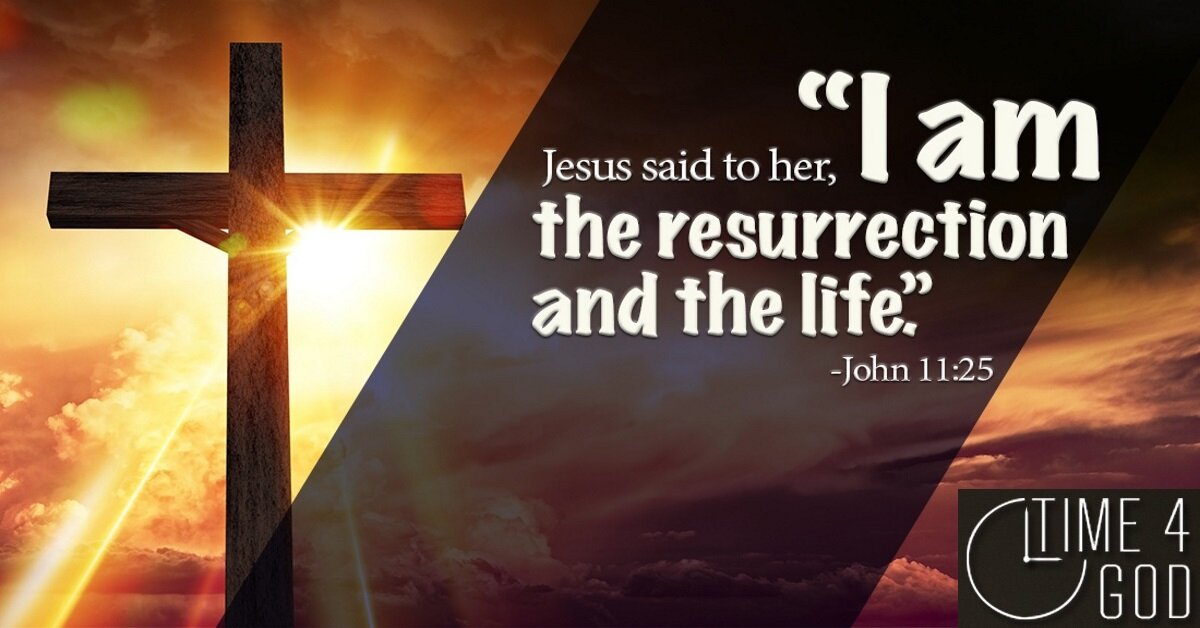
Jesus met with Martha and told her that he was the resurrection and the life. Life comes to those who believe even in the face of death. Whoever lived and believed in him would never die. He asked her if she believed this.

She confessed that she believed that he was the Messiah, the Son of God who had been expected to enter the world. Peter was the only other disciple who had confessed to this belief with speech.

The story about the miracle explained the meaning for the name, Lazarus. It translates as 'God helped.'

John 11:38-45

Jesus came to the tomb. He was greatly disturbed. It was a cave with a stone lying against it.
He said, 'Take away the stone.'

Martha said to him, 'Lord, there is a stench already. He has been dead for 4 days.'
Jesus said to her, 'Did I not tell you that if you believed, you would see the glory of God?'
They took away the stone.

Jesus looked upwards and said, 'Father, I thank you for having heard me. I knew that you hear me, but I have said this for the sake of the crowd standing here so they may believe that you sent me.'

When he had said this, he cried with a loud voice, 'Lazarus, come out!'

The dead man came out. His hands and feet were bound with strips of cloth. His face was wrapped in a cloth.

Jesus said to them, 'Unbind him and let him go.'

Many of the Jews who had come with Mary and had seen what Jesus did, believed in him.

---------------------

The cave was closed with a stone lying against it.
The body had been in state for 4 days with incensed gifts.

The stage was set to roll away the stone.
The sister complained that odor might be known.

She was told that her belief would result in the glory of God as shown.
The stone was rolled away that resurrected life would be known.

The Son extended a prayer of gratitude to the Father of lights
for the sake of the crowd that they might understand the belief in their sight.

The man was helped by the instruction to come out.
He rose. His hands and feet with strips of cloth were bound.
A linen cloth, around his face was wound.

The captive of the tomb was set free
by the word of the Son for those who believed.
Many who saw the event saw the reward for their faith received.

================

Church of England
John Keble

John Keble was one of the leaders of the Oxford Movement in the 19th century. Keble College, Oxford, was named after him.

The Oxford Movement developed at the university in the 1830's in response to fears that the Whig government intended to disestablish the Church of England.

John Keble was born in Fairford, Gloucestershire where his father, the Rev. John Keble, was Vicar of Coln St. Aldwyns.

He attended Corpus Christi College, Oxford and became a Fellow of Oriel College, Oxford. He was a tutor and examiner in the University for years.

He took Holy Orders in 1815 while still at Oxford. He became first a curate to his father, and later curate of St Michael and St Martin's Church, Eastleach Martin in Gloucestershire.

He had been writing 'The Christian Year', a book of popular verse. The work appeared in 1827. The object of the text as described by the author was to bring the thoughts and feelings of the reader into unison with those exemplified in the Prayer Book.

It was well received by the public. Ninety-five editions of the devotional text were printed during his lifetime. The number had arisen to a hundred-and-nine at the end of the year following his death.

Over 375,000 copies had been sold in Britain and 158 editions had been published by the time the copyright expired in 1873.

John Henry Newman of Oriel College was the leader of the Oxford Movement. He traced the start of the movement back to Keble’s sermon on ‘national apostasy’ in the university church in 1833. Keble was a fellow of Oriel also.

The previous five years had seen radical changes to the nature of the relationship between the Church of England and the state.

The centuries-old discrimination against Protestant Dissenters was repealed in 1828. Catholic Emancipation was passed in 1829. The Pittite-Tory regime fell in 1830.

The first Whig government in a generation took office. It was dedicated to Calvinist reform.

The Puritans had never been fully formed as a religious group, but they were instrumental in the establishment of the Whig faction as the party that imposed the First English Civil War (1642–1646) on England.

The Whigs aggressively defined the monarch as corrupt. They claimed that they were opposed to absolute monarchy in favor of a constitutional form, but the English Bill of Rights was a factionalist document that sought to coerce the public into agreement with their party.

Almost all Puritan clergy left the Church of England after the restoration of the monarchy in 1660 and the 1662 Uniformity Act. Their beliefs were enshrined in the Savoy Declaration (1658), the confession of faith held by the Congregationalist churches.

Many continued to practice their faith in nonconformist denominations, especially in Congregationalist, Presbyterian and eventually the Methodist churches.

The Methodists modeled their worship on the Anglican form, but were politicallly non-conformist. This made the Whig party the representative leaders of the non-conformist sects.

The Puritans had dissolved as a religious movement by the 18th century.

Many Anglican churchmen believed that the Whigs were preparing to invade the rights and alter the constitution of the Church after the Whig triumph of the Reform Act 1832.

The Whigs passed the Church Temporalities Act in 1833. This reorganised the Church of Ireland and reduced its bishoprics from 22 to 12. The action justified Anglican fears that the government was prepared to act against Church opinion.

Keble argued that the nation had acknowledged herself as Christian in her theory of government for centuries. This acknowledgement was implicitly extended to Christ's Church.

The Church should be allowed to celebrate the monarchy just as Judaism had had theirs.

When Hooker had written about English Church tradition in the 16th century, he basically insisted that Roman customs for worship had already been in practice for hundreds of years.

National sovereignty had been the objective for the Royal Acts of Supremacy, not the complete overhaul of the Church to extinguish Roman customs.

This was basically what the non-conformists represented, the rejection and extinguishment of Church tradition. The signs and symbols for celebrating the faith were to be replaced by austerities to help their factional representation grow in power.

The Whigs may have said that they were for constitutional monarchy, but they were for the subordination of the government to non-conformist demands in order to build their partisan faction.

The tractarians appealed to the observation of Roman Catholic custom in order to reinstate the English Church tradition that had been pushed out of existence by the Whigs for their non-conformist representation.

Newman and his followers published Ninety Tracts for the Times. The publications earned them the name Tractarians. Newman joined the Roman Catholic Church in 1845 and would become cardinal, but Keble and others remained in the Church of England.

They would have have a lasting influence on the Anglican church at home and abroad as Anglo-Catholics.

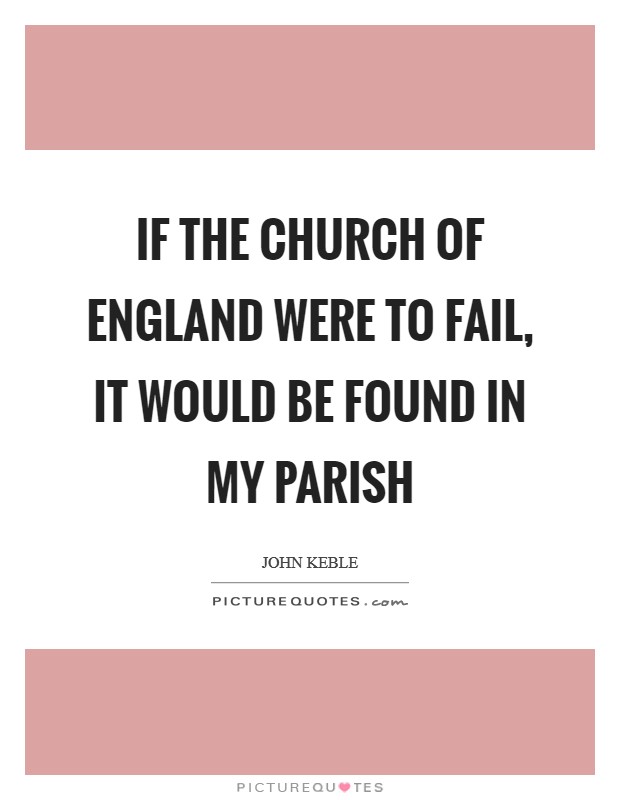
Keble retired to his country vicarage in the village of Hursley, near Winchester after 1841. He wrote tracts and hymns. He took his clerical duties so seriously that he once said that if the Church of England collapsed, it would be found in his parish.

Prayer


John Keble
S. 约翰·凯布尔
T. 約翰·凱布爾

约 Yue    about                約  yaku    promise       Jon    じょん   ジョン       Jon  존  zone         
翰 han    John                  翰  kan      letter           Ke      け          ケ               Ke    케   ke           
凯  Kai     Kay                 凱  gai       victory         bu     ぶ           ブ               beul 블   bl           
布  bu      cloth                布  fu         linen            ru      る           ル                                       
尔  er       er                     爾  ji           you                                                     
                                                                 
----------------------

The Church has the right to celebrate the promise of conservative reform.
The standards of the cloth represent the signs and symbols of the clerical norm.

==============

Lectionary John Keble
Obit. JK
wiki National Apostasy

==============

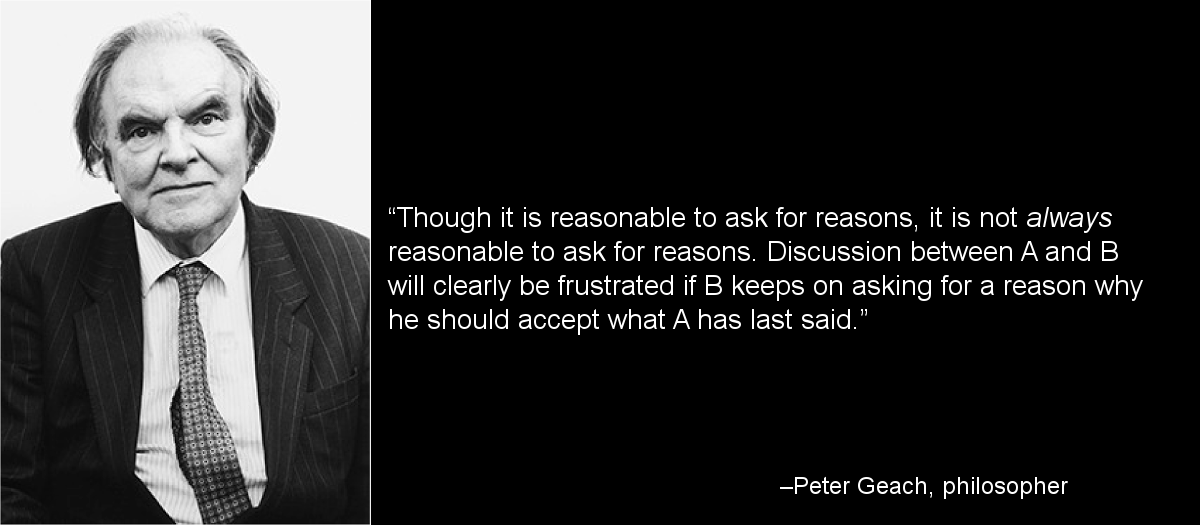
Reasonable Reason

Peter Geach
b. Chelsea, London, England  5.29.1916
d. Cambridge, England 12.23.2013

Peter Geach was a younger colleague of Ludwig Wittgenstein. He supported analytical philosophy. He was a professor of logic at the University of Leeds. His interests were logic, ethics, history, religion and identity.

He translated the works of Gottlebe Frege with Max Black in 1952.

Geach synthesized analytic philosophy with Thomism. He was one of the most  notable Catholic philosophers in the last half century.  Faith neither conflicted with reason nor trumped it.

The two dovetailed. He produced sharp gems of analytical argument that criticized relevant currents in philosophy.

-------------------------

Peter Geach was born in Chelsea, London on 29 March 1916. He was the only son of George Hender Geach and his wife Eleonora Frederyka Adolfina née Sgonina.

His father was employed in the Indian Educational Service. He would go on to work as a professor of philosophy in Lahore and later as the principal of a teacher-training college in Peshawar in Pakistan.

Geach won a scholarship to Balliol College, Oxford in 1934. He graduated with a degree in the Classics in 1938. He spent a year (1938–39) as a Gladstone Research Student based at St Deiniol's Library, Hawarden.

Geach's married Elizabeth Anscombe in 1941. Both were converts to Catholicism. Their marraige was a fertile philosophical coupling like that of Jean-Paul Sartre and Simone de Beauvoir.

They had four daughters and three sons. They were a daunting duo in philosophical debate. Each collaborated in translating Descartes and in the movement (later called Analytical Thomism)

He undertook further research at Cambridge following the end of World War II in 1945.

He was appointed to his first substantive academic post as assistant lecturer at the University of Birmingham in 1951. He became a reader in logic later.

Geach's first book was Mental Acts (1957). It became a classic in the philosophy of psychology. It argued that the acquisition of a concept was a process of becoming able to do something.

It was not a matter of having internal representations of external things or undergoing inner experiences as many philosophers since Descartes had held.

Geach criticised what he called abstractionism. The view held that we acquire the concept of red from repeated experiences of red.

It would fail to account for many of our concepts. You could not find anything in the sensible world, nor could you draw any picture that could suitably be labelled 'or' or 'not'.

The book, Mental Acts, was indebted to Wittgenstein. His paper Ascriptivism (1960) was more original and in line with his distinctive technique of using hard logic to crack problems in metaphysics and ethics.

He showed by means of "if" sentences the inadequacy of ethical theories which claimed that calling a person, act or principle good or bad was just a matter of commending or expressing disapproval of the person, act or principle, without any possibility of referring to a real quality they have or of being accurate about that quality.

The rule of modus ponens asserted that if a conditional statement (“if p then q ”) is accepted and the antecedent ( p ) holds, then the consequent ( q ) may be inferred.

He made what he called "the Frege point", and later came to be called the Frege-Geach point. The “embedding problem” was posed in his article “Assertion” (Geach, 1964), but the discussion had started back from his article “Imperatives and Deontic Logic” (Geach, 1958).

Sentences that express moral judgments can form part of semantically complex statements in a way that an expressivist view cannot easily explain.

The sentence “Telling lies is wrong” has the same meaning regardless of whether it occurs on its own or as the antecedent to “If telling lies is wrong, then getting your little brother to tell lies is also wrong”.

He recommended  attention to Frege’s distinction between assertion and predication. Assertion expressed illocutionary force, whereas predication was about propositional content.

Illocutionary force conveyed an imperative sense of caution, whereas propositional content described the modification of the subject.

The same statement "telling lies is wrong" could then express different degrees of emotional concern.

If you were emphatically telling your son that getting your little brother to torment the cat was wrong, it would be illocutionary. If you were illustrating an example of moral statements, the condition is propositional content.

Consider the embedded statements in the modus ponens:

1. If tormenting the cat is wrong, then getting your little brother to torment the cat is also wrong

2. Tormenting the cat is wrong

Therefore, getting your little brother to torment the cat is wrong.

The modus ponens gives the argument a more emphatic sense of relevance.

Geach was appointed Professor of Logic in the Department of Philosophy at the University of Leeds in 1966.

He defended the Thomistic position that human beings are essentially rational animals, each one miraculously created.

He dismissed Darwinistic attempts to regard reason as inessential to humanity.  He repudiated any capacity for language in animals as mere association of manual signs with things or performances.

He disagreed with both pragmatic and epistemic conceptions of truth. He developed the correspondence theory proposed by Aquinas.

He saw W. V. Quine and Arthur Prior as his allies, in that they held three truths. 1) There are no non-existent beings. 2) A proposition can occur in discourse without being there asserted. 3) The sense of a term does not depend on the truth of the proposition in which it occurs.

Geach retired from his chair in 1981 with the title Emeritus Professor of Logic. He held visiting professorships at the universities  of Cornell, Chicago, Michigan, Pennsylvania and Warsaw.

He was elected a Fellow of the British Academy (FBA) in 1965. He was elected an Honorary Fellow of Balliol College in 1979.

He was awarded the papal cross "Pro Ecclesia et Pontifice" by the Holy See for his philosophical work.

===============

Aquinas had defended monarchy with his dialectic imitation of Aristotle in the 13th century.

Roman Catholics that favor national sovereignty don't qualify as threats to national or international security.

Papal claims to supremacy and infallibility destablized Europe in terms of monarchical and parliamentarian government. Supremacy supported Vatican investiture as did the call for the Crusades, the Inquisition and indulgences.

The conversion of Geach to catholicism presented an interesting social quandary to the British government. Aquinas could be used to support national sovereignty, but the conversion could have suggested that the monarchy should just comply with the Vatican as had been the case prior to Henry VIII.

It is likely that his public position as a professor indicated that he was interested in promoting the Oxford movement effort to support Roman customs in Anglican Churches in service to the United Kingdom.

Catholics that supported reasonable policy for conservative expenditure by government were for national sovereignty. Their political perspective had proven to be necessary to counter liberal expenditure for Calvinist reform.

Rather than promote the prohibition of employment for Roman Catholics, the British government entertained employment as a means to consider national security in relation to the international situation.

wiki Peter Geach
Info Phil PG
Guardian Obit PG
Geach, Frege and Wittgenstein
The Frege-Geach Problem
Video

Wednesday, July 17, 2019

Find

7.18.19

Remembrance

Find
Benefit
找到好处
Zhǎodào hǎochù
メリットを見つける
Meritto o mitsukeru
ps52
Reperio bonum

What is the error when pride becomes a sin?
It is the will to destroy as though destruction had yet to begin.

There is a place that is against God in mind
that plans to ruin the bonds of belief that believers find.

The tongue is sharpened like a razor
to work deception for brutal behavior.

Evil is esteemed more powerful than good.
Lying is tried for denying truth as understood.

Speech that hurts is thrown
when words are not owned as known.

What is the divine will
for the correction of the ill?

Conscience looks to earned reward.
until the sense of honor is ordered.

Alliance or cooperation makes a difference
in international relations as an inference.

Pride drove this one from the refuge of faith.
Deceit was that which refused to stay straight.

Truth stumbled in the public square
until honor used a measure for what's fair.

I was shown a basket of summer fruit.
Fruition was known as a metaphorical suit.

Humility is the parent to utility.
The humble mind shapes ability
to achieve productivity
where joy is a result of the activity. 

Christ is the precedent for our place in everything.
The fullness of God is held like an anchor ring.

Jesus praised Mary for the gift of her attention. 
Martha was urged to consider her connection to this affection.

Your Father loves you more than words can say.
You are worth more than the beauty of birds at play.

The image of the invisible deity
is the firstborn form for faith in verity.

I am like an olive tree in the house of the Word.
Divine mercy will help me to overcome the adversity of the absurd.

I will give thanks for the grace of blissful providence
to declare goodness in the presence of moral intelligence.

--------------------------

52 Quid gloriaris?
What is pride?

1 You tyrant, why do you boast of wickedness
against the godly all day long?
2 You plot ruin;
your tongue is like a sharpened razor,
O worker of deception.
3 You love evil more than good
and lying more than speaking the truth.
4 You love all words that hurt,
O you deceitful tongue.
5 Oh, that God would demolish you utterly,
topple you, and snatch you from your dwelling,
and root you out of the land of the living!
6 The righteous shall see and tremble,
and they shall laugh at him, saying,
7 "This is the one who did not take God for a refuge,
but trusted in great wealth
and relied upon wickedness."
8 But I am like a green olive tree in the house of God;
I trust in the mercy of God for ever and ever.
9 I will give you thanks for what you have done
and declare the goodness of your Name in the presence
of the godly.

---------------------------
Isa. 59:14-15

Justice was turned back.
Righteousness stood at a distance.
Truth stumbled in the public square.
Uprightness could not enter.
The LORD saw it. It displeased him
that there was no justice.

---------------------------

Truth stumbled in the public square
until honor used a measure for what's fair.

===================
Philemon 8-11

I would rather appeal to you on the basis of love though I am bold enough in Christ to command you to do your duty. I, Paul, do this as an old man and a prisoner of Christ Jesus. I am appealing to you for my child, Onesimus, whose father I have become during my imprisonment. He was useless to you formerly, but now he is useful to both you and me.

Paul - humble
Onesimus- useful

---------------------------

Humility is the parent to utility.
The humble mind shapes ability
to achieve productivity
where happiness is a result of the activity.

===================
Matt. 10:29-30

Are not two sparrows sold for a small price? Yet not one of them will fall to the ground unperceived by your Father. Even the hairs on your head are counted. Do not be afraid. You are of more worth than many sparrows.

---------------------------

Your Father loves you more than words can say.
You are worth more than the beauty of birds at play.

================

Offense Against Natives

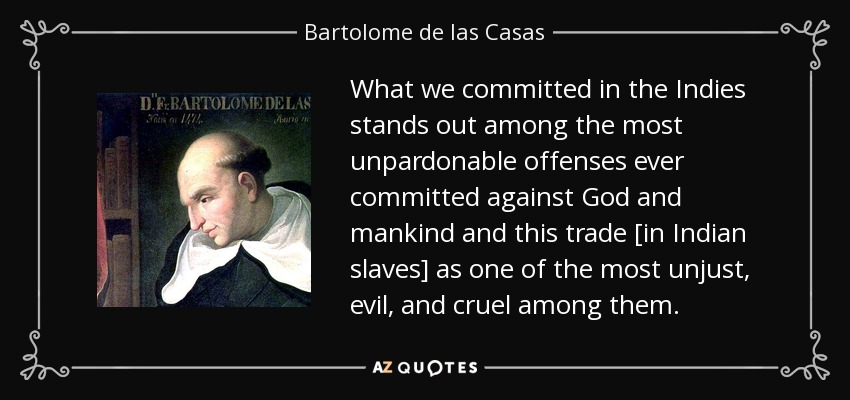
Bartolome de las Casas
b. c. 11.11.1484 Seville, Crown of Castille
d. 7.18.1566  Madrid, Crown of Castille, Spain

Las Casas was a 16th-century Spanish colonist who acted as a historian and social reformer before becoming a Dominican friar. He was appointed as the first resident Bishop of Chiapas. He was the first officially appointed "Protector of the Indians".

He wrote A Short Account of the Destruction of the Indies and Historia de Las Indias (1543) as a chronicle for the first decades of colonization of the West Indies. He described the atrocities committed by the colonizers against the indigenous peoples.

Bartolomé de las Casas spent 50 years of his life actively fighting slavery and the colonial abuse of indigenous peoples, especially by trying to convince the Spanish court to adopt a more humane policy of colonization. Unlike some other priests who sought to destroy the indigenous peoples' native books and writings, he strictly opposed this action

He was born in Seville when it was a kingdom in Castille, Spain in the 15th century.

Seville

Seville is the capital for the province of Seville in Andalusia. Andalusia is the most southern autonomous community in Spain. It is the only European region with both Mediterranean and Atlantic coastlines.

Seville is situated on the plain of the river Guadalquivir. The Guadlquivir is the second longest river with its entire length in Spain. The Guadalquivir valley has experienced some of the highest temperatures recorded in Europe, with a maximum of 46.6 °C (115.9 °F) recorded at Córdoba and Seville.

Seville was incorporated into the Christian Kingdom of Castile under Ferdinand III in 1248. Castile's name is generally thought to derive from "land of castles." Castle in Spanish is castillo. Castles were built in the area to consolidate the Christian Reconquest from the Moors.

The city's development continued after the Castilian conquest. Public buildings were constructed including churches. Many of the buildings were built in the Mudéjar and Gothic styles. The Seville Cathedral was built during the 15th century with Gothic architecture.

Other Moorish buildings were converted into Catholic edifices. Such conversion was customary for the Catholic Church during the Reconquista.The Torre del Oro was once an important Moorish naval watchtower along the Guadalquivir for example. It was converted into a cathedral by 1271.

The Moors' Palace became the Castilian royal residence. It was replaced by the Alcázar during Pedro I's rule. The upper levels are still used by the Spanish royal family as the official Seville residence.

All the synagogues in Seville were converted to churches after the 1391 pogrom. The Jewish quarter's land and shops (located in modern-day Barrio Santa Cruz) were appropriated by the church. Many were killed during the pogrom. Most were forced to convert. Converts were called converso.

The first tribunal of the Spanish Inquisition was instituted in Seville in 1478. The activity of the Inquisition was limited to the dioceses of Seville and Córdoba at first. Alonso de Ojeda had detected converso activity.

The first Auto de Fé took place in Seville on 6 February 1481 when 6 people were burned alive. An Auto de Fe was a public rite for penance for heretics and apostates. The convicted were burned at the stake, exiled or forced to become Catholic.

The Inquisition grew rapidly. The Plaza de San Francisco was the site of the 'autos de fé'.
Tribunals existed in eight Castilian cities by 1492.  Ávila, Córdoba, Jaén, Medina del Campo, Segovia, Sigüenza, Toledo and Valladolid had tribunals. All Jews were forced to convert to Catholicism or be ejected from Spain by the  Alhambra Decree.

Seville became one of the economic centers of the Spanish Empire after the discovery of the Americas in the late 15th century. All goods imported from the New World had to pass through the Casa de Contratación in the city before being distributed throughout the rest of Spain.

The port of Seville was unlike other harbors. Reaching the port required sailing about 80 km (50 miles) up the river Guadalquivir. The river was heavily defended with fortifications from the Middle Ages.

This made Seville the best defended port to bring the riches from the Americas.  A 'golden age of development' commenced  due to its being the only port awarded the royal monopoly for trade.

Bartolome de las Casas

Bartolome de las Casas was born in Seville on November 11, 1484. It was 8 years before Columbus would cross the Atlantic Ocean to discover the Americas.

His father was Pedro de las Casas. He was a merchant from one of the families that had migrated from France to found the town of Seville. His family spelled the name Casaus.

Bartolome studied for a licentiate (professional license) at Salamanca. The University of Salamanca was founded in 1218. It is the oldest university in Spain. Salmanca is about 465 km (290 miles) north of Seville.

Las Casas immigrated with his father to the island of Hispanola in the Caribbean in 1502 on the expedition of Nicolás de Ovando. Bartolome became a hacendado and slave owner. He received a piece of land in the province of Cibao in what is now known as the Dominican Republic. He participated in slave raids and military expeditions against the native Taíno population of Hispaniola.

He journeyed to Rome in 1507 as a young man to observe the Festival of Flutes. Festivals in Rome were an important part of religious life during both the Republican and Imperial eras. Festivals were one of the primary features of the Roman calendar.

Feriae were "holidays." These were holy days in the sense that some deity was celebrated. Pagan festivals were often converted to something associated with the Church after the conversion to Christianity.

Faunus was a horned god of the forest, plains and fields. He came to be equated in literature with the Greek god Pan. Either represented fertility for cattle.

Faunus is identified with Lupercus ("he who wards off the wolf"). The wolf was warded off with a flute or a staff. It is likely that the festival of flutes was a monotheistic form for the celebration that took place on 5 December. Peasants brought rustic offerings and amused themselves with flute music for dance.

He was ordained a priest in 1510. He was one of the first to be ordained in the new world.
A group of Dominican friars arrived in Santo Domingo led by Pedro de Córdoba in September 1510.

The friars were appalled by the injustices they saw committed by the slave owners against the Indians. They decided to deny slave owners the right to confession.  Las Casas was among those denied confession for this reason.

A Dominican preacher Fray Antonio de Montesinos preached a fiery sermon that implicated the colonists in the genocide of the native peoples in December 1511.

He is said to have preached, "Tell me by what right of justice do you hold these Indians in such a cruel and horrible servitude? On what authority have you waged such detestable wars against these people who dealt quietly and peacefully on their own lands?"

Las Casas himself argued against the Dominicans in favor of the justice of the encomienda. The colonists dispatched a complaint against the Dominicans to the King. The Dominicans were recalled from Hispaniola.   

Las Casas participated in the conquest of Cuba as a chaplain in 1513. He was involved in some of the major campaigns on the island. He witnessed the massacre of the Hatuey. He saw many atrocities committed by Spaniards against the native people.

He later wrote: "I saw here cruelty on a scale no living being has ever seen or expects to see."

He was awarded a joint encomienda with a friend which was rich in gold and slaves on the Arimao River close to Cienfuegos. He divided his time between being a colonist and his duties as an ordained priest during the next years.

Las Casas was studying a passage in the book of Sirach for a Pentecost sermon in 1514.

From something false what will be made true?
Divinations, omens and dreams are folly.
They are like the fancies of a woman in travail.
The law will be fulfilled without such deceptions.
Wisdom is made perfect in truthful lips. 

(Sirach 34:4-5,8)

He was finally convinced that all the actions of the Spanish in the New World had been illegal. They constituted a great injustice. He made up his mind to give up his slaves and encomienda.

He started to preach that other colonists should do the same. When his preaching met with resistance, he realized that he would have to go to Spain to fight there against the enslavement and abuse of the native people.

He gave up his Indian slaves and encomienda in 1515. He advocated for the rights of natives before King Charles V, the Holy Roman Emperor. He advocated the use of African slaves instead of Natives in the West Indian colonies in his early written work.

He has been criticized for his role among the founders of the Atlantic slave trade in the 20th century. He retracted this position later in life. He regarded both forms of slavery as equally wrong.

He left for Spain in September 1515. He arrived in Seville in November with a plan to convince the king to end the encomienda system. This was not an easy task. Most of the people who were in positions of power were themselves either encomenderos or otherwise profiting from the influx of wealth from the Indies.

King Ferdinand was ill in Plasencia in the winter of 1515. Las Casas was able to get a letter of introduction to the king from the Archbishop of Seville, Diego de Deza. Las Casas met the monarch on Christmas Eve and discussed the situation in the Indies with him. The king agreed to hear him out in more detail at a later date.

Las Casas produced the report that he presented to the Bishop of Burgos and a secretary. These were functionaries in charge of the royal policies regarding the Indies. Both were encomenderos. They were not impressed by his account. Las Casas had to find a different avenue of change. He put his faith in his coming audience with the king, but it never came. King Ferdinand died on January 25, 1516.

The regency of Castile passed on to Ximenez Cisneros and Adrian of Utrecht. They were the guardians for the under-age Prince Charles. Las Casas was resolved to see Prince Charles who resided in Flanders.  He passed Madrid and delivered to the regents a written account of the situation in the Indies and his proposed remedies on his way there.

This was his "Memorial de Remedios para Las Indias" of 1516. Las Casas advocated importing Black slaves from Africa to relieve the suffering Indians in this early work. He later retracted the stance. He became an advocate for the Africans in the colonies as well.

His first concern was not to end slavery as an institution, but to end the physical abuse of the Indians. Las Casas believed that slavery could be justified if it was the result of Just War. This was in accord with the legal and moral doctrine of the time. He assumed that the enslavement of Africans was justified. This position presumed that primitive civilization was a cause for Just War.

Cardinal Cisneros was worried by the visions that Las Casas had drawn up of the situation in the Indies. He sent a group of Hieronymite monks to take over the government of the islands. Las Casas played a role in the selection of the three monks. He also wrote the instructions by which the new government was to be run.

Las Casas himself was granted the official title of Protector of the Indians. He was given a yearly salary of one hundred pesos. He was expected to serve as an advisor to the new governors with regard to Indian issues in the new office. He was to speak the case of the Indians in court and send reports back to Spain.

Las Casas and the commissioners traveled to Santo Domingo on separate ships. The Protector arrived two weeks later than the Hieronimytes. The Hieronimytes had time to form a more pragmatic view of the situation than the one advocated by Las Casas during this time.

Their position was precarious. There were encomenderos on the Islands who were fiercely against any attempt to curtail their use of native labor. The commissioners were unable to take any radical steps towards improving the situation with the natives.

They revoked some encomiendas from the Spaniards who were living in Spain and not on the islands themselves. They even repossessed the encomienda of Fonseca, the Bishop of Burgos. They also carried out an inquiry into the Indian question. The encomenderos asserted that the Indians were quite incapable of living freely without their supervision.

Las Casas was disappointed and infuriated. When he accused the Hieronymites of being complicit in kidnapping Indians the relationship broke down. Las Casas had become a hated figure by Spaniards in the islands. He had to seek refuge in the Dominican monastery.

The Dominicans had been the first to indict the encomenderos. They continued to chastise them. The absolution of confession was refused to slave owners. They even stated that priests who took their confession were committing a mortal sin.

Las Casas was forced to travel back to Spain in May 1517 to denounce to the regent the failure of the Hieronymite reforms. The Hieronymites began to congregate Indians into towns similar to what Las Casas had wanted only after he had left.

His former protector, the regent Cardinal Ximenez Cisneros, was ill when he arrived in Spain. He had grown tired of the political tenacity. Las Casas resolved to meet instead with the young king Charles I. Ximenez died on November 8. The young King arrived in Valladolid on November 25, 1517. Las Casas managed to secure the support of the king's Flemish courtiers.

Chief among them was the powerful Chancellor Jean de la Sauvage. Las Casas's influence turned the favor of the court against Secretary Conchillos and Bishop Fonseca. Sauvage spoke highly of Las Casas to the king. The king appointed Las Casas and Sauvage to write a new plan for reforming the governmental system of the Indies.

Las Casas suggested a plan where the encomienda would be abolished. The Indians would be congregated into self-governing townships to become tribute-paying vassals of the king. He still suggested that the loss of Indian labor for the colonists could be replaced by allowing the importation of African slaves.

Another important part of the plan was to introduce a new kind of sustainable colonization. Las Casas advocated for the migration of Spanish peasants to the Indies where they would introduce small-scale farming and agriculture. It was a kind of colonization that didn't rely on resource depletion and Indian labor.

Las Casas worked to recruit a large number of peasants who would want to travel to the islands. They would be given land to farm, cash advances and the resources they needed to establish themselves there. The recruitment drive was difficult. The power relation shifted at court when Chancellor Sauvage unexpectedly died.

A much smaller number of peasant families were sent than originally planned. They were supplied with insufficient provisions. No support was secured for their arrival. Those who survived the journey were ill-received.

They had to work hard even to survive in the hostile colonies. Las Casas was devastated by the tragic result of his peasant migration scheme. He felt that it had been thwarted by his enemies.

He tried to launch a new kind of peaceful colonialism on the coast of Venezuela in 1522, but this venture failed. Las Casas entered the Dominican Order and became a friar. He left public life for a decade.

He traveled to Central America to act as a missionary among the Maya of Guatemala. He participated in debates among colonial churchmen about how best to bring the natives to the Christian faith.

He traveled back to Spain to recruit more missionaries and to lobby for the abolition of the encomienda. He gained an important victory by the passage of the New Laws in 1542. He was appointed Bishop of Chiapas.

De las Cases served only a short time as a bishop before he was forced to return to Spain. There was resistance to the New Laws by the encomenderos. There were also conflicts with Spanish settlers due to his activist religious stance with the pro-Indian policies.

He wrote a Brief Report On the Destruction of the Indies (or Tears of the Indians). It was written in 1542 and sent to Prince Philip II of Spain. It wasn't published until 1552 when he was 67 years old.

He argued that the atrocities were a display of Popery in its bloody colors. His narrative described the events as horrid and unexampled massacres, butcheries and all manner of cruelties that hell and malice could invent.

These events had been committed by the Popish Spanish party on the inhabitants of West India. Several "Kingdoms in America" had been devastated by fire and sword for the space of 42 years from the time of their discovery.

It was a fervid and exaggerated account of the atrocities of the Spanish conquerors against the Indians. It was written to persuade the Spanish king to act in response to the conquistadors' abuse of the indigenous population. Critics argue that facts and figures about the mistreatment and death toll were exaggerated for persuasion.

The book was widely translated and read. The English version was used to stir up English feeling against the Spanish as a cruel race.

Las Casas served in the Spanish court for the remainder of his life. He held great influence over Indies-related issues there. He participated in the Valladolid debate in 1550.

King Charles V called for a junta (or jury) to discuss the contrasting rights of slaves and their colonial masters. What started as a plea for mercy turned into a debate on the fundamental question of human existence. Are men created equal? Should they all be treated with equal respect and dignity? If so, what could justify the economic exploitation of a whole people by an invading force?

Juan Ginés de Sepúlveda argued that the Indians were less than human. They required Spanish masters in order to become civilized. Las Casas maintained that they were fully human. Forceful subjugation was unjustifiable.

Bartolomé de las Casas spent 50 years of his life actively fighting slavery and the colonial abuse of indigenous peoples. He did what he could to convince the Spanish court to adopt a more humane policy of colonization.

He was not like the priests who sought to destroy the indigenous peoples' native written work. He strictly opposed this action. His efforts resulted in the improvement of the legal status of the natives. There was an increased colonial focus on the ethics of colonialism.

The difference between the serf and slave based economies was the issue that ran under the debate about equality. Serfdom had been instituted as a land management practice by the Egyptians. It treated labor as part of that property that was being managed. Serfs were not legally designated as property. It was possible to obtain employment with another owner.

Slavery had a disturbing association with the rise of monotheism as an agency for political expansion even in Egypt. It became a legal norm with the Babylonian dominance in Sumerian culture. The operational principle was that the empire could take more land by conquest from those who refused to join the alliance of kingdoms.

The Persians adopted the system from the Babylonians despite the celebration of Cyrus as the Christ who had liberated the captives. The Greeks took it over after the triumph of Alexander. The Romans adapted the system to their republican variation.

Europe was largely monarchical in the 16th century. Serfdom was the operant condition for feudal society. Charles V was challenged by the success of the Ottomans in the Middle East. The Muslims had extended their reach into Spanish territory on the Iberian peninsula.

Charles wrote against slavery as the king of Castille, but allowed for the trade and the practice in the ecomenida in the imperial expansion in colonialism. It was a precedent that had preceded his ascension.

Martin Luther argued against indulgences as a practice for the Catholic Church. It is likely that slavery was implicitly regarded as an indulgence. King Henry the VIII of Great Britain opposed the religious control of his kingdom with his petition for divorce. His difficulties with marriage were at least potentially orchestrated to defend the royal line of succession.

The English and German reformation defended monarchy as the chief political form. It was known that classical literature supported republican government. The Roman classics were included in educational instruction as a standard where education was supported by monarchical, aristocratic or monastic forms in organization.

The Renaissance represented a shift from grammar and logic to rhetoric in the emphasis posited through the trivium.

Las Casas was a representative in the shift to rhetoric with his advocacy against slavery. He started out in opposition to the abuse of natives. He ended up with an advocacy for a variant on serf based society that allowed for colonization in foreign territory.

His basic defense for the advocacy was that it would cost the crown and the taxpayer less for police action, but this position was masked by the overstatement of atrocity on the part of the conquistadors.

Las Casas (1484-1566) preceded William Wilberforce (1759-1833) in the position against slavery by more than 2 centuries, but Wilberforce was able to persuade the British Parliament to outlaw the trade and the institution.

This law against slavery was used in negotiation with other foreign powers until it came to be accepted as the standard legal position in international relations.

Bartoleme de las Casas
S. 巴特德拉斯卡萨斯
T. 巴特德拉斯卡薩斯

巴  Ba     to hope         巴  tomoe  comma design             Ba  ば-   バ-          Ba  바  bar       
特  te     special           特  toku       special                        to   と       ト         teu 트  the                       
德  de    favor              德  no kanji                                    de  で      デ           de  데  place           
拉  la      hold              拉   da           Latin                          ra     ら     ラ         la   라   la                 
斯  si       this               斯   shi          this                            su     す    ス          seu 스  switch         
卡  Ka     card            卡   no kanji                                      Ka     か   カ          Ka  카   car                 
萨  sa      sat               薩   katsu      sweet potato                sa     さ    サ           sa   사   four 
斯  si       this             斯   shi            this                             su     す   ス           seu  스  the         

---------------------------

Alliance or cooperation makes a difference
in international relations as an inference.

===================

Lectionary Bartolome de las Casas
wiki Bartolome de las Casas
Brief Account
wiki Seville

Friday, June 7, 2019

Do

6.8.19


Do
Well
做得好
Zuò dé hǎo
うまくやる
Umaku yaru
ps.119.65

Do well 
even in hell. 

You have done well according to your word.
Don't discard the affirmative as absurd.

I have believed in the common law
for discernment in knowledge for all. 

I went astray before I was afflicted.
I keep faith with reason to untangle the twisted.

Wisdom said, 
'Come. Eat some bread.
I had risen as I had said.
Take. Drink some wine. 
It will taste fine. 
I had ascended the frame as a vine.'    

You bring forth good from your goodness
to instruct me in your fullness.

The proud have smeared me with lies
but I will stay true to our benign ties.

Their will is twisted in heart
but my delight is in your law for my part.

The wealthy studious woman was married to her faith.
She was ranked next to the plum in the dark color for her face.

I have used affliction to learn your statutes.
The variants in nature establish pass routes.

Jesus said, 'Come to me uncertain person.
Draw near you  weary from the heavy burden. 
Learn from me and I will give you rest.
My burden will help you to pass the test.' 

The commandment to love is most dear to me.
I use the order in the command for the ability to see
beyond the corruption that seeks to control me.

---------------------------


Please
Answer
请回答 
Qǐng huídá
お答えください 
Okotae kudasai
ps119.145
Die obsecro

I cried to you with my whole heart.
Answer me that I may make my part in law my art. 

I call to you that you may save me.
I will keep your decrees to help save all of these. 

I rise early to honor you
in the search for what your word will prove.

My eyes seek movement in the night watch
that I may meditate on the strength of your promised notch.

Hear my voice according to your kindness.
Give me life. Deliver me from blindness.

Those who are far from your law persecute me.
They drawn near with malice to induce flaw with deceit.

Your presence, Lord, is near in your commandment.
Your existence is an advance in companionship. 

I would that all would will to divide the word of truth rightly.
The history of love is salvation achieved dimly or brightly.

It has been given for you to know the secrets of parables
so the figure of an image and reason may become comparable.

The orchid is cut for beauty in aesthetics.
Gauze is applied to cover a wound for medical ethics. 

God provides blessing in abundance for enough of anything
that you may share good work to engulf the best that you can bring.

-----------------------

The Phoenician letter name ṭēth means "wheel."

Tet represents the number nine in Hebrew.
Jewish scripture books about the "holy letters" from the 10th century and on discuss the connection or origin of the letter Teth with the word Tov. Tov means 'good.'

Teth
Bonitatem fecisti
You have done well

65 O Lord, you have dealt graciously with your servant,
according to your word.
66 Teach me discernment and knowledge,
for I have believed in your commandments.
67 Before I was afflicted I went astray,
but now I keep your word.
68 You are good and you bring forth good;
instruct me in your statutes.
69 The proud have smeared me with lies,
but I will keep your commandments with my whole heart.
70 Their heart is gross and fat,
but my delight is in your law.
71 It is good for me that I have been afflicted,
that I might learn your statutes.
72 The law of your mouth is dearer to me
than thousands in gold and silver.

----------------------

Qoph


Qoph is the nineteenth letter of the Semitic abjads. It has the numerical value of 100 in Hebrew gamatria.

The origin of the glyph shape of qōp is uncertain. It originally depicted either a sewing needle, specifically the eye of a needle, or the back of a head and neck.  Hebrew קוף and Aramaic קופא both refer to the eye of a needle.  Qāf in Arabic meant "nape".  It may also have been a picture of a monkey and its tail. The Hebrew קוף means "monkey."

The Aramaic Qop gave rise to the letter in the Semitic abjads used in classical antiquity. Phoenician qōp is also the origin of the Latin letter Q and Greek ײ (phi).

Qoph 
Clamavi in toto corde meo
I cried with my whole heart

145 I call with my whole heart; 
answer me, O Lord, that I may keep your statutes.
146 I call to you;
oh, that you would save me! 
I will keep your decrees.
147 Early in the morning I cry out to you, 
for in your word is my trust.
148 My eyes are open in the night watches, 
that I may meditate upon your promise.
149 Hear my voice, O Lord, according to your loving-kindness; 
according to your judgments, give me life.
150 They draw near who in malice persecute me; 
they are very far from your law.
151 You, O Lord, are near at hand, 
and all your commandments are true.
152 Long have I known from your decrees 
that you have established them for ever.

-----------------------

Proverbs 9:5-6

Wisdom said, 'Come. Eat bread
and drink the wine I have mixed.
Lay aside immaturity and live
and walk in the way of insight. 

----------------------

Wisdom said, 
'Come. Eat some bread.
I had risen as I had said.
Drink some wine. It will taste fine. 
I had ascended the frame as a vine.'   

================

Matt. 11:28-29

Jesus said, 'Come to me, all you that are weary and carry heavy burdens. I will give you rest. Take my yoke upon you. Learn from me. I am gentle and humble in heart. You will find rest for your souls. My yoke is easy. My burden is light. 

----------------------

Jesus said, 'Come to me uncertain person.
Any may come that are weary from heavy burden. 
Learn from me and I will give you rest.
The lightness of my burden will help you to pass the test.' 

================

Asceticism
https://img.libquotes.com/pic-quotes/v4/karl-marx-quote-lbn2y2g.jpg 

"Has not Christianity declaimed against private property, against marriage, against the State? Has it not preached in the place of these, charity and poverty, celibacy and mortification of the flesh, monastic life and Mother Church? Christian Socialism is but the holy water with which the priest consecrates the heart-burnings of the aristocrat." 

Karl Marx, Communist Manifesto (1848)
https://www.marxists.org/archive/marx/works/1848/communist-manifesto/ch03.htm

Melania the Elder
b. c.350 Spain
d. 6.8.410  Jerusalem

Melania the Elder was a Desert Mother who was an influential figure in the Christian ascetic movement. The Desert Fathers and Mothers sprang up in the generation after the Emperor Constantine made Christianity a legal religion of the Roman Empire.

Spain

Hispania was part of the Roman empire in the 4th century.

Roman armies invaded the Iberian peninsula in 218 BCE. The land was used as a training ground for officers. Tactics were tested during campaigns against the Carthaginians, the Iberians, the Lusitanians, the Gallaecians and other Celts. 

It was not until 19 BCE that the Roman emperor Augustus (r. 27 BC–AD 14) was able to complete the conquest. Much of Hispania remained autonomous until then.

Romanization proceeded quickly in some regions after the time of Augustus. There are references to the togati. The process was very slowly in others. Hispania was divided into three separately governed provinces. 

There were nine provinces by the 4th century. More importantly, Hispania was for 500 years part of a cosmopolitan world empire bound together by law, language and Roman roads. The impact of Hispania on the newcomers was also big. Caesar wrote on the Civil Wars that the soldiers from the Second Legion had become Hispanicized and regarded themselves as hispanici.

Some of the peninsula's population were admitted into the Roman aristocratic class. They participated in governing Hispania and the Roman empire. There was a native aristocratic class who ruled each local tribe. 

The latifundia (sing., latifundium) were large estates controlled by the aristocracy. These estates were superimposed on the existing Iberian landholding system.

The Romans improved existing cities such as Lisbon (Olissipo) and Tarragona (Tarraco), established Zaragoza (Caesaraugusta), Mérida (Augusta Emerita) and Valencia (Valentia), and reduced other native cities to mere villages. 

The peninsula's economy expanded under Roman tutelage. Hispania served as a granary and a major source of metals for the Roman market. Its harbors exported gold, tin, silver, lead, wool, wheat, olive oil, wine, fish and garum. 

Agricultural production increased with the introduction of irrigation projects. Some of the constructs remain in use today. The Romanized Iberian populations and the Iberian-born descendants of Roman soldiers and colonists had all achieved the status of full Roman citizenship by the end of the 1st century. 

The emperors Trajan (r. 98–117) and Hadrian (r. 117–138) were of Hispanic origin.

------------------

Proverbs 9:5-6

Wisdom said, 'Come. Eat bread
and drink the wine I have mixed.
Lay aside immaturity and live
and walk in the way of insight.

------------------- 

Melania

Melania was one of the wealthiest citizens of the empire. She was married at 14 and moved from Spain with her husband to the suburbs of Rome. Her husband and two out of three sons had died by the time she was 22. 

----------------------

Matt. 11:28-29

Jesus said, 'Come to me, all you that are weary and carry heavy burdens. I will give you rest. Take my yoke upon you. Learn from me. I am gentle and humble in heart. You will find rest for your souls. My yoke is easy. My burden is light. 

----------------------

She became a Christian in Rome. She left her son with a guardian and set off to Alexandria, accompanied by her servants to join other Christian ascetics to visit the monks at the mountain of Nitria. 

She came into contact with holy men such as Pambo, Arsisius, Sarapion the Great, Paphnutius of Scete, Isidore the bishop of Hermopolis and Dioscorus. She stayed there for six months.

When persecution broke out after the death of Bishop Athanasius in 373 many of the monks were exiled to Diocaesaraea in Palestine. 

Isidore, Pisinius, Adelphius Paphnutius and Pambo were exiled. Melania followed and supported them financially. She would cover herself in a slave's cloak and bring them goods in the evenings. 

When the governor of Palestine discovered this, he attempted to blackmail her and threw her into prison. When the judge realized her social status, he let her go. Palladius attributes this release to her Christian works.

She built a convent for about 50 nuns in Jerusalem and a monastery on the Mount of Olives for the monk and theologian Rufinus of Aquileia.

Melania was known to Abba Macarius and other Desert Fathers in Egypt.  She was a contemporary of Jerome, Augustine of Hippo, Paulinus of Nola (her cousin or cousin-in-law), and Evagrius of Pontus. She was a follower of Origen. She practiced asceticism in accord with his instruction. 

She was a spiritual mentor to Evagrius of Pontus, later author of the Eastern Orthodox Philokalia. She persuaded him to go to Egypt to join the desert ascetics and carried on a correspondence with him while he was there.

She left for Rome to see her son around the year 400. Her granddaughter, known as Melania the Younger, would later take up the religious life due to her influence. 

When the Visigoths marched on Rome in 410, Melania, her daughter-in law Albina, granddaughter Melania and her husband fled to Sicily. 

They then went to Jerusalem. Melania remained in the city when the exiled ascetics were allowed to return to Egypt. 

She energetically practiced hospitality and funded churches and monasteries in the Roman and Persian Empires. She constantly read and re-read the works of Origen, Basil the Great and Gregory of Nazianzus. 

Melania died in Jerusalem around 417.

Her social network was one of the most important in the fourth and early fifth century Christianity. She was fluent and well read in both Latin and Greek. Her geographical connections reached from Spain to Persia. 

She grew as a member of the first generation in which members of the nobility and social elites were expected to take Christianity seriously. She lived to see it become the official religion of the Empire.

The ascetic lifestyle was semi-communal. Ownership for the property was signed to the abbot or the abbess. The monks lived in cells. They prayed and studied individually until the community gathered together.  

The determination of policy in the political empire was subject to the competition for authority. Arguments about what was wanted probably defaulted to who wanted it often enough. 

The struggle with asceticism directed attention away from the want of the will in the gratification of desire, but it threw the question of happiness out of court as well.

The perception of goodness lent itself to market conditions. If fish could be eaten and tasted satisfactory, it was good. If it could be eaten, but wasn't satisfactory, it wasn't.  Good fish were taken to market. Bad fish were thrown back.   

Policy decisions for the public have to rule out that which is not good for people. Legislation is the documentation of policy. It can't be too ambiguous or too particular.  

Melania 
S. 梅拉尼亚
T. 梅拉尼亞

梅  Mei     plum            梅   bai       plum          Me  め    メ          Mel   멜   Mell                                   
拉  la         pull               拉   ratsu   Latin           la      ら   ラ           la       라   la         
尼  ni         nun               尼   ni         nun             ni      に   ニ         ni       니   ni                 
亚  ya        next to         亞   a           rank            a       あ   ア          a        아    ah             

----------------------

The wealthy studious woman was married to her faith.
She was ranked next to the plum in the dark color for her face.

================


=================

Numbers 11:27-29

A young man ran and told Moses, 'Eldad and Medad are prophesying in the camp.' Joshua son of Nun, assistant to Moses, said, 'My lord Moses, stop them!' Moses said to him, 'Are you jealous for my sake? Would that all the LORD's people were prophets that the LORD would put his spirit on them!'
Eldad- God has loved.
Medad- Love.
Moses- Drawn.
Joshua- Yhwh is salvation

-----------------------

I would that all would will to divide the word of truth rightly.
The history of love is salvation achieved dimly or brightly.

=================

2 Corinthians 9:8

God is able to provide you with every blessing in abundance that by always having enough of everything, you may share abundantly in every good work.

-----------------------

God provides blessing in abundance for enough of anything
that you may share good work to engulf the best that you can bring.

=================

Luke 8:9-10

His disciples asked him what the parable meant. He said, 'To you it has been given to know the secrets of the kingdom of God, but to others I speak in parables, so
"Looking, they may not perceive
and listening, they may not understand."

-----------------------

It has been given for you to know the secrets of parables
so the figure of an image and reason may become comparable. 

=================

Recognition

Roland Allen 
b. 12.29.1868 Bristol, United Kingdom
d. 6.9.1947 Nairobi, Kenya

Roland Allen was an English missionary sent by the Society for the Propagation of the Gospel to China. His views on missionary strategy have been influential.

Bristol 

Bristol is a port city on the west coast in the southern part of England.

Iron Age hill forts and Roman villas were built near the confluence of the rivers Frome and Avon.  The settlement was known as Brycgstow (Old English "the place at the bridge") around the beginning of the 11th century. 

Bristol received a royal charter in 1155. It was historically divided between Gloucestershire and Somerset until 1373. It became a county of itself. It was among the top three English cities after London in tax receipts from the 13th to the 18th century.

The port was a starting place for early voyages of exploration to the New World.  John Cabot, a Venetian, became the first European since the Vikings to land on mainland North America on a ship out of Bristol in 1497. 

William Weston, a Bristol merchant, was the first Englishman to lead an exploration to North America in 1499. More than 2,000 slave ships carried an estimated 500,000 people from Africa to slavery in the Americas at the height of the Bristol slave trade from 1700 to 1807. 

The Port of Bristol has since moved from Bristol Harbour in the city center to the Severn Estuary at Avonmouth and Royal Portbury Dock. It was surpassed by the rapid rise of Birmingham, Manchester and Liverpool in the Industrial Revolution.

Roland Allen

Roland Allen was born in Bristol, England on December 19, 1868.  He was the son of an Anglican priest but was orphaned early in life. 

He trained for ministry at Oxford and became a priest in 1893. 

He spent two periods in Northern China working for the Society for the Propagation of the Gospel. The first from 1895 to 1900 ended due to the Boxer Rebellion.  

Boxer Rebellion

The rebellion was an anti-imperialist, anti-foreign, and anti-Christian uprising that took place in China between 1899 and 1901 toward the end of the Qing dynasty. It was initiated by the Militia United in Righteousness (Yihetuan), known in English as the Boxers. Many of their members had been practitioners of Chinese martial arts.

The secret organization led an uprising in northern China against the spread of Western and Japanese influence there. The rebels performed physical exercises they believed would make them able to withstand bullets. They  killed foreigners, Chinese Christians and destroyed foreign property.

Western powers and Japan had forced China’s ruling Qing dynasty to accept wide foreign control over the country’s economic affairs by the end of the 19th century. China had fought to resist the foreigners with popular rebellions in the Opium Wars (1839-42, 1856-60) and the Sino-Japanese War (1894-95), but it lacked a modernized military and suffered many casualties.

The uprising took place against a background that included severe drought. Disruption to established administration was caused by the growth of foreign spheres of influence.

Allen was forced to flee to the British Legation in Beijing during this time. He was chaplain to the community throughout much of the siege.

Diplomats, foreign civilians and soldiers as well as Chinese Christians in the Legation Quarter were besieged for 55 days by the Imperial Army of China and the Boxers. Chinese officialdom was split between those supporting the Boxers and those favoring conciliation, led by Prince Qing.  

The Eight-Nation Alliance was made up of American, Austro-Hungarian, British, French, German, Italian, Japanese and Russian forces. The alliance was initially turned back. They brought 20,000 armed troops to China, defeated the Imperial Army and arrived at Peking on August 14, to relieve the siege of the Legations. 

Plunder of the capital and the surrounding countryside ensued along with the summary execution of those suspected of being Boxers. The Boxer Protocol of 7 September 1901 provided for the execution of government officials who had supported the Boxers. 

A large indemnity was charged to China to pay the 8 nations over the course of the next 39 years. The indemnity was 450 million units of silver. Each unit (tael) was about 40 grams.

Allen returned to North China after a period back in England in 1902, but was forced home due to illness. These ‘early experiences led him to a radical reassessment of his own vocation and the theology and missionary methods of the Western churches’.

Allen became an early advocate of establishing Churches which from the beginning would be self-supporting, self-propagating and self-governing. Each church would adapt to local conditions. The community would not merely imitate Western Christianity. The Church would preserve Chinese culture within the framework of Christian monotheism.

Allen's views were confirmed by a trip to India in 1910 and by later research in Canada and East Africa. It is with this background that Allen wrote his book Missionary Methods which was first published in 1912.

Allen’s approach to Mission strategy for indigenous Churches is based on the study of Saint Paul’s missionary methods as he is convinced that in them can be found the solution to most of the difficulties of the day. 

He believed it was the recognition of the church as a local entity and trust in the Holy Spirit’s indwelling within the converts and churches which was the mark of Paul’s success. 

Paul was a representative of the apostolic community in Jerusalem in a way that was comparable to how Augustine was related to the ecumenical Church at a later time. Disputes over doctrine were referred to the statements of the larger body. 

Allen believed in contrast that the people of his day were unable to entrust their converts to the Holy Spirit and instead relied in His work through them. His views became increasingly influential. 

There was room for development from the local level of authority, but the assumption of benefit in Diocesan organization was not as clear as it was with Selwyn (1809-1878). 

Allen himself became disillusioned with the established churches. It is likely that socialism was an inhibitor to Church growth.

He spent the last years of his life in Kenya. He established a reclusive church of his own design centered on an idiosyncratic family rite. 

Allen died in Nairobi on June 9, 1947.

Roland Allen
S. 罗兰艾伦
T. 羅蘭艾倫

罗  Luo      to catch              羅  ra     gauze              Ro      ろ-          ロ-         Lol   롤  role           
兰  lan       orchid                 蘭  ran   orchid            ran      らん       ラン       laen  랜   LAN      
艾  Ai         to cut                 艾  kai    moxa             do       ど            ド          deu   드   de                 
伦  lun       order                  倫  rin    ethics              Aren  あれん アレン     Al     알   egg      
                                                                                                                           laen  렌   LAN                                             
-----------------------

The orchid is cut for beauty in aesthetics.
Gauze is applied to cover a wound for medical ethics.

=================


Indentured Servitude

Education is not slavery. It is no longer a form of indentured service. 

Education had an affiliation with slavery in classical culture. The Greeks provided the teachers for the Roman Patricians from the population of slaves.

Experience with education is such that it can be imagined that the standard for judgment could be raised in a way that indicated that nothing from the student could result in a good report. 

Objective testing requires vocabulary. A definition goes with a word. The definition can be matched or included in a set of choices. The word can be used to fill in a blank or used in a sentence. There are a variety of game formats available in cognitive strategies that help teachers to build student memory about the meaning of words.

When vocabulary building is included in the course of instruction, tests can be written that qualify as fair for student perception. 

Student memory can be built from identification of the correctly spelled word to association with the definition and the correct use in a sentence. Reading comprehension is complimented by application with grammar. 

The modern art of instruction is not limited to making the student 'jump through hoops' to demonstrate a desire to perform. The testing has to present a fair assessment of student achievement in the acquisition of knowledge. 

Indentured Servants 
http://www.virtualjamestown.org/indentures/about_indentures.html  

This database of indenture contracts includes over 15,000 indentured servants contracts from the London, Middlesex and Bristol Registers. 

The contracts list the servant's name and length of indenture. The name of the servant's parents and owner, their home province and city, occupation, destination, and ship of embarkation are noted as well. 

These records provide a detailed composition of indentured servants in the Atlantic World of the 17th century.