7.18.19
Remembrance
Find
Benefit
找到好处
Zhǎodào hǎochù
メリットを見つける
Meritto o mitsukeru
ps52
Reperio bonum
What is the error when pride becomes a sin?
It is the will to destroy as though destruction had yet to begin.
There is a place that is against God in mind
that plans to ruin the bonds of belief that believers find.
The tongue is sharpened like a razor
to work deception for brutal behavior.
Evil is esteemed more powerful than good.
Lying is tried for denying truth as understood.
Speech that hurts is thrown
when words are not owned as known.
What is the divine will
for the correction of the ill?
Conscience looks to earned reward.
until the sense of honor is ordered.
Alliance or cooperation makes a difference
in international relations as an inference.
Pride drove this one from the refuge of faith.
Deceit was that which refused to stay straight.
Truth stumbled in the public square
until honor used a measure for what's fair.
I was shown a basket of summer fruit.
Fruition was known as a metaphorical suit.
Humility is the parent to utility.
The humble mind shapes ability
to achieve productivity
where joy is a result of the activity.
Christ is the precedent for our place in everything.
The fullness of God is held like an anchor ring.
Jesus praised Mary for the gift of her attention.
Martha was urged to consider her connection to this affection.
Your Father loves you more than words can say.
You are worth more than the beauty of birds at play.
The image of the invisible deity
is the firstborn form for faith in verity.
I am like an olive tree in the house of the Word.
Divine mercy will help me to overcome the adversity of the absurd.
I will give thanks for the grace of blissful providence
to declare goodness in the presence of moral intelligence.
--------------------------
52 Quid gloriaris?
What is pride?
1 You tyrant, why do you boast of wickedness
against the godly all day long?
2 You plot ruin;
your tongue is like a sharpened razor,
O worker of deception.
3 You love evil more than good
and lying more than speaking the truth.
4 You love all words that hurt,
O you deceitful tongue.
5 Oh, that God would demolish you utterly,
topple you, and snatch you from your dwelling,
and root you out of the land of the living!
6 The righteous shall see and tremble,
and they shall laugh at him, saying,
7 "This is the one who did not take God for a refuge,
but trusted in great wealth
and relied upon wickedness."
8 But I am like a green olive tree in the house of God;
I trust in the mercy of God for ever and ever.
9 I will give you thanks for what you have done
and declare the goodness of your Name in the presence
of the godly.
---------------------------
Isa. 59:14-15
Justice was turned back.
Righteousness stood at a distance.
Truth stumbled in the public square.
Uprightness could not enter.
The LORD saw it. It displeased him
that there was no justice.
---------------------------
Truth stumbled in the public square
until honor used a measure for what's fair.
===================
Philemon 8-11
I would rather appeal to you on the basis of love though I am bold enough in Christ to command you to do your duty. I, Paul, do this as an old man and a prisoner of Christ Jesus. I am appealing to you for my child, Onesimus, whose father I have become during my imprisonment. He was useless to you formerly, but now he is useful to both you and me.
Paul - humble
Onesimus- useful
---------------------------
Humility is the parent to utility.
The humble mind shapes ability
to achieve productivity
where happiness is a result of the activity.
===================
Matt. 10:29-30
Are not two sparrows sold for a small price? Yet not one of them will fall to the ground unperceived by your Father. Even the hairs on your head are counted. Do not be afraid. You are of more worth than many sparrows.
---------------------------
Your Father loves you more than words can say.
You are worth more than the beauty of birds at play.
================
Offense Against Natives
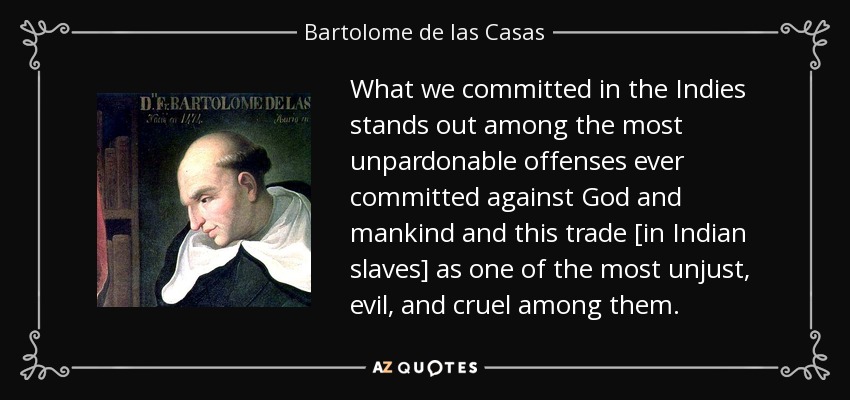
Bartolome de las Casas
b. c. 11.11.1484 Seville, Crown of Castille
d. 7.18.1566 Madrid, Crown of Castille, Spain
Las Casas was a 16th-century Spanish colonist who acted as a historian and social reformer before becoming a Dominican friar. He was appointed as the first resident Bishop of Chiapas. He was the first officially appointed "Protector of the Indians".
He wrote A Short Account of the Destruction of the Indies and Historia de Las Indias (1543) as a chronicle for the first decades of colonization of the West Indies. He described the atrocities committed by the colonizers against the indigenous peoples.
Bartolomé de las Casas spent 50 years of his life actively fighting slavery and the colonial abuse of indigenous peoples, especially by trying to convince the Spanish court to adopt a more humane policy of colonization. Unlike some other priests who sought to destroy the indigenous peoples' native books and writings, he strictly opposed this action
He was born in Seville when it was a kingdom in Castille, Spain in the 15th century.
Seville
Seville is the capital for the province of Seville in Andalusia. Andalusia is the most southern autonomous community in Spain. It is the only European region with both Mediterranean and Atlantic coastlines.
Seville is situated on the plain of the river Guadalquivir. The Guadlquivir is the second longest river with its entire length in Spain. The Guadalquivir valley has experienced some of the highest temperatures recorded in Europe, with a maximum of 46.6 °C (115.9 °F) recorded at Córdoba and Seville.
Seville was incorporated into the Christian Kingdom of Castile under Ferdinand III in 1248. Castile's name is generally thought to derive from "land of castles." Castle in Spanish is castillo. Castles were built in the area to consolidate the Christian Reconquest from the Moors.
The city's development continued after the Castilian conquest. Public buildings were constructed including churches. Many of the buildings were built in the Mudéjar and Gothic styles. The Seville Cathedral was built during the 15th century with Gothic architecture.
Other Moorish buildings were converted into Catholic edifices. Such conversion was customary for the Catholic Church during the Reconquista.The Torre del Oro was once an important Moorish naval watchtower along the Guadalquivir for example. It was converted into a cathedral by 1271.
The Moors' Palace became the Castilian royal residence. It was replaced by the Alcázar during Pedro I's rule. The upper levels are still used by the Spanish royal family as the official Seville residence.
All the synagogues in Seville were converted to churches after the 1391 pogrom. The Jewish quarter's land and shops (located in modern-day Barrio Santa Cruz) were appropriated by the church. Many were killed during the pogrom. Most were forced to convert. Converts were called converso.
The first tribunal of the Spanish Inquisition was instituted in Seville in 1478. The activity of the Inquisition was limited to the dioceses of Seville and Córdoba at first. Alonso de Ojeda had detected converso activity.
The first Auto de Fé took place in Seville on 6 February 1481 when 6 people were burned alive. An Auto de Fe was a public rite for penance for heretics and apostates. The convicted were burned at the stake, exiled or forced to become Catholic.
The Inquisition grew rapidly. The Plaza de San Francisco was the site of the 'autos de fé'.
Tribunals existed in eight Castilian cities by 1492. Ávila, Córdoba, Jaén, Medina del Campo, Segovia, Sigüenza, Toledo and Valladolid had tribunals. All Jews were forced to convert to Catholicism or be ejected from Spain by the Alhambra Decree.
Seville became one of the economic centers of the Spanish Empire after the discovery of the Americas in the late 15th century. All goods imported from the New World had to pass through the Casa de Contratación in the city before being distributed throughout the rest of Spain.
The port of Seville was unlike other harbors. Reaching the port required sailing about 80 km (50 miles) up the river Guadalquivir. The river was heavily defended with fortifications from the Middle Ages.
This made Seville the best defended port to bring the riches from the Americas. A 'golden age of development' commenced due to its being the only port awarded the royal monopoly for trade.
Bartolome de las Casas
Bartolome de las Casas was born in Seville on November 11, 1484. It was 8 years before Columbus would cross the Atlantic Ocean to discover the Americas.
His father was Pedro de las Casas. He was a merchant from one of the families that had migrated from France to found the town of Seville. His family spelled the name Casaus.
Bartolome studied for a licentiate (professional license) at Salamanca. The University of Salamanca was founded in 1218. It is the oldest university in Spain. Salmanca is about 465 km (290 miles) north of Seville.
Las Casas immigrated with his father to the island of Hispanola in the Caribbean in 1502 on the expedition of Nicolás de Ovando. Bartolome became a hacendado and slave owner. He received a piece of land in the province of Cibao in what is now known as the Dominican Republic. He participated in slave raids and military expeditions against the native Taíno population of Hispaniola.
He journeyed to Rome in 1507 as a young man to observe the Festival of Flutes. Festivals in Rome were an important part of religious life during both the Republican and Imperial eras. Festivals were one of the primary features of the Roman calendar.
Feriae were "holidays." These were holy days in the sense that some deity was celebrated. Pagan festivals were often converted to something associated with the Church after the conversion to Christianity.
Faunus was a horned god of the forest, plains and fields. He came to be equated in literature with the Greek god Pan. Either represented fertility for cattle.
Faunus is identified with Lupercus ("he who wards off the wolf"). The wolf was warded off with a flute or a staff. It is likely that the festival of flutes was a monotheistic form for the celebration that took place on 5 December. Peasants brought rustic offerings and amused themselves with flute music for dance.
He was ordained a priest in 1510. He was one of the first to be ordained in the new world.
A group of Dominican friars arrived in Santo Domingo led by Pedro de Córdoba in September 1510.
The friars were appalled by the injustices they saw committed by the slave owners against the Indians. They decided to deny slave owners the right to confession. Las Casas was among those denied confession for this reason.
A Dominican preacher Fray Antonio de Montesinos preached a fiery sermon that implicated the colonists in the genocide of the native peoples in December 1511.
He is said to have preached, "Tell me by what right of justice do you hold these Indians in such a cruel and horrible servitude? On what authority have you waged such detestable wars against these people who dealt quietly and peacefully on their own lands?"
Las Casas himself argued against the Dominicans in favor of the justice of the encomienda. The colonists dispatched a complaint against the Dominicans to the King. The Dominicans were recalled from Hispaniola.
Las Casas participated in the conquest of Cuba as a chaplain in 1513. He was involved in some of the major campaigns on the island. He witnessed the massacre of the Hatuey. He saw many atrocities committed by Spaniards against the native people.
He later wrote: "I saw here cruelty on a scale no living being has ever seen or expects to see."
He was awarded a joint encomienda with a friend which was rich in gold and slaves on the Arimao River close to Cienfuegos. He divided his time between being a colonist and his duties as an ordained priest during the next years.
Las Casas was studying a passage in the book of Sirach for a Pentecost sermon in 1514.
From something false what will be made true?
Divinations, omens and dreams are folly.
They are like the fancies of a woman in travail.
The law will be fulfilled without such deceptions.
Wisdom is made perfect in truthful lips.
(Sirach 34:4-5,8)
He was finally convinced that all the actions of the Spanish in the New World had been illegal. They constituted a great injustice. He made up his mind to give up his slaves and encomienda.
He started to preach that other colonists should do the same. When his preaching met with resistance, he realized that he would have to go to Spain to fight there against the enslavement and abuse of the native people.
He gave up his Indian slaves and encomienda in 1515. He advocated for the rights of natives before King Charles V, the Holy Roman Emperor. He advocated the use of African slaves instead of Natives in the West Indian colonies in his early written work.
He has been criticized for his role among the founders of the Atlantic slave trade in the 20th century. He retracted this position later in life. He regarded both forms of slavery as equally wrong.
He left for Spain in September 1515. He arrived in Seville in November with a plan to convince the king to end the encomienda system. This was not an easy task. Most of the people who were in positions of power were themselves either encomenderos or otherwise profiting from the influx of wealth from the Indies.
King Ferdinand was ill in Plasencia in the winter of 1515. Las Casas was able to get a letter of introduction to the king from the Archbishop of Seville, Diego de Deza. Las Casas met the monarch on Christmas Eve and discussed the situation in the Indies with him. The king agreed to hear him out in more detail at a later date.
Las Casas produced the report that he presented to the Bishop of Burgos and a secretary. These were functionaries in charge of the royal policies regarding the Indies. Both were encomenderos. They were not impressed by his account. Las Casas had to find a different avenue of change. He put his faith in his coming audience with the king, but it never came. King Ferdinand died on January 25, 1516.
The regency of Castile passed on to Ximenez Cisneros and Adrian of Utrecht. They were the guardians for the under-age Prince Charles. Las Casas was resolved to see Prince Charles who resided in Flanders. He passed Madrid and delivered to the regents a written account of the situation in the Indies and his proposed remedies on his way there.
This was his "Memorial de Remedios para Las Indias" of 1516. Las Casas advocated importing Black slaves from Africa to relieve the suffering Indians in this early work. He later retracted the stance. He became an advocate for the Africans in the colonies as well.
His first concern was not to end slavery as an institution, but to end the physical abuse of the Indians. Las Casas believed that slavery could be justified if it was the result of Just War. This was in accord with the legal and moral doctrine of the time. He assumed that the enslavement of Africans was justified. This position presumed that primitive civilization was a cause for Just War.
Cardinal Cisneros was worried by the visions that Las Casas had drawn up of the situation in the Indies. He sent a group of Hieronymite monks to take over the government of the islands. Las Casas played a role in the selection of the three monks. He also wrote the instructions by which the new government was to be run.
Las Casas himself was granted the official title of Protector of the Indians. He was given a yearly salary of one hundred pesos. He was expected to serve as an advisor to the new governors with regard to Indian issues in the new office. He was to speak the case of the Indians in court and send reports back to Spain.
Las Casas and the commissioners traveled to Santo Domingo on separate ships. The Protector arrived two weeks later than the Hieronimytes. The Hieronimytes had time to form a more pragmatic view of the situation than the one advocated by Las Casas during this time.
Their position was precarious. There were encomenderos on the Islands who were fiercely against any attempt to curtail their use of native labor. The commissioners were unable to take any radical steps towards improving the situation with the natives.
They revoked some encomiendas from the Spaniards who were living in Spain and not on the islands themselves. They even repossessed the encomienda of Fonseca, the Bishop of Burgos. They also carried out an inquiry into the Indian question. The encomenderos asserted that the Indians were quite incapable of living freely without their supervision.
Las Casas was disappointed and infuriated. When he accused the Hieronymites of being complicit in kidnapping Indians the relationship broke down. Las Casas had become a hated figure by Spaniards in the islands. He had to seek refuge in the Dominican monastery.
The Dominicans had been the first to indict the encomenderos. They continued to chastise them. The absolution of confession was refused to slave owners. They even stated that priests who took their confession were committing a mortal sin.
Las Casas was forced to travel back to Spain in May 1517 to denounce to the regent the failure of the Hieronymite reforms. The Hieronymites began to congregate Indians into towns similar to what Las Casas had wanted only after he had left.
His former protector, the regent Cardinal Ximenez Cisneros, was ill when he arrived in Spain. He had grown tired of the political tenacity. Las Casas resolved to meet instead with the young king Charles I. Ximenez died on November 8. The young King arrived in Valladolid on November 25, 1517. Las Casas managed to secure the support of the king's Flemish courtiers.
Chief among them was the powerful Chancellor Jean de la Sauvage. Las Casas's influence turned the favor of the court against Secretary Conchillos and Bishop Fonseca. Sauvage spoke highly of Las Casas to the king. The king appointed Las Casas and Sauvage to write a new plan for reforming the governmental system of the Indies.
Las Casas suggested a plan where the encomienda would be abolished. The Indians would be congregated into self-governing townships to become tribute-paying vassals of the king. He still suggested that the loss of Indian labor for the colonists could be replaced by allowing the importation of African slaves.
Another important part of the plan was to introduce a new kind of sustainable colonization. Las Casas advocated for the migration of Spanish peasants to the Indies where they would introduce small-scale farming and agriculture. It was a kind of colonization that didn't rely on resource depletion and Indian labor.
Las Casas worked to recruit a large number of peasants who would want to travel to the islands. They would be given land to farm, cash advances and the resources they needed to establish themselves there. The recruitment drive was difficult. The power relation shifted at court when Chancellor Sauvage unexpectedly died.
A much smaller number of peasant families were sent than originally planned. They were supplied with insufficient provisions. No support was secured for their arrival. Those who survived the journey were ill-received.
They had to work hard even to survive in the hostile colonies. Las Casas was devastated by the tragic result of his peasant migration scheme. He felt that it had been thwarted by his enemies.
He tried to launch a new kind of peaceful colonialism on the coast of Venezuela in 1522, but this venture failed. Las Casas entered the Dominican Order and became a friar. He left public life for a decade.
He traveled to Central America to act as a missionary among the Maya of Guatemala. He participated in debates among colonial churchmen about how best to bring the natives to the Christian faith.
He traveled back to Spain to recruit more missionaries and to lobby for the abolition of the encomienda. He gained an important victory by the passage of the New Laws in 1542. He was appointed Bishop of Chiapas.
De las Cases served only a short time as a bishop before he was forced to return to Spain. There was resistance to the New Laws by the encomenderos. There were also conflicts with Spanish settlers due to his activist religious stance with the pro-Indian policies.
He wrote a Brief Report On the Destruction of the Indies (or Tears of the Indians). It was written in 1542 and sent to Prince Philip II of Spain. It wasn't published until 1552 when he was 67 years old.
He argued that the atrocities were a display of Popery in its bloody colors. His narrative described the events as horrid and unexampled massacres, butcheries and all manner of cruelties that hell and malice could invent.
These events had been committed by the Popish Spanish party on the inhabitants of West India. Several "Kingdoms in America" had been devastated by fire and sword for the space of 42 years from the time of their discovery.
It was a fervid and exaggerated account of the atrocities of the Spanish conquerors against the Indians. It was written to persuade the Spanish king to act in response to the conquistadors' abuse of the indigenous population. Critics argue that facts and figures about the mistreatment and death toll were exaggerated for persuasion.
The book was widely translated and read. The English version was used to stir up English feeling against the Spanish as a cruel race.
Las Casas served in the Spanish court for the remainder of his life. He held great influence over Indies-related issues there. He participated in the Valladolid debate in 1550.
King Charles V called for a junta (or jury) to discuss the contrasting rights of slaves and their colonial masters. What started as a plea for mercy turned into a debate on the fundamental question of human existence. Are men created equal? Should they all be treated with equal respect and dignity? If so, what could justify the economic exploitation of a whole people by an invading force?
Juan Ginés de Sepúlveda argued that the Indians were less than human. They required Spanish masters in order to become civilized. Las Casas maintained that they were fully human. Forceful subjugation was unjustifiable.
Bartolomé de las Casas spent 50 years of his life actively fighting slavery and the colonial abuse of indigenous peoples. He did what he could to convince the Spanish court to adopt a more humane policy of colonization.
He was not like the priests who sought to destroy the indigenous peoples' native written work. He strictly opposed this action. His efforts resulted in the improvement of the legal status of the natives. There was an increased colonial focus on the ethics of colonialism.
The difference between the serf and slave based economies was the issue that ran under the debate about equality. Serfdom had been instituted as a land management practice by the Egyptians. It treated labor as part of that property that was being managed. Serfs were not legally designated as property. It was possible to obtain employment with another owner.
Slavery had a disturbing association with the rise of monotheism as an agency for political expansion even in Egypt. It became a legal norm with the Babylonian dominance in Sumerian culture. The operational principle was that the empire could take more land by conquest from those who refused to join the alliance of kingdoms.
The Persians adopted the system from the Babylonians despite the celebration of Cyrus as the Christ who had liberated the captives. The Greeks took it over after the triumph of Alexander. The Romans adapted the system to their republican variation.
Europe was largely monarchical in the 16th century. Serfdom was the operant condition for feudal society. Charles V was challenged by the success of the Ottomans in the Middle East. The Muslims had extended their reach into Spanish territory on the Iberian peninsula.
Charles wrote against slavery as the king of Castille, but allowed for the trade and the practice in the ecomenida in the imperial expansion in colonialism. It was a precedent that had preceded his ascension.
Martin Luther argued against indulgences as a practice for the Catholic Church. It is likely that slavery was implicitly regarded as an indulgence. King Henry the VIII of Great Britain opposed the religious control of his kingdom with his petition for divorce. His difficulties with marriage were at least potentially orchestrated to defend the royal line of succession.
The English and German reformation defended monarchy as the chief political form. It was known that classical literature supported republican government. The Roman classics were included in educational instruction as a standard where education was supported by monarchical, aristocratic or monastic forms in organization.
The Renaissance represented a shift from grammar and logic to rhetoric in the emphasis posited through the trivium.
Las Casas was a representative in the shift to rhetoric with his advocacy against slavery. He started out in opposition to the abuse of natives. He ended up with an advocacy for a variant on serf based society that allowed for colonization in foreign territory.
His basic defense for the advocacy was that it would cost the crown and the taxpayer less for police action, but this position was masked by the overstatement of atrocity on the part of the conquistadors.
Las Casas (1484-1566) preceded William Wilberforce (1759-1833) in the position against slavery by more than 2 centuries, but Wilberforce was able to persuade the British Parliament to outlaw the trade and the institution.
This law against slavery was used in negotiation with other foreign powers until it came to be accepted as the standard legal position in international relations.
Bartoleme de las Casas
S. 巴特德拉斯卡萨斯
T. 巴特德拉斯卡薩斯
巴 Ba to hope 巴 tomoe comma design Ba ば- バ- Ba 바 bar
特 te special 特 toku special to と ト teu 트 the
德 de favor 德 no kanji de で デ de 데 place
拉 la hold 拉 da Latin ra ら ラ la 라 la
斯 si this 斯 shi this su す ス seu 스 switch
卡 Ka card 卡 no kanji Ka か カ Ka 카 car
萨 sa sat 薩 katsu sweet potato sa さ サ sa 사 four
斯 si this 斯 shi this su す ス seu 스 the
---------------------------
Alliance or cooperation makes a difference
in international relations as an inference.
===================
Lectionary Bartolome de las Casas
wiki Bartolome de las Casas
Brief Account
wiki Seville
Showing posts with label productivity. Show all posts
Wednesday, July 17, 2019
Friday, July 12, 2019
Feel
7.13.19
The World
Feel
the
Accord
感受到协议
Gǎnshòu dào xiéyì
調和を感じる
Chōwa o kanjiru
ps122
Sentire eademque sententia
When they said, "Let us go to the house of the Lord"
I was filled with the feeling of great accord.
Now that we are standing within your gates in peace,
accord with common law is the ground beneath our feet.
The capital is built as a city for unity with the nation.
Border strength is a priority in national station.
Freedom of assembly allows for legal organization.
Organization is grown for purpose in negotiation.
There are seats of judgment for justice
in the house of legal augustness.
There are seats for writing law
in the house of legislative awe.
There are seats for executive authority
in the house of administrative minority
for the majority.
There is the seat for the royal unity
of the houses for the moral reduction of immoral impunity.
The Father grew the vine and built a vineyard in time.
The Son inherited the vineyard to abide with redemption from error in mind.
The Spirit abides for the perpetuation of salvation to find.
Religious rites are for the emulation of salvation.
The assembly considered the value of law for the community in the nation.
Pray for the strength of the nation
in international relations.
I seek reason with faith.
I commit my cause to God as I pray.
Faith in Christ is for God's appeal through us.
Be reconciled for unity with benefit for trust.
The Father was present before the world existed.
The Son was tested to incarnate divine existence.
The Spirit is present to convert the world's resistance
to benign resilience.
May they prosper who love you
with respect for the balance of power with truth.
Let peace reign within your borders
with the quiet strength of social order.
The translator learned another language to negotiate for peace.
Freedom for trade and travel sought to decrease immoral ease.
I pray for the prosperity of productivity
in the nativity of earned equity with festivity.
I will seek to do good in the house of the Lord our God
for your benefit in the course of experience for our guard.
Feel the accord
in the house of the Lord.
--------------------------
122 Lætatus sum
I am happy
1 I was glad when they said to me,
"Let us go to the house of the Lord."
2 Now our feet are standing
within your gates, O Jerusalem.
3 Jerusalem is built as a city
that is at unity with itself;
4 To which the tribes go up,
the tribes of the Lord,
the assembly of Israel,
to praise the Name of the Lord.
5 For there are the thrones of judgment,
the thrones of the house of David.
6 Pray for the peace of Jerusalem:
"May they prosper who love you.
7 Peace be within your walls
and quietness within your towers.
8 For my brethren and companions' sake,
I pray for your prosperity.
9 Because of the house of the Lord our God,
I will seek to do you good."
-----------------------------
Job 5:8
I would seek God.
I would commit my cause to God.
-----------------------------
I seek reason with faith.
I commit my cause to God as I pray.
=====================-
2 Corinth. 5:20
We are ambassadors for Christ since God is making his appeal through us. We entreat you on behalf of Christ, be reconciled to God.
-----------------------------
Faith in Christ is for God's appeal through us.
Be reconciled for unity with benefit for trust.
=====================-
John 17:5
Glorify me in your own presence Father with the glory that I had in your presence before the world existed.
-----------------------------
The Father was present before the world existed.
The Son was tested to incarnate divine existence.
The Spirit is present to convert the world's resistance
to benign resilience.
=====================
Iroquois Confederacy
Conrad Weiser
b. 11.2.1696 Herrenberg, Wurtemberg
d. 7.13.1760 Womelsdorf, Pennsylvania
Conrad Weiser was a Pennsylvania Dutch pioneer, interpreter and diplomat between the Pennsylvania Colony and Native Americans. He was a farmer, soldier, monk, tanner and judge.
He was an ally to the Iroquois. He contributed as an emissary in councils between Native Americans and Pennsylvania during the 18th century's tensions of the French and Indian War (Seven Years' War).
He was born in Germany in the last part of the 17th century.
Herrenberg
Herrenberg is located in the southwestern part of Germany. It is is situated on the western edge of the Schonbuch forest. It is a town in the middle of Baden Wurttemberg. Baden Wurttemberg is a state that sits east of the Rhine River and forms the border with France.
The County Palatine of the Rhine was a palatinate. The word is drawn from the Latin palatium. It is the word for palace. The palatinate is the office. It was administered by the Count Palatine of the Rhine.
The fragmented territory stretched from the left bank of the Upper Rhine from the Hunsrück mountain range into the adjacent parts of the French regions of Alsace and Lorraine to the opposite territory on the east bank of the Rhine in present-day Hesse and Baden-Württemberg.
The Duchy of Wurttemberg was a member of the Holy Roman Empire from 1495 to 1806. The dukedom survived for nearly four centuries mainly due to its size. It was larger than its immediate neighbors. The duchy faced great pressure from the Holy Roman Empire to remain a member during the Protestant Reformation.
The German Palatines were 18th-century emigrants from the Middle Rhine region of the Holy Roman Empire. They were both Protestant and Catholic. The wealthy region was repeatedly invaded by French troops towards the end of the 17th and into the 18th century. The invasions resulted in continuous military requisitions, widespread devastation and famine.
The "Poor Palatines" were some 13,000 Germans who migrated to England between May and November 1709. Their arrival in England, and the inability of the British Government to integrate them, caused a highly politicized debate over the merits of immigration. The English tried to settle them in England, Ireland and the Colonies.
The Weiser family was among the Poor Palatines.
Conrad Weiser
He was born as Johann Conrad Weiser on November 2, 1696 in the small village of Affstadt in Herrenberg in the Wurttemberg Duchy.
His father (Johann Conrad Weiser, Sr.) was stationed as a member of the Württemberg Blue Dragoons. Soon after Conrad's birth, his father was discharged from the Blue Dragoons and moved back to the family ancestral home in nearby Großaspach.
The boy's mother, Anna Magdalena, died of fever in 1709. Conrad Weiser (senior) wrote for his children, "Buried beside Her Ancestors, she was a god-fearing woman and much loved by Her neighbors. Her motto was Jesus I live for thee, I die for thee, thine am I in life and death."
The Palatine area had been ravaged by the French invasions and pestilence. The winter of 1709 was especially long and harsh.
Conrad Weiser and his family were among thousands of refugees who left German lands that year. They traveled down the Rhine River then sailed to England. Support had been offered for Protestant refugees.
Thousands of Palatine German refugees made their way to London seeking escape from the harsh conditions. There were so many that the English had to make a camp for them outside the London walls for the winter.
The following year in 1710, the Crown (under Queen Anne) arranged for transport in ten ships of the nearly 3,000 Germans to the New York colony. New Amsterdam had become New York in 1664.
The Crown supported the migration of the immigrants to help settle the New York colony. The plan was that they would work off their passage in a form of indentured service in camps devoted to producing ships' stores, such as tar and other materials. Later they would be allowed to trade their work for land.
Most of the Germans were first located in what were called the East and West Camps along the Hudson River, near Livingston Manor.
It was not until 1723 that some 100 heads of families received land grants in the central Mohawk Valley, under Governor Burnetsfield. The Mohawk River ran east to west between the Adirondack and the Catskill mountains across the middle of the colony.
Weiser senior managed to move his family to the Schoharie Valley earlier than that. Schoharie Creek was about 30 miles (48 km) southeast of the Mohawk Valley.
When Conrad was 16 his father agreed to a chief's proposal for the youth to live with the Mohawk in the upper Schoharie Valley. Weiser learned much about the Mohawk language and the customs of the Iroquois during his stay in the winter and spring of 1712-1713.
Cold, hunger and homesickness were among the hardships that he endured. Conrad Weiser returned to his own people toward the end of July 1713.
Weiser married Anna Eve Feck on November 22, 1720 at the age of 24. Anna was a daughter of Johan Peter Feg and Anna Maria Risch.
The couple followed the Susquehanna River south out of New York and settled their young family on a farm in Womelsdorf, Pennsylvania near present-day Reading in 1725. The couple had 14 children. Only 7 reached adulthood.
Weiser's colonial service began in 1731. The Iroquois sent Shikellamy, an Oneida chief, as an emissary to other tribes and the British. Shikellamy lived on the Susquehanna River at Shamokin village near present-day Sunbury, Pennsylvania.
An oral tradition holds that Weiser met Shikellamy while hunting. The two became friends in any case. When Shikellamy traveled to Philadelphia for a council with the province of Pennsylvania, he brought Weiser with him. The Iroquois trusted him and considered him an adopted son of the Mohawk.
Weiser impressed the Pennsylvania governor and council. His services as an interpreter were used heavily thereafter. Weiser also interpreted in a follow-up council in Philadelphia in August, 1732.
Shikellamy, Weiser and the Pennsylvanians negotiated a deed whereby the Iroquois sold the land drained by the Delaware River and south of the Blue Mountain during the treaty of Philadelphia in 1736.
Pennsylvania's agreement to purchase from them represented a significant change in the colony's policy toward the Native Americans since the Iroquois had not until then laid claim to this land.
William Penn had died in 1718. He had never taken sides in disputes between tribes.
The Pennsylvanians were favoring the Iroquois over the claims of the Lenape/Delawares for the same land by this formal purchase. This treaty by Penn's sons exacerbated Pennsylvania-Lenape relations. The Walking Purchase of the following year increased tension further.
The Lenape became disenchanted with the English colonials as a result. They sided with the French during the French and Indian Wars. The Lenape took part in actions against the colonists that caused many deaths. Penn's purchase persuaded the Six Nations of the Iroquois to continue to side with the British over the French.
The French and Indian War took place between 1754 and 1763. Three wars between Britain and France started in Europe, then moved to North America. Once the conflict broke out in America, it was fought by colonial militias. The French and Indian War broke this pattern.
Weiser acted as the interpreter for a number of treaties prior to the outbreak in hostility. He traveled to Onandaga, NY to negotiate for peace between the Iroquois and southern tribes during the winter of 1737.
He interpreted a treaty between the Iroquois and English colonials at Philadelphia in 1742. He acted as the interpreter for the Treaty of Lancaster between representatives of the Iroquois and the colonies of Pennsylvania, Maryland and Virginia in 1744.
Pennsylvania sent Conrad to Logstown, a council and trade village on the Ohio River, in 1748. Virginia and Pennsylvania colonial officials acted as if they had been sold settlement rights to the Ohio Valley, but the Iroquois did not believe they had done so.
Weiser traveled again to Onondaga in 1750. He found the political dynamics in the Six Nations had shifted. Canasatego, always pro-British, had died. Several Iroquois tribes were leaning toward the French. The Mohawk remained pro-British.
Weiser was a member of a Pennsylvania delegation to Albany early in the summer of 1754. It was the eve of the eruption of the French and Indian War. The English government had called the meeting to win assurance of Iroquois support in the looming war with the French. The Iroquois and seven colonies sent representatives.
The council did not result in the treaty of support which the crown desired due to the divisions in the Native American tribes with respect for the British.
Each colony made the best deal it could with individual Iroquois leaders. No single person spoke for the Iroquois League. Bands acted independently in this and other wars.
Weiser negotiated one of the more successful agreements. Some lower-level chiefs deeded to the colony most of the land remaining in present-day Pennsylvania. This included the southwestern part of the land for the colony that Virginia also claimed.
The government appointed Weiser and Ben Franklin to lead construction of a series of forts between the Delaware River and the Susquehanna River in 1756.
Weiser attended a council at Easton, Pennsylvania in the fall of 1758. Colonial leaders from Pennsylvania met with the Iroquois and other Native American tribes. He helped to smooth over the tension.
The tribes in the Ohio Valley agreed to abandon support for the French with the Treaty of Easton. This collapse of Native American support was a factor in the French decision to demolish Fort Duquesne and withdraw from the Forks of the Ohio.
Weiser built on his knowledge of Native American languages and culture to become a key player in treaty negotiations, land purchases and the formulation of Pennsylvania's policies towards Native Americans. He helped to keep the powerful Iroquois allied with the British.
Weiser combined farming with other trades like many other colonists when he wasn't negotiating for a treaty. He was a tanner, merchant, land owner and speculator.
He drew the plan for the town of Reading in 1748, was a key figure in the creation of Berks County in 1752 and served as its chief judge until 1760. Conrad Weiser was also a teacher and a lay minister of the Lutheran Church. He was one of the founders of Trinity Church in Reading.
Trinity Church, Reading, PA
https://i.pinimg.com/originals/2c/b9/76/2cb976c16f91f53068fde3822ebcaa31.jpg
Weiser died on his farm on July 13, 1760. He was buried on a small hill slightly west of his home.
One Iroquois noted to a group of colonists, "We are at a great loss and sit in darkness... we cannot so well understand one another." Relations between the colonists and the Native Americans began to decline after his death.
The Conrad Weiser Homestead in Womelsdorf, PA continues to serve as an interpretive center for 18th century farming, political and colonial history. It hosts regular re-enactments, especially of events during the French and Indian War.
Conrad Weiser
S. 康拉德威瑟
T. 康拉德威瑟
康 Kang healthy 康 ko ease Kon こん コン Kon 콘 cone
拉 la pull 拉 ra Latin rah らっ ラッ lae 래 ra
德 de favor 德 toku morality do ど ド deu 드 de
威 Wei prestige 威 i dignity Wai わい ワイ Wa 와 wow
瑟 se instrument 瑟 shitsu koto za ざ- ザ- i 이 this
jeo 저 that
-----------------------------
The translator learned another language to negotiate for peace.
Freedom for trade and travel sought to decrease immoral ease.
=====================-
Lectionary Conrad Weiser
wiki Conrad Weiser
The World
Feel
the
Accord
感受到协议
Gǎnshòu dào xiéyì
調和を感じる
Chōwa o kanjiru
ps122
Sentire eademque sententia
When they said, "Let us go to the house of the Lord"
I was filled with the feeling of great accord.
Now that we are standing within your gates in peace,
accord with common law is the ground beneath our feet.
The capital is built as a city for unity with the nation.
Border strength is a priority in national station.
Freedom of assembly allows for legal organization.
Organization is grown for purpose in negotiation.
There are seats of judgment for justice
in the house of legal augustness.
There are seats for writing law
in the house of legislative awe.
There are seats for executive authority
in the house of administrative minority
for the majority.
There is the seat for the royal unity
of the houses for the moral reduction of immoral impunity.
The Father grew the vine and built a vineyard in time.
The Son inherited the vineyard to abide with redemption from error in mind.
The Spirit abides for the perpetuation of salvation to find.
Religious rites are for the emulation of salvation.
The assembly considered the value of law for the community in the nation.
Pray for the strength of the nation
in international relations.
I seek reason with faith.
I commit my cause to God as I pray.
Faith in Christ is for God's appeal through us.
Be reconciled for unity with benefit for trust.
The Father was present before the world existed.
The Son was tested to incarnate divine existence.
The Spirit is present to convert the world's resistance
to benign resilience.
May they prosper who love you
with respect for the balance of power with truth.
Let peace reign within your borders
with the quiet strength of social order.
The translator learned another language to negotiate for peace.
Freedom for trade and travel sought to decrease immoral ease.
I pray for the prosperity of productivity
in the nativity of earned equity with festivity.
I will seek to do good in the house of the Lord our God
for your benefit in the course of experience for our guard.
Feel the accord
in the house of the Lord.
--------------------------
122 Lætatus sum
I am happy
1 I was glad when they said to me,
"Let us go to the house of the Lord."
2 Now our feet are standing
within your gates, O Jerusalem.
3 Jerusalem is built as a city
that is at unity with itself;
4 To which the tribes go up,
the tribes of the Lord,
the assembly of Israel,
to praise the Name of the Lord.
5 For there are the thrones of judgment,
the thrones of the house of David.
6 Pray for the peace of Jerusalem:
"May they prosper who love you.
7 Peace be within your walls
and quietness within your towers.
8 For my brethren and companions' sake,
I pray for your prosperity.
9 Because of the house of the Lord our God,
I will seek to do you good."
-----------------------------
Job 5:8
I would seek God.
I would commit my cause to God.
-----------------------------
I seek reason with faith.
I commit my cause to God as I pray.
=====================-
2 Corinth. 5:20
We are ambassadors for Christ since God is making his appeal through us. We entreat you on behalf of Christ, be reconciled to God.
-----------------------------
Faith in Christ is for God's appeal through us.
Be reconciled for unity with benefit for trust.
=====================-
John 17:5
Glorify me in your own presence Father with the glory that I had in your presence before the world existed.
-----------------------------
The Father was present before the world existed.
The Son was tested to incarnate divine existence.
The Spirit is present to convert the world's resistance
to benign resilience.
=====================
Iroquois Confederacy
Conrad Weiser
b. 11.2.1696 Herrenberg, Wurtemberg
d. 7.13.1760 Womelsdorf, Pennsylvania
Conrad Weiser was a Pennsylvania Dutch pioneer, interpreter and diplomat between the Pennsylvania Colony and Native Americans. He was a farmer, soldier, monk, tanner and judge.
He was an ally to the Iroquois. He contributed as an emissary in councils between Native Americans and Pennsylvania during the 18th century's tensions of the French and Indian War (Seven Years' War).
He was born in Germany in the last part of the 17th century.
Herrenberg
Herrenberg is located in the southwestern part of Germany. It is is situated on the western edge of the Schonbuch forest. It is a town in the middle of Baden Wurttemberg. Baden Wurttemberg is a state that sits east of the Rhine River and forms the border with France.
The County Palatine of the Rhine was a palatinate. The word is drawn from the Latin palatium. It is the word for palace. The palatinate is the office. It was administered by the Count Palatine of the Rhine.
The fragmented territory stretched from the left bank of the Upper Rhine from the Hunsrück mountain range into the adjacent parts of the French regions of Alsace and Lorraine to the opposite territory on the east bank of the Rhine in present-day Hesse and Baden-Württemberg.
The Duchy of Wurttemberg was a member of the Holy Roman Empire from 1495 to 1806. The dukedom survived for nearly four centuries mainly due to its size. It was larger than its immediate neighbors. The duchy faced great pressure from the Holy Roman Empire to remain a member during the Protestant Reformation.
The German Palatines were 18th-century emigrants from the Middle Rhine region of the Holy Roman Empire. They were both Protestant and Catholic. The wealthy region was repeatedly invaded by French troops towards the end of the 17th and into the 18th century. The invasions resulted in continuous military requisitions, widespread devastation and famine.
The "Poor Palatines" were some 13,000 Germans who migrated to England between May and November 1709. Their arrival in England, and the inability of the British Government to integrate them, caused a highly politicized debate over the merits of immigration. The English tried to settle them in England, Ireland and the Colonies.
The Weiser family was among the Poor Palatines.
Conrad Weiser
He was born as Johann Conrad Weiser on November 2, 1696 in the small village of Affstadt in Herrenberg in the Wurttemberg Duchy.
His father (Johann Conrad Weiser, Sr.) was stationed as a member of the Württemberg Blue Dragoons. Soon after Conrad's birth, his father was discharged from the Blue Dragoons and moved back to the family ancestral home in nearby Großaspach.
The boy's mother, Anna Magdalena, died of fever in 1709. Conrad Weiser (senior) wrote for his children, "Buried beside Her Ancestors, she was a god-fearing woman and much loved by Her neighbors. Her motto was Jesus I live for thee, I die for thee, thine am I in life and death."
The Palatine area had been ravaged by the French invasions and pestilence. The winter of 1709 was especially long and harsh.
Conrad Weiser and his family were among thousands of refugees who left German lands that year. They traveled down the Rhine River then sailed to England. Support had been offered for Protestant refugees.
Thousands of Palatine German refugees made their way to London seeking escape from the harsh conditions. There were so many that the English had to make a camp for them outside the London walls for the winter.
The following year in 1710, the Crown (under Queen Anne) arranged for transport in ten ships of the nearly 3,000 Germans to the New York colony. New Amsterdam had become New York in 1664.
The Crown supported the migration of the immigrants to help settle the New York colony. The plan was that they would work off their passage in a form of indentured service in camps devoted to producing ships' stores, such as tar and other materials. Later they would be allowed to trade their work for land.
Most of the Germans were first located in what were called the East and West Camps along the Hudson River, near Livingston Manor.
It was not until 1723 that some 100 heads of families received land grants in the central Mohawk Valley, under Governor Burnetsfield. The Mohawk River ran east to west between the Adirondack and the Catskill mountains across the middle of the colony.
Weiser senior managed to move his family to the Schoharie Valley earlier than that. Schoharie Creek was about 30 miles (48 km) southeast of the Mohawk Valley.
When Conrad was 16 his father agreed to a chief's proposal for the youth to live with the Mohawk in the upper Schoharie Valley. Weiser learned much about the Mohawk language and the customs of the Iroquois during his stay in the winter and spring of 1712-1713.
Cold, hunger and homesickness were among the hardships that he endured. Conrad Weiser returned to his own people toward the end of July 1713.
Weiser married Anna Eve Feck on November 22, 1720 at the age of 24. Anna was a daughter of Johan Peter Feg and Anna Maria Risch.
The couple followed the Susquehanna River south out of New York and settled their young family on a farm in Womelsdorf, Pennsylvania near present-day Reading in 1725. The couple had 14 children. Only 7 reached adulthood.
Weiser's colonial service began in 1731. The Iroquois sent Shikellamy, an Oneida chief, as an emissary to other tribes and the British. Shikellamy lived on the Susquehanna River at Shamokin village near present-day Sunbury, Pennsylvania.
An oral tradition holds that Weiser met Shikellamy while hunting. The two became friends in any case. When Shikellamy traveled to Philadelphia for a council with the province of Pennsylvania, he brought Weiser with him. The Iroquois trusted him and considered him an adopted son of the Mohawk.
Weiser impressed the Pennsylvania governor and council. His services as an interpreter were used heavily thereafter. Weiser also interpreted in a follow-up council in Philadelphia in August, 1732.
Shikellamy, Weiser and the Pennsylvanians negotiated a deed whereby the Iroquois sold the land drained by the Delaware River and south of the Blue Mountain during the treaty of Philadelphia in 1736.
Pennsylvania's agreement to purchase from them represented a significant change in the colony's policy toward the Native Americans since the Iroquois had not until then laid claim to this land.
William Penn had died in 1718. He had never taken sides in disputes between tribes.
The Pennsylvanians were favoring the Iroquois over the claims of the Lenape/Delawares for the same land by this formal purchase. This treaty by Penn's sons exacerbated Pennsylvania-Lenape relations. The Walking Purchase of the following year increased tension further.
The Lenape became disenchanted with the English colonials as a result. They sided with the French during the French and Indian Wars. The Lenape took part in actions against the colonists that caused many deaths. Penn's purchase persuaded the Six Nations of the Iroquois to continue to side with the British over the French.
The French and Indian War took place between 1754 and 1763. Three wars between Britain and France started in Europe, then moved to North America. Once the conflict broke out in America, it was fought by colonial militias. The French and Indian War broke this pattern.
Weiser acted as the interpreter for a number of treaties prior to the outbreak in hostility. He traveled to Onandaga, NY to negotiate for peace between the Iroquois and southern tribes during the winter of 1737.
He interpreted a treaty between the Iroquois and English colonials at Philadelphia in 1742. He acted as the interpreter for the Treaty of Lancaster between representatives of the Iroquois and the colonies of Pennsylvania, Maryland and Virginia in 1744.
Pennsylvania sent Conrad to Logstown, a council and trade village on the Ohio River, in 1748. Virginia and Pennsylvania colonial officials acted as if they had been sold settlement rights to the Ohio Valley, but the Iroquois did not believe they had done so.
Weiser traveled again to Onondaga in 1750. He found the political dynamics in the Six Nations had shifted. Canasatego, always pro-British, had died. Several Iroquois tribes were leaning toward the French. The Mohawk remained pro-British.
Weiser was a member of a Pennsylvania delegation to Albany early in the summer of 1754. It was the eve of the eruption of the French and Indian War. The English government had called the meeting to win assurance of Iroquois support in the looming war with the French. The Iroquois and seven colonies sent representatives.
The council did not result in the treaty of support which the crown desired due to the divisions in the Native American tribes with respect for the British.
Each colony made the best deal it could with individual Iroquois leaders. No single person spoke for the Iroquois League. Bands acted independently in this and other wars.
Weiser negotiated one of the more successful agreements. Some lower-level chiefs deeded to the colony most of the land remaining in present-day Pennsylvania. This included the southwestern part of the land for the colony that Virginia also claimed.
The government appointed Weiser and Ben Franklin to lead construction of a series of forts between the Delaware River and the Susquehanna River in 1756.
Weiser attended a council at Easton, Pennsylvania in the fall of 1758. Colonial leaders from Pennsylvania met with the Iroquois and other Native American tribes. He helped to smooth over the tension.
The tribes in the Ohio Valley agreed to abandon support for the French with the Treaty of Easton. This collapse of Native American support was a factor in the French decision to demolish Fort Duquesne and withdraw from the Forks of the Ohio.
Weiser built on his knowledge of Native American languages and culture to become a key player in treaty negotiations, land purchases and the formulation of Pennsylvania's policies towards Native Americans. He helped to keep the powerful Iroquois allied with the British.
Weiser combined farming with other trades like many other colonists when he wasn't negotiating for a treaty. He was a tanner, merchant, land owner and speculator.
He drew the plan for the town of Reading in 1748, was a key figure in the creation of Berks County in 1752 and served as its chief judge until 1760. Conrad Weiser was also a teacher and a lay minister of the Lutheran Church. He was one of the founders of Trinity Church in Reading.
Trinity Church, Reading, PA
https://i.pinimg.com/originals/2c/b9/76/2cb976c16f91f53068fde3822ebcaa31.jpg
Weiser died on his farm on July 13, 1760. He was buried on a small hill slightly west of his home.
One Iroquois noted to a group of colonists, "We are at a great loss and sit in darkness... we cannot so well understand one another." Relations between the colonists and the Native Americans began to decline after his death.
The Conrad Weiser Homestead in Womelsdorf, PA continues to serve as an interpretive center for 18th century farming, political and colonial history. It hosts regular re-enactments, especially of events during the French and Indian War.
Conrad Weiser
S. 康拉德威瑟
T. 康拉德威瑟
康 Kang healthy 康 ko ease Kon こん コン Kon 콘 cone
拉 la pull 拉 ra Latin rah らっ ラッ lae 래 ra
德 de favor 德 toku morality do ど ド deu 드 de
威 Wei prestige 威 i dignity Wai わい ワイ Wa 와 wow
瑟 se instrument 瑟 shitsu koto za ざ- ザ- i 이 this
jeo 저 that
-----------------------------
The translator learned another language to negotiate for peace.
Freedom for trade and travel sought to decrease immoral ease.
=====================-
Lectionary Conrad Weiser
wiki Conrad Weiser
Tuesday, May 21, 2019
Feel
5.22.19
Eleona Church, Mount of Olives, Jerusalem
Feel
the
Accord
感受到协议
Gǎnshòu dào xiéyì
調和を感じる
Chōwa o kanjiru
Sentire eademque sententia
ps122
When they said, "Let us go to the house of the Lord"
I was filled with the feeling of great accord.
Now that we are standing within your gates in peace,
accord with common law is the ground beneath our feet.
The capital is built as a city for unity with the nation.
Border strength is a priority in national station.
Freedom of assembly allows for legal organization.
Organization is grown for purpose in negotiation.
There are seats of judgment for justice
in the house of legal augustness.
There are seats for writing law
in the house of legislative awe.
There are seats for executive authority
in the house of administrative minority
for the majority.
There is the seat for the royal unity
of the houses for the moral reduction of immoral impunity.
The Father grew the vine and built a vineyard in time.
The Son inherited the vineyard to abide with redemption from error in mind.
The Spirit abides for the perpetuation of salvation of the right kind.
Religious rites are for the emulation of salvation.
The assembly considered the value of law for the community in the nation.
Pray for the strength of the nation
in international relations.
May they prosper who love you
with respect for the balance of power with truth.
Let peace reign within your borders
with the quiet strength of social order.
I pray for prosperity from productivity
in the nativity of earned equity with festivity.
I will seek to do good in the house of the Lord our God
for your benefit in the course of experience for our guard.
Feel the accord
in the house of the Lord.
--------------------------
The World
122 Lætatus sum
I am happy
1 I was glad when they said to me,
"Let us go to the house of the Lord."
2 Now our feet are standing
within your gates, O Jerusalem.
3 Jerusalem is built as a city
that is at unity with itself;
4 To which the tribes go up,
the tribes of the Lord,
the assembly of Israel,
to praise the Name of the Lord.
5 For there are the thrones of judgment,
the thrones of the house of David.
6 Pray for the peace of Jerusalem:
"May they prosper who love you.
7 Peace be within your walls
and quietness within your towers.
8 For my brethren and companions' sake,
I pray for your prosperity.
9 Because of the house of the Lord our God,
I will seek to do you good."
-----------------------------
Acts 15:2-6
Paul and Barnabas had no small dissension with those who taught that circumcision was necessary for salvation. They were appointed with some others to go to Jerusalem to discuss the question with the apostles and elders. They went on their way by the church. They reported the conversion of the Gentiles as they passed through Phoenicia and Samaria. It brought great joy to all believers. They were welcomed by the church, the apostles and the elders when they arrived in Jerusalem. Some who belonged to the sect of the Pharisees stood up and said, 'It is necessary for them to be circumcised and ordered to keep the law of Moses.'
The apostles and elders met together to consider the matter.
----------------------------
Religious rites are for the emulation of salvation.
The assembly considered the value of law for the community in the nation.
=====================
John 15:1-5
'I am the true vine. My Father is the vine-grower. He removes every branch in me that bears no fruit. Every branch that bears fruit he prunes to make it bear more fruit. You have been cleansed by the word I have spoken to you. Abide in me as I abide in you. Just as the branch cannot bear fruit by itself unless it is attached to the vine, neither can you unless you abide in me. I am the vine. You are the branches.'
----------------------------
The Father grew the vine and built a vineyard in time.
The Son inherited the vineyard to abide with redemption from error in mind.
=====================
The Bible
Helena of Constantinople
c.246/248
d. 330 Rome, Roman Empire
Helena was an Empress of the Roman Empire. She was the mother of Emperor Constantine the Great.
She was born among the lowest of commoners, possibly in Drepana, Bithynia. Drepana is known as Hersek in modern times. It is about 82 km (51 miles) from Istanbul, formerly known as Constantinople.
Bithynia is a province located next to the Black Sea in Asia Minor. The location in the north west made it a strategic point of interaction between Greeks, Romans, Armenians and Persians (Parthians). It was positioned between the frontiers of the Danube in the north and the Euphrates in the south-east.
Drepana was in the western part of Bithynia. It was on the southern side of the Gulf of Astacus. The gulf is also known as Izmit Bay.
She became the consort of the future Roman Emperor Constantius Chlorus (reigned 293–306) and the mother of the future Emperor Constantine the Great (reigned 306–337).
Helena ranks as an important figure in the history of Christianity and of the world due to her influence on her son. She made a religious tour of Syria Palaestina in her final years. She allegedly discovered the True Cross during her visit to Jerusalem.
Helena gave birth to the future emperor Constantine I on 27 February, 272. Constantius divorced her some time before 289 in order to obtain a wife more consonant with his rising status.
Helena and her son were dispatched to the court of Diocletian at Nicomedia. Constantine grew to be a member of the inner circle. Helena never remarried. She lived for a time close to her only son in obscurity. He had a deep regard and affection for her.
Constantine was proclaimed Augustus of the Roman Empire in 306 by Constantius' troops after the latter had died. His mother was brought back to the public life in 312 in her return to the imperial court and following his elevation.
She received the title of Augusta in 325. Her conversion to Christianity followed her son becoming emperor according to Eusebius.
Helena undertook a trip to the Holy Places in Palestine and other eastern provinces in 326-328. She was responsible for the construction or beautification of two churches according to Eusebius of Caesarea.
The Church of the Nativity in Bethlehem and the Church of Eleona on the Mount of Olives were blessed by her administration. The churches were built on the sites of Christ's birth and ascension, respectively.
Jerusalem was still being rebuilt following the destruction caused by Titus in 70 at the time of Helena's pilgrimage. Emperor Hadrian had built during the 130's a temple over the site of Jesus's tomb near Calvary, and renamed the city Aelia Capitolina.
"There was a temple of Venus on the spot. This the queen (Helena) had destroyed," according to Eusebius. Helena ordered the temple torn down and chose a site to begin excavating according to a legend that arose at the end of the 4th century.
The excavation led to the recovery of three different crosses. Helena had a woman who was near death brought from the city. When the woman touched the first and second crosses, her condition did not change, but when she touched the third and final cross she suddenly recovered.
Helena declared the cross with which the woman had been touched to be the True Cross. Constantine ordered the building of the Church of the Holy Sepulchre on the site of discovery.
Helena died around 330 with her son at her side. She was buried in the Mausoleum of Helena outside Rome on the Via Labicana.
Eleona Church, Mount of Olives, Jerusalem
Feel
the
Accord
感受到协议
Gǎnshòu dào xiéyì
調和を感じる
Chōwa o kanjiru
Sentire eademque sententia
ps122
When they said, "Let us go to the house of the Lord"
I was filled with the feeling of great accord.
Now that we are standing within your gates in peace,
accord with common law is the ground beneath our feet.
The capital is built as a city for unity with the nation.
Border strength is a priority in national station.
Freedom of assembly allows for legal organization.
Organization is grown for purpose in negotiation.
There are seats of judgment for justice
in the house of legal augustness.
There are seats for writing law
in the house of legislative awe.
There are seats for executive authority
in the house of administrative minority
for the majority.
There is the seat for the royal unity
of the houses for the moral reduction of immoral impunity.
The Father grew the vine and built a vineyard in time.
The Son inherited the vineyard to abide with redemption from error in mind.
The Spirit abides for the perpetuation of salvation of the right kind.
Religious rites are for the emulation of salvation.
The assembly considered the value of law for the community in the nation.
Pray for the strength of the nation
in international relations.
May they prosper who love you
with respect for the balance of power with truth.
Let peace reign within your borders
with the quiet strength of social order.
I pray for prosperity from productivity
in the nativity of earned equity with festivity.
I will seek to do good in the house of the Lord our God
for your benefit in the course of experience for our guard.
Feel the accord
in the house of the Lord.
--------------------------
The World
I am happy
1 I was glad when they said to me,
"Let us go to the house of the Lord."
2 Now our feet are standing
within your gates, O Jerusalem.
3 Jerusalem is built as a city
that is at unity with itself;
4 To which the tribes go up,
the tribes of the Lord,
the assembly of Israel,
to praise the Name of the Lord.
5 For there are the thrones of judgment,
the thrones of the house of David.
6 Pray for the peace of Jerusalem:
"May they prosper who love you.
7 Peace be within your walls
and quietness within your towers.
8 For my brethren and companions' sake,
I pray for your prosperity.
9 Because of the house of the Lord our God,
I will seek to do you good."
-----------------------------
Acts 15:2-6
Paul and Barnabas had no small dissension with those who taught that circumcision was necessary for salvation. They were appointed with some others to go to Jerusalem to discuss the question with the apostles and elders. They went on their way by the church. They reported the conversion of the Gentiles as they passed through Phoenicia and Samaria. It brought great joy to all believers. They were welcomed by the church, the apostles and the elders when they arrived in Jerusalem. Some who belonged to the sect of the Pharisees stood up and said, 'It is necessary for them to be circumcised and ordered to keep the law of Moses.'
The apostles and elders met together to consider the matter.
----------------------------
Religious rites are for the emulation of salvation.
The assembly considered the value of law for the community in the nation.
=====================
John 15:1-5
'I am the true vine. My Father is the vine-grower. He removes every branch in me that bears no fruit. Every branch that bears fruit he prunes to make it bear more fruit. You have been cleansed by the word I have spoken to you. Abide in me as I abide in you. Just as the branch cannot bear fruit by itself unless it is attached to the vine, neither can you unless you abide in me. I am the vine. You are the branches.'
----------------------------
The Father grew the vine and built a vineyard in time.
The Son inherited the vineyard to abide with redemption from error in mind.
=====================
The Bible
Helena of Constantinople
c.246/248
d. 330 Rome, Roman Empire
Helena was an Empress of the Roman Empire. She was the mother of Emperor Constantine the Great.
She was born among the lowest of commoners, possibly in Drepana, Bithynia. Drepana is known as Hersek in modern times. It is about 82 km (51 miles) from Istanbul, formerly known as Constantinople.
Bithynia is a province located next to the Black Sea in Asia Minor. The location in the north west made it a strategic point of interaction between Greeks, Romans, Armenians and Persians (Parthians). It was positioned between the frontiers of the Danube in the north and the Euphrates in the south-east.
Drepana was in the western part of Bithynia. It was on the southern side of the Gulf of Astacus. The gulf is also known as Izmit Bay.
She became the consort of the future Roman Emperor Constantius Chlorus (reigned 293–306) and the mother of the future Emperor Constantine the Great (reigned 306–337).
Helena ranks as an important figure in the history of Christianity and of the world due to her influence on her son. She made a religious tour of Syria Palaestina in her final years. She allegedly discovered the True Cross during her visit to Jerusalem.
Helena gave birth to the future emperor Constantine I on 27 February, 272. Constantius divorced her some time before 289 in order to obtain a wife more consonant with his rising status.
Helena and her son were dispatched to the court of Diocletian at Nicomedia. Constantine grew to be a member of the inner circle. Helena never remarried. She lived for a time close to her only son in obscurity. He had a deep regard and affection for her.
Constantine was proclaimed Augustus of the Roman Empire in 306 by Constantius' troops after the latter had died. His mother was brought back to the public life in 312 in her return to the imperial court and following his elevation.
She received the title of Augusta in 325. Her conversion to Christianity followed her son becoming emperor according to Eusebius.
Helena undertook a trip to the Holy Places in Palestine and other eastern provinces in 326-328. She was responsible for the construction or beautification of two churches according to Eusebius of Caesarea.
The Church of the Nativity in Bethlehem and the Church of Eleona on the Mount of Olives were blessed by her administration. The churches were built on the sites of Christ's birth and ascension, respectively.
Jerusalem was still being rebuilt following the destruction caused by Titus in 70 at the time of Helena's pilgrimage. Emperor Hadrian had built during the 130's a temple over the site of Jesus's tomb near Calvary, and renamed the city Aelia Capitolina.
"There was a temple of Venus on the spot. This the queen (Helena) had destroyed," according to Eusebius. Helena ordered the temple torn down and chose a site to begin excavating according to a legend that arose at the end of the 4th century.
The excavation led to the recovery of three different crosses. Helena had a woman who was near death brought from the city. When the woman touched the first and second crosses, her condition did not change, but when she touched the third and final cross she suddenly recovered.
Helena declared the cross with which the woman had been touched to be the True Cross. Constantine ordered the building of the Church of the Holy Sepulchre on the site of discovery.
Helena died around 330 with her son at her side. She was buried in the Mausoleum of Helena outside Rome on the Via Labicana.
Labels:
community,
emulation,
equity,
executive authority,
festivity,
house,
Justice,
law,
nativity,
order,
productivity,
prosperity,
royal,
salvation,
seats
Sunday, April 15, 2012
Against Destruction
Occupy productivity.
Others,
What has the
term “metaphysics” got to do with anything? Metaphysics is a derivative of
physics that proposes explanations regarding the cause of causes. The
definition can be left without explanation of the historical context, but
leaving out the history invites the repetition of error.
Plato had
presented a rudimentary metaphysic in the Timaeus. His treatment of the
elements however was directly linked to destruction as the ruling truth of
nature. When he wrote about fire, earth, air and water he was referring to the
destructiveness of the elements as related to the government of people. People
were viewed as a threat to order. They had to be threatened with destruction in
order to establish and maintain order according to the metaphysics of
destruction.
Aristotle (384-322
BCE) revised Plato's work, but the Greeks were immersed in concern about the
Persian threat. http://home6.swipnet.se/~w-63448/grekhist3.htm
The Lydians
from Asia Minor had defeated the Greeks from 560 to 546 BCE. When the Persians conquered
the Lydians, the Greek city-states were “colonized” by the Persian Empire. Pericles (led: 461-429 BCE) had preceded
Alexander (led: 336-323 BCE) in rebellion against the large empire. The Persian threat was regarded as a challenge to
take over empire by the time of Alexander.
Empire
however was made up of kingdoms. Kingdoms were developed to protect national
identity. National identity would either fight to retain independence outside
the empire, join the empire as a larger political entity, be conquered by the
empire or fight to become the leading kingdom of the empire. Alexander chose to conquer the conquerors.
Destructiveness
was the major theme in this competition. Genocide was entertained as a means to
frighten people into submission. Slavery was exercised as a means for reminding
people that conquered people were kept indefinitely in a lower social status
Aristotle had
enough sense to develop an ethics as a means to encourage self-control as a
virtue for citizens, but he, like Plato, supported slavery as a political
institution. Slavery not only served as a reminder of consequence for conquered
people, it was a motivation to avoid being conquered.
Eventually,
empire would rise up to compete with empire for global domination. This competition
culminated in WWII. While slavery had been outlawed as a legal institution,
genocide was still entertained as a means for engendering fear and exploiting
resources on a "metaphysical" level.
The most
important development in the interim had been the English Bill of Rights in
1689. American history tends to slight the role that the UK had in the
development of democracy, but the US Constitution had to add a Bill of Rights
or the US would have become an implicit dictatorship (like Syria). Most of the
countries with which the US and the western world have conflict lack a bill of
rights.
Those
countries don't interpret their "law" with rules that emphasize the
reduction of cruelty to increase correction. Until the bill of rights was
recorded Great Britain was locked in the competition for leadership by
destruction. Torture and the death penalty were used liberally to oppress
people with fear.
Now the
western world is faced with the challenge of not regressing to the rule of
cruelty. The foreign relations competition has shifted from the fight with
communist controlled industrialization to a battle to "control" the
limited oil reserves in the Middle East. Many governments in the Middle East
claim to be socialist republics. They have a single party government. They
don't have a bill of rights. IOW, they use fascism to “govern.”
The way to
promote cooperation with the Middle East and Africa is to call for countries
without a bill of rights to add one. The list of rights provides a document to
which people can point when it comes to interpreting the law to settle
disputes, prosecute criminal offense or defend someone accused of criminal
behavior.
The
metaphysics of destruction had been a derivative of physics as applied to
political leadership. Metaphysics as a derivative of scientific investigation
doesn’t overstate the role of destruction in nature. Time, space, mass, light, energy and life
itself are metaphysical concepts that fundamentally support the theoretical
framework for the philosophy of science.
Evolution is
a metaphysical concept that concedes difficulty to finding the scientific
explanation for the genesis of life. The whole Darwinian "descent"
from monkeys was (and is) a dodge. It is a theoretical means for avoiding the
question of human generation. It wasn't until DNA was discovered that it became
possible to think that science could explain the genesis of life and the human
species.
Now the
actual scientific theory of evolution avoids Darwin's dodge. Nevertheless, creationism
provides a metaphysical counterpoint to the implicit assumption that science
requires atheism for theoretical context.
When atheism is promoted as a requirement, it renounces freedom of
religion.
Agreement
between different religions necessitates freedom of religion. Freedom of
religion is free as long as criminal behavior is not sanctioned. Religion
becomes sectarian when the interest of a religion is placed above the rule of
law in a democratic society.
The following
re-write celebrates faith from the Christian perspective.
Anointment
The group of
those who believehave one heart and soul.
No one is owned by ownership.
All own responsibility
with grace in truth
for the law of love.
The power
of the resurrected Christ
is witnessed
in testimony regarding
the love of God with
Jesus.
How good and
pleasant it is,
when people live together in harmony!
It is like
oil poured upon your headwhen people live together in harmony!
that runs down your face
upon the cheek of your age
and the collar of your authority.
It is like
dew that makes plants glisten;
that lays sweetly upon the Spring growth
in your yard.
There the
LORD has ordained blessing:that lays sweetly upon the Spring growth
in your yard.
Life lives forever more.
We declare
that which was declared from the beginning,
what we have heard, what we have seen with our eyes,
what we have touched with our hands,
concerning the word of love--
this life was revealed.
We have experienced it.
We testify to it.
We declare to you the word
that has been revealed to us
by God through Christ.
We declare to you what
we have witnessed
so you may have fellowship with us.
Truly our fellowship is with Jesus as Christ.
These things are being written so our joy
may be complete.
This is the message that we have heard from him.
God sends forth uncreated energy through light.
If we say that we have love while we disrespect others,
we lie. The truth is not in us.
If we walk in the light of Christ
as he is in the love of God
we have fellowship with one another.
The blood of Jesus has cleansed nature from sin.
We have been ushered into the resurrected Christ.
If we
confess our sins,what we have heard, what we have seen with our eyes,
what we have touched with our hands,
concerning the word of love--
this life was revealed.
We have experienced it.
We testify to it.
We declare to you the word
that has been revealed to us
by God through Christ.
We declare to you what
we have witnessed
so you may have fellowship with us.
Truly our fellowship is with Jesus as Christ.
These things are being written so our joy
may be complete.
This is the message that we have heard from him.
God sends forth uncreated energy through light.
If we say that we have love while we disrespect others,
we lie. The truth is not in us.
If we walk in the light of Christ
as he is in the love of God
we have fellowship with one another.
The blood of Jesus has cleansed nature from sin.
We have been ushered into the resurrected Christ.
we will be forgiven.
We will be cleansed for the work
of correction with compassion.
Truth will be used to attain justice
with mercy to make repairs for error.
We will transform the cruelty of the world
with equity and kindness.
Beloved
family, I am writing to you
so we may avoid harming others,
but if we err, we have an advocate
with Jesus Christ who offered himself
as the atoning sacrifice for the errors of the past;
not only ours but those of the whole world.
Jesus said,
“As I have been sentso we may avoid harming others,
but if we err, we have an advocate
with Jesus Christ who offered himself
as the atoning sacrifice for the errors of the past;
not only ours but those of the whole world.
so am I sending you.
Receive the Holy Spirit.”
Respect life.
Correct cruelty.
Love God
by showing love
for others.
Blessed are you
who see Christ at work
in your life.
Peace be with you.
(fm. Acts 4:32-35, Ps.133, 1 John 1:1-2:2, John 20:19-31)
===========================================
Disagreement
is not war. When debate is used to develop understanding of a topic, it is
productively constructive. When it is aimed at destroying the topic, it is
counter-productive. Obsession with destruction has inhibited the growth of
civilization.
Michael
Zimmerman – The War on Religion
http://www.huffingtonpost.com/michael-zimmerman/the-war-on-religion-a-vie_b_1402010.html
Evolution is
a term that categorizes something in nature. It is a meta-hypothesis in its own
right. When facts are analyzed and findings organized to support or disprove
the existence of evolution, it is a scientific theory. When scientific theory
is used to disprove the existence of God or prove the existence of divine
being, the effort to prove or disprove is metaphysical.http://www.huffingtonpost.com/michael-zimmerman/the-war-on-religion-a-vie_b_1402010.html
Debating
metaphysical positions is fine when it is productively constructive, i.e. it
develops the understanding of the topic in relation to relevant issues and
facts. The goal to eliminate either position is a violation of the right to
freedom of religion and directs the debate away from understanding the topic in
anything other than the topic's relation to absolutes. Either you are for or against "evolution." Absolutism is destructive.
Many people
enter the debate regarding evolution to learn something about life in nature.
Metaphysical positions are evident when atheism or theism is being promoted
along with the scientific evaluation of evidence in the context of theory. I
would say that it is best to eliminate metaphysical speculation, but when
controversy is eliminated there is nothing to debate and the topic loses
relevance.
Some
scientific theory is so well organized and so careful to avoid metaphysical
association that it induces drowsiness. There is no work left for critical assessment.
Lack of stimulation becomes the issue. Lose the goal of destroying the other
metaphysical position. Encourage constructive debate. It keeps the
investigation of the topic open to public discourse and personal development.
Intelligent
design was not intended to replace evolution. It is an alternative to atheism.
There is only
so much information available for science regarding the origins of life. Life
retains mystery for now.
The K-Pop group Girls Generation (GG) has a song that says:
“You know that life is a mystery.
I’m gonna make history.
I’m taking it from the start.
It’s a total emergency.
I’m watchin’ the phone ring.
I’m feelin’ this in my heart, my heart!”
SNSD – The Boys
http://www.youtube.com/watch?v=6T96ppMppwM&feature=related
Feel this
with your heart. The K-Pop group Girls Generation (GG) has a song that says:
“You know that life is a mystery.
I’m gonna make history.
I’m taking it from the start.
It’s a total emergency.
I’m watchin’ the phone ring.
I’m feelin’ this in my heart, my heart!”
SNSD – The Boys
http://www.youtube.com/watch?v=6T96ppMppwM&feature=related
Choice is a human right.
Occupy freedom
with the metaphysics
of productivity.
Expect the unexpected.
You won’t be disappointed.
Steve K.
Wednesday, April 11, 2012
Social Productivity
Others,
http://motherjones.com/mojo/2012/04/video-child-being-shocked-rotenberg-school
It would be nice if we could say that the English bill of rights had eliminated injustice in the world. It has not. Torture is not correction even if it “works.” I worked with people who had been diagnosed with disabilities, mental illness and brain trauma. Baseline behaviors were observed and documented. Incentives were provided for productive behaviors. Progress was documented and encouraged.
Linkin Park – From the Inside
http://www.youtube.com/watch?v=YLHpvjrFpe0&feature=relmfu
After Locke
had laid out his case against traditional revelation (the metaphysics of
destruction), he proposed an alternative in the form of the metaphysics for
production.
He argued
that reason is "natural revelation." The "fountain of all
knowledge" communicates to human being that portion of truth that has been
placed within the reach of our natural faculties.
Revelation is
"natural reason enlarged by a new set of discoveries communicated by
God."
He set up a
dynamic that encouraged progression in the interactive relations between reason
and revelation. This argument established the ground for the English bill of
rights as the means by which law was to be interpreted.
Law would no
longer be a force by which the rule of majority authority as a manifestation of
the "divine right of kings" would be abused to destroy dissidents.
The rule of law is to be used in accordance with the design of nature according
to nature's God.
The purpose
of the law is to correct criminal behavior. It is not to destroy those who are
accused of crime. The death penalty had been used to kill people based on
membership in religion or membership in a social group. Torture was used to
punish people on the same basis.
Due process
in law is not aimed at obtaining conviction based on the social status of the
accuser (sensationalism). The elimination of cruelty by its immediate reduction
was essential to establishing the rule of law as a force for fairness and
equity. While there are a number of provisions in the bill, the one against
cruel punishment was the most significant.
http://en.wikipedia.org/wiki/Bill_of_Rights_1689
Read the
story and watch the video of the electro-shock therapy being applied to “correct”
aggressive behavior at the Rotenberg School.http://motherjones.com/mojo/2012/04/video-child-being-shocked-rotenberg-school
It would be nice if we could say that the English bill of rights had eliminated injustice in the world. It has not. Torture is not correction even if it “works.” I worked with people who had been diagnosed with disabilities, mental illness and brain trauma. Baseline behaviors were observed and documented. Incentives were provided for productive behaviors. Progress was documented and encouraged.
Aversive
procedures were not used. Electro-shock “therapy” was not entertained as a
course of action except in cases of extreme depression. The electrical currents
were being considered as a form of stimulation. Even this was viewed with
skepticism as a bridge to torture.
Therapy was
used to encourage personal development and build community. It was working. The
therapeutic procedures were rejected for Republican “spending cuts.” The
electro-shock treatment displayed in the video at the Judge Rotenberg Center is
being advocated as scientific and affordable. It is not therapy. It is not
education. It is torture.
The bill of
rights has established the ground rules for the promotion of justice and the
elimination of cruelty. It is the metaphysics for productivity, productively
representative government included.
The long
standing complaint against western decadence has implied the criticism of the
bill of rights. People without the bill were (and are) immersed in the belief
that cruelty is necessary for law and order. This belief is the
"traditional revelation" to which John Locke had alluded. It is the
metaphysics of destruction that had been used by kingdoms and empires to
justify expansion. It is the belief that continues to do the most damage to the
progression of justice in civilization.
Reason and
revelation interpret the law with respect to human rights. Any modification of
the bill of rights needs to be based on liberty and justice for all. Productivity with respect for
self-sufficiency is the key to independence in relation to identity.
Reason and
revelation look at the world from the inside.Linkin Park – From the Inside
http://www.youtube.com/watch?v=YLHpvjrFpe0&feature=relmfu
There is so
much going on outside one’s self that the rejection of motivations to destroy
others is a regular part of filtering external stimuli. The imperative to love
others requires the rejection of impulses towards cruelty and destruction.
Steve K.
Subscribe to:
Posts (Atom)