3.17.19
Gilmore Girls
Kelly Bishop, Lauren Graham, Alexis Bledel
Work
for
Health
为健康而努力
Wèi jiànkāng ér nǔlì
健康のために働く
Kenkō no tame ni hataraku
ps27
The Lord is my light and salvation.
Faith is the strength for the nation.
Light from Light,
you grant me sight.
Outer to inner,
you make me shimmer.
Truth from Truth,
respect is due
from youth to youth.
God from God,
you kept me from falling to the odds.
My faith will be held as dear.
I will not fall to my fear.
War was fought for supremacy.
I will put my trust in divine memory.
I have asked for one thing.
There is one thing I seek to bring.
I wish to dwell in the relevant presence
of the elegance near the essential essence.
I hope to behold fair beauty
in the temple to which my faith drew me.
Protection will keep me safe in the day of strife.
Concealment will hide me in secrecy from sight.
My head has been lifted above my enemies.
It will remain lifted even when the tension of conflict leaves.
I will offer an oblation with great gladness.
I will sing and make music to overcome sadness.
Please listen when I call.
Have mercy with your wherewithal.
You say to my heart, "Seek my face."
I will seek your grace anyplace.
Don't hide from me.
Help the blind to see.
You have been my salvation.
Don't cast me from your relation.
Jesus is my Savior.
My transformation will be savored.
I believed that I would see your goodness.
I believed in your incarnate fullness.
Some of the separated had come to say
your adversary wants to put you away.
Deliver me from the adversity imposed by adversaries.
False witnesses have spoken against your beneficiaries.
Though adverse human relation has shaken me,
your support has sustained my family and community.
Severus raised the soldier's wage too high.
The tax burden became a battle cry.
Leadership for the city became divided.
Support for any one subsided.
Caesars were charged to serve Augustus.
Expansion was viewed as the way to fund thus for us.
Polytheism for Republic was seen as viable
to organize groups to enslave the tribal.
The newness of respect for Christ
lifted settlement beyond slavery's divisive vice.
The sound of the flower is a blessing that surrounds
the field that produces grain for the towns.
The procession of the Spirit
allows growth for those who hear it.
Faith in your production
will lead us from the path to destruction.
Show me your way.
Teach me what to say
and how to pray.
The communication of ideas is not the only purpose for language.
The experience of reception holds its own vantage.
Language can proclaim good news for faith
or it can be used to warn against doing damage as a trait.
The conjunct force of reason for principle
serves the public in the reform of that which is printable
as legislation inferred from the script that is biblical.
I believed that I would see the goodness of your word.
I believed in your incarnate fullness as a way to overcome the absurd.
Be strong and wait patiently my soul.
The Lord's pleasure will make you whole.
Ur of the Chaldeans = fire of thieves
I was brought out from the fire of thieves
to care for my land with those who believe.
Our citizenship is in heaven
for which this experience is the leaven.
Humiliation will be transformed.
To the body of glory it will conform.
We will use responsibility
to shape our fertility with civility
for agility in facility.
Humility is not thinking less of yourself.
It is thinking of yourself less for the wealth of your health.
Capital is the ability for stock to generate revenue
from the sale of a product for a perpetually perceptive view.
There are better things that lie ahead
than the bad that is left behind with dread
for that good which is worth the tread.
27 Dominus illuminatio
1 The Lord is my light and my salvation;
whom then shall I fear?
the Lord is the strength of my life;
of whom then shall I be afraid?
----------------------------------
The Lord is my light and salvation.
Faith is the strength for the nation.
Light from Light,
you grant sight.
Truth from Truth,
your strength is due
from our youth.
=========================
2 When evildoers came upon me to eat up my flesh,
it was they, my foes and my adversaries, who
stumbled and fell.
----------------------------------
God from God,
you kept me from falling to the odds.
=========================
3 Though an army should encamp against me,
yet my heart shall not be afraid;
----------------------------------
My faith will be held as dear.
I will not fall to my fear.
=========================
4 And though war should rise up against me,
yet will I put my trust in him.
----------------------------------
War is fought for supremacy.
I will put my trust in divine memory.
=========================
5 One thing have I asked of the Lord;
one thing I seek;
that I may dwell in the house of the Lord all the days of my life;
----------------------------------
I have asked for one thing.
There is one thing I seek to bring.
I wish to dwell in the relevant presence
of the elegance near the essential essence.
=========================
6 To behold the fair beauty of the Lord
and to seek him in his temple.
----------------------------------
I hope to behold fair beauty
in the temple to which my faith drew me.
=========================
7 For in the day of trouble he shall keep me safe in his shelter;
he shall hide me in the secrecy of his dwelling
and set me high upon a rock.
----------------------------------
Protection will keep me safe in the day of strife.
Concealment will hide me in secrecy from sight.
=========================
8 Even now he lifts up my head
above my enemies round about me.
----------------------------------
My head has been lifted above my enemies.
It will remain lifted even when the tension leaves.
=========================
9 Therefore I will offer in his dwelling an oblation
with sounds of great gladness;
I will sing and make music to the Lord.
----------------------------------
I will offer an oblation with great gladness.
I will sing and make music to overcome sadness.
=========================
10 Hearken to my voice, O Lord, when I call;
have mercy on me and answer me.
----------------------------------
Please listen when I call.
Have mercy with your wherewithal.
=========================
11 You speak in my heart and say, "Seek my face."
Your face, Lord, will I seek.
----------------------------------
You say to my heart, "Seek my face."
I will seek your face anyplace.
=========================
12 Hide not your face from me,
nor turn away your servant in displeasure.
----------------------------------
Don't hide from me.
Help the blind to see.
=========================
13 You have been my helper;
cast me not away;
do not forsake me, O God of my salvation.
----------------------------------
You have been my salvation.
Don't cast me from your relation.
=========================
14 Though my father and my mother forsake me,
the Lord will sustain me.
----------------------------------
Though adverse human relation has shaken me
your support has sustained my family and community.
=========================
15 Show me your way, O Lord;
lead me on a level path, because of my enemies.
----------------------------------
Show me your way.
Teach me what to say
and how to pray.
=========================
16 Deliver me not into the hand of my adversaries,
for false witnesses have risen up against me,
and also those who speak malice.
----------------------------------
Deliver me from the adversity imposed by my adversaries.
False witnesses have spoken against your beneficiaries.
=========================
17 What if I had not believed
that I should see the goodness of the Lord
in the land of the living!
----------------------------------
I believed that I would see your goodness.
I believed in your incarnate fullness.
=========================
18 O tarry and await the Lord's pleasure;
be strong, and he shall comfort your heart;
wait patiently for the Lord.
----------------------------------
Be strong and wait patiently my soul.
The Lord's pleasure will make you whole.
=========================
Genesis 15:7
Then he said to him, 'I am the LORD who brought you from Ur of the Chaldeans, to give you this land to possess.'
----------------------------------
Ur- fire
Chaldeans- robbers
You were brought out from the fire of thieves
to possess your land with those who believe.
=========================
Phil. 3:20-21
But our citizenship is in heaven, and it is from there that we are expecting a Saviour, the Lord Jesus Christ. He will transform the body of our humiliation so that it may be conformed to the body of his glory, by the power that also enables him to make all things subject to himself.
----------------------------------
Our citizenship is in heaven
for which this experience is the leaven.
Humiliation will be transformed
to the body of glory conformed.
We will use responsibility
to shape our fertility with civility
for agility in facility.
Jesus is my savior.
My transformation will be savored.
=========================
Luke 13:31
At that very hour some Pharisees came and said to Jesus, 'Get away from here, for Herod wants to kill you.'
----------------------------------
Pharisees-separated
Jesus- God saves
Herod- hero
Some of the separated had come to say
your adversary wants to put you away.
=========================
Rome had been sacked by the Visigoths as led by their king, Alaric, on 24 August 410 CE. Rome was no longer the capital of the western Roman empire. It had been replaced by Mediolanum (Milan) in 286. Ravenna was made the capital in 402.
The last sack of Rome had occured around 390 BCE by the Gauls. It had been almost 800 years. While the invasion did not destroy the western Roman empire, it was seen as a major step in the direction of the fall.
The Roman polytheists had blamed the calamity on Christian monotheism. Augustine's friend, Marcellinus, had asked him to write a treatise in defense of the religion.
Marcellinus had been sent to Africa by the Emperor Honorius to arrange a settlement of the differences between the Donatists and the Catholics shortly before the fall of Rome. This brought him into contact with Augustine.
He also met Volusian, the proconsul for Africa. While he was not a Christian he had an interest in the faith. Marcellinus asked Augustine to write a persuasion for him to accept Christianity as the true faith. The City of God was the product of this request.
Aurelius Augustine
City of God
426
“For to this earthly city belong the enemies against whom I have to defend the city of God. Many of them, indeed, being reclaimed from their ungodly error, have become sufficiently creditable citizens of this city; but many are so inflamed with hatred against it, and are so ungrateful to its Redeemer for His signal benefits, as to forget that they would now be unable to utter a single word to its prejudice, had they not found in its sacred places, as they fled from the enemy's steel, that life in which they now boast themselves. Are not those very Romans, who were spared by the barbarians through their respect for Christ, become enemies to the name of Christ?”
--------------------------------
Severus raised the soldier's wage too high.
The tax burden became a battle cry.
Leadership for the city became divided.
Support for any one subsided.
Caesars were charged to serve Augustus.
Expansion was viewed as the way to fund thus for us.
Polytheism for Republic was seen as viable
to organize groups to enslave the tribal.
The newness of respect for Christ
lifted settlement beyond slavery's divisive vice.
=======================
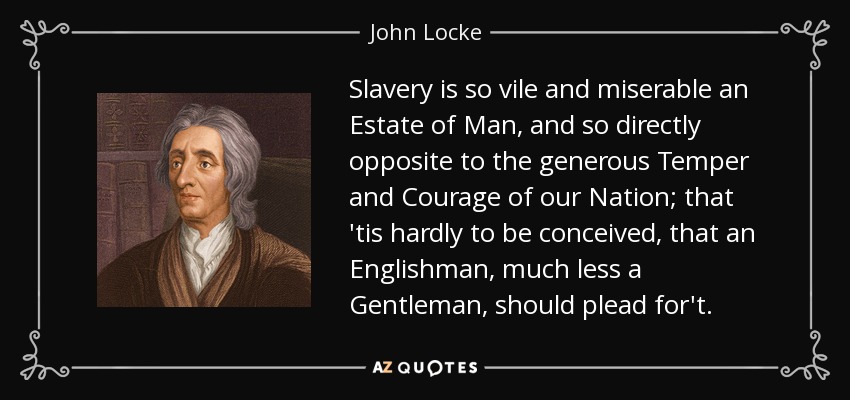
Locke was for slavery.
Locke opposed Hobbe's argument for the claim to absolute power by the monarchy. He rejected the use of absolute power for enslavement.
This was a parliamentarian issue. The English Civil War had amounted to Parliament taking the power to declare war from the monarchy. They then had the authority for taxation, legislation, deportation, colonization and to authorize military action.
The potential to increase profit from the precipitation of war had increased. This included the promotion of revolution as though it were a reform to the constancy of war. The context for perpetual war had increased to a global scale with the competition for colonialism.
The power of the monarchy was made ceremonial and communicative. Foreign monarchs were brought in when the parliament wanted a spokes person and straw man for their decisions.
The power of the monarchy as a symbol for conservative expenditure was enhanced by the large scale changes. Anti-monarchical democracy was also anti-patrician and anti-aristocratic. The liberal element for parliament pressed the case for their authority despite the implication.
Locke owned stock in slave trading companies. He was secretary of the Lords Proprietors of the Carolinas where slavery was constitutionally permitted. He flipped the argument against slavery into a proposal for it with Aristotle's justification of it as an aspect of perpetual war.
He stated that in war he had the right to destroy any who would destroy him.
Two Treatises on Government
Chapter 4 (IV)
Section 24
"This is the perfect condition of slavery, which is nothing else, but the state of war continued, between a lawful conqueror and a captive: for, if once compact enter between them, and make an agreement for a limited power on the one side, and obedience on the other, the state of war and slavery ceases, as long as the compact endures..."
---------------------
The implication of his statement is such that the reader is expected to believe that once war has been completed, slavery ceases to exist except as a drudgery. This was said with his knowledge of his support for colonialism as a force to make natives or those tribal people captured by the trade to serve as indebted to the liberal element.
There were two things that indicated that slavery was being instituted. He referred to "the perfect condition of slavery" as the "state of war continued." The global nature of the competition for colonial power was implied as a support for the institution. The slave was seen as capable of agreement to work.
Locke also asserted that the slave could end the slavery by taking his own life.
It needs to be noted that the claim to absolute power was used to justify the existence of the monarchy. It was not used to justify slavery. This type of argument can be inferred as the basis for the ancient Roman rejection of monarchy.
Berkeley's proposal for a seminary school in the Bahamas treated 'slavery' as a term of indentured service for boys to be trained to become clerical evangelists. Learning the language was essential to proclaiming the good news and living as a responsible citizen.
Manumission on completion of the course of studies was an implicit condition in the proposal. It may have been too explicit even for the time given Locke's expression of personal distasted for slavery.
It was nevertheless much less of an institution of forced labor than Locke's argument for slavery as a perfect condition to end perpetual war. Students were expected to work on a plantation while they were engaged in their education for the persuasion of the conversion of native populations.
Berkeley's immaterialism was treated as a joke that lacked sufficient force. It was a civil proposal for the government of civility though. It also looked at the experience of empire and made the least desirable aspect of it a contractually limited enterprise. The sum of his philosophy was for conservative expenditure in public policy.
George Berkeley
Principles of Human Knowledge
1710
Language
“…the communicating of ideas marked by words is not the chief and only end of language, as is commonly supposed. There are other ends, as the raising of some passion, the exciting to or deterring from an action, the putting the mind in some particular disposition--to which the former is in many cases barely subservient, and sometimes entirely omitted, when these can be obtained without it, as I think does not unfrequently happen in the familiar use of language. I entreat the reader to reflect with himself, and see if it doth not often happen, either in hearing or reading a discourse, that the passions of fear, love, hatred, admiration, disdain, and the like, arise immediately in his mind upon the perception of certain words, without any ideas coming between. At first, indeed, the words might have occasioned ideas that were fitting to produce those emotions; but, if I mistake not, it will be found that, when language is once grown familiar, the hearing of the sounds or sight of the characters is oft immediately attended with those passions which at first were wont to be produced by the intervention of ideas that are now quite omitted.”
--------------------------------
The communication of ideas is not the only purpose for language.
The experience of reception holds its own vantage.
Language can proclaim good news for faith
or it can be used to warn against doing damage as a trait.
=======================
Education
Education was gleaned from telling stories in polytheistic culture. Priests told stories about their god or goddess. This helped people to appreciate the difficulty of political leadership.
The leadership was educated by tutors. Mothers or fathers explained words to their children insofar as they were able. Education that wasn't directed to instruction of the aristocracy was developed by the priesthood for the appreciation of their stories.
Athens and Sparta had public education. Athens prepared students to become citizens. Sparta drilled theirs to become soldiers. Schools of philosophy were developed with the help of Eastern asceticism.
There were early explorations of monotheism by the Egyptian pharaohs. These explorations resulted in monotheistic cults in ancient Persian, Israelite and Judean forms of Middle Eastern culture. China and India developed monotheistic cults as well. These were shared with their satellite kingdoms and possible some tribal societies.
Monotheism was proposed as a simplification of polytheism in Greek philosophy by Xenophanes of Colophon in the 5th century BCE.
Rome took tutors from Greece, but they did not have public education. Their priesthood also developed language learning for the appreciation of their stories. The Church developed instruction to compete with the polytheists after monotheism was adopted by the Roman leadership.
The second Roman empire in Europe developed universities out of colleges. The colleges were likely formed out of the parish level instruction that was developed in relation to royal families.
Education was still largely limited to the aristocracy and the priesthood as clerical intermediaries. Greater advances were initially made in the Byzantine empire. Similar developments were made in Russia.
The Church of Scotland became the official state religion in 1560 during the Protestant Reformation. John Knox was a leader in the reformation that established the Presbyterian Church. They uphold Baptism and the Eucharist along with 5 other rites. It is a reformed branch that did not reject the monarchy, but did not retain the episcopacy. Church government is led by a board of elders in accord with the teaching of John Calvin.
Scotland had 4 universities (St. Andrews, Glasgow, Edinburgh and Aberdeen) compared to 2 in England by the time of the union in 1707. This was remarkable insofar as England had 5 times the population of Scotland and about 36 times the wealth. The parish system of education prepared youth for participation in the universities.
Contacts with England led to the effort to improve agriculture among the gentry and nobility. The colonization of America made a major change in the market for international trade.
Glasgow benefited from this opportunity for expansion in particular. They supplied the colonies with manufactured goods. Tobacco emerged as a cash crop for trade. It was re-exported to France. Tobacco lords dominated the city for most of the 18th century.
Adam Smith and David Hume followed Francis Hutcheson as leaders in the Scottish enlightenment. Hutcheson was the first to propose that the greatest happiness for the greatest number would become a principle for making decisions for public policy.
This principle was offered as an expression of moral philosophy. Adam Smith was a moral philosopher and the political economist. David Hume was an empiricist, but not a moral philosopher.
Smith proposed that labor was the wealth of nations. The division of labor was the means to produce a product efficiently. He defined capital as "That part of men's stock which he expects to afford him revenue."
Capitalism was an economic system wherein the government allowed capitalists to develop productive capacities in and for society. Large industry developed sponsorship for small businesses as distributors or independent agents for local communities.
Education was a generative value in this economic system. Adam Smith advocated for public education prior to the establishment of it in British society. Education wasn't legislated as mandatory for the public until the 19th century in the United Kingdom. Mississippi was the last state in the union to make education compulsory for the public in 1917.
Adam Smith
Wealth of Nations
1776
Pins and more
“In every other art and manufacture, the effects of the division of labour are similar to what they are in this very trifling one, though, in many of them, the labour can neither be so much subdivided, nor reduced to so great a simplicity of operation. The division of labour, however, so far as it can be introduced, occasions, in every art, a proportionable increase of the productive powers of labour. The separation of different trades and employments from one another, seems to have taken place in consequence of this advantage. This separation, too, is generally carried furthest in those countries which enjoy the highest degree of industry and improvement; what is the work of one man, in a rude state of society, being generally that of several in an improved one. In every improved society, the farmer is generally nothing but a farmer; the manufacturer, nothing but a manufacturer. The labour, too, which is necessary to produce any one complete manufacture, is almost always divided among a great number of hands. How many different trades are employed in each branch of the linen and woollen manufactures, from the growers of the flax and the wool, to the bleachers and smoothers of the linen, or to the dyers and dressers of the cloth! The nature of agriculture, indeed, does not admit of so many subdivisions of labour, nor of so complete a separation of one business from another, as manufactures.”
--------------------------------
Capital is the ability for stock to generate revenue.
The public is the market for the sale of a product or service as a fortitude.
=======================
Bentham was known to associate with revolutionaries. The precipitation of revolution for his profit was an offense to common law.
His contribution to the reform of the legal code is significant, but it is marred by the individually self-perpetuating increase in reward for his control of the benefit derived from the reform as that which was demonstrated by Locke.
It's not that they didn't deserve anything for the risk that they took. There is the question of their taking so much that their contribution ceased to be a value to the people of the state. The same kind of trait is seen in the advocates for liberal expenditure by government. The cost for their war, change or reform is so large that it the benefit to the public suffers damage.
History allows for compensation in the sense that the reform to the legal code that was acceptable insofar as it was beneficial to the public in word can currently be accepted with conservative expenditure by the government as well.
Jeremy Bentham
Principles and Morals in Legislation
Text
1780
“…a body of proposed law, how complete soever, would be comparatively useless and uninstructive, unless explained and justified, and that in every tittle, by a continued accompaniment, a perpetual commentary of reasons: which reasons, that the comparative value of such as point in opposite directions may be estimated, and the conjunct force, of such as point in the same direction may be felt, must be marshalled, and put under subordination to such extensive and leading ones as are termed principles. There must be therefore, not one system only, but two parallel and connected systems, running on together. the one of legislative provisions, the other of political reasons, each affording to the other correction and support.”
--------------------------------
The conjunct force of reason for principle
serves the public in the reform of that which is printable
as legislation inferred from the script that is biblical.
=======================
C.S. Lewis (1898-1963)
C.S. Lewis was educated in classical literature at Oxford University in England. It is difficult to view his literature as Christian from the Calvinist perspective. Witches were regarded as enemies of the state along with Catholics in British Calvinism.
His contribution to Christianity in the English speaking world was to oppose prejudice against the Wiccan, Catholic and Judaic religions. He saw royalty as a bridge between the classical and contemporary worlds in a way that was similar to that of his collegial associate, J.R. Tolkien.
Puritans had entertained civil war and cruelty in punishment as the means to take the power to declare war from the monarchy. Their ability to profit for their authority by the precipitation of conflict was increased.
Parliament had already acquired legislative authority to write and enact law. It was a key reason for their institution. Taxation was added in time. Parliamentarians were actively engaged in deporting 'dissidents' to the state to populate British colonies overseas by the time the Puritans took over in the latter part of 17th century.
The Act of Royal Supremacy acquired greater significance with the help of the popular literature written by Lewis and Tolkien by the 20th century. The official state religion was not promoted as a means to punish non-Christians. It was a way to encourage social solidarity for the civility of the realm. The kind of thing that Puritans had called corrupt was recast as a public benefit.
The Hobbesian defense from attack was still regarded as a chief heroic and civic virtue. The authors of modern classical literature countered the greatest complaint to the official state religion with their fiction. The popularity of their literary efforts contributed to the transformation of English speaking society with their British style so people could view royalty as a stabilizing social virtue.
"Humility is not thinking less of yourself, but thinking of yourself less."
(Mere Christianity, C.S. Lewis)
---------------------------------
Humility is not thinking less of yourself.
It is thinking of yourself less for the wealth of your health.
========================
“There are far, far better things ahead than any we leave behind.”
(Collected Letters of C.S. Lewis)
----------------------------------
There are better things that lie ahead
than the bad that is left behind with dread
for that good which is worth the tread.
=========================
Kanon Fukuda 3.12.95 Kawagoe, Saitama, Japan
福田花音
福田凯恩
Kawagoe
Kawagoe is 20 km (12.4 mi.) northwest of the city of Saitama. The city has many historic buildings. It is called "Little Edo." Edo was the old name for Tokyo.
Kawagoe is located near the edge of the Kanto Plain in the Musashino Upland terrain. The Arakawa and Tawagawa rivers run through the city
.
It is located about 30 km (25 mi.) from downtown Tokyo. The population was estimated at more than 359,000 in 2016.
Kawagoe Castle was the headquarters for the domain during the Tokugawa shogunate in the Edo period (1603-1808).
Fukuda Kanon
S/mileage
ANGERME:
Dondengaeshi
Fukuda Kanon was born on March 12, 1995 in Kawagoe. Her parents named her after "Pachelbel's Canon."
She began ballet lessons when she was 2 years old. She practiced for about 7 years. She auditioned for Hello! Project Kids in 2002, but failed.
She passed the auditions for Hello Pro Egg with 31 other girls in June 2004. The girls were trained in song and dance to prepare for stage performance. They performed as dancers behind the girl groups during concerts.
Tsunku announced in his blog on April 4, 2009 that a new group named S/mileage would become part of Hello! Project. The members listed were Wada Ayaka, Maeda Yuuka, Ogawa Saki and Fukuda Kanon. The group would produce miles of smiles.
The members of S/mileage graduated from Hello Pro Egg in May 2010 to form the new group.
She produced a number of photobooks, held birthday events and starred in a number of different groups as well.
The name S/mileage was changed to ANGERME in 2015. She announced in May that she would graduate from ANGERME and Hello! Project in the fall to pursue a career as a lyricist. She graduated on November 29 at Nippon Budokan.
Fukuda has already written a number of songs for different groups in Hello! Project. Four of her songs were produced in 2016 and 2017. She also wrote the lyrics for a soundtrack.
Kanon Fukuda 3.12.95 Kawagoe, Saitama, Japan
福田花音
福田凯恩
福 Fu blessing 福 Fuku blessing Ka か カ Ka 카 car
田 tian field 田 ta rice field non のん ノン non 논 field
凯 Kai victory 花 Ka flower Fu ふ フ Hu 후 after
恩 en kindness 音 non sound ku く ク ku 쿠 ku
da だ ダ da 다 all
-----------------------------
The sound of the flower is a blessing that surrounds
the field that produces grain for the towns.
======================