Showing posts with label government. Show all posts

Sunday, September 8, 2019

Have

9.15.19
Alexis Bledel

Have
Mercy
怜悯 
Liánmǐn
どうかご慈悲を
Dō ka go jihi o
ps.51
Miserere

Have mercy on me according to your love. 
Grant me compassion from above.

Wash me from the wickedness of violence and cruelty. 
Cleanse me from the evil of tyranny, terrorism and usury.

Allow me the freedom to think, learn, organize, speak,
write, 
assemble, petition, work, play and worship for happiness with what's for my peak. 

Give me a vote to support due process in law for justice. 
Protect my right to defense for what's just about us. 

Education is the best asset for my social role.
Conservative reform for government is my greatest goal. 

I know my transgression. 
The memory of false impression 
helps me to find a better way than violent aggression. 

I look for a better way than what was wrong 
with what didn't belong for long 
in the last play along to grow strong. 

Autocratic authority by liberal rule 
is not the path to redemption as the tool 
for building an economy for the people as the vestibule.

Reveal divine will through design 
as shown in nature to my mind. 

Put your law within my heart.
Let the right to life run to the final part.

Cast me not away from your presence.
Let my prayers take me to the truth of your divine essence.

Do not bring disaster on your community.
They have been working to build opportunity.

This group has been dedicated to establishing a state
that remembers your promise of inheritance as great.

The remarkable thing about the allegiance of this people
is the devotion to defense against the threat of attacks that are lethal.

The commitment to build national security
deterred the risk of destruction that was building in their immaturity.

The time has come for your joy.
Beauty and reason will be employed.

I am grateful to Christ Jesus as the teacher who taught me with his instruction.
I was deceived by my lack of belief in faith with love as defense against self-destruction.

The inside track will till fertility.
The soil will hide the seed's virility.
Hurricane Lily

The hurricane lily goes dormant in spring.
The flower blooms in September when it's time to sing.

The runner runs to feel agility.
The driver drives to wield tactility.

There will be great joy for those who repent from the lack of concern for security.
They will join the stability that comes with the generation of growth in maturity.

Purgation includes expiation in relation to the divine
to find the way to the jade of the jewel with this mind of mine.  

Socialism demands the defense of liberal expenditure
as though the competitor were the cause of the global rise in temperature.

Wash me from the wickedness of violence and cruelty.
Cleanse me from the evil of tyranny, terrorism and usury.

Create a clean heart within me.
Reveal the truth to help me see.

Have mercy on me according to your love.
Grant me compassion from above.

---------------------------

あなたの愛に応じて私を憐れませてください。
Anata no ai ni ōjite watashi o awarema sete kudasai.
Have mercy on me according to your love.

Grant me compassion from above.
Ue kara omoiyari o ataete keihatsu pai.
上から思いやりを与えて啓発パイ。

--------------------------

51 Miserere mei, Deus
Have mercy on me, Light

1 Have mercy on me, O God, according to your loving-kindness;
in your great compassion blot out my offenses.

2 Wash me through and through from my wickedness
and cleanse me from my sin.

3 For I know my transgressions,
and my sin is ever before me.
.
4 Against you only have I sinned
and done what is evil in your sight.

5 And so you are justified when you speak
and upright in your judgment.

6 Indeed, I have been wicked from my birth,
a sinner from my mother's womb.

7 For behold, you look for truth deep within me,
and will make me understand wisdom secretly.

8 Purge me from my sin, and I shall be pure;
wash me, and I shall be clean indeed.

9 Make me hear of joy and gladness,
that the body you have broken may rejoice.

10 Hide your face from my sins
and blot out all my iniquities.
11 Create in me a clean heart, O God,
and renew a right spirit within me.

12 Cast me not away from your presence
and take not your holy Spirit from me.

13 Give me the joy of your saving help again
and sustain me with your bountiful Spirit.

------------------------

Exodus 32:12

'Why should the Egyptians say, "It is with evil intent that he brought them out to kill them in the mountains and to consume them from the face of the earth?" Turn from your fierce wrath; change your mind and do not bring disaster on your people. Remember Abraham, Isaac and Israel, your servants, how you swore to them by your own self, saying to them, "I will multiply your descendents like the stars of heaven and all this land that I have promised I will give to  your descendents. They will inherit it forever."'

The LORD changed his mind about the disaster that he planned to bring on his people.

------------------------

Do not bring disaster on your community.
They have been working to build opportunity.

This group has been dedicated to establishing a state
that remembers your promise of inheritance as great.

The remarkable thing about the allegiance of this people
is the devotion to defense against the threat of attacks that are lethal.

The commitment to build national security
deterred the risk of destruction that was building in their immaturity.

=================

1 Timothy 1:12-14

I am grateful to Christ Jesus our Lord who has strengthened me. He judged me faithful and appointed me to his service even though I was formerly a blasphemer, a persecutor and a man of violence. I received mercy because I had acted ignorantly in unbelief. The grace of our Lord overflowed for me with the faith and love that are in Christ Jesus.

------------------------

I am grateful to Christ Jesus as the teacher who taught me with his instruction.
I was deceived by my lack of belief in faith with love as defense against self-destruction.

=================

Luke 15:6-7

'When he comes home, he calls together his friends and neighbors, saying "Rejoice with me for I have found my sheep that was lost." Just so, I tell you, there will be more rejoicing in heaven over one sinner who repents than over ninety-nine righteous people who need no repentance.'

------------------------

There will be great joy for those who repent from the lack of concern for security.
They will join the stability that comes with the generation of growth in maturity.

=================

Mystical Experience
Catherine of Genoa
b. 1447 Genoa, Italy
d. 9.15.1510 Genoa, Italy

Catherine of Genoa was an Italian mystic and social worker in the Roman Catholic Church.
She wrote the Spiritual Dialogue and a Treatise on Purgatory. She is noted as an authority regarding the doctrine of purgatory.

She is remembered for her work among the sick and the poor. She served the sick during the plague which ravaged Genoa in 1497 and 1501.

She was a member of the noble Fieschi family.  Her fame outside her native city is connected with the publication in 1551 of the book known in English as the Life and Doctrine of Saint Catherine of Genoa.

She and her teaching were the subject of Baron Friedrich von Hügel's classic work The Mystical Element of Religion (1908).

Genoa

The city of Genoa is located between the Apennine Mountains and the Ligurian Sea.

The Apennine are a mountain range of parallel smaller chains extending about 1,200 km (750 mi) along the length of peninsular Italy. They join with the Ligurian Alps at Altare in the northwest.

The Ligurian is part of the Mediterranean Sea between the Italian Riviera (Liguria) and the island of Corsica.

Genoa is the capital of the Italian region of Liguria. It is the sixth-largest city in Italy.

The port is located on the Gulf of Genoa in the Ligurian Sea. It has historically been one of the most important ports on the Mediterranean.  it is currently the busiest in Italy.

It is the birthplace of Christopher Columbus, Niccolò Paganini and Grimaldo Canella, founder of the House of Grimaldi, among others.

 The Bank of Saint George was founded in 1407. It is among the oldest in the world and has played an important role in the city's prosperity since the middle of the 15th century.

The port established  itself as the merchant capital of the newly established Republic of Genoa in 1005 and maintaining its autonomy until 1797.

The capital struggled to rule itself. Many inner conflicts among the nobility weakened the Republic. The inability to rule itself caused the state to put themselves twice under French rule. Once was in 1391. It happened again in 1458.

The Black Death hit Genoa hard in 1348 and contributed to its decline.

Caterina Fieschi Adorno

Catherine's parents were Jacopo Fieschi and Francesca di Negro. Both were of noble Italian birth.  Two popes, Innocent IV and Adrian V, had been of the Fieschi family. Jacopo himself became Viceroy of Naples.

The family were Guelphs. They were in the faction that supported the pope. The Ghibellines were for the Roman emperor

Catherine was the last of 5 children. She was born in 1447. She was described as an extraordinary child who was gifted in prayer and devotion to Christ. She wished to enter a convent when about 13.

Her sister, Limbania, was an Augustinian nun. The nuns to whom her confessor applied refused her on account of her youth. She put aside the idea without any further attempt.

Her father died when she was young. She was married to the young Genoese nobleman, Giuliano Adorno, at 16. Giuliano had returned to Genoa after several experiences in the area of trade and in the military world.

Their conjugal life was not easy. Her husband's character was worldly in affection for games of chance. They didn't produce children. She felt induced to lead a life that lacked serenity. She had a feeling of profound emptiness after 10 years of marriage. She prayed to remain sick in bed for 3 months.

She received a conversion experience as an answer.  Catherine went to the church of St. Benedict and to the monastery of Our Lady of Graces for confession on March 20, 1473.

She wrote that she was wounded in heart by the knowledge of the life she had led and the goodness of God. She did not stay to finish her confession.

She went home and entered a remote room to weep and pray. She received the sense of the immense love of God. She had a vision of Jesus bent beneath the cross. She understood that he suffered so those who suffered pain from discrimination might feel loved.

She entered into a life of profound union by faith with constant prayer and the daily reception of Communion. It was unusual for laity to receive the sacrament so often.

She sought to be taught by God with the nourishment from prayer and the eucharist for 25 years. She did not become dependent upon the priest in confession. She did not become a monastic.

The place of her ascent to mystical peaks was Pammatone Hospital, the largest hospital complex in Genoa, of which she was director.

She lived an active existence despite the depth of her inner life. A group of followers, disciples and collaborators formed around her. They felt edified by her faith and charity. Her husband was won over as well. He became a Third Order Franciscan and moved into the hospital to help his wife.

The plague hit Genoa in 1493. It was reported that it killed up to 80% of the community. Her husband died in 1497.

She resigned her position as director, although she continued working full time until 1499, when her health began to fail. She finally accepted a priest as her spiritual guide during this time. He was her successor as the head of the hospital. He would later write her biography.

She wrote the Spiritual Dialog and Treatise on Purgatory in the 10 years before her death.
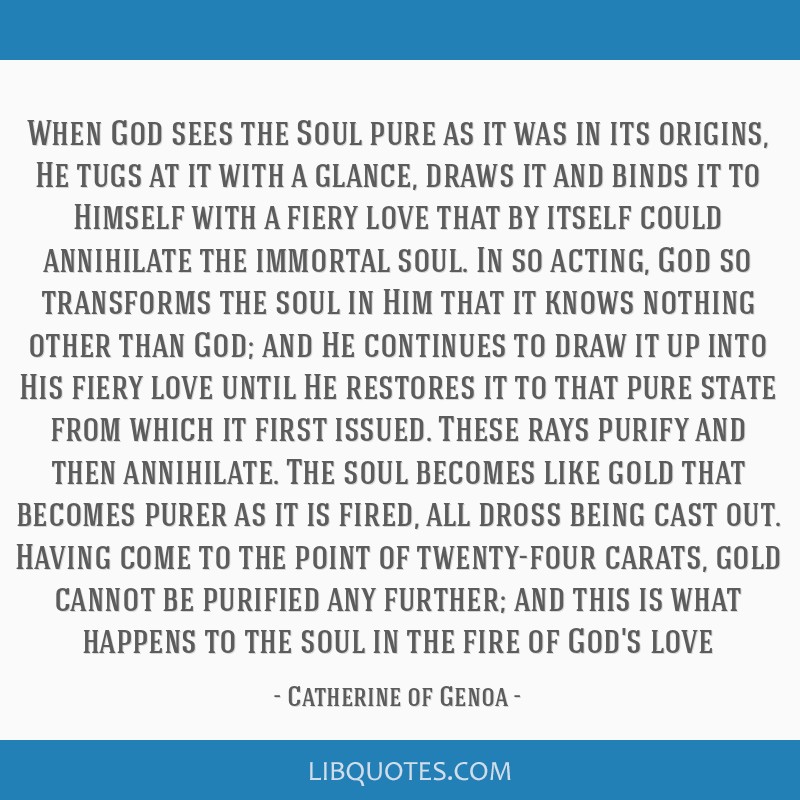
Purgatory was not a place located in the bowels of the earth for her. It was an inner fire for purification. It was a movement toward full communion in the kingdom of heaven.

She died in Genoa in 1510.

Elements of Religion

The elements of religion according to Hugel are mystical, intellectual and institutional. The three work to keep religion alive and relevant. Mysticism could never be the whole of religion.

It is personal in a primitive and monotheistic way insofar as it avoids the errors of superstition and hostility, but it holds the institutional and intellectual parts in question.

Catherine used her mysticism to support that which was right about the intellectual and institutional parts. 

Hugel was engaged in theological discussions with a diverse group of scholars associated with the Modernist controversy at the start of the 20th century.

The modernists shared a belief that science had raised new questions for religious faith that undermined naïve suppositions that believers could rely purely on dogmatic authority as a source of truth.

His scholarly concerns included the relationship of Christianity to history, ecumenism, mysticism, the philosophy of religion and the rejection of much of the immanentism in nineteenth-century theology.

The anti-dogmatic position neglected to acknowledge the value that Trinitarian and Christological instruction held with respect for theology. This antagonism supported the liberal position in theology and political philosophy.

Catherine Fieschi
S. 凯瑟琳菲斯基
T. 凱瑟琳菲斯基

凯  Kai  victory             凱  gai         victory song          Ka   きゃ   キャ        Kae  캐  casserole 
瑟  se    harp                 瑟  shitsu     large koto              sa    さ        サ            seo  서  book         
琳  lin    jade                 琳  rin          jewel                     rin  りん    リン         lin    린  Lynn     
菲  Fei   poor                菲   hi           thin                        Fi    ふぃ   フィ         Pi     피  blood   
斯  si      this                 斯   shi         this                         e     え        エ             swi   쉬  wee       
基  ji       base                基  ki           fundamentals         su   す        ス                       
                                                                                         ki    き        キ                                           
-----------------------------

Purgation includes expiation in relation to the divine
to find the way to the jade of the jewel with this mind of mine.

=================

wiki Catherine of Genoa
Franciscan Media: Catherine of Genoa
Lectionary: Catherine of Genoa
Commentary: Treatise on Purgatory
Papal Podcast: Catherine of Genoa
Benedict XVI: Text St. Catherine of Genoa
wiki The Mystical Element of Religion
wiki Genoa
New Advent Encyclopedia: Catherine of Genoa
wiki Guelphs and Ghibellines

Tolerance

David Stove
b. 9.15.1927 Moree, New South Wales, Australia
d. 6.2.1994    Mulgoa, New South Wales

David Charles Stove was an Australian philosopher who argued against socialism. He was for logical probability and rational induction in reason.

Stove criticized the irrationalism that infested the modern philosophy of science. The relativist and “social constructivist” views that were current in the sociology of science and postmodernist humanities departments depicted  modern science as no better (or worse) than voodoo or astrology or reading chicken entrails. The view was made to look like the majority opinion.

Popper, Kuhn and Feyerabend were irrationalists in the philosophy of science. They denied that there was reason to believe in any theory of science. There has been no significant accumulation of relevant knowledge in recent centuries according to the position.

Stove came to be known for his opposition to socialism in college departments in Australia. The socialists made their demands the basis for making decisions for higher education. It ran contrary to the consideration of benefit in reasonable administration.

The argument against socialism seeks to reduce the detrimental affect of socialist analysis on administrative decisions, but argument against it is not enough. Socialism was a derivative of liberal politics. That means that there is another tier to be considered in the argument against non-representative judgment.

The reduction of consideration in the legitimate range of choice for representative policy in democratic society is the area of concern for political organization whether it is in republic or kingdom.

Liberals have been tolerant of socialism because the focus on the role of industrial organization on political leadership has placed their 'power' in government over industry, the middle class and the poor.

They have resorted to populist factionalism in media representation as though it were a representation of democracy. They don't promote representation. They attack it in conservative forms.

Professionalism as a product of education has suffered as a result. While Stove was critical of Popper and his error in science and economics, he wasn't critical enough of liberalism.

The aggressive error of liberalism has to be challenged for the benefit of conservative reform.

Moree, New South Wales
 

Moree is a town in northern New South Wales.

New South Wales is in the southeastern part of Australia. It sits on the banks of the May may River. The name comes from an Aboriginal word meaning "long springs."

The land is a plains region. It has been used for agriculture. The town is not heavily populated. The 2016 census numbers the population at about 7,400 people.

The first constable arrived and a police station was set up in 1865. The first church (Wesleyan) was built in 1867 when the town had a population of 43.

Agriculture emerged as a thriving industry on the fertile flood plains. Banking began in 1876 and the first local newspaper was set up in 1881. The population had grown to 295.

The Great Artesian Basin which sits under Moree was tapped in 1895. The basin yields over thirteen megalitres of water every day, but was proved unsuitable to provide enough water for the agriculture.

The railway line and service from Sydney arrived in 1897. Floods in the area caused numerous washouts of the railway in January 1910. An unknown number of livestock were drowned and at least four people drowned.

A flood cut the township in two in January 1946. Several hundred homes were flooded. The water damaged the power station and caused a black out. Roads and railway lines were damaged.

Moree railway station is situated on the Mungindi line, 665 kilometres (413 mi) from Sydney. It marks the northernmost point of passenger service on the line.

David Stove

David Stove was born in Moree, New South Wales on September 15, 1927.

His parents were Robert James Stove, schoolteacher, and his wife Ida Maude, née Hill. He was the fifth surviving child.

He went to Newcastle Boys’ High School where he excelled in running and was captain of the school track team.

He attended the University of Sydney (BA, 1950) and graduated with first-class honors in moral and political philosophy.

He was strongly influenced by the Challis professor of philosophy John Anderson.

Anderson founded the empirical brand of philosophy known as Australian realism. The central claim was that "whatever exists … is real".  That which is real is spatial and temporal in a situation or occurrence that is on the same level of reality as anything else that exists.

Any object is a fact. Every fact is situated in a complex situation. There are no simple ideas, no atomic facts, no objects which cannot be, as it were, expanded into facts.

All situations exist independently of knowledge of them. All entities are caused. Ethics is concerned with establishing and describing that which is good. It is a positive science. It is not abstractly detached from reality.

Anderson's insistence on unceasing inquiry and criticism became central to the intellectual principles of the university's Libertarian Society. This group supplanted the Free Thought Society in the early 1950's. It provided a philosophic platform for the much broader subculture known as "the Push" throughout the 1960's.

The movement was against socialism, yet he was a defender of free speech. He was critical of the Australian government's bans on certain political publications (1928). People could talk about socialism, but concession to the demands of Marxist ideology was not to be granted.

Stove was appointed a teaching fellow at the University of Sydney in 1951. He became a lecturer in philosophy at the New South Wales University of Technology (later the University of New South Wales) in 1952.

He married Jessie Amelia Leahy, a biochemist on 4 November 1959 at the registrar general’s office. The next year he returned to the University of Sydney.  He was promoted to senior lecturer in 1963 and associate professor in 1974. He would teach there until his retirement in 1987.

Stove was alarmed by the spread of radical left-wing ideas on campus in the early 1970's especially in his own department. He strongly resisted the introduction of courses in Marxism-Leninism and feminism with his colleague David Armstrong, the Challis professor of philosophy.

The subjects went ahead. The dispute resulted in a split in the department. Stove and Armstrong joined a new department of traditional and modern philosophy (colloquially ‘T & M’). Stove headed the department in 1981 and 1982. The left wing department was troubled by political schism. Stove felt that T & M was a perfect environment for serious work.

His work in philosophy mostly concerned the problem of induction. He argued that inference from the observed to the unobserved was justified for purely logical reasons in Probability and Hume’s Inductive Scepticism (1973) and The Rationality of Induction (1986).

There exists a probabilistic kind of logic which renders ‘The next swan is white’ probable, though not certain, on the evidence that all swans so far observed have been white.

His more polemical philosophical work included Popper and After: Four Modern Irrationalists (1982). The work accused leading philosophers of science such as Sir Karl Popper and Thomas Kuhn of undermining, rather than as they claimed, defending science.

Popper had concluded in his massive The Logic of Scientific Discovery (1934) that science could never establish truth.  Stove compared the conclusion to the one that had been made by the fox in Aesop's fable.

The fox had decided that the grapes must be sour, because he could not reach them. Stove added that to make the comparison complete, the sly creature would have gone on to write a long book on the progress of viticulture.

He wrote 'A Farewill to Arts' in protest to the spread of postmodernist varieties of left wing thought in 1986. He described the Faculty of Arts at the University of Sydney as a disaster area.

This disaster was like an area that had been ravaged by flood, a badly leaking nuclear reactor or an outbreak of hoof and mouth disease in cattle. His complaint was that Marxism, semiotics and feminism were being used to favor the employment of women on the faculty.

His opinion was that logically probable deduction and simple induction were the path to truth. Common sense has to be applied in practical reason for realism to work.

He was witty and irreverent in expression, but principled in thought. He was pessimistic in that he found no consolation in religion or hope for political progress.

He found some comfort in classical music, old books and nature. He enjoyed planting trees at his rural property at Mulgoa. He also liked cricket and rugby league.

He was a heavy smoker. He contracted oesophageal cancer.

He committed suicide on 1 or 2 June 1994 at Mulgoa after a period of depression following severe treatment for the disease.

While his criticism of socialism was warranted, his conservatism was pessimistic. He did not admit to room for the stable management of reform.

-----------------------

David Stove
S. 大卫斯托夫
T. 大衛斯托夫

大 Da       great              大 dai        large                   De   で     デ          De  데  place             
卫 wei     health              衛  ei        defense                bi    びっ  ビッ      i    이  this             
斯  Si         this               斯  shi       this                      Do   ど      ド        bi     비  ratio           
托  tuo      support          托   taku    requesting           su    す    ス          deu  드  de             
夫  fu        husband         夫  fu         husband              to    と-   ト-        Seu   스  s                           
                                                                                      bu    ぶ    ブ         to     토  sat     
                                                                                                                    beu  브 bro                 
-----------------------

Socialism demands the defense of liberal expenditure
as though the competitor were the cause of the global rise in temperature.

=================

wiki David Stove
James Franklin: Sydney Philosophy Disturbance
Bio David Charles Stove

Wednesday, July 31, 2019

Manage

8.1.19
Glastonbury Thorn

Manage
Resources
管理资源
Guǎnlǐ zīyuán
リソースを管理する
Risōsu o kanri suru
ps16
Curo opibus

A person is born in the image of God by conversion.
The universe is the machine for energy sought in recursion
through the design of nature as it ought to be taught with immersion.

Is there a place for the fear of God in your heart? 
The Broken (Hittites) reasoned from the position as a start
for placing the horse before the cart.

The Father was living among those where human sacrifice was a custom.
He was tempted by adversity to sacrifice his laughter before the 5 year lustrum.

He was given a ram with his horns caught in a thicket
as the thing to offer for propitiation as the ticket.

His Princess died after many years by his side.
He asked for a place where in the future he could be laid by his bride. 

The Father of many said, 'I am a stranger in this strange land.
Will you allow me a place to bury my beloved dame?'

The most fruitful of the Broken said,
'You are a prince. You may bury the one whom you had wed.'  

Conserving resources preserves energy.
The management works continually.

The cultivation of production in time
works best when managed with respect for design.

The Latin form for Addition (Josephus) was opposed to sedition
after his attempt to attain that force in factual recognition.

Truthful testimony for the law of God as covenant
was the basis for social organization for government.

The court system was established to evaluate the claim of a charge.
Two witnesses were needed to warrant consideration for the public at large.

Republic or kingdom was not as significant in form
as the need for the enactment of conservative reform.

The line of succession has a perpetual benefit in fact.
The ownership of property is passed to the family with the will as contract.

When the body of the Savior was taken from the cross
it was laid to rest that our management of resources would gain from the loss.

The rule of law is for protection.
Crime is subject to correction.

Cruelty in punishment is not the cure.
Direction by correction works for sure.

Delight is shown with respect for others.
Joy is a reward that doesn't smother.

The perfect gift comes down from the Father of lights as a generous act.
The atonement gives birth by the word of truth to fulfill the purposeful tact
that we may become the fruit of the divine contractual tract.

Law that places profit from violence above people is flawed.
War or genocide is not to be held in awe.

Life rules the living.
Love favors giving.

Order by design is my proportion.
This table doesn't suffer from mass distortion.

Boundaries enclose pleasure
as a measured treasure.

Healthy happiness is a good heritage.
It works in and outside of marriage.

My heart reviews reaching for the teaching of truth.
This teaching is not reserved for the dismissal of youth.

Good counsel is blessed.
It helps you test for the best.

Don't support the rule of death.
It is more destructive than a missile laden jet. 

Justice with liberty is the goal of law.
Equity is that which the economy has to draw.

The goal before me
is built upon the accomplishment seen.

My heart rejoices. My spirit is glad.
My strength avoids that which is bad.

I have not been condemned by the grave.
The rule of death does not bless or save.

The path to life is being known
by the design that is shown.

Those that sleep will wake
to rise or fall with respect for that which is great.

Let us approach authority in the house of worship
with a true heart and a conscience cleansed to cure it.

There will be disasters in various places.
There will be recovery with respect for stages.

The elegance of power requires restraint for the driven.
Intuition regarding objects provides a frame for reality in existence.
The colors of dried sedge provide objects for subsistence.
Mats, baskets and hats are useful to protect floors, store goods and provide solar resistance.

Exercise generates radiance for your tower
as you watch over the valley like a book for the hours.

The majesty of beauty in the language
builds prestige for you in the reduction of anguish.

The sound of the wind gave a promise to the man.
He was to be husband to both his woman and his land.

There is fullness of joy in your presence.
Search for the essential essence
gives joy as a gift for the present.

-----------------------

16 Conserva me, Domine
Preserve me, Dominated

1 Protect me, O God, for I take refuge in you;
I have said to the Lord, "You are my Lord,
my good above all other."
2 All my delight is upon the godly that are in the land,
upon those who are noble among the people.
3 But those who run after other gods
shall have their troubles multiplied.
4 Their libations of blood I will not offer,
nor take the names of their gods upon my lips.
5 O Lord, you are my portion and my cup;
it is you who uphold my lot.
6 My boundaries enclose a pleasant land;
indeed, I have a goodly heritage.
7 I will bless the Lord who gives me counsel;
my heart teaches me, night after night.
8 I have set the Lord always before me;
because he is at my right hand I shall not fall.
9 My heart, therefore, is glad, and my spirit rejoices;
my body also shall rest in hope.
10 For you will not abandon me to the grave,
nor let your holy one see the Pit.
11 You will show me the path of life;
in your presence there is fullness of joy,
and in your right hand are pleasures for evermore.

-----------------------

Abraham- Father of Many
Sarah- Princess
Hittites- Broken; those who fear
Isaac- laughter

Gen. 23:3-6

Abraham rose up from beside his dead and said to the Hittites, 'I am a stranger and an alien residing among you. Give me property among you for a burying place so I may bury my dead out of sight.'

The Hittites answered Abraham, 'Hear us, my lord. You are a mighty prince among us. Bury your dead in the choicest of our burial places. None of us will withhold from you any burial ground for burying your dead.'

-----------------------

Is there a place for the fear of God in your heart?
The Broken (Hittites) reasoned from the position as a start
for placing the horse before the cart.

The Father was living among those where human sacrifice was a custom.
He was tempted by adversity to sacrifice his laughter before the 5 year lustrum.

He was given a ram with his horns caught in a thicket
as the thing to offer for propitiation as the ticket.

His Princess died after many years by his side.
He asked for a place where in the future he could be laid by her side.

The Father of many said, 'I am a stranger in this strange land.
Will you allow me a place to bury my beloved dame?'

The most fruitful of the Broken said,
'You are a prince. You may bury the one whom you had wed.' 

================

James 1:17-18

Every generous act with every perfect gift is from above coming down from the Father of lights with whom there is no variation or shadow due to change. He gave us birth by the word of truth in fulfillment of his own purpose so we would become a kind of first fruits of his creatures.

-----------------------

The perfect gift comes down from the Father of lights as a generous act.
The atonement gives birth by the word of truth to fulfill the purposeful tact
that we may become the fruit of the divine contractual tract.

=================

Joseph- He will add
Pontius Pilate- Fifth Cap
Jesus- God saves

Luke 23:50-54

There was a good and righteous man named Joseph who was a member of the council. He had not agreed to their plan and action. He came from the Jewish town of Arimathea. He was waiting expectantly for the kingdom of God. This man went to Pilate and asked for the body of Jesus. Then he took it down, wrapped it in a linen cloth and laid it in a rock-hewn tomb where no one had ever been laid. It was the day of Preparation. The sabbath was beginning.

-----------------------

The Latin form for Addition (Josephus) was opposed to sedition
after his attempt to attain that force in factual recognition.

Truthful testimony for the law of God as covenant
was the basis for social organization for government.

The court system was established to evaluate the claim of a charge.
Two witnesses were needed to warrant consideration for the public at large.

Republic or kingdom was not as significant in form
as the need for the enactment of conservative reform.

The line of succession has a perpetual benefit in fact.
The ownership of property is passed to the family with the will as contract.

When the body of the Savior was taken from the cross
it was laid to rest that our management of resources would gain from the loss.

=================

The Disciple Joseph

When ancient Rome claimed authority over the land now known as Israel, they took the claim from the Seleucids. They were in the process of adopting the Hellenic system of government to something that satisfied the sensibilities of the Roman republic.

When Cyrus had liberated the captives from Babylon, Judea became a province of the Achaemenid Persian empire. They were appointed a governor who met the emperor's approval.

They were allowed to have a high priest who organized the building of the Second Temple. They maintained religious custom for the Temple. Synagogues were added after the exile as a place to read the Law and the prophets throughout the land.

The Sandhedrin

The ancient Jewish court system was called the Sanhedrin.

The earliest record of the system is by Josephus who wrote of a political body convened by the Romans in 57 BCE. Hellenistic sources generally depict the Sanhedrin as a political and judicial council headed by the country’s ruler.

The Great Sanhedrin was the supreme religious body in the Land of Israel during the time of the Holy Temple. There were also smaller religious courts in every town in the land as well as a civil political-democratic council.

There were two classes of rabbinical courts. A lesser Sanhedrin of 23 judges was appointed to each city, but there was to be only one Great Sanhedrin of 71 judges for the capital. This council acted as the Supreme Court among other roles. They took appeals from cases decided by lesser courts.

Jewish sources describe the Great Sanhedrin as a religious assembly of 71 sages who met in the Chamber of Hewn Stones in the Temple in Jerusalem. They met daily except on the Sabbath, festivals or festival eves.

It was the final authority on Jewish law. Any scholar who went against its decisions was put to death as a zaken mamre (rebellious elder). The Sanhedrin was led by a president called the nasi (lit. "prince") and a vice president called the av bet din (lit. "father of the court").

The other 69 sages sat in a semicircle facing the leaders. It is unclear whether the leaders included the high priest.

The Sanhedrin judged those accused as lawbreakers. They did not initiate arrests. It required a minimum of two witnesses to convict a suspect. There were no attorneys.

The witness who was making the accusation stated the offense in the presence of the accused. The accused could call witnesses on his own behalf. The court questioned the accused, the accusers and the defense witnesses.

The Great Sanhedrin dealt with religious and ritualistic Temple matters, criminal matters appertaining to the secular court, proceedings in connection with the discovery of a corpse, trials of adulterous wives, tithes, preparation of Torah Scrolls for the king and the Temple, drawing up the calendar and the solving of difficulties related to ritual law.

The Great Sanhedrin lost its authority to inflict capital punishment sometime around 30 CE.  These Jewish courts existed until the abolishment of the rabbinic patriarchate in about 425 CE.
Joseph of Arimathaea

It was the evening before the sabbath in the Passover festival in 30 CE. Joseph of Arimathaea was a member of the council. He was also a secret disciple of Jesus. It was the responsibility of the senior male representative of the crucified person to deal with the crucified. He was Mary's uncle. The responsibility fell to him.

Joseph went to Pontius Pilate and asked him for the body. Pilate sent for the centurion to see if he was dead. He ordered that the body be given to Joseph when he found out that he was.

He took the body. Nicodemus had been the first to come to Jesus by night. He brought a mixture of myrrh and aloes. They took the body of Jesus and wrapped it in a fine linen cloth with the mixture according to the burial custom of the Jews.

There was a tomb that had been hewn out of rock in a garden near where Jesus had been crucified. No one had been laid in the tomb. They laid the body there, then rolled a stone against the door.

There is no town named Arimathaea in Judea. It is speculated that a small village 5 miles northwest of Jerusalem named Ramatha is the closest approximation. (Arimathea could be translated as 'thanks to the goddess.') It is reputed to be the resting place for the prophet Samuel. He was the prophet who had said, "Here I am" when he heard the Lord call to him. 

Joseph was a merchant. He traveled to England to buy some cornish tin. Britain was known to the Classical world. The Greeks, Phoenicians and Carthaginians had traded for Cornish tin as early as the 4th century BCE. The Greeks called them the Cassiterides or "tin islands" near the west coast of Europe.

Tin is an element in the periodic table. The symbol Sn is an abbreviation from the Latin stannum.
Tin was combined with copper to form bronze. The earliest bronze objects had a tin or arsenic content of less than 2% . These objects were believed to be the result of unintentional alloying due to trace metal content in the copper ore.

The addition of a second metal to copper increased its hardness, lowered the melting temperature and improved the casting process to produce a more fluid melt that cooled to a denser, less spongy metal.
Tin bonds readily to iron and is used for coating lead, zinc and steel to prevent corrosion. Tin-plated steel containers are widely used for food preservation. This forms a large part of the market for metallic tin in the contemporary world.

A tinplate canister for preserving food was first manufactured in London in 1812. Speakers of British English call them "tins", while speakers of American English call them "cans" or "tin cans".

The most likely use for tin during the time of Joseph of Arimathaea was to make bronze. Tools, weapons, armor and building materials such as decorative tiles were harder and more durable than their stone and copper ("Chalcolithic") predecessors.

Rome had not yet made Britain a colony when Joseph traveled there.

Julius Caesar had taken two campaigns to the Islands in 55 and 54. He believed the Britons were helping the Gallic resistance during his conquest of Gaul. The first expedition gained a foothold in Kent, but was unable to advance further due to lack of cavalry and a storm that damaged their ships.

The Roman Senate declared a 20-day public holiday in Rome to honor the unprecedented achievement of obtaining hostages from Britain. Belgian tribes were defeated on the return to the continent.

The second invasion involved a substantially larger force. Caesar invited many of the native Celtic tribes to pay tribute and give hostages in return for peace. A friendly local king was installed. A rival was brought to terms. Caesar conquered no territory. He left no troops behind but he established clients. Britain was brought into Rome's sphere of influence.

Augustus planned invasions in 34, 27 and 25 BCE, but circumstances were never favorable. The relationship between Britain and Rome settled into one of diplomacy and trade. Strabo claimed that taxes on trade brought in more annual revenue than any conquest could when he wrote late in the reign of Augustus.

Joseph is associated with Philip in the evangelical mission to the northwest of Europe. The Apostle Philip is reputed to have preached to the Gauls.

Philip had been named after the Roman Tetrarch (26 BCE-34 CE)whose territory was east of the Jordan and north of Decapolis.

He had been the one who had called Nathaniel to see Jesus of Nazareth of whom Moses in the law and the prophets wrote. He was the father to 4 daughters who were named as prophets in the Acts of the Apostles.

There are stories that link his mission to Scythia and Phrygia. Scythia was north of the Black Sea. Phrygia was a kingdom in Asia Minor in the country now known as Turkey. This area came to have an association with Montanism. It was a doctrine regarding the prophesy of the Holy Spirit that was identified as a heresy by the Church in Rome. The Church in Gaul expressed respect for certain traits of the Montanists.

The mission of Joseph of Arimathaea to Britain has been associated with that of the Apostle Philip in France, but Philip probably never traveled to Gaul.

Joseph took the cup that had been used at the Last Supper to Glastonbury in Somerset, England.  The well is also known as the Red Spring. It is situated at the base of the tor in Glastonbury. Legend has it that the drops of Christ's blood were caught in the Grail. These drops and some rusty nails from the cross turned the water in the spring red when Joseph hid the chalice there.

The waters from this well have three attributes in common with human blood. The liquid is  red. It coagulates as does hemoglobin and it is warm. The iron content gives it the reddish color. There is a coagulation of rust with the accumulation of ferric oxide. The subterranean water from the well is often warmer than the surface ground temperature.

Roses near the well bloom even in winter when other plants and flowers further away do not. The Thorn Tree, also known as the Glastonbury Thorn (Crataegus Monogyna praecox) blooms in the Chalice Well garden every Christmas. Locals said that this tree took root when Joseph of Arimathea drove his staff into the ground near the well.

The name 'Avalon' refers to Glastonbury. The parish church is dedicated to St John. This was the location for the medieval legends regarding King Arthur and the Holy Grail.

The Glastonbury Thorn is a variety of hawthorn that flowers twice a year in winter and spring. It flowers at Christmas and Easter given suitable conditions. Blossoms from the Thorn are used to decorate the Christmas breakfast table of the Queen.

Joseph converted many to Christianity. Over a hundred were converted in a single day at the town of Wells. He converted Ethelbert a local king. Then he went on to found Glastonbury Abbey. The  Church has a stained glass window commemorating him.

Josephus
S. 约瑟夫
T. 約瑟夫

约 Yue   to restrict                 約  yaku      promise                           Jo  じょ  ジョ     Yo   요  yo   
瑟  se      sound of wind        瑟  shitsu    stringed instrument          se   せ    セ          se    세  three 
夫  fu      husband                 夫  fu           husband                           fu   ふ   フ           pu    푸 fu   
                                                                                                          su  す    ス           seu   스 switch
-----------------------

The sound of the wind gave a promise to the man.
He was to be husband to both his woman and his land.

=================

https://www.jewishvirtuallibrary.org/the-sanhedrin
http://www.bbc.co.uk/thepassion/articles/joseph_of_arimathea.shtml
https://en.wikipedia.org/wiki/Joseph_of_Arimathea#Britain
http://www.ccel.org/j/josephus/works/ant-18.htm
https://en.wikipedia.org/wiki/Ramathaim-Zophim
https://en.wikipedia.org/wiki/1st_century
https://en.wikipedia.org/wiki/Roman_Britain#History
https://en.wikipedia.org/wiki/History_of_the_British_Isles#Iron_Age_(1200_BC_to_600_AD)
https://en.wikipedia.org/wiki/History_of_England#Roman_Britain
https://en.wikipedia.org/wiki/Chalice_Well
The Passion of St. John, J.S. Bach
https://www.youtube.com/watch?v=X7mVWc4QFyQ

Sunday, May 12, 2019

Praise

5.19.19
Nicole Kidman as Atlanna
in Aquaman

Praise
God
赞美神
Zànměi shén
神を賛美する
Kami o sanbi suru
ps148

Yeah Yah! 
You fill me with awe!

Help me see your revelation
with the gift of sensation.

Guide others also to see your design
with instruction both transcendent and sublime.

Sunrise, Florida 

Recognize the value of light
for your sight!

Applaud the radiance of heaven.
Appreciate matter as creation with essence.

Shine like the sun and moon.
Let the beauty of stars be seen in the flowers that bloom.

Celebrate heaven as the essence of sky.
Let the brightness of highness shine in your inner light.

Let water fall on the face of the earth.
Let life be blessed with the grace of worth.

The cedar and pine will go in the wilderness.
The cypress will grow near water in the desert emptiness.

All may consider and understand
that this was done by the LORD's hand.

The Holy One has created this
as an expression of creative bliss.

Let creation praise the name of the Most High.
Let your heart sing with everything under the sky. 

The Word spoke and everything began to be.
The morning broke and this vision began to see.

The law was written into the fabric of life
to help us to live without excessive strife.

Love one another as I have loved you.
By this everyone will know that you are true.

Grace was given to amend disgrace.
Correction is to be tested with respect for place.

Follow your lead 
in those who succeed.

That which you need 
should not cause you to bleed.

Cheer achievement
to leave bereavement
from disagreement.

The waves surge between distant shores.
The language stirs for the heart to roar.

Praise the Lord from the sea
you sea creatures that plumb the deep.
Fire, hail, snow and fog; 
tempestuous winds that stir the bog
with turtles and frogs;
mountains and hills
support divine will;
fruit, nut, olive and avocado trees
give variety to a diet of milk and honey;
grains of all kinds 
bestow the blessing of peace in mind;
 wild beasts and domestic cattle
dodge or trample the snakes that rattle;
creeping things feed the birds
that fly from branches with leaves like words;
men, women, old and young together
sing your praises no matter what the weather.

Praise the divine name
with heart aflame.

A multitude sought salvation through the rolling hills.
They came from outside the state to seek divine will.

Jesus preached the love of God
as the path to life on which to trod.

I pray with joy for all of you.
You have shared good news 
for the bliss of truth
to guide your youth. 

Strength has raised the faith
to see faithfulness as something great.

Ignorance of the law is not wisdom.
Knowledge of concepts shapes vision.
Morality guides behavior away from destructive decision.

The study of an abstract general idea
shows false principles to cease as reasonable media. 

Take note of thought in contemplation.
Climb the ladder of letters to consummation 
in concentration.

Love one another as I have loved you.
By this everyone will know that you are true.

The dexterity of the worker improves the quantity of work
with respect for skill developed in the production of a well defined cirque.

The principle of utility approves or disapproves of every action
for the happiness of the individual or government rejection of faction.

The apostles were baptized with the Holy Spirit.
The Church is apostolic in search of the catholic near it.

The preservation of goodness is deliberate.
Wholeness with maturity is sought in the literate.

The heart of God is at home with mortals
in the practical application of morals.

Consciousness is the product of the body in the brain
as created by the genetic chain
in the human refrain
of the astral plane.

The idea of design is refined
for the production of insight 
in mind. 

Yeah Yah!
You draw
goodness in awe
for justice in law.

----------------------------

148 Laudate Dominum
Laud the Masterful

1 Hallelujah!
Praise the Lord from the heavens;
praise him in the heights.
2 Praise him, all you angels of his;
praise him, all his host.
3 Praise him, sun and moon;
praise him, all you shining stars.
4 Praise him, heaven of heavens,
and you waters above the heavens.
5 Let them praise the Name of the Lord;
for he commanded, and they were created.
6 He made them stand fast for ever and ever;
he gave them a law which shall not pass away.
7 Praise the Lord from the earth,
you sea-monsters and all deeps;
8 Fire and hail, snow and fog,
tempestuous wind, doing his will;
9 Mountains and all hills,
fruit trees and all cedars;
10 Wild beasts and all cattle,
creeping things and winged birds;
11 Kings of the earth and all peoples,
princes and all rulers of the world;
12 Young men and maidens,
old and young together.
13 Let them praise the Name of the Lord,
for his Name only is exalted,
his splendor is over earth and heaven.
14 He has raised up strength for his people
and praise for all his loyal servants,
the children of Israel, a people who are near him.
Hallelujah!

------------------------

Acts 11:15-6

As I began to speak, the Holy Spirit fell upon them just as it had upon us at the beginning. I remembered the word of the Lord, how he had said, "John baptized you with water, but you will be baptized with the Holy Spirit."

---------------------------

The apostles were baptized with the Holy Spirit.
The Church is apostolic in search of the catholic near it.

The preservation of goodness is deliberate.
Wholeness with maturity is sought in the literate.

====================

Rev. 21:1-3

I saw a new heaven and a new earth. The first heaven and earth had passed away. The sea was no more. I saw the holy city, the new Jerusalem, coming down out of heaven from God, prepared as a bride adorned for her husband.

I heard a loud voice from the throne saying,
See, the home of God is among mortals.
He will dwell with them.
They will be his people.

---------------------------

The heart of God is at home with mortals
in the practical application of morals.

====================

John 13:34-5

Jesus said, 'I give you a new commandment. Love one another. Just as I have loved you, you also should love one another. Everyone will know that you are my disciples by this.'

---------------------------

Love one another as I have loved you.
By this everyone will know that you are true.

====================

Ability to Know

Johann Gotlieb Fichte
b. 5.19.1762  Rammenau, Saxony, Holy Roman Empire
d. 1.27.1814 Berlin, Prussia

Johann Fichte was the German philosopher who established the thesis-antithesis-synthesis model for thought. This made him the founder of idealism.

Rationalism had rejected knowledge based on the claim to an established authority. The form was limited to personal reason.

Empiricism had rejected rationalism, but admit to the need for direct perception in relation to the inductive reason in science for the experience of government. There was also the strong implication that ideas should be expressed simply for the public.

The focus on experience contributed to an overstatement of induction. Things were done as they had been done without critical reflection about automated policy.

Rationalism was not rejected by the Dutch republic. Corporate structures were organized for the mass production of goods and services. Business executives became the state officials when state officials didn't make themselves into business executives.

This system had some conservative policy as was the case with AT&T in the US, but overall it instituted socialist policy for the Dutch and their colonies in history. Much of Europe has a large amount of this kind of policy. There are media accounts that lay claim to paradise, but how objective are the reports?

Idealism asserted that things have value ascribed to them. The values aren't inherit in the things-in-themselves. Intrinsic value wasn't recognized.

Fichte produced a philosophy similar to Kant's without the thing-in-itself. He asserted that our representations, ideas or mental images are merely the productions of our ego as the subject of knowledge.

Fichte was like Descartes and Kant in the consideration of the problem of subjectivity in consciousness. He wrote about political philosophy. This contributed to his reputation as the father of German nationalism.

He was born in Rammenau, Upper Lusatia. Lusatia belonged to the lands of the Bohemian crown.

Rammenau

Rammenau was a municipality in Lusatia which was also a district in Saxony. Saxony was part of the commonwealth of Poland-Lithuania.

Elector Frederick Augustus I (1694–1733) was made the King of Poland and Grand Duke of Lithuania after he converted to Catholicism on 1 June 1697.

His son, Elector Frederick Augustus II (1733–63), was received into the Catholic Church in Bologna, Italy while heir-apparent on 28 November 1712.

His conversion had to be kept secret for 5 years on account of the excitable Lutheran population. They didn't know that the ruling family of Saxony had become Catholic again.

He too was controversially "elected King of Poland and Grand duke of Lithuania," This made him the monarch of the Commonwealth of Poland-Lithuania. He was selected against the French candidate, Louis François, Prince of Conti.

Louis Francois attempted to claim the throne with his arrival by sea at the port of Gdańsk. His attempt was denied. Frederick Augustus II reigned as Augustus III of Poland 1734-1763.
Johann Fichte

Johann was born  in Rammenau, Upper Lusatia on 19 May 1762. He came of peasant stock which had lived in the region for many generations. His father was a ribbon weaver. The family was known for their piety. Christian, Johann's father, married above his station. He inherited impatience from his mother.

He received the rudiments of his education from his father. He showed ability from an early age.
His reputation among the villagers gained him the opportunity for a better education than he otherwise would have received.

Freiherr von Militz, a country landowner, arrived too late to hear the local pastor preach. He was informed that a lad in the neighborhood would be able to repeat the sermon almost verbatim. The baron took the lad into his protection as a result. He paid his tuition.

Fichte was placed in the family of Pastor Krebel at Niederau near Meissen. He received a thorough grounding in the classics there. He saw little of his parents from that time.  He was attending the celebrated foundation-school at Pforta near Naumburg in October 1774. The school at Pforta had been part of a Cistercian monastery.

The Cistercians held the vow of poverty in strict reverence. Observance of the vow allowed for rigorous academic study. The dark night of the soul was a central theme in their ascetic struggle to understand truth in relation to others and nature.

This school is associated with the names of Novalis, August Wilhelm Schlegel, Friedrich Schlegel and Nietzsche. The spirit of the institution was semi-monastic. The education given was excellent in its rigor.

The focus on individual academic achievement was too restrictive in contact with the world for a pupil of Fichte's social temperament and antecedents. His education strengthened a tendency toward introspection and independence. These were characteristics which appear strongly in his doctrines and writings.

He began study at the theology seminary of the University of Jena in 1780. He was transferred a year later to study at the Leipzig University. Fichte seems to have supported himself at this period of bitter poverty and hard struggle. Freiherr von Militz continued to support him, but he died in 1784. Fichte had to end his studies without completing his degree.

He supported himself as a tutor in various Saxon families from 1784 to 1788. He returned to Leipzig in the hope of finding a better employment in early 1788. He had to settle for a less promising position with the family of an innkeeper in Zurich. He lived in Zurich for the next two years (1788–1790). It was a time of contentment for him.

There he met his future wife, Johanna Rahn, and Johann Heinrich Pestalozzi. He also became a member of the Freemasonry lodge "Modestia cum Libertate" in 1793. Johann Wolfgang Goethe was connected with this lodge.

He became engaged to Johanna in the spring of 1790. Fichte began to study the works of Kant in the summer of 1790. This occurred because one of his students wanted to know about them.

They had a lasting effect on the trajectory of his life and thought. While he was assimilating the Kantian philosophy and preparing to develop it, fate dealt him a blow. The Rahn family suffered financial reverses. His impending marriage had to be postponed.

Fichte returned to Leipzig in May 1790 from Zurich. He obtained a tutorship at Warsaw in the house of a Polish nobleman in the spring of 1791. The situation proved disagreeable and he was released.

He then got a chance to see Kant at Königsberg. He shut himself in his lodgings after a disappointing interview on July 4 of the same year. He threw his energy into the composition of an essay which would compel Kant's attention and interest.

This essay was completed in five weeks. It was called the Versuch einer Critik aller Offenbarung (Attempt at a Critique of All Revelation, 1792). Fichte investigated the connections between divine revelation and Kant's critical philosophy in this book.

The first edition of the book was published without Fichte's name or signed preface. It was mistakenly thought to be a new work by Kant himself.

Reviews assumed that Kant was the author. He cleared the confusion and openly praised Fichte as the author for the work. His reputation skyrocketed. Many intellectuals of the day were of the opinion nobody but Kant could have written the book. It was a shocking development. Fichte was called "a third sun in the philosophical heavens".

Karl Popper considered the book to be "a fraud."  He thought that it imitated Kant's style. The rumors that Kant himself had written the book had to be contrived.

Kant waited seven years to make public statement about the incident. He dissociated himself from Fichte after considerable external pressure.  He inscribed, "May God protect us from our friends. From our enemies, we can try to protect ourselves".

He was married in Zurich in October 1793. He remained there the rest of the year. He was stirred by the events and principles of the French Revolution. He wrote two pamphlets that were published anonymously. These works led to him being seen as a devoted defender of liberty in thought and action in the advocacy for political change.

He received an invitation to fill the position of extraordinary professor of philosophy at the University of Jena in December of the same year. He accepted and began his lectures in May of the next year. He expounded his system of "transcendental idealism" with extraordinary zeal.

His success was immediate. He seems to have excelled as a lecturer because of the earnestness and force of his personality. These lectures were later published under the title The Vocation of the Scholar (Einige Vorlesungen über die Bestimmung des Gelehrten). He gave himself up to intense production. A succession of works soon appeared.

He was finally dismissed from Jena in 1799 as a result of a charge of atheism after weathering a couple of academic storms. He was accused of this after publishing his essay "Ueber den Grund unsers Glaubens an eine göttliche Weltregierung" ("On the Ground of Our Belief in a Divine World-Governance") in 1798. He had written the essay in response to Friedrich Karl Forberg's essay "Development of the Concept of Religion" in his Philosophical Journal.

God should be conceived primarily in moral terms according to Fichte: "The living and efficaciously acting moral order is itself God. We require no other God, nor can we grasp any other" ("On the Ground of Our Belief in a Divine World-Governance").

Fichte's intemperate "Appeal to the Public" ("Appellation an das Publikum", 1799) provoked F. H. Jacobi to publish an open letter to him. Jacobi equated philosophy in general and Fichte's transcendental philosophy in particular with nihilism.

Prussia did not join in the cry against Fichte. He moved to Berlin. There he associated himself with the Schlegels, Schleiermacher, Schelling and Tieck. He was initiated into Freemasonry in the Lodge Pythagoras of the Blazing Star through the introduction of the Hungarian writer Ignaz Aurelius Fessler. He was elected minor warden in April 1800.

Fichte was a warm admirer of Fessler at first. He was disposed to aid him in his proposed Masonic reform. He became Fessler's bitter opponent later. Their controversy attracted much attention among Freemasons.

Fichte presented two lectures on the philosophy of Masonry during the same period as part of his work on the development of various higher degrees for the lodge in Berlin. A certain Johann Karl Christian Fischer, a high official of the Grand Orient.

He published those lectures in 1802/03 in two volumes under the title Philosophy of Freemasonry: Letters to Konstant (Philosophie der Maurerei. Briefe an Konstant). The name Konstant referred to a fictitious non-Mason.

Fichte published The Closed Commercial State: A Philosophical Sketch as an Appendix to the Doctrine of Right and an Example of a Future Politics (Der geschlossene Handelsstaat. Ein philosophischer Entwurf als Anhang zur Rechtslehre und Probe einer künftig zu liefernden Politik) in November 1800.

It was a philosophical statement of his property theory, a historical analysis of European economic relations and a political proposal for reforming them. He was appointed to a professorship at the University of Erlangen in 1805.

Napoleon defeated the Prussian army in the Battle of Jena-Auerstedt in 1806. The loss drove Fichte to Königsberg for a time. He returned to Berlin in 1807 and continued his literary activity.
German southern principalities resigned as member states after the collapse of the Holy Roman Empire. They became part of a French protectorate.

Fichte delivered the famous Addresses to the German Nation (Reden an die deutsche Nation, 1807-1808) which attempted to define Germany in an uprising against Napoleon.

He became a professor at the new University of Berlin. It was founded in 1810.  Fichte was unanimously elected its rector in the succeeding year by the votes of his colleagues. His impetuosity and reforming zeal led to friction once more before long. He resigned in 1812.

The campaign against Napoleon began. The hospitals at Berlin were soon full of patients. Fichte's wife devoted herself to work as a nurse. She caught a virulent fever. He himself was stricken down just as she was starting to recover. He died of typhus at the age of 51.

His son, Immanuel Hermann Fichte (18 July 1796 – 8 August 1879) also made contributions to philosophy.

Fichte's critics argued that he produced works that were barely intelligible in his mimicry of Kant's style. He plumed himself on his great skill in the shadowy and obscure. He remarked to his pupils that there was only one man in the world who could fully understand his work. Even "he was often at a loss to seize upon his real meaning."

Fichte acknowledged the difficulty involved in the comprehension of his writing, but argued that his work was clear to those who made the effort to think without the preconceptions of prejudice.

Fichte did not endorse Kant's argument for the existence of noumena. The "things in themselves" were not the supra-sensible reality beyond the category of direct human perception.

He saw the rigorous and systematic separation of "things in themselves" (noumena) and things "as they appear to us" (phenomena) as an invitation to skepticism. He made the radical suggestion that we should throw out the notion of a noumenal world rather than invite such doubt.

He proposed that consciousness does not have a grounding in a so-called "real world". He achieved fame for originating the argument that consciousness is not grounded in anything outside of itself. The phenomenal world as such arises from self-consciousness, the activity of the ego and moral awareness.

Johann Gottlieb Fichte was one of the major figures in German philosophy in the period between Kant and Hegel. He was considered to be one of Kant's most talented followers, until he developed his own system of transcendental philosophy. This was called Wissenschaftslehre (administration of knowledge). The difficulty was that the philosophy 'transcended' the acknowledgement of reality.

The subjectivity of Fichte's system contributed to a government that was too prohibitive and punished truth. The law was set up to benefit the official at the expense of the people. The military was objective about taking control of territory for government administration but people weren't allowed to own weapons for defense from attack.

Prussia was similar to the Ottoman rule. People were threatened with punishment as though it were in their best interest to support punishment by the government.

The best that could be hoped was that an official wouldn't be too punitive to the injured party if he mediated a dispute. The worst case was that the official created disputes that were to be resolved in favor of his increased power for an increase in liberal expenditure for his office.

The Roman prejudice against executive authority has had such a strong effect on political thought that there is radical opposition to both monarchy and long term executive authority in a republic.

The claim that the legislature is the supreme authority opens that door to even more expenditure for covert and official operations by the government.

Johann Fichte
S. 约翰费希特
T. 約翰費希特

约  Yue      to weigh               約  yaku     promise         Yo       よ       ヨ              Yo    요 yo             
翰  han      writing                   翰  kan       letter             han    はん  ハン            han 한 one
费  Fei       to spend                費  hi          expense         Fi       ふぃ   フィ           Pi    피  blood     
希  xi          hope                     希  ki          hope              hi       ひ        ヒ              chi  치  tooth   
特  te         special                   特  toku    special             te      て        テ                                                                           
---------------------------

Consciousness is the product of the body brain
as created by the genetic chain
in the human refrain
of the astral plane.

The idea of design is refined
for the production of insight
in mind.

====================

https://en.wikipedia.org/wiki/Johann_Gottlieb_Fichte
https://plato.stanford.edu/entries/johann-fichte/
https://www.iep.utm.edu/fichtejg/