
Have
Mercy
怜悯
Liánmǐn
どうかご慈悲を
Dō ka go jihi o
ps.51
Miserere
Have mercy on me according to your love.
Grant me compassion from above.
Wash me from the wickedness of violence and cruelty.
Cleanse me from the evil of tyranny, terrorism and usury.
Allow me the freedom to think, learn, organize, speak,
write, assemble, petition, work, play and worship for happiness with what's for my peak.
Give me a vote to support due process in law for justice.
Protect my right to defense for what's just about us.
Education is the best asset for my social role.
Conservative reform for government is my greatest goal.
I know my transgression.
The memory of false impression
helps me to find a better way than violent aggression.
I look for a better way than what was wrong
with what didn't belong for long
in the last play along to grow strong.
Autocratic authority by liberal rule
is not the path to redemption as the tool
for building an economy for the people as the vestibule.
Reveal divine will through design
as shown in nature to my mind.
Put your law within my heart.
Let the right to life run to the final part.
Cast me not away from your presence.
Let my prayers take me to the truth of your divine essence.
Do not bring disaster on your community.
They have been working to build opportunity.
This group has been dedicated to establishing a state
that remembers your promise of inheritance as great.
The remarkable thing about the allegiance of this people
is the devotion to defense against the threat of attacks that are lethal.
The commitment to build national security
deterred the risk of destruction that was building in their immaturity.
The time has come for your joy.
Beauty and reason will be employed.
I am grateful to Christ Jesus as the teacher who taught me with his instruction.
I was deceived by my lack of belief in faith with love as defense against self-destruction.
The inside track will till fertility.
The soil will hide the seed's virility.

The hurricane lily goes dormant in spring.
The flower blooms in September when it's time to sing.
The runner runs to feel agility.
The driver drives to wield tactility.
There will be great joy for those who repent from the lack of concern for security.
They will join the stability that comes with the generation of growth in maturity.
Purgation includes expiation in relation to the divine
to find the way to the jade of the jewel with this mind of mine.
Socialism demands the defense of liberal expenditure
as though the competitor were the cause of the global rise in temperature.
Wash me from the wickedness of violence and cruelty.
Cleanse me from the evil of tyranny, terrorism and usury.
Create a clean heart within me.
Reveal the truth to help me see.
Have mercy on me according to your love.
Grant me compassion from above.
---------------------------
あなたの愛に応じて私を憐れませてください。
Anata no ai ni ōjite watashi o awarema sete kudasai.
Have mercy on me according to your love.
Grant me compassion from above.
Ue kara omoiyari o ataete keihatsu pai.
上から思いやりを与えて啓発パイ。
--------------------------
51 Miserere mei, Deus
Have mercy on me, Light
1 Have mercy on me, O God, according to your loving-kindness;
in your great compassion blot out my offenses.
2 Wash me through and through from my wickedness
and cleanse me from my sin.
3 For I know my transgressions,
and my sin is ever before me.
.
4 Against you only have I sinned
and done what is evil in your sight.
5 And so you are justified when you speak
and upright in your judgment.
6 Indeed, I have been wicked from my birth,
a sinner from my mother's womb.
7 For behold, you look for truth deep within me,
and will make me understand wisdom secretly.
8 Purge me from my sin, and I shall be pure;
wash me, and I shall be clean indeed.
9 Make me hear of joy and gladness,
that the body you have broken may rejoice.
10 Hide your face from my sins
and blot out all my iniquities.
11 Create in me a clean heart, O God,
and renew a right spirit within me.
12 Cast me not away from your presence
and take not your holy Spirit from me.
13 Give me the joy of your saving help again
and sustain me with your bountiful Spirit.
------------------------
Exodus 32:12
'Why should the Egyptians say, "It is with evil intent that he brought them out to kill them in the mountains and to consume them from the face of the earth?" Turn from your fierce wrath; change your mind and do not bring disaster on your people. Remember Abraham, Isaac and Israel, your servants, how you swore to them by your own self, saying to them, "I will multiply your descendents like the stars of heaven and all this land that I have promised I will give to your descendents. They will inherit it forever."'
The LORD changed his mind about the disaster that he planned to bring on his people.
------------------------
Do not bring disaster on your community.
They have been working to build opportunity.
This group has been dedicated to establishing a state
that remembers your promise of inheritance as great.
The remarkable thing about the allegiance of this people
is the devotion to defense against the threat of attacks that are lethal.
The commitment to build national security
deterred the risk of destruction that was building in their immaturity.
=================
1 Timothy 1:12-14
I am grateful to Christ Jesus our Lord who has strengthened me. He judged me faithful and appointed me to his service even though I was formerly a blasphemer, a persecutor and a man of violence. I received mercy because I had acted ignorantly in unbelief. The grace of our Lord overflowed for me with the faith and love that are in Christ Jesus.
------------------------
I am grateful to Christ Jesus as the teacher who taught me with his instruction.
I was deceived by my lack of belief in faith with love as defense against self-destruction.
=================
Luke 15:6-7
'When he comes home, he calls together his friends and neighbors, saying "Rejoice with me for I have found my sheep that was lost." Just so, I tell you, there will be more rejoicing in heaven over one sinner who repents than over ninety-nine righteous people who need no repentance.'
------------------------
There will be great joy for those who repent from the lack of concern for security.
They will join the stability that comes with the generation of growth in maturity.
=================
Mystical Experience
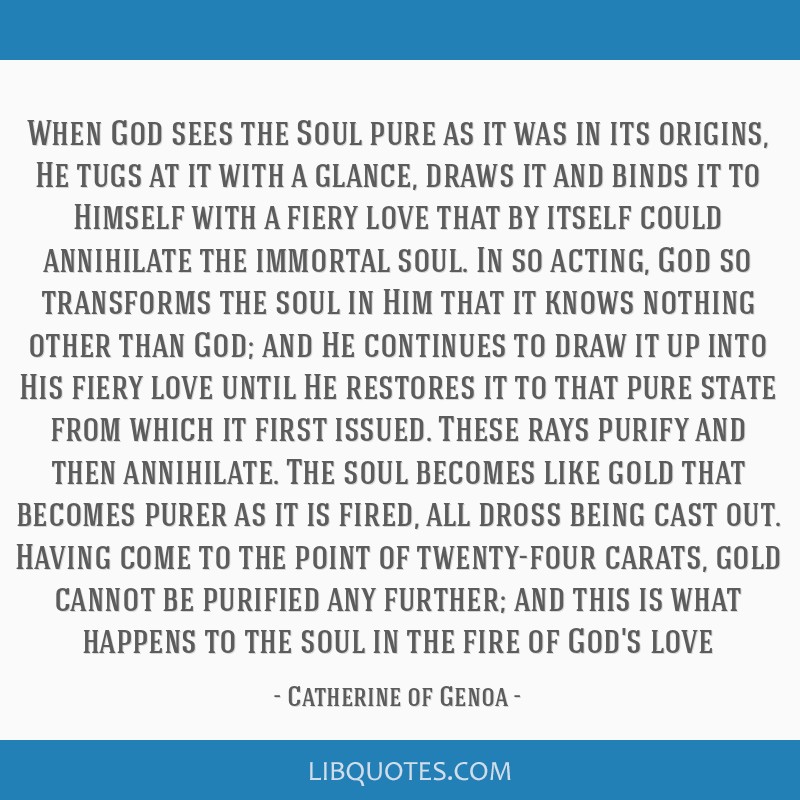
Catherine of Genoa
b. 1447 Genoa, Italy
d. 9.15.1510 Genoa, Italy
Catherine of Genoa was an Italian mystic and social worker in the Roman Catholic Church.
She wrote the Spiritual Dialogue and a Treatise on Purgatory. She is noted as an authority regarding the doctrine of purgatory.
She is remembered for her work among the sick and the poor. She served the sick during the plague which ravaged Genoa in 1497 and 1501.
She was a member of the noble Fieschi family. Her fame outside her native city is connected with the publication in 1551 of the book known in English as the Life and Doctrine of Saint Catherine of Genoa.
She and her teaching were the subject of Baron Friedrich von Hügel's classic work The Mystical Element of Religion (1908).
Genoa

The city of Genoa is located between the Apennine Mountains and the Ligurian Sea.
The Apennine are a mountain range of parallel smaller chains extending about 1,200 km (750 mi) along the length of peninsular Italy. They join with the Ligurian Alps at Altare in the northwest.
The Ligurian is part of the Mediterranean Sea between the Italian Riviera (Liguria) and the island of Corsica.
Genoa is the capital of the Italian region of Liguria. It is the sixth-largest city in Italy.
The port is located on the Gulf of Genoa in the Ligurian Sea. It has historically been one of the most important ports on the Mediterranean. it is currently the busiest in Italy.
It is the birthplace of Christopher Columbus, Niccolò Paganini and Grimaldo Canella, founder of the House of Grimaldi, among others.
The Bank of Saint George was founded in 1407. It is among the oldest in the world and has played an important role in the city's prosperity since the middle of the 15th century.
The port established itself as the merchant capital of the newly established Republic of Genoa in 1005 and maintaining its autonomy until 1797.
The capital struggled to rule itself. Many inner conflicts among the nobility weakened the Republic. The inability to rule itself caused the state to put themselves twice under French rule. Once was in 1391. It happened again in 1458.
The Black Death hit Genoa hard in 1348 and contributed to its decline.
Caterina Fieschi Adorno
Catherine's parents were Jacopo Fieschi and Francesca di Negro. Both were of noble Italian birth. Two popes, Innocent IV and Adrian V, had been of the Fieschi family. Jacopo himself became Viceroy of Naples.
The family were Guelphs. They were in the faction that supported the pope. The Ghibellines were for the Roman emperor
Catherine was the last of 5 children. She was born in 1447. She was described as an extraordinary child who was gifted in prayer and devotion to Christ. She wished to enter a convent when about 13.
Her sister, Limbania, was an Augustinian nun. The nuns to whom her confessor applied refused her on account of her youth. She put aside the idea without any further attempt.
Her father died when she was young. She was married to the young Genoese nobleman, Giuliano Adorno, at 16. Giuliano had returned to Genoa after several experiences in the area of trade and in the military world.
Their conjugal life was not easy. Her husband's character was worldly in affection for games of chance. They didn't produce children. She felt induced to lead a life that lacked serenity. She had a feeling of profound emptiness after 10 years of marriage. She prayed to remain sick in bed for 3 months.
She received a conversion experience as an answer. Catherine went to the church of St. Benedict and to the monastery of Our Lady of Graces for confession on March 20, 1473.
She wrote that she was wounded in heart by the knowledge of the life she had led and the goodness of God. She did not stay to finish her confession.
She went home and entered a remote room to weep and pray. She received the sense of the immense love of God. She had a vision of Jesus bent beneath the cross. She understood that he suffered so those who suffered pain from discrimination might feel loved.
She entered into a life of profound union by faith with constant prayer and the daily reception of Communion. It was unusual for laity to receive the sacrament so often.
She sought to be taught by God with the nourishment from prayer and the eucharist for 25 years. She did not become dependent upon the priest in confession. She did not become a monastic.
The place of her ascent to mystical peaks was Pammatone Hospital, the largest hospital complex in Genoa, of which she was director.
She lived an active existence despite the depth of her inner life. A group of followers, disciples and collaborators formed around her. They felt edified by her faith and charity. Her husband was won over as well. He became a Third Order Franciscan and moved into the hospital to help his wife.
The plague hit Genoa in 1493. It was reported that it killed up to 80% of the community. Her husband died in 1497.
She resigned her position as director, although she continued working full time until 1499, when her health began to fail. She finally accepted a priest as her spiritual guide during this time. He was her successor as the head of the hospital. He would later write her biography.
She wrote the Spiritual Dialog and Treatise on Purgatory in the 10 years before her death.
Purgatory was not a place located in the bowels of the earth for her. It was an inner fire for purification. It was a movement toward full communion in the kingdom of heaven.
She died in Genoa in 1510.
Elements of Religion
The elements of religion according to Hugel are mystical, intellectual and institutional. The three work to keep religion alive and relevant. Mysticism could never be the whole of religion.
It is personal in a primitive and monotheistic way insofar as it avoids the errors of superstition and hostility, but it holds the institutional and intellectual parts in question.
Catherine used her mysticism to support that which was right about the intellectual and institutional parts.
Hugel was engaged in theological discussions with a diverse group of scholars associated with the Modernist controversy at the start of the 20th century.
The modernists shared a belief that science had raised new questions for religious faith that undermined naïve suppositions that believers could rely purely on dogmatic authority as a source of truth.
His scholarly concerns included the relationship of Christianity to history, ecumenism, mysticism, the philosophy of religion and the rejection of much of the immanentism in nineteenth-century theology.
The anti-dogmatic position neglected to acknowledge the value that Trinitarian and Christological instruction held with respect for theology. This antagonism supported the liberal position in theology and political philosophy.
Catherine Fieschi
S. 凯瑟琳菲斯基
T. 凱瑟琳菲斯基
凯 Kai victory 凱 gai victory song Ka きゃ キャ Kae 캐 casserole
瑟 se harp 瑟 shitsu large koto sa さ サ seo 서 book
琳 lin jade 琳 rin jewel rin りん リン lin 린 Lynn
菲 Fei poor 菲 hi thin Fi ふぃ フィ Pi 피 blood
斯 si this 斯 shi this e え エ swi 쉬 wee
基 ji base 基 ki fundamentals su す ス
ki き キ
-----------------------------
Purgation includes expiation in relation to the divine
to find the way to the jade of the jewel with this mind of mine.
=================
wiki Catherine of Genoa
Franciscan Media: Catherine of Genoa
Lectionary: Catherine of Genoa
Commentary: Treatise on Purgatory
Papal Podcast: Catherine of Genoa
Benedict XVI: Text St. Catherine of Genoa
wiki The Mystical Element of Religion
wiki Genoa
New Advent Encyclopedia: Catherine of Genoa
wiki Guelphs and Ghibellines
Tolerance

David Stove
b. 9.15.1927 Moree, New South Wales, Australia
d. 6.2.1994 Mulgoa, New South Wales
David Charles Stove was an Australian philosopher who argued against socialism. He was for logical probability and rational induction in reason.
Stove criticized the irrationalism that infested the modern philosophy of science. The relativist and “social constructivist” views that were current in the sociology of science and postmodernist humanities departments depicted modern science as no better (or worse) than voodoo or astrology or reading chicken entrails. The view was made to look like the majority opinion.
Popper, Kuhn and Feyerabend were irrationalists in the philosophy of science. They denied that there was reason to believe in any theory of science. There has been no significant accumulation of relevant knowledge in recent centuries according to the position.
Stove came to be known for his opposition to socialism in college departments in Australia. The socialists made their demands the basis for making decisions for higher education. It ran contrary to the consideration of benefit in reasonable administration.
The argument against socialism seeks to reduce the detrimental affect of socialist analysis on administrative decisions, but argument against it is not enough. Socialism was a derivative of liberal politics. That means that there is another tier to be considered in the argument against non-representative judgment.
The reduction of consideration in the legitimate range of choice for representative policy in democratic society is the area of concern for political organization whether it is in republic or kingdom.
Liberals have been tolerant of socialism because the focus on the role of industrial organization on political leadership has placed their 'power' in government over industry, the middle class and the poor.
They have resorted to populist factionalism in media representation as though it were a representation of democracy. They don't promote representation. They attack it in conservative forms.
Professionalism as a product of education has suffered as a result. While Stove was critical of Popper and his error in science and economics, he wasn't critical enough of liberalism.
The aggressive error of liberalism has to be challenged for the benefit of conservative reform.
Moree, New South Wales

Moree is a town in northern New South Wales.
New South Wales is in the southeastern part of Australia. It sits on the banks of the May may River. The name comes from an Aboriginal word meaning "long springs."
The land is a plains region. It has been used for agriculture. The town is not heavily populated. The 2016 census numbers the population at about 7,400 people.
The first constable arrived and a police station was set up in 1865. The first church (Wesleyan) was built in 1867 when the town had a population of 43.
Agriculture emerged as a thriving industry on the fertile flood plains. Banking began in 1876 and the first local newspaper was set up in 1881. The population had grown to 295.
The Great Artesian Basin which sits under Moree was tapped in 1895. The basin yields over thirteen megalitres of water every day, but was proved unsuitable to provide enough water for the agriculture.
The railway line and service from Sydney arrived in 1897. Floods in the area caused numerous washouts of the railway in January 1910. An unknown number of livestock were drowned and at least four people drowned.
A flood cut the township in two in January 1946. Several hundred homes were flooded. The water damaged the power station and caused a black out. Roads and railway lines were damaged.
Moree railway station is situated on the Mungindi line, 665 kilometres (413 mi) from Sydney. It marks the northernmost point of passenger service on the line.
David Stove
David Stove was born in Moree, New South Wales on September 15, 1927.
His parents were Robert James Stove, schoolteacher, and his wife Ida Maude, née Hill. He was the fifth surviving child.
He went to Newcastle Boys’ High School where he excelled in running and was captain of the school track team.
He attended the University of Sydney (BA, 1950) and graduated with first-class honors in moral and political philosophy.
He was strongly influenced by the Challis professor of philosophy John Anderson.
Anderson founded the empirical brand of philosophy known as Australian realism. The central claim was that "whatever exists … is real". That which is real is spatial and temporal in a situation or occurrence that is on the same level of reality as anything else that exists.
Any object is a fact. Every fact is situated in a complex situation. There are no simple ideas, no atomic facts, no objects which cannot be, as it were, expanded into facts.
All situations exist independently of knowledge of them. All entities are caused. Ethics is concerned with establishing and describing that which is good. It is a positive science. It is not abstractly detached from reality.
Anderson's insistence on unceasing inquiry and criticism became central to the intellectual principles of the university's Libertarian Society. This group supplanted the Free Thought Society in the early 1950's. It provided a philosophic platform for the much broader subculture known as "the Push" throughout the 1960's.
The movement was against socialism, yet he was a defender of free speech. He was critical of the Australian government's bans on certain political publications (1928). People could talk about socialism, but concession to the demands of Marxist ideology was not to be granted.
Stove was appointed a teaching fellow at the University of Sydney in 1951. He became a lecturer in philosophy at the New South Wales University of Technology (later the University of New South Wales) in 1952.
He married Jessie Amelia Leahy, a biochemist on 4 November 1959 at the registrar general’s office. The next year he returned to the University of Sydney. He was promoted to senior lecturer in 1963 and associate professor in 1974. He would teach there until his retirement in 1987.
Stove was alarmed by the spread of radical left-wing ideas on campus in the early 1970's especially in his own department. He strongly resisted the introduction of courses in Marxism-Leninism and feminism with his colleague David Armstrong, the Challis professor of philosophy.
The subjects went ahead. The dispute resulted in a split in the department. Stove and Armstrong joined a new department of traditional and modern philosophy (colloquially ‘T & M’). Stove headed the department in 1981 and 1982. The left wing department was troubled by political schism. Stove felt that T & M was a perfect environment for serious work.
His work in philosophy mostly concerned the problem of induction. He argued that inference from the observed to the unobserved was justified for purely logical reasons in Probability and Hume’s Inductive Scepticism (1973) and The Rationality of Induction (1986).
There exists a probabilistic kind of logic which renders ‘The next swan is white’ probable, though not certain, on the evidence that all swans so far observed have been white.
His more polemical philosophical work included Popper and After: Four Modern Irrationalists (1982). The work accused leading philosophers of science such as Sir Karl Popper and Thomas Kuhn of undermining, rather than as they claimed, defending science.
Popper had concluded in his massive The Logic of Scientific Discovery (1934) that science could never establish truth. Stove compared the conclusion to the one that had been made by the fox in Aesop's fable.
The fox had decided that the grapes must be sour, because he could not reach them. Stove added that to make the comparison complete, the sly creature would have gone on to write a long book on the progress of viticulture.
He wrote 'A Farewill to Arts' in protest to the spread of postmodernist varieties of left wing thought in 1986. He described the Faculty of Arts at the University of Sydney as a disaster area.
This disaster was like an area that had been ravaged by flood, a badly leaking nuclear reactor or an outbreak of hoof and mouth disease in cattle. His complaint was that Marxism, semiotics and feminism were being used to favor the employment of women on the faculty.
His opinion was that logically probable deduction and simple induction were the path to truth. Common sense has to be applied in practical reason for realism to work.
He was witty and irreverent in expression, but principled in thought. He was pessimistic in that he found no consolation in religion or hope for political progress.
He found some comfort in classical music, old books and nature. He enjoyed planting trees at his rural property at Mulgoa. He also liked cricket and rugby league.
He was a heavy smoker. He contracted oesophageal cancer.
He committed suicide on 1 or 2 June 1994 at Mulgoa after a period of depression following severe treatment for the disease.
While his criticism of socialism was warranted, his conservatism was pessimistic. He did not admit to room for the stable management of reform.
-----------------------
David Stove
S. 大卫斯托夫
T. 大衛斯托夫
大 Da great 大 dai large De で デ De 데 place
卫 wei health 衛 ei defense bi びっ ビッ i 이 this
斯 Si this 斯 shi this Do ど ド bi 비 ratio
托 tuo support 托 taku requesting su す ス deu 드 de
夫 fu husband 夫 fu husband to と- ト- Seu 스 s
bu ぶ ブ to 토 sat
beu 브 bro
-----------------------
Socialism demands the defense of liberal expenditure
as though the competitor were the cause of the global rise in temperature.
=================
wiki David Stove
James Franklin: Sydney Philosophy Disturbance
Bio David Charles Stove


