9.5.19
Redeem
Time
兑换时间
Duìhuàn shíjiān
償還時間
Shōkan jikan
ps98
Tunc redeem
Heaven opens. Light descends.
Sight is given the right to see.
People are seen to dream as friends.
Each ascends or descends with the end to be free.
Angelic intelligence opens the mind to perceive.
Insight is given the right to breathe.
People conceive what they believe they can achieve.
Each seeks likeness in the presence above that which is beneath.
Love has redemptive power.
It transforms idiosyncrasy.
The power works by the hour
to make production a reality.
Dependence on fossil fuels
risks toxins and pollutants.
Gas from fuel burns to pop pistons
to turn rods in turbine for electricity in joules
and provides light to fight against violent disputants
and arrogant mules.
Medical care, business and transportation are powered.
Food is cooled or heated for storage or consumption.
Electricity powered the hours taken to destroy the World Trade Center towers.
Destruction was the consumption of function for the compunction of unction.
Cool air wards off death by heat exhaustion.
Heat prevents frozen cardiac arrest in the stressed chest.
Horse poop in the street lost a ton of tossing in the option.
Sewage treatment reduced epidemic disease the best.
We are insignificantly significant.
Our unremarkable star is remarkably magnificent
in infinitely emitting energy for those who are innocent.
Our magnificence is a typical galaxy event.
Marvelous things have been done for us.
Medicine treats illness until we find something better.
Victory with love makes our trust most august.
Justice must keep this thrust to meet morality's weather.
Good diet and exercise improve health in competition.
Health makes music with joy in the sight of all the nations.
The omission of cognition is not good for volition.
The relation of ideation is the foundation for sensation's elation
in education.
Lift up your voice. Rejoice and sing with elation.
Instruments make notes for the revelation of sensation.
The pluck or stroke of the string for the resonant ring is born.
The pumped force through the chambered conic adorns the sound of air as horn.
Each color that passion wore
made sadness or joy the thing to bring.
Let the hills ring with happiness galore.
Let the rivers speak sadly of tragic things.
Let the alleys flatly express the cubic savvy and straightness of the less
than Stonehenge meant astronomical bent in the strategy for family gravity.
Let the world be judged for rightness
with the measure of equity's levity without depravity.
The less mess that the light does bless
will result in the most ecstatic content with consent.
Be brave for love. Be kind to others.
It will make you a better father, mother,
sister, brother or other.
The bract fall softly
by the gutter on the eaves.
My mind sits tired, awfully alone even for me.
My image is caressed on the surface of the water under trees.
I can hear the sound of voice stir uncertainty
as my mother and father whisper urgently
after the spring shower had fed the intent pleas
of the gentle leaves that stirred emergently
in the post rain breeze.
The novel was an instrument of victory
insofar as it predicted history.
The argument contained therein
promoted knowledge of evolution as the way to win.
Socialism demanded order by government control.
It was the forum for degenerates and trolls.
Knowledge of evolution in political form
shows a solution to the criminal norm.
The tall tree stands strong with the ability to sway.
The wind gives the osprey a place to stay.
He cries crassly as the officer who arrests the day.
The heron's trail walks down the beach
like a broken comb sifting with sight and beak
through wet sand for a peek of a slug as succulent as a peach.
The bikini clad chica walks slowly in the sand.
She takes a moment to block the sun with the palm of her hand.
The sun threatens to take her heart like an offering for the land.
Her blood flows firmly to deny the sacrifice as damned.
The crow marches by the river
as the marshal whose parade the march delivered.
The rowboat sent out shivers that shimmered
as a sign of the movement giver.
Unshaken visitors thrash the river banks for relief
as the water wrings itself clean of grief
through the dirty sponge of marshy disbelief
while another coat of color is mixed for the bandstand seats.
A fleet of Harleys rumble through the square.
Some ride single; some in pairs.
We have seen the postcards of panthers,
funny answers and babies dressed in pampers.
We know that Florida harbors bikini clad dancers.
Let winged fancy wander
through the thought spread beyond her.
Open wide the science conditioned door.
Imagination will dart out and upward soar.
Late summer bakes the rake to get ready for autumn
with the fall of leaves from the trees as the quantum
of solemn.
This is the law that has been delivered.
Love others as you saw love given from the Giver.
Both boats were filled with fish
in answer to the fisherman's wish.
In a flash of light the eye of Jesus saw
the location of the school in reality as law.
Blood is pumped by the heart and cleansed by the liver.
Nutrients are delivered as the body's embodied dinner.
Love is the substance that makes your heart grow quicker.
Stand tall. Be brave. Please deliver as a giver.
Be strong with the strength
that comes from the length
of power in the knowledge of God with breadth
that you may be prepared for trials with patience
while giving thanks to the Father of relations
who has enabled you to share the spacious
station in the inheritance of the gracious
love of life in the light of the nations.
Redemption is against the compunction
for unction, but unction has its function.
------------------------
Psalm 98
Cantate Domino
Sing Friend
1 Sing to the Lord a new song,
for he has done marvelous things.
2 With his right hand and his holy arm
has he won for himself the victory.
3 The Lord has made known his victory;
his righteousness has he openly shown in the sight of the nations.
4 He remembers his mercy and faithfulness to the house of Israel,
and all the ends of the earth have seen the victory of our God.
5 Shout with joy to the Lord, all you lands;
lift up your voice, rejoice, and sing.
6 Sing to the Lord with the harp,
with the harp and the voice of song.
7 With trumpets and the sound of the horn
shout with joy before the King, the Lord.
8 Let the sea make a noise and all that is in it,
the lands and those who dwell therein.
9 Let the rivers clap their hands,
and let the hills ring out with joy before the Lord,
when he comes to judge the earth.
10 In righteousness shall he judge the world
and the peoples with equity.
-----------------------
Colossians 1:11
May you be made strong with all the strength that comes from the glorious power in the knowledge of God that you may be prepared to endure everything with patience while joyfully giving thanks to the Father who has enabled you to share in the inheritance of the saints in the light.
-----------------------
Be strong with the strength
that comes from the length
of power in the knowledge of God with breadth
that you may be prepared for trials with patience
while giving thanks to the Father of creation
who has enabled you to share the spacious
station in the inheritance of the gracious
love of life in the light of the nations.
=================
Luke 5:6-10
When they had acted again as instructed, they caught so many fish that their nets were beginning to break. They signaled to their partners in the other boat to come and help them. They came and filled both boats. When Simon Peter saw it, he fell down at Jesus' knees, saying, 'Go away from me, Lord, for I am a sinful man!' He and all that were with him were amazed at the catch of fish that they had taken. So were James and John, sons of Zebedee, who were partners with Simon.
-----------------------
Both boats were filled with fish
in answer to the fisherman's wish.
A flash light in the eye of Jesus saw
the location in the school of reality as law.
=================
Genius
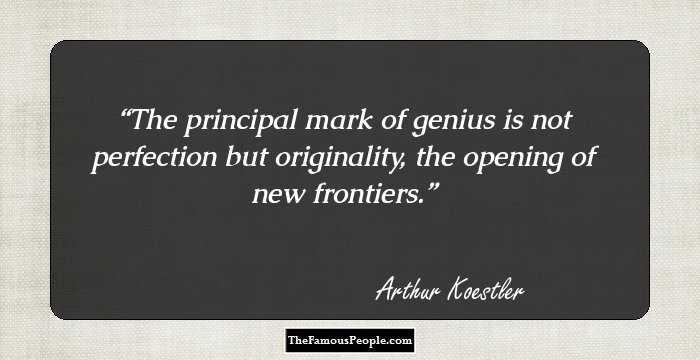
Arthur Koestler
b. 9.5.1905 Budapest, Austria-Hungary
d. 3.1.1983 London, England, United Kingdom
Arthur Koestler was a Hungarian British author and journalist. His novel Darkness at Noon was published in 1940. It was an anti-totalitarian work drawn from his experience of Stalinism in Germany. It gained him international fame.
He espoused many political causes from his residence in Britain over the next 43 years. He wrote novels, memoirs, biographies and numerous essays.
He was made a Commander of the Order of the British Empire (CBE) in 1972. The order rewards contributions to the arts and sciences, work with charitable and welfare organisations and public service outside the civil service in recognition of chivalry.
He maintained an anti-communist position throughout the rest of his career as a writer in both fiction and journalism. His political orientation was leftist despite this stance.
Budapest
Map
Budapest is strategically placed at the center of the Carpathian Basin in central Hungary. It lies on an ancient route linking the hills of Transdanubia with the Great Plain.
The Danube enters the city from the north. The river that separates the two parts of the city is 230 m (755 ft) wide at its narrowest point in Budapest. Pest lies on the flat terrain of the Great Plain while Buda is rather hilly.
The city's importance in terms of transportation is central. Many major European roads and European railway lines lead to Budapest. The Danube is still an important water-way. This region in the center of the Carpathian Basin lies at the cross-roads of trade routes.
"Buda" comes from the name of its founder a ccording to a legend recorded in chronicles from the Middle Ages. Bleda was brother to the Hun ruler Attila. Pest originates in the Slavic word for cave where fires burned for a limekiln.
Famous cultural institutions are the Hungarian National Museum, House of Terror, Franz Liszt Academy of Music, Hungarian State Opera House and National Széchényi Library.
Budapest is the capital and the most populous city of Hungary. It is the tenth-largest city in the European Union by population within city limits.
The 19th century was dominated by the Hungarian struggle for independence and modernization. The national insurrection against the Habsburgs began in the Hungarian capital in 1848. It was defeated one and a half years later with the help of the Russian Empire.
The year of Reconciliation that brought about the birth of Austria-Hungary was 1867. This made Budapest the twin capital of a dual monarchy. It was this compromise which opened the second great phase of development in the history of Budapest. The phase lasted until World War I.
The Chain Bridge linking Buda with Pest was opened as the first permanent bridge across the Danube in 1849. Buda and Pest were officially merged with the third part, Óbuda (Old Buda) in 1873. The new metropolis of Budapest was created.
The dynamic Pest grew into the country's administrative, political, economic, trade and cultural hub. Ethnic Hungarians overtook Germans in the second half of the 19th century due to mass migration from the overpopulated rural Transdanubia and Great Hungarian Plain.
The proportion of Hungarians increased from 35.6% to 85.9% between 1851 to 1910. Hungarian became the dominant language, and German was crowded out. The proportion of Jews peaked in 1900 with 23.6%.
Budapest was often called the "Jewish Mecca" or "Judapest" due to the prosperity and the large Jewish community of the city at the start of the 20th century. Austria-Hungary lost the war and collapsed in 1918. Hungary declared itself an independent republic (Republic of Hungary).
Arthur Koestler
Arthur was born in Budapest to Henrik and Adele Koestler. He was an only child. His father Henrik had been born on 18 August 1869 in the town of Miskolc in northeastern Hungary.
Arthur's mother, Adele (née Jeiteles), was born on 25 June 1871 into a prominent Jewish family in Prague. Adele's father, Jacob Jeiteles, moved the family to Vienna where she grew up in relative prosperity until about 1890.
Her father abandoned his wife and daughter when faced with financial difficulties and emigrated to the United States. Adele and her mother moved from Vienna to Budapest to stay with Adele's married sister.
Henrik Koestler met Adele in 1898 and married her in 1900. Arthur, their only child, was born on 5 September 1905.
The Koestlers lived in spacious, well-furnished, rented apartments in various predominantly Jewish districts of Budapest. They employed a cook/housekeeper as well as a foreign governess during Arthur's early years.
His primary school education started at an experimental private kindergarten founded by Laura Striker (née Polányi). Her daughter Eva Striker later became Koestler's lover. They remained friends all his life.
The outbreak of World War I in 1914 deprived Koestler's father of foreign suppliers. His business collapsed. The family faced destitution, so they moved temporarily to a boarding house in Vienna. When the war ended the family returned to Budapest.
Koestler and his family were sympathetic to the short-lived Hungarian Bolshevik Revolution of 1919. The small soap factory owned at the time by Koestler's father was nationalized. Henrik was appointed its director by the revolutionary government and was paid.
Even when Koestler had become an outspoken anti-Communist, he wrote favorably of the Hungarian Communists and their leader Béla Kun. He recalled fondly the hopes for a better future he had felt as a teenager in revolutionary Budapest.
The Koestler family witnessed the temporary occupation of Budapest by the Romanian Army and the White Terror under the right-wing regime of Admiral Horthy. The family returned to Vienna, where Henrik set up a successful new import business in 1920.
Arthur enrolled in the Vienna Polytechnic University to study engineering in September 1922. He joined a Zionist dueling student fraternity. He stopped attending lectures and was expelled for non-payment of fees when his father's latest business failed.
He wrote a letter to his parents in March 1926 telling them that he was going to Palestine for a year to work as an assistant engineer in a factory. He wanted to gain experience that would help him find a job in Austria.
He left Vienna for Palestine on 1 April 1926. He lived in a kibbutz for a few weeks, but his application to join the collective (Kvutzat Heftziba) was rejected by its members. He supported himself with menial jobs in Haifa, Tel Aviv and Jerusalem for the next 12 months.
He often depended on friends and acquaintances for survival because he was frequently starving and penniless.
He occasionally wrote or edited broadsheets and other publications mostly in German. He left Palestine briefly in the spring of 1927 to run the Secretariat of Ze'ev Jabotinsky's Revisionist Party in Berlin.
Jabotinsky was a Ukrainian Jew who had proposed that the purpose of settlement in the homeland was to establish a political state.
David ben Gurion and Chaim Weizmann had recommended the practical approach which focused on the independent individuals' settling of Eretz Yisrael as a culture in the Palestinian state. Revisionist Zionism was focused on gaining the aid of Britain as a major power for settlement.
Palestine had been established by British mandate to partition the Ottoman empire after WWI.
Koestler obtained the position of Middle East correspondent through a friend for the prestigious Berlin-based Ullstein-Verlag group of newspapers later in 1927.
He returned to Jerusalem where for the next two years he produced detailed political essays as well as some lighter journalism for his principal employer and for other newspapers.
He traveled extensively, interviewed heads of state, kings, presidents and prime ministers. His reputation as a journalist was greatly enhanced. He came to realize that he would never really fit in Palestine's Zionist Jewish community, the Yishuv. He would not be able to have a journalistic career in Hebrew.
Koestler successfully lobbied at Ullstein for a transfer away from Palestine while on leave in Berlin in June 1929. He was sent to Paris to fill a vacancy in the bureau of the Ullstein News Service in September.
He was called to Berlin in 1931. He was appointed science editor of the Vossische Zeitung, a liberal publication. He was also made science adviser to the Ullstein newspaper empire.
The same year he was Ullstein's choice to represent the paper on board the Graf Zeppelin's Polar flight. The zeppelin carried a team of scientists and the polar aviator Lincoln Ellsworth close to the North Pole and back.
Koestler was the only journalist on board. His live wireless reports were broadcast in Europe. Subsequent articles and lecture tours brought him further kudos. He was appointed foreign editor and assistant editor-in-chief of the mass-circulation Berliner Zeitung am Mittag soon afterwards.
Koestler became a supporter of Marxism-Leninism in 1931. He was encouraged by Eva Striker and impressed by what he believed to be the achievements of the Soviet Union. He applied for membership of the Communist Party of Germany on 31 December 1931.
He was disappointed by the conduct of the Vossische Zeitung, the"Flagship of German Liberalism." It had adapted to changing times by firing Jewish journalists, hiring writers with marked German Nationalist views and dropping its longstanding campaign against capital punishment.
This led Koestler to the conclusion that Liberals and moderate Democrats could not stand against the rising Nazi tide. The Communists were the only real counter-force.
Koestler wrote a book on the Soviet Five-Year Plan. It did not meet with the approval of the Soviet authorities and was never published in Russian. A heavily censored German edition for German speaking Soviets was published.
He traveled to Turkmenistan and Central Asia in 1932. He returned to Paris in September 1933. He was active in the anti-Fascist movement of the Comintern for the next two years. The Comintern was an international communist organization. Koestler wrote propaganda under the direction of Willi Münzenberg.
He married Dorothy Ascher, a fellow Communist activist, in 1935. They separated amicably in 1937.
He visited General Francisco Franco in Seville during the Spanish Civil War in 1936. He pretended to be a Franco sympathizer. He used credentials from the London daily News Chronicle as cover.
He collected evidence of the direct involvement of Fascist Italy and Nazi Germany on Franco's side.
The Nationalist rebels were trying to conceal the support. He had to escape after he was recognized and denounced as a Communist by a German former colleague.
He wrote L'Espagne Ensanglantée (Bloody Spain) when he returned to France. This was later incorporated into his book Spanish Testament.
He returned to Loyalist Spain as a war correspondent for the News Chronicle in 1937. He was in Málaga when it fell to Mussolini's troops. The Italian Fascists were fighting on the side of the Spanish Nationalists.
He took refuge in the house of retired zoologist Sir Peter Chalmers Mitchell. They were both arrested by Franco's chief propagandist, Luis Bolín. Bolin had sworn that if he ever laid his hands on Koestler he would "shoot him like a dog".
He was imprisoned in Seville under sentence of death from February until June. He was eventually exchanged for a "high value" Nationalist prisoner held by the Loyalists, the wife of one of Franco's ace fighter pilots.
He became one of the few authors to have been sentenced to death. He wrote about the experience in Dialogue with Death.
His separated wife Dorothy Ascher had contributed to saving his life by months-long lobbying in Britain. They tried to resume their marriage when he arrived in Britain after his release. His gratitude to her proved insufficient for a daily life together.
He agreed to write a sex encyclopedia to support himself when he returned to France. It was published with the title The Encyclopœdia of Sexual Knowledge under the pseudonyms of "Drs A. Costler, A. Willy, and Others".
He finished work on his novel The Gladiators in July 1938. He became editor of Die Zukunft (The Future), a German-language weekly published in Paris in the same year.
He resigned from the Communist Party and started work on a new novel.
He was arrested as a spy. He endured three months in solitary. He combined his prison experience after his release in 1940 with his revulsion at the Moscow shows trials of Bukharin and the old Bolsheviks in Darkness at Noon.
Nicholas Rubashov was the vehicle for an abstract novel about crime, guilt and man's fate.
George Orwell would later praise the book as an example of prison literature. It tapped into the French literary criticism of cruelty in punishment in republican government. The mistreatment of the prisoners was depicted as motivation to escape the cruelty.
The Soviet Union is never mentioned explicitly. Readers took it as a polemical repudiation of Stalinism as with Orwell's Animal Farm.
Koestler was assigned to the Ministry of Information where he worked as a scriptwriter for propaganda broadcasts and films in March 1942. He continued to write in his spare time.
The international success of Darkness at Noon propelled Koestler into a literary and intellectual milieu for whom his writing became a touchstone for postwar culture.
Then, more than now, he was "indispensable". He appeared on progressive platforms to champion anything and everything from "cultural freedom" to the abolition of capital punishment.
Later travels to America and France became a rolling bacchanal of binge drinking, fashionable restaurants and sex with a dizzying array of star-struck young women.
When Koestler visited France in 1946, he was a celebrity in Paris. He was a rival to the film star glamour of Albert Camus. The reality of his relations with the intellectuals was bitter, drunken and maudlin.
He clicked with Camus, threw a wine glass at Sartre and ended up in bed with de Beauvoir. The authors of The Second Sex and Darkness at Noon saw at least one dawn that broke over liberated Paris with both sobbing into the Seine at "the tragedy of the human condition".
He traveled to Palestine with accreditation from The Times in December 1944. There he had a clandestine meeting with Menachem Begin, the head of the Irgun paramilitary organisation.
Begin was wanted by the British. He had a 500-pound bounty on his head. Koestler tried to persuade him to abandon militant attacks and accept a two-state solution for Palestine, but failed.
When he returned to England Mamaine Paget, whom he had started to see before going out to Palestine, was waiting for him. The couple moved to a cottage in Wales in August 1945.
He became a friend to George Orwell and joined the intellectual circle in the area. Bertrand Russell lived only a few miles from the Koestler home.
The state of Israel was less than a month old when the Manchester Guardian launched a series of articles by Koestler. The country had declared independence on 14 May 1948.
When war broke out between the newly declared state of Israel and the neighboring Arab states, Koestler was accredited by several newspapers. They were American, British and French. He traveled to Israel. Mamaine Paget went with him.
He arrived to an Israel that was considerably different from the regional powerhouse it is today. Israel’s untested leaders were gathering Jewish militant factions into one army and forming a nation of disparate Jews from across Europe and the Middle East.
The territory had been under the British Mandate for Palestine for close to three decades. The United Nations proposed in 1947 to split the area into two to form independent Arab and Jewish states. Civil war erupted. Jewish leaders later announced Israel’s creation.
The country was so young that the Israeli visas stamped on Koestler’s and his partner’s passports in Paris were numbered five and six. He found airport signs freshly painted in English and Hebrew on arrival. Immigration and customs officers had not yet received uniforms.
Israel had no clearly accepted borders but was hastily forming a government. The state was in the midst of a conflict with Arab Palestinians coupled with the invasion by surrounding states.
He wrote, “Here is bureaucracy in a state of virginal innocence before it has had time to spin itself into a cocoon of red tape” in his first article titled “Israel: First Impressions”.
Arthur and Mamaine arrived in Israel on 4 June and stayed there until October.
They decided to leave the UK for a while to live in France later that year. News that his long-pending application for British nationality had been granted reached him in late December. He returned to London to swear the oath of allegiance to the British Crown early in 1949.
Koestler had reached agreement with his first wife, Dorothy, on an amicable divorce. Their marriage was dissolved on 15 December 1949. This cleared the way for his marriage to Mamaine Paget on 15 April 1950 at the British Consulate in Paris.
He lobbied for permanent resident status in the U.S. in autumn. He bought a farm on a small island on the Delaware River near New Hope, Pennsylvania. A dramatized version of Darkness at Noon by Sidney Kingsley opened in New York in January 1951.
Koestler sent tickets for the play to his House sponsor Richard Nixon and his Senate sponsor Owen Brewster, a close confidant of Joseph McCarthy.
His marriage to Mamaine collapsed in August 1952. They separated, but remained close until her sudden and unexpected death in June 1954.
He decided to make his permanent home in Britain. He bought a three-storey Georgian town house on Montpelier Square in London in May 1953. He sold his houses in France and the United States.
Koestler interrupted his journey on his way back from a conference in San Francisco at the University of Michigan, Ann Arbor in early 1960. Some experimental research was going on with hallucinogens.
He tried psilocybin and had a "bad trip". Later, when he arrived at Harvard to see Timothy Leary, he experimented with more drugs. He was not enthusiastic about that experience either.
He undertook a lecture tour of various universities in California in November 1964. He married Cynthia Jefferies in New York in 1965. They moved to California where he participated in a series of seminars at the Center for Advanced Study in the Behavioral Sciences at Stanford.
He spent most of 1966 and the early months of 1967 working on The Ghost in the Machine. The title is a phrase coined by Oxford philosopher Gilbert Ryle to describe the Cartesian dualist account of the mind–body relationship. Koestler shares with Ryle the view that the mind of a person is not an independent non-material entity that temporarily inhabits the body to govern it.
Holarchy was developed from the concept of what Koestler called a holon. Everything in the nature of some thing is both a whole and a part. Atoms are whole in themselves, but also a part of a molecule. The brain as a holon has evolved from primitive mechanisms that are retained. This accounts for emotional distress and the violent inclinations that affect the ghost in the machine.
This premise is expressed as the basis to explain an otherwise accidental set of relations that occurs at the house of the central character, a serial murderer who goes by the name of Karl Hochman. His consciousness was set free from his body after his death to go on another killing spree.
The Ghost in the Shell movie based on the Japanese Manga is related insofar as the consciousness of a person is electronically transferred to the robotic shell of an android. The android experiences cognitive dissonance until she rediscovers the identity of her previous body as the shell for her person.
Koestler was diagnosed with Parkinson's disease early in 1976. He and Cynthia killed themselves on the evening of 1 March 1983 in an act of voluntary euthanasia. His suicide note stated that he also had a slow-killing variety of leukemia. Controversy arose over why Koestler allowed, consented to or compelled his wife's simultaneous suicide.
-----------------------
Koestler started to write Darkness at Noon before the Second World War. His experience as a communist writer preceded the change in his political position. His argument against totalitarianism was against socialism in any form. Both communism and fascism were discredited.
Socialism is not a functional economic position. Koestler had seen his father attempt to maintain a business during socialist swings in political favor. He had tried to find employment as an engineer with the better part of an undergraduate degree in education at a technical college. He sought employment in a political climate that entertained the battle between communism and fascism.
The argument against socialism is better than the one that is for it, but Koestler's activism amounted to an effort to make parliament liberal instead of socialist. His non-religious stand was not as offensive against the right to freedom of religion as anti-religious aggression, but it still didn't qualify as an improvement for representative constitutional government.
He had tried to join forces with the political organization for communism. The authority of the economic view was self-destructive. He became disillusioned. Successful business built its reputation by providing a service that people could afford yet would cover the costs of production to make a profit. Success in this was not as easy as the Marxist analysis would have the general population believe.
The philosophy for revolution established by Hegel had established dismissive rhetorical reduction that discarded the explanation of any functional concern to favor the power of overthrowing reason in political leadership.
Marx and Engels added labor as the primary demographic factor that was to be elevated over organization for the means of production in the government control of people. Professionalism from education was also to be subordinated to the official use of the "proletariat" to destroy success generated by capitalism.
The dynamics of revolutionary mechanics were such that the leadership was testing to see if they could get the public to believe that what they defined as unacceptable had to be replaced by something worse. It was dependent upon propaganda to accomplish that end.
The argument against socialism is significant in terms of the evolution of republic as a form of government. J. Edgar Hoover had formed his argument against communism as a form of sedition. His investigation was organized to catalog indexed references to red flags with respect for association with communism.
If Marx had just documented criticism against capitalism as critical analysis, his economic theory could have passed as an objective theory. His prediction that the capitalist system would have to be overthrown by a proletariat revolution made it a seditious doctrine against conservative measure in government.
Communism was also characterized by a pronounced anti-religious policy. Science in this kind of a culture wasn't as concerned with knowledge as it was with anti-religious policy supported by the rhetoric for the same.
Fascism was oriented toward industrial civilization like communism, but it was populist with respect for political organization. Religion was tolerated as a tool for the state.
They didn't need someone who was an educated professional in law or economics. A general (Franco), a former corporal who learned public speaking in beer halls (Hitler) or a self-taught political journalist (Mussolini) sufficed. The basic idea was to organize military force in order to win the battle with the communists.
Those who didn't pick communism or fascism were viewed as part of the problem. The middle class fell into this group. They weren't regarded as strong enough to make an impact on the world with government.
Ronald Reagan reintroduced the argument against socialism during his political career. He had gotten his degree in economics. His career in entertainment included participation in the leadership of political organization. He used his supply side economics to counter the leftist legacy established by FDR and perpetuated by Kennedy, Clinton and Obama.
Donald Trump was educated in economics at a business school. He extended his influence into mass media entertainment with reality based shows. His argument against socialism was presented in the context of his "Make America Great Again" platform.
His participation in the Republican debates helped to produce a policy to reform national security. He proposed that the country build a wall between Mexico and the US as an essential component of immigration reform. He ordered that Muslims from countries designated as hostile to the US be barred from entry.
It was much less punitive than rounding up the Japanese for internment during WWII as FDR had done. Americans of German and Italian heritage were categorized as potential criminals or communists.
Trump's position for Israel was even an improvement on that which was presented by Koestler.
Israel was left to build a republic with support from those who were sympathetic to the re-establishment of a state as the Jewish homeland.
It was redemption for republic as the form of government that had originally destroyed the capital of the kingdom and had the Jews dispersed to other locations to perpetuate the expansion of the Roman empire.
Koestler was critical of the Israeli republic when he described it as a dictatorship. Reports about democracy in republic have been characterized by prejudice against executive authority.
Even though populist inclinations have been more destructive towards representation of social or economic benefit for the people, the idea of inherited leadership in monarchy was regarded as unearned.
Elected leadership wasn't as bad because they had to campaign for election, but those who didn't speak like populists or socialists have been depicted as criminals due to the association with capitalism.
Koestler reported that the government was a dictatorship. It wouldn't allow citizens to own guns. It worked to establish elected leadership without term limits. Reports of government strategy favored brutally repressive accounts of action.
The violence wasn't as overstated as it had been with the French or Russian revolutions, but the reports didn't want to give terrorists the impression that the republic would tolerate violent attacks against citizens.
The French and the Russians were working to put down any threat of counter-revolution as soon as they were established. Israel was working to establish a government in a territory from which they had been banned since 70 CE. It was 1,875 years to the end of WWII.
President Trump expressed his approval to move the capital of the republic from Tel Aviv to Jerusalem in 2018.
-------------------------
Arthur Koestler
S. 亚瑟·凯斯特勒
T. 亞瑟·凱斯特勒
亚 Ya Asian 亞 a rank A あ- ア- A 아 ah
瑟 se instrument 瑟 shitsu koto sa さ- サ- seo 서 book
凯 Kai victory 凱 gai victory song Ke け ケ Ko 코 nose
斯 si this 斯 shi this su す ス e 에 on
特 te unique 特 toku special to と ト seul 슬 slender
勒 lei to compel 勒 roku halter ra ら- ラ- leo 러 naughty
-------------------------
The novel was an instrument of victory
insofar as it predicted history.
The argument contained therein
promoted knowledge of evolution as the way to win.
Socialism demanded order by government control.
It was the forum for degenerates and trolls.
Knowledge of evolution in political form
shows a solution to the criminal norm.
===================
wiki Arthur Koestler
Guardian: Israel
Guardian: Writer
Comey's Conduct
Giuliani and Ingraham
It was no small thing when Giuliani said that Comey's conduct was criminal.
Comey was the director of the FBI from 2013 to 2017. He was preceded by Mueller who was the director from 2001 until 2013.
Mueller was then appointed to act as the special counsel from 2017-2019. Both Comey and Mueller were registered as Republicans, but they were working for liberals.
Coercive attacks against the American public started with Sandusky in 1999 at the end of the Clinton administration.
Representatives for cooperative leadership from minority groups were targeted with accusations of sexual assault. Hollywood starlets were included with implications of substance abuse to test for public reaction.
Bill Cosby, Harvey Weinstein and Donald Trump were included among those who were accused of sexual misconduct. There was a build against those who were less competitive for societal leadership toward one who became the chief competitor for the executive office for the US.
This campaign of coercion wasn't just personal. It wasn't just partisan. It was part of the liberal mechanism to turn the public against those accused of misconduct by accusers whose accusations were testimonials against success in 'capitalist' society.
The media role on the import of personal testimony in the trial of the charge of criminal misconduct was being played for the benefit of liberal political policy as defined against the character of the representatives of conservative policy.
The fake news promoted by the liberal media has been instrumental in the promotion of dissent from the discontent for the institution of socialism as the economic force in the determination of political leadership.
If you count the number of people who were imprisoned or had their names destroyed by media expression, you'll find it easy to agree that the conduct that instituted the coercion was criminal.
This policy has had a negative impact on public policy in general and administrative decisions in the school system.
While No Child Left Behind had certain high stake issues that could have been used to close 'low performance' schools down, it had incentive as the core principle for judgment.
Race to the Top removed incentive and replaced it with punishment. Now that the national government influence is being reduced, the punitive policy has managed to retain its standing.
Students who are working on their assignments are denied hall passes for anything in what can only be defined as an effort to flush those dedicated to cooperative leadership into a place designated for punishment.
It's not like they would allow the 'illegals' as potential criminals to be suspended or expelled for misconduct that disrupted the course of instruction for other students. It was the student who had the potential to work for a better society that would get carted off to jail.
The replacement of incentive with punishment is a socialist mechanism. It is not good for society. It prevents achievement from reaching out to different social groups in American culture.
Showing posts with label mind. Show all posts
Wednesday, September 4, 2019
Friday, May 24, 2019
Draw
5.25.19
Draw
Dawn
画出黎明
Huà chū límíng
夜明けを描く
Yoake o kaku
ps.19
Draw dawn
without flaw
for awe.
The heavens declare the beauty of divine majesty.
Benign design is the work of the Creator's reality.
Sweet daughter
by the altered altars
that nature offers
you know you oughta
dance like the otter
plays in water.
Dance daughter
for your offers
from alien paupers
without flying saucers.
.
You will be loved
because you are a loving dove.
The story for glory
grows glory for the story
with the warning that violence
is not the catalyst for change or silence.
Cruelty creates atavism for pain
and disdain.
We have been brought out of the house of misery.
We have been delivered from the bitterness of injury.
The helpful priest brought the law before the assembled body.
He read for their hearing that they might understand the godly.
All were washed as one body by the Spirit.
Divine presence was invoked to draw near it.
The Word went out so people could hear it.
It was proclaimed in the assembly to embody the spirit.
The beach was a good place to find seashells.
It was a break from work in between bells.
Love is the votive motive
for motoring in a better locomotive.
L’amour is the automotive lotus.
Society needs signs.
Individuality seeks wisdom for mind.
My mind perceives an object of knowledge as thought.
Sensible quality is recognized by another thinker's reasoned lot.
Knowledge of the structure of the world and the activity of elements;
the alterations in solstice and equinox for change in seasonal relevance;
the nature of animals and temper of wildness in beasts;
the power of the spirit and thought in human beats;
the varieties of plant and the virtue of roots for subsistence;
produce wisdom about the nature of existence.
The beginning, middle and end of time
establish relevance for the relativity of the objective mind.
I learned how the hidden is revealed as manifest
by instruction from the wisdom of using statements to test.
Controlled experiment helps to rule out false presumption.
Mathematical measure in variant quality produces formulation about function.
Knowledge is for wisdom in the management of material resources.
Wisdom is the spirit of intelligence in discourse with power as the source.
The scribe of history who has been trained for the kingdom of heavenly essence
is like the author of explanation in variant relations for the real presence.
The cross celebrates crucifixion
as the cement for the conviction
that pain is the friction
that precedes the reconciliation
of conflict in resurrection.
The crucifixion of that which is false about belief
is part of education with redemption for the relief of grief.
Faith looks past the impossible
to possibility.
The promise of the promisable
is seen
as believed with maturity
for fertility in civility.
Creativity in the present
presence presses forward with intent
into the future until it has passed
into the past as it has been cast
for reverie
or review
by memory
as true.
Love is true.
Love is you.
Reason and beauty close the day.
Another day is on the way.
-----------------------
19 Cœli enarrant
Heaven declares
1 The heavens declare the glory of God,
and the firmament shows his handiwork.
2 One day tells its tale to another,
and one night imparts knowledge to another.
3 Although they have no words or language,
and their voices are not heard,
4 Their sound has gone out into all lands,
and their message to the ends of the world.
5 In the deep has he set a pavilion for the sun;
it comes forth like a bridegroom out of his chamber;
it rejoices like a champion to run its course.
6 It goes forth from the uttermost edge of the heavens
and runs about to the end of it again;
nothing is hidden from its burning heat.
7 The law of the Lord is perfect
and revives the soul;
the testimony of the Lord is sure
and gives wisdom to the innocent.
8 The statutes of the Lord are just
and rejoice the heart;
the commandment of the Lord is clear
and gives light to the eyes.
9 The fear of the Lord is clean
and endures for ever;
the judgments of the Lord are true
and righteous altogether.
10 More to be desired are they than gold,
more than much fine gold,
sweeter far than honey,
than honey in the comb.
11 By them also is your servant enlightened,
and in keeping them there is great reward.
12 Who can tell how often he offends?
cleanse me from my secret faults.
13 Above all, keep your servant from presumptuous sins;
let them not get dominion over me;
then shall I be whole and sound,
and innocent of a great offense.
14 Let the words of my mouth and the meditation of my heart be acceptable in your sight,
O Lord, my strength and my redeemer.
-----------------------------
Wisdom 7:17-22
God gave me knowledge of what exists
to know the structure of the world and the activity of the elements;
the beginning, end and middle of times:
the alteration of the solstices and the changes in season;
the nature of animals and temper of wild beasts;
the power of spirit and the thoughts of human being;
the varieties of plant and the virtue of roots.
I learned what is secret and what is manifest
for wisdom, the fashioner of all things, taught me.
There is in her a spirit that is intelligent, holy,
unique, manifold, subtle, mobile, clear, unpolluted,
distinct, invulnerable, loving the good, keen and irresistible.
--------------------------
Knowledge of the structure of the world and the activity of elements;
the alterations in solstice and equinox for change in seasonal relevance;
the nature of animals and temper of wildness in beasts;
the power of the spirit and thought in human beats;
the varieties of plant and the virtue of roots for subsistence;
produce wisdom about the nature of existence.
The beginning, middle and end of time
establish relevance for the relativity of the objective mind.
I learned how the hidden is revealed as manifest
by instruction from the wisdom of using statements to test.
Controlled experiment helps to rule out false presumption.
Mathematical measure in variant quality produces formulation about function.
Knowledge is for wisdom in the management of material resource.
Wisdom is the spirit of intelligence in discourse with power as the source.
===============
Matt. 13:52
He said to them, 'Every scribe who has been trained for the kingdom of heaven is like the master of a household who brings out of his treasure what is new and what is old.'
--------------------------
The scribe of history who has been trained for the kingdom of heavenly essence
is like the author of explanation in variant relations for the real presence.
===============
Discipline with Joy
Bede (bead)
c. 673, Jarrow, Northumbria
d. 26 May 735, Jarrow, Northumbria
Bede is regarded as the greatest Anglo-Saxon scholar and the father of English history.
He was an English Benedictine monk at the monastery of St. Peter and its companion monastery of St. Paul in the Kingdom of Northumbria of the Angles.
He is well known as an author, teacher and scholar. His most famous work, Ecclesiastical History of the English People, gained him the title "The Father of English History".
His ecumenical work was extensive. The writing included a number of Biblical commentaries and other theological works of exegetical erudition.
Another important area of study for Bede was the academic discipline of computus. This was otherwise known to his contemporaries as the science of calculating calendar dates.
He established the practice of dating forward from the birth of Christ (Anno Domini – in the year of our Lord). The practice eventually became commonplace in medieval Europe.
Bede was one of the greatest teachers and writers of the Early Middle Ages. He is considered by many historians to be the single most important scholar of antiquity for the period between the death of Pope Gregory I in 604 and the coronation of Charlemagne in 800.
He was a skilled linguist and translator. His work made the Latin and Greek writings of the early Church Fathers accessible to his fellow Anglo-Saxons.
Jarrow
Jarrow is a town in northeast England. It is located on the RiverTyne.
The river is formed by the confluence of the North and the South Tyne. The northern part has its source close to the Scottish border near the village of Kielder. It is 118 km (73 miles) in length.
The South Tyne rises in the hills of Alston Moor in Cumbria. The river empties into the North Sea not far from Jarrow. The town is only 7.25 km (4.5 miles) from the sea.
St. Peter's Tower
The monastery of Saint Paul was located in Jarrow in the 8th century. It is now called the Monkwearmouth–Jarrow Abbey. The abbey was a Benedictine double monastery in the Kingdom of Northumbria, England.
A double monastery is a separate community of monks joined together with one of nuns in a single institution. They were more common in the monasticism of Eastern Christianity. The institution was started in the 4th century. This kind of monastery was established in Anglo-Saxon England, Scotland, Ireland and Gaul.
Monks and nuns lived in separate buildings but were usually united under an Abbess as head of the entire household. They would have chanted the Liturgy of the Hours and attended Mass together in the Chapel. Either an abbess or an abbot would normally have control over both houses. It was only in exceptional circumstances that each would have its own superior.
Jarrow became a center of learning along with the abbey at Wearmouth. It had the largest library north of the Alps due to the widespread travels of Benedict Biscop, its founder. Bede helped to build the library with his extensive written work. The library contributed significantly to the growth of English Christianity.
Bede
Bede gave his birthplace as "on the lands of this monastery". He is referring to the twinned monasteries of Monkwearmouth and Jarrow.
Bede's first abbot was Benedict Biscop. The names "Biscop" and "Beda" both appear in a king list of the kings of Lindsey from around 800. The listing of his name with kings suggests that he came from a noble family.
Bede's name reflects West Saxon Bīeda. It is an Anglo-Saxon short name formed on the root of bēodan "to bid, command". The name also occurs in the Anglo-Saxon Chronicle, s.a. 501, as Bieda, one of the sons of the Saxon founder of Portsmouth.
The Liber Vitae of Durham Cathedral names two priests with this name, one of whom is presumably Bede himself. Some manuscripts of the Life of Cuthbert, one of Bede's works, mention that Cuthbert's own priest was named Bede. It is possible that this priest is the other name listed in the Liber Vitae.
He was sent as a puer oblatus at the age of 7 to the monastery of Monkwearmouth by his family to be educated by Benedict Biscop and later by Ceolfrith. An oblate is in the status where he is considering whether of not to be tonsured as a monk. His hair was cut in a special way after he agreed to take vows for life.
It was fairly common in Ireland at this time for young boys, particularly those of noble birth, to be fostered out as an oblate. The practice was also likely to have been common among the Germanic people in England.
Monkwearmouth's sister monastery at Jarrow was founded by Ceolfrith in 682. Bede probably transferred to Jarrow with Ceolfrith that year.
The dedication stone for the church has survived to the present day. It is dated 23 April 685. The young monk would have been required to assist with menial tasks in his day-to-day life. It is possible that he helped in building the original church.
Plague broke out at Jarrow in 686. The Life of Ceolfrith (710) records that only two surviving monks were capable of singing the full offices. One was Ceolfrith. The other was a young boy.
The boy had been taught by Ceolfrith according to the anonymous writer. The two managed to do the entire service of the liturgy until others could be trained. The young boy was almost certainly Bede. He would have been about 14.
When he was about 17 years old, Adomnán, the abbot of Iona Abbey, visited Monkwearmouth and Jarrow. Bede would probably have met the abbot during this visit. It may be that Adomnan sparked Bede's interest in the Easter dating controversy.
Bede was ordained a deacon in about 692 when he was 19 by his diocesan bishop. John was bishop of Hexham.
The canonical age for the ordination of a deacon was 25. His early ordination may mean that his abilities were considered exceptional. It is also possible that the minimum age requirement was often disregarded.
There might have been minor orders ranking below a deacon; but there is no record of whether he held any of these offices. He was ordained a priest in about 702 when he was 30 with the ordination again performed by Bishop John.
He said of himself: "I have devoted my energies to a study of the Scriptures, observing monastic discipline, and singing the daily services in church; study, teaching, and writing have always been my delight."
He was the first person to write scholarly works in the English language. Only fragments of his English writings have survived. He wrote extensively in Latin. He wrote commentaries on the Pentateuch and other portions of Holy Scripture.
His best-known work is his History of the English Church and People. This is a classic which has frequently been translated. It gives a history of Britain up to 729.
It recorded how the Celtic people were converted to Christianity during the first three centuries of the Christian era. The invasion of the Anglo-Saxon pagans took place in the 5th and 6th centuries. The Anglo-Saxons were subsequently converted by Celtic missionaries from the north and west and Roman missionaries from the south and east.
His work is our chief source for the history of the British Isles during this period. He cited the sources for his information. He also wrote hymns, other verse, the first martyrology with historical notes, letters, homilies, works on grammar, chronology and astronomy. He was aware that the earth is a sphere.
He was the first historian to date events ANNO DOMINI. He was the earliest known writer to state that the solar year is not exactly 365 and a quarter days long. Even the Gregorian calendar (one leap year every four years) requires some adjusting if the months are not to get out of step with the seasons.
He translated the Gospel of John into Old English, completing the work on the very day of his death.
Bede (bead)
S. 贝德
T. 貝德
贝 Bei sea shell 貝 bai shellfish Be べ ベ Be 베 the
德 de goodness 德 toku virtue de で デ de 데 place
--------------------------
The beach was a good place to find seashells.
It was a break from work in the cell between bells.
===============
Wiki Bede bio
Lectionary Bede
Wiki Jarrow
George Berkeley
Principles of Human Knowledge
1710
Text
"1. OBJECTS OF HUMAN KNOWLEDGE.--It is evident to any one who takes a survey of the objects of human knowledge, that they are either IDEAS actually imprinted on the senses; or else such as are perceived by attending to the passions and operations of the mind; or lastly, ideas formed by help of memory and imagination--either compounding, dividing, or barely representing those originally perceived in the aforesaid ways...
"2. MIND--SPIRIT--SOUL.--But, besides all that endless variety of ideas or objects of knowledge, there is likewise something which knows or perceives them, and exercises divers operations, as willing, imagining, remembering, about them. This perceiving, active being is what I call MIND, SPIRIT, SOUL, or MYSELF. By which words I do not denote any one of my ideas, but a thing entirely distinct from them, WHEREIN THEY EXIST, or, which is the same thing, whereby they are perceived--for the existence of an idea consists in being perceived."
-------------------------------
My mind perceives an object of knowledge as thought.
Sensible quality is recognized by another thinker's reasoned lot.
==================
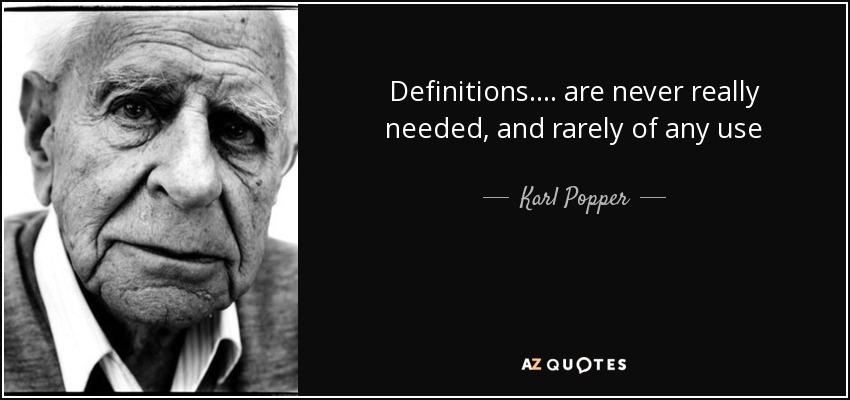
How is a statement to be assessed for the sense of truth without the knowledge of definitions?
Popper formed a great critique of Plato, Aristotle, Hegel and Marx. Plato was too directed toward the defense of the absolute with the sword of Damocles.
He felt that those people who were prone to rebellion had to be warned that they would suffer the death penalty for the consideration of such a thing.
This system of thought resulted in the formation of a number of small kingdoms that failed to organize for unity.
Aristotle didn't agree with the absolute, but he substituted universals. A universal was something that was true anywhere.
The kingdoms united with the greatest aggressor in military battle to extend the boundaries for the empire as far as possible. This resulted in an unsustainable 'unity.'
Hegel engaged in the revolutionary thought of setting empires against each other. His idealism was directed against agreement with virtually anything proposed by the opposition.
Marx teamed with Engels to put Hegel in a class struggle until the end of time. They predicted that the success of capitalism would be such that workers would have to unite in order to overthrow the government that supported the capitalists.
Their economic theory produced a degenerative economic value. Their theory of numbers was such that labor was the 'majority' that had to make executive authority meet their demands.
The prohibition of education in labor meant that their demands remained poorly defined. Essentially, they demanded benefit for minimal productivity. They were paid to do as little work as possible.
This is where Popper works against the value of his own statement for an open society. He instituted a strange loop. He advocated for the overthrow of government with the vote instead of rebellion, but the definition for the purpose of government was only defined as not tyrannical.
This leaves the government susceptible to attack from the Hegelians and Marxists. They define the government as tyrannical to see if they can win the next election.
The history of government has been such that defense from attack allows for the defense of borders. These borders can be united with others for the same purpose.
The goal of cooperation with other nations whether allied or non-allied keeps the alliance sensitive to the needs of the people who pay for it with tax money.
Capitalism actually allows an economy for competition in providing a product or service that is valuable to consumers anywhere. The borders for the country provide a context for the measure of the competition.
Border security and immigration reform are necessary in the definition of context. Immigrants have to register to be legal. They can't be allowed to vote. This is the line of demarcation between a citizen and an immigrant.
Immigrants can't be given benefits from taxpayers. They can't be allowed to take jobs from citizens. They came to the country for employment or to get away from where they were.
They haven't been paying taxes or working for national security here long enough to give them something that belongs to those who have been working for it in this country.
An open society can be too open. We need statements with definitions to establish a sense of measure for what is true.
Draw
Dawn
画出黎明
Huà chū límíng
夜明けを描く
Yoake o kaku
ps.19
Draw dawn
without flaw
for awe.
The heavens declare the beauty of divine majesty.
Benign design is the work of the Creator's reality.
Sweet daughter
by the altered altars
that nature offers
you know you oughta
dance like the otter
plays in water.
Dance daughter
for your offers
from alien paupers
without flying saucers.
.
You will be loved
because you are a loving dove.
The story for glory
grows glory for the story
with the warning that violence
is not the catalyst for change or silence.
Cruelty creates atavism for pain
and disdain.
We have been brought out of the house of misery.
We have been delivered from the bitterness of injury.
The helpful priest brought the law before the assembled body.
He read for their hearing that they might understand the godly.
All were washed as one body by the Spirit.
Divine presence was invoked to draw near it.
The Word went out so people could hear it.
It was proclaimed in the assembly to embody the spirit.
The beach was a good place to find seashells.
It was a break from work in between bells.
Love is the votive motive
for motoring in a better locomotive.
L’amour is the automotive lotus.
Society needs signs.
Individuality seeks wisdom for mind.
My mind perceives an object of knowledge as thought.
Sensible quality is recognized by another thinker's reasoned lot.
Knowledge of the structure of the world and the activity of elements;
the alterations in solstice and equinox for change in seasonal relevance;
the nature of animals and temper of wildness in beasts;
the power of the spirit and thought in human beats;
the varieties of plant and the virtue of roots for subsistence;
produce wisdom about the nature of existence.
The beginning, middle and end of time
establish relevance for the relativity of the objective mind.
I learned how the hidden is revealed as manifest
by instruction from the wisdom of using statements to test.
Controlled experiment helps to rule out false presumption.
Mathematical measure in variant quality produces formulation about function.
Knowledge is for wisdom in the management of material resources.
Wisdom is the spirit of intelligence in discourse with power as the source.
The scribe of history who has been trained for the kingdom of heavenly essence
is like the author of explanation in variant relations for the real presence.
The cross celebrates crucifixion
as the cement for the conviction
that pain is the friction
that precedes the reconciliation
of conflict in resurrection.
The crucifixion of that which is false about belief
is part of education with redemption for the relief of grief.
Faith looks past the impossible
to possibility.
The promise of the promisable
is seen
as believed with maturity
for fertility in civility.
Creativity in the present
presence presses forward with intent
into the future until it has passed
into the past as it has been cast
for reverie
or review
by memory
as true.
Love is true.
Love is you.
Reason and beauty close the day.
Another day is on the way.
-----------------------
19 Cœli enarrant
Heaven declares
1 The heavens declare the glory of God,
and the firmament shows his handiwork.
2 One day tells its tale to another,
and one night imparts knowledge to another.
3 Although they have no words or language,
and their voices are not heard,
4 Their sound has gone out into all lands,
and their message to the ends of the world.
5 In the deep has he set a pavilion for the sun;
it comes forth like a bridegroom out of his chamber;
it rejoices like a champion to run its course.
6 It goes forth from the uttermost edge of the heavens
and runs about to the end of it again;
nothing is hidden from its burning heat.
7 The law of the Lord is perfect
and revives the soul;
the testimony of the Lord is sure
and gives wisdom to the innocent.
8 The statutes of the Lord are just
and rejoice the heart;
the commandment of the Lord is clear
and gives light to the eyes.
9 The fear of the Lord is clean
and endures for ever;
the judgments of the Lord are true
and righteous altogether.
10 More to be desired are they than gold,
more than much fine gold,
sweeter far than honey,
than honey in the comb.
11 By them also is your servant enlightened,
and in keeping them there is great reward.
12 Who can tell how often he offends?
cleanse me from my secret faults.
13 Above all, keep your servant from presumptuous sins;
let them not get dominion over me;
then shall I be whole and sound,
and innocent of a great offense.
14 Let the words of my mouth and the meditation of my heart be acceptable in your sight,
O Lord, my strength and my redeemer.
-----------------------------
Wisdom 7:17-22
God gave me knowledge of what exists
to know the structure of the world and the activity of the elements;
the beginning, end and middle of times:
the alteration of the solstices and the changes in season;
the nature of animals and temper of wild beasts;
the power of spirit and the thoughts of human being;
the varieties of plant and the virtue of roots.
I learned what is secret and what is manifest
for wisdom, the fashioner of all things, taught me.
There is in her a spirit that is intelligent, holy,
unique, manifold, subtle, mobile, clear, unpolluted,
distinct, invulnerable, loving the good, keen and irresistible.
--------------------------
Knowledge of the structure of the world and the activity of elements;
the alterations in solstice and equinox for change in seasonal relevance;
the nature of animals and temper of wildness in beasts;
the power of the spirit and thought in human beats;
the varieties of plant and the virtue of roots for subsistence;
produce wisdom about the nature of existence.
The beginning, middle and end of time
establish relevance for the relativity of the objective mind.
I learned how the hidden is revealed as manifest
by instruction from the wisdom of using statements to test.
Controlled experiment helps to rule out false presumption.
Mathematical measure in variant quality produces formulation about function.
Knowledge is for wisdom in the management of material resource.
Wisdom is the spirit of intelligence in discourse with power as the source.
===============
Matt. 13:52
He said to them, 'Every scribe who has been trained for the kingdom of heaven is like the master of a household who brings out of his treasure what is new and what is old.'
--------------------------
The scribe of history who has been trained for the kingdom of heavenly essence
is like the author of explanation in variant relations for the real presence.
===============
Discipline with Joy
Bede (bead)
c. 673, Jarrow, Northumbria
d. 26 May 735, Jarrow, Northumbria
Bede is regarded as the greatest Anglo-Saxon scholar and the father of English history.
He was an English Benedictine monk at the monastery of St. Peter and its companion monastery of St. Paul in the Kingdom of Northumbria of the Angles.
He is well known as an author, teacher and scholar. His most famous work, Ecclesiastical History of the English People, gained him the title "The Father of English History".
His ecumenical work was extensive. The writing included a number of Biblical commentaries and other theological works of exegetical erudition.
Another important area of study for Bede was the academic discipline of computus. This was otherwise known to his contemporaries as the science of calculating calendar dates.
He established the practice of dating forward from the birth of Christ (Anno Domini – in the year of our Lord). The practice eventually became commonplace in medieval Europe.
Bede was one of the greatest teachers and writers of the Early Middle Ages. He is considered by many historians to be the single most important scholar of antiquity for the period between the death of Pope Gregory I in 604 and the coronation of Charlemagne in 800.
He was a skilled linguist and translator. His work made the Latin and Greek writings of the early Church Fathers accessible to his fellow Anglo-Saxons.
Jarrow
Jarrow is a town in northeast England. It is located on the RiverTyne.
The river is formed by the confluence of the North and the South Tyne. The northern part has its source close to the Scottish border near the village of Kielder. It is 118 km (73 miles) in length.
The South Tyne rises in the hills of Alston Moor in Cumbria. The river empties into the North Sea not far from Jarrow. The town is only 7.25 km (4.5 miles) from the sea.
St. Peter's Tower
The monastery of Saint Paul was located in Jarrow in the 8th century. It is now called the Monkwearmouth–Jarrow Abbey. The abbey was a Benedictine double monastery in the Kingdom of Northumbria, England.
A double monastery is a separate community of monks joined together with one of nuns in a single institution. They were more common in the monasticism of Eastern Christianity. The institution was started in the 4th century. This kind of monastery was established in Anglo-Saxon England, Scotland, Ireland and Gaul.
Monks and nuns lived in separate buildings but were usually united under an Abbess as head of the entire household. They would have chanted the Liturgy of the Hours and attended Mass together in the Chapel. Either an abbess or an abbot would normally have control over both houses. It was only in exceptional circumstances that each would have its own superior.
Jarrow became a center of learning along with the abbey at Wearmouth. It had the largest library north of the Alps due to the widespread travels of Benedict Biscop, its founder. Bede helped to build the library with his extensive written work. The library contributed significantly to the growth of English Christianity.
Bede
Bede gave his birthplace as "on the lands of this monastery". He is referring to the twinned monasteries of Monkwearmouth and Jarrow.
Bede's first abbot was Benedict Biscop. The names "Biscop" and "Beda" both appear in a king list of the kings of Lindsey from around 800. The listing of his name with kings suggests that he came from a noble family.
Bede's name reflects West Saxon Bīeda. It is an Anglo-Saxon short name formed on the root of bēodan "to bid, command". The name also occurs in the Anglo-Saxon Chronicle, s.a. 501, as Bieda, one of the sons of the Saxon founder of Portsmouth.
The Liber Vitae of Durham Cathedral names two priests with this name, one of whom is presumably Bede himself. Some manuscripts of the Life of Cuthbert, one of Bede's works, mention that Cuthbert's own priest was named Bede. It is possible that this priest is the other name listed in the Liber Vitae.
He was sent as a puer oblatus at the age of 7 to the monastery of Monkwearmouth by his family to be educated by Benedict Biscop and later by Ceolfrith. An oblate is in the status where he is considering whether of not to be tonsured as a monk. His hair was cut in a special way after he agreed to take vows for life.
It was fairly common in Ireland at this time for young boys, particularly those of noble birth, to be fostered out as an oblate. The practice was also likely to have been common among the Germanic people in England.
Monkwearmouth's sister monastery at Jarrow was founded by Ceolfrith in 682. Bede probably transferred to Jarrow with Ceolfrith that year.
The dedication stone for the church has survived to the present day. It is dated 23 April 685. The young monk would have been required to assist with menial tasks in his day-to-day life. It is possible that he helped in building the original church.
Plague broke out at Jarrow in 686. The Life of Ceolfrith (710) records that only two surviving monks were capable of singing the full offices. One was Ceolfrith. The other was a young boy.
The boy had been taught by Ceolfrith according to the anonymous writer. The two managed to do the entire service of the liturgy until others could be trained. The young boy was almost certainly Bede. He would have been about 14.
When he was about 17 years old, Adomnán, the abbot of Iona Abbey, visited Monkwearmouth and Jarrow. Bede would probably have met the abbot during this visit. It may be that Adomnan sparked Bede's interest in the Easter dating controversy.
Bede was ordained a deacon in about 692 when he was 19 by his diocesan bishop. John was bishop of Hexham.
The canonical age for the ordination of a deacon was 25. His early ordination may mean that his abilities were considered exceptional. It is also possible that the minimum age requirement was often disregarded.
There might have been minor orders ranking below a deacon; but there is no record of whether he held any of these offices. He was ordained a priest in about 702 when he was 30 with the ordination again performed by Bishop John.
He said of himself: "I have devoted my energies to a study of the Scriptures, observing monastic discipline, and singing the daily services in church; study, teaching, and writing have always been my delight."
He was the first person to write scholarly works in the English language. Only fragments of his English writings have survived. He wrote extensively in Latin. He wrote commentaries on the Pentateuch and other portions of Holy Scripture.
His best-known work is his History of the English Church and People. This is a classic which has frequently been translated. It gives a history of Britain up to 729.
It recorded how the Celtic people were converted to Christianity during the first three centuries of the Christian era. The invasion of the Anglo-Saxon pagans took place in the 5th and 6th centuries. The Anglo-Saxons were subsequently converted by Celtic missionaries from the north and west and Roman missionaries from the south and east.
His work is our chief source for the history of the British Isles during this period. He cited the sources for his information. He also wrote hymns, other verse, the first martyrology with historical notes, letters, homilies, works on grammar, chronology and astronomy. He was aware that the earth is a sphere.
He was the first historian to date events ANNO DOMINI. He was the earliest known writer to state that the solar year is not exactly 365 and a quarter days long. Even the Gregorian calendar (one leap year every four years) requires some adjusting if the months are not to get out of step with the seasons.
He translated the Gospel of John into Old English, completing the work on the very day of his death.
Bede (bead)
S. 贝德
T. 貝德
贝 Bei sea shell 貝 bai shellfish Be べ ベ Be 베 the
德 de goodness 德 toku virtue de で デ de 데 place
--------------------------
The beach was a good place to find seashells.
It was a break from work in the cell between bells.
===============
Wiki Bede bio
Lectionary Bede
Wiki Jarrow
George Berkeley
Principles of Human Knowledge
1710
Text
"1. OBJECTS OF HUMAN KNOWLEDGE.--It is evident to any one who takes a survey of the objects of human knowledge, that they are either IDEAS actually imprinted on the senses; or else such as are perceived by attending to the passions and operations of the mind; or lastly, ideas formed by help of memory and imagination--either compounding, dividing, or barely representing those originally perceived in the aforesaid ways...
"2. MIND--SPIRIT--SOUL.--But, besides all that endless variety of ideas or objects of knowledge, there is likewise something which knows or perceives them, and exercises divers operations, as willing, imagining, remembering, about them. This perceiving, active being is what I call MIND, SPIRIT, SOUL, or MYSELF. By which words I do not denote any one of my ideas, but a thing entirely distinct from them, WHEREIN THEY EXIST, or, which is the same thing, whereby they are perceived--for the existence of an idea consists in being perceived."
-------------------------------
My mind perceives an object of knowledge as thought.
Sensible quality is recognized by another thinker's reasoned lot.
==================
How is a statement to be assessed for the sense of truth without the knowledge of definitions?
Popper formed a great critique of Plato, Aristotle, Hegel and Marx. Plato was too directed toward the defense of the absolute with the sword of Damocles.
He felt that those people who were prone to rebellion had to be warned that they would suffer the death penalty for the consideration of such a thing.
This system of thought resulted in the formation of a number of small kingdoms that failed to organize for unity.
Aristotle didn't agree with the absolute, but he substituted universals. A universal was something that was true anywhere.
The kingdoms united with the greatest aggressor in military battle to extend the boundaries for the empire as far as possible. This resulted in an unsustainable 'unity.'
Hegel engaged in the revolutionary thought of setting empires against each other. His idealism was directed against agreement with virtually anything proposed by the opposition.
Marx teamed with Engels to put Hegel in a class struggle until the end of time. They predicted that the success of capitalism would be such that workers would have to unite in order to overthrow the government that supported the capitalists.
Their economic theory produced a degenerative economic value. Their theory of numbers was such that labor was the 'majority' that had to make executive authority meet their demands.
The prohibition of education in labor meant that their demands remained poorly defined. Essentially, they demanded benefit for minimal productivity. They were paid to do as little work as possible.
This is where Popper works against the value of his own statement for an open society. He instituted a strange loop. He advocated for the overthrow of government with the vote instead of rebellion, but the definition for the purpose of government was only defined as not tyrannical.
This leaves the government susceptible to attack from the Hegelians and Marxists. They define the government as tyrannical to see if they can win the next election.
The history of government has been such that defense from attack allows for the defense of borders. These borders can be united with others for the same purpose.
The goal of cooperation with other nations whether allied or non-allied keeps the alliance sensitive to the needs of the people who pay for it with tax money.
Capitalism actually allows an economy for competition in providing a product or service that is valuable to consumers anywhere. The borders for the country provide a context for the measure of the competition.
Border security and immigration reform are necessary in the definition of context. Immigrants have to register to be legal. They can't be allowed to vote. This is the line of demarcation between a citizen and an immigrant.
Immigrants can't be given benefits from taxpayers. They can't be allowed to take jobs from citizens. They came to the country for employment or to get away from where they were.
They haven't been paying taxes or working for national security here long enough to give them something that belongs to those who have been working for it in this country.
An open society can be too open. We need statements with definitions to establish a sense of measure for what is true.
Labels:
atavism,
dawn,
dove,
faith,
knowledge,
majesty,
mind,
motive,
possibility,
priest,
reality,
redemption,
relativity,
relevance,
time,
votive. elements,
wisdom
Sunday, May 12, 2019
Praise
5.19.19
Nicole Kidman as Atlanna
in Aquaman
Praise
God
赞美神
Zànměi shén
神を賛美する
Kami o sanbi suru
ps148
Yeah Yah!
You fill me with awe!
Help me see your revelation
with the gift of sensation.
Guide others also to see your design
with instruction both transcendent and sublime.
Sunrise, Florida
Recognize the value of light
for your sight!
Applaud the radiance of heaven.
Appreciate matter as creation with essence.
Shine like the sun and moon.
Let the beauty of stars be seen in the flowers that bloom.
Celebrate heaven as the essence of sky.
Let the brightness of highness shine in your inner light.
Let water fall on the face of the earth.
Let life be blessed with the grace of worth.
The cedar and pine will go in the wilderness.
The cypress will grow near water in the desert emptiness.
All may consider and understand
that this was done by the LORD's hand.
The Holy One has created this
as an expression of creative bliss.
Let creation praise the name of the Most High.
Let your heart sing with everything under the sky.
The Word spoke and everything began to be.
The morning broke and this vision began to see.
The law was written into the fabric of life
to help us to live without excessive strife.
Love one another as I have loved you.
By this everyone will know that you are true.
Grace was given to amend disgrace.
Correction is to be tested with respect for place.
Follow your lead
in those who succeed.
That which you need
should not cause you to bleed.
Cheer achievement
to leave bereavement
from disagreement.
The waves surge between distant shores.
The language stirs for the heart to roar.
Praise the Lord from the sea
you sea creatures that plumb the deep.
Fire, hail, snow and fog;
tempestuous winds that stir the bog
with turtles and frogs;
mountains and hills
support divine will;
fruit, nut, olive and avocado trees
give variety to a diet of milk and honey;
grains of all kinds
bestow the blessing of peace in mind;
wild beasts and domestic cattle
dodge or trample the snakes that rattle;
creeping things feed the birds
that fly from branches with leaves like words;
men, women, old and young together
sing your praises no matter what the weather.
Praise the divine name
with heart aflame.
A multitude sought salvation through the rolling hills.
They came from outside the state to seek divine will.
Jesus preached the love of God
as the path to life on which to trod.
I pray with joy for all of you.
You have shared good news
for the bliss of truth
to guide your youth.
Strength has raised the faith
to see faithfulness as something great.
Ignorance of the law is not wisdom.
Knowledge of concepts shapes vision.
Morality guides behavior away from destructive decision.
The study of an abstract general idea
shows false principles to cease as reasonable media.
Take note of thought in contemplation.
Climb the ladder of letters to consummation
in concentration.
Love one another as I have loved you.
By this everyone will know that you are true.
The dexterity of the worker improves the quantity of work
with respect for skill developed in the production of a well defined cirque.
The principle of utility approves or disapproves of every action
for the happiness of the individual or government rejection of faction.
The apostles were baptized with the Holy Spirit.
The Church is apostolic in search of the catholic near it.
The preservation of goodness is deliberate.
Wholeness with maturity is sought in the literate.
The heart of God is at home with mortals
in the practical application of morals.
Consciousness is the product of the body in the brain
as created by the genetic chain
in the human refrain
of the astral plane.
The idea of design is refined
for the production of insight
in mind.
Yeah Yah!
You draw
goodness in awe
for justice in law.
----------------------------
148 Laudate Dominum
Laud the Masterful
1 Hallelujah!
Praise the Lord from the heavens;
praise him in the heights.
2 Praise him, all you angels of his;
praise him, all his host.
3 Praise him, sun and moon;
praise him, all you shining stars.
4 Praise him, heaven of heavens,
and you waters above the heavens.
5 Let them praise the Name of the Lord;
for he commanded, and they were created.
6 He made them stand fast for ever and ever;
he gave them a law which shall not pass away.
7 Praise the Lord from the earth,
you sea-monsters and all deeps;
8 Fire and hail, snow and fog,
tempestuous wind, doing his will;
9 Mountains and all hills,
fruit trees and all cedars;
10 Wild beasts and all cattle,
creeping things and winged birds;
11 Kings of the earth and all peoples,
princes and all rulers of the world;
12 Young men and maidens,
old and young together.
13 Let them praise the Name of the Lord,
for his Name only is exalted,
his splendor is over earth and heaven.
14 He has raised up strength for his people
and praise for all his loyal servants,
the children of Israel, a people who are near him.
Hallelujah!
------------------------
Acts 11:15-6
As I began to speak, the Holy Spirit fell upon them just as it had upon us at the beginning. I remembered the word of the Lord, how he had said, "John baptized you with water, but you will be baptized with the Holy Spirit."
---------------------------
The apostles were baptized with the Holy Spirit.
The Church is apostolic in search of the catholic near it.
The preservation of goodness is deliberate.
Wholeness with maturity is sought in the literate.
====================
Rev. 21:1-3
I saw a new heaven and a new earth. The first heaven and earth had passed away. The sea was no more. I saw the holy city, the new Jerusalem, coming down out of heaven from God, prepared as a bride adorned for her husband.
I heard a loud voice from the throne saying,
See, the home of God is among mortals.
He will dwell with them.
They will be his people.
---------------------------
The heart of God is at home with mortals
in the practical application of morals.
====================
John 13:34-5
Jesus said, 'I give you a new commandment. Love one another. Just as I have loved you, you also should love one another. Everyone will know that you are my disciples by this.'
---------------------------
Love one another as I have loved you.
By this everyone will know that you are true.
====================
Ability to Know
Johann Gotlieb Fichte
b. 5.19.1762 Rammenau, Saxony, Holy Roman Empire
d. 1.27.1814 Berlin, Prussia
Johann Fichte was the German philosopher who established the thesis-antithesis-synthesis model for thought. This made him the founder of idealism.
Rationalism had rejected knowledge based on the claim to an established authority. The form was limited to personal reason.
Empiricism had rejected rationalism, but admit to the need for direct perception in relation to the inductive reason in science for the experience of government. There was also the strong implication that ideas should be expressed simply for the public.
The focus on experience contributed to an overstatement of induction. Things were done as they had been done without critical reflection about automated policy.
Rationalism was not rejected by the Dutch republic. Corporate structures were organized for the mass production of goods and services. Business executives became the state officials when state officials didn't make themselves into business executives.
This system had some conservative policy as was the case with AT&T in the US, but overall it instituted socialist policy for the Dutch and their colonies in history. Much of Europe has a large amount of this kind of policy. There are media accounts that lay claim to paradise, but how objective are the reports?
Idealism asserted that things have value ascribed to them. The values aren't inherit in the things-in-themselves. Intrinsic value wasn't recognized.
Fichte produced a philosophy similar to Kant's without the thing-in-itself. He asserted that our representations, ideas or mental images are merely the productions of our ego as the subject of knowledge.
Fichte was like Descartes and Kant in the consideration of the problem of subjectivity in consciousness. He wrote about political philosophy. This contributed to his reputation as the father of German nationalism.
He was born in Rammenau, Upper Lusatia. Lusatia belonged to the lands of the Bohemian crown.
Rammenau
Rammenau was a municipality in Lusatia which was also a district in Saxony. Saxony was part of the commonwealth of Poland-Lithuania.
Elector Frederick Augustus I (1694–1733) was made the King of Poland and Grand Duke of Lithuania after he converted to Catholicism on 1 June 1697.
His son, Elector Frederick Augustus II (1733–63), was received into the Catholic Church in Bologna, Italy while heir-apparent on 28 November 1712.
His conversion had to be kept secret for 5 years on account of the excitable Lutheran population. They didn't know that the ruling family of Saxony had become Catholic again.
He too was controversially "elected King of Poland and Grand duke of Lithuania," This made him the monarch of the Commonwealth of Poland-Lithuania. He was selected against the French candidate, Louis François, Prince of Conti.
Louis Francois attempted to claim the throne with his arrival by sea at the port of Gdańsk. His attempt was denied. Frederick Augustus II reigned as Augustus III of Poland 1734-1763.
Johann Fichte
Johann was born in Rammenau, Upper Lusatia on 19 May 1762. He came of peasant stock which had lived in the region for many generations. His father was a ribbon weaver. The family was known for their piety. Christian, Johann's father, married above his station. He inherited impatience from his mother.
He received the rudiments of his education from his father. He showed ability from an early age.
His reputation among the villagers gained him the opportunity for a better education than he otherwise would have received.
Freiherr von Militz, a country landowner, arrived too late to hear the local pastor preach. He was informed that a lad in the neighborhood would be able to repeat the sermon almost verbatim. The baron took the lad into his protection as a result. He paid his tuition.
Fichte was placed in the family of Pastor Krebel at Niederau near Meissen. He received a thorough grounding in the classics there. He saw little of his parents from that time. He was attending the celebrated foundation-school at Pforta near Naumburg in October 1774. The school at Pforta had been part of a Cistercian monastery.
The Cistercians held the vow of poverty in strict reverence. Observance of the vow allowed for rigorous academic study. The dark night of the soul was a central theme in their ascetic struggle to understand truth in relation to others and nature.
This school is associated with the names of Novalis, August Wilhelm Schlegel, Friedrich Schlegel and Nietzsche. The spirit of the institution was semi-monastic. The education given was excellent in its rigor.
The focus on individual academic achievement was too restrictive in contact with the world for a pupil of Fichte's social temperament and antecedents. His education strengthened a tendency toward introspection and independence. These were characteristics which appear strongly in his doctrines and writings.
He began study at the theology seminary of the University of Jena in 1780. He was transferred a year later to study at the Leipzig University. Fichte seems to have supported himself at this period of bitter poverty and hard struggle. Freiherr von Militz continued to support him, but he died in 1784. Fichte had to end his studies without completing his degree.
He supported himself as a tutor in various Saxon families from 1784 to 1788. He returned to Leipzig in the hope of finding a better employment in early 1788. He had to settle for a less promising position with the family of an innkeeper in Zurich. He lived in Zurich for the next two years (1788–1790). It was a time of contentment for him.
There he met his future wife, Johanna Rahn, and Johann Heinrich Pestalozzi. He also became a member of the Freemasonry lodge "Modestia cum Libertate" in 1793. Johann Wolfgang Goethe was connected with this lodge.
He became engaged to Johanna in the spring of 1790. Fichte began to study the works of Kant in the summer of 1790. This occurred because one of his students wanted to know about them.
They had a lasting effect on the trajectory of his life and thought. While he was assimilating the Kantian philosophy and preparing to develop it, fate dealt him a blow. The Rahn family suffered financial reverses. His impending marriage had to be postponed.
Fichte returned to Leipzig in May 1790 from Zurich. He obtained a tutorship at Warsaw in the house of a Polish nobleman in the spring of 1791. The situation proved disagreeable and he was released.
He then got a chance to see Kant at Königsberg. He shut himself in his lodgings after a disappointing interview on July 4 of the same year. He threw his energy into the composition of an essay which would compel Kant's attention and interest.
This essay was completed in five weeks. It was called the Versuch einer Critik aller Offenbarung (Attempt at a Critique of All Revelation, 1792). Fichte investigated the connections between divine revelation and Kant's critical philosophy in this book.
The first edition of the book was published without Fichte's name or signed preface. It was mistakenly thought to be a new work by Kant himself.
Reviews assumed that Kant was the author. He cleared the confusion and openly praised Fichte as the author for the work. His reputation skyrocketed. Many intellectuals of the day were of the opinion nobody but Kant could have written the book. It was a shocking development. Fichte was called "a third sun in the philosophical heavens".
Karl Popper considered the book to be "a fraud." He thought that it imitated Kant's style. The rumors that Kant himself had written the book had to be contrived.
Kant waited seven years to make public statement about the incident. He dissociated himself from Fichte after considerable external pressure. He inscribed, "May God protect us from our friends. From our enemies, we can try to protect ourselves".
He was married in Zurich in October 1793. He remained there the rest of the year. He was stirred by the events and principles of the French Revolution. He wrote two pamphlets that were published anonymously. These works led to him being seen as a devoted defender of liberty in thought and action in the advocacy for political change.
He received an invitation to fill the position of extraordinary professor of philosophy at the University of Jena in December of the same year. He accepted and began his lectures in May of the next year. He expounded his system of "transcendental idealism" with extraordinary zeal.
His success was immediate. He seems to have excelled as a lecturer because of the earnestness and force of his personality. These lectures were later published under the title The Vocation of the Scholar (Einige Vorlesungen über die Bestimmung des Gelehrten). He gave himself up to intense production. A succession of works soon appeared.
He was finally dismissed from Jena in 1799 as a result of a charge of atheism after weathering a couple of academic storms. He was accused of this after publishing his essay "Ueber den Grund unsers Glaubens an eine göttliche Weltregierung" ("On the Ground of Our Belief in a Divine World-Governance") in 1798. He had written the essay in response to Friedrich Karl Forberg's essay "Development of the Concept of Religion" in his Philosophical Journal.
God should be conceived primarily in moral terms according to Fichte: "The living and efficaciously acting moral order is itself God. We require no other God, nor can we grasp any other" ("On the Ground of Our Belief in a Divine World-Governance").
Fichte's intemperate "Appeal to the Public" ("Appellation an das Publikum", 1799) provoked F. H. Jacobi to publish an open letter to him. Jacobi equated philosophy in general and Fichte's transcendental philosophy in particular with nihilism.
Prussia did not join in the cry against Fichte. He moved to Berlin. There he associated himself with the Schlegels, Schleiermacher, Schelling and Tieck. He was initiated into Freemasonry in the Lodge Pythagoras of the Blazing Star through the introduction of the Hungarian writer Ignaz Aurelius Fessler. He was elected minor warden in April 1800.
Fichte was a warm admirer of Fessler at first. He was disposed to aid him in his proposed Masonic reform. He became Fessler's bitter opponent later. Their controversy attracted much attention among Freemasons.
Fichte presented two lectures on the philosophy of Masonry during the same period as part of his work on the development of various higher degrees for the lodge in Berlin. A certain Johann Karl Christian Fischer, a high official of the Grand Orient.
He published those lectures in 1802/03 in two volumes under the title Philosophy of Freemasonry: Letters to Konstant (Philosophie der Maurerei. Briefe an Konstant). The name Konstant referred to a fictitious non-Mason.
Fichte published The Closed Commercial State: A Philosophical Sketch as an Appendix to the Doctrine of Right and an Example of a Future Politics (Der geschlossene Handelsstaat. Ein philosophischer Entwurf als Anhang zur Rechtslehre und Probe einer künftig zu liefernden Politik) in November 1800.
It was a philosophical statement of his property theory, a historical analysis of European economic relations and a political proposal for reforming them. He was appointed to a professorship at the University of Erlangen in 1805.
Napoleon defeated the Prussian army in the Battle of Jena-Auerstedt in 1806. The loss drove Fichte to Königsberg for a time. He returned to Berlin in 1807 and continued his literary activity.
German southern principalities resigned as member states after the collapse of the Holy Roman Empire. They became part of a French protectorate.
Fichte delivered the famous Addresses to the German Nation (Reden an die deutsche Nation, 1807-1808) which attempted to define Germany in an uprising against Napoleon.
He became a professor at the new University of Berlin. It was founded in 1810. Fichte was unanimously elected its rector in the succeeding year by the votes of his colleagues. His impetuosity and reforming zeal led to friction once more before long. He resigned in 1812.
The campaign against Napoleon began. The hospitals at Berlin were soon full of patients. Fichte's wife devoted herself to work as a nurse. She caught a virulent fever. He himself was stricken down just as she was starting to recover. He died of typhus at the age of 51.
His son, Immanuel Hermann Fichte (18 July 1796 – 8 August 1879) also made contributions to philosophy.
Fichte's critics argued that he produced works that were barely intelligible in his mimicry of Kant's style. He plumed himself on his great skill in the shadowy and obscure. He remarked to his pupils that there was only one man in the world who could fully understand his work. Even "he was often at a loss to seize upon his real meaning."
Fichte acknowledged the difficulty involved in the comprehension of his writing, but argued that his work was clear to those who made the effort to think without the preconceptions of prejudice.
Fichte did not endorse Kant's argument for the existence of noumena. The "things in themselves" were not the supra-sensible reality beyond the category of direct human perception.
He saw the rigorous and systematic separation of "things in themselves" (noumena) and things "as they appear to us" (phenomena) as an invitation to skepticism. He made the radical suggestion that we should throw out the notion of a noumenal world rather than invite such doubt.
He proposed that consciousness does not have a grounding in a so-called "real world". He achieved fame for originating the argument that consciousness is not grounded in anything outside of itself. The phenomenal world as such arises from self-consciousness, the activity of the ego and moral awareness.
Johann Gottlieb Fichte was one of the major figures in German philosophy in the period between Kant and Hegel. He was considered to be one of Kant's most talented followers, until he developed his own system of transcendental philosophy. This was called Wissenschaftslehre (administration of knowledge). The difficulty was that the philosophy 'transcended' the acknowledgement of reality.
The subjectivity of Fichte's system contributed to a government that was too prohibitive and punished truth. The law was set up to benefit the official at the expense of the people. The military was objective about taking control of territory for government administration but people weren't allowed to own weapons for defense from attack.
Prussia was similar to the Ottoman rule. People were threatened with punishment as though it were in their best interest to support punishment by the government.
The best that could be hoped was that an official wouldn't be too punitive to the injured party if he mediated a dispute. The worst case was that the official created disputes that were to be resolved in favor of his increased power for an increase in liberal expenditure for his office.
The Roman prejudice against executive authority has had such a strong effect on political thought that there is radical opposition to both monarchy and long term executive authority in a republic.
The claim that the legislature is the supreme authority opens that door to even more expenditure for covert and official operations by the government.
Johann Fichte
S. 约翰费希特
T. 約翰費希特
约 Yue to weigh 約 yaku promise Yo よ ヨ Yo 요 yo
翰 han writing 翰 kan letter han はん ハン han 한 one
费 Fei to spend 費 hi expense Fi ふぃ フィ Pi 피 blood
希 xi hope 希 ki hope hi ひ ヒ chi 치 tooth
特 te special 特 toku special te て テ
---------------------------
Consciousness is the product of the body brain
as created by the genetic chain
in the human refrain
of the astral plane.
The idea of design is refined
for the production of insight
in mind.
====================
https://en.wikipedia.org/wiki/Johann_Gottlieb_Fichte
https://plato.stanford.edu/entries/johann-fichte/
https://www.iep.utm.edu/fichtejg/
Nicole Kidman as Atlanna
in Aquaman
Praise
God
赞美神
Zànměi shén
神を賛美する
Kami o sanbi suru
ps148
Yeah Yah!
You fill me with awe!
Help me see your revelation
with the gift of sensation.
Guide others also to see your design
with instruction both transcendent and sublime.
Sunrise, Florida
Recognize the value of light
for your sight!
Applaud the radiance of heaven.
Appreciate matter as creation with essence.
Shine like the sun and moon.
Let the beauty of stars be seen in the flowers that bloom.
Celebrate heaven as the essence of sky.
Let the brightness of highness shine in your inner light.
Let water fall on the face of the earth.
Let life be blessed with the grace of worth.
The cedar and pine will go in the wilderness.
The cypress will grow near water in the desert emptiness.
All may consider and understand
that this was done by the LORD's hand.
The Holy One has created this
as an expression of creative bliss.
Let creation praise the name of the Most High.
Let your heart sing with everything under the sky.
The Word spoke and everything began to be.
The morning broke and this vision began to see.
The law was written into the fabric of life
to help us to live without excessive strife.
Love one another as I have loved you.
By this everyone will know that you are true.
Grace was given to amend disgrace.
Correction is to be tested with respect for place.
Follow your lead
in those who succeed.
That which you need
should not cause you to bleed.
Cheer achievement
to leave bereavement
from disagreement.
The waves surge between distant shores.
The language stirs for the heart to roar.
Praise the Lord from the sea
you sea creatures that plumb the deep.
Fire, hail, snow and fog;
tempestuous winds that stir the bog
with turtles and frogs;
mountains and hills
support divine will;
fruit, nut, olive and avocado trees
give variety to a diet of milk and honey;
grains of all kinds
bestow the blessing of peace in mind;
wild beasts and domestic cattle
dodge or trample the snakes that rattle;
creeping things feed the birds
that fly from branches with leaves like words;
men, women, old and young together
sing your praises no matter what the weather.
Praise the divine name
with heart aflame.
A multitude sought salvation through the rolling hills.
They came from outside the state to seek divine will.
Jesus preached the love of God
as the path to life on which to trod.
I pray with joy for all of you.
You have shared good news
for the bliss of truth
to guide your youth.
Strength has raised the faith
to see faithfulness as something great.
Ignorance of the law is not wisdom.
Knowledge of concepts shapes vision.
Morality guides behavior away from destructive decision.
The study of an abstract general idea
shows false principles to cease as reasonable media.
Take note of thought in contemplation.
Climb the ladder of letters to consummation
in concentration.
Love one another as I have loved you.
By this everyone will know that you are true.
The dexterity of the worker improves the quantity of work
with respect for skill developed in the production of a well defined cirque.
The principle of utility approves or disapproves of every action
for the happiness of the individual or government rejection of faction.
The apostles were baptized with the Holy Spirit.
The Church is apostolic in search of the catholic near it.
The preservation of goodness is deliberate.
Wholeness with maturity is sought in the literate.
The heart of God is at home with mortals
in the practical application of morals.
Consciousness is the product of the body in the brain
as created by the genetic chain
in the human refrain
of the astral plane.
The idea of design is refined
for the production of insight
in mind.
Yeah Yah!
You draw
goodness in awe
for justice in law.
----------------------------
148 Laudate Dominum
Laud the Masterful
1 Hallelujah!
Praise the Lord from the heavens;
praise him in the heights.
2 Praise him, all you angels of his;
praise him, all his host.
3 Praise him, sun and moon;
praise him, all you shining stars.
4 Praise him, heaven of heavens,
and you waters above the heavens.
5 Let them praise the Name of the Lord;
for he commanded, and they were created.
6 He made them stand fast for ever and ever;
he gave them a law which shall not pass away.
7 Praise the Lord from the earth,
you sea-monsters and all deeps;
8 Fire and hail, snow and fog,
tempestuous wind, doing his will;
9 Mountains and all hills,
fruit trees and all cedars;
10 Wild beasts and all cattle,
creeping things and winged birds;
11 Kings of the earth and all peoples,
princes and all rulers of the world;
12 Young men and maidens,
old and young together.
13 Let them praise the Name of the Lord,
for his Name only is exalted,
his splendor is over earth and heaven.
14 He has raised up strength for his people
and praise for all his loyal servants,
the children of Israel, a people who are near him.
Hallelujah!
------------------------
Acts 11:15-6
As I began to speak, the Holy Spirit fell upon them just as it had upon us at the beginning. I remembered the word of the Lord, how he had said, "John baptized you with water, but you will be baptized with the Holy Spirit."
---------------------------
The apostles were baptized with the Holy Spirit.
The Church is apostolic in search of the catholic near it.
The preservation of goodness is deliberate.
Wholeness with maturity is sought in the literate.
====================
Rev. 21:1-3
I saw a new heaven and a new earth. The first heaven and earth had passed away. The sea was no more. I saw the holy city, the new Jerusalem, coming down out of heaven from God, prepared as a bride adorned for her husband.
I heard a loud voice from the throne saying,
See, the home of God is among mortals.
He will dwell with them.
They will be his people.
---------------------------
The heart of God is at home with mortals
in the practical application of morals.
====================
John 13:34-5
Jesus said, 'I give you a new commandment. Love one another. Just as I have loved you, you also should love one another. Everyone will know that you are my disciples by this.'
---------------------------
Love one another as I have loved you.
By this everyone will know that you are true.
====================
Ability to Know
Johann Gotlieb Fichte
b. 5.19.1762 Rammenau, Saxony, Holy Roman Empire
d. 1.27.1814 Berlin, Prussia
Johann Fichte was the German philosopher who established the thesis-antithesis-synthesis model for thought. This made him the founder of idealism.
Rationalism had rejected knowledge based on the claim to an established authority. The form was limited to personal reason.
Empiricism had rejected rationalism, but admit to the need for direct perception in relation to the inductive reason in science for the experience of government. There was also the strong implication that ideas should be expressed simply for the public.
The focus on experience contributed to an overstatement of induction. Things were done as they had been done without critical reflection about automated policy.
Rationalism was not rejected by the Dutch republic. Corporate structures were organized for the mass production of goods and services. Business executives became the state officials when state officials didn't make themselves into business executives.
This system had some conservative policy as was the case with AT&T in the US, but overall it instituted socialist policy for the Dutch and their colonies in history. Much of Europe has a large amount of this kind of policy. There are media accounts that lay claim to paradise, but how objective are the reports?
Idealism asserted that things have value ascribed to them. The values aren't inherit in the things-in-themselves. Intrinsic value wasn't recognized.
Fichte produced a philosophy similar to Kant's without the thing-in-itself. He asserted that our representations, ideas or mental images are merely the productions of our ego as the subject of knowledge.
Fichte was like Descartes and Kant in the consideration of the problem of subjectivity in consciousness. He wrote about political philosophy. This contributed to his reputation as the father of German nationalism.
He was born in Rammenau, Upper Lusatia. Lusatia belonged to the lands of the Bohemian crown.
Rammenau
Rammenau was a municipality in Lusatia which was also a district in Saxony. Saxony was part of the commonwealth of Poland-Lithuania.
Elector Frederick Augustus I (1694–1733) was made the King of Poland and Grand Duke of Lithuania after he converted to Catholicism on 1 June 1697.
His son, Elector Frederick Augustus II (1733–63), was received into the Catholic Church in Bologna, Italy while heir-apparent on 28 November 1712.
His conversion had to be kept secret for 5 years on account of the excitable Lutheran population. They didn't know that the ruling family of Saxony had become Catholic again.
He too was controversially "elected King of Poland and Grand duke of Lithuania," This made him the monarch of the Commonwealth of Poland-Lithuania. He was selected against the French candidate, Louis François, Prince of Conti.
Louis Francois attempted to claim the throne with his arrival by sea at the port of Gdańsk. His attempt was denied. Frederick Augustus II reigned as Augustus III of Poland 1734-1763.
Johann Fichte
Johann was born in Rammenau, Upper Lusatia on 19 May 1762. He came of peasant stock which had lived in the region for many generations. His father was a ribbon weaver. The family was known for their piety. Christian, Johann's father, married above his station. He inherited impatience from his mother.
He received the rudiments of his education from his father. He showed ability from an early age.
His reputation among the villagers gained him the opportunity for a better education than he otherwise would have received.
Freiherr von Militz, a country landowner, arrived too late to hear the local pastor preach. He was informed that a lad in the neighborhood would be able to repeat the sermon almost verbatim. The baron took the lad into his protection as a result. He paid his tuition.
Fichte was placed in the family of Pastor Krebel at Niederau near Meissen. He received a thorough grounding in the classics there. He saw little of his parents from that time. He was attending the celebrated foundation-school at Pforta near Naumburg in October 1774. The school at Pforta had been part of a Cistercian monastery.
The Cistercians held the vow of poverty in strict reverence. Observance of the vow allowed for rigorous academic study. The dark night of the soul was a central theme in their ascetic struggle to understand truth in relation to others and nature.
This school is associated with the names of Novalis, August Wilhelm Schlegel, Friedrich Schlegel and Nietzsche. The spirit of the institution was semi-monastic. The education given was excellent in its rigor.
The focus on individual academic achievement was too restrictive in contact with the world for a pupil of Fichte's social temperament and antecedents. His education strengthened a tendency toward introspection and independence. These were characteristics which appear strongly in his doctrines and writings.
He began study at the theology seminary of the University of Jena in 1780. He was transferred a year later to study at the Leipzig University. Fichte seems to have supported himself at this period of bitter poverty and hard struggle. Freiherr von Militz continued to support him, but he died in 1784. Fichte had to end his studies without completing his degree.
He supported himself as a tutor in various Saxon families from 1784 to 1788. He returned to Leipzig in the hope of finding a better employment in early 1788. He had to settle for a less promising position with the family of an innkeeper in Zurich. He lived in Zurich for the next two years (1788–1790). It was a time of contentment for him.
There he met his future wife, Johanna Rahn, and Johann Heinrich Pestalozzi. He also became a member of the Freemasonry lodge "Modestia cum Libertate" in 1793. Johann Wolfgang Goethe was connected with this lodge.
He became engaged to Johanna in the spring of 1790. Fichte began to study the works of Kant in the summer of 1790. This occurred because one of his students wanted to know about them.
They had a lasting effect on the trajectory of his life and thought. While he was assimilating the Kantian philosophy and preparing to develop it, fate dealt him a blow. The Rahn family suffered financial reverses. His impending marriage had to be postponed.
Fichte returned to Leipzig in May 1790 from Zurich. He obtained a tutorship at Warsaw in the house of a Polish nobleman in the spring of 1791. The situation proved disagreeable and he was released.
He then got a chance to see Kant at Königsberg. He shut himself in his lodgings after a disappointing interview on July 4 of the same year. He threw his energy into the composition of an essay which would compel Kant's attention and interest.
This essay was completed in five weeks. It was called the Versuch einer Critik aller Offenbarung (Attempt at a Critique of All Revelation, 1792). Fichte investigated the connections between divine revelation and Kant's critical philosophy in this book.
The first edition of the book was published without Fichte's name or signed preface. It was mistakenly thought to be a new work by Kant himself.
Reviews assumed that Kant was the author. He cleared the confusion and openly praised Fichte as the author for the work. His reputation skyrocketed. Many intellectuals of the day were of the opinion nobody but Kant could have written the book. It was a shocking development. Fichte was called "a third sun in the philosophical heavens".
Karl Popper considered the book to be "a fraud." He thought that it imitated Kant's style. The rumors that Kant himself had written the book had to be contrived.
Kant waited seven years to make public statement about the incident. He dissociated himself from Fichte after considerable external pressure. He inscribed, "May God protect us from our friends. From our enemies, we can try to protect ourselves".
He was married in Zurich in October 1793. He remained there the rest of the year. He was stirred by the events and principles of the French Revolution. He wrote two pamphlets that were published anonymously. These works led to him being seen as a devoted defender of liberty in thought and action in the advocacy for political change.
He received an invitation to fill the position of extraordinary professor of philosophy at the University of Jena in December of the same year. He accepted and began his lectures in May of the next year. He expounded his system of "transcendental idealism" with extraordinary zeal.
His success was immediate. He seems to have excelled as a lecturer because of the earnestness and force of his personality. These lectures were later published under the title The Vocation of the Scholar (Einige Vorlesungen über die Bestimmung des Gelehrten). He gave himself up to intense production. A succession of works soon appeared.
He was finally dismissed from Jena in 1799 as a result of a charge of atheism after weathering a couple of academic storms. He was accused of this after publishing his essay "Ueber den Grund unsers Glaubens an eine göttliche Weltregierung" ("On the Ground of Our Belief in a Divine World-Governance") in 1798. He had written the essay in response to Friedrich Karl Forberg's essay "Development of the Concept of Religion" in his Philosophical Journal.
God should be conceived primarily in moral terms according to Fichte: "The living and efficaciously acting moral order is itself God. We require no other God, nor can we grasp any other" ("On the Ground of Our Belief in a Divine World-Governance").
Fichte's intemperate "Appeal to the Public" ("Appellation an das Publikum", 1799) provoked F. H. Jacobi to publish an open letter to him. Jacobi equated philosophy in general and Fichte's transcendental philosophy in particular with nihilism.
Prussia did not join in the cry against Fichte. He moved to Berlin. There he associated himself with the Schlegels, Schleiermacher, Schelling and Tieck. He was initiated into Freemasonry in the Lodge Pythagoras of the Blazing Star through the introduction of the Hungarian writer Ignaz Aurelius Fessler. He was elected minor warden in April 1800.
Fichte was a warm admirer of Fessler at first. He was disposed to aid him in his proposed Masonic reform. He became Fessler's bitter opponent later. Their controversy attracted much attention among Freemasons.
Fichte presented two lectures on the philosophy of Masonry during the same period as part of his work on the development of various higher degrees for the lodge in Berlin. A certain Johann Karl Christian Fischer, a high official of the Grand Orient.
He published those lectures in 1802/03 in two volumes under the title Philosophy of Freemasonry: Letters to Konstant (Philosophie der Maurerei. Briefe an Konstant). The name Konstant referred to a fictitious non-Mason.
Fichte published The Closed Commercial State: A Philosophical Sketch as an Appendix to the Doctrine of Right and an Example of a Future Politics (Der geschlossene Handelsstaat. Ein philosophischer Entwurf als Anhang zur Rechtslehre und Probe einer künftig zu liefernden Politik) in November 1800.
It was a philosophical statement of his property theory, a historical analysis of European economic relations and a political proposal for reforming them. He was appointed to a professorship at the University of Erlangen in 1805.
Napoleon defeated the Prussian army in the Battle of Jena-Auerstedt in 1806. The loss drove Fichte to Königsberg for a time. He returned to Berlin in 1807 and continued his literary activity.
German southern principalities resigned as member states after the collapse of the Holy Roman Empire. They became part of a French protectorate.
Fichte delivered the famous Addresses to the German Nation (Reden an die deutsche Nation, 1807-1808) which attempted to define Germany in an uprising against Napoleon.
He became a professor at the new University of Berlin. It was founded in 1810. Fichte was unanimously elected its rector in the succeeding year by the votes of his colleagues. His impetuosity and reforming zeal led to friction once more before long. He resigned in 1812.
The campaign against Napoleon began. The hospitals at Berlin were soon full of patients. Fichte's wife devoted herself to work as a nurse. She caught a virulent fever. He himself was stricken down just as she was starting to recover. He died of typhus at the age of 51.
His son, Immanuel Hermann Fichte (18 July 1796 – 8 August 1879) also made contributions to philosophy.
Fichte's critics argued that he produced works that were barely intelligible in his mimicry of Kant's style. He plumed himself on his great skill in the shadowy and obscure. He remarked to his pupils that there was only one man in the world who could fully understand his work. Even "he was often at a loss to seize upon his real meaning."
Fichte acknowledged the difficulty involved in the comprehension of his writing, but argued that his work was clear to those who made the effort to think without the preconceptions of prejudice.
Fichte did not endorse Kant's argument for the existence of noumena. The "things in themselves" were not the supra-sensible reality beyond the category of direct human perception.
He saw the rigorous and systematic separation of "things in themselves" (noumena) and things "as they appear to us" (phenomena) as an invitation to skepticism. He made the radical suggestion that we should throw out the notion of a noumenal world rather than invite such doubt.
He proposed that consciousness does not have a grounding in a so-called "real world". He achieved fame for originating the argument that consciousness is not grounded in anything outside of itself. The phenomenal world as such arises from self-consciousness, the activity of the ego and moral awareness.
Johann Gottlieb Fichte was one of the major figures in German philosophy in the period between Kant and Hegel. He was considered to be one of Kant's most talented followers, until he developed his own system of transcendental philosophy. This was called Wissenschaftslehre (administration of knowledge). The difficulty was that the philosophy 'transcended' the acknowledgement of reality.
The subjectivity of Fichte's system contributed to a government that was too prohibitive and punished truth. The law was set up to benefit the official at the expense of the people. The military was objective about taking control of territory for government administration but people weren't allowed to own weapons for defense from attack.
Prussia was similar to the Ottoman rule. People were threatened with punishment as though it were in their best interest to support punishment by the government.
The best that could be hoped was that an official wouldn't be too punitive to the injured party if he mediated a dispute. The worst case was that the official created disputes that were to be resolved in favor of his increased power for an increase in liberal expenditure for his office.
The Roman prejudice against executive authority has had such a strong effect on political thought that there is radical opposition to both monarchy and long term executive authority in a republic.
The claim that the legislature is the supreme authority opens that door to even more expenditure for covert and official operations by the government.
Johann Fichte
S. 约翰费希特
T. 約翰費希特
约 Yue to weigh 約 yaku promise Yo よ ヨ Yo 요 yo
翰 han writing 翰 kan letter han はん ハン han 한 one
费 Fei to spend 費 hi expense Fi ふぃ フィ Pi 피 blood
希 xi hope 希 ki hope hi ひ ヒ chi 치 tooth
特 te special 特 toku special te て テ
---------------------------
Consciousness is the product of the body brain
as created by the genetic chain
in the human refrain
of the astral plane.
The idea of design is refined
for the production of insight
in mind.
====================
https://en.wikipedia.org/wiki/Johann_Gottlieb_Fichte
https://plato.stanford.edu/entries/johann-fichte/
https://www.iep.utm.edu/fichtejg/
Subscribe to:
Posts (Atom)