Showing posts with label relativity. Show all posts

Monday, June 10, 2019

Draw

6.11.19

Draw
Awe
画敬畏 
Huà jìngwèi
畏敬の念を描きます 
Ikei no nen o kakimasu
ps112
pavet trahere

Draw awe
from the beauty that you saw.

Happy are those who have the faith and awe
to take delight in the common law.

Their descendents will be healthy in the land.
The generation of the educated will be grand.

Wealth and order will be in their house.
Family trust will be their spouse.

Light shines in the darkness for those who wait.
Shape for form in substance becomes easy to appreciate.

It is good to produce something of value for surplus
to help manage affairs with reason for purpose.

The productive will not be shaken.
Service will last in remembrance. It won't be taken.

They will not be frightened by fake news.
Their heart is right. They won't lose. 

Their resolve is established. It will not shrink.
The achievement of goals will not make them blink.

Their honor will stand fast forever.
They will remember the reward for effort.

Those who sought to do damage to honor will see their error.
They will turn back from their error with terror.

I have given you as a covenant. 
You are a light for government. 

Your deliverance from captivity
showed objectivity in law with relativity.

Those who had not seen will see
that the captives were set free
from the darkness of slavery
with faith in their future delivery.

The disciples spoke the word of faith to no one except the Jews
until the Hellenists were included in the good news.

The Jews had made education 
in religion the vocation 
for any nation.

The son of encouragement held the hope
that Gentiles would also take this rope
to learn to cope.  

The kingdom of heaven has come near.
The paralyzed, possessed and blind will be delivered from their fear.

--------------------------

112 Beatus vir
Happy man

1 Hallelujah!
Happy are they who fear the Lord
and have great delight in his commandments!
2 Their descendants will be mighty in the land;
the generation of the upright will be blessed.
3 Wealth and riches will be in their house,
and their righteousness will last for ever.
4 Light shines in the darkness for the upright;
the righteous are merciful and full of compassion.
5 It is good for them to be generous in lending
and to manage their affairs with justice.
6 For they will never be shaken;
the righteous will be kept in everlasting remembrance.
7 They will not be afraid of any evil rumors;
their heart is right;
they put their trust in the Lord.
8 Their heart is established and will not shrink,
until they see their desire upon their enemies.
9 They have given freely to the poor,
and their righteousness stands fast for ever;
they will hold up their head with honor.
10 The wicked will see it and be angry;
they will gnash their teeth and pine away;
the desires of the wicked will perish.

---------------------------

====================

Isa. 42:6-7

I am the LORD, I have called you in righteousness.
I have taken you by the hand and kept you.
I have given you as a covenant to the people
as a light to the nations
to open the eyes that are blind
to bring the prisoners from the dungeon
from the prison whose who sit in darkness.

---------------------------

I have given you as a covenant.
You are a light for government.

Your deliverance from captivity
showed objectivity with relativity.

Those who had not seen will see
that the prisoners were set free
from the darkness of slavery.

====================

Acts 11:19-26

Those who were scattered because of the persecution that took place over Stephen travelled as far as Phoenicia, Cyprus and Antioch. They spoke the word to no one except the Jews. Some men of Cyprus and Cyrene spoke to the Hellenists on coming to Antioch. They proclaimed the Lord Jesus. The hand of the Lord was with them. A great number became believers. News of the conversion came to the ears of the church in Jerusalem. They sent Barnabas to Antioch. When he came and saw the grace of God, he rejoiced. He exhorted them all to remain faithful to the Lord with steadfast devotion. He was a good man, full of the Holy Spirit and faith. A great many people were brought to the Lord. Barnabas went to Tarsus to look for Saul. When he found him, he brought him to Antioch. It was there for an entire year they associated with the church and taught a great many people. It was in Antioch that the disciples were first called 'Christians.'

---------------------------

The disciples spoke the word of faith to no one except the Jews
until the Hellenists were included in the good news.

====================

Matt. 10:7-8

Proclaim the good news as you go, "The kingdom of heaven has come near." Cure the sick, raise the dead, cleanse the lepers, cast out demons."

---------------------------

The kingdom of heaven has come near.
The paralyzed, possessed and blind will be delievered from their fear.

====================

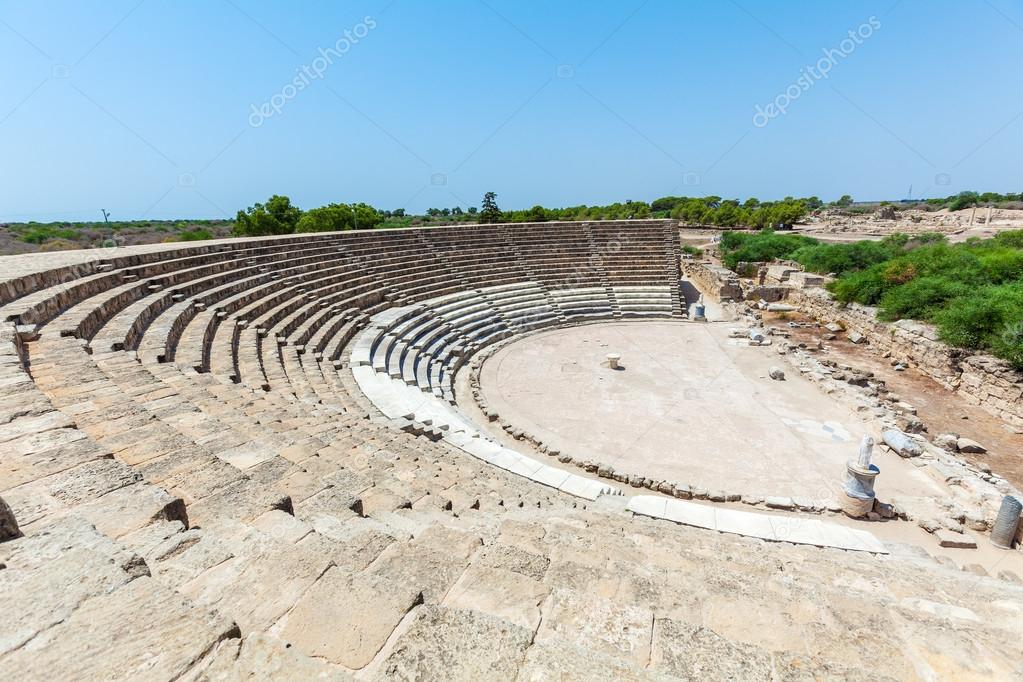
There was a classical influence on the island of Cyprus. The theater of Salamis is an example.

The Theater
Salamis, Cyprus

Salamis was an ancient Greek city-state on the east coast of Cyprus. It sits at the mouth of the river Pedieos 6 km north of modern Famagusta. The founder of Salamis was Teucer, son of Telamon, according to tradition.  Teucer could not return home after the Trojan war because he had failed to avenge his brother Ajax.

The "cultural centre" of Salamis during the Roman period was situated at the northernmost part of the city. A gymnasium, theater, amphitheater, stadium and public baths have been revealed. There are baths, public latrines (for 44 users), various little bits of mosaic, a harbor wall, a Hellenistic and Roman agora and a temple of Zeus that had the right to grant asylum.

It was the island’s most important port city. Ships stopped there from the Middle East and from Europe in antiquity. Many of the ships came from the Aegean. Salamis was the largest city on the island during the Roman period. It surpassed even Paphos, the administrative capital.

Barnabas
Son of Encouragement 

Barnabas of the Seventy was born on the island of Cyprus into the family of the tribe of Levi. He was named Joseph. He was a Cypriot Jew according to Acts 4:36.

Acts 4:36

Joseph, a Levite, born in Cyprus, whom the apostles called Barnabas (son of encouragement), sold a field he owned, brought the money, and turned it over to the apostles.

--------------------------

He received his education at Jerusalem with his friend and fellow student Saul, the future Apostle Paul, under the renowned teacher of the Law, Gamaliel.

He was one of the prominent Christian disciples in Jerusalem. He was named an apostle in Acts 14:14. His new name fits what is known of his actions. When Saul (or Paul) came to Jerusalem after his conversion, most of the Christians there wanted nothing to do with him. They had known him as a persecutor and an enemy of the Church.

Barnabas was willing to give him a second chance. He went to Tarsus, spoke with him and brought him to see the other Christians in Antioch. Later, Paul and Barnabas went on a missionary journey together. They took Mark with them. Mark turned back and went home before they had finished the mission.

Barnabas and Paul traveled together making more converts (c 45-47). They defended Gentile converts against the Judaizers.

They participated in the Council of Jerusalem (c 50). They successfully evangelized among the "God-fearing" Gentiles who attended synagogues in various Hellenized cities of Anatolia.

When they were about to set out on another such journey, Barnabas proposed to take Mark.  Paul was against it. He said that Mark had shown himself undependable.

Barnabas wanted to give Mark a second chance. He and Mark went off on one journey. Paul took Silas and went on another. Apparently Mark responded well to the trust given him by the "son of encouragement." Paul later thought of him as a valuable assistant (2 Tim 4:11; see also Col 4:10 and Phil 24).

St. Peter's Church
Ancient Roman Road
Antakya, Turkey (Antioch)

Antakya was known as Antioch in ancient times. The city has historical significance for Christianity. It was the place where the followers of Jesus Christ were called Christians for the first time. The city and its massive walls also played an important role during the Crusades.

Late Antiquity

The city had a large population of Jewish origin in a quarter called the Kerateion. It attracted the earliest missionaries. It was evangelized by Peter himself among others. The Antiochene patriarchate still rests its claim for primacy according to this tradition.

It was the starting point for Barnabas and Paul during the first missionary journey. Its converts were the first to be called Christians. This is not to be confused with Antioch in Pisidia, to which the early missionaries later travelled.

Several small Christian communities are still active in the city. The largest church is St. Peter and St. Paul on Hurriyet Caddesi. The long history of spiritual and religious movements makes Antakya a place of pilgrimage for Christians.

The city is home to a functioning synagogue serving the Jewish community. It has a reputation in Turkey as a place for spells, fortune telling, miracles and spirits.

The location near the Syrian border makes the city more cosmopolitan than many cities in Turkey. It did not attract the mass immigration of people from eastern Anatolia in the 1980's and 1990's that radically swelled the populations of Mediterranean cities such as Adana and Mersin. Both Turkish and Arabic are still widely spoken in Antakya. Written Arabic is rarely used.

A mixed community of faiths and denominations co-exist peacefully here. Most of the inhabitants are Muslim. A substantial proportion adhere to the Alevi and the Arab Alawi traditions.  There is a place to honor the Alawite saint Hızır in 'Harbiye.' Numerous tombs of saints for both the Sunni and Alawite are located throughout the city.

Barnabas
S. 巴拿巴
T. 巴拿巴

巴  Ba     to hope             巴   ha    comma design      Ba   バ   ば         Ba   바   bar             
拿  na      to hold             拿    da   catch                      ru   ル   る          na   나    I     
巴  ba      to desire          巴   ha    to hope                   na   ナ   な          na   나    I 
                                                                                     ba   バ  ば                                                                                 
---------------------------

The Jews had made education
in religion the vocation
for any nation.

The son of encouragement held the hope
that Gentiles would also take this rope
to learn to cope. 

====================

wiki Barnabas
Lectionary Barnabas
OCA Apostle Barnabas
Slideshow Antioch on the Orontes
wiki Antakya
wiki Antioch Late Antiquity
wiki Salamis, Cyprus
Bible Places Salamis

Friday, May 24, 2019

Draw

5.25.19

Draw
Dawn
画出黎明
Huà chū límíng
夜明けを描く
Yoake o kaku
ps.19

Draw dawn
without flaw
for awe.

The heavens declare the beauty of divine majesty.
Benign design is the work of the Creator's reality.

Sweet daughter
by the altered altars 
that nature offers
you know you oughta
dance like the otter
plays in water.

Dance daughter
for your offers
from alien paupers
without flying saucers.
.
You will be loved
because you are a loving dove.

The story for glory
grows glory for the story
with the warning that violence
is not the catalyst for change or silence.

Cruelty creates atavism for pain 
and disdain.

We have been brought out of the house of misery.
We have been delivered from the bitterness of injury.

The helpful priest brought the law before the assembled body.
He read for their hearing that they might understand the godly.

All were washed as one body by the Spirit.
Divine presence was invoked to draw near it.

The Word went out so people could hear it.
It was proclaimed in the assembly to embody the spirit.

The beach was a good place to find seashells.
It was a break from work in between bells.

Love is the votive motive
for motoring in a better locomotive. 
L’amour is the automotive lotus.

Society needs signs.
Individuality seeks wisdom for mind.

My mind perceives an object of knowledge as thought.
Sensible quality is recognized by another thinker's reasoned lot.  

Knowledge of the structure of the world and the activity of elements;
the alterations in solstice and equinox for change in seasonal relevance;
the nature of animals and temper of wildness in beasts;
the power of the spirit and thought in human beats;
the varieties of plant and the virtue of roots for subsistence;
produce wisdom about the nature of existence.

The beginning, middle and end of time
establish relevance for the relativity of the objective mind.

I learned how the hidden is revealed as manifest 
by instruction from the wisdom of using statements to test.

Controlled experiment helps to rule out false presumption.
Mathematical measure in variant quality produces formulation about function.

Knowledge is for wisdom in the management of material resources.
Wisdom is the spirit of intelligence in discourse with power as the source. 

The scribe of history who has been trained for the kingdom of heavenly essence
is like the author of explanation in variant relations for the real presence.

The cross celebrates crucifixion
as the cement for the conviction
that pain is the friction
that precedes the reconciliation
of conflict in resurrection.

The crucifixion of that which is false about belief
is part of education with redemption for the relief of grief.

Faith looks past the impossible
to possibility. 
The promise of the promisable
is seen 
as believed with maturity
for fertility in civility. 

Creativity in the present 
presence presses forward with intent
into the future until it has passed
into the past as it has been cast 
for reverie 
or review 
by memory
as true.

Love is true.
Love is you.

Reason and beauty close the day.
Another day is on the way.

-----------------------

19 Cœli enarrant
Heaven declares

1 The heavens declare the glory of God,
and the firmament shows his handiwork.
2 One day tells its tale to another,
and one night imparts knowledge to another.
3 Although they have no words or language,
and their voices are not heard,
4 Their sound has gone out into all lands,
and their message to the ends of the world.
5 In the deep has he set a pavilion for the sun;
it comes forth like a bridegroom out of his chamber;
it rejoices like a champion to run its course.
6 It goes forth from the uttermost edge of the heavens
and runs about to the end of it again;
nothing is hidden from its burning heat.
7 The law of the Lord is perfect
and revives the soul;
the testimony of the Lord is sure
and gives wisdom to the innocent.
8 The statutes of the Lord are just
and rejoice the heart;
the commandment of the Lord is clear
and gives light to the eyes.
9 The fear of the Lord is clean
and endures for ever;
the judgments of the Lord are true
and righteous altogether.
10 More to be desired are they than gold,
more than much fine gold,
sweeter far than honey,
than honey in the comb.
11 By them also is your servant enlightened,
and in keeping them there is great reward.
12 Who can tell how often he offends?
cleanse me from my secret faults.
13 Above all, keep your servant from presumptuous sins;
let them not get dominion over me;
then shall I be whole and sound,
and innocent of a great offense.
14 Let the words of my mouth and the meditation of my heart be acceptable in your sight,
O Lord, my strength and my redeemer.

-----------------------------

Wisdom 7:17-22

God gave me knowledge of what exists
to know the structure of the world and the activity of the elements;
the beginning, end and middle of times:
the alteration of the solstices and the changes in season;
the nature of animals and temper of wild beasts;
the power of spirit and the thoughts of human being;
the varieties of plant and the virtue of roots.
I learned what is secret and what is manifest
for wisdom, the fashioner of all things, taught me.
There is in her a spirit that is intelligent, holy,
unique, manifold, subtle, mobile, clear, unpolluted,
distinct, invulnerable, loving the good, keen and irresistible.

--------------------------

Knowledge of the structure of the world and the activity of elements;
the alterations in solstice and equinox for change in seasonal relevance;
the nature of animals and temper of wildness in beasts;
the power of the spirit and thought in human beats;
the varieties of plant and the virtue of roots for subsistence;
produce wisdom about the nature of existence.

The beginning, middle and end of time
establish relevance for the relativity of the objective mind.

I learned how the hidden is revealed as manifest
by instruction from the wisdom of using statements to test.

Controlled experiment helps to rule out false presumption.
Mathematical measure in variant quality produces formulation about function.

Knowledge is for wisdom in the management of material resource.
Wisdom is the spirit of intelligence in discourse with power as the source.

===============

Matt. 13:52

He said to them, 'Every scribe who has been trained for the kingdom of heaven is like the master of a household who brings out of his treasure what is new and what is old.'

--------------------------

The scribe of history who has been trained for the kingdom of heavenly essence
is like the author of explanation in variant relations for the real presence.

===============

Discipline with Joy

Bede (bead)
c. 673, Jarrow, Northumbria
d. 26 May 735, Jarrow, Northumbria

Bede is regarded as the greatest Anglo-Saxon scholar and the father of English history.

He was an English Benedictine monk at the monastery of St. Peter and its companion monastery of St. Paul in the Kingdom of Northumbria of the Angles.

He is well known as an author, teacher and scholar. His most famous work, Ecclesiastical History of the English People, gained him the title "The Father of English History".

His ecumenical work was extensive. The writing included a number of Biblical commentaries and other theological works of exegetical erudition.

Another important area of study for Bede was the academic discipline of computus. This was otherwise known to his contemporaries as the science of calculating calendar dates.

He established the practice of dating forward from the birth of Christ (Anno Domini – in the year of our Lord). The practice eventually became commonplace in medieval Europe.

Bede was one of the greatest teachers and writers of the Early Middle Ages. He is considered by many historians to be the single most important scholar of antiquity for the period between the death of Pope Gregory I in 604 and the coronation of Charlemagne in 800.

He was a skilled linguist and translator. His work made the Latin and Greek writings of the early Church Fathers accessible to his fellow Anglo-Saxons.

Jarrow

Jarrow is a town in northeast England. It is located on the RiverTyne.

The river is formed by the confluence of the North and the South Tyne. The northern part has its source close to the Scottish border near the village of Kielder. It is 118 km (73 miles) in length.
The South Tyne rises in the hills of Alston Moor in Cumbria. The river empties into the North Sea not far from Jarrow. The town is only 7.25 km (4.5 miles) from the sea.

St. Peter's Tower

The monastery of Saint Paul was located in Jarrow in the 8th century. It is now called the Monkwearmouth–Jarrow Abbey. The abbey was a Benedictine double monastery in the Kingdom of Northumbria, England.

A double monastery is a separate community of monks joined together with one of nuns in a single institution. They were more common in the monasticism of Eastern Christianity. The institution was started in the 4th century. This kind of monastery was established in Anglo-Saxon England, Scotland, Ireland and Gaul.

Monks and nuns lived in separate buildings but were usually united under an Abbess as head of the entire household. They would have chanted the Liturgy of the Hours and attended Mass together in the Chapel. Either an abbess or an abbot would normally have control over both houses. It was only in exceptional circumstances that each would have its own superior.

Jarrow became a center of learning along with the abbey at Wearmouth. It had the largest library north of the Alps due to the widespread travels of Benedict Biscop, its founder. Bede helped to build the library with his extensive written work. The library contributed significantly to the growth of English Christianity.

Bede

Bede gave his birthplace as "on the lands of this monastery". He is referring to the twinned monasteries of Monkwearmouth and Jarrow.

Bede's first abbot was Benedict Biscop. The names "Biscop" and "Beda" both appear in a king list of the kings of Lindsey from around 800. The listing of his name with kings suggests that he came from a noble family.

Bede's name reflects West Saxon Bīeda. It is an Anglo-Saxon short name formed on the root of bēodan "to bid, command". The name also occurs in the Anglo-Saxon Chronicle, s.a. 501, as Bieda, one of the sons of the Saxon founder of Portsmouth.

The Liber Vitae of Durham Cathedral names two priests with this name, one of whom is presumably Bede himself. Some manuscripts of the Life of Cuthbert, one of Bede's works, mention that Cuthbert's own priest was named Bede. It is possible that this priest is the other name listed in the Liber Vitae.

He was sent as a puer oblatus at the age of 7 to the monastery of Monkwearmouth by his family to be educated by Benedict Biscop and later by Ceolfrith. An oblate is in the status where he is considering whether of not to be tonsured as a monk. His hair was cut in a special way after he agreed to take vows for life. 

It was fairly common in Ireland at this time for young boys, particularly those of noble birth, to be fostered out as an oblate. The practice was also likely to have been common among the Germanic people in England.

Monkwearmouth's sister monastery at Jarrow was founded by Ceolfrith in 682. Bede probably transferred to Jarrow with Ceolfrith that year.

The dedication stone for the church has survived to the present day. It is dated 23 April 685. The young monk would have been required to assist with menial tasks in his day-to-day life. It is possible that he helped in building the original church.

Plague broke out at Jarrow in 686. The Life of Ceolfrith (710) records that only two surviving monks were capable of singing the full offices. One was Ceolfrith. The other was a young boy.

The boy had been taught by Ceolfrith according to the anonymous writer. The two managed to do the entire service of the liturgy until others could be trained. The young boy was almost certainly Bede. He would have been about 14.

When he was about 17 years old, Adomnán, the abbot of Iona Abbey, visited Monkwearmouth and Jarrow. Bede would probably have met the abbot during this visit. It may be that Adomnan sparked Bede's interest in the Easter dating controversy.

Bede was ordained a deacon in about 692 when he was 19 by his diocesan bishop. John was bishop of Hexham.

The canonical age for the ordination of a deacon was 25. His early ordination may mean that his abilities were considered exceptional. It is also possible that the minimum age requirement was often disregarded.

There might have been minor orders ranking below a deacon; but there is no record of whether he held any of these offices. He was ordained a priest in about 702 when he was 30 with the ordination again performed by Bishop John.

He said of himself: "I have devoted my energies to a study of the Scriptures, observing monastic discipline, and singing the daily services in church; study, teaching, and writing have always been my delight."

He was the first person to write scholarly works in the English language. Only fragments of his English writings have survived.  He wrote extensively in Latin. He wrote commentaries on the Pentateuch and other portions of Holy Scripture.

His best-known work is his History of the English Church and People. This is a classic which has frequently been translated. It gives a history of Britain up to 729.

It recorded how the Celtic people were converted to Christianity during the first three centuries of the Christian era. The invasion of the Anglo-Saxon pagans took place in the 5th and 6th centuries. The Anglo-Saxons were subsequently converted by Celtic missionaries from the north and west and Roman missionaries from the south and east.

His work is our chief source for the history of the British Isles during this period. He cited the sources for his information. He also wrote hymns, other verse, the first martyrology with historical notes, letters, homilies, works on grammar, chronology and astronomy. He was aware that the earth is a sphere.

He was the first historian to date events ANNO DOMINI. He was the earliest known writer to state that the solar year is not exactly 365 and a quarter days long. Even the Gregorian calendar (one leap year every four years) requires some adjusting if the months are not to get out of step with the seasons.

He translated the Gospel of John into Old English, completing the work on the very day of his death.

Bede (bead)
S. 贝德
T. 貝德

贝  Bei      sea shell       貝  bai    shellfish     Be    べ   ベ        Be  베  the   
德  de       goodness      德  toku  virtue         de    で    デ       de   데  place                                                             
--------------------------

The beach was a good place to find seashells.
It was a break from work in the cell between bells.

===============

Wiki Bede bio
Lectionary Bede
Wiki Jarrow

George Berkeley
Principles of Human Knowledge
1710
Text

"1. OBJECTS OF HUMAN KNOWLEDGE.--It is evident to any one who takes a survey of the objects of human knowledge, that they are either IDEAS actually imprinted on the senses; or else such as are perceived by attending to the passions and operations of the mind; or lastly, ideas formed by help of memory and imagination--either compounding, dividing, or barely representing those originally perceived in the aforesaid ways...

"2. MIND--SPIRIT--SOUL.--But, besides all that endless variety of ideas or objects of knowledge, there is likewise something which knows or perceives them, and exercises divers operations, as willing, imagining, remembering, about them. This perceiving, active being is what I call MIND, SPIRIT, SOUL, or MYSELF. By which words I do not denote any one of my ideas, but a thing entirely distinct from them, WHEREIN THEY EXIST, or, which is the same thing, whereby they are perceived--for the existence of an idea consists in being perceived."

-------------------------------

My mind perceives an object of knowledge as thought.
Sensible quality is recognized by another thinker's reasoned lot.

==================

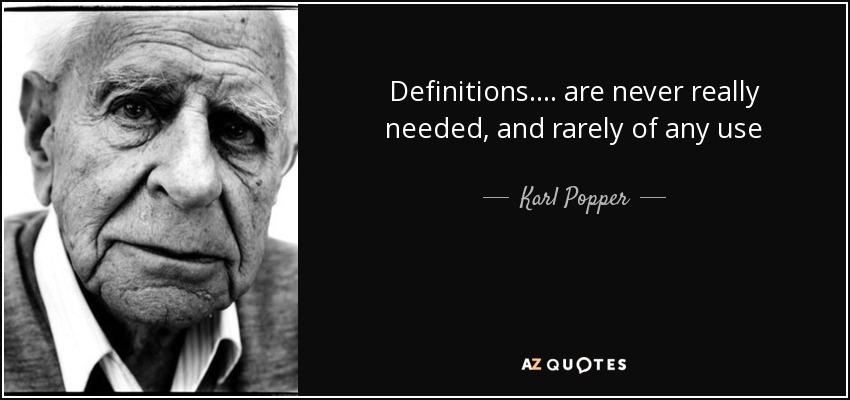
How is a statement to be assessed for the sense of truth without the knowledge of definitions?


Popper formed a great critique of Plato, Aristotle, Hegel and Marx. Plato was too directed toward the defense of the absolute with the sword of Damocles.

He felt that those people who were prone to rebellion had to be warned that they would suffer the death penalty for the consideration of such a thing.

This system of thought resulted in the formation of a number of small kingdoms that failed to organize for unity.

Aristotle didn't agree with the absolute, but he substituted universals. A universal was something that was true anywhere.

The kingdoms united with the greatest aggressor in military battle to extend the boundaries for the empire as far as possible. This resulted in an unsustainable 'unity.'

Hegel engaged in the revolutionary thought of setting empires against each other. His idealism was directed against agreement with virtually anything proposed by the opposition.

Marx teamed with Engels to put Hegel in a class struggle until the end of time. They predicted that the success of capitalism would be such that workers would have to unite in order to overthrow the government that supported the capitalists.

Their economic theory produced a degenerative economic value. Their theory of numbers was such that labor was the 'majority' that had to make executive authority meet their demands.

The prohibition of education in labor meant that their demands remained poorly defined. Essentially, they demanded benefit for minimal productivity. They were paid to do as little work as possible.

This is where Popper works against the value of his own statement for an open society. He instituted a strange loop. He advocated for the overthrow of government with the vote instead of rebellion, but the definition for the purpose of government was only defined as not tyrannical.

This leaves the government susceptible to attack from the Hegelians and Marxists. They define the government as tyrannical to see if they can win the next election.

The history of government has been such that defense from attack allows for the defense of borders. These borders can be united with others for the same purpose.

The goal of cooperation with other nations whether allied or non-allied keeps the alliance sensitive to the needs of the people who pay for it with tax money.

Capitalism actually allows an economy for competition in providing a product or service that is valuable to consumers anywhere. The borders for the country provide a context for the measure of the competition.

Border security and immigration reform are necessary in the definition of context. Immigrants have to register to be legal. They can't be allowed to vote. This is the line of demarcation between a citizen and an immigrant.

Immigrants can't be given benefits from taxpayers. They can't be allowed to take jobs from citizens. They came to the country for employment or to get away from where they were.

They haven't been paying taxes or working for national security here long enough to give them something that belongs to those who have been working for it in this country.

An open society can be too open. We need statements with definitions to establish a sense of measure for what is true.