Rachel McAdams
Redeem
Time
兑换时间
Duìhuàn shíjiān
償還時間
Shōkan jikan
ps98
Tunc redeem
The Creator established free will
so the choice of goodness would fit the bill.
People are seen to dream as friends to be.
Each ascends or descends relation with the end to be free.
Heaven opens. Light descends.
Sight is given the right to see, believe and attend
to ends.

for the discernment of sensation.
Angelic intelligence opens the mind to perceive.
People conceive what they believe they can achieve.
Insight is given the right to breathe.
Each seeks likeness above that which is beneath.
Love has redemptive power.
The power works by the hour
to make production a reality.
It transforms idiosyncrasy
into personal sociography.
Dependence on fossil fuel
risks toxin and pollutant duels.
Gas sparked in chambers burns to pop piston fueled
to turn rods in the turbine for electricity in jules
and provides light to fight against violent disputants,
arrogant mules and criminal moles as mutants.
Electricity powered the hours taken to destroy the World Trade Center towers.
Medical care, business and transportation are powered.
Food is cooled or heated for storage or consumption.
Destruction was the consumption of function
for the compunction of unction.
Horse poop in the street lost a ton of tossing in the transportation option.
Cool air wards off death by heat exhaustion.
Heat prevents frozen cardiac arrest in the stressed chest.
Sewage treatment reduced epidemic disease the best.
We are insignificantly significant.
Our unremarkable star is remarkably magnificent
in infinitely emitting energy for those who are innocent.
Our magnificence is a typical galaxy event.
Marvelous things have been done for us.
Victory with love makes our trust most august.
Justice must keep this thrust to meet morality's weather.
Medicine treats illness until we find something better.
Good diet and exercise improve health in competition.
The omission of cognition is not good for volition.
Health makes music with joy in the sight of all the nations.
The relation of ideation is the foundation for sensation's elation
in education.
Lift up your voice. Rejoice and sing with jubilation.
Instruments make notes for the revelation to sensation.
The pluck or stroke of the string for the resonant ring is born.
The pumped force through the chambered conic adorns the sound of air as horn.
Each color that passion wore
made sadness or joy the thing to bring.
Let the hills ring with happiness galore.
Let the rivers speak sadly of tragic things.
We were not idle when we dwelt among you.
We worked so the group would not be burdened by our few.
Imitate us in the providence of faith.
Don't depend on being served by others as your state.
Let the alleys flatly express the cubic savvy and straightness of the less
than Stonehenge meant astronomical bent in the strategy for family gravity.
Let the world be judged for rightness
with the measure of equity's levity without depravity.
The less mess that the light does bless
will result in the most ecstatic content with consent.
Be brave for love. Be kind to others.
It will make you a better father, mother,
sister, brother or other.
The bract fall softly
by the gutter on the eaves.
My mind sits tired, awfully alone even for me.
My image is caressed on the surface of the water under trees.
I can hear the sound of voice stir uncertainty
as my mother and father whispering urgently
after the spring shower had fed the intent pleas
of the gentle leaves as they stirred emergently
in the post storm breeze.
The novel was an instrument of victory
insofar as it predicted history.
The argument contained therein
promoted knowledge of evolution as the way to win.
Socialism demanded order by government control.
It was the forum for degenerates and trolls.
Knowledge of evolution in political form
shows a solution to the criminal norm.
The tall tree stands strong with the ability to sway.
The wind gives the osprey a place to stay.
He cries crassly as the officer who arrests the day.
The heron's trail walks down the beach
like a broken comb sifting with sight and beak
through wet sand for a peek of a slug as succulent as a peach.
The bikini clad chica walks slowly in the sand.
She takes a moment to block the sun with the palm of her hand.
The sun threatens to take her heart like an offering for the land.
Her blood flows firmly to deny the sacrifice as damned.
The crow marches by the river
as the marshal whose parade the march delivered.
The rowboat sent out shivers that shimmered
as a sign of the movement giver.

Unshaken visitors thrash the river banks for relief
as the water wrings itself clean of grief
through the dirty sponge of marshy disbelief
while another coat of color is mixed for the bandstand seats.
A fleet of Harleys rumble through the square.
Some ride single; some in pairs.
We have seen the postcards of panthers,
funny answers and babies dressed in pampers.
We know that Florida harbors bikini clad dancers.
Let winged fancy wander
through the thought spread beyond her.
Open wide the science conditioned door.
Imagination will dart out and upward soar.
The sobriety of Autumn watches dead leaves blow down the street
as the spring born calves break from their stalls and into the fields with leaps.
The maker of the universe was the Father
with the Son as his Word for the power that bothers
to care for the creation by watching over the hours.
Essence was the compaction of the indivisible inside of corporeal form
that gave matter its shape as a functional entity from the immaterial storm.
This is the law that has been delivered.
Love others as you saw love given from the Giver.
Both boats were filled with fish
in answer to the fisherman's wish.
A flash of light in the eye of Jesus saw
the location in the school of reality as law.
Blood is pumped by the heart and cleansed by the liver.
Nutrients are delivered as the body's embodied dinner.
Love is the substance that makes your heart grow quicker.
Stand tall. Be brave. Please deliver as a giver.
Pragmatism turns from insufficiency as promoted by abstraction
towards action that results in benefit from power without factions.
Naming is rated by the modes of necessity.
Possibility precedes the charge of electricity.
Be strong with the strength
that comes from the length
of power in the knowledge of God with breadth
that you may be prepared for trials with patience
while giving thanks to the Father of relations
who has enabled you to share the spacious
station in the inheritance of the gracious
love of life in the light of the nations.
The evil of the arrogant will be burned to ashes in a hot fired oven
to leave stubble without root or branch in the charcoaled rubble of repercussion.
The light of righteousness will rise like the sun with healing in its wings
in the hearts of those who love others with reverence for the goodness of things.
The dawn from on high will shine upon us
from the mercy of the God who is just.
There will be trials and tribulations before the end of time.
Live your life for goodness with joy that you may celebrate the sublime.
Redemption is against the compunction
for unction, but last rites help society to function.
------------------------
Psalm 98
Cantate Domino
Sing Friend
1 Sing to the Lord a new song,
for he has done marvelous things.
2 With his right hand and his holy arm
has he won for himself the victory.
3 The Lord has made known his victory;
his righteousness has he openly shown in the sight of the nations.
4 He remembers his mercy and faithfulness to the house of Israel,
and all the ends of the earth have seen the victory of our God.
5 Shout with joy to the Lord, all you lands;
lift up your voice, rejoice, and sing.
6 Sing to the Lord with the harp,
with the harp and the voice of song.
7 With trumpets and the sound of the horn
shout with joy before the King, the Lord.
8 Let the sea make a noise and all that is in it,
the lands and those who dwell therein.
9 Let the rivers clap their hands,
and let the hills ring out with joy before the Lord,
when he comes to judge the earth.
10 In righteousness shall he judge the world
and the peoples with equity.
-----------------------
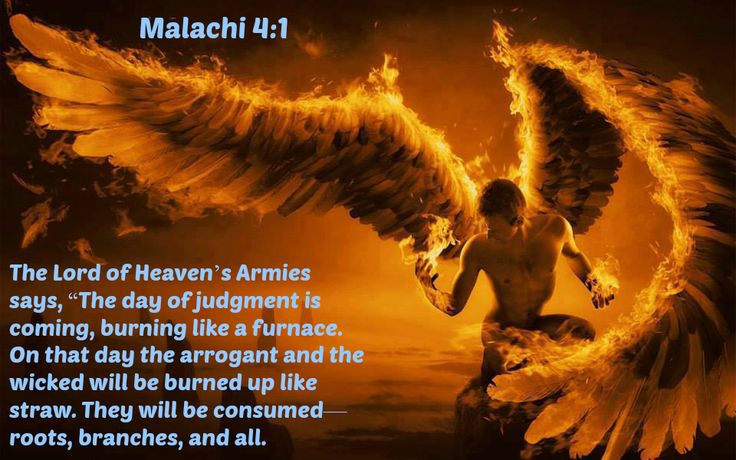
Malachi 4:1
The name Malachi is an abbreviation of "messenger of YHWH." The first verse of the third chapter reads, "Behold, I will send my messenger." (Malachi 3:1) Malachi is Hebrew for 'my messenger.'
The books of Zechariah and Haggai were written during the lifetime of Ezra. They are similar in style. The Persian-era term for governor (pehâ) is used in Mal.1:8. 'Try offering blind, lame or diseased animals to your governor! Would he be pleased with you?'
The themes of the book place it in a position after Haggai and Zechariah. It is close to the time of Ezra when Nehemiah traveled to Jerusalem in 445 BCE.
The prophets had urged the people of Judah and Israel to see their exile as punishment for failing to uphold their covenant with God. The people had been restored to the land and to worship that offered animal sacrifice in the Temple. The people's commitment began to wane.
The book is made up of 6 oracles. It is structured along the lines of a judicial trial, a suzerain treaty or a covenant.
Testament is one of the major themes throughout the Hebrew Scriptures. Faith in Yhwh is vindicated while those who do not adhere to the law of Moses are condemned.
Division within the community was described in terms of the story about Jacob and Esau. The descendants of Jacob (Israel) retained favor in Mosaic law.
Judaic law had demanded animals 'without blemish' (Lev. 1:3) for worship in the Temple. The priests were to determine whether the animal was acceptable. They had been offering blind, lame and diseased animals for sacrifice.
Divorce was not viewed as favored. Whether it was promoted for divorcing a Jewish wife for someone foreign or someone foreign for a Jewish woman, the action was viewed as a lack of fidelity in commitment to covenant.
Israel is figured as Yahweh's wife or bride in the Scriptures, particularly in the Book of Hosea. Malachi's discussion of divorce may also be understood to conform to this metaphor.
The restoration to the land of Judah had not resulted in the expected splendor of the messianic age.
Some were becoming disillusioned with their religion. Marriage was a metaphor for commitment to faith. Divorce was not.
Malachi reminded the people that God is just. Patience with faithfulness was essential while waiting for justice. Just as the priests had been offering unacceptable sacrifices, so the people had been neglecting to offer their tithe. The temple was a symbol for the life of the religious community in Judaic culture.
Mal.4:2

The day of the Lord is used as a vision to anticipate the end of time. Justice in the legal system is dependent upon the judgment of judges. The faith of the faithful is to be rewarded with divine recognition in joy. The arrogant will burn with indignation at the destruction of evil as power.
----------------------
Malachi 4:1-2
The day is coming, burning like an oven, when all the arrogant and all evildoers will be stubble. The day that comes will burn them up, says the LORD of hosts. It will leave them neither root nor branch. The sun of righteousness will rise with healing in its wings for you who revere my name. You shall go out leaping like calves from the stall.
-----------------------
The evil of the arrogant will be burned to ashes in a hot fired oven
to leave stubble without root or branch in the charcoaled rubble of repercussion.
The light of righteousness will rise like the sun with healing in its wings
in the hearts of those who love others with reverence for the goodness of things.
The dawn from on high will shine upon us
from the mercy of the God who is just.
=================
The Votum
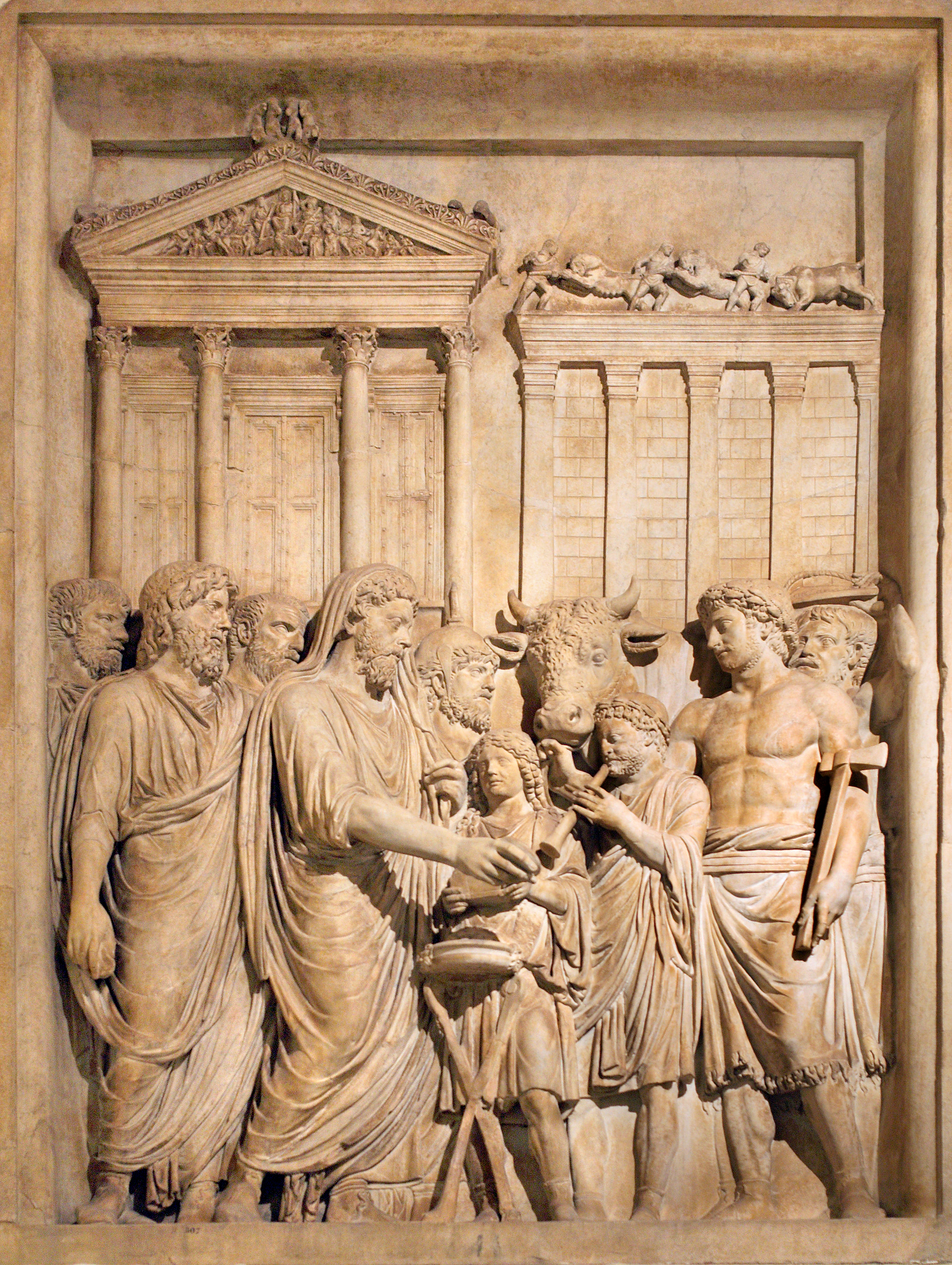
The Bull of Sacrifice
Roman religion was practical and contractual. It was based on the principle of do ut des, "I give that you might give". Religion depended on knowledge and the correct practice of prayer, ritual and sacrifice.
Vota pro salute rei publicae ("vows for the security of the republic") were offered at the beginning of the year on the day the consuls took office in the Republic.
Vota publica continued even after Christianity had become the official religion of the Empire. This practice ran as late as the 6th century.
The vows were as much affirmations of political loyalty as religious expressions. The people assembled on January 3 to offer collective vows for the salus ("health, safety, wellbeing") of the emperor during the empire.
The public side of religion was more organized and more formal than the private. The paterfamilias or head of the family performed religious rituals for the household at home.
Gods were worshiped for the benefit of the state beyond the home. Colleges of highly trained priests and priestesses were employed.
The government and the Romans in general tended to be tolerant towards most religions and cults. Some religions were banned for political reasons rather than dogmatic zeal. Rites which involved human sacrifice were banned.
The Patricians knew Greek philosophy as well as the stories of polytheism. The school of Elea promoted the monotheism of the monad as a way to consider the value of meaning in the expression of language.
The diversity of opinions founded on beliefs in different deities suggested a state of civilization that would not develop much beyond the primitive state of nature.
Cruelty and violence were entertained as natural elements in human nature. Social hierarchy was fractured to favor decentralization in political organization.
Monotheistic faith was viewed as a necessary development from polytheistic culture. Something unified for the state of the nation was necessary for the credibility of the social contract.
Christianity presented itself as a favorable vehicle for the Roman version of the Judaic moral code in societal relations.
There must have been a strong sense that the Roman polytheistic emphasis on tradition would never allow for a transition to the worship of a single deity, particularly one that was revered by the people of the Middle East.
They were viewed as too organized in their cruelty to those in their empire and in their violence to those outside of it. Some may have even been aware that the idea of covenant had been derived from the Middle East as drawn from the Far East.
The Roman perpetuation of Greek culture however favored the treatment of their civilization as barbaric. The stories circulated to promote the fear of imperial power didn't discourage the view.
The votum was a regular part of ceremonies conducted at the Capitoline by a general holding imperium before deployment. The triumph with its dedication of spoils and animal sacrifices at the Capitol was in part a fulfillment of such a vow.
Poor people had to be supplied with employment or some other means of conveyance. A basic feature in the system was that the organization of public religion would provide food for people through festival celebrations.
The distribution of the public duty to officials to provide for the feasts of the festivals found favor in that which was established about the polytheistic calendar of sacrifice.
The deacons in Christianity were placed in charge of the distribution of bread for those who were in need in the community. The name for the office indicated that those selected had to be willing to serve. They were appointed by the apostles for the distribution of alms (Acts 6:3).
The following passage from the second letter to the Thessalonians indicates that there were those who sough to exploit the distribution by not offering their labor in exchange for their food.
2 Thess. 3:6-13
We command you, beloved, in the name of our Lord Jesus Christ, to keep away from believers who are living in idleness and not according to the tradition that they received from us. You know how you ought to imitate us.
We were not idle when we were with you. We did not eat anyone's bread without paying for it. We worked night and day with toil so we might not burden any of you. This was not because we do not have that right, but in order to give you an example to imitate.
We gave you this command when we were with you: Anyone unwilling to work should not eat. We heard that some of you are living in idleness, mere busybodies, not doing any work. Such persons we command and exhort in the Lord Jesus Christ to do their work quietly and to earn their own living.
Do not weary in doing what is right, brothers and sisters.
-----------------------
We were not idle when we dwelt among you.
We worked so the group would not be burdened by our few.
Imitate us in the providence of faith.
Don't depend on being served by others as your state.
=================
The Temple
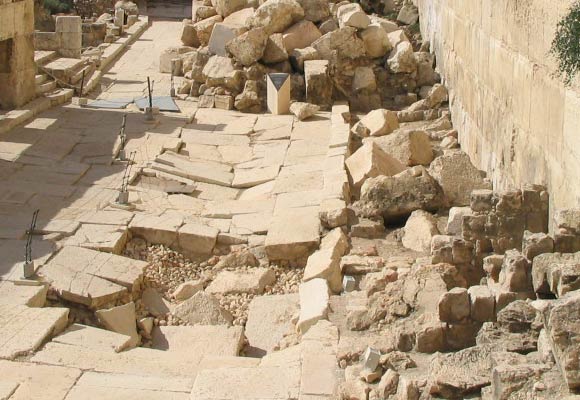
The stones at the base of the western wall in Jerusalem tell the tale of what happened on August 10, 70 CE. The stones had been heaved 50 feet over the wall onto the Herodian street adjacent to the Temple. Every block had been pried apart. Not one was left standing on the site.
The only stone left from the building was the foundation stone. It is now located under the Dome of the Rock. There is a small hole in the southeastern corner that enters a cavern beneath the called the Well of Souls.
The cave is partly natural and partly man made. The name is taken from a medieval Islamic legend. It was said that the spirits of the dead can be heard awaiting Judgment Day at this place.
When the Crusaders took Jerusalem in 1099 they converted the Dome of the Rock into a church. They called it the Templum Domini (Temple of the Lord).
Some of the physical changes to the site were radical. The entrance was enlarged. Much of the rock in the cavern was cut away to make staircases. The stone floor was paved over with marble slabs. The shaft ascending from the center of the chamber was most likely added.
The Crusaders called the cave the Holy of Holies. It was identified as the location for the annunciation of John the Baptists birth. There had been a place in the Temple called the Holy of Holies.
The destruction of the Temple represented the dissolution of the capital for the kingdom that had been established by the Romans as a client state. The state religion was also dissolved. This made the synagogues the institution for the preservation of Judaism.
Most of the synagogues unearthed in archaeological excavations in Israel, the State of Palestine and the Golan Heights date from the Roman and Byzantine periods from the 3d to 7th centuries.
Synagogues from before the destruction of the Second Temple in 70 CE include Gamla, Masada and Herodium.
The earliest synagogue inscription uncovered to date is in Greek and dates to the first century BCE or the first century CE. It was discovered in the City of David, just south of the Temple Mount in Jerusalem.
It was inscribed to Theodotos. It described the purpose for the synagogue. It was for reading the Torah, study of the commandments and lodging travelers.
Jesus taught in synagogues according to the gospels. There are more than 10 passages that refer to his instruction there.
One was in Capernaum in Galilee (Mk.1:21-8). The synagogue that stands in Capernaum in northern Israel on the coast of the Sea of Galilee was built several centuries after the time of Jesus. The evidence for a first-century construct there is disputed.
The Acts of the Apostles suggests that Paul taught in a synagogue in which he had been invited to speak. (Acts 17:1-2)
The practice of prayer with or without sacrifice which was to be so central to the synagogue had already begun in the Temple. There was a court yard where people could gather, but only Levites could enter the sanctuary and only the high priest could enter the holy of holies.
Synagogue is a Greek word meaning "assembly." It is compared with the Hebrew Qahal and contrasted with Ecclesia, a group called out from the larger community.
The assembly of people for the purpose of study and prayer started in the Babylonian exile after the destruction of the first Temple.
Jewish scholars believe Ezekiel's reassuring promise that God would provide a "sanctuary" (11:16) for his people is a reference to the small groups that gathered in their homes during the exile to recall God's covenant, his law and the redemptive promises of the prophets.
It is likely that these godly people, having learned a hard lesson about the importance of obedience to God, assembled regularly to study his Torah to prevent the sins of their ancestors from being repeated.
A group of experts in the law and its interpretation taught and studied in small associations at humble locations called "houses of study." These places of study are the roots of the synagogue, a sanctuary to inspire obedience to the law of God.
Communal worship in the time while the Temple still stood centered around the korbanot ("sacrificial offerings") brought by the kohanim ("priests") in the Temple in Jerusalem. The all-day Yom Kippur service was an event in which the congregation both observed the movements of the kohen gadol ("the high priest") as he offered the day's sacrifices and prayed for his success.
Synagogues were used for a variety of purposes in the first century according to Josephus. They were used as schools, hostels, courts and political meetings. Scholars disagree about the extent of communal prayers, but the literary sources suggest that Jews prayed in at least some synagogues at this time.
The prediction of the 'Day of the Lord" was first used by Isaiah in the Hebrew Bible. It refers to temporal events such as the invasion of a foreign army, the capture of a city and the suffering that befalls the inhabitants. Other prophets alluded to the presumption of a final judgment at the end of time.
The predictions in Christian Scriptures may refer to the writer's own times or it may refer to predicted events in a later age of earth's history including the final judgment. The following passage in the gospel of Luke alludes to the destruction of the Temple.
It was predicted that not one stone would be left to stand on another.
A number of wars in the form of Jewish rebellions had been fought. Josephus was a leader in the rebel army that made Masada its stronghold. This was also one of the locatons of a known synagogue in the first century.
There had been others who unlike Jesus claimed to be the Messiah.
The persecution of Christians was started presumably during the reign of Nero. This had preceded the invasion by Vespasian and the subsequent conquest of Jerusalem by his son, Titus.
https://www.sbl-site.org/assets/pdfs/pubs/9780884143208_OA.pdf
Luke 21:5-19
When some were speaking about the temple, how it was adorned with beautiful stones and gifts dedicated to God, he said, 'As for these things that you see, the days will come when not one stone will be left upon another; all will be thrown down.'
They asked him, 'Teacher, when will this be, and what will be the sign that this is about to take place?' He said, 'Beware taht you are not led astray; for many will come in my name and say. "I am he!" and "The time is near!" Do not go after them.
'When you hear of wars and insurrections, do not be terrified. These things must take place first, but the end will not take place immediately.' Then he said to them, 'Nation will rise against nation and kingdom against kingdom. There will be great earthquakes, famines and plagues in various places. There will be dreadful portents and great signs from heaven.
'They will arrest and persecute you before all this occurs. They will hand you over to synagogues and prisons. You will be brought before kings and governors because of my name. This will give you an opportunity to testify. So make up your minds not to prepare your defense in advance.
'I will give you words and wisdom that none of your opponents will be able to withstand or contradict. You will be betrayed even by parents and brothers, by relatives and friends. They will put some of you to death. You will be hated by all because of my name. Not a hair of your head will perish. You will gain your souls by your endurance.'
-----------------------
There will be trials and tribulations before the end of time.
Live your life for goodness with joy that you may celebrate the sublime.
=================
Monotheism

It is arguable that when Plato wrote about the god, he meant Apollo. This inference would be drawn from knowledge about Greek culture, not from the summary of quotes made in the Platonic dialogs.
There is a distinction to be drawn between the deity as divine nature and the chief among deities. The Hindus have abstracted the divine nature from polytheism. The Godhead was a step beyond that. Reference to faith was then theologically reduced to fidelity to one God.
The Eleatics expressed deference to the monad as the source for creation. That all else is illusion is a distinct doctrine that has been expressed in Hindu instruction also.
The bible documents that while the theology of the prophets was monotheistic, the belief of the aristocracy and the people didn't rule out polytheism. There is a value to psychology that is realistic about the reconstruction of classical consciousness in human nature.
Freud's psychoanalytic reduction appeared redundant in the identification of the Oedipal inclination as the cause of mental malady, but western civilization has suffered from a redundant obsession with rebellion, revolution, terrorism or invasion as the way to achieve political change.
Timaeus argued that since nothing "becomes or changes" without cause, then the cause of the universe must be a demiurge or a god. This demiurge was called the father and maker of the universe.
Insofar as fairness exists in the universe, the demiurge must have looked to the eternal model to make it. The perishable paradigm was subject to subjectivity in change.
Plato (429-348 BCE)
Timaeus (360)
Text
"God took of the unchangeable and indivisible and also of the divisible and corporeal, and out of the two he made a third nature, essence, which was in a mean between them, and partook of the same and the other, the intractable nature of the other being compressed into the same."
-----------------------
The maker of the universe was the Father
with the Son as his Word for the power that bothers
to care for the creation by watching over the hours.
Essence was the compaction of the indivisible inside of corporeal form
that gave matter its shape as a functional entity from the immaterial storm.
=================
-----------------------
Idealism v. Pragmatism

Roman state religion purported to be inclusive, but monotheism was persecuted as a form for centuries.
The kingdom of Judah was replaced with the republic of Palestine. Jews were forbidden to live in Jerusalem. Judaism was defined by the Roman media as the cause of rebellion. Christianity was treated as a delinquent derivative of Judaism.
Roman society entertained the consideration of monotheism through philosophy. The Eleatic school had adopted a distinctly Brahministic overview of religion. This was accepted and perpetuated by Plato and Aristotle.
The Timaeus presented the demiurge as the Creator. The metaphysics of Aristotle posited the existence of an unmoved Mover as the controlling principle for the universe. The one deity was not defined as the Creator. Matter was defined as eternal.
Traditional polytheists resisted the change with stories about the persecution of Jews and Christians.
Christianity did not hold true to the promise of an inclusive state religion. The edict of toleration was countered and contradicted by legislation that defined the official state religion as the only legal entity.
It would seem at this point that the answer from the Republican or the Constitutional monarchical views would be to define legal religion legislatively. Given the experience with the institution of slavery, it seems likely that it will be easier to define that which is not legal.
Religion cannot promote rebellion, revolution, terrorism or invasion. There is legislation against terrorism. Terrorism presents as a base element for rebellion or revolution. No one whether he or she is a member of a religious community or not, can use the threat of damage or death to force political change on the government.
William James sidestepped the whole issue of official state sanction when he defined religion as a social institution derived from religious organization based on mystical experience.
The view entertained the consideration of psychological health as the baseline for the acceptance of variety. Pragmatic logical concerns were included with respect for coherence and consistency.
The variety proposed by James as healthy for society was more broad in scope than the treatment of legislation against terrorism. The essential consideration has been incorporated in state laws that prohibit harm to self or others. Harm that approximates damage is regarded as mentally ill.
Royce was more direct in his approach to the study of religion. He recommended objective analysis that favored community as opposed to personal organization. The consideration of the moral code as an object allowed for devotion in worship in religious ceremonies.
It seems that political as well as religious organization can only allow for so much debate or disagreement with respect for functional operation in practical application. The disruption of political events is punishable by removal from the event. Any property or bodily damage caused by the disrupter is charged as a criminal offense.
Religious worship cannot entertain dispute or debate during devotional celebration. The agreement of the religious community assumes that worship observe expressions that have been approved prior to the celebration. Any change has to be vetted in the poltical organization for the religious social body.
James defined pragmatism as the resolution of disagreement between empiricism and rationalism. The definition of religion that is legal is pragmatic. People are allowed by law to define the value of religion for themselves insofar as no damage is incurred in the process.
William James (1842-1910)
Pragmatism (1907)
Text
"Pragmatism represents a perfectly familiar attitude in philosophy, the empiricist attitude, but it represents it, as it seems to me, both in a more radical and in a less objectionable form than it has ever yet assumed. A pragmatist turns his back resolutely and once for all upon a lot of inveterate habits dear to professional philosophers. He turns away from abstraction and insufficiency, from verbal solutions, from bad a priori reasons, from fixed principles, closed systems, and pretended absolutes and origins. He turns towards concreteness and adequacy, towards facts, towards action, and towards power."
-----------------------
Pragmatism turns from insufficiency as promoted by abstraction
towards action that results in benefit from power without factions.
=================

Saul Kripke
b. 11.13.1940
Saul Kripke is an American logician associated with the development of modal logic. He has been a central figure in a number of fields related to mathematical reason.
His critical analysis is non-classical in the philosophy of language. He argued that necessity is a metaphysical notion that is not a priori. There are necessary truths that are a posteriori. That 'water is H2O' is an example.
His work Naming and Necessity (1970) evaluated the relation between names in terms of possibility or necessity. The distinction of what is necessary has significance in the meaning of the name in logical argument.
Gottlob Frege had said that if an identity statement such as "Hesperus is the same planet as Phosphorus" is to be informative, the proper names flanking the identity sign must have a different meaning or sense.
Hesperus is the evening star. Phosphorus is the name for the same planet as it appears in the sky in the morning. There would be no compelling reason to identify Hesperus with Phosphorus as the explanation of an event, if they were not the same planet.
The statement that 'Venus is Venus' is not meaningful. If is meaningful to those who didn't know to say that the morning and evening stars have been identified as the planet Venus.
The statement had to have the same descriptive reference to make it true. A 'mode of presentation' serves to illuminate only a single aspect of the referent.
The name "Aristotle" is just a sort of shorthand for a definite description such as "The last great philosopher of ancient Greece" or "The teacher of Alexander the great" or some conjunction of two or more such descriptions according to Bertrand Russell.
Such descriptions must be reduced to a certain very specific logical form of existential generalization according to his theory of definite descriptions.
The sentence "The king of France is bald" becomes ]x(K(x) &y(K(y) --> x = y) & B(x). This means that there is an object 'x' such that 'x' is the King of France and 'x' is bald. Definite descriptions or names have no reference. Their meanings are just the truth conditions of the logical forms illustrated.
Descriptivism and the descriptive theory of proper names came to be associated with both the views of Frege and Russell. Both addressed the problem of names without bearers in a similar way.
Kripke offered what has come to be known as "the modal argument" or the "argument from rigidity" against descriptivism.
Consider the descriptions "the greatest student of Plato," "the founder of logic" and "the teacher of Alexander." The name Aristotle satisfies all of the descriptions, but it is not a necessary truth that if Aristotle existed then he was any one, or all, of these descriptions.
He might have existed to not have become known to posterity or he might have died in infancy.
Suppose that Aristotle had been associated with the description “the last great philosopher of antiquity” by Terry and the actual Aristotle had died in infancy. Terry's description would then refer to Plato. Names have to be "rigid designators," according to Kripke. They refer to the same individual in every possible world in which that individual exists.
Aristotle means "the greatest student of Plato," "the founder of logic" and "the teacher of Alexander" for descriptivists. The expression “the greatest student of Plato" means that "Aristotle was the greatest student of Plato."
If there is a set of properties that speaker A believes to be associated with X, then these properties must be already known by the speaker. They are a priori in this sense.
The second argument employed by Kripke has come to be called the "argument from unwanted necessity". This is simply the observation that if the meaning of "Angela Merkel" is "the Chancellor of Germany," then the statement "Angela is the Chancellor of Germany" should seem to the average person to be a priori, analytic and trivial.
It would not merit the expression to someone who knew the association. It would be like saying that a bachelor is unmarried to those who were not trying to make the unmarried into criminals by the implication of homosexuality.
If a unique object satisfies the properties associated with 'X' such that A believes that 'X has such-and-such properties', it picks out or refers to that object.
People may associate inadequate or inaccurate descriptions with proper names. Kripke uses Kurt Gödel as an example. The only thing most people know about Gödel is that he proved the incompleteness of arithmetic.
Suppose he hadn't proved such a thing. What if his friend Schmidt had argued that arithmetic is incomplete. If most of the properties associated with 'Gödel' are satisfied by Schmidt, then he is the referent for 'Gödel.'
Kripke wrote, "...even if archeologists or geologists were to discover tomorrow some fossils conclusively showing the existence of animals in the past satisfying everything we know about the unicorns from the myth, that would not show that there were unicorns."
(Naming and Necessity)
------------------------
Naming is rated by the modes of necessity.
Possibility precedes the charge of electricity.
===================
The discovery would lack cultural significance in the relevant necessity of truth.
That climate change is happening has not met with great debate. That industrial management is the only cause of the increase in global temperatures as a measure for the degree of change is subject to disagreement.
That climate change has contributed to the strength of hurricanes and tornadoes or the number of forest fires has not been denied. It is feasible that the size of the increase is measurable. The methods deemed necessary to decrease the increase are debatable.
Kripke's examples purported to render descriptivism implausible as a theory of how names get their reference determined.
Subsequent publications on Wittgenstein, the theory of truth, the semantics of belief reports and other areas sparked an industry of philosophical commentary and criticism.
----------------------

Alvin Plantinga
b. 11.15.1932 Ann Arbor, MI
Alvin Plantinga is an American analytic philosopher who works primarily in the fields of philosophy of religion, epistemology and logic.
He served as president of the Society of Christian Philosophers from 1983 to 1986. He has delivered the Gifford Lectures two times and was described by Time magazine as "America's leading orthodox Protestant philosopher."
William Lane Craig wrote in his work Reasonable Faith that he considers Plantinga to be the greatest Christian philosopher alive.
Some of Plantinga's most influential works including God and Other Minds (1967), The Nature of Necessity (1974). He wrote a trilogy of books on epistemology, culminating in Warranted Christian Belief (2000). The epistemic justification was simplified in Knowledge and Christian Belief (2016).
Ann Arbor, Michigan
Ann Arbor is located in the southeastern part of Michigan. The speculators John Allen and Elisha Rumsey founded the city in 1824. They named it for their wives who shared the same name. The stands of bur oak in the area gave the attachment 'Arbor' its place next to their spouses' name.
The University of Michigan was established there in 1837 after the town lost the bid to become the state capital. The history of the university has been closely linked with that of Ann Arbor ever since.
The town became a regional transportation hub in 1839 with the arrival of the Michigan Central Railroad. A north–south railway connecting Ann Arbor to Toledo and other markets to the south was established in 1878.
Settlers continued to migrate to the area through the the 1840's and the 1850's. The earlier settlers were primarily of British ancestry. Germans, Irish and African Americans came later.
Ann Arbor was chartered as a city in 1851. The city showed a drop in population during the Depression of 1873. It saw robust growth in the early 1880's. New emigrants came from Greece, Italy, Russia and Poland.
Mills provided the predominant industry for growth for the manufacturing industry. Ann Arbor's Jewish community grew after the turn of the 20th century. Its first and oldest synagogue, Beth Israel Congregation, was established in 1916.
The city gained a reputation as an important center for liberal politics in the 1960's and 1970's. It became a locus for left-wing activism and anti-Vietnam War protests as a student movement.
Countercultural and New Left enterprises sprang up and developed constituencies within the city. These influences washed into municipal politics during the early and mid-1970's. Three members of the Human Rights Party (HRP) won city council seats on the strength of the student vote.
HRP representatives fought for measures that included an antidiscrimination ordinance, the decriminalization of marijuana possession and a rent-control ordinance during their time on the council.
A small group of conservative institutions were born along with the leftist groups. These included the Word of God. The a charismatic inter-denominational movement was established in 1967. The Thomas More Law Center was established in 1999. This was a religious-conservative advocacy group.
Alvin Plantinga
Alvin Plantinga was born on November 15, 1932, in Ann Arbor, Michigan. His parents were Cornelius A. Plantinga (1908–1994) and Lettie G. Bossenbroek (1908–2007). Plantinga's father was a first-generation immigrant, born in the Netherlands.
His family is from the Dutch province of Friesland. They lived on a relatively low income until he secured a teaching job in Michigan in 1941.
Plantinga's father earned a PhD in philosophy from Duke University and a master's degree in psychology. He taught several academic subjects at different colleges over the years.
His father urged him to skip his last year of high school and immediately enroll in college after Plantinga completed 11th grade. He reluctantly followed his father's advice and enrolled in Jamestown College in Jamestown, North Dakota in 1949, a few months before his 17th birthday.
His father accepted a teaching job at Calvin College, in Grand Rapids, Michigan. He moved to Grand Rapids with his family and enrolled in Calvin College in January 1950.
He spent two semesters at Harvard beginning in the fall of 1950. He attended a few philosophy classes at Calvin College during the Spring recess at Harvard. He was so impressed with the philosophy professor William Harry Jellema that he returned in 1951 to study philosophy there.
He began his graduate studies at the University of Michigan in 1954. He transferred to Yale a year later. He received his PhD in 1958.
Plantinga began his career as an instructor in the philosophy department at Yale in 1957. He became a professor of philosophy at Wayne State University during its heyday as a major center for analytic philosophy in 1958.
He accepted a teaching job at Calvin College where he replaced the retiring Jellema in 1963. He then spent the next 19 years at Calvin before moving to the University of Notre Dame in 1982. He retired from the University of Notre Dame in 2010.
He returned to Calvin College where he serves as the first holder of the William Harry Jellema Chair in Philosophy.
Plantinga has presented some major arguments with respect for science, religion and politics within the contest of this theism.
Naturalism and Science
Plantinga has argued that belief in naturalism and evolution doesn't work. Dawkins had asserted that theism is incompatible with naturalism. Plantinga argued that evolution is incompatible with atheistic naturalism.
Evolution selects for mechanisms that produce beliefs that perpetuate survival. The belief forming mechanisms that led us to accept evolution and naturalism are unreliable according to atheism. Naturalism rules out belief in evolution.
Plantinga argued that the conflict between science and theistic religion is superficial. The conflict is actually drawn from illusion. Religion is in accord with knowledge when it is scientific and morally sound. Objective science doesn't presume to argue against the existence of God.
Plantinga's definition of "evolution" includes an ancient earth, the appearance of increasingly complex life forms over time and descent with modification from a common ancestor. The scientific definition for "Darwinism" is limited to the thesis that the principal mechanism driving evolutionary change is natural selection operating on random genetic change.
He expressed agreement with what C.S. Lewis defined as Christian in Mere Christianity. Christians who don't believe that God is a person are not categorized as Christian.
Christianity does not imply six literal days of creation or anything else that is obviously incompatible with the deliverances of science. The success of science is a striking yet unsurprising development of the imago dei in humanity.
Free Will and the Ontological Argument
The argument for the problem asserts that the existence of evil is inconsistent with the claim that God is omniscient, omnipresent, omnipotent and omnibenevolent.
Kripke has added the modal considerations of necessity and possibility to critical analysis.
Plantinga added greatness and excellence to the ontological argument for the existence of God. This gave a form of weight to the logical considerations of necessity or possibility.
J.L. Mackie had removed the claim to omnipresence from the logical analysis.
Plantinga argued that it is possible that there is a being that has maximal greatness. A being has maximal excellence in a given possible world W if it is omnipotent, omniscient and all good in W. It is necessarily true that an omniscient, omnipotent and omnibenevolent being exists.
The argument for excellence is beneficial in the identification of the question 'what is best' in any given situation. This position amounts to agreement to the claim of supremacy without the papal office as the key recipient of the benefit.
The king or chief elected official would be the key beneficiary of this argument. The religious leader appointed by him would be his advisor and co-beneficiary. It is still the major argument for Protestant reform. The leader of the state is the head of the Church.
The claim to papal supremacy had resulted in the competition for greater authority in the investiture of power to a person in office during the ontological controversy.
There is this difficulty.
Government that functions to represent rights for people is necessarily moral in order to achieve actual results in civility. This suggests favor for the religious office.
Those in government have to compete with those who claim that immorality is what actually works whether they are running for election or working from an appointed position.
This gives favor to political office whether inherited or elected. This position is not a rejection of the authority of the pope. It argues against the claim to papal supremacy over political office.
The empirical argument against rationality affirmed that too much corporate knowledge was rejected with the reduction of consideration to personal agreement with logical expression in classical discovery.
Descartes didn't leave himself with less than enough to do, but the personal approval of what was logical and empirically verifiable necessarily became a social effort that required personal investiture in the exploration of knowledge derived from the classics.
Rationality also allowed for excessive reference to a priori argument or innate ideas as a form of justification. It can be asserted that Luther argued against slavery and colonial exploitation with his complaint against indulgences as the institutional error in the papal office.
While he was for moral rectitude as a duty and against rebellion as the means fo attain political change, socialism and radical political activism by reformed elements prevailed against his objections to immorality in leadership practice.
The empiricists for their part were too inductive in their argument. The royals had expressed a position against slavery and the mistreatment of primitive natives.
The empiricists allowed for the reincarnation of slavery and colonial exploitation. They added the requirement of experimental verification as a condition for the reconstruction of education that didn't necessarily include much investigation into the classics.
Their reduction of philosophical concern to perceptual particulars on the part of citizens limited reasonable participation in government. Participation by petition and logical argument were discouraged. The threat of rebellion anticipated the threat of revolution as the ways to control the decisions made by government.
Belligerent ignorance particularly from the House of Commons or the House of Representatives became the rule for 'order.' Whether the 'consensus' came from the Whigs with the threat of rebellion or Labour with the threat of revolution, mass media expression played a large role in the distortion of public perception to shape 'consensus.'
Plantinga's argument for excellence persuades against the formulation of false consensus.
Alvin Plantinga
T. 阿尔文·普兰丁加
S. 阿爾文·普蘭丁加
阿 A flatter 阿 a flatter A あ ア Ael 앨 al
尔 er you 爾 ji you ru る ル bin 빈 empty
文 wen gentle 文 bun sentence fin びん ビン Peul 플 play
普 Pu general 普 fu universal Pu ぷ プ laen 랜 LAN
兰 lan orchid 蘭 ran orchid ran らん ラン ting 팅 ting
丁 ding fourth 丁 cho street tin てぃん ティン ga 가 end
加 jia add 加 ka add ga が ガ
-----------------------
The Creator established free will
so the choice of goodness would fit the bill.
=================
wiki Alvin Plantinga
Gifford Lectures bio Plantinga
SEP: Epistemology Religion
IEP: Epistemology
SEP: Ontological Arguments
NY Times Books: Religion Plantinga
wiki Ann Arbor, Michigan