8.15.19
The Maiden
Be
Happy
要开心
Yào kāixīn
幸せになります
Shiawase ni narimasu
ps.34
Es laetus
The story is as old
as the discovery of gold.
The parents of the gifted
were threatened by how their gift was shifted.
They didn't chain me to test the beast,
but on my soul they made a feast.
I had said I am not better than those who came before me.
I prayed to die. 'Take my life.' it is too dark to see.
Be angry, but do not sin.
Happiness is a feeling that you will win.
Fireballs will drive through the night sky.
The Perseids will delight your eye.
I am the bread of life.
I will help you overcome strife.
I will be happy
with a dash of savvy.
You will never make the crab walk straight,
but you can hasten or delay the return to the sea as its fate.
Consider this
for your bliss.
Foreign rule
could be more cruel.
Private property is a responsibility.
Manage it well for your security.
Fear of love will flee from your heart.
Responsible behavior will be the end from the start.
Orientation will be the secret to which you bow.
It will trace enlightenment in how
to wield your trowel.
Time will edify space in the wow of now.
The West favors wheat to rice.
The right amount is always nice.
Happiness will be my praise.
Wisdom will guide me in my ways.
I will rejoice in the feel of reality
with the fruits of factuality.
Let those who listen hear
how gladness grows when truth is near.
Honest speech for truth is science.
It determines beauty in cultural reliance.
Proclaim the greatness of existence with me.
Let us transcend the beast of inhumanity.
I asked for help when it was needed to mend.
I bandaged cuts when my heart bled.
Escape from error
delivered me from terror.
Radiant as the light of day,
I didn't let shame cloud my way.
I called out in my affliction and I was heard.
Love delivered me from the burden of the absurd.
The message of deliverance embraces
those who value life with the aegis of happy faces.
Taste and see. Love is good.
Happy are those who rejoice as we should.
Respect the right to life.
Exercise with good health in your diet.
Use respect to set an example
for those who do not sample angles.
Even young panthers suffer hunger.
Hunger drives them to thunder on the prey down under.
The swirl of chance whirls through the forest.
The lucky hand conducts the chorus.
Those who read reality to find design
do not lack in the discovery of goodness for the mind.
Come youth. Listen to me.
The love of truth will set you free.
I will teach you to respect your rights.
You will win what would have been fights.
Who among you desires justified popularity
and would like the time to enjoy prosperity?
Speak truth to power.
Walk with justice by the hour.
Do not defend cruelty or violence.
Enjoy the benefits of serenity in silence.
Turn from evil. Do good.
Seek peace. Pursue it as you should.
Security protects those mainly
who take risk to value safety.
Punishment is not for destruction.
It is not as good as instruction,
but it is for the correction of insurrection
to root out the weeds in our perception.
Needs cry out. Selection detects them.
Judgment plans. Action tends to amend the withered stem.
Sympathy attends to brokenness. Empathy amends
what led to the breaking of harmony with our friends.
What we do know is this.
We will come to feel each other should we kiss.
Troubles attend the selection of goodness in design,
but effective production provides deliverance divine
from turbulent turmoil in time.
The Son was born of a woman in the fullness of time
to redeem us for adoption as children of the divine.
The Spirit was sent into our hearts to cry
'Abba! Dad!' You are our Father of lights from on high.
We are no longer slaves but decendents.
The offspring are heirs to the real presence.
The Lord GOD will make righteousness and praise spring up before the nations
as seeds give plants growth from the earth in gardened stations.
The quiet increase in the strength of August
produces thrust for us to trust.
Your reward will be great.
Your destiny will rise above your fate.
Security will protect your organization.
Structure will preserve your conceptual elation.
These are those who come from the great ordeal.
The blood of the land has revealed the deal.
The Virgin said, 'My soul magnifies the Lord as the Author of worth.
My spirit rejoices in light from the Savior above the earth.
He has looked with favor on his maiden.
My lowliness has been taken.
The generations will call me blessed.
The new world will test for what is best
in a way that is bereft of deceptive theft
for the war chest.
The least force necessary will correct a crisis.
Retribution will punish those who impose violence,
cruelty or oppression to silence self-reliance.
Restitution is the correction for accident
when repair does not increase damage that wasn't meant.
Those who do no harm will not be punished.
The tail of the scorpion will not admonish.
Those who do not require correction
will not be corrected in the intention
of seeking perfection.
-------------------------
Psalm 34
Benedicam Dominum
Thank the Dominant
1 I will bless the Lord at all times;
his praise shall ever be in my mouth.
2 I will glory in the Lord;
let the humble hear and rejoice.
3 Proclaim with me the greatness of the Lord;
let us exalt his Name together.
4 I sought the Lord, and he answered me
and delivered me out of all my terror.
5 Look upon him and be radiant,
and let not your faces be ashamed.
6 I called in my affliction and the Lord heard me
and saved me from all my troubles.
7 The angel of the Lord encompasses those who fear him,
and he will deliver them.
8 Taste and see that the Lord is good;
happy are they who trust in him!
9 Fear the Lord, you that are his saints,
for those who fear him lack nothing.
10 The young lions lack and suffer hunger,
but those who seek the Lord lack nothing that is good.
11 Come, children, and listen to me;
I will teach you the fear of the Lord.
12 Who among you loves life
and desires long life to enjoy prosperity?
13 Keep your tongue from evil-speaking
and your lips from lying words.
14 Turn from evil and do good;
seek peace and pursue it.
15 The eyes of the Lord are upon the righteous,
and his ears are open to their cry.
16 The face of the Lord is against those who do evil,
to root out the remembrance of them from the earth.
17 The righteous cry, and the Lord hears them
and delivers them from all their troubles.
18 The Lord is near to the brokenhearted
and will save those whose spirits are crushed.
19 Many are the troubles of the righteous,
but the Lord will deliver him out of them all.
20 He will keep safe all his bones;
not one of them shall be broken.
21 Evil shall slay the wicked,
and those who hate the righteous will be punished.
22 The Lord ransoms the life of his servants,
and none will be punished who trust in him.
-----------------------
Shah - king of kings
Cyrus - visionary
kyrios - lord
Darius - kingly; possesses
Xerxes - hero among rulers
Isaiah 61:11
As the earth brings forth its shoots
and as a garden causes what is sown in it to spring up
so the Lord GOD will cause righteousness and praise
to spring up before all the nations.
-----------------------
The Lord GOD will make righteousness and praise spring up before the nations
as seeds give plants growth from the earth in gardened stations.
=================
Gal. 4:4-7
When the fullness of time had come, God sent his Son, born of a woman, born under the law, in order to redeem those who were under the law, so we might receive adoption as children. God has sent the Spirit of his Son into our hearts to cry, 'Abba! Father!' You are no longer a slave but a child and if a child then an heir through God.
-----------------------
The Son was born of a woman in the fullness of time
to redeem us for adoption as children of the divine.
The Spirit was sent into our hearts to cry
Abba! Dad! You are our Father of lights from on high.
You are no longer a slave but a descendent.
The offspring is the heir to the real presence.
=================
Luke 1:46-8
Mary said,
'My soul magnifies the Lord.
My spirit rejoices in God my Savior.
He has looked with favor on the lowliness of his maiden.
Surely, all generations will call me blessed.'
-----------------------
The Virgin said, 'My soul magnifies the Lord as the Author of worth.
My spirit rejoices in light from the Savior above the earth.
He has looked with favor on his maiden.
My lowliness has been taken.
The generations will call me blessed.
The new world will test for what is best
in a way that is bereft of deceptive theft
for the war chest.
=================
Heaven to Earth
Temple of Artemis
It was conceivable that the Temple of Artemis in Ephesus could be renamed for the Virgin Mary according to the plan to convert Roman religion from polytheism to monotheism.
Diana was the goddess of wild animals and the hunt in Roman religion. She was the Latin counterpart to the Greek Artemis.
Her name is akin to the Latin words dium (“sky”) and dius (“daylight”). She was also the matron for domestic animals.
Mary would come to be identified with fisherman, boats and livestock.
Mary, Mother of Jesus
b. 9.9.18 BCE Nazareth, Galilee
d. 8.15.41 CE Ephesus, Asia (Pergamum)
Mary was a Jewish woman from Nazareth in Galilee. She was the mother of Jesus according to the New Testament and the Quran.
She has been venerated since early Christianity. She has been considered by millions to be the most meritorious saint of the religion.
The Eastern and Oriental Orthodox, Catholic, Anglican and Lutheran churches believe that Mary is the Theotokos (God-bearer) as the mother of Jesus. Mary also has a revered position in Islam. One of the longer chapters of the Quran is devoted to her.
Honor is paid to Mary on August 15th each year as the day of her Dormition or 'falling asleep.' The feast is also celebrated for her assumption into heaven. This honor extends goes back to the earliest days of the Church.
She is commonly referred to as the Virgin in Christianity. This name is ascribed in accordance with the belief that she conceived Jesus miraculously through the Holy Spirit without her husband's involvement.
The New Testament records several incidents from the life of the Virgin. She was betrothed to Joseph (Matt.1:18). The Annunciation of the Conception was made by the angel Gabriel that Mary was to bear the Messiah (Luke 1:29-33). She made a Visitation to Elizabeth the mother of John the Baptist (Luke 1:39). The Census led Joseph and Mary to Bethlehem. (Luke 2:1)
The Nativity of Jesus took place in Bethlehem with the visits of the shepherds and the magi (Luke 2:7ff.). The Presentation of the infant was made in the Temple at the age of forty days (Luke 2:22). The flight into Egypt to avoid persecution from Herod was told in Matthew (Matt.2:13).
The Passover visit to the Temple when Jesus was twelve is told in Luke (Luke 2:41). The wedding at Cana in Galilee and the performance of her Son's first miracle at her intercession is unique to John (John 2:1-11). The occasion when observers said, "How can this man be special? We know his family!" is told in all four gospels. (Matt. 13:54-56 = Mk. 6:1-3 = Luke 4:22; also John 6:42).
The occasion when Mary went with others to see him while he was preaching is synoptic (Matthew 12:46-50 = Mark 3:31-35 = Luke 8:19-21). Her presence at the foot of the Cross where Jesus commends her to the care of the Beloved Disciple is recorded in the gospel of John (John 19:25-27).
Her presence with the apostles in the upper room after the Ascension waiting for the promised Spirit is presented in the Acts of the Apostles (Acts 1:14). She was seen to be present at most of the chief events of her Son's life.
Assumption Day commemorates the belief that when Mary, the mother of Jesus Christ, died, her body was not subjected to the usual process of physical decay but was “assumed” into heaven and reunited there with her soul.
This holiday has been celebrated since the fourth century CE, but it is a Christianization of an earlier harvest festival. It is known as the Feast of Our Lady of the Harvest in many parts of Europe.
Celebrations were held in the honor of the goddess Isis of the Sea for centuries. She was born on this day according to mythology. Church leaders decided that the easiest way to handle this pagan ritual was to simply change it into a Christian holiday.
The Assumption was not always an official dogma of the Roman Catholic Church. Pope Pius XII ruled it so in 1950.
While there is not an explicit biblical reference to the appearance of the constellation Virgo in the bible, there is an implicit association with the celebration of the feast of Mary with the astrological celebration of the sign.
Remnants of the ancient celebration include night time bonfires and public illuminations. Some Italian plazas were flooded in previous years. Citizens would ride through the temporary “lakes” in carriages.
It was common for people to carry bowls of rose-scented water which they sprinkled on themselves. This was a carryover from a pagan ritual in which the gods were petitioned to provide adequate rainfall for the crops as a tribute to the pagan goddess Isis of the Sea.
Blue is the color most often associated with the Virgin Mary. It symbolizes truth and clarity. The lily is a symbol of purity, chastity and simplicity. It is also associated with the Virgin
Those born in the sign of Virgo are born between Aug. 22 and Sept. 22. The celebration of the Virgin Mary takes place a week before the recognition of the sign. The constellation appears in the late August or early September night sky.
The poet Aratus wrote about the constellation in his poem "Phenomena" sometime around 277 BCE.
"Phenomena"
a poem by Aratus
Text
"Beneath both feet of Boötes [Farmer] mark the Maiden [Virgo], who in her hands bears the gleaming Ear of Corn [Spica]. Whether she be daughter of Astraeus, who, men say, was the father of the stars, or child of other sire, untroubled be her course!
"But another tale is current among men, how of old she dwelt on earth and met men face to face, nor ever disdained in olden time the tribes of men and women, but mingling with them took her seat, immortal though she was.
"Her men called her Justice; but she assembling the elders, it might be in the market-place or in the wide-wayed streets, uttered her voice, ever urging on them judgements kinder to the people."
-------------------------------------
The Song of Mary in the bible (Luke 1:46-55) describes Mary as singing of herself as blessed with mercy for generations. Her reference to God as having cast down the mighty from their thrones echoes the sentiment expressed by Plato about slavery.
He stated that there were no kings that were not descended from slaves. Neither were there slaves that had not had kings in their lineage. It is a commentary that alludes to justice as a manifestation in the length of time. The belief that Christ is the liberator of those held captive to slavery contributed to the outlawing of the slave trade and the institution.
Either Mary or Elizabeth can be referred to as 'Justice' insofar as they gave birth to Jesus and John. Both were advocates for justice with mercy in society.
The moon for August 15, 2019 is full. This is a phase that occurs when the rays of the sun's light are reflected back toward the earth.
The Sun emanates energy as well as light. It gives us heat. It sends electro-magnetic pulses with solar flares. The Moon reflects frequencies. These energy waves influence the tides, our bodies, our emotions and our consciousness.
The celebration of her nativity will take place in September in proximity to the time that the constellation will appear in the night sky. The celebration of her life lends meaning to the description of her character as ever-virgin in relation to the cosmic event.
The Septuagint was an ancient translation of the Hebrew bible into Greek. It is said that 70 scholars worked on the translation. Septuagint is Latin for seventy. The Latin translation was made from the Greek.
The translation wasn't always exact in word or spirit. When the bible first speaks of a beautiful young maiden as a wife to be in Gen.24:16, the Septuagint describes her as a virgin virgin as opposed to a young unmarried woman.
The Septuagint did not mimic the Hebrew exactly. There are rough or imprecise translations. The Hebrew of Genesis 24:16 for example described a “young woman who was a virgin,” but the Septuagint was content with near matches for vocabulary. The phrase was changed into the silly expression “a virgin who was a virgin.”"
----------------
There are different traditions with regard for what the title 'ever-virgin' means in the life of Mary. Eastern Orthodoxy continues to accept Joseph's prior marriage and children. She was virgin. He was not. Jerome doubly secured Mary's virginity by proposing that Joseph was a virgin also in the West.
The 'siblings' of Jesus were cousins. This view is still regarded as Roman Catholic. Protestants eventually decided that Joseph and Mary had additional children. The difference in opinion is drawn from the meaning of the term, 'Ever-Virgin.' The controversy is relevant to the institution of marriage as a union blessed by the Church.
Mary could have been betrothed to Joseph at 12 years of age according to ancient Jewish custom.
There is a the suggestion that some Church fathers had actually doubted whether Mary and Joseph's union could be called a marriage. There was question as to whether Joseph could actually be called Jesus' father. The verdict was mixed.
The Protoevangelium of James is regarded as an apocryphal text, but it goes into detail about the early life of Mary and her marriage at 12 years of age. The commentary of a number of early Fathers is included at this cite. The Nestorian controversy was a major dispute in the history of the Church over the significance of Mary in her relation to Jesus with respect for their titles.
Only two humans are mentioned by name in the Creeds. One is Pontius Pilate. He was the Roman procurator of Judea from 26 to 36 AD. That Jesus was crucified by order of Pontius Pilate pins down the date of his death within a few years.
It certifies that we are not talking, like the worshipers of Tammuz or Adonis, about a personification or symbol of the annual death and resurrection of the crops. His death is an event in history, something that really happened.
The other name is that of Mary. The Creeds say that Christ was "born of the virgin Mary." This means that they assert that his nature was truly and fully human. Jesus was born of a woman and not descended from the skies like an angel.
The belief that he was simply an ordinary man who was so virtuous that he eventually at his baptism became filled with the Spirit of God is excluded.
His virgin birth attests to the fact that he was always more than merely human. His title as Son of God had to distinguish him from that of the polytheistic emperor as the son of Mars, the god of war.
This presence of his divine person among us was in itself a miracle from the first moment of his earthly existence. God gives us a sign that Jesus is both truly God and truly Man in Mary the Virgin and Mother.
wiki Mary, Mother of Jesus
Church Fathers The Ever Virgin
Showing posts with label deliverance. Show all posts
Wednesday, August 14, 2019
Thursday, August 8, 2019
Write
8.9.19
Write
Piety
写虔诚
Xiě qiánchéng
敬意を書く
Keii o kaku
ps119.49
Scribere pietate
The Word of God existed before creation.
He wrote faith with piety as a path to salvation.
Heavenly Word, you gave us reason for scope.
The measure of how things work helps us to cope.
Remember the word that you gave for hope.
Your promise was the zenith beyond the height of the slope.
This is my comfort in the day of trouble
that your covenant helped me to win the struggle.
The proud have derided me for flaw
but I have not turned from your law.
When I remember your judgement
I take comfort in the adjustment
that made us triumphant
at the moral summit.
I have been filled with a burning desire
to correct the damage caused by angry raging fire.
Your statutes have been like songs to a stranger
whenever I needed deliverance from danger.
I remember your Name in the night
as the Lord who gave me insight.
Your law has given the enchantment
of the benign design of your commandments.
You are my portion in the land.
Your words are my meridian.
I entreat you with all my heart.
Be merciful to me for my part.
I have considered your decrees
and how they deliver me from disease.
I do not delay to perform my duty
that achievement may become a thing of beauty.
Though the words of the wicked seek to entangle,
your law gives me the better angle.
I rise at night to give you thanks
for the security of money in the bank.
I am a companion to all who revere you
with sublime direction to steer true.
The earth is full of your instruction
in how to organize material for production.
You have made goodness
for the wealth of human fullness.
Teach me discernment for knowledge
that defines a paradigm to solve the problem.
I went astray before I was afflicted.
Now your word helps me keep my thought restricted.
Your goodness brings forth more
instruction in how to keep score.
Divine law will be written on our hearts.
God will be the writer for the pious arts.
Empathy for others is the power of the recognized thread
on the level of human nature as the designated bread.
The proud have smeared trust in truth with lies.
The experience of your word bares youthful eyes.
Their heart is grossly flawed
by distaste for delight in your law.
You taught me to learn from affliction
to avoid pain with plausible prediction.
The recognition of mistake
is worth its weight
in changing fate.
Conversion is birth by the Spirit.
Inspiration is the guide for those who hear it.
Birth by the Spirit causes conversion
by the experience of baptismal immersion.
Write piety on your experience in life.
It will take you to the height above strife.
---------------------------
Psalm 119
Zayin
The Phoenician letter appears to be named after a sword or other weapon. Zayin (זין) means "sword" in Biblical Hebrew. The verb lezayen (לזיין) means "to arm".
Memor esto verbi tui
Remember the word you
49 Remember your word to your servant,
because you have given me hope.
50 This is my comfort in my trouble,
that your promise gives me life.
51 The proud have derided me cruelly,
but I have not turned from your law.
52 When I remember your judgments of old,
O Lord, I take great comfort.
53 I am filled with a burning rage,
because of the wicked who forsake your law.
54 Your statutes have been like songs to me
wherever I have lived as a stranger.
55 I remember your Name in the night, O Lord,
and dwell upon your law.
56 This is how it has been with me,
because I have kept your commandments.
Heth Portio mea, Domine
My portion of land, Sir
57 You only are my portion, O Lord;
I have promised to keep your words.
58 I entreat you with all my heart,
be merciful to me according to your promise.
59 I have considered my ways
and turned my feet toward your decrees.
60 I hasten and do not tarry
to keep your commandments.
61 Though the cords of the wicked entangle me,
I do not forget your law.
62 At midnight I will rise to give you thanks,
because of your righteous judgments.
63 I am a companion of all who fear you
and of those who keep your commandments.
64 The earth, O Lord, is full of your love;
instruct me in your statutes.
Teth Bonitatem fecisti
Made Goodness
65 O Lord, you have dealt graciously with your servant,
according to your word.
66 Teach me discernment and knowledge,
for I have believed in your commandments.
67 Before I was afflicted I went astray,
but now I keep your word.
68 You are good and you bring forth good;
instruct me in your statutes.
69 The proud have smeared me with lies,
but I will keep your commandments with my whole heart.
70 Their heart is gross and fat,
but my delight is in your law.
71 It is good for me that I have been afflicted,
that I might learn your statutes.
72 The law of your mouth is dearer to me
than thousands in gold and silver.
------------------------
=================
------------------------
Jeremiah 31:33
This is the covenant that I will make with the house of Israel after those days, says the LORD: I will put my law within them. I will write it on their hearts. I will be their God and they will be my people.
------------------------
Divine law will be written on our hearts.
God will be the writer for the pious arts.
==================
Nicodemus- victory for people
John 3:4-8
Nicodemus said to him, 'How can anyone be born after having grown old? Can one enter a second time into the mother's womb and be born?' Jesus answered, 'I tell you no one can enter the kingdom of God without being born of water and Spirit. What is born of the flesh is flesh. What is born of the Spirit is spirit. Do not be astonished that I said to you, "You must be forn from above." The wind blows where it chooses. You hear the sound of it, but you do not know where it comes from or where it goes. So it is with everyone who is born of the Spirit.'
------------------------
Conversion is birth by the Spirit.
Inspiration is the guide for those who hear it.
==================
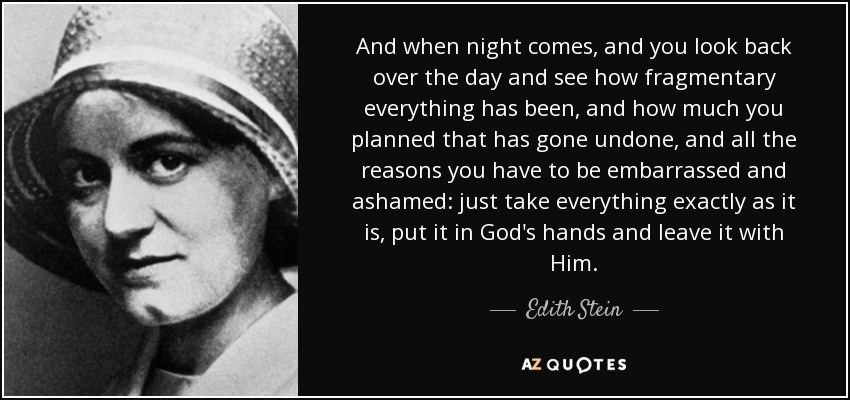
Fragmentary Consciousness
Edith Stein
b. 10.12.1891 Breslau, German Empire
d. 8.9.1942 Auschwitz-Birkenau, German occupied Poland
Edith Stein was a German Jewish philosopher who converted to Roman Catholicism. She became a Discalced Carmelite nun. Discalced is derived from Latin. It means "without shoes." The asceticism for the sub-order was more pronounced.
Breslau
The city named Breslau in the German Empire is now called Wroclaw (Vroclaf). It is located in the east central part of Poland.
It has been part of the Kingdom of Poland, Kingdom of Bohemia, Kingdom of Hungary, Habsburg Monarchy, Prussia and Germany. Wrocław became part of Poland again in 1945 as a result of the border changes after the Second World War. The changes included a nearly complete exchange of population.
Napoleonic redevelopments increased prosperity in Silesia and the city. The leveled fortifications opened space for the city to grow beyond its old limits.
Breslau became an important railway hub and industrial center. Linen and cotton manufacture and metal industry were notable.
The reconstructed university served as a major center for science. Secularization laid the base for a museum landscape. Johannes Brahms wrote his Academic Festival Overture to thank the university for an honorary doctorate awarded in 1881.
The Diocese of Breslau was disentangled from the Polish ecclesiastical province (archbishopric) in Gniezno in 1821. The action made Breslau an exempt bishopric.
The Jewish Theological Seminary opened on 10 October 1854. The institution was the first modern rabbinical seminary in Central Europe.
The brothers Karl and Louis Stangen founded the travel agency Stangen in 1863. This was the second travel agency in the world.
The Unification of Germany in 1871 turned Breslau into the sixth-largest city in the German Empire. Its population more than tripled to over half a million between 1860 and 1910. The 1900 census listed 422,709 residents.
Construction began on Breslau Fortress in 1890. The construction of the first infantry shelters that were part of the fortress began on April 24, 1890. Nineteen infantry shelters were built by 1901.
The shelters were built as three-layer structures in the years 1891–1895. The casemate vault was made in the form of a brick barrel, above it was a one-meter thick sand cushion and on it rested a granite-concrete detonation slab.
This type of construction was used in Prussian fortifications from 1887. It was to overcome the effects of introducing new artillery shells with a delayed fuse to the battlefield.
The 1900 census listed 98% as German-speakers with 5,363 Polish-speakers (1.3%) and another 3,103 (0.7%) speaking both German and Polish.
The population was 58% Protestant, 37% Catholic (including at least 2% Polish) and 5% Jewish (totaling 20,536 in the 1905 census). The Jewish community of Breslau was among the most important in Germany. They produced several distinguished artists and scientists.
Edith Stein
Edith Stein was born in Breslau on 12 October 1891 in an observant Jewish family. She was the youngest of 11 children and was born on Yom Kippur. Her day of birth made her a favorite of her mother.
Her mother encouraged critical thought. Edith was a gifted child who enjoyed her education. She admired her mother's strong religious faith, but she became an atheist as a teenager.
Her father died while she was young, but her widowed mother was determined to give her children a thorough education. She was sent to the University of Breslau.
She traveled to Göttingen in April 1913 to study for the summer semester with Edmund Husserl. She had decided to pursue her degree in philosophy under Husserl by the end of the summer. She chose "Empathy" as her thesis topic.
Her studies were interrupted in July 1914 because of the outbreak of World War I. She then served as a volunteer wartime Red Cross nurse in an infectious disease hospital at Märisch-Weisskirchen in 1915. Marish-Wiesskirchen is now Hranice, Czechia, formerly Czechoslovakia. It is located about 785 km (~490 miles) from Gottingen.
Stein moved to Freiburg in order to complete her dissertation on Empathy in 1916. She became a teaching assistant at the University of Freiburg. She agreed to become Husserl's assistant before receiving her degree. Husserl had transferred to the university.
While Stein had earlier contacts with Roman Catholicism she was drawn to the Catholic Faith by reading the works of the reformer of the Carmelite Order, Teresa of Avila. She read the autobiography of the mystic Teresa during her summer holidays in Bad Bergzabern in 1921.
She wanted to become a Discalced Carmelite nun, but was dissuaded by her spiritual mentors. She then taught at a Catholic school of education in Münster from 1923 to 1931.
She translated Thomas Aquinas' De Veritate (Of Truth) into German, familiarized herself with Roman Catholic philosophy in general and tried to bridge the phenomenology of her teacher, Husserl, to Thomism.
She visited Husserl and Heidegger at Freiburg in April 1929, the same month that Heidegger gave a speech to Husserl on his 70th birthday. She became a lecturer at the Catholic Church-affiliated Institute for Scientific Pedagogy in Münster in 1932.
Legislation for the requirement of an "Aryan certificate" for civil servants was promulgated by the Nazi government in April 1933 as part of its Law for the Restoration of the Professional Civil Service.
The word Aryan was adopted to refer not only to the Indo-Iranian peoples, but also to native Indo-European speakers as a whole. This included the Romans, Greeks and the Germans. It was recognized that Balts, Celts, and Slavs also belonged to the same group. The term was used academically as a general description for Caucasians.
The purest stock of Aryans according to Nazi ideology was the Nordic people of Germany, England, Denmark, the Netherlands, Sweden and Norway.
The Nazis defined Nordics as being identified by tall stature (average 175 cm), long faces, prominent chins, narrow and straight noses with a low bridge, lean builds, doliocephalic skulls, straight light hair, light eyes and fair skin.
The Nazis claimed that Germanic people specifically represented a southern branch of the Aryan-Nordic population
The Nazi use of the term was regarded as a code to exclude Jews from employment.
It had a social connection with the aggressive theology of the priest Arius whose teaching had been rejected as heretical by the Council of Nicaea in 325. Arius had associated teaching about the Son with the demiurge. The Son was not co-equal with the Father in this view.
The demiurge was defined as creative, but destruction was assumed as necessary to restructure society. This destructiveness was assumed as part of the role of the Son in the expansion of empire by military aggression.
Edith was admitted to the Discalced Carmelite monastery in Cologne the following October. She received the religious habit of the Order as a novice in April 1934. She took the religious name Teresa Benedicta of the Cross ("Teresa blessed by the Cross").
Her sister Rosa was also a convert and an extern Sister of the monastery by then. They were sent to the Carmelite monastery in Echt, Netherlands for their safety in 1938.
Stein's move to Echt prompted her to be more devout and even more observant of the Carmelite rule. She eased back into the role of instructor at the convent in Echt, teaching both fellow sisters and students within the community Latin and philosophy.
They were not arrested despite the Nazi invasion of the state in 1940. Edith made a will and wrote to the Prioress to offer herself as a sacrifice for atonement in the heart of Jesus. She began to quietly train herself for life in a concentration camp by enduring cold and hunger.
The Dutch Bishops' Conference had a public statement read in all the churches of the nation on 20 July 1942 condemning Nazi racism. The Reichskommissar of the Netherlands, Arthur Seyss-Inquart, ordered the arrest of all Jewish converts who had previously been spared in a retaliatory response on 26 July 1942.
Edith and her sister were arrested by the SS on 2 August 1942 along with 243 baptized Jews living in the Netherlands. They were sent to two different concentration camps.
Edith and her sister were among the 987 Jews who were deported to the Auschwitz concentration camp on 7 August 1942. It was reported that they were exterminated in the gas chamber. A Red Cross investigation denied the veracity of that form of execution.
That they were deported and forced to live without recognition as citizens was still an illegal action.
-------------------------
Edith Stein
S. 伊迪丝·斯坦
T. 伊迪絲·斯坦
伊 Yi she 伊 i Italy E え エ E 에 on
迪 di enlighten 迪 teki edify di でぃ ディ di 디 d
丝 si string 絲 shi thread su す ス teu 트 t
斯 Si this 斯 shi this Shu しゅ シュ Syu 슈 shu
坦 tan smooth 坦 tan level ta た タ ta 타 ta
in いん イン in 인 sign
------------------------
Empathy for others is the power of recognized thread
on the level of human nature as the designated bread.
==================
Lectionary Edith Stein
wiki Edith Stein
Franciscan Life and Legacy ES
Oxford Summary
Gutenberg Article ES
Article ES
wiki Siege of Breslau
Phenomenology lent itself to idealism and socialist ideology. It was rigorously dogmatic in scientific exposition. It was more like science was dictating the way to perceive phenomena to the investigator. The scientist wasn't encouraged to enjoy exploration or the description of discovery. Edith was only able to relate it to Aquinas because it wasn't explicitly anti-religious.
Write
Piety
写虔诚
Xiě qiánchéng
敬意を書く
Keii o kaku
ps119.49
Scribere pietate
The Word of God existed before creation.
He wrote faith with piety as a path to salvation.
Heavenly Word, you gave us reason for scope.
The measure of how things work helps us to cope.
Remember the word that you gave for hope.
Your promise was the zenith beyond the height of the slope.
This is my comfort in the day of trouble
that your covenant helped me to win the struggle.
The proud have derided me for flaw
but I have not turned from your law.
When I remember your judgement
I take comfort in the adjustment
that made us triumphant
at the moral summit.
I have been filled with a burning desire
to correct the damage caused by angry raging fire.
Your statutes have been like songs to a stranger
whenever I needed deliverance from danger.
I remember your Name in the night
as the Lord who gave me insight.
Your law has given the enchantment
of the benign design of your commandments.
You are my portion in the land.
Your words are my meridian.
I entreat you with all my heart.
Be merciful to me for my part.
I have considered your decrees
and how they deliver me from disease.
I do not delay to perform my duty
that achievement may become a thing of beauty.
Though the words of the wicked seek to entangle,
your law gives me the better angle.
I rise at night to give you thanks
for the security of money in the bank.
I am a companion to all who revere you
with sublime direction to steer true.
The earth is full of your instruction
in how to organize material for production.
You have made goodness
for the wealth of human fullness.
Teach me discernment for knowledge
that defines a paradigm to solve the problem.
I went astray before I was afflicted.
Now your word helps me keep my thought restricted.
Your goodness brings forth more
instruction in how to keep score.
Divine law will be written on our hearts.
God will be the writer for the pious arts.
Empathy for others is the power of the recognized thread
on the level of human nature as the designated bread.
The proud have smeared trust in truth with lies.
The experience of your word bares youthful eyes.
Their heart is grossly flawed
by distaste for delight in your law.
You taught me to learn from affliction
to avoid pain with plausible prediction.
The recognition of mistake
is worth its weight
in changing fate.
Conversion is birth by the Spirit.
Inspiration is the guide for those who hear it.
Birth by the Spirit causes conversion
by the experience of baptismal immersion.
Write piety on your experience in life.
It will take you to the height above strife.
---------------------------
Psalm 119
Zayin
The Phoenician letter appears to be named after a sword or other weapon. Zayin (זין) means "sword" in Biblical Hebrew. The verb lezayen (לזיין) means "to arm".
Memor esto verbi tui
Remember the word you
49 Remember your word to your servant,
because you have given me hope.
50 This is my comfort in my trouble,
that your promise gives me life.
51 The proud have derided me cruelly,
but I have not turned from your law.
52 When I remember your judgments of old,
O Lord, I take great comfort.
53 I am filled with a burning rage,
because of the wicked who forsake your law.
54 Your statutes have been like songs to me
wherever I have lived as a stranger.
55 I remember your Name in the night, O Lord,
and dwell upon your law.
56 This is how it has been with me,
because I have kept your commandments.
Heth Portio mea, Domine
My portion of land, Sir
57 You only are my portion, O Lord;
I have promised to keep your words.
58 I entreat you with all my heart,
be merciful to me according to your promise.
59 I have considered my ways
and turned my feet toward your decrees.
60 I hasten and do not tarry
to keep your commandments.
61 Though the cords of the wicked entangle me,
I do not forget your law.
62 At midnight I will rise to give you thanks,
because of your righteous judgments.
63 I am a companion of all who fear you
and of those who keep your commandments.
64 The earth, O Lord, is full of your love;
instruct me in your statutes.
Teth Bonitatem fecisti
Made Goodness
65 O Lord, you have dealt graciously with your servant,
according to your word.
66 Teach me discernment and knowledge,
for I have believed in your commandments.
67 Before I was afflicted I went astray,
but now I keep your word.
68 You are good and you bring forth good;
instruct me in your statutes.
69 The proud have smeared me with lies,
but I will keep your commandments with my whole heart.
70 Their heart is gross and fat,
but my delight is in your law.
71 It is good for me that I have been afflicted,
that I might learn your statutes.
72 The law of your mouth is dearer to me
than thousands in gold and silver.
------------------------
=================
------------------------
Jeremiah 31:33
This is the covenant that I will make with the house of Israel after those days, says the LORD: I will put my law within them. I will write it on their hearts. I will be their God and they will be my people.
------------------------
Divine law will be written on our hearts.
God will be the writer for the pious arts.
==================
Nicodemus- victory for people
John 3:4-8
Nicodemus said to him, 'How can anyone be born after having grown old? Can one enter a second time into the mother's womb and be born?' Jesus answered, 'I tell you no one can enter the kingdom of God without being born of water and Spirit. What is born of the flesh is flesh. What is born of the Spirit is spirit. Do not be astonished that I said to you, "You must be forn from above." The wind blows where it chooses. You hear the sound of it, but you do not know where it comes from or where it goes. So it is with everyone who is born of the Spirit.'
------------------------
Conversion is birth by the Spirit.
Inspiration is the guide for those who hear it.
==================
Fragmentary Consciousness
Edith Stein
b. 10.12.1891 Breslau, German Empire
d. 8.9.1942 Auschwitz-Birkenau, German occupied Poland
Edith Stein was a German Jewish philosopher who converted to Roman Catholicism. She became a Discalced Carmelite nun. Discalced is derived from Latin. It means "without shoes." The asceticism for the sub-order was more pronounced.
Breslau
The city named Breslau in the German Empire is now called Wroclaw (Vroclaf). It is located in the east central part of Poland.
It has been part of the Kingdom of Poland, Kingdom of Bohemia, Kingdom of Hungary, Habsburg Monarchy, Prussia and Germany. Wrocław became part of Poland again in 1945 as a result of the border changes after the Second World War. The changes included a nearly complete exchange of population.
Napoleonic redevelopments increased prosperity in Silesia and the city. The leveled fortifications opened space for the city to grow beyond its old limits.
Breslau became an important railway hub and industrial center. Linen and cotton manufacture and metal industry were notable.
The reconstructed university served as a major center for science. Secularization laid the base for a museum landscape. Johannes Brahms wrote his Academic Festival Overture to thank the university for an honorary doctorate awarded in 1881.
The Diocese of Breslau was disentangled from the Polish ecclesiastical province (archbishopric) in Gniezno in 1821. The action made Breslau an exempt bishopric.
The Jewish Theological Seminary opened on 10 October 1854. The institution was the first modern rabbinical seminary in Central Europe.
The brothers Karl and Louis Stangen founded the travel agency Stangen in 1863. This was the second travel agency in the world.
The Unification of Germany in 1871 turned Breslau into the sixth-largest city in the German Empire. Its population more than tripled to over half a million between 1860 and 1910. The 1900 census listed 422,709 residents.
Construction began on Breslau Fortress in 1890. The construction of the first infantry shelters that were part of the fortress began on April 24, 1890. Nineteen infantry shelters were built by 1901.
The shelters were built as three-layer structures in the years 1891–1895. The casemate vault was made in the form of a brick barrel, above it was a one-meter thick sand cushion and on it rested a granite-concrete detonation slab.
This type of construction was used in Prussian fortifications from 1887. It was to overcome the effects of introducing new artillery shells with a delayed fuse to the battlefield.
The 1900 census listed 98% as German-speakers with 5,363 Polish-speakers (1.3%) and another 3,103 (0.7%) speaking both German and Polish.
The population was 58% Protestant, 37% Catholic (including at least 2% Polish) and 5% Jewish (totaling 20,536 in the 1905 census). The Jewish community of Breslau was among the most important in Germany. They produced several distinguished artists and scientists.
Edith Stein
Edith Stein was born in Breslau on 12 October 1891 in an observant Jewish family. She was the youngest of 11 children and was born on Yom Kippur. Her day of birth made her a favorite of her mother.
Her mother encouraged critical thought. Edith was a gifted child who enjoyed her education. She admired her mother's strong religious faith, but she became an atheist as a teenager.
Her father died while she was young, but her widowed mother was determined to give her children a thorough education. She was sent to the University of Breslau.
She traveled to Göttingen in April 1913 to study for the summer semester with Edmund Husserl. She had decided to pursue her degree in philosophy under Husserl by the end of the summer. She chose "Empathy" as her thesis topic.
Her studies were interrupted in July 1914 because of the outbreak of World War I. She then served as a volunteer wartime Red Cross nurse in an infectious disease hospital at Märisch-Weisskirchen in 1915. Marish-Wiesskirchen is now Hranice, Czechia, formerly Czechoslovakia. It is located about 785 km (~490 miles) from Gottingen.
Stein moved to Freiburg in order to complete her dissertation on Empathy in 1916. She became a teaching assistant at the University of Freiburg. She agreed to become Husserl's assistant before receiving her degree. Husserl had transferred to the university.
While Stein had earlier contacts with Roman Catholicism she was drawn to the Catholic Faith by reading the works of the reformer of the Carmelite Order, Teresa of Avila. She read the autobiography of the mystic Teresa during her summer holidays in Bad Bergzabern in 1921.
She wanted to become a Discalced Carmelite nun, but was dissuaded by her spiritual mentors. She then taught at a Catholic school of education in Münster from 1923 to 1931.
She translated Thomas Aquinas' De Veritate (Of Truth) into German, familiarized herself with Roman Catholic philosophy in general and tried to bridge the phenomenology of her teacher, Husserl, to Thomism.
She visited Husserl and Heidegger at Freiburg in April 1929, the same month that Heidegger gave a speech to Husserl on his 70th birthday. She became a lecturer at the Catholic Church-affiliated Institute for Scientific Pedagogy in Münster in 1932.
Legislation for the requirement of an "Aryan certificate" for civil servants was promulgated by the Nazi government in April 1933 as part of its Law for the Restoration of the Professional Civil Service.
The word Aryan was adopted to refer not only to the Indo-Iranian peoples, but also to native Indo-European speakers as a whole. This included the Romans, Greeks and the Germans. It was recognized that Balts, Celts, and Slavs also belonged to the same group. The term was used academically as a general description for Caucasians.
The purest stock of Aryans according to Nazi ideology was the Nordic people of Germany, England, Denmark, the Netherlands, Sweden and Norway.
The Nazis defined Nordics as being identified by tall stature (average 175 cm), long faces, prominent chins, narrow and straight noses with a low bridge, lean builds, doliocephalic skulls, straight light hair, light eyes and fair skin.
The Nazis claimed that Germanic people specifically represented a southern branch of the Aryan-Nordic population
The Nazi use of the term was regarded as a code to exclude Jews from employment.
It had a social connection with the aggressive theology of the priest Arius whose teaching had been rejected as heretical by the Council of Nicaea in 325. Arius had associated teaching about the Son with the demiurge. The Son was not co-equal with the Father in this view.
The demiurge was defined as creative, but destruction was assumed as necessary to restructure society. This destructiveness was assumed as part of the role of the Son in the expansion of empire by military aggression.
Edith was admitted to the Discalced Carmelite monastery in Cologne the following October. She received the religious habit of the Order as a novice in April 1934. She took the religious name Teresa Benedicta of the Cross ("Teresa blessed by the Cross").
Her sister Rosa was also a convert and an extern Sister of the monastery by then. They were sent to the Carmelite monastery in Echt, Netherlands for their safety in 1938.
Stein's move to Echt prompted her to be more devout and even more observant of the Carmelite rule. She eased back into the role of instructor at the convent in Echt, teaching both fellow sisters and students within the community Latin and philosophy.
They were not arrested despite the Nazi invasion of the state in 1940. Edith made a will and wrote to the Prioress to offer herself as a sacrifice for atonement in the heart of Jesus. She began to quietly train herself for life in a concentration camp by enduring cold and hunger.
The Dutch Bishops' Conference had a public statement read in all the churches of the nation on 20 July 1942 condemning Nazi racism. The Reichskommissar of the Netherlands, Arthur Seyss-Inquart, ordered the arrest of all Jewish converts who had previously been spared in a retaliatory response on 26 July 1942.
Edith and her sister were arrested by the SS on 2 August 1942 along with 243 baptized Jews living in the Netherlands. They were sent to two different concentration camps.
Edith and her sister were among the 987 Jews who were deported to the Auschwitz concentration camp on 7 August 1942. It was reported that they were exterminated in the gas chamber. A Red Cross investigation denied the veracity of that form of execution.
That they were deported and forced to live without recognition as citizens was still an illegal action.
-------------------------
Edith Stein
S. 伊迪丝·斯坦
T. 伊迪絲·斯坦
伊 Yi she 伊 i Italy E え エ E 에 on
迪 di enlighten 迪 teki edify di でぃ ディ di 디 d
丝 si string 絲 shi thread su す ス teu 트 t
斯 Si this 斯 shi this Shu しゅ シュ Syu 슈 shu
坦 tan smooth 坦 tan level ta た タ ta 타 ta
in いん イン in 인 sign
------------------------
Empathy for others is the power of recognized thread
on the level of human nature as the designated bread.
==================
Lectionary Edith Stein
wiki Edith Stein
Franciscan Life and Legacy ES
Oxford Summary
Gutenberg Article ES
Article ES
wiki Siege of Breslau
Phenomenology lent itself to idealism and socialist ideology. It was rigorously dogmatic in scientific exposition. It was more like science was dictating the way to perceive phenomena to the investigator. The scientist wasn't encouraged to enjoy exploration or the description of discovery. Edith was only able to relate it to Aquinas because it wasn't explicitly anti-religious.
Monday, June 10, 2019
Draw
6.11.19
Draw
Awe
画敬畏
Huà jìngwèi
畏敬の念を描きます
Ikei no nen o kakimasu
ps112
pavet trahere
Draw awe
from the beauty that you saw.
Happy are those who have the faith and awe
to take delight in the common law.
Their descendents will be healthy in the land.
The generation of the educated will be grand.
Wealth and order will be in their house.
Family trust will be their spouse.
Light shines in the darkness for those who wait.
Shape for form in substance becomes easy to appreciate.
It is good to produce something of value for surplus
to help manage affairs with reason for purpose.
The productive will not be shaken.
Service will last in remembrance. It won't be taken.
They will not be frightened by fake news.
Their heart is right. They won't lose.
Their resolve is established. It will not shrink.
The achievement of goals will not make them blink.
Their honor will stand fast forever.
They will remember the reward for effort.
Those who sought to do damage to honor will see their error.
They will turn back from their error with terror.
I have given you as a covenant.
You are a light for government.
Your deliverance from captivity
showed objectivity in law with relativity.
Those who had not seen will see
that the captives were set free
from the darkness of slavery
with faith in their future delivery.
The disciples spoke the word of faith to no one except the Jews
until the Hellenists were included in the good news.
The Jews had made education
in religion the vocation
for any nation.
The son of encouragement held the hope
that Gentiles would also take this rope
to learn to cope.
The kingdom of heaven has come near.
The paralyzed, possessed and blind will be delivered from their fear.
--------------------------
112 Beatus vir
Happy man
1 Hallelujah!
Happy are they who fear the Lord
and have great delight in his commandments!
2 Their descendants will be mighty in the land;
the generation of the upright will be blessed.
3 Wealth and riches will be in their house,
and their righteousness will last for ever.
4 Light shines in the darkness for the upright;
the righteous are merciful and full of compassion.
5 It is good for them to be generous in lending
and to manage their affairs with justice.
6 For they will never be shaken;
the righteous will be kept in everlasting remembrance.
7 They will not be afraid of any evil rumors;
their heart is right;
they put their trust in the Lord.
8 Their heart is established and will not shrink,
until they see their desire upon their enemies.
9 They have given freely to the poor,
and their righteousness stands fast for ever;
they will hold up their head with honor.
10 The wicked will see it and be angry;
they will gnash their teeth and pine away;
the desires of the wicked will perish.
---------------------------
====================
Isa. 42:6-7
I am the LORD, I have called you in righteousness.
I have taken you by the hand and kept you.
I have given you as a covenant to the people
as a light to the nations
to open the eyes that are blind
to bring the prisoners from the dungeon
from the prison whose who sit in darkness.
---------------------------
I have given you as a covenant.
You are a light for government.
Your deliverance from captivity
showed objectivity with relativity.
Those who had not seen will see
that the prisoners were set free
from the darkness of slavery.
====================
Acts 11:19-26
Those who were scattered because of the persecution that took place over Stephen travelled as far as Phoenicia, Cyprus and Antioch. They spoke the word to no one except the Jews. Some men of Cyprus and Cyrene spoke to the Hellenists on coming to Antioch. They proclaimed the Lord Jesus. The hand of the Lord was with them. A great number became believers. News of the conversion came to the ears of the church in Jerusalem. They sent Barnabas to Antioch. When he came and saw the grace of God, he rejoiced. He exhorted them all to remain faithful to the Lord with steadfast devotion. He was a good man, full of the Holy Spirit and faith. A great many people were brought to the Lord. Barnabas went to Tarsus to look for Saul. When he found him, he brought him to Antioch. It was there for an entire year they associated with the church and taught a great many people. It was in Antioch that the disciples were first called 'Christians.'
---------------------------
The disciples spoke the word of faith to no one except the Jews
until the Hellenists were included in the good news.
====================
Matt. 10:7-8
Proclaim the good news as you go, "The kingdom of heaven has come near." Cure the sick, raise the dead, cleanse the lepers, cast out demons."
---------------------------
The kingdom of heaven has come near.
The paralyzed, possessed and blind will be delievered from their fear.
====================
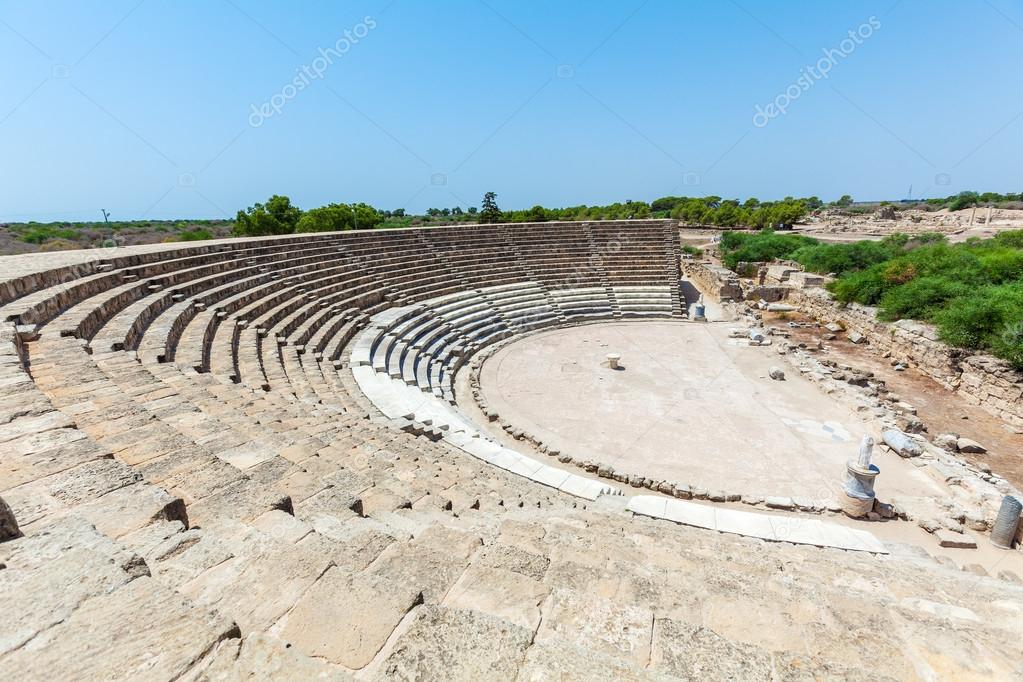
There was a classical influence on the island of Cyprus. The theater of Salamis is an example.
The Theater
Salamis, Cyprus
Salamis was an ancient Greek city-state on the east coast of Cyprus. It sits at the mouth of the river Pedieos 6 km north of modern Famagusta. The founder of Salamis was Teucer, son of Telamon, according to tradition. Teucer could not return home after the Trojan war because he had failed to avenge his brother Ajax.
The "cultural centre" of Salamis during the Roman period was situated at the northernmost part of the city. A gymnasium, theater, amphitheater, stadium and public baths have been revealed. There are baths, public latrines (for 44 users), various little bits of mosaic, a harbor wall, a Hellenistic and Roman agora and a temple of Zeus that had the right to grant asylum.
It was the island’s most important port city. Ships stopped there from the Middle East and from Europe in antiquity. Many of the ships came from the Aegean. Salamis was the largest city on the island during the Roman period. It surpassed even Paphos, the administrative capital.
Barnabas
Son of Encouragement
Barnabas of the Seventy was born on the island of Cyprus into the family of the tribe of Levi. He was named Joseph. He was a Cypriot Jew according to Acts 4:36.
Acts 4:36
Joseph, a Levite, born in Cyprus, whom the apostles called Barnabas (son of encouragement), sold a field he owned, brought the money, and turned it over to the apostles.
--------------------------
He received his education at Jerusalem with his friend and fellow student Saul, the future Apostle Paul, under the renowned teacher of the Law, Gamaliel.
He was one of the prominent Christian disciples in Jerusalem. He was named an apostle in Acts 14:14. His new name fits what is known of his actions. When Saul (or Paul) came to Jerusalem after his conversion, most of the Christians there wanted nothing to do with him. They had known him as a persecutor and an enemy of the Church.
Barnabas was willing to give him a second chance. He went to Tarsus, spoke with him and brought him to see the other Christians in Antioch. Later, Paul and Barnabas went on a missionary journey together. They took Mark with them. Mark turned back and went home before they had finished the mission.
Barnabas and Paul traveled together making more converts (c 45-47). They defended Gentile converts against the Judaizers.
They participated in the Council of Jerusalem (c 50). They successfully evangelized among the "God-fearing" Gentiles who attended synagogues in various Hellenized cities of Anatolia.
When they were about to set out on another such journey, Barnabas proposed to take Mark. Paul was against it. He said that Mark had shown himself undependable.
Barnabas wanted to give Mark a second chance. He and Mark went off on one journey. Paul took Silas and went on another. Apparently Mark responded well to the trust given him by the "son of encouragement." Paul later thought of him as a valuable assistant (2 Tim 4:11; see also Col 4:10 and Phil 24).
St. Peter's Church
Ancient Roman Road
Antakya, Turkey (Antioch)
Antakya was known as Antioch in ancient times. The city has historical significance for Christianity. It was the place where the followers of Jesus Christ were called Christians for the first time. The city and its massive walls also played an important role during the Crusades.
Late Antiquity
The city had a large population of Jewish origin in a quarter called the Kerateion. It attracted the earliest missionaries. It was evangelized by Peter himself among others. The Antiochene patriarchate still rests its claim for primacy according to this tradition.
It was the starting point for Barnabas and Paul during the first missionary journey. Its converts were the first to be called Christians. This is not to be confused with Antioch in Pisidia, to which the early missionaries later travelled.
Several small Christian communities are still active in the city. The largest church is St. Peter and St. Paul on Hurriyet Caddesi. The long history of spiritual and religious movements makes Antakya a place of pilgrimage for Christians.
The city is home to a functioning synagogue serving the Jewish community. It has a reputation in Turkey as a place for spells, fortune telling, miracles and spirits.
The location near the Syrian border makes the city more cosmopolitan than many cities in Turkey. It did not attract the mass immigration of people from eastern Anatolia in the 1980's and 1990's that radically swelled the populations of Mediterranean cities such as Adana and Mersin. Both Turkish and Arabic are still widely spoken in Antakya. Written Arabic is rarely used.
A mixed community of faiths and denominations co-exist peacefully here. Most of the inhabitants are Muslim. A substantial proportion adhere to the Alevi and the Arab Alawi traditions. There is a place to honor the Alawite saint Hızır in 'Harbiye.' Numerous tombs of saints for both the Sunni and Alawite are located throughout the city.
Barnabas
S. 巴拿巴
T. 巴拿巴
巴 Ba to hope 巴 ha comma design Ba バ ば Ba 바 bar
拿 na to hold 拿 da catch ru ル る na 나 I
巴 ba to desire 巴 ha to hope na ナ な na 나 I
ba バ ば
---------------------------
The Jews had made education
in religion the vocation
for any nation.
The son of encouragement held the hope
that Gentiles would also take this rope
to learn to cope.
====================
wiki Barnabas
Lectionary Barnabas
OCA Apostle Barnabas
Slideshow Antioch on the Orontes
wiki Antakya
wiki Antioch Late Antiquity
wiki Salamis, Cyprus
Bible Places Salamis
Draw
Awe
画敬畏
Huà jìngwèi
畏敬の念を描きます
Ikei no nen o kakimasu
ps112
pavet trahere
Draw awe
from the beauty that you saw.
Happy are those who have the faith and awe
to take delight in the common law.
Their descendents will be healthy in the land.
The generation of the educated will be grand.
Wealth and order will be in their house.
Family trust will be their spouse.
Light shines in the darkness for those who wait.
Shape for form in substance becomes easy to appreciate.
It is good to produce something of value for surplus
to help manage affairs with reason for purpose.
The productive will not be shaken.
Service will last in remembrance. It won't be taken.
They will not be frightened by fake news.
Their heart is right. They won't lose.
Their resolve is established. It will not shrink.
The achievement of goals will not make them blink.
Their honor will stand fast forever.
They will remember the reward for effort.
Those who sought to do damage to honor will see their error.
They will turn back from their error with terror.
I have given you as a covenant.
You are a light for government.
Your deliverance from captivity
showed objectivity in law with relativity.
Those who had not seen will see
that the captives were set free
from the darkness of slavery
with faith in their future delivery.
The disciples spoke the word of faith to no one except the Jews
until the Hellenists were included in the good news.
The Jews had made education
in religion the vocation
for any nation.
The son of encouragement held the hope
that Gentiles would also take this rope
to learn to cope.
The kingdom of heaven has come near.
The paralyzed, possessed and blind will be delivered from their fear.
--------------------------
112 Beatus vir
Happy man
1 Hallelujah!
Happy are they who fear the Lord
and have great delight in his commandments!
2 Their descendants will be mighty in the land;
the generation of the upright will be blessed.
3 Wealth and riches will be in their house,
and their righteousness will last for ever.
4 Light shines in the darkness for the upright;
the righteous are merciful and full of compassion.
5 It is good for them to be generous in lending
and to manage their affairs with justice.
6 For they will never be shaken;
the righteous will be kept in everlasting remembrance.
7 They will not be afraid of any evil rumors;
their heart is right;
they put their trust in the Lord.
8 Their heart is established and will not shrink,
until they see their desire upon their enemies.
9 They have given freely to the poor,
and their righteousness stands fast for ever;
they will hold up their head with honor.
10 The wicked will see it and be angry;
they will gnash their teeth and pine away;
the desires of the wicked will perish.
---------------------------
====================
Isa. 42:6-7
I am the LORD, I have called you in righteousness.
I have taken you by the hand and kept you.
I have given you as a covenant to the people
as a light to the nations
to open the eyes that are blind
to bring the prisoners from the dungeon
from the prison whose who sit in darkness.
---------------------------
I have given you as a covenant.
You are a light for government.
Your deliverance from captivity
showed objectivity with relativity.
Those who had not seen will see
that the prisoners were set free
from the darkness of slavery.
====================
Acts 11:19-26
Those who were scattered because of the persecution that took place over Stephen travelled as far as Phoenicia, Cyprus and Antioch. They spoke the word to no one except the Jews. Some men of Cyprus and Cyrene spoke to the Hellenists on coming to Antioch. They proclaimed the Lord Jesus. The hand of the Lord was with them. A great number became believers. News of the conversion came to the ears of the church in Jerusalem. They sent Barnabas to Antioch. When he came and saw the grace of God, he rejoiced. He exhorted them all to remain faithful to the Lord with steadfast devotion. He was a good man, full of the Holy Spirit and faith. A great many people were brought to the Lord. Barnabas went to Tarsus to look for Saul. When he found him, he brought him to Antioch. It was there for an entire year they associated with the church and taught a great many people. It was in Antioch that the disciples were first called 'Christians.'
---------------------------
The disciples spoke the word of faith to no one except the Jews
until the Hellenists were included in the good news.
====================
Matt. 10:7-8
Proclaim the good news as you go, "The kingdom of heaven has come near." Cure the sick, raise the dead, cleanse the lepers, cast out demons."
---------------------------
The kingdom of heaven has come near.
The paralyzed, possessed and blind will be delievered from their fear.
====================
There was a classical influence on the island of Cyprus. The theater of Salamis is an example.
The Theater
Salamis, Cyprus
Salamis was an ancient Greek city-state on the east coast of Cyprus. It sits at the mouth of the river Pedieos 6 km north of modern Famagusta. The founder of Salamis was Teucer, son of Telamon, according to tradition. Teucer could not return home after the Trojan war because he had failed to avenge his brother Ajax.
The "cultural centre" of Salamis during the Roman period was situated at the northernmost part of the city. A gymnasium, theater, amphitheater, stadium and public baths have been revealed. There are baths, public latrines (for 44 users), various little bits of mosaic, a harbor wall, a Hellenistic and Roman agora and a temple of Zeus that had the right to grant asylum.
It was the island’s most important port city. Ships stopped there from the Middle East and from Europe in antiquity. Many of the ships came from the Aegean. Salamis was the largest city on the island during the Roman period. It surpassed even Paphos, the administrative capital.
Barnabas
Son of Encouragement
Barnabas of the Seventy was born on the island of Cyprus into the family of the tribe of Levi. He was named Joseph. He was a Cypriot Jew according to Acts 4:36.
Acts 4:36
Joseph, a Levite, born in Cyprus, whom the apostles called Barnabas (son of encouragement), sold a field he owned, brought the money, and turned it over to the apostles.
--------------------------
He received his education at Jerusalem with his friend and fellow student Saul, the future Apostle Paul, under the renowned teacher of the Law, Gamaliel.
He was one of the prominent Christian disciples in Jerusalem. He was named an apostle in Acts 14:14. His new name fits what is known of his actions. When Saul (or Paul) came to Jerusalem after his conversion, most of the Christians there wanted nothing to do with him. They had known him as a persecutor and an enemy of the Church.
Barnabas was willing to give him a second chance. He went to Tarsus, spoke with him and brought him to see the other Christians in Antioch. Later, Paul and Barnabas went on a missionary journey together. They took Mark with them. Mark turned back and went home before they had finished the mission.
Barnabas and Paul traveled together making more converts (c 45-47). They defended Gentile converts against the Judaizers.
They participated in the Council of Jerusalem (c 50). They successfully evangelized among the "God-fearing" Gentiles who attended synagogues in various Hellenized cities of Anatolia.
When they were about to set out on another such journey, Barnabas proposed to take Mark. Paul was against it. He said that Mark had shown himself undependable.
Barnabas wanted to give Mark a second chance. He and Mark went off on one journey. Paul took Silas and went on another. Apparently Mark responded well to the trust given him by the "son of encouragement." Paul later thought of him as a valuable assistant (2 Tim 4:11; see also Col 4:10 and Phil 24).
St. Peter's Church
Ancient Roman Road
Antakya, Turkey (Antioch)
Antakya was known as Antioch in ancient times. The city has historical significance for Christianity. It was the place where the followers of Jesus Christ were called Christians for the first time. The city and its massive walls also played an important role during the Crusades.
Late Antiquity
The city had a large population of Jewish origin in a quarter called the Kerateion. It attracted the earliest missionaries. It was evangelized by Peter himself among others. The Antiochene patriarchate still rests its claim for primacy according to this tradition.
It was the starting point for Barnabas and Paul during the first missionary journey. Its converts were the first to be called Christians. This is not to be confused with Antioch in Pisidia, to which the early missionaries later travelled.
Several small Christian communities are still active in the city. The largest church is St. Peter and St. Paul on Hurriyet Caddesi. The long history of spiritual and religious movements makes Antakya a place of pilgrimage for Christians.
The city is home to a functioning synagogue serving the Jewish community. It has a reputation in Turkey as a place for spells, fortune telling, miracles and spirits.
The location near the Syrian border makes the city more cosmopolitan than many cities in Turkey. It did not attract the mass immigration of people from eastern Anatolia in the 1980's and 1990's that radically swelled the populations of Mediterranean cities such as Adana and Mersin. Both Turkish and Arabic are still widely spoken in Antakya. Written Arabic is rarely used.
A mixed community of faiths and denominations co-exist peacefully here. Most of the inhabitants are Muslim. A substantial proportion adhere to the Alevi and the Arab Alawi traditions. There is a place to honor the Alawite saint Hızır in 'Harbiye.' Numerous tombs of saints for both the Sunni and Alawite are located throughout the city.
Barnabas
S. 巴拿巴
T. 巴拿巴
巴 Ba to hope 巴 ha comma design Ba バ ば Ba 바 bar
拿 na to hold 拿 da catch ru ル る na 나 I
巴 ba to desire 巴 ha to hope na ナ な na 나 I
ba バ ば
---------------------------
The Jews had made education
in religion the vocation
for any nation.
The son of encouragement held the hope
that Gentiles would also take this rope
to learn to cope.
====================
wiki Barnabas
Lectionary Barnabas
OCA Apostle Barnabas
Slideshow Antioch on the Orontes
wiki Antakya
wiki Antioch Late Antiquity
wiki Salamis, Cyprus
Bible Places Salamis
Sunday, June 2, 2019
Be
6.9.19
Natalie Portman
Be
Impartial
要公正
Yào gōngzhèng
公平に
Kōhei ni
ps33
et facti
Rejoice in impartiality those of you who desire justice.
It is good for the just to sing praise for divine augustness.
Praise augustness with the piano and sax
with grammar that is hallowed as the shallow in Halifax.
Make music with guitar and drums.
Take delight in caviar and conundrums.
Make a noise that sounds triumphant.
Play it so people can hear your trumpet.
Find the best explanation for how things work.
The word is right when joy in detection is perked.
The elements make substance in existence.
The unity of being reflects consonance with subsistence.
By the word of the Creator heaven was made.
By the breath of the Spirit came the breeze for the glade.
The waters of the ocean were gathered as fluid for sky.
The depths reach wonders where solutions lie.
Let all the earth revere noble loyalty.
The world will find that awe is the heart of royalty.
Logic ordered thoughts so the mind could see.
Reason spoke and it came to be.
When will is false it is brought to naught.
Design that damages ought not to be sought.
Divine will stands fast forever.
Design discerned with faith will be remembered.
Happy is the nation that defines borders to defend.
Joyful are those whose national security does not end.
Defense from attack is a legal unity.
Stand your ground in constitutional credulity.
Light shines down from heaven
to behold people in the presence
of legal essence.
The real presence sits enthroned at the heart of human life
for all who dwell on earth for the girth of its worth beyond the strife.
Hearts are fashioned for healthy relationship.
Functional operations permit good will as the championship.
Military service is an exercise in national security.
Strength is an element in faithful maturity.
Watchfulness preserves respect for deliverance.
Existence requires meaning for the gift of chance
to dance with consilience.
Fear is part of the relevance of reverence.
It sparks selective attention for environmental elements.
The sense of sanctity plucks lives from death
and feeds the hungry in famine's shibboleth.
Our soul waits for deliverance
with the help of the Deliverer.
Scripture said, "Out of the believer's heart shall flow rivers of living water."
Jesus said, "Let anyone who is thirsty come to me to drink" as an offer.
The empire of Babylon invested in learning many languages.
Captivity and construction made slavery a resultant damage.
These bones were told they would receive divine breath to live.
Skin would be laid on flesh and sinew to receive that which the Lord GOD would give.
Energy is conserved in transformation.
The moon lit the woods in confirmation.
The nurse rocked the infant as her affectionate occupation
Speaking good news in a foreign tongue
was granted as the Spirit gave the ability with love.
Our heart rejoices in salvation
for the name of the Savior for the nation
among nations.
Let the energy of God's love be with us
for our trust is in that which is divine about justice.
----------------------------
33 Exultate, justi
Exult, you impartial
1 Rejoice in the Lord, you righteous;
it is good for the just to sing praises.
2 Praise the Lord with the harp;
play to him upon the psaltery and lyre.
3 Sing for him a new song;
sound a fanfare with all your skill upon the trumpet.
4 For the word of the Lord is right,
and all his works are sure.
5 He loves righteousness and justice;
the loving-kindness of the Lord fills the whole earth.
6 By the word of the Lord were the heavens made,
by the breath of his mouth all the heavenly hosts.
7 He gathers up the waters of the ocean as in a water-skin
and stores up the depths of the sea.
8 Let all the earth fear the Lord;
let all who dwell in the world stand in awe of him.
9 For he spoke, and it came to pass;
he commanded, and it stood fast.
10 The Lord brings the will of the nations to naught;
he thwarts the designs of the peoples.
11 But the Lord's will stands fast for ever,
and the designs of his heart from age to age.
12 Happy is the nation whose God is the Lord!
happy the people he has chosen to be his own!
13 The Lord looks down from heaven,
and beholds all the people in the world.
14 From where he sits enthroned he turns his gaze
on all who dwell on the earth.
15 He fashions all the hearts of them
and understands all their works.
16 There is no king that can be saved by a mighty army;
a strong man is not delivered by his great strength.
17 The horse is a vain hope for deliverance;
for all its strength it cannot save.
18 Behold, the eye of the Lord is upon those who fear him,
on those who wait upon his love,
19 To pluck their lives from death,
and to feed them in time of famine.
20 Our soul waits for the Lord;
he is our help and our shield.
21 Indeed, our heart rejoices in him,
for in his holy Name we put our trust.
22 Let your loving-kindness, O Lord, be upon us,
as we have put our trust in you.
-----------------------
Gen. 11:6-9
The LORD said, 'Look. They are one people. They all have one language. This is only the beginning of what they will do. Nothing that they propose to do will now be impossible for them. Come. Let us go down and confuse their language so they will not understand one another's speech.' The LORD scattered them abroad from there over the face of the earth. They left off building the city. It was called Babel because the LORD confused the language of all the earth. The LORD scattered them abroad over the face of the earth.
--------------------------
The empire of Babylon invested in learning many languages.
Captivity and construction made slavery a resultant damage.
===================
Ezekiel 37:5-6
The Lord GOD said to these bones: I will cause breath to enter you and you shall live. I will lay sinews on you to cause flesh to come upon you to cover you with skin and put breath in you. You will live and know that I am the LORD.
--------------------------
These bones were told they would receive divine breath to live.
Skin would be laid on flesh and sinew to receive that which Lord GOD would give.
===================
Acts 2:1-4
When the day of Pentecost had come they were all together in one place. There came a sound like the rush of a violent wind suddenly. It filled the house where they sat. Divided tounges as of fire appeared among them. A tongue rested on each of them. All of them were filled with the Holy Spirit and began to speak in other languages as the Spirit gave them ability.
--------------------------
Speaking the gospel in foreign tongue
was granted as the Spirit gave the ability with love.
===================
John 7:37-38
While Jesus was standing there on the last day of the festival, he cried out, 'Let anyone who is thirsty come to me. Let the one who believes in me drink. The scripture has said, "Out of the believer's heart shall flow rivers of living water."
--------------------------
Scripture said, "Out of the believer's heart shall flow rivers of living water."
Jesus said, "Let anyone who is thirsty come to me to drink" as an offer.
===================
History of Science
Pierre Duhem
b. 6.9.1861 Paris, France
d. 9.14.1916 Carbrespine, France
Pierre Duhem was a French theoretical physicist who worked on thermodynamics, hydrodynamics and the theory of elasticity. He championed “energetics.” Generalized thermodynamics is foundational for physical theory. All of chemistry and physics, including mechanics, electricity and magnetism, should be derivable from thermodynamic first principles.
Duhem was also a historian of science. He has been noted for his work on the European Middle Ages. He produced groundbreaking work in medieval theory and defended a thesis of continuity between medieval and early modern science.
He is remembered principally for his views on the indeterminacy of experimental criteria as a philosopher of science. Hypotheses are not straightforwardly refuted by experiment. There are no crucial experiments.
Paris
Napoleon III was the nephew of Napoleon Bonaparte. He was born in Paris, but spent very little of his life there until he assumed the presidency of the French Second Republic in 1848.
He had lived most of his life in exile in Switzerland, Italy, the United States and England. He had to ask Victor Hugo where the Place des Vosges was located at the time of his election as the French president.
He had been greatly influenced by London where he had spent years in exile. He admired its squares, wide streets and sidewalks, and especially Hyde Park with its lake and winding paths. The park was copied in the design for the Bois de Boulogne and other Paris parks.
Paris had beautiful buildings in 1852 but it was not a beautiful city according to many visitors. The most significant civic structures such as the Hôtel de Ville and the Cathedral of Notre Dame were surrounded and partially hidden by slums. Napoleon wanted to make them visible and accessible.
Napoleon III was fond of quoting the utopian philosopher Charles Fourier. A century which does not provide luxurious buildings can make no progress in the framework of social well-being. A barbarian city is "composed of buildings thrown together by hazard, without any evident plan, and grouped in confusion between twisting, narrow, badly-made and unhealthy streets."
Napoleon declared in 1850: "Let us make every effort to embellish this great city. Let us open new streets, make healthy the crowded arrondissements which are lacking air and daylight, and let the healthy sunlight penetrate every corner within our walls."
Napoleon staged a coup d'état to become Emperor in December 1852. He began to transform Paris into a more open, healthier and more beautiful city. He attacked the overcrowded and unhealthy slums; the shortage of drinking water; sewers that emptied directly into the Seine; the absence of parks and green spaces especially in the outer parts of the city; congestion in the narrow streets; and the need for easier travel between the new train stations.
Napoleon III ruled as emperor of the second French Empire from 1852-1870. Paris was the largest city in continental Europe. It was a leading center for finance, commerce, fashion and the arts.
The population of the city grew dramatically from about one million to two million people. The city was greatly enlarged through the annexation of eleven surrounding communes. These additions led to the creation of eight new arrondissements. The expansion brought the city to its present boundaries.
Napoleon III and the prefect of the Seine, Georges-Eugene Haussmann, began a massive public works project in 1853. New boulevards, parks, theaters, markets and monuments were built. The project continued for 17 years until his downfall.
Pierre Duhem
Pierre Maurice Marie Duhem was born on June 10, 1861 in Paris. It was a modest neighborhood on the Rue des Jeûneurs near the Grands Boulevards just South of Montmartre.
His father, Pierre-Joseph Duhem, was of Flemish origin. He was the oldest child of a large family who lived in the French northern industrial city of Roubaix near the Belgian border. He was a commercial traveler.
Pierre-Joseph was forced to discontinue his studies with the Jesuits in order to provide for the family. He worked in the textile industry as a sales representative, but never abandoned his love of learning. He was seen everywhere with the work of a Latin author under his arm later in his life.
His mother was Alexandrine Fabre. She was descended on her mother’s side from the Hubault-Delormes. They were a bourgeois family who had settled in Paris during the seventeenth century. Her father’s family had originally come from the southern town of Cabesprine, near Carcasonne.
Pierre was the eldest of his parents four children. The Duhems made sure that Pierre was well educated. He was given private lessons starting at the age of 7 with a small group of students, on grammar, arithmetic, Latin and catechism.
The young Duhem was witness to some troubling times. The Franco-Prussian War raged until the armistice in February 1871 and the Paris Commune in March. The Duhems had avoided the advance of the Prussians against Paris but were caught up in the siege of Chateaudun. They barely escaped to Bordeaux.
Their return to Paris came after the armistice and just before the Paris Commune. That social experiment lasted only two months. It set the stage for some wide-ranging transformations to French culture that were to have great consequences when they were later established permanently.
The separation of church from state, the rendering of all church property into public property and the exclusion of religion from schools were among the Commune’s decrees.
The Duhems did not approve of these measures and were particularly chagrined by some of the extreme actions taken by the most radical elements of the Commune. The desecration of churches and graveyards were examples of these actions. The Commune was a paradigm of anarchy and irreligion for the Duhems.
The Fall of 1872 brought two great tragedies to the Duhem family. A diphtheria epidemic killed Pierre’s younger sister Antoinette and his recently born brother Jean. This left only Pierre and Antoinette’s twin sister Marie.
Pierre continued his education (as demi-pensionnaire) at a Catholic school. He was at the Collège Stanislas in Paris for the next 10 years from 1872. The mature Duhem recalled his college days as most formative. He singled out his science teacher as an important influence.
He left the Collège Stanislas with outstanding achievements in Latin, Greek, science, mathematics and other subjects. He had to choose between studying at the École Polytechnique which prepared one to be an engineer and the École Normale, the more academic of the two.
Duhem's father wanted him to study science at the École Polytechnique. He wanted his son to follow a technical career. Duhem's mother, on the other hand, wanted him to study Latin and Greek at the École Normale. She feared that a study of science would turn him away from the Roman Catholic beliefs that she had instilled in her children.
Duhem was ranked first in the entrance examinations of both institutions but he chose to please neither of his parents by studying pure scientific at the École Normale. He began his studies on 2 August 1882.
He published his first paper on electrochemical cells in 1884 while at the Ecole Normale. He submitted his doctoral thesis in 1884 before receiving his licence in mathematics. The thesis was on thermodynamic potential in physics and chemistry. He defined the criterion for chemical reactions in terms of free energy in it.
Marcellin Berthelot had put forward an incorrect criterion twenty years earlier. Duhem put forward a correct alternative. Berthelot was influential. He was able to arrange for Duhem's thesis to be rejected.
Duhem published the rejected thesis in 1886. Berthelot became French Minister of Education in 1886. Duhem worked on a second thesis. He chose a mathematical topic. The topic was less likely to be affected by the fate of his first thesis. His mathematical work on magnetism was accepted in 1888.
He was already teaching at Lille before his second thesis was submitted. He worked there from the time he took up the appointment on 13 October 1887 until 1893. He lectured on hydrodynamics, elasticity and acoustics. The lectures were published in 1891.
He married Adèle Chayet in October 1890 while in Lille. She died two years later during the birth of their second daughter. The infant girl died also. This personal tragedy may have made it harder for him to get on with his superiors. He always found hard despite having many good personal friendships.
It was after a dispute with the Dean, M. Demartres, that Duhem requested a move from Lille. He was appointed maître de conférence at Rennes in October 1893. He found that it was not well equipped for his work and requested another post at once.
He became professor of theoretical physics at the University of Bordeaux on 13 October 1894 but a request to move to Paris was blocked.
He requested a move from Bordeaux again in the following year after becoming a corresponding member of the Académie des Sciences on 30 July 1900. It was refused again.
Few scientists have contributed in works of leading importance to the philosophy of science, the history of science and science itself as did Duhem.
He argued that physics is subject to certain methodological limitations that do not affect other sciences. Duhem critiqued the Baconian notion of "crucial experiments" in his The Aim and Structure of Physical Theory. An experiment in physics is not simply an observation according to this critique, but rather an interpretation of observations by means of a theoretical framework.
It is impossible to subject an isolated single hypothesis to an experimental test no matter how well one constructs one's experiment. Testing a hypothesis includes the testing of a whole interlocking group of hypotheses, background assumptions and theories.
This thesis has come to be known as confirmation holism. This inevitable holism renders crucial experiments impossible. More generally, Duhem was critical of Newton's description of the method of physics as a straightforward "deduction" from facts and observations.
He is best known today for his work on chemical thermodynamics and for the Gibbs–Duhem and Duhem–Margules equations in particular.
Chemical thermodynamics is the study of the interrelation of heat and work with chemical reactions or with physical changes of state within the confines of the laws of thermodynamics.
The study involves not only laboratory measurements of various thermodynamic properties, but also the application of mathematical methods to the study of chemical questions and the spontaneity of processes.
The first law of thermodynamics is concerned with the conservation of energy. When energy passes as work, heat or into or out of an isolated system the total energy remains constant. It is said to be conserved over time.
The sum of the entropies of the interacting thermodynamic systems increases in a natural process in the second law of thermodynamics. Perpetual motion machines that spontaneously convert thermal energy into mechanical work are impossible.
The Gibbs–Duhem equation provides a relationship between the intensive variables of the system. If a gas cylinder is filled with pure nitrogen at room temperature (298 K) and 25 MPa (Mega-Pascal unit of pressure), the fluid density (258 kg/m3), enthalpy (272 kJ/kg), entropy (5.07 kJ/kg⋅K) or any other intensive thermodynamic variable can be determined. If instead the cylinder contains a nitrogen/oxygen mixture, additional information is required, usually the ratio of oxygen-to-nitrogen.
The Duhem-Margoles equation is a thermodynamic statement of the relationship between the two components of a single liquid where the vapor mixture is regarded as an ideal gas.
An ideal gas is theoretically composed of many randomly moving point particles whose only interactions are perfectly elastic collisions. The composition is useful because it is a good approximation of the behavior of many gases under many conditions.
Duhem was convinced that all physical phenomena, including mechanics, electromagnetism and chemistry, could be derived from the principles of thermodynamics. He was Influenced by Macquorn Rankine's "Outlines of the Science of Energetics." He carried out this intellectual project in his Traité de l'Énergétique (1911), but was ultimately unable to reduce electromagnetic phenomena to thermodynamic first principles.
Duhem shared a skepticism about the reality and usefulness of the concept of atoms with Ernst Mach. He therefore did not follow the statistical mechanics of Maxwell, Boltzmann and Gibbs who explained the laws of thermodynamics in terms of the statistical properties of mechanical systems composed of many atoms.
Duhem is well known for his work on the history of science. His research resulted in the ten volume Le système du monde: histoire des doctrines cosmologiques de Platon à Copernic (The System of World: A History of Cosmological Doctrines from Plato to Copernicus).
He endeavored to show that the Roman Catholic Church had helped foster Western science in one of its most fruitful periods. The approach was unlike former historians (e.g. Voltaire and Condorcet) who denigrated the Middle Ages.
His work in this field was originally prompted by his research into the origins of statics, where he encountered the works of medieval mathematicians and philosophers such as John Buridan, Nicole Oresme and Roger Bacon. Their sophistication surprised him.
He consequently came to regard them as the founders of modern science. They anticipated many of the discoveries of Galileo Galilei and later thinkers. Duhem concluded that "the mechanics and physics of which modern times are justifiably proud to proceed, by an uninterrupted series of scarcely perceptible improvements, from doctrines professed in the heart of the medieval schools."
Duhem's views on the philosophy of science are explicated in his 1906 work The Aim and Structure of Physical Theory. He opposed Newton's statement that the Principia's law of universal mutual gravitation was deduced from 'phenomena', including Kepler's second and third laws in this work.
The second and third laws explained the eccentricity of orbits.
The Sun is not at the center but at a focal point of the elliptical orbit.
Neither the linear speed nor the angular speed of the planet in the orbit is constant. The area speed is constant. The area speed is closely linked historically with the concept of angular momentum.
The time from the March equinox to the September equinox is around 186 days. This period is unequal to the time from the September equinox to the March equinox. That is around 179 days.
A diameter would cut the orbit into equal parts. The plane through the Sun parallel to the equator of the Earth cuts the orbit into two parts with areas in a 186 to 179 ratio. This demonstrates the eccentricity the orbit of the Earth makes.
Newton's claims in this regard had already been attacked by critical proof-analyses of the German logician Leibniz. Immanuel Kant followed Hume's logical critique of induction.
The novelty of Duhem's work was his proposal that Newton's theory of universal mutual gravity flatly contradicted Kepler's Laws of planetary motion because the interplanetary mutual gravitational perturbations caused deviations from Keplerian orbits.
No proposition can be logically deduced from any it contradicts according to Duhem. Newton must not have logically deduced his law of gravitation directly from Kepler's Laws.
Duhem’s work was important for members of the Vienna Circle. The circle included Otto Neurath and Philipp Frank as well as Ernst Mach. Duhem's work was also taken up by participants in the Viennese political scene despite his conservative beliefs. Friedrich Adler translated La théorie physique into German in 1908.
The Duhem thesis surfaced fully in Anglo-American philosophy in the 1950's through the work of W. V. O. Quine. He wrote “Two Dogmas of Empiricism” as a criticism of the Vienna Circle's positivism. The first dogma was analyticity. The second dogma was reductionism.
Reductionism was the belief that “each meaningful statement is equivalent to some construct upon terms which refer to immediate experience”. Quine argued that reductionism is an ill-founded dogma.
He asserted that although reductionism has ceased to figure in some empiricists’ thoughts, there remains a more subtle form of reductionism that each statement taken in isolation can admit confirmation or disconfirmation.
Quine argued that “our statements about the external world face the tribunal of sense experience not individually, but only as a corporate body”.
He noted that the doctrine of holism was well argued by Pierre Duhem in a footnote of the reprinted article in his collected essays, From a Logical Point of View.
Quine proceeded to detail an “empiricism without the dogmas” in which knowledge is to be likened to a field of force where “a conflict with experience at the periphery occasions readjustments in the interior of the field.” Any statement can be held true when drastic adjustments are made “elsewhere in the system.”
Since empirical statements are interconnected, they cannot be singly disconfirmed. A particular statement can be made true with the adjustment of another statement. The two sub-theses has become known as the Duhem-Quine thesis.
Quine attributed the first sub-thesis to Duhem. Duhem would have recognized sub-thesis (i) as an offspring of his, but would not have fully agreed with it as formulated by Quine.
The underdetermination of the Duhem–Quine thesis held that for any given set of observations there is a large number of explanations. It is the same as Hume's critique of induction in essence.
The agreement in criticism asserted that empirical evidence cannot force the choice of a theory or its revision. Duhem's instrumentalism and Popper's thesis on falsification presented alternatives to induction.
Duhem used holism and underdetermination to consider the hypothetico-deductive method to test a theory. An observable prediction can be derived from the proposition under test. if the prediction comes out true, there is evidence for the theory. If not, we are said to have evidence against it.
Duhem explained that the method is much too simple. The scientist does not derive testable implications from the proposition alone. Implications come from that proposition and "a whole group of theories accepted by him..."
Newton's laws of motion and gravitation for the Solar System can be used to obtain an observable prediction, but those laws have to be used in conjunction with auxiliary hypotheses and assumed facts.
That only gravitational forces act on planets; assumptions about the relative masses of the planets, their satellites and the sun; or information about planetary velocities are derived from instruments whose correct functioning is based on the employment of still other theories; and so on.
Duhem now asks us to suppose that the prediction generated by this body of statements does not turn out true. Since no single hypothesis or theory entails the false prediction, but only a whole web of theory and alleged fact taken together, the evidence does not by itself indicate which member of that web is refuted. Nature is silent with respect to where the blame lies.
The evidence underdetermines which parts of the body are to be believed and which parts are not. The same should also go for evidence consistent with one's theory. No theory by itself entails an observable prediction.
There would simply be no fact of the matter with respect to which the evidence would support the prediction. The conclusion points to evidential holism. Evidence never bears on a proposition in isolation, but only on a body of propositions taken as a whole.
Duhem thought that his problem could be solved by the "good sense" of the practicing physicist. It was Quine who unleashed the problem of holism by extending it beyond a theory and its auxiliary assumptions to an entire body of statements.
Quine's holism is intimately related to his rejection of the analytic-synthetic distinction in the philosophy of language. An analytic statement is one that is true solely by virtue of its meaning. The assertion that 'All bachelors are unmarried' is categorically true. It is a priori.
A synthetic statement is one that is true or false by virtue of its meaning and how things turn out in the world. If all bachelors were less than five feet five inches tall, the assertion that 'Short men aren't husband material' would be an a posteriori synthesis.
Duhem–Quine is a conjoint thesis in the philosophy of science, but Pierre Duhem and Willard Van Orman Quine stated different theses from different fields.
Pierre Duhem believed that experimental theory in physics is fundamentally different from fields like physiology and certain branches of chemistry. Duhem's conception of theoretical group has its limits. Not all concepts are connected to each other logically.
Quine conceived this theoretical group as a whole unit of human knowledge.
Late in his career Duhem was offered a professorship in Paris as a historian of science and not as a mathematical physicist. He refused the chance to work in Paris. He said that he was a mathematical physicist and did not want to get to Paris through the back door.
He died while on a walking holiday in Cabrespine. Some reports say it was a heart attack. Others reported that he died of a chest infection.
The question of impartial judgment extends back through history. What is it that makes judgment impartial? Is it precedent? Is it the blindness with respect for social status?
Consider 3 different views of induction as offered by Hume, Popper and Duhem.
Hume believed that reason did not play a role in the consideration of precedent. Passion was the real determinant force. Reason was insignificant unless it was driven by passion. Passion however lends itself to prejudice. Prejudice doesn't evaluate issues based on a productive value for society.
Some faction is given favor based on their position against something. The success of the Puritans was based on this kind of factional thought. The monarchy was judged to be corrupt. The Church of England was corrupt. The Catholic Church in Rome was corrupt.
The Puritans didn't have a better system for judgment. They had prejudice against everything that was established. Their bill of rights was too particular for the English Puritans to represent benefit for the society.
When Locke expressed his belief in the legislature as the supreme authority and professed the right to destroy any who would destroy him, he opened the door to too much aggression in political action. The enslavement of primitive people or genocide against natives became operative norms in 'civil' government.
Popper came after Duhem in time, but his version of induction wasn't critical of precedent. A statement had to be tested to see if it could be falsified or it wasn't scientific or certain. He denied the value of definitions in judgment. His method was so open that it didn't rule out enough of what was wrong about prior policy to qualify as beneficial.
Popper seemed to feel that he reduced the popularity of revolutions. He substituted the overthrow of elected governments with the vote when tyrannical, but dissatisfaction with not having factional predominance was used to claim that the incumbent government was tyrannical.
Duhem had underdetermined certainty in scientific judgment. The Communes in France were a new development. The indication was that judgement offered by the new officials was too confident in the new order. The new order had faith in freedom of religion.
He expressed confidence in the ability of the physicist to act as his own official. The underdetermined quality of knowledge however suggested that bureaucratic authority would predominate.
The science of the bureaucrat could find any proposal to be deficient, no matter how good it may have been. Even knowledge gained by testing with formulations regarding proportions in variability was lacked determination.
Induction has to have a way to critically assess for improvement in policy for the public. When a procedure is good enough to maintain, it can be replaced by something better provided that the proposal is valid and it doesn't cost too much to implement the reform.
When a policy is deficient, it needs to be replaced by something that is good enough to maintain.
When it isn't deficient, it doesn't need to be replaced. It can be modified however.
There was an incentive policy in place in the local school district. It included tokens for student participation. Students were allowed to use the restroom when they were doing their work.
Some local district administrator supported by some bureaucrat in the house of representatives in national government decided that the incentive policy wasn't good enough to maintain. It was replaced with a 'no hall pass' policy during class time. Incentives were removed.
Challenging student behaviors grew worse. There were times when a 'herd' of students would run through the halls to get away from some teacher or administrator. If you haven't seen over 40 students running through the halls at the same time, you can't really appreciate the term 'herd behavior.'
It was a public safety hazard. Any one of the students could have been trampled by the force of group.
I was working with a lawyer firm. The handwriting was on the wall, so to speak. Any one who supported incentives for education was likely to be set up for dismissal. I wrote to district administration to protest the 'no hall pass' policy. I wrote in favor of incentives. I recommended a modification for the incentive policy that involved less labor.
I was dismissed as predicted. I protested the decision with my report of the process. I put in my petition to be considered for an administrative position. I have not heard of any change.
It was after this point that I came to suspect that someone in Washington DC was involved in the support of the district administrator who made the policy change. Some underqualified elected official was manipulating events to disrupt smooth functioning in the public school system in order to prevent competition for his election.
Pierre Duhem
S. 皮埃尔杜赫姆
T. 皮埃爾杜赫姆
皮 Pi skin 皮 hi pelt Pie ぴえ- ピエ- Pi 피 blood
埃 ai Egypt 埃 ai dust ru る ル e 에 on
尔 er you 爾 ji you Du どぅ ドゥ leu 르 le
杜 Du restrict 杜 to woods hemu へむ ヘム Dyu 듀 dew
赫 he bright 赫 kaku brighten hem 헴 heme
姆 mu nurse maid 姆 mo nurse
--------------------------
Energy is conserved in transformation.
The moon lit the woods in confirmation.
The nurse rocked the infant as her affectionate occupation
===================
https://www-history.mcs.st-and.ac.uk/Biographies/Duhem.html
https://en.wikipedia.org/wiki/Pierre_Duhem
https://plato.stanford.edu/entries/duhem/
Natalie Portman
Be
Impartial
要公正
Yào gōngzhèng
公平に
Kōhei ni
ps33
et facti
Rejoice in impartiality those of you who desire justice.
It is good for the just to sing praise for divine augustness.
Praise augustness with the piano and sax
with grammar that is hallowed as the shallow in Halifax.
Make music with guitar and drums.
Take delight in caviar and conundrums.
Make a noise that sounds triumphant.
Play it so people can hear your trumpet.
Find the best explanation for how things work.
The word is right when joy in detection is perked.
The elements make substance in existence.
The unity of being reflects consonance with subsistence.
By the word of the Creator heaven was made.
By the breath of the Spirit came the breeze for the glade.
The waters of the ocean were gathered as fluid for sky.
The depths reach wonders where solutions lie.
Let all the earth revere noble loyalty.
The world will find that awe is the heart of royalty.
Logic ordered thoughts so the mind could see.
Reason spoke and it came to be.
When will is false it is brought to naught.
Design that damages ought not to be sought.
Divine will stands fast forever.
Design discerned with faith will be remembered.
Happy is the nation that defines borders to defend.
Joyful are those whose national security does not end.
Defense from attack is a legal unity.
Stand your ground in constitutional credulity.
Light shines down from heaven
to behold people in the presence
of legal essence.
The real presence sits enthroned at the heart of human life
for all who dwell on earth for the girth of its worth beyond the strife.
Hearts are fashioned for healthy relationship.
Functional operations permit good will as the championship.
Military service is an exercise in national security.
Strength is an element in faithful maturity.
Watchfulness preserves respect for deliverance.
Existence requires meaning for the gift of chance
to dance with consilience.
Fear is part of the relevance of reverence.
It sparks selective attention for environmental elements.
The sense of sanctity plucks lives from death
and feeds the hungry in famine's shibboleth.
Our soul waits for deliverance
with the help of the Deliverer.
Scripture said, "Out of the believer's heart shall flow rivers of living water."
Jesus said, "Let anyone who is thirsty come to me to drink" as an offer.
The empire of Babylon invested in learning many languages.
Captivity and construction made slavery a resultant damage.
These bones were told they would receive divine breath to live.
Skin would be laid on flesh and sinew to receive that which the Lord GOD would give.
Energy is conserved in transformation.
The moon lit the woods in confirmation.
The nurse rocked the infant as her affectionate occupation
Speaking good news in a foreign tongue
was granted as the Spirit gave the ability with love.
Our heart rejoices in salvation
for the name of the Savior for the nation
among nations.
Let the energy of God's love be with us
for our trust is in that which is divine about justice.
----------------------------
33 Exultate, justi
Exult, you impartial
1 Rejoice in the Lord, you righteous;
it is good for the just to sing praises.
2 Praise the Lord with the harp;
play to him upon the psaltery and lyre.
3 Sing for him a new song;
sound a fanfare with all your skill upon the trumpet.
4 For the word of the Lord is right,
and all his works are sure.
5 He loves righteousness and justice;
the loving-kindness of the Lord fills the whole earth.
6 By the word of the Lord were the heavens made,
by the breath of his mouth all the heavenly hosts.
7 He gathers up the waters of the ocean as in a water-skin
and stores up the depths of the sea.
8 Let all the earth fear the Lord;
let all who dwell in the world stand in awe of him.
9 For he spoke, and it came to pass;
he commanded, and it stood fast.
10 The Lord brings the will of the nations to naught;
he thwarts the designs of the peoples.
11 But the Lord's will stands fast for ever,
and the designs of his heart from age to age.
12 Happy is the nation whose God is the Lord!
happy the people he has chosen to be his own!
13 The Lord looks down from heaven,
and beholds all the people in the world.
14 From where he sits enthroned he turns his gaze
on all who dwell on the earth.
15 He fashions all the hearts of them
and understands all their works.
16 There is no king that can be saved by a mighty army;
a strong man is not delivered by his great strength.
17 The horse is a vain hope for deliverance;
for all its strength it cannot save.
18 Behold, the eye of the Lord is upon those who fear him,
on those who wait upon his love,
19 To pluck their lives from death,
and to feed them in time of famine.
20 Our soul waits for the Lord;
he is our help and our shield.
21 Indeed, our heart rejoices in him,
for in his holy Name we put our trust.
22 Let your loving-kindness, O Lord, be upon us,
as we have put our trust in you.
-----------------------
Gen. 11:6-9
The LORD said, 'Look. They are one people. They all have one language. This is only the beginning of what they will do. Nothing that they propose to do will now be impossible for them. Come. Let us go down and confuse their language so they will not understand one another's speech.' The LORD scattered them abroad from there over the face of the earth. They left off building the city. It was called Babel because the LORD confused the language of all the earth. The LORD scattered them abroad over the face of the earth.
--------------------------
The empire of Babylon invested in learning many languages.
Captivity and construction made slavery a resultant damage.
===================
Ezekiel 37:5-6
The Lord GOD said to these bones: I will cause breath to enter you and you shall live. I will lay sinews on you to cause flesh to come upon you to cover you with skin and put breath in you. You will live and know that I am the LORD.
--------------------------
These bones were told they would receive divine breath to live.
Skin would be laid on flesh and sinew to receive that which Lord GOD would give.
===================
Acts 2:1-4
When the day of Pentecost had come they were all together in one place. There came a sound like the rush of a violent wind suddenly. It filled the house where they sat. Divided tounges as of fire appeared among them. A tongue rested on each of them. All of them were filled with the Holy Spirit and began to speak in other languages as the Spirit gave them ability.
--------------------------
Speaking the gospel in foreign tongue
was granted as the Spirit gave the ability with love.
===================
John 7:37-38
While Jesus was standing there on the last day of the festival, he cried out, 'Let anyone who is thirsty come to me. Let the one who believes in me drink. The scripture has said, "Out of the believer's heart shall flow rivers of living water."
--------------------------
Scripture said, "Out of the believer's heart shall flow rivers of living water."
Jesus said, "Let anyone who is thirsty come to me to drink" as an offer.
===================
History of Science
Pierre Duhem
b. 6.9.1861 Paris, France
d. 9.14.1916 Carbrespine, France
Pierre Duhem was a French theoretical physicist who worked on thermodynamics, hydrodynamics and the theory of elasticity. He championed “energetics.” Generalized thermodynamics is foundational for physical theory. All of chemistry and physics, including mechanics, electricity and magnetism, should be derivable from thermodynamic first principles.
Duhem was also a historian of science. He has been noted for his work on the European Middle Ages. He produced groundbreaking work in medieval theory and defended a thesis of continuity between medieval and early modern science.
He is remembered principally for his views on the indeterminacy of experimental criteria as a philosopher of science. Hypotheses are not straightforwardly refuted by experiment. There are no crucial experiments.
Paris
Napoleon III was the nephew of Napoleon Bonaparte. He was born in Paris, but spent very little of his life there until he assumed the presidency of the French Second Republic in 1848.
He had lived most of his life in exile in Switzerland, Italy, the United States and England. He had to ask Victor Hugo where the Place des Vosges was located at the time of his election as the French president.
He had been greatly influenced by London where he had spent years in exile. He admired its squares, wide streets and sidewalks, and especially Hyde Park with its lake and winding paths. The park was copied in the design for the Bois de Boulogne and other Paris parks.
Paris had beautiful buildings in 1852 but it was not a beautiful city according to many visitors. The most significant civic structures such as the Hôtel de Ville and the Cathedral of Notre Dame were surrounded and partially hidden by slums. Napoleon wanted to make them visible and accessible.
Napoleon III was fond of quoting the utopian philosopher Charles Fourier. A century which does not provide luxurious buildings can make no progress in the framework of social well-being. A barbarian city is "composed of buildings thrown together by hazard, without any evident plan, and grouped in confusion between twisting, narrow, badly-made and unhealthy streets."
Napoleon declared in 1850: "Let us make every effort to embellish this great city. Let us open new streets, make healthy the crowded arrondissements which are lacking air and daylight, and let the healthy sunlight penetrate every corner within our walls."
Napoleon staged a coup d'état to become Emperor in December 1852. He began to transform Paris into a more open, healthier and more beautiful city. He attacked the overcrowded and unhealthy slums; the shortage of drinking water; sewers that emptied directly into the Seine; the absence of parks and green spaces especially in the outer parts of the city; congestion in the narrow streets; and the need for easier travel between the new train stations.
Napoleon III ruled as emperor of the second French Empire from 1852-1870. Paris was the largest city in continental Europe. It was a leading center for finance, commerce, fashion and the arts.
The population of the city grew dramatically from about one million to two million people. The city was greatly enlarged through the annexation of eleven surrounding communes. These additions led to the creation of eight new arrondissements. The expansion brought the city to its present boundaries.
Napoleon III and the prefect of the Seine, Georges-Eugene Haussmann, began a massive public works project in 1853. New boulevards, parks, theaters, markets and monuments were built. The project continued for 17 years until his downfall.
Pierre Duhem
Pierre Maurice Marie Duhem was born on June 10, 1861 in Paris. It was a modest neighborhood on the Rue des Jeûneurs near the Grands Boulevards just South of Montmartre.
His father, Pierre-Joseph Duhem, was of Flemish origin. He was the oldest child of a large family who lived in the French northern industrial city of Roubaix near the Belgian border. He was a commercial traveler.
Pierre-Joseph was forced to discontinue his studies with the Jesuits in order to provide for the family. He worked in the textile industry as a sales representative, but never abandoned his love of learning. He was seen everywhere with the work of a Latin author under his arm later in his life.
His mother was Alexandrine Fabre. She was descended on her mother’s side from the Hubault-Delormes. They were a bourgeois family who had settled in Paris during the seventeenth century. Her father’s family had originally come from the southern town of Cabesprine, near Carcasonne.
Pierre was the eldest of his parents four children. The Duhems made sure that Pierre was well educated. He was given private lessons starting at the age of 7 with a small group of students, on grammar, arithmetic, Latin and catechism.
The young Duhem was witness to some troubling times. The Franco-Prussian War raged until the armistice in February 1871 and the Paris Commune in March. The Duhems had avoided the advance of the Prussians against Paris but were caught up in the siege of Chateaudun. They barely escaped to Bordeaux.
Their return to Paris came after the armistice and just before the Paris Commune. That social experiment lasted only two months. It set the stage for some wide-ranging transformations to French culture that were to have great consequences when they were later established permanently.
The separation of church from state, the rendering of all church property into public property and the exclusion of religion from schools were among the Commune’s decrees.
The Duhems did not approve of these measures and were particularly chagrined by some of the extreme actions taken by the most radical elements of the Commune. The desecration of churches and graveyards were examples of these actions. The Commune was a paradigm of anarchy and irreligion for the Duhems.
The Fall of 1872 brought two great tragedies to the Duhem family. A diphtheria epidemic killed Pierre’s younger sister Antoinette and his recently born brother Jean. This left only Pierre and Antoinette’s twin sister Marie.
Pierre continued his education (as demi-pensionnaire) at a Catholic school. He was at the Collège Stanislas in Paris for the next 10 years from 1872. The mature Duhem recalled his college days as most formative. He singled out his science teacher as an important influence.
He left the Collège Stanislas with outstanding achievements in Latin, Greek, science, mathematics and other subjects. He had to choose between studying at the École Polytechnique which prepared one to be an engineer and the École Normale, the more academic of the two.
Duhem's father wanted him to study science at the École Polytechnique. He wanted his son to follow a technical career. Duhem's mother, on the other hand, wanted him to study Latin and Greek at the École Normale. She feared that a study of science would turn him away from the Roman Catholic beliefs that she had instilled in her children.
Duhem was ranked first in the entrance examinations of both institutions but he chose to please neither of his parents by studying pure scientific at the École Normale. He began his studies on 2 August 1882.
He published his first paper on electrochemical cells in 1884 while at the Ecole Normale. He submitted his doctoral thesis in 1884 before receiving his licence in mathematics. The thesis was on thermodynamic potential in physics and chemistry. He defined the criterion for chemical reactions in terms of free energy in it.
Marcellin Berthelot had put forward an incorrect criterion twenty years earlier. Duhem put forward a correct alternative. Berthelot was influential. He was able to arrange for Duhem's thesis to be rejected.
Duhem published the rejected thesis in 1886. Berthelot became French Minister of Education in 1886. Duhem worked on a second thesis. He chose a mathematical topic. The topic was less likely to be affected by the fate of his first thesis. His mathematical work on magnetism was accepted in 1888.
He was already teaching at Lille before his second thesis was submitted. He worked there from the time he took up the appointment on 13 October 1887 until 1893. He lectured on hydrodynamics, elasticity and acoustics. The lectures were published in 1891.
He married Adèle Chayet in October 1890 while in Lille. She died two years later during the birth of their second daughter. The infant girl died also. This personal tragedy may have made it harder for him to get on with his superiors. He always found hard despite having many good personal friendships.
It was after a dispute with the Dean, M. Demartres, that Duhem requested a move from Lille. He was appointed maître de conférence at Rennes in October 1893. He found that it was not well equipped for his work and requested another post at once.
He became professor of theoretical physics at the University of Bordeaux on 13 October 1894 but a request to move to Paris was blocked.
He requested a move from Bordeaux again in the following year after becoming a corresponding member of the Académie des Sciences on 30 July 1900. It was refused again.
Few scientists have contributed in works of leading importance to the philosophy of science, the history of science and science itself as did Duhem.
He argued that physics is subject to certain methodological limitations that do not affect other sciences. Duhem critiqued the Baconian notion of "crucial experiments" in his The Aim and Structure of Physical Theory. An experiment in physics is not simply an observation according to this critique, but rather an interpretation of observations by means of a theoretical framework.
It is impossible to subject an isolated single hypothesis to an experimental test no matter how well one constructs one's experiment. Testing a hypothesis includes the testing of a whole interlocking group of hypotheses, background assumptions and theories.
This thesis has come to be known as confirmation holism. This inevitable holism renders crucial experiments impossible. More generally, Duhem was critical of Newton's description of the method of physics as a straightforward "deduction" from facts and observations.
He is best known today for his work on chemical thermodynamics and for the Gibbs–Duhem and Duhem–Margules equations in particular.
Chemical thermodynamics is the study of the interrelation of heat and work with chemical reactions or with physical changes of state within the confines of the laws of thermodynamics.
The study involves not only laboratory measurements of various thermodynamic properties, but also the application of mathematical methods to the study of chemical questions and the spontaneity of processes.
The first law of thermodynamics is concerned with the conservation of energy. When energy passes as work, heat or into or out of an isolated system the total energy remains constant. It is said to be conserved over time.
The sum of the entropies of the interacting thermodynamic systems increases in a natural process in the second law of thermodynamics. Perpetual motion machines that spontaneously convert thermal energy into mechanical work are impossible.
The Gibbs–Duhem equation provides a relationship between the intensive variables of the system. If a gas cylinder is filled with pure nitrogen at room temperature (298 K) and 25 MPa (Mega-Pascal unit of pressure), the fluid density (258 kg/m3), enthalpy (272 kJ/kg), entropy (5.07 kJ/kg⋅K) or any other intensive thermodynamic variable can be determined. If instead the cylinder contains a nitrogen/oxygen mixture, additional information is required, usually the ratio of oxygen-to-nitrogen.
The Duhem-Margoles equation is a thermodynamic statement of the relationship between the two components of a single liquid where the vapor mixture is regarded as an ideal gas.
An ideal gas is theoretically composed of many randomly moving point particles whose only interactions are perfectly elastic collisions. The composition is useful because it is a good approximation of the behavior of many gases under many conditions.
Duhem was convinced that all physical phenomena, including mechanics, electromagnetism and chemistry, could be derived from the principles of thermodynamics. He was Influenced by Macquorn Rankine's "Outlines of the Science of Energetics." He carried out this intellectual project in his Traité de l'Énergétique (1911), but was ultimately unable to reduce electromagnetic phenomena to thermodynamic first principles.
Duhem shared a skepticism about the reality and usefulness of the concept of atoms with Ernst Mach. He therefore did not follow the statistical mechanics of Maxwell, Boltzmann and Gibbs who explained the laws of thermodynamics in terms of the statistical properties of mechanical systems composed of many atoms.
Duhem is well known for his work on the history of science. His research resulted in the ten volume Le système du monde: histoire des doctrines cosmologiques de Platon à Copernic (The System of World: A History of Cosmological Doctrines from Plato to Copernicus).
He endeavored to show that the Roman Catholic Church had helped foster Western science in one of its most fruitful periods. The approach was unlike former historians (e.g. Voltaire and Condorcet) who denigrated the Middle Ages.
His work in this field was originally prompted by his research into the origins of statics, where he encountered the works of medieval mathematicians and philosophers such as John Buridan, Nicole Oresme and Roger Bacon. Their sophistication surprised him.
He consequently came to regard them as the founders of modern science. They anticipated many of the discoveries of Galileo Galilei and later thinkers. Duhem concluded that "the mechanics and physics of which modern times are justifiably proud to proceed, by an uninterrupted series of scarcely perceptible improvements, from doctrines professed in the heart of the medieval schools."
Duhem's views on the philosophy of science are explicated in his 1906 work The Aim and Structure of Physical Theory. He opposed Newton's statement that the Principia's law of universal mutual gravitation was deduced from 'phenomena', including Kepler's second and third laws in this work.
The second and third laws explained the eccentricity of orbits.
The Sun is not at the center but at a focal point of the elliptical orbit.
Neither the linear speed nor the angular speed of the planet in the orbit is constant. The area speed is constant. The area speed is closely linked historically with the concept of angular momentum.
The time from the March equinox to the September equinox is around 186 days. This period is unequal to the time from the September equinox to the March equinox. That is around 179 days.
A diameter would cut the orbit into equal parts. The plane through the Sun parallel to the equator of the Earth cuts the orbit into two parts with areas in a 186 to 179 ratio. This demonstrates the eccentricity the orbit of the Earth makes.
Newton's claims in this regard had already been attacked by critical proof-analyses of the German logician Leibniz. Immanuel Kant followed Hume's logical critique of induction.
The novelty of Duhem's work was his proposal that Newton's theory of universal mutual gravity flatly contradicted Kepler's Laws of planetary motion because the interplanetary mutual gravitational perturbations caused deviations from Keplerian orbits.
No proposition can be logically deduced from any it contradicts according to Duhem. Newton must not have logically deduced his law of gravitation directly from Kepler's Laws.
Duhem’s work was important for members of the Vienna Circle. The circle included Otto Neurath and Philipp Frank as well as Ernst Mach. Duhem's work was also taken up by participants in the Viennese political scene despite his conservative beliefs. Friedrich Adler translated La théorie physique into German in 1908.
The Duhem thesis surfaced fully in Anglo-American philosophy in the 1950's through the work of W. V. O. Quine. He wrote “Two Dogmas of Empiricism” as a criticism of the Vienna Circle's positivism. The first dogma was analyticity. The second dogma was reductionism.
Reductionism was the belief that “each meaningful statement is equivalent to some construct upon terms which refer to immediate experience”. Quine argued that reductionism is an ill-founded dogma.
He asserted that although reductionism has ceased to figure in some empiricists’ thoughts, there remains a more subtle form of reductionism that each statement taken in isolation can admit confirmation or disconfirmation.
Quine argued that “our statements about the external world face the tribunal of sense experience not individually, but only as a corporate body”.
He noted that the doctrine of holism was well argued by Pierre Duhem in a footnote of the reprinted article in his collected essays, From a Logical Point of View.
Quine proceeded to detail an “empiricism without the dogmas” in which knowledge is to be likened to a field of force where “a conflict with experience at the periphery occasions readjustments in the interior of the field.” Any statement can be held true when drastic adjustments are made “elsewhere in the system.”
Since empirical statements are interconnected, they cannot be singly disconfirmed. A particular statement can be made true with the adjustment of another statement. The two sub-theses has become known as the Duhem-Quine thesis.
Quine attributed the first sub-thesis to Duhem. Duhem would have recognized sub-thesis (i) as an offspring of his, but would not have fully agreed with it as formulated by Quine.
The underdetermination of the Duhem–Quine thesis held that for any given set of observations there is a large number of explanations. It is the same as Hume's critique of induction in essence.
The agreement in criticism asserted that empirical evidence cannot force the choice of a theory or its revision. Duhem's instrumentalism and Popper's thesis on falsification presented alternatives to induction.
Duhem used holism and underdetermination to consider the hypothetico-deductive method to test a theory. An observable prediction can be derived from the proposition under test. if the prediction comes out true, there is evidence for the theory. If not, we are said to have evidence against it.
Duhem explained that the method is much too simple. The scientist does not derive testable implications from the proposition alone. Implications come from that proposition and "a whole group of theories accepted by him..."
Newton's laws of motion and gravitation for the Solar System can be used to obtain an observable prediction, but those laws have to be used in conjunction with auxiliary hypotheses and assumed facts.
That only gravitational forces act on planets; assumptions about the relative masses of the planets, their satellites and the sun; or information about planetary velocities are derived from instruments whose correct functioning is based on the employment of still other theories; and so on.
Duhem now asks us to suppose that the prediction generated by this body of statements does not turn out true. Since no single hypothesis or theory entails the false prediction, but only a whole web of theory and alleged fact taken together, the evidence does not by itself indicate which member of that web is refuted. Nature is silent with respect to where the blame lies.
The evidence underdetermines which parts of the body are to be believed and which parts are not. The same should also go for evidence consistent with one's theory. No theory by itself entails an observable prediction.
There would simply be no fact of the matter with respect to which the evidence would support the prediction. The conclusion points to evidential holism. Evidence never bears on a proposition in isolation, but only on a body of propositions taken as a whole.
Duhem thought that his problem could be solved by the "good sense" of the practicing physicist. It was Quine who unleashed the problem of holism by extending it beyond a theory and its auxiliary assumptions to an entire body of statements.
Quine's holism is intimately related to his rejection of the analytic-synthetic distinction in the philosophy of language. An analytic statement is one that is true solely by virtue of its meaning. The assertion that 'All bachelors are unmarried' is categorically true. It is a priori.
A synthetic statement is one that is true or false by virtue of its meaning and how things turn out in the world. If all bachelors were less than five feet five inches tall, the assertion that 'Short men aren't husband material' would be an a posteriori synthesis.
Duhem–Quine is a conjoint thesis in the philosophy of science, but Pierre Duhem and Willard Van Orman Quine stated different theses from different fields.
Pierre Duhem believed that experimental theory in physics is fundamentally different from fields like physiology and certain branches of chemistry. Duhem's conception of theoretical group has its limits. Not all concepts are connected to each other logically.
Quine conceived this theoretical group as a whole unit of human knowledge.
Late in his career Duhem was offered a professorship in Paris as a historian of science and not as a mathematical physicist. He refused the chance to work in Paris. He said that he was a mathematical physicist and did not want to get to Paris through the back door.
He died while on a walking holiday in Cabrespine. Some reports say it was a heart attack. Others reported that he died of a chest infection.
The question of impartial judgment extends back through history. What is it that makes judgment impartial? Is it precedent? Is it the blindness with respect for social status?
Consider 3 different views of induction as offered by Hume, Popper and Duhem.
Hume believed that reason did not play a role in the consideration of precedent. Passion was the real determinant force. Reason was insignificant unless it was driven by passion. Passion however lends itself to prejudice. Prejudice doesn't evaluate issues based on a productive value for society.
Some faction is given favor based on their position against something. The success of the Puritans was based on this kind of factional thought. The monarchy was judged to be corrupt. The Church of England was corrupt. The Catholic Church in Rome was corrupt.
The Puritans didn't have a better system for judgment. They had prejudice against everything that was established. Their bill of rights was too particular for the English Puritans to represent benefit for the society.
When Locke expressed his belief in the legislature as the supreme authority and professed the right to destroy any who would destroy him, he opened the door to too much aggression in political action. The enslavement of primitive people or genocide against natives became operative norms in 'civil' government.
Popper came after Duhem in time, but his version of induction wasn't critical of precedent. A statement had to be tested to see if it could be falsified or it wasn't scientific or certain. He denied the value of definitions in judgment. His method was so open that it didn't rule out enough of what was wrong about prior policy to qualify as beneficial.
Popper seemed to feel that he reduced the popularity of revolutions. He substituted the overthrow of elected governments with the vote when tyrannical, but dissatisfaction with not having factional predominance was used to claim that the incumbent government was tyrannical.
Duhem had underdetermined certainty in scientific judgment. The Communes in France were a new development. The indication was that judgement offered by the new officials was too confident in the new order. The new order had faith in freedom of religion.
He expressed confidence in the ability of the physicist to act as his own official. The underdetermined quality of knowledge however suggested that bureaucratic authority would predominate.
The science of the bureaucrat could find any proposal to be deficient, no matter how good it may have been. Even knowledge gained by testing with formulations regarding proportions in variability was lacked determination.
Induction has to have a way to critically assess for improvement in policy for the public. When a procedure is good enough to maintain, it can be replaced by something better provided that the proposal is valid and it doesn't cost too much to implement the reform.
When a policy is deficient, it needs to be replaced by something that is good enough to maintain.
When it isn't deficient, it doesn't need to be replaced. It can be modified however.
There was an incentive policy in place in the local school district. It included tokens for student participation. Students were allowed to use the restroom when they were doing their work.
Some local district administrator supported by some bureaucrat in the house of representatives in national government decided that the incentive policy wasn't good enough to maintain. It was replaced with a 'no hall pass' policy during class time. Incentives were removed.
Challenging student behaviors grew worse. There were times when a 'herd' of students would run through the halls to get away from some teacher or administrator. If you haven't seen over 40 students running through the halls at the same time, you can't really appreciate the term 'herd behavior.'
It was a public safety hazard. Any one of the students could have been trampled by the force of group.
I was working with a lawyer firm. The handwriting was on the wall, so to speak. Any one who supported incentives for education was likely to be set up for dismissal. I wrote to district administration to protest the 'no hall pass' policy. I wrote in favor of incentives. I recommended a modification for the incentive policy that involved less labor.
I was dismissed as predicted. I protested the decision with my report of the process. I put in my petition to be considered for an administrative position. I have not heard of any change.
It was after this point that I came to suspect that someone in Washington DC was involved in the support of the district administrator who made the policy change. Some underqualified elected official was manipulating events to disrupt smooth functioning in the public school system in order to prevent competition for his election.
Pierre Duhem
S. 皮埃尔杜赫姆
T. 皮埃爾杜赫姆
皮 Pi skin 皮 hi pelt Pie ぴえ- ピエ- Pi 피 blood
埃 ai Egypt 埃 ai dust ru る ル e 에 on
尔 er you 爾 ji you Du どぅ ドゥ leu 르 le
杜 Du restrict 杜 to woods hemu へむ ヘム Dyu 듀 dew
赫 he bright 赫 kaku brighten hem 헴 heme
姆 mu nurse maid 姆 mo nurse
--------------------------
Energy is conserved in transformation.
The moon lit the woods in confirmation.
The nurse rocked the infant as her affectionate occupation
===================
https://www-history.mcs.st-and.ac.uk/Biographies/Duhem.html
https://en.wikipedia.org/wiki/Pierre_Duhem
https://plato.stanford.edu/entries/duhem/
Subscribe to:
Posts (Atom)