Showing posts with label danger. Show all posts

Sunday, August 25, 2019

See

9.1.19
Zendaya

See
Energy
看能量 
Kàn néngliàng
エネルギーを見て
Enerugī o mite
ps81
Vide industria

When September observes the death of August
the heat of day starts to diminish for us.

Nature remembers the value of labor.
Vegetable harvest is sold to savor.

Summer has moved closer to Fall. 
Light has decreased some from the solstice call.

The wind blows cool to calm the heat.
People find ways to stay off the street.

The bee still dances from flower to flower
to drink the golden glow of particulate power.

The comb is a home
to many a drone.

This model of society is a recognized monarchy.
The natural government has a strong hierarchy.
The hierarchy frames the strength for society.

There is order, stability and interest for production.
The utility of purpose acts as a reduction.

The reduction of wasted time and effort is the result.
The production of a tasteful product reduces tumult.

I am the sole unbusy thing.
My watching doesn't make honey, build or sing.

The hive is the superorganism.
The community is a form of swarming formalism 

Observers open the chambers hunting for the queen.
Is she eating honey, laying eggs or avoiding being seen?

Love fulfilled is chance imbibed. 
The dance circumscribed 
is the eternal flow of time in the hive.

Darkness is welcome even without rain.
The clouds spell relief from the heat as pain.

The earth waits with patience for the golden guest of ray.
The brilliance is released to sing of angelic play.

This voice of gold has called me out there,
outside the window to receive the soft stare.

The uncontested summer played plainly in the air.
Your love looked as simple as that purest of pears
that you picked for me with the greatest of care.

The pearskin’s fleck and trace
was as smooth as any human grace.

It gave the power to break the attack
that held us back from what we lack.

You were brought into a plentiful land
to enjoy its fruit and to make it grand.

The prophets prophesied by the official deposit
then went after things that do not profit.

People changed their glory
for the deception of the liberal media story.

The fountain of living water has been forsaken.
Faith in God has been given away or taken.

That barrier that held us back
was best known to our zodiac
as the curse of the megalomaniac.

The “fear” most of us defined
was a product of the mind. 

Those who conquered this great foe
weren't called heroes.  

The feeling was brave
for it seemed unafraid. 

The fear was not ejected.
It was actually extended
that courage could be defended.

Corporations probed households to increase their prices.
The prices shrieked MORE despite the height of their highness.

The veil of light in day hid the sky seen at night.
The memory of the hive was inscribed in the light
of mind's sight.


Industry sat in the shell of defense.
We built benefit to protect ourselves from menace.

The world was all that was the case.
The Dutch republic decided to give monarchy chase.

The seventeenth century was the frame.
The slave trade became the insane part of the game.

Otherwise, Dutch art became world reknowned.
It celebrated life as it was found.

Sea travel became more frequent.
The ships increased risk with the increase in sequence.

Large waves due to storms had a regularity in their swell.
The up and down was large, but it was manageable.

The rogue wave that was thought to have been a fiction
was met more often in the sailor predeliction for prediction.

The ocean south of Africa's Cape of Good Hope
was likely to make the seasoned sailor feel like  a dope.

The monster wave was formed by different factors.
They came together when it was wished that it hadn't mattered.

Crosswinds can push the water waves into a higher swell
when they converge in diagonals in the currents that propel.

Ocean currents also created a rogue.
The water conjoined as the waves arose.

The result was a monster twice the size of normal.
This wave could break your boat as if it were paranormal.

I heard the unfamiliar voice say,
"I eased his burden along the way."

I answered you from the secret place of thunder.
You were rescued when you thought you had made a fatal blunder.

The bitter bite of storm
had threatened to take you from your normal forms.

The calm waters appeared to be made from luck
after the storm had tossed the ship around like a rubber duck
in a tub of foamy bubbles to remove your nasty funk. 

Moxibusted mugwort was worth more than gold
when the sailor felt that his body had been told
that it had been mugged, drugged, thugged and rolled.

We confront death while we live
that salvation may be that which gives
us life as the win.

It is energy for the body 
that makes it feel alive or godly.

Time for rest is given as a form of freedom
that the body may be forgiven for being driven as needed 
in season with or without reason.

Beauty is a state of mind in elegance
that is refined with the practice of intelligence.

Let love be mutual. 
Functional relationship has to be usual.

Do not neglect to show kindness to the stranger.
Some have entertained angels that delivered them from danger.

Cool black night had crept in through the forest.
The shadows shrunk as the darkness became enormous. 


L'Auberge (The Inn) de Sedona, AZ

The shy moon cast little light between the stones upon the river.
The river of stars reached across forever to cause a shiver.


Milky Way

The artist pulled back to look at the canvas.
Certain strokes needed more art as exacted by practice.

The musician cast a wary eye out the window.
The rest was a pest that wanted to be known as wind blown.

The ravine was parched by the heat of the day.
The porch held some souls without much to say.

The black leather jackets were open all the way.
Whatever the color, the wooden house looked grey.

The hi-fi made "Angels Never Die" echo through the trees.
The memory of the highway played along with the breeze.

The Harley hog road by fields, gardens and towns.
Nomadic soul drowned amidst the domestic sounds.

The starving black angel hid in human disguise
with dimensionless being by American design. 

A solemn charge was laid upon our gift
as we had come from the land of misery for this.

We are born to suffer
the power of the other.

Sit down and breathe
the breath that you need.

The breath relaxes tension
with attention for descension.

Aim high and plan low.
Constant effort will help you grow.
A mockingbird chased a squirrel with the confidence of flight. 
The squirrel had to scramble as the bird left sight.

Choice in chance is a social gambit
but there are times when things work as you plan it.

Work like the sun 
to see what you've done.

Don't take poison to see if the antidote works.
If it doesn't, your body will suffer pain or worse.

Realize birth in the boundless moment. 
The light is delight in what power has chosen. 

The celestial entourage shines in paradise.
The divine device resides inside your surprise.

Shine in your heaven.
The news is on at seven.

Give the past its place. 
The present shapes your face. 

The future will meet you further in space 
with a place for you in grace. 

Forget the flash in which you exist.
The world is your map should you persist. 
If there was a time when you had to resist,
it went by like a gift without a twist.

This level of gambling is high stakes.
Preserve your benefit with what is right about what it takes.

The logic of reason in constitutional life
is a measure that proves progression against strife.

You are the other already. 
You took the Chevy to the levy.

It may sound heavy, 
but eternity is steady.

It's a lasting paradigm.
You are the heavy in eternal time. 
Become one with your story. Revel with your rhyme.

Tell us who you are with every step. 
We vanish inevitably, only when inept. 

You remain in the experience you have kept. 
You were hewn in dreams as you slept.

The shadow of the dome of pleasure
drifts past with the mingled measure.

I don't know how to pray to make pain pass.
I know how to fall down on my knees in the soft grass
to press the earth with my temple sideways cast. 

It is a miracle of rare device.
My heart becomes warm where there had been ice. 
What do you plan to do with your wild and precious life?

Sing with joy as your strength.
Let the divine experience of being human guide you at length.

-------------------

81 Exultate Deo
Exult in God

1 Sing with joy to God our strength
and raise a loud shout to the God of Jacob.
2 Raise a song and sound the timbrel,
the merry harp, and the lyre.
3 Blow the ram's-horn at the new moon,
and at the full moon, the day of our feast.
4 For this is a statute for Israel,
a law of the God of Jacob.
5 He laid it as a solemn charge upon Joseph,
when he came out of the land of Egypt.
6 I heard an unfamiliar voice saying,
"I eased his shoulder from the burden;
his hands were set free from bearing the load."
7 You called on me in trouble, and I saved you;
I answered you from the secret place of thunder
and tested you at the waters of Meribah.
8 Hear, O my people, and I will admonish you:
O Israel, if you would but listen to me!
9 There shall be no strange god among you;
you shall not worship a foreign god.
10 I am the Lord your God,
who brought you out of the land of Egypt and said,
"Open your mouth wide, and I will fill it."
11 And yet my people did not hear my voice,
and Israel would not obey me.
12 So I gave them over to the stubbornness of their hearts,
to follow their own devices.
13 Oh, that my people would listen to me!
that Israel would walk in my ways!
14 I should soon subdue their enemies
and turn my hand against their foes.
15 Those who hate the Lord would cringe before him,
and their punishment would last for ever.
16 But Israel would I feed with the finest wheat
and satisfy him with honey from the rock.

----------------------

Jeremiah 2:7-13

I brought you into a plentiful land
to eat its fruits and its good things.
When you entered you defiled the country
and made my heritage an abomination.

The priest did not say, 'Where is the LORD?'
Those who handle the law did not know me.
The rulers transgressed against me.
The prophets prophesied by Baal
and went after things that do not profit.

Once more I accuse you, says the LORD.
I accuse your children's children.
Cross to the coasts of Cyprus and look.
Send to Kedar and examine with care.
See if there has ever been such a thing.

Has a nation changed its gods
even though they are no gods?
My people have changed their glory
for something that does not profit.

My people have forsaken me,
the fountain of living water.
They dug out cisterns that cracked
and can hold no water.

----------------------

You were brought into a plentiful land
to enjoy its fruit and to make it grand.

The prophets prophesied by the official deposit
then went after things that do not profit.

People changed their glory
for the deception of the liberal media story.

The fountain of living water has been forsaken.
Faith in God has been given away or taken.

================

Hebrews 13:1-2

Let love be mutual. Do not neglect to show hospitality to strangers. Some have entertained angels without knowing it.

----------------------

Let love be mutual.
Functional relationship has to be usual.

Do not neglect to show kindness to the stranger.
Some have entertained angels that delivered them from danger.

================

Luke 14:10-11

Jesus said, 'When you are invited to a banquet, go and sit at the lowest place. When your host comes, he may say to you, "Friend, move up higher." Then you will be honored in the presence of all who sit at the table with you.

'Those who exalt themselves will be humbled. Those who humble themselves will be exalted.'

----------------------

Aim high and plan low.
Constant effort will help you grow.

Choice in chance is a social gambit
but there are times when things work as you plan it.

================

Stanley Cavell was subtle in the way he addressed the idea of eternal return in the re-construction of classical consciousness.

If the Greek thought was tainted with obsession for technical brilliance in individual exposition and the Roman polytheistic variant was more concerned with the public proof of personal expertise, then what is the goal for philosophy in monotheistic culture?

Where does personal perspective fit into the grand scheme of cultural development? How does the comedy of re-marriage influence the view of how things change with a different partner? Is it possible to achieve progress in the recurrence of cyclical events?

Are we condemned with Nietzsche to rant at the errors of the Christian religion as the weakness of western society? The logical positivists attempted to rule out metaphysical thought as an absurdity for public discourse.

The broad reach of the philosophy of language has sought to limit debate to areas of concern that can be resolved in the course of human knowledge. It is a reasonable limitation when socialist or populist economic theory isn’t seeking to destroy opposition to the demands of the liberal political position. 

Liberals want government to create problems that only their political position can refuse to resolve in order to elevate their own benefit to a superior place in society.

Cavell turned to the aesthetics of film with ordinary language philosophy to look for ways to deal with the problem of recurrence.

Re-marriage and Change
http://img.picturequotes.com/2/314/313360/can-human-beings-change-the-humor-and-the-sadness-of-remarriage-comedies-can-be-said-to-result-from-quote-1.jpg

Stanley Cavell
b. 9.1.1926 Atlanta, Georgia
d. 6.19.2018 Boston, Massachusetts

Stanley Louis Cavell was an American philosopher who taught at Harvard University for much of his life. He made statements in the fields of ethics, aesthetics and ordinary language philosophy.

He produced influential works on Wittgenstein, Austin, Emerson, Thoreau and Heidegger. Much of his expression was published as an interpreter. His work is characterized by its conversational tone and frequent literary references. He is noted for having included film and literary study in philosophical inquiry.

I remember Stanley Cavell for his recommendation to use ordinary language in philosophy, but his use of film for commentary set him apart from the philosophers who preceded him.

Atlanta

Atlanta is situated among the foothills of the Appalachian Mountains. It  straddles the Eastern Continental Divide. The rainwater that falls on the south and east side of the divide flows into the Atlantic Ocean. The rainwater on the north and west side flows into the Gulf of Mexico. It has one of the highest elevations among major cities east of the Mississippi River.

It is the capital and most populous city in the U.S. state of Georgia. The estimated population in 2018 was under 500,000. The larger metropolitan area holds 5.9 million people. It is the ninth-largest metropolitan area in the nation.

Atlanta was originally founded as the end of the line for a major state-sponsored railroad. It soon became the convergence point between multiple railroads with rapid expansion. Further growth was spurred. The city's name was derived from that of the Western and Atlantic Railroad's local depot.

The city was almost entirely burned to the ground during the American Civil War in  General William T. Sherman's famous March to the Sea. The city rose from its ashes and quickly became a national center of commerce and the unofficial capital of the "New South".

It experienced a period of unprecedented growth during the first decades of the 20th century. The population tripled as the city limits expanded to include nearby streetcar suburbs in three decades.

The city's skyline emerged with the construction of the Equitable, Flatiron, Empire and Candler buildings. Sweet Auburn emerged as a center of black commerce.

The period was also marked by strife and tragedy. Increased racial tensions led to the Atlanta Race Riot of 1906. The violence left at least 27 people dead and over 70 injured.

Leo Frank, a Jewish-American factory superintendent, was convicted of the murder of a 13-year-old girl in a highly publicized trial in 1913. He was hanged in Marietta by a lynch mob after having his death sentence commuted in 1915. The event deeply impacted the Jewish community in Atlanta and across the country.

The city became a major organizing center of the civil rights movement with Dr. Martin Luther King Jr. and Ralph David Abernathy during the 1950's and 60's.

Stanley Cavell

Stanley Louis Goldstein was born to Jewish immigrants in Atlanta on September 1, 1926. His mother, Fannie (nee Segal) was a locally renowned pianist. She trained him in music from his early years. His father, Irving, had a series of jewelry and other small shops.

The family moved from Atlanta to Sacramento, California and back again several times when he was young. His father was chasing economic stability during the Depression.

Stanley was a gifted student. He played lead alto saxophone as the youngest member of a black jazz band in Sacramento when he was an adolescent. He graduated from high school in Sacramento in 1943.

He changed his name to Cavell. “Goldstein” had been assigned to his father, an immigrant from Poland, when he arrived in the United States. “Cavell” was a variant on the family’s original Polish name.

He attempted to enlist in the military. He was rejected because of ear damage he had suffered when he was struck by a car at age 6. He tried to bluff his way through. He was eager to serve due to his family roots. He lied about his age and forged a doctor's note about his ear.  The entry physician took a look at his ear and sent him home.

He enrolled at the University of California, Berkeley and studied music with his friend, Bob Thompson. He graduated in 1947. He studied composition at the Juilliard School of Music in New York City for a short time. He discovered that it wasn't his vocation.

He entered graduate school at UCLA to study philosophy, then transferred to Harvard. The influence of J.L. Austin "knocked him off his horse" as a student. Austin was a British philosopher of language and leading proponent of ordinary language philosophy. He is perhaps best known for developing the theory of speech acts.

Austin pointed out that we use language to do things as well as to assert things. The utterance of a statement like "I promise to do so-and-so" is best understood as doing something. It is the act of making a promise. This speech is more significant as an act than making an assertion about anything.

He made a significant challenge to the philosophy of language with his theory of speech acts. It went beyond the analysis of morphological sentence forms that function to do what they name.

Utterance is the doing of something with words and signs. It challenges the metaphysics that would posit denotative, propositional assertion as the essence of language.

Cavell was awarded a Junior Fellowship at the Harvard Society of Fellows in 1954. He became an Assistant Professor of Philosophy at the University of California, Berkeley, in 1956 before the completion of his Ph.D.

Cavell's daughter by his first wife (Marcia), Rachel Lee Cavell, was born in 1957. His marriage to Marcia ended in divorce in 1961.

He was a Fellow at the Institute for Advanced Study in Princeton, New Jersey from 1962-63. He befriended the British philosopher Bernard Williams there.

Williams was a visiting professor at Princeton University in 1963. He was an English moral philosopher. He is known for his efforts to reorient the study of moral philosophy to psychology, history and in particular to the Greeks.

Cavell returned to the Harvard Philosophy Department where he became the Walter M. Cabot Professor of Aesthetics and the General Theory of Value in 1963.

He joined a group of graduate students who taught at Tougaloo College in the summer of 1964. Tougaloo was a historically black college in Mississippi. The group organized a volunteer drive to register as many African American voters as possible in Mississippi.

This was part of the Civil Rights movement in the 1960's. The claim that white racism divided and oppressed black people was used as the organizational motivation.

He and Cathleen (Cohen) were married in 1967.

Cavell was helped by his colleague John Rawls  to draft language with a group of African American students for a vote by the faculty that established the Department of African and African-American Studies at Harvard.

Rawls is known for his moral position against ultilitarian political philosophy. He argued that the 'veil of ignorance' kept people from fairness in the theory of justice. He basically asserted that there is no such thing as institutional racism from the minority group.

White racism is defined as a mechanism of the majority group. This is the political mechanism that has to be countered socially for justice. The theory institutes racism against the majority group with stories about it in the liberal media.

Cavell's first son Benjamin was born in 1976.

Prof. Cavell interacted with the continental group even though he was trained in the Anglo-American analytic tradition. He wrote about  Ludwig Wittgenstein, J. L. Austin and Martin Heidegger, as well as on the American transcendentalists Henry Thoreau and Ralph Waldo Emerson. He interpreted Wittgenstein in a fashion known as the New Wittgenstein.

The New Wittgenstein interpretation is a view that the earlier Tractatus Logico-Philosophicus and the later Investigations are actually in less opposition to each other than usually understood. This view is in conflict with the interpretation of the Tractatus Logico-Philosophicus advocated by the logical positivists associated with the Vienna Circle.

A prominent view set out in the Tractatus is the picture theory of language. The picture theory is an explanation of the capacity of language and thought to represent the world. Wittgenstein was largely concerned with the way propositions function as representations although something need not be a proposition to represent something in the world.

Propositions can "picture" the world as being a certain way. The picture can accurately represent it either truly or falsely. Pictures have what Wittgenstein calls Form der Abbildung or pictorial form which they share with what they depict. This means that all the logically possible arrangements of the pictorial elements in the picture correspond to the possibilities of arranging the things which they depict in reality.

Pictures cannot represent their own logical form. They cannot say what they have in common with reality. They can only show it.

This conception of representation as picturing also allows him to derive two striking claims. No proposition can be known a priori. There is only logical necessity. If a proposition pictures a state of affairs in virtue of being a picture in logical space, then a non-logical or metaphysical "necessary truth" would be a state of affairs which is satisfied by any possible arrangement of objects.

This means that the would-be necessary proposition would not depict anything as being so. It will be true no matter what the world is actually like. If that's the case, then the proposition cannot say anything about the world or describe any fact in it. It would not be correlated with any particular state of affairs. It is like a tautology insofar as it lacks sense.

When a proposition is thought or expressed according to the logical positivists, the proposition represents reality (truly or falsely) by virtue of sharing some features with that reality in common.

Those features themselves are something Wittgenstein claimed we could not say anything about.
We cannot describe the relationship that pictures bear to what they depict, but only show it via fact stating propositions.

We cannot say that there is a correspondence between language and reality. The correspondence itself can only be shown since our language is not capable of describing its own logical structure. You can lead a horse to water, but you can't make him drink.

The Tractatus caught the attention of the philosophers of the Vienna Circle (1921–1933). The interest of Rudolf Carnap and Moritz Schlick was especially piqued. Schlick eventually convinced Wittgenstein to meet with members of the circle to discuss the Tractatus when he returned to Vienna.

The positivists argued that the last few passages, including Proposition 7, are confused. Carnap hailed the book as containing important insights, but encouraged people to ignore the concluding sentences.

Proposition 7 ends the book with the statement "Whereof one cannot speak, thereof one must be silent." Wittgenstein told Schlick that he couldn't imagine how Carnap had missed the point of the work.

The New Wittgenstein argues that he did not provide a theoretical account of language that relegates ethics and philosophy to a mystical realm of the unsayable. The purpose for the Tractatus is to make the reader aware of the logic of our language. The reader is presented with a model for reason.

Cavell's writing incorporates autobiographical elements concerning how his movement within the ideas of Wittgenstein, Austin, Heidigger, Thoreau and Emerson influenced his own thought in that it impacted spheres in the arts and humanities beyond the technical study of philosophy.

Cavell established his distinct philosophical identity with Must We Mean What We Say? (1969). It addresses topics such as language use, metaphor, skepticism, tragedy and literary interpretation from the point of view of ordinary language philosophy.

One of the essays discusses Søren Kierkegaard's work on revelation and authority. The Book on Adler was written by Kierkegaard  about pastor Adolph Peter Adler. He had claimed to have received a revelation.

Adler was subsequently dismissed from his pastor duties after some questionable acts. He later restated that his was the work of genius as opposed to revelation. The rest of the work focuses on the concept of authority and how it relates to Adler's situation.

Kierkegaard was against claims of received revelation without due consideration. Cavell described the situation is an effort to help re-introduce the book to modern philosophical readers.

Modern Media

Cavell looks at photography and film in The World Viewed (1971). He also covers modernism in art and the nature of media. He mentions the influence of art critic Michael Fried's writing on his work. The philosophy of film is now a firmly established sub-field of contemporary in aesthetics.

Aesthetics has always had a concern not just with art in general but with specific art forms. Aristotle's Poetics was devoted to explaining the nature of Greek tragedy.

Philosophers have sought to explain the specific characteristics of each significant art form of their culture since controversy in the culture has stimulated a reason to understand the conflict.

Plato had banished poets from his ideal city in The Republic. There has been a thread of hostility towards the arts that has been endemic to anti-aesthetic thought.

Philosophy and the various art forms were perceived to be competing sources of knowledge and belief. Those who sought to maintain the exclusivity of their claim to truth have dismissed the arts as poor pretenders to the title of purveyors of truth.

Philosophers of film have generally opposed this view. Film is a source of knowledge. The media is a potential contributor to philosophy itself. This view was forcefully articulated by Cavell. His interest in the philosophy of film helped spark the field's development.

The meaning of film is inherently concerned with skepticism and the different ways that it can be overcome. He has argued that film shares this concern with philosophy and can even provide philosophic insights of its own in a number of his books and articles.

Cavell described his experience of seven prominent Hollywood comedies: The Lady Eve, It Happened One Night, Bringing Up Baby, The Philadelphia Story, His Girl Friday, Adam’s Rib and The Awful Truth in Pursuits of Happiness (1981).

He argued that these films from the years 1934–1949 formed a part of what he called the genre of "The Comedy of Remarriage." He found in them great philosophical, moral and indeed political significance.

He traced the history of moral perfectionism in the Cities of Words (2004). This was a mode of moral thinking that spanned the history of Western philosophy and literature. He used Emerson to outline the concept. The book suggested a way we might want to understand philosophy, literature and film as preoccupied with features of perfectionism.

He helped found the Harvard Film Archive along with the documentary filmmaker Robert Gardner to preserve and present the history of film.

Cavell is perhaps best known for his book, The Claim of Reason: Wittgenstein, Skepticism, Morality, and Tragedy (1979). It formed the centerpiece of his work. Its origins were investigated in his doctoral dissertation.

His second son David was born in 1984.

He remained on the Harvard faculty until his retirement in 1997. He taught courses at Yale University and the University of Chicago after he retired. He also held the Spinoza Chair of Philosophy at the University of Amsterdam in 1998.

Cavell died in Boston, Massachusetts of heart failure on June 19, 2018 at the age of 91. He was buried at Mount Auburn Cemetery among other Boston brahmins.

Stanley Cavell
S. 斯坦利卡维尔
T. 斯坦利卡維爾

斯 Si       this                        斯 shi    this             Su  す       ス            Seu   스  s         
坦 tan    level                       坦  tan    level          tan  たん  タン         taen  탠  tan                       
利  li       to benefit               利  ri      profit         ri     り-      リ-          li      리  lee           
卡 Ka      card                       卡 ka     card            Ka    か      カ           Ka     카   car       
维 wei   to preserve               維 i        tie              be   べ      ベ             bel    벨   bell                 
尔 er       you                         爾  ji      you             ru    る      ル                                         

------------------------

This level of gambling is high stakes.
Preserve your benefit with what is right about what it takes.

The logic of reason in constitutional life
is a measure that proves progression against strife.

==================

wiki Stanley Cavell
wiki Atlanta
wiki Tractatus Logico-Philosophicus
Obituary NYT
Obituary WP
IEP Ordinary Language Philosophy
wiki New Wittgenstein
SEP Philosophy of Film
Abstract for 'Film Philosophy' Ednbrgh Prss

Monday, June 24, 2019

Enjoy

6.27.19
Ava and Reese 

Enjoy
Freedom
享受自由 
Xiǎngshòu zìyóu
自由を享受する
Jiyū o kyōju suru
ps90
frui libertate

The afternoon breeze
blew through the trees
dispersing storm tossed leaves.

The place away from danger is a refuge.
Refugees flee to find safety for their use.

Like wolves we chose to move even in the night
to escape certain death as our plight.

This has been true from one generation to another.
War has been against your fellow man as brother.

It has driven non-combatants to a place that is other
than the one in which we had taken succor.

Spoils and taxes have driven war against some flutter
of threat created by news of some slaughtering snuffer.

War has to be limited to defense to be just.
The limitation will guide those who govern for us.

A thousand years in divine sight
are like one watch within the night.

We had been swept away like a dream.
Like the grass in the morning, we were green
then, we lost the moisture to feed our need.
We withered brown by the evening due to heat.

We consumed too much in displeasure.
We took beyond the seasoned measure.

We lost our faith for fear of wrath.
We lost our health upon this path.

We didn't change to meet the challenge.
Iniquity prevented the savagery to manage.

Guilt from secret sins held movement in check.
Power as a motive had become a train wreck.

Destruction makes sure the days are gone.
Years are shortened before they grow long.

The span of life is eighty years.
It's more like ninety when we shed fears with tears.

The sum of life is labor and sorrow
when we don't build law with love for tomorrow.

The power of production replaces wrath with math.
This is the power that civilization has.

Seek good, not evil, that you may live
as a model for living as one who gives.

Hate evil and love good for justice in the gate
to manage resources with patience in how to participate.

Who can be saved when judgment condemns the person?
Immortal strength selects statements that strengthen benign purpose.

Knowledge is like standing on a chair to get closer to the moon.
A step back for perspective will produce a fall with a consequential tune.

Different frames for perception produce a race
for perspective on how to rule out what is not the case.

The insect that lighted on the girl on a horse
was brushed away as the ordinary course
without remorse.

The pear blossom blooms in the early Spring.
The tree is seen as a beautiful thing.

Terrific thunder from the elder brother
produced good fortune unique to each other.

We have a high priest who has passed through the heavens.
Salvation from the Son of God lets us hold fast to our confession.

The one who serves Christ is acceptable for approval.
Slavery as protected by law has met with removal.

The Son has the power to take up life again.
The Spirit resurrects for the imminent presence to attend.

Variance in production with instruction from time
makes the value of our products seem sublime.

Learn from experience to teach yourself measure.
It is the gold which life does so highly treasure.

Replace the daze of affliction in adversity
with the ways of satisfaction in maturity.

Time turns mind back to the dust to say,
"Go back to earth like a child at play."

Who feels the power of your presence?
You are in the wonder of the divine essence.

Who loves the real feeling of true power?
You are growing in strength by the hour.

Teach us to value time for our hearts in wisdom.
We will learn to see mission with our vision.

How long will you wait?
Get this goal straight.

Be gracious with your love.
It is the message that came from above with the dove.

Satisfy us with your kindness in the morning,
so we may weather storms as life's adorning.

Make us glad by the measure of the days
in which we were afflicted in ways
that the endurance of adversity will be raised
as the emblem of virtue to be praised.

Show your work to your loved ones.
Your splendor will shine like the sun.

Productive action makes the power to alleviate distress.
The rule for production blends thought into action to eliminate mess.

May your grace be with us.
The fruit of labor will be discussed.

We see that we saw the soul as one
in the products of our love.

-----------------------

Psalm 90
Domine, refugium
Dominated, our refuge

1 Lord, you have been our refuge
from one generation to another.
2 Before the mountains were brought forth,
or the land and the earth were born,
from age to age you are God.
3 You turn us back to the dust and say,
"Go back, O child of earth."
4 For a thousand years in your sight are like yesterday when it is past
and like a watch in the night.
5 You sweep us away like a dream;
we fade away suddenly like the grass.
6 In the morning it is green and flourishes;
in the evening it is dried up and withered.
7 For we consume away in your displeasure;
we are afraid because of your wrathful indignation.
8 Our iniquities you have set before you,
and our secret sins in the light of your countenance.
9 When you are angry, all our days are gone;
we bring our years to an end like a sigh.
10 The span of our life is seventy years,
perhaps in strength even eighty;
yet the sum of them is but labor and sorrow,
for they pass away quickly and we are gone.
11 Who regards the power of your wrath?
who rightly fears your indignation?
12 So teach us to number our days
that we may apply our hearts to wisdom.
13 Return, O Lord; how long will you tarry?
be gracious to your servants.
14 Satisfy us by your loving-kindness in the morning;
so shall we rejoice and be glad all the days of our life.
15 Make us glad by the measure of the days that you afflicted us
and the years in which we suffered adversity.
16 Show your servants your works
and your splendor to their children.
17 May the graciousness of the Lord our God be upon us;
prosper the work of our hands;
prosper our handiwork.

-----------------------
Romans 14:18

The one who serves Christ is acceptable to God for human approval.

-----------------------

The one who serves Christ is acceptable for approval.
Slavery as protected by law has met with removal.

=================
John 10:18

'The Father loves me, because I lay down my life in order to take it up again. I laid it down of my own accord. I have the power to lay it down. I have the power to take it up again. I have received this command from my Father.'

-----------------------

The Son has the power to take up life again.
The Spirit resurrects for the imminent to attend.

=================
Reservations
----------------------
Ps.90:1

Lord, you have been our refuge
from one generation to another.

----------------------


Cornelius Hill
b. November 13, 1834, tribal land in Wisconsin
d. January 26, 1907, Oneida, Wisconsin

He was ordained to the diaconate on June 27, 1895.

The native name for Cornelius Hill  was Onan-gwat-go (“Big Medicine”). He was the last hereditary chief of the Oneida Nation. He also served as a priest for the Episcopal Church in the United States of America in his last years.

Cornelius was born on tribal lands in Wisconsin in 1834. His parents belonged to the Oneida tribe. The Oneida were with the Iroquois confederacy in New York state. They were known for their longhouses and communal lifestyle.

They were not opposed to settlement or agriculture. The period of time into which he was born was characterized by significant change in the relations between Native and European Americans.

About 80,000 members of the Cherokee, Creek, Chickasaw, Choctaw and Seminole Nations lived on land that many Americans felt could be more profitably farmed and settled by non-Indians by the early 1830’s.

All five nations had signed treaties with the US government guaranteeing the right to live in their ancestral lands and maintain their sovereign systems of tribal government.  These nations were unwilling to negotiate new treaties with the federal government that would give away any of their territory.

President Andrew Jackson decided that a new federal policy would be necessary in order to remove the natives from their lands.  He supported the Removal Act of 1830. This gave the President the right to make land "exchanges" by forcibly removing the five tribes from their ancestral lands against their will.

The men who created the reservation system believed that if natives could be confined to one particular geographical place reserved for them they could become 'civilized" and assimilated into American life.

They could be encouraged to stop being nomadic and to become settled like white men. The reservations were to make sure the remaining tribes were converted to Christianity, taught English, sewing and small-scale farming. The goal was to make them Americanized in the European American way.

----------------------
Amos 5:15

Hate evil and love good.
Establish justice in the gate.
It may be that the LORD, the God of hosts,
will be gracious to the remnant of Joseph

 ----------------------

An Episcopal missionary by the name of Rev. James Lloyd Breck escorted the ten year old Cornelius and two other boys to Nashotah House to learn English in 1843. The boys were to be educated by Episcopal bishop Jackson Kemper and other missionaries for five years.

Hill became a chief for the Bear clan as a teenager at a council of Oneida from New York, Canada and Wisconsin. He was given the responsibility for distributing the annuity money from previous treaties among his people at age 18.

He was later given responsibility for taking the census of tribal members. The number of members doubled in Wisconsin in the course of his office. Hill went to Albany, New York and Washington, D.C. to advocate for his people several times.

Federal Law

The Indian Trade and Intercourse Act of 1790 had placed nearly all interaction between Indians and non-Indians under federal control. A judge from a state could not arbitrate  disputes.

The jurisdiction for the US government included the buying and selling of Indian land. It also established new boundaries for Indian Country, protected Indian lands against non-Indian aggression, subjected trade with Indians to federal regulation, and stipulated that injuries against Indians by non-Indians was a federal crime.

The conduct of Indians among themselves while in their country was left to the tribal leadership.  Indian people saw their lands greatly diminished between 1763 and 1889 despite the initial attempt to respect their lands and rights.

Eastern and Plains Indian nations lost the range of their ancestral homeland. Nations on the West Coast also suffered great losses.  Oregon tribes lost the majority of their territory beginning in 1841, continuing in 1864 and ending in 1880.

California native tribes suffered a similar fate beginning with the 1848 discovery of gold. The loss of land continued with the 1850’s negotiations of eighteen treaties in northern California that were never ratified by the U.S. government. The rapid loss of land decreased as the 19th century came to a close.

The Dawes Act of 1887 divided tribal allocations into individual properties. It was a way of reducing the land protected by treaties. It was also part of the movement to assimilate native Americans in European American traditions.

The major distinction between the two cultures was that of settled versus nomadic lifestyles. The reservations and the individual land allocations were a way to insist on the right to private property.
European American Culture

Tribal land was broken up and given to individuals.  These plots could not be sold for 25 years, but reservation land left over after the distribution of allotments could be sold to outsiders. The US government sold the "excess" land to whites to help expose Indians to the civilizing effects of mainstream American society after the allotment process was completed.

[Citizens or not, the Apostles insisted on abstinence from meat sacrificed to idols. It was a more contentious issue than it may have seemed. The author of the letter to the Romans was moving Christendom away from the apostolic injunction against said sacrifice.]

---------------------
Romans 14:17

The kingdom of God is not food and drink. It is righteousness, peace and joy in the Holy Spirit.

---------------------

Cornelius used his knowledge of tribal history from New York and his communication skills to defend native allocations.

Rev. Edward A. Goodnough worked among the Oneidas as a missionary and teacher from 1853 to 1890. Hill had served with him as an organist and interpreter for Episcopal services. He thought ordination would bring additional authority among whites to help him become a bridge between the cultures.

Hill and Goodnough's successor, Rev. Solomon S. Burleson, was also a lawyer and doctor. He had negotiated with the federal government to secure a hospital for the reservation in 1893. The Sisters of the Holy Nativity for nuns were designated to work in the hospital and educate tribal members.

Agriculture

Hill also helped tribal members learn new farming techniques and secure machinery. Women made baskets and beadwork for sale. They learned to make lace to support themselves in the modernized world after 1900.

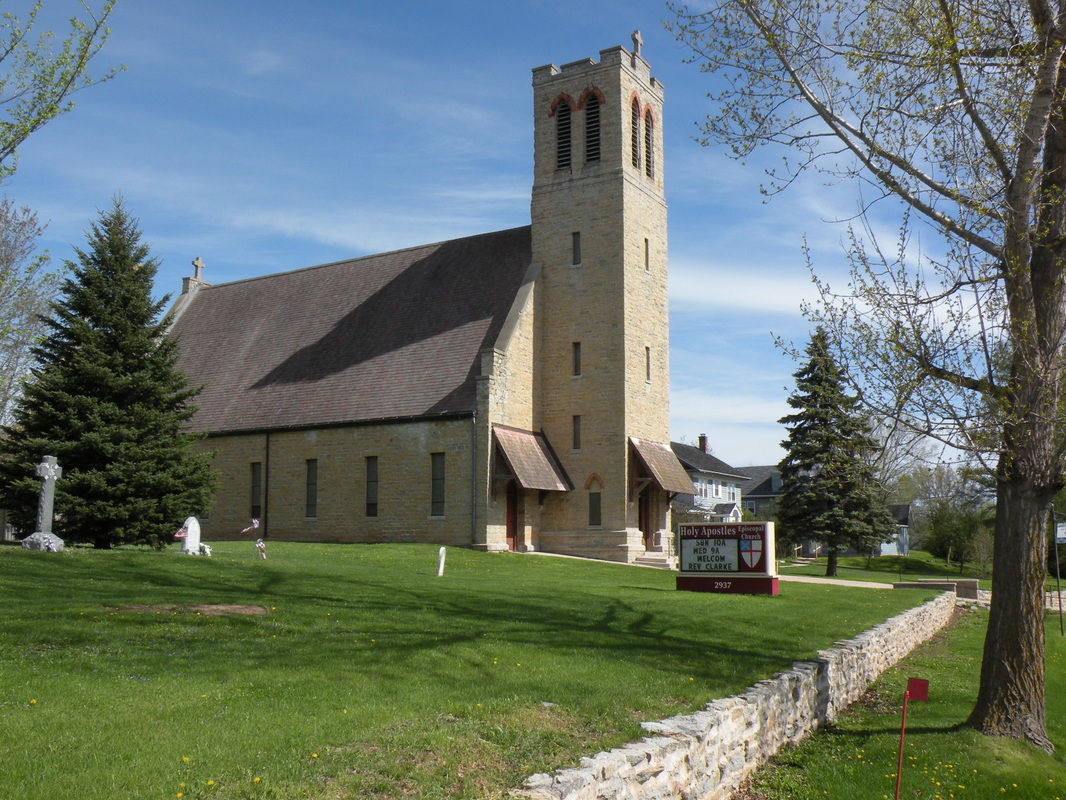
Tribal members had volunteered at a limestone quarry one day a week since 1870. They laid the cornerstone for a new gothic stone chapel in order to dress stone for a new church building in 1887.

They named the building the Church of the Holy Apostles.

Church of the Holy Apostles
Oneida, Wisconsin

The Church of the Holy Apostles in NY was the oldest Indian mission of the Episcopal Church. The name traces its roots to the earliest Anglican missionaries from the Church of England and the Society for the Propagation of the Gospel.  The mission was established in the area that would later become central New York around Oneida Lake.

Bishop John Henry Hobart of New York licensed Mr. Eleazer Williams as Lay Reader, Catechist and Schoolmaster to the Oneida about 1815 at the earnest request of the Oneida chiefs.

Williams would become the first Episcopal missionary in Wisconsin. He played a major role in the removal of the Oneida from New York to Wisconsin.

The Oneida Indians settled and built a log church building in 1825 in the vicinity of Duck Creek after removing from New York in the 1820’s. Duck Creek was about 10 miles (16 km) southwest of Green Bay.

Williams also translated parts of the Prayer Book and certain hymns into the Mohawk tongue.
He wrote a letter to the Domestic and Foreign Missionary Society, the missionary arm of the Episcopal Church, on December 2, 1822.  He requested the establishment of a mission.

The Rev. Norman Nash was appointed as an official missionary on May 22, 1823 for the area around Green Bay. He did not arrive until 1825. Williams had been ordained Deacon in 1824 and undoubtedly held services at Oneida among the Indians.

A larger wood frame "Gothic" church building was built by the Oneidas after out-growing the log church.  The laying of the cornerstone on August 7, 1838 was by Bishop Jackson Kemper, the first Missionary Bishop of the Episcopal Church. It was his first official act in the territory.

The third and present stone church building was built with the support of the Rev. E. A. Goodnough.  The building plan was prepared by the Rev. Charles Babcock, who was also an architect, as a gift to the mission.

------------------------
John 10:7

Jesus said to them, ‘Very truly, I tell you, I am the gate for the sheep.’

------------------------

Bishop Charles C. Grafton ordained Hill a deacon on June 27, 1895. Hill was ordained as a priest in 1903. He was the first of his people to serve in the office. He repeated his vows in his native language.

Hill died on January 26, 1907. He was buried on the reservation in the Church of the Holy Apostles graveyard.

Fire from a lightning strike on July 17, 1920 destroyed the gothic stone church. It was rebuilt in a similar design.

The Oneida continued to revere Hill's wisdom and sanctity. They related tales about him to Works Progress Administration historians during the Great Depression.

Cornelius Hill
科尼利厄斯和力
科尼利厄斯和力

科 Ke       rules                        科  ka          course           Ko   こ-  コ-           Go  고  the         
尼  ni       nun                        尼   ni            nun                ne     ね    ネ          nel  넬  Nell                   
利  li         to benefit              利   ri            profit              ri      り    リ          lyo  료  ryo         
厄  e         distressed              厄   yaku      bad luck          a      あ    ア          Hil   힐  hill                   
斯  si         this                       斯   shi          this                 su    す    ス                             
和  He       to blend                和  wa           harmony        Hi     ひ     ヒ             
力   li         power                  力   ryoku      power            ru     る     ル                               

-----------------------

Productive action makes the power to alleviate distress.
The rule for production blends thought into action to eliminate mess.                                                   

===============

wiki Cornelius Hill
wiki Church of the Holy Apostles, Oneida, Wisconsin
Turning Points in Wisconsin History: Settlement
Turning Pts: Indians in the 20th c.
HistoryToday: Native Americans and the Federal Gvt.
http://americanindiantah.com/…/nar_19thcenturyrelations.html


Sunday, November 11, 2018

Learn


Kristen Bell

Learn
from
Experience
経験から学ぶ
Keiken kara manabu
ps146

Happy are those who learn from experience.
They get to be less serious about the mysterious.

The hope for improvement transcends past performance.
The sound for this chorus is fantastically enormous.

Those who make earth their foundation
build up from the ground to increase structured gradation.

Those who make heaven their destiny
find endless ecstasy in reasonable expectancy. 

Those who make the waters their blood
survive the trial by water in the flood. 

Those who believe in the promise 
of living into the promised province 
of likeness with divinity however modest
honor the homage to being honest.

Those who demand justice for the oppressed
insist on sharing food to give hunger rest.
The expectation of an honest return is there
or the giving as part of living isn't shared.

Liberation sets the prisoner free.
Sight opens the eyes of the blind to see.
Lift raises up those who were down on bent knees.

Space is where the air takes place.
Freedom reigns as the natural case.

The bird takes flight from any threat as absurd
to leave the scene as seen for a word.

The sound of the sea resounds inside the shell.
The beach doesn't impeach the tell from the bell.

Fishing, smelting and dye gave the city by the sea a name
that bore witness to an economy with fame.

The world knew that their production produced profit.
There was enough there for the widow to feed the prophet 
from the raven's brook who saw fit to ascribe honor to the promise.

It was as if their abundance produced more
than the drought had reduced in the grain that had been stored.

The sanctuary for providence was not made by human hands,
but the management of labor satisfied reasonable demands.

Those who contributed from their abundance 
set an example for giving to overcome reluctance.

They couldn't give beyond the need to help feed the poor
but their sponsorship expanded appreciation of things stored
by those who didn't hoard to keep things above board. 

Truth loves righteousness.
The feeling of rightness feels timeless.

The perfect stranger looked for the right thing to say
to make the inside of the mystery go away.

The man from the strange land had a plan
to make a profit from the oddness at hand.

Grace inside the field of perception
was the elegant way to avoid deception.

Friendship cares for the stranger
in order to diminish danger.

Charity sustains the orphan and widow
much like condensation in a cloud billows.

Repentance is for improvement
or it is not worth the movement.

The LORD will reign forever.
This rule, time will not sever.
The God of Life is for all generations.
The worth of love will be felt by all nations.

Yea Yah!
You are worthy of awe!

146 Lauda, anima mea

1 Hallelujah!
Praise the Lord, O my soul! *
I will praise the Lord as long as I live;
I will sing praises to my God while I have my being.
2 Put not your trust in rulers, nor in any child of earth, *
for there is no help in them.
3 When they breathe their last, they return to earth, *
and in that day their thoughts perish.
4 Happy are they who have the God of Jacob for their help! *
whose hope is in the Lord their God;
5 Who made heaven and earth, the seas, and all that is in them; *
who keeps his promise for ever;
6 Who gives justice to those who are oppressed, *
and food to those who hunger.
7 The Lord sets the prisoners free;
the Lord opens the eyes of the blind; *
the Lord lifts up those who are bowed down;
8 The Lord loves the righteous;
the Lord cares for the stranger; *
he sustains the orphan and widow,
but frustrates the way of the wicked.
9 The Lord shall reign for ever, *
your God, O Zion, throughout all generations.
Hallelujah!

Zarephath

Zarephath is preserved in the name of the modern village, Sarafand. The site was known as Sarepta or Sariptu in antiquity. The location is about 8.5 miles (13.5 km) south of Sidon and 14 miles (23 km) north of Tyre.

The first Books of Kings (17:8-24) describes the city as being subject to Sidon in the time of Ahab. The prophet Elijah multiplied the meal and oil of the widow of Zarephath (Sarepta) after leaving the brook Cherith. The prophet raised her son from the dead there. The incident is also referred to by Jesus in Luke's Gospel.

Sidon is the Greek name for 'fishery’.  The ancient Phoenician port city of Sidonia was also known as Saida. It is located today in Lebanon. It is about 25 miles south of Beirut. Sidon was the most powerful city-state of ancient Phoenicia along with the city of Tyre. It first  manufactured the purple dye which made Tyre famous. The dye was so rare and expensive that the color purple became synonymous with royalty.

The Princess Jezebel would later become Queen of Israel. She was the daughter of Ethbaal, the King of Sidon, in the 9th century BCE. She married King Ahab of Israel to cement ties between the two kingdoms.

Zarephath in Hebrew became the eponym for any smelter, forge or metalworking shop. The Roman Sarepta was a port about a kilometer to the south in the 1st century CE. It is mentioned by Josephus in Jewish Antiquities (Book VIII, xiii:2) and by Pliny in Natural History (Book V, 17).

1 Kings 17:8-9
Then the word of the Lord came to him, saying, ‘Go now to Zarephath, which belongs to Sidon, and live there; for I have commanded a widow there to feed you.’

Hebrews 9:24
Christ did not enter a sanctuary made by human hands, a mere copy of the true one, but he entered into heaven itself, now to appear in the presence of God on our behalf.

Mark 12:44
'All of them have contributed out of their abundance; but she out of her poverty has put in everything she had, all she had to live on.’

The Perfect Stranger


Fyodor Dostoyevsky 11.11.1821 Moscow, Russia
S. 费奥多尔·陀斯妥耶夫斯基
T. 費奧多爾·陀斯妥耶夫斯基

费  Fei    fee                        費  hi           cost                     Fui  ふぃ  フィ       Do   도    degree
奥  ao     mysterious            奧  oku       interior                 yo   よ     ヨ           do    도    degree
多  Duo   many                    多  ta          multi-                   ru    る     ル          leu   르    le
尔  er      you                        爾  ore        you                      do   ど     ド           Do   도    degree 
陀  tuo   steep bank              陀  da          bird                     Do  ど     ド           seu   스    switch
斯  si       this                        斯  kou       in this way           su   す     ス           to     토    sat
妥  tuo   suitable                   妥  datou   proper                    to    と      ト         ye    예    yes
耶  ye     ye                            耶  ya          ya                        e     え     エ          peu  프   the
夫  fu     husband                  夫  otto     husband                 fu   ふ     フ           seu   스    switch
斯  si      this                          斯  kou      in this way           su   す     ス           ki     키    key
基  ji       base                        基  moto   base                       ki    き-   キ-

Moscow had been the capital for Russia. Peter the Great moved his government to the newly built Saint Petersburg on the Baltic coast in 1712.

The population of Moscow decreased after losing the status as capital of the empire. It shrunk from 200,000 in the 17th century to 130,000 in 1750. The population grew more than tenfold over the remaining duration of the Russian Empire. It reached 1.8 million by 1915.

The Moscovites were evacuated when Napoleon invaded Russia in 1812. Napoleon hoped to compel Tsar Alexander I of Russia to cease trading with British merchants through proxies in an effort to pressure the United Kingdom to sue for peace.

It is suspected today that the Moscow fire which ensued initially started as a result of Russian sabotage.  An estimated three-quarters of the city lay in ruin in the fire's wake.

The Arbat Street had been in existence since at least the 15th century, but it was developed into a prestigious area during the 18th century. It was destroyed in the fire of 1812, but it was rebuilt completely in the early 19th century.

National political and military successes from 1812 through 1855 calmed the critics and validated efforts to produce a more enlightened and stable society.

Fyodor Dostoevsky was born on 11 November 1821 in Moscow. He was the second child of Dr. Mikhail Dostoevsky and Maria Dostoevskaya (born Nechayeva). He was raised in the family home in the grounds of the Mariinsky Hospital for the Poor. The hospital was in a lower class district on the edges of Moscow.

Fyodor Dostoevsky
(11 November 1821 – 9 February 1881)

Fyodor was a Russian novelist, short story writer, essayist, journalist and philosopher. His literary works explore human psychology in the troubled political, social and spiritual atmospheres of 19th-century Russia. His imagination engages  a variety of philosophical and religious themes.

His most acclaimed works include Crime and Punishment (1866), The Idiot (1869), Demons (1872) and The Brothers Karamazov (1880). His 1864 novella Notes from Underground is considered to be one of the first works of existentialist literature.

Dostoevsky's parents were part of a multi-ethnic and multi-denominational noble family, its branches including Russian Orthodox Christians, Polish Roman Catholics and Ukrainian Eastern Catholics.

The family traced its roots back to a Tatar. Aslan Chelebi-Murza defected from the Golden Horde in 1389 to join the forces of Dmitry Donskoy. Donskoy was the first prince of Muscovy to openly challenge the Mongol authority in the region.

Aslan's descendant, Danilo Irtishch, was ennobled and given lands in the Pinsk region in 1509. This region was part of the Grand Duchy of Lithuania for centuries. It is now in modern-day Belarus. Danilo was ennobled for his services under a local prince. His progeny took the name "Dostoevsky" based on a village there called Dostoïevo.

Fyodor Dostoyevsky was introduced to literature at an early age through fairy tales and legends. The tales gave way to books by Russian and foreign authors. His mother died in 1837 when he was 15. He left school to enter the Nikolayev Military Engineering Institute around the same time.

He worked as an engineer after graduation. He enjoyed a lavish lifestyle briefly. He translated books to earn extra money. He wrote his first novel, Poor Folk, in the mid-1840's. This gave him entry into St. Petersburg's literary circles.

He was arrested in 1849 for belonging to a socialist literary group that discussed banned books critical of "Tsarist Russia". He was sentenced to death but the sentence was commuted at the last moment. He spent four years in a Siberian prison camp, followed by six years of compulsory military service in exile.

Dostoevsky worked as a journalist in the following years. He published and edited several magazines of his own and later A Writer's Diary, a collection of his writings. He began to travel around western Europe and developed a gambling addiction. The addiction led to financial hardship. He had to beg for money for a time. He eventually became one of the most widely read and highly regarded Russian writers.

His psychological struggle was typical for a modern man in the 19th century. His civilized self entertained self-destructive behaviors in order to reconnect with primitive vitality. He felt he had to peel away the layers of social conditioning to find the meaning of redemption for salvation.

He was a stranger to the meaning of life until he found the way to write about it as an expression that held meaning for others. The modern writer needs to explore ways to find the vitality of life without the self-destructive behaviors.

The reconstruction of classical consciousness is something that has been paired with the modern institution of Republic. The state of affairs had included slavery as a means for social ascension with the declaration of an immoral institution as legal. It was an antecedent to socialism. It wasn't an expression of capitalism as some would argue.


Stanley Tucci 11.11.60 Peekskill, New York
S. 斯坦利·图奇
T. 斯坦利·圖奇
Tweet
FB

斯     Si      this               斯  kou      in this way            Su      す    ス             Seu    스    switch
坦     tan   tan                 坦  tan       level                       tan     たん タン        taen    탠   tan
利     li       profit           利  ri           advantage              ri        り-   リ-           li        리    lee
图     Tu    figure            圖  zu         scheme                  Tou   とぅ     トゥ     Tu      투    way 
奇      qi    odd               奇  ki         strange                    tchi  っち  ッチ         chi     치    tooth

Peekskill is situated on a bay along the east side of the Hudson River across from Jones Point.
Jan Peeck made the first recorded contact in the early 1640's with the Lenape people of this area after the establishment of the province of New Netherland, New Amsterdam. The name Peekskill derives from a combination of Mr. Peek's surname and the Dutch word for stream, kil or kill.

Annsville Creek and McGregory Brook were useful locations for sawmills and grinding mills convenient to river shipping. Mechanical processes were set up to turn wheat and corn into flour, tallow into candles, leather into shoes and rags into paper.

Slaughterhouses were important for food supply. The river docks allowed transport of supply items and soldiers to the several other fort garrisons placed to prevent British naval passage between Albany and New York City.

Fort Hill Park, the site of Camp Peekskill, contained five barracks and two redoubts. It was part of Fort Independence. The complex was built in August 1776.

A British raiding force of about 500 men landed at Peekskill on 23 Mar 1777. The supply depot was evacuated and the supplies that could not be removed were burned.

The fall of Fort Clinton and Fort Montgomery to the British on 6 Oct 1777 forced patriot General Israel Putnam to order the evacuation of the defenses at Peekskill, including Fort Independence.

The evacuation did not go well.  The British sent another raiding force to Peekskill and found the warehouses full three days after the decision to evacuate on 9 Oct 1777. The evacuation wagon trains were still waiting to leave. The British again burned what they could not carry off. Fort Independence and the supply depot were destroyed and were not rebuilt.

The site was obliterated by quarry operations.

African-Americans had experience with Peekskill from its earliest days. There is evidence indicating the use of Negro slavery from about 1750 through 1825. This population could serve in the Continental Army as a condition for their freedom by the time the Revolution in 1776. Peekskill saw several “free blacks” well established in the community before the end of the Civil War.

Abolitionist minister Henry Ward Beecher lived at his East Main Street mansion in the later 1800's. His sister, Harriet Beecher Stowe, authored “Uncle Tom’s Cabin,” the powerful anti-slavery work.

A summer concert was planned from New York City to take place along Oregon Road in Peekskill August 1949. The keynote entertainer was to be Paul Robeson. Robeson made a speech to the World Peace Conference in Paris that month.

He was quoted as having said that no African Americans would fight for the US in any prospective war against the Soviet Union. The planned benefit concert for the Civil Rights Congress had to be cancelled amid White Nationalist and anti-communist violence. An effigy of Robeson was lynched in the town.

Another concert was held in  Van Cortlandtville, the town right next to Peeksville. The publicity drew a crowd of around 20,000. Two men with rifles were discovered and removed prior to any violence.
It was one of the earliest performances of Pete Seeger's "If I Had a Hammer". Robeson sang surrounded by union guards and volunteers from the audience as protection against other snipers.

Area police and state troopers directed exiting traffic down a single road into an ambush following the event. Rocks were thrown through car windows. Some vehicles were overturned. Their occupants were beaten without police intervention. One hundred forty people were injured.

These Peekskill Riots were subsequently well-publicized in the news. Folk songs were written and sung. The incident was described as a major event in E.L. Doctorow's historical fiction novel The Book of Daniel.

Tucci was born in Peekskill, New York on 11 November 1961. He grew up in nearby Katonah. His parents were both of Italian descent with roots in Calabria. Joan (née Tropiano) was a secretary and writer. Stanley Tucci, Sr. was an art teacher at Horace Greeley High School in Chappaqua, New York. Tucci is the oldest of three children.

Stanley is an American actor, writer, producer and film director. He has been nominated three times for Golden Globes. He won twice. One was for his title role in Winchell (1998). The other was for his supporting role as Adolf Eichmann in Conspiracy (2001). Both were HBO films. He also received a Screen Actors Guild Award nomination for Winchell.

He was nominated for Broadway's Tony Award as Best Actor in a Play for his role as Johnny in the 2002 revival of Terrence McNally's Frankie and Johnny in the Clair de Lune.

Tucci portrayed George Harvey in 2009. Harvey was a serial killer of young girls in The Lovely Bones. It was Peter Jackson's adaptation of Alice Sebold's novel. He received Golden Globe and Academy Award nominations.  He consulted with retired FBI profiler John Douglas to prepare for the role.

Tucci played Dr. Abraham Erskine in 2011's Captain America: The First Avenger. He has appeared in such films as The Devil Wears Prada (2006) and Julie & Julia (2009). Both rolls were opposite Meryl Streep.

He played Caesar Flickerman in The Hunger Games and its sequels, The Hunger Games: Catching Fire, The Hunger Games: Mockingjay – Part 1 and The Hunger Games: Mockingjay – Part 2. He divined the role of the Ancient Greek God Dionysus in Percy Jackson: Sea of Monsters in 2013.
He has appeared in a number of other films and tv shows as well.


Kristen Bell 7.18.80  Huntington Woods, Michigan
S. 克里斯汀贝尔
T. 克里斯汀貝爾
Tweet
Veronica Mars 

克  Ke      restrain       克 ko           deny                      Ku    く     ク          Keu  크   greater
里  li         inside         里  sato        village                   ri      り     リ          li       리  lee
斯  si         this            斯  kou        in this way             su    す    ス            seu   스  switch
汀  ting    beach          汀  nagisa   beach                      ten  てん テン        tin     틴  tin
贝  Bei     sea shell     貝  kai          shell                      Be    べ    ベ           Bel    벨  bell
尔  er       you             爾  ore          you                        ru     る    ル

Huntington Woods is a suburb of Detroit, located in southeastern Oakland County, Michigan. The population was 6,238 at the 2010 census.

The first land grant in Huntington Woods was signed by President James Monroe in 1824. The land was granted to J. Lockwood, a War of 1812 veteran.

The area was comprised by some nine farms until 1916. Fred Remole plotted and recorded a part of the territory as Banks Park. Huntington Woods, Manor, Bronx and Huntington Park were the subdivisions. The unplotted fifty-acre tract called Hannan's West was regarded as part of the area.

These subdivisions were known as Royal Oak Township until incorporated as the village of Huntington Woods in 1926. The village was later incorporated as a city in 1932.

The land that now constitutes the City of Huntington Woods was ceded to a dozen landowners in parcels ranging from 40 to 320 acres between 1830 and 1837. Mr. Edward C. Mathews received a land grant in what is now the “The Hill” Historic District in January 1834.

Huntington Woods became home to many of Detroit’s upper-level executives beginning in the early 1920's. The executives were building elegant English-influenced homes in a style similar to two of Detroit’s established neighborhoods: Sherwood Forest and Palmer Park. The city was home to advertising executives, automobile designers, bankers and architects along with other business owners.

All dwellings were required to be single-family and built with pressed brick fronts or cement block covered with stucco. Flat roof dwellings were not to be erected on any lot in the subdivision. Garages could be erected, but only for the private use of the homeowner and only after the permanent residence was constructed. All garages were required to correspond in architecture and material to the main residence. Each street had specific stipulations as to the placement of buildings on the lots.

All boundary lines were to be designated by hedges or woven wire fences with iron posts of an approved pattern. None were to exceed four feet in height and had to be set back fifty feet from the front line. All lots were to be used for private residences.

Kirsten Bell was born on July 18, 1980, in Huntington Woods, Michigan. She was raised there by her mother Lorelei (née Frygier). She was a registered nurse. Her father, Tom Bell, works as a television news director in Sacramento, CA.

Her parents divorced when she was two years old. Her mother is of Polish descent and her father has German, Scottish and Irish ancestry. She has two stepsisters from her father's second marriage. She also has two half-sisters and two half-brothers from her mother's second marriage.

She attended Shrine Catholic High School in nearby Royal Oak.  She won the starring role in the school's 1997 production of The Wizard of Oz as Dorothy Gale and also appeared in productions of Fiddler on the Roof (1995), Lady, Be Good (1996), and Li'l Abner (1998). She was named the yearbook's "Best Looking Girl" by senior class vote in 1998, the year she graduated.

She moved to New York City to attend New York University's Tisch School of the Arts shortly after her high school graduation. She majored in musical theater. Bell left a few credits shy of graduating during her senior year in 2001 to take a role in the Broadway musical version of The Adventures of Tom Sawyer.

Kristen Anne Bell is an American actress. She gained critical acclaim for her first major role as the title character in the teen noir drama television series Veronica Mars (2004–07). She was awarded a Saturn Award for Best Actress on Television for her performance. She reprised the eponymous role in the 2014 film continuation of the series.

Bell starred as Mary Lane in the film Reefer Madness: The Movie Musical (2005), a reprise of the role she had played in the New York musical upon which the film was based. She starred as Elle Bishop in the sci-fi drama series Heroes from 2007 to 2008. She voiced the titular narrator in the teen drama television series Gossip Girl from 2007 to 2012.

She had her breakout film role as the title character in Forgetting Sarah Marshall in 2008. She has since appeared in a number of comedy films including Couples Retreat (2009), When in Rome (2010), You Again (2010), The Boss (2016), Bad Moms (2016) and A Bad Moms Christmas (2017).

Bell garnered further recognition for voicing Princess Anna in the Disney animated fantasy film Frozen (2013), the short films Frozen Fever (2015) and Olaf's Frozen Adventure (2017), and the upcoming Frozen 2 (2019). She starred as Jeannie van der Hooven, the female lead on the Showtime series House of Lies from 2012 to 2016. She has starred in the main role of Eleanor Shellstrop on the NBC comedy series The Good Place since 2016.


Reina Tanaka 11.11.89 Fukuoka, Japan
田中 麗奈
田中丽纳
Hello Project Graduate
Say A-Ha!

田  Tian       field                    田    Ta        rice field              Ta    た    タ               Da  다    all
中  zhong   middle                  中    naka    inside                   na   な    ナ                 na  나    I
丽  Li             elegant              麗    Rei        grace                  ka    か    カ                ka  카    car
纳  na           accept                 奈     na         place                  Rei  れい  レイ           Le  레    re
                                                                                                 na   な    ナ                 i    이   this
                                                                                                                                     na  나    I

Fukuoka is the capital city for the prefecture of the same name. It is situated on the northern shore of the Japanese island of Kyushu.

Kublai Khan of the Mongol Empire turned his attention towards Japan starting in 1268. The Khanate exerted a new external pressure on an area with which it had no experience. Kublai first sent an envoy to Japan to make the Shogunate acknowledge the Khan's suzerainty. The Kamakura shogunate refused. Mongolia repeatedly sent envoys thereafter to no avail.

Kublai mounted an invasion of the northern part of Kyushu with a fleet of 900 ships and 33,000 troops in 1274. Soldiers from Goryeo on the Korean Peninsula were included. This initial invasion was defeated by a combination of incompetence and severe storms.

Japanese samurai built a stone barrier 20 km (12 mi) in length bordering the coast of Hakata Bay in what is now the city of Fukuoka. The wall was 2–3 meters in height. It had a base width of 3 meters. It was constructed between 1276 and 1277. It was excavated in the 1930's.

Kublai sent another envoy to Japan in 1279. Hōjō Tokimune of the Hōjō clan (1251–1284) was the Eighth Regent at the time. He declined the offer and beheaded the five Mongolian emissaries after summoning them to Kamakura.

Kublai organized another attack on Fukuoka Prefecture in 1281. He mobilized 140,000 soldiers and 4,000 ships. The Japanese defenders numbered around 40,000. They were no match for the Mongols.

The invasion force made it as far as Dazaifu, 15 km (9 mi) south of the city of Fukuoka. The Japanese were again aided by severe weather. This time a typhoon struck a crushing blow to the Mongolian troops and thwarted the invasion.

It was this typhoon that came to be called the Kamikaze (Divine Wind).

The modern city was formed on April 1, 1889 with the merger of the former cities of Hakata and Fukuoka. Hakata was the port and merchant district historically. It was more associated with the area's culture. It remains the main commercial area today.

The Fukuoka area was home to many samurai. Its name has been used since Kuroda Nagamasa, the first daimyō of Chikuzen Province, named it after his birthplace in Okayama Prefecture. The "old Fukuoka" is the main shopping area. It is now called Tenjin.

A meeting was held to decide the name for the new city when Hakata and Fukuoka decided to merge. Hakata was initially chosen, but a group of samurai crashed the meeting and forced those present to choose Fukuoka as the name for the merged city.

Hakata is still used to refer to that same area of the city. It is most commonly used to refer to the city's train station, Hakata Station. The dialect is called Hakata-ben.

Fukuoka Tawā is a 234-meter (768 ft) tall tower located in the Momochihama area of Fukuoka, Japan. It is the tallest seaside tower in the country. The highest observation deck has a 360 degree view of the surrounding area at 123m. The most popular time to visit is at sunset.

The tower has a triangular cross-section which is covered with 8000 half-mirrors. This gives it  the appearance of a skyscraper. It has been given the nickname "Mirror Sail" because of this. The half-mirrors reflect the sky when viewed from the exterior but allow visitors to see outside while riding elevators to the top.

The space between the base and the observation decks is hollow and unoccupied. There are three observation decks. There is one at 116 meters. There is a café/lounge deck at 120 meters. The highest is at 123 metres above the ground.  A 111-metre television mast above this level rises.

Fukuoka Tower was finished in 1989. It took a total of 14 months to build at a cost of ¥6,000,000,000. That is roughly US $50,000,000 in 2015 terms. It was designed by Nikken Sekkei. It was built on reclaimed land out of Hakata Bay

The tower appears in the Japanese film Godzilla vs. SpaceGodzilla (1994).  Godzilla destroys the tower in a battle between the titular monsters.

The city is most famous for its Hakata ramen dish. It's made with thin noodles and the rich broth made from tonkotsu or pork bone.

Tanaka Reina was born on November 11, 1989 in Fukuoka, Japan. She is a Japanese pop-rock singer. She is one of the vocalists in the band LoVendoЯ and a former sixth generation member of the J-pop group Morning Musume. Her professional first name is spelled in hiragana to distinguish her from the Japanese actress Tanaka Rena whose name is the same in kanji.

Tanaka and Michishige Sayumi officially reached 10 full years in Morning Musume on January 19, 2013. Sayumi was the leader for the group. Tanaka appointed  Fukumura Mizuki and Iikubo Haruna as the groups sub-leaders when she graduated on May 21.

She and Michishige Sayumi were surprise guests at the Morning Musume Event on September 14, 2017. They performed "Ookii Hitomi" together and "Kare to Issho ni Omise ga Shitai!" with Morning Musume '17.

Tanaka made a surprise appearance alongside Takahashi Ai and Michishige Sayumi during the Morning Musume Concert Tour at Nippon Budokan on November 21 in the same year. The three of them performed "Shabondama" and "Resonant Blue" with all of the current members.