Shakira
Present
Love
现在的爱
Xiànzài de ài
現在の愛
Genzai no ai
ps88
Nunc love
The messenger of the covenant has come
for presentation in the temple as a son.

The offerings of Judah and Jerusalem have been pleasant
as the model for the worship of God in the present.
Membership in a tribe is not equivalent to instruction in the law.
Knowledge of the language for the promise of salvation has to be drawn.
Those who were held in slavery by the fear of death
were liberated by the Spirit with the holy breath.
He came to fulfill the promise to the descendants of Abraham
with the bloodless sacrifice established by the blood of the Lamb.
This high priest offered the sacrifice of his body on the cross
by the fire of the Spirit with prayer for those who had been lost.
He himself was tested by what he suffered for others
to help those who are being tested for what they may discover.
The parents of Jesus took him to Jerusalem for purification
according to the law of Moses to celebrate their station in the nation.
A sacrifice was offered to fulfill their obligation.
Simeon was righteous and devout in his study of the law.
His obedience was a symbol of grace in the acceptable draw.
He and Anna gave testimony as the first god-parents for the Church
that Jesus as Christ was the light for the revelation to the Gentile search.
O Lord, my God I call for help by day.
I cry out in the night for guidance in Your way.
Christ is the Lord
that leads the astral chord
for the choral ford.
Our Lord
is above board.
It may seem odd
but we can reach closer to God.
It is close enough to say
that we can be heard to pray.
Let my prayer arise.
Incline Your ear to my cry.
My soul is full of trouble.
My life feels the derision of division doubled.

I had been reckoned like those in the Pit.
My strength had gone. I felt like this was it.
Like one forsaken among the dead
I lie as slain and profaned on a deathbed;
Like those who are remembered no more
as though the body had drifted in a boat from shore.
I laid in a state as in the depths of the grave
in regions dark, deep and depraved.
Wrath toyed with anger and envy at my expense.
My body was struck by waves that sought to erase sense.
My companions shunned me for the power
that made me a thing of horror by the hour.
I was shut in this state.
It felt like there was no escape.
My eyes had grown dim through sorrow.
Every day I called to You to help me reach tomorrow.
I spread my fingers at the end of extended arms
in the hope that You would release me from my alarm.
Have You worked wonders for the dead?
Did the shades rise up to praise You as living Bread?
Is Your steadfast love declared in the grave
or where the daffodil or lily no longer wave?
Are Your wonders known in the darkness?
Is the promise of Your salvation found among the starkless?
I cry to You before the dawn.
My prayer is offered before the first light is drawn.
Did You cast me off?
Why did my prayer not payoff?
I suffered terror for my error.
I seek Your redemption as the standard bearer.
Wrath toyed with anger and envy at my expense.
My body was struck by waves that sought to erase all sense.
The waves assaulted my sense all day.
They closed in on sensibility as the way
to play.
Love from family and friends was denied.
My companions dwelt in darkness unsatisfied.
Let Your love be imparted with peace
according to the word that doesn't cease.
My eyes have seen the salvation
promised to the people of faithful station
as a light to the Gentiles and for the glory of Israel as a nation.
---------------------
Ps.88
A Song.
A Psalm of the Sons of Korah.
To the choirmaster: according to Mahalath Leannoth.
A Maskil of Heman the Ezrahite.
[1] O LORD, my God, I call for help by day;
I cry out in the night before thee.
[2] Let my prayer come before thee,
incline thy ear to my cry!
[3] For my soul is full of troubles,
and my life draws near to Sheol.
[4] I am reckoned among those who go down to the Pit;
I am a man who has no strength,
[5] like one forsaken among the dead,
like the slain that lie in the grave,
like those whom thou dost remember no more,
for they are cut off from thy hand.
[6] Thou hast put me in the depths of the Pit,
in the regions dark and deep.
[7] Thy wrath lies heavy upon me,
and thou dost overwhelm me with all thy waves. [Selah]
[8] Thou hast caused my companions to shun me;
thou hast made me a thing of horror to them.
I am shut in so that I cannot escape;
[9] my eye grows dim through sorrow.
Every day I call upon thee, O LORD;
I spread out my hands to thee.
[10] Dost thou work wonders for the dead?
Do the shades rise up to praise thee? [Selah]
[11] Is thy steadfast love declared in the grave,
or thy faithfulness in Abaddon?
[12] Are thy wonders known in the darkness,
or thy saving help in the land of forgetfulness?
[13] But I, O LORD, cry to thee;
in the morning my prayer comes before thee.
[14] O LORD, why dost thou cast me off?
Why dost thou hide thy face from me?
[15] Afflicted and close to death from my youth up,
I suffer thy terrors; I am helpless.
[16] Thy wrath has swept over me;
thy dread assaults destroy me.
[17] They surround me like a flood all day long;
they close in upon me together.
[18] Thou hast caused lover and friend to shun me;
my companions are in darkness.
--------------------
===============
---------------------
Psalm 88

The title of the psalm states that it is a song from the sons of Korah and a maskil from Heman the Ezrahite. It is addressed to the choirmaster according to Mahalath Leannoth.
The bible addresses the theme of rebellion with the sons of Korah. Korah was the cousin of Moses. He led a rebellion against the prophet. It is reported that he and his family were 'struck down' by fire from heaven.
The group was not destroyed in fact. They were made into one of those families that served as singers in the temple. Now the sons of Korah were leaders of the people in prayer expressed with music as song along with the Kothahites. The Kothathites were the part of the tribe of Levi, those who served as priests in the temple.
Redemption is the key implication. Those who had rebelled acquired a position of service in the temple after they changed their position regarding God, Moses and the law. They had sought to force change on the leadership and the people with violence.
Their story would come to serve as an example that dissatisfaction could be used to seek guidance with prayer. They joined with the family of Kohath. Kohath translates as 'obey.'
The theme of redemption from the impulse to rebel is beneficial to the sovereignty of a state. It's not as though the weapons that were used in rebellion had to be outlawed. Knowledge of the use for defense is legal.
The darkness of Naphtali represents strength born of working the earth to produce a yield. Part of that strength is embodied in experience of work with tools that turns the dirt to make it fertile enough to produce plants for consumption from seeds. Another part comes from the ability to use the tools in defense from attack against the people of the land.
Heman the Ezrahite
'Heman' is a Jewish name (Hebrew: הימן) meaning 'Faithful'. It is found 16 times in the Bible. Heman the Ezrahite may be one of the three Levites assigned by King David to be ministers of music. This Heman was a grandson of Samuel the prophet.
The name Ezra is derived from the Hebrew word for 'help.' The Korahite Heman is called "the Ezrahite." A descendant of Levi was ascribed a name if he were a son of Zerah who belonged to the tribe of Judah. The psalm may have been worked into the canon of scripture from a later date.
The word "Maskil" מַשְׂכִּיל or "ha-maskil" indicates a scholar or an "enlightened man." The name was used as a title for activists in the Haskalah movement of the 18th and 19th centuries.
The Haskalah was an intellectual movement among the Jews of Central and Eastern Europe. It arose as a defined ideological worldview during the 1770's. its last stage ended around 1881 with the rise of Jewish nationalism.
The Haskalah promoted rationalism, liberalism, freedom of thought and enquiry. It was largely perceived as the Jewish variant of the general Age of Enlightenment. The modern press and literature in the language were pioneered.
The movement was functionally bi-lingual. Knowledge of Hebrew was promoted for cultural and moral renewal. The optimal integration of the Jews in surrounding societies included the study of native vernacular and adoption of modern values, culture and appearance. All this was combined with respect for economic productivity.
The pamphlet Auto-Emancipation was written in German by Russian-Polish Jewish doctor and activist Leo Pinsker in 1882. It was considered a founding document of modern Jewish nationalism especially Zionism.
Zionism was the movement that espoused the re-establishment of and support for a Jewish state in the territory defined as the historic Land of Israel. The pamphlet inspired Christians and Jews throughout Europe to support the establishment of the Jewish State.
The issue addressed the difficulty involved in working for recognition with both minority and majority identity in social status.
Choirmaster Mahalath Leannoth
The choirmaster was given the instruction to deliver the psalm according to Mahalath Leannoth.
The meaning of these words is uncertain. The conjecture is that mahalath is a guitar (lyre). It occurs in other places in the Bible as a wife.
Leannoth has reference to the character of the psalm in a way that may be rendered as 'to humble or afflict.' The root occurs in ver. 7. Illness is taken as a metaphor for an affliction that 'leans on' the body.
v.7 Your wrath lies hard on me. You have afflicted me with all your waves.
The two words could be taken as a name representing the name of a person as the tone for that expression of sorrow.
The psalm is a personal lament. It is the only psalm that doesn't explicitly celebrate the experience of having received an answer to the request for help in the past.
Verse 12 suggests that the value for deliverance will be present in the expiation of song for having been delivered.
v. 12 Will your wonders be known in the dark? Will your righteousness be remembered in the land of forgetfulness?
The last verse is reminiscent of the trial of Job.
v. 18 Lover and friend have been put far from me. Mine acquaintance was cast into the darkness.
The psalm was a song of lament from the faithful helper whose hope was in the Author of faith by the promise of salvation. If darkness is darkest before the dawn, the brightest implication for the psalm is the hope for the light of deliverance from affliction.
---------------------
When is the darkest part of the day?
It is darkest before dawn.
Chn. 一天中最黑暗的时间是什么时候?
Yītiān zhōng zuì hēi'àn de shíjiān shì shénme shíhòu?
黎明前最黑
Límíng qián zuì hēi.
Jpn. その日の最も暗い部分はいつですか?
Sonohi no mottomo kurai bubun wa itsudesu ka?
夜明け前に最も暗い。
Yoake mae ni mottomo kurai.
Krn. 오늘의 가장 어두운 부분은 언제입니까?
oneul-ui gajang eoduun bubun-eun eonjeibnikka?
새벽이되기 전에 가장 어둡습니다.
saebyeog-idoegi jeon-e gajang eodubseubnida.
Ltn. Quando tenet partem diei consumit;
Est in conspectu tenebris lucem.
Itln. Quando è la parte più buia della giornata?
È più buio prima dell'alba.
Spn. ¿Cuándo es la parte más oscura del día?
Es más oscuro antes del amanecer.
Frn. Quelle est la partie la plus sombre de la journée?
Il fait plus sombre avant l'aube.
Gmn. Wann ist der dunkelste Teil des Tages?
Es ist am dunkelsten vor der Morgendämmerung.
Dtch. Wanneer is het donkerste deel van de dag?
Het is het donkerst vóór zonsopgang.
Czch. Kdy je nejtemnější část dne?
Je nejtemnější před úsvitem.
Hng. Mikor van a nap sötétebb része?
A sötétebb hajnal előtt.
Rmn. Când este cea mai întunecată parte a zilei?
Este cel mai întunecat înainte de zori.
Trk. Günün en karanlık kısmı ne zaman?
Şafaktan önce en karanlık.
Grk. Πότε είναι το πιο σκοτεινό μέρος της ημέρας;
Póte eínai to pio skoteinó méros tis iméras?
Είναι πιο σκοτεινό πριν την αυγή.
Eínai pio skoteinó prin tin avgí.
Rsn. Когда самая темная часть дня?
Kogda samaya temnaya chast' dnya?
Это самое темное перед рассветом.
Eto samoye temnoye pered rassvetom.
When is the darkest part of the day?
"It's darkest before dawn" is what people say.
--------------------
Messenger

Malachi prophesied in Judah after the temple had been rebuilt. His book is the last of the Neviim contained in the Tanakh.
He is canonically the last of the Twelve Minor Prophets. This makes his the last section of the Old Testament in the Christian order for the prophetic books. Malachi is the last book before the New Testament.
The prophets had urged the people of Judah and Israel to see their exile as punishment for failing to uphold their covenant. Their commitment to the one God had began to wane after they had been restored to the land and worship in the Temple.
Animal sacrifice was being phased out of monotheistic worship. The experience of a strong literary emphasis on worship had been observed during the exile when they did not have a temple in which to offer sacrifice.
The literary emphasis instructed people in the value of religious expression (rhetoric) for the law with the emphasis on the agreement between the leadership, the people and God.
The religion still needed elders instructed in the law and the prophets to lead prayer in the consideration of the word. The tribe of Levi was to retain their position as a tribe of priests.
You will know that I have sent this commandment unto you that my covenant might be with Levi, says the Lord of hosts. (Mal.2:4)
Theirs was the covenant for life and peace. These gifts were granted for the fear that showed reverence with faith.
The priest's lips should keep knowledge to speak about the law as the messenger for the covenant. The priests would come to preside over the celebration of the marriage ceremony.
Marriage was a symbol of the covenant. It was a contract that required fidelity for success. It was not to be entered lightly. It was not to be taken as a prelude to divorce for any insufficient reason.
Some argued for divorce from their wives for being Jewish. Others insisted on divorce for foreign birth.
Marriage was that which produced offspring to be raised in the promise of salvation. Children that received instruction in the faith from their youth had an advantage with respect for fidelity in belief over how they might have been at the same age without such.
Different spiritual gifts were for the celebration of religious devotion in the community of faith with support drawn from profit for the production of a service for trade in the world.
A messenger with the gift of prophecy was considered to be specially sanctioned to talk about the relevance of the law for the promise of salvation.
A messenger with the gift of prophecy was considered to be specially sanctioned to talk about the relevance of the law for the promise of salvation.
The gift for such speech had been cultivated in the community of the prophets who studied the scripture with prayer in their tradition.
Speech about the word is cultivated in seminary in affiliation with college in the contemporary world.
The Bible is studied in relation to classical knowledge.
Malachi 3:1-4
See, I am sending my messenger to prepare the way before me. The Lord whom you seek will suddenly come to his temple. The messenger of the covenant in whom you delight is coming, says the LORD of hosts. Who can endure the day of his coming and who can stand when he appears?
He is like a refiner's fire and like fullers' soap. He will sit as a refiner and purifier of silver until they present offerings to the LORD in righteousness. Then the offerings of Judah and Jerusalem wil be pleasing to the LORD as in the days of old and as in former years.
--------------------
The messenger of the covenant will come
for presentation in the temple as a son.
The offerings of Judah and Jerusalem will be pleasant
as the model of reverence for God in the present.
Membership in a tribe is not equivalent to instruction in the law.
Knowledge of the language for the promise of salvation has to be drawn.
===============
Light to the Nations

Isa. 49:6
It is too small a thing for you to be my servant to restore the tribes of Jacob and bring back those of Israel I have kept. I will make you a light for the Gentiles that you may bring my salvation to the ends of the earth.
------------------
Israel was called to operate as a symbol for the nations of the world with respect for faith in the one God. The descendants of Abraham have a genetic component with the Jewish people.
The tribes of Jacob were raised to the kingdom of Israel.
The restoration of Israel was promised in the testimony of Judah. The testimony has been preserved in the Jewish faith. The faith has resulted in the restoration of the state of Israel to the promised land.
The title of the chief religious official of Judaism was Kohen Gadol (High Priest) from the early post-Exilic times until the destruction of the Second Temple in Jerusalem in 70 CE.
The high priests were drawn from the Jewish priestly families that trace their paternal line back to Aaron. He was the first 'high priest' of Israel in the Hebrew Bible and elder brother of Moses.
Zadok became the first chief priest for the kingdom of Judah in the establishment of the dynasty with David and Solomon. This tradition came to an end in the 2nd century BCE during the rule of the Hasmoneans. The position was occupied by other priestly families unrelated to Zadok.
The sacrifice of Christ was offered on the cross in atonement for sin that the gift of the promise would be extended to those who were not Jewish by birth.
The Christian Church was established as an option to become descendants by the adoption of faith in the One who gave the promise to many nations through Abraham.
Hebrews 2:14-18
Since the children share flesh and blood he himself shared the same things that through death he might destroy the one who has the power of death, the devil, and free those who all their lives were held in slavery by the fear of death. It is clear that he did not come to help angels, but the descendants of Abraham. He had to become like his brothers and sisters in every respect that he might be a merciful and faithful high priest in the service of God to make a sacrifice of atonement for the sins of the people. He himself was tested by what he suffered. He is able to help those who are being tested.
--------------------
Those who were held in slavery by the fear of death
were liberated by the Spirit with the holy breath.
He came to fulfill the promise to the descendants of Abraham
with the bloodless sacrifice established by the blood of the Lamb.
This high priest offered the sacrifice of his body
for baptism by the fire of the Spirit with water and hands on the baptizee.
He himself was tested by what he suffered
to help those who are being tested for what they may discover.
===============
Luke 2:25
John the Baptist was sanctioned for baptism with his celebration of speech about action with faith in the one God in his association with asceticism and his instruction in the law.
Jesus would share the same message without having left the world to live in the wilderness.
Either was considered a messenger, but the presentation in the temple was recounted by Luke in his gospel with respect for the testimony of Simeon and Anna about Jesus as the Christ.
The gospel of Luke was addressed to a Greco-Roman audience. Simeon, the obedient, was the monotheistic embodiment of Father time in human form. Anna was full of grace as the female form for spiritual devotion.
They were the proto-types for god-parents to welcome the mother back from her post-partum confinement to purify the infant in front of the community with water, prayer and a hand on the head.
The purification represents another form of conversion from the darkness of separation to the light of re-union.
Luke 2:22-32
When the time came for their purification according to the law of Moses, they brought him up to Jerusalem to bless him in the temple with prayer. It is written in the law, 'Every firstborn male shall be designated as holy to the Lord.'
They offered a sacrifice according to what is stated in the law, 'a pair of turtle-doves or two young pigeons.'
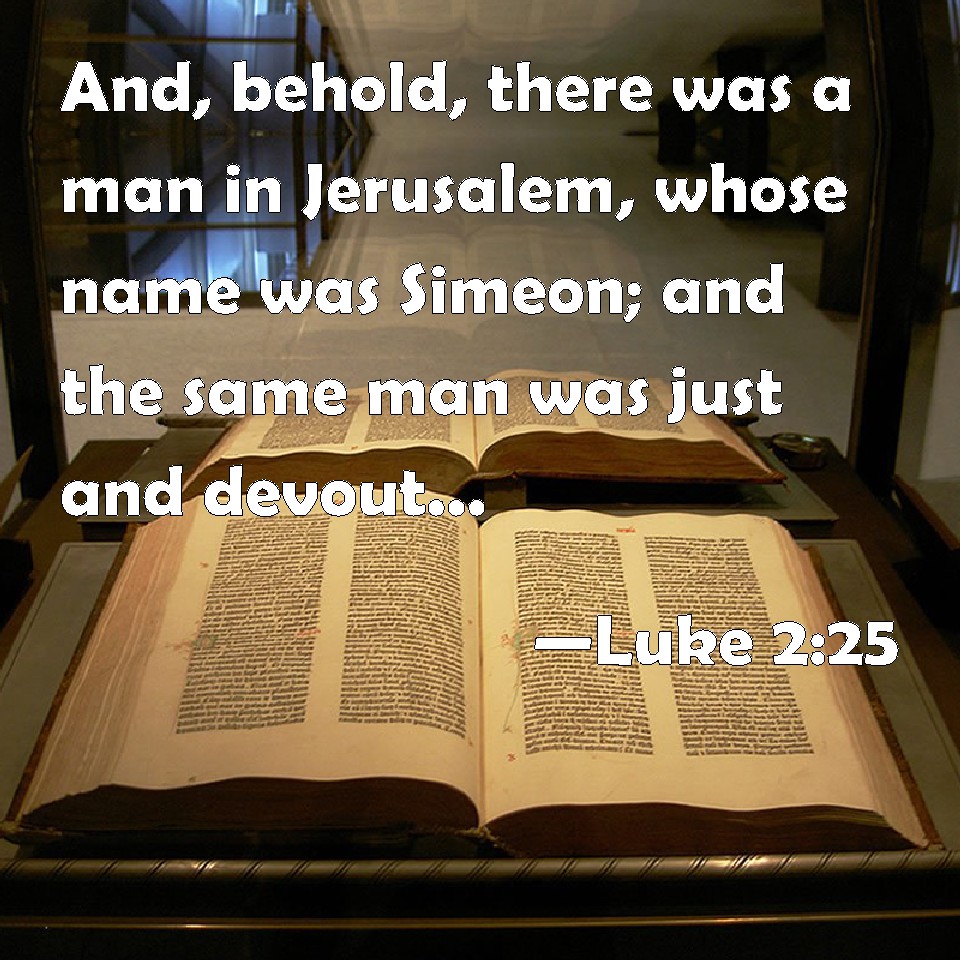
There was a man in Jerusalem whose name was Simeon. This man was righteous and devout. He looked forward to the consolation of Israel. The Holy Spirit rested on him. It had been revealed to him by the Holy Spirit that he would not see death before he had seen the Lord's Messiah.
Simeon came into the temple guided by the Spirit. When the parents brought in the child Jesus to do for him what was customary under the law, Simeon took him in his arms and praised God.
'Master, let your servant depart in peace according to your word.
My eyes have seen your salvation
which you have prepared in the presence of all people,
a light for revelation to the Gentiles
and for glory to your people Israel.'
--------------------
The parents of Jesus took him to Jerusalem for purification
according to the law of Moses to celebrate their station in the nation.
A sacrifice was offered to fulfill their obligation.
Simeon was righteous and devout in his study of the law.
His obedience was a symbol of grace in the acceptable draw.
He and Anna gave testimony as the first god-parents for the Church
that Jesus as Christ was the light for the revelation to the Gentile search.
===============
Purification
Postpartum Confinement
wiki Postpartum Confinement
Postpartum confinement is a traditional practice for recuperation after giving birth to an infant child. This postnatal recuperation lasts for a culturally variable length of time.
It lasts from 30 to 40 days according to one standard. Another runs from between 2 months and 100 days. The story about the presentation of Jesus in the temple identifies the length of recuperation and separation as 40 days.
The woman was defined as impure due to the susceptibility to illness or the communication of disease. There are other physical recovery issues as well that included blood loss from damage caused by delivery after having carried the fetus to term.
The practice is for the health of the mother and the infant. The woman's body needs time to recover from the stress of pregnancy and giving birth. The immune system for the infant needs to build strength close to the body of the mother.
The baby has started to breathe the air and eat food with his or her mouth for the first time. The strength of the immune system is necessary for the independent movement of the child.
The weeks of rest while the mother heals also protect the infant as it adjusts to the world, and both learn to recover from the change in physical states. This recovery includes feeding on milk and baby food.
The period of recuperation unburdens the mother of physically demanding responsibilities and ensures that she gets plenty of rest. This practice is standard for China, Japan, Korea, India and Latin America as well as in Europe, English speaking countries and various diverse locations.
Almost all countries have some form of maternity leave. There are countries that encourage men to take some paternity leave.
Even those that mandate that some of the shared parental leave must be used by the father ("father's quota") acknowledge that the mother needs time off work to recover from the childbirth and deal with the postpartum physiological changes.
The Churching of women is celebrated after the postpartum confinement in Christian tradition. Baby showers or push presents can be given to show support before birth or after the confinement.
Certain 'Birth of Jesus' paintings depict the 'lying in' of Mary as an image that encourages mothers to take the time to rest and recover after birth.
The European custom of recuperation was called 'lying in'. Women were "confined" to their beds of homes during this period that preceded the return to the community.
"Churching" served to mark the end of these weeks of separation and to start the reintegration of the woman into the community as a mother.
The Churching of Women is the ceremony wherein a blessing is given to the mother after recovery from childbirth. Thanksgiving is offered for the survival of the woman even in cases where the infant did not survive (stillborn or death prior to baptism).
The ceremony contains no elements of ritual purification with animal sacrifice as described in Leviticus. Cleansing in a mikvah or a ritual bath was not required.
A young turtledove or pigeon was to be offered in expiation for sin to the priest at the door of the temple. A lamb was to be brought to be burnt in sacrifice.
Two turtledoves or pigeons could be offered, if a lamb wasn't affordable or available.
This text was of particular interest to Luke in his capacity as a physician. It described the Jewish custom for purification in terms of the mothers' health.
The postpartum confinement was for the purification of "the blood" of the mother. She was to remain separate from the temple and was to touch "no holy thing" until the period of separation had been completed.
Luke added that the offering of sacrifice for sin was for the "first born" son. He then simply stated that the law required a "pair of doves or two young pigeons." He concluded that the parents fulfilled what the law required.
There are symbolic indications that the period represents a return to the primitive state of paradise for the mother and child for the sake of recovery in the return to the normal activities of civilized life.
Passage through the psychological stages of development from animism to polytheism to monotheism were symbolically recounted by not touching any holy thing until the mother, child and father were celebrated as a family in the community with the blessing of prayer.
Presentation
wiki Presentation of Jesus in the Temple
The feast of the Presentation is also known as the "Meeting" in Greek celebration and "Candlemas" in Latin rites.
The date for the celebration of the feast is marked as 40 days after the Nativity on December 25th.
The Gospel of Luke 2:22–39 relates that Mary was purified according to the religious law with the presentation of the baby Jesus in the Jerusalem temple.
The 40 days for purification were stipulated by the book of Leviticus 12:2-8. This explains how the date for the celebration was determined with respect for the Nativity.
It also preserves the recognition of the Roman respect for the special nature of time. The Nativity was celebrated near the winter solstice to represent the re-birth of the sun. The presentation represents the integration of polytheistic with monotheistic customs regarding the birth of the new year.
Candlemas is another "epiphany" type feast as Jesus is revealed as the messiah by the canticle of Simeon and the prophetess Anna. Elder time for community is represented by Simeon, Anna, the priest, Joseph and Mary.
They are like the Father in the experience of newness with respect for the past. New time is represented by the infant Jesus for the promise of conservative reform.
New technology has to be developed with respect for established forms or the change is too costly.
Purification in the context of the celebration of the Presentation is requested by prayer and answered with grace by faith.