
Learn
from
Experience
从经验中学习
Cóng jīngyàn zhōng xuéxí
経験から学ぶ
Keiken kara manabu
ps146
Discere a experientia
The intellect of the rebel rejected agreement
with any system that didn't use vehemence
to disagree with reasonable appeasement.
Egoism was seen as the necessary postulate in psychic gravity.
The tragic sense of pain affirmed life beyond the agony
but it was not realistic about the anatomy of sanity.
The crow did not consent to the rule of rice
when scavenging garbage made him feel so nice.
The revelry of haters will pass away.
Their hate will be exiled to make way for debate
and trade.
There is a mean between arrogance and despair
that seeks degrees of certainty in the sense of what's fair.
There is logic in arithmetic for the measure of reason
to mark thought for self or signify speech in due season.
Abstraction provides deliverance from deception
when it is not restricted too heavily to the ideal of perfection.
Happy are those who learn from experience.
They get to be less serious about the mysterious.
The hope for improvement transcends past performance.
The sound for this chorus is fantastically enormous.
Those who make earth their foundation
build up from the ground to increase structured gradation.
Those who make heaven their destiny
find endless ecstasy in reasonable expectancy.
Those who make the waters their blood
survive the trial by water in the flood.
Those who believe in the promise
of living into the promised province
of likeness with divinity however modest
honor the homage to being honest.
Those who demand justice for the oppressed
should donate some food to give hunger rest.
The expectation of an honest return is there
or the giving as part of living isn't shared.
Liberation sets the falsely convicted prisoner free.
Sight opens the eyes of the blind to see.
Lift raises up those who were down on bent knees.
Space is where the air takes place.
Freedom reigns as the natural case.
The bird takes flight from any threat as absurd
to leave the scene as seen for a word.

The sound of the sea resounds inside the shell.
The beach doesn't impeach the tell from the bell.
Fishing, smelting and dye gave the city by the sea a name
that bore witness to an economy with fame.

The world knew that their production produced profit.
There was enough there for the widow to feed the prophet
from the raven's brook who saw fit to ascribe honor to the promise.
It was as if their abundance produced more
than the drought had reduced in the grain that had been stored.
The sanctuary for providence was not made by human hands,
but the management of labor satisfied reasonable demands.
Those who contributed from their abundance
set an example for giving to overcome reluctance.
They couldn't give beyond the need to help feed the poor
but their sponsorship expanded appreciation of things stored
by those who didn't hoard to keep things above board.
The line of royal succession provides a model for the conservation
of loyalty to the whole body as the basis for automation.
The detection of representation
is the cause for selection by election.
The time has come in the progress of human affairs
where conservative reform is the means to improve numerous pairs.
Truth loves righteousness.
The feeling of rightness feels timeless.
The perfect stranger looked for the right thing to say
to make the inside of the mystery go away.
The man from the strange land had a plan
to make a profit from the oddness at hand.
Grace inside the field of perception
was the elegant way to avoid deception.
Friendship cares for the stranger
in order to diminish danger.
Charity sustains the orphan and widow
much like condensation in a cloud billows.
Repentance is for improvement
or it is not worth the movement.
If you do not listen to the meaning of the law and the prophets
you will not be convinced by the resurrection of topics.
Fight with good sight for the faith.
Take hold of eternal life to be great.
The continuum of goodness
is a passage to fullness.
You were called to confession in the presence of many
to give value to argument for progression from envy
to friendly plenty.
The LORD will reign forever.
This rule, time will not sever.
The God of Life is for all generations.
The worth of love will be felt by all nations.
Yea Yah!
You are worthy of awe!
---------------------------
経験から学ぶ人は幸せです。
Keiken kara manabu hito wa shiawasedesu.
Happy are those who learn from experience.
彼らはミステリーについてそれほど真剣ではなくなります。
Karera wa misuterī ni tsuite sorehodo shinkende wanaku narimasu.
They get to be less serious about the mysterious.
(The u is silent at the end of a sentence in Japanese.)
---------------------------
146 Lauda, anima mea
Praise, my soul
1 Hallelujah!
Praise the Lord, O my soul!
I will praise the Lord as long as I live;
I will sing praises to my God while I have my being.
2 Put not your trust in rulers, nor in any child of earth,
for there is no help in them.
3 When they breathe their last, they return to earth,
and in that day their thoughts perish.
4 Happy are they who have the God of Jacob for their help!
whose hope is in the Lord their God;
5 Who made heaven and earth, the seas, and all that is in them;
who keeps his promise for ever;
6 Who gives justice to those who are oppressed,
and food to those who hunger.
7 The Lord sets the prisoners free;
the Lord opens the eyes of the blind;
the Lord lifts up those who are bowed down;
8 The Lord loves the righteous;
the Lord cares for the stranger;
he sustains the orphan and widow,
but frustrates the way of the wicked.
9 The Lord shall reign for ever,
your God, O Zion, throughout all generations.
Hallelujah!
----------------------
Amos 6:7
They will be the first to go into exile.
The revelry of the loungers will pass away.
----------------------
The revelry of haters will pass away.
Their hate will be exiled to make way for trade.
================
1 Timothy 6:12
Fight the good fight of the faith. Take hold of the eternal life to which you were called and for which you made the good confession in the presence of many witnesses.
----------------------
Fight with good sight for the faith.
Take hold of eternal life to be great.
The continuum of goodness
is a passage to fullness.
You were called to confession in the presence of many
to give value to argument for progression from envy
to friendly plenty.
================
Luke 16:31
Abraham said to him, "If they do not listen to Moses and the prophets, neither will they be convinced even if someone rises from the dead."
----------------------
If you do not listen to the meaning of the law and the prophets
you will not be convinced by the resurrection of topics.
================
Christ

James VI was the King of Scotland from 1567. He became the King of England and Ireland in 1603 where he was named James I. He was the monarch of the Scottish and English crowns until his death in 1625.
The kingdoms of Scotland and England were individual sovereign states. Each had their own parliament, judiciary and laws. James represented the union in his monarchy.
James was the son of Mary, Queen of Scots, and a great-great-grandson of Henry VII, King of England and Lord of Ireland. His birth positioned him to eventually accede to all three thrones.
James succeeded to the Scottish throne at the age of thirteen months after his mother was compelled to abdicate in his favor. Four different regents governed during his minority. The regency ended officially in 1578. He did not gain full control of his government until 1583.
He succeeded the last Tudor monarch of England and Ireland, Elizabeth I, who died childless in 1603. He continued to reign in all three kingdoms for 22 years. The period was known after him as the Jacobean era.
His reign was longer than those of any of his predecessors at 58 years. He achieved most of his aims in Scotland but faced great difficulties in England, including the Gunpowder Plot in 1605 and repeated conflicts with the English Parliament.
James was the only son of Mary, Queen of Scots, and her second husband, Henry Stuart, Lord Darnley. Both Mary and Darnley were great-grandchildren of Henry VII of England through Margaret Tudor, the older sister of Henry VIII.
Mary's rule over Scotland was insecure. She and her husband faced a rebellion by Protestant noblemen because they were Roman Catholic. James was baptized as James Charles in a Catholic ceremony held at Stirling Castle 1566.
James was anointed King of Scots at the age of thirteen months at the Church of the Holy Rude, Stirling by Adam Bothwell, Bishop of Orkney, on 29 July 1567. The sermon at the coronation was preached by John Knox.
James was brought up as a member of the Protestant Church of Scotland, the Kirk, in accordance with the religious beliefs of most of the Scottish ruling class.
He based himself in England from 1603. It was the largest of the three realms. He returned to Scotland only once in 1617. He styled himself "King of Great Britain and Ireland".
He was a major advocate of a single parliament for England and Scotland. The Plantation of Ulster and British colonization of the Americas began in his reign.
James cited the bible in order to reconcile the conflict between Catholics and Protestants. The Judean monarchy was used to explain the relation between the monarch and the people. A good monarch was defined as one who acted in accord with the law he was selected to represent. Goodness for the people was defined in accordance with the law as well.
Punishment was not limited to life or death administration.
James I, King of England, Scotland and Ireland
True Law of Free Monarchies (1598)
Text
"As the kindly father ought to foresee all inconuenients and dangers that may arise towards his children, and though with the hazard of his owne person presse to preuent the same; so ought the King towards his people. As the fathers wrath and correction vpon any of his children that offendeth, ought to be by a fatherly chastisement seasoned with pitie, as long as there is any hope of amendment in them..."
James had used the word absolute in this way.
"I haue chosen then onely to set downe in this short Treatise, the trew grounds of the mutuall duetie, and alleageance betwixt a free and absolute Monarche, and his people"
The king knew well the importance of benign relations with other royal families. Allegiance with the pope had fostered a network of royal relations throughout Europe.
The rise of the Ottoman empire stimulated a resurgence of interest in classical culture. The Ottomans entertained slavery and the slave trade as an extension of empire.
James used the word absolute to suggest that accountability for the office was under God for "their administration to giue vnto him". Absolute power was not an excuse to have people tortured or put to death.
David had not executed those who cursed him. He did not even order the execution of the rebel Absalom. He was family. That punishment was administered by a general. The general was punished for insubordination.
The power over life or death was reserved by ancient Judean custom to punish murder or treason. It was also used to declare war to defend the homeland.
John Calvin placed the local council under the direct authority of God by contrast.
There were those in the English parliament who thought that union was the end of their national identity and political authority. They also feared that the Church of England would be lost to Rome.
These concerns gave birth to Empiricism as a philosophy. This quest for independence would result in the Two Treatises on Civil Government and the English Bill of Rights as a declaration of Puritan parliamentarian nationalism for the liberal Whig party.
While the Whigs were too particular in the identification of constitutional rights as theirs, Locke and the Earl of Shaftsbury documented the English attempt at Constitutional expression that had been recommended by Spinoza.
Francis Bacon proposed the adoption of a fixed rule by parliament in 1620. It was before the English Civil War.
---------------------
Francis Bacon
1561-1626
Novum Organum (1620)
Text
"They who have presumed to dogmatize on nature, as on some well investigated subject, either from self-conceit or arrogance, and in the professorial style, have inflicted the greatest injury on philosophy and learning. For they have tended to stifle and interrupt inquiry exactly in proportion as they have prevailed in bringing others to their opinion: and their own activity has not counterbalanced the mischief they have occasioned by corrupting and destroying that of others...
"The more ancient Greeks (whose writings have perished), held a more prudent mean, between the arrogance of dogmatism, and the despair of scepticism; and though too frequently intermingling complaints and indignation at the difficulty of inquiry, and the obscurity of things, and champing, as it were, the bit, have still persisted in pressing their point, and pursuing their intercourse with nature; thinking, as it seems, that the better method was not to dispute upon the very point of the possibility of anything being known, but to put it to the test of experience. Yet they...have not adopted a fixed rule...
"Our method, though difficult in its operation, is easily explained. It consists in determining the degrees of certainty, while we, as it were, restore the senses to their former rank, but generally reject that operation of the mind which follows close upon the senses, and open and establish a new and certain course for the mind from the first actual perceptions of the senses themselves. This, no doubt, was the view taken by those who have assigned so much to logic; showing clearly thereby that they sought some support for the mind, and suspected its natural and spontaneous mode of action. But this is now employed too late as a remedy, when all is clearly lost, and after the mind, by the daily habit and intercourse of life, has come prepossessed with corrupted doctrines, and filled with the vainest idols. The art of logic therefore being (as we have mentioned), too late a precaution, and in no way remedying the matter, has tended more to confirm errors, than to disclose truth. Our only remaining hope and salvation is to begin the whole labor of the mind again; not leaving it to itself, but directing it perpetually from the very first, and attaining our end as it were by mechanical aid."
----------------------
There is a mean between arrogance and despair
that seeks degrees of certainty in the sense of what's fair.
================
The difficulty with the rule rested in relations with the king. While the people needed to govern themselves through the representative legislative body, they needed to do so with respect for the king. They saw the royal family's alliance with Roman Catholic royalty elsewhere as a threat to their independence.
Calvinists from Holland were brought into the country to reinforce Puritans who protested the corruption of the crown and the church. They brought with them knowledge of rifles and how to use them. Rebellion was to be made the test for power.
The Puritans were organized into the Whig party. The Whig test for authority in experience was fixed to overthrow corrupt government as the power for the social contract.
Hobbes explained that there was no absolute power among men regarding knowledge, but he defended monarchy against the establishment of an independent republic. His effort was directed to explain how the king and the people needed judgment guided by reason.
Thomas Hobbes
1588-1679
Leviathan (1651)
Reason and Science
Chapter 5
Text
"Out of all which we may define, (that is to say determine,) what that is, which is meant by this word Reason, when wee reckon it amongst the Faculties of the mind. For Reason, in this sense, is nothing but Reckoning (that is, Adding and Substracting) of the Consequences of generall names agreed upon, for the Marking and Signifying of our thoughts; I say Marking them, when we reckon by our selves; and Signifying, when we demonstrate, or approve our reckonings to other men."
----------------------
There is logic in arithmetic for the measure of reason
to mark thought for self or signify speech for others in season.
================
Purpose

Defense from attack was the reason for law for monarch and people. The social contract was in agreement with the divine will for Hobbes. The benefit of the nation was an even more pronounced organizational principle. Defense was the chief way to justify the benefit. The preservation of property was the chief functional element for that design.
Locke associated Hobbes argument with that of Filmer, then attacked Filmer for his identification of Adam as king. The association of the authority of the king with the power over and life and death as absolute was refuted with logical argument.
Filmer argued that the first kings were fathers of families. They were selected by the multitude for the benefit of the nation. He also defined the desire for liberty as the cause of the Fall of Adam.
Robert Filmer
1588-1653
Patriarchia (1680)
Text
"This Tenent was first hatched in the Schools, and hath been fostered by all succeeding Papists for good Divinity. The Divines also of the Reformed Churches have entertained it, and the Common People every where tenderly embrace it, as being most plausible to Flesh and blood, for that it prodigally destributes a Portion of Liberty to the meanest of the Multitude, who magnifie Liberty, as if the height of Humane Felicity were only to be found in it, never remembring That the desire of Liberty was the first Cause of the Fall of Adam."
-------------------------
Filmer's reference to Adam as the first king was metaphorical. It conveyed the association between a tribal chieftain like Abraham and a king like David.
While the election of a king was not proposed as the basis for participation, it was argued by Jesuits and the Geneva Discipline that a Prince could be deposed for transgression by popular acclaim.
----------------------------
"Yet upon the ground of this Doctrine both Jesuites, and some other zealous favourers of the Geneva Discipline, have built a perillous Conclusion, which is, That the People or Multitude have Power to punish, or deprive the Prince, if he transgress the Laws of the Kingdom."
-----------------------------
A monarch has princes associated with the defense of the realm. The princes are responsible for organizing the people in their territory for the production of products and defensive action when necessary.
Filmer noted that Aristotle was referred to by those who favored the election of political leadership. This was the basic justification for republic as opposed to monarchy. Locke was careful to disagree with the claim to absolute power without impugning the authority of Aristotle.
The Whigs were more in agreement with classical culture about elected government than with the divine appointment of monarchy. They were also in agreement with the slave trade and slavery as operations for the expansion of civilization with empire.
Locke documented the Whig position that their rebellion was justified in the overthrow of the corruption of monarchy.
The rebellious faction of parliament actually instituted a commonwealth or a republic for a time with Oliver Cromwell. (1653-1658)
The conservatives negotiated for the restoration of the monarchy with the help of Hobbes and military conscription. The written word had become very significant in the order of parliament with respect for the advice of Francis Bacon.
The Whigs used rebellion and the slave trade to increase their authority in parliament. They selected William as their king. He was a Stateholder in the Netherlands as well as the Prince of Orange. He represented alliance with the Dutch Reform and the Protestants in France.
John Locke
1632-1704
Two Treatises on Civil Government (1689)
Text
Preface
"Reader, thou hast here the beginning and end of a discourse concerning government; what fate has otherwise disposed of the papers that should have filled up the middle, and were more than all the rest, it is not worth while to tell thee. These, which remain, I hope are sufficient to establish the throne of our great restorer, our present King William; to make good his title, in the consent of the people, which being the only one of all lawful governments, he has more fully and clearly, than any prince in Christendom; and to justify to the world the people of England, whose love of their just and natural rights, with their resolution to preserve them, saved the nation when it was on the very brink of slavery and ruin."
The Whig use of Aristotle then was subtle. They argued for elected leadership to the public. While Locke expressed personal distaste for slavery, he was instrumental in using the Atlantic slave trade to establish the use of slaves and serfs on plantations in the Carolinas. Election by Aristotle was favored over the release of the captives by Cyrus as Christ in the bible.
Private property was presented as a Constitutional right, but primitive people would be subjected to the threat of genocide or enslavement.
---------------------
Mind

Rome had suffered assault and downfall after it was discovered that the phalanx of foot soldiers could be defeated by riders with weapons on horseback.
The political organization of those on horseback was tribal. It was not organized for monarchy or republic.
The empire had been built on the ability of Roman soldiers to defeat other soldiers in battle with strikes on strategic locations within a designated territory.
Alexander had experienced more success in the Middle East than the Romans. It is likely that the battle with the Persians was won by a larger calvary. The Persians had also become more civilized. Their military was stratified into component parts, most of which was on foot.
Civilization had property that was given to the care of men appointed by the kings. The kings had been elevated from the rank of tribal chief.
Rome used the royal priesthood to organize the tribes of Europe into kingdoms to anticipate unity in an empire. Pope Leo III fled to Charlemagne after he had been assaulted by some Romans. He reported that they tried to put out his eyes and tear out his tongue.
Leo III made an oath of innocence to Charlemagne. Two days later he crowned him the emperor of the Romans in St. Peter's Basilica. The claim to authority over Rome by Empress Irene of Constantinople was diminished.
Military organization had strengthened castles for defense. Builders had been raised in importance to European society. The builders needed knowledge of triangles and measure. This had been a characteristic adopted by the Greeks and the Romans from the Egyptians.
The Romans had learned from the Greeks. They had slavery prior to the invasion and conquest by the Goths, warriors on horseback. Slavery had been posited as more practical than the destruction of those conquered in battle.
When Rome defeated the Greeks, educated people were made slaves. They were made teachers in the Roman households of Patricians. Northern Africa had been settled and organized into civilization, but the people in the land further south remained tribal.
Plato had referred to slavery as an irony. There were kings who had been slaves and slaves who would become kings. Success in battle was left for inference as the catalyst for change.
Aristotle took the argument regarding slavery a step further when he proposed that there were those who were meant to rule and those who were meant to be enslaved. His was a prelude to Hegel's endorsement of revolution as the means to establish power.
Knowledge of triangles made the difference between organized and primitive society. Structures could not be built to last without measure and the practical application of geometry.
The cultivation of the land was also a practical application that required knowledge of agriculture to prevent desertification by exhaustion of the soil. Trigonometry was also used to calculate trajectory for missiles or to engineer design for machines for industry.
The liberal Whigs had proposed private property as the purpose for government. They also made the case for the right to bear arms. Provision was made to eliminate cruelty in punishment.
They had made election the way by which political leadership was to be established. The monarchy was saved by the discovery of a Protestant prince who was also a state holder in the Dutch Republic.
They engaged in the European competition for global expansion to build empire with the taking of slaves from Africa for use in the colonies. Manumission for slaves was documented in the bible as a component of Judean policy. The year of jubiliation was a designation of time in service. Slaves would be regarded as civilized enough to work in society after a period of 50 years.
The Romans allowed their slaves to win manumission by battle as gladiators. Some earned their liberation by request from the owners most likely after a viable plan for making a living had been presented. There was the threat nevertheless of perpetual slavery particular in cases where the primitive people did not understand the language of the owners.
The empiricism documented by Locke for the Earl of Shaftesbury and the Whigs threatened to subject the world to misery with genocide, perpetual war, revolution as advised by Aristotle's implication regarding what it took to rule.
Berkeley felt that it was necessary to make education and manumission a condition for the ownership of slaves. The monarchy had used serfdom as a means to care for the land given to lords appointed by the monarch. Serfs could be fired and released from provision if they failed to do their jobs.
Slaves were chained to be sold. The social structure didn't allow for release when they failed to do their work. They were beaten or deprived of food. Few were given education. They were taught enough English to follow orders. It was an imposition of misery that made civilization seem to lack the incentive of benefit for primitive society.
The Irish had dealt with the issue since Patrick had been taken from England to work as a slave in Ireland. They valued education but felt that the rapid expansion of civilization would contribute to a lack of sensitivity to primitive culture.
Berkeley used immaterialism to emphasize the importance of responsibility in the use of knowledge about material reality. He gave enough information about triangles in his argument against them to suggest that the student had to work things out with mental calculation for practical application.
It wasn't the best approach to instruction in geometry, but there were political implications at the time that suggested that it was a way to oppose the liberal political machinery of the Whigs in their overstatement of their particular importance to the unity of kingdoms in Great Britain.
Berkeley established a pattern in his argument with the immaterial where he was arguing for what was right about what he argued against. His criticism of Newton used an alacrity that presented the opposition's argument better than the opposition had expressed it. It became a technique in debate that recognized the worth of the opponent's position while it argued against what was wrong with it.
He argued in the Principle of Human Knowledge that there was advantage to be found in getting clear of disputes that were verbal, in extrication from abstraction and to the confinement of thought to ideas without words.
It seems at this point that he had not acknowledged what was right about a Constitutional rule of order for the government of society. There are disputes that are just verbal. These are unproductive. It is productive to get clear of them.
Extrication from abstraction however is a relative advantage. There are times when abstract thought is counter-productive to social relations.
The confinement of thought to ideas without words is an argument against free speech. He recommends that we don't test statements for truth. We have to argue against any proposal in order to affirm the advantage of the immaterial.
He argued for restriction to particular ideas.
The avoidance of error in particularity or generalization in simple speech is a precursor to the legislation of law though. It requires abstract thought.
It is conceivable that Berkeley was one of those who thought that constitutional expression was an error in itself. It hadn't been done before. It could only make things worse. Civilized society had to eschew legislated law in order to value the primitive self as restricted to particulars.
George Berkeley
(1685-1753)
Principles of Human Knowledge (1710)
Text
"But the attainment of all THESE ADVANTAGES doth PRESUPPOSE AN ENTIRE DELIVERANCE FROM THE DECEPTION OF WORDS, which I dare hardly promise myself; so difficult a thing it is to dissolve an union so early begun, and confirmed by so long a habit as that betwixt words and ideas. Which difficulty seems to have been very much increased by the doctrine of ABSTRACTION. For, so long as men thought abstract ideas were annexed to their words, it doth not seem strange that they should use words for ideas--it being found an impracticable thing to lay aside the word, and RETAIN THE ABSTRACT IDEA IN THE MIND, WHICH IN ITSELF WAS PERFECTLY INCONCEIVABLE."
----------------------
Abstraction provides deliverance from deception
when it is not restricted too heavily to the ideal of perfection.
================
It makes sense to seek deliverance from the deception of words. It is a major action in the search for truth. Truth is not divorced from reality due to that which is human in the establishment of it. It seeks alignment with the design of reality for an improvement in circumstance in the context of experience with knowledge.
-------------------------
Tyranny
Quotes: Tyranny of Majority v. Minority
There is something to be said for not assuming that tyranny is a necessary condition.
The Whigs were liberals insofar as they claimed that tyranny was the basis to overthrow the monarchy of Charles. The Stuarts were working on establishing a parliament for the united kingdoms of England, Scotland and Ireland.
This was being done during a time when tensions between Catholics, Anglicans and Reformed Protestants were high.
The Whigs pressed the case for election against the royal line of succession. The line of succession was defended as a divine right of kings that had been started with Adam as the head of his family.
The issue was polarized. Parliament had been established to organize leadership for the representation of society with law.
Education had not been established as a standard for the public. Many of those who declared that the bible was the authority over the pope could barely read.
The rebellion against the king was successful. The success raised the question of whether the monarchy of Charles was a tyranny or not. It is true that he did not convene parliament a number of times.
It is not clear that he refused to do so to force compliance with a tyrannical will. The unity of the kingdoms may have been perceived as tyrannical by liberals, but they were looking to impose the slave trade and slavery as the rule of order for the world.
They wanted to extend 'civilization' with imperial expansion. Forced servitude was the norm for the extension of election as the means to select political leadership. It was a giant straw man fallacy.
The goal of a united parliament for Great Britain was viewed as a tyranny, while slavery was treated as a necessary aspect for the establishment of democratic republic.
Rebels trained with the use of rifles prevailed over the military organized for the monarchy. The military still favored swords and archers. The mass production of the new technology secured the advantage.
Constitutional law has since been established as the plan for government. It is a necessary component for the extension for overruling loyalty to party in order to reach loyalty to the nation with representative legislation and government action.
Liberals in the US have used media expression to broadcast information that suggests that it is not possible for a minority to institutionally.
Stories about sexual assault however promote the view that women cannot institutionally assault men based on sex. Reports about unprovoked violence against minorities were used to promote the belief that racism can't be instituted against the majority group.
These stories sought to invoked fear as the basis to persuade the public as how to vote. The liberals want more liberals elected. They don't want conservatives. The liberals are mostly Democrats. They have been working to induce Republicans to believe that they have the majority representation in Congress.
J. S. Mill chose to declare that individual rights should be used as a protection against tyranny in government. He was a Utilitarian and a liberal. It's not that unfair practice hasn't been established with the perception of power in the Congressional body, but the presumption of tyranny seeks to steer judgment from reason to fear.
J.S. Mill
(1806-1873)
On Liberty (1859)
Text
"The struggle between Liberty and Authority is the most conspicuous feature in the portions of history with which we are earliest familiar, particularly in that of Greece, Rome, and England. But in old times this contest was between subjects, or some classes of subjects, and the government. By liberty, was meant protection against the tyranny of the political rulers. The rulers were conceived (except in some of the popular governments of Greece) as in a necessarily antagonistic position to the people whom they ruled. They consisted of a governing One, or a governing tribe or caste, who derived their authority from inheritance or conquest, who, at all events, did not hold it at the pleasure of the governed, and whose supremacy men did not venture, perhaps did not desire, to contest, whatever precautions might be taken against its oppressive exercise. Their power was regarded as necessary, but also as highly dangerous; as a weapon which they would attempt to use against their subjects, no less than against external enemies...
"A time, however, came, in the progress of human affairs, when men ceased to think it a necessity of nature that their governors should be an independent power, opposed in interest to themselves. It appeared to them much better that the various magistrates of the State should be their tenants or delegates, revocable at their pleasure."
----------------------
The detection of representation
is the cause for selection by election.
The line of royal succession provides a model for the conservation
of loyalty to the whole body as the basis for automation.
The time has come in the progress of human affairs
where conservative reform is the means to improve numerous pairs.
================
Cures
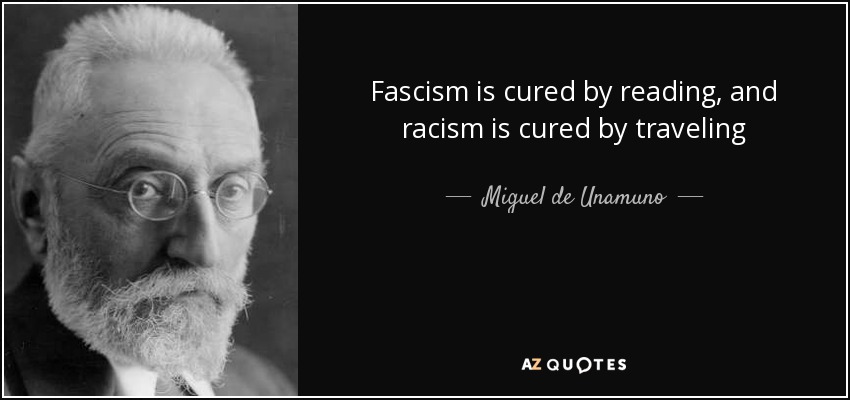
Miguel de Unamuno
b. 9.29.1864 Bilbao, Biscay, Spain
d. 12.31.1936 Salamanca, Salamanca, Spain
Miguel de Unamuno was a 20th century Spanish writer, professor of Greek classics and rector at the University of Salamanca. He wrote during the Miguel de Rivera and Francisco Franco dictatorships.
He wrote the philosophical essay The Tragic Sense of Life (1912). It provides testimony to his will to live despite existential angst.
His most famous novel was Abel Sánchez: The History of a Passion (1917). It is a modern exploration of the Cain and Abel story.
He was a socialist when he was young. He became an advocate for liberalism as he looked to find where his Basque identity fit into the international scheme of literary relations. He extricated himself from socialism eventually, but he was left feeling alone as a liberal.
Bilbao
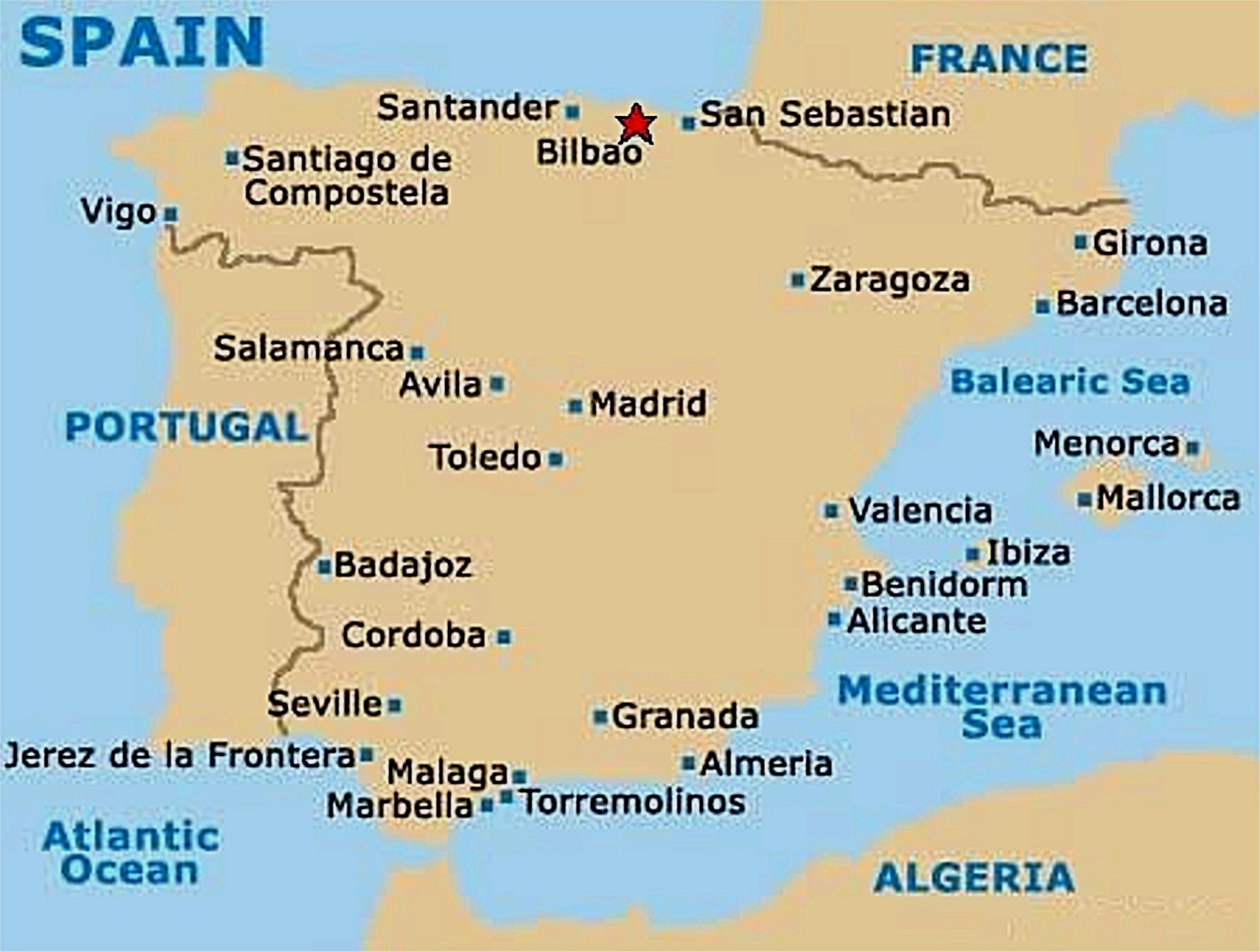
The historical name for the location is Bilbo. The word was used for a sword noted for elasticity and temper. Tolkien used the name for the central character in the novel, The Hobbit.
Bilbo Baggins was a home loving creature from a small town in Middle Earth. He was recruited for a mission to take back the treasure that had been stolen by the dragon Smaug. The hobbit was about half the size of a human.
He wasn't the strongest of fighters, but he used stealth, ingenuity, diplomacy and the ring of power to help the company of dwarves, elves and men fight a variety of different creatures in the effort to fulfill the quest for their journey.
The village is known affectionately by its inhabitants as the botxo meaning hole since it is surrounded by mountains.
Bilbao is situated in the north of Spain. It is only 16 km (10 mi.) south of the Bay of Biscay. The main urban core is surrounded by two small mountain ranges with an average elevation of 400 meters (1,300 ft). It is the capital for the province of Biscay.
The climate is shaped by the low-pressure systems of the bay. The air is mild with moderating summer temperatures for Iberian standards. The average high for September is 24.6 C (76.3 F). The average low for January and February is 5.1 C (41.2 F). The range for the temperature is low for the latitude.
It was a commercial hub of the Basque Country in Green Spain. Green Spain is a lush natural region near the northern coast. The port activity was mainly based on the export of iron from the Biscayan quarries.
Bilbao experienced heavy industrialization during the 19th century and into the early 20th century. It was the second-most industrialized region of Spain behind Barcelona.
It is currently working on revitalization as a service city.
The Basque country is located in the western Pyrenees. It straddles the border between France and Spain on the coast of the Bay of Biscay. The Basques call themselves the euskaldunak formed from euskal- (i.e. "Basque (language)") and -dun (i.e. "one who has").
Euskara would literally mean "way of saying", "way of speaking". The Basque language is unrelated to Indo-European. It has long been thought to represent the people or culture that occupied Europe before the spread of Indo-European languages there.
A comprehensive analysis of Basque genetic patterns has shown that Basque genetic uniqueness predates the arrival of agriculture in the Iberian Peninsula, about 7,000 years ago.
Miguel de Unamuno
Miguel de Unamuno was born in Bilbao on September 29, 1864. He was the son of Félix de Unamuno and Salomé Jugo. He was a descendent of the Basque heritage. He inherited the independent spirit and self-pride of his ancestors.
Felix died when he was 6. His mother moved him with her to live with his grandmother. He was provided with deep Catholic instruction in faith.
He was interested in the Basque language as a young man. He compete for a teaching position in the Instituto de Bilbao against Sabino Arana. Arana would become the founder of the Basque Nationalist Party. The contest was finally won by the Basque scholar Resurrección María de Azkue.
He was about to start studying his baccalaureate when he was witness to the siege of Bilbao during the Third Carlist War.
The Carlist pretender to the Bourbon dynasty in Spain had called for a rebellion to restore charters that had been abolished in the beginning of the 18th century.
The call for rebellion was echoed in Catalonia and especially in the Basque region where the Carlists managed to design a temporary state. They had laid siege to Bilbao but failed to take it. Unamuno's experience of the siege was used to write his first novel, Paz en la Guerra (Peace in the War).
He attended the University of Madrid. He studied literature and philosophy. He read the works of T. Carlyle, Herber Spencer, Friedrich Hegel and Karl Marx.
He began frequenting “Generation of 1898”, a popular literary society dedicated to the revival of the intellectual society of Spain. He enrolled in a four year degree for a doctorate in philosophy.
He received a PhD in 1884. His thesis was on the origin and prehistory of the Basque race.
He got a job in a Spanish school as a Latin and Psychology teacher in 1884. He was given the Psychology, Logic and Ethics Chair in the Bilbao Institute in 1888.
He became a professor of Greek at the University of Salamanca in 1891. He married his childhood sweetheart, Concepción, later that year. They would have 10 children together.
Unamuno was a member of the Generation of '98. This was an ex post facto group. The name Generación del 98 was coined by José Martínez Ruiz, commonly known as Azorín. The group of novelists, poets, essayists and philosophers were active in Spain at the time of the Spanish–American War (1898).
The main issue in the war was Cuban independence. The United States Navy armored cruiser USS Maine mysteriously exploded and sank in Havana Harbor. Political pressure from the Democratic Party pushed McKinley into a war that he had wished to avoid.
The ten-week war was fought in both the Caribbean and the Pacific. U.S. naval power would prove decisive. Expeditionary forces disembarked in Cuba against a Spanish garrison already facing nationwide Cuban insurgent attacks and further wasted by yellow fever.
The invaders obtained the surrender of Santiago in Cuba and Manila in the Philippines despite the good performance of some Spanish infantry units and fierce fighting for positions such as San Juan Hill.
The U.S. was allowed temporary control of Cuba. Spain ceded ownership of Puerto Rico, Guam and the Philippine islands. The cession of the Philippines involved payment of $20 million ($602,320,000 today) to Spain by the U.S. to cover infrastructure owned by Spain.
The loss of the last remnants of the Spanish Empire was a profound shock to Spain's national psyche. The defeat provoked a thorough philosophical and artistic reevaluation of Spanish society by the Generation of '98. The major works fall in the two decades after 1898.
The intellectuals included in this group were known for their criticism of the Spanish literary and educational establishments. The establishments were criticized for characteristics of conformism, ignorance and a lack of any true spirit. The writers disliked the Restoration Movement that was occurring in Spanish government.
Two distinct political movements were formed after the war. Republicanism and Carlist Monarchism were marked by the oscillation of power.
The "Glorious Revolution" of 1868 was followed by 6 years of battle that had overthrown Queen Isabella The First Spanish Republic of 1873 had lasted only 22 months. The Restoration project of Antonio Cánovas del Castillo, was an attempt to create a constitutional monarchy based on Victorian Britain.
A system called turno pacífico ("peaceful alternation") was devised. The two political parties alternated control of the government by means of a heavily orchestrated and controlled electoral process. The Restoration was reasonably successful in restoring political stability, but finally ended with the Second Spanish Republic in 1931.
The Generation of '98 intellectuals objected to the meticulously organized structure of the Restoration system of government and the corruption that it fostered. They agreed on the urgency of finding a means of rescuing Spain from its catatonic state in areas of thought in activity separate from politics.
The writers, poets and playwrights of this generation maintained a strong intellectual unity. They opposed the Restoration of the monarchy in Spain, revived Spanish literary myths and broke with classical schemes of literary genres.
They brought back traditional and lost words. They alluded to the old kingdom of Castile. Many supported the idea of Spanish Regionalism. They were liberals.
Most texts in this literary era were produced in the years immediately after 1910. They are generally marked by the justification of radicalism and rebellion. Miguel de Unamuno's articles written during the First World War are characteristic.
Unamuno would have preferred to be a philosophy professor, but was unable to get an academic appointment. Philosophy was politicized in Spain.
He became a Greek professor at the University of Salamanca instead. He became the rector at the university in 1900. He would publish essays on metaphysics, politics, religion and travel throughout his life. He also published over 10 novels and a number of plays. He wrote poetry as well. He contributed to dissolving the boundaries between the genres as a modernist.
Unamuno gave a conference on the scientific and literary inviability of the Basque in 1901. He went against the Basque language once his political views changed along his reflection on Spain.
He did not begin to publish poetry until the age of 43. His first book, Poesías (1907), used common Spanish to offer the poet's impressions of nature and travel. He had translated the poets Samuel Taylor Coleridge and Giacomo Leopoardi. Their influence on his early work is clear.
He published “Del sentimiento trágico de la vida en los hombres y en los pueblos” (The Tragic Sense of Life in Men and Peoples), which dealt with the contrasts between logic and faith in 1913.
Unamuno’s description of the tragic sense of life is reminiscent of the sentiments of Blaise Pascal. Both convey a sense of loss regarding our place in an indifferent cosmos.
Unamuno is unusual among the existentialists insofar as he used his reflection on death as the means to affirm the will to live. He defined egoism as the principle of psychic gravity. It was the necessary postulate. He was an anti-realist in this philosophy.
Abel Sanchez: The History of a Passion was released in 1917. The Cain of the novel is named Joaquin. He is not the brother of Abel, but the two grew up together competing as brothers.
Abel became a famous and recognized painter while Joaquin trained to become a well-known doctor. Joaquin's goal was to outdo Abel by making medical discoveries. He felt compelled to compete with Abel's art by excelling at science as an art. His envy of Abel was the motive force in his life.
Hatred resulted from envy as the consuming passion for their history. The book is replete with biblical comparisons. It shows what one's life becomes when consumed by passion like hatred.
Unamuno became one of the most passionate advocates of Spanish liberalism in the 1920's and 1930's. He linked his liberalism with his hometown of Bilbao. He felt that the individualism and independence of the city provided a stark contrast to the narrow-mindedness of Carlist traditionalism.
Unamuno blamed the assassination of Jose Canales by an anarchist in 1912 on the lack of a true liberal democratic party. He denounced the large property owners for their negligence and ignorance in 1914. He was an outspoken supporter of the Allied cause during the First World War despite Spain's official neutrality.
He published The Christ of Velasquez in 1920. It ran 2,538 lines in length. It reflected the poet's desire to define a uniquely Spanish Christ. He prepared a volume of travel sketches during the summer of 1920. They were published as Spanish Travels and Visions in 1922. Many of the prose poems in this volume were published in daily newspapers.
Rhymes for Within was published in 1922. Teresa was released in 1924.
General Miguel Primo de Rivera launched a successful military coup in Spain on September 13, 1924. Unamuno published a number of articles critical of the new government.
He was exiled without his family in 1924 to the island of Fuerteventura in the Canaries. He wrote the Intimate Diary of Confinement about the experience. The Ballads of Exile was published in 1928. It was the last book of poetry that was published in his lifetime.
King Alfonso of Spain removed the dictator, Primo de Rivera, in 1930. Unamuno returned from exile. He was restored to his position as rector of the University of Salamanca.
He had become convinced of the universal values of Spanish culture even though he had started his literary career as an internationalist. He felt that Spain's essential qualities would be destroyed if influenced too much by outside forces.
He initially welcomed Franco's revolt as necessary to rescue Spain from the excesses of the Second Republic. The harsh tactics employed by the Francoists in the struggle against their republican opponents caused him to oppose both the Republic and Franco.
He said that the military revolt would result in a victory of "a brand of Catholicism that is not Christian and of a paranoid militarism bred in the colonial campaigns" of Spanish Morocco.
He had a public quarrel with the Nationalist general Millán Astray at the university in 1936. He denounced both Astray and elements of the rebel movement. He called their battle cry, "Long live death" repellent.
He suggested that Astray wanted to see Spain crippled. He refuted the fascist in front of a crowd of Franco's Falangists. It was a remarkable act of moral courage for which he risked being lynched.
He was saved by Franco's wife who took him out of the place. He was effectively removed for a second time from the rectorship of the University of Salamanca.
Unamuno wrote this in 1936:
"No, I am neither fascist nor Bolshevik. I am alone!...Like Croce in Italy, I am alone!"
He was placed under house arrest by Franco. His death followed ten weeks later on 31 December.
Unamuno's philosophy was not systematic but rather a negation of all systems and an affirmation of faith "in itself."
He developed intellectually under the influence of rationalism and positivism, but during his youth he wrote articles that clearly show his sympathy for socialism and his great concern for the situation in which he found Spain at the time.
He was in a distinct sense the victim of his own error in thought. He extricated himself from socialism at the end, but socialism was an extension of liberalism that promoted revolution.
Liberalism still promoted rebellion.
The ideology for socialism became so pronounced that one revolution was countered by another. Overthrow of the government was the common goal for any socialist or liberal organizational motive.
Extrication from socialism left Unamuno feeling alone in liberalism. He was still constrained to complain in the context of another error.
---------------------
Miguel de Unamuno
S. 米格尔的乌纳穆诺
T. 米格爾的烏納穆諾
米 Mi rice 米 bei rice Mi み ミ Mi 미 beauty
格 gu rule 格 kaku status ge げ ゲ gu 구 phrase
尔 er that 爾 ji you ru る ル el 엘 el
的 di clear 的 teki bull's eye de で デ de 데 place
乌 Wu crow 烏 u crow U う ウ U 우 oo
纳 na admit 納 no settlement na な ナ na 나 I
穆 mu reverent 穆 boku respectful mu む ム mu 무 radish
诺 nuo consent 諾 daku consent no の ノ no 노 furnace
----------------------
The intellect of the rebel rejected agreement
with any system that didn't use vehemence
to disagree with reasonable appeasement.
Egoism was seen as the necessary postulate in psychic gravity.
The tragic sense of pain affirmed life beyond the agony
but it was not realistic about the anatomy of sanity.
The crow did not consent to the rule of rice
when scavenging garbage made him feel so nice.
================
Confrontation with Astray
wiki Historical Dialog
Biography
wiki Miguel de Unamuno
Poet MdU
Philosopher MdU
Author MdU
Spanish Bks: MdU
Article Tragic Sense of Life
Text: The Tragic Sense of Life
Electrical Power
Electrical Power in Spain
wiki Electricity Generation
Unamuno and Franco


