
Recognize
Boundaries
认识到边界
Rènshì dào biānjiè
境界を認識する
Kyōkai o ninshiki suru
ps79
Agnoscis finibus terminabitur
They came
to defame.
Hostiles have entered your land.
They have rejected the Constitution as a plan.
They crossed the border illegally
to take money from the citizens strategically.
Your inheritance has been invaded.
Sanctuary by liberals has been abraded.
The temple built for divine design
has been profaned by the illegal line.
The bodies of those murdered have been given as food for the birds of the air.
The flesh of your faithful were given to the beasts outside of legal affairs.
Blood has been shed on either side of the border.
There was no one there to observe the burial order.

Open borders make a parody of security.
Policy has run contrary to our maturity.
How long will the fire blaze as angry?
How long will the flesh burn like gangrene?
Correct those hostile to the divine will for the country.
Punish those who defy the law so bluntly.
They have devoured profit from competition.
They have agreed to the liberal fiction.
Do not hold our error against us forever.
We are working to build our national treasure
together.
Help us to find glory in the name of God.
Deliver us by forgiveness to help us beat the odds.
Why should liberals be allowed to ask, "Where is their victory?"
They seek to destroy opposition as contradictory
to their conquest of history.
The protagonist was on the inside of order looking out, but not.
He found chaos in and outside the border without a plot.
Let the sorrowful sighs of sadness arise to the skies.
Spare those convicted of crime by the testimony of lies.
Whoever is constant in faithfulness can be trusted with more.
Those who have not been worthy of trust in another's store
did not earn the right to take excess, much less more.
What will come to those who operated dishonestly?
Restitution will be their largest commodity.
Let them suffer remorse for the reviling with which they reviled.
Let the remorse endorse the correction of error they compiled.
We are the people of God. Christ is our pastor.
We will give praise with thanks to recover from disaster.
The autumnal equinox has arrived.
The end of summer will be derived.
The earth will start to tilt away from the sun.
The light of day for work or fun
will become shorter than the night's run.

The Harvest Moon serves as a sentinel in the sky
to remind us of the bounty that the earth with work supplies.

The bible and prayer evangelized the frontier
while the tortoise ate the orchid without fear.
I mourn for those who have been hurt.
Dismay is felt for those who did not convert.
Conservative reform gives credit to things won in the past
as an expression of accomplishment by what our ancestors asked.
I urge that prayers be made for everyone including those in high positions.
Offer thanksgiving for petitions that have been acquisitioned.
Lead peaceful lives with dignity in constancy
that we may be found acceptable in the sight of divine economy.
abraded- scraped
----------------------
Harvest moon works as a sentinel of worth
収穫月は空のガードとして機能
Shūkaku tsuki wa sora no gādo to shite kinō
of the blessings of a working earth.
します働く地球の祝福の。
shimasu hataraku chikyū no shukufuku no.
-----------------------
79 Deus, venerunt
Light, they came
1 O God, the heathen have come into your inheritance;
they have profaned your holy temple;
they have made Jerusalem a heap of rubble.
2 They have given the bodies of your servants as food for the birds of the air,
and the flesh of your faithful ones to the beasts of the field.
3 They have shed their blood like water on every side of Jerusalem,
and there was no one to bury them.
4 We have become a reproach to our neighbors,
an object of scorn and derision to those around us.
5 How long will you be angry, O Lord?
will your fury blaze like fire for ever?
6 Pour out your wrath upon the heathen who have not known you
and upon the kingdoms that have not called upon your Name.
7 For they have devoured Jacob
and made his dwelling a ruin.
8 Remember not our past sins;
let your compassion be swift to meet us;
for we have been brought very low.
9 Help us, O God our Savior, for the glory of your Name;
deliver us and forgive us our sins, for your Name's sake.
10 Why should the heathen say, "Where is their God?"
Let it be known among the heathen and in our sight
that you avenge the shedding of your servants' blood.
11 Let the sorrowful sighing of the prisoners come before you,
and by your great might spare those who are condemned to die.
12 May the revilings with which they reviled you, O Lord,
return seven-fold into their bosoms.
13 For we are your people and the sheep of your pasture;
we will give you thanks for ever
and show forth your praise from age to age.
----------------------
================.
----------------------
Jeremiah 8:18-19
'The harvest is past, the summer ended
and we are not saved.'
For the hurt of my people I am hurt.
I mourn. Dismay has taken hold of me.
----------------------
The autumnal equinox has arrived.
The end of summer will be derived.
The earth will start to tilt away from the sun.
Daylight will become shorter than the night's run.
I mourn for those who have been hurt.
Dismay is felt for those who did not convert.
================
1 Timothy 2:1-3
I urge that supplications, prayers, intercessions and thanksgiving should be made for everyone including kings and all who are in high positions so we may lead a quiet and peaceable life in godliness and dignity. This is right and acceptable in the sight of God our Savior who desires everyone to be saved and to come to the knowledge of the truth.
----------------------
I urge that prayers be made for everyone including those in high positions.
Offer thanksgiving for petitions that have been acquisitioned.
Lead peaceable lives with dignity in constancy
that we may be found acceptable in the sight of divine economy.
================
Luke 16:10-12
Make friends for yourselves with wealth that when it is gone they may welcome you into the eternal home. Whoever is faithful in little is faithful also in much. Whoever is dishonest in little is dishonest in much. If you have not been faithful with wealth, who will entrust to you true riches? If you have not been faithful with what belongs to another, who will give you what is your own?
----------------------
Whoever is constant in faithfulness can be trusted with more.
Those who have not been worthy of trust in another's store
did not earn the right to take excess, much less more.
What will come to those who operated dishonestly?
Restitution will be their largest commodity.
================
Fall Equinox
Facts About Equinox
While the September equinox usually occurs on September 22 or 23, it can very rarely fall on September 21 or September 24.
A September 21 equinox has not happened for several millennia. It will happen twice in the 21st century in the years 2092 and 2096. The last September 24 equinox occurred in 1931. The next one will take place in 2303.
The equinox dates vary because of the difference between how the Gregorian calendar defines a year (365 days) and the time it actually takes for Earth to complete its orbit around the Sun (about 365 and 1/4 days).
This means that each September equinox occurs about 6 hours later than the previous year's September Equinox. This eventually moves the date by a day.
-------------------------
Self-Sufficiency

Philander Chase
b. 12.14.1775 Cornish, New Hampshire
d. 9.20.1852 Jubilee College, Illinois
Philander Chase was a bishop and an educator in the United States in the 19th century. His ancestors were Puritans. His parents were Congregationalists. He became an Episcopalian. He was a pioneer on the western frontier. This was in Louisiana, Ohio and Illinois for him.
His life gives a view of religion in the United States at the outset of its institution as a republic. His organizational skill for prayer and evangelization came from his education at Dartmouth College. He was trained to act as a missionary for the new nation with organization at the community level.
He helped to establish a number of churches before he became a bishop.
He organized Kenyon College as a seminary and a private liberal arts school in Gambier, Ohio. It was founded in 1824 with grants from Lords Kenyon and Gambier in England. Ohio became the 17th state on March 1, 1803
He founded Jubilee College in Illinois in 1840. It was one of the earliest educational enterprises in the state. It became the 21st state in 1818.
Self-sufficiency was the goal for both institutions.
The schools included a theological seminary, a college and a grammar school for boys. Kenyon had a printing press for local publications. Jubilee added a “seminary” for girls and a gristmill to grind grain.
Each had its own sawmill and farm. The schools were built with lumber from the saw mills. Instruction in small farming operations was offered. The school was named as an expression of thankfulness with joy.
Cornish
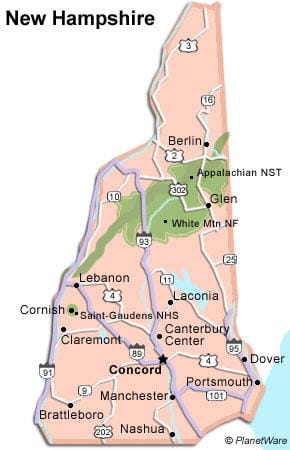
Cornish is a town in Sullivan County on the western border in southern New Hampshire.
The long ridge of Croydon Mountain follows the eastern boundary for the town. The highest point in the town limits is a knob on the mountain that reaches an elevation of 2,323 ft (708 m) above sea level. The Connecticut River bounds the town on the west.
There were 1,661 people as of the 2000 census.
The town was granted in 1763. It contained the area once known as “Mast Camp.” It was the shipping point for the tall masts that were floated down the river by English settlers.
It was incorporated by Colonial Governor Benning Wentworth in 1765. It was named for Sir Samuel Cornish, a distinguished admiral of the Royal Navy.
Philander Chase
Philander was born in Cornish, New Hampshire on December 14, 1775. His parents were Dudley and Allace Corbett Chase, the founders of the town. He was the youngest of 14 children. He utlimately survived his siblings.
His name was taken from the Greek root 'philandros.' It means lover. Philander showed his love for God with his life.
His ancestors had been Puritans who had fled to New England. His father was a deacon at the local Congregational church. He wanted one of his 5 sons to become a minister. Philander wanted to become a farmer, but his father persuaded him to go to college.
He enrolled at Dartmouth College for education in the ministry. It was while he was there that he discovered the Book of Common Prayer. It was like a reference book with short prayers for different occasions. It could be used by a priest or the laity.
The minister didn't have to create his prayer in the moment for the community. He would just read the prayers for the occasion. There was less disturbance caused by disagreement with personal choice in expression. The format carried the promise of organized evangelization.
Church communities could be established. Schools that entertained prayer could be organized with its help. He was so enchanted with the book that he became a lay reader in the Episcopal Church while at college.
He graduated from Dartmouth in 1795. The Episcopal Church in America was still in its infancy in the United States. It had been split from the Church of England during the American Revolution. Young men were not required to attend seminary in England, but there were no American Episcopal seminaries at the time. The first would not be founded until 1817.
Philander traveled to Albany, New York, to study under the Reverend Thomas Ellison.
He married Mary Fay of Hardwick, Massachusetts during the period of his instruction. They would have 2 sons before her death in 1818. George was born in 1797; Philander in 1800.
He was ordained as a deacon at St. George's Chapel on Long Island, New York on May 10, 1798. He was assigned to missionary duty by the bishop in the state's northern and western parts. Chase became one of only three Episcopal clergymen above the Highlands.
He traveled to evangelize by horseback in Troy, Lake George, Auburn and Bloomfield. He baptized, prayed and preached to meet the needs of widely scattered Episcopalians and other Protestants in the more rural areas.
He helped to organize the first congregation of Trinity Church in Utica, New York in 1798. St. John's Episcopal Church was established in the town of Canandaigua in the following year.
He was ordained as a priest in 1799. He was assigned to Christ Church in Poughkeepsie, New York. He preached to a community of Mohawk assembled in Canajoharie by the Society for the Propagation for the Gospel.
The Rev. Chase accepted a challenge to establish the first Episcopal congregation in Louisiana in 1805. He became the founding rector of what ultimately became Christ Church Cathedral in New Orleans.
He had moved south with Mary hoping to cure her of her tuberculosis. They left their children with relatives in New England.
Mary's health did not improve, but they wanted to oversee the further education of their sons George and Philander who had been accepted at the academy in Chesire, Connecticut.
He accepted a position as rector of Christ Church in Hartford in 1811. He would serve there for 6 years. His autobiography called them the "Sunshine Years".
He felt the call to preach on the frontier. This urge was coupled with growing tension with John Henry Hobart, bishop of New York. Chase felt compelled to follow the migration west.
He settled in Worthington, Ohio, a small pioneer community established in 1803 by a group of fellow New Englanders. He purchased a tract of land for a farm and was appointed principal of Worthington Academy. His wife Mary succumbed to her illness in 1818.
He received the appointment of bishop of the newly-formed Diocese of Ohio after the loss of his wife. This appointment was met with much disapproval by several bishops. Chase was not consecrated until February, 1819. He married Sophia May Ingraham that same year.
Life in Worthington was not easy for the new bishop. His income from his farm and from Worthington Academy did not suffice. His position paid him no salary. He accepted the presidency of Cincinnati College in 1821 to improve his financial situation.
Chase would return to Worthington after about one year. He soon realized that the Diocese of Ohio was in dire need of help. He logged over 1200 miles on horseback between June 1820 and June 1821. He found it exceedingly difficult to find trained clergy.
The Episcopal Church paid little attention to its western expansion since its split from the Church of England. There was no expectation of help from the East. Bishop Chase formulated a plan.
He would found a theological seminary in the West to train clergy for the West. Other bishops objected to the plan, especially his rival, Bishop Hobart. General Theological Seminary had been founded in New York in 1817. Hobart believed that General was sufficient to train American clergy.
He was convinced that he could not raise the necessary funds in the US. He received a letter of introduction from Henry Clay to Lord Gambier and traveled to England. Kenyon College was founded with donations from his trip to England.
Chase initially set the college up on his farm in Worthington, but he soon determined that a new location was necessary. He purchased eight thousand acres of land in Knox County, northeast of Worthington. He was given help by Henry Curtis, a young Mount Vernon lawyer. Chase named the property Gambier.
Work began immediately on Gambier Hill. Kenyon College was moved to its new location in 1828. Chase had a saw mill built. Lumber from it was used to build the college building. He laid out the plot for a farm which he worked.
He was given a printing press as a gift from Lord and Lady Ackland for publications. He had a post office built for which he acted as the postmaster.
His theological seminary soon developed into a much larger educational institution. It included a traditional college and a grammar school.
Chase’s wife, Sophia, proved nearly as vital to the functioning of Kenyon College as the Bishop himself. She cooked for the students, nursed their illnesses and did their laundry. She managed affairs during the Bishop’s frequent trips to raise funds.
Some thought that Chase had misused monies donated to the theological seminary for the establishment and maintenance of the college. Others thought that the bishop of the diocese should not have charge of the college and the grammar school.
The Ohio Convention demanded that he relinquish some control in 1831. Chase was both frustrated and exhausted. He resigned the presidency of Kenyon College and the episcopacy of Ohio on September 9.
Chase left Gambier with his family and settled on a small farm 20 miles away near Millersburg. He named it the Valley of Peace. The next spring the family moved to Gilead, Michigan. He returned to the life of a simple farmer and itinerant minister.
He was elected the first bishop in a newly formed Diocese of Illinois in 1835. He looked to the East for aid for his new ministry. He received little help, so he quickly formulated plans for another theological seminary to be established near Peoria. He went to England again to raise the necessary funds.
He was greeted warmly by his English friends, but his efforts to raise money were less successful. He returned to American soil and began a fundraising tour of the southern United States.
This proved successful enough to allow him to lay the cornerstone for Jubilee College in 1839. Chase continued his travel and fundraising and left his cousin, Samuel, in charge of the day-to-day operations of the new college. The chapel at Jubilee was finished by 1841.
He wanted Jubilee to be a self-sufficient community as with Kenyon. His sons, Henry, Philander and Dudley managed the college farm and a large flock of sheep. Chase also built a sawmill and a gristmill on Kickapoo Creek.
Chase’s daughter, Mary, ran a small girls’ school. There was also a college and a grammar school along with the seminary.
His position within the church improved. He was appointed to preside in 1843 as the senior bishop. His new college struggled to stay open. Fire destroyed the Jubilee saw and grist mills in 1849. A significant source of income was eliminated.
Its most important source of income would also be lost 3 years later. Chase was 77 by 1852. He had lived a hard pioneer life. His health began to fail. He was pulled from his carriage by his horse in September. He lingered for a few days, but died on September 20.
Jubilee College struggled without Bishop Chase at the helm. The doors were closed in 1862 after a decade. His son, Samuel, sought to open the college again after he had served as a chaplain in the Civil War. He was forced to start selling lands in 1871.
Bishop Chase was able to overcome the hardship of pioneer life to achieve his goal of bringing religion and education to the west. His position as a seminal figure in the history of the United States was established in the American frontier.
Dartmouth had originally been chartered as a missionary school for natives. The effort for this mission was limited by charity from the lower economic scale. It wasn't color blind.
Bishop Chase was a charitable leader who did what he could to provide for his students in an institution for a settled society. There would have been more integration if there had been less racial prejudice in either direction.
------------------------
Philander Chase
S. 菲兰德蔡斯
T. 菲蘭德蔡斯
菲 Fei humble 菲 hi thin Fi ふぃ フィ Pil 필 Phil
兰 lan orchid 蘭 ran orchid ran らん ラン lan 란 Lan
德 de goodness 德 toku ethics da だ- ダ- deo 더 more
蔡 Cai tortoise 蔡 sai tortoise Che ちぇ チェ Che 체 sieve
斯 si this 斯 shi this isu いす イス i 이 this
seu 스 s
----------------------
The bible and prayer evangelized the frontier
while the tortoise ate the orchid without fear.
================
wiki Philander Chase
Lectionary: Philander Chase
NE Historical Society: Philander Chase
Jubilee College
Kenyon bio: P. Chase
------------------------
French history gives the reader the opportunity to consider a political system that entertained the restoration to monarchy as part of the vote. It is an investigation into the republican view of monarchy or republic.
The literary view looks at first person perspective as a consideration of different systems of thought. This explains how the relatively solitary life of a writer can be described as 'not alone' by Blanchot. The written word is an extension of identification with society.
Not Alone

b. 9.22.1907 Quain, Devrouze, France
d. 2.20.03 Le Mesnil Saint Denis, France
Maurice Blanchot was a French writer, philosopher and literary theorist in the 20th century. His work had a strong influence on post-structuralist philosophers such as Gilles Deleuze, Michel Foucault, Jacques Derrida and Jean-Luc Nancy.
His greatest influence has been felt in the fields of literature and literary theory. He wrote 11 novels and a series of essays. Many of the essays appeared in book form. None were bestsellers, but their quality counted. People were not always converted to his ideas, but they were invariably fascinated by him.
His fictional texts, Thomas the Obscure (1941), Death Sentence (1948) and The Madness of the Day (1949) are among the most unique and challenging in French literature.
His critical essays on Kafka, Rilke, Sade, Mallarmé, Hölderlin and his interpretation of the myth of Orpheus are considered canonical texts in the field of literary studies. His relationship to philosophy, though equally significant, is more nuanced and complex.
He sought to read philosophers on their own terms by engagement with their respective terminologies. He operated from inside the philosophical system in order to highlight the way in which the system inevitably opens onto an outside.
The tension between the functional scheme whether it was philosophical, political or textual and its anarchic unrepresentable outside was a commonly recurring trope within his writing.
Other recurrent themes can likewise be discerned in his work. These include an exploration of the paradoxes associated with death, repetition and time.
There are various aporias related to origins and ends as well. His writing shows him to be a thinker broadly committed to the privilege of anonymity and difference over identity and sameness.
This left his work with the French form of continental idealism. There was a shell within which different forms could operate, but the inside was dedicated to the avoidance of categorization rather than the identification of profit as the chief value.
It was the consequence of the liberal mechanism.
Dijon, France
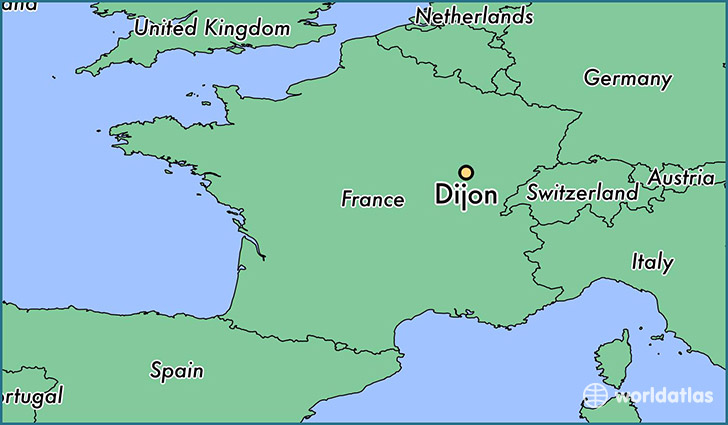
Quain is a small village in Saone-et-Loire. It lies between the Saone and Loire rivers. It is located about 80 km (50 mi.) south of Dijon in east central France.
The region is called Bourgogne-Franche-Comte. It is the result of the merger of the former regions of Burgundy and Franche-Comte in 2016. It is about the size of Switzerland.
The basement contains clay, sandstone, limestone, gypsum and alluvium, but the main subsoil resource is coal.
There are 3 mountain ranges in the area. The Vosges massif is located in the north-east. The Jura extends over the entire eastern limit. The Morvan occupies a central position in the western part. The Vosges and the Jura meet in the Trouée de Belfort.
France was in the Third Republic at the start of the 20th century. The French Constitutional Laws of 1875 had defined the composition.
Calls for the re-establishment of the monarchy dominated the tenures of the first two presidents. The growth of support for the republican form of government among the French populace and a series of republican presidents in the 1880's gradually quashed prospects of a monarchical restoration.
The Third Republic established many French colonial possessions, including French Indochina, French Madagascar, French Polynesia and large territories in West Africa during the Scramble for Africa. All of them were acquired during the last two decades of the 19th century.
The early years of the 20th century were dominated by the Democratic Republican Alliance. The alliance was originally conceived as a center-left political body, but over time became the main center-right party.
Politics under the Third Republic were sharply polarized. Reformist France stood on the left as the heir to the French Revolution. Conservative France was rooted in the peasantry, the Roman Catholic Church and the army on the right.
The Third Republic endured for 70 years despite the sharply divided electorate and persistent attempts to overthrow it. It is the longest lasting system of government in France as of 2019 since the collapse of the Ancien Régime in 1789.
Maurice Blanchot
Maurice was born in Quain on September 22, 1907.
His family was Catholic. His father encouraged Maurice and his siblings to practice Latin at the kitchen-table.
He went to the University of Strasbourg to study philosophy and German. The university had one of the largest libraries in France at the time.
He met Emmanuel Levinas in 1926. Levinas was a Lithuanian born French Jewish phenomenlogist. The two began a life long relationship.
Blanchot had relocated to Paris by 1929. He briefly pursued the study of medicine at Saint Anne’s Hospital during the early 1930's.
He began his first collaborations with the journals of the French far-right. He was editor of the mainstream conservative daily the Journal des débats from 1932 to 1940. He contributed to a series of radical nationalist magazines while also serving as editor of the fiercely anti-German daily Le rempart in 1933. He was editor of Paul Lévy's anti-Nazi polemical weekly Aux écoutes.
He expressed the opinion that France was being ruined by its constitution, the corruption of politicians and by foreigners. The worst enemy was Léon Blum's Popular Front government. He denounced "the degenerates and the traitors" who were governing France in the revue Combat in November 1936. He added that the day must come when the government should be brought down by the people.
Similar sentiments were expressed by anti-semitic writers attacking Blum. Blanchot was criticized for anti-semitism. This was not the case. Paul Levy's weekly Aux Ecoutes had been founded to denounce Hitler. His best friend was the Jewish philosopher Emmanuel Levinas. He did not use racially-exclusionary language or overt anti-semitic expression.
That he asserted that the government should be overthrown by the people made his polemical argument an advocacy for violence against France and the League of Nations of which it was part. This was risked to warn against the threat to peace in Europe posed by Nazi Germany, but it was still seditious.
He worked in Paris during the Nazi occupation. He continued to work as a book reviewer for the Journal des débats from 1941 to 1944 in order to support his family. He wrote about such figures as Sartre and Camus, Bataille and Michaux, Mallarmé and Duras for a putatively Pétainist readership. Phillipe Petain served as the Chief of State of Vichy France from 1940 to 1944.
Blanchot laid the foundations for later French critical thinking by examining the ambiguous rhetorical nature of language and the irreducibility of the written word to notions of truth or falsity in these reviews.
His first novel, Thomas l'Obscur (1941), was an abstract work. It anticipated le nouveau roman in many ways. The ideal nouveau roman would be an individual version and vision of things.
It subordinated plot and character to the details of the world rather than enlisting the world in their service. The principal character, Thomas, had no personal history, was not situated socially and had no clear geographical location. There was no plot. There was only the set of the situation for description.
The work was an indication of Blanchot's postwar route. He would write a monthly article for the Nouvelle Revue Francaise from 1953 to 1968. It was these pieces, together with a number of collected essays, that would make his reputation as a literary critic.
His thought ran counter to the prevailing belief that literature and art should be dedicated to a cause to which writers have a duty to commit themselves. Blanchot believed that it was in writing itself that the author found his purpose. There was the use of language, the reality of silence and the overwhelming reality of death.
Blanchot met Georges Bataille in December 1940. Bataille had written strong anti-fascist articles in the thirties. They would remain friends until his death in 1962. Bataille was working on his book about Nietzsche when they met. He defined Nietzsche as a radically non-teleological adversary of Hegel.
Blanchot became a regular participant in the bi-monthly philosophical discussions at 3 rue de Lille at Bataille's invitation. He met Denise Rollin with whom he would later become friends.
Blanchot helped Bataille formulate the abortive project of the “Collège socratique” in late 1942. He was present at the famous “Discussion on Sin” organized by Bataille in March 1944. The discussion was attended by Camus, Merleau-Ponty, Sartre and Klossowski, among others.
Blanchot's devotion to language was comparable to the observations of his friend Georges Bataille on obsessions and impulses. His devotion to the craft led him to support new writers such as Samuel Beckett and Alain Robbe-Grillet.
The spring of 1944 was a difficult time for both men. Bataille temporarily left Paris for Samois due to illness. Blanchot departed for his family-home in Quain.
He had been active in the Resistance and remained a bitter opponent of the fascist, anti-semitic novelist and journalist Robert Brasillach. Brasillach was the principal leader of the pro-Nazi collaborationist movement.
It was in Quain in June 1944 that Blanchot was put against the wall by a firing-squad and “mock-executed” by Nazi soldiers. These traumatic circumstances would be later recounted by Blanchot some fifty years later in his text, “The Instant of My Death” (1994).
He was on the move between Paris and various locales in the south of France throughout 1945 and 1946. It was during this period that he penned important essays on Kafka, René Char, Nietzsche and Hölderlin. He assisted Bataille in bringing to publication the first edition of the journal Critique.
Blanchot stopped work as a political journalist and began to write as a novelist and literary critic. He left Paris for the secluded village of Èze in the south of France in 1947. He spent the next decade of his life there.
He avoided the academy as a means of livelihood like Sartre and other French intellectuals of the era. He relied on his pen. He began a lifestyle of relative isolation. He would not see friends like Levinas for years though he continued to write lengthy letters to them.
Poor health was part of the reason for his self-imposed isolation. This was only part of it. His isolation was closely connected to his writing and is often featured among his characters.
He completed Death Sentence in 1947 and saw it published in June 1948. His third (and final) novel, The Most-High, featured a more political bent. It was also published in 1948.
It was followed by the fictional text, The Madness of the Day (1949) and another volume of critical essays, The Work of Fire (1949). The essays contained the seminal text, “Literature and the Right to Death” (first published in 1948). Lautréamont and Sade was published in 1949.
He was producing a new critical essay for publication virtually every couple of weeks by this point. He moved frequently during this period. He stayed with his brother, René, whenever he found himself in Paris.
He returned to the small house in Èze in September 1949. This would be his primary residence until 1957. He wrote some of the most influenctial critical essays of his career amidst the “essential solitude” of this medieval village overlooking the Mediterranean coast. The theoretical writings contained within The Space of Literature (1955) were included.
He published regularly in Nouvelle Revue Française from 1953 to 1968.
His mother died in 1957. Her passing affected the family greatly. He moved into his own flat on rue Madame in late summer 1958 after spending the winter with his brother and sister-in-law in Paris.
This began a new phase in his intellectual and personal itinerary. The return to Paris in 1957 was significant in a number of respects. First, it marked a renewed engagement with national politics. Second, it coincided with an increasing focus on questions of an explicitly philosophical nature which called for more rigor in that which was written.
The Algiers crisis of 1958, the collapse of the French Fourth Republic and the rise to power of de Gaulle ushered in a frightening new era in politics. Blanchot had not participated in national politics since the 1930's. He threw himself into the resistance against de Gaulle’s Fifth Republic.
He frequently met with Marguerite Duras and Dionys Mascolo throughout the late summer of 1958. Mascolo was a major influence on Blanchot’s political thinking during this time. He became involved with Mascolo’s anti-Gaullist paper (co-founded with Jean Schuster), Le 14 Juillet.
The marked change in Blanchot’s political thinking was clearly evident in his manifesto, “Refusal”. This was published in October 1958 along with another anti-Gaullist piece, “The Essential Perversion.”
When Francis Jeansen and twenty-three other dissidents were put on trial in September 1960 for opposing French colonial rule and supporting the Algerian struggle for independence, Blanchot, Mascolo, and a group of other intellectuals, determined to pen a declaration of solidarity with the defendants.
They wrote the "Manifesto of the 121". French soldiers in Algeria were called to desert rather than employ torture.
The document was named after the number of its signatories. Those who signed included Jean-Paul Sartre, Robert Antelme, Alain Robbe-Grillet, Marguerite Duras, René Char, Henri Lefebvre, Alain Resnais, Simone Signoret and others.
The manifesto supported the rights of conscripts to refuse the draft in Algeria. The manifesto was crucial to the intellectual response to the war.
Blanchot left his solitude to join the street demonstrations of the student protest movement in May 1968. He met the philosopher Jacques Derrida on one of the protests. They had both researched the work of Mallarmé, who had fulfilled Blanchot's belief that the hold on language was the supreme test of a writer.
He found himself at the heart of the anti-authoritarian movement as a member of the Comité d'action étudiants-écrivains. He penned numerous, unsigned pieces for the group’s magazine, Comité. He espoused a radical politics based upon a rejection of all forms of hitherto existing political order. It was to be a communism without communism.
Blanchot had distanced himself from the group by mid-1969. He cited its position in support of Palestine and opposition to the state of Israel as a reason in a letter to Levinas.
He worked continually in his writing to break the barriers between what are generally perceived as different "genres" or "tendencies". Much of his later work moves freely between narration and philosophical investigation.
He published La Communauté inavouable (The Unavowable Community) in 1983. This work inspired The Inoperative Community (1986), Jean-Luc Nancy's attempt to approach community in a non-religious, non-utilitarian and un-political exegesis.
He died on 20 February 2003 in Le Mesnil-Saint-Denis, Yvelines, France.
His work had been marked by an individual opposition to national movements. He repeated the European inclination to default to one form of socialism against the other. His position became nihilistic when he proposed a communism that was not communism. He was simply against any proposal for organization of any kind.
The argument against the liberal political mechanism rejects socialism and proposes that government employ the principle of the least force necessary to deter crisis. The liberal strategy as recorded by Locke sought to use the English bill of rights as the means to enslave or destroy any who would oppose government for the increase of benefit for liberals.
------------------------
Maurice Blanchot
S. 莫里斯布兰肖特
T. 莫里斯布蘭肖特
莫 Mo do not 莫 baku must not Mo も- モ- Mo 모 mother
里 li inside 里 ri village ri り リ li 리 lee
斯 si this 斯 shi this su す ス seu 스 s
布 Bu cloth 布 fu linen Bu ぶ ブ Beul 블 Bl
兰 lan orchid 蘭 ran orchid ran らん ラン lang 랑 lang
肖 xiao to resemble 肖 sho resemblance sho しょっ ショッ has 핫 hot
特 te unique 特 toku special to と ト
----------------------
The protagonist was on the inside of order looking out, but not.
He found chaos in and outside the border without a plot.
================
wiki Maurice Blanchot
IEP: Blanchot
Gdn Obituary: Maurice Blanchot