Showing posts with label mountain. Show all posts

Friday, May 3, 2019

Respect

5.4.2019
Mt. Zion, Jerusalem

Respect
Security
尊重安全
Zūnzhòng ānquán
セキュリティを尊重する
Sekyuriti o sonchō suru
ps87

The city was built on a small mountain.
The mountain grounded that which was founded.

Height held the advantage of sight for distance.
When invaders attacked the city was prepared for resistance.

Traders from different directions could be seen.
Welcome was prepared by the social machine.

The gate to the city welcomed visitors, family and friends.
It wasn't closed to ministers, misters, sisters or gems.

The gate was the way through which travelers entered.
Messengers shared word as a gift from the sender. 

Egypt and Babylon were among those who knew me.
Revelation was the gate for the truth of our history.

Philistia, Tyre and Ethiopia were partners in trade.
Weapons, wheels and cattle were the offerings they made.

The ring of fellowship is that which unites.
Power is grounded in defense of alliance.

Alliance against the destructive elements 
prepares people for defense against violence.

Cooperation extends beyond alliance.
Trade requires tact with respect for self-reliance.

The military is drawn from the people.
Training in strength overcomes feeling feeble.

Search for those lost while at work or at play
lends experience to training in a beneficial way.

The source of life is love.
Rescue comes from within and from above.

Zion is a lion on a hill.
Orion and Kiron match the iron will.

The Most High will sustain her.
She is a mighty cat that can still purr.

Accord with belief in what's right in law
is a birth that helps us grow despite our flaws.

The singers and dancers will show,
"Fresh springs are for your refreshment to know."

Pretend pre-dawn is light though dark
to watch your mind define the start. 

We proclaim good news for your sake
that faith may shine to make your heart wake
to the knowledge of Christ that you may partake
of that which is great. 

The Son of Man has been glorified
to bear fruit in the divine will for good as implied
for life.

---------------------------

Psalm 87
Fundamenta ejus
Her foundation

1 On the holy mountain stands the city he has founded;
the Lord loves the gates of Zion
more than all the dwellings of Jacob.
2 Glorious things are spoken of you,
O city of our God.
3 I count Egypt and Babylon among those who know me;
behold Philistia, Tyre, and Ethiopia:
in Zion were they born.
4 Of Zion it shall be said, "Everyone was born in her,
and the Most High himself shall sustain her."
5 The Lord will record as he enrolls the peoples,
"These also were born there."
6 The singers and the dancers will say,
"All my fresh springs are in you."

--------------------------

2 Corinth. 4:5-6

We do not proclaim ourselves. We proclaim Jesus Christ as Lord and ourselves as yours for Jesus' sake. It is the God who said, 'Let light shine out of darkness' who has shone in our hearts to give the light of the knowledge of the glory of God in the face of Jesus Christ.

--------------------------

We proclaim good news for your sake
that faith may shine to make your heart wake
that in the knowledge of Christ you may partake
of that which is great.

===================

John 12:23-4

Jesus answered them, 'The hour has come for the Son of Man to be glorified. Unless a grain of wheat falls into the earth and dies, it remains just a single grain. If it dies, it bears much fruit.'

--------------------------

The Son of Man has been glorified
to bear fruit in the divine will for good as implied
for life.

===================

Martyrs of the Reformation
Lectionary

The Roman Catholic Church commemorates the Forty Martyrs of England and Wales on this date. (May 4) These were men and women who were executed for treason between 1535 and 1679 for their allegiance to the Catholic Church.

The Church of England has shared this commemoration in recent years. The scope of the recognition has been broadened to all of the English saints and martyrs of the Reformation era. Anglican martyrs like Thomas Cranmer, Hugh Latimer and Nicholas Ridley died for their adherence to the Church of England.

Objectivity requires the remembrance of those Catholics who were killed by Anglicans. All other Christians who were persecuted by their fellow Christians for their beliefs are to be remembered with respect for their courage in faith as well.

The Quakers helped organize the movement to outlaw slavery. The Anabaptists were Swiss reformists who helped to reform the reform of the Protestant Reformation. They advocated for adult baptism for the knowledge of faith. They were persecuted along with Quakers by both Protestant and Catholic forces.

-------------------------

Agnosticism

Thomas Henry Huxley
b. 5.4.1825 Ealing, London, England
d. 6.29.1895 Eastbourne, Sussex, England

Ealing

Ealing is a district in west London. It was a rural village in the county of Middlesex when the area was not part of the larger city. The urban expansion in the late 19th and early 20th century incorporated the area.

The village was mostly made up of open countryside and fields where the main occupation was farming as in previous centuries. The transport of heavy goods tended be restricted to those times when the roads were passable due to dry weather with the exception of driving animals into London on foot.

The highway was graveled with the passage of the Toll Road Act. The old Oxford Road became an increasingly busy and important thoroughfare running from east to west through the center of the parish. This road was later renamed as Uxbridge Road.

The well-to-do of London began to see Ealing as a place to escape from the smoke and smells. The architect John Soane bought Payton Place in 1800. He renamed it Pitzhanger Manor. It was not bought as a place to live. It was somewhere green and pleasant where he could entertain his friends and guests.

The Duke of Kent bought a house at Castlebar soon after (1801). More affluent Londoners followed but with the intention of taking up a permanent residence which was conveniently close to the city.

More food and materials went in and more finished goods came out as London grew in size. Draft horses were used to haul loads. Frequent overnight stops were needed since they can only haul loads a few miles per day.

A large number of inns were situated along the Uxbridge Road to satisfy this demand. Horses could be changed and travellers refreshed. The road came to be favored by highwaymen.

Stops in Ealing included The Feathers, The Bell, The Green Man and The Old Hats. There were two pubs called the Old Hat at one point in history. They were located  either side of one of the many toll gates on the Uxbridge Road in West Ealing. The westernmost pub was renamed The Halfway House following the removal of the toll gate.

George IV was King of the United Kingdom of Great Britain and Ireland after the death of his father George III on 29 January 1820. He also became the King of Hanover. He retained the throne until his death in 1830.

He had served as Prince Regent during his father's mental illness from 1811 until his accession. He commissioned John Nash to build the Royal Pavilion in Brighton and to remodel Buckingham Palace. Sir Jeffry Wyattville was awarded the contract to rebuild Windsor Castle.

Robert Jenkinson was the British Prime Minister from 1812–1827. He was the Earl of Liverpool and was referred to as such. Lord Liverpool controlled the government during the regency and reign of George IV. He called for repressive measures at the domestic level as Prime Minister. He sought to maintain order after the Peterloo Massacre of 1819.

He had to steer the country through the period of radicalism and unrest that followed the Napoleonic Wars. He favored commercial and manufacturing as well as the landed interest. He sought compromise in the heated issue of Catholic emancipation.

The revival of the economy strengthened his political position. He was the leader of a reform faction of "Liberal Tories" who lowered the tariff by the 1820's. He abolished the death penalty for many offenses and reformed the criminal law.

T. H. Huxley

Thomas Henry Huxley was a British biologist. He was called "Darwin's bulldog" for his advocacy for Charles Darwin's theory of evolution. He was the grandfather to Julian, Aldous and Andrew Huxley. He was a critic of organised religion and devised the words "agnostic" and "agnosticism" to describe his own views.

Thomas was born on 4 May 1825 in Ealing when it was a village in Middlesex. He was the second youngest of the eight children of George Huxley and Rachel Withers. He was brought up in a literate middle-class family which had fallen on hard times. Other British scientists of the nineteenth century such as Alfred Russel Wallace shared a similar experience.

His father was a mathematics teacher at Ealing School until it closed. The closing of the school put the family into financial difficulties. His parents were Anglicans, but he sympathized with the town's Nonconformist against organized religion. Thomas left school after only two years of formal schooling at age 10. The family moved to Coventry.

Thomas was determined to educate himself despite his limited education. He became one of the great autodidacts of the nineteenth century.  He read Thomas Carlyle, James Hutton's Geology and Hamilton's Logic to start. He taught himself German in his teens.

He eventually became fluent enough to be used by Charles Darwin as a translator of scientific material in German. He learned Latin and enough Greek to read Aristotle in the original.

He made himself an expert on invertebrates and later on vertebrates as a young adult. He was skilled in drawing and did many of the illustrations for his publications on marine invertebrates.

He was apprenticed for short periods to several medical practitioners. He went to his brother-in-law John Cooke in Coventry at 13.

Cooke passed him on to Thomas Chandler. Chandler was notable for his experiments using mesmerism for medical purposes. His practice was in London's Rotherhithe amidst the squalor endured by the Dickensian poor. Here Thomas would have seen poverty, crime and rampant disease at its worst.

John Salt, his eldest sister's husband, took him on later. Huxley entered Sydenham College at 16. Sydenham was a cut-price anatomy school whose founder, Marshall Hall, discovered the reflex arc. Huxley continued his personal program of reading to make up for his lack of formal education in school.

Huxley was admitted to study at Charing Cross Hospital where he obtained a small scholarship a year later. He was taught by Thomas Wharton Jones, Professor of Ophthalmic Medicine and Surgery at University College London.

Jones had been Robert Knox's assistant when Knox bought cadavers from Burke and Hare. The young Jones was exonerated of crime. He had acted as go-between. He thought it best to leave Scotland though. He was a fine teacher as he was up-to-date in physiology. He was also an ophthalmic surgeon.

Huxley published his first scientific paper in 1845 under Wharton Jones' guidance. He demonstrated the existence of a hitherto unrecognised layer in the inner sheath of hairs. The band has been known since as Huxley's layer. He organised a pension for his old tutor later in life.

He passed his First M.B. examination at the University of London at 20. He won the gold medal for anatomy and physiology. He did not present himself for the final (Second M.B.) exams and consequently did not qualify with a university degree.

He was too young to apply to the Royal College of Surgeons for a licence to practise and he was 'deep in debt'.  He applied for an appointment in the Royal Navy at a friend's suggestion.

He had references on character and certificates showing the time spent on his apprenticeship and on requirements such as dissection and pharmacy. Sir William Burnett, the Physician General of the Navy, interviewed him and arranged for the College of Surgeons to test his competence by means of an oral exam.

He was made 'surgeon's mate' for HMS Rattlesnake. This was a marine naturalist in practice. The craft about to set sail on a voyage of discovery to survey New Guinea and Australia. The Rattlesnake left England on 3 December 1846.

He devoted his time to the study of marine invertebrates once they had arrived in the southern hemisphere. He began to send details of his discoveries back to England. Publication was arranged by Edward Forbes FRS. He had also been a pupil of Knox. Forbes was something of a mentor to Huxley both before and after the voyage.

He had mailed back research results to England from each port of call. He collected and studied cnidarians, tunicates and cephalopod molluscs.  When he returned to England in October 1850 he found that his research results had won him acceptance into the ranks of the English scientific establishment.

He was elected a Fellow of the Royal Society.  He not only received the Royal Society Medal but was also elected to the Council in the following year at the age of 26. He met Joseph Dalton Hooker and John Tyndall. They remained his lifelong friends.

The Admiralty retained him as a nominal assistant-surgeon, so he might work on the specimens he collected and the observations he made during the voyage of the Rattlesnake. He solved the problem of Appendicularia.

Johannes Peter Müller had found himself wholly unable to assign the place for the class in the animal kingdom. It and the Ascidians are both, as Huxley showed, tunicates. Today they are regarded as a sister group to the vertebrates in the phylum Chordata.

Other papers on the morphology of the cephalopods and on brachiopods and rotifers are also noteworthy. The Rattlesnake's official naturalist, John MacGillivray, did some work on botany. He proved surprisingly good at notating Australian aboriginal languages. He wrote up the voyage in the standard Victorian two volume format.

Huxley became acquainted with scientists like the geologist Charles Lyell, the botanist Joseph Hooker, the philosopher Herbert Spencer and the naturalist Charles Darwin. Professional positions in science were rare at the time. Most naturalists were affluent amateurs. Huxley managed to support himself on a stipend from the Navy and by writing popular science articles.

He secured a lectureship at the School of Mines in London after leaving the Navy in 1854. He sent for the fiancée he had met in Sydney. They were married in 1855. He was Fullerian Professor at the Royal Institution 1855–58 and 1865–67; Hunterian Professor at the Royal College of Surgeons 1863–69; President of the British Association for the Advancement of Science 1869–1870; President of the Quekett Microscopical Club 1878; President of the Royal Society 1883–85; Inspector of Fisheries 1881–85; and President of the Marine Biological Association 1884–1890.

The thirty-one years during which Huxley occupied the chair of natural history at the Royal School of Mines included work on vertebrate palaeontology and on many projects to advance the place of science in British life.

He was an outspoken defender and advocate for Darwin's theory of evolution by natural selection. He was an opponent of any evolutionary change at all at first. He believed that the living world had stayed much the same for as far back as its history could be traced.

He felt that modern taxa would eventually be found in the oldest rocks. He came to accept Darwin's position on evolution. His reaction to reading the Origin of Species was "How stupid of me not to have thought of that."

He is known for his debate in June 1860 at the British Association meeting at Oxford. His opponent was Archbishop Samuel Wilberforce. Wilberforce was coached against Huxley by Richard Owen.

The Archbishop ridiculed evolution and asked Huxley whether he was descended from an ape on his grandmother's side or his grandfather's. It has been said that Huxley  rose to defend Darwin's theory and concluded with the rejoinder, "I would rather be the offspring of two apes than be a man afraid to face the truth."

Huxley did not blindly follow Darwin's theory. He critiqued it even as he was defending it. Darwin had seen evolution as a necessarily slow, gradual, continuous process. Huxley thought that an evolving lineage might make rapid jumps, or saltations.

He wrote to Darwin just before publication of the Origin of Species, "You have loaded yourself with an unnecessary difficulty in adopting Natura non facit saltum [Nature does not make leaps] so unreservedly."

Huxley's support for natural selection is contrasted with his earlier attacks on the evolutionary theories put forth by Lamarck and Robert Chambers. Both of these theories advocated some kind of progression. Some kind of general tendency was present in all organisms to evolve "upward" into more and more complex forms.

Huxley would have nothing to do with such progressionist ideas. He regarded these as being more metaphysical than scientific. This mistrust of progression lay behind his initial skepticism of all evolutionary ideas.

He also rejected the then-popular theory of recapitulation proposed by Karl von Baer. Huxley had translated his writing from the German. He wrote, "the progress of a higher animal in development is not through the forms of the lower, but through forms which are common to both lower and higher..."

He had an important influence upon English thought through his numerous addresses and essays on the topics of science, philosophy, religion and politics. He wrote papers entitled 'The Physical Basis of Life' (1868), and 'On the Hypothesis that Animals are Automata' (1874). He made a monograph on Hume (1879) and wrote the Romanes lecture Ethics and Evolution (1893).

He made contributions to ethics. He concluded that the safety of morality lay "in a real and living belief in that fixed order of nature which sends social disorganization on the track of immorality in a paper entitled 'Science and Morals' (1888)."

His Romanes lecture revealed a different tone. The moral order is contrasted with the cosmic order in it.  Evolution shows constant struggle. He "repudiates the gladiatorial theory of existence" instead of looking to it for moral guidance.

He saw that the facts of historical process did not constitute validity for moral conduct. His plain language compelled others to see the same truth. He did not leave room for the influence of moral ideas as a factor in the historical process.

Huxley was also a major influence in the direction taken by British schools. He was voted onto the London School Board in November 1870. He advocated a wide range of disciplines, similar to what is taught today in primary school: reading, writing, arithmetic, art, science, music, etc.

He recommended two years of basic liberal studies followed by two years of some upper-division work that focused on a more specific area of study in secondary education.

A practical example of the latter is his famous 1868 lecture On a Piece of Chalk which was first published as an essay in Macmillan's Magazine in London later that year. The piece reconstructs the geological history of Britain from a simple piece of chalk and demonstrates science as "organized common sense."

Huxley supported the reading of the Bible in schools. This may seem out of step with his agnostic convictions, but he believed that the Bible's significant moral teachings and superb use of language were relevant to English life. He said, "I do not advocate burning your ship to get rid of the cockroaches".

Huxley proposed to create an edited version of the Bible that was shorn of "shortcomings and errors... statements to which men of science absolutely and entirely demur... These tender children [should] not be taught that which you do not yourselves believe".

The Board voted against his idea. It also voted against the idea that public money should be used to support students attending church schools. Vigorous debate took place on such points. The debates were minuted in detail. Huxley said "I will never be a party to enabling the State to sweep the children of this country into denominational schools".

The Act of Parliament which founded board schools permitted the reading of the Bible, but did not permit any denominational doctrine to be taught.

Huxley was a determined opponent of organised religion throughout his life. He wrote the "Roman Church... carefully calculated for the destruction of all that is highest in the moral nature, in the intellectual freedom, and in the political freedom of mankind".

He used the expression "the so-called Christianity of Catholicism" in an article in Popular Science. He explained: "I say 'so-called' not by way of offense, but as a protest against the monstrous assumption that Catholic Christianity is explicitly or implicitly contained in any trust-worthy record of the teaching of Jesus of Nazareth."

It looks like he waxed toward the Calvinist critique of the Roman Church.

Huxley's interest in adult education went further than school and university classrooms. He made an effort to reach interested adults of all kinds. He was largely self-educated after all. He had lecture courses for working men. He made use of journalism to earn money in his appeal to reach the literate public.

He wrote for periodicals for most of his adult life. His articles were published by the Westminster Review, the Saturday Review, the Reader, the Pall Mall Gazette, Macmillan's Magazine, the Contemporary Review. Germany was still ahead of Victorian Britain in formal science education, but interested people could use their initiative and find out what was going on by reading periodicals and using the lending libraries.

The technique of printing his more popular lectures in periodicals which were sold to the general public was extremely effective. A good example was The physical basis of life, a lecture given in Edinburgh on 8 November 1868.

The theme was that vital action is nothing more than "the result of the molecular forces of the protoplasm which displays it." It shocked the audience. That was nothing compared to the uproar that was created when it was published in the Fortnightly Review for February 1869.

John Morley, the editor, said "No article that had appeared in any periodical for a generation had caused such a sensation". The issue was reprinted seven times. Protoplasm became a household word. The name  'Professor Protoplasm' was added to his other soubriquets.

The topic had been stimulated by Huxley seeing the cytoplasmic streaming in plant cells. Huxley claimed that this activity should not be explained by words such as vitality, but by the working of its constituent chemicals.

This was shocking to the public at the time. Today we would perhaps emphasise the extraordinary structural arrangement of those chemicals as the key to understanding what cells do, but little of that was known in the nineteenth century.

He regarded consciousness as a collateral effect of certain physical causes.  It was an effect, not a cause. Physical phenomena can be analyzed as states of consciousness. This leaves mental fact in the position of being the effect of something that is fact.

The Archbishop of York thought this 'new philosophy' was based on Auguste Comte's positivism. Huxley corrected him: "Comte's philosophy [is just] Catholicism minus Christianity." (Vol 1 Collected Essays 156, 1893).

Huxley wrote on many issues relating to the humanities in the ten years after his retirement.
Evolution and Ethics addressed the question of whether biology has anything particular to say about moral philosophy. Huxley and his grandson Julian Huxley gave Romanes Lectures on this theme. Huxley dismissed religion as a source of moral authority.

He believed the mental characteristics of man are as much a product of evolution as the physical aspects. Our emotions, our intellect, our tendency to prefer living in groups and spend resources on raising our young are part and parcel of our evolution. These traits are inherited.

The details of our values and ethics are not inherited. They are determined by our culture and chosen by ourselves. Morality and duty are often at war with natural instincts. Ethics cannot be derived from the struggle for existence: "Of moral purpose I see not a trace in nature. That is an article of exclusively human manufacture."

It is our responsibility to make ethical choices. This put Huxley in the compatibilist category in the Free Will vs Determinism debate. He was diametrically opposed to his old friend Herbert Spencer in this argument.

Huxley's dissection of Rousseau's views on man and society is another example of his later work. The essay undermined Rousseau's ideas on man as preliminary to undermining his position on the ownership of property. A characteristic statement is: "The doctrine that all men are, in any sense, or have been, at any time, free and equal, is an utterly baseless fiction."

Huxley's strategy for persuasion and his tactics in argument are an object for study. His career included controversial debates with scientists, clerics and politicians; persuasive discussions with Royal Commissions and other public bodies; lectures and articles for the general public, and a mass of detailed letter-writing to friends and other correspondents. A large number of textbooks have excerpted his prose for anthologies.

He moved from London to Eastbourne where he edited the nine volumes of his Collected Essays in 1890. He heard of Eugene Dubois' discovery in Java of the remains of Pithecanthropus erectus (now known as Homo erectus) in 1894. He died of a heart attack after contracting influenza and pneumonia in 1895. He was buried in North London at St Marylebone.

Thomas Henry Huxley founded a dynasty of English scientists and thinkers. His son Leonard was a noted biographer and "man of letters." Leonard's oldest son Julian was one of the authors of the evolutionary synthesis of the early 20th century. Julian's son Francis became a noted anthropologist.

Another of Leonard's sons, Andrew was also an eminent scientist who shared the 1963 Nobel Prize in Physiology or Medicine for his work on nerve impulses and muscle contraction. Julian's brother Aldous Huxley was a novelist, screenwriter and essayist. His best-known book is the anti-utopia Brave New World. A more distant relative, Leonard George Golden Huxley, became a prominent physicist.

Thomas Huxley was part of a movement towards the institution of the threat of rebellion as a constituent force in parliament. His position against the Roman Church as organized religion was subjective and prejudiced. It used language derived from the Puritan position against foreign influence on the English bible.

I think that the leadership for the Roman Church had the organization of the European continent as a defense of the culture. That strikes me as a reasonable goal in the light of what happened to Rome in history. Had the goal been limited to the European culture with respect for the defense of boundaries, it would have been successful.

When the invasion of the Holy Land in the Middle East was used to unite the kingdoms and tribes of Europe, the integrity of the goal was compromised. This difficulty has been amended with the establishment of Israel as a modern state.

It is understandable that Muslims desire the unity of the Middle East for their cultural security as well. The difficulty from the Roman perspective is that they destroyed the kingdoms of Judah and Galilee in order to establish republic as the acceptable form for government.

The Judaic religion can be seen as the parent religion for monotheism in Christianity and Islam. Roman monotheism owes recognition to Israel. The restoration of the homeland for the Jews presented itself as a moral imperative.

Islam was a protest against the level of civilization that was expected of their tribal society by the Byzantine Romans. Their monotheism took a step back towards polytheism with respect for classical culture. It wasn't until the discovery of oil that Saudi Arabia had enough wealth to enlarge the relatively small degree of settlement that they had.

The Ottomans weren't all that Islamic in their political organization. The use of slavery placed them closer to Hellenic and Roman polytheistic empire. The institution was probably used as a way to force settlement on the tribes in their territory.

The hostile position that Huxley expressed toward the Roman Church obscured the Church's contribution to British society for the sake of pre-Christian Roman political belief. European nations have been sorting through what was right about classical culture in order to organize against that which was not good about it. Reconstruction is still a large if largely unnamed objective.

His support for Darwin's evolution allowed for a position that has become characterized by a general belief in the aggression of natural selection. The Calvinist investment in rebellion against corruption couldn't be sustained indefinitely. Belief in aggression however reflected the Roman confabulation of the law of nations with that of nature.

Huxley was also an early advocate for socialism. This was intended as a next step in the promotion of precipitation as the defining characteristic for British parliament. He made some interesting proposals regarding the relations between morality, education and nature.

Agnosticism is a position that emphasizes the weight of evidence, but the objectivity of the position is compromised by the prejudice against organized religion as the basis for European unity in the defense of borders. The prohibition of guns in Great Britain is more an expression of legislative aggression against the rights of people, than it is a protection for the same.

Immanuel Kant had made a similar proposal for 'perpetual peace' as promoted by the Prussian empire. It involved unilateral disarmament. This leaves people without defense from attack at a personal level.

Locke had established a deceptive device that used the claim of civil rights as the basis for enslavement and colonial expansion with the military. His position rejected the authority of the monarchy and the sensibility of defense from attack as argued by Hobbes. It was a major step in using fear of the threat of destruction as the basis for increasing liberal expenditure in government.

Huxley was instrumental in the development of science and education for the public. His skill in illustration made biology something that wasn't just an exercise in the technical use of language.

His exploration of the relation between morality and science was directed toward the conscience of each individual with respect for the influence of natural law on behavior. He waxed too Roman in this regard.

When the law of nature is defined as a matter of selection by aggression, the governing body makes precipitation of profit from violent conflict the 'will of the people.' The consideration of using boundaries for security is minimized to favor invasion by the military or covert agency for insurrection against foreign government. 

Thomas Huxley
S. 托马斯赫胥黎
T. 托馬斯赫胥黎

托 Tuo   rest                   托  taku   pretend               To  と-   ト-        To    토 sat       
马  ma   horse                馬   ba       horse                 ma  ま   マ         ma   마 hemp       
斯  si      this                  斯   shi      this                     su    す   ス        seu   스 switch                         
赫  He    radiant             赫   kaku  brighten               Ha   は  ハ       Heog  헉 ugh                     
胥  xu     store                 胥   sho    together              ku    く     ク      seul  슬  the         
黎  li       many                 黎  rei     dark                     su    す    ス        li     리 lee                     
                                                                                      ri   り-  リ-                           
----------------------------

Pretend pre-dawn is light though dark
to watch your mind define the start.

====================

Wiki
Quotes
Berkeley history
IEP: Internet Encyclopedia of Philosophy

Lord Christ the Son of God

Martin Luther favored reformation without rebellion.

There is a need to reform the legal code conservatively. The code used to include cruelty in punishment for 'correction.' The code in the Constitution allows support for invasion or insurrection for the profit of state officials. The current policy with respect for immigration at the national level fosters illegal immigration.

J.S. Bach -  Lord Christ the Son of God

--------------------------

The German Reformation did not explicitly refer to the Christ as Jesus in documents for state officials.

Martin Luther favored reformation without rebellion. The content of the song of Mary, the Magnificat, made explicit reference to the Mighty being thrown down from their thrones by the power of God.

Even though Judas was the disciple who complained about charity for the poor to criticize the veneration of Jesus as King, there has been a pronounced tendency in Roman political belief to use the existence of poor people to instigate rebellion against conservative policy in government.

The lack of explicit association between Jesus and Christ was to keep the Protestant reformation modern with the use of discovery with the scientific method. The reform of the legal code had yet to be advocated with respect to conservative reform.

The German Reformation allowed for liberal expenditure in the promotion of the science of natural law without respect for the critical evaluation of the definition for natural law as it applied to economy in government expenditure. A similar tendency is evident in the British Reformation. The Vatican itself had reformed Church and state government for their property in Rome.

When invasion and the promotion of insurrection against foreign government is entertained as natural to official policy, people are taxed to reduce our own rights. There is a need to reform the legal code and policy associated with it conservatively.


Sunday, February 24, 2019

Save

3.3.19

Rachel Weisz

Save
the
World
拯救世界 
Zhěngjiù shìjiè
世界を救う
Sekai o sukuu
ps99

The sun shines for all the earth.
The moon shows fractions for what it's worth.

Rain falls for growth
in plants and animals, both.

Life is for living.
Love is for giving.

We live to rejoice!
Make music with your voice!

Praise the essential presence
of life in the present
as the field of perception
that rules out deception.

Use what was right in the past
to make the goodness last
and plan improvement for the future
to guide the present with its nurture.

Mighty lovers of justice,
equity will not bust us!

Wonderful winners of fame,
responsibility builds your game!

Wise witness of accountability, 
care for others. Build your security.

Security is compensation
for unfair dispensation.

Reconciliation for the damage to liberty's bell
is more important than the crack can tell.

The competition for prosperity
has to be governed for posterity.

Let people agree.
This is easy to see.

No one is without flaw.
No one is above the law.

Murder for profit
is not on the docket.

Judgment is the purpose for reason.
Proof is the objective for judgment in season.

Reason rejects the fear of threat
as the justification for death
or destruction 
as time's only induction.

Invasion, genocide, murder and torture,
are agents of misfortune.

Violence, cruelty and vice 
are not elements of immortal device.

The existence of threat
is grounds for preparing defense.

Defense is limited to the least force
for the protection of our course.

Induction and deduction are ways
to learn logic as instruction in what to pray or say.

Making use of words implies having general ideas.
Animal consciousness is more like ours than the asclepias'.

Asclepias Tuberosa

Perception with controlled experimentation
is for the selection of facts in truth's detection.

The property of value is from solid substance drawn.
Background provides contrast like the sky above the horizon at dawn.

Freedom is seen in the observation of the sky.
Release from tedium helps your spirit fly.

Providence for labor requires land for construction 
and machines for production.

The division of labor is an object for observation.
The labor is divided for ease in conservation.

The inference of prevalence
is to measure occurrence in relevance.

The rejection of false reason
helps us act in due season.

The salvation of hope for improvement
is the rock for political movement.

This formula for success
has gradual growth in the newness 
of the que's access to due process
in economic noblesse.

Storytelling for the protection of theft
is express disrespect for what is left
in the national chest to invest.

Fake news 
is not something to choose
to believe as true.


Truth in darkness and light
is present with or without sight.
It is the test of reason for right.

Reform for the code of law
began with that which the view from the mountain saw.

Jesus was transfigured by prayer on the mountain. 
His appearance changed with the prophets’ counsel counted.

The sound from the scarlet feathers of the phoenix
rose with joy above the ashes to redeem keenness for cleanness. 

The rule of law protects rights, not wrongs.
It is the bong that belongs with the gong.
Forgiveness allows for development
of the elements of the celebrant.

Restitution fosters retribution
for correction, not the institution 
of elocution for destruction.

Revel in the revelation of love for others.
Shine forth with light for your sisters and brothers,
fathers and mothers; for your family wonders.

Respect rights for life with liberty and justice.
Save the world from reduction to the augustus 
of just us. It will help others to trust us.


Bert and Ernie

Save the world from a world full of hurt.
Then you'll laugh with Ernie and Bert.


99 Dominus regnavit

1 The Lord is King;
let the people tremble; *
he is enthroned upon the cherubim;
let the earth shake.
2 The Lord is great in Zion; *
he is high above all peoples.
3 Let them confess his Name, which is great and awesome; *
he is the Holy One.
4 "O mighty King, lover of justice,
you have established equity; *
you have executed justice and righteousness in Jacob."
5 Proclaim the greatness of the Lord our God
and fall down before his footstool; *
he is the Holy One.
6 Moses and Aaron among his priests,
and Samuel among those who call upon his Name, *
they called upon the Lord, and he answered them.
7 He spoke to them out of the pillar of cloud; *
they kept his testimonies and the decree that he gave them.
8 "O Lord our God, you answered them indeed; *
you were a God who forgave them,
yet punished them for their evil deeds."
9 Proclaim the greatness of the Lord our God
and worship him upon his holy hill; *
for the Lord our God is the Holy One.


Ex. 34:29
Moses came down from Mount Sinai with the two tablets of the covenant. He did not know that the skin of his face shone because he had been talking with God.

----------------------------------- 

Reform for the code of law
began with that which the view from the mountain saw.

======================

2 Corinth. 3:17
The Lord is the Spirit. Where the Spirit is, there is freedom.

----------------------------------- 

The property of value is from solid substance drawn.
Background provides contrast like the sky above the horizon at dawn.

Freedom is seen in the observation of the sky.
Release from tedium helps your spirit fly.

======================

Luke 9:29
While Jesus prayed on the mountain, the appearance of his face changed. His clothes became dazzling white.

----------------------------------- 

Jesus was transfigured by prayer on the mountain.
His appearance changed with the prophets’ counsel counted.

======================

George Berkeley
Principles of Human Knowledge
1710
“The reason that is here assigned why we have no grounds to think brutes have abstract general ideas is, that we observe in them no use of words or any other general signs; which is built on this supposition--that the making use of words implies the having general ideas. From which it follows that men who use language are able to ABSTRACT or GENERALIZE their ideas. “

-------------------------------

Making use of words implies having general ideas.
Animal consciousness is more like ours than the asclepias'.

======================

Adam Smith
The Wealth of Nations
1776
“In those great manufactures, on the contrary, which are destined to supply the great wants of the great body of the people, every different branch of the work employs so great a number of workmen, that it is impossible to collect them all into the same workhouse. We can seldom see more, at one time, than those employed in one single branch. Though in such manufactures, therefore, the work may really be divided into much greater number of parts, than in those of a more trifling nature, the division is not so near so obvious, and has accordingly been much less observed.”

------------------------------- 

Providence for labor requires land for construction
and machines for production.

The division of labor is an object for observation.
The labor is divided for ease in conservation.

======================

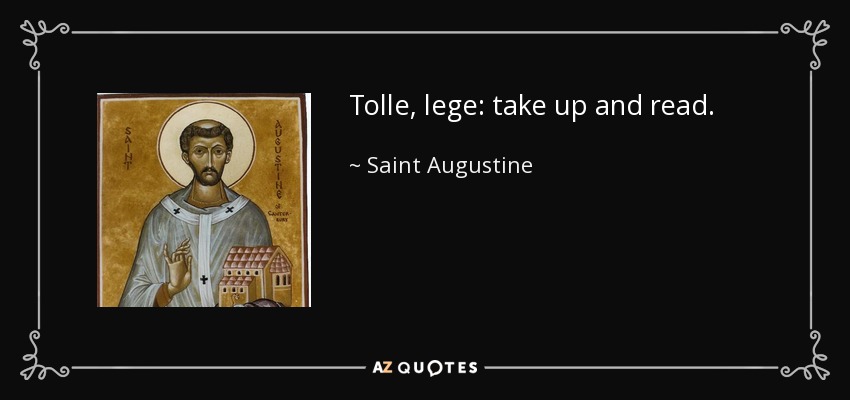
Tolle lege
Take up and Read
https://www.azquotes.com/picture-quotes/quote-tolle-lege-take-up-and-read-saint-augustine-34-51-45.jpg

When I first came to believe that I was a Christian, I was stationed at Ft. Bragg, NC. My priest was my godfather. He gave me a copy of the Book of Common Prayer and the Confessions of St.
Augustine.

Augustine had re-written psalms to express his faith. He had been trained in classical rhetoric. He wrote a catechism based on his dialog with his son. The question and answer format was designed to define terms for use in communications about faith.

He re-wrote many of the ideas of Greek and Roman writers as a monotheistic expression of his faith in the City of God.

It was the first example of the re-construction of classical consciousness in the Christian world. His basic premise had been stated by the apostle Paul. Faith allows power in God, but it does not make us infallible.

Augustine ran into claims to perfection in divinity with the Manichaeans, the Donatists and the Pelagians. While the Pelagians didn't lay explicit claim to perfection, they did imply that synergy enabled authority to use slaves to live the good life.

It looks like the second Roman empire in Europe did not have slavery. Aristotle's argument for slavery remained dormant  until the Spanish empire approached the conquest of the Roman world. Aristotle's argument for the institution was used to sanction the trade as a means to increase status for traders. Those patricians that used it did so to stay in front of non-patricians.

This contributed to Augustine's definition of human nature as corrupt. The basic implication was that we are saved by grace, not by our work. No one is without flaw. No one is above the law.
His work became the foundation for Roman Christendom with Latin.

Orthodox Christianity preserved instruction in the other Rome. Constantinople was even called the new Rome. Byzantium lasted until the 15th century. Their language was Greek.

The Russian empire was a product by design with custom in a different language. It was an extension of culture from the Egyptians to the modern age. The means for production was organized in relation to the ownership of land.

Ownership of land was chartered by the monarchy. Charters were contracted with respect for contributions to defense. Political organization was similar to that which was used in the west. Their policy on expenditure was more conservative.

Lex orandi built credendi for vivendi. The rule of prayer asked for a faith that could be lived.
Serfdom did not use chains and whips to induce labor. Serfs were an early form of residential labor. They lived on the land for which they cared. The land was owned by an owner.

Opposition to monarchy grew as the Spanish empire expanded. Republican ideas of government were bolstered by investment in reform in the classical model with a special emphasis on the republic in Rome. There were patricians in the Republic that had entertained slavery as a development of empire.

The Church in Rome had added celibacy as a requirement for priests and bishops. Any marriage of clergy was unofficial. It was viewed as a concession to the world by some and a corruption by others. Latin was the formal language for prayer and study.

The claim to papal supremacy had been used to reconstruct the Roman empire as a multi-lingual entity, but the Inquisition and extensive reliance on the "sword of Damocles" to deter rebellion contributed to the perception that the clergy and the monarchy were corrupt institutions.

The Church of England and the Lutheran Germans had agreed to the sacraments of Baptism and the Eucharist as biblically solid. They also agreed that monarchy and episcopacy were sanctified as forms for Leadership by the bible.

The principle for officially recognized religion was called Cuius regio, eius religio in Latin. It means Whose realm, his religion. The principle was intended to simplify the complexity of competitive claims to authority in the Roman empire.

The democracy of Calvin rejected monarchy and episcopacy to favor local councils as directed by the direct authority of Providence. Calvinism accepted Baptism and the Lord's Supper as ordained. They called them ordinances rather than sacraments. Some Calvinists entertained slavery. John Locke was a leading representative.

Opinions against slavery were written by the likes of Charles V (1500-58), John Locke (1632-1704) and Jeremy Bentham (1748-1832), but they owned, traded and used slaves for their profit. They used a broker to keep the activity from the public record.

The trade was regarded as an imperial form in the Roman tradition. It just wasn't revived until the Spanish and the Dutch started to compete with the Ottomans. Parliament was not directed to legislate against the trade or the institution.

William Wilberforce led a lobby in British parliament for 18 years before legislation was enacted against the trade or the institution. Once the legislation was enacted however negotiations for treaties with foreign powers was promoted.

Adam Smith proposed a capitalist system of organization as the means to define the wealth of nations. The proposal acknowledged the organization of the means for production with respect for the ownership of land.

His system allowed for organizational development in the Republican form of government. The stress for efficiency and effectiveness in organization for production promoted independence from slavery. Management provided the means for producing wealth with labor.

The institution of slavery was made into a legal form by the US republic with the designation "slave state." Half the states were non-slave. They were in the north. A number of those had outlawed the institution after the American Revolution.

Florida made an issue out of secession from the union to join a federated government. The Ordinance of Secession declared the intent to join a confederation. There had been significant concern expressed against too much centralization of authority even with the federalist party not long after the revolution.

The country was moving toward centralization in national government. Southern states argued for a state's right to govern their people.  The confederation had a constitution. Residential labor was necessary for agriculture.

This was a major difference with the north. Both had agriculture, but the south was more agricultural due to the climate and the favorable conditions for plant growth and domestic livestock.

Slavery was the term for the form of residential labor in the republic. The difficulty was that there were those who used shackles in the trade. Whips were also used to coerce labor for profit from production. It was an abusive form. It reduced voluntary participation in political and social relations.

Cotton was the cash crop for a number of the southern states. Mississippi was one of the largest producers. They also had the largest population of black people.

While legislation against slavery was enacted during the Civil War, the national government has since started to use precipitation of profit from war as a means to perpetuate an increase in taxation. It could be argued that the Civil War was precipitated for the profit of government officials and their favored relations in munitions, surveillance and the media.

National overreach has since been shown in electronic surveillance and protectionism for insurance agencies. Fake news has been used to promote gun control. The categorization of cannabis sativa as a narcotic has been another form of Prohibition.

 The lack of coordination for immigration reform has been directed by media campaigns that don't admit that criminals are crossing the border illegally. Socialism has been used to press for increased taxation in general with a particular emphasis on populist factions. Increased taxation decreases the capacity for the sponsorship of small business.

National government regulation is detrimental to the growth of small business. Large industry cannot employ everyone. Even if they could, it wouldn't be good for the culture.

Meeting the demands of labor becomes an exercise in degeneration. Labor refuses to seek education. The attainment of educational standards loses significance. People who get education are punished for being too qualified.

Education provides the means to form judgments regarding contracts and services. When government limits representation to the concern for national and international industry, the self-employed and small business agents suffer as a result.

-----------------------------

Akane Haga  3.7.2002 Nagano, Nagano, Japan
羽賀朱音   
华卡啊卡奈
 Hello! Project
Morning Musume '19 I Surrender

华  Hua    flower              羽   Ha       feathers         Ha   は   ハ          Ha  하   ha 
卡  ka        card                 賀   ga       joy                 ga    が   ガ          ga   가   end                         
啊   Ah      ah                    朱   Ake   scarlet             A    あ   ア            A     아   ah                           
卡   ka       card                 音   ne      sound              ka   か   カ           ka    카   car     
奈   nai      endure                                                      ne   ね   ネ          ne   네   yeah     

------------------------------

The sound from the scarlet feathers of the phoenix
rose with joy above the ashes to redeem keenness for cleanness.

====================== 

Nagano

Nagano is located near the middle of Honshu, the main island for Japan. It was the site used for the 1998 Winter Olympics and Paralympics. The city also hosted the Special Olympic Winter Games for the world in 2005.

Kaizo Castle was built by Takeda Shingen in 1560. It was renamed Matsushiro by Sanada Yukimichi in the early 18th century (1711). The castle sits between the main stream and an old bed of the Chikuma River in the flatlands of the city.

The Chikuma is the upper part of the Shinano River. This is the longest and widest river in Japan. It starts in the Japanese Alps and flows northeast through the Nagano and Niigata Prefectures before it empties into the Sea of Japan.

Akane Haga

Haga Akane was born on March 7, 2002 in Nagano. She was raised in the Matsushiro district.

Haga auditioned for Morning Musume in 2012, but failed to pass. She took lessons in her hometown to improve her skills. No new members were added in 2013 when she auditioned again. She joined Hello Pro Kenshuusei to train for performance with Hello! Project.

Sayumi Michishige announced on September 30, 2014 that Haga was selected along with Ogata Haruna, Nonaka Miki and Makino Maria to become the 12th generation for Morning Musume.

She has held a fanclub event for each birthday since 2017. She will celebrate her 17th birthday with a fanclub event on March 22, 2019.

Thursday, September 6, 2018

Amend

Michelle Williams

Amend
the Law
法律を改正します 
Hōritsu o kaisei shimasu
ps125

Faith can move mountains
when it reduces doubting
for the accountant. 

Those who trust in improvement 
allow the mountain of confusion
to be moved for a solution. 

Defense provides security for the people
like the hills that surround the city that is peaceful 
in protection from threats that are lethal.

Law based on expansion by violent aggression
is the mountain that needs to be removed as a digression.

Zion will celebrate progression
as change without regression.

From the rich to the poor
people have justice to adore.

Royal law is still true.
Love your neighbor as though he or she were you.

Political evolution doesn't increase spending too much.
Microscopically fractional is rational as such.

Decrease is necessary when excess punch 
is an accessory to economic crunch.

The power of citizenship will be apprehended. 
The Constitution will be amended.

The War Powers Article will be repealed.
The Second Amendment will be rewritten to reveal
defense as the right to wield.

Outlaw invasion, genocide, terrorism, the death penalty,
graft and corruption for clarity that is not ordinary for parity.

Those who seek profit from violence or cruelty
will be corrected with fluency for being truly unruly.

Defense will be revealed 
to those who need it as the yield.

Survival demands command
during storms away from land.

Beauty and love swam
when they had to abandon their stand
on the land for the typhoon at hand.
They fired prayers as they swam to get out of the jam.

People who love their enemies
will build charity as their legacy.

Goodness will be shown to those who are good                         
 Truth will be granted to be understood as it should.

Examine logic for reason in due season
to escape the trappings of treason.

The mulberry business
savors fruit flavor with swiftness
for fitness to witness. 

Intermittent power measures 
the caring that treasures
the right amount of pleasure.

Two flower pots
add to the knowledge that one got.

Advantage will be increased to encourage the disadvantaged.
Peace will be the vantage to be managed to prevent damage.

ps125
125 Qui confidunt
1 Those who trust in the Lord are like Mount Zion, *
which cannot be moved, but stands fast for ever.
2 The hills stand about Jerusalem; *
so does the Lord stand round about his people,
from this time forth for evermore.
3 The scepter of the wicked shall not hold sway over the land allotted to the just, *
so that the just shall not put their hands to evil.
4 Show your goodness, O Lord, to those who are good *
and to those who are true of heart.
5 As for those who turn aside to crooked ways,
the Lord will lead them away with the evildoers; *
but peace be upon Israel.


Proverbs 22:2
The rich and the poor have this in common:
  the Lord is the maker of them all.

James 2:8
You do well if you really fulfil the royal law according to the scripture, ‘You shall love your neighbour as yourself.’

Mark 7:31
Then he returned from the region of Tyre and went by way of Sidon towards the Sea of Galilee in the region of the Decapolis.

9.9.18
New Moon
Neptune at opposition
Neptune = Poseidon = demands command during storms away from land

Piscid meteor shower

The constellation Pisces is depicted as the fish. These two fish were Aphrodite and Eros in Greek mythology. They were walking along the Euphrates River when Typhon appeared. They were scared and unable to run, so they called upon Zeus for help. He turned them into two fish. They jumped in the river and escaped. Athena placed the fish among the stars and they became the constellation of Pisces.

Birthdays


Charles Sanders Peirce 9.10.1839, Cambridge, MA
查尔斯皮尔斯

查  Zha     investigate          no kanji                       Chi    ち   チ            Chal  찰   good
尔  er        you                     no kanji                        -ya    ゃ-  ャ-           seu   스    switch
斯  si         this                    kou        in this way       ru     る   ル            Pi      피    blood
皮  Pi         fur                     kawa     skin                  zu    ず   ズ            eo      어    uh     
尔  er         you                    no kanji                          Pi     ぴ   ピ           seu     스   switch
斯  si          this                    kou        in this way       a      あ   ア
                                                                                  su    す   ス

Cambridge is situated directly north of Boston across the Charles River. It was named in honor of the University of Cambridge in England. It was an important center of the Puritan theology embraced by the town's founders.

Harvard University and the Massachusetts Institute of Technology (MIT), two of the world's most prestigious universities, are in Cambridge. Radcliffe College was one of the leading colleges for women in the United States until it merged with Harvard on October 1, 1999.

Cambridge was incorporated as a city in 1846. The incorporation was completed despite persistent tensions between East Cambridge, Cambridgeport and Old Cambridge. The tensions stemmed from differences in culture, sources of income and the national origins of the residents. The city's commercial center began to shift from Harvard Square.  Central Square became the city's downtown around this time.

Charles Sanders Peirce [purse] was born at 3 Phillips Place in Cambridge, Massachusetts on September 10, 1839. He was the son of Sarah Hunt Mills and Benjamin Peirce. His father was a professor of astronomy and mathematics at Harvard University. He was the first serious research mathematician in America.

Charles Peirce was an American philosopher, logician, mathematician and scientist who is sometimes known as "the father of pragmatism". He was educated as a chemist and employed as a scientist for 30 years. He is appreciated for his contributions to logic, mathematics, philosophy, scientific methodology, semiotics and for his founding of pragmatism.

He was an innovator in mathematics, statistics, philosophy, research methodology and various sciences. He considered himself, first and foremost, a logician. He made major contributions to logic, but this encompassed much of that which is now called epistemology and philosophy of science.
He saw logic as the formal branch of semiotics, a triadic system of signs. The three kinds of signs were icons, indexes and symbols. An icon shares the image of a quality with the object. An index denotes an existential connection. A symbol is defined by definition as an object.

His work in semiotics foreshadowed the debate among logical positivists and proponents of philosophy of language that dominated 20th century Western philosophy. He defined the concept of abductive reasoning. He rigorously formulated mathematical induction and deductive reasoning. He saw that logical operations could be carried out by electrical switching circuits as early as 1886. The same idea was used decades later to produce digital computers.


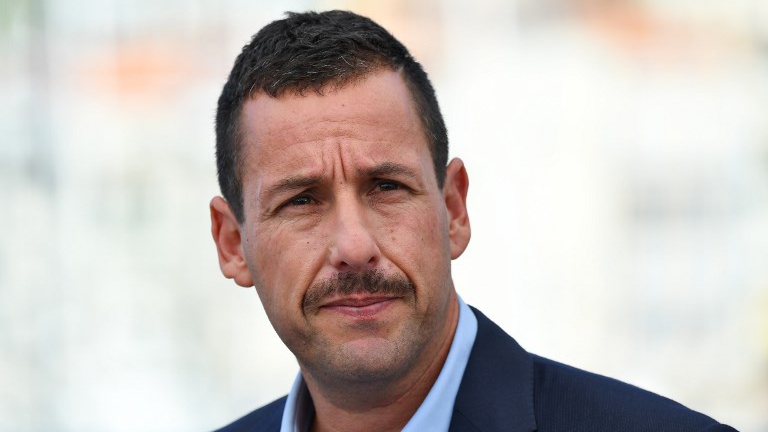
Adam Sandler 9.9.66 Brooklyn, NY
亚当·桑德勒
FB Fans

亚  Ya        second          no kanji                               A     あ    ア      A        아  ah
当  dang    during            tou          this business       da   だ   ダ       dam   담  wall
桑  Sand    mulberry       kuwa      mulberry               mu  む   ム      Saen  샌  san
德  du        goodness      no kanji                               San さん サン  deul    들  field
勒  le         carve             roku      manage                 do    ど    ド       leo     러  the
                                                                                   r a   ら-  ラ-

Brooklyn was once home to the Canarsie Native American tribe. The natives fished and farmed the land. Dutch colonists moved in and took over the area in the early 1600's. Brooklyn's forested rural landscape gave way to urbanization over the next 400 years. The area eventually became the Brooklyn known today. It is one of the most populated regions in the United States.

The New York Aquarium was built on Coney Island in 1957. The Dodgers left Brooklyn the same year. The Verrazano-Narrows Bridge was completed seven years later in 1964, connecting Brooklyn to Staten Island. The Brooklyn Navy Yard was closed in 1966. It became New York's first landmarked historic district.

Robert Kennedy visited Bedford-Stuyvesant in 1966. The area had a population of 450,000 (82% African American and 12% Puerto Rican) at the time. He saw burnt out buildings, vacant lots, littered streets and abandoned vehicles during his walking tour. He found some cynics while meeting with community activists. They told him: “You’re another white guy that’s out here for the day. You’ll be gone and you’ll never be seen again. And that’s that. We’ve had enough of that.”

Kennedy presented a plan for the Bedford-Stuyvesant Development and Service Corporation along with Mayor Lindsay and Senator Javits ten months later in December 1966.

Adam Richard Sandler was born in Brooklyn, New York in 1966 to Judith "Judy" (née Levine), a nursery school teacher, and Stanley Sandler (1935-2003), an electrical engineer. His family is Jewish and descends from Russian Jewish immigrants on both sides.

He moved to Manchester, New Hampshire at the age of six. He grew up in the Granite State until he graduated from Manchester Central High School. Adam went to New York University's Tisch School of the Arts. He graduated in 1988.

He is an American actor, comedian, screenwriter and film producer. He went on to star in many Hollywood feature films after becoming a Saturday Night Live cast member. The films grossed over $2 billion at the box office combined. He often played a cynical degenerate with a heart in his comic films.

He is best known for his roles in the films Billy Madison (1995), the sports comedies Happy Gilmore (1996) and The Waterboy (1998), the romantic comedy The Wedding Singer (1998), Big Daddy (1999) and Mr. Deeds (2002). He voiced Dracula in Hotel Transylvania (2012), Hotel Transylvania 2 (2015) and Hotel Transylvania 3: Summer Vacation (2018).

A number of his films, most notably the widely panned Jack and Jill, have gained harsh criticism, culminating in a shared second place in the number of Raspberry Awards (3) and Raspberry Award nominations (11), in both cases second only to Sylvester Stallone. He has ventured into more dramatic territory with his roles in Punch-Drunk Love (2002), Spanglish (2004), Reign Over Me (2007), Funny People (2009) and The Meyerowitz Stories (2017). These roles earned him critical praise.


Michelle Williams  9.9.80 Kalispell, MT
米歇尔威廉姆斯
FB Fan

米  Mi      rice                me          meter                   Mi      み   ミ    Mi      미   beauty
歇  xie     rest               kanke       intermittent          shi     し   シ    syel   셸   shell
尔  er      you                no kanji                                -e      ぇ   ェ     Wil    윌   will
威  Wei   prestige         i               power                  r u     る   ル    li        리  lee
廉  lian    investigate    kado         charge                 U       う   ウ    eom  엄  mum
姆  mu    governess     bo            daycare worker    -i       ぃ   ィ     seu   스  switch
斯  si      this                 kou          in this way            r i      り   リ
                                                                                  a       あ  ア
                                                                                  mu    む  ム
                                                                                  zu     ず  ズ

The name Kalispell is a Salish word meaning "flat land above the lake". The location is also the gateway to Glacier National Park. It began as a railroad town. This fact shaped its history for many years. The townsite was platted in the spring of 1891 in order to serve as the division point for the Great Northern Railway that was being constructed from St. Paul, Minnesota, to Seattle, Washington.

Kalispell was officially incorporated as a city in 1892. The city has continued to grow in population since that time. It reached 19,927 in 2010. It is the largest city in Northwest Montana. The city serves as the county seat and commercial center of Flathead County. It is home to Kalispell Regional Medical Center, which boasts a 150-bed facility.

Kalispell is nestled in the Flathead valley 31 miles (50 km) from Glacier National Park. It is 22 miles (35 km) from Hungry Horse Dam. Skiers have access to Whitefish Mountain Resort on Big Mountain and Blacktail Mountain Ski Area each 17 miles (27 km) away. Flathead Lake is 7 miles (11 km) away. Buffalo Hill Golf Club was designed by Robert Muir Graves.

The tribal schools nearby offer classes in the Kalispel–Spokane–Flathead language, a language nest and intensive language training for adults. There is a Salish language school and training center in Arlee, Montana.

Michelle Ingrid Williams was born on September 9, 1980, in Kalispell, Montana, to Carla Ingrid (née Swenson), a homemaker, and Larry R. Williams, an author and commodities trader. She is of Norwegian descent.

Her father twice ran unsuccessfully for the United States Senate as a Republican Party nominee. Williams lived with her three paternal half-siblings and her younger sister, Paige in Kalispell. She shared a close bond with her father who taught her fishing and shooting. He encouraged her to form a reading habit.

She has recounted fond memories of growing up in the vast landscape of Montana. The family moved to San Diego, California when she was nine.

Michelle is an American actress. She is particularly known for her work in small-scale independent productions with dark or tragic themes. She is the recipient of several accolades including a Golden Globe Award. She has been nominated for four Academy Awards and one Tony Award.

Williams went on to earn critical acclaim for playing emotionally troubled women coping with loss or loneliness in the independent dramas Wendy and Lucy (2008), Blue Valentine (2010) and Manchester by the Sea (2016).

She won the Golden Globe for portraying Marilyn Monroe in My Week with Marilyn (2011). Her highest-grossing releases came with the thriller Shutter Island (2010), the fantasy film Oz the Great and Powerful (2013) and the musical The Greatest Showman (2017).

Williams starred in revivals of the musical Cabaret in 2014 and the drama Blackbird in 2016 on Broadway. She received a nomination for the Tony Award for Best Actress in a Play for playing a sexually abused woman in the latter.


Yuuka Nihei 10.20.95  Tokyo, Japan
二瓶有加
UpFront: PINK CRES.
Etcetera

二  er      two              Ni      two                     Yu   ゆう   ユ-      Yu   유  u
瓶  ping  pitcher         bin     flower pot           ka    か     カ         i      이  this 
有  you   to have        Yuu    possess               Ni    に     ニ          ka   카  car
加  jia     add              ka      add                      e     へ     ヘ           Ni   니  needle
                                                                        i       い     イ          he   헤  h
                                                                                                        i     이  this

The Rainbow Bridge was built by Kawasaki Heavy Industries. Construction started in 1987. It was completed in 1993. The bridge is 798 metres (2,618 ft) long with a main span of 580 metres (1,903 ft). It was officially called the "Shuto Expressway No. 11 Daiba Route - Port of Tokyo Connector Bridge."  The name "'Rainbow Bridge" was decided by the public.

DN Tower 21 is an office building in Tokyo. The shorter five-storey building is the former headquarters of SCAP. It was completed in 1933 (renovated 1989–1995) for the headquarters of the Norinchukin Bank and the Dai-Ichi Seimei began to house its offices in the building in 1938. It was designed by the Japanese architect Yoshikazu Uchida.

The taller 21-storey building ( 99.8 metres in height) began construction in 1988. It was completed in 1993. It was designed by the Irish-American architect Kevin Roche. Shimizu Corporation was contracted to construct both buildings.

Five two-man terrorist teams from the Aum Shinrikyo religious cult converged at the Kasumigaseki station on March 20, 1995 from separate subway trains at the height of the morning rush hour in Tokyo. They released lethal sarin gas into the air. The terrorists took a sarin antidote and escaped.  Commuters were blinded. They gasped for air as they rushed to the exits.

Twelve people died. Five thousand and five hundred were treated in hospitals. Some were comatose. Most of the survivors recovered. Some suffered permanent damage to their eyes, lungs and digestive systems. A United States Senate subcommittee later estimated that if the sarin gas had been disseminated more effectively at the hub in the Tokyo subway system, tens of thousands might have been killed.

Japanese police raided Aum Shinrikyo headquarters in the aftermath of the attack. Hundreds of members were arrested including the cult’s blind leader, Shoko Asahara. The cult was already under investigation for a 1994 sarin attack that killed seven and for the murder of several political opponents. The cult combined Buddhism and yoga with apocalyptic Christian philosophy.

Nihei Yuuka was born October 20, 1995 in Tokyo. She is a Japanese pop singer under UP-FRONT CREATE as a member of PINK CRES..

It was revealed in the broadcast of the Natsuyaki Miyabi Shin Group Member Audition in March 2016 that Nihei was one of the two finalists for PINK CRES. alongside Kobayashi Hikaru.

She and Kobayashi were both announced as the winners in April. The group's name was announced on August 25 at Buono! Festa 2016. They performed in concert for the first time!
Nihei was in the third year of university when she joined the group. Her last year was 2017.