
Emily Mortimer
Recognize
Error
识别错误
Shìbié cuòwù
エラーを認識する
Erā o ninshiki suru
ps73
Error agnoscis
The light from the height is good
for those by which love is understood.
My feet had nearly slipped from the way.
I had almost tripped and fallen in the light of day.
I had envied the proud.
I saw prosperity as a wicked shroud.
Their bodies were so sleek and sound.
They didn't appear to suffer pound for pound.
Misfortune did not appear to be theirs.
They were not afflicted by my cares.
They wore their pride like a necklace.
They ate recklessness for breakfast.
They wrapped violence around them like a cloak.
The wind swept those leaves around that left the stately oak.
The autumn leaves have left the trees
but disparagement from disparity decreases ease
by degrees.

Their iniquity grew from between their toes.
Their hearts overflowed with wicked lows.
They scoffed and spoke with malicious tones
to extend your pain to the throes of your bones.
They set their mouths against the world
as evil speech around them whirled.
People seemed to turn to them
even though the star shone over Bethlehem.
They said, "Is there knowledge in the Most High?
How is it that he should let them fly?"
These then were the wicked at ease with increased power
as they sought to deceive people in the cowardly hour.
I have watched my thought to keep my heart clean.
I have washed my hands to keep my spirit keen.
I have been afflicted in the day
and punished in various ways.
Had I gone on with this kind of thought or speech
I would have betrayed the children with its reach.
When I tried to work out this puzzle with my mind
the answer was too hard for me to find.
When I entered the sanctuary of God
I discerned the end of the path the wicked trod.
They have set themselves in slippery places
that lead to ruin in various phases.
They will suddenly arrive at their own destruction
to perish from the terror of their error in self-instruction.
When the truth is revealed their deception will vanish
to show the dream they had managed to banish.
When my mind was embittered
my heart was littered with chitter.
The dignity of direction in constituted ideals
has to avoid poison to how the public feels.
The external arbitrary force that affects human affairs
is worthy of investigation in historical cares.
I was wounded by the lack of understanding.
I felt like a brute beast in your presence everlasting.
I am always with you
as you hold me to what is true.
You guide me by your instruction
to live with faith and a will for production.

Who do I have in heaven but you?
I desire nothing but your goodness in truth.
Though the desires of the flesh will pass away
you are the strength of my heart in every day.
Those who forsake you will lose heart.
The unfaithful will destroy their own destructive part.
It is good for me to be near your presence.
I have made my faith the refuge for the eternal essence.
I will speak of your work when the time is right.
Speech will spring forth even at night
or when the length of darkness reaches for its height.
------------------------
73 Quam bonus Israel!
How good Israel!
1 Truly, God is good to Israel,
to those who are pure in heart.
2 But as for me, my feet had nearly slipped;
I had almost tripped and fallen;
3 Because I envied the proud
and saw the prosperity of the wicked:
4 For they suffer no pain,
and their bodies are sleek and sound;
5 In the misfortunes of others they have no share;
they are not afflicted as others are;
6 Therefore they wear their pride like a necklace
and wrap their violence about them like a cloak.
7 Their iniquity comes from gross minds,
and their hearts overflow with wicked thoughts.
8 They scoff and speak maliciously;
out of their haughtiness they plan oppression.
9 They set their mouths against the heavens,
and their evil speech runs through the world.
10 And so the people turn to them
and find in them no fault.
11 They say, "How should God know?
is there knowledge in the Most High?"
12 So then, these are the wicked;
always at ease, they increase their wealth.
13 In vain have I kept my heart clean,
and washed my hands in innocence.
14 I have been afflicted all day long,
and punished every morning.
15 Had I gone on speaking this way,
I should have betrayed the generation of your children.
16 When I tried to understand these things,
it was too hard for me;
17 Until I entered the sanctuary of God
and discerned the end of the wicked.
18 Surely, you set them in slippery places;
you cast them down in ruin.
19 Oh, how suddenly do they come to destruction,
come to an end, and perish from terror!
20 Like a dream when one awakens, O Lord,
when you arise you will make their image vanish.
21 When my mind became embittered,
I was sorely wounded in my heart.
22 I was stupid and had no understanding;
I was like a brute beast in your presence.
23 Yet I am always with you;
you hold me by my right hand.
24 You will guide me by your counsel,
and afterwards receive me with glory.
25 Whom have I in heaven but you?
and having you I desire nothing upon earth.
26 Though my flesh and my heart should waste away,
God is the strength of my heart and my portion for ever.
27 Truly, those who forsake you will perish;
you destroy all who are unfaithful.
28 But it is good for me to be near God;
I have made the Lord God my refuge.
29 I will speak of all your works
in the gates of the city of Zion.
----------------------
================
------------------------
Eng. The autumn leaves have left the trees.
Chn. 秋天的落叶离开了树木。
Qiūtiān de luòyè líkāile shùmù.
Jpn. 秋の紅葉が木を離れました。
Akinomomiji ga ki o hanaremashita.
Krn. 단풍이 나무를 떠났습니다.
danpung-i namuleul tteonassseubnida.
Ltn. Autumno folia arboribus reliquisse.
Itln. Le foglie d'autunno hanno lasciato gli alberi.
Spn. Las hojas de otoño han dejado los árboles.
Frn. Les feuilles d'automne ont quitté les arbres.
Gmn. Die Herbstblätter haben die Bäume verlassen.
Grk. Τα φύλλα του φθινοπώρου έχουν αφήσει τα δέντρα.
Ta fýlla tou fthinopórou échoun afísei ta déntra.
Rsn. Осенние листья покинули деревья.
Osenniye list'ya pokinuli derev'ya.
Trk. Sonbahar yaprakları ağaçları terk etti.
------------------------
Psalm 73

Psalm 73 is one of the songs of Asaph. Asaph was appointed by David to work with Heman to make music for worship. He is credited with performing at the dedication of Solomon’s temple in 2 Chronicles 5:12.
The psalm is descriptive of report and confession. The author reflects on how he had perceived things, then reported a better inference from the sense of experience. This sense touched eternal goodness with faith.
This section of the book of Psalms is part of a section known as the Elohist psalms. The Elohist is is one of four source documents underlying the Torah. The E source is so named because of its pervasive use of the word Elohim to refer to the Israelite God of gods.
The source is characterized by an abstract view among other things. Horeb is used as the name for the mountain at which Moses received the ten commandments instead of Sinai. The "fear of God" is the phrase used as the motivation to observe the laws of Israel.
The ancestral stories are habitually located in the north in this source. Ephraim is the favored location for discourse. The documentary hypothesis holds that it must have been composed in that region in the second half of the 9th century BCE.
The source is so old that it is highly fragmented. It was mostly preserved by the integration of the fragments into the Yahweh narrative in the J or Jahwist source.
Psalms 42–83 are referred to as Elohistic because the name "Yahweh" is not used. Elohim or Adonai are used instead. Psalms 50, 73–83 are of Asaph. The Asaphites were a musical guild in the temple.
'Asaph' admit that it looked like the wicked seemed to prosper, but he gained a new perspective when he entered the sanctuary where sacrifices were offered. His thinking changed. His perspective shifted to the eternal. He started to realize what the reality is.
The psalm appears to have been a reflection on the integration of the E into the J source with respect for the consideration of the plight of Israel as an implication.
The "offering of thanksgiving" is seen as the highest value. It was the reason for the "burnt offerings."
The goodness of God is viewed as that which is worthy of desire. Relationship with the source of guidance is the greatest good.
Divine providence provides aid in the internal battle to choose that which is best. The psalm points the reader or hearer towards offering thanksgiving and a life of devotion as the correct way to live despite appearance to the contrary.
------------------------
My flesh may fail, but God is the strength
of my heart for the eternal length.
=================
The House

Isaiah ben Amoz was an 8th century prophet. He is referred to as 'the prophet' in the book ascribed to his name.
Chapters 1-39 originated with the historical prophet. The section is interspersed with prose commentaries written in the time of King Josiah a hundred years later.
The remainder of the book dates from immediately before and immediately after the end of the exile in Babylon. It was almost two centuries after the time of the historical prophet.
The first verse of the Book of Isaiah states that Isaiah prophesied during the reigns of Uzziah (or Azariah), Jotham, Ahaz and Hezekiah. These were kings of Judah (Isaiah 1:1).
Uzziah's reign was 52 years in the middle of the 8th century BCE. William F. Albright dated Uzziah's reign to 783 -742. Isaiah must have begun his ministry a few years before Uzziah's death. It was probably in the 740's BCE.
Isaiah lived until the 14th year of Hezekiah's reign. Edwin Thiele concluded that his reign was between c. 715 and 686. Hezekiah witnessed the destruction of the northern Kingdom of Israel by Sargon's Assyrians in c. 722. He was king of Judah during the siege of Jerusalem by Sennacherib in 701.
Hezekiah enacted sweeping religious reforms, including a strict mandate for the sole worship of Yahweh and a prohibition on venerating other deities within the Temple of Jerusalem. Isaiah and Micah prophesied during his reign.
Isaiah may have been contemporary for some years with Manasseh. He may have prophesied for as long as 64 years.
The Book of Isaiah is the first of the Latter Prophets in the Hebrew Bible and the first of the Major Prophets in the Christian Old Testament.
Isaiah 1-33 promises judgment and restoration for Judah, Jerusalem and the nations. Chapters 34-66 presume that judgment has been pronounced and restoration follows soon. The can be read as an extended meditation on the destiny of Jerusalem into and after the Exile.
The second part of the book describes how God will make Jerusalem the center of his worldwide rule through a royal savior who will destroy her oppressor (Babylon). This messiah is the Persian king Cyrus the Great. He was the agent who brings about Yahweh's kingship.
Isaiah was one of the most popular works among Jews in the Second Temple period (c. 515 BCE – 70 CE).
It was held in such high regard in Christian circles as to be called "the Fifth Gospel". Its influence extends beyond Christianity to English literature and to Western culture in general. Citations appear from the libretto of Handel's Messiah to a host of such everyday phrases as "swords into ploughshares" and "voice in the wilderness".
Isa. 2:4
Out of Zion instruction will go forth.
The word of the LORD from Jerusalem.
He will judge between the nations
and arbitrate for many people.
They will beat their swords into ploughshares
and their spears into pruning-hooks.
----------------------
Instruction will go forth out of Zion.
The word will be heard like the roar of a lion.
The nations will be judged.
Arbitration will not trudge.
Swords will be beaten into the prows of plows.
Spears will become blades to prune branches and boughs.
================
Awake. The day has drawn near.

Jewish Christians were faithful religious Jews who formed an apocalyptic sect during the late Second Temple period of the first century.
They regarded Jesus as the Son of Man who had been unjustly crucified. The Book of Acts reports that the early followers continued daily Temple attendance and the relatively recent Rabbinic home prayer.
Most prayers and blessings can be found in the Siddur or prayer book. The earliest parts of Jewish prayer book are the Shema Yisrael ("Hear O Israel") (Deut. 6:4) and the Priestly Blessing (Num. 6:24-26) which are in the Torah.
A set of 18 (currently 19) blessings are called the Shemoneh Esreh or the Amidah (Hbw."standing [prayer]"). Note the proximity in sound of Esreh to Ezra. The origin of the prayer is traditionally ascribed to the Great Assembly in the time of Ezra at the end of the Biblical period.
Ezra arrived in the seventh year of the rule of Artaxerxes II (404-359) according to the interpreation of Ezra 7:7 by a number of scholars. This was about 50 years after Nehemiah.
The name Shemoneh Esreh, literally means "eighteen". It is a historical anachronism since there are now 19 blessings. It was only near the end of the Second Temple period that the 18 prayers of the weekday Amidah became standardized.
Even at that time their precise wording and order was not yet fixed. It varied from locale to locale. Many modern scholars believe that parts of the Amidah came from the Hebrew apocryphal work Ben Sira.
The early 2nd-century BCE Jewish author Ben Sira praised Nehemiah, but made no mention of Ezra. The similarities between the work of Nehemiah and Ezra has caused speculation as to whether the work of the governor wasn't re-written as a priest-scribe.
Soon after the destruction of the Temple in Jerusalem in 70 CE a formal version of the Amidah was adopted at a rabbinical council in Yavne according to the Talmud, a rabbinic work. The order was formed under the leadership of Rabban Gamaliel II and his colleagues.
Christians continued to worship alongside Jewish believers at first, but within 20 years of Jesus' death, Sunday was being regarded as the Lord's day or the primary day of worship. The early liturgical ritual was rooted in the Jewish Passover and synagogue services.
The singing of the Psalms and reading from the scriptures may have only been supplemented at time with the reenactment of the actions of Jesus in the Last Supper prior to the crucifixion.
Peter was the first leader of the Jerusalem ekklēsia.[82][83] He was soon eclipsed in this leadership by James the Just, "the Brother of the Lord." The more conservative faction of James the Just gained strength as the liberal position of Peter lost influence.
The Jerusalem community "held a central place among all the churches," as witnessed by the writings of Paul.
Christian missionary activity spread "the Way" to early centers of Christianity in the predominantly Greek-speaking eastern half of the Roman Empire.
Apostles and preachers traveled to Jewish communities around the Mediterranean Sea to attract Jewish converts. Apostles had attracted enthusiasts for "the Way" from Jerusalem to Antioch, Ephesus, Corinth, Thessalonica, Cyprus, Crete, Alexandria and Rome within 10 years of the death of Jesus.
Early Christian beliefs were proclaimed in kerygma (preaching). The inclusion of Gentiles into early Christianity posed a problem for the Jewish identity of some of the early Christians.
Observance of the Jewish commands, including circumcision, was regarded as a token of the membership of this covenant. The early Jewish Christians insisted on keeping those observances.
Paul's opposition to male circumcision for Gentiles is in line with Old Testament predictions that "in the last days the gentile nations would come to the God of Israel, as gentiles (e.g., Zechariah 8:20-23), not as proselytes to Israel. Peter was sympathetic to this position.
The history of the Jews in the Roman Empire traces the interaction of Jews and Romans during the period of the Roman Empire (27 BCE - 476 CE). Their cultures began to overlap in the centuries just before the Christian Era.
Jews migrated to Rome and Roman Europe from the Land of Israel, Asia Minor, Babylon and Alexandria in response to economic hardship and incessant warfare over the land of Israel between the Ptolemaic and Seleucid empires.
The Roman general Pompey established the Roman province of Syria in 64 and conquered Jerusalem in 63 BCE in his eastern campaign.
Judaism was officially recognized as a legal religion by Julius Caesar. The policy was followed by the first Roman emperor, Augustus.
Herod the Great was designated 'King of the Jews' by the Roman Senate in c. 40 BCE. The Roman province of Egypt was established in 30 BCE. Judea proper, Samaria and Idumea (biblical Edom) were converted to the Roman province of Iudaea in 6 CE.
Christianity was developed from Second Temple Judaism.
Jews were expelled from Rome because of disturbances around AD 49 by the edict of Claudius. Claudius died around the year 54 CE. His successor, Emperor Nero, allowed the Jews back into Rome. Christians were persecuted after the Great Fire of Rome of 64.
The Jewish–Roman wars were a series of revolts by the Jews of the Eastern Mediterranean against the Roman Empire between 66 and 135 CE. Josephus was captured by Vespasian during the reing of Nero.
He initially fought against the Romans during the First Jewish–Roman War (66-73) as head of Jewish forces in Galilee. He had surrendered in 67 CE to Roman forces led by Vespasian after the six-week siege of Jotapata.
Josephus recorded Jewish history with special emphasis on the first century CE and the First Jewish–Roman War (66–70 CE) including the Siege of Masada. His most important works were The Jewish War (c. 75) and Antiquities of the Jews (c. 94).
The Jewish War recounts the Jewish revolt against Roman occupation. Antiquities of the Jews recounts the history of the world from a Jewish perspective for an ostensibly Greek and Roman audience. These works provide valuable insight into first century Judaism and the background of Early Christianity.
\
The people of Rome were tolerant of most religious expressions. That tolerance was largely limited to religions that were polytheistic. Polytheism had developed mythology that allowed for the worship of the emperor as a cult. The Roman authorities didn't care who you worshiped as long as you included the emperor and didn't create problems with other religious systems.
That was a problem for both Christians and Jews during the middle of the first century. The history of the Jews had already witnessed monotheism grow out of polytheism in the Middle East.
Jews were monotheistically opposed to emperor worship. Their Christian contemporaries also refused to worship the emperor or acknowledge him as any kind of deity.
The earliest Christian converts in Rome were likely of Jewish origin. The early Roman churches were dominated and led by Jewish disciples of Jesus.
When Claudius expelled all Jews from the city of Rome, however, only the Gentile Christians remained. The church there grew and expanded as a largely Gentile community from 49 to 54 CE.
The Acts of the Apostles claims that the Jewish Christian couple Priscilla and Aquila had recently come from Rome to Corinth when Paul reached the latter city in about the year 50.
Paul used his rights as a Roman citizen to appeal to Caesar after being arrested by Roman officials in Jerusalem (Acts 25:8-12). Paul was sent to Rome and spent several years in a house prison. He used the time to train church leaders and Christians within the city.
Paul was probably released after Claudius died. Jews were allowed back in Rome. When the returning Jewish Christians returned they found a church that was much different from the one they had left.
This resulted in disagreements about how to incorporate the Old Testament law into following Christ. The ritual of circumcision was of particular concern.
The letter to the Romans includes instructions for Jewish and Gentile Christians on how to live in harmony and properly worship God. Instruction in connection to eating meat sacrificed to idols was also offered.
Paul was arrested again for preaching the gospel under renewed persecution from Nero. Church tradition holds that Paul was beheaded as a Roman citizen and a martyr in Rome. It was reported that Peter was crucified upside down by his request in the city.
Commentary on Romans
The epistle to the Romans is dated to 57 CE when Paul was in Corinth. He had never been to Rome when he wrote the letter, but he had expressed his desire to travel there (Acts 19:21).
The apostle greeted 26 different people by name to personalize the communication.
The 16-year-old Nero had ascended to the rank of Emperor in Rome 3 years earlier. The political situation in the capital had not yet deteriorated for the Roman Christians, as Nero wouldn’t begin his persecution of them until he made them scapegoats after the great Roman fire in 64 CE.
Paul had likely encountered a diverse array of people and practices in Corinth. They ranged from gruff sailors and meticulous tradesmen to wealthy idolaters and enslaved Christians. The prominent Greek city was also a hotbed of sexual immorality and idol worship.
When Paul had written about the sinfulness of humanity to the Romans, he knew that of which he wrote. It was played out before his eyes on a regular basis.
The letter was written to give them a concrete theological foundation on which to construct their faith.
The work reveals the answers to important questions and supplies information on many topics such as salvation, sovereignty, judgment, spiritual growth and righteousness.
He explained the fundamentals and foundations of the Christian faith in Chapters 1-8. Salvation from sin is only possible through faith.
The example of the biblical patriarch Abraham is cited. He received the divine blessing and passed it on to his descendants through “the righteousness of faith” (4:13).
The free gift of grace is undeserved. It is the product of love manifested toward the unworthy. Adam’s fall brought sin and death into the world. The self-sacrifice of Jesus brought grace and life.
This was a subtle petition for republic as the form of government. The descent from Adam was used as a metaphorical claim to the continuum of authority in the royal line of succession for the Judaic monarchy.
The re-institution of slavery since Cyrus had set the captives free as the Messiah served as a reminder of the need for conservative reform.
Baptism initiates the new life with grace. The sinner symbolically dies when baptized into the death of Jesus. The person who emerges is dead to sin and alive to God in Christ (6:11).
Circumcision ceased to be the binding rite to the law. Christians became dead to the flesh. Paul urged the Romans to live by the Spirit (8:4). All believers become spiritual children called to glory. This potential is the source of great strength.
Paul explained God’s sovereignty over salvation in Chapters 9-11. Righteousness was demonstrated by the conversion from rebels into followers. The Jews will be saved by the same power. They will come to express faith in Jesus to enable the fulfillment of the original promise.
Salvation cannot be attained through good deeds but only through faith in God’s righteousness.
Romans 13:11-13
You know what time it is. It is the moment for you to wake from sleep. Salvation is nearer to us than when we became believers. The night is far gone. The day is near. Let us lay aside the works of darkness and put on the amour of light. Let us live honorably as in the day; not in reveling and drunkenness, not in debauchery and licentiousness, not in quarreling and jealousy. Instead, put on the Lord Jesus Christ.
----------------------
Salvation is closer than when we first came to believe.
Lay aside the works of darkness as the light for love to achieve.
The new year draws near.
Live honorably with cheer.
Do not revel in drunkenness or debauchery.
Put on the rightness of Christ despite the fear of gaucherie.
================
Watchfulness
https://www.kingjamesbibleonline.org/Inspirational-Images/large/Matthew_24-36.jpg
The gospel of Matthew was placed at the beginning of the New Testament. Mark's gospel had been written earlier, but it had been believed that Matthew had been written first.
Matthew was written to a Jewish audience in Aramaic. Luke was written for Greeks. The gospel of Mark was for Romans.
The gospel of Matthew has a strong emphasis on continuity with Judaism in the transition from Hebrew to Christian scripture.
Matthew relies heavily on the earlier gospel of Mark as well as an older first-century oral tradition for its description of events in Christ’s life. There are a large number of Jesus' sayings and discourses, but there are also a group of stories not found in any of the other gospels.
The document has 5 distinct divisions. There is an introductory section that precedes the first and a concluding section that follows the last. Each of the divisions is composed of a portion of the narrative concerning Jesus' activities, together with a group of his teachings.
The words "When Jesus had finished saying these things" end each division.
The author of Matthew uses the same sequence of events that are recorded in Mark, but at select intervals he interrupts the narrative and inserts a selection of statements taken from the "sayings of Jesus". This older document has come to be identified as the Q source.
One example of this kind of insertion is usually referred to as the Sermon on the Mount. The materials included in this sermon are also in the Gospel of Luke, but they are scattered throughout instead of being grouped together.
When Matthew reached a point in the Marcan narrative where Jesus taught the people, he inserted a selection of sayings from Q.
The author of Matthew did not think of Christianity as something that involved a definite break with the Jewish religion. He thought of Christianity as a continuation and fulfillment of that which had been set forth in the literature of the Old Testament.
Jesus did not change or set aside the requirements of the Mosaic Law. Matthew supplements and interprets the requirements in a manner that accords with their original purpose.
The gospel is characterized by references to incidents in the life of Jesus for no other reason than to document them as fulfilling Old Testament prophecy.
The narrative regarding the nativity of Jesus was added by Matthew, then adapted by Luke. John transformed the account of the nativity into the theological declaration that described Jesus as the Word who was in the beginning with God.
The nativity narrative is prefaced by a genealogy of Jesus that traces his ancestry as far back as Abraham. The ancestry is traced on the side of Joseph, although the author later definitively states that Joseph was not Jesus' father.
The account of the wise men's visit to Jesus' birth site, Herod's attempt to destroy the newborn child and the flight into Egypt for the child's protection are unique.
The miraculous events associated with the birth, baptism, transfiguration, crucifixion and resurrection were elements that were competitive with the theology of the imperial mythology associated with the emperor.
The story about the divine conception of Caesar Augustus stated that he was conceived by the god Mars in the womb of his mother, Atia.
When Octavius was flush with the inheritance, he decided to host public games to honor his patron. It was reported that a comet shone for 7 successive days just when the Julius Caesar games had started.
This comet appeared both in the birth month of Julius Caesar and at the onset of games in his honor. The people "believed (the comet) to be the soul of Caesar" taken up into heaven. Octavian petitioned the Roman Senate and the people to formally declare Julius Caesar a god for 2 years.
The declaration made Octavian the adopted son of this god.
The Senate and people of Rome became devout followers of this son of a god. Augustus marked the star's appearance as his rise and the birth of an empire. The comet's star symbol would appear on Augustan coinage for the next 2 and 1/2 decades.
His title as son of god lent itself to different cultic interpretations. Caesar Augustus could be declared the son of Jupiter, Mars, Apollo or virtually any other god depending on the cult that was making the declaration.
There was the suggestion that the succession by family generation and inheritance made the nativity begotten. Birth by adoption was made.
When the title for the office was chiseled in stone in Latin, it was in capital letters.
King Herod also hitched his future as King of the Jews to this son of a god. This was public knowledge. The largest denomination coin Herod issued in the third year of his reign, features a helmet with long cheek pieces topped by a star flanked by two palm-branches.
When the gospels were written there was already a “Son of God,” “Lord,” and peace-bringing “Savior” in the world in which Jesus lived and in which early Christianity emerged.
Matthew insists that the laws of God are eternal. Christians and Jews are obligated to observe them, but he recognizes that formal obedience in itself is not enough.
This recognition is discussed in various parts of the Sermon on the Mount, as indicated by use of the expression "You have heard that it was said. . . . But I tell you. . . ."
The point of the contrast in each instance is that the motive that lies behind the act is of greater importance than the overt act.
This point is emphasized again in the discussions that Jesus held with the Scribes and Pharisees. Jesus made it clear that the inner motives of the heart and mind are of far greater importance than following customs regarding table etiquette in reply to their insistence on following certain regulations concerning food and drink.
The early church seems to have entertained two different views concerning the coming of the kingdom of God. One view held that it was a future event. It was to be established at the end of the age but not until after the earthly kingdoms had been destroyed.
The other view held that the kingdom was already present insofar as principles and motives were established in human hearts. Certain passages support either view in the gospel of Matthew.
Matt. 24:36-42
'No one knows about that day and hour, no man, neither the angels of heaven but only the Father. The coming of the Son of Man will be as the days of Noah. They were eating, drinking, marrying and giving in marriage in those days until the day Noah entered the ark. They knew nothing until the flood came and swept them all away. So too will be the coming of the Son of Man. Two will be in the field. One will be taken and one will be left. Two women will be grinding meal together. One will be taken. The other will be left. Stay watchful for you do not know on what day your Lord is coming. If the owner of the house had known in what part of the night the thief was coming, he would have stayed awake to prevent the entry into his house.'
----------------------
No one knows the day or the hour
when the Son of Man will return in power.
Two may be working in a single location.
One will be left. The other will be taken.
Be watchful for the occurrence of the divine event.
The special nature of time will help you interpret content.
If the owner had known what part of the night the thief would arrive
he would have stayed awake to prevent entry to his house contrived.
================
Belief
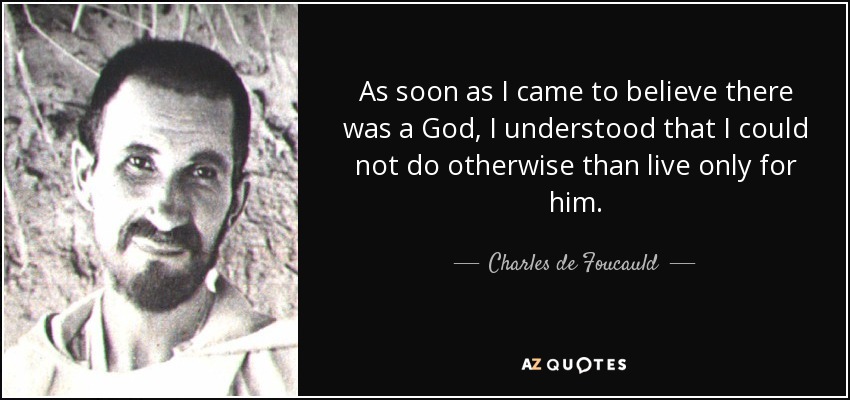
Charles de Foucauld
b. 9.15.1858 Strasbourg, French Empire
d. 12.1.1916 Tamranrasset, French Algeria
Charles de Foucald was a viscount who was born in Strasbourg when it was part of the Second French Empire.
Viscount
La noblesse was a privileged social class in France. Nobles were required to honor, serve and counsel their king. They often rendered military service. Service in the military was part of the impôt du sang or "blood tax."
The kings appointed counts to administer provinces and smaller regions as governors and military commanders starting in the Carolingian Empire. Viscounts were appointed to assist the counts in their running of the province. They often took on judicial responsibility.
The class of nobles had started in the Middle Ages and was maintained until the revolution in 1790.
The nobility was revived in 1805 with limited rights as a titled elite class from the start of the First Empire to the fall of the July Monarchy in 1848. All privileges were permanently abolished.
About 1% of the population had the privilege to hold an estate of land. Noble estates comprised about one-fifth of the land at the time of the revolution.
The hierarchy within the French nobility below peers of the king was initially based on seniority. A count whose family had been noble since the 14th century was higher-ranked than a marquis whose title only dated to the 15th century.
A marquis was often a title of courtesy that could outweigh the ownership of an estate. A comte was a count who possessed a county.
A vicomte or viscount owned property that was usually smaller in size than a county. A viscount was higher in rank than a baron.
Precedence at the royal court was based on the family's ancienneté. The alliances through marriage, its hommages in dignities and offices held and, lastly, its illustrations by record of deeds and achievements.
Strasbourg
The camp of Argentoratum was first mentioned in 12 BCE as part of the Roman province of Germanium. The name suggests that it was a mining site. Argent was Latin for precious metal.
The city of Strasbourg which grew from it celebrated its 2,000th anniversary in 1988. It is located on the western side of the Rhine River. The river serves as the border between France and Germany.
The city is located in the fertile area in the Upper Rhine Plain between the rivers Ill and Rhine. It was governed by bishops from 362 to 1262.
It was occupied successively by Alemanni, Huns and Franks in the 5th century.
The citizens violently rebelled against the bishop's rule. The location was granted the status of a free imperial city.
A revolution in 1332 resulted in a broad-based city government with participation of the guilds. Strasbourg declared itself a free republic.
Johannes Gutenberg invented the printing press in 1440. The first printing offices outside of his hometown Mainz were established around 1460 in Strasbourg by pioneers Johannes Mentelin and Heinrich Eggestein.
The city embraced the religious teachings of Martin Luther under the political leadership of Jacob Sturm von Sturmeck and the spiritual guidance of Martin Bucer in the 1520's during the Protestant Reformation.
It was a center of humanist scholarship and early book-printing in the Holy Roman Empire. Its intellectual and political influence contributed much to the establishment of Protestantism as an accepted denomination in the southwest of Germany. John Calvin spent several years as a political refugee in the city.
Protestant iconoclasm caused much destruction to churches and cloisters despite Luther's opposition to such practices.
It became a French city in 1681 after the conquest of Alsace by the armies of Louis XIV. The city became German again after the Franco-Prussian war ended in 1871. It became French again after the end of World War I in 1918.
Second French Empire
The French Empire was the regime of Napoleon III from 1852 to 1870. It was the state of the nation between the Second and the Third Republic in France.
Napoleon III liberalized his rule after 1858. He promoted French business and exports. The greatest achievements came in material improvements in the form of a grand railway network that facilitated commerce and tied the nation together with Paris as the capital and cultural center.
The change had the effect of stimulating economic growth and bringing prosperity to most regions of the country. The Second Empire is given credit for the rebuilding of Paris with broad boulevards, striking public buildings and attractive residential districts for upscale Parisians.
Napoleon III tried to emulate his uncle in international policy. He engaged in numerous imperial ventures around the world as well as several wars in Europe. His methods for building the empire in North Africa and Southeast Asia were harsh.
He mishandled the threat from Prussia and found himself without allies in the face of overwhelming German force by the end of his reign.
Charles de Foucauld
Charles de Foucauld was born in Strasbourg on September 15, 1858. De Foucauld's family was originally from the Périgord region of France. The Perigord corresponds roughly to the current Dordogne department in Southwestern France.
The Foucauld's were part of the old French nobility. Their motto was "Jamais arrière" or "Never back." Several of his ancestors took part in the crusades. This was source of great prestige within the French nobility.
His mother, Élisabeth de Morlet, was from the Lorraine aristocracy in northeastern France. His grandfather had made a fortune during the revolution as a republican.
His mother married the viscount Édouard de Foucauld de Pontbriand, fôrest inspector, in 1855. They named their first child Charles in 1857, but he died a month after his birth.
Their second son, Charles Eugene, was born in the family house at what was previously mayor Dietrich's mansion in 1858. The child was baptised at the Saint-Pierre-le-Jeune Church on November 4.
His father was transferred to Wissembourg in northeastern France a few months after his birth. Wissembourg is about 70 km (43.5 mi.) north of Strasbourg.
His mother was deeply religious. She educated him in the catholic faith with acts of devotion and piety. She died following miscarriage on 13 March 1864. Her husband who suffered from neurasthenia, a nerve disorder. He died on 9 August.
The now orphaned Charles (age 6) and his sister Marie (age 3) were put in the care of their paternal grandmother, viscountess Clothilde de Foucauld. She died of a heart attack shortly afterwards.
The children were then taken in by their maternal grandparents, colonel Beaudet de Morlet and his wife, who lived in Strasbourg.
The colonel Beaudet de Morlet was an alumni of the École Polytechnique near Paris. He had become an engineering officer. He provided for his grandchildren in an affectionnate home. Charles would later describe him as a man with beautiful intelligence.
Charles pursued his studies at the Saint-Arbogast episcopal school until he went to Strasbourg high school in 1868. He was often ill and obtained much of his education thanks to private tuition.
The de Morlet family fled the Franco-Prussian War in 1870 and found refuge in Bern, Switzerland. The family moved to Nancy in northeastern France in October 1871 following the French defeat.
Charles had four years of secular school left. He gained a taste for classical literature and patriotic sentiment alongside a mistrust for the German Empire.
He was confirmed and received his first communion in 1872. He began to distance himself from his religion in a rhetoric class in 1873. He received his baccalaureat in 1874.
Charles was sent to the Sainte-Geneviève school in Paris in order to prepare the admission test for the Saint-Cyr Military Academy. The school is now located in Versailles. It was located in the Latin Quarter at that time. It was run by the Jesuites.
Charles was opposed to the strictness of the boarding school. He decided to abandon religious practice. He obtained his second baccalauréat in August 1875. He led a lifestyle that was dissipate to the discovery of pleasure at that point in time. He was expelled from further study at the school for being "lazy and undisciplined" in March 1876.
He signed up for Saint-Cyr Military Academy and was accepted 82d out of 412 in June 1876. His grandfather emancipated him at 18 years of age. He received his inheritance.
He became an officer after 2 years of study at the academy. He was sent to Algeria in October 1880. He took his mistress Mimi with him.
He was dismissed from the army when he refused to give her up. He reenlisted after they split while still in the foreign country, but resigned from the service when he was refused permission to make a scientific exploration of nearby Morocco. The country was forbidden to Europeans.
He became a covert European explorer and geographer with the help of a Jewish rabbi. He disguised himself as a Jew and began a one-year exploration in 1883. He recorded his findings in a book that was well received by the European community. Little was known about the people of the area.
He became inspired by the Jews and Muslims whom he met there. He resumed the catholic faith that he had abandoned when he returned to his country in 1886. He joined a Trappist monastery in Ardeche, France and later transferred to one in Akbes, Syria.
He was released from his Trappist vows to work to live a life like Jesus. He became a gardener and sacristan for the Poor Clare nuns in Nazareth and later in Jerusalem after leaving the monastery in Syria in 1897. He returned to France and was ordained a priest in 1901.
He journeyed to Beni-Abbes, Morocco later that year. He intended to found a monastic religious community in North Africa that offered hospitality to Christians, Muslims, Jews or people with no religion. He lived a peaceful, hidden life but attracted no companions.
A former army comrade invited him to live among the Tuareg people in Algeria. The Tuareg are a large Berber ethnic confederation. They principally inhabit the Sahara in a vast area stretching from far southwestern Libya to southern Algeria, Niger, Mali and Burkina Faso.
Tuareg society has featured clan membership, social status and caste hierarchies within each political confederation. They are traditionally nomadic pastoralists, but small groups of Tuareg are also found in northern Nigeria.
The Tuareg have controlled several trans-Saharan trade routes and have been an important party to the conflicts in the Saharan region during the colonial and post-colonial era. They have been historically influential in the spread of Islam and its legacy in North Africa.
He lived among the Tuareg in the Sahara in Algeria. He learned their language enough to write a Tuareg-French and French-Tuareg dictionary. He translated the Gospels into Tuareg.
He wanted to be among those who were “the furthest removed" and "the most abandoned.” He wanted all who drew close to him to find in him “a universal brother.”
He moved to Tamanrasset on southern Algeria in 1905 where he lived the rest of his life. He visited France and established an association of laypeople who pledged to live by the Gospels in early 1909. His return to Tamanrasset was welcomed by the Tuareg.
The outbreak of World War I led to attacks on the French in Algeria. The war had been tearing Europe apart for 2 years.
It was reported that he was assassinated on December 1 in 1916. Charles was seized in a raid. He was shot along with two French soldiers from the Camel Corps when they attempted to obtain his release.
The murder was witnessed by an African Arab sacristan who had been liberated from slavery and instructed by Fr. de Foucauld.
The French authorities continued to search for years to find the bandits involved. The murderer was apprehended and executed in 1944 at Djanet in southeastern Algeria.
Fr. Charles de Foucauld is considered by the Church to be a martyr. He was beatified as a saint by Pope Benedict XVI in 2005.
The Association of the Brothers and Sisters of the Sacred Heart of Jesus consisted of 48 lay and ordained members at the time of his death.
He had always dreamed of sharing his vocation with others. He came to the conclusion that this “life of Nazareth” could be led by all after having written several rules for religious life.
His inspiration and writings led to the founding of the Little Brothers of Jesus among other religious congregations.
Members of these groups live in small communities, called fraternities, in areas where the people are largely poor. They support themselves by doing the same kind of work as their neighbors. The life is animated by prayer and humble service which is hoped to draw others to Christ.
Charles de Foucauld
T. 查尔斯·德·富考德
S. 查爾斯·德·富考德
查 Cha to examine 查 No kanji Sha しゃ シャ Sya 샤 shah
尔 er that 爾 ji you ru る ル leul 를 to
斯 si this 斯 shi this ru る ル deu 드 de
德 de morality 德 toku ethics do ど ド Pu 푸 foo
富 Fu abundant 富 fu wealth Fu ふ- フ- ka 카 ka
考 kao to study 考 ko consider ko こ- コ- ul 울 fence
德 de morality 德 toku ethics ru る ル deu 드 de
do ど ド
----------------------
The morality of faith is examined with prayer.
Christ is the model for the study you care to share.
================
wiki Charles de Foucauld
wiki French Nobility
biography de Foucauld
Franciscan bio
Choice or Accident
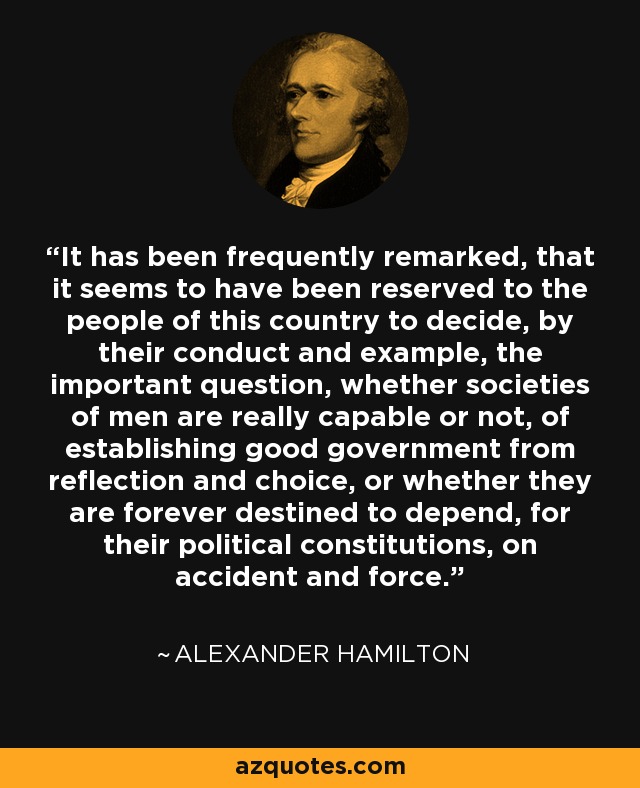
Alexander Hamilton (1755-1804)
Alexander Hamilton was an American lawyer, banker and economist. He promoted the US Constitution along with John Jay and James Madison. They published a series of 85 articles in 1788. The collection has come to be known as the Federalist Papers.
Hamilton argued that the Constitution was for the existence of the union in his introduction to the series (Federalist Paper 1). Society has the capacity to establish good government by reflection and choice. Choice avoids dependence upon the use of force and accident for political existence.
Philanthropy and patriotism contribute to happiness in the direction of choice in the judicious estimate of our true interests. The causes which serve to give a false bias to judgment are so numerous that the wise and good are seen on the wrong as well as on the right side of questions of the first magnitude of importance to society.
Moderation is recommended to those who are ever so much persuaded of their being in the right in any controversy. Ambition, avarice, personal animosity, party opposition and other motives are apt to operate on those who support as well as those who oppose the right side of a question. Nothing could be more detrimental to the inducement of moderation than the spirit of intolerance that has characterized political parties.
It is as absurd to seek conversion by the force of fire in politics as it is in religion. Error is rarely cured by persecution. The punitive in either party appear to mutually hope to evince the justness of their opinions and to increase the number of their converts by the loudness of their declamations and the bitterness of their invectives.
The energy and efficiency of government will be stigmatized as the offspring of a temper fond of despotic power and hostile to the principles of liberty by an over-scrupulous jealousy that plays on the danger to the rights of citizens.
Those who have overturned the liberties of republics have started their career by paying an obsequious court to "the people." They began as demagogues and ended as tyrants by the promotion of factional majority.
Citizens need to be on guard against any impressions other than those which may result from the evidence of truth. The adoption of the Constitution is in the best interest of the public for the safest course to dignity, liberty and happiness.
The utility of the union is deeply engraved on the hearts of the great body of the people in every State. The confederation had been insufficient as the federal government. The existence of the union is dependent upon the ratification of the Constitution for the United States of America.
Federalist Papers
Text
Love

Boethius
b. c.477 Rome, Kingdom of Odacer
d. 544 Pavia, Ostrogothic Kingdom
Anicius Boethius was a Roman senator, consul, magister officiorum, and philosopher. He was born about a year after Odoacer deposed the last Western Roman Emperor and declared himself King of Italy.
He entered public service under Ostrogothic King Theodoric the Great. Theodoric imprisoned him on the charge of conspiracy to overthrow him. Boethius composed his Consolation of Philosophy while in prison.
It was a treatise on fortune, death and other issues. It became one of the most popular and influential works of the Middle Ages. He became the main intermediary between Classical antiquity and following centuries due to his numerous written works and his translation of Aristotle.
Rome
Julius Nepos, the last western emperor of Rome, was killed in 476. A Roman general of barbarian origin, Odoacer, declared allegiance to Eastern Roman emperor Zeno.
The popes and their clergy assumed the functions of Roman civil government, ransoming those sold into slavery, caring for refugees, negotiating with Barbarians, continuing the dole, etc.
The popes sent out missionaries to convert the barbarians and to make sure that the dream and legacy of Rome would be preserved.
Supreme Good
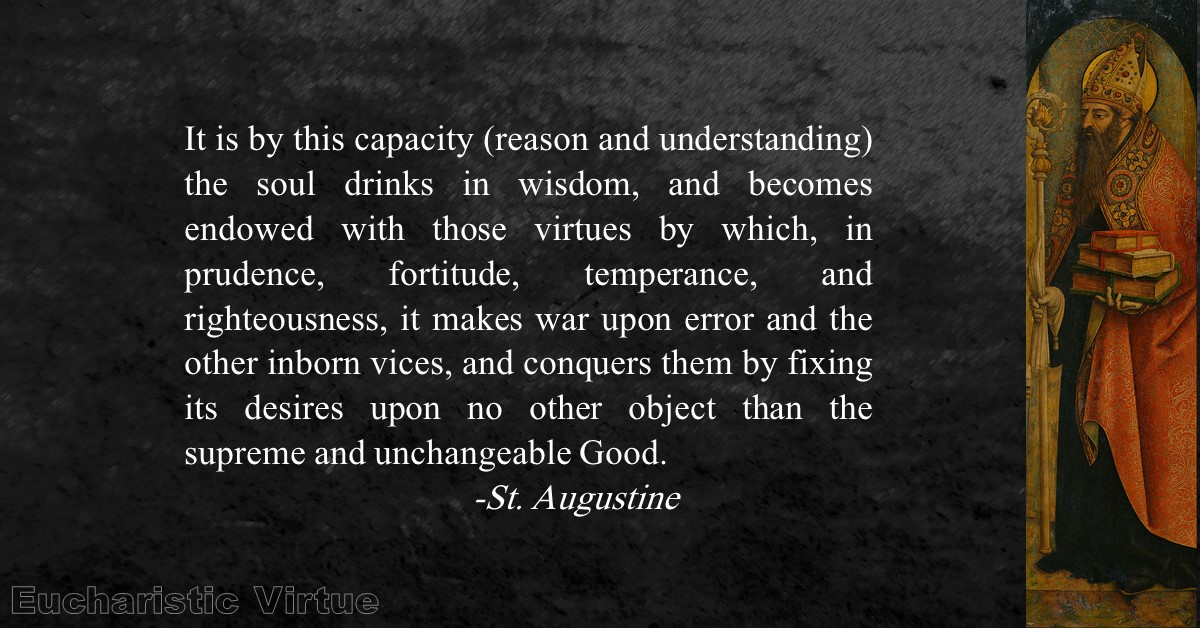
Augustine had argued that the sack of Rome by the Visigoths in 410 was not the fault of Christianity in his book City of God. Human history was a conflict between the earthly and heavenly city in his view.
The people who dedicate themselves to eternal truth as revealed by faith belong to the City of God. Those who have immersed themselves in the cares and pleasures of the present world are earthly.
The history of the world is a universal conflict between the unification of the political body by faith in God and the dissipation caused by the infinite division of the dyadic impulse.
Odacer (r. 476-493)
Odoacer and later the Ostrogoths continued, like the last emperors, to rule Italy as a virtually independent realm from Ravenna. The allegiance to Constantinople was nominal.
Odoacer generally used the Roman honorific patrician, granted by the emperor Zeno, but is referred to as a king (Latin: rex) in many documents.
Odoacer introduced few important changes into the administrative system of Italy. He had the support of the Roman Senate and was able to distribute land to his followers without much opposition. Unrest among his warriors led to violence in 477–478, but no such disturbances occurred during the later period of his reign.
Odoacer was an Arian Christian, but he rarely intervened in the affairs of the Trinitarian state church of the Roman Empire.
Theodoric the Great (r. 493-526)
Theodoric was king of the Ostrogoths (471–526), ruler of the independent Ostrogothic Kingdom of Italy between 493–526, regent of the Visigoths (511–526) and a patrician of the Roman Empire.
Theodoric controlled an empire stretching from the Atlantic Ocean to the Adriatic Sea. He kept good relations between Ostrogoths and Romans, maintained a Roman legal administration and oversaw a flourishing scholarly culture as well as overseeing a significant building program across Italy.
Magister Officiorum
The office can first be definitely traced to the year 320 during the reign of Roman emperor Constantine the Great (r. 306–337). The office was created to limit the power of the praetorian prefect (praefectus praetorio) the Roman emperor's chief administrative official.
The praetorian prefect had originated as the commander of the Praetorian Guard, but the office gradually acquired extensive legal and administrative functions. The holders had become the Emperor's chief aides. The office was much reduced in power by Constantine.
It was transformed into a purely civilian administrative post. Territorially-defined praetorian prefectures emerged as the highest-level administrative division of the Empire under his successors. The prefects functioned as the chief ministers of the state. Many laws were addressed to them by name.
Praetorian prefects continued to be appointed by the Eastern Roman Empire and the Ostrogothic Kingdom until the reign of Heraclius in the 7th century CE. Wide-ranging reforms reduced their power and converted them to overseers of provincial administration. The last traces of the prefecture disappeared in the Byzantine Empire by the 840's.
The Magister Officiorum or Master Officer became a minister of internal security in administrative oversight and communications. The holders of the office were the emperor's chief watchdogs.
Almost all routine business was channeled to the office of the magister through the secretariats from other ministries such as the prefectures, the Treasury ('res summa') and the Crown Estates ('res privata').
Each office for a ministry performed the function as a control point to catch and vet information. Higher officials and military officers had the right to communicate with the emperor if the matter was important enough.
The office rose quickly in importance. The officer was initially ranked as a regimental commander or tribunus. The magister was a 'comes' or companion to the emperor by the end of Constantine's reign.
He became a member of the imperial consistorium as one of the top four palatine officials with the quaestor sacri palatii, comes rerum privatarum and comes sacrarum largitionum.
The office survived as a bureaucratic function in the Byzantine Roman Empire, but during the late 7th or the 8th century, most of the office's administrative functions were removed. It was converted into the dignity of magistros
The Consolation of Philosophy
The Consolation of Philosophy was written by Boethius in 523 during a one-year imprisonment he served while awaiting trial for the alleged crime of treason under the Ostrogothic King Theodoric the Great.
Boethius was at the height of his power in Rome. He held the prestigious office of magister officiorum. He had been working to revitalize the relationship between the Roman and the Constantinopolitan See.
Disagreement had begun to emerge between them. This may have set in place a course of events that would lead to loss of royal favor.
The referendarius Cyprianus accused the ex-consul Caecina Albinus of treasonous correspondence with Justin I. Boethius argued in his defense. He asserted that if Albinus was guilty, then he and entire senate were guilty as well.
Boethius was charged with the same crime by Cyprianus. Three men were produced who claimed that they had witnessed the crime.
Boethius was arrested. He was detained in the baptistery of a church. Then he was exiled to the Ager Calventianus, a distant country estate. It is reported that he was put to death there.
Theodoric was feeling threatened by international events. The Acacian schism between the Eastern and Western Christian Churches had lasted for 35 years (484 to 519).
The leaders of Eastern Christianity were considering Cyril of Alexandria's Miaphysitism. This Christological formula had asserted that the divine and human natures were united in the person of Jesus Christ.
The natures were mixed as one in the same person without separation (mia = mixed). The Chalcedonians recognised two natures (physis) in Christ, the Miaphysites only one.
Pope Felix III wrote two letters, one to Emperor Zeno and one to Patriarch Acacius of Constantinople. He reminded them of the need to defend the faith without compromise.
Zeno had proposed the Henotikon or "instrument of union". It was promulgated by him and signed by all the Eastern bishops with the design of resolving the monophysite and Nestorian controversies.
The monophysites asserted that human nature was consumed by the divine, like a drop of water in the ocean.
The Nestorians argued that Jesus Christ had divine and human persons within himself. Mary was the mother of Jesus, not the mother of God.
The Henotikon had been developed with the support of Acacius. It was addressed to the factions in Egypt. The edict affirmed the Nicene-Constantinopolitan Creed as affording a common, final and united symbol or expression of faith. No explicit mention was made about the two natures.
All other symbola or mathemata were excluded. Eutyches and Nestorius were condemned in an anathema. The twelve chapters of Cyril of Alexandria were accepted.
The bishop of Rome, Pope Felix III, refused to accept the document. He excommunicated Acacius (484). This began the Acacian schism which lasted until 519.
The Catholic Hilderic had become king of the Vandals. He had put Theodoric's sister Amalafrida to death (c.523). The new emperor, Justin I had replaced Anastasius, a man with whom Theodoric had good relations.
Justin was under the influence of his nephew Justinian. Somehow imperial views hardened against the West. Talk of Rome's fall emerged during this period. The legitimacy of barbarian rule was questioned.
The Consolation was written by Boethius as a conversation between himself and Lady Philosophy. Lady Philosophy consoled him by discussing the transitory nature of fame and wealth. No one can truly be secure until forsaken by Fortune.
The things of the mind are those which she called the "one true good". She contended that happiness comes from within. Virtue is all that is true, because it is not imperiled by misfortune.
Boethius engaged consideration of the nature of predestination and free will. Why do those who are evil often appear to prosper? How is that the good are allowed to fall into ruin? Shouldn't the virtue that produces justice in human nature be recognized by society?
He asked if God knows and sees all as predestined or is there free will? On human nature, He asserted that humans are essentially good. It is only when they give in to “wickedness” that they “sink to the level of being an animal.”
He argued that criminals are not to be abused. They ought to be treated with sympathy and respect as a doctor treats a patient. Criminal charge itself can be the outcome of belief in determinism. The ideal relationship between prosecutor and the accused should be an investigation of how the evidence is to be interpreted.
Boethius answered religious questions without reference to Christianity in the Consolation. He relied on natural philosophy and the Classical Greek tradition. He believed in the correspondence between faith and reason. The truths found in Christianity would be no different from the truths found in philosophy in the light of reason.
His was the story of Job retold in the first reconstruction of the Roman world after the fall of Rome to Gothic invaders.
--------------------
Giordano Bruno (1548-1600)
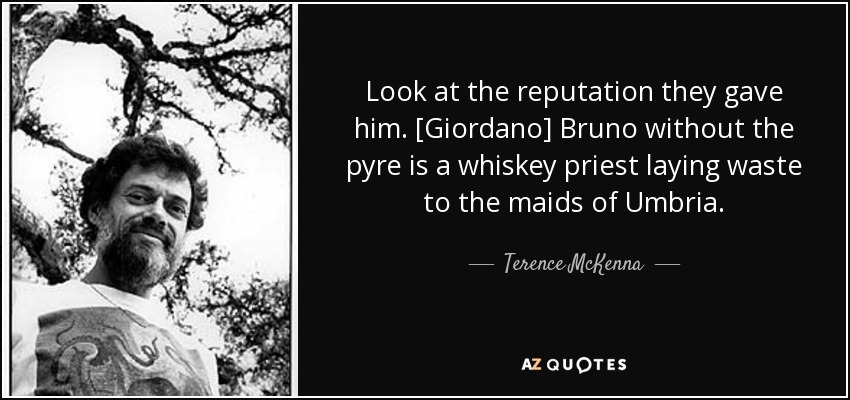
Fillipo Bruno took the name Giordano when he entered the Dominican order (1565). He was 17 years old. He was instructed in Aristotle's philosophy In the great Dominican monastery in Naples where Thomas Aquinas had taught.
Bruno was attracted to new streams of thought. The works of Plato and Hermes Trismegistus had both been resurrected in Florence by Marsilio Ficino in the late 15th century.
It had been believed that Hermes Trismegistus was a gentile prophet who was a contemporary of Moses. The works attributed to him in fact date from the turn of the Christian era.
Bruno was a good student, but an independent thinker in an order that demanded intellectual discipline. His work in mnemonics brought him attention, but he was suspected of heretical views.
He left the order in 1576. It was not long after having been ordained as a Dominican priest. He began to move restlessly about Europe to write and teach. He moved to Toulouse, Paris, London, Wittenberg, Prague and Frankfurt.
Two of his best known cosmological works were published while he was in London. La cena de le cenari (Ash Wednesday Supper) and De Vinfinito universo et mondi (On the Infinite Universe and Worlds) were released in 1584. These works contained his most extensive writing on the subject of astronomy and the Copernican theory.
Ash Wednesday Supper
Text
Ash Wednesday Supper presented an exposition of Copernican heliocentric theory. Copernican theory held that the universe was finite with a sphere of fixed stars. Bruno posited an infinite universe that was homogenous spatially and materially without a center.
His theory embraced an infinite number of worlds with innumerable solar systems. He argued for the link between conceptions descended from the Pre-Socratics with the discoveries of contemporary science.
On the Infinite Universe
Text
His books and sojourns to Protestant countries only exacerbated his Italian problems. He was soon arrested, imprisoned and finally tried before the Inquisition as a heretic upon his return to Italy in 1592.
The Inquisition
The Inquisition started in 12th-century France to combat religious dissent. The Cathars and the Waldensians were targeted as groups. The Spiritual Franciscans, the Hussites (followers of Jan Hus) and the Beguines were investigated later.
Inquisitors were generally chosen from members of the Dominican Order beginning in the 1250's. The earlier practice had been to use local clergy as judges.
The concept and scope of the Inquisition significantly expanded in response to the Protestant Reformation and the Catholic Counter-Reformation.
The Execution of Bruno
Giordano Bruno started to argue for the classical position in the 16th century during the Reformation. The Reformation was largely organized in protest against the imposition of religion by the Inquisition and the toleration of slavery by government officials.
Bruno's argument was overstated in opposition to the implication of a single legal monotheistic religion. Theodoric may have believed that he was only defending his claim to independence against the expansion of the Byzantine Roman empire.
The removal of the magister, Boethius, may have been coupled with the report of his execution in order to preserve the tenure of the office as a companion to the king without term limits.
It could have all have been part of the media circus used to keep the public misinformed as to royal or imperial intent, but it set a harmful precedent regarding the official state religion.
The polytheistic state religion had allowed multiple cults as a means to preserve that which belonged to the emperor. The precedent was such that the monotheistic model would allow for variant monotheistic forms as legal, if not official.
The notion that classical religion was viable as legal was retained despite the official disclaimers of polytheism as a form. This was a significant issue when it came to relations with primitive cultures.
The ancient Phoenician and Carthaginian empires had established cities as outposts in foreign lands. The city could operate as a metropolitan form for imperial government with respect for the development of trade by expansion into the territory provided that the natives were amenable to the development.
The office of the Inquisitor added aggression to the claim of dominance by the imposition of religion. If those who refused to join the Church were investigated for the knowledge of Christian doctrine and found to be in error, they were subject to persecution as a group.
Reports would be made to the public regarding torture and execution of representative members. There was the implication that they were only dead to participation in the official religion as the imperial cult, but it gave the religion a bad name with respect for liberty in sustainable development.
The opportunity for voluntary participation in the legal standing of the kingdom, republic or empire was reduced to the possibility of a 'now or never' type of concession to the only officially legal religion.
It is conceivable that the work of Bruno would have remained obscure and unknown had he not been convicted of heresy, but his advocacy for infinite division in multiple 'worlds' wasn't exactly a support for sustainable development. He was made into a martyr for classical religion.
The freedom of religion that had been implicated as the practical policy for the basis for interaction between government and religion eventually found expression in the First Amendment. Congress is not allowed to make law for the establishment of religion or to prevent the practice of religion organized by freedom of assembly.
The legality of religion however is significant insofar as common law does not allow assembly for the promotion of riot, rebellion, revolution or terrorism. The law against murder cannot be overridden by the claim of liberal power.
--------------------
Emotional Relativism

William Fontaine
b. 12.02.1909 Chester, Pennsylvania
d. 12.29.1968 Philadelphia, Pennsylvania
William Fontaine was an American Professor of philosophy in the Ivy League. He taught at the University of Pennsylvania from 1947 to 1967. He advocated for African American rights.
He was born in Pennsylvania in the early part of the 20th century.
Chester, PA

Europeans first settled the area in the 17th century. When the Quaker William Penn arrived in 1682 to oversee his “Holy Experiment” in the English colony of Penn’s Woods (Pennsylvania), he had hoped to make Chester the capital.
Penn moved 13 miles upstream to Philadelphia, and in the 18th and 19th centuries the hamlet of Chester grew very slowly. It nonetheless remained important to the Quaker farmers who spread into the Delaware Valley.
Chester is the oldest city in Pennsylvania. It is located on the western bank of the Delaware River between the cities of Philadelphia and Wilmington, Delaware.
The Delaware River Iron Ship Building and Engine Works was opened in 1871 by John Roach through the purchase of the Reaney, Son & Archbold shipyard. The first steel ships of the U.S. Navy were built at the Roach shipyard.
It was the largest and most productive shipyard in the United States for the first 15 years of operation. More tonnage of ships were built at the Roach shipyard than its next two competitors combined.
Roach built other businesses to supply materials for building ships. These included the Chester Rolling Mill in 1873 to supply metal hull plates and beams, the Chester Pipe and Tube Company in 1877 for the manufacture of iron pipes and boiler tubes and the Standard Steel Casting Company in 1883 to supply steel ingots.
Roach built the Combination Steel and Iron Company in 1880 to supply steel rails and other products for businesses beyond the Roach shipyard. He lost control of the company after his shipbuilding enterprise entered receivership in 1885.
William Fontaine
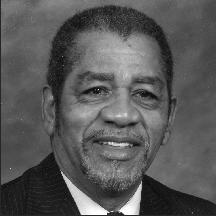
William's father worked in the steel mill on the Delaware River. He was the grandson of a slave and the second son of 13 children.
He graduated in the top third of his class at Chester High School. His aunt raised his younger siblings and funded their continued education after his parents died in the 1930's.
Fontaine enrolled in Lincoln University in 1926. The school was about 30 miles west of Chester. Lincoln is a historically black university. It was founded as a private university in 1854.
Rev. John Miller Dickey, a Presbyterian minister, and his wife, Sarah Emlen Cresson, a Quaker, founded Ashmun Institute in Hinsonville, PA.
The school was named after Jehudi Ashmun, a religious leader and social reformer who was active in the establishment of Liberia in western Africa. There was an emphasis on instruction in western civilization that entertained the goal of leadership in their ancestral homeland.
It was established for the education of African Americans. They had few opportunities for higher education at the time. The university was later renamed Lincoln in 1866, a year after Abraham Lincoln had been assassinated.
Fontaine wanted to become a teacher. He wrote poems and analytic essays for the school newspaper. He argued that African Americans needed to show ability, aggressiveness and cooperation to succeed.
He graduated cum laude with a BA from Lincoln. He took his degree from Lincoln in the spring of 1930, just as the United States was entering the Great Depression.
He earned his living as an instructor there over the next 6 years. He was one of several part-timers. He just preceded the first black professors whom the institution hired as standing faculty.
Fontaine taught Latin. His level of instruction moved up from elementary Latin. He taught the learning of the grammar of the language and the reading of Caesar’sGallic Wars. Then his classes moved to the authors Cicero, Vergil and Livy. These were traditionally considered more advanced in history and government.
He pursued graduate level instruction in Philosophy from the nearby University of Pennsylvania. He earned an M.A. in 1932. He earned his Ph.D. in 1936. His doctorate thesis was on the "Concept of Fortune in Boethius and Giordana Bruno."
He worked as a professor of philosophy and history at Southern University in Louisiana from 1936 to 1942. it was near Baton Rouge. He taught philosophy and history. He married an acquaintance from Philadelphia in 1936, Willabelle Hatton of Iva, South Carolina. They had two daughters, Jean and Vivian.
Southern Louisiana had a French (Cajun) and Spanish heritage that was reflected in mixed European and African American (Creole) cultures. These cultures were centered in New Orleans, a large and thriving metropolis with a permissive flavor. Black Catholics abounded.
Oil refineries up and down the Mississippi where New Orleans at the mouth made the state wealthy. New Orleans did not represent more conventional southern towns such as Baton Rouge, Shreveport and Alexandria. There was more respect for classical education there.
He was able to do postdoctoral work at Penn and at the University of Chicago during the summers in Lousiana.
Fontaine was drafted for service in World War II. He served as an enlisted man in World War II. He worked at Holabird Signal Depot in Baltimore, Maryland where he taught basic education to illiterate soldiers.
He was hired to teach philosophy at Morgan State College in 1946. It was an African American college in Maryland. He was given a one year guest lecturer position at the University of Pennsylvania faculty in philosophy in the Spring of 1947. He was promoted to assistant professor two years later.
Fontaine was influenced by emotivist philosopher C. L. Stevenson.
Stevenson had been educated at Yale and Harvard. He got his B.A. in English literature at Yale in 1930, a B.A. in moral sciences at Cambridge in 1933 and a Ph.D. at Harvard in 1935. He was an instructor at Yale from 1936 to 1944. He spent some of his time teaching mathematics to wartime naval recruits.
He was an analytical philosopher who adapted agreement with the logical positivism of A.J. Ayers. His papers "The Emotive Meaning of Ethical Terms" (1937), "Persuasive Definitions" (1938) and his book Ethics and Language (1944) developed a theory of emotivism.
Emotive meaning proposed that any ethical theory should explain three things. Intelligent disagreement can occur over debatable statements. Terms like good are "magnetic" in encouraging action. The scientific method is insufficient for verifying moral claims.
He agreed with Ayer that ethical sentences express the speaker's feelings with language. He added that they also have an imperative component intended to change the listener's feelings. This component is regarded as having greater importance in emotivism.
Where Ayer spoke of values or fundamental psychological inclinations, Stevenson spoke of attitudes. Where Ayer spoke of disagreement of fact or rational dispute over the application of certain values to a particular case, Stevenson speaks of differences in belief.
Imperatives are implied to decrease argumentation and solicit a practical sense of duty. The reasons to close a door don't have to be proofs in order to reach sufficiency.
Statements like 'It's drafy' or 'It's too noisy' may be offered. They aren't necessarily proofs that the door needs to be closed, but they are reasons for the implication of the imperative.
Stevenson proposed that emotivism is a meta-ethical theory that delineates between scientific and non-scientific uses of the language. He used this to provide a foundation for his theory of a persuasive definition.
Moral disagreement may arise from different fundamental attitudes, beliefs about specific cases or both. The method of argumentation has been divided into three groups known as logical, rational and non-rational psychological forms.
Logic involves the effort to show inconsistencies between a person's fundamental attitudes and their particular moral beliefs.
Rationality examine the facts which relate fundamental attitudes to particular beliefs. The goal is not to show that someone has been inconsistent as with logic, but only that they are wrong about the facts which connect their attitudes to their beliefs.
Non-rational argument revolves around language with psychological influence but no necessarily logical connection to the listener's attitude. It is rhetoric as a means for persuasion.
Rhetoric depends on the emotional impact of dramatic declaration. A redirection of the hearer's attitudes is sought not by the mediating step of altering his belief, but by exhortation.
The impact of metaphor, over or under statement, tone, volume, cadence, pitch or the demonstration of emotion are watched for motivational effect. The listener's reaction is tested by the non-verbal yet vocal or bodily expressions of the speaker.
Fontaine called his own position a "modified ethical relativism." He presented his argument in terms of group dynamics for the African American population. He argued that when a group desired a certain state of affairs, an alteration in the attitude for an ethical stance could achieve the desired result.
Politicians offered employment to blacks during World War I to avert defeat by Germany. The group may not have been interested in military victory over Germans. Germany wasn't active in the slave trade. African Americans wanted the racial equality that came with better jobs though. An increased investment in military or industrial occupations resulted.
Fontaine had been raised in a Democratic household. He was for the New Deal. He spoke for African American rights. He supported a liberal Republican presidential candidate from Pennsylvania, but his economic view was against communism.
He supported Presidents Truman, Eisenhower and Kennedy in their anti-Communist agendas, but he supported the growth of the Civil Rights movement. His Reflections on Segregation, Desegregation, Power, and Morals was published in 1967.
While he supported racial equality, he argued that the growing Black Power movement contained the same intellectual defects that existed in white racism.
He criticized the left from his leftist position. He was well versed in the classics, but his position defaulted to the prejudice against the majority as proposed by Cicero.
People of color had been granted the right to vote after the Civil War, but progress in the development of integrated public and segregated private institutions was dismissed as insufficient at any given stage until special legislation was enacted at the national level to 'protect' civil rights for a particular racial faction of the population.
It amounted to the institution of racism against the majority group on the basis that such an institution of prejudice was not possible.
William Fontaine
S. 威廉·方丹
T. 威廉·方丹
威 Wei dominate 威 i dignity Ui うぃ ウィ Wil 윌 Will
廉 lian to investigate 廉 ren bargain ri り リ li 리 lee
方 Fang honest 方 ho direction amu あむ アム eom 엄 moth
丹 dan cinnabar 丹 tan red Fon ふぉん フォン pong 퐁 pong
tenu て-ぬ テ-ヌ ten 텐 ten
----------------------
The external arbitrary force that affects affairs
is worthy of investigation in historical cares.
The dignity of direction in constituted ideals
has to avoid poison to how the public feels.
================


