Showing posts with label morality. Show all posts

Friday, August 16, 2019

Shine

8.17
Fused Glass Bowl

Shine
Bright
闪耀着光芒 
Shǎnyàozhe guāngmáng
明るく輝く
Akaruku kagayaku
ps107
Clare splendere

The broken bowl bell 
held food quite well 
until it fell. 

The squeaking squeal from the wheel 
yields wealth in health appeal 
from the way the appeal feels. 

Mop up the mess.
It's part of the test.

Sweep up the ceramic.
You won't have to panic.

This piece was shaped like a diamond. 
My mind looked to the horizon. 

A diamond shines bright 
with the facets of light’s life 
in a mind with insight. 

She smiles for miles
with the delight of her sight.

Diamonds start as coal.
Earth is the source for the intense force that cajoles
the carbon in its moles to make tiny holes
extol less space for lex taste holding the philosopher’s stone 
as a blown tome now known
as the most remarkable clone.

Opaque matter, darker than night,
becomes transparent, shining sparkles in light.

Hardship hardens your core for sure
to make your heart shine as pure.
Purity is the cure that lures.

Performers stay healthy 
so their products are wealthy.

The best work smart with rested heart
for the next test to start.

These followed their food.
These chopped what the beaver chewed.

These grew what they could.
These shot from where they stood.

These worked in mines.
These hunted from blinds.

These worked in fields.
These negotiated deals.
These squealed for appeals.

These worked in a factory.
These made customers happy.

These worked in the field.
'No mind' was their shield.

Mugwort and hemp 
healed that which was bent.

The redeemer’s redemption came
by correction in detention for those who lost their way to fame
and became lame with respect for the rules of the game

These formed conception with education
to avoid the deception of perception 
by the sensation of the senses.

All these weathered the storm;
while these struggled through thorns.

These strengthened their homes
while these burned diseased bones.

When the mist came with Spring.
these felt they had to travel and sing.

When they strayed from the path
they became children of wrath.

They rode and they fought.
They forgot what they had been taught.

Some went to the sea to travel in ships
to ply their trade without loose lips.

They moved straight on the ocean
when the crab didn't make the motion.

They beheld the wonders of the deep.
Things went so well they felt that they could weep.

Then a storm bossed the wind and the waves of the sea.
They rose so high they tossed the ship like a flea on a sheep.

The ship mounted the heavens then fell back to the depths.
Their hearts melted groan. Some actually wept.

They staggered and fell like the most practiced of drunkards.
They looked to the sky and prayed for their mothers.

The wind carried their prayer to the height of the sky.
They were delivered from the storm as if by their cry.

The storm was stilled to a whispering purr.
The sea felt so soft she seemed like the cure.
They all felt glad because of the calm of the sea.

The harbor they made soothed them like the balm of morality.
Let them give thanks for the love of sweet mercy.
The sailors were saved from wet death with the thirst for eternity.

The Redeemer redeemed lost time as the story.
Joy was embraced as a parcel of glory.

The weather is the greatest of friends
or the worst to offend.

We accomplish all things with the goodness of weather.
Natural disaster destroys anything, but buh-bling or bird feathers.

A silver cord streams 
from the container of dreams.

We were made to be loved
with light from above.

A nation without borders isn't secure.
The strength of security gives length to endure.

Citizens carry rights that are earned as learned.
Participation in the media tests substance affirmed.

Legal immigration is a start on the path
to the blessing that heaven grants beyond wrath. 

Conservative policy insists on a balance
between foreign and domestic investment in talents.

The ethics of morality in law 
has a measure in the observation of what you draw.

Drink truth deep from your heart before sleep.
It will help you keep what you seek
looking sleek.

Shine like a diamond.
You will be alive then.
You won’t feel like a siren 
on an island off the horizon.

------------------------

Psalm 107
Part I

Confitemini Domino
Acknowledge Mastery

1 Give thanks to the Lord, for he is good,
and his mercy endures for ever.
2 Let all those whom the Lord has redeemed proclaim
that he redeemed them from the hand of the foe.
3 He gathered them out of the lands;
from the east and from the west,
from the north and from the south.
4 Some wandered in desert wastes;
they found no way to a city where they might dwell.
5 They were hungry and thirsty;
their spirits languished within them.
6 Then they cried to the Lord in their trouble,
and he delivered them from their distress.
7 He put their feet on a straight path
to go to a city where they might dwell.
8 Let them give thanks to the Lord for his mercy
and the wonders he does for his children.
9 For he satisfies the thirsty
and fills the hungry with good things.
10 Some sat in darkness and deep gloom,
bound fast in misery and iron;
11 Because they rebelled against the words of God
and despised the counsel of the Most High.
12 So he humbled their spirits with hard labor;
they stumbled, and there was none to help.
13 Then they cried to the Lord in their trouble,
and he delivered them from their distress.
14 He led them out of darkness and deep gloom
and broke their bonds asunder.
15 Let them give thanks to the Lord for his mercy
and the wonders he does for his children.
16 For he shatters the doors of bronze
and breaks in two the iron bars.
17 Some were fools and took to rebellious ways;
they were afflicted because of their sins.
18 They abhorred all manner of food
and drew near to death's door.
19 Then they cried to the Lord in their trouble,
and he delivered them from their distress.
20 He sent forth his word and healed them
and saved them from the grave.
21 Let them give thanks to the Lord for his mercy
and the wonders he does for his children.
22 Let them offer a sacrifice of thanksgiving
and tell of his acts with shouts of joy.
23 Some went down to the sea in ships
and plied their trade in deep waters;
24 They beheld the works of the Lord
and his wonders in the deep.
25 Then he spoke, and a stormy wind arose,
which tossed high the waves of the sea.
26 They mounted up to the heavens and fell back to the depths;
their hearts melted because of their peril.
27 They reeled and staggered like drunkards
and were at their wits' end.
28 Then they cried to the Lord in their trouble,
and he delivered them from their distress.
29 He stilled the storm to a whisper
and quieted the waves of the sea.
30 Then were they glad because of the calm,
and he brought them to the harbor they were bound for.
31 Let them give thanks to the Lord for his mercy
and the wonders he does for his children.
32 Let them exalt him in the congregation of the people
and praise him in the council of the elders.

-----------------------

David - beloved
Ziba- army
Mephibosheth- mouth of shame

2 Samuel 16:3-4

The king said, 'Where is your master's son?'
Ziba said to the king, 'He remains in Jerusalem. He said, "Today the house of Israel will give me back my grandfather's kingdom."

The king said to Ziba, 'All that belonged to Mephibosheth is now yours.' Ziba said, 'I do obeisance. Let me find favor in your sight, my lord the king.'

-----------------------

A nation without borders isn't secure.
The strength of security gives length to endure.

Conservative policy insists on a balance
between foreign and domestic investment in talents.

=================

Acts 22:27-29

The tribune came and asked Paul, 'Tell me, are you a Roman citizen?' He said, 'Yes.' The tribune answered, 'It cost me a large sum of money to get my citizenship.' Paul said, 'I was born a citizen.' Immediately those who were about to examine him drew back from him. The tribune was also afraid for he realized that Paul was a Roman citizen and he had bound him.

-----------------------

Citizens carry rights that are earned as learned.
Participation in the media tests substance affirmed.

=================

Mark 11:7-10

They brought the colt to Jesus and threw their cloaks on it. He sat on it. Many people spread their cloaks on the road. Others spread leafy branches that they had cut in the fields. Then those who went ahead and those who followed were shouting,

'Hosanna! Blessed is he who comes in the name of the Lord!
Blessed is the coming kingdom of our ancestor David!
Hosanna in the highest heaven!'

-----------------------

Legal immigration is a start on the path
to the blessing that heaven grants beyond wrath.

=================

Posterity
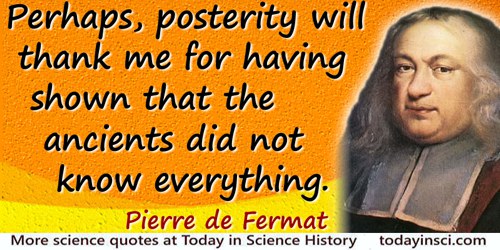
Pierre de Fermat (fair-ma)
b. 10.31.1607  Beaumont-de-Lomagne, France
d. 1.12.1665 Castres, France

Pierre de Fermat was a French lawyer at the Parlement of Toulouse, France. He was also an amateur mathematician.

His exploration of mathematics as a hobby resulted in some major developments for the field of study. He has been given credit for early developments that led to infinitesimal calculus.

He presented the notion of adequality as an approximate equivalence. This broadened the practical application for calculation.

He is recognized for his discovery of an original method of finding the greatest and the smallest ordinates of curved lines. Finding the maxima and minuma is used in differential calculus today.
He made notable contributions to analytic geometry, probability and optics.

He is best known for his principle for light propagation and his Last Theorem in number theory.
His largest contributions to mathematics as a field were in analytic geometry and number theory.

His theorem led to the consideration of the development of exponential notation as a key contribution in either application.

------------------------ 

It is helpful to consider the state of education during the 17th century to understand how significant Fermat's contributions were.

Grammar, logic and rhetoric were essential to a classical education as explained in Plato's dialogues. The three subjects together were denoted by the word trivium during the Middle Ages. The trivium was fundamental to education in Latin,  but the tradition of first learning those three subjects was established in ancient Greece.

The quadrivium consisted of arithmetic, geometry, music and astronomy. These followed the preparatory work of the trivium. The quadrivium was considered the foundation for the study of philosophy (sometimes called the "liberal art par excellence") and theology.

The trivium and the quadrivium comprised the seven liberal arts. The liberal arts presented instruction in the skill of thought. It was distinguished from the practical arts (such as medicine and architecture).

The Renaissance brought an increased emphasis on mathematics and science to Europe. There was period of transition from a sectarian feudal and ecclesiastical culture. There was an increase in the emphasis on a non-sectarian society.

Early Renaissance figures added mathematics to their other occupations. Luca Pacioli was a Franciscan friar who founded accounting. Niccolò Fontana Tartaglia was an invalid with a speech impediment who became a notable engineer and bookkeeper.

Gerolamo Cardano was a doctor of medicine who was also the earliest founder of probability and binomial expansion. Robert Recorde was a physician. François Viète was a lawyer.

Descartes was originally trained as a lawyer, but he acquired greater instruction in mathematics when he studied military engineering in the Netherlands.

The modern form of exponential notation was introduced by Rene Descartes in his text titled La Géométrie early in the 17th century.

Descartes is also widely regarded as one of the founders of modern philosophy. He differed from Aristotle and the revived Stoicism of the 16th century on two major points.

He rejected the splitting of corporeal substance into matter and form. Form and matter are intrinsically interconnected in substance. Aristotle had used the distinction between the two to suggest the difference between the idea of the object and the thing itself. Descartes also rejected any appeal to final ends, divine or natural, in explaining natural phenomena.

His dualism embraced the idea that mind and body are distinct but closely joined. While many contemporary readers of Descartes found the distinction between mind and body difficult to grasp, he thought it was entirely straightforward.

He employed the concept of modes as the ways in which substances exist. He explained in Principles of Philosophy that we cannot understand the mode apart from the substance. The perception of a modal form apart from its substance requires an intellectual abstraction.

Two substances are distinct when each of them can exist apart from the other.

Descartes laid the foundation for the continental rationalism that was later advocated by Spinoza and Leibniz. This was later opposed by the empiricist school of thought consisting of Hobbes, Locke, Berkeley and Hume.

Leibniz, Spinoza and Descartes were well-versed in mathematics as well as philosophy. Descartes and Leibniz contributed greatly to science as well. Spinoza presented an axiomatic argument for constitutional monarchy.

Rene Descartes was born in La Haye en Touraine (now Descartes, Indre-et-Loire), France, on 31 March 1596. His mother, Jeanne Brochard, died soon after giving birth to him. He was not expected to survive. His father, Joachim, was a member of the Parlement of Brittany at Rennes.

René lived with his grandmother and with his great-uncle. Their family was Roman Catholic, but the Poitou region was controlled by the Protestant Huguenots.

The Swiss politician Besançon Hugues had been allied with John Calvin in Geneva. They sought an alliance between the city-state of Geneva and the Swiss Confederation. The label Huguenot was purportedly first applied in France to those conspirators who were involved in the Amboise (am-bwas) plot of 1560 to wrest power from the Catholic House of Guise (gees) in France.

Descartes entered the Jesuit Collège Royal Henry-Le-Grand at La Flèche (flesh) in 1607. It was late because of his fragile health. He was introduced to mathematics and physics. This included Galileo's work.

He studied for two years (1615–16) at the University of Poitiers after graduation in 1614. He earned a Baccalauréat and Licence in canon and civil law in 1616 in accordance with his father's wishes that he should become a lawyer.  He moved to Paris from there.

He abandoned the study of letters. He resolved to seek knowledge from himself and the "great book of the world." He spent the rest of his youth traveling, visiting courts and armies, mixing with people of diverse temperaments and ranks, gathering various experiences, testing himself in the situations that fortune offered to reflect upon whatever came his way in order to derive the profit from it.

His ambition was to become a professional military officer. He joined the Protestant Dutch States Army in Breda under the command of Maurice of Nassau as a mercenary  in 1618. He undertook the study of military engineering as established by Simon Stevin.

This is the period where he began to gain distinction as a mathematician. The study did not produce mathematicians as such. The field was subordinate to logic or physics at the time. He  received much encouragement in Breda to advance his knowledge of mathematics.

He became acquainted with Isaac Beeckman, the principal of a Dordrecht school, in this way. He wrote the Compendium of Music (written 1618, published 1650) for Beeckman. Together they worked on free fall, catenary, conic section and fluid statics. Both believed that it was necessary to create a method that thoroughly linked mathematics and physics.

Descartes was present at the Battle of the White Mountain outside Prague while in the service of the Catholic Duke Maximilian of Bavaria in November 1620. He shut himself in a room with an "oven" (probably a cocklestove) to escape the cold while stationed in Neuburg an der Donau on the night of 10–11 November 1619 (St. Martin's Day).

He had three dreams and believed that a divine spirit revealed to him a new philosophy in the room. He had formulated analytical geometry and the idea of applying the mathematical method to philosophy.

He concluded from these visions that the pursuit of science would prove to be the pursuit of true wisdom and a central part of his life's work. He saw that all truths were linked with one another. The use of logic from the discovery of a fundamental truth would open the way to all science.

He expressed the Latin "Cogito ergo sum" in his native French. It is translated to English as "I think, therefore I am."

He left the army and returned to France in 1620. He was present at the siege of La Rochelle by Cardinal Richelieu in 1627.

He went to listen to a lecture by an alchemist about a new philosophy at the residence of the papal nuncio in the fall of the same year. Cardinal Bérulle urged him to write an exposition of his own new philosophy in some location beyond the reach of the inquisition.

Descartes returned to the Dutch Republic in 1628. He joined the University of Franeker in April 1629. He enrolled at the Leiden University to study mathematics the next year under the name "Poitevan."

He wrote all his major work during his 20-plus years in the Netherlands despite frequent moves.  Galileo was condemned by the Italian Inquisition in 1633. Descartes abandoned plans to publish Treatise on the World. He had been working on the publication for the previous four years.

He published parts of this work in three essays in 1637. "Les Météores" (The Meteors), "La Dioptrique" (Dioptrics) and "La Géométrie" (Geometry) took the first important steps in the description of science with math. These essays were preceded by an introduction, his famous Discours de la méthode (Discourse on the Method).

"La Geometrie" laid out the principles and mechanics for the development of analytic geometry.  The base definitions and mechanics for his discovery are taught in high school algebra courses in the US. The work included the explanation of exponential notation.

Exponents are shorthand for repeated multiplication of the same thing by itself. The shorthand for multiplying three copies of the number 5 for instance is shown on the right-hand side of the "equals" sign in (5)(5)(5) = 5^3. The notation is read as 5 to the 3d power.

The "exponent" is 3 in this example. It stands for however many times the value is being multiplied. The thing that's being multiplied is 5. It is called the "base".

Analytic geometry would become dependent upon algebraic notation with exponents to formulate the curves that were to be drawn on graphs.

Knowledge of conics had developed the first forms with exponential equations. These forms for open and closed figures were adapted for functions. Functions are graphs of equations that depict growth or diminishment.

The vertices, co-vertices and foci are related by the equation c^ 2 = a^ 2 − b^ 2. When we are given the coordinates of the foci and vertices of an ellipse, we can use the relationship to find the equation of the ellipse in standard form.

An ellipse is a modular form.

Number Theory
Fermat's Last Theorem

No three positive integers a, b and c satisfy the equation a^n + b^n = c^n for any integer value of n greater than 2.

The Note in the Margin

It is not possible for a cube to be the sum of two cubes, a fourth power to be the sum of two fourth powers or in general for any number that is a power greater than the second to be the sum of two like powers. Fermat wrote, "I have discovered a truly marvelous demonstration of this proposition that this margin is too narrow to contain."

The (Not) Proof

A centuries old math mystery may have been cracked by a Princeton professor. His colleagues estimate that only one-tenth of 1 percent of mathematicians could understand his explanation.

Did Fermat have the solution? His skill in mathematics was largely limited to his letters to friends and associates. He didn't write for the public much. His writing about math lacked exposition in certain important regards. He helped define analytic geometry with a work on the topic published before Descartes. 

Fermat wrote his marginal note on exponents around 1630 when he first studied Diophantus's Arithmetica. All his other theorems were stated and restated in challenge problems that he sent to other mathematicians. He knew how to answer the special cases of n = 3 and n = 4 as challenges.The general theorem was never mentioned again by Fermat.

No one came up with an example wherein the sum of two cubes resulted in another cube. The sum of two lines can result in a sum with the same power as a line: 1^1 + 2^1 = 3^1. Any addition problem satisfies the condition. The first power is usually not written. 

The sum of two squares isn't as easy, unless you count 0^2 as an option: 0^2 + 2^2 = 2^2. Any number of examples can be produced with this device. There are other solutions:

5^2 = 3^2 + 4^2
or
25^2 = 7^2 + 24^2 = 15^2 + 20^2.   

There are cases where the sum of three or more cubes equals another cube, but a cube simply can't be divided in two and retain an equal length to the sides around the two halfs of the divided cube.

The lines for the object have to be equal in length by definition. The length of the divided lines will always be half of the distance for the lines that are not divided.

The consideration of geometric solids helped Fermat to rule out the possibility of higher exponential equations. The act of dividing a cube in half demonstrates that two cubes can't be added together to equal another cube. It can't be done.

While it is conceivable that the volume for two cubes could possibly be added together to equal the volume for another, such an equation hasn't been discovered. While this explanation doesn't fit the general criteria for a theoretical proof, it has yet to be disproved.

The proof has only been proved insofar as it remains in a state that has not been disproved.

Godel would eventually argue that this kind of incompleteness is the case with proofs in general. There is always some element in any argument that can not be completely proven. It justifies the attachment of the word 'theoretical' to the argument that qualifies as logically consistent enough to be called a proof.

There is something in the description of reality that defies completeness. It is as though the incompleteness is a challenge to come as close to completeness as possible without working too hard at it.

Pierre de Fermat
S. 皮埃尔德费马
T. 皮埃爾德費馬

皮 Pi      skin                  皮  hi       pelt              Pie  ぴえ-   ピエ-         Pi   피   blood           
埃 ai      dust                   埃  ai       dust              ru    る          ル            e    에   on                   
尔 er      you                   爾  ji        you              do    ど           ド           leu  르  porn               
德  De    ethics               德  toku   morality       Fe    ふぇ      フェ        de   데  place                   
费  Fei   expenses          費 hi        expense        ru     る          ル            Pe   페  fe               
马  ma   horse                 馬 ba       horse           ma    ま-       マ-             leu  르  porn 
                                                                                                                   ma  마  hemp               
-----------------------

The ethics of morality in law
has a measure in the observation of what you draw.

=================

When the sum of cubes equals a cube
Sum of Cubes equal to a Cube
wiki Trivium
wiki Quadrivium
Equations of Ellipses
wiki Pierre de Fermat
wiki History of Exponential Notation
Wolfram Fermat's Last Theorem
wiki F's Last Theorem
History of F's Last Theorem
Wiles Solution to F's Last Theorem

Friday, May 17, 2019

Look

5.18.19
Jennifer Garner

Look
for the
Best
寻找最好的
Xúnzhǎo zuì hǎo de
ベストを探す
Besuto o sagasu

Heavenly Father, hear my request.
Help me to reach the time for rest at my best.

My cares have deprived me of peace.
Help me to find relief in the right degree of release.

I have been shaken by the noise of the enemy.
Their pressure has been at enmity with me.

Adversity has been used as an incantation.
Accusation has been the agent for defamation.

Public perception has been jaded with fake news
as a twisted incrimination of a mangled political view.

Fear and trembling have been miscast as courage.
The error of subversion has been thrown as a malnourished flourish.

My heart has recoiled within me.
What is it about the process that isn't being seen?

I said, "Ideas are bulletproof.
Each premise remains aloof.

"The conclusion is drawn as a proposal
for how to proceed with the vocal disposal.

"The better argument is so self-reliant
it is taken to be an expression of defiance.

"The purpose of government is self-limitation
to a conservative form of legal expression.

"Liberty in law is for public instruction.
The range for freedom does not condone destruction.

"Expenditure has to be minimal.
Otherwise, taxation becomes criminal. 

"National security is defined for defense.
Profit from the precipitation of conflict is too intense.

"Invasion destroyed the balance of countervaillance. 
Probable cause was rejected to sell electronic surveillance."

Don't agree to the abundance of logical fallacy.
Those with the weaker argument resort to fantasy.
Policy gets shaped by insanity.

Stories of violence and strife were released
to suggest that chaos rules the streets.

The right to bear arms for defense
allows the power of the well regulated to become intense.

Should a friend become a violent adversary
my mission will become disciplinary.

Lethal force is only justified against an imminent deadly threat.
Otherwise, some other form of punishment for correction is a better bet.

Anyone who threatens to damage another has broken the covenant.
Common law is the basis for morality in government.

I will entreat the Lord in the morning with my petition
to establish a warning against sedition.

I will ask for direction as to what is best.
I will do my best to earn no regrets.

I will pray for sustenance during the day
to work with integrity for the moral way.

I will ask for protection when night falls
to rejuvenate with rest when sleep calls.

Every priest offers prayer as sacrifice for sin.
Sacrifice is offered to build softness gently until strength wins.

Jesus asked the guardian for a drink of water.
She was surprised as she was not a tribal daughter.

He said, 'Ask of me and I will give you life.
Living water will release you from strife.'

Cast your burden on the Lord.
He will sustain you in what you can afford
with accord.

Put these words in your heart and soul.
Bind them insofar as your hand can hold.

Fix them as an emblem for thought.
Teach them to your children as taught.

Talk about them when you are at home
or wherever you may roam.

Think about them when you lie down
or you rise again to move around.

What are the poor and disabled in the state of civilization?
Should they not be encouraged to work for civilized generation?
Should there not be limits to deter damage to critical examination?

If the will to produce value is shown 
so it can be known,
let it be grown.

Request favor for the lovely dream
but don't take until you make yourself mean.

Knowledge is formed by ruling out inconsistency
to frame general ideas for profit in rest, play or activity.

I am a descendent of the first formed child of earth.
I was generated in the womb so my mother could give birth.

Sing songs of any kind with gratitude in your heart.
Let the feeling of joy or sorrow radiate from that start.

Consent builds consensus in knowledge.
Benefit seeks agreement in and out of college.

The destructive will be led to the pit of destruction.
They will be offered the chance to become productive.

Insidious ways
lead to pernicious pay.
I will put my trust in God
that I may walk with pleasure on the esplanade.

-----------------------------

55 Exaudi, Deus
Answer, God

1 Hear my prayer, O God;
do not hide yourself from my petition.

2 Listen to me and answer me;
I have no peace, because of my cares.

3 I am shaken by the noise of the enemy
and by the pressure of the wicked;

4 For they have cast an evil spell upon me
and are set against me in fury.

5 My heart quakes within me,
and the terrors of death have fallen upon me.

6 Fear and trembling have come over me,
and horror overwhelms me.

7 And I said, "Oh, that I had wings like a dove!
I would fly away and be at rest.

8 I would flee to a far-off place
and make my lodging in the wilderness.

9 I would hasten to escape
from the stormy wind and tempest."

10 Swallow them up, O Lord;
confound their speech;
for I have seen violence and strife in the city.
11 Day and night the watchmen make their rounds
upon her walls,
but trouble and misery are in the midst of her.

12 There is corruption at her heart;
her streets are never free of oppression and deceit.

13 For had it been an adversary who taunted me,
then I could have borne it;
or had it been an enemy who vaunted himself against me,
then I could have hidden from him.

14 But it was you, a man after my own heart,
my companion, my own familiar friend.

15 We took sweet counsel together,
and walked with the throng in the house of God.

16 Let death come upon them suddenly;
let them go down alive into the grave;
for wickedness is in their dwellings, in their very midst.

17 But I will call upon God,
and the Lord will deliver me.

18 In the evening, in the morning, and at noonday,
I will complain and lament,
and he will hear my voice.

19 He will bring me safely back from the battle waged against me;
for there are many who fight me.

20 God, who is enthroned of old, will hear me and bring them down;
they never change; they do not fear God.

21 My companion stretched forth his hand against his comrade;
he has broken his covenant.
22 His speech is softer than butter,
but war is in his heart.

23 His words are smoother than oil,
but they are drawn swords.

24 Cast your burden upon the Lord,
and he will sustain you;
he will never let the righteous stumble.

25 For you will bring the bloodthirsty and deceitful
down to the pit of destruction, O God.

26 They shall not live out half their days,
but I will put my trust in you.

-----------------------

Wisdom 7:1

I am mortal like everyone else.
I am a descendent of the first formed child of earth.
I was molded into flesh in the womb of a mother.

-----------------------

I am a descendent of the first formed child of earth.
I was generated in the womb so my mother could give birth.

================

Colossians 3:16

Let the word of Christ dwell in you richly. Teach and admonish one another in all wisdom. Sing psalms, hymns and spiritual songs to God with gratitude in your hearts.

-----------------------

Sing songs of any kind with gratitude in your heart.
Let the feeling of joy or sorrow radiate from that start.

================

Luke 7:22-3

Jesus said, 'Go and tell John what you have seen and heard. The blind receive their sight. The lame walk. Lepers are cleansed. The deaf hear. The dead are raised. The poor have good news brought to them. Blessed is anyone who takes no offense at me.'

-----------------------

What are the poor and disabled in the state of civilization?
Should they not be encouraged to work for civilized generation?
Should there not be limits to deter damage to critical examination?
What is the legal boundary for immigration?
Registration is the first step to determine location.

If the will to produce value is shown
so it can be known,
let it be grown.

================

Faith
https://images-na.ssl-images-amazon.com/images/I/61pstzZkvEL._SY606_.jpg

Mary Jane McCloud Bethune
b. 7.10.1875 Mayesville, South Carolina
d. 5.18.1955 Daytona Beach, Florida

Mary Jane McCloud Bethune was an American educator, stateswoman, philanthropist, and humanitarian best known for starting a private school for African-American students in Daytona Beach, Florida. The school is known as Bethune-Cookman University.
She co-founded the United Negro College Fund on April 25, 1944 with William Trent and Frederick D. Patterson.

She was born in Mayesville, South Carolina. 

Mayesville

Mayesville is a town in Sumter County, South Carolina. The population was 731 at the 2010 census. This was a decline from 1,001 in 2000.

The patriarch of the Mayes family, Matthew Peterson Mayes II, was known as "the Squire." He had been a merchant in Raleigh, North Carolina. He was wounded in the War of 1812 and turned to agriculture on a farm. He purchased an existing plantation prior to 1819. This was turned into an empire that would survive the Civil War.

The fortunes made in cotton and tobacco created wealthy landowners in this area of South Carolina. Mayesville served the local area as a place to process these products for sale and to obtain supplies.
Merchants such as I.W. Bradley, Witherspoon Cooper and Isaac Strauss opened some of the earliest businesses in town. The town suffered greatly during the Civil War but thrived again for several decades beginning in about 1880.

The Squire died in 1879. He was buried in the historic cemetery at Salem Black River Presbyterian Church. His great-great grandson James Edgar Mayes was known locally as “Bubba Jim." He presided over an 8,000-acre cotton plantation in Mayesville and served as president of the National Cotton Council before his death in 1994.

Mary Jane Bethune

Mary Jane McCloud was born on July 10, 1875 in a small log cabin on a rice and cotton farm near Mayesville, South Carolina. She was the 15th of 17 children born to Sam and Patsy (McIntosh) McLeod, both former slaves.

Most of her siblings had been born into slavery. Her mother worked for her former master. Her father farmed cotton near a large house they called "The Homestead."

Her parents wanted to be independent so they had sacrificed to buy a farm for the family. Mary would accompany her mother to deliver "white people's" wash as a child. Mary became fascinated with their toys when she was allowed to go into the white children's nursery.

She picked up a book one day. A white child snatched it away from her as she opened it. She said that she didn't know how to read. Mary decided that the only difference between white and colored people was the ability to read and write. She used the experience as inspiration to learn.

McLeod attended Mayesville's one-room black schoolhouse. Trinity Mission School was run by the Presbyterian Board of Missions of Freedmen. She was the only child in her family to attend school. She taught her family what she had learned each day.

Mary walked five miles to get to and from school. Her teacher Emma Jane Wilson became a significant mentor in her life.

Wilson had attended Scotia Seminary. The seminary is now Barber-Scotia College. She helped McLeod attend the same school on a scholarship from 1888–1893. She attended Dwight L. Moody's Institute for Home and Foreign Missions in Chicago the following year. The school is called Moody Bible Institute now.

She hoped to become a missionary in Africa. She changed her goal to education when she was told that black missionaries were not needed. She planned to teach African Americans instead.
Mary married Albertus Bethune in 1898. They moved to Savannah, Georgia. She worked as a social worker until the Bethunes made the move to Florida. They had a son, named Albert.

Coyden Harold Uggams, a visiting Presbyterian minister, persuaded the couple to run a mission school in Palatka, Florida. The Bethunes moved in 1899. Mary ran the mission school and began an outreach to prisoners. Albertus left the family in 1907. He never got a divorce but relocated to South Carolina. He died in 1918 from tuberculosis

Bethune worked as a teacher briefly at her former elementary school in Sumter County. She began teaching at Haines Normal and Industrial Institute in Augusta, Georgia in 1896. This was part of a Presbyterian mission organized by northern congregations.

It was founded and run by Lucy Craft Laney. Laney was the daughter of former slaves. She ran her school with a Christian missionary zeal. She emphasized character and practical education for girls. She also accepted the boys who showed up eager to learn. Laney's mission was to imbue Christian moral education in her students to arm them for their life challenges.

Bethune adopted Laney's educational philosophy. This philosophy included her emphasis on educating girls and women to improve conditions for black people. She said, "I believe that the greatest hope for the development of my race lies in training our women thoroughly and practically."

This strategy is being followed by organizers in numerous developing countries.
Educating women raises the lives of families as a whole. Bethune was transferred by the Presbyterian mission to the Kindell Institute in Sumter, South Carolina after one year at Haines. She had met her next husband there.

Bethune moved from Palatka to Daytona to start her school for girls because it had more economic opportunity. It had become a popular tourist destination. Businesses were thriving. She rented a small house for $11.00 per month in October 1904. She made benches and desks from discarded crates. She acquired other items through charity. Bethune used $1.50 to start the Educational and Industrial Training School for Negro Girls.

She initially had 6 students. There were 5 girls aged 6 to 12 and her son Albert. The school bordered Daytona's dump. Bethune, parents of students and church members raised money by making sweet potato pies, ice cream and fried fish. They sold them to crews at the dump.

The students made ink for pens from elderberry juice and pencils from burned wood in the early days. They asked local businesses for furniture. Bethune wrote later, "I considered cash money as the smallest part of my resources. I had faith in a loving God, faith in myself, and a desire to serve." The school received donations of money, equipment and labor from local black churches. Bethune was teaching more than 30 girls at the school within a year.

Bethune also courted wealthy white organizations such as the ladies' Palmetto Club. When Booker T. Washington of Tuskegee Institute visited in 1912, he advised her of the importance of gaining support by white benefactors for funds.

Bethune had met with Washington in 1896 and was impressed by his clout with his donors. She invited influential white men to sit on her school board of trustees. She gained participation by James Gamble (of Procter & Gamble) and Thomas H. White (of White Sewing Machines).

The rigorous curriculum had the girls rise at 5:30 a.m. for Bible study. The classes in home economics and industrial skills such as dressmaking, millinery, cooking and other crafts emphasized a life of self-sufficiency for them as women. Students' days ended at 9 pm.

Bethune added science and business courses, then high school-level courses of math, English and foreign languages. She was always seeking donations to keep her school operational. When she traveled, she was fundraising. A donation of $62,000 by John D. Rockefeller helped.

The Methodist Church helped the merger of her school with the boys' Cookman Institute in 1931.  A coeducational junior college was formed. It was named Bethune-Cookman College. Bethune became president.

Bethune-Cookman School continued to operate through the Great Depression. The school met the educational standards of the State of Florida. Bethune had to cut back her time as president because of her duties in Washington, DC from 1936 to 1942.

Funding declined during this period of her absence. The college had developed a four-year curriculum and achieved full college status by 1941.  Bethune gave up the presidency by 1942. Her health was being adversely affected by her many responsibilities.

Daytona Beach Florida was lacking a hospital that would help people of color in the early 1900's. Bethune had the idea to start a hospital after an incident involving one of her students.

She was called to the bedside of a young female student who fell ill with acute appendicitis. It was clear that the student needed immediate medical attention, yet there was no local hospital to take her to that would treat black people.

Bethune insisted that the white physician at the local hospital help the girl. She was asked to enter through the back door when she went to visit her student. She found that her student had been neglected, ill-cared for and segregated on an outdoor porch at the hospital.

Bethune decided that the black community in Daytona needed a hospital out of this experience.  She found a cabin near the school. Sponsors helped her raise money. She purchased it for five thousand dollars.

Bethune opened the first black hospital in Daytona in 1911. It started with two beds and held twenty within a few years. Both white and black physicians worked at the hospital along with Bethune's student nurses. This hospital went on to save many black lives within the twenty years that it operated.

Daytona' s public hospital, Halifax, agreed to open a separate hospital for people of color in 1931. Black people would not fully integrate to the public hospital's main location until the 1960's.

Bethune's participation in a number of national or regional institutions helped her to raise funds for her school and hospital. She was the Florida chapter president of the National Association for Colored Women from 1917 to 1925. She was national president for the NACW in 1924. She was the president of the Southeastern Federation of Colored Women's Clubs from 1920 to 1925.

She founded the National Council of Negro Women in New York City in 1935. The council brought together representatives of 28 different organizations to work to improve the lives of black women and their communities.

She entered the realm of New Deal socialism when she became employed by the National Youth Administration (NYA) as a federal agency created under Roosevelt's Works Progress Administration (WPA). The administration provided programs specifically to promote relief and employment for young people.

It focused on unemployed citizens aged 16 to 25 years who were not in school. It is easy to imagine that Bethune entered into a socialist program that contradicted the work ethic promoted by her school for industrial employment.

Insofar as socialist programs were designed to meet the demands of labor and the demands were for benefits for the least amount of labor, the socialism wasn't aimed at the production of a value for society.

She earned a full-time staff position in 1936 as an assistant for the NYA. She was appointed to a position of Director of the Division of Negro Affairs within 2 years. She became the first African-American female division head as such. She managed NYA funds to help black students through school-based programs. She was the only black agent of the NYA who was a financial manager.

Bethune became a close and loyal friend of Eleanor and Franklin Roosevelt. Eleanor requested a seat next to Bethune despite state segregation laws at the Southern Conference on Human Welfare in 1938 held in Birmingham, Alabama.

Bethune told black voters about the work being done on their behalf by the Roosevelt Administration. She made their concerns known to the Roosevelts. She had unprecedented access to the White House through her relationship with the First Lady.

She used her access to form a coalition of leaders from black organizations called the Federal Council of Negro Affairs. This came to be known as the Black Cabinet. It served as an advisory board to the Roosevelt administration on issues facing black people in America.

It was composed of numerous talented blacks, mostly men, who had been appointed to positions in federal agencies. This was the first collective of black people working in higher positions in government.

Bethune became a member of the  Methodist Church in 1931 when it endorsed the merger of the male and female schools into Bethune-Cookman College. The church was segregated. She was prominent in the primarily black Florida Conference, but claimed that she was against segregation.

She argued that segregation was opposed to the integration of rights for all. 
She opened her school for black students to tourists in Daytona Beach on Sundays to show off her students' accomplishments, to host national speakers on black issues and to take donations.

She co-founded the United Negro College Fund on April 25, 1944 with William Trent and Frederick D. Patterson. The UNCF is a program in which is gives many different scholarships, mentorships and job opportunities to African American and minority students attending any of the 37 historically black colleges and universities.

William J. Tent had joined Frederick D. Patterson and Mrs. Bethune in raising money for UNCF. The organization started in 1944. Trent had raised over 50 million by 1964.

Bethune was described as "ebony" in complexion. She carried a cane, not for support but for effect. She said it gave her "swank". She was a teetotaler and preached temperance. She took opportunities to chastise drunken blacks she encountered in public.

Bethune said more than once that the school and the students in Daytona were her first family. Her son and extended family came second. Her students often referred to her as "Mama Bethune."

She was noted for achieving her goals. Dr. Robert Weaver, who also served in Roosevelt's Black Cabinet, said of her, "She had the most marvelous gift of effecting feminine helplessness in order to attain her aims with masculine ruthlessness."

Self-sufficiency was a high priority throughout her life. Bethune invested in several businesses. Her investment in the Pittsburgh Courier, a black newspaper, was included. She also invested in many life insurance companies. She founded Central Life Insurance of Florida. She eventually retired in Florida.

Blacks were not allowed to visit the beach due to segregation. Bethune and several other business owners invested in Paradise Beach. They purchased a 2-mile (3.2 km) stretch of beach and the surrounding properties. They sold these to black families. Paradise Beach was later renamed as Bethune-Volusia Beach in her honor.

Bethune had defended  the U.S. Supreme Court ruled in Brown v. Board of Education (1954) that segregation of public schools was unconstitutional. She defended the decision by writing in the Chicago Defender that year.

She said that there can be no divided democracy, no class government or no half-free county under the constitution. There can be no discrimination, no segregation, no separation of citizens from the rights which belong to all.

She admit that we are on our way, but these are frontiers which must be conquered.  There  must be full equality in education, in franchise, in economic opportunity and full equality in the abundance of life. She was an egalitarian.

Having been educated in schools with integrated populations, I don't argue that segregation is better than integration. I have to say that while I respect Bethune's fundraising success, she played the sympathy card for her race in order to gain more funds for her special group.

Much of her success was based on the implication that she was working toward integration, but she didn't have to observe the goal as a requirement for her school or her organization. She did support integration as a requirement for public schools and church.

More recent Supreme Court decisions have decided against the favoritism in civil rights for minorities as a requirement for the majority group. Liberals have used the claim of civil or human rights violations in other countries as the justification for invasion, occupation or air strikes.

Those violations may have been a reflection of less economic development in the foreign nation. They have may have been reported as such when they weren't violations in fact. There may have been incidents caused by covert agents working to make it look like the violations were caused by the government for the country.

The violation of rights in a foreign country is not a justification for insurrection against the government or invasion of the country for the establishment of military forces in their territory.   

It can be said that freedom of assembly allowed for the development of segregated schools as a means to work for integration. When the majority group is being taxed to pay for war or military maneuvers in a foreign land; being taxed to pay for the integration of schools and organizations; and paying for the success of majority and minority groups with charity, then the burden of proof for integrated citizenship is being paid for with money that mainly comes from the majority group and wealthy contributors.   

This is the very group that Marxists define as the problem. The middle class is paying for that which works for the integration of populations, but socialists define this class and those business leaders who are capitalists as the cause of economic malady.

Florida schools have integrated populations at this point in time, but intervention by liberals with national government has allowed for undocumented immigrants to disrupt the course of instruction in the classroom for the entire class.

Teachers and administrators have not been allowed to discipline, suspend or expel this kind of student because any who would have been threatened with the termination of employment by middle level management that is seeking to exploit the claim that the legislature is the supreme authority in government.

----------------------

Mary Bethune
S. 玛丽白求恩
T. 瑪麗白求恩

玛  Ma      agate                 瑪   on         grace             Ma   めあ     メア             Me  메   me               
丽  li          pretty               麗   rei        lovely             ri      り-       リ-                li     리    lee         
白  Bai      bright               白   haku    white              Be    べ          ベ                Be   베   the       
求  qiu     demand             求   kyu      request            sun  す-ん   ス-ン             tun  툰  toon       
恩  en       kindness           恩   on        favor                                                       

----------------------

Request favor for the lovely dream
but don't take benefit until you make yourself mean.

================

Wiki Bio Bethune
Lectionary Bio
Bethune Cookman University

Royalist Position


The Anglo-Catholic position supports baptism and the eucharist as sacraments instituted by Jesus as the Leader for the Church.

Classicism in literature and education present the case for using reason to support opinion with knowledge of the language.

The royalist position is an advocacy for defense against attack in the general sense. It is also promotes conservative reform with respect for inheritance, the line for succession, the communication of intent in public ceremony and the principles for management of property.

Bishop Selwyn traveled to New Zealand with respect for the consideration of the value of British occupancy in a foreign territory. How is a foreign power to conduct itself with respect for the benefit of tribal society in their territory?

The successful missionaries went into tribal society in order to learn their language, to teach ours and to include those who wished to join in the Church as the religious element for political development in the foreign territory.

I suspect that education in the value of hygienic practice is a first step in the development of a primitive culture. Instruction in home economics is actually the next step. Then comes education in the exchange of language for the development of political benefit.

Sunday, April 14, 2019

Discover

 4.21.19
Jennifer Garner

Discover
Truth
发现真相 
Fāxiàn zhēnxiàng
真実を発見する
Shinjitsu o hakken suru
ps114

Discover truth
for your youth.

Discovery is a creative act. 
When you define a thing it becomes a fact.

The ladybug sat on the white phlox above the sedge
as the bright sun shown on the flower box on the ledge.


Reality produces creation by design.
Design expressed by me is mine.

When perception came out of anguish
conflict became a foreign language.

Courage became our sanctuary;
learning our actuary
over the adversary
adversity.
Have mercy.

Creation by discovery divines design.
Goodness is the quality we seek to find.

Discovery was a creative act. 
Creation became an actual fact.

Ignorance looked and fled.
The stream of consciousness was fed.

Creativity leapt with joy.
The lion became the lamb's great toy.

Why did the stream of thought change?
What produced the strangeness in range?

What made ignorance flee?
Was it the discovery of creativity?

Discovery is a creative act.
The created acquires heart in fact.

Tremble at the presence 
of the essential essence.

The Teacher teaches the student to discover truth.
The student looks for facts like a sleuth. 

Find new information.
Observe your sensation.

Transcend encumbrance.
Infer knowledge from substance.

Sense that which is actual.
Translate this sense into the factual.

The sleuth records that which is found.
Results are shared to test for common ground.

Creation by discovery divines design for reality.
Goodness is the basis for healthy morality.


This tower for faith
leads to understanding the inner wraith. 

Discovery is a creative act. 
When you define a thing it becomes a fact.

Discover truth
for your youth.

Yeah Yah!
We're in awe!
You're the law!
Yeah Yah!

---------------------------

114 In exitu Israel
When Israel left

1 Hallelujah!
When Israel came out of Egypt,
the house of Jacob from a people of strange speech,
2 Judah became God's sanctuary
and Israel his dominion.
3 The sea beheld it and fled;
Jordan turned and went back.
4 The mountains skipped like rams,
and the little hills like young sheep.
5 What ailed you, O sea, that you fled?
O Jordan, that you turned back?
6 You mountains, that you skipped like rams?
you little hills like young sheep?
7 Tremble, O earth, at the presence of the Lord,
at the presence of the God of Jacob,
8 Who turned the hard rock into a pool of water
and flint-stone into a flowing spring.

---------------------------

Belief for Understanding


Anselm of Canterbury
b. 1033, Aosta, Arles, Holy Roman Empire
d. 21 April 1109, Canterbury, England

Map of Francia
Aosta

Pope Leo III had crowned Charles the Great as the Holy Roman emperor at St. Peter's Basilica in Rome on Christmas Day in 800. This was the start of Carolingian dynasty in the Holy Roman Empire. The monarch was identified as the protector for the Church. The pope was acknowledged as the leader of the official faith. Latin was to become the language for instruction.

Louis the Pious was the sole heir to the empire. He was made co-emperor in November 813. He became the emperor after Charlemagne's death in January 814. He ruled until 840. Louis divided Francia between three of his sons.

Charles the Bald was the King of West Francia (843–877), King of Italy (875–877) and Holy Roman Emperor (875–877, as Charles II). Lothair was the Holy Roman Emperor (817–855, co-ruling with his father until 840), the governor of Bavaria (815–817), King of Italy (818–855) and Middle Francia (840–855).

Louis the German was the first king of East Francia, and ruled from 843-876. He received the appellation Germanicus shortly after his death in recognition of Magna Germania of the Roman Empire.

Lothair led his full-brothers Pepin I of Aquitaine and Louis the German in revolt against their father to protest against attempts to make their half-brother Charles the Bald a co-heir to the Frankish domains.

Charles and Louis joined forces against Lothair in a three-year civil war (840–843) upon their father's death. The struggles between the brothers led directly to the breakup of the Frankish Empire assembled by their grandfather Charlemagne. This laid the foundation for the development of modern France and Germany.

Aosta was that main city in the Aosta valley in Arles in Middle Francia. The Kingdom of Arles was a dominion established in 933 by the merger of the kingdoms of Upper and Lower Burgundy under King Rudolf II. The kingdom came to be named after the Lower Burgundian residence at Arles. Arles is a city located near the southern coast of France.

Via Francigena

Aosta acquired importance as a post on the Via Francigena under Charlemagne. It was a stopping point on the path from Calais to Rome. It is in the highest region in Italy. It is near the Matternhorn. It became part of the Kingdom of Burgundy in the 10th century.

Anselm

Anselm was born in April 1033 near Aosta, a Burgundian town on the frontier with Lombardy. His father Gundulph was a Lombard noble. His mother Ermenberga was almost certainly the granddaughter of Conrad the Peaceful. Conrad was the king of Burgundy from 937 until his death. Gundulph moved to his wife's town where she held a palace near the cathedral and a villa in the valley.

Anselm's father was not prudent with the management of his wealth. His mother was.

Anselm desired to enter a monastery at the age of 15, but his father would not grant his consent. The abbot refused his petition. He gave up his studies and for a time lived a carefree life.

His father repented his earlier lifestyle after the death of his wife, but professed his new faith with a severity that the boy found unbearable. Anselm left home with a single attendant at the age of 23 crossed the Alps and wandered through Burgundy and France for 3 years. He went to Normandy in 1059 because his countryman Lafranc had been appointed the  prior of the Benedictine abbey of Bec.

He consulted with Lanfranc as to whether to return to his estates and employ their income in providing alms or to renounce them after his father died. Lanfranc sent him to Maurilius, the archbishop of Rouen. He convinced Anselm to enter the abbey as a novice at the age of 27.

He wrote his first work in philosophy. It was a treatment of Latin paradoxes called the Grammarian. The Rule of Saint Benedict reshaped his thought over the next decade.

Duke William II summoned Lanfranc to serve as the abbot of his new abbey of St Stephen at Caen in 1063. The monks of Bec elected Anselm as their new abbot. Bec became the foremost seat of learning in Europe under Anselm's direction. Students were attracted from France, Italy and elsewhere.

He wrote the Monologion and Proslogion during this time. The Monologian argued for the Supreme Being and the Trinity with the use of philosophical reasons as opposed to scriptural citation.

His theology on the Trinity sought to justify the filioque clause insofar as the Spirit was defined as the Father's and the Son's. The procession was not limited to the Father as was the case in the Eastern Church. He argued that the rational creature was made to love the Supreme Being. We ought to believe equally in the Father, the Son and their Spirit.

His original title for the Proslogion was Faith Seeking Understanding. The discourse is the source for Anselm's famous and highly controversial ontological arguments for the existence of God.

The first can be summarized as follows.

1. A being than which none greater can be conceived can be imagined.
2. Existence in reality is greater than that which exists in the mind alone.
3. A being than which none greater can be conceived must also exist in reality.

The second argument is related.

1. Contingent is not as great as necessary being.
2. It is a contradiction to think of the greatest conceivable being as non-existent.
3. God exists.

He also composed a series of dialogues on the nature of truth, free will and the fall of Satan.  He composed the first draft of De Fide Trinitatis as a rebuttal for tritheism and as a defense of Trinitarianism and universals.

The fame of the monastery grew from his good example as well as his intellectual achievement. His method of discipline particularly with the younger monks was kind. His spirited defense of the abbey's independence from archiepiscopal and lay control protected it from the influence of both the new Archbishop of Rouen and the Earl of Leicester.

Devoted lords had given the abbey lands across the Channel following the Norman Conquest in 1066.  Anselm occasionally visited to oversee the monastery's property, to wait upon his sovereign William I of England (formerly Duke William II of Normandy). He also visited Lanfranc who had been installed as archbishop of Canterbury in 1070.

He was respected by William I and the good impression he made while in Canterbury made him the favorite of its cathedral chapter as a future successor to Lanfranc.

King William II was the third son of William I. He became King of England in 1087. He refused the appointment of any successor and appropriated the see's lands and revenues for himself upon the archbishop's death in 1089.

Anselm avoided journeying to England during this time.  Hugh, Earl of Chester lured him over in 1092. Hugh kept him occupied for 4 to 5 months with  the establishment of a new monastery at St Werburgh's.

He then traveled to his former pupil Gilbert Crispin, abbot of Westminster, to assemble the donors of Bec's new lands in order to obtain royal approval of the grants. William II pledged by the Holy Face of Lucca that neither Anselm nor any other would sit at Canterbury while he lived at Christmas. He fell seriously ill at Alveston in March. He believed his sinful behavior was responsible. He summoned Anselm to hear his confession and administer last rites.

He published a proclamation releasing his captives, discharging his debts and promising to henceforth govern according to the law. He  nominated Anselm to fill the vacancy at Canterbury on 6 March 1093.

The clerics gathered at court to acclaim him, forced the crozier into his hands and bodily carried him to a nearby church amid a Te Deum. He tried to refuse on the grounds of age, ill-health and the assertion that the monks of Bec refused to give him permission to leave them.

Anselm gave King William the conditions under which he would accept the position on 24 August. The conditions amounted to the agenda of the Gregorian Reform. The king would have to return the church lands which had been seized, accept his spiritual counsel and forswear the antipope Clement III in favor of Urban II.

William was exceedingly reluctant to accept these conditions. He consented only to the first.  He reneged on that a few days afterwards. Preparations for Anselm's investiture were suspended.  Public pressure forced William to return to Anselm.

They settled on a partial return of Canterbury's lands as his own concession. Anselm received dispensation from his duties in Normandy, did homage to William and was installed at Canterbury Cathedral on 25 September 1093. William finally returned the lands of the see that day.

It had become customary from the mid-8th century that metropolitan bishops could not be invested without a woolen pallium given or sent by the pope himself. Anselm wanted to travel to Rome for his pallium. William would not permit it.

 Pope Gregory VII and Emperor Henry IV had deposed each other twice during the Investiture controversy. Bishops loyal to Henry finally elected Guibert, archbishop of Ravenna, as a second pope.  Philip I had recognized Gregory and his successors Victor III and Urban II in France. Guibert held Rome after 1084 as "Clement III."

William had not chosen a side. He maintained his right to prevent the acknowledgement of either pope by an English subject prior to his choice. A ceremony was held to consecrate Anselm as archbishop on 4 December without the pallium.

Anselm maintained his monastic ideals, including stewardship, prudence, and proper instruction, prayer and contemplation as archbishop. He continued to agitate for reform and the interests of Canterbury.

Anselm's term in office has been viewed as the English theater for the Investiture Controversy for Pope Gregory VII and the emperor Henry IV. If it were only a question of common law for the empire, agreement would have been easier to obtain. The emperor was always a king who was crowned by the pope. The pope had declared himself as supreme in order to organize the Holy Roman Empire.

When an emperor used his position to consolidate his gains, his house moved closer to a position of dominance over the whole empire. It wasn't necessarily the case that he just held the advantage for the unity of kingdoms. When the advantage was pressed too hard, the independence of each kingdom suffered. The authority of the pope was not recognized as supreme over royal authority when the emperor imposed his will on the papal office.

When an emperor didn't press his advantage to increase authority for his house, he ran the risk of looking weak and ineffectual.

Anselm played his support for the authority of the empire for the advantage of his office over the power of the monarch. He titled himself "Archbishop of Canterbury and primate of Great Britain and Ireland and vicar of the High Pontiff Paschal" by 3 September 1101.

He had won the lands for the see of Canterbury from submission to the English king. He received papal recognition of the subservience of the wayward York and the Welsh bishops. He had gained authority over the Irish bishops for the office. He died before the Canterbury–York dispute was definitively settled. Pope Honorius II finally found in favor of York instead.

Anselm's vision was of a universal Church with its own internal authority. The power of this vision clashed with William II's desire for royal control over the church for the state.

One of Anselm's first conflicts with William came in the month he was consecrated. William II needed funds to wrest Normandy from his elder brother, Robert II. Anselm was among those expected to pay him. He offered £500 but William refused. He had been encouraged by his courtiers to insist on 1000 as a kind of annates for Anselm's elevation to archbishop.

Anselm not only refused, he further pressed the king to fill England's other vacant positions, permit bishops to meet freely in councils and to allow Anselm to resume enforcement of canon law particularly against incestuous marriages.  He was ordered to silence his negotiation.

When a group of bishops subsequently suggested that William might now settle for the original sum, Anselm replied that he had already given the money to the poor and "that he disdained to purchase his master's favour as he would a horse or ass".

The king replied that Anselm's blessing for his invasion would not be needed as "I hated him before, I hate him now, and shall hate him still more hereafter." Anselm withdrew to Canterbury and began work on the Cur Deus Homo.

Anselm insisted that he travel to the court of Urban II to secure the pallium that legitimized his office when William returned.

The Lords Spiritual and Temporal of England met in a council at Rockingham to discuss the issue on 25 February 1095. William ordered the bishops the next day not to treat Anselm as their primate or as Canterbury's archbishop, as he openly adhered to Urban.

The bishops sided with the king. The Bishop of Durham presented his case. He even advised William to depose and exile Anselm. The nobles sided with Anselm. The conference ended in deadlock. The matter was postponed.

William secretly sent William Warelwast and Gerard to Italy immediately following this to prevail on Urban to send a legate bearing Canterbury's pallium. Walter, bishop of Albano, was chosen and negotiated in secret with William's representative, the Bishop of Durham.

The king agreed to publicly support Urban's cause in exchange for acknowledgement of his right to accept no legates without invitation and to block clerics from receiving or obeying papal letters without his approval.

William's greatest desire was for Anselm to be removed from office. Walter said that "there was good reason to expect a successful issue in accordance with the king's wishes." When William acknowledged Urban as pope, Walter refused to depose the archbishop.

William tried to sell the pallium to others, but failed. He tried to extract a payment from Anselm for it, but was again refused. He then tried to personally bestow it on Anselm to connote the church's subservience to the throne. He was again refused. The pallium was laid on the altar at Canterbury in the end. Anselm took it on 10 June 1095.

The First Crusade was declared at the Council of Clermont in November.

Anselm journeyed to console and bless the Bishop of Durham on his deathbed in December.
William opposed several of Anselm's efforts at reform over the next two years.  His right to convene a council was not recognized but no overt dispute is known.

The Welsh had begun to recover their lands from the Marcher Lords in 1094 and William's 1095 invasion had accomplished little. Two larger forays were made in 1097 against Cadwgan in Powys and Gruffudd in Gwynedd. These were also unsuccessful. William was compelled to erect a series of border fortresses.

He charged Anselm with having given him insufficient knights for the campaign and tried to fine him. Anselm resolved to proceed to Rome to seek the counsel of the pope in the face of William's refusal to fulfill his promise of church reform. An army of French crusaders had finally installed Urban. William again denied him permission.

The negotiation ended with Anselm being "given the choice of exile or total submission." If he left,
William declared he would seize Canterbury and never again allow Anselm as archbishop. If he were to stay, William would impose his fine and force him to swear never again to appeal to the papacy.

Anselm chose exile in October 1097. William seized the revenue for Canterbury. It was never returned. Anselm traveled to Rome to request release from his office. Urban refused. He had Anselm write a defense of the western procession of the Spirit to the Greek Church.

While in exile Anselm finished his Cur Deus Homo. He wrote the treatises Epistolae de Incarnatione Verbi (On the Incarnation of the Word), De Conceptu Virginali et de Originali Peccato (On the Virgin Conception and on Original Sin), De Processione Spiritus Sancti (On the Proceeding of the Holy Spirit) and De Concordia Praescientia et Praedestinationis et Gratiae Dei cum Libero Arbitrio (On the Harmony of the Foreknowledge, the Predestination, and the Grace of God with Free Choice).

Anselm delivered his defense of the Filioque and the use of unleavened bread in the Eucharist before 185 bishops at the Council of Bari in October. The Italian Greeks seem to have accepted papal supremacy and Anselm's theology under pressure from their Norman Lords. The council condemned William II, but did not excommunicate him.

William II was killed hunting in the New Forest on 2 August 1100. His brother Henry moved quickly to secure the throne before his elder brother Robert, duke of Normandy, returned from the First Crusade. Henry pledged in his letter to submit himself to the archbishop's counsel if he would return to Canterbury.

Anselm was ordered by Henry to do homage for his Canterbury estates once in England. He was also directed to receive his investiture by ring and crozier anew despite having done so under William.

The bishop refused to violate canon law. Henry for his part refused to relinquish a right possessed by his  predecessors. He sent an embassy to Pope Paschal II to present his case. Paschal reaffirmed Urban's bans to that mission and the one that followed it.

Anselm publicly supported Henry against the threatened invasion of his brother Robert. He wooed wavering barons to the king's cause. He emphasized the religious nature of their oaths and duty of loyalty.

He supported the deposition of Ranulf Flambard, the disloyal new bishop of Durham. He threatened Robert with excommunication. The lack of popular support for the invasion near Portsmouth compelled Robert to accept the Treaty of Alton instead. He renounced his claim to the crown for an annual payment of 3000 marks.

Anselm held a council at Lambeth Palace which found that Henry's beloved Matilda had not technically become a nun. She was thus eligible to wed and become queen.

Anselm was finally able to convene a general church council at London to establish the Gregorian Reform within England on Michaelmas in 1102. The council prohibited marriage, concubinage and drunkenness to all those in holy orders. It condemned sodomy and simony.  Clerical dress was regulated.  A resolution was passed against the British slave trade.

Henry supported Anselm's reforms and his authority over the English church, but continued to assert his own authority over the archbishop. The three bishops he had dispatched on his second delegation to the pope claimed that the pontiff had been receptive to Henry's counsel and had secretly approved of Anselm's submission to the crown upon their return.

The claim was made in defiance of Paschal's sealed letter to Anselm, his public acts and the testimony of the two monks who had accompanied them. Anselm consented to journey himself to Rome along with the king's envoy William Warelwast in 1103.

Anselm supposedly traveled in order to argue the king's case for a dispensation but, in response to this third mission, Paschal fully excommunicated the bishops who had accepted investment from Henry. He spared the king himself.

Anselm received a letter forbidding his return.  He withdrew to Lyons to await Paschal's response. Paschal again excommunicated prelates who had accepted investment from Henry and the advisers responsible on 26 March 1105. This time Robert de Beaumont, Henry's chief adviser was included. He finally threatened Henry with the same.

Anselm sent messages to the king directly and through his sister Adela in April. He expressed his own willingness to excommunicate Henry. The negotiation tactic came at a critical period in Henry's reign.

It worked. A meeting was arranged. A compromise was concluded at Laigle on 22 July 1105. Henry would forsake lay investiture if Anselm obtained Paschal's permission for clerics to do homage for their lands.

Henry's bishops' and counselors' excommunications were to be lifted provided they advise him to obey the papacy,  the revenues of Canterbury would be returned to the archbishop and priests would no longer be permitted to marry.

Anselm insisted on the agreement's ratification by the pope before he would consent to return to England, but wrote to Paschal in favor of the deal. He argued that Henry's forsaking of lay investiture was a greater victory than the matter of homage.

Paschal wrote Anselm accepting the terms established at Laigle on 23 March 1106. Both clerics saw this as a temporary compromise and intended to continue pressing for reforms. This included the ending of homage to lay authorities.

Anselm refused to return to England even after this. Henry traveled to Bec and met with him on 15 August 1106. He was forced to make further concessions. He restored to Canterbury all the churches that had been seized during Anselm's exile. He promised that nothing more would be taken from them.

The Concordat of London formalized the agreements between the king and archbishop in 1107. Henry formally renouncing the right of English kings to invest the bishops of the church.

The remaining two years of Anselm's life were spent in the duties of his archbishopric. He succeeded in getting Paschal to send the pallium for the archbishop of York to Canterbury, so that future archbishops-elect would have to profess obedience before receiving it.

The incumbent archbishop Thomas II had received his own pallium directly and insisted on York's independence. Anselm anathematized all who failed to recognize Canterbury's primacy over all the English church from his deathbed. This ultimately forced Henry to order Thomas to confess his obedience to Anselm's successor.

He died on Holy Wednesday, 21 April 1109. His remains were translated to Canterbury Cathedral and laid at the head of Lanfranc at his initial resting place to the south of the Altar of the Holy Trinity.

Anselm is best known for his ontological argument. The argument was tied to the claim to papal supremacy and the procession of the Spirit from the Father and the Son. The doctrine of the procession was intrinsically tied to the investiture controversy. The right of the Church to invest bishops and the crown to select officials was not clearly delineated.

Anselm had repeatedly taken advantage of expedient moments to press the English monarchy for concession and support of the reform agenda. His opposition to royal prerogatives over the church twice led to his exile from England.

The investiture controversy made it difficult to view the Holy Roman Empire as holy, but the standard use of Latin and the claim to papal supremacy made it Roman in a way that favored the clergy over the royalty.

The Church of England has not laid claim to a Holy British Empire, but the royalism of Anglican doctrine with respect for common law doesn't force the faith into a sectarian religious position.

Anselm Aosta
安塞姆奥斯塔
安塞姆奧斯塔

安 An   still                      安  an     relax                      An   あん   アン       An     안 within 
塞 sai   stopper                 塞  sai    close                      se   せ         セ          jel     젤 gel     
姆 mu  child care             姆  mo    child nurse            ru   る          ル         leum 름 the       
奥 Ao   profound             奧  o        heart                     mu  む        ム                       
斯 si      this                     斯 shi    this         
塔 ta    tower                   塔  to      pagoda                                   

-------------------------------

This tower for faith
leads to understanding the inner wraith.

=======================                         

https://en.wikipedia.org/wiki/Anselm_of_Canterbury
https://www.iep.utm.edu/anselm/
https://plato.stanford.edu/entries/anselm/
https://en.wikisource.org/wiki/Proslogion
http://www.logicmuseum.com/authors/anselm/monologion/anselmmonologion.htm

---------------------------------

Action, Reflection, Distraction

Queen Elizabeth II
b. 21 April 1947, Mayfair, London, UK
c. 2 June 1953

Mayfair

Mayfair is an affluent area in the West End of London towards the eastern edge of Hyde Park in the City of Westminster. It mainly consists of the historical Grosvenor along with the Albemarle, Berkeley, Burlington and Curzon estates.

Grosvenor Square is a garden area roughly in the center of the location. The rest of the area is surrounded by parkland. Hyde Park and Green Park run along its boundary.

Romans settled in the area before establishing Londinium.  Aulus Plautius built a fort here during the Roman conquest of Britain in 43 CE while waiting for Claudius.

This area was the manor of Eia in the Domesday Book, and owned by Geoffrey de Mandeville after the Norman Conquest. It was subsequently given to the Abbey of Westminster, who owned it until 1536 when it was taken over by Henry VIII.

The May Fair was held every year at Great Brookfield from 1–14 May. The fair was established during the reign of Edward I in open fields beyond St. James. It was recorded as "Saint James's fayer by Westminster" in 1560. It was postponed in 1603 because of plague, but otherwise continued throughout the 17th century.

The festival moved to what is now Mayfair in 1686. It had attracted showmen, jugglers and fencers and numerous fairground attractions by the 18th century. Popular attractions included bare-knuckle fighting, semolina eating contests and women's foot racing.

The May Fair had fallen into disrepute by the reign of George I. It was regarded as a public scandal. The 6th Earl of Coventry, who lived on Piccadilly, considered the fair to be a nuisance. He led a public campaign against it with local residents. It was abolished in 1764.

The origins of major development began when Sir Thomas Grosvenor, 3rd Baronet married Mary Davis, heiress to the Manor of Ebury, in 1677. The Grosvenor family gained 500 acres (200 ha) of land. 100 acres (40 ha) lay south of Oxford Street and east of Park Lane. The land was referred to as "The Hundred Acres" in early deeds.

The London Journal reported in 1721 "the ground upon which the May Fair formerly was held is marked out for a large square, and several fine streets and houses are to be built upon it."  Sir Richard Grosvenor, 4th Baronet asked the surveyor Thomas Barlow to design the street layout which has survived mostly intact to the present day despite most of the properties being rebuilt.

Barlow proposed a grid of wide, straight streets with a large place as a centerpiece. Buildings were constructed in quick succession. The area was covered with houses by the mid-18th century.

Most of Mayfair was built on with upper-class housing by the end of the 18th century. It has never lost its affluent status unlike some nearby areas of London. The decline of the British aristocracy in the early 20th century led to the area becoming more commercial. Many houses converted into offices for major corporate headquarters, embassies and other businesses.

Mayfair retains a substantial quantity of luxury residential property, upmarket shops and restaurants and modern hotels along Piccadilly and Park Lane. It is one of the most expensive districts in London and the world.

Elizabeth II

Elizabeth was born in Mayfair on 21 April 1926. She was the first child of the Duke and Duchess of York. The duke and duchess would later become King George VI and Queen Elizabeth.

She was educated privately at home. Her father acceded to the throne on the abdication of his brother King Edward VIII in 1936. She was the heir presumptive from that time.

She began to undertake public duties during the Second World War when she served in the Auxiliary Territorial Service.

She married Prince Philip, Duke of Edinburgh, in 1947. The duke was a former prince of Greece and Denmark. They have four children: Charles, Prince of Wales; Anne, Princess Royal; Prince Andrew, Duke of York; and Prince Edward, Earl of Wessex.

She became head of the Commonwealth when her father died in February 1952. She was queen regnant of seven independent Commonwealth countries: the United Kingdom, Canada, Australia, New Zealand, South Africa, Pakistan and Ceylon.

She has reigned as a constitutional monarch through major political changes such as devolution in the United Kingdom, Canadian patriation and the decolonisation of Africa.

The number of her realms varied as territories gained independence between 1956 and 1992. Realms including South Africa, Pakistan and Ceylon (renamed Sri Lanka) became republics. Her many historic visits and meetings include a state visit to the Republic of Ireland and visits to or from five popes.

Significant events have included her coronation in 1953 and the celebrations of her Silver, Golden and Diamond Jubilees in 1977, 2002, and 2012 respectively. She became the first British monarch to reach a Sapphire Jubilee in 2017.

She is the longest-lived and longest-reigning British monarch as well as the world's longest-reigning queen regnant and female head of state, the longest-reigning current monarch and the longest-serving current head of state.

Elizabeth has occasionally faced republican sentiments and press criticism of the royal family. The breakdown of her children's marriages, her annus horribilis in 1992 and the death in 1997 of her former daughter-in-law Diana, Princess of Wales. Support for the monarchy has consistently been and remains high along with her personal popularity.

She has been an important figure for the UK and the Commonwealth during times of enormous social change. She is known for her sense of duty and her devotion to a life of service.

Her extraordinary reign has seen her travel more widely than any other monarch. Her Majesty continues to visit charities and schools, host visiting Heads of State, lead the nation in remembrance and celebratory events with support from other members of the Royal Family.

She has worked to make her reign more modern and sensitive to a changing public while maintaining traditions associated with the crown.

Elizabeth Windsor
伊丽莎白温莎
伊麗莎白溫莎

伊  Yi       she             伊  I              Italy         Eri  えり      エリ        El   엘 el                               
丽  li        pretty          麗  rei           lovely       za    ざ          ザ           li    리 lee                     
莎  sha    insect           莎  sa            sedge        be   べ         ベ            ja    자  character         
白  bai     bright          白  byaku      white        su    す         ス           be   베  the               
温  Wen  warm            溫  on           warm       Uin  うぃん ウィン   seu 스 switch             
莎  sha    sedge            莎 sa             sedge       za    ざ-       ザ-          Win 윈 win     
                                                                                                               jeo 저  that                                                         
---------------------------------

The ladybug sat on the white phlox
as the bright sun shown on the flower box.

========================

https://en.wikipedia.org/wiki/Mayfair
https://en.wikipedia.org/wiki/Elizabeth_II