5.18.19
Jennifer Garner
Look
for the
Best
寻找最好的
Xúnzhǎo zuì hǎo de
ベストを探す
Besuto o sagasu
Heavenly Father, hear my request.
Help me to reach the time for rest at my best.
My cares have deprived me of peace.
Help me to find relief in the right degree of release.
I have been shaken by the noise of the enemy.
Their pressure has been at enmity with me.
Adversity has been used as an incantation.
Accusation has been the agent for defamation.
Public perception has been jaded with fake news
as a twisted incrimination of a mangled political view.
Fear and trembling have been miscast as courage.
The error of subversion has been thrown as a malnourished flourish.
My heart has recoiled within me.
What is it about the process that isn't being seen?
I said, "Ideas are bulletproof.
Each premise remains aloof.
"The conclusion is drawn as a proposal
for how to proceed with the vocal disposal.
"The better argument is so self-reliant
it is taken to be an expression of defiance.
"The purpose of government is self-limitation
to a conservative form of legal expression.
"Liberty in law is for public instruction.
The range for freedom does not condone destruction.
"Expenditure has to be minimal.
Otherwise, taxation becomes criminal.
"National security is defined for defense.
Profit from the precipitation of conflict is too intense.
"Invasion destroyed the balance of countervaillance.
Probable cause was rejected to sell electronic surveillance."
Don't agree to the abundance of logical fallacy.
Those with the weaker argument resort to fantasy.
Policy gets shaped by insanity.
Stories of violence and strife were released
to suggest that chaos rules the streets.
The right to bear arms for defense
allows the power of the well regulated to become intense.
Should a friend become a violent adversary
my mission will become disciplinary.
Lethal force is only justified against an imminent deadly threat.
Otherwise, some other form of punishment for correction is a better bet.
Anyone who threatens to damage another has broken the covenant.
Common law is the basis for morality in government.
I will entreat the Lord in the morning with my petition
to establish a warning against sedition.
I will ask for direction as to what is best.
I will do my best to earn no regrets.
I will pray for sustenance during the day
to work with integrity for the moral way.
I will ask for protection when night falls
to rejuvenate with rest when sleep calls.
Every priest offers prayer as sacrifice for sin.
Sacrifice is offered to build softness gently until strength wins.
Jesus asked the guardian for a drink of water.
She was surprised as she was not a tribal daughter.
He said, 'Ask of me and I will give you life.
Living water will release you from strife.'
Cast your burden on the Lord.
He will sustain you in what you can afford
with accord.
Put these words in your heart and soul.
Bind them insofar as your hand can hold.
Fix them as an emblem for thought.
Teach them to your children as taught.
Talk about them when you are at home
or wherever you may roam.
Think about them when you lie down
or you rise again to move around.
What are the poor and disabled in the state of civilization?
Should they not be encouraged to work for civilized generation?
Should there not be limits to deter damage to critical examination?
If the will to produce value is shown
so it can be known,
let it be grown.
Request favor for the lovely dream
but don't take until you make yourself mean.
Knowledge is formed by ruling out inconsistency
to frame general ideas for profit in rest, play or activity.
I am a descendent of the first formed child of earth.
I was generated in the womb so my mother could give birth.
Sing songs of any kind with gratitude in your heart.
Let the feeling of joy or sorrow radiate from that start.
Consent builds consensus in knowledge.
Benefit seeks agreement in and out of college.
The destructive will be led to the pit of destruction.
They will be offered the chance to become productive.
Insidious ways
lead to pernicious pay.
I will put my trust in God
that I may walk with pleasure on the esplanade.
-----------------------------
55 Exaudi, Deus
Answer, God
1 Hear my prayer, O God;
do not hide yourself from my petition.
2 Listen to me and answer me;
I have no peace, because of my cares.
3 I am shaken by the noise of the enemy
and by the pressure of the wicked;
4 For they have cast an evil spell upon me
and are set against me in fury.
5 My heart quakes within me,
and the terrors of death have fallen upon me.
6 Fear and trembling have come over me,
and horror overwhelms me.
7 And I said, "Oh, that I had wings like a dove!
I would fly away and be at rest.
8 I would flee to a far-off place
and make my lodging in the wilderness.
9 I would hasten to escape
from the stormy wind and tempest."
10 Swallow them up, O Lord;
confound their speech;
for I have seen violence and strife in the city.
11 Day and night the watchmen make their rounds
upon her walls,
but trouble and misery are in the midst of her.
12 There is corruption at her heart;
her streets are never free of oppression and deceit.
13 For had it been an adversary who taunted me,
then I could have borne it;
or had it been an enemy who vaunted himself against me,
then I could have hidden from him.
14 But it was you, a man after my own heart,
my companion, my own familiar friend.
15 We took sweet counsel together,
and walked with the throng in the house of God.
16 Let death come upon them suddenly;
let them go down alive into the grave;
for wickedness is in their dwellings, in their very midst.
17 But I will call upon God,
and the Lord will deliver me.
18 In the evening, in the morning, and at noonday,
I will complain and lament,
and he will hear my voice.
19 He will bring me safely back from the battle waged against me;
for there are many who fight me.
20 God, who is enthroned of old, will hear me and bring them down;
they never change; they do not fear God.
21 My companion stretched forth his hand against his comrade;
he has broken his covenant.
22 His speech is softer than butter,
but war is in his heart.
23 His words are smoother than oil,
but they are drawn swords.
24 Cast your burden upon the Lord,
and he will sustain you;
he will never let the righteous stumble.
25 For you will bring the bloodthirsty and deceitful
down to the pit of destruction, O God.
26 They shall not live out half their days,
but I will put my trust in you.
-----------------------
Wisdom 7:1
I am mortal like everyone else.
I am a descendent of the first formed child of earth.
I was molded into flesh in the womb of a mother.
-----------------------
I am a descendent of the first formed child of earth.
I was generated in the womb so my mother could give birth.
================
Colossians 3:16
Let the word of Christ dwell in you richly. Teach and admonish one another in all wisdom. Sing psalms, hymns and spiritual songs to God with gratitude in your hearts.
-----------------------
Sing songs of any kind with gratitude in your heart.
Let the feeling of joy or sorrow radiate from that start.
================
Luke 7:22-3
Jesus said, 'Go and tell John what you have seen and heard. The blind receive their sight. The lame walk. Lepers are cleansed. The deaf hear. The dead are raised. The poor have good news brought to them. Blessed is anyone who takes no offense at me.'
-----------------------
What are the poor and disabled in the state of civilization?
Should they not be encouraged to work for civilized generation?
Should there not be limits to deter damage to critical examination?
What is the legal boundary for immigration?
Registration is the first step to determine location.
If the will to produce value is shown
so it can be known,
let it be grown.
================
Faith
https://images-na.ssl-images-amazon.com/images/I/61pstzZkvEL._SY606_.jpg
Mary Jane McCloud Bethune
b. 7.10.1875 Mayesville, South Carolina
d. 5.18.1955 Daytona Beach, Florida
Mary Jane McCloud Bethune was an American educator, stateswoman, philanthropist, and humanitarian best known for starting a private school for African-American students in Daytona Beach, Florida. The school is known as Bethune-Cookman University.
She co-founded the United Negro College Fund on April 25, 1944 with William Trent and Frederick D. Patterson.
She was born in Mayesville, South Carolina.
Mayesville
Mayesville is a town in Sumter County, South Carolina. The population was 731 at the 2010 census. This was a decline from 1,001 in 2000.
The patriarch of the Mayes family, Matthew Peterson Mayes II, was known as "the Squire." He had been a merchant in Raleigh, North Carolina. He was wounded in the War of 1812 and turned to agriculture on a farm. He purchased an existing plantation prior to 1819. This was turned into an empire that would survive the Civil War.
The fortunes made in cotton and tobacco created wealthy landowners in this area of South Carolina. Mayesville served the local area as a place to process these products for sale and to obtain supplies.
Merchants such as I.W. Bradley, Witherspoon Cooper and Isaac Strauss opened some of the earliest businesses in town. The town suffered greatly during the Civil War but thrived again for several decades beginning in about 1880.
The Squire died in 1879. He was buried in the historic cemetery at Salem Black River Presbyterian Church. His great-great grandson James Edgar Mayes was known locally as “Bubba Jim." He presided over an 8,000-acre cotton plantation in Mayesville and served as president of the National Cotton Council before his death in 1994.
Mary Jane Bethune
Mary Jane McCloud was born on July 10, 1875 in a small log cabin on a rice and cotton farm near Mayesville, South Carolina. She was the 15th of 17 children born to Sam and Patsy (McIntosh) McLeod, both former slaves.
Most of her siblings had been born into slavery. Her mother worked for her former master. Her father farmed cotton near a large house they called "The Homestead."
Her parents wanted to be independent so they had sacrificed to buy a farm for the family. Mary would accompany her mother to deliver "white people's" wash as a child. Mary became fascinated with their toys when she was allowed to go into the white children's nursery.
She picked up a book one day. A white child snatched it away from her as she opened it. She said that she didn't know how to read. Mary decided that the only difference between white and colored people was the ability to read and write. She used the experience as inspiration to learn.
McLeod attended Mayesville's one-room black schoolhouse. Trinity Mission School was run by the Presbyterian Board of Missions of Freedmen. She was the only child in her family to attend school. She taught her family what she had learned each day.
Mary walked five miles to get to and from school. Her teacher Emma Jane Wilson became a significant mentor in her life.
Wilson had attended Scotia Seminary. The seminary is now Barber-Scotia College. She helped McLeod attend the same school on a scholarship from 1888–1893. She attended Dwight L. Moody's Institute for Home and Foreign Missions in Chicago the following year. The school is called Moody Bible Institute now.
She hoped to become a missionary in Africa. She changed her goal to education when she was told that black missionaries were not needed. She planned to teach African Americans instead.
Mary married Albertus Bethune in 1898. They moved to Savannah, Georgia. She worked as a social worker until the Bethunes made the move to Florida. They had a son, named Albert.
Coyden Harold Uggams, a visiting Presbyterian minister, persuaded the couple to run a mission school in Palatka, Florida. The Bethunes moved in 1899. Mary ran the mission school and began an outreach to prisoners. Albertus left the family in 1907. He never got a divorce but relocated to South Carolina. He died in 1918 from tuberculosis
Bethune worked as a teacher briefly at her former elementary school in Sumter County. She began teaching at Haines Normal and Industrial Institute in Augusta, Georgia in 1896. This was part of a Presbyterian mission organized by northern congregations.
It was founded and run by Lucy Craft Laney. Laney was the daughter of former slaves. She ran her school with a Christian missionary zeal. She emphasized character and practical education for girls. She also accepted the boys who showed up eager to learn. Laney's mission was to imbue Christian moral education in her students to arm them for their life challenges.
Bethune adopted Laney's educational philosophy. This philosophy included her emphasis on educating girls and women to improve conditions for black people. She said, "I believe that the greatest hope for the development of my race lies in training our women thoroughly and practically."
This strategy is being followed by organizers in numerous developing countries.
Educating women raises the lives of families as a whole. Bethune was transferred by the Presbyterian mission to the Kindell Institute in Sumter, South Carolina after one year at Haines. She had met her next husband there.
Bethune moved from Palatka to Daytona to start her school for girls because it had more economic opportunity. It had become a popular tourist destination. Businesses were thriving. She rented a small house for $11.00 per month in October 1904. She made benches and desks from discarded crates. She acquired other items through charity. Bethune used $1.50 to start the Educational and Industrial Training School for Negro Girls.
She initially had 6 students. There were 5 girls aged 6 to 12 and her son Albert. The school bordered Daytona's dump. Bethune, parents of students and church members raised money by making sweet potato pies, ice cream and fried fish. They sold them to crews at the dump.
The students made ink for pens from elderberry juice and pencils from burned wood in the early days. They asked local businesses for furniture. Bethune wrote later, "I considered cash money as the smallest part of my resources. I had faith in a loving God, faith in myself, and a desire to serve." The school received donations of money, equipment and labor from local black churches. Bethune was teaching more than 30 girls at the school within a year.
Bethune also courted wealthy white organizations such as the ladies' Palmetto Club. When Booker T. Washington of Tuskegee Institute visited in 1912, he advised her of the importance of gaining support by white benefactors for funds.
Bethune had met with Washington in 1896 and was impressed by his clout with his donors. She invited influential white men to sit on her school board of trustees. She gained participation by James Gamble (of Procter & Gamble) and Thomas H. White (of White Sewing Machines).
The rigorous curriculum had the girls rise at 5:30 a.m. for Bible study. The classes in home economics and industrial skills such as dressmaking, millinery, cooking and other crafts emphasized a life of self-sufficiency for them as women. Students' days ended at 9 pm.
Bethune added science and business courses, then high school-level courses of math, English and foreign languages. She was always seeking donations to keep her school operational. When she traveled, she was fundraising. A donation of $62,000 by John D. Rockefeller helped.
The Methodist Church helped the merger of her school with the boys' Cookman Institute in 1931. A coeducational junior college was formed. It was named Bethune-Cookman College. Bethune became president.
Bethune-Cookman School continued to operate through the Great Depression. The school met the educational standards of the State of Florida. Bethune had to cut back her time as president because of her duties in Washington, DC from 1936 to 1942.
Funding declined during this period of her absence. The college had developed a four-year curriculum and achieved full college status by 1941. Bethune gave up the presidency by 1942. Her health was being adversely affected by her many responsibilities.
Daytona Beach Florida was lacking a hospital that would help people of color in the early 1900's. Bethune had the idea to start a hospital after an incident involving one of her students.
She was called to the bedside of a young female student who fell ill with acute appendicitis. It was clear that the student needed immediate medical attention, yet there was no local hospital to take her to that would treat black people.
Bethune insisted that the white physician at the local hospital help the girl. She was asked to enter through the back door when she went to visit her student. She found that her student had been neglected, ill-cared for and segregated on an outdoor porch at the hospital.
Bethune decided that the black community in Daytona needed a hospital out of this experience. She found a cabin near the school. Sponsors helped her raise money. She purchased it for five thousand dollars.
Bethune opened the first black hospital in Daytona in 1911. It started with two beds and held twenty within a few years. Both white and black physicians worked at the hospital along with Bethune's student nurses. This hospital went on to save many black lives within the twenty years that it operated.
Daytona' s public hospital, Halifax, agreed to open a separate hospital for people of color in 1931. Black people would not fully integrate to the public hospital's main location until the 1960's.
Bethune's participation in a number of national or regional institutions helped her to raise funds for her school and hospital. She was the Florida chapter president of the National Association for Colored Women from 1917 to 1925. She was national president for the NACW in 1924. She was the president of the Southeastern Federation of Colored Women's Clubs from 1920 to 1925.
She founded the National Council of Negro Women in New York City in 1935. The council brought together representatives of 28 different organizations to work to improve the lives of black women and their communities.
She entered the realm of New Deal socialism when she became employed by the National Youth Administration (NYA) as a federal agency created under Roosevelt's Works Progress Administration (WPA). The administration provided programs specifically to promote relief and employment for young people.
It focused on unemployed citizens aged 16 to 25 years who were not in school. It is easy to imagine that Bethune entered into a socialist program that contradicted the work ethic promoted by her school for industrial employment.
Insofar as socialist programs were designed to meet the demands of labor and the demands were for benefits for the least amount of labor, the socialism wasn't aimed at the production of a value for society.
She earned a full-time staff position in 1936 as an assistant for the NYA. She was appointed to a position of Director of the Division of Negro Affairs within 2 years. She became the first African-American female division head as such. She managed NYA funds to help black students through school-based programs. She was the only black agent of the NYA who was a financial manager.
Bethune became a close and loyal friend of Eleanor and Franklin Roosevelt. Eleanor requested a seat next to Bethune despite state segregation laws at the Southern Conference on Human Welfare in 1938 held in Birmingham, Alabama.
Bethune told black voters about the work being done on their behalf by the Roosevelt Administration. She made their concerns known to the Roosevelts. She had unprecedented access to the White House through her relationship with the First Lady.
She used her access to form a coalition of leaders from black organizations called the Federal Council of Negro Affairs. This came to be known as the Black Cabinet. It served as an advisory board to the Roosevelt administration on issues facing black people in America.
It was composed of numerous talented blacks, mostly men, who had been appointed to positions in federal agencies. This was the first collective of black people working in higher positions in government.
Bethune became a member of the Methodist Church in 1931 when it endorsed the merger of the male and female schools into Bethune-Cookman College. The church was segregated. She was prominent in the primarily black Florida Conference, but claimed that she was against segregation.
She argued that segregation was opposed to the integration of rights for all.
She opened her school for black students to tourists in Daytona Beach on Sundays to show off her students' accomplishments, to host national speakers on black issues and to take donations.
She co-founded the United Negro College Fund on April 25, 1944 with William Trent and Frederick D. Patterson. The UNCF is a program in which is gives many different scholarships, mentorships and job opportunities to African American and minority students attending any of the 37 historically black colleges and universities.
William J. Tent had joined Frederick D. Patterson and Mrs. Bethune in raising money for UNCF. The organization started in 1944. Trent had raised over 50 million by 1964.
Bethune was described as "ebony" in complexion. She carried a cane, not for support but for effect. She said it gave her "swank". She was a teetotaler and preached temperance. She took opportunities to chastise drunken blacks she encountered in public.
Bethune said more than once that the school and the students in Daytona were her first family. Her son and extended family came second. Her students often referred to her as "Mama Bethune."
She was noted for achieving her goals. Dr. Robert Weaver, who also served in Roosevelt's Black Cabinet, said of her, "She had the most marvelous gift of effecting feminine helplessness in order to attain her aims with masculine ruthlessness."
Self-sufficiency was a high priority throughout her life. Bethune invested in several businesses. Her investment in the Pittsburgh Courier, a black newspaper, was included. She also invested in many life insurance companies. She founded Central Life Insurance of Florida. She eventually retired in Florida.
Blacks were not allowed to visit the beach due to segregation. Bethune and several other business owners invested in Paradise Beach. They purchased a 2-mile (3.2 km) stretch of beach and the surrounding properties. They sold these to black families. Paradise Beach was later renamed as Bethune-Volusia Beach in her honor.
Bethune had defended the U.S. Supreme Court ruled in Brown v. Board of Education (1954) that segregation of public schools was unconstitutional. She defended the decision by writing in the Chicago Defender that year.
She said that there can be no divided democracy, no class government or no half-free county under the constitution. There can be no discrimination, no segregation, no separation of citizens from the rights which belong to all.
She admit that we are on our way, but these are frontiers which must be conquered. There must be full equality in education, in franchise, in economic opportunity and full equality in the abundance of life. She was an egalitarian.
Having been educated in schools with integrated populations, I don't argue that segregation is better than integration. I have to say that while I respect Bethune's fundraising success, she played the sympathy card for her race in order to gain more funds for her special group.
Much of her success was based on the implication that she was working toward integration, but she didn't have to observe the goal as a requirement for her school or her organization. She did support integration as a requirement for public schools and church.
More recent Supreme Court decisions have decided against the favoritism in civil rights for minorities as a requirement for the majority group. Liberals have used the claim of civil or human rights violations in other countries as the justification for invasion, occupation or air strikes.
Those violations may have been a reflection of less economic development in the foreign nation. They have may have been reported as such when they weren't violations in fact. There may have been incidents caused by covert agents working to make it look like the violations were caused by the government for the country.
The violation of rights in a foreign country is not a justification for insurrection against the government or invasion of the country for the establishment of military forces in their territory.
It can be said that freedom of assembly allowed for the development of segregated schools as a means to work for integration. When the majority group is being taxed to pay for war or military maneuvers in a foreign land; being taxed to pay for the integration of schools and organizations; and paying for the success of majority and minority groups with charity, then the burden of proof for integrated citizenship is being paid for with money that mainly comes from the majority group and wealthy contributors.
This is the very group that Marxists define as the problem. The middle class is paying for that which works for the integration of populations, but socialists define this class and those business leaders who are capitalists as the cause of economic malady.
Florida schools have integrated populations at this point in time, but intervention by liberals with national government has allowed for undocumented immigrants to disrupt the course of instruction in the classroom for the entire class.
Teachers and administrators have not been allowed to discipline, suspend or expel this kind of student because any who would have been threatened with the termination of employment by middle level management that is seeking to exploit the claim that the legislature is the supreme authority in government.
----------------------
Mary Bethune
S. 玛丽白求恩
T. 瑪麗白求恩
玛 Ma agate 瑪 on grace Ma めあ メア Me 메 me
丽 li pretty 麗 rei lovely ri り- リ- li 리 lee
白 Bai bright 白 haku white Be べ ベ Be 베 the
求 qiu demand 求 kyu request sun す-ん ス-ン tun 툰 toon
恩 en kindness 恩 on favor
----------------------
Request favor for the lovely dream
but don't take benefit until you make yourself mean.
================
Wiki Bio Bethune
Lectionary Bio
Bethune Cookman University
Royalist Position
The Anglo-Catholic position supports baptism and the eucharist as sacraments instituted by Jesus as the Leader for the Church.
Classicism in literature and education present the case for using reason to support opinion with knowledge of the language.
The royalist position is an advocacy for defense against attack in the general sense. It is also promotes conservative reform with respect for inheritance, the line for succession, the communication of intent in public ceremony and the principles for management of property.
Bishop Selwyn traveled to New Zealand with respect for the consideration of the value of British occupancy in a foreign territory. How is a foreign power to conduct itself with respect for the benefit of tribal society in their territory?
The successful missionaries went into tribal society in order to learn their language, to teach ours and to include those who wished to join in the Church as the religious element for political development in the foreign territory.
I suspect that education in the value of hygienic practice is a first step in the development of a primitive culture. Instruction in home economics is actually the next step. Then comes education in the exchange of language for the development of political benefit.
Showing posts with label common law. Show all posts
Friday, May 17, 2019
Wednesday, April 3, 2019
Love
4.4.19
Power
Love
Your
Enemy
爱你的敌人
Ài nǐ de dírén
あなたの敵を愛しなさい
Anata no teki o aishi nasai
I will remember the lesson taught by experience.
The remembrance of wonder will deliver me from weariness.
The distance for the journey extended beyond the street.
Time for rest at the end of the trip invited reflection as a treat.
Making general ideas absolute is an error.
The degree of the mistake can lead to terror.
Science is like the skin to math.
Math is the measure for the logical path.
I will meditate on your acts
to ponder wealth in the truth of facts.
Your way is sanctified with benefit
when agreement is not defined as degenerate.
It is difficult to love your enemy,
but reason finds the best remedy.
Who is so great as our God?
Wonder lines the path on which we trod.
You have declared your power
as redemption from that which made crisis flower.
We are the children for preservation in competition.
God fathered our deliberation on mission.
The water saw divine work in wind.
The waves were raised as akin to chagrin.
The depths were moved
to the aquatic tune.
The clouds shed massive waves of particle plunder
as the heat clashed charge flash lit the darkness before the thunder.
The staggered path of dancing light
announced the presence of the static to sight.
The sound of your power was in the whirlwind.
Your lightning flashed remembrance of what made life begin.
The earth trembled and shook
until a path through the sea of reeds opened like a book.
You made a way through the water
for each beloved son and daughter.
Your footsteps were not seen
yet your presence was felt as serene
despite the tumult of the scene.
The people were drawn along the way
by the exaltation of passage through the fray.
The LORD delivered you from bondage to ignorance.
The transcendence of strife saved you from belligerence.
Pinellas Park City Hall and Vol. Fire Department 1959
Common law is the standard for the state.
Support for defense is the deterrent to hate.
-----------------------------
Psalm 77:11+
11 I will remember the works of the Lord,
and call to mind your wonders of old time.
12 I will meditate on all your acts
and ponder your mighty deeds.
13 Your way, O God, is holy;
who is so great a god as our God?
14 You are the God who works wonders
and have declared your power among the peoples.
15 By your strength you have redeemed your people,
the children of Jacob and Joseph.
16 The waters saw you, O God;
the waters saw you and trembled;
the very depths were shaken.
17 The clouds poured out water;
the skies thundered;
your arrows flashed to and fro;
18 The sound of your thunder was in the whirlwind;
your lightnings lit up the world;
the earth trembled and shook.
19 Your way was in the sea,
and your paths in the great waters,
yet your footsteps were not seen.
20 You led your people like a flock
by the hand of Moses and Aaron.
------------------------------
Exo. 3:12
The LORD said, Certainly I will be with you. This will be a token for you that I have sent you. When you have brought the people out of Egypt, you will serve God upon this mountain.
---------------------------------
The LORD delivered you from bondage to ignorance.
The transcendence of strife will deliver you from belligerence.
=========================
Luke 6:27-28
I say to you who listen: Love your enemies. Do good to those who hate you. Bless those who curse you. Pray for those who use you.
---------------------------------
It is difficult to love your enemy,
but reason finds the best remedy.
=========================
Berkeley objected to some of the abstractions that were used by Locke in his Essay on Human Understanding. The objection extended to the Two Treatises on Civil Government as well.
Locke had objected to the use of the word absolute by Hobbes in the defense of monarchy in kingdom or executive authority in republic. Absolute power in the monarch was posited as the cause of corruption in government.
It seemed that while Locke objected to the use of the 'absolute' to reduce the administration of executive leadership to one, he abstracted general ideas into absolute entities to justify his claim to parliamentarian authority.
When words like human, civil and government were limited to one particular meaning in each case in order lay claim to universal authority, a play on words was being used to take authority from the central figure in order to ascribe it to another body, whether it was parliament or the people.
Reason was thereby subordinated to passion, because prejudice didn't take as much thought. It would be an error to assert that Hume's natural history had no value when it was replaced by the theory of evolution as a support for excessive aggression, but the passion for history was flawed by Hume's 'natural' bent.
The scientific study of history would be a step closer than that which had been advanced by Hume, but reason has an administrative function in the evaluation of history. Philosophy has to have a place for judgment regarding the value of knowledge.
Berkeley sought to eliminate agreement with that which was wrong with Locke's philosophy. He did not condemn the philosophy altogether. The reason wasn't as cognitive as Descartes rationalism. It recognized the importance of perception in empirical experience. Reason for government had to be expressible in simple terms for public perspective.
There were distinct elements in Locke's definition of human understanding that threatened abuse. It seemed plausible that something as ridiculous as the knowledge of the definition of a triangle in the English language could be used as a test to determine whether a tribe was bent on the destruction of the representative of a government official.
The tribal condition itself was seen as too primitive to be regarded as civil. If the tribal membership wasn't willing to agree to work as slaves, they could be shackled to work as forced labor or killed. Locke had made the right to destroy an absolute abstraction for his authority.
The conditions for understanding had to be guided by the principles for knowledge. The principles had to be organized in a way so the public would be able to learn about rights with respect for participation in government. Berkeley's empiricism left room for public education. Locke's was deceptive. He was taking power from monarchy for himself as though he were doing it for the people.
The right to bear arms had been used to incite civil war by the Puritans with the Presbyterians, but Hobbes had defined defense from attack as the reasonable self-limitation for the authority of that right.
Berkeley took pains to argue that a triangle cannot be defined as a general abstraction in order to discourage the use of it as a universal. It is standard to define a triangle as a closed figure with three sides. The definition is general in the sense that the size of the lines and angles can vary. One size and shape of a single triangle does not define the particulars of all other triangles.
He was concerned with Locke's agreement with Aristotle. Aristotle had argued that slavery was a reasonable institution.
George Berkeley
Principles of Human Knowledge
1710
"We have, I think, shown the impossibility of ABSTRACT IDEAS. We have considered what has been said for them by their ablest patrons; and endeavored to show they are of no use for those ends to which they are thought necessary. And lastly, we have traced them to the source from whence they flow, which appears evidently to be language."
---------------------------------
Making general ideas absolute is an error.
The degree of the mistake can lead to terror.
=========================
Hellfire
Dr. Martin Luther King Jr. organized the movement to protest unfair treatment for minorities in a "democratic" society. This movement inspired the Civil and Voting Rights legislation in the 60's. He was was an American Baptist minister and activist who became the most visible spokesperson and leader in the civil rights movement from 1954 until his assassination in 1968.
Martin Luther King Jr.
b. Atlanta, Georgia, January 15, 1929
d. Memphis, Tennessee, April 4, 1968
Atlanta
Atlanta is situated in the foothills of the Appalachian Mountains. It has one of the highest elevations for any city east of the Mississippi River. It straddles the Eastern Continental Divide.
Rainwater that falls on the south and east side of the divide flows down to the Atlantic Ocean. Rain that falls on the north and west side flows into the Gulf of Mexico.
The city was built on a ridge that sits south of the Chattahoochee River. Much of the river's natural habitat is preserved in the national recreation area.
The settlement was established as the terminating stop for a major state-sponsored railroad. It became the convergence point between multiple railroads with expansion.
The name Atlanta was taken from the Western and Atlantic Railroad's local depot. The line connected the city to the Midwest in 1851. It signified the town's desire to grow as a transportation hub.
The city was set on fire by Union forces on November 15, 1864 in General Sherman's March to the Sea. Slaves were freed with the end of the Civil War in 1865.
Atlanta University, the first black college for the city, was founded in the same year. Atlanta was made the capital for Georgia in 1868.
The Atlanta Historical Society was founded in 1926. The Atlanta Historical Bulletin began publication in 1927. The Atlanta World newspaper was started in 1928.
Martin Luther King Jr.
He was born as the second child to Michael King Sr., a pastor, and Alberta Williams, a former school teacher, in Atlanta, Georgia on January 15, 1929. Both parents were African-American. He also had Irish ancestry through his paternal great-grandfather.
Michael Jr. grew up with his older sister, Christine, and younger brother, Alfred, in the city’s Sweet Auburn neighborhood. The elder Michael went through the legal process to have his name changed to Martin Luther Sr. and his son's to Martin Luther Jr in 1934.
The senior King was inspired during a trip to Germany for that year's meeting of the Baptist World Alliance (BWA). The rise of Nazism was a concern that was addressed to attendees while visiting sites associated with reformation leader.
The BWA conference issued a resolution condemning anti-Semitism. The senior King gained deepened appreciation for the power of Luther's protest. He had the name for his son changed on his birth certificate.
King was initially skeptical of many of Christianity's claims. He denied the bodily resurrection of Jesus during Sunday school at the age of 13. Doubt began to spring forth from that time. He later concluded that the Bible has "many profound truths which one cannot escape."
King attended Booker T. Washington High School. He became known for his public-speaking ability and was part of the school's debate team. Morehouse College, a respected historically black college, announced that it would accept any high school juniors who could pass its entrance exam during his junior year in high school.
Many students had abandoned further studies to enlist in World War II. Morehouse was eager to fill its classrooms. King passed the exam and entered at the age of 15. He graduated with a BA in sociology in 1948 at the age of 19. He enrolled in Crozer Theological Seminary in Chester, Pennsylvania. He graduated with a B.Div degree in 1951.
King married Coretta Scott in her hometown of Heiberger, Alabama on June 18, 1953. They had four children. They were named Yolanda (1955-2007), Martin Luther III (1957), Dexter Scott (1961) and Bernice (1963).
He became the pastor of the Dexter Avenue Baptist Church in Montgomery, Alabama at the age of 25 in 1954. He received his Ph.D. in systematic theology at Boston University on June 5, 1955.
King, Ralph Abernathy, Fred Shuttlesworth, Joseph Lowery and other civil rights activists founded the Southern Christian Leadership Conference (SCLC). The group was created for the moral authority and organizing power of black churches to conduct nonviolent protests in the service of civil rights reform.
The group was inspired by the crusades of Billy Graham. The evangelist had befriended King after he attended a 1957 Graham crusade in New York City.
Attorney General Robert F. Kennedy was concerned that public allegations of communists in the SCLC would derail the administration's civil rights initiatives. He warned King to discontinue these associations. He felt compelled to issue the written directive that authorized the FBI to wiretap King and other SCLC leaders later.
King believed that organized, nonviolent protest against Jim Crow laws would lead to extensive media coverage of the struggle for black equality and voting rights. He led marches for blacks' right to vote, desegregation, labor rights and other basic civil rights.
Most of these rights were successfully enacted into the law of the United States with the passage of the Civil Rights Act of 1964 and the 1965 Voting Rights Act.
King and the SCLC put into practice many of the principles of the Christian Left. They applied the tactics of nonviolent protest by strategically choosing the method of protest and the places in which protests were carried out.
There were dramatic stand-offs with authorities which sometimes turned violent. The SCLC began a campaign against racial segregation and economic injustice in Birmingham, Alabama. The campaign started to use intentionally confrontational tactics in April 1963.
Protesters occupied public spaces with marches and sit-ins. openly violating laws that they considered unjust. King's intent was to provoke mass arrests. He wanted to create a crisis situation in public perception to open the door to negotiation.
He was arrested and jailed early in the campaign. It was his 13th arrest out of 29. He wrote his Letter from Birmingham Jail. It called for greater participation in the movement to pursue legal channels for social change.
He argued that the Boston Tea Party was a celebrated act of rebellion in the American colonies. It was illegal civil disobedience. Everything that Adolf Hitler did in Germany was conversely considered legal.
He expressed his frustration with white moderates and clergymen too timid to oppose an unjust system. This was a tactic that emulated what Karl Marx had done to the Middle Class. The effort was to blame the middle for lacking sufficient concern for the cause of 'justice.'
King was among the leaders of the "Big Six" civil rights organizations who were instrumental in the organization of the March on Washington for Jobs and Freedom which took place on August 28, 1963.
Bayard Rustin was the primary logistical and strategic organizer for the March. His open homosexuality, support for democratic socialism and his former ties to the Communist Party USA caused many white and African-American leaders to demand King distance himself from Rustin. King agreed to distance himself, but participated in the march.
John F. Kennedy initially expressed opposition to the march. He was concerned it would negatively impact the drive for passage of civil rights legislation. The Kennedys decided it was important to work to ensure the success of the protest with the march going forward.
President Kennedy was concerned the turnout would be less than 100,000. He enlisted the aid of additional church leaders and Walter Reuther, president of the United Automobile Workers, to help mobilize demonstrators for the cause.
The protest made specific demands to end racial segregation in public schools; enact meaningful civil rights legislation including a law prohibiting racial discrimination in employment; protect civil rights workers from police brutality; Increase the minimum wage for all workers; and institute self-government for Washington, D.C., then governed by congressional committee.
King delivered the "I Have a Dream" speech at the event.
He delivered the inaugural speech of a lecture series called the American Race Crisis at the New School for Social Research in NYC on February 6, 1964. A recording was recently discovered where he compared the condition of African Americans with the untouchables of India in a conversation with Jawaharal Nehru.
King and the SCLC joined forces with Robert Hayling's then-controversial movement in St. Augustine, Florida in March 1964. Hayling's group was controversial because it advocated that non-violent protesters should be armed for self-defense.
This presented a difficulty due to the aggressive confrontational tactics employed by the protesters for publicity. The potential for violent confrontation was significantly increased.
The associations with socialism and communism justified southern concerns about armed rebellion. J. Edgar Hoover's law enforcement concerns were not motivated by racism.
The movement marched nightly through St. Augustine in June 1964. Many marchers were arrested and jailed. The Civil Rights Act of 1964 was passed during the course of the event. There was a strong implication of collusion by the liberal element in national government to enact the legislation.
King's involvement with civil rights protests was raising security concerns in the South by the time he organized the march to Montgomery, Alabama in March 1965. The violence that resulted was described as motivated by racism in the national media.
Stories about Jim Crow laws were broadcast to suggest an imposed culture of racist segregation. The stories implied that non-violent marchers could not be held accountable for the violence by state police.
King and other civil rights activists organized the Chicago Freedom Movement in 1966. King and Ralph Abernathy had been raised in the middle class. They moved into the slums of North Lawndale on Chicago's West Side as an educational experience to demonstrate their support for the poor.
A number of large marches were planned and executed. King later stated that the movement received a worse reception in Chicago than in the South. Bottles were thrown at protesters. All the screams were not for the movement. The threat of a riot breaking out was plausible.
King went to New York in April 1967. He appeared at the New York City Riverside Church on April 4th. He spoke out strongly against US involvement in the war. He argued that Vietnam had been occupied as an American colony.
He argued that the country needed serious moral change due to the economic injustice imposed by the government as the greatest purveyor of violence in the world. He had been inspired by the outspokenness of Muhammad Ali.
His rhetoric became more economic and less racial in protest. His opposition cost him significant support among white allies including President Johnson, Billy Graham, union leaders and powerful publishers.
J. Edgar Hoover lost moral authenticity as he put his opposition to communism into support for the occupation of a country on the border with China. It was a liberal position insofar as it required expenditure to support precipitation as far from the nation's boundaries as possible. The opportunity to unite the anti-war with the civil rights movements was used to pressure King into increasing his anti-war activities.
King and the SCLC organized the "Poor People's Campaign" to address issues of economic justice in 1968. He traveled the country to assemble "a multiracial army of the poor" that would march on Washington to engage in nonviolent civil disobedience at the Capitol until Congress created an "economic bill of rights" for poor Americans.
While his rhetoric had become more economic, his politics had become more socialist. There was a strong opposition between the socialism of one kind and the other. The opposition wasn't as violent as the Spanish Civil War had been, but the ideas were still being pressed into a false dichotomy.
The Poor People's Campaign was controversial even within the civil rights movement. One leader stated that the goals of the campaign were too broad. the demands were unrealizable. He thought that these campaigns would accelerate the backlash and repression on the poor and the black.
King went to Memphis, Tennessee, in support of the black sanitary public works employees on March 29, 1968. The workers had been on strike since March 12 for higher wages and better treatment.
He led what had been a peaceful downtown march in support of the sanitation workers until bands of teenagers began smashing random store windows. Memphis police attacked some of the teens and also activists with nightsticks. The activists lost control of the demonstration, called it off and rushed King to an automobile for his own safety.
He was booked in Room 306 at the Lorraine Motel. He was fatally shot by James Earl Ray at 6:01 pm, April 4, 1968. He died at St. Joseph's Hospital at 7:05 p.m after emergency chest surgery.
He is remembered for advancing civil rights through non-violence and civil disobedience. He believed that the tactics inspired by Mahatma Ghandi were consistent with his Christian beliefs.
-------------------------
Voting and civil rights are the major means by which political change can be affected non-violently.
J.S. Mill wrote about the tyranny of the majority vs. the minority in his work On Liberty in 1859.
Many won't admit to a tyranny of the minority. When law enforcement is looking for offense against the smaller group, do they allow for offense against the larger?
What if officials are looking for offense against the membership of the smaller group as opposed to the larger? If they only look for offense against one or the other, a latent statistical trend is formed.
This trend was overextended with the theory of justice presented by John Rawls. It was always the majority that was in error according to his theory. It was not even feasible that a minority could be found guilty of prejudice.
A minority was not capable of the institutional form. This position ignores the potential for a majority of minorities to institute prejudice against the majority. It also denies the possibility that a liberal minority can control government decisions for their benefit to the detriment of the constituency.
When the majority is taxed to pay 'restitution' for the damage incurred by the liberal element of Congress, prejudice has been instituted in a major way. This is the institution that Rawls theory has established with the policy for liberal expenditure.
The liberal element has created problems under the pretense of representation for some faction or group of factions in the general population. Labor, the middle and upper classes have been taxed for 'reparation.'
The liberal element has claimed the power to perpetuate more of the same at the expense of the people. The claim of prejudice by the majority has been used to place the minority over the majority in authority. The tyranny of the minority can be used to institute prejudice.
Martin Luther King
马丁路德金
馬丁路德金
马 Ma horse 馬 ba horse Ma ま- マ- Ma 마 hemp
丁 ding fourth 丁 chin street tin てぃん ティン tin 틴 tin
路 Lu journey 路 ru distance Ru る- ル- Lu 루 sack
德 de morality 德 toku ethics sa さ- サ- teo 터 foundation
金 Jin king 金 kin gold Kin きん キン King 킹 king
gu ぐ グ
---------------------------------
The distance for the journey extended beyond the street.
Time for rest at the end of the trip invited reflection as a treat.
=========================
Wikipedia Martin Luther King Jr.
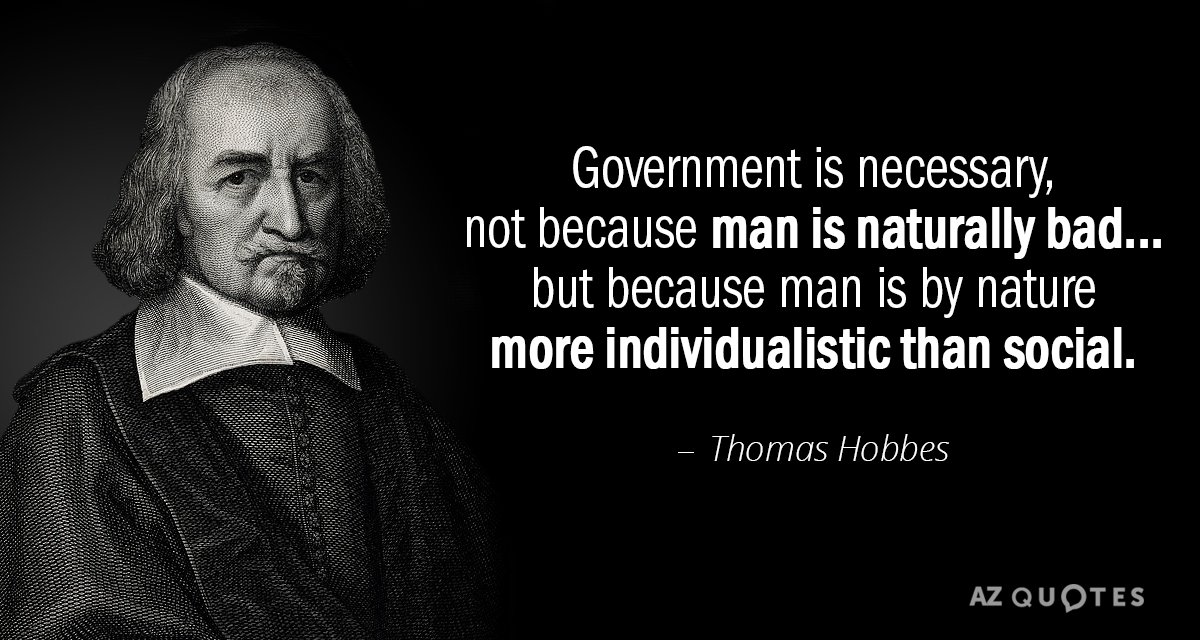
Thomas Hobbes
b. 5 April 1588
d. 4 December 1679
Profit is the measure of rightness in the state of nature. Hobbes provided the basis for reason in capitalism as a prime aspect of natural law.
Profit
https://media.allauthor.com/images/quotes/img/thomas-hobbes-quote-in-the-state-of-nature-profit-is-the.jpg?fbclid=IwAR0_E6MlSBUtoAuddr0B0THf114MuUd_VhPMCIvdliIJxxp8UnNvpO-Owus
Human Nature
https://www.azquotes.com/vangogh-image-quotes/116/43/Quotation-Thomas-Hobbes-Government-is-necessary-not-because-man-is-naturally-bad-but-116-43-54.jpg
Thomas Hobbes was born at Westport on April 5, 1588. Westport is now part of Malmesbury in Wiltshire, England.
He was born prematurely when his mother heard of the coming invasion of the Spanish Armada. He reported that "my mother gave birth to twins: myself and fear.” His mother's name is unknown.
His father, Thomas Sr., was the vicar of Charlton and Westport. Thomas Jr. had a brother Edmund who was two years older and a sister.
Thomas Sr. was involved in a fight with the local clergy outside his church. He left London and abandoned the family. The family was left in the care of Thomas Sr.'s older brother, Francis, a wealthy merchant with no family.
Young Thomas was educated at Westport church from age four. He passed to the Malmesbury school. Then he went to a private school kept by a young man named Robert Latimer, a graduate of the University of Oxford.
He was a good pupil. He went up to Magdalen Hall around 1603. Magdalen Hall was the predecessor college to Hertford College, Oxford. The principal John Wilkinson was a Puritan. He had some influence on Hobbes.
He followed his own curriculum at the university. He was "little attracted by the scholastic learning." Aristotle, Plato, Aquinas and Calvin had a strong influence on republican and democratic political thought in scholasticism.
Calvin was trained as a lawyer prior to his study of theology. The style of is written work was comparable to that of Descartes. There was a strong investment in the expression of his personal view of things. His interpretation of the bible was directed by the goal to limit government to democracy and democracy to local councils.
Hobbes did not complete his B.A. degree until 1608. He was recommended by Sir James Hussey, his master at Magdalen, as tutor to William, the son of William Cavendish, Baron of Hardwick and later Earl of Devonshire. This began a lifelong connection with that family.
He became a companion to the younger William. They both took part in a grand tour of Europe in 1610. They were exposed to European scientific and critical methods during the tour. The experience was in contrast to the scholastic philosophy which he had learned in Oxford.
His scholarly efforts at the time were aimed at a careful study of classic Greek and Latin authors. He translated Thucydides' “History of the Peloponnesian War” in 1628. It was the first translation of that work into English from a Greek manuscript. Hobbes was developing his ability to reconstruct classical political theory in monotheistic framework for expression. He wanted to present the justification for monarchy in biblical terms.
He associated with literary figures like Ben Jonson. He briefly worked as Francis Bacon's amanuensis. He did not extend his efforts into philosophy until after 1629. His employer Cavendish, then the Earl of Devonshire, had died of the plague in June 1628.
He championed absolutism for the sovereign, but he also developed some of the fundamentals for European constitutional expression. The right of the individual; the natural equality of all men; the artificial character of the political order; the view that all legitimate political power must be "representative" and based on the consent of the people; and an interpretation for liberty in the law which leaves people free to do whatever the law does not explicitly forbid were concepts he developed in relation to the absolute.
He was one of the founders of modern political science. He saw humans as being matter and motion that obey the same physical laws as other matter and motion. Human nature is self-interested cooperation. Political communities are based upon a "social contract." The contract remains one of the major topics of political philosophy.
Hobbes set out his doctrine of the foundation of states and legitimate governments to create an objective science of morality in “Leviathan.” This gave rise to social contract theory. “Leviathan” was written during the English Civil War.
Much of the book is occupied with demonstrating the necessity of a strong central authority to avoid the evil of discord and civil war. It was a development of the concepts expressed in the books of Ezekiel and Jonah. The books had only been translated into English with the King James Bible in 1611.
He postulated what life would be like without government beginning from a mechanistic understanding of human beings and the passions. He called the condition the state of nature. Each person would have a right, or license, to everything in the world in that state.
This would lead to a "war of all against all" (bellum omnium contra omnes). The description contains what has been called one of the best known passages in English philosophy. It describes how humankind would be were it not for political community.
He set the terms for the debate about the fundamentals of political life. He presented argument for the thesis that had been adopted by King James I and his son King Charles I. They believed in the divine right of kings.
Charles thought he could govern according to his own conscience. Many of his subjects opposed his policies. His actions were perceived as those of a tyrannical monarch because he was not anti-catholic.
His religious policies, coupled with his marriage to a Roman Catholic, generated the antipathy and mistrust of reformed groups such as the Puritans and Calvinists. They thought his views were too Catholic. Belief that the absolute power of monarchy was the cause of corruption in government was a primary reason for the English Civil War.
The presentation of the cause as the solution was not popular, but it preserved the monarchy for constitutional expression. Human authority is something that requires justification. If the divine right of kings to rule was the justification for monarchy, Hobbes presented the rights of man as the primary concern for society.
We live in a world where all human beings are supposed to have rights, that is, moral claims that protect basic interests. What or who determines what those rights are? Who will enforce them? Who exercises the most important political powers when the basic assumption is that we all share the same entitlements?
Hobbes sought to discover rational principles for the construction of a civil polity that would not be subject to destruction from within. Having lived through the period of political disintegration culminating in the English Civil War, he came to the view that the burdens of even the most oppressive government are “scarce sensible, in respect of the miseries, and horrible calamities, that accompany a Civill Warre”.
All but absolute governments are systematically prone to dissolution. People ought to submit themselves to an absolute political authority. Continued stability will require that they also refrain from the sorts of actions that might undermine the common law that supports human rights as part of that which was sanctioned by the divine.
Subjects should not engage in armed rebellion against the sovereign power for example. Under no circumstances should they overthrow common law to achieve political objectives. Aversion to rebellion is the key element in his thesis. He aimed to demonstrate the reciprocal relationship between political obedience and peace.
The social contract is the absolute sovereign. Progress towards justice in society does not take place without political accord, but the congress has to be for people without discrimination. A cynical view of history places democracy in front of dictatorship by tyranny.
This presumes the corruption of human nature. Tyranny and dictatorship are not democracy though. The claims that need to be evaluated with skepticism to a cynical degree are those which posit war, any war, as necessary.
John Locke wrote after Hobbes. He had accepted the terms of debate, but he was opposed to the association of absolute power with monarchy. He insisted in his Second Treatise of Government that the state of nature was indeed to be preferred to subjection to the arbitrary power of an absolute sovereign.
Hobbes had argued that such a “dissolute condition of masterlesse men, without subjection to Lawes, and a coercive Power to tye their hands from rapine, and revenge” would make impossible all of the basic security upon which comfortable, sociable, civilized life depends. His state of nature assumed the corruption of humanity, not paradise.
There would be “no place for industry, because the fruit thereof is uncertain; and consequently no culture of the earth; no navigation, nor use of the commodities that may be imported by Sea; no commodious Building; no Instruments of moving and removing such things as require much force; no Knowledge of the face of the Earth; no account of Time; no Arts; no Letters; and which is worst of all, continuall feare, and danger of violent death…”
If this is the state of nature, people have strong reason to avoid it. He argued that this can be done only by submitting to some mutually recognized public authority, for “so long a man is in the condition of mere nature, (which is a condition of war,) as private appetite is the measure of good and evill.”
Education in science and the arts has been cultivated by the aristocracy of monarchy, but it is wrong to infer from this that the destructiveness of the elements and war were necessary to establish this paradise in society.
It was defense against the destructiveness of violent aggression and cruelty in punishment that made the quality of life within the social constructs of organization for order natural. This cultivated state of nature however should be accessible to all, not just state officials. It is destructiveness that makes “the life of man, solitary, poore, nasty, brutish, and short.”
Thomas Hobbes
托马斯霍布斯
托馬斯霍布斯
托 Tuo support 托 taku entrust To と- ト- To 토 sat
马 ma horse 馬 ba horse ma ま マ ma 마 hemp
斯 si this 斯 shi this su す ス seu 스 switch
霍 Huo quickly 霍 kaku quick Hou ほっ ホッ Hob 홉 hop
布 bu to announce 布 fu linen bu ぶ ブ seu 스 switch
斯 si this 斯 shi this zu ず ズ
---------------------------------
Common law is the standard for the state.
Support for defense is the deterrent to hate.
=========================
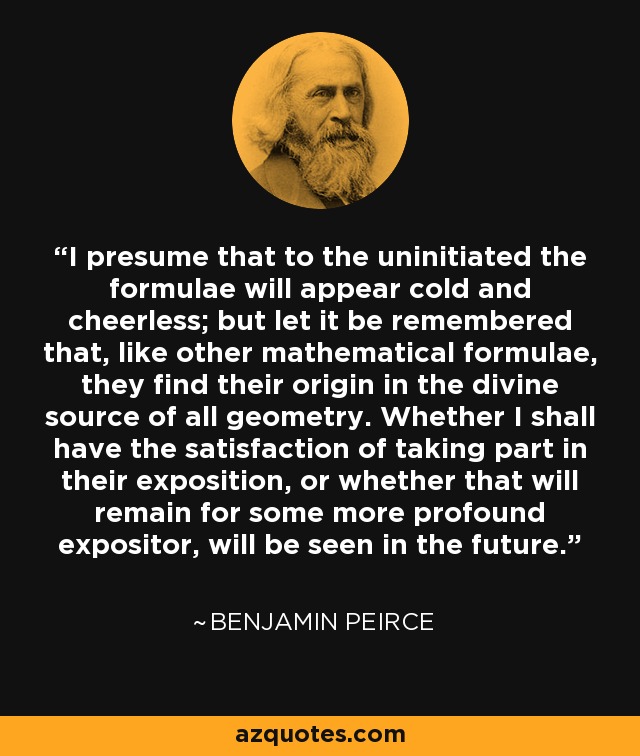
Abstraction is a tool for thought. https://www.azquotes.com/public/picture_quotes/8b/3f/8b3f4ceaf942736ee2ed92247fc2ba25/benjamin-peirce-1116847.jpg
Benjamin Peirce
b. April 4, 1809, Salem, Massachusetts
d. October 6, 1880, Cambridge, MA
Salem
The city of Salem is located in the northeastern portion of Massachusetts on the shores of Massachusetts Bay. It lies approximately 18 miles northeast of Boston. The present area is 8.18 square miles. The eastern boundary is Salem Harbor.
Salem is located at the mouth of the Naumkeag River at the site of an Indian village and trading center. European colonists first settled it in 1626.
A company of fishermen arrived from Cape Ann led by Roger Conant. Conant's leadership provided the stability to survive the first two years, but John Endecott replaced him by order of the Massachusetts Bay Company.
Conant graciously stepped aside and was granted 200 acres (0.81 km2) of land in compensation. These "New Planters" and the "Old Planters" agreed to cooperate in large part due to the diplomacy of Conant and Endecott.
The name of the settlement was changed to Salem in recognition of this peaceful transition to the new government. The name is a hellenized form of the Hebrew word for "peace" (שלום, shalom).
Endecott ordered that the Great House be moved from Cape Ann in 1628. The Great House was the residence for the governor. It was remarkable that the structure had two stories.
The Massachusetts Bay Charter was issued a year later. The charter created the Massachusetts Bay Colony. Matthew Craddock was its governor in London. Endecott was the governor in the colony. John Winthrop was elected Governor in late 1629. He arrived with the Winthrop Fleet in 1630. This was one of the many events that began the Puritan Great Migration.
The term Great Migration usually refers to the migration in this period of English Puritans to Massachusetts and the West Indies, especially Barbados. The movement was marked in its effects in the two decades from 1620 to 1640.
King James I of England made some efforts to reconcile the Puritan clergy. They had been alienated by the lack of change in the Church of England.
Puritans embraced Calvinism (Reformed theology). The reform held opposition to ritual. There was an emphasis on preaching, a growing sabbatarianism and preference for a presbyterian system of church polity. They were opposed to the episcopal polity of the Church of England which had also preserved medieval canon law with some modification. They opposed church practices that resembled Roman Catholic ritual.
This religious conflict worsened after Charles I became king in 1625. Parliament increasingly opposed his authority. Charles dissolved Parliament in 1629. Many Puritans decided to leave the country due to the lack of promise for reform. Some of the migration was also from English expatriate communities of non-conformists and Separatists who had set up churches in the Netherlands since the 1590's.
The Winthrop Fleet of 1630 included 11 ships led by the flagship Arbella. It delivered about 700 passengers to the Massachusetts Bay Colony. Migration continued until Parliament was reconvened in 1640.
Endecott was one of the signers on the building contract for enlarging the meeting house in Town House Square for the first church in Salem in 1639. This document remains part of the town records at City Hall. He was active in the affairs of the town throughout his life. Samuel Skelton was the first pastor of the First Church of Salem. This was the original Puritan church in America.
The infamous witch trials were conducted in 1692. Abigail Williams, Betty Parris and their friends were caught playing with a Venus glass (mirror) and egg. The trials began in 1692. The record states that 20 people were executed as a result of the accusations of witchcraft.
Salem had become the sixth largest city in the country by 1790. It was a world-famous seaport particularly in the China Trade. Codfish was exported to Europe and the West Indies. Sugar and molasses was imported from the West Indies and tea from China. Products are depicted on the city seal from the East Indies. Sumatran pepper is prominent. Salem ships visited Africa with a special interest in Zanzibar, Russia, Japan and Australia.
The neutrality of the United States was tested during the Napoleonic Wars (1803-1815). President Thomas Jefferson was faced with a decision to make regarding the situation after the Chesapeake–Leopard affair.
This was a naval engagement that occurred off the coast of Norfolk, Virginia on June 22, 1807. The conflict was between the British warship HMS Leopard and the American frigate USS Chesapeake.
Jefferson chose to impose an economic option. The Embargo Act of 1807 essentially closed all the ports overnight. This put a damper on the seaport town of Salem. The embargo of 1807 was the starting point on the path to the War of 1812 with Great Britain.
Both Great Britain and France imposed trade restrictions in order to weaken each other's economies. This also had the effect of disrupting American trade.
The disruption of trade tested neutrality. The harassment of American ships by the British Navy increased as time passed. This included impressment and seizures of American men and goods
Benjamin Peirce
Benjamin was born in Salem on 4 April 1809. He was named after his father. His father would be appointed as the librarian for Harvard.
He remained as a tutor after graduating from Harvard University in 1829. He was subsequently appointed professor of mathematics in 1831. He added astronomy to his portfolio in 1842. He remained as Harvard professor until his death.
He was devoutly religious, though he seldom published his theological thoughts. He credited God as shaping nature in ways that account for the efficacy of pure mathematics in describing empirical phenomena.
He was instrumental in the development of Harvard's science curriculum. He served as the college librarian. He was director of the U.S. Coast Survey from 1867 to 1874. He was elected a Foreign Member of the Royal Society of London in 1852.
He was an apologist for slavery. He stated that it should be condoned if it was used to allow an elite to pursue scientific inquiry. This was not a historically unique position among Puritans, but it was unusual for a citizen of Massachusetts at the time. The state had effectively abolished the institution on July 8, 1783 with the ruling by the Massachusetts Supreme Court in the Commonwealth v. Jennison case.
Peirce was an American mathematician. He taught at Harvard University for approximately 50 years. He made contributions to celestial mechanics, statistics, number theory, algebra and the philosophy of mathematics.
He is often regarded as the earliest American scientist whose research was recognized as world class.
He proved there is no odd perfect number with fewer than four prime factors in number theory.
He was notable for the study of associative algebras. He first introduced the terms idempotent and nilpotent in 1870 to describe elements of these algebras. He also introduced the Peirce decomposition.
He became known for the statement that "Mathematics is the science that draws necessary conclusions". Peirce's definition of mathematics was credited by his son, Charles Sanders Peirce, as helping to initiate the consequence-oriented philosophy of pragmatism.
Peirce was like George Boole insofar as he believed that mathematics could be used to study logic. These ideas were further developed by his son Charles. He noted that logic also includes the study of faulty reasoning. The later logicist program of Gottlob Frege and Bertrand Russell attempted to base mathematics on logic in contrast.
Peirce proposed what came to be known as Peirce's Criterion for the statistical treatment of outliers. Outliers are data points that lie outside proximity to the central measure. His ideas were further developed by his son Charles.
He died on 6 October 1880 in Cambridge, Massachusetts.
Benjamin Peirce
本杰明皮尔斯
本傑明皮爾斯
本 Ben source 本 hon book Ben べん ベン Ben 벤 Ben
杰 jie heroic 傑 ketsu greatness ja じゃ ジャ ja 자 character
明 ming clear 明 mei bright min みん ミン min 민 min
皮 Pi skin 皮 hi pelt Pa ぱ- パ- Pi 피 blood
尔 er you 爾 ji you su す ス eo 어 uh
斯 si this 斯 shi this seu 스 switch
---------------------------------
Science is like the skin to math.
Math is the measure of the logical path.
=========================
Power
Love
Your
Enemy
爱你的敌人
Ài nǐ de dírén
あなたの敵を愛しなさい
Anata no teki o aishi nasai
I will remember the lesson taught by experience.
The remembrance of wonder will deliver me from weariness.
The distance for the journey extended beyond the street.
Time for rest at the end of the trip invited reflection as a treat.
Making general ideas absolute is an error.
The degree of the mistake can lead to terror.
Science is like the skin to math.
Math is the measure for the logical path.
I will meditate on your acts
to ponder wealth in the truth of facts.
Your way is sanctified with benefit
when agreement is not defined as degenerate.
It is difficult to love your enemy,
but reason finds the best remedy.
Who is so great as our God?
Wonder lines the path on which we trod.
You have declared your power
as redemption from that which made crisis flower.
We are the children for preservation in competition.
God fathered our deliberation on mission.
The water saw divine work in wind.
The waves were raised as akin to chagrin.
The depths were moved
to the aquatic tune.
The clouds shed massive waves of particle plunder
as the heat clashed charge flash lit the darkness before the thunder.
The staggered path of dancing light
announced the presence of the static to sight.
The sound of your power was in the whirlwind.
Your lightning flashed remembrance of what made life begin.
The earth trembled and shook
until a path through the sea of reeds opened like a book.
You made a way through the water
for each beloved son and daughter.
Your footsteps were not seen
yet your presence was felt as serene
despite the tumult of the scene.
The people were drawn along the way
by the exaltation of passage through the fray.
The LORD delivered you from bondage to ignorance.
The transcendence of strife saved you from belligerence.
Pinellas Park City Hall and Vol. Fire Department 1959
Common law is the standard for the state.
Support for defense is the deterrent to hate.
-----------------------------
Psalm 77:11+
11 I will remember the works of the Lord,
and call to mind your wonders of old time.
12 I will meditate on all your acts
and ponder your mighty deeds.
13 Your way, O God, is holy;
who is so great a god as our God?
14 You are the God who works wonders
and have declared your power among the peoples.
15 By your strength you have redeemed your people,
the children of Jacob and Joseph.
16 The waters saw you, O God;
the waters saw you and trembled;
the very depths were shaken.
17 The clouds poured out water;
the skies thundered;
your arrows flashed to and fro;
18 The sound of your thunder was in the whirlwind;
your lightnings lit up the world;
the earth trembled and shook.
19 Your way was in the sea,
and your paths in the great waters,
yet your footsteps were not seen.
20 You led your people like a flock
by the hand of Moses and Aaron.
------------------------------
Exo. 3:12
The LORD said, Certainly I will be with you. This will be a token for you that I have sent you. When you have brought the people out of Egypt, you will serve God upon this mountain.
---------------------------------
The LORD delivered you from bondage to ignorance.
The transcendence of strife will deliver you from belligerence.
=========================
Luke 6:27-28
I say to you who listen: Love your enemies. Do good to those who hate you. Bless those who curse you. Pray for those who use you.
---------------------------------
It is difficult to love your enemy,
but reason finds the best remedy.
=========================
Berkeley objected to some of the abstractions that were used by Locke in his Essay on Human Understanding. The objection extended to the Two Treatises on Civil Government as well.
Locke had objected to the use of the word absolute by Hobbes in the defense of monarchy in kingdom or executive authority in republic. Absolute power in the monarch was posited as the cause of corruption in government.
It seemed that while Locke objected to the use of the 'absolute' to reduce the administration of executive leadership to one, he abstracted general ideas into absolute entities to justify his claim to parliamentarian authority.
When words like human, civil and government were limited to one particular meaning in each case in order lay claim to universal authority, a play on words was being used to take authority from the central figure in order to ascribe it to another body, whether it was parliament or the people.
Reason was thereby subordinated to passion, because prejudice didn't take as much thought. It would be an error to assert that Hume's natural history had no value when it was replaced by the theory of evolution as a support for excessive aggression, but the passion for history was flawed by Hume's 'natural' bent.
The scientific study of history would be a step closer than that which had been advanced by Hume, but reason has an administrative function in the evaluation of history. Philosophy has to have a place for judgment regarding the value of knowledge.
Berkeley sought to eliminate agreement with that which was wrong with Locke's philosophy. He did not condemn the philosophy altogether. The reason wasn't as cognitive as Descartes rationalism. It recognized the importance of perception in empirical experience. Reason for government had to be expressible in simple terms for public perspective.
There were distinct elements in Locke's definition of human understanding that threatened abuse. It seemed plausible that something as ridiculous as the knowledge of the definition of a triangle in the English language could be used as a test to determine whether a tribe was bent on the destruction of the representative of a government official.
The tribal condition itself was seen as too primitive to be regarded as civil. If the tribal membership wasn't willing to agree to work as slaves, they could be shackled to work as forced labor or killed. Locke had made the right to destroy an absolute abstraction for his authority.
The conditions for understanding had to be guided by the principles for knowledge. The principles had to be organized in a way so the public would be able to learn about rights with respect for participation in government. Berkeley's empiricism left room for public education. Locke's was deceptive. He was taking power from monarchy for himself as though he were doing it for the people.
The right to bear arms had been used to incite civil war by the Puritans with the Presbyterians, but Hobbes had defined defense from attack as the reasonable self-limitation for the authority of that right.
Berkeley took pains to argue that a triangle cannot be defined as a general abstraction in order to discourage the use of it as a universal. It is standard to define a triangle as a closed figure with three sides. The definition is general in the sense that the size of the lines and angles can vary. One size and shape of a single triangle does not define the particulars of all other triangles.
He was concerned with Locke's agreement with Aristotle. Aristotle had argued that slavery was a reasonable institution.
George Berkeley
Principles of Human Knowledge
1710
"We have, I think, shown the impossibility of ABSTRACT IDEAS. We have considered what has been said for them by their ablest patrons; and endeavored to show they are of no use for those ends to which they are thought necessary. And lastly, we have traced them to the source from whence they flow, which appears evidently to be language."
---------------------------------
Making general ideas absolute is an error.
The degree of the mistake can lead to terror.
=========================
Hellfire
Dr. Martin Luther King Jr. organized the movement to protest unfair treatment for minorities in a "democratic" society. This movement inspired the Civil and Voting Rights legislation in the 60's. He was was an American Baptist minister and activist who became the most visible spokesperson and leader in the civil rights movement from 1954 until his assassination in 1968.
Martin Luther King Jr.
b. Atlanta, Georgia, January 15, 1929
d. Memphis, Tennessee, April 4, 1968
Atlanta
Atlanta is situated in the foothills of the Appalachian Mountains. It has one of the highest elevations for any city east of the Mississippi River. It straddles the Eastern Continental Divide.
Rainwater that falls on the south and east side of the divide flows down to the Atlantic Ocean. Rain that falls on the north and west side flows into the Gulf of Mexico.
The city was built on a ridge that sits south of the Chattahoochee River. Much of the river's natural habitat is preserved in the national recreation area.
The settlement was established as the terminating stop for a major state-sponsored railroad. It became the convergence point between multiple railroads with expansion.
The name Atlanta was taken from the Western and Atlantic Railroad's local depot. The line connected the city to the Midwest in 1851. It signified the town's desire to grow as a transportation hub.
The city was set on fire by Union forces on November 15, 1864 in General Sherman's March to the Sea. Slaves were freed with the end of the Civil War in 1865.
Atlanta University, the first black college for the city, was founded in the same year. Atlanta was made the capital for Georgia in 1868.
The Atlanta Historical Society was founded in 1926. The Atlanta Historical Bulletin began publication in 1927. The Atlanta World newspaper was started in 1928.
Martin Luther King Jr.
He was born as the second child to Michael King Sr., a pastor, and Alberta Williams, a former school teacher, in Atlanta, Georgia on January 15, 1929. Both parents were African-American. He also had Irish ancestry through his paternal great-grandfather.
Michael Jr. grew up with his older sister, Christine, and younger brother, Alfred, in the city’s Sweet Auburn neighborhood. The elder Michael went through the legal process to have his name changed to Martin Luther Sr. and his son's to Martin Luther Jr in 1934.
The senior King was inspired during a trip to Germany for that year's meeting of the Baptist World Alliance (BWA). The rise of Nazism was a concern that was addressed to attendees while visiting sites associated with reformation leader.
The BWA conference issued a resolution condemning anti-Semitism. The senior King gained deepened appreciation for the power of Luther's protest. He had the name for his son changed on his birth certificate.
King was initially skeptical of many of Christianity's claims. He denied the bodily resurrection of Jesus during Sunday school at the age of 13. Doubt began to spring forth from that time. He later concluded that the Bible has "many profound truths which one cannot escape."
King attended Booker T. Washington High School. He became known for his public-speaking ability and was part of the school's debate team. Morehouse College, a respected historically black college, announced that it would accept any high school juniors who could pass its entrance exam during his junior year in high school.
Many students had abandoned further studies to enlist in World War II. Morehouse was eager to fill its classrooms. King passed the exam and entered at the age of 15. He graduated with a BA in sociology in 1948 at the age of 19. He enrolled in Crozer Theological Seminary in Chester, Pennsylvania. He graduated with a B.Div degree in 1951.
King married Coretta Scott in her hometown of Heiberger, Alabama on June 18, 1953. They had four children. They were named Yolanda (1955-2007), Martin Luther III (1957), Dexter Scott (1961) and Bernice (1963).
He became the pastor of the Dexter Avenue Baptist Church in Montgomery, Alabama at the age of 25 in 1954. He received his Ph.D. in systematic theology at Boston University on June 5, 1955.
King, Ralph Abernathy, Fred Shuttlesworth, Joseph Lowery and other civil rights activists founded the Southern Christian Leadership Conference (SCLC). The group was created for the moral authority and organizing power of black churches to conduct nonviolent protests in the service of civil rights reform.
The group was inspired by the crusades of Billy Graham. The evangelist had befriended King after he attended a 1957 Graham crusade in New York City.
Attorney General Robert F. Kennedy was concerned that public allegations of communists in the SCLC would derail the administration's civil rights initiatives. He warned King to discontinue these associations. He felt compelled to issue the written directive that authorized the FBI to wiretap King and other SCLC leaders later.
King believed that organized, nonviolent protest against Jim Crow laws would lead to extensive media coverage of the struggle for black equality and voting rights. He led marches for blacks' right to vote, desegregation, labor rights and other basic civil rights.
Most of these rights were successfully enacted into the law of the United States with the passage of the Civil Rights Act of 1964 and the 1965 Voting Rights Act.
King and the SCLC put into practice many of the principles of the Christian Left. They applied the tactics of nonviolent protest by strategically choosing the method of protest and the places in which protests were carried out.
There were dramatic stand-offs with authorities which sometimes turned violent. The SCLC began a campaign against racial segregation and economic injustice in Birmingham, Alabama. The campaign started to use intentionally confrontational tactics in April 1963.
Protesters occupied public spaces with marches and sit-ins. openly violating laws that they considered unjust. King's intent was to provoke mass arrests. He wanted to create a crisis situation in public perception to open the door to negotiation.
He was arrested and jailed early in the campaign. It was his 13th arrest out of 29. He wrote his Letter from Birmingham Jail. It called for greater participation in the movement to pursue legal channels for social change.
He argued that the Boston Tea Party was a celebrated act of rebellion in the American colonies. It was illegal civil disobedience. Everything that Adolf Hitler did in Germany was conversely considered legal.
He expressed his frustration with white moderates and clergymen too timid to oppose an unjust system. This was a tactic that emulated what Karl Marx had done to the Middle Class. The effort was to blame the middle for lacking sufficient concern for the cause of 'justice.'
King was among the leaders of the "Big Six" civil rights organizations who were instrumental in the organization of the March on Washington for Jobs and Freedom which took place on August 28, 1963.
Bayard Rustin was the primary logistical and strategic organizer for the March. His open homosexuality, support for democratic socialism and his former ties to the Communist Party USA caused many white and African-American leaders to demand King distance himself from Rustin. King agreed to distance himself, but participated in the march.
John F. Kennedy initially expressed opposition to the march. He was concerned it would negatively impact the drive for passage of civil rights legislation. The Kennedys decided it was important to work to ensure the success of the protest with the march going forward.
President Kennedy was concerned the turnout would be less than 100,000. He enlisted the aid of additional church leaders and Walter Reuther, president of the United Automobile Workers, to help mobilize demonstrators for the cause.
The protest made specific demands to end racial segregation in public schools; enact meaningful civil rights legislation including a law prohibiting racial discrimination in employment; protect civil rights workers from police brutality; Increase the minimum wage for all workers; and institute self-government for Washington, D.C., then governed by congressional committee.
King delivered the "I Have a Dream" speech at the event.
He delivered the inaugural speech of a lecture series called the American Race Crisis at the New School for Social Research in NYC on February 6, 1964. A recording was recently discovered where he compared the condition of African Americans with the untouchables of India in a conversation with Jawaharal Nehru.
King and the SCLC joined forces with Robert Hayling's then-controversial movement in St. Augustine, Florida in March 1964. Hayling's group was controversial because it advocated that non-violent protesters should be armed for self-defense.
This presented a difficulty due to the aggressive confrontational tactics employed by the protesters for publicity. The potential for violent confrontation was significantly increased.
The associations with socialism and communism justified southern concerns about armed rebellion. J. Edgar Hoover's law enforcement concerns were not motivated by racism.
The movement marched nightly through St. Augustine in June 1964. Many marchers were arrested and jailed. The Civil Rights Act of 1964 was passed during the course of the event. There was a strong implication of collusion by the liberal element in national government to enact the legislation.
King's involvement with civil rights protests was raising security concerns in the South by the time he organized the march to Montgomery, Alabama in March 1965. The violence that resulted was described as motivated by racism in the national media.
Stories about Jim Crow laws were broadcast to suggest an imposed culture of racist segregation. The stories implied that non-violent marchers could not be held accountable for the violence by state police.
King and other civil rights activists organized the Chicago Freedom Movement in 1966. King and Ralph Abernathy had been raised in the middle class. They moved into the slums of North Lawndale on Chicago's West Side as an educational experience to demonstrate their support for the poor.
A number of large marches were planned and executed. King later stated that the movement received a worse reception in Chicago than in the South. Bottles were thrown at protesters. All the screams were not for the movement. The threat of a riot breaking out was plausible.
King went to New York in April 1967. He appeared at the New York City Riverside Church on April 4th. He spoke out strongly against US involvement in the war. He argued that Vietnam had been occupied as an American colony.
He argued that the country needed serious moral change due to the economic injustice imposed by the government as the greatest purveyor of violence in the world. He had been inspired by the outspokenness of Muhammad Ali.
His rhetoric became more economic and less racial in protest. His opposition cost him significant support among white allies including President Johnson, Billy Graham, union leaders and powerful publishers.
J. Edgar Hoover lost moral authenticity as he put his opposition to communism into support for the occupation of a country on the border with China. It was a liberal position insofar as it required expenditure to support precipitation as far from the nation's boundaries as possible. The opportunity to unite the anti-war with the civil rights movements was used to pressure King into increasing his anti-war activities.
King and the SCLC organized the "Poor People's Campaign" to address issues of economic justice in 1968. He traveled the country to assemble "a multiracial army of the poor" that would march on Washington to engage in nonviolent civil disobedience at the Capitol until Congress created an "economic bill of rights" for poor Americans.
While his rhetoric had become more economic, his politics had become more socialist. There was a strong opposition between the socialism of one kind and the other. The opposition wasn't as violent as the Spanish Civil War had been, but the ideas were still being pressed into a false dichotomy.
The Poor People's Campaign was controversial even within the civil rights movement. One leader stated that the goals of the campaign were too broad. the demands were unrealizable. He thought that these campaigns would accelerate the backlash and repression on the poor and the black.
King went to Memphis, Tennessee, in support of the black sanitary public works employees on March 29, 1968. The workers had been on strike since March 12 for higher wages and better treatment.
He led what had been a peaceful downtown march in support of the sanitation workers until bands of teenagers began smashing random store windows. Memphis police attacked some of the teens and also activists with nightsticks. The activists lost control of the demonstration, called it off and rushed King to an automobile for his own safety.
He was booked in Room 306 at the Lorraine Motel. He was fatally shot by James Earl Ray at 6:01 pm, April 4, 1968. He died at St. Joseph's Hospital at 7:05 p.m after emergency chest surgery.
He is remembered for advancing civil rights through non-violence and civil disobedience. He believed that the tactics inspired by Mahatma Ghandi were consistent with his Christian beliefs.
-------------------------
Voting and civil rights are the major means by which political change can be affected non-violently.
J.S. Mill wrote about the tyranny of the majority vs. the minority in his work On Liberty in 1859.
Many won't admit to a tyranny of the minority. When law enforcement is looking for offense against the smaller group, do they allow for offense against the larger?
What if officials are looking for offense against the membership of the smaller group as opposed to the larger? If they only look for offense against one or the other, a latent statistical trend is formed.
This trend was overextended with the theory of justice presented by John Rawls. It was always the majority that was in error according to his theory. It was not even feasible that a minority could be found guilty of prejudice.
A minority was not capable of the institutional form. This position ignores the potential for a majority of minorities to institute prejudice against the majority. It also denies the possibility that a liberal minority can control government decisions for their benefit to the detriment of the constituency.
When the majority is taxed to pay 'restitution' for the damage incurred by the liberal element of Congress, prejudice has been instituted in a major way. This is the institution that Rawls theory has established with the policy for liberal expenditure.
The liberal element has created problems under the pretense of representation for some faction or group of factions in the general population. Labor, the middle and upper classes have been taxed for 'reparation.'
The liberal element has claimed the power to perpetuate more of the same at the expense of the people. The claim of prejudice by the majority has been used to place the minority over the majority in authority. The tyranny of the minority can be used to institute prejudice.
Martin Luther King
马丁路德金
馬丁路德金
马 Ma horse 馬 ba horse Ma ま- マ- Ma 마 hemp
丁 ding fourth 丁 chin street tin てぃん ティン tin 틴 tin
路 Lu journey 路 ru distance Ru る- ル- Lu 루 sack
德 de morality 德 toku ethics sa さ- サ- teo 터 foundation
金 Jin king 金 kin gold Kin きん キン King 킹 king
gu ぐ グ
---------------------------------
The distance for the journey extended beyond the street.
Time for rest at the end of the trip invited reflection as a treat.
=========================
Wikipedia Martin Luther King Jr.
==========================
Thomas Hobbes
b. 5 April 1588
d. 4 December 1679
Profit is the measure of rightness in the state of nature. Hobbes provided the basis for reason in capitalism as a prime aspect of natural law.
Profit
https://media.allauthor.com/images/quotes/img/thomas-hobbes-quote-in-the-state-of-nature-profit-is-the.jpg?fbclid=IwAR0_E6MlSBUtoAuddr0B0THf114MuUd_VhPMCIvdliIJxxp8UnNvpO-Owus
Human Nature
https://www.azquotes.com/vangogh-image-quotes/116/43/Quotation-Thomas-Hobbes-Government-is-necessary-not-because-man-is-naturally-bad-but-116-43-54.jpg
Thomas Hobbes was born at Westport on April 5, 1588. Westport is now part of Malmesbury in Wiltshire, England.
He was born prematurely when his mother heard of the coming invasion of the Spanish Armada. He reported that "my mother gave birth to twins: myself and fear.” His mother's name is unknown.
His father, Thomas Sr., was the vicar of Charlton and Westport. Thomas Jr. had a brother Edmund who was two years older and a sister.
Thomas Sr. was involved in a fight with the local clergy outside his church. He left London and abandoned the family. The family was left in the care of Thomas Sr.'s older brother, Francis, a wealthy merchant with no family.
Young Thomas was educated at Westport church from age four. He passed to the Malmesbury school. Then he went to a private school kept by a young man named Robert Latimer, a graduate of the University of Oxford.
He was a good pupil. He went up to Magdalen Hall around 1603. Magdalen Hall was the predecessor college to Hertford College, Oxford. The principal John Wilkinson was a Puritan. He had some influence on Hobbes.
He followed his own curriculum at the university. He was "little attracted by the scholastic learning." Aristotle, Plato, Aquinas and Calvin had a strong influence on republican and democratic political thought in scholasticism.
Calvin was trained as a lawyer prior to his study of theology. The style of is written work was comparable to that of Descartes. There was a strong investment in the expression of his personal view of things. His interpretation of the bible was directed by the goal to limit government to democracy and democracy to local councils.
Hobbes did not complete his B.A. degree until 1608. He was recommended by Sir James Hussey, his master at Magdalen, as tutor to William, the son of William Cavendish, Baron of Hardwick and later Earl of Devonshire. This began a lifelong connection with that family.
He became a companion to the younger William. They both took part in a grand tour of Europe in 1610. They were exposed to European scientific and critical methods during the tour. The experience was in contrast to the scholastic philosophy which he had learned in Oxford.
His scholarly efforts at the time were aimed at a careful study of classic Greek and Latin authors. He translated Thucydides' “History of the Peloponnesian War” in 1628. It was the first translation of that work into English from a Greek manuscript. Hobbes was developing his ability to reconstruct classical political theory in monotheistic framework for expression. He wanted to present the justification for monarchy in biblical terms.
He associated with literary figures like Ben Jonson. He briefly worked as Francis Bacon's amanuensis. He did not extend his efforts into philosophy until after 1629. His employer Cavendish, then the Earl of Devonshire, had died of the plague in June 1628.
He championed absolutism for the sovereign, but he also developed some of the fundamentals for European constitutional expression. The right of the individual; the natural equality of all men; the artificial character of the political order; the view that all legitimate political power must be "representative" and based on the consent of the people; and an interpretation for liberty in the law which leaves people free to do whatever the law does not explicitly forbid were concepts he developed in relation to the absolute.
He was one of the founders of modern political science. He saw humans as being matter and motion that obey the same physical laws as other matter and motion. Human nature is self-interested cooperation. Political communities are based upon a "social contract." The contract remains one of the major topics of political philosophy.
Hobbes set out his doctrine of the foundation of states and legitimate governments to create an objective science of morality in “Leviathan.” This gave rise to social contract theory. “Leviathan” was written during the English Civil War.
Much of the book is occupied with demonstrating the necessity of a strong central authority to avoid the evil of discord and civil war. It was a development of the concepts expressed in the books of Ezekiel and Jonah. The books had only been translated into English with the King James Bible in 1611.
He postulated what life would be like without government beginning from a mechanistic understanding of human beings and the passions. He called the condition the state of nature. Each person would have a right, or license, to everything in the world in that state.
This would lead to a "war of all against all" (bellum omnium contra omnes). The description contains what has been called one of the best known passages in English philosophy. It describes how humankind would be were it not for political community.
He set the terms for the debate about the fundamentals of political life. He presented argument for the thesis that had been adopted by King James I and his son King Charles I. They believed in the divine right of kings.
Charles thought he could govern according to his own conscience. Many of his subjects opposed his policies. His actions were perceived as those of a tyrannical monarch because he was not anti-catholic.
His religious policies, coupled with his marriage to a Roman Catholic, generated the antipathy and mistrust of reformed groups such as the Puritans and Calvinists. They thought his views were too Catholic. Belief that the absolute power of monarchy was the cause of corruption in government was a primary reason for the English Civil War.
The presentation of the cause as the solution was not popular, but it preserved the monarchy for constitutional expression. Human authority is something that requires justification. If the divine right of kings to rule was the justification for monarchy, Hobbes presented the rights of man as the primary concern for society.
We live in a world where all human beings are supposed to have rights, that is, moral claims that protect basic interests. What or who determines what those rights are? Who will enforce them? Who exercises the most important political powers when the basic assumption is that we all share the same entitlements?
Hobbes sought to discover rational principles for the construction of a civil polity that would not be subject to destruction from within. Having lived through the period of political disintegration culminating in the English Civil War, he came to the view that the burdens of even the most oppressive government are “scarce sensible, in respect of the miseries, and horrible calamities, that accompany a Civill Warre”.
All but absolute governments are systematically prone to dissolution. People ought to submit themselves to an absolute political authority. Continued stability will require that they also refrain from the sorts of actions that might undermine the common law that supports human rights as part of that which was sanctioned by the divine.
Subjects should not engage in armed rebellion against the sovereign power for example. Under no circumstances should they overthrow common law to achieve political objectives. Aversion to rebellion is the key element in his thesis. He aimed to demonstrate the reciprocal relationship between political obedience and peace.
The social contract is the absolute sovereign. Progress towards justice in society does not take place without political accord, but the congress has to be for people without discrimination. A cynical view of history places democracy in front of dictatorship by tyranny.
This presumes the corruption of human nature. Tyranny and dictatorship are not democracy though. The claims that need to be evaluated with skepticism to a cynical degree are those which posit war, any war, as necessary.
John Locke wrote after Hobbes. He had accepted the terms of debate, but he was opposed to the association of absolute power with monarchy. He insisted in his Second Treatise of Government that the state of nature was indeed to be preferred to subjection to the arbitrary power of an absolute sovereign.
Hobbes had argued that such a “dissolute condition of masterlesse men, without subjection to Lawes, and a coercive Power to tye their hands from rapine, and revenge” would make impossible all of the basic security upon which comfortable, sociable, civilized life depends. His state of nature assumed the corruption of humanity, not paradise.
There would be “no place for industry, because the fruit thereof is uncertain; and consequently no culture of the earth; no navigation, nor use of the commodities that may be imported by Sea; no commodious Building; no Instruments of moving and removing such things as require much force; no Knowledge of the face of the Earth; no account of Time; no Arts; no Letters; and which is worst of all, continuall feare, and danger of violent death…”
If this is the state of nature, people have strong reason to avoid it. He argued that this can be done only by submitting to some mutually recognized public authority, for “so long a man is in the condition of mere nature, (which is a condition of war,) as private appetite is the measure of good and evill.”
Education in science and the arts has been cultivated by the aristocracy of monarchy, but it is wrong to infer from this that the destructiveness of the elements and war were necessary to establish this paradise in society.
It was defense against the destructiveness of violent aggression and cruelty in punishment that made the quality of life within the social constructs of organization for order natural. This cultivated state of nature however should be accessible to all, not just state officials. It is destructiveness that makes “the life of man, solitary, poore, nasty, brutish, and short.”
Thomas Hobbes
托马斯霍布斯
托馬斯霍布斯
托 Tuo support 托 taku entrust To と- ト- To 토 sat
马 ma horse 馬 ba horse ma ま マ ma 마 hemp
斯 si this 斯 shi this su す ス seu 스 switch
霍 Huo quickly 霍 kaku quick Hou ほっ ホッ Hob 홉 hop
布 bu to announce 布 fu linen bu ぶ ブ seu 스 switch
斯 si this 斯 shi this zu ず ズ
---------------------------------
Common law is the standard for the state.
Support for defense is the deterrent to hate.
=========================
Abstraction is a tool for thought. https://www.azquotes.com/public/picture_quotes/8b/3f/8b3f4ceaf942736ee2ed92247fc2ba25/benjamin-peirce-1116847.jpg
Benjamin Peirce
b. April 4, 1809, Salem, Massachusetts
d. October 6, 1880, Cambridge, MA
Salem
The city of Salem is located in the northeastern portion of Massachusetts on the shores of Massachusetts Bay. It lies approximately 18 miles northeast of Boston. The present area is 8.18 square miles. The eastern boundary is Salem Harbor.
Salem is located at the mouth of the Naumkeag River at the site of an Indian village and trading center. European colonists first settled it in 1626.
A company of fishermen arrived from Cape Ann led by Roger Conant. Conant's leadership provided the stability to survive the first two years, but John Endecott replaced him by order of the Massachusetts Bay Company.
Conant graciously stepped aside and was granted 200 acres (0.81 km2) of land in compensation. These "New Planters" and the "Old Planters" agreed to cooperate in large part due to the diplomacy of Conant and Endecott.
The name of the settlement was changed to Salem in recognition of this peaceful transition to the new government. The name is a hellenized form of the Hebrew word for "peace" (שלום, shalom).
Endecott ordered that the Great House be moved from Cape Ann in 1628. The Great House was the residence for the governor. It was remarkable that the structure had two stories.
The Massachusetts Bay Charter was issued a year later. The charter created the Massachusetts Bay Colony. Matthew Craddock was its governor in London. Endecott was the governor in the colony. John Winthrop was elected Governor in late 1629. He arrived with the Winthrop Fleet in 1630. This was one of the many events that began the Puritan Great Migration.
The term Great Migration usually refers to the migration in this period of English Puritans to Massachusetts and the West Indies, especially Barbados. The movement was marked in its effects in the two decades from 1620 to 1640.
King James I of England made some efforts to reconcile the Puritan clergy. They had been alienated by the lack of change in the Church of England.
Puritans embraced Calvinism (Reformed theology). The reform held opposition to ritual. There was an emphasis on preaching, a growing sabbatarianism and preference for a presbyterian system of church polity. They were opposed to the episcopal polity of the Church of England which had also preserved medieval canon law with some modification. They opposed church practices that resembled Roman Catholic ritual.
This religious conflict worsened after Charles I became king in 1625. Parliament increasingly opposed his authority. Charles dissolved Parliament in 1629. Many Puritans decided to leave the country due to the lack of promise for reform. Some of the migration was also from English expatriate communities of non-conformists and Separatists who had set up churches in the Netherlands since the 1590's.
The Winthrop Fleet of 1630 included 11 ships led by the flagship Arbella. It delivered about 700 passengers to the Massachusetts Bay Colony. Migration continued until Parliament was reconvened in 1640.
Endecott was one of the signers on the building contract for enlarging the meeting house in Town House Square for the first church in Salem in 1639. This document remains part of the town records at City Hall. He was active in the affairs of the town throughout his life. Samuel Skelton was the first pastor of the First Church of Salem. This was the original Puritan church in America.
The infamous witch trials were conducted in 1692. Abigail Williams, Betty Parris and their friends were caught playing with a Venus glass (mirror) and egg. The trials began in 1692. The record states that 20 people were executed as a result of the accusations of witchcraft.
Salem had become the sixth largest city in the country by 1790. It was a world-famous seaport particularly in the China Trade. Codfish was exported to Europe and the West Indies. Sugar and molasses was imported from the West Indies and tea from China. Products are depicted on the city seal from the East Indies. Sumatran pepper is prominent. Salem ships visited Africa with a special interest in Zanzibar, Russia, Japan and Australia.
The neutrality of the United States was tested during the Napoleonic Wars (1803-1815). President Thomas Jefferson was faced with a decision to make regarding the situation after the Chesapeake–Leopard affair.
This was a naval engagement that occurred off the coast of Norfolk, Virginia on June 22, 1807. The conflict was between the British warship HMS Leopard and the American frigate USS Chesapeake.
Jefferson chose to impose an economic option. The Embargo Act of 1807 essentially closed all the ports overnight. This put a damper on the seaport town of Salem. The embargo of 1807 was the starting point on the path to the War of 1812 with Great Britain.
Both Great Britain and France imposed trade restrictions in order to weaken each other's economies. This also had the effect of disrupting American trade.
The disruption of trade tested neutrality. The harassment of American ships by the British Navy increased as time passed. This included impressment and seizures of American men and goods
Benjamin Peirce
Benjamin was born in Salem on 4 April 1809. He was named after his father. His father would be appointed as the librarian for Harvard.
He would become the father to Charles Sanders Peirce, another Harvard mathematician.
He remained as a tutor after graduating from Harvard University in 1829. He was subsequently appointed professor of mathematics in 1831. He added astronomy to his portfolio in 1842. He remained as Harvard professor until his death.
He was devoutly religious, though he seldom published his theological thoughts. He credited God as shaping nature in ways that account for the efficacy of pure mathematics in describing empirical phenomena.
He was instrumental in the development of Harvard's science curriculum. He served as the college librarian. He was director of the U.S. Coast Survey from 1867 to 1874. He was elected a Foreign Member of the Royal Society of London in 1852.
He was an apologist for slavery. He stated that it should be condoned if it was used to allow an elite to pursue scientific inquiry. This was not a historically unique position among Puritans, but it was unusual for a citizen of Massachusetts at the time. The state had effectively abolished the institution on July 8, 1783 with the ruling by the Massachusetts Supreme Court in the Commonwealth v. Jennison case.
Peirce was an American mathematician. He taught at Harvard University for approximately 50 years. He made contributions to celestial mechanics, statistics, number theory, algebra and the philosophy of mathematics.
He is often regarded as the earliest American scientist whose research was recognized as world class.
He proved there is no odd perfect number with fewer than four prime factors in number theory.
He was notable for the study of associative algebras. He first introduced the terms idempotent and nilpotent in 1870 to describe elements of these algebras. He also introduced the Peirce decomposition.
He became known for the statement that "Mathematics is the science that draws necessary conclusions". Peirce's definition of mathematics was credited by his son, Charles Sanders Peirce, as helping to initiate the consequence-oriented philosophy of pragmatism.
Peirce was like George Boole insofar as he believed that mathematics could be used to study logic. These ideas were further developed by his son Charles. He noted that logic also includes the study of faulty reasoning. The later logicist program of Gottlob Frege and Bertrand Russell attempted to base mathematics on logic in contrast.
Peirce proposed what came to be known as Peirce's Criterion for the statistical treatment of outliers. Outliers are data points that lie outside proximity to the central measure. His ideas were further developed by his son Charles.
He died on 6 October 1880 in Cambridge, Massachusetts.
Benjamin Peirce
本杰明皮尔斯
本傑明皮爾斯
本 Ben source 本 hon book Ben べん ベン Ben 벤 Ben
杰 jie heroic 傑 ketsu greatness ja じゃ ジャ ja 자 character
明 ming clear 明 mei bright min みん ミン min 민 min
皮 Pi skin 皮 hi pelt Pa ぱ- パ- Pi 피 blood
尔 er you 爾 ji you su す ス eo 어 uh
斯 si this 斯 shi this seu 스 switch
---------------------------------
Science is like the skin to math.
Math is the measure of the logical path.
=========================
Subscribe to:
Posts (Atom)