3.30.19
Sunrise, Florida
Praise
God
赞美神
Zànměi shén
神を賛美する
Kami o sanbi suru
ps148
Yeah Yah!
You fill me with awe!
Help me see your revelation
with the gift of sensation.
Guide others also to see your design
with instruction both transcendent and sublime.
Recognize the value of light
for your sight!
Applaud the radiance of heaven.
Appreciate matter as creation with essence.
Shine like the sun and moon.
Let the beauty of stars be seen in the flowers that bloom.
Celebrate heaven as the essence of sky.
Let the brightness of highness shine in your inner light.
Let water fall on the face of the earth.
Let life be blessed with the grace of worth.
The cedar and pine will go in the wilderness.
The cypress will grow near water in the desert emptiness.
All may consider and understand
that this was done by the LORD's hand.
The Holy One has created this
as an expression of creative bliss.
Let creation praise the name of the Most High.
Let your heart sing with everything under the sky.
The Word spoke and everything began to be.
The morning broke and this vision began to see.
The law was written into the fabric of life
to help us to live without excessive strife.
Grace was given to amend disgrace.
Test correction with respect for place.
Follow your lead
in those who succeed.
That which you need
should not cause you to bleed.
Cheer achievement
to leave bereavement
from disagreement.
The waves surge between distant shores.
Language stirs for the heart to roar.
Praise the Lord from the sea
you creatures that plumb the deep.
Praise God as Creator of fire, hail, snow, fog
and tempestuous winds that stir the bog
with turtles and frogs.
Mountains and hills
support divine will.
Fruit, nut, olive and avocado trees
give variety to a diet of milk and honey.
Grains of all kinds
bestow the blessing of peace in mind.
Wild beasts and domestic cattle
dodge or trample the snakes that rattle.
Creeping things feed the birds
that fly from branches with leaves like words.
Men, women, old and young together
sing your praises no matter what the weather.
Praise the divine name
with heart aflame.
A multitude sought salvation through the rolling hills.
They came from outside the state to seek divine will.
Jesus preached the love of God
as the path to life on which to trod.
I pray with joy for all of you.
You have shared good news
for the bliss of truth
to guide your youth.
Strength has raised the faith
to see faithfulness as something great.
Ignorance of the law is not wisdom.
Knowledge of concepts shapes vision.
Morality guides behavior away from destructive decision.
The study of an abstract general idea
shows false principles to cease as reasonable media.
Take note of thought in contemplation.
Climb the ladder of letters to consummation
in concentration.
The dexterity of the worker improves the quantity of work
with respect for skill developed in the production of a well defined cirque.
The principle of utility approves or disapproves of every action
for the happiness of the individual or government rejection of faction.
Yeah Yah!
You draw
goodness in awe
for justice in law.
----------------------------
148 Laudate Dominum
Laud the Masterful
1 Hallelujah!
Praise the Lord from the heavens;
praise him in the heights.
2 Praise him, all you angels of his;
praise him, all his host.
3 Praise him, sun and moon;
praise him, all you shining stars.
4 Praise him, heaven of heavens,
and you waters above the heavens.
5 Let them praise the Name of the Lord;
for he commanded, and they were created.
6 He made them stand fast for ever and ever;
he gave them a law which shall not pass away.
7 Praise the Lord from the earth,
you sea-monsters and all deeps;
8 Fire and hail, snow and fog,
tempestuous wind, doing his will;
9 Mountains and all hills,
fruit trees and all cedars;
10 Wild beasts and all cattle,
creeping things and winged birds;
11 Kings of the earth and all peoples,
princes and all rulers of the world;
12 Young men and maidens,
old and young together.
13 Let them praise the Name of the Lord,
for his Name only is exalted,
his splendor is over earth and heaven.
14 He has raised up strength for his people
and praise for all his loyal servants,
the children of Israel, a people who are near him.
Hallelujah!
----------------------------
Isaiah 41:19-20
I will put in the wilderness the cedar,
the acacia, the myrtle and the olive.
I will set in the desert the cypress,
the plane and the pine together
so all may see and know.
All may consider and understand
that the hand of the LORD has done this.
The Holy One of Israel has created it.
----------------------------------
The cedar and pine will go in the wilderness.
The cypress will grow by water in the desert emptiness.
All may consider and understand
that this was done by the LORD's hand.
The Holy One has created this
as an expression of creative bliss.
=========================
Phil. 1:3-5
I thank my God every time I remember you. I constantly pray with joy in every one of my prayers for all of you because of your sharing in the gospel from the first day until now.
----------------------------------
I pray with joy for all of you.
You have shared good news
for the bliss of truth
to guide your youth.
=========================
Mark 3:7-8
Jesus departed with his disciples to the lake. A great multitude from Galilee followed him. They had heard what he had done. They came to him in great numbers from Judea, Jerusalem, Idumea, beyond the Jordan and the region around Tyre and Sidon.
----------------------------------
A multitude sought salvation through the rolling hills.
They came from outside the state to seek divine will.
Jesus preached the love of God
as the path to life on which to trod.
=========================
George Berkeley
Principles of Human Knowledge
1710
Text
There is an advantage to investigating the doctrine of abstract general ideas.
"When men consider the great pains, industry, and parts that have for so many ages been laid out on the cultivation and advancement of the sciences, and that notwithstanding all this the far greater part of them remains full of darkness and uncertainty, and disputes that are like never to have an end, and even those that are thought to be supported by the most clear and cogent demonstrations contain in them paradoxes which are perfectly irreconcilable to the understandings of men, and that, taking all together, a very small portion of them does supply any real benefit to mankind, otherwise than by being an innocent diversion and amusement--I say the consideration of all this is apt to throw them into a despondency and perfect contempt of all study. But this may perhaps cease upon a view of the false principles that have obtained in the world, amongst all which there is none, methinks, has a more wide and extended sway over the thoughts of speculative men than this of abstract general ideas."
-----------------------------------------
The study of an abstract general idea
shows false principles to cease as reasonable media.
========================
Adam Smith
Wealth of Nations
1776
Text
"First, the improvement of the dexterity of the workmen, necessarily increases the quantity of the work he can perform; and the division of labour, by reducing every man's business to some one simple operation, and by making this operation the sole employment of his life, necessarily increases very much the dexterity of the workman. A common smith, who, though accustomed to handle the hammer, has never been used to make nails, if, upon some particular occasion, he is obliged to attempt it, will scarce, I am assured, be able to make above two or three hundred nails in a day, and those, too, very bad ones. A smith who has been accustomed to make nails, but whose sole or principal business has not been that of a nailer, can seldom, with his utmost diligence, make more than eight hundred or a thousand nails in a day. I have seen several boys, under twenty years of age, who had never exercised any other trade but that of making nails, and who, when they exerted themselves, could make, each of them, upwards of two thousand three hundred nails in a day. The making of a nail, however, is by no means one of the simplest operations. The same person blows the bellows, stirs or mends the fire as there is occasion, heats the iron, and forges every part of the nail: in forging the head, too, he is obliged to change his tools."
----------------------------------
The dexterity of the worker improves the quantity of work
with respect for skill developed in the production of a well defined cirque.
=========================
Jeremy Bentham
Principles of Morals and Legislation
1789
"The principle of utility is the foundation of the present work: it will be proper therefore at the outset to give an explicit and determinate account of what is meant by it. By the principle of utility is meant that principle which approves or disapproves of every action whatsoever, according to the tendency it appears to have to augment or diminish the happiness of the party whose interest is in question: or, what is the same thing in other words, to promote or to oppose that happiness. I say of every action whatsoever, and therefore not only of every action of a private individual, but of every measure of government."
----------------------------------
The principle of utility approves or disapproves of every action
for the happiness of the individual or the government rejection of faction.
=========================
The Egyptian influence on classical Christian society was ascetic, academic and social, but it lacked training in weapons for defense. It's a significant deficit with respect for the self-defense of citizens.
Persevere
https://i.pinimg.com/originals/2d/ff/cb/2dffcb5f0a1b31d9e941e4fba7a89598.jpg
John Climacus
b. 579 Syria
d. 649 Mount Sinai, Egypt
John moved to the Vatos Monastery at Mount Sinai when he was 16 years old. The location now holds St. Catherine's Monastery. He became a novice. He was taught about the spiritual life by the elder monk Martyrius.
John withdrew to a hermitage at the foot of the mountain after the death of Martyrius to practice greater asceticism. He lived in isolation for about 20 years. He studied the lives of the saints. His study helped him to become a leader of the monastic lay community. The monks of Sinai persuaded him to become their Igumen when he was about 75 years of age.
He wrote Κλῖμαξ in the early 7th century in response to a request from John, the Abbot of Raithu. Raithu was a monastery situated on the shores of the Red Sea.
Κλῖμαξ is the completed form for κλίμακα. It means to climb or scale. The climax is the height of the climb in this metaphor for the ascetic life. The monk was directed to carry a notebook to record his thoughts during contemplation. The title was translated to Scala Paradisi in Latin. It is usually translated as the Ladder of Divine Ascent in English.
The advice was offered to monks if they wanted to stay at the monastery despite the hardship associated with self-denial. It has been viewed as an aid to prayer and living as conservatively as possible for life in the "world." Confession to an elder monk was practiced to communicate strategy for living as an individual in the community.
The Ladder describes how to raise one's soul to God through the acquisition of virtue for the body. John Climacus used the analogy of Jacob's Ladder as the framework for this instruction. Each chapter is referred to as a "step" and treats a separate subject.
There are 30 steps in the ladder. The number corresponds to the age of Jesus at the beginning of his ministry with his baptism. The first 7 steps concern virtues necessary for the struggle to climb the ladder. The next 19 steps give instruction in how to avoid vice. The final 4 steps concern the higher virtues.
The final rung of the ladder lies beyond prayer (προσευχή / prosefchi), stillness (ἡσυχία / isychia ) and even dispassion (ἀπάθεια / apatheia). The last step is love (ἀγάπη / agape).
The book was originally written for the monks of a neighboring monastery. It became one of the most widely read books of Byzantine asceticism. The Ladder is recommended reading for the season of Lent that precedes Pascha (Easter).
It is often read in the trapeza (refectory) in Orthodox monasteries. Some places have it read in church as part of the Daily Office on Lenten weekdays as prescribed in the Triodion.
John Climacus died at Mt. Sinai in March 649. He was about 70 years old.
John Climacus
S. 约翰规模
T. 約翰規模
約 Yue approximately 約 yaku about Jon じょん ジョン Jon 존 zone
翰 han letters 翰 kan letters Ku く ク Keul 클 big
規 Gui regulation 規 chi rule ri り リ li 리 lee
模 mo mold 模 mo pattern ma ま マ ma 마 hemp
ka か カ ku 쿠 ku
su す ス seu 스 switch
-------------------------------
Take note of thought in contemplation.
Climb the ladder of letters to consummation
in concentration.
=======================
Self-Denial
https://i.pinimg.com/originals/74/06/2f/74062f28f150b2d23fa5be36bf0b0d16.jpg
Innocent of Alaska
b. August 26, 1797, Anginskoye, Irkutsk Oblast, Russia
d. April 12, 1879, Moscow, Russia
Anginskoye
Anginskoye is a city in the Irkutsk province of Russia. The province is in the district of Siberia. It is shown on the map as about 100 km (60 mi.) north from the border with China and 825 km (515 mi.) east of Irkutsk, the capital for the province. The capital is about 5200 km east of Moscow.
Map Russia
http://billbaroni.com/wp-content/uploads/2018/11/impressive-ideas-map-of-eastern-europe-and-russia-russia-russian-uplands-and-eastern-europe-google-search-social.gif
Anginskoye was probably a company town in 1797. Russian presence in the area dates from the 17th century. The Tsardom expanded east following the defeat of the Khanate of Sibir in 1582. Irkutsk had become a town by the end of the 17th century. A monastery was being built. Agricultural settlement was growing into what would eventually become suburbs outside of the town.
Trades and crafts began to develop in the 18th century. Gold and silver smiths appeared. The city became the capital of an enormous territory from the Yenisey River to the Pacific Ocean as the Russian state expanded. The capital played an important role in securing Eastern Siberian and Far Eastern territories.
Research expeditions were sent to the Kamchatka peninsula with Vitus Bering. His first expedition to the area took place from 1725 to 1730. The second was from 1733 to 1743.
The Russian Orthodox Church established the Irkutsk Eparchy in 1727.
Schools, technical colleges, science museums, libraries, theaters and book printers developed to promote culture for trade. The first school in Eastern Siberia was attached to the Voznesensky monastery (1672). It opened in 1725.
Irkutsk gained importance as the transportation and trade center for Eastern Siberia. Trade routes extended to Kamchatka, Mongolia and China. It became a center for a fifth of the provinces in Siberia. The Irkutsk Governorate was established in 1764.
Navigation and secondary schools were opened in 1754.
The 1780's saw the opening of the second public library in provincial towns in Russia, as well as a regional museum and an amateur theater.
The merchant class developed in the second half of the 18th century. Industrial and merchant companies began to explore the Aleutian Islands. The exploration extended to Alaska later.
The merchant companies formed the Russian-American Company in 1799 for trade in the Aleutian and Kuril islands along with the rest of the North-Eastern sea. Grigorii Ivanovich Shelikov was an accomplished seafarer. He founded the first colonies of Russian American with the Shelikov-Golikov Company.
Aginskoye was founded in 1781.
Innocent of Alaska
Innocent was a Russian Orthodox missionary priest. He was ordained the first bishop and arch-bishop in America. He was elevated to the Metropolitan of Moscow and all Russia. His missionary work included his ability as a scholar, linguist and administrator.
He wrote many of the earliest scholarly works about the native peoples of Alaska. He compiled dictionaries and grammars for their languages to develop a writing system. He translated parts of the Bible and religious works in the native language.
He was born in Anginskoye as Ivan Evseyevich Popov on August 26, 1797. His father Evsey Popov was a church server. He died when Ivan was 6. Ivan went to live with his uncle the parish deacon in Anga. He entered the Irkutsk Theological Seminary in 1807 when he was 10. The rector renamed him Veniaminov in honor of the recently deceased Bishop Veniamin of Irkutsk.
He married a local priest's daughter named Catherine in 1817. Ivan Veniaminov was made a deacon in the Church of the Annunciation on May 18 that same year. Veniaminov was appointed a teacher in a parish school after completing his studies in 1818.
He was ordained a priest in the same church on May 18, 1821. He was known as Father Ioann. Ioann was the Greek root for Ivan. It is same root for the English name John.
Bishop Michael of Irkutsk received instructions to send a priest to the island of Unalaska in the Aleutian Islands of Alaska at the beginning of 1823. Father Ioann volunteered to go. He departed from Irkutsk accompanied by his aging mother, his wife, his infant son Innocent and his brother Stefan on May 7, 1823.
His travels over the islands greatly enhanced Father Ioann's familiarity with the local dialects. He devised an alphabet of Cyrillic letters for the Unagan dialect of Aleut. It was the most widely spoken. He translated portions of the Bible and other church material into that dialect in 1828.
Father Ioann was transferred to Sitka Island in 1834. He devoted himself to the Tlingit people and studied their language and customs. His studies there produced the scholarly works Notes on the Kolushchan and Kodiak Tongues and Other Dialects of the Russo-American Territories. The text had a Russian-Kolushchan Glossary.
Father Ioann journeyed to St. Petersburg, Moscow and Kiev in 1838 to report on his activities. He requested an expansion of Church activities in Russian America. He received notice that his wife had died while he was there. It was suggested that he take vows as a monk.
Father Ioann at first ignored these suggestions, but, on November 29, 1840 he was tonsured a monk. He chose the name Innocent in honor of the first bishop of Irkutsk. He was elevated to the rank of Archimandrite.
Archimandrite Innocent was consecrated Bishop of Kamchatka and Kuril Islands in Russia and the Aleutian Islands in Russian America on December 15, 1840. Bishop Innocent was elevated to Archbishop on April 21, 1850.
Map of Russia and North America
http://geocurrents.info/wp-content/uploads/2012/05/Proposed-RussiaNorth-America-Rail-Connectionm.jpg
Archbishop Innocent took up permanent residence in the town of Yakutsk. He devoted much energy to the translation of the scriptures and service books into the Yakut (Sakha) language.
He was appointed the Metropolitan of Moscow on November 19, 1867. He replaced his friend and mentor, Filaret, who had died. He undertook revisions of many church texts that contained errors as metropolitan. He also raised funds to improve the living conditions of impoverished priests and established a retirement home for clergy.
Mission work by the Russian Church followed the pattern established by Cyril and Methodius for the Byzantines. The Bible was translated into the native language. The liturgy was expressed in Slavonic until enough support was generated for translation.
Innocent died on March 31, 1879. He was buried on April 5, 1879 at Trinity-St. Sergius Lavra outside of Moscow.
http://www.satucket.com/lectionary/innocent_alaska.htm https://en.wikipedia.org/wiki/Innocent_of_Alaska https://i.pinimg.com/originals/74/06/2f/74062f28f150b2d23fa5be36bf0b0d16.jpg
Innocent Popov
伊宁斯波波夫
伊寧斯波波夫
伊 Yi he 伊 i that one Ino いの イノ Ino 이노 Inno
宁 ning peaceful 寧 nei rather sen せん セン sen 센 sen
斯 si this 斯 shi this to と ト teu 트 the
波 Bo surge 波 ha waves Po ぽ ポ Po 포 artillery
波 bo surge 波 ha waves po ぽ ポ po 포 artillery
夫 fu husband 夫 fu husband fu ふ フ peu 프 the
----------------------------
The waves surge between distant shores.
The language stirs for the heart to roar.
=====================
Self-Instruction
https://www.azquotes.com/picture-quotes/quote-we-each-decide-whether-to-make-ourselves-learned-or-ignorant-compassionate-or-cruel-maimonides-146-77-62.jpg
Moses Maimonides
b. 1135, Cordoba, Spain
d. December 13, 1204, Fustat, Egypt
Cordoba
The Iberian Peninsula is located in the southwestern corner of Europe. It is principally divided between Portugal and Spain. It also includes the small principality, Andorra, small areas of France and the British territory of Gibraltar. It is the second largest peninsula by area. It is smaller than Scandinavia. It is the second largest by population. The Balkan peninsula has more people.
The expanding Roman Republic took control of Carthaginian trading colonies along the Mediterranean coast during the Second Punic War (210-205). It took nearly two centuries to complete the conquest of Iberia, but control was retained for over six centuries.
The cultures of the Celtic and Iberian populations were gradually Romanized at different rates. Local leaders were admitted into the Roman aristocratic class. Hispania served as a granary for the Roman market. Gold, wool, olive oil and wine were exported from Hispanic harbors.
Germanic Suebi and Vandals together with the Sarmatian Alans entered the peninsula at the invitation of a Roman usurper in 409. This weakened the western Roman Empire's jurisdiction in Hispania.
The tribes had crossed the Rhine River in 407 to ravage Gaul. The Suebi established a kingdom in what is today modern Galicia and northern Portugal. The Vandals established themselves in southern Spain by 420. They crossed over to North Africa in 429. They took Carthage in 439.
The western Roman Empire was in a state of transition to a cultural entity. The political structure collapsed, but the laws and the Christian religion were retained. The Byzantines had established Spania as an occidental province in southern Iberia with the intention to revive Roman rule throughout the peninsula, but the Visigoths or 'western horses' united Hispania after the sack of Rome by Alaric in 410.
Athaulf (411-415) took the northeastern portion. Wallia (415-418) extended Visigothic rule over most of the peninsula. The Suebians were restricted to Galicia. Theodoric I (418-451) allied with the Franks and the Romans to defeat Attila in the Battle of the Catalaunian Plains (451). Euric (466-484) ended Roman rule in the peninsula. He was the first king to give written laws to the Visigoths.
The kings of France intervened as protectors for the Hispano Roman Catholics against the Arianism of the Visigoths in the wars that followed. Alaric II (484-507) and Amalaric (511-531) lost their lives in battle.
Agila (549-554) became king after the death of Amalaric, but Athanagild (554-567) rose to challenge his succession. While Athangild prevailed, Agila seded maritime ports in the southeast to the Byzantines for assistance.
Liuvigild (568-586) restored political unity with a code that asserted equal rights for Visgoths and Hispano-Romans. Religous divisions led to civil war. Hermengild, the king's son, led a rebellion in 579 after he converted to Chalcedonian Christianity.
He was defeated and taken prisoner. He was put to death after refusing communion with the Arians. Recared (586-601) accepted the Catholic faith at the Third Council of Toledo (589).
Religious unity was the basis for the mixture of Hispano-Romans and Goths in Spanish blood. Sisebut (612-621) and Suintila (621-631) expelled the Byzantines from Spain.
Nearly all the Iberian peninsula was conquered by Moorish Muslim armies from North Africa (711-718). The conquest was part of the expansion of the Umayyid Caliphate. Christians and Jews were given subordinate status as dhimmi or 'protected' under Islamic law.
The status allowed the practice of religion as people of the Book but they were required to pay a special tax. Their rights were inferior to those of Muslims.
Muslim Spain was known as al-Andalus. It was a succession of different rules that lasted from 711 until 1492.
Map of the Caliphate of Cordoba
https://upload.wikimedia.org/wikipedia/commons/thumb/f/f8/Califato_de_C%C3%B3rdoba_-_1000-en.svg/1200px-Califato_de_C%C3%B3rdoba_-_1000-en.svg.png
Cordoba was a Roman settlement that was taken over by the Visigoths until the Muslim invasion. It was made the capital of the Muslim emirate. The Caliphate of Cordoba encompassed most of the Ibernian peninsula. It was a center for education and culture. It grew in size to become possibly the largest city in Europe in the 10th century.
Moses Maimonides
(1135-1204)
Maimonides was born in Cordoba in the Almoravid Empire on Passover Eve near the end of March sometime before 1140. The Moors had taken control of the Iberian peninsula. Jewish culture had experienced a golden age. He was one of the last representatives of the expression.
He developed an interest in science and philosophy at an early age. He read the Greek philosophers accessible in Arabic translations. He was deeply immersed in the education facilitated by Islamic culture.
Talmud scholarship had grown in Sura and Pembedita, two cities in the territory that had been Babylon. The Gaon was the head of the academy for the research. His authority was influential with respect for understanding the Talmud in the Judaic legal tradition.
Maimonides or Rambam was Gaonic with respect for Almohad legal thought. He was a Sephardic Jewish philosopher. He became one of the most prolific Torah scholars in the Middle Ages. He studied the Torah under his father Maimon. Maimon had studied under Rabbi Joseph ibn Migash, a student of Isaac Alfasi.
The Almohads were a Berber dynasty. They had conquered Cordoba in 1148. They abolished the dhimmi status. The loss of the status left Jewish and Christian communities with conversion to Islam, death or exile. Many were forced to convert, but due to suspicion of fake conversion, the new converts had to wear clothing that set them apart for public scrutiny.
Maimonides' family chose exile. Maimonides moved about southern Spain for the next ten years. He settled in Fez, Morocco eventually. He wrote his commentary on the Mishnah during the years 1166-1168.
There is no established formulation for the principles of faith that is recognized by all the branches of Judaism. Rambam wrote 13 principles that describe Judaic belief.
God
1. existence
2. unity
3. incorporeality
4. eternity
5. the sole object for worship
6. revelation through prophets
Moses
7. preeminent prophet
8. given Torah on Mt. Sinai
9. permanent law
Morality
10. divine awareness of human action
11. good rewarded; evil punished
12. Messiah
13. resurrection
These principles have become widely held as the cardinal principals of faith for Orthodox Jews.
He traveled to the Holy Land with his two sons before settling in Fustat, Egypt around 1169. He prayed at the Temple Mount during his visit. He said that it was a day of holiness for him and his descendents.
Maimonides was instrumental in helping rescue Jews taken captive during the Christian King Amalric's siege of the Egyptian town of Bilbays. He sent five letters to the Jewish communities of Lower Egypt asking them to pool money together to pay the ransom. The money was collected and given to two judges. These were sent to Palestine to negotiate with the Crusaders. The captives were eventually released.
Maimonides was appointed the Nagid of the Egyptian Jewish community around 1171. The leadership he displayed during the ransoming of the Crusader captives led to this appointment.
His brother David drowned on a trip to India. Maimonides assumed the vocation of physician with the loss of the family funds tied up in David's business venture. He had trained in medicine in both Córdoba and in Fez. He was appointed court physician to the Grand Vizier Al Qadi al Fadil, then to Sultan Saladin. He remained a physician to the royal family after the death of the Sultan.
Maimonides described many conditions, including asthma, diabetes, hepatitis and pneumonia in his medical literature. He emphasized moderation and a healthy lifestyle. His treatises became influential for generations of physicians. He was knowledgeable about Greek and Arabic medicine. He followed the principles of humorism in the tradition of Galen.
He did not blindly accept authority but used his own observation and experience. His medical writing sought to interpret works of authority so that they could become acceptable. He displayed respect for the patient's autonomy in his interactions in a way that today would be called intercultural awareness.
He wrote of his longing for solitude in order to come closer to God and to extend his reflections on the prophetic experience, but he gave over most of his time to caring for others.
Maimonides described his daily routine in a letter. He would arrive home exhausted and hungry after visiting the Sultan's palace where "I would find the antechambers filled with gentiles and Jews … I would go to heal them, and write prescriptions for their illnesses … until the evening … and I would be extremely weak."
He would receive members of the community even on the Sabbath. It is remarkable that he managed to write extended treatises, including not only medical and other scientific studies but some of the most systematically thought-through and influential treatises on halakha (rabbinic law) and Jewish philosophy of the Middle Ages.
Maimonides wrote his Iggeret Teman (Epistle to Yemen) in 1173.
He wrote The Guide for the Perplexed (1190) to reconcile the philosophy of Aristotle with Hebrew Bible theology by finding rational explanations for many events in the text.
It was written in Judeo-Arabic in the form of a three part letter to his student, Rabbi Joseph ben Judah of Ceuta, the son of Rabbi Judah. It is the main source of the Rambam's philosophical views as opposed to his opinion on Jewish law.
It is a systematic exposition on the theology of creation from Genesis and the chariot passage in Ezekiel. These were the two mystical texts in the Tanakh (Hebrew Bible).
The first book begins with the thesis against anthropomorphism. There are many expressions in the Bible that refer to God in human terms. The "hand" of God is an example. He argued that it was an error to view the divine nature as corporeal.
The second book contains an exposition of the physical structure of the universe with the spherical earth in the center surrounded by heavenly spheres in accord with the Aristotle's description.
Aristotle's view of the eternity of the universe however is rejected. He uses an exposition of creation as outlined in Genesis to place the prophecy of Moses at the highest level. Subsequent lower levels reduce the immediacy between God and prophet.
Prophecies through increasingly external and indirect factors such as angels and dreams are allowed. The language and nature of the prophetic books of the Bible are described to conclude the book.
The third book presents a rational explanation of the mysticism in the chariot passage in Ezekiel. Jewish law did not allow the interpretation of the passage to be expressed explicitly.
The teacher was expected to give hints from which the student would acquire knowledge indirectly. Rabbinic writing on the subject often crossed the line from hints into explicit detail about the instruction.
Maimonides explained basic mystical concepts with Biblical terms that shared proximity to knowledge with heavenly spheres, elements and intelligence. This was followed by an analysis of the moral aspects of the universe.
He deals with the problem of evil, free will, tests, trials, omniscience and providence. He argues that evil has no positive existence. It is a privation of goodness that proceeds from God. When scripture described evil as being sent by God it was an allegorical description.
He explained the reasons for the 613 laws in the 5 books of Moses in the Torah. His exposition departed from traditional Rabbinic explanation to favor a practical and physical approach. He concluded the work with the notion of a harmonious life founded on the correct worship of God.
The Guide influenced Christian thought. Thomas Aquinas and Duns Scotus made use of it. The negative theology contained in it also influenced mystics such as Meister Eckhart. It was also read and commented on in Islamic circles and remains in print in Arab countries. While it is not regarded as definitively Judaic by all of Judaism, it is respected for the philosophical intent.
Maimonides died on December 12, 1204 (20th of Tevet 4965) in Fustat.
Moses Maimonides
摩西迈蒙尼德
摩西邁蒙尼德
摩 Mo rub 摩 ma polish Mo も- モ- Mo 모 mother
西 xi west 西 sei west se せ セ se 세 three
迈 Mai pass 邁 mai excel Mai まい マイ Ma 마 hemp
蒙 meng cover 蒙 mo ignorance mo も モ i 이 this
尼 ni nun 尼 ni nun ni に ニ mo 모 mother
德 de morality 德 toku ethics de で デ ni 니 nee
su す ス de 데 place
seu 스 switch
-----------------------------
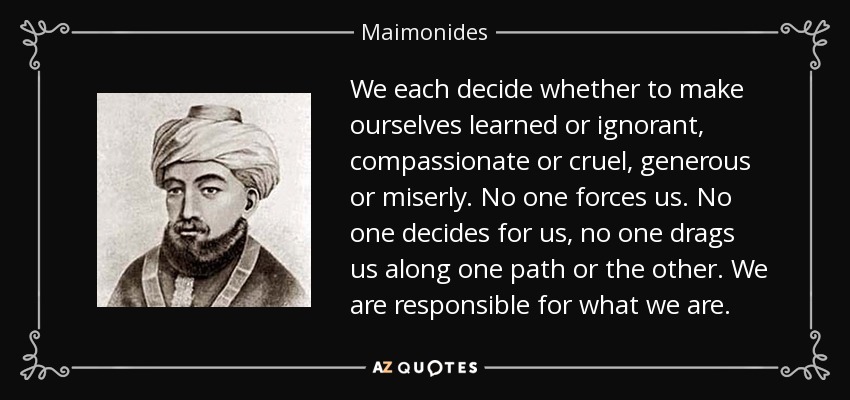
Ignorance of the law is not wisdom.
Knowledge of concepts shapes vision.
Morality guides behavior away from destructive decision.
======================
Well-Regulated Defense
https://www.azquotes.com/picture-quotes/quote-a-well-regulated-militia-composed-of-the-body-of-the-people-trained-in-arms-is-the-best-james-madison-18-35-70.jpg
Education and Arms
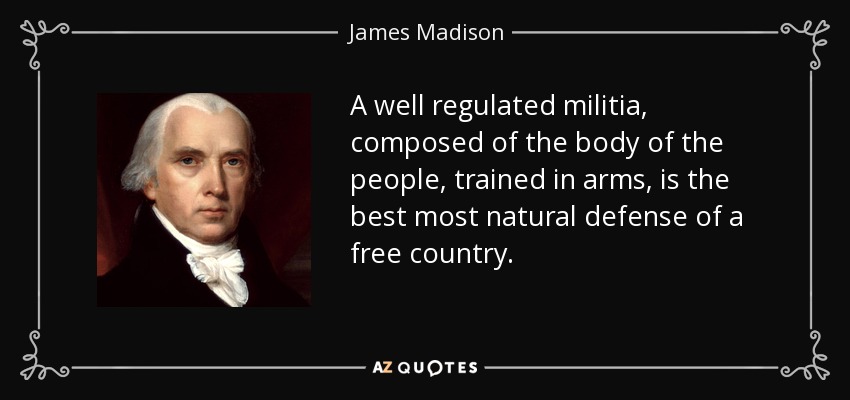
A well-regulated defense requires education and arms.
Calvin was extreme in his definition of government. He limited the organization of authority to the local council as directly under God.
The Reformed movement however contributed to the achievement of two major changes to western society. Education became a public institution. It has been paid for mainly with local and state taxes.
The right to bear arms was also a significant advance. It was initially used to achieve the overthrow of both the monarchy and parliament, but there is the more significant development in terms of the right to defense for citizens.
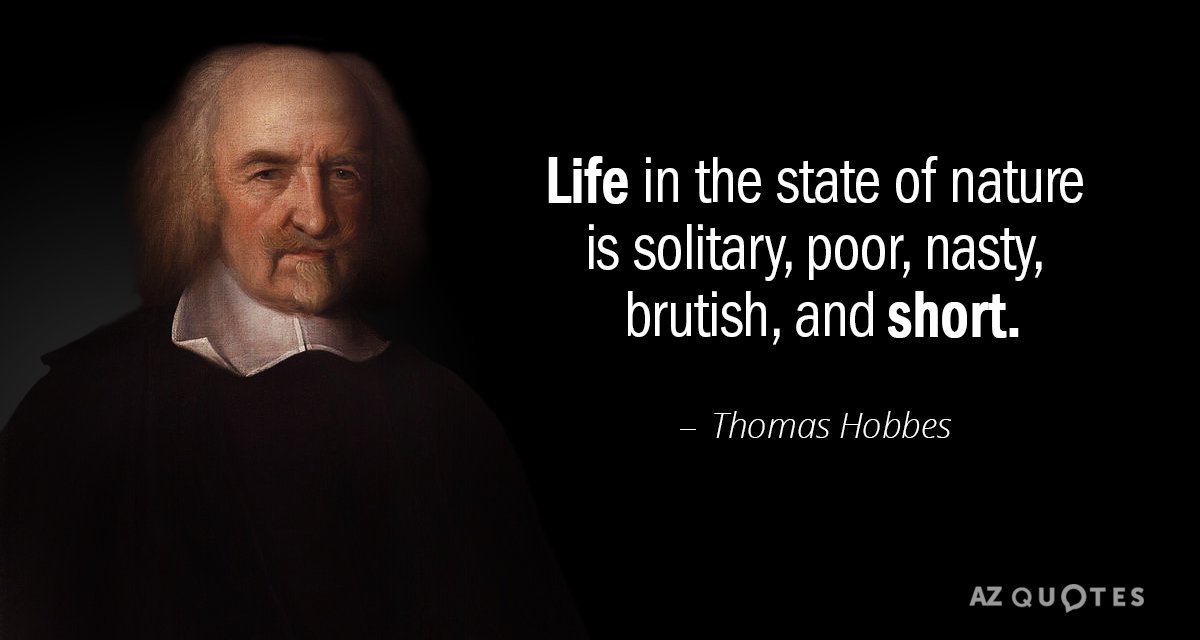
This element had been proposed by Hobbes as the right to defense against attack. It is his most significant philosophical contribution to political science.
This is a critical definition for the purpose of government. Law enforcement officials cannot always be where they are needed at the time of need. People have the right to defend themselves from attack. The right to bear arms is a fundamental advance in constitutional law.
Dominance
https://i.pinimg.com/originals/8f/a1/bc/8fa1bc995f89918f275d79d454747459.jpg
Augustine summarized the neo-Platonic view for his day with his definition of good and evil with respect for the political sphere. Neo-Platonism was popular as a philosophy because it could entertain the debate between monotheists and polytheists.
Slavery was still a social institution. Monarchy was regarded as the de facto case for leadership in the empire. The line of succession wasn't regarded as royal by the Romans.
There was still the longstanding resentment against aristocracy as the flagrantly corrupt social dimension of the political institution.
Augustine wrote the City of God to defend Christians from the view that they were responsible for the first downfall of Rome since the Gauls had ransacked the city sometime around 390 BCE.. Alaric had invaded the city in 410 CE. It was his third attack in Italian territory.
Ravenna had been made the capital of the western Roman empire in 402.
The optimists in Rome were looking at a long period to re-build the dominance of the city as a political power.
The college of cardinals and the papacy would eventually organize the Vatican to negotiate the organization of European tribal society into royal houses that would serve the unity of Christendom.
This was managed without slavery as an institution. It is conceivable that the status of serfdom was managed severely in order to justify organization without slavery, but the Christian Roman empire had managed to quietly abolish the institution.
There was most likely implicit cooperation with the eastern Roman empire to accomplish the achievement. The Byzantines occupied a position between the Europeans and the more eastern part of the Middle East.
John Chrysostom had complained about the mistreatment of slaves when he was the Patriarch of Constantinople (398-404). The Byzantine empire probably allowed the ownership of slaves or there was a translation issue.
The distinction between a slave and a serf was conceptually subtle. A serf was regarded as part of the staff who cared for the property. They were treated as part of the responsibility for managing the property. They were in this sense part of the property.
A slave was owned as property. Even in Rome some slaves were caretakers and others were trained as gladiators. The difference in lifestyle among slaves was significant. Those who were trained as gladiators could be used as soldiers in private armies.
The size of a private army could make the difference with respect for who beat whom in a report regarding the outcome of a conflict.
When it came to the competition between kingdoms in empire or the contest between empires, the distinction could be easily blurred to make it a non-issue for debate.
Slavery had to be outlawed because the categorization of a human as a piece of property allowed for shackles in the trade, whips to induce labor while enslaved, torture when accused of criminal behavior or the death penalty when found to be too troublesome. Slavery could not be allowed as legal or moral in a civilized society.