Showing posts with label ignorance. Show all posts

Tuesday, May 21, 2019

Respect

5.20.19

U.S. Border


Respect
Borders
尊重边界
Zūnzhòng biānjiè
尊敬の境界線 
Sonkei no kyōkai-sen

Respectu termini
ps112

Respect for borders honors rights. 
Lack of respect loses sight.

Happy are those who revere the Lord
with reverence for the commandments accord.

Their descendents will be mighty in the land.
The generation of the upright will be at hand.

Health and wealth will be in their house with order.
Relations will show respect for borders.

Sight is divined in the dark for those with faith.
The reflection of light is low but visible for those who wait.

The righteous don't race to punish.
Evidence is sorted to correct or admonish. 

Time is generous in lending for goodness.
Affairs are managed for practical fulfillment.

Wisdom in mercy is kept in remembrance.
Benign judgment is the entrance to temperance.

The humble heart is opened to prayer
to ask pardon for sin as the way  to avoid error.

Judgment is like a net that is thrown into the sea.
Good fish are saved. The bad are thrown back to flee.

The Lord will share counsel to show knowledge
in the removal of ignorance as some form of blockage.

Wisdom will be shown from what has been learned
for the glory of the law in the covenant discerned.

Rumors deceive those who are needful.
Disagreement with false statement turns away the deceitful. 

Faith that will not shrink is established with heart
until correction is attained as a new start.

The poor will find the way to produce value.
The productive will maintain belief in the 'can do' attitude.

Those who harm to inflict damage
will be alarmed to see how they mismanaged vantage.

--------------------------


112 Beatus vir
Blessed are they

1 Hallelujah!
Happy are they who fear the Lord
and have great delight in his commandments!
2 Their descendants will be mighty in the land;
the generation of the upright will be blessed.
3 Wealth and riches will be in their house,
and their righteousness will last for ever.
4 Light shines in the darkness for the upright;
the righteous are merciful and full of compassion.
5 It is good for them to be generous in lending
and to manage their affairs with justice.
6 For they will never be shaken;
the righteous will be kept in everlasting remembrance.
7 They will not be afraid of any evil rumors;
their heart is right;
they put their trust in the Lord.
8 Their heart is established and will not shrink,
until they see their desire upon their enemies.
9 They have given freely to the poor,
and their righteousness stands fast for ever;
they will hold up their head with honor.
10 The wicked will see it and be angry;
they will gnash their teeth and pine away;
the desires of the wicked will perish.

--------------------------

Sirach 39:5,7-8

He opens his heart to prayer
and asks pardon for his sin.

The Lord will direct his counsel and knowledge
as he meditates on his mysteries.
He will show the wisdom of what has been learned
for the glory in the law of the Lord's covenant.

---------------------------

The humble heart is opened to prayer
to ask pardon for sin as the way  to avoid error.
The Lord will share counsel to show knowledge
in the removal of ignorance as some form of blockage.
Wisdom will be shown from what has been learned
for the glory of the law in the covenant discerned.

====================

Matt. 13:47

The kingdom of heaven is like a net that was thrown into the sea and caught fish of every kind. When it was full, they drew it ashore and sat down. They put the good into baskets but threw out the bad.

------------------------------

Judgment is like a net that is thrown into the sea.
Good fish are saved. The bad are thrown back to flee.

======================

Una Voce
Non Uno Ore
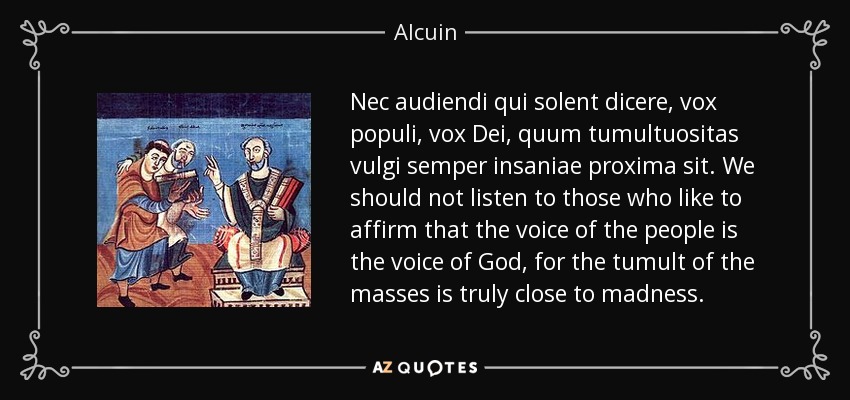
Alcuin of York
c. 735,  York, Northumbria
d. 19 May 804, Tours, Carolingian Empire

Alcuin of York was an English scholar, clergyman, poet and teacher from York, Northumbria. He became a leading scholar and teacher at the Carolingian court at the invitation of Charlemagne. He was made Abbot of Tours in 796 where he remained until his death. He is counted among the most important architects of the Carolingian Renaissance.

Charlemagne

When Pepin the Short became king in 752 it ended the Merovingian dynasty and started the Carolingian. He was succeeded by his son Charlemagne in 768.

Charlemagne expanded the borders of the kingdom to defend the Pope. He conquered the Lombards in northern Italy. He took an area in northern Spain that became known as the Spanish March to protect his southern borders from the Muslims in Spain.

He conquered the Saxons  to stop their raids from the Saxons. He took some territory from the South Slavs and the Avars to protect his eastern border as well. This became known as the Eastern March  or Ostmark. Ostmak would eventually become Austria.

Charlemagne became the first person since the fall of Rome to control the majority of continental Europe due to his military success.

York

York is located in the northern part of the kingdom of England.

The city was founded in 71 CE when the Ninth Legion conquered the Brigantes and constructed a wooden military fortress on flat ground above the River Ouse close to its confluence with the River Foss.

The fortress walls were rebuilt in stone by the VI legion. It was inhabited by 6,000 legionary soldiers and covered an area of 50 acres (20 ha). The site of the principia (HQ) of the fortress lies under the foundations of York Minster. Excavations in the undercroft have revealed part of the Roman structure and columns.

The Emperors Hadrian, Septimius Severus and Constantius I all held court there during their various campaigns.   The Emperor Severus proclaimed York capital of the province of Britannia Inferior during his stay 207–211. It is likely that it was he who granted York the privileges of a 'colonia' or city.

Constantius I died in 306 during his stay in York. His son Constantine the Great was proclaimed Emperor by the troops based in the fortress in 306. A bishop from York attended the Council at Arles in 314 to represent Christians from the province.

While the Roman colonia and fortress were located on high ground, the town was victim to occasional flooding from the Rivers Ouse and Foss by 400. The population was reduced. York declined in the post-Roman era. It was taken and settled by the Angles in the 5th century.

Reclamation of parts of the town was initiated in the 7th century under King Edwin of Northumbria. York became his chief city. The first wooden minster church was built for the baptism of Edwin in 627 according to the Venerable Bede. Edwin ordered that the small wooden church be rebuilt in stone. He was killed in 633 and the task of completing the stone minster fell to his successor Oswald.

Alcuin

Alcuin was an Englishman from York. He was born into a noble family about 730. He was educated by a pupil of Bede.

He was made a teacher of the cathedral school at York. He was made the director of St. Peter's School around 770 after he was ordained as a deacon. He was asked by the Emperor Charlemagne to become his minister of education in 781.

Charlemagne realized that he needed educated people to administer his kingdom given the size. He decided that he would start an education program headed by the finest scholar he could find.

The church in York had been founded by Irish missionaries. It was a major center for education. Alcuin had been educated by Archbishop Egbert, the student of the Venerable Bede. He had played an important role in reviving the late Roman classical arts in the school.

He was welcomed at the Palace School of Charlemagne in Aachen (Urbs Regale) in 782. It had been founded by the king's ancestors as a place for the education of the royal children. They were educated mostly in manners and the ways of the court but Charlemagne wanted to include classical education and the study of the religion.

Alcuin taught Charlemagne, his sons Pepin and Louis, the young men sent to be educated at court and the young clerics attached to the palace chapel from 782 to 790. He brought his assistants Pyttel, Sigewulf and Joseph with him from York.

Alcuin revolutionised the educational standards of the Palace School. He introduced Charlemagne to the liberal arts. He created a personalised atmosphere of scholarship to the extent that the institution came to be known as the 'school of Master Albinus'.

Many ancient writings had been lost in the preceding years of constant wars and invasions. Alcuin established the scriptorium as a place to the copy and preserve ancient manuscripts, both pagan and Christian. That we have as much as we do of the writings of classical Roman authors is largely due to Alcuin and his scribes.

He is credited with the invention of cursive script. The letters were connected for greater speed of writing. Much of the credit for the  revision and organisation of the Latin liturgy, the preservation of many of the ancient prayers and the development of plainchant belongs to Alcuin backed by Charlemagne.

He disagreed with the emperor over his policy of forcing pagans to be baptised on pain of death. He argued, "Faith is a free act of the will, not a forced act. We must appeal to the conscience, not compel it by violence. You can force people to be baptised, but you cannot force them to believe." His arguments seem to have prevailed. Charlemagne abolished the death penalty for paganism in 797.

Third Council of Aachen
5 November 809 -810

He and his fellow theologians at Charlemagne's capital of Aachen (or Aix-le-Chappelle) were important advocates of the doctrine that the Holy Ghost proceeds from the Father and the Son jointly.

The Filioque clause was the object of this Council. It was a subtle addition to the Holy Trinity dogma. Filioque means Son. It was added to the end of the Niceo-Constantinopolitan creed ("The Holy Spirit proceeds from the Father and the Son").

Italian and Frankish priests discovered the clause during the 8th century and started using it. Pope Leo III was against the idea. It was regarded as heretical in the East. He tasked Charlemagne with the organization of a Council to regulate it.

The Council was held in Aachen, Frankish capital, at the end of 809. Frankish bishops based their discussions on the works of Theodulf of Orleans and Alcuin of York. They declared the Filioque legitimate.

The Roman Empire adopted it despite opposition from both the Byzantine Emperor and the Pope. The addition would not be endorsed by Rome until 1014 even after it had been adopted by the western empire.

The Filioque clause would come to create friction with the Investiture controversy. Bishops and kings compete for authority over territory and authority.

It wouldn't take long before the Carolingian dynasty would suffer from both overreach at the  borders for the empire and in the competition to expand the claims between kings in the empire. The clause lacked distinctiveness for different roles.

The addition of the clause was political. It challenged the Pope's authority as well as the Byzantine Empire's orthodoxy. Charlemagne had chosen his title to challenge the sovereignty from Constantinople.

He was crowned Imperator Romanorum, Emperor of the Romans. When the barbarian Odoacer had become the king of Italy in 476 he deposed the last Western Roman Emperor.

The Western Empire was not eradicated. It was merged it with the Eastern Empire by way of the title, Emperor of the Romans. This was the title that Charlemagne claimed. It denied the authority claimed by Empress Irene of Constantinople.

Provocations put Charlemagne in a position of strength while negotiating the Pax Nicephori with Nikephoros I (803-811), but the advantage was for his advantage, not that of the empire. The Byzantine emperor had enough problems with Arabs and internal issues. He could not afford an open confrontation against the Franks. It can also be seen as an answer to Nikephoros' pro-iconoclast religious politics.

The East regarded the Emperor at Byzantium as the sole Emperor for the Romans. They resented Charlemagne's assumption of the title. This hardened their opposition to the aforesaid doctrine and contributed to the rift between East and West.

A collection of mathematical and logical word problems entitled Propositiones ad acuendos juvenes ("Problems to Sharpen Youths") is attributed to Alcuin. The scholar claimed to have sent "certain figures of arithmetic for the joy of cleverness" to Charlemagne in a letter dated in 799.

Some scholars have identified this reference with the Propositiones. The text contains about 53 mathematical word problems with solutions in no particular pedagogical order.

Alcuin made the abbey school into a model of excellence. Many students flocked to it. He had many manuscripts copied using outstandingly beautiful calligraphy, the Carolingian minuscule based on round and legible uncial letters.

He wrote letters to his English friends, to Arno, bishop of Salzburg and above all to Charlemagne. There are 311 letters that are extant. These communications are filled mainly with pious meditations, but they form an important source of information as to the literary and social conditions of the time. They are the most reliable authority for the history during the Carolingian age.

Alcuin trained  numerous monks of the abbey in piety. It was in the midst of these pursuits that he died in May 804.

https://en.wikipedia.org/wiki/Alcuin
http://www.breakpoint.org/2011/10/alcuin-york-c-735-804/
http://satucket.com/lectionary/Alcuin.htm
https://en.wikipedia.org/wiki/York

Monday, March 25, 2019

Announce

3.25.19

Announce
the Annunciation
宣布报喜 
Xuānbù bàoxǐ
受胎告知を発表する
Jutai kokuchi o happyō suru
ps40

I waited patiently for deliverance.
My hope was based on ignorance
but insisted on persistence.

Pain pressed for acceptance.
Escape was the only relevance.

The experience
was tainted with bitterness.

Expectation waited to pass the hope expected.
The wanting frustrated the detection.

Reflection on the past created fixation
on the duration of dilation.

Desolation is a fear with its own sensation.
Extrication felt like a revelation.

Such bounty was not a gift of chance.
I felt happy enough to dance.


I was lifted out of the darkness of the pit.
My feet were set on a ledge of cliff
where the strength of stone still sits.

My mouth was filled with a new song.
I sang it loud. I will sing it long.

I gave thanks for my deliverance.
I will never question the value of my existence.

Many will see and stand in awe.
They too will enjoy the thrall.

Happy are those who work with faith to overcome the odds.
They do not seek counsel from evil spirits or false gods.

Great are the things done by my Lord and God.
Wonders have been shown to deconstruct fraud.

That which was wrong has been indicated as detected.
It will be investigated for evidence of what needs to be corrected.

The annunciation announced the Son of the Most High
to be incarnate as the Christ Jesus to justify sighs
for justice on earth beneath the sky.

The young woman is with child to tell
the world will come to know Immanuel.

The Lord has taken no pleasure in sacrifice for murder.
Prosperity is for those who serve the Server.

By the offering of the body of Jesus Christ, we have been sanctified
for atonement from sin that salvation may be satisfied. 

It is written in the book about me:
'I love to do your will as the law that is to be.
You help the lame to walk and the blind to see.
My God you are the healer in whom I believe.'

Many troubles had crowded around me.
Sin had taken my feet and sight. I could not walk or see.

I have not hidden your service in my heart.
I have spoken of your deliverance as my grateful start.

I proclaimed faith as righteous in the congregation.
We will conserve earth's treasure as a measure of station
for the nation.

Do not withhold your compassion.
Let your love and security become the fashion.

Please be pleased with your deliverance.
My world has been saved by your existence.
Make haste to preserve your security.

Those with faith will increase in certainty.
Let those who seek to destroy life be dismayed.

Let their dismay turn them from plans to betray
those who put their hope in you in order to stay.

Let all those who seek you, rejoice and be glad.
You are our heavenly Dad.

You are my deliverer, my Lord and God.
Do not refrain from help for those who seek your awe.

-----------------------------

40 Expectans, expectavi

1 I waited patiently upon the Lord;
he stooped to me and heard my cry.
2 He lifted me out of the desolate pit, out of the mire and clay;
he set my feet upon a high cliff and made my footing sure.
3 He put a new song in my mouth,
a song of praise to our God;
many shall see, and stand in awe,
and put their trust in the Lord.
4 Happy are they who trust in the Lord!
they do not resort to evil spirits or turn to false gods.
5 Great things are they that you have done, O Lord my God!
how great your wonders and your plans for us!
there is none who can be compared with you.
6 Oh, that I could make them known and tell them!
but they are more than I can count.
7 In sacrifice and offering you take no pleasure
(you have given me ears to hear you);
8 Burnt-offering and sin-offering you have not required,
and so I said, "Behold, I come.
9 In the roll of the book it is written concerning me:
'I love to do your will, O my God;
your law is deep in my heart.'"
10 I proclaimed righteousness in the great congregation;
behold, I did not restrain my lips;
and that, O Lord, you know.
11 Your righteousness have I not hidden in my heart;
I have spoken of your faithfulness and your deliverance;
I have not concealed your love and faithfulness from the great congregation.
12 You are the Lord;
do not withhold your compassion from me;
let your love and your faithfulness keep me safe for ever,
13 For innumerable troubles have crowded upon me;
my sins have overtaken me, and I cannot see; *
they are more in number than the hairs of my head,
and my heart fails me.
14 Be pleased, O Lord, to deliver me;
O Lord, make haste to help me.
15 Let them be ashamed and altogether dismayed
who seek after my life to destroy it;
let them draw back and be disgraced who take pleasure in my misfortune.
16 Let those who say "Aha!" and gloat over me be confounded,
because they are ashamed.
17 Let all who seek you rejoice in you and be glad;
let those who love your salvation continually say,
"Great is the Lord!"
18 Though I am poor and afflicted,
the Lord will have regard for me.
19 You are my helper and my deliverer;
do not tarry, O my God.

------------------------------

Isa. 7:14
The Lord himself will give you a sign. Look, the young woman is with child. She will bear a son and name him Immanuel.

-------------------------------

The young woman is with child to tell
the world will come to know Immanuel.

=======================

Hebrews 10:10
It is by God's will that we have been sanctified through the offering of the body of Jesus Christ once for all.

-------------------------------

By the offering of the body of Jesus Christ, we have been sanctified,
for atonement from sin that salvation may be satisfied.

=======================

Luke 1:31
Now you will conceive in your womb and bear a son. You will name him Jesus. He will be great. He will be called the Son of the Most High. The Lord God will give to him the throne of his ancestor David.

-------------------------------

The annunciation announced the Son of the Most High
to be incarnate as the Christ Jesus to justify sighs
for justice on earth beneath the sky.

=======================

The Equinox
3.20.19

Equinox- Equal length of night and day

The Annuciation is celebrated with proximity to the Spring Equinox.

The feast has been celebrated on March 25. It has commemorated  the belief that the spring equinox was not only the day of God's act of creation but also the beginning of Christ's redemption of that same creation from the earliest recorded history.

Many Christians observe the Annunciation with the feast as an approximation of nine full months before Christmas, the ceremonial birthday celebration of Jesus.

The Feast of the Annunciation was celebrated as early as the fourth or fifth century. The first certain mention of the feast is in a canon of the Council of Toledo in 656. It was described as celebrated throughout the Church.

Another observation was documented for the Council of Constantinople "in Trullo" in 692. It is often known as the Council in Trullo, because like the Sixth Ecumenical Council it was held in a domed hall in the Imperial Palace. Trullo means a cup or dome (τρούλος, troulos).

The council forbade the celebration of any festivals during Lent except for the Lord's Day (Sunday) and the Feast of the Annunciation. A Synod of Worcester, England in 1240 forbade all servile work on the feast.

The story celebrates the difficulty of a young woman who found that she was pregnant prior to her wedding. Mary was Jewish. She lived in Galilee during the Roman occupation. The Judean observation of the law was monotheistic at a time that preceded the conversion of Rome to monotheism.

The fullness of her courage is exemplified by her response to the angelic announcement of her pregnancy as both celestial and natural. The natural event became an emblem of the divine struggle to come to terms with the nobility of destiny. The struggle to rise above fate to meet the demands of a destined goal visits even those born in common circumstances.

She went on to get married. She carried her baby to term even though it would be known that she got pregnant prior to her marriage ceremony. Her courage is celebrated with the title, "Mother of God."

The Annunciation was the first step in the direction of her heroic struggle to maintain her responsibility as a woman of Galilee, a wife and a mother as Rome and imperial government moved to the conversion to monotheism with faith in the Christ Jesus.

----------------------------

Stephen Toulmin
b. 3.25.1922 London, England
d. 12.4.2009 Los Angeles, California

London

The city outgrew the County of London in the first few decades of the 20th century. The urban area grew faster than at any point before or since. Most of the development was suburban expansion into neighboring counties.

Semi-detached housing units, what Americans call duplexes, were favored over terraced houses. The duplexes were housing units connected by a single wall. The terraced units were a row of houses that shared side walls. A block looked like an apartment building.

The semi-detached units had yards. They weren't as efficient in the use of land, but they allowed for a domestic connection to nature. They were one step closer to the household model of an aristocratic estate.

The rapid expansion of the city swallowed up large swathes of the countryside. The Metropolitan Green Belt was introduced to restrict growth. Labor and material shortages contributed to the restriction. The County Council called for a single Authority to cover the entire area. This call was rejected by the Royal Commission on London Government in 1921.

Sharp rises in income and estate taxes made the cost of large houses unaffordable. British aristocrats sold their homes to private developers.

Virginia Woolf published her novel Mrs. Dalloway in 1925. It was about the life of a high society woman in post World War I England. The story travels forward and back in time with an interior perspective  in and out of the characters' minds to construct an image of Clarissa's life and of the inter-war social structure.

Stephen Toulmin

Stephen Toulmin was born in London on 25 March 1922 to Doris Holman and Geoffrey Edelson Toulmin.

He earned his Bachelor of Arts degree from King's College in Cambridge in 1943. He was hired by the Ministry of Aircraft Production as a junior scientific officer soon after. He was assigned to the Malvern Radar Research and Development Station first. He was moved to the Supreme Headquarters of the Allied Expeditionary Force in Germany next.

He returned to England to earn a Master of Arts degree in 1947 and a PhD in moral science from Cambridge University at the end of World War II. He was influenced by the Austrian philosopher Ludwig Wittgenstein on the meaning of language. His dissertation was published as An Examination of the Place of Reason in Ethics (1950).

He was appointed University Lecturer in Philosophy of Science at Oxford University from 1949 to 1954 after his graduation. He wrote The Philosophy of Science: an Introduction (1953). He was appointed to the position of Visiting Professor of History and Philosophy of Science at Melbourne University in Australia from 1954 to 1955. He returned to England to serve as Professor and Head of the Department of Philosophy at the University of Leeds from 1955 to 1959.

He published The Uses of Argument (1958) as an investigation of the flaws of traditional logic. It was one of his most influential books in the field of rhetoric. It was satirized as "Toulmin's anti-logic book" by his fellow philosophers at Leeds. The book was applauded by rhetoricians in the United States. Toulmin was invited to serve as a visiting professor at New York, Stanford and Columbia Universities in 1959.

He argued that absolutism represented by theoretical or analytic argument has limited practical value. Plato's idealized formal logic from the world of forms anticipated Aristotle's advocacy for universal truth. Absolutists believe that moral issues can be resolved by adhering to a standard set of moral principles regardless of context.

Toulmin contended that many of these so-called standard principles are irrelevant to real situations encountered in daily life. He introduced the concept of argument fields. He claimed that some aspects of argument vary from field to field.

These are called "field-dependent." Other aspects of argument are the same throughout all fields. These are called "field-invariant." The flaw of absolutism lies in its lack of awareness fo the field-dependent aspect. Absolutism assumes that all aspects of argument are field invariant. Relativism tends to treat all arguments as 'different.' The cultural context for the reason is the only sigificanct feature.

He called for the use of practical argument as substantial for justificatory function. He contrasted this type with the absolutists' inferential function in theoretical argument.  Practical arguments find a claim of interest first, then provide justification for it. Theoretical argument makes inferences based on a set of principles to arrive at a claim. It is deductive.

Reason in general is less an activity of inference from logical principles. It is an act achievable through the process of justification. A good argument needs to provide sufficient justification for a claim.

He laid out a proposal for six interrelated components in the analysis of argument. It has to have a claim, ground, warrant, backing, rebuttal and qualifier. The claim is a statement. The sentence, "Harry was born in Bermuda, so he must be a British subject" claims that Harry is a British subject.

The ground appeals to data that serves as evidence to support the claim. The fact that Harry was born in Bermuda is the ground for the claim.

The statement "Someone born in Bermuda is a British citizen" provides a bridge to warrant the claim.
Backing is introduced when the warrant itself isn't convincing enough. "My training as a barrister with a specialization in citizenship taught me that a man born in Bermuda is a legal citizen" is an example.

A rebuttal recognizes a restriction as a counter to the general claim. Someone born in Bermuda is a legal citizen unless he has betrayed Britain by acting as a spy for another country.

Qualifiers have a Boolean aspect insofar as the degree of force of certainty concerning the claim is expressed. Such words or phrases include "possibly," "probably," "plausibly,"  "impossible," "certainly," "presumably," "as far as the evidence goes" and "necessarily." The statement that Harry is definitely a British citizen is more certain than Harry is presumably a citizen of Britain.

The first three elements, "claim," "ground," and "warrant," are considered as the essential components of practical arguments, though the "warrant" is often left implied.  The second triad, "qualifier," "backing" and "rebuttal," may not be needed in some arguments.

The appointment of a special prosecutor by the House of Commons in Great Britain or the House of Representatives in the US represents a kind of case where the value of practical argument is overstated to win votes.

Either house may be more interested in driving the chief official out of office to demonstrate the ability to do so as opposed to driving the person out of office because the accused was actually guilty of a criminal charge. The ability is demonstrated to show greater authority.

When accusation is followed by defamation, the claim is backed by personal attack as the ground for pressing the charge. It is not good practical argument, but with an aggressive media assault it has proved to be all too effective in persuading the public that the official was guilty of something, if not the charge that was pressed.

Toulmin's work was introduced to communication scholars in the States. It was recognized as as a good structural model for the analysis and criticism of rhetorical arguments.

Toulmin returned to London to hold the position of director of the Unit for History of Ideas of the Nuffield Foundation in 1960.

He returned to the United States in 1965. He held positions at various universities.

Human Understanding: The Collective Use and Evolution of Concepts (1972) was published while he was at the University of California, Santa Cruz. He examined the cause and process of conceptual change.

Major philosophical questions were viewed in the context of a novel comparison between conceptual change and Darwin's model of biological evolution. Conceptual change is analyzed as an evolutionary process.

He suggested in Human Understanding (1972) that anthropologists have been tempted to side with relativists because they have noticed the influence of cultural variations on rational arguments. The anthropologist or relativist overemphasized the importance of the "field-dependent" aspect of argument and neglected the "field-invariant" elements.

Toulmin attempts throughout his work to develop standards that are neither absolutist nor relativist for assessing the worth of ideas in order to provide solutions to the problems of absolutism and relativism.

He attacked Thomas Kuhn's account of conceptual change in his seminal work The Structure of Scientific Revolutions (1962). Kuhn believed that conceptual change is a revolutionary process (as opposed to an evolutionary process), during which mutually exclusive paradigms compete to replace one another.

Toulmin criticized the relativist elements in Kuhn's thesis. He argued that mutually exclusive paradigms provide no ground for comparison. Kuhn made the relativists' error of overemphasizing the "field variant" while ignoring the "field invariant" or commonality shared by all argumentation or scientific paradigms.

He proposed the evolutionary model of conceptual change comparable to Darwin's model of biological evolution in order to oppose the revolutionary model. Toulmin stated that conceptual change involves the process of innovation and selection.

Innovation accounts for the appearance of conceptual variation while selection accounts for the survival and perpetuation of the soundest conceptions.

Innovation occurs when the professionals of a particular discipline come to view things differently from their predecessors. Selection subjects the innovative concepts to a process of debate and inquiry in a "forum of competitions." The soundest concepts will survive the forum of competition as replacements or revisions of the traditional conceptions.

Concepts are either valid or invalid regardless of contexts from the absolutists' point of view. One concept is neither better nor worse than a rival concept from a different cultural context from the relativists' perspective. The evaluation depends on a process of comparison which determines whether or not one concept will improve explanatory power more than its rival concepts from Toulmin's perspective.

The use of the terms 'revolutionary' or 'evolutionary' have the intent to evoke interest in an intellectual debate. Either term however can convey support for excessive aggression in the promotion of a position.

Current events indicate that even non-violent revolutionary change can be used for the subversive subordination of executive authority to the manipulation of public perception. Evolutionary theory can seem like watching paint dry when contrasted with revolutionary change, but Darwin inserted elements into his theory that supported violence or excess in aggression for change.

Toulmin advanced a thesis that underscored the significance of history to human reason while at the University of Chicago in 1973. He argued that truth can be a relative quality that is dependent on historical and cultural contexts. This was a continuation his disagreement with Kuhn on "conceptual schema" as part of a "paradigm shift."

He worked with a national commission for the protection of human subjects in Biomedical and Behavioral Research. This commission was established by the United States Congress from 1975 to 1978.

He collaborated with Albert R. Jonsen to write The Abuse of Casuistry: A History of Moral Reasoning (1988) during this time. He demonstrated the procedures for resolving moral cases.
One of his most recent works, Cosmopolis: The Hidden Agenda of Modernity (1990) was written at Northwestern University. It specifically criticized the practical use and the thinning morality underlying modern science.

He traced the philosophers' "quest for certainty" back to René Descartes and Thomas Hobbes. He lauded John Dewey, Wittgenstein, Martin Heidegger and Richard Rorty for abandoning that tradition.
Toulmin held distinguished professorships at numerous universities, including Columbia, Dartmouth College, Michigan State, Northwestern, Stanford, the University of Chicago and the University of Southern California School of International Relations while in the United States.

He died on 4 December 2009 in Los Angeles, California.

The Toulmin Model
Application
https://www.youtube.com/watch?v=Ifc3FQ0WccU

The claim that Assad had used chemical weapons was not justified by the evidence. The ground for the claim was not established.

Warrants were developed on the basis of the US State Departments definition of a dictator of an authoritarian regime. Any elected official who is re-elected beyond the term limits that exist for the US is defined as a dictator or a president for life by this criteria for judgment.

The implication was that Assad was a dictator because his father was re-elected as president throughout his life.

The inference was drawn that the public would believe that a dictator like Assad would use chemical weapons. Term limits are not universal. The term limits for the US president are not necessarily good for the US.

Term limits have been used as a justification for invasion, air strikes and insurrection in the middle east. This has been done at the expense of the American, British and European taxpayers.

The anti-authoritative position was derived from the anti-monarchical position adopted by the Roman Republic when term limits of one year were applied to the two consuls who were elected supposedly for one term only.

The Roman Republic entertained kingdoms for a time as a polytheistic entity, but they also used slavery as a means to compete with governments without gladitorial contests as the primary basis for manumission.

The Romans did not have public education like the Athenians or the Spartans. They had training for slaves to become gladiators. They used slaves as soldiers to win wars with the Spartan style of warfare.

The Roman empire in Europe was organized as a unity of kingdoms by the authority of papal blessing after the college of cardinals and the pope rose to a position of prominence in Christendom. This was after Rome had been destroyed as the capital for the empire.

The Christian Roman empire did not have slavery. The polytheist empire did. The Reformation happened in opposition to the re-institution of slavery as a practice by the Spanish monarchy. Republican government was re-instituted with revolution with slavery.

British parliament organized a model for modern republic that outlawed slavery. This condition was negotiated with treaties with foreign powers.

The Muslim nations started to adopt constitutional government starting after the fall of the Ottoman empire in WWI.  A government does not have to have term limits for the executive authority to qualify as a constitutional republic. None of the European powers have term limits for their executives.

Obama was presenting an argument that had been presented to him by the US State Department and the liberal element of Congress along with covert agencies. It was all based on a claim that was not justified by investigation.

The special prosecutor appointed by the House of Representatives has been organized against the institution of conservative policy. This appointment is something that was modeled after something used by the House of Commons in Britain to promote the precipitation of profit from military conflict.

Any time that a monarch or a leader in parliament would rise up to promote conservative policy, he or she would be subjected to 'investigation' that included accusation followed by defamation in the press.

The accused was not allowed defense in a compensatory way. This method of 'prosecution' doesn't follow reasonable models for the judiciary. It is essentially subversive. It should not be allowed as a practice for government.

Friday, April 14, 2017

Discover

Elle Fanning
"I Think We're Alone Now"

Discover
Truth
真実を発見する
Shinjitsu o hakken suru 
ps114

Discover truth
for your youth.

Discovery is a creative act. 
When you define a thing it becomes a fact.

Reality produces creation by design.
Design expressed by me is mine.

When perception came out of anguish
conflict became a foreign language.

Courage became our sanctuary;
learning our actuary
over the adversary
adversity.
Have mercy.


Creation by discovery divines design.
Goodness is the quality we seek to find.

Discovery was a creative act. 
Creation became an actual fact.

Ignorance looked and fled.
The stream of consciousness was fed.
Creativity lept with joy.
The lion became the lamb's great toy.

Why did the stream of thought change?
What produced the strangeness in range?

What made ignorance flee?
Was it the discovery of creativity?

Discovery is a creative act.
The created acquires heart in fact.

Tremble at the presence 
of the essential essence.

The Teacher teaches the student to discover truth.
The student looks for facts like a sleuth. 

Find new information.
Observe your sensation.
Transcend encumbrance.
Infer knowledge from substance.
Sense that which is actual.
Translate this sense into the factual.

The sleuth records that which is found.
Results are shared to test for common ground.

Creation by discovery divines design for reality.
Goodness is the basis for healthy morality.

Discovery is a creative act. 
When you define a thing it becomes a fact.

Discover truth
for your youth.

Yeah Yah!
We're in awe!
You're the law!
Yeah Yah!

114 In exitu Israel

1 Hallelujah!
When Israel came out of Egypt, *
the house of Jacob from a people of strange speech,

2 Judah became God's sanctuary *
and Israel his dominion.

3 The sea beheld it and fled; *
Jordan turned and went back.

4 The mountains skipped like rams, *
and the little hills like young sheep.

5 What ailed you, O sea, that you fled? *
O Jordan, that you turned back?

6 You mountains, that you skipped like rams? *
you little hills like young sheep?

7 Tremble, O earth, at the presence of the Lord, *
at the presence of the God of Jacob,

8 Who turned the hard rock into a pool of water *
and flint-stone into a flowing spring.

Saturday, December 10, 2016

Cheer


Katie Holmes:
Romance

Cheer
the Dear
愛して応援
Ai shite ōen
ps146

Yeah Yah!
Booya daya!

Extol the whole, O my soul!
Peace lives as the goal.

I will outline the design that is fine;
the design that will be mine
after I climb my mind to find
what I left behind in the sublime.

I will celebrate the date 
that does not hate  
or berate what's straight.

I won't trust ignorance
as cause to destroy difference.
It will only protect the ignorant,
the irritable and the belligerent. 

Happy are those who savor the Savior
for salvation. The patient awaken nations
 to find relations for generations.

Who made heaven and earth?
Who gave life the capacity to give birth?
Who made the promise to protect life?
How is the law to prevent strife?

Who gives justice to the oppressed?
Who gives guidance for what is best? 
Who gives food to those who hunger? 
Who gives knowledge to those who are younger?

The Liberator sets the prisoners free.
Compensation helps the blind to see.

 Uprightness lifts those bowed down.
The lift is spread all around.
Strangeness makes the stranger tame.
Tameness keeps the game in frame.

Provision for the orphan and widow
gives economy an open window.
Wickedness. It will not pay.
It reduces credence for what they say.

Time will reign throughout the length.
Length is lent to good judgment.

Life will live by generation.
Love is felt for our creation.
Generation for creation
is Love's incarnation!

Extol the whole, O my soul!
Peace lives as the goal.

Booya daya!
Yeah Yah!


146 Lauda, anima mea

1 Hallelujah!
Praise the Lord, O my soul! *
I will praise the Lord as long as I live;
I will sing praises to my God while I have my being.
2 Put not your trust in rulers, nor in any child of earth, *
for there is no help in them.
3 When they breathe their last, they return to earth, *
and in that day their thoughts perish.
4 Happy are they who have the God of Jacob for their help! *
whose hope is in the Lord their God;
5 Who made heaven and earth, the seas, and all that is in them; *
who keeps his promise for ever;
6 Who gives justice to those who are oppressed, *
and food to those who hunger.
7 The Lord sets the prisoners free;
the Lord opens the eyes of the blind; *
the Lord lifts up those who are bowed down;
8 The Lord loves the righteous;
the Lord cares for the stranger; *
he sustains the orphan and widow,
but frustrates the way of the wicked.
9 The Lord shall reign for ever, *
your God, O Zion, throughout all generations.
Hallelujah!