Showing posts with label quarrel. Show all posts

Sunday, March 8, 2020

Talk

3.15.20

Kanon Fukuda and Ayaka Wada

Talk
Time
谈话时间
Tánhuà shíjiān
連続通話時間
Renzoku tsūwa jikan
ps95
Disputatio tempore

Saturn was seen before we could dream
of counting his moons as a part of his team.

The seventh of the heavenly objects that shine in the night
is the planet that is known as the symbol of time.

The oldest known of celestial spheres
adheres to the path to travel with tears
that veers from that of which the stars steer.

The Lord of the rings 
has exchanged meaningful things.

He gathered together the fauns and the nymphs
and gave them a glimpse of life without pimps.

Saturn has many moons.
Their orbits play different tunes.

Titan is larger than Mercury.
His lineage precedes that of Hercules.

Rhea is plenty smaller than our moon
but she is the wife to Saturn's swoon.

Many others are smaller still.
They don't comply with the equatorial will.

Crashes do occur.
Space debris does recur.

A co-orbit exists where the rocks change place
The inside track is replaced.

Janus and Epimetheus make the change.
Transitions are the name of their game.

Rock holds the joy for our salvation.
The height of mountain celebrates our elation.

The depth of cavern shields us from harm.
Rubble tells the standing stone that it is lacking charm.

The sheep have been scattered on a day of darkness.
The wilderness can seem so harsh that it is heartless.

Care seeks out the flock as they drift like clouds.
The shepherd calls each by name with a voice that is loud.

The sheep have been found.
The shepherd feels the profound sound 
of joy echo from the ground.

Don't harden your heart for adversity.
Knowledge is found at the edge of uncertainty.

Quarreling in hardship was pronounced.
The counting of faults was announced.

Testing without rest was a mess.
Survival was for the fittest when it was best.

The wilderness was a maze in the mind.
The consequence for error was that which confined.

Where was there water
for your son or your daughter?

Where was the food
that would lighten your mood?

Where was the danger
that crept up like a stranger?

Where was the pasture
that would result in your laughter?

Where was the power for those who believe?
Where was the knowledge that would provide your relief?

March is the month that marks the start for the growing season.
Politics is framed in the context of the contest for economic reason.

Joseph had interpreted his dream for storage 
to secure surplus against when we had to forage.

Prosperity followed for the interpration of natural design
until benefit from agreement with the Pharaoh had declined.

The Israelites found themselves decline to a state of servitude
as the leadership of Egypt grew a more celestial attitude.

Moses fled from the land to avoid the guilt produced 
after he had killed a man for a pattern of abuse.

He saw a bush burn though the flames did not consume it.
The name for the divine nature was seen by the one who had viewed it.

Nature exists in that which is divine
as an expression of the intent for the design. 

Pharaoh released the people after the last of many plagues
that showed that the power of the prophet prevailed over oppressive ways.

The congregation wandered through the wilderness of sin
to find food and water wherever their feet had carried them.

When they did not find water at the place of rest in Rephidim
the people complained against Moses as though the lack was because of him.

'Were we brought out of Egypt to die from thirst?
Leaving the life we knew looks more and more like a curse.'

Moses took his staff along with the elders of Israel
to the rock of Horeb to produce water as something visible.


He struck the hot rock with his staff.
It split in half. The elders laughed.

Water gushed out for the people to drink
before they could blink or think.

The place was named for the test that the quarrel had made.
Providence was demonstrated when the risk for faith was paid.

The Son sat down by the well on the shoulder of the road.
He asked the watchful woman for a drink of water as not necessarily owed.

He offered her living water that she might see what could be shown 
by the gift of giving something that was hers but not her own.

This gift of giving gave the promise of eternal life
insofar as the gift is returned like a husband's hug to his wife.

She asked him for the wonder of this unending gift.
She thought the trick was to receive without the work of thrift.

He asked her to get her husband  and to bring him back.
She said she had no husband to hide her lack of tact.

He said you were right to say you have not that which you lack.
'You had 5 husbands. The man with whom you live is the one that you do not have.' 

She said 'I see that you are a prophet, but I cannot worship in the Temple.'
He said the Father seeks those who will worship wherever they may assemble.

The gift of the Holy Spirit wishes for worship in spirit and truth.
The spirit of truth is given by the Son that seeks to share his truth with youth.

We stand justified by faith with grace in the hope of Christ.
We have been honored to share in the glory that his sacrifice sufficed.

The experience of adversity produced endurance.
Endurance produced character with assurance.

Character has formed hope that doesn't disappoint
that which is right about that to which we point.

Love has been poured into our heart's by the Holy Spirit
for the experience of the presence for those who will draw near it.

Someone might dare to die for a good person
but the choice to die for those who were not certain
would be as rare as the final curtain.

Christ died for us when we were sinners
to glorify reconciliation with God for winning figures.

We will be saved from wrath in justification by his blood
as a body for salvation annointed by his love.

The evidence for our testament has been revealed by the Father
through the reconciliation that Jesus Christ has offered. 

When the Son of man and his angels appear,
will you be ready for the heavenly here?

Survival for fitness was for the best.
Learn from the experience expressed in the test.

Come let us sing the song of salvation.
It will be good for us, the world and our nation.

-------------------

Psalm 95
Venite, exultemus
Come, let us

1 Come, let us sing to the Lord;
let us shout for joy to the Rock of our salvation.
2 Let us come before his presence with thanksgiving
and raise a loud shout to him with psalms.
3 For the Lord is a great God,
and a great King above all gods.
4 In his hand are the caverns of the earth,
and the heights of the hills are his also.
5 The sea is his, for he made it,
and his hands have molded the dry land.
6 Come, let us bow down, and bend the knee,
and kneel before the Lord our Maker.
7 For he is our God,
and we are the people of his pasture and the sheep of his hand.
Oh, that today you would hearken to his voice!
8 Harden not your hearts,
as your forebears did in the wilderness,
at Meribah, and on that day at Massah,
when they tempted me.
9 They put me to the test,
though they had seen my works.
10 Forty years long I detested that generation and said,
"This people are wayward in their hearts;
they do not know my ways."
11 So I swore in my wrath,
"They shall not enter into my rest."

----------------------

March is the month that marks the start for the growing season.

Chn.  三月是标志着生长季节开始的月份。
            Sān yuè shì biāozhìzhe shēngzhǎng jìjié kāishǐ de yuèfèn.
Jpn.   3月は成長期の始まりを示す月です。
            3 Tsuki wa seichō-ki no hajimari o shimesu tsukidesu.
Krn.   3 월은 성장 계절의 시작을 나타내는 달입니다.
           3 wol-eun seongjang gyejeol-ui sijag-eul natanaeneun dal-ibnida.
Ltn.  Mensis Martii est notas quae est satus de crescens temporum.
Itln.  Marzo è il mese che segna l'inizio della stagione di crescita.
Spn.  Marzo es el mes que marca el inicio de la temporada de crecimiento.
Frn.   Mars est le mois qui marque le début de la saison de croissance.
Gmn. März ist der Monat, der den Beginn der Vegetationsperiode markiert.
Dtch.  Maart is de maand die het begin van het groeiseizoen markeert.
Czch.  Březen je měsíc, který označuje začátek vegetačního období.
Hgn.   A március az a hónap, amely a növekedési időszak kezdete.
Trk.    Mart, büyüme mevsiminin başlangıcını gösteren aydır.
Grk.   Ο Μάρτιος είναι ο μήνας που σηματοδοτεί την έναρξη της καλλιεργητικής περιόδου.
          O Mártios eínai o mínas pou simatodoteí tin énarxi tis kalliergitikís periódou.
Rsn.   Март - это месяц начала вегетации.
           Mart - eto mesyats nachala vegetatsii.

March is the month that marks the start for the growing season.
Politics is framed in the context of the contest for economic reason.

--------------------------

God is King


Psalms 93-99 are called the royal psalms. They declare that God is the King for his people.
None in this group is titled as one of David's. Psalm 95 is attributed to David in the letter to the Hebrews (Heb. 4:7).

It is conceivable that the Roman general Vespasian had notified the Pharisaical sect with Josephus that the temple in Jerusalem would be destroyed. The Judaic kingdom would be replaced with a republic under the name of Palestine. It would not be Jewish.

It was probably clear to Vespasian and Josephus that the Judean kingdom was more advanced culturally than the Roman republic.

Judea had demonstrated the capacity to entertain a system of election in a way that recognized the conservative reform embodied by the royal line of succession. It was done with the help of belief in the one God.

These royal psalms represented the abiltiy for the believer in any kingdom or republic to praise the sovereignty of deity in the people as well as in the royal line. 

They ascribe royalty to God for national sovereignty.

Seeds Family Worship - Sing for Joy (Ps.95:1-4)
Music video

Sons of Korah - Psalm 95
Music video

----------------------

Rock of Horeb


The last reading from the book of Exodus was for the last Sunday in February 2020. It was about the revelation to Moses on Mt. Sinai.

This selection refers to an event that preceded the ascription of law to tablets.

Moses had fled to Midian after he killed an Egyptian for the abuse of a Jew at work.

While he may have expected to remain in exile for the rest of his life, he had a mysterious encounter with  the burning bush that was not consumed by the flames that he saw. He witnessed a name as a testimony to the existence of the divine nature.

He felt compelled to receive the vision as instruction to return to Egypt to help the Israelites to escape from servitude and to lead them back to the land that had been promised to Abraham.

The initial petition to let the people go was made to Pharaoh by Aaron. Their workload was increased.  Moses and Aaron returned to insist on their release.

Plagues were sent on the land as a reminder that the authority of the Creator was greater than that of oppressive leadership.

The Isrealites were released after the last plague had passed over their children, but damaged or destroyed those who held on to belief in superstition.

Exodus 17:1-7

The whole congregation of the Israelites journeyed by stages from the wilderness of Sin (guilt) as the LORD commanded. They camped at Rephidim (place of rest), but there was no water to drink. The people quarrelled with Moses and said, 'Give us water to drink.'

Moses said to them, 'Why do you quarrel with me? Why do you test the LORD?'

The people thirsted for water. They complained against Moses and said, 'Did you bring us out of Egypt to kill us, our children and livestock with  thirst?'

Moses cried out to the LORD, 'What shall I do? The people are almost ready to stone me.'

The LORD said, 'Go on ahead of the people. Take some of the elders of Israel. Take the staff with which you struck the NIle and go. I will be standing there in front of you on the rock of Horeb (heat). Strike the rock. Water will come out of it so the people may drink.'

Moses did these things in the sight of the elders. He called the place Massah (test) and Meribah (quarrel) because the Israelites had quarrelled and tested the LORD saying, 'Is the LORD among us or not?'

----------------------

Joseph had interpreted his dream for storage
to secure surplus against when we had to forage.

Prosperity followed for the interpration of natural design
until benefit from agreement with the Pharaoh had declined.

The Israelites found themselves decline to a state of servitude
as the leadership of Egypt grew a more celestial attitude.

Moses fled from the land to avoid the guilt produced
after he had killed a man for a pattern of abuse.

He saw a bush burn though the flames did not consume it.
The name for the divine nature was seen by the one who had viewed it.

Nature exists in that which is divine
as an expression of the intent for the design.

Pharaoh released the people after the last of many plagues
that showed that the power of the prophet prevailed over oppressive ways.

The congregation wandered through the wilderness of sin
to find food and water wherever their feet had carried them.

When they did not find water at the place of rest in Rephidim
the people complained against Moses as though the lack was because of him.

'Were we brought out of Egypt to die from thirst?
Leaving the life we knew looks more and more like a curse.'

Moses took his staff along with the elders of Israel
to the rock of Horeb to produce water as something visible.

He struck the hot rock with his staff.
It split in half. The elders laughed.

Water gushed out for the people to drink
before they could blink or think.

The place was named for the test that the quarrel had made.
Providence was demonstrated when the risk for faith was paid.

=================

Chemical Brothers - Sometimes I Feel So Deserted
Music video

Crash Test Dummies - God Shuffled His Feet
Music video

--------------------------

Hope

Justification by faith was shown to be the case by the interpretation of the story about Abraham in the 4th chapter of the letter to the Romans. He received the promise through the righteousness of faith. We are justified in the same way.

Persuasion for conversion was aimed at the adult audience in Rome. Circumcision had been worked into the Judaic faith as a rite after the promise had been made to Abraham. The rite itself was a testimony to the value of hygiene for ease in the reduction of odor.

Baptism as a rite also promoted good hygiene, but it didn't require adult men to receive circumcision in order to enter the community of the religious body. It offered the symbolic history of Judaism as the way to cleanse perception for the reception of faith in the one God.

The apostle pointed to Abraham as the renowned forefather in Jewish reverence. Since justification wasn't counted before the law, he was given the promise by grace. Abraham became the spiritual forefather for all in his obedience to the promise.

The gift of grace given to Abraham pointed to Christ as the incarnation of the Son for monotheism and monogamy as standards for the religious body. Abraham's faith did not justify him by his own merit or value. It gave him a part in Christ.

We are not justified by the merit of our own work. Faith in Jesus Christ and his righteousness is the truth urged by the 3d and 4th chapters as the foundation for comfort.

Christ worked for our salvation by his passion and death. The power of his work with respect to us depends on his resurrection for the vision of our perfection. He paid our debt by his death. He received our receipt for settlement in his resurrection.

We received the discharge from the guilt and punishment of sin in him by his sacrifice once and for all time. This is the summary for the gospel. We have also been given the promise of salvation. 

Romans 5:1-11

We have peace with God through our Lord Jesus Christ through whom we have obtained access to the grace in which we stand justified by faith. We boast in the hope of sharing this glory.

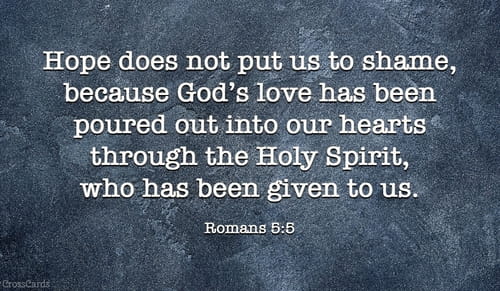
We also boast in our suffering knowing that suffering produces endurance. Endurance produces character. Character produces hope and hope does not disappoint us. God's love has been poured into our hearts through the Holy Spirit that has been given to us.

Christ died for the ungodly at the right time while we were still weak. Someone might actually dare to die for a good person, but rarely will anyone die for any one who is not. God proved his love for us in that while we were sinners Christ died for us.

We will be saved from wrath through him now that we have been justified by his blood. If we were reconciled to God through the death of his Son while we were enemies, much more surely will we be saved by his life having been reconciled.

Our boast is in the Father through our Lord Jesus Christ through whom we have now received reconciliation.

----------------------

We stand justified by faith with grace in the hope of Christ.
We have been honored to share in the glory that his sacrifice sufficed.

The experience of adversity produced endurance.
Endurance produced character with assurance.

Character has formed hope that doesn't disappoint
that which is right about that to which we point.

Love has been poured into our heart's by the Holy Spirit
for the experience of the presence for those who will draw near it.

Someone might dare to die for a good person
but the choice to die for those who were not certain
would be as rare as the final curtain.

Christ died for us when we were sinners
to glorify reconciliation with God for winning figures.

We will be saved from wrath in justification by his blood
as a body for salvation annointed by his love.

The evidence for our testament has been revealed by the Father
through the reconciliation that Jesus Christ has offered.

=============

Rebecca St.James - Hope's Song
Music video

Citizen Way - The Hope Song
Music video

--------------------

Topo Map for Sychar, Samaria


Political Map Sychar, Samaria


The Well

The fourth gospel described the identity of Jesus. The gospel text presented an explanation of Christ's nature and origin as the christian Christology.

Much of the material that had been common to the other 3 gospels was left out. This text includes discourses about the divinity of the Son as the Word for the kingdom of God.

The theological implications for the vision of John the Baptist at the baptism of Jesus were set down in the first chapter of the gospel of John the Evangelist.

Water was turned into wine at the wedding celebration in Canaan. The money-changers were driven from the temple.

Nicodemus was told that it was through the water and the Spirit that a believer had to be re-born in spirit and truth to receive the gift of the Holy Spirit.

John the Baptist declared that Christ was above all.

The 4th chapter recounted the presentation of the Son of God in Samaria, then Galilee. It provided a vision for the redemption of Israel and the lost tribes.

The disciples baptized for repentence in the name of Jesus. Those who had started with John baptized more than he did through their discipleship with Christ as representative of leadership in the world.

When the Pharisees heard of the success of baptism, Jesus chose to leave Judea to travel back to Galilee. He had to pass through Samaria.

Jesus could have chosen a route that avoided Samaria. Most Israelites chose the route near the Jordan to travel north. The Samaritans were hostile to Jews.

He chose to pass through Samaria as part of God's plan for redemption. The  history of discord between Judeans and Samaritans stretched back to pre-Samaritan times in the 10th century BCE. The 10 northern tribes of Israel united in a civil war against David's descendant King Rehoboam.

The 10 tribes of the Northern Kingdom of Israel elected Jeroboam, a descendant of Joseph's son Ephraim, as their king.

Jeroboam expelled all the priests and Levites to reject worship with the Covenant at the Temple in Jerusalem. He set up a new Temple on Mt. Gerizim in violation of the Sinai Covenant and reintroduced golden calf worship.

The Assyrians exiled the 10 tribes of Israel for rebellion in the 8th century BCE. They brought in 5 different groups of people from the East. They brought their gods and their baalim [plural of baal] with them. This was syncretized with the worship of Yahweh.

The Samaritans offered to help rebuild the Temple in the 6th century BCE when the Southern Kingdom of Judah was allowed to return from the Babylonian exile to rebuild in Jerusalem.

They sought to keep the Jews from rebuilding the Temple after their offer was rejected. Did they want to help re-build or was it part of their plan to disrupt the re-construction?

Centuries of enmity left deep-seeded distrust between Jews and Samaritans.  The Samaritans only accepted the first 5 books of Moses (Genesis through Deuteronomy).  They did not accept the histories or the prophets or the books of wisdom into their canon.

The word Sychar is probably the Greek corruption of the name of the ancient city of Shechem. Shechem means 'shoulder' or 'personal interest.' It was where Jacob had made his well. It was to become the capital for the northern kingdom.

The Aramaic name for Shechem is Sichara. The word is very similar to the name Sychar. Scholars usually identify Sychar as either the ancient city of Shechem near Mt. Gerizim or as the present day Arab village of Askar at the foot of Mt. Ebal.

The site for Sychar was prominently located on the road to Galilee in the time of Jesus. Many scholars identify Sychar as the ancient Shechem.

Jesus was tired by the time that he reached Jacob's well, but he did not waste the opportunity to reach out to the lost sheep as the Good Shepherd.

Jesus spoke with the Samaritan woman about her husbands and the man to whom she was not married. She asked others, "Can this be the Christ?" Many believed.

John 4:5-24

Jesus came to a Samaritan city called Sychar near the plot of ground that Jacob had given to his son Joseph. Jacob's well was there. He was sitting by the well at about noon tired from his journey.

A Samaritan woman came to draw water. Jesus said to her, 'Give me a drink.' (His disciples had gone to the city to buy food.) The woman said, 'How is it that you, a Jew, ask a drink of me, a woman of Samaria? (Jews did not share things in common with Samaritans.)

Jesus answered, 'If you knew the gift of God and who it is that is saying to you "Give me a drink", you would have asked him and he would have given you living water.'

The woman said, 'Sir, you have no bucket. The well is deep. Where did you get that living water? Are you greater than our ancestor Jacob who gave us the well from which his sons and his flocks drank?'

Jesus said, 'Everyone who drinks of this water will be thirsty again, but those who drink of the water that I will give them will never be thirsty. The water that I will give will become a spring of water gushing up to eternal life in them.'

The woman said, 'Give me this water so I may never be thirsty or have to keep coming here to draw water.'

Jesus said, 'Go, call your husband and come back.' The woman answered, 'I have no husband.' Jesus said, 'You are right to say, "I have no husband." You have had 5 husbands and the one you are with now is not your husband. What you have said is true!'

The woman said, 'I see that you are a prophet. Our ancestors worshipped on this mountain, but you say that the place where people must worship is in Jerusalem.'

Jesus said, 'Believe me. The hour is coming when you will worship the Father neither on this mountain nor in Jerusalem. You worship what you do not know. We worship what we know for salvation is from the Jews. The hour is coming on us, when the true worshipper will worship the
Father in spirit and truth. The Father seeks such as these. God is spirit. Those who worship him must worship in spirit and truth.'

----------------------

The Son sat down by the well on the shoulder of the road
He asked the watchful woman for a drink of water as not necessarily owed.

He offered her living water that she might see what could be shown
by the gift of giving something that was hers but not her own.

This gift of giving gave the promise of eternal life
insofar as the gift is returned like a husband's hug to his wife.

She asked him for the wonder of this unending gift.
She thought the trick was to receive without the work of thrift.

He asked her to get her husband  and to bring him back.
She said she had no husband to hide her lack of tact.

He said you were right to say you have not that which you lack.
'You had 5 husbands. The man with whom you live is the one that you do not have.'

She said 'I see that you are a prophet, but I cannot worship in the Temple.'
He said the Father seeks those who will worship wherever they may assemble.

The gift of the Holy Spirit wishes for worship in spirit and truth.
The spirit of truth is given by the Son that seeks to share his truth with youth.

=================

Water from the Well
Music video

Casting Crowns - The Well
Music video

-------------------------

Louise de Marillac


When monasticism was authorized by the pope after the claim of papal  sumpremacy, it wasn't dedicated to the recognition of national sovereignty. Participation in the traditional orders carried both a papal and socialist kind of internationalism.

Monasticism had originated with Anthony of Egypt. His followers literally did not own property at the start. They left all that they had to live in the wilderness as a pre-civilized state of existence. They sought to find the economy of natural law.

There were probably benefactors who joined later who claimed that they had sold all their possessions to serve the poor, but used their money to purchase land to build an estate that could house labor that would produce a product of value for the market.

There was a literal aspect in the obedience to the statement to sell all that you have and serve the poor, but it is likely that the abbot who bought property for the use of the Church and didn't sell all his possessions was able to sustain the community long enough to pass it to a successor who could be expected to lead the group in liturgical and social productivity.

It seems likely that the public statement that all had been given to the poor became a declaration that a property would be used to house labor in the name of the Church.

The life of the organization was sustained in the process. The estate might have even made enough for the abbot to give back to the family from which he came.

A number of monasteries were successful because they took in visitors who would make a voluntary contribution for the stay.

The voluntary part of the contribution allowed those who were poor to pay less than a lodge might charge.  Participation in liturgical prayer and the communal contemplation of the scripture was asked to make up the difference.

There was also the chance that a charitable contributor would make a substantial donation for charity and the life of the monastic community.

The vow of chastity was a public admission that marriage didn't look like it would ever work for the monastic. The vow of poverty was a pledge to work for the sustainment of the community.

The vow of charity was an open door to perform good works for those who were less fortunate and not willing to join a monastery.

The medical profession and related supports were largely developed out of innovations that had been adopted and sustained by monastic communities.

Some monasteries used the land purchased in the name of the church to plant vineyards for wine or grain for bread and other foodstuffs.

French Monasticism

Louise de Marillac was born in France, but she had wanted to join the Poor Clares when she was growing up. The Reformation in France was managed differently than in England. Protestants had become a social as well as a religious influence on government.

The royalty in France did not dissolve monastic orders or confiscate their property.

Vincent de Paul and Louise de Marillac created a new national order. The monastic vows were revised for social service in the context of republic or kingdom. There was an increased emphasis on the value of national sovereignty. The property for the monastic order was retained in the name of the leader as privately owned.

While the Church in France, Spain or other nations did not necessarily claim independence from Rome as King Henry VIII had done, there was an adjustment in emphasis even for nations that remained 'catholic.' This adjustment was supported by the Anglican and Lutheran Reformations.

Vincent de Paul established the Congregation of the Mission in 1625. The members of this order were called the Lazarists or Vicentians. They were a community of priests who devoted themselves to work in the small towns and villages of France even though it wasn't necessarily the best choice for ecclesiastical advancement in urban settings like the capital.

Louise established the Daughters of Charity as a mobile monastic community. They didn't live cloistered behind the walls of a monastery devoted to the contemplative life with the liturgical cycle of prayer.

The sisters set up soup kitchens, organized community hospitals, established schools and homes for orphaned children, offered job training, taught the young to read and write and worked to improve prison conditions.

The order spread out from Paris into the countryside, but those who were willing to go through the French speaking world or beyond were authorized by the instruction in charity work. It had become a privately owned and organized form of social work for charity.

Donations were accepted.

Louise de Marillac
b. 8.12.1591  Le Meux, Olse, France
d. 3.15.1660  Paris, France

Louise was born out of wedlock near Le Meux in the Olse department of Picardy in northern France on August 12, 1591. She never knew her mother.

Louis de Marillac, Lord of Ferrires (1556-1604), claimed her as his natural daughter but not his legal heir. Louis was a member of the prominent de Marillac family. He was a widower at the time that Louise was born.  Her uncle, Michel de Marillac, was a major figure in the court of Queen Marie de' Medici.

Louise was not a member of the Queen’s court, but she lived and worked among the French aristocracy. 

When her father married his new wife, Antoinette Le Camus, she refused to accept Louise as part of their family. Louise grew up amid the affluent society of Paris, but without the stability offered by the promise of inheritance home life.

She was cared for and received an excellent education at the royal monastery of Poissy near Paris. Her aunt was a Dominican nun.

Louise remained at Poissy until her father's death when she was 12 years old. She stayed with a devout spinster from whom she learned household management skills in addition to the secrets of herbal medicine.

Louise felt drawn to the cloistered life at around the age of 15. She made an application to the Capuchin nuns in Paris but was refused admission. It is not clear if her refusal was for poor health or other reasons. Her spiritual director assured her that God had "other plans" for her.

Her family convinced her that marriage was the best alternative when she was 22 years old. Her uncle arranged for her to marry Antoine Le Gras, secretary to Queen Marie.

Antoine was an ambitious young man who seemed destined for great accomplishments. Louise and Antoine were wed in the fashionable Church of St. Gervaise on February 5, 1613.

The couple had their only child, Michel, in October. Louise grew to love Antoine and was an attentive mother to their son.

Louise was also active in ministry in her parish. She had a leading role in the Ladies of Charity, an organization of wealthy women dedicated to assisting those suffering from poverty and disease.

Her two uncles who held high rank within the government were imprisoned during civil unrest.  One was executed in public. The other died in prison.

Antoine contracted a chronic illness and eventually became bedridden in 1621. Louise nursed and cared for him. Depression threatened to overtake Louise as the illness took its toll on Antoine in 1623.

She had suffered doubt for years for not having answered the call that she had felt as a teenager. Francis de Sales and his friend, the bishop of Belley, acted as sympathetic counsellors to her.

She had a religious experience on the feast of Pentecost during the Mass in 1623. She decided that it was right to stay with her husband. She vowed not to remarry if her husband was to die before her. She would be able to make her vows of service to the Church in a small community.

She believed that she had received the insight that she would be guided to a new spiritual director whose face she was shown. When she happened to meet Vincent de Paul, she recognized him as the priest from her vision.

Antoine died in 1625. Louise had managed to find time to maintain her household, entertain guests and nurture Michel, her 13-year-old son, with special needs.

She wrote her own "Rule of Life in the World" that detailed a structure for her day.

Time was set aside for reciting the Little Office of the Blessed Virgin Mary, attending Mass, receiving Holy Communion, meditation, spiritual reading, fasting, penance, reciting the rosary and special prayers.

She had to move after Antoine died as she lacked the financial means to sustain the property. Vincent lived near her new residence.

He was reluctant to be her confessor at first. He was busy with his Congregation of Charity. The members were aristocratic ladies of charity who were helping him nurse the poor and look after neglected children. It was a real need for the time.

The ladies were busy with many of their own concerns and duties. His work needed more helpers, especially ones who were peasants themselves. Louise was well prepared to teach and organize the poor.

Vincent invited Louise to become involved in his charity work in 1629. She found great success in these endeavors. She became convinced that it was time to intensify her ministry with poor and needy persons in 1632.

Louise found the help she needed in young, humble country women who had the energy and the proper attitude to deal with people weighed down by the suffering of destitution. She began working with a group of them and saw a need for common life and formation.

She invited four country girls to live in her home in the Rue des Fosses‐Saint‐Victor and began training them to care for those in need.

Mobility was a major innovation. The Daughters of Charity were unlike other established religious communities whose religious women were behind cloister walls in a monastery and performed a ministry of contemplative prayer.

"Love the poor and honor them as you would honor Christ Himself," Louise explained. That was the foundation of the Company of the Daughters of Charity which received official approbation in 1655.

The organization had sponsorship, but little capital. The mission gave instruction in prayer for order with hygiene in the household.

Louise led the Company of Daughters until her death in Paris on March 15, 1660.

She died six months before the death of her dear friend and mentor, Vincent de Paul. She was 68.

The Daughters of Charity had more than 40 houses in France. The nuns have always been held in high repute and have a presence in all parts of the world.

While monasticism in France was not immediately transformed French monasticism had been established. The work of Louise de Marillac and Vincent de Paul helped to start the transition to service that was extended through the French speaking world to other locations.

It was a lever against the claim of papal supremacy.

Louise de Marillac
S.  路易丝·德·马里拉克
T.  路易絲·德·馬里拉克

路 Lu    road                        路  ro        path              Ru    ル    る             Lu    루  sack       
易 yi     easy                        易  eki      easy               i       イ-   い-            i       이   this           
丝  si    wire                         絲  shi      thread           zu     ズ    ず             seu    스  s             
德  de  goodness                  德   toku  ethics            do      ド    ど            deu    드   de                 
马  Ma  horse                      馬  ba       horse             Ma     マ    ま            Ma    마   hemp           
里   li     in                           里   ri       village            ri      リ    り             lil      릴    reel 
拉   la    pull                         拉   ratsu  Latin             ratsu ラッ らっ      lag    락     rock             
克  ke    gram                       克  koku   overcome      ku      ク    く                             

 ----------------------

Prayer, reading, meditation and church guided thought to particular petition.
The path to goodness went from the individual to the group with repetition.

Growth in the vision of self as connected by the personal to the social view
helped to overcome the impulse of desire by the movement to the true.

=================

Casting Crowns - The Well
Music Video

Leave that which is wrong behind to find the order for reality that is better for life.

Lectionary: Louise de Marillac
wiki LdM

===========

Socialism and Populism


The leading Democrats are either openly socialist or socialist without declaration.

Marxist socialism was defined in support of labor, either by government regulation or corporate selection. The institution of socialism as an economic form is against the attainment of education as a merit based system for employment.

This economic system imposes a degenerate influence on society. When people are hired because they don't have an education, it makes demographic despotism the rule for order in making decisions.

New York state declares itself a leading representative for education, but the mechanism for membership selection as used by the Tammany society are still employed for employment. It is not as openly behind the scenes as it had been, but it still operates like a ghost in the machine.

Populism is for the use of government in the redistribution of wealth. Huey Long is regarded as the leading representative of the economic policy for redistribution with taxation.

The hybrid economic form has found its way into the national media. Politicians don't emphasize concession to the demands of labor as in former times. Populism is the media expression for a 'socialist' agenda.

Factions are used to suggest that an anti-majority principle of government is necessary to correct the social institution of partiality in judgment.

When men aren't being accused of sexual assault as a form of sexism, white people are accused of institutional racism, because a minority can't institute racism against the majority.

It is a populist factionalism insofar as the factions are used to suggest to the public that government is necessary to shift the favor from due process in law to correcting the errors of sexism or racism with government favor. This adversely effects the distribution of wealth.

The epistle to James complained about wealthy people dragging the poor into court in order to win the court case with the influence of affluence. He didn't complain about people with less wealth dragging people to court to take money from those who were wealthier. Neither case is ethically justified.

A court case has to be determined on the merit of argument for justice. Was the person who brought the complaint wronged by the accused?

The gospel of Matthew also expressed bias against the wealthy when it was assumed that the rich man was the cause for the condition of Lazarus. He had been taking money without having earned it, while Lazarus sought nothing more than to ask for money from others.

It's not as though there are never wealthy people who exploit others. It's just not the case that wealthy people are always guilty of offending large groups of people.

Social security was presented as employment insurance for the payer and disability insurance for others. Socialists and populists use it for their re-election.

Donald Trump is not a populist. Family trusts are formed by private investment in privately owned corporations. It is an endorsement of capitalist enterprise that warrants merit. Many of those in labor who had their demands met by corporate employment have trusts esbalished for them.

Legal complications have ensured that the use of family trust for supplemental income is not too easy.

------------------

Huey Long longed to share the wealth.
Article: JSTR Daily

Long and Trump
Article: The Advocate

Populism was against the established authority as an agency for the wealthy. It advocated for increased taxes to redistribute or share the wealth.

Donald Trump has had to defend the public and himself against attacks from the abuse of authority by those who were leading the Democrat party.

HC used the media to declare that Republican had a war on women, so she could feel justified in going after men in the public perception. This included using the presumption of sexism  to authorize the claim of sexual assault with the support of media outlets.

BO used the media to imply that public opinion was stacked against black men. His position was used against the NRA and for taking a knee in football games. It was anti-majority in the implication that black men were oppressed by the 'majority.'

BO, HC and JB were working to increase hostility against foreign powers to authorize the destruction of Libya and the assault against Syria, Russia and China. Support for regime change was implicated as a promotion for ISIS and other terrorist organizations.

The Dems were the most aggressive in the media attack on successful Americans.
It is an error to define Donald Trump as a populist.

The only thing that Trump has in common with Huey Long is that he is fiery also.

-------------------

Sunday, January 19, 2020

Order

1.26.20


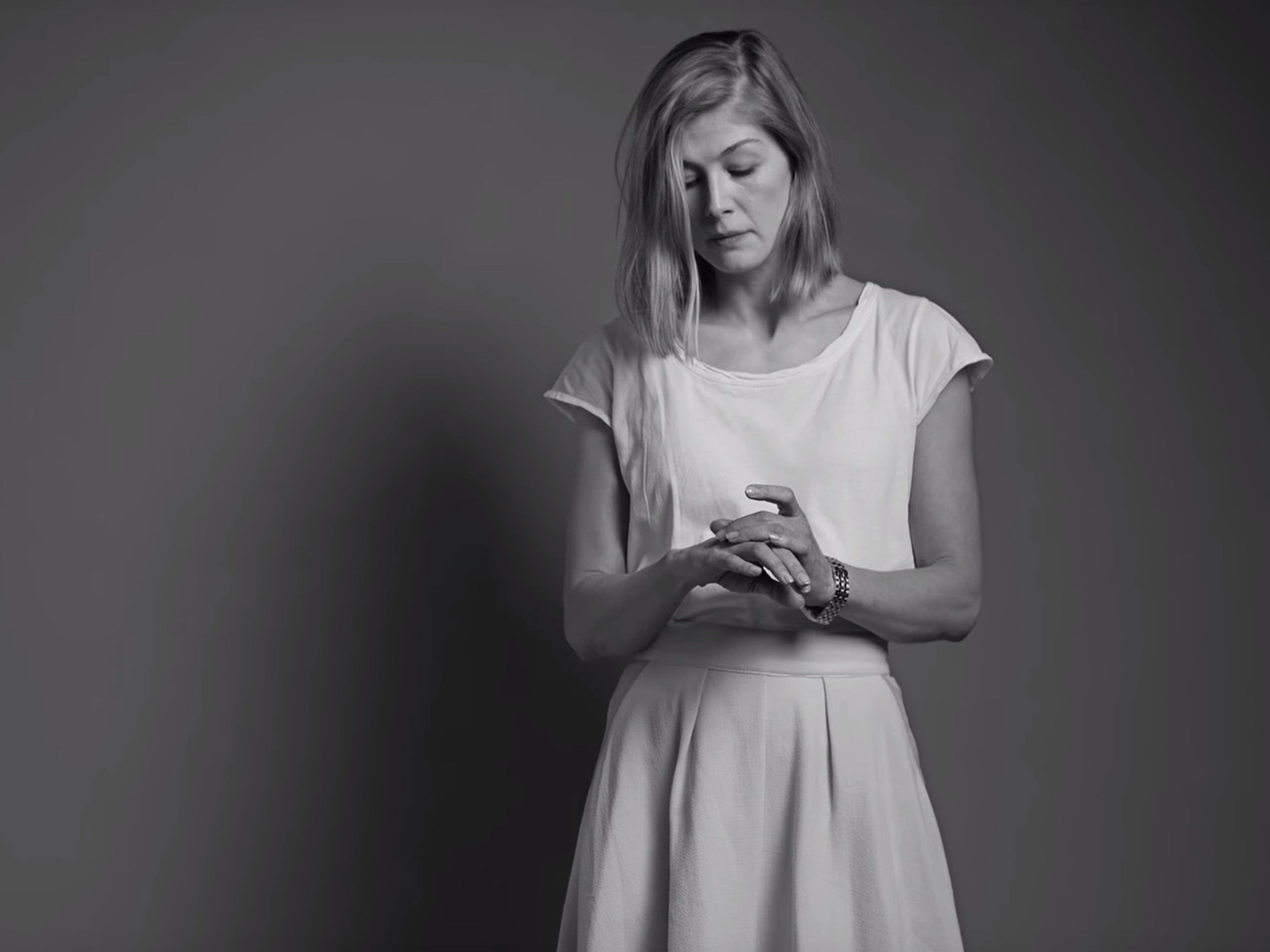
Rosamund Pike


Order
Thought
订单思想
Dìngdān sīxiǎng
注文思考
Chūmon shikō
ps119.97+
Ordinis thought

The Father spoke the elements with material elation.
The Word put them together in the act of creation.

Logic is drawn from language with the art of reason.
It is the means of expression for the particular season.

What is the name for this season now?
Winter shivers when cold is sensibly endowed.

The art of division separates thought 
from emotions that have nought.

Animals are prompted to action by impulse with instinct.
A person is directed to act by judgement that isn't too instant.

Self-preservation is common to both
but the human entertains production for economic growth.

How I love 
the sight of the dove!

The flight in the light 
represents spiritual delight.

When darkness had threatened the memory of the past
the wings of the dove signaled remembrance of strength that will last.

Water is necessary to drink, cook and clean.
It is essentially good for health and hygiene.

Various arts are devoted to the performance of action
with the order of readiness to display interaction.

Entertainment produces action for a desirable effect
to impress the audience with the desired intent.

Art has procedure established by reason.
Happiness varies with time in the season.

How I love law for constancy and variance.
It is constant against acts that damage in variants.
It allows for variance in empirical experience.

Reason directs action from the lower powers
but it also reflects on itself with respect for the hour.

Logic and grammar form the base for rhetoric.
These are the elements of thought that reverence relevance.

The order of letters identify the word as a unit.
Spelling precedes grammar in language that is human.

The art of production enables the performance of manual acts
in the easiest way that thought can enact.

Reason had reasoned about manual acts
to create a product that expresses consensual craft.

Art is necessary to direct the act of apprehension
so the action can gain traction for production by selection.

Logic is the name for the craft in this art.
The order of thought communicates ideas at least in part. 

The order of nature is a concern in this craft.
It is design that produces duty that isn't just a fast draft cast to last.

Reflection on the commandments made me wiser for what's true 
than I would have been had I not used the law as a cipher for the newly renewed.

That which was savage in the expression of the elements 
had 'made' me act in a way that wasn't civil or relevant.

My enemies work to push me back to that state
that often enough sounded like an expression of hate.

Logic is an art in the science of reason.
It is ordered for meaning in the action needed.

It was a beacon of light 
when darkness darkened sight.


This darkness was rebellion against authority
whether it came from the majority or minority.


The land of Zebulun and Naphtali had fallen into contempt
but from this curse they would ascend.

Each home struggled with the call to unity
in defense of tribal land as part of a larger community.

They had allied with a planned rebellion
that turned the land into a dwelling place for hellions.

Darkness had obscured faith in the Light
as the means by which people came to sight.

The best end was hidden by the brightness.
It could be discerned by diligent forthrightness.

They rejoice before you as with the joy of harvest
but by your faith you will reach the farthest.


Rod of Asclepius

Reason is structured to communicate ideas on design
when these fix agreement like the rod of Asclepius divined.

Logic is the art of arts
that directs production from any start.

The parts of diversity are ordered for unity
to guide the union to organize community.

The first act of reason is the recognition of the unit.
A thing exists as it is and is as illumined. 
Recognition of the unit is like song is to music.

The thing that exists is represented by an idea in the memory.
The representation is a reflection of a fact that is sensory.

The second operation is combination or division.
Truth or falsity are present in the interpretation of the mission
for the admission of what is right about this vision.

Subtraction is the reverse of addition.
Multiplication is the inverse of division.

I have more understanding of knowledge than the vitriol from my haters
because the acts of reason lift me above the insults from those anti-negotiators.

I can move from one thing to another grown
when the unknown becomes known 
by knowledge drawn from other sources shown.

The order for the comprehension of representation
is drawn from the recognition of units in combination.

My study has made me wiser than the experience of my years
because I have observed instruction from God's law extend beyond the fears
and tears drawn from the weird.

I restrain my action from evil
that I may keep my word intact in the legal.

I do not shrink from judgment by reason
because I was taught to judge with reasonable adhesion.

Unity in things essential is more important
than disagreement as the constant content in portent.

Has Christ been divided?
Such a view is misguided.

Is the name of your baptist the main concern for faith?
Baptism is the initiation that helps you to learn to deal with natural pain.

The gospel is the means by which to grow in Christ.
By this our unity is defined as essentially undivided.

Divine energy is sweet to my taste.
It is a product of experiential or literary grace.

I gained understanding from the experience of what is right
by direction from the commandments of God in law with insight.

The struggle to find truth with combination or division
continues with participation in the heavenly vision.

The administration of agriculture was named Galilee.
The corridor of land extended from the smaller to the larger sea.

Like the transcendence of Jacob by Israel
the law of the land was for the unity of the legally real.

The people who toiled in darkness
were shown a great light that would not disarm us.

John had stated, 'Repent for the kingdom of heaven is at hand.'
Jesus declared the same message without asceticism implied by demand.

Peter, Andrew, James and John were fishermen by trade.
They left their nets to become fishers of men by Jesus made.

The Word provides a light for my feet.
Illumination in the dark is what I need
to believe, breath and see what I seek.

There is light enough to avoid snakes
or bad luck from mischief or mistakes.  

I have sworn and am determined 
to keep the rightness of the judgments illumined.

When I am deeply troubled
I ask for help to avoid the trouble doubled. 

The testimony from my lips has been accepted
as willing tribute for what is divine and not neglected.

Responsibility is organized for safety
with security as a measure for the stately.

Traps have been laid for me by the immoral
but I have not been deterred by their quarrel.

The promise of salvation is my inheritance. 
It is my support against conflict, adversity and insensate chance.

I have applied my heart to fulfill the divine statutes
by the application of principles for duty I can use.

I hate it when my mistake does me harm.
I love the rules that keep me armed for charm.

You are the safety that secures my refuge
My hope is in the word that will be used. 

I will not act on the impulse to cause harm
yet I will defend myself from attack that is so armed.

Sustain me with the shelter of your promise
that my hope will remain august and honest.

Hold me in safety with the length and strength of security
and I will delight in what's right in law beyond my maturity.

Consequence results from action in the world.
Deceitfulness adds dissonance to the consequential blur.

Reward for rightness or loss for the wrong
is consequence that judgment can discern to grow strong. 

Those who deny consequence for their action 
lose the sense of true consonance for their faction.

My flesh trembles with fear for salvation.
I fear the loss of benefit for the nation.

The Spirit soars
when love adores.

-----------------------

Psalm 119
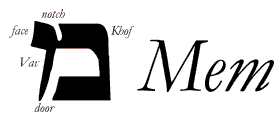
Mem
13th letter
Water
Quomodo dilexi!
How I love!

97 Oh, how I love your law!
all the day long it is in my mind.
98 Your commandment has made me wiser than my enemies,
and it is always with me.
99 I have more understanding than all my teachers,
for your decrees are my study.
100 I am wiser than the elders,
because I observe your commandments.
101 I restrain my feet from every evil way,
that I may keep your word.
102 I do not shrink from your judgments,
because you yourself have taught me.
103 How sweet are your words to my taste!
they are sweeter than honey to my mouth.
104 Through your commandments I gain understanding;
therefore I hate every lying way.

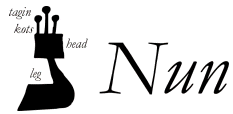
Nun
14th letter
Snake
Lucerna pedibus meis
My feet

105 Your word is a lantern to my feet
and a light upon my path.
106 I have sworn and am determined
to keep your righteous judgments.
107 I am deeply troubled;
preserve my life, O Lord, according to your word.
108 Accept, O Lord, the willing tribute of my lips,
and teach me your judgments.
109 My life is always in my hand,
yet I do not forget your law.
110 The wicked have set a trap for me,
but I have not strayed from your commandments.
111 Your decrees are my inheritance for ever;
truly, they are the joy of my heart.
112 I have applied my heart to fulfill your statutes
for ever and to the end.


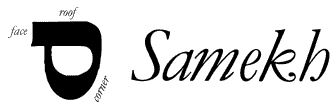
Samekh
15th letter
Support
Iniquos odio habui
I hate

113 I hate those who have a divided heart,
but your law do I love.
114 You are my refuge and shield;
my hope is in your word.
115 Away from me, you wicked!
I will keep the commandments of my God.
116 Sustain me according to your promise, that I may live,
and let me not be disappointed in my hope.
117 Hold me up, and I shall be safe,
and my delight shall be ever in your statutes.
118 You spurn all who stray from your statutes;
their deceitfulness is in vain.
119 In your sight all the wicked of the earth are but dross;
therefore I love your decrees.
120 My flesh trembles with dread of you;
I am afraid of your judgments.

--------------------
===============
--------------------

Psalm 119
13th, 14th and 15th letters

Mem
Water

Mem is the 13th letter in the Semitic abjads. These include the Hebrew mēm מ, Aramaic Mem, Syriac mīm ܡܡ, Arabic mīm م and Phoenician mēm.

The Phoenician letter gave rise to the Greek mu (ج), Etruscan M, Latin M and Cyrillic ج.

It is believed that the Phoenician word for “water”, mem (Phoenician mem.png) is a morphed and simplified Egyptian hieroglyphic symbol for water.

Mem, like Kaph, Nun, Pe, and Tzadi, has a final form that is used at the end of words. The shape is changed from מ to ם.

The letter is King over Water, Formed Earth in the Universe, Cold in the Year, and the Belly in the Soul in  the Sefer Yetzirah. The Sefer Yetzirah is the title of the earliest extant book on Jewish mysticism.

Some early commentators treated it as a treatise on mathematical and linguistic theory as opposed to Kabbalah. Yetzirah is more literally translated as "Formation"; the word Briah is used for "Creation".

The letter is associated with The Hanged Man (Atu XII), the element of water and the path between Geburah and Hod on the Tree of Life in Tarot cards.

The card for the Hanged Man shows  an image of a man being hung upside-down by one ankle. This method of hanging was a common punishment at the time for traitors in Italy. The solemn expression on his face suggests that he is there by his own accord.

The card is meant to represent self-sacrifice as opposed to corporal punishment for criminality. It means the person having the cards read can choose to correct himself to avoid the imposition of being corrected by others.

Gevurah is "the essence of judgment and limitation". It corresponds to awe and the element of fire.
Hod is explained as an analogy. One overcomes or submits to an obstacle in oneself instead of "conquering" some thing in one's way (Netzach).

Nun
Snake

Nun is the 14th letter of the Semitic abjads. These include the Phoenician Nūn, Hebrew Nun נ, Aramaic Nun, Syriac Nūn ܢܢ, and Arabic Nūn ن.

The Phoenician letter gave rise to the Greek nu (ح), Etruscan N, Latin N, and Cyrillic ح.

Nun is believed to be derived from an Egyptian hieroglyph of a snake. The Hebrew word for snake, nachash begins with a Nun and snake in Aramaic is nun. Nūn means large fish or whale in Arabic.
Naḥs in modern Arabic literally means "bad luck".

A rolled Nun passes play to the next player with no other action in the game of dreidel. A dreidel is a four-sided spinning top used to play the game with the same name during the Jewish holiday of Hanukkah.

Each side of the dreidel bears a letter of the Hebrew alphabet. The letters are  נ (nun), ג (gimel), ה (hei) and ש (shin).

These letters are translated in Yiddish to a mnemonic for the rules of a gambling game played with the dreidel. Nun stands for the Yiddish word nisht ("nothing"), Gimel for gants ("all"), Hei for halb ("half") and Shin for shtel ayn ("put in").

Together they represent the Hebrew phrase nes gadol hayah sham ("a great miracle happened there"). The statement refers to the Miracle of the cruse of oil.

The story of the miracle occurred after the liberation of the Temple in Jerusalem during the Maccabean Revolt as described in the Talmud. A  jug of pure oil that was to be enough to light the lamp for one day lasted for eight days.

Samekh
Support

Samekh is the 15th letter in the Semitic abjads. These include the Phoenician sāmek 𐤎‎ ; Hebrew samekh סָמֶךְ and Syriac semkaṯ.

The letter has no continuant in the Arabic alphabet, its numerical value is taken by Arabic Šīn.
The Phoenician letter gave rise to the Greek xi (خ).

The archaic "grid" shape of Western Greek xi (Greek Xi archaic grid.svg) was adopted in the early Etruscan alphabet (𐌎 esh), but was never included in the Latin alphabet.

The Phoenician letter may continue a glyph from the Middle Bronze Age alphabets. It is either based on a hieroglyph for a tent peg or a support. It may possibly be the djed "pillar" hieroglyph.

-----------------------

Bring the bull before the entrance of the tent. Aaron and his sons shall lay (samkh) their hands on the head of the bull. (Exo. 29:10)

 -----------------------

The act of laying on hands was used to consecrate a priest for service or an animal for sacrifice in a blood ritual.

The apostles combined the action with prayer for the restoration of good health.

-----------------------

What is the name for this season?
Winter.

Chn.  这个季节叫什么名字?
            Zhטge jלjiי jiאo shיnme mםngzל?
           冬季。
            Dōngjל.
Jpn.    今シーズンの名前は何ですか?
             Kon shīzun no namae wa nanidesu ka?
             冬。
             Fuyu.
Krn.    이번 시즌의 이름은 무엇입니까?
             ibeon sijeun-ui ileum-eun mueos-ibnikka?
             겨울.
             gyeoul.
Ltn.     Quod nomen hoc tempore
             Hiems.
Itln.     Qual ט il nome per questa stagione? Inverno.
Spn.     ¿Cףmo se llama esta temporada? Invierno.
Frn.      Quel est le nom de cette saison? Hiver.
Gmn.    Wie heit die Saison? Winter.
Dtch.     Wat is de naam voor dit seizoen? Winter.
Czch.     Jak se jmenuje tato sezףna? Zimnם.
Hngn.    Mi a neve ennek a szezonnak? Tיli.
Trk.         Bu sezonun adı nedir? Kış.
Grk.        Ποιο είναι το όνομα αυτής της σεζόν; Χειμώνας.
                Poio eםnai to ףnoma aftםs tis sezףn? Cheimףnas.     
Rsn.      Как называется этот сезон? Зима.
               Kak nazyvayetsya etot sezon? Zima.

-------------------

Isaiah 9:2


Map of 12 Tribes of Israel


Zebulun was the sixth son of Jacob and Leah. The name translates as 'home.' It was ascribed to one of the twelve tribes of Israel. It was to become one of the ten lost tribes at the time of Isaiah.

Joshua allocated the land among the twelve tribes after the conquest of Canaan according to the book ascribed to his name.

Zebulun was allocated the territory at the southern end of the Galilee. The eastern border was the small sea. The western border was the Mediterranean. The south was bordered by the Tribe of Issachar. The north had Asher on the western side and Naphtali on the eastern.

Zebulun is described as sending to the battle those that handle the "sopher shebet" in the ancient Song of Deborah. The "rod of the scribe" was a stylus of wood or metal used to inscribe clay tablets or to write on papyrus. It was depicted in certain Assyrian monuments.

Those who wielded it would have been the associates of lawgivers. The tribe was considered to have a symbiotic relationship with Issachar. Issachar was the tribe that traditionally was seen as having many scholars according to Jewish tradition.

Zebulun financially supported Issachar's devotion to the study and teaching of the Torah in exchange for a share of the spiritual reward from such research. The terms Issachar and Zebulun came to be used by Jews for anyone engaged in such a relationship.

The Revised Standard Version rendered the description in the Song of Deborah of the people sent to battle by Zebulun as "those who handle the marshal's staff". They weren't the scholars. They sent officials as officers.

Naphtali was one of the northernmost of the twelve tribes. The name means "my struggle." Joshua assigned Naphtali the eastern side of the Galilee according to the Bible. This region held the highly fertile plain of Gennesaret. Josephus had called the area the pride of nature.

The tribe produced farmers and fighters. Militarism was celebrated in Naphtali's history.
Ahaz, king of Judah, had appealed to Tiglath-Pileser III, the king of Assyria, for help c. 732 BCE.

Tiglath-Pileser sacked Damascus and Israel. He annexed Aram and a large part of Israel, "including all the land of Naphtali." The people were not allowed to have a king from their tribes.

Chapter 9 in the Book of Isaiah is a continuation of the prophecy started in Ch. 7 and continued in Ch. 8. It is composed of mingled threats and promises. Its characteristic may be said to be "rays of light thrown into the midst of shades."

It promises comfort and deliverance at the same time it denounces the sins of the nation. The anger of the Lord had not been turned away. The previous chapter had closed by describing a time of general calamity and darkness.

This begins Isa 9:1-4 by showing that the calamity would not be so great as in former times. It would be mitigated. There would be light, particularly in the dark regions of Zebulun and Naphtali.

--------------------

Isaiah 9:1-3

There will be no gloom for those who were in anguish. He brought into contempt the land of Zebulun and the land of Naphtali in the former time, but he will make glorious the way of the sea, the land beyond the Jordan, Galilee of the nations in the latter time.

The people who lived in a land of deep darkness--
on them light has shined.
You have multiplied the nation.
You have increased its joy.
They rejoice before you
as with joy at the harvest
as people exult when dividing plunder.

--------------------

The land of Zebulun and Naphtali had fallen into contempt
but from this curse they would ascend.

Each home struggled with the call to unity
in defense of tribal land as part of a larger community.

They had allied with a planned rebellion
that turned the land into a dwelling for hellions.

Darkness had obscured faith in the Light
as the means by which people came to sight.

The best end was hidden by the brightness.
It could be discerned by diligent forthrightness.

They rejoice before you as with the joy of harvest
but by your faith you will reach the farthest.

===============

Unity in Faith


Corinth was a classically cosmopolitan Greco-Roman city.

Its location by the sea made it accessible to other cultures. Poseidon was the chief god, but there were temples for Demeter, Octavia, Apollo, Hermes, Isis, Venus-Fortuna and Aphrodite.

The temple of Aphrodite on the Acrocorinth was reputed to have temple prostitution.
Competition for reputation was based on the claim to fame by association with a name.

Ecstatic experience was associated with religion. Too much thought might lead to the consideration of measure. Measure could be used to test for certain claims to fame, but there was always something about a cult that transcended investigation by experiment.

It was the experience of ecstasy that defied and defined Apollonian excess in measured existence.

T.S. Eliot expressed the WWII form of cosmopolitan consciousness in his poem The Love Song of J. Alfred Prufrock.  The excess of measure was reduced to a physical household act when Prufrock declared:

I have measured out my life with coffee spoons;
I know the voices dying with a dying fall
Beneath the music from a farther room.
So how should I presume?

Competition is regarded as a beneficial part of nature insofar as it helps sensory perception focus on key elements in the production of a service. Too much competition however is divisive. It can result in enslavement to 'victory' as a form of idolatry.

The introduction to the first letter to the Corinthians renounced that which is wrong with the claim to authority by association with a name.

The new religious form for monotheism was looking like it would simply transfer the conflict between the gods to that between humans.

The author later referred to a letter that he had written earlier (1 Corinth. 5:9). He had explained that mixture with the immoral could corrupt the resurrected life in Christ.

His advice was, "Don't mix with the immoral." This may have been a major theme in the first letter.

The unity of the faith was to be found in Jesus as Christ. The preservation of the forward movement of society in the monotheistic form was expressed in the symbolic death of false gods in Christ crucified on the cross.

The same problem that had existed before the establishment of the church threatened to manifest in a different guise. Who baptized whom was packaged as the new competition. This also was all too human.

The anthropomorphism of the gods had the societal value for drawing attention to the unique frame for time with respect for the movement of the planets and stars. This uniqueness found expression in the immorality of divine beings.

This was not good insofar as it encouraged vice through stories about violence in aggression or cruelty in punishment.

Paul knew that the message of Christ crucified would not appeal to the wisdom of the world, but he felt that the church had to have a government that was directed toward societal benefit in advancement by faith in the love of God.

He downplayed his own leadership in terms of baptism in order to emphasize the value of the gospel for the Church and the larger society outside the community. The loyalty of believers was directed to the name of Jesus as the Author of salvation for the faith.

1 Corinth. 1:10-17

I appeal to you by the name of our Lord Jesus Christ that all of you should be in agreement. There should be no divisions among you. You should be united in the same mind and the same purpose.

It has been reported to me by Chloe's people that there are quarrels among you. What I mean is that each of you says, "I belong to Paul', 'I belong to Apollos', 'I belong to Cephas' or 'I belong to Christ.'

Has Christ been divided? Was Paul crucified for you? Were you baptized in the name of Paul?
I thank God that I baptized none of you except Crispus and Gaius. No one can say that you were baptized in my name. (I did baptize the household of Stephanas also. I don't know if I baptized anyone else beyond that.)

Christ did not send me to baptize, but to proclaim the gospel.

--------------------

Unity in things essential was more important
than disagreement as the constant content in portent.

Has Christ been divided?
Such a view is misguided.

Is the name of your baptist the main concern for our faith?
Baptism is the initiation that helps you to learn to deal with natural pain.

The gospel is the means by which to grow in Christ.
By this our unity is defined as essentially undivided.

===============

Upper and Lower Galilee


The area occupied by the tribes of Zebulun and Naphtali would become Lower and Upper Galilee by the time of the Roman occupation.

The fertility of the upper region made the land a symbol for cross-cultural development. The administrative function for Zebulun combined with the struggle to produce food from the land that had to be defended for the production of Naphtali. The union of administration with agricultural labor represented sustenance with the ability to increase production.

The cultivation of the darkness of the earth in the light of day was an expression of promise.

Matt. 4:12-23

When Jesus heard that John had been arrested, he withdrew to Galilee. He left Nazareth and made his home in Capernaum by the lake in the territory of Zebulun and Napthtali, so what had been spoken through the prophet Isaiah might be fulfilled:

'Land of Zebulun, land of Naphtali,
on the road by the sea across the Jordan, Galilee of the Gentiles--
the people who sat in darkness
have seen a great light.
Light has dawned
for those who sat in the region of shadow and death.'

Jesus began to proclaim from that time, 'Repent for the kingdom of heaven has come near.'

He saw two brothers as he walked by the Sea of Galilee. Simon, who is called Peter, and Andrew, his brother, were casting a net into the lake for they were fishermen. He said to them, 'Follow me and I will make you fishers for men.' They left their nets and followed him immediately.

He saw two other brothers as he went from there. James son of Zebedee and his brother John were in the boat with their father Zebedee mending their nets. He called them. They left the boat with their father and followed him.

--------------------

The Land of Zebulun and Naphtali
was a corridor that extended from the sea of Galilee.

Like the transcendence of Jacob by Israel
the law of the land was for the unity of the legally real.

The people who toiled in darkness
were shown a great light that would not disarm us.

John had stated, 'Repent for the kingdom of heaven is at hand.'
Jesus declared the same message without asceticism implied by demand.

Peter, Andrew, James and John were fishermen by trade.
They left their nets to become fishers of men by Jesus made.

===============

Truth


When Thomas Aquinas lived in the 13th century the works of  Aristotle had largely been forgotten in Western Europe.  These works started to become available again partly from Eastern European sources and partly from Muslim Arab sources.

The Muslims in Africa had most likely received translations from the Middle East and passed them into Europe through their occupation of Spain.

These works offered an exciting new way of looking at the world. The logic of Aristotle considered what a number of sources had to say, but unlike the Socrates in Plato's dialogs, he didn't use logic as a means to eliminate explicit agreement.

His dialectic reason offered the expansion of the capacity to look at virtually anything from the first person perspective to develop a philosophy that allowed for metaphysics.

Metaphysics was important in Greek and Roman exposition because it allowed for the relevance of observation by an observer. The focus was not just on the definition of order in nature as something that was outside of the human perspective.

There were  students of Aristotle that adopted him as as an alternative to Christianity. Others used his political philsophy as the means to justify slavery as the means to expand 'civilization.'

Christians who had been influenced by the anti-pagan legislation of Byzantine Romans defined Aristotle and Plato as enemies of the faith.

Thomas Aquinas was an example of the kind who used knowledge of scripture to consider the analysis of Aristotle's classical perspective to criticize the Islamic influence on European culture. It was felt that Islam was an incursion in Europe.

Aquinas was like the Muslims who had translated Aristotle's work in that he undertook to explain Christian ideas and beliefs in language that would make sense to disciples of Aristotle.

Aristotle's analytics were not as restricted to the control of a city state by a king or a despot as was the political philosophy of Plato.

His a posteriori analytics made it into the historical analysis of the history of Rome without explicit reference to his work. A number of patricians were inclined to see him as too imperial for their sense of republic.

This analytical approach was still radical in the time of Aquinas. Given the threat of exclusion or punishment represented by the Inquisition he lived on the edge of ecclesiastical approval.

His success can be measured by the prevalence of the notion that Christian scholars in the Middle Ages informed reason for faith with the work of Aristotle as a scholastic effort.

The insistence of Aquinas that logical argument must be prepared to meet argument from other scholars on their own ground to become familiar with the oppositional view. A logician can argue for his position from their premises. This technique has been a permanent and valuable contribution to Christian thought.   

The socialist position as derived from Marx has expressed the asceticism of the Christian religion as a means to convert the unconverted. The Christian logician can argue that though socialism is anti-religious, it doesn't prove that Christianity is false.

It can be asserted that the popularity of Marx is dependent upon the condemnation of capitalism by the demands of labor as supported by officials in government who are working for their bureaucratic power over the private sector.

The socialist position essentially reduces the existence of management, the middle class, the wealthy and Christianity to things that are in the way of the proletariat. It is a degenerative advocacy in the development of civilized society. It was the replacement ideology for slavery. 

Plato


Thomas Aquinas on Posterior Analytics

Posterior analytics is the study of patterns in analysis that retains consistency with the logical description of reality. It is about the experience of education with reason.

Physics is the study of nature. This study includes the description of forces that change things in the physical world. Change doesn't happen unless it is caused.

This study describes how things would work in nature without the observation of the observer. It is purely physical in terms of mechanical operations of matter and energy in space.

Metaphysics is concerned with first causes and the principles for how things work. It is derived from physics, but it is about that which is greater than the mechanical materialism in purely physical operations.

Free will is the expression of choice that seeks to order the randomness that occurs in the regular course of events to organize a structure that will result in a beneficial outcome.

How is it that we are to work the elements of chance to result in a desired benefit? Can we work to make luck produce good fortune?

Aristotle wrote in his Metaphysics, (980b26), “the human race lives by art and reason." The art of reason distinguishes humankind from other animals. Animals are prompted to action by instinct and impulse. A person is directed to act by judgment with reason.

Various arts are devoted to the ready and orderly performance of human action. An art is a definite and fixed procedure established by choice that produces a desirable effect.

Reason not only directs the action of lower powers, it selects its own direction for action. That which is particular to intellect is the ability to reflect upon itself. Intellect knows itself.

Reason is able to reason about its own operation.

The art of construction or production enables anyone capable to perform manual acts in an easy and orderly manner. This was thought that had reasoned about manual acts.

An art is needed to direct the act of communication, so the act of reasoning might proceed in an orderly and easy manner with the hope of producing a product with a benign purpose.

This art is logic. It is the science for reason with language. Logic is concerned with order for the meaning of expression in the act of organizing thought. Reason concerns itself with its proper matter, the ability to communicate ideas.

It is the art of the arts, because it directs us in order for the acts from which all arts proceed. The parts of logic are to be viewed according to diversity for the order of unity.

There are three acts of reason. The first two belong to the intellect. One action of the mind is the understanding of the unity of a simple thing.

It conceives what a thing is as it exists according to this action. This operation is called representation. Aristotle explained this in his book on Categories.

The second operation of the intellect is combination or division. The true or the false are present in this operation. Aristotle recorded his observations on this in the book entitled On Interpretation.

The third act is concerned with that which is unique to reason. This is the means by which to advance from one thing to another in such a way that through that which is known someone comes to a knowledge of the unknown.

This order for the comprehension of meaning with the structure for reason is considered in the remaining books of logic.

Text: Posterior Analytics I, Thomas Aquinas
Text: Posterior Analytics II, Thomas Aquinas

Brennan


Education has to have a reasonable means to test for comprehension with respect for age and grade level.

It is necessary to build the strength of student memory with instruction that starts with vocabulary and ends with student application in written expression.

Word recognition requires the correct order of letters that is given in the instruction of how to spell. Definition has to be given so the meaning of the word is recognizable.

The memory of definition has to be strengthened with repetition in the context of different contextual sets. There are different word games that allow for this action. Students can break down one word to make different words for review. They can play hangman to guess the spelling for a word based on the number of letters.

Variability in context allows the student to see that choice is an element of reason in the expression with words with the intent to communicate an idea.

Wordsearch facilitates word recognition.  Crossword puzzles, matching and fill in the blank games provide different contexts to strengthen the memory of the definition.

Verbal debates on a topic that includes the words being studied develops skill in verbal expression.
Around the World helps students to move around the room when the definition is remembered correctly.

Certain games lend a sense of order to the composition of tests to assess for retention. Matching the definition with the word can be combined with filling in the blank or multiple choice contests.

Short essays can be used until students have developed the capacity to express argument to defend an opinion.

The science of logic can be developed in an orderly and beneficial way for student achievement.

Is Republic in or with the Monarchy?


Federalist Paper #5

Anne was Queen of England, Scotland and Ireland between 8 March 1702 and 1 May 1707. She had been born in the reign of Charles II to his younger brother and heir presumptive, James II.

The House of Stuarts was suspected of Roman Catholicism. Charles had Anne and her older sister Mary raised as Anglicans for this reason.

Mary married William III of Orange. Orange was a province in southern France, but he was also a Stadtholder of Holland. This made him part of the Dutch reform.

The Dutch leadership was more radical than the English or the German monarchy, because they had adopted republic as their form of government.  This made their affiliation with Calvin strong and their opposition to the agreement between Henry VIII and Martin Luther a political cause.

The monarchy was defined as corrupt due to the claim to the divine rights of kings. The divine right was interpreted as an assertion of absolute power.

The marriage of William and Mary saved the monarchy in England, Scotland and Ireland by virtue of William's association with the Dutch reform.

Mary's Anglican position was shifted to allow Calvinism even though they had instigated the Civil War and replaced the monarchy with the commonwealth.

Anne married Prince George of Denmark. He was from the House of Hanover. This made him acceptable to Protestants in Germany, Denmark, England and Scotland. The Danes had an alliance with the French.

The marriage was arranged by Charles II with the hope of joining the parliaments of England and Scotland.

Her father, James II, had appointed Roman Catholics to military and administrative posts in defiance of the Test Acts that prohibited the action. He also tried to persuade Anne to baptize her youngest daughter as a Catholic.

The opposition to Roman Catholicism wasn't sectarian. The papal office had claimed supremacy. The claim would not have aroused much opposition if it were purely titular.

Papal supremacy was claimed prior to the call to the Crusades and the institution of the Inquisition. It also came before the assertion of investiture and the policy of indulgences.

The office of the pope was asserting itself as the emperor in fact or the power that determined the emperor's actions. Henry VIII's concern regarding the royal line of succession was supported by his protest against the sovereignty of the state being divided.

The English Civil War demonstrated that a 'house divided against itself' could not stand. The alliance between the Anglicans and Calvinists was strengthened. Rhetoric against Roman Catholicism as a threat to sovereignty was allowed.

The Calvinists favored control of parliament by the House of Commons. They had used the argument that royalty was corrupt for the civil war and to take control of parliament, but allowed for the restoration of the monarchy with the alliance with the Dutch reform in the marriage of William and Mary. 

William and Mary had no children so Anne was elevated to Queen after William died in 1702.

The Acts of Union were instituted by the parliaments of England (1706) and Scotland (1707) to form Great Britain as a single state.

John Jay made reference to Anne's letter about the union in the 5th Federalist Paper.

His argument as Publius was directed to persuade the public to agree to the union of the states with a Constitution for the national republic as a modern state. Those who were opposed to the national union were inclined to propose a confederacy with 3 or 4 regional governments.

The divisions in the Seleucid empire would only be divided according to geographical convenience according to that historical model. Jay and Madison were favorably disposed to a hybrid between the commercial empire of the Phoenicians and the Roman variation on the same.

The one year term limit for the cursus honorum or course of honor was too rigorous to be regarded as practical given the modern experience of the administration of law by parliament in Europe.

The recommended requirement of education in law was to be more rigorous for election to the Senate. The smaller yet more stately body was to temper the lesser requirements for election to the House of Representatives to guard against the populist inclinations of democracy.

The Calvinists in England had called themselves Puritans because they hoped that the charge that the royalty was corrupt would unify the local councils in parliament for self-determination.

The Calvinists in Scotland identified themselves as Presbyterians because they wanted to emphasize the local church government was run by presbyters or elders. The elders agreed on policy that was given to the parish as theirs as well.

That which was agreed to be the case by the elders was expected to be agreed to by the vote of the congregation. The will of the people was determined by the elders and passed to the people for agreement.

We are best acquainted with the history of Great Britain by the convenience of knowing the English language. The limitation to a single language isn't as beneficial as a multi-lingual capacity, but the history of Great Britain offers a microcosm of European relations with each other through Rome.

Jay offered agreement with the value of empiricism when he asserted that we could profit from the experience of British unity without having to pay as much to find the way independently.

While common sense indicated that the three kingdoms should be united as one, history shows that they were divided for ages. There was a constancy of quarrels that contributed to the report of wars.

Anne was born in England from a Scottish dynasty. When she spoke of her nationality she identified herself as English. It was a choice as well as a condition of birth. When she persuaded Scotland to join the union, she wrote about being joined in affection for protection against the animosities promoted by foreigners as enemies. 

Mutual jealousies were perpetually kept inflamed when the kingdoms were not united. The seperate states were more meddlesome than useful to each other.

Regional nations in America would invite the same kind of difficulties in the conflicts with bordering states and foreign powers.

It could not  be presumed that the same degree of sound policy, prudence and foresight would uniformly be observed by each of these confederacies for a long succession of years.

The argument to retain the confederacy was treated as an argument for the retention of separate confederacies. If the government did not have national security as a chief purpose for union, agreement for a confederate army would not be as strong.

The American government has not as yet legislated approval for a standing military. The existence of military bases on foreign soil is a major justification for the support for that which is supported by the government in practice.

Jay identified the North as the region of strength. The militia that had been raised for the Revolutionary War would come to be raised again for the Civil War. This was due in no small part to the classification of residents as citizens. Males could vote and own property at the time.

Jay would eventually lead the movement in New York to abolish slavery. Voting by former slaves was subject to populist contrivance at local levels. The national government would not recognize the right for African American males to vote until the 15th amendment was ratified in 1870.

He argued that the strength of the northern hive would come to excite the same ideas and sensations in the more southern parts of America which it formerly did in the southern parts of Europe.

He wrote that it would not be a rash conjecture to predict that its young swarms might often be tempted to gather honey in the more blooming fields and milder air of their luxurious and more delicate neighbors.

The harshness of the winter climate was used to anticipate the behavioral tendencies of those who would come to be called the 'carpetbaggers' of the Reconstruction period from the north.

Had these regional trends been left to form in confederacies it would not be reasonable to assume that alliance could have been organized for the combination and union of wills of arms and of resources necessary to put and keep them in a formidable state of defense against foreign enemies.

When did the independent states into which Britain and Spain were formerly divided combine in such alliance to unite their forces against a foreign enemy?

It was the divisions in Spain that allowed for the Muslim incursion. The inquisition was instituted after the Muslim occupation was overthrown as an act of overcompensation.

It was likely that the foreign nation with whom the southern confederacy might be at war would be the one with whom the northern confederacy would be the most desirous of preserving peace and friendship.

An alliance contrary to their immediate interest would not be easy to form. It would be more natural for these confederacies to apprehend danger from one another than from distant nations considering the distance from Europe.

Each of them should be more desirous to guard against the others by the aid of foreign alliances, than to guard against foreign dangers by alliances between themselves. It would be easier to receive foreign fleets into our ports and foreign armies into our country, than it is to persuade or compel them to depart.

Let candid judgment determine whether the division of America into any given number of independent sovereignties would secure us against the hostilities and improper interference of foreign nations.

Calvinism as a religious form was against monarchy in general. Locke made it clear in his treatise on civil government that the parts of the bible that favored monarchy were to be treated as history. The analytical philosophy of Aristotle allowed for the interpretation of the bible with respect for democracy.

The orientation allowed for local prejudice as the determinant force in law. The presumption of prejudice has since come to be used by populist socialism as a means to enforce national prejudice as a correction.

The national prejudice assumes that the majority is at fault for racism, sexism or capitalism. The majority then is overcorrected for the reelection of populists in Congress. These same 'representatives' favor the impeachment of the president on the basis that the office must have won the election by corruption.

The charges of abuse of power and the obstruction of Congress were made for the benefit of the state officials who made the charges. They were not formed with probable cause for investigation. The populists just want to see if the unsubstantiated formation of the charges for impeachment will win the popular vote.

Analytical philosophy also allows for the favorable interpretation of union. Union was described as stronger than division with respect for independence. The weakness of division would invite danger from foreign powers.

The royal family was tolerated in both England and Scotland at the time of the union as Great Britain. Queen Anne had argued for union on the basis that the agreement would provide protection from enemies.

The Acts of Union were enacted in 1707 to form Great Britain in anticipation of the larger union with the Irish kingdom in 1800.

Ireland became a republic with the institution of their constitution in 1937. Brexit presents another challenge to British unity insofar as there those who favor the European union over that of Britain.       
wiki Federalist Paper #5
Text: Federalist Paper #5

Logic
W.O. Quine