Showing posts with label principle. Show all posts

Wednesday, August 28, 2019

Find

8.28.19

Find
Refuge
找到避难所
Zhǎodào bìnàn suǒ
避難所を探す
Hinansho o sagasu
ps71

I have taken refuge in my faith.
I look to find reality as the actual case.

Let reality for me act as a guide
to produce a service that will shine as a find.

Let me never be afraid of sensible reason.
Courage uses the light of truth as a beacon. 

Responsibility sets me free from fear of the unseen
to seek help in assimilating what has already been seen
as the mean for what's keen.

There is a context in perception beyond personal vision
that shapes perspective for the service of the versatile given.

Knowledge is solid until it finds a better form.
Assimilation or accommodation are resilient norms.

I know what can be known in the way that was shown,
but the shown has to be owned to be as solid as stone.

Organization for automation builds action for success.
Producing a service for others serves as the real test for what's best.

You were known before you were formed in the womb.
Speech was consecrated by maturity to reach beyond the tomb.

Information for nations requires translation to escape doom.
Knowledge of language is a task to be assumed.

If I speak without love,
I am a loud noise from above.
When I speak with love from above
the word is fulfilled with blessing from the heavenly dove.

Principle is used in the search for truth with knowledge.
Proximity to a word develops thought for college.
False principles are to be avoided, not acknowledged.

Wealth is associated with labor for a nation.
Commerce in the world is a subject for international relations.
Private ownership versus government control is a public policy implication.

The graceful darkness reached out to gain prestige
with a self-criticism that challenged the socialist intrigue.

The hemp on the edge of the pasture
served as a meal for the horse that bordered on rapture.

Let reality for me act as a guide
to produce a service that will shine as a find.

I have taken refuge in my faith.
I look to find reality as the actual case.

--------------------------

71 In te, Domine, speravi
In you, Sir, trust

1 In you, O Lord, have I taken refuge;
let me never be ashamed.

---------------------------------

I have taken refuge in my faith.
I look to find reality as the actual case.

========================

2 In your righteousness, deliver me and set me free;
incline your ear to me and save me.
3 Be my strong rock, a castle to keep me safe;
you are my crag and my stronghold.
4 Deliver me, my God, from the hand of the wicked,
from the clutches of the evildoer and the oppressor.
5 For you are my hope, O Lord God,
my confidence since I was young.
6 I have been sustained by you ever since I was born;
from my mother's womb you have been my strength;
my praise shall be always of you.
7 I have become a portent to many;
but you are my refuge and my strength.
8 Let my mouth be full of your praise
and your glory all the day long.
9 Do not cast me off in my old age;
forsake me not when my strength fails.
10 For my enemies are talking against me,
and those who lie in wait for my life take counsel together.
11 They say, "God has forsaken him;
go after him and seize him;
because there is none who will save."
12 O God, be not far from me;
come quickly to help me, O my God.
13 Let those who set themselves against me be put to shame and be disgraced;
let those who seek to do me evil be covered with scorn and reproach.
14 But I shall always wait in patience,
and shall praise you more and more.
15 My mouth shall recount your mighty acts
and saving deeds all day long;
though I cannot know the number of them.
16 I will begin with the mighty works of the Lord God;
I will recall your righteousness, yours alone.
17 O God, you have taught me since I was young,
and to this day I tell of your wonderful works.
18 And now that I am old and gray-headed, O God, do not forsake me,
till I make known your strength to this generation
and your power to all who are to come.
19 Your righteousness, O God, reaches to the heavens;
you have done great things;
who is like you, O God?
20 You have showed me great troubles and adversities,
but you will restore my life
and bring me up again from the deep places of the earth.
21 You strengthen me more and more;
you enfold and comfort me,
22 Therefore I will praise you upon the lyre for your
faithfulness, O my God;
I will sing to you with the harp, O Holy One of Israel.
23 My lips will sing with joy when I play to you,
and so will my soul, which you have redeemed.
24 My tongue will proclaim your righteousness all day long,
for they are ashamed and disgraced who sought to do me harm.

-----------------------

9.8

Experience

The search for knowledge from the experience of others extends into knowledge beyond personal experience.

John Locke
b. 8.29.1632 Wrington, Somerset, England
d. 10.28.1704 High Laver, Essex, England

John Locke was an English philosopher and physician. He grew up and lived through one of the most extraordinary centuries of English political and intellectual history.

It was a century in which conflicts between the Crown and Parliament overlapped with those between Protestants, Anglicans and Catholics. The conflicts swirled into civil war in the 1640's.

He is considered one of the first of the British empiricists. He is commonly known as the Father of Liberalism. His writings on social contract theory influenced Voltaire, Jean-Jacques Rousseau, many Scottish Enlightenment thinkers and the American revolutionaries.

Locke's theory of mind has been cited as the origin of modern conceptions of identity and the self. These concepts figured prominently in the work of later philosophers such as David Hume, Rousseau and Immanuel Kant.

Locke was the first to define the self through a continuity of consciousness. The mind was a blank slate or tabula rasa at birth. He maintained that we are born without innate ideas. This ran contrary to Cartesian philosophy based on pre-existing concepts. Knowledge was instead determined only by experience derived from sense perception.

He has not only been identified as the founder of British empiricism, he has been thought to be the most influential of Enlightenment thinkers.

Wrington

Wrington is a village in North Somerset, England. It is in the south west corner of the island.
Somerset is  a rural county with rolling hills and large flat expanses of land.

The Church of All Saints has 13th-century foundations. It was remodelled with the addition of a west tower about 1450. There was a restoration in 1859 and further restoration of the tower in 1948.

The church includes stone busts to John Locke and Hannah More on either side of the door dating from the early 19th century.

John Locke

John Locke was born on 29 August 1632, in a small thatched cottage by the church in Wrington, Somerset, about 12 miles from Bristol. He was baptised the same day.

The family moved to the market town of Pensford about 7 miles south of Bristol soon after Locke's birth. He grew up in a rural Tudor house in Belluton.

John Locke was born to Puritan parents of modest means. His mother was Agnes Keene.
His father was a country lawyer who served in a cavalry company on the Puritan side in the early stages of the English Civil War.

His father’s commander, Alexander Popham, became the local MP. It was his patronage which allowed the young John to gain an excellent education. He went to Westminster School in London in 1647.

John went to Christ Church, Oxford from Westminster in the autumn of 1652 at the age of 20. Just as Westminster school was the most important English school, Christ Church was the most important Oxford college.

Locke was awarded a bachelor's degree in February 1656, a master's degree in June 1658 and a bachelor of medicine in February 1675. He studied medicine extensively during his time at Oxford and worked with such noted scientists and thinkers as Robert Boyle and Robert Hooke.

He met Lord Anthony Ashley Cooper, 1st Earl of Shaftesbury in 1666. Cooper had come to Oxford seeking treatment for a liver infection. He was impressed with Locke and persuaded him to become part of his retinue.

Locke had been looking for a career. He moved into Shaftesbury's home at Exeter House in London to serve as Lord Ashley's personal physician in 1667. He resumed his medical studies under the tutelage of Thomas Sydenham in London.

Sydenham had a major effect on Locke's natural philosophical thought. The effect would become evident in An Essay Concerning Human Understanding. Sydenham would eventually come to be called the English Hippocrates.

The essay was one of the principal sources of empiricism in modern philosophy. The first book refuted the rationalist notion of innate ideas. The second set forth the theory of ideas.

A distinction was drawn between simple and complex ideas. Simple qualities such as "red," "sweet," "round," etc were used to build complex abstractions such as numbers, causes and effects, abstract ideas, ideas of substances, identity and diversity.

The primary qualities of bodies like shape, motion and the arrangement of minute particles are distinct from the secondary qualities that produce various sensations like sweetness. Secondary qualities are dependent upon the primary.

Locke considered personal identity or the self to be founded on consciousness by way of memory. It was not the substance of either the soul or the body.

Book III is concerned with language. Book IV describes knowledge in intuition, mathematics, moral philosophy, natural philosophy ("science"), faith and opinion.

Locke's medical knowledge was put to the test when Shaftesbury's life was threatened by the liver infection. Locke coordinated the advice of several physicians.

He was probably instrumental in persuading Shaftesbury to undergo surgery to remove the cyst. Surgery was life-threatening itself. Shaftesbury survived and prospered. He credited Locke with saving his life.

Locke served as Secretary of the Board of Trade and Plantations during this time. He was the Secretary to the Lords Proprietors of Carolina. It helped to shape his ideas on international trade and economics.

Shaftesbury was a founder of the Whig movement, exerted great influence on Locke's political ideas. The Whigs' origin lay in constitutional monarchism and opposition to absolute monarchy. The position against Hobbes as an advocate for absolute monarchy was a straw man fallacy.

The Whigs played a central role in the Glorious Revolution of 1688. They were the standing enemies of the Stuart kings who were Roman Catholic. They supported the slave trade and slavery for the colonies.

Locke became involved in politics when Shaftesbury became Lord Chancellor in 1672. He spent some time traveling across France as tutor and medical attendant to Caleb Banks following Shaftesbury's fall from favor in 1675.

He returned to England in 1679 when Shaftesbury's political fortunes took a brief positive turn. Locke composed the bulk of the Two Treatises of Government around this time most likely at Shaftesbury's recommendation.

The First Treatise attacks patriarchalism in the form of a refutation of Robert Filmer's Patriarcha. The Second Treatise outlines Locke's ideas for a more civilized society based on natural rights and contract theory.

Two Treatises was first published, anonymously, in December 1689. It was translated into French by David Mazzel in 1691. Mazzel was a French Huguenot living in the Netherlands. The translation left out Locke's "Preface," all of the First Treatise and the first chapter of the Second Treatise which summarized Locke's conclusions in the First Treatise.

It was in this form that Locke's work was reprinted during the 18th century in France. Montesquieu, Voltaire and Rousseau were exposed to this translation.

The only American edition from the 18th century was printed in 1773 in Boston. It left out the same sections. There were no other American editions until the 20th century.

The First Treatise is focused on the refutation of the Patriarcha of Sir Robert Filmer. Filmer had argued that civil society was founded on a divinely sanctioned patriarchalism.

Locke proceeded through Filmer's arguments, contested his proofs from Scripture and ridiculed them as senseless. He concluded that no government can be justified by an appeal to the divine right of kings.

Filmer and Locke represented their incarnation of the debate based on the differences of Plato and Aristotle. Plato favored the description of the deity as Absolute, whereas Aristotle concerned himself with universal conditions that explicitly tolerated slavery as an elevation of civilized over primitive society.

The Second Treatise outlined a theory of civil society. Locke began by describing the state of nature with a picture that was more stable than that presented by Thomas Hobbes. Hobbes had described nature without government as a state of "war of every man against every man."

Locke argued that all men are created equal by God in the state of nature. He explained from this the rise of property and civilization. The only legitimate governments are those that have the consent of the people. Any government that rules without the consent can be overthrown as had been the case in the "Glorious Revolution."

While Locke presented an argument that sounded like it was more reasonable, he made some radically liberal statements that are still used to influence foreign and domestic policy in contemporary western society.

The "consent of the people" was a perception that could be manipulated with media expression. Stories could be told to 'inform' the public that other governments did not satisfy the condition of consent.

The claim of the violation of civil or human rights was used to suggest that the government was not civil. If it was not civil, it was tyrannical and warranted rebellion towards the end of regime change.

The media expression was made to 'check' to see if the public would protest taxation to overthrow the foreign power.

This was where the doctrine for destruction became especially devisive.     

The State of War
https://oll.libertyfund.org/pages/john-locke-two-treatises-1689

Locke used an argument against somebody else to implicate Hobbes as an advocate for absolute monarchy.

Louis XIV had used the statement "I am the state" to manage the affairs of France for 72 years. He instituted some changes in his rule that refused to delegate authority in the customary way.

It is probably more appropriate to associate the idea of the absolute with the philosophy of Plato and the universal with that of Aristotle, than with the political philosophy of Hobbes.

It is appropriate to question the particular use of the concepts of absolute or universal authority with respect to human application.

The law against murder is still regarded as an absolute. The prohibition of killing someone else is not absolute or universal insofar as lethal defense against a deadly attack is regarded as an exception to the general prohibition.

Locke documented a number of reasonable provisions with respect for government for the Earl of Shaftesbury. The Whigs were the political forum for the Puritans.

They enacted the English Bill of Rights for their demographic representation. The expression is much too particular for modern standards of legality, but there were advances in legislative initiatives that have come to be be recognized as standard for constitutional government for monarchy or republic.

When Locke wrote about the state of war, he made the statement that he had the right to destroy anyone who had the intent to destroy him.

State of War S.16
Two Treatises on Civil Government: 2d Treatise
"THE state of war is a state of enmity and destruction...I should have a right to destroy that which threatens me with destruction: for, by the fundamental law of nature, man being to be preserved as much as possible, when all cannot be preserved, the safety of the innocent is to be preferred: and one may destroy a man who makes war upon him, or has discovered an enmity to his being..."

--------------------------

The statement in itself alludes to something that is correct, but the assertion that there is a right to destroy implied a proposal to enslave those who had yet to adopt settlement and private property as manifestations of civil society. The proposal was used in a general application to subject primitive people to slavery with respect for universal law.

The primitive lifestyle was taken to represent a threat to the extension of civilized society into primitive territories. Natives in invaded lands were given the 'choice' to work as slaves, or the suffer indefinite war against any indication of opposition to expansion.

The Whig support for slavery, aristocracy and serfdom was documented in the Carolina Constitutions. The document was co-authored by Locke. The extension of civilized society would not have been as rapid without the provisions, but it would not have been as offensive with respect for the inclusion of primitive people into civilized society.

Locke fled to the Netherlands in 1683. He had time to return to his writing. He spent time re-writing the Essay on Human Understanding and composing the Letter on Toleration. Locke did not return home until after the Glorious Revolution.

King James II of England (VII of Scotland) was overthrown in 1688 by a union of Parliamentarians and the stadtholder of the Dutch Republic William III of Oranje-Nassau (William of Orange).

The decision to retain a monarch a resulted in his ascension to the English throne as William III of England. He ruled jointly with Mary II, as Protestants. Mary was the daughter of James II. She had a strong claim the English Throne.

Locke claimed in the "Preface" to the Two Treatises that its purpose was to justify William III's ascension to the throne.

Locke's close friend Lady Masham invited him to join her at Otes, the Mashams' country house in Essex. His time there was marked by variable health from asthma attacks. He became an intellectual hero of the Whigs nevertheless. He discussed matters with such figures as John Dryden and Isaac Newton during this time.

He died on 28 October 1704 at HIgh Laver in Essex at 72 years of age. He was buried in the churchyard of the village of High Laver, east of Harlow in Essex, where he had lived in the household of Sir Francis Masham since 1691. Locke never married nor had children.

Events that happened during Locke's lifetime include the English Restoration, the Great Plague of London and the Great Fire of London. He did not quite see the Act of Union of 1707, though the thrones of England and Scotland were held in personal union throughout his life. Constitutional monarchy and parliamentary democracy were in their infancy during his time.

John Locke
wiki John Locke
IEP Locke
SEP Locke Political Philosophy
Text: Two Treatises on Civil Government
Liberty Fund txt
Adelaide E-Books
Commentary
SparkNotes
Locke Library
Liberty Fund

Felons in Sanctuary Cities
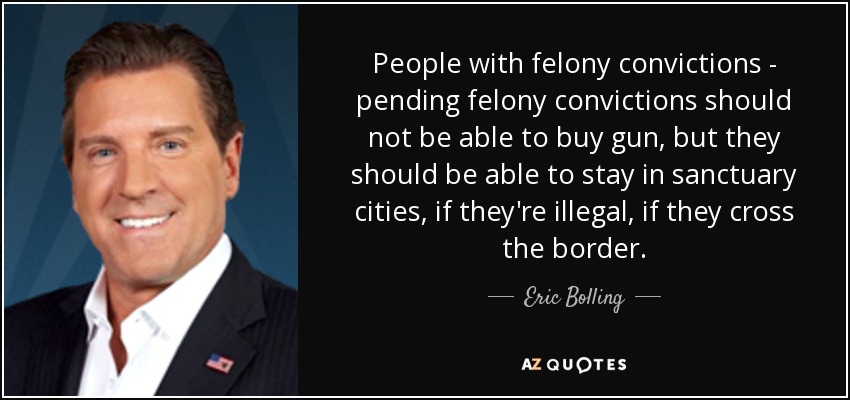
Convicted felons who have crossed the border illegally ought to be deported.

The restriction of the purchase of a gun for an illegal immigrant is not secure enough as a measure for law enforcement.

The idea of sanctuary from prosecution extends back to questionable belief in the sanctity of providing sanctuary for the enemy of my enemy. It was allowed for local administration by the Catholic Church, but the notion of universal law was attached by way of overstatement.

Locke expressed an argument for sanctuary that was overextended as well.

He wrote in his Second Treatise "I doubt not but this will seem a very strange doctrine to some men: but before they condemn it, I desire them to resolve me, by what right any prince or state can put to death, or punish an alien, for any crime he commits in their country."
(https://oll.libertyfund.org/pages/john-locke-two-treatises-1689, S.9)

The expression "their country" is ambiguous. It suggests that law enforcement can't even punish a felon seeking sanctuary in their homeland. The felon could commit a crime in his own country, then immigrate to another to escape prosecution where the liberal ethic would protect him from prosecution for further criminal action.

This liberal doctrine has been aggressively promoted by leading Democrats who seek to tax citizens to pay for the prevention of extradition or deportation.

Sunday, February 17, 2019

Don't

2.24.19
Paris Hilton

Don't
Worry
别担心
Bié dānxīn
心配しないで
shinpaishinaide
ps37

Don't fret. 

You'll teach yourself to regret.


Do not worry when you lose.
The loss is a marker for how to choose.

The confidence that you can win is important to begin.

Adjustment to conditions is a variant form to avoid loss to sin.

Remember the skill that was used to beat what you had.

See capacity as the benefit in relation to other contests in the dyad.

Build your skill with drills that aspire to better performance.
Develop what you can. The results will be enormous.

The memory of the opposition will wither like grass.

Like the green of the plant, the sense of loss will fade and pass.

Trust in your Leadership and do your best.
Enjoy the privilege of reasonable tests.

Own your responsibility.
It will enhance your ability.

Delight in what was given by Providence.
You are a valued member in the larger populace.

Establish a goal that you can achieve.
Challenge yourself to actually believe.
Commit to your goal to make it succeed.

Goshen, Egypt

Cultivated land produces a surplus of grain.
Storage makes the product last beyond drought or hunger pain.

Substance defines a unit as unique as a grain of wheat.
Quantity allows equitability to repeat.

Your honor in nobility will be made as clear as light.
Loyalty to royalty is a state that exists in your insight.

Be still.
Watch your will.

Listen for the power of faith.
Wait for the feeling that you can be great.

Watch to see what moves your body.
Move with that which seeks to embody
goodness as a vocation, not just a hobby.

Don't measure yourself against those who prosper.
The prosperous have moved into what they have to offer.

Don't feel jealous of those who profit from fraud.
They did not prosper in a way you should applaud.

They are liable for the harm caused by their theft.
Liability hinders the ability to achieve that which is best.

The detriment will consume the place where they dwell.
Their will to succeed will suffer more as well.

Pray for the abused and the abuser.
Redemption for prevention is the prime mover.

Refrain from anger aimed at destruction.
Keep your eye on the prize to build your production.

Organize for economy as the efficiency clause.
There is so much to manage. Don't damage your cause.

Enslavement to success is a loss in itself.
Your achievement must be governed by self-regulation to excel or do well.

Those who own responsibility with action will manage their land.
Violent aggression will be transcended with a productive hand.

The energy of anger will be redirected to reconstructing yourself.
Shaping the body anticipates action for improving where you dwell.

Nature has a law to govern it.
Speech is allowed to utter this.

The physical comes first.
Then the spiritual is nursed.

The gospel has a beautiful reach into history.
Good news has become less of a mystery.\


Wisteria above a stream on Mt. Fuji
aka Fuji on Fujiyama


The mystery of beauty was hidden in the bells of wisteria.
Happiness bloomed with unusual radiance and no hysteria.

No one ought to cause damage to the health or property of another.
Wishing harm precedes damage unless the wish is replaced by something other.

The management of labor for production from private property
employs those who might otherwise have been unemployed and living in poverty.

Management is a principle of knowledge
that can be applied for organization after college.

Principle can be applied in organization
for government, business, society or household station.

The market is the measure for service to the public.
Supply is built for sales to meet the convenience need has structured.

The market is a measure
for pleasure to treasure.

The ownership of responsibility
is applicable to each at any level of ability.

Logic and metaphysics suppose existence for abstraction.
Abstraction is framed as a quality for attention's attraction.


Psalm 37
Part I Noli æmulari

1 Do not fret yourself because of evildoers;
do not be jealous of those who do wrong.
2 For they shall soon wither like the grass,
and like the green grass fade away.
3 Put your trust in the Lord and do good;
dwell in the land and feed on its riches.
4 Take delight in the Lord,
and he shall give you your heart's desire.
5 Commit your way to the Lord and put your trust in him,
and he will bring it to pass.
6 He will make your righteousness as clear as the light
and your just dealing as the noonday.
7 Be still before the Lord
and wait patiently for him.
8 Do not fret yourself over the one who prospers,
the one who succeeds in evil schemes.
9 Refrain from anger, leave rage alone;
do not fret yourself; it leads only to evil.
10 For evildoers shall be cut off,
but those who wait upon the Lord shall possess the land.
11 In a little while the wicked shall be no more;
you shall search out their place, but they will not be there.
12 But the lowly shall possess the land;
they will delight in abundance of peace.
13 The wicked plot against the righteous
and gnash at them with their teeth.
14 The Lord laughs at the wicked,
because he sees that their day will come.
15 The wicked draw their sword and bend their bow
to strike down the poor and needy,
to slaughter those who are upright in their ways.
16 Their sword shall go through their own heart,
and their bow shall be broken.
17 The little that the righteous has
is better than great riches of the wicked.
18 For the power of the wicked shall be broken,
but the Lord upholds the righteous.

Goshen

Goshen is located in the northeastern region of Egypt on the eastern side of the Nile delta. The sons of Jacob traveled from Hebron in the second of a seven year drought to ask for food from Joseph in the land of Goshen.

Gen. 45:9
Hurry to my father. Say to him, "Thus says your son Joseph, 'God has made me lord of all Egypt. Come down to me. Do not delay.'

---------------------------------

Joseph- increase
Goshen- Gosem- cultivated

Cultivated land produces a surplus of grain.
Storage makes the product last beyond drought or hunger pain.

==================

1 Corinth. 15:46
It is not the spiritual that is first. The physical comes, then the spiritual.

---------------------------------

The physical comes first.
Then the spiritual is nursed.

==================

Luke 6:27
"I say to you that listen, 'Love your enemies. Do good to those who hate you. Bless those who curse you. Pray for those who abuse you.'"

---------------------------------

Pray for the abused and the abuser.
Redemption for prevention is the prime mover.

========================

John Locke
Two Treatises of Civil Government
1689

"The state of nature has a law of nature to govern it, which obliges every one: and reason, which is that law, teaches all mankind, who will but consult it, that being all equal and independent, no one ought to harm another in his life, health, liberty, or possessions… (and) when his own preservation comes not in competition, ought he, as much as he can, to preserve the rest of mankind, and may not, unless it be to do justice on an offender, take away, or impair the life, or what tends to the preservation of the life, the liberty, health, limb, or goods of another."

Naturalization

Nature has a law to govern it. No one ought to cause damage to the life, health or property of another. Causing damage is a criminal act. Wishing harm is immoral.

The management of labor for production from private property is a principle of knowledge. The principle can be applied to government, business, social or household organization.

There are ways in which organization works the same. There are also ways in which there is significant difference. The ownership of responsibility helps to determine that which is manageable in any case.

---------------------------------

Nature has a law to govern it.
Speech is allowed to utter this.

No one ought to cause damage to the health or property of another.
Wishing harm precedes damage unless the wish is replaced by something other.

The management of labor for production from private property
employs those who might otherwise have been unemployed and living in poverty.

Management is a principle of knowledge
that can be applied for organization after college.

Principle can be applied in organization
for government, business, society or household station.

The ownership of responsibility
is applicable to each of any ability.

========================

George Berkeley
The Principles of Human Knowledge
1710

"...the mind has a power of framing ABSTRACT IDEAS or notions of things. He who is not a perfect stranger to the writings and disputes of philosophers must needs acknowledge that no small part of them are spent about abstract ideas. These are in a more especial manner thought to be the object of those sciences which go by the name of LOGIC and METAPHYSICS, and of all that which passes under the notion of the most abstracted and sublime learning, in all which one shall scarce find any question handled in such a manner as does not suppose their existence in the mind, and that it is well acquainted with them."

---------------------------------

The mind has the power to frame ABSTRACT IDEAS. Logic and metaphysics suppose the existence of abstract ideas. A mind is able to consider each quality for an object singly as abstracted from those other qualities with which it is united. This is how abstraction is framed.

Abstraction is used to discourage investment in the Platonic “world of forms” as having an existence independent from human thought. The primal existence of a chair as a form in the mind of God is regarded as an unlikely thing.

---------------------------------

Logic and metaphysics suppose existence for abstraction.
Abstraction is framed as a quality for attention's attraction.

========================

Adam Smith
Wealth of Nations
1776

The Product of Labor
"...this produce, or what is purchased with it, bears a greater or smaller proportion to the number of those who are to consume it, the nation will be better or worse supplied with all the necessaries and conveniencies for which it has occasion.

"But this proportion must in every nation be regulated by two different circumstances: first, by the skill, dexterity, and judgment with which its labour is generally applied; and, secondly, by the proportion between the number of those who are employed in useful labour, and that of those who are not so employed. Whatever be the soil, climate, or extent of territory of any particular nation, the abundance or scantiness of its annual supply must, in that particular situation, depend upon those two circumstances."

----------------------------------

The nation will be supplied with all the necessities and conveniences with the product of labor in proportion to those who consume it. This proportion must be regulated by two different circumstances. The skill, dexterity and judgment with which its labor is generally applied is first. The proportion between the number of those who are employed in useful labor and those who are not is second. The abundance of the annual supply depends upon those two circumstances whatever the soil, climate or extent of territory of any particular nation.

---------------------------------

The market is the measure for service to the public.
Supply is built for sales to meet the convenience need has structured.

The market is a measure
for pleasure to treasure.

========================

2.24.19

Amanda Berry Smith
b. Jan. 23, 1837, Long Green, Maryland
d. Feb. 24, 1915, Sebring, Florida

Mason-Dixon Line

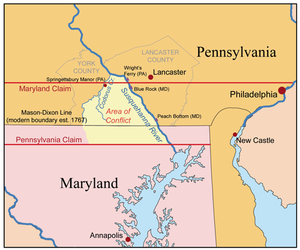
The Mason-Dixon line was surveyed between 1763 and 1767 by Charles Mason and Jeremiah Dixon. The line was demarcated to resolve a border dispute between Maryland, Pennsylvania and Delaware in Colonial America.

The Penn's of Pennsylvania and the Calvert's of Maryland disagreed about the boundary.  Charles II granted a charter for Pennsylvania in 1681. Charles and William Penn though the that 40th parallel would intersect with the 12 mile circle around New Castle, Delaware. The 40th parallel actually runs north of Philadelphia.

New Castle
https://upload.wikimedia.org/wikipedia/commons/thumb/e/e1/Cresapwarmap.png/300px-Cresapwarmap.png

The difference in interpretation was significant for the claim to the resources of the land. An agreement in 1732 settled for something in between the two claims. Delaware was seded as a satellite to Pennsylvania. Cresap's war was fought between settlers on the respective sides starting in the mid-1730's.

The English surveyers, Charles Mason and Jeremiah Dixon, were commissioned by the Penns and Calverts to survey a line 15 miles south of the southernmost house in Philadelphia. The line was extended due west 5 degrees of longitude from the Delaware River for the southern border of Pennsylvania in 1779.

The border became a line of demarcation between slave and free states after Pennsylvania abolished slavery in 1781.

It is still used to mark the border for 4 of the United States. West Virginia and Maryland are distinguished from Pennsylvania. Delaware is designated as east of Maryland.

It became known as the border between the northern and southern U.S. It was used to draw the northern limit for slavery before the Missouri Compromise.

Long Green

Long Green was once home to an Amish community. The community was founded in 1833. It lasted for 120 years.

The community was established by Amish from Lancaster County, but few settlers moved to the area. Maryland was a slave state at the time. Few Amish crossed the Mason-Dixon line due to their opposition to slavery.

Amanda Berry Smith
(1837-1915)

Amanda was born to slaves in Long Green, Maryland. Her father's name was Samuel. Her mother's name was Mariam Matthews. The Smiths had 13 children. Her father was a well-trusted man. His master's widow trusted him enough to place him in charge of her farm.

Mr. Berry was allowed to earn extra money for himself and his family after his duties for the day were done. He would go without sleep many nights because he was busy making brooms and husk mats for the Baltimore market. He made the money to buy freedom for himself and his family. The Smiths move to Pennsylvania after their freedom was secured.

Amanda was taught by her parents to read and write. Her father read to his family from the Bible on Sunday mornings. Her mother helped her to learn reading before whe was 8. She was sent to school after she turned this age.

The Smith children were privileged to learn in their early youth. The school only held summer sessions. It was forced to close after Amanda and her  brother had attended for 6 weeks.

They were given the option of attending another school 5 years later at the age of 13. The school was 5 miles from their home. They were only taught if there was time after the teachers gave the white kids their lesson. The siblings felt that it was not worth traveling in the cold to receive lessons only if time was permitted. They dropped out after attending for two weeks. They were taught at home by their parents. Sometimes they taught themselves.

Amanda went to work in York, PA after only three and a half months of formal education. She worked as the servant for a widow with 5 children.  She attended a revival service for the Methodist Episcopal Church while there.

Her husband was killed in the American Civil War.  She had lost two husbands and four of her five children by the time she was thirty two.

She worked hard as a cook and a washerwoman to provide for herself and her daughter She worked through her grief by attending religious camp meetings and revivals. She immersed herself in the African Methodist Episcopal (AME) Church.

Prayer became a way of life for her. She trusted in God for shoes, the money to buy her sister's freedom and food for her family.  She became well known for her beautiful voice and inspired instruction. Opportunities to evangelize in the South and West opened up for her.

She wore a plain poke bonnet and a brown or black Quaker wrapper wherever she went. She carried her belongings in her own carpetbag suitcase.

The appearance of women in the 19th century was described as fraught with volatile meaning. African American women struggled to receive respect even when they dressed the part of a lady. The shadowed stereotypes bred by slavery pressed for division between wanton Jezebels and pious Mammies. If free women dressed out of their respective class, judgments were made against them.

Amanda arranged for her daughter, Mazie, to study in England in 1878. They traveled overseas and stayed in England for two years. The captain invited her to conduct a religious service on board on the journey over. She was so modest that the other passengers spread word for her.

She traveled to India alone next. She ministered there for 18 months.

She spent 8 years in Africa evangelizing in churches. She went to Liberia and West Africa. She expanded her family by adopting two African boys. She suffered from repeated attacks of "African fever" but persisted in her work.

She was a strong advocate for the Temperance Movement in Africa and the US. She was invited by the noted temperance promoter, Rev. Dr. Theodore Ledyard Cuyler to preach at his Lafayette Avenue Presbyterian Church in Brooklyn, NY upon her return to the USA. It was the largest church for the denomination.

Temperance turned out to be an over-extension of religion into public policy. It was too close to establishment to allow it to stand as an amendment.

Smith pursued her long-time dream of educating African American children by founding the Amanda Smith Orphanage and Industrial Home for Abandoned and Destitute Colored Children in Harvey, Illinois in 1899. She couldn’t support the school sufficiently despite her relentless fundraising efforts.

She left the school at the age of 75 and moved to a home in Sebring, Florida. She passed away on February 24, 1915.

Amanda Berry Smith
S. 阿曼达史密斯
T. 阿曼達史密斯

阿  Ah       ah                    阿  a            flatter                        A        あ      ア           A     아  a
曼  man   beautiful           曼  man       wide                          man  まん  マン        man  만  just
达  da       reach                達  da         accomplished            da      だ      ダ            da     다  all
史  Shi     history              史  shi        history                       Su      す      ス            Seu   스  switch     
密  mi      thick                 密  mitsu    secrecy                      mi      み      ミ            mi     미  beauty 
斯  si        this                   斯  shi        this                             su      す      ス            seu   스  switch                                 

---------------------------------

The gospel has a beautiful reach into history.
Good news has become less of a mystery.

========================

Max Black
b. 2.24.1909 Baku, Russian Empire
d. 8.27.1988 Ithaca, New York

Philosophy of Mathematics
Max Black

Max Black was born in Baku, Azerbaijan of Jewish descent.

His family moved to London in 1912. He grew up there.

He studied mathematics at Queens’ College, Cambridge where he developed an interest in the philosophy of mathematics.

Bertrand Russell, Wittgenstein, G.E. Moore and Ramsey were all at Cambridge at the time. Their influence on Black was considerable.

He graduated in 1930 and was awarded a fellowship to study at Gottingen for a year.

He was the mathematics master at the Royal Grammar School in Newcastle, England. The school had received royal foundation by Queen Elizabeth II.

His first book was The Nature of Mathematics (1933). It was an exposition of Principia Mathematica and the current developments in the philosophy of mathematics.

Black made notable contributions to the metaphysics of Identity. He presented an objection to Leibniz’ Law in “The Identity of Indiscernibles.”

He conceived of two distinct spheres having exactly the same properties in a hypothetical scenario.

The scenario contradicted Leibniz second principle in his formulation of identity. The existence of two objects even in a void with identical properties denies their identicality.

Identity

Max Black worked with Peter Geach to translate the philosophical writings of Gottlob Frege. Both Black and Geach were interested in the question of what constitutes identity.

A always has the property of being A itself. This can never be true of B insofar as it is B. The objects can be identical with respect to the intrinsic internal information when the extrinsic properties are ignored.

The object’s position in space and time remains the only distinction between the two spheres in the otherwise empty space.

Black lectured in mathematics at the Institute of Education in London from 1936 to 1940. He moved to the United States. He joined the Philosophy Department at the University of Illinois at Urbana-Champaign in 1940.

He accepted a professorship in philosophy at Cornell University in 1946. He became a naturalized citizen of the U.S. in 1948.

He was elected a Fellow of the American Academy of Arts and Sciences in 1963.
Black died in Ithaca, New York at the age of 79.

Metaphors

Max Black
S. 嘛佳卜啦赫
T. 嘛佳卜啦赫

嘛  Ma      well                      嘛  ma        wheat               Maku   まっく   マック   Mae  매   every 
佳  jia       good                     佳   ka        excellent           su          す          ス          keu    크   big   
卜  Bo      to divine              卜  boku     divining            Bu         ぶ          ブ          seu     스  switch
啦  la        la                         啦  ro         assertion            ra         ら            ラ          Bol     볼  ball
赫  he      awe-inspiring       赫  kaku     illuminate          kku      っく       ック       lag     락  rock                                                             
---------------------------------

Substance defines a unit as unique as a grain of wheat.
Quantity allows equitability to repeat.

========================


Miki Fujimoto 2.26.1985  Takikawa, Hokaiddo, Japan
藤本美貴
米奇福即墨拖
UPFRONT
Morning Musume- Sexy Boy

米  Mi    meter                    藤  Fuji     wisteria           Fu    ふ     フ             Hu    후   after                 
奇  qi      unusual                本  moto  book                 ji       じ      ジ            ji       지   G                     
福  Fu    happiness             美  Mi       beauty             mo   も      モ             mo    모   mother
即  ji      immediately        貴  ki         value                to     と       ト            to      토   sat                   
墨  mo  ink                                                                   Mi    み     ミ             Mi     미   beauty     
拖  tuo  to mop                                                             ki     き      キ            ki      키   key             

--------------------------------

The mystery of beauty was hidden in the bells of wisteria.
Happiness bloomed with unusual radiance and no hysteria.

=======================                   

Takikawa

Takikawa is located in the west central part of the island of Hokkaido. The name comes from the Ainu language, 'Sorapuchi.' It means 'under the river.' The city is south and west of a waterall in the Sorachi River. The Ishikari splits from the the Sorachi just west of the city.

Takikawa
https://upload.wikimedia.org/wikipedia/commons/thumb/c/c0/Takikawa_view_from_glider.jpg/800px-Takikawa_view_from_glider.jpg

Takikawa is surrounded by nature. About 60 percent of the metropolitan area is covered in greenery by either forest or farmland. The population is estimated at 41,300.

It is the transportation hub for surrounding towns.

The average temperature in summer is 19 degrees Celsius (66 F). The winter temperature is about --5.9 C (21 F). It is the snowiest location in Hokkaido. It gets about 0.8 meter (31 in.) of snow per year. 

A lantern festival is held each year in late February. The event was organized by an artist named Igarashi Takenobu. He was born in the city. People are encouraged to craft their own lanterns. The festival lights the streets at night with over 10,000 hand crafted lamps.

Fujimoto Miki

Fujimoto Miki was born on February 26, 1985 in Takikawa. She wanted to become an enka singer when she was young due to her grandmother. Enka is sentimental Japanese ballad music.

Hello! Project offered Miki training lessons when she didn't pass the third audition to become a 4th generation member in 2000. She worded as a receptionist for UP-FRONT Agency during her training period.

It was announced in October 2001 that she would perform as a soloist. She started as a solo singer in 2002. Her first album was released on her 18th birthday in 2003. She was added to Morning Musume as a 6th generation member by Tsunku after the release of the solo album.

Miki became the sub-leader for Morning Musume in April 2005 when Mari Yaguchi resigned. When Yoshizawa Hitomi graduated in 2007 Miki took over as the leader. She was the fifth leader for the group.

She resigned as the leader of Morning Musume after she admit to dating someone in 2007. She remained a soloist with UP-FRONT.

She was married to Shouji Tomoharu in 2009. She had a baby boy in 2012. She had a girl in 2015.  She appeared in a Kamen Rider film in 2017.

Sunday, January 27, 2019

Find


Find
Refuge
找到避难所
Zhǎodào bìnàn suǒ
避難所を探す
Hinansho o sagasu
ps71

I have taken refuge in my faith.
I look to find reality as the actual case.

Let reality for me act as a guide
to produce a service that will shine as a find.

Let me never be afraid of sensible reason.
Courage uses the light of truth as a beacon. 

Responsibility sets me free from fear of the unseen
to seek help in assimilating what has already been seen
as the mean for what's keen.

There is a context in perception beyond personal vision
that shapes perspective for the service of the versatile given.

Knowledge is solid until it finds a better form.
Assimilation or accommodation are resilient norms.

I know what can be known in the way that was shown,
but the shown has to be owned to be as solid as stone.

Organization for automation builds action for success.
Producing a service for others serves as the real test for what's best.

You were known before you were formed in the womb.
Speech was consecrated by maturity to reach beyond the tomb.

Information for nations requires translation to escape doom.
Knowledge of language is a task to be assumed.

If I speak without love,
I am a loud noise from above.
When I speak with love from above
the word is fulfilled with blessing from the heavenly dove.


Principle is used in the search for truth with knowledge.
Proximity to a word develops thought for college.
False principles are to be avoided, not acknowledged.

Wealth is associated with labor for a nation.
Commerce in the world is a subject for international relations.
Private ownership versus government control is a public policy implication.

The graceful darkness reached out to gain elegant prestige
with a self-criticism that challenged the socialist intrigue.


The hemp on the edge of the winter pasture
served as a meal for the horse that bordered on rapture.

Let reality for me act as a guide
to produce a service that will shine as a find.

I have taken refuge in my faith.
I look to find reality as the actual case.


71 In te, Domine, speravi

1 In you, O Lord, have I taken refuge;
let me never be ashamed.
---------------------------------
I have taken refuge in my faith.
I look to find reality as the actual case.

========================

2 In your righteousness, deliver me and set me free;
incline your ear to me and save me.
3 Be my strong rock, a castle to keep me safe;
you are my crag and my stronghold.
4 Deliver me, my God, from the hand of the wicked,
from the clutches of the evildoer and the oppressor.
5 For you are my hope, O Lord God,
my confidence since I was young.
6 I have been sustained by you ever since I was born;
from my mother's womb you have been my strength;
my praise shall be always of you.
7 I have become a portent to many;
but you are my refuge and my strength.
8 Let my mouth be full of your praise
and your glory all the day long.
9 Do not cast me off in my old age;
forsake me not when my strength fails.
10 For my enemies are talking against me,
and those who lie in wait for my life take counsel together.
11 They say, "God has forsaken him;
go after him and seize him;
because there is none who will save."
12 O God, be not far from me;
come quickly to help me, O my God.
13 Let those who set themselves against me be put to shame and be disgraced;
let those who seek to do me evil be covered with scorn and reproach.
14 But I shall always wait in patience,
and shall praise you more and more.
15 My mouth shall recount your mighty acts
and saving deeds all day long;
though I cannot know the number of them.
16 I will begin with the mighty works of the Lord God;
I will recall your righteousness, yours alone.
17 O God, you have taught me since I was young,
and to this day I tell of your wonderful works.
18 And now that I am old and gray-headed, O God, do not forsake me,
till I make known your strength to this generation
and your power to all who are to come.
19 Your righteousness, O God, reaches to the heavens;
you have done great things;
who is like you, O God?
20 You have showed me great troubles and adversities,
but you will restore my life
and bring me up again from the deep places of the earth.
21 You strengthen me more and more;
you enfold and comfort me,
22 Therefore I will praise you upon the lyre for your
faithfulness, O my God;
I will sing to you with the harp, O Holy One of Israel.
23 My lips will sing with joy when I play to you,
and so will my soul, which you have redeemed.
24 My tongue will proclaim your righteousness all day long,
for they are ashamed and disgraced who sought to do me harm.


Jeremiah 1:5
 ‘Before I formed you in the womb I knew you,
and before you were born I consecrated you;
I appointed you a prophet to the nations.’

---------------------------------

You were known before you were formed in the womb.
Speech was consecrated by maturity to reach beyond the tomb.
Information for nations requires translation to escape doom.
Knowledge of language is a task to be assumed.

========================

1 Corinthians 13:1
If I speak in the tongues of mortals and of angels, but do not have love, I am a noisy gong or a clanging cymbal.

---------------------------------

If I speak without love,
I am a loud noise from above.

========================

Luke 4:21
Then he began to say to them, ‘Today this scripture has been fulfilled in your hearing.’

---------------------------------

When I speak with love from above
the word is fulfilled with blessing from the heavenly dove.

========================

George Berkeley
Principles of Human Knowledge
First Principles
"...there may be some grounds to suspect that those lets and difficulties, which stay and embarrass the mind in its search after truth, do not spring from any darkness and intricacy in the objects, or natural defect in the understanding, so much as from false Principles which have been insisted on, and might have been avoided."

---------------------------------

Principle is used in the search for truth with knowledge.
Proximity to a word develops thought for college.
False principles are to be avoided, not acknowledged.

========================

Objectivity
Know Yourself
in the World
https://quotes.thefamouspeople.com/images/quotes/adam-smith-521.jpg

Introduction to the Wealth of Nations
1776
Text
"The annual labour of every nation is the fund which originally supplies it with all the necessaries and conveniencies of life which it annually consumes, and which consist always either in the immediate produce of that labour, or in what is purchased with that produce from other nations."

---------------------------------

Wealth is associated with labor for a nation.
Commerce in the world is a subject for international relations.
Private ownership versus government control is a public policy implication.

========================

The private ownership of business defines success by the impact that the product or service has on the market.

What does the government control of private business do to the strength of that measure for serving the public through the success of the market?

Are monopoly and oligarchy formed with socialism? It's not as though private owners haven't used money and influence to control government control, but who assumes responsibility for decisions that are made by the government to benefit just the wealthy, just labor or a variety of populist platforms?
Doesn't liability without recognition increase the liability?

Insurance is required by law for certain service. Operating a car without auto insurance is punishable offense. It is punished by increased cost or the removal of the service.

The service is required by law to operate a vehicle. Certain insurance agents have stage accidents in order to force the use of the service to drive up the price for the product.

When a customer is paying enough to buy a used car for the protection of the vehicle and the price for the insurance for the next vehicle is increased in order to decrease the likelihood of such an action, then the market is not a measure for a service to the consumer.

The consumer is made to pay for the benefit of the insurance industry. Their lobbies are paying for legislation that protects their service. Government officials take kickbacks for campaigns or personal benefit.

The problem has become one of government corruption, but it is blamed on capitalism because the lobbies paid for the service. It's actually a form of socialism.

Similar analysis can be applied to the health insurance or the electricity industry. Does management in these industries provide sponsorship for small business ventures or are they directed to buying favor from government officials?

Increasing the prices without the extension of benefit with service is a liability. Insurance and power companies claim to extend service, but leave it for the customer to imagine that use of the service is used to increase the price. Are they going to decrease prices to make the product affordable?

What is the labor for insurance if the organization is directed to buying increase in government protection? The labor is for the corruption of official authority.

An Enlarged Fallacy
Objectivity seeks to reduce fallacy to a point for manageability. There is a certain amount of deception involved in public expression. The degree can make the difference between respect for the ability of people to use critical judgment of a product and fraud.

Much of the media expression that passes itself as journalism is really ad hominem followed by strawman fallacy or strawman followed by ad hominem. The fallacy seeks to enlarge itself as though it increases the authority for the argument.

When the process is repeated, it creates an even larger enlarged fallacy. This enlargement of the enlarged fallacy is being used to create the impression that the liberal element in Congress and covert agency has reason to impeach the president. It is subversive argument.

Simone Weil
b. 2.3. 09, Paris, France
d. 8.24.43, Ashford, Kent, England
Paris

How many wars were related to the French Revolution?

The French Revolution took place between 1789 and 1799. There was a republic in France from 1792 to 1804.

A Constitutional monarchy was instituted from 1789 to 1791. The Declaration of the Rights of Man and of the Citizen was published during the first year. Thomas Jefferson worked with General Lafayette to document principles for governance.

The Civil Constitution of the Clergy turned the clergy into employees for the state on 12 July 1790. Priests and Bishops had to be elected. They were paid a set wage. There were Catholics who objected to the election system because it denied the authority of the pope over the Church in France, but the celebration of the mass was left largely intact.

The First Amendment for the US Constitution and the separation of Church and State prevented any such system from being considered in the new republic in the United States of America.

The National Constituent Assembly was convened to draft a Constitution. It was completed in 1791.
The Reign of Terror is a label used by some historians for French history between 1789 and 1794, The Committee for Public Safety came under the control of Maximilien Robespierre. He was a lawyer associated with the Jacobins.

The Jacobins were a club in Paris. They were a group of men who were anti-royalist radicals for democracy. They were willing to use violent revolution and reports about violence to overthrow the government and to maintain the revolutionary replacement.

Public archives indicate that at least 16,594 people were executed by the guillotine. Concern that the government that overthrew the monarchy would be overthrown by a coalition sympathetic to the monarchy contributed to the sense that the report had to be exaggerated to emphasize intensity in conviction that a Constitutional Republic would be better than monarchy.

There would have to be as many graves with corpses in them as there were reported deaths to verify the accuracy of the report. The guillotine was brutal in finality. Decapitation was the cause of death. It was used in the republic as modern expression for the decapitation of a citizen in Rome as a quick means of death that did not include physical torture.

The greatest error in the terror of the guillotine was that it made class the case for conviction and execution. The general implication was that to be born as an aristocrat was to be born guilty of criminal offense against the state. It place family success in a line of succession into arrears. This put the republic and kingdom into a state of degeneration in the administration of government.

Napoleon declared his goal for a united republic with his relation of independence to public safety.

Independence

Public safety was tagged as the reason to celebrate the expansion of the French Empire.

There was an empire under Napoleon from 1804 until 1815. The Bourbon Restoration of Monarchy lasted from 1815 to 1830 with Louis XVIII and Charles X. The July Monarchy ran from 1830 to 1848 with Louis Philippe d’Orleans.

There was another republic for four years. It ran from 1848 to 1852. Another empire was extended with Napoleon III from 1852-1870. A depression lasted from 1873 to 1890.

The Belle Epoque or the “Beautiful Era” lasted from 1871 until 1914 in France.

The era was named in retrospect when it was contrasted to the horrors of World War I. It is dated from the end of the Franco-Prussian War in 1871 to the outbreak of WW I.

It was part of the Third Republic in France. It was during the apex of the colonial period. The time was characterized by optimism, regional peace, economic prosperity and cultural innovations that were technologically scientific.

When the French people looked back at this period after the devastation and hardship imposed by two world wars, they saw a time that was characterized by prosperity with peace and the joie de vivre (joy of living).

They had lost the war with Prussia. They experienced a depression that lasted nearly two decades, but they were shifting their political and social organization toward economic benefit without the political dependence on military expansion.

The French Republic was being reconstituted toward producing products for the health and well being of people. Domestic products were the chief characteristic for the new state.

The arts flourished during this period, especially in Paris. Fashion was both a graphic and a performance art. The fashion was anti-Edwardian and pro-elitist. It was designed for the peak of luxury for the select few.

Religion for this state of affairs was directed to the majority group. The largest group had become the function for the Republic. The most serious political issue to face the people was the Dreyfus Affair. The affair displayed the difficulty in making religion a function for the state.

Captain Alfred Dreyfus was convicted of treason with evidence that was fabricated by French government officials. Anti-Semitism tolerated by the general French public in everyday society was directed at Dreyfus. Prejudice became the central issue in the controversy and the court trials that followed.

Public debate surrounded the Dreyfus Affair. The scandal lasted from 1894 until it was resolved in 1906. The uproar peaked after a letter sent to newspapers by prominent novelist Émile Zola entitled J'accuse was published in 1898.

The letter condemned government corruption and French anti-Semitism. The Dreyfus Affair consumed the interest of the French for several years. It received heavy newspaper coverage.
Religion cannot promote insurrection, subversion or terrorism  and retain legal status in a free society.

It can't be reduced to a function for the state either. Social development is a key characteristic for a healthy economy. The competitive market is a regulatory agency that the government should not seek to eliminate,

Religion is supposed to promote the belief that a good life can be achieved with the organization to serve self and others. This belief is beneficial to the society and the state that governs it, but it is not dependent upon the state for tax money. Non-profit status allows the religion to develop as a social agency without establishment by the government.

Simone Weil
Patriotism

SW: "Our patriotism comes straight from the Romans. This is why French children are encouraged to seek inspiration for it in Corneille. It is a pagan virtue, if these two words are compatible. The word pagan, when applied to Rome, early possesses the significance charged with horror which the early Christian controversialists gave it. The Romans really were an atheistic and idolatrous people; not idolatrous with regard to images made of stone or bronze, but idolatrous with regard to themselves. It is this idolatry of self which they have bequeathed to us in the form of patriotism." (Prelude to Politics, 1943)

Simone Weil was born in her parents’ apartment in Paris on February 3, 1909. Her father Bernard was a medical doctor. Her mother’s name was Saolomea. They were Alsatian Jews. They had moved to Paris after the annexation of Alsace-Lorraine by Germany.

Simone was healthy for the first six months. She had an attack of appendicitis. She struggled with poor health throughout her life.

She was the second of two children. Her older brother became the famous mathematician, Andre Weil. The two enjoyed a close relationship. Their parents were agnostic and fairly affluent. The children were raised in an attentive and supportive atmosphere.

She learned to translate Ancient Greek by age 12. She later learned to decipher Sanskrit to read the Bhagavad Ghita. She developed an interest in religion in an attempt to understand each tradition as an expression of transcendent wisdom

She studied at the Lycee Henri IV with the tutelage of Emile Chartier to prepare for entrance to the Ecole Normale Superieure (ENS) in Paris.

This was the most selective of the colleges outside the public university system. It had been conceived during the French Revolution. It was intended to provide the Republic with a new body of professors trained in the values of the Enlightenment. The principal goal of ENS is to train professors, researchers and public administrators. ENS students hold the position of paid civil servants.

Her first attempt to enter in June 1927 failed due to low marks in history. She was successful in 1928. She finished first in the exam for the certificate of "General Philosophy and Logic."

She studied philosophy at the institute. She earned her DES (diplome d'etudes superieures) in 1931. The DES is roughly equivalent to an MA. Her thesis was entitled "Science et perfection dans Descartes" (Science and Perfection in Descartes).

Philosophy

Her involvement in political action was an expression of sympathy for the working class. She declared herself to be a Marxist and a pacifist.

She traveled to Germany early August 1932 in order to understand the conditions fostering Nazi Germany better. She wrote to friends upon her return to France.

German trade unions were the single force in Germany able to generate revolution, but they were fully reformist. Long periods of unemployment left many Germans without energy or esteem. She criticized the tendency of social organization to build bureaucracy.

She arranged to have Leon Trotsky stay in her parents' apartment in December 1933 while he was there for secret meetings. She had argued against Trotsky in print and in person. She stated that elite communist bureaucrats could be just as oppressive as the worst capitalist.

Weil applied for a sabbatical from teaching on 20 June 1934. She was determined to spend a year working in Parisian factories to investigate conditions. Her sympathy for labor made the objectivity of her investigation suspect, but factory conditions had a reputation for harsh and unsafe unexpectations by description.

There was more humiliation in her experience than physical suffering. The emotional consequence produced fatigue rather than a desire for rebellion. She described the work as a kind of "slavery" nonetheless.

She went to the Spanish Civil War in 1936 despite her profession of pacifism. She joined the Republican side in the anarchist ranks with Buenaventura Durruti. She took a rifle, but was expelled from the combat unit due to her poor eyesight.

She was a poor shot on the firing range. She ran into a pot of boiling liquid because of her near-sightedness. She received noticeable burns. Her family was contacted to take her away. They took for to Assisi for her recovery. It was reported that her unit was nearly wiped out after her departure. Every woman in the group was killed.

Weil experienced religious ecstasy in the Basilica Santa Maria degli Angeli (St. Mary of the Angels). She was led to pray for the first time in her life.  This was the first of three encounters that would lead her to convert to Christianity.

She revisited her Marxist analysis after the encounter from 1937-38. She argued that there is a contradiction in Marx's thought. He had identified the overthrow of the government as the object for the proletarian revolution, yet the militant state was inherently oppressive. The definition of the state as the military, the police and the bureaucracy made it the object for liberation that would result in another form of oppression. Would it be better with communism?

She visited the Benedictine Abbey of Solesmes from Palm Sunday to the following Tudesday during the week of Easter in 1938. She was suffering from headaches while she listened to Gregorian chant. She found a joy so pure that it gave her the impression that she could live with divine love in the midst of affliction.

She claimed to have an experience of the divine presence while reciting the George Herbert poem called "Love." She stated that Christ took possession of her while she fixed her attention of the poem during a severe headache.

Her writing became more mystical from 1938, but retained the focus on social and political issues. This spiritual emphasis expressed a critical judgement against Marxism, but moved her toward a Hegelian nihilism. It was objective insofar as it was against socialism of any kind, but she was also against government itself and capitalism.

France became the singular object for affection, but French independence from anything but critical judgement against anything not French was the only objective allowed.

She turned to her aesthetic appreciation of religion as a way to compensate. She was attracted to Roman Catholicism. It was still French, but it allowed for a global perspective defined in relation to the pope and Roman custom. She declined baptism to continue to look at things outside of Christianity.

Weil was keenly interested in other religious traditions. The Greek and Egyptian mysteries, Hinduism and Mahayana Buddhism were favored. She believed that all these and other traditions contained elements of genuine revelation for the beauty of the world.

She was opposed to religious syncretism. This allowed for interfaith political organization, but discouraged the formation of a single religion with a common prayer service to make the public into one faith group.

She claimed that syncretism effaced the particularity of the individual traditions. Language and custom effect behavior with belief as an expression of cultural identity. Contrast is necessary for reasonable judgment regarding the formation of policy with position for beneficial relations.

Weil renounced her pacificism after the military alliance of Germany and Italy was formed in 1939. She felt that France was no longer strong enough to remain generous or merely defensive.

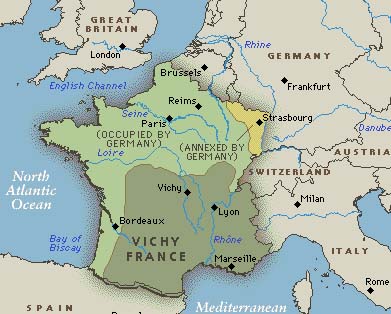
Map of Vichy France


She left Paris with her family on the last train in 1940 following the German western offensive. They took residence in Marseilles in Vichy France.

She was introduced to the Dominican priest Joseph-Marie Perrin to discuss the question of baptism. Perrin asked his friend, Gustave Thibon, if he could get Weil a job as an agricultural laborer.

She worked in the grape harvest during the fall of 1941. She worked for eight hours a day like the others, but she stayed in her employer's house. She took a copy of Plato's Symposium with her to the vineyards to teach the text to her fellow workers.

She agreed to leave France in 1942 so her parents could be safe. She also felt that she could do more for France in another country. They traveled to New York via Morocco.

She wrote profusely during her stay in New York, but felt that she would be one step closer to the liberation of France with the Free French movement in London. She was given a small office and wrote day and night for four months. She wrote a total of about 800 printed pages. She resigned from the movement in July.

She died on Tuesday, 24 August 1943. The coroner pronounced her death a suicide. She had been refusing to eat out of sympathy with those who were suffering in occupied France. Malnutrition left her immune system susceptible to disease.

She contracted tuberculosis and died from cardiac arrest. The diagnosis was severe insofar as she had suffered from ill health from the time that she had been a baby. There was less willfullness to die than the inexplicable inability to not eat. The fear of compromising a weak immune system drove her  to 'describe' the fear of food as an ascetic effort.

The teleology of labor in Weil's philosophy corresponded with Hegel and Marx in opposition to the private property proposed by Locke.

While slavery is an offense against natural law, the ownership of private property is not. It can be argued that the key contributions that Locke made to modern law was the proposal for private property and the reduction of cruelty in punishment.

The English Bill of Rights also document the right to bear arms. If it was not limited to English Protestants, it could have been more attributed as a right for citizens in defense against attack.

Simone Weil
S. 西蒙娜威尔
T. 西蒙娜威爾

西 Xi             west               西 nishi   west                        Shi      し          シ           Si      시    city
蒙 meng     to suffer            蒙 mo      darkness                 mo     も-       モ-             mon  몬  mon     
娜 na            elegant            娜  da      graceful                  ne      ね         ネ              Ba      바   bar     
威 Wei         prestige           威  i          prestige                 Vei   ヴぇい  ヴェイ       il       일   work
尔 er             you                 爾  ore     you                           ru      る          ル                 

-------------------------------

The graceful darkness reached out to gain prestige
with a self-criticism that challenged the socialist intrigue.

======================       

2.3.1870
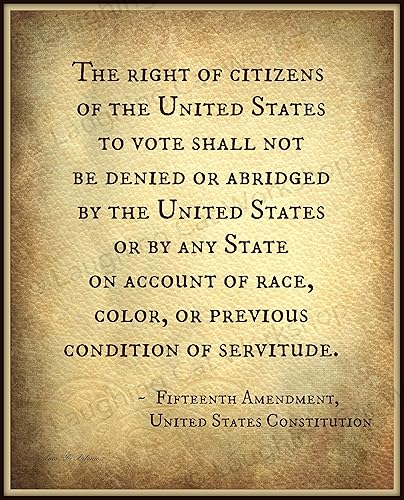
15th Amendment to US Constitution
Vote- Men of Color


The right of citizens of the United States to vote shall not be denied or abridged by the United States or by any State on account of race, color, or previous condition of servitude.

===================

Race is identified by color in this amendment. The extension of the right to vote to men of color was enacted to reduce racism in election contests and society in general. The right for women to vote was not instituted until the 19th amendment in 1920.

The 15th amendment was ratified on February 3, 1870 as the third and last of the Reconstruction Amendments.

The right to vote is a key feature in the definition of citizenship. The 14th amendment had stipulated that all persons born or naturalized in the US are citizens. Naturalization is the path to citizenship.

Those who refuse to register the date of entry, duration and location of residence are operating without the documentation of intent to obey the law. They are treated as illegal immigrants due to illegal entry or duration in residence.

2.3.1913
16th Amendment
National Income Tax

The Congress shall have power to lay and collect taxes on incomes, from whatever source derived, without apportionment among the several States, and without regard to any census or enumeration.

===================

The 16th amendment allows the federal government for the United States to collect an income tax from all Americans. Taxes on houses or other property are considered “direct” taxes by the Constitution and would have to be divided back among the states. States have levied property and sales tax as a general practice.

Federation had been ruled out as a form of government for the US on the basis that competitive prices between states would prohibit free trade. The states would then be engaged in a high cost competition to claim the power to charge other states more for trade or travel.

The national government was called federal in order to suggest that any national tax would have to be for the benefit of the nation. The idea was that a national tax was a step in the direction of overt centralization for the consolidation of the power for national officials. Conservative policy in taxation was the ideal for the experiment in constitutional republican government.

There are certain features of monarchy that are implicitly conservative. Inheritance is used to conserve national resources with respect for the line of succession.  There was one monarch who didn't run for election at the expense of funding agents and agencies. The ruler had to work with a body of elected and appointed officials in order to discern the "will of the people" insofar as it was for the benefit of national security in relations.

When anti-monarchical democracy became a feature of the renaissance revival of republican ideas, constitutional documentation became necessary to promote a literate society that kept the people informed about proposals for policy. When the British colonies in North America were organizing for self-government based on English practice and French political philosophy, Virginia became a leader in the documentation of a state constitution.

Principles for National Government
Principles

Virginia's constitution included "a declaration of principles such as popular sovereignty, rotation in office, freedom of elections, and an enumeration of the fundamental liberties -moderate bail and humane punishments, a militia instead of a standing army, speedy trials by the law of the land, trial by jury, freedom of the press, of conscience, of the right of a majority to reform or, alter the government, and prohibition of general warrants. Other states considerably enlarged this list to include freedom of speech, of assemblage, of petition, of bearing arms, the right to a writ of habeas corpus, inviolability of domicile, and equal operation of the laws. In addition, all the state constitutions paid allegiance to the theory of executive, legislative, and judiciary branches, each one to be checked and balanced by the others."

=======================

The 16th amendment wasn't ratified until 1913. It was only a year before World War I started. The 14th amendment had defined citizenship as a condition of birth or naturalization within national boundaries. The 15th amendment attributed the right to vote to citizens irrespective of race or former servitude.

The boundaries of the competition with the inherent conservativism of monarchy have been pushed by the liberal element for increased expenditure.  The precipitation of profit for officials has been open ended for advocates of liberal spending policy. The proposal to secure the borders with a wall forms a contrast with precipitation.

The contrast recommends a budget that balances the concerns for national security. Liberals are not only pushing for an increase in expenses, they are promoting a policy that contradicts due process in law with respect for habeus corpus to support the accusation of sexual assault with the defamation of character for the accused. Ad hominem argument has been supported with straw man fallacy and false dichotomy.

The spending policy for national government has become mythically liberal for taxation. Conservative policy is necessary to cap further expansion in costs for a 'service' that refuses to solve the problems that it creates for its own benefit. While socialism has been the de facto economic theory, Marx started the trend of identifying capitalism as the faulty theory.


Maria Makino 2.2.2001, Nishio, Aichi, Japan
牧野真莉愛
马利啊马基诺
Morning Musume
Are You Happy?

马  Ma    horse                      牧 Maki    pasture                          Ma      ま      マ         Ma    마  hemp 
利  li        profit                      野 no         field                             ri          り      リ         li      리  lee   
亚  ya      Asian                      真  Ma       genuine                       a           あ     ア          a       아   ah   
马  Ma    horse                       莉 ri           Arabian jasmine        Ma         ま     マ         Ma    마  hemp 
基  ji        base                        愛 ai          love                             ki          き     キ         ki       키  key   
诺  nuo   promise                                                                         no         の    ノ         no     노  furnace             

======================

The hemp on the edge of the winter pasture
served as a meal for the horse that bordered on rapture.

-------------------------------                             

Nishio

Nishio is situated on the northern coast of Mikawa Bay on the Pacific Ocean in southern Aichi Prefecture on Honshu.

It is a regional commercial center and fishing port. It has a mixed economy of light manufacturing and agriculture. Numerous suppliers to the Japanese automotive industry such as Denso and Aishin have production plants in and around Nishio.

It is also the largest producer of powdered green tea in Japan. It is one of the leading producers of Unagi eels.

The city lies on the eastern bank of the Yahagi River. The fertile plains along the Yahagi River have been used for rice-farms. The soil has been used for the production of tea and cotton since ancient times.

Shell mounds dating to the late stone age are found in what is today the town center. The mounds point to fish and seafood as important early local produce.

Nishio is sheltered by Chita and Atsumi Peninsulas. The local climate is mild. There are a number of natural sites to visit. Hirahara Waterfall and nature trail are located in Hirahara-cho. Kira Waikiki Beach has a series of sheltered sandy coves. The beach is open for bathing and water sports from June to September.

Sakushima is a samll inhabited island with many traditional wooden buildings in Mikawa Bay. It can be reached by ferry from Ishiki Harbor. It is popular for fishing trips.

Sangenesan Skyline is a spectacular forested mountain range that overlooks Mikawa Bay. It is used for hiking and bird watching.

Yatsuomote-yama is a hillside park in central Nishio. It offers a good view of the surrounding cities, mountains and waterfront.

Syoboji Kofun is a megalithic tomb. The tomb with the casket is made from large stones. The grounds are key-shaped when viewed from above. Kofun were constructed between the third and sixth centuries CE.

Nishio Castle was built by Ashikaga Yoshiuji around 1221.  Sakai Shigetada rebuilt the castle in 1585 with moats, stone walls, several yagura, gates and a donjon by order of Tokugawa Ieyasu. It was expanded further by Tanaka Yoshimasa, ruler of Sunpu Castle during the reign of Toyotomi Hideyoshi.

The castle was dismantled in 1872 following the Meiji Restoration. The current structures include a large "yagura" and gate. The  reconstruction was complete in 1996 to boost local tourism along with a local history museum.

The castle is the highlight for the sightseeing tour.

The Toba Fire Festival is held on the 2nd Sunday in February. Two teams of local men from Hazu and Kira vie to pull bamboo poles from a huge bonfire. The traditional rite is meant to ensure a good harvest.

The population for Nishio was about 100,000 in 2000.

Marina Makino

Makino Maria was born on February 2, 2001 in Nishio, Aichi, Japan.

Makino auditioned for the Morning Musume 10ki member group in 2011, but did not pass. She tried again the next summer, but failed again.

She joined Hello! Pro Kenshuusei on November 1, 2012. The kenshuusei is the trainee program. It was officially announced that she had joined the group with Kanazawa Tomoko, Kaga Kaede, Wada Sakurako, Ichioka Reina and Kishimoto Yumeno on November 20. The were introduced in the show on December 9.

It was announced during the Morning Musume '14 Concert Tour at Nippon Budokan on September 30, 2014 that Maria had been selected for the 12th generation of Morning Musume along with Ogata Haruna, Nonaka Miki and fellow Hello Pro Kenshuusei member Haga Akane.