Showing posts with label pain. Show all posts

Sunday, March 29, 2020

Own

4.6.20

Hayley Atwell
as Agent Carter


Own
Knowledge
自己的知识
Zìjǐ de zhīshì
自分の知識
Jibun no chishiki
ps117
Scientia sua

Sing praise for goodness all you nations.
Let your song be heard by every station.

Merciful kindness is great toward us.
Truth in design affords accordance.

That which has been learned 
is a word that has been earned
as heard.

The tongue of a teacher knows how to sustain
the weary with the hope to avoid pain.

Each morning awakens the ear 
to the knowledge of another year.

What has been heard
is the word that has been lured
beyond the absurd
to that which has been opened to movement
away from rebellion to improvement
without revolution.


The 4th month of the year
says the spring has started here.

Love desired and requited 
called for favor in time as sighted.

Grace had jested about loftier themes.
Would you speak of wounds when you could not sing?

What wicked wit would you make about my wound?
I do what I can with or without a tune.

Will the sixth wit please take a number 
to have his wound witted from slumber? 

What is it to be witted?
You must be fitted 
to be permitted
to be witted.

Your pleasure has been the task I set
each time the sight of sky is met.

I sing the season and the cause
that starry signs may be seen with awe.

I drew my lore from annals old.
The evening star had risen and shown 
when time had opened her floral bows.

Sovereign Master of our hearts,
you know the way you set our parts.

Spirit gave you breath to sing
that we might imitate beauty's ring.

Each was chosen to sing the sound
in the harmony of good news found.

You road the colt over fronds of palm
that framed your grace with reverent calm.

You accepted anointment 
with the ointment 
as you sat to eat
your bread with meat.

You kept the passover meal with your disciples
to tell them of the impending trial.

You invoked the rite of thanks
for a communion beyond the Jordan's banks.

You took bread, blessed and broke it
to denote the body that would be broken.

You took wine in the cup raised with gratitude
to signify the blood of the new testament attitude.

The Son of Man was given to the hands of sinners.
He was offered in sacrifice for our redemption as winners. 

Faith in gods had become belief in One.
Classical consciousness had found direction in the continuum.

Materialism pronounced fate as a condition of nature.
The immaterial mind outlawed enslavement to matter as the maker.  

Humanity endures only so much discontinuity.
The elements are organized for functional unity.

The body is made with spirit and blood
for worship in the temple built with wood and hardened mud.

Let the same mind be in you
that was in Christ Jesus for goodness in truth.

He did not regard equality with the Father 
as a claim for exploitation to garner. 

He took on human form in likeness for the form of duty
to humble himself to death on the cross for beauty.

He was exalted with a name for the power of authority
that worked for the public in truth for posteriority.

Greatness in form is organized against misfortune. 
The ideal is made real when the form for function is tuned.

Education develops in the context of concepts placed.
Thought governs action in feeling for satisfaction traced.

Should Christ decide to hold his peace
let your celebration in song never cease.

The angels sing around his throne in glory.
The stars and planets shine to tell time's wistful story.

Flowers grow to celebrate the earth.
Stones rest in the darkness of the dirt
that his Name will be blessed for true worth.

Let his praise be sung
by every musical tongue
with well played instruments
to integrate the elements
while those who have not been trained
may listen well to the divine refrains.

Let your power and mercy show
goodness to this world below
to breathe the breath of life infused
into the noble things that found vile use.

Waken into sound divine
the pavement of your shrine
that we on the haven of heaven's floor
may give praise to you whom we adore.

Childlike though our voices may sound
with poorly tuned choices found,
let the tunable nature of the parts
flow with grace from grateful hearts.

------------------------

Psalm 117
King James Version (KJV)

1 O praise the Lord, all ye nations: praise him, all ye people.
2 For his merciful kindness is great toward us: and the truth of the Lord endureth for ever. Praise ye the Lord.

---------------------
===============
----------------------

Ovid
"Fasti"

Introduction to April

“O gracious Mother of the Twin Loves,(Cupid and Anteros)” said I, “grant me thy favour.” The goddess looked back at the poet. “What wouldst thou with me?” she said, “surely thou wast wont to sing of loftier themes. Has thou an old wound rankling in thy tender breast?” “Goddess,” I answered, “thou wottest of my wound.” She laughed, and straightway the sky was serene in that quarter. “Hurt or whole, did I desert thy standards? Thou, thou hast ever been the task I set myself. In my young years I toyed with themes to match, and gave offence to none; now my steeds treat a larger field. I sing the seasons, and their causes, and the starry signs that set beneath the earth and rise again, drawing my lore from annals old. We have come to the fourth month in which thou art honoured above all others, and thou knowest, Venus that both the poet and the month are thine.”

---------------------

Love desired and requited
called for favor in time as sighted.

Grace had jested about loftier themes.
Would you speak of wounds when you could not sing?

Would you make wit about my wound?
I do what I can with or without a tune.

Your pleasure has been the task I set
each time the serene sky is met.

I sing the season and the cause
that starry signs may be seen with awe.

I drew my lore from annals old.
The evening star had rose and shown
when time had opened her floral bows.

================

April


The Romans thought that the name Aprilis derived from aperio, aperire or apertus, a verb meaning "to open". The Fasti Praenestini offered the expanded explanation that fruits, flowers, animals, seas and lands open in this time.

April was marked by a series of festivals devoted to aspects of rural life. It was a busy month for farmers.

The Parilia was an archaic pastoral festival that celebrated the "birthday" (dies natalis) or founding day of Rome. The festivities opened with the Feast of Venus on the Kalends, the first day of the month.

April was the second month of the earliest Roman calendar. This was before Ianuarius and Februarius were added by King Numa Pompilius about 700 BCE.

It became the fourth month of the calendar year during the time of the decemvirs. This was about 450 BCE. It was given 29 days.

The 30th day was added during the reform of the calendar undertaken by Julius Caesar in the mid-40s BCE. This produced the Julian calendar.

Psalm 117


This  is the shortest of the 150 psalms. It is the 595th of the 1,189 chapters of the King James Version of the Bible. That places it in the middle of the version.

The Gentiles are invited to join in praise of God in this psalm.  Christians view this as a fulfillment of the divine promise of mercy that all nations would be blessed in the seed of Abraham.

Galatians 3:16 says "The promises were spoken to Abraham and to his seed. The use of the singular refers to Christ.

The musical setting is known the opening words in Latin as "Laudate dominum".  William Byrd, Johann Sebastian Bach 'Lobet den Herrn alle Heiden' (BWV 230), Michel Richard Delalande, Robert Strassburg and Wolfgang Amadeus Mozart have arranged the words in classical themes.

Marc-Antoine Charpentier composed 7 settings (H 177, H 152, H 159, H 182, H 214, H 223, H 227).

It has been set by the Swedish composer Fredrik Sixten more recently.The Taizé community has also made a popular arrangement.

----------------------

Will the sixth wit please take a number to have his wound wotted? What? Watted? Wottled? Waddled?

Chn. 第六位机智的人请打个电话弄伤口吗? 什么? 瓦了? 昏昏欲睡? 蹒跚?
           Dì liù wèi jīzhì de rén qǐng dǎ gè diànhuà nòng shāngkǒu ma? Shénme? Wǎle? Hūn hūn
           yù shuì? Pánshān?
Jpn.   6番目のウィットは、彼の傷を書き留めるために数字をとってくれませんか? 何? ワッ
       ト? むらがある? ぐちゃぐちゃ?
            6-Banme no u~itto wa, kare no kizu o kakitomeru tame ni sūji o totte kuremasen ka?
            Nani? Watto? Mura ga aru? Guchagucha?
Krn.   여섯 번째 위트가 상처를 입었을 때 숫자를 가져 가겠습니까? 뭐? 와트? Wottled? 싸
            여?
             yeoseos beonjjae witeuga sangcheoleul ib-eoss-eul ttae susjaleul gajyeo
             gagessseubnikka? mwo? wateu? Wottled? ssayeo?
Ltn.    Et sextus ingenii placet in vulnus suum, et in numero accipies wotted? Quid? Watted?
            Wottled? Waddled?
Itln.    Il sesto ingegno prenderà un numero per far cancellare la sua ferita? Che cosa? Watted?
             Wottled? Dondolando?
Spn.   ¿El sexto ingenio, por favor, tomará un número para que su herida sea eliminada?
            ¿Qué? Watted? Wottled? Waddled?
Frn.    Le sixième esprit prendra-t-il un numéro pour faire sa blessure? Quelle? Watté?
             Tacheté? Waddled?
Gmn.  Wird der sechste Witz bitte eine Nummer nehmen, damit seine Wunde verwischt
             wird? Was? Watted? Wottled? Watschelte?
Dtch.   Wil de zesde geest een nummer nemen om zijn wond te laten wrijven? Wat? Watted?
              Gevlekt? Waggelde?
Czch.  Vezme si šestý vtip, prosím, číslo, aby se mu zranila jeho rána? Co? Watted? Wottled?
             Waddled?
Hng.   Kérem, hogy a hatodik szellem számot szerezzen, hogy a sebét kiszáradjon? Mit?
             Watted? Wottled? Totyogott?
Trk.     Altıncı zekâ, yarasının zayıflaması için lütfen bir sayı alacak mı? Ne? Watted? Wottled?
             Waddled?
Grk.    Το έκτο πνεύμα παρακαλώ να πάρει έναν αριθμό για να έχει πληγεί το τραύμα του; Τι?
             Watted; Εμφιαλωμένο; Μπερδεμένη;
             To ékto pnévma parakaló na párei énan arithmó gia na échei pligeí to trávma tou? Ti?
              Watted? Emfialoméno? Berdeméni?
Rsn.    Будет ли шестое остроумие, пожалуйста, взять число, чтобы иметь его рану
             wotted? Какие? Watted? Wottled? Переваливаясь?
             Budet li shestoye ostroumiye, pozhaluysta, vzyat' chislo, chtoby imet' yego ranu
             wotted? Kakiye? Watted? Wottled? Perevalivayas'?

Will the sixth wit please take a number
to have his wound witted from slumber?

What is it to be witted?
You must be fitted
to be permitted
to be witted.

-----------------------

John Keble
Palm Sunday
The Christian Year
---------------------
===============
---------------------

Speech from what has been learned is the tongue of the Learned. It is the language of education.


Second Isaiah was an anonyous 6th century BCE author who wrote during the exile in Babylon.
He echoed the words of the first in his declaration of having been called from the womb.
He referred to the weapons of war as symbols of his word.

The prophecy described how Jerusalem would be restored to become the worldwide center for worship. The Messiah (Cyrus) would set the captives free to bring about the rule of Yahweh.

This prophet also wrote against corrupt leadership. He spoke for the disadvantaged. Righteousness was associated with holiness. Isaiah 44:6 used the start and end of time to declare the sovereignty of one God. He said, I am the first and the last. Beside me there is no other.

This separated the deity from the parthenon of gods from whom the One had been drawn. The punishment of Israel was a prelude to the redemptive deeds for the exiles and Zion.

Monotheism became the defining characteristic of post-Exilic Judaism. It was used as the template for Christianity and Islam. Judah still sang about being a kingdom even though it was a province of the Achaemenid empire with a governor.

Isaiah 50:4-5

The Lord GOD has given me
the tongue of a teacher
that I may know how to sustain
the weary with a word.
Morning by morning he wakens--
wakens my ear
to listen as those who are taught.
The Lord GOD has opened my ear
and I was not rebellious.
I did not turn backwards.

---------------------

That which has been learned
is a word that has been earned
as heard.

The tongue of a teacher knows how to sustain
the weary with hope as to how to avoid pain.

Each morning awakens the ear
to the knowledge of another year.

What has been heard
is the word that has been lured
beyond the absurd
to that which has been opened to movement
away from rebellion to improvement
without revolution.

================

For Goodness that Lasts


Map of Philippi

Philippi

Colonists from the island of Thasos established a settlement at Krenides (springs) in Thrace in 360 BCE.

Thasos had been colonised at an early date by Phoenicians. Gold had been discovered. Thasos was said to have been the leader of the Phoenicians. It was his name that had been given to the island.
Greeks from Paros founded a colony on Thasos around 650 BCE.

Thasians owned gold mines even more valuable than those of the island on the mainland.

The settlement at Krenides was located near the head of the Aegean Sea at the foot of Mt. Orbelos, now called Mt. Lekani, about 13 km (8.1 mi) north-west of Kavalla. It was past the northern border of the marsh that covered the plain that separated it from the Pangaion Hills to the south.

King Philip II of Macedon conquered the city and renamed it Philippi in 356 BCE. The Macedonians conquered the town to take control of the gold mines.

A garrison was established to control the strategic passage. The post was located on the route between Amphipolis and Neapolis. This was part of the great royal road which ran east-west across Macedonia. It would later be made into a part of the via Egnatia by the Romans.

The population preserved its autonomy within the kingdom of Macedon with the assembly of the demos.  The discovery of new gold mines near the city, at Asyla, contributed to the wealth of the kingdom. Philip put a mint there.

Antigonus I Monophthalmus ("the One-eyed") was one of Alexander's generals. He ruled over Asia Minor and northern Syria, but his territory extended to Philippi.

When the Romans destroyed the Antigonid dynasty of Macedon in the Third Macedonian War (168 BCE), they divided the kingdom into four separate states (merides). Amphipolis became the capital of the eastern Macedonian state rather than Philippi.

Archeological remains include walls, the Greek theatre, the foundations of a house under the Roman forum and a little temple dedicated to a hero cult. This monument covers the tomb of a certain Exekestos.

Mark Antony and Octavian confronted the forces of the assassins Marcus Junius Brutus and Gaius Cassius Longinus at the Battle of Philippi on the plain to the west of the city during October in 42 BCE. Antony and Octavian won this final battle against the partisans of the Republic.

They released some of their veteran soldiers, probably from Legion XXVIII, to colonize the city. It was refounded as Colonia Victrix Philippensium.

Octavian established his control of the Roman state from 30 BCE. He became the emperor in 27 BCE. Veterans (possibly from the Praetorian Guard) and other Italians were given a place to live.

The city was renamed Colonia Iulia Philippensis. It was renamed yet again as Colonia Augusta Iulia Philippensis after January, 27 BC, when Octavian received the title Augustus from the Roman Senate.

The land was centuriated or divided into squares of land. It was distributed to the colonists. The city kept its Macedonian walls. The general plan was modified only partially by the construction of a forum, a little to the east of the site of Greek agora.

It was a "miniature Rome". It was governed by two military officers, the duumviri, who were appointed directly from the capital. This placed it under the municipal law of the imperial city.

The New Testament recorded a visit to the city by the apostle Paul during his second missionary journey (49 or 50 CE)(Acts 16:9-10). Early Christians concluded that Paul had founded their community on the basis of the Acts and the letter to the Philippians.

Paul had preached for the first time on European soil in Philippi accompanied by Silas, Timothy and Luke.

The Epistle to the Philippians is dated to the time when Paul was renting a house in Rome (61-62 CE). The development of Christianity in Philippi is indicated by a letter from Polycarp of Smyrna addressed to the community in Philippi around 160 CE.

Many of the Philippians were retired military men who had been given land in the vicinity and who in turn served as a military presence in this frontier city. There were not enough Jews there to permit the establishment of a synagogue. The letter does not contain citations of the Judaic scripture.

The apostle extended his greetings, thanksgiving and a prayer for the Philippians. He explained his personal circumstances. He exhorted the congregants to live a life worthy of the gospel.

He defined himself as in chains and under watch by the palace guard. He distinguished between preaching the gospel from envy and good will. Those who preached from envy did so for selfish ambition. Those who preached from good will did so from love in order to increase the knowledge of benefit in truth.

He said that to live was Christ and to die was gain for him.

The attitude for the mind of Christ was posited in the second chapter as that of a servant to appeal to the sense of duty.

Philippians 2:5-10

Let the same mind be in you that was in Christ Jesus
who, though he was in the form of God
did not regard equality with him
as something to be exploited,
but emptied himself
taking the form of a servant
being born in human likeness.
Being found in human form,
he humbled himself
and became obedient to the point of death
even death on a cross.

God highly exalted him
and gave him the name
that is above every other
so in devotion to Jesus
every knee should bend
in heaven, on earth and under the earth.

---------------------

Let the same mind be in you
that was in Christ Jesus for goodness in truth.

He did not regard equality with the Father
as a claim for exploitation to garner.

He emptied himself to excess demand for privilege
as something by which the sons of Eli were driven.

He took on human form in likeness to the form for duty
to humble himself to death on the cross for beauty.

He was exalted with a name for the power of authority
that worked for the public in the truth of goodness for posteriority.

================

Blood of the Covenant

The gospel of Matthew hasn't been used in the Sunday readings since March 1, 2020. That reading was from the 4th chapter.

It was about Jesus being led by the Spirit into the wilderness. It reminded the Church that Jesus had left the world to consider how natural law applied to the kingdom of Judah as a model for any political form anywhere in the world.

It was read at the start of Lent as encouragment to consider the value of fasting and prayer in the household and the community as it related to the kingdom of heaven.

Jesus was tempted to test God with the reckless endangerment of his body. He stated that he would not test God. This was the same thing that Ahaz had said to the prophet Isaiah (Isaiah 7:12). Isaiah had told him to ask for a sign.

Isaiah was the prophet who had first had the vision of the one God seated on a throne in the heavenly kingdom.

The selection for Palm Sunday on April 5, 2020 is about Jesus in the garden of Gethsemane. The timeline in Matthew, Mark and Luke differs from that offered by John. The synoptic gospels drew their material from the 'sayings of Jesus.' The existence of the 'Q' source is presumed to have existed at the time due to the common material in those 3 gospels.

The intent of John's gospel was to establish the Eucharist as the basis for liturgical celebration. Jesus was identified with the Son as the Word of God who preceded the existence of time in the creation of the world.

Palm Sunday celebrates the triumphant procession of Jesus as prophet and king into Jerusalem. It was testimony as to the popularity of allowing non-Jews to accept the benefit of monotheistic belief in a way that was similar to the Jewish community.

This reading is for the last Sunday before Easter. The story of the betrayal of Jesus is necessary in the Sunday cycle of services. Jesus is remembered for his prayer to let the cup of his sacrifice pass from him.

This was a reference to the elements of the Last Supper as the template for the institution of the Eucharist. Giving thanks in remembrance of the life of Jesus was to serve as the call for the community to gather together in communion to worship.

The crucifixion had been predicted by scripture as the means to transform the celebration of animal sacrifice in expiation to the gods to the ritual reinactment of the one sacrifice of the Son as the emblem for human nature for the rest of time.

Jesus asked that the cup be taken from him, but he offered himself that the Father's will be done.

He had asked his disciples to stay awake to watch him with prayer. Peter and the two sons of Zebedee witnessed his agitation, but they fell asleep. When Jesus found Peter somnolent, he asked him to watch and pray.

He prayed more and found the others asleep again. He prayed one more time. When he woke the disciples he told them that the time had come. The Son of man had been betrayed for trial.

This gospel recounts the detail that 'one of those with Jesus' drew his sword and struck the ear of the slave to the high priest. He instructed the follower to put his sword back.

The course of these events had been determined for a purpose. Jesus could have asked for 12 legions of angels, but the scriptures would not have been fulfilled.

The Son of Man was cursed to hang on a tree that the Gentiles might see the inheritance of the promise of salvation allowed for the atonement of sin by the one sacrifice of God as man for the redemption of human nature.

The selection alerts the participants that Good Friday and the crucifixion will be commemorated at the end of the work week.

The resurrection is to be celebrated late Saturday night or early Sunday morning.

Matt. 26:45-46

Then he came to the disciples and said to them, 'Are you sleeping and taking your rest? See. The hour is at hand. The Son of Man is betrayed into the hands of sinners. Get up. Let us go. My betrayer is at hand.'

---------------------

The Son of Man had been betrayed into the hands of sinners.
He was offered in sacrifice for our redemption as winners.

================

Epictetus

 
Epictetus was born a slave at Hierapolis, Phrygia (present day Pamukkale, Turkey). He lived from 55 to 135 CE. He became a Greek Stoic philosopher during that time.

He lived in Rome until his banishment. He went to Nicopolis in northwestern Greece for the rest of his life. His teachings were written down and published by his pupil Arrian in his Discourses and Enchiridion.

The Stoics had a dangerous problem with their view of physics. They described the world  in terms of (a) monism, (b) materialism and (c) dynamism to present a coherent picture.

The materialism was overextended in a way that overstated the relation of matter to the immaterial in the physical world. There was an implicit aggression that sought to force agreement with their definition of how it created change.

Statements recorded in the Discourses presented a disturbing view of reality. He argued that the irrational was unendurable to reason. Only the rational was endurable.

Suicide was presented as an example of the unendurable. If someone were to see it as reasonable however, he would kill himself.

This sounded like it was going to result in a justification for reason, but it ended up as an argument against it. Rationality was an excuse to impose change by force.

The materialism of the Stoic belief suggested that pantheism was the order for things. Each began from all. Each returned to all that is. Egalitarian economics was the natural order for human relations.

When Epictetus referred to God it was in the context of the will. Humans were given faculties to bear any event without being broken or bent, but a leader (prince or father) placed the exercise of the faculties above restraint, compulsion or hindrance without control.

Death, exile, pain or anything of this kind was not the real cause of our doing or not doing any action. It was our inward opinions and principles that caused action.

The pantheistic context made opinions and principles into things that were inviable. They were not subject to tests to determine truth or falsity.

They were positions that had to be used to hammer the opposition into submission. If that didn't work, then the other side had won.

The materialist dilemma was such that it both cursed and sanctioned slavery. All were equal in the pantheist view. Society imposed hierarchy as a deceit. Those in a higher station were asked if the claim to superiority made tyranny endurable.

This was something of a counter-force to the  belief that the force of will was that which created change. Materialism accepted fate as a condition of nature.

The human condition was such that people were in perpetual conflict due to oppositional positions. It was this that was viewed as immutably true. The only way to escape the cycle of conflict was philosophy.

Habit could make a change for the better, but it required enslavement to the habit to achieve improvement.

The greatest happiness principle would have met with disfavor as something that got in the way of the ascetic struggle to use the will to overcome the fear death with persistent denial.

Stoics were supposed to cheer their children to endure the lash of a whip with joy according to Seneca. This was an admission of guilt as far as the abuse of power was concerned. Abuse was an opinion that would happily endure the pain of being whipped.

Epictetus might have disagreed, but that would have just been his opinion. 

It was the materialism of the pantheistic belief that placed the Stoic in a battle to overcome human nature by the force of will.

The current government reaction to the report of the 'coronavirus' shows distinct agreement with Stoic materialism. The iteration of numbers has been used to reinforce the presumption of pandemic. The presumption has reinforced the imposition of quarantine on the public.

------------------

Materialism pronounced fate as a condition of nature.
The immaterial mind outlawed enslavement to matter as the maker.

==============

Doubletalk
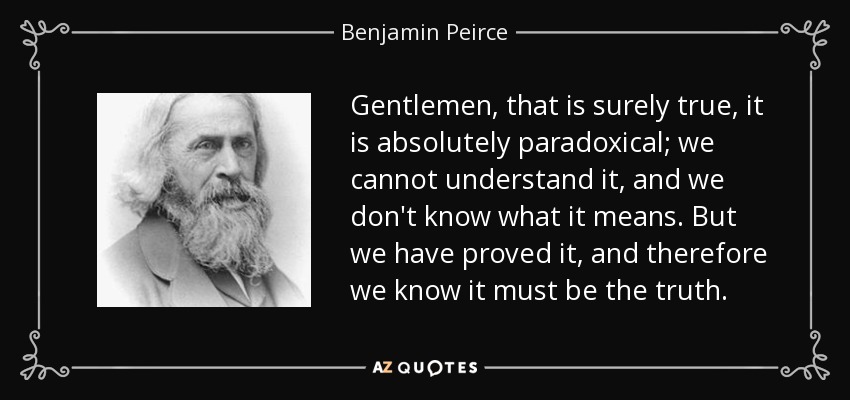

A slave class was not needed for the educated to prosper.

The goal of describing things as they are is motivation for the continual refinement of science with mathematics.

Benjamin Peirce
b. 4.4.1809  Salem, Massachusetts
d. 10.6.1880  Cambridge, MA

Benjamin Peirce was an American mathematician who taught at Harvard University for approximately 50 years. He became a major figure in mathematics and the physical sciences during a period when the U.S. was still a minor country in these areas.

He saw mathematics as a study of creation in recognition of the creatures. He identified himself as a Christian, but he was an apologist for slavery. He thought that it should be condoned if it was used to allow an elite to pursue scientific enquiry.

The theology was more Stoic than it was Christian. Materialism was the philosophical justification for enslavement.

The observation of evidence as limited to the world pressed  argument into a pressurized containment for the victory of the will over nature. What was 'known' was subordinated to that which could be controlled.

He became known for the statement that "Mathematics is the science that draws necessary conclusions". He is often regarded as the earliest American scientist whose research was recognized as world class.

He was director of the U.S. Coast Survey from 1867 to 1874. The survey drew maps.

Benjamin Peirce had interests in celestial mechanics, applications of plane and spherical trigonometry to navigation, number theory and algebra as a professor at Harvard.

Salem, Massachusetts
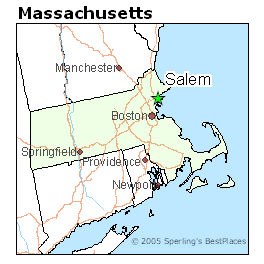
Salem was settled in 1626. It was one of the most significant seaports in early American history. It is about 22 miles or 35 km northeast of Boston.

Puritans had settled in the location to base their settlement on religious freedom. They were ruled by their ascetic inclinations as their political view ruled out most of biblical history except for the support for local councils.

One of the most widely known aspects of Salem is its history of allegations about witchcraft. Witchcraft was defined as a sin that was punishable by death in the Babylonian empire.

Just as the advocates for the one God argued for refinement of the belief in the God of gods, the Babylonians were pressing for an advance in polytheism that ruled out more primitive forms of belief.

These primitive forms were viewed as a form of treason. They argued for reformation that accepted the god of gods as a justification for the ascription of divine status to their leadership. The Puritans were a branch of Calvinists who held that the monarchy was corrupt.

They left England to test their reduced ascetic form of political order in the new world. Every man would get to be part of the government through church in the original plans for the government of the settlement.

William Hathorne was a prosperous businessman in early Salem. He became one of its leading citizens. He led troops to victory in King Philip's War (1675-1678) against the natives.

He had served as a magistrate on the highest court and was chosen as the first speaker of the House of Deputies. He was a zealous advocate of the personal rights of freemen against royal emissaries and agents.

His son Judge John Hathorne came to prominence in the late 17th century when witchcraft was a serious felony.

The accusations started when Abigail Williams, Betty Parris and their friends were observed  playing with a Venus glass (mirror) and egg. The infamous witch trials began in 1692. It was reported that 19 people were executed by hanging as a result of the false accusations.

Judge Hathorne was the best known of the witch trial judges. He became known as the "Hanging Judge" for sentencing accused witches to death.

The town became a center for privateers during the American Revolutionary War. About 1,700 Letters of Marque were granted during that time.

A lettre de marque was a government license in the Age of Sail (c.1550-c.1850) that authorized a private person, known as a privateer or corsair, to attack and capture vessels of a nation at war with the issuer.

The case for that prize could be brought before their own admiralty court for condemnation and transfer of ownership to the privateer once captured.  A letter of marque and reprisal would include permission to cross an international border to conduct some action against an attack or injury.

Cruising for enemy prizes with a letter of marque was considered an honorable calling that combined patriotism and profit. Such privateering contrasted with attacks and captures of random ships.

Unlicensed attack was not authorized. It was known as piracy. Piracy was almost universally reviled.
Nearly 800 vessels were commissioned as privateers and are credited with capturing or destroying about 600 British ships during the Revolutionary War.

Many ships used as privateers were too large for short voyages in the coasting trade after the revolution. Their owners determined to open new avenues of trade to distant countries.

The Empress of China, formerly a privateer, was refitted as the first American ship to sail from New York to China starting in 1784.

Salem had become the sixth largest city in the country and a world-famous seaport by 1790.

Salem Seal


The China Trade, along with exporting codfish to Europe and the West Indies, importing sugar and molasses from the West Indies and the products depicted on the city seal from the East Indies was part of the global reach.

Salem ships also visited Zanzibar in Africa, Russia, Japan and Australia.

Benjamin Peirce

Benjamin was born in Salem, Massachusetts on April 4, 1809.

His father was also named Benjamin (1778-1831). His mother was Lydia Ropes Nichols Peirce (1781–1868). The elder Benjamin would later be appointed as the librarian for Harvard.

The younger became a student at that school. He was appointed tutor there in 1829. Two  years later he became Professor of Mathematics at the University. The post was changed to include astronomy in 1842. He held it until his death in 1880.

He played a prominent role in the development of the science curriculum at the university. He also acted as the librarian for a time.

He wrote some introductory textbooks in mathematics and something more advanced in mechanics (Peirce 1855).

His definition of mechanics was anti-paradisiacal with respect for the occurence of perpetual motion in nature. If design had made providence purely perpetual without incident in destructiveness it would have proved destructive to human belief in the spiritual origin of force.

The First Cause was of necessity superior to matter. If everything were made for the perpetual production of providence for everyone, there would not have been any reason to appeal to authority for help in understanding benevolence in free will. Capriciousness in judgment would result as a consequence toward the functional application of mechanics.

'Ideality' connoted the 'ideal-ism' in the certain knowledge that served as the foundation for mathematics.

Berkeley had qualified idealism as a criticism of materialism. He warned against too much abstraction, but it was with the renunciation of it.

Peirce qualified idealism with respect for free will in the mechanics of necessity. He set the frame for the work in pragmatism that followed.

His son,  Charles Sanders Peirce (1839–1914), became a remarkable though maverick polymath. He would become a mathematician, chemist, logician and historian with a strength of mind that reflected that of his father.

Opportunity was incentive to organize thought for the production of a product for the public.

The most important among Benjamin's other appointments was his post as the Director of the U.S. Coast Survey from 1867 to 1874. His son would work for him there in the production of maps to aid travelers.

Benjamin was like George Boole (1815-1864) in that he believed that mathematics could be used to study logic. These ideas were further developed by his son Charles. He noted that logic also includes the study of faulty reason.

Benjamin maintained that mathematics could be used to analyse logic. The analytical philosophy of Frege would (1848-1925) derive logic from arithmetic. Russell (1872-1970) would derive logic from all mathematics in the 1900's. 

There is a chain of command implicit in the idealism of pragmatism. Ideals are firmly anchored in the production of providential value for the public in the market or government.

While there is great importance in the capital for production, organization has to order work with the understanding that disaster could destroy the means for production.

Endowment was not just for the arts. It is support for the means of production in the face of threat from the incidence of destructive crisis.

Support for slavery ran contrary to the operation of free will in society. It wasn't a necessity. It was an obstruction to the solicitation of voluntary cooperation in the management of labor. His support was conditioned by the spirit of the times.

Benjamin married Sarah Hunt Mills, the daughter of U.S. Senator Elijah Hunt Mills. They had 4 children. James Mills also taught mathematics at Harvard. He succeeded to his father's professorship.

Charles Sanders became a famous logician, polymath and philosopher. Benjamin Mills worked as a mining engineer. His death came early. Helen Huntington married William Roger Ellis. Herbert Henry Davis pursued a career in the Foreign Service.

His philosophy was characterized by his love for geometry. Geometry uses reason to establish proofs.

He argued that geometry provided more proof with reason than any other  science. The world that has been alloted to us can be adapted by mind to promote intellectual progress.

Progress with the plan for defense against destruction requires functional respect for the public. The order for the world might have been otherwise transposed to a complicated system that our finite power could not unravel.

He died in Cambridge, Massachusetts on October 6, 1880.

Benjamin Peirce
S. 本杰明·普厄斯
T.  本傑明·普厄斯

本 Ben      this                    本  hon     book                         Ben  べん  ベン       Ben  벤  Ben     
杰 jie        jay                     傑  ketsu   greatness                  ja      じゃ   ジャ       ja     자  character
明 ming   bright                 明  mei      bright                      min   みん  ミン       min   민  min           
普 Pu        general              普  fu         universal                Pu     ぷ        プ          Pu     푸   fu             
厄 e          hey                     厄  yaku    unlucky                   ru      る        ル          eo    어  uh 
斯 si         span                    斯  shi       this                           se      せ       セ 

---------------------

Greatness in form is organized against the unlucky.
The ideal is made real when the form for function is plucky.

===============

wiki Benjamin Peirce
SOPE: BP
Salem's History

The Band Perry - If I Die Young
Music Video

Assimilation


Assimilation is a major feature in the acquisition of new knowledge. The attainment of one new fact or technology can drastically effect the existence of an industry.

The song that said, "Video killed the radio star" wasn't completely true, but there was a dramatic drop in the public perception of the importance of radio when tv and movies added the visual element to broadcasts.

Existing industry has historical justification for concern in the fear of being replaced. The public has a legitimate concern insofar as replacement presents itself as a costly consequence.

If the US were to jettison nuclear and hydro-power for the sake of other renewable sources, it would cost the public to have the former industries reduced to relative insignificance.

Solar power presents itself as an element which could be added to the network of services provided it isn't assumed to be the 'new' source of energy.

The solar industry currently stands as a pig in the poke. You could buy the apparatus to install in your yard in the hope that it will reduce the cost for the others in the result of a total decrease in cost, but if it doesn't work the buyer is left with what amounts to useless aparatus in the yard.

Chances are great that the new industry will charge the individual users for the cost of having risked the change in the larger industry. While the consumer may assume reasonable risk in the investment, the new industry may be assuming that the risk has to be transferred to the consumer in order to establish the industry.

The apparatus has to justify the cost for the risk in purchase, but lobbies for industry work their influence in the context of 'buyer beware' maxim.

C.S. Peirce

C.S. Peirce defined synechism in terms of what it does not say. A synechist cannot say, “I am altogether myself, and not at all you.” No one is an island.

Only the liberal solipsist that argues for him or herself as "the people" views self in terms of absolute individuality.

The Continuity of Being
Article: Synechism

Benjamin Peirce had argued against government as the source of paradise. He indicated that this was the source of delusion with respect for the expectation of perpetual motion in a socialist utopia.

His son, C.S. Peirce, argued that humankind cannot tolerate too much discontinuity in providence.

When good faith providers are treated as delusional it is a disincentive to the production of a service. This adversely effects industry in general.

Together the Peirces argued for pragmatism as a form of correction of the materialism in Stoic philosophy. Idealism had to be qualified by something observably beneficial in practical value.

This supported Berkeley's criticism of materialism with his advocacy for the immaterial operation of mind.

Insofar as leading non-conformist Protestants felt the compunction to provide the principles for conservative reform in monarchy to republican government there was a synechist type of agreement in the formation of reasonable expectation for cooperation with leadership.

---------------------

Humanity endures only so much discontinuity.
The elements are organized for functional unity.

The body is made with spirit and blood
for worship in the temple built with wood and hardened mud.

================

Sunday, October 20, 2019

Kiss

10.27.19

India Eisley

Kiss
Bliss
亲吻幸福 
Qīnwěn xìngfú
至福を楽しむ
Shifuku o tanoshimu
ps 65
Oscula beato

The sky is moist with air.
The courage of conviction has to be fair.

The image of our sky appears in the night
when the crescent moon is nearly out of sight.

The creativity of darkness approaches its height.


Uranus

Oversight sails on high.
Beauty gives courage an ally.

This temple was not made with human hands.
It was not built on stone. It is closer to sand
but it is on land.

Build a promise like you build a house.
Don't forget your beginning sprouts
with the tests you tout.

Prayer is answered with each test
insofar as you seek to find the best.

Start each task with the end in mind
until the next step is the tie that binds.

Courage for faith 
will pave 
the way 
to say:

"Design will be conceived.
Goals will be achieved.
Stress will be relieved.
Reward will be believed.

"Promises will be kept.
Support will not have left.
Meaning will be what was meant
with respect for the right intent."


The ominous drama of office
will honor the keeping of promise
for the honorable prominence
of love's dominance.

Salvation is a benefit for worship with prayer.
Survival blessed with goodness waits at the height of the spiral stair.

The Pastor was given the strength to deliver his message
that potential believers might hear the essence of the lesson.

The liturgy is a model for concise variation in prayer
that asks for guidance in statecraft to build on the goodness which is there.

The free exercise of religion is adverse to damage to self or others
in the psychology that respects health as a natural wonder.

Leadership is modeled on the image of divinity
when interpretation is viewed in relation to the Trinity.

The administration of the state concerns the law
as the means to reduce human flaw.

The law of the state is inferred from the design of nature
insofar as written intent is recorded by the legislature.

Attachment to asceticism can rise from religion or political inclination
but passion for punishment is harmful to the intent of investigation
or legislation.

From what premises are propositions deduced?
Isn't the evidence of the senses used? 


The dogmas of empiricism are against the inference of principle.
Logical constructs cannot stray from the expression of the clinical. 

Absurd conclusions are drawn from want of method.
The lack of definition results in what you may have expected.

Absurdities proceed from the confusion
in a way that resembles a cerebral contusion.

Forgiveness will be shown.
The drone groan will not have blown
the bliss of this kiss.
The fixable will forge forgiveness
for that which is forgivable in this.

Happiness will happen.
Welcome will be in fashion.
Reliability will protect the hallowed halls
with the brightly painted walls
of faith with fidelity
as the melody
for the clarity
of charity.

We will be satisfied in this house of satisfaction
with attraction for the action of benefaction
as the plan for action that is not just abstraction
with respect for life with liberty and the justice
that will thrust us into august robustness
with justness as our substance.

There is no partiality in impartial judgment.
Statistical inference has to rule on the budget.

Deliverance
will deliver us
from ignorance

as the construction
for destruction
and belief in being lawyers
with destroyers as employers.


Salvation is hope that reaches

by the farthest seas to the nearest beaches.

Mountains were established by the strength of land
being pressed by pressure from beyond and beneath the sands.

The roaring waves of outraged oceans
find solace in silent motions
after the purging surge of roaring rage
releases peace from the pain of the age.

That the funnel forms from the cloud to the ground in a tornado
doesn't rule out lightning as the cause of thunder in the sound before the hailstone.

Not all that is determined through the immediate perception of sense
is known as an inferable expense in the future tense.

Love for life quiets the tumult
from turbulent tides and the lightning bolt.

Merchants commission transportation for materials
and pay employees to sell products in a way defined as managerial.

Carriers are paid to navigate transportation 
with direction drawn from the stars to reach the destination.

Materials are transported from remote places around the globe
to reach the manufacturing industry for production beyond hope.

Machinery automates that which can be automated in labor.
Operators work the machines to produce products you or your neighbor
can favor. 

The morning and evening
shout for joy as gateways for retrieving
the goodness of peace that reaches
to the ultimate end that the awe of awesome teaches.

The power of the sun, wind, water and soil
make grain grow as part of the plan for the least amount of toil.

Irrigation teaches water to reach low
to each place that had not been known
by moisture or had not been shown
the blessing of growth.

Drainage drives deluge into ponds
for holding the drink for the palm's unfolding fronds.

Time is crowned by provision.
Trade, travel and labor's vision
will overflow with wealth in a provident decision
of the economy's revision of monetary division.

The land abounds with boundaries
established by pastures. forest trees,
rivers, lakes, seas, deserts and constructed levies.

Meadows are adorned with flocks.
Gates are secured with locks.

Valleys give growth to grain.
Pleasure is cultivated from pain.

Life sings for the joy of living.
This joy is strengthened with thanksgiving.

Liberty is limited by the law of love for life.
Redemption transforms adversity from strife.

Happy are those who are brought near your courts.
Security transcends the structure of the fort.

Kiss bliss.
Don't dismiss this.
It will help you to dismiss
what the Swiss missed.

Like you build a temple, like you build a statue, you build a vow...

----------------------

Psalm 65
Te decet hymnus
You are praised

To the leader. A Psalm of David. A Song.

1 Praise is due to you,
   O God, in Zion;
and to you shall vows be performed,
2   O you who answer prayer!
To you all flesh shall come.
3 When deeds of iniquity overwhelm us,
   you forgive our transgressions.
4 Happy are those whom you choose and bring near
   to live in your courts.
We shall be satisfied with the goodness of your house,
   your holy temple.
5 By awesome deeds you answer us with deliverance,
   O God of our salvation;
you are the hope of all the ends of the earth
   and of the farthest seas.
6 By your* strength you established the mountains;
   you are girded with might.
7 You silence the roaring of the seas,
   the roaring of their waves,
   the tumult of the peoples.
8 Those who live at earth’s farthest bounds are awed by your signs;
you make the gateways of the morning and the evening shout for joy.
9 You visit the earth and water it,
   you greatly enrich it;
the river of God is full of water;
   you provide the people with grain,
   for so you have prepared it.
10 You water its furrows abundantly,
   settling its ridges,
softening it with showers,
   and blessing its growth.
11 You crown the year with your bounty;
   your wagon tracks overflow with richness.
12 The pastures of the wilderness overflow,
   the hills gird themselves with joy,
13 the meadows clothe themselves with flocks,
   the valleys deck themselves with grain,
   they shout and sing together for joy.

-----------------------

Joel- YHWH believer
Penthuel- Mouth of God

Joel refrained from mentioning the current ruling kings. This omission suggests that the prophecy occurred in the aftermath of Judah’s only ruling queen, Athaliah (d. 835 BCE).

Her young grandson, Joash, succeeded Athaliah upon her death. Joash was too young to rule after her death so the priest Jehoida ruled in his place until he came of age. This presented a caretaking period in the monarchy.

If Joel prophesied during this caretaking period, it would make sense that he mentioned no official king. The book makes ample mention of priests, temple rituals and nations.

Phoenicia, Philistia, Egypt and Edom were prominent in the late ninth century BCE. All of this points to a date prior to 835 BCE or soon after. This makes Joel one of the earliest writing prophets and a  contemporary of the prophet Elisha.

The book focuses its prophetic judgment on the southern kingdom of Judah. There are a number of references to Zion and the temple worship. Joel’s familiarity with this area and the worship in the temple places him in Judah, possibly in the city of Jerusalem.

The book of Joel’s importance to the canon of Scripture stems from its being the first to develop the day of the Lord as a biblical idea that was to be mentioned often. Some of the most striking and specific details in all of Scripture are given. The days cloaked in darkness, a plague of locusts, armies that conquer like consuming fire and the moon turning to blood are listed.

The day is described as a time of divine judgment when consequence is imposed for the infidelity of immorality, but it had an immediate frame of reference for the public with the incidence of forest or building fires.

The eternal flame was a component of the Jewish religious rituals performed in the Tabernacle in the wilderness. Records show that a commandment required a fire to burn continuously upon the Outer Altar.

This flame was included in the temple after it had been built. Modern Judaism continues a similar tradition by having a sanctuary lamp, the ner tamid, always lit above the ark in the synagogue. The flame is a symbolic reminder of tragic events in history.

The eternal fire is a long-standing tradition in many cultures and religions. The Atar was tended by a dedicated priest in ancient Iran. The fire represented the concept of "divine sparks" or Amesha Spenta as understood in Zoroastrianism.

The tragedy of the past is used to predict the repetition in the future as a marker for living a good life in the present. A good life is divinely blessed.

The Day of the Lord

Joel 2:32

Everyone who calls on the name of the LORD will be saved. There shall be those who escape in Mount Zion and Jerusalem. The LORD has said, there will be those whom have been called among the survivors.

-----------------------

Salvation is a benefit for worship with prayer.
Survival blessed with goodness waits at the height of the spiral stair.

=================

Sirah, the Book of Ecclesiasticus, is a collection of ethical instructions. It closely resembles Proverbs, except that, unlike the latter, it is the work of a single author, not an anthology of maxims drawn from various sources.

It is likely that the author compiled statements drawn from a number of sources. Attribution to a single author was a movement towards the recognition of private property as a legal entity.

The premise for the organization of the sources was structured around the definition of wisdom as the fear of God. This fear is the presumed motivation for adherence to Mosaic law.

The maxims are expressed in exact formulas as illustrated by striking images. They show a profound knowledge of the human heart, the disillusionment of experience and sympathy for the poor as subject to oppression from adversity.

Two opposing tendencies are at conflict in the testimony of the author. It's like the conflict expressed in Ecclesiastes. The strength of morality as drawn from the past is at odds with that faith that holds an Epicurean desire for progress.

The prayer of Israel runs through the moral chapters imploring God to gather together his scattered children, to bring to fulfilment the predictions of the Prophets and to have mercy upon his Temple and his people.

The book concludes with a justification for faith in God whose wisdom and greatness are said to be revealed in morality and the history of Israel.

The book was written by the Jewish scribe Ben Sira of Jerusalem sometime between 200 and 175 BCE. He was inspired by his father, Joshua son of Sirach. The name Joshua can be translated as Jesus or Yeshua.

The book was translated into Greek in Egpyt by the author's unnamed grandson. The grandson added a prologue.

This prologue is generally considered the earliest witness to a canon of the books of the prophets. The date of the text has been the subject of intense scrutiny. The book itself is the largest wisdom book from antiquity to have survived.

Ecclesiasticus 35:15-16

The Lord is the judge.
There is no partiality with him.
He will not show partiality to the poor,
but he will listen to the prayer of one who is wronged.

-----------------------

There is no partiality in impartial judgment.
Statistical inference has to rule on the budget.

=================

The second letter to Timothy has been identified as 1 of 3 pastoral epistles traditionally attributed to the apostle Paul. The epistles are called "pastoral" because they relate to the conduct of church leaders. The leaders are named pastors as a figurative association with shepherds.

The Epistle advocates endurance as the main quality for a preacher of the gospel. Salvation was celebrated as deliverance from attack. The deliverance allowed for persuasion to faith in Christ Jesus as the author of the good news for the love of God in life.

The pastoral letters are different from Paul's other epistles. Scholars since the early 19th century have increasingly seen the pastorals as the work of an unknown student of Paul's doctrine.  They are believed to have been written between 90 and 140. They reflect a church hierarchy that is more organized and defined than the church was in Paul's time.

2 Timothy 4:17-18

The Lord stood by me and gave me strength that through me the message might be fully proclaimed and all the Gentiles might hear it. I was rescued from the lion's mouth. The Lord will rescue me from every evil attack and save me for his heavenly kingdom.

-----------------------

The Pastor was given the strength to deliver his message
that potential believers might hear the essence of the lesson.

=================

The 18th chapter of the gospel of Luke had presented the parable of the widow to encourage persistence in prayer. The parable of the publican and the pharisee promoted humility and concise expression in the persistence.

Luke 18:9-14

Jesus told this parable to some who trusted that they were righteous and regarded others with contempt: 'Two men went up to the temple to pray, one a Pharisee and the other a tax collector. The Pharisee stood by himself and prayed, "God, I thank you that I am not like other people: thieves, rogues, adulterers or even like this tax-collector. I fast twice a week and give a tenth of all my income."

'The tax-collector stood far off. He would not even look up to heaven, but beat his breast and said, "God be merciful to me, a sinner!" I tell you this man went down to his home justified rather than the other. All who exalt themselves will be humbled, but all who humble themselves will be exalted.'

-----------------------

The liturgy is a model for concise variation in prayer
that asks for guidance in statecraft to build on the goodness which is there.

=================


James wrote True Law about the same time that Richard Hooker had published the Laws of Ecclesiastical Polity (1597) to defend the Elizabethan settlement. Hooker had argued that there were good and bad monarchies, democracies and church hierarchies.

Authority was to be based on reason for goodness. He called this goodness piety. The term is interchangeable with prudence or duty. It is one of the cardinal virtues in classical culture. It refers to that which is automated in behavior based on belief. The belief is derived with reason with respect for order in nature.

When authority is wrong, it has to be corrected with right reason. The correction of that policy which was established without regard for the maintenance or improvement of goodness in precedent is a duty. The logic isn't circular. It is dialectical.

James argued that knowledge of God was the basis for allegiance especially in monarchy. Rebellion strengthened error in the Commonwealth. The true ground for allegiance between the monarch and the people was mutual duty. The duty produces the benefit of freedom within the law in relation to the absolute.   

Sound instruction in truth is the true law for that which is free. Faith in God is the guide to sound instruction.

The future king of England provided the context for his argument with respect for the Bible, the kingdom and nature. The Bible was used as a historical reference that established that monarchy was a pattern for government that developed the practice of royal succession by inheritance with birth.

The first king had won monarchy in battle.The story regarding the consumption of his heirs by Saturn illustrated that the  polytheists had trouble with the establishment of a royal line.

Rebellion was viewed as a test of mettle to repeat the establishment of rule by military battle. Each heir was seen as a competitor to the authority of the crown prior to the death of the established monarch.

The Romans had done away with monarchy to insist on victory by popular election, but the term limits for the chief elected position of consul was one year for two consuls. It was an over-correction that resulted in the rise of the emperor as a position that allowed for family succession.

The Patricians who ran the senate did not approve of the innovation. They saw it as an offense to the elected leadership in the republic. They made sure that the emperor was subject to the approval of the Patricians and the Plebians.

The policy was not favorable to foreign relations insofar as monarchies were treated as anachronistic and primitive people were viewed as barbarians. Either were capable of rebellion that could overthrow the Roman extension of rule in empire.

James VI was right to identify rebellion as the cause of error for selection of leadership by royal succession or election by the commonwealth. His treatise established an argument for the use of reason in legislative reform.

James I (1566-1625)
The True Lawe of Free Monarchies (1598)
Text

"First then, I will set downe the trew grounds, whereupon I am to build, out of the Scriptures, since Monarchie is the trew paterne of Diuinitie, as I haue already said: next, from the fundamental Lawes of our owne Kingdome, which nearest must concerne vs: thirdly, from the law of Nature, by diuers similitudes drawne out of the same: and will conclude syne by answering the most waighty and appearing incommodities that can be obiected."

----------------------

"First then, I will set down the true grounds whereupon I am to build out of the Scriptures. Monarchy is the true pattern of Divinity as I have already said. Next, the fundamental Laws of our own Kingdom which are nearest must concern us. Thirdly, the law of Nature is drawn out of the same by divers similitudes. I will conclude soon by answering the most weighty and appearing incommodities that can be objected."

---------------------

Leadership is modeled on the image of divinity
when interpretation is viewed in relation to the Trinity.

The administration of the state concerns the law
as the means to reduce human flaw.

The law of the state is inferred from the design of nature
insofar as written intent is recorded by the legislature.

================


Locke wrote the Two Treatises (1689) after Hobbes' Leviathan (1651), but his work reflected the mindset that insisted that rebellion was the power over the commonwealth.

Locke's argument was a regression even though it came after what Hobbes had published. His work couldn't be published in his name during his life.

Hobbes established the development of James' biblically based argument with the social contract as a constitutional expression.

Locke wrote about the state of nature in terms of perfect freedom. His freedom was defined in terms of the liberal claim to power over the government and the people whom had elected them for representation.

Liberal power was defined in terms of the threat of terrorism or rebellion. Treason could even be defined as the threat of rebellion. The requirement that it was organized against the claim of the tyranny in executive leadership was stipulated as neccessary to control parliament and the monarchy from the House of Commons.

Hobbes defined the same state of nature as the condition of life without government in order to establish the importance of allegiance.

The first ten amendments to the US Bill of Rights were written by James Madison. The language was used in way that demonstrated that the English Bill of Rights was too particular for the power of the Whigs and Locke in expression.

The US Bill was ratified 100 years after the English form. The English Bill came 100 years after James had his work published. The American Bill displayed the ability to learn from experience. It was the first step in the reconstruction of Roman republic for their time.

The Constitutional expression would have to add the right to vote for women and people of color later to make it less particular to the majority political group.

One of the chief elements in the liberal claim to power was the admonition to reckon without words. Aristotle's law of the excluded middle was used to reduce argument for a law against slavery. The slave trade was tolerated for slavery in the colonies.

Slavery was such an offense against that which could be defined as natural law with respect for kingdom or republic in the Bible that it was an absurdity in speech. The liberals were so invested in the establishment of their power that they didn't admit to error much less abusurdity in public speech.

Hobbes felt that it was necessary to establish that right reason admit to the correction of error or absurdity to guide the application of addition or subtraction to the constitutional expression of the social contract.

Thomas Hobbes (1588-1679)
Leviathan (1651)
Text

"The first cause of Absurd conclusions I ascribe to the want of Method; in that they begin not their Ratiocination from Definitions; that is, from settled significations of their words: as if they could cast account, without knowing the value of the numerall words, One, Two, and Three.

"And whereas all bodies enter into account upon divers considerations, (which I have mentioned in the precedent chapter;) these considerations being diversly named, divers absurdities proceed from the confusion, and unfit connexion of their names into assertions."

----------------------

"The first cause of absurd conclusions I ascribe to the want of method. They don't begin with argument from definitions; that is from settled significations of their words: as if they could could cast account without knowing the value of the numeral words, one, two and three.

"Whereas all bodies enter into account upon drivers considerations, these considerations being diversely named, divers absurdities proceed from the confusion and unfit connection of their names into assertions."

----------------------

Absurd conclusions are drawn from want of method.
The lack of definition results in what you may have expected.

Absurdities proceed from the confusion
in a way that resembles a cerebral contusion.

================

The British line of succession was maintained despite the Whig argument for selection by Parliament.
Anne was the older sister to Mary. Charles II was their father. He had both of them raised as Anglicans.

Mary ascended to the throne first by virtue of the Whig favor for her husband, William of Orange, and her Protestant religion. Mary ruled with William from 1669 until her death in 1694. William remained in power until his death in 1702. They did not produce any children.

Anne was crowned in 1702. She reigned until she died in 1714. She was 49 years of age. She had not had any children.

The Act of Settlement was passed by the English Parliament in 1701.  Parliament did not choose to select the next monarch. They restricted the succession to Protestants.

The Act applied to England and Ireland. Scotland abstained. A strong minority wished to preserve the Stuart dynasty and its right of inheritance to the throne.

The Acts of Union was enacted in 1707. Anne became the Queen of both England and Scotland. The two kingdoms were united with one Parliament.

Most of the House of Stuart was Roman Catholic, but whoever was being considered to succeed to the throne had to be raised Protestant. The monarch would become the head of the Anglican Church.

Sophia of Hanover was the grand-daughter of James I. When Anne died, Sophia's son, George I, became the king. This was the start of the Hanoverian dynasty in Great Britain. There would be two foreign born monarchs before the House produced a British heir.

The Jacobite risings were attempts to restore the House of Stuart to dynastic rule.  The House of Stuart had abdicated the throne when King James II (1633–1701) fled to France in 1688. He and his son, James Francis Stuart, the Prince of Wales, claimed to be the legitimate kings.

They had support from important elements in England. King Louis XIV in France supported them as well. The main issue was religion. Catholic Europe was for the Stuarts.

The Whigs were staunch opponents of Catholicism. Protestant Europe favored them. This included the Dutch and Swiss Reforms, German Protestants and Reformed Protestants and French Protestants.

The Protestant House of Hanover starting with King George I in 1714. They were not especially popular in Britain because they were born in a foreign country.

The Jacobites plotted and attempted seaborne invasions. The major attempts were the Jacobite rising of 1715 and the Jacobite rising of 1745. Both failed to rally significant popular support. The Jacobite defeat at the Battle of Culloden in 1746 ending any realistic hope of a Stuart restoration.

Britain was one of the most prosperous countries in the world by the 1720's. The nation has a set of primary interests that distinguished them from the continental dynasties of the Habsburgs, Bourbons and the House of Hohenzollern. The main diplomatic goal was to build  a worldwide trading network for its merchants, manufacturers, shippers and financiers.

The Royal Navy was strengthened to defend shipping routes and the homeland from invasion. The London government enhanced the private sector by incorporating numerous privately financed London-based companies for establishing trading posts and opening import-export businesses across the world.

Each was given a monopoly of trade to the specified geographical region. The first enterprise was the Muscovy Company set up in 1555 to trade with Russia. The East India Company and the Hudson's Bay Company in Canada were other prominent enterprises.

Trade with Africa included slaves as well as gold and ivory. The Company of Royal Adventurers was organized after the English Civil War in 1662. it was reestablished as the Royal African Company in 1672 to focus on the slave trade.

British involvement in four major wars between 1740 to 1783 paid off in terms of trade. The loss of the 13 colonies resulted in trade relations with the United States. The slave, sugar and commercial trades in West Africa and the West Indies contributed to the dominance of the British in trade with India.

China would be next on the agenda. Other powers set up similar monopolies on a smaller scale. Only the Netherlands emphasized trade as much as England. British exports soared from £6.5 million in 1700, to £14.7 million in 1760.

Adam Smith studied social philosophy at the University of Glasgow. He studied moral philosophy under Francis Hutcheson. He developed his passion for liberty, reason and free speech at the university.

He was the graduate scholar presented to undertake postgraduate studies at Balliol College, Oxford in 1740 from a scholarship set up by the Scot John Snell. He felt that the rich endowments of the colleges at Oxford and Cambridge separated the income of the professor from the ability to attract students.

Smith wrote two classic works, The Theory of Moral Sentiments (1759) and An Inquiry into the Nature and Causes of the Wealth of Nations (1776). The work reflects on the economics at the beginning of the Industrial Revolution. The major theme is unusual insofar as productivity in labor is identified as the basic building block for wealth.

Stocks, opulence, political economy and the revenue of the sovereign or commonwealth are counted as elements. 

The Wealth of Nations gained him a reputation as the Father of Capitalism. It laid the foundations of classical free market economic theory. The Wealth of Nations was a precursor to the modern academic discipline of economics.

His explanation of the division of labor is rich in detail. He described the coat of a common day laborer in terms of all the industries that were included to make the coat.

The woolen coat required the work of the shepherd, the sorter of the wool, the wool-comber or carder, the dyer, the scribbler, the spinner, the weaver, the fuller, the dresser and others.

They all joined their arts in order to complete the product. Merchants and carriers were employed to transport the materials from different parts of the country. Modern machines were employed to automate important features in the production.

Larger scale industries transferred the work from human to mechanical automation. Skilled labor was required to run the machines to reduce the costs for the operation.   

Adam Smith (1723-1790)
Wealth of Nations (1776)
Ch.1: The Division of Labour
Text

"How many merchants and carriers, besides, must have been employed in transporting the materials from some of those workmen to others who often live in a very distant part of the country? How much commerce and navigation in particular, how many ship-builders, sailors, sail-makers, rope-makers, must have been employed in order to bring together the different drugs made use of by the dyer, which often come from the remotest corners of the world? What a variety of labour, too, is necessary in order to produce the tools of the meanest of those workmen! To say nothing of such complicated machines as the ship of the sailor, the mill of the fuller, or even the loom of the weaver..."

----------------------

Merchants commission transportation for materials
and pay employees to sell products in a way defined as managerial.

Carriers are paid to navigate transportation
with direction drawn from the stars to reach the destination.

Materials are transported from remote places around the globe
to reach the manufacturing industry for production beyond hope.

Machinery automates that which can be automated in labor.
Operators work the machines to produce products you or your neighbor
can favor.

================


The two party system for Britain was formed in England in the 17th century. The Court Party and the Country Party were organized after the English Civil War.

The Court Party came to be known as the Tories. The term stuck despite the official name “Conservative.”

The Exclusion Bill crisis of 1678-1681 produced the nicknames for the respective parties. The Country Party supported the exclusion of the Duke of York for the thrones of England, Ireland and Scotland because he was Roman Catholic. The Courts opposed the bill.

Both names were originally insults. A “whiggamore” was a horse driver. A “tory” was an Irish term for an outlaw. The Conservatives are still known as Tories.

Jeremy Bentham was born in a wealthy family that supported the Tories. He studied law. He got his Bachelor's degree from Queen's College in 1763 and his master's degree in 1766. He never practiced law, but he wrote about the philosophy of law.

He spent most of his life criticizing the existing law and strongly advocating legal reform. He wrote a critical response to the Declaration of Independence. He referred to the French Rights of Man as nonsense on stilts.

He spent much of his time in intense study. He would write for 8 to 12 hours a day. He was an active polemicist.

He became associated with William Petty, the Earl of Shelburne in 1781. He came into contact with a number of the leading Whig politicians and lawyers through him. His work was admired by some, but remained largely unappreciated.

He coined the name “utilitarian” in recording a dream he had while a guest at the country estate of the Earl, his patron. He imagined himself as the founder of the sect of utilitarians. He was to be a personage of great sanctity and importance.

His major proposal was for prison reform in relation to the panopticon view of design. He had traveled to Krichev in White Russia (modern Belarus) to visit his brother, Samuel, in 1786 and 1787. Samuel was engaged in managing various industrial and other projects for Prince Potemkin.

His brother conceived the basic idea of a circular building at the hub of a larger compound as a means of allowing a small number of managers to oversee the activities of a large and unskilled workforce. Jeremy developed the model for prisons.

He outlined his ideas in a series of letters sent home to his father in England. The supervisory principle with the idea of contract management. The director of the administration would have a pecuniary interest in lowering the average rate of mortality.

The panopticon was intended to be cheaper than the prisons of his time as it required fewer staff. The proposal was the development of his utilitarian philosophy with respect for law enforcement. It was not an advocacy for hedonism. He had the utility of the national interest in mind.

The ultimately abortive proposal for a panopticon prison to be built in England was one among his many proposals for legal and social reform. He spent about 16 years of his life developing and refining his ideas for the construct.

He hoped that the government would adopt the plan for a National Penitentiary appointing him as contractor-governor. The building of a new prison in London had been authorized by the Penitentiary Act 1794 and Bentham’s plan initially received the support of the Pitt administration.

He devoted considerable sums of his own money to the project over the years. He published further material comparing the merits of the panopticon with the disadvantages of the system of transporting convicts to penal colonies

The prison was never built, but the concept had an important influence on later generations of thinkers. He was given £23,000 compensation for his work on the proposal.

His most important theoretical work was the Introduction to the Principles of Morals and Legislation (1789). His moral theory reflected "the greatest happiness principle" as the logical basis for legislation.

The theory was developed out of empiricism with references to statements by Locke and Hume.
The notion that pleasure and pain are the universal bases from which the principle of utility was derived is a development of what Locke had said about the state of nature as perfect freedom. Hume's philosophy of history was used to endorse the concept of psychological egoism for self-interest.

Bentham identified two classes of ascetics who were opposed to the utility of happiness in legislation. One class was moral. The other was religious. He observed that the religious party had been less wise with respect for government. The religionists not only courted pain as a product of asceticism, they used the principle to impose misery with punishment by the affliction on others.

While Locke had distanced himself from biblical reason in the metaphor of Adam as a reference to the development of monarchy out of tribal life, his association with Aristotle was tied into the justification for the Crusades, the Inquisition and slavery by the position that there were those who were meant to rule and those who were meant to be ruled.

The same cruelty towards people appeared to be the case in the Ottoman rule as well.
The Puritans weren't exactly pure when it came to government in local councils, but the religiousity of the Whig party had broader and more harmful applications on the political order.

Jeremy Bentham (1748-1832)
Principles of Morals and Legislation (1789)
Text

"It is true, that from the same source from whence, among the religionists, the attachment to the principle of asceticism took its rise, flowed other doctrines and practices, from which misery in abundance was produced in one man by the instrumentality of another: witness the holy wars, and the persecutions for religion. But the passion for producing misery in these cases proceeded upon some special ground: the exercise of it was confined to persons of particular descriptions: they were tormented, not as men, but as heretics and infidels."

----------------------

Attachment to asceticism can rise from religion or political inclination
but passion for punishment is harmful to the intent of legislation.

================


When freedom is used in relation to religion, it welcomes the consideration of variety to value the meaning of faith in the context of the believer's religion. Religion is moved from a closed system to one where growth is possible personally and socially. This concept rests at the heart of classical reconstruction.

The proposal to move from polytheism to monotheism held the social value of moving from primitive to civilized life. Civilized life holds the promise that comes with association by allegiance to law in the political body.

Freedom of religion is only one element in the First Amendment, but it is socially and personally significant in political application.

James Madison re-wrote English documents on administrative structure in government for the US Constitution. It was ratified in 1788. He also re-wrote the English Bill of Rights. The American form was ratified in 1791. He edited the content for the public by the removal of expression that was too favorable to any faction.

The Federalist Papers were written by Alexander Hamilton, James Madison and John Jay. The Papers are a collection of 85 articles and essays. They were written under the pseudonym "Publius" to promote the ratification fo the US Constitution.

The first 77 of these essays were published serially in the Independent Journal, the New York Packet and The Daily Advertiser between October 1787 and April 1788. The last eight papers (Nos. 78–85) were republished in the New York newspapers between June 14 and August 16, 1788.

The authors explicitly stated that they were looking at the establishment of good government by "reflection and choice." This was presented in contrast to the general notion that political constitutions are determined by accident and force.

Federalist No. 10 is the most important of the 85 articles from a philosophical perspective. Madison discussed the means to prevent rule by majority faction. He advocated for a commerical republic for the promotion of employment in trade.

The proposed Constitution was ratified by the minimum 9 states stipulated in Article VII on June 21, 1788. The process of organizing the new government began when 11 states had agreed to the proposal by the end of July 1788.

The use of debate in journals published by some major media outlets contributed to the controversy that helped the public consideration of the ideas for reflection and choice.

The Federalist collection has been used by judges to interpret constitutional law. Chief Justice John Marshall noted in McColloch v. Maryland that the right to judge the correctness of the opinions expressed by the authors had to be retained for the progress of government.

The Federalist had been quoted 291 times in Supreme Court decisions by 2000.

While the source documents for the US Constitution and the Bill of Rights were written in English, the English were engaged in the controversial consideration of the political ideas that had shaped European culture. 

The Declaration of Independence had declared independence from the tyranny of monarchy.
Reflection and choice in political participation could make the difference between a successful government that facilitated trade and a tyrannical republic determined by accident and force.

Freedom of Religion was one of the key elements in the First Amendment. It stipulated that Congress will make no law for the establishment of religion nor to prevent free exercise.

Bentham's objection to the use of the force of asceticism on government decisions is relevant in a broad context. It represents disagreement with immoral morality or the domination of government by a religious faction, even the predominant kind.

Locke's liberal proposal was that political power from the larger body is expressed with the threat of rebellion over the higher authority. Force and accident are favored by this form.

The Whigs in general supported the establishment of religion for the Puritan dominance and the 'moral' norm that punishment controls public dissent. The punishment included the death penalty. torture, invasion, colonial expansion with military conquest, the threat of genocide and slavery.

The native American population was reduced to 1% of the total with this political policy. The natives were either killed by disease, in battle or by massacre. It is likely that many chose to migrate to Mexico, South America or Asian countries for protection. 

The objection to the Crusades as an example of papal supremacy stands against the invasion of foreign nations, yet their is no national law legislated against invasion as an act of aggression.

Josiah Royce recommended a definition of religion that had a moral code, allowed for devotion for observation and demonstrated value for belief. His philosophy of religion was expressed as the religious aspect of philosophy.

It was pragmatic. It provided a general definition for religion. It was drawn from the work of William James, but Royce felt that James placed too much emphasis on the extraordinary experience for an individual. He felt that an emphasis on community was necessary to define the social value of religion.

Richard Hooker's observation that there are good and bad ecclesiastical hierarchies applies to religion. Opposition to insurrection, cruelty in punishment, violent aggression and invasion stand as qualifiers of goodness in the moral code for a religion.

William James stipulated that his interest in religion was psychological from a medical perspective. He was trained in medical art. His approach was therapeutic, not political or legislative against establishment. It was for free exercise.

Freedom is qualified legally and morally as against causing damage to self or others.

William James (1842-1910)
Varieties of Religious Experience (1902)
Text

"If the inquiry be psychological, not religious institutions, but rather religious feelings and religious impulses must be its subject, and I must confine myself to those more developed subjective phenomena recorded in literature produced by articulate and fully self-conscious men, in works of piety and autobiography. Interesting as the origins and early stages of a subject always are, yet when one seeks earnestly for its full significance, one must always look to its more completely evolved and perfect forms. It follows from this that the documents that will most concern us will be those of the men who were most accomplished in the religious life and best able to give an intelligible account of their ideas and motives."

----------------------

The free exercise of religion is adverse to damage to self or others
in the psychology that respects health as a natural wonder.

================


Pragmatism began in the United States around 1870. The product of a belief was regarded as the practical value. Peirce defined the practical effects of a conception as that which defined the object.
It continued to be a dominant movement in philosophy during the early decades of the 20th century. Other movements and schools of thought emerged.

George Santayana (1863-1952) was a student of Josiah Royce. He studied at Harvard University. He went to Berlin before returning to write his dissertation and to teach. His dissertation was on Hermann Lotze, a German logician with a degree in medicine. He studied at King's College, Cambridge from 1896 to 1897.

He published The Life of Reason in 1906. His idea of common sense defined an ideal as having a natural basis. Everything natural has an ideal development. It wasn't a rejection of idealism. The biological perspective of history was added. This placed idealism in the framework of common sense.

He described reason in common sense, society, religion, art and science. His explanation of religion was conditioned by reason in experience. A little philosophy could incline someone's mind to atheism. Depth in philosophy brings thought to reflection about religion. The God that inspires atheism is different from the one for depth in wisdom.

He resigned his position at Harvard in 1912. He spent the rest of his life writing in Europe and living on his inheritance.

The influence of John Dewey (1859–1952) and his friend Jane Addams (1860–1935) was immense. Jane Addams invented the profession of social work as an expression of pragmatist ideas. She was awarded the Nobel Peace Prize in 1931.

George Herbert Mead (1863–1931) was also of considerable importance. He contributed significantly to the social sciences. Pragmatist perspectives upon the relations between the self and the community were developed.

When the progressive Deweyan ‘New Deal’ era passed away, the US moved into the Cold War. Pragmatism’s influence was challenged. Analytic philosophy blossomed and became the dominant methodological orientation in most Anglo-American philosophy departments.

Transitional or ‘third generation’ figures included C.I. Lewis and W.V.O. Quine. These philosophers developed a number of pragmatist themes, but their analytic allegiance may be seen in their significant focus on theory of knowledge as first philosophy. Dewey had deprecated this view as ‘the epistemological industry’.

The analytic school of philosophy started to dominate academic philosophy early in the 20th century. This was most notable in Great Britain and the United States. It originated as G. E. Moore and Bertrand Russell broke away from Absolute Idealism. Absolute idealism had been a leading school in the British universities. Gottlob Frege was also regarded as a founder of the analytic movement in the late 19th century.

The middle of the 20th century was the beginning of the dominance of analytic philosophy in America. Analytic philosophy had begun in Europe with the work of Gottlob Frege, Bertrand Russell, Ludwig Wittgenstein and the logical positivists.

The truths of logic and mathematics are tautologies according to logical positivism. Those of science are empirically verifiable. Any other claim, including the claims of ethics, aesthetics, theology, metaphysics and ontology are meaningless. This theory is called verificationism.

Many positivists fled Germany to Britain and America with the rise of Adolf Hitler and the Nazi Party. This helped reinforce the dominance of analytic philosophy in the United States in subsequent years.

W.V.O. Quine was an American logician who was affiliated with Harvard from 1930 until his death in 2000.

He was not a logical positivist, but he shared their view that philosophy should stand  with science in its pursuit of intellectual clarity and understanding of the world. He criticized the logic the analytic/synthetic distinction of knowledge drawn by the positivists in his essay "Two Dogmas of Empiricism". He also criticized the reduction of logic to immediate experience.

He advocated for his "web of belief". The web was for coherent belief in justification. No experience occurs in isolation in Quine's epistemology. The theory is actually a holistic approach to knowledge where every belief or experience is intertwined with the whole. Quine is also famous for inventing the term "gavagai" as part of his theory of the indeterminacy of translation.

Quine opened his statement against the two dogmas with the critical analysis of empiricism. This questioned the dogma that was being used to define experience. The logical positivist rejection of metaphysics prevented the use of science to infer statements of metaphysical import.

Logical positivism didn't allow people to investigate the claims of science with respect to philosophy. It basically left anti-religious sentiment as the product of critical analysis in empiricism. They disagreed with the proposal of anything even if it was derived from scientific investigation.

W.V.O Quine (1908-2000)
Two Dogmas of Empiricism (1953)
Text

"Modern empiricism has been conditioned in large part by two dogmas. One is a belief in some fundamental cleavage between truths which are analytic, or grounded in meanings independently of matters of fact and truths which are synthetic, or grounded in fact. The other dogma is reductionism: the belief that each meaningful statement is equivalent to some logical construct upon terms which refer to immediate experience. Both dogmas, I shall argue, are ill founded. One effect of abandoning them is, as we shall see, a blurring of the supposed boundary between speculative metaphysics and natural science. Another effect is a shift toward pragmatism."

----------------------

The dogmas of empiricism are against the inference of principle.
Logical constructs cannot stray from the expression of the clinical.

================


A. J. Ayer
b. 10.29.1910  London, England
d. 6.27.1989 London, England

A.J. Ayers was an English philosopher known for his promotion of logical positivism. He argued against transcendental idealism in Language, Truth, and Logic (1936). The book brought the ideas of the Vienna Circle and the logical empiricists to the English speaking world.

The verification principle asserted that only statements that are empirically verifiable are meaningful. Metaphysical statements were designated as meaningless.

Ayer saw himself as a representative of the line of British empiricism with George Berkeley and David Hume. The most recent representatives for him were Bertrand Russell and Ludwig Wittgenstein.

He argued in The Problem of Knowledge (1956) that the conditions for something as the case were that what was said is known to be true, that there was certainty regarding the truth and there was the right to be sure.

London

The years between Queen Victoria's death in 1901 and the start of the First World War in 1914 were years of growth and general prosperity. The inequalities which had characterized Victorian London continued.

One out of five Britons lived in London by 1900. The population of roughly 5 million in 1900 rose to over 7 million by 1911.

Representatives of various trade unions and of the Independent Labour Party, Fabian Society and Social Democratic Federation agreed to form a Labour Party backed by the unions and with its own whips in 1900.

The Labour Representation Committee was founded with Keir Hardie as its leader. At the 1900 general election, The LRC won only two seats at the 1900 general election. The SDF disaffiliated, but more unions signed up.

The LRC affiliated to the Socialist International. The name was changed to the Labour Party in 1906. It formed an electoral pact with the Liberals. The intent was to cause maximum damage to the Unionist government at the forthcoming election. Twenty nine Labour MPs were elected to the House of Commons.

Edwardian London was characterized principally by the burgeoning Women's Suffrage movement. The nationwide movement was spearheaded by Emmeline Pankhurst and her Women's Social and Political Union. Protests and demonstrations intensified during these years. Tension reached a peak between 1912 and 1914 as the movement militarized.

The introduction of the new 'Dreadnought' class battleship and the subsequent naval arms race with Germany prompted David Lloyd George, the chancellor of the exchequer, to introduce a tax on land, to increase income tax and to propose a 'super-tax' on incomes over £5,000 per annum in 1909. He presented these increases as designed to fund social reforms.

The Conservative-dominated House of Lords broke the parliamentary convention that the upper house should not overturn a financial bill when Chancellor David Lloyd George's budget was rejected in 1909. This ensured that House of Lords reform was one of the issues at stake in the next general election.

The election precipitated by the Lords' rejection of the 'People's Budget' resulted in 275 seats for the Liberals, 273 for the Conservatives and 40 for Labour. The budget was then passed. The Irish Nationalists were now in a position to force Irish 'Home Rule' back up the agenda with 82 seats.

Edward VII died in 1910. His son, George V, ensured that the monarchy was more active than it had been in the latter years of Victoria's reign. Edward's funeral brought the royalty of Europe for the last time before war broke out in 1914. Many of the European royals were family relations.

A.J. Ayer

Alfred Jules Ayer was born in St John's Wood in north west London on 29 October 1910. His family was wealthy. They were from continental Europe. His mother, Reine Citroën, was from the Dutch-Jewish family who founded the Citroën car company in France. His father, Jules Ayer, was a Swiss Calvinist financier who worked for the Rothschild family.

Ayer was educated at Ascham St Vincent's School. St. Vincent's was a former boarding preparatory school for boys in the seaside town of Eastbourne in Sussex. He started boarding at the comparatively early age of seven due to the First World War. He won a scholarship to Eaton College when he was 13.

It was at Eton that Ayer became known for his characteristic bravado and precocity. He was keen on sports, particularly rugby. He reputedly played the Eton Wall Game very well.

Ayer was ranked second in his year in the final examinations at Eton. He was first in classics. He unsuccessfully campaigned for the abolition of corporal punishment at the school as a member of Eton's senior council in his final year.

He won a classics scholarship to Christ Church College of Oxford University in 1929. There he studied Greek and philosophy. One of his tutors was Gilbert Ryle. He suggested that Ayer read Ludwig Wittgenstein’s Tractatus Logico-Philosophicus.

He traveled to Vienna in 1933 to meet with Moritz Schlick and other members of the Vienna Circle of logical positivists. He was one of only two English-speaking people to meet and study with the Vienna Circle. W. V. O. Quine was the other.

Ayer was elected to a five-year research fellowship at Christ Church in 1935. He finished writing Language, Truth, and Logic in that year. The book brought some of the ideas of the Vienna Circle and the logical empiricists to the attention of the English-speaking world.

He argues for the verification principle of logical positivism. This principle is referred to as the criterion of significance or criterion for meaning. Ayer explains how the principle of verifiability may be applied to the problems of philosophy.

The metaphysical thesis that philosophy affords us knowledge of a transcendent reality was rejected. Unless logical or empirical verification is possible, statements like "God exists" or "charity is good" are not true or untrue but meaningless.

Ayer became strongly involved in politics in the pre WWII years. He supported the Republican side in the Spanish Civil War. He considered joining the Communist Party, but became instead an active member of the British Labour party. He joined the Welsh Guards when WWII broke out and worked for a time interrogating prisoners.

He was Grote Professor of the Philosophy of Mind and Logic at University College London from 1946 until 1959. He returned to Oxford to become Wykeham Professor of Logic at New College.
He was president of the Aristotelian Society from 1951 to 1952 and knighted in 1970. He was known for his advocacy of humanism, and was the first executive director of the British Humanist Association (now known as Humanists UK).

Ayer wrote an article entitled, "What I saw when I was dead" in 1988 shortly before his death. He described an unusual near-death experience. The attending physician claimed in 2001 that Ayer had confided to him: "I saw a Divine Being. I'm afraid I'm going to have to revise all my books and opinions." His son Nick, however, said that he had never mentioned this to him. He found the words to be extraordinary though.

-----------------------

“One way of attacking a metaphysician who claimed to have knowledge of a reality which transcended the phenomenal world would be to inquire from what premises his propositions were deduced. Must he not begin, as other men do, with the evidence of his senses? And if so, what valid process of reasoning can possible lead him to the conception of a transcendental reality? Surely from empirical premises nothings whatsoever concerning the properties, or even the existence, of anything super-empirical can legitimately be inferred.”

------------------------

From what premises are propositions deduced?
Isn't the evidence of the senses used?

==============

Ayer was against the transcendental idealism of Kant but didn’t rule out Hegelian argument in Marxist form. He was socialist who had ruled out communism as extreme, but was a member of the Labour Party.

Socialism was seen as necessary to correct ‘Capitalist’ excess. This was the case on the European mainland and in the leftist elements in Parliamentarian politics.

Marx had made certain statements that indicated that religion was rife ground for recruits to socialism, but there was a pronounced anti-religious trend in socialist ideology. This made logical positivism aggressively anti-religious in political representation.

Their separation of Church and State was absolute. It didn’t allow for the free exercise of religion or recognition in participation in the political world. The Proletariat was too important.

This reduced the value of his logical empiricism insofar as the proposition of empirical statements from those with a religious affiliation was not regarded as possible.

------------------------

Alfred Ayer
S. 阿尔弗雷德·艾尔斯
T. 阿爾弗雷德·艾爾斯

阿 A    flatter              阿   A        flatter         A       あ   ア          Al    알  egg
尔 er   you                  爾   ji          you            ru     る    ル          peu 프  f                     
弗 fu   not                   弗  futsu   dollar         fu     ふ    フ           le    레  re         
雷 lei  terrific             雷  rai         thunder    re    れっ レッ        deu 드 de             
德 de  favor                德 toku      ethics        do   どえ  ドエ        E     에  on
艾  Ai  to reap             艾 kai         moxa        Ah   あ-   ア-         eo   어  uh       
尔  er  you                   爾 ji            you           zu    ず     ズ           seu  스  s               
斯  si   this                    斯 shi         this                   

----------------------

That the funnel forms from the cloud to the ground in a tornado
doesn't rule out lightning as the cause of thunder in the sound before the hailstone.

Not all that is determined through the immediate perception of sense
is known as an inferable expense in the future tense.

================

Language, Truth and Logic
wiki Language, Truth and Logic
Text: Language, Truth and Logic
Text: Foundations of Empirical Knowledge

-------------------------

The Military and the Declaration of War

The definition of Congress as the power that declares war is subversive. The war powers article was written when there was no standing military. It needs to be replaced with something that reflects the security of the nation.

There is an army clause in the Constitution. [Article I, Section 8, Clause 12], but it has a limit to the duration in organization. The limitation needs to be removed. The war powers article could simply be repealed at this point in time.

The liberal power of the deep state has awarded authority to those who attack the people by their claim to authority over the president. The separation of powers is not sustained by making war the basis for bi-lateral agreement between extremist factions.

The war powers article stands as the source for all the news that is used to justify action. The lack of written legislation for a standing armed force has been used to authorize many wars to justify an established military.

It allowed for the invasion of the Middle East, when negotiation and the use of counter-terrorist units as allowed by the foreign government in the particular area of concern would have been more practical and reasonable as a military response.

History of US Army
wiki Early National Period

The Continental Army was disbanded as part of the American distrust of standing armies after the Revolutionary War. Irregular state militias became the new nation's sole ground army, with the exception of a regiment to guard the Western Frontier and one battery of artillery guarding West Point's arsenal.

The Legion of the United States, was established between June and Nov. 1792 at Fort Lafayette, Pennsylvania, under Major Gen. "Mad" Anthony Wayne. The newly formed Legion moved in Dec. 1792 to an encampment downriver on the Ohio near Fort McIntosh named Legionville to train.

The Legion moved by barge down the Ohio to a camp named Hobson's Choice two miles from Fort Washington (Cincinnati) on the western frontier In September 1793. There it was joined by units from the Kentucky Militia.

Their assignment was to advance to the site of St. Clair's earlier defeat, recover the cannons lost there and continue to the Miami capital at Kekionga to establish U.S. sovereignty over northern and western Ohio and beyond.

The Legion was renamed the United States Army after Wayne's death in 1796.