Hayley Atwell
as Agent Carter
Own
Knowledge
自己的知识
Zìjǐ de zhīshì
自分の知識
Jibun no chishiki
ps117
Scientia sua
Sing praise for goodness all you nations.
Let your song be heard by every station.
Merciful kindness is great toward us.
Truth in design affords accordance.
That which has been learned
is a word that has been earned
as heard.
The tongue of a teacher knows how to sustain
the weary with the hope to avoid pain.
Each morning awakens the ear
to the knowledge of another year.
What has been heard
is the word that has been lured
beyond the absurd
to that which has been opened to movement
away from rebellion to improvement
without revolution.
/epcot-international-flower-and-garden-festival-530879298-59257da55f9b585950863278.jpg)
The 4th month of the year
says the spring has started here.
Love desired and requited
called for favor in time as sighted.
Grace had jested about loftier themes.
Would you speak of wounds when you could not sing?
What wicked wit would you make about my wound?
I do what I can with or without a tune.
Will the sixth wit please take a number
to have his wound witted from slumber?
What is it to be witted?
You must be fitted
to be permitted
to be witted.
Your pleasure has been the task I set
each time the sight of sky is met.
I sing the season and the cause
that starry signs may be seen with awe.
I drew my lore from annals old.
The evening star had risen and shown
when time had opened her floral bows.
Sovereign Master of our hearts,
you know the way you set our parts.
Spirit gave you breath to sing
that we might imitate beauty's ring.
Each was chosen to sing the sound
in the harmony of good news found.
You road the colt over fronds of palm
that framed your grace with reverent calm.
You accepted anointment
with the ointment
as you sat to eat
your bread with meat.
You kept the passover meal with your disciples
to tell them of the impending trial.
You invoked the rite of thanks
for a communion beyond the Jordan's banks.
You took bread, blessed and broke it
to denote the body that would be broken.
You took wine in the cup raised with gratitude
to signify the blood of the new testament attitude.
The Son of Man was given to the hands of sinners.
He was offered in sacrifice for our redemption as winners.
Faith in gods had become belief in One.
Classical consciousness had found direction in the continuum.
Materialism pronounced fate as a condition of nature.
The immaterial mind outlawed enslavement to matter as the maker.
Humanity endures only so much discontinuity.
The elements are organized for functional unity.
The body is made with spirit and blood
for worship in the temple built with wood and hardened mud.
Let the same mind be in you
that was in Christ Jesus for goodness in truth.
He did not regard equality with the Father
as a claim for exploitation to garner.
He took on human form in likeness for the form of duty
to humble himself to death on the cross for beauty.
He was exalted with a name for the power of authority
that worked for the public in truth for posteriority.
Greatness in form is organized against misfortune.
The ideal is made real when the form for function is tuned.
Education develops in the context of concepts placed.
Thought governs action in feeling for satisfaction traced.
Should Christ decide to hold his peace
let your celebration in song never cease.
The angels sing around his throne in glory.
The stars and planets shine to tell time's wistful story.
Flowers grow to celebrate the earth.
Stones rest in the darkness of the dirt
that his Name will be blessed for true worth.
Let his praise be sung
by every musical tongue
with well played instruments
to integrate the elements
while those who have not been trained
may listen well to the divine refrains.
Let your power and mercy show
goodness to this world below
to breathe the breath of life infused
into the noble things that found vile use.
Waken into sound divine
the pavement of your shrine
that we on the haven of heaven's floor
may give praise to you whom we adore.
Childlike though our voices may sound
with poorly tuned choices found,
let the tunable nature of the parts
flow with grace from grateful hearts.
------------------------
Psalm 117
King James Version (KJV)
1 O praise the Lord, all ye nations: praise him, all ye people.
2 For his merciful kindness is great toward us: and the truth of the Lord endureth for ever. Praise ye the Lord.
---------------------
===============
----------------------
Ovid
"Fasti"
Introduction to April
“O gracious Mother of the Twin Loves,(Cupid and Anteros)” said I, “grant me thy favour.” The goddess looked back at the poet. “What wouldst thou with me?” she said, “surely thou wast wont to sing of loftier themes. Has thou an old wound rankling in thy tender breast?” “Goddess,” I answered, “thou wottest of my wound.” She laughed, and straightway the sky was serene in that quarter. “Hurt or whole, did I desert thy standards? Thou, thou hast ever been the task I set myself. In my young years I toyed with themes to match, and gave offence to none; now my steeds treat a larger field. I sing the seasons, and their causes, and the starry signs that set beneath the earth and rise again, drawing my lore from annals old. We have come to the fourth month in which thou art honoured above all others, and thou knowest, Venus that both the poet and the month are thine.”
---------------------
Love desired and requited
called for favor in time as sighted.
Grace had jested about loftier themes.
Would you speak of wounds when you could not sing?
Would you make wit about my wound?
I do what I can with or without a tune.
Your pleasure has been the task I set
each time the serene sky is met.
I sing the season and the cause
that starry signs may be seen with awe.
I drew my lore from annals old.
The evening star had rose and shown
when time had opened her floral bows.
================
April

The Romans thought that the name Aprilis derived from aperio, aperire or apertus, a verb meaning "to open". The Fasti Praenestini offered the expanded explanation that fruits, flowers, animals, seas and lands open in this time.
April was marked by a series of festivals devoted to aspects of rural life. It was a busy month for farmers.
The Parilia was an archaic pastoral festival that celebrated the "birthday" (dies natalis) or founding day of Rome. The festivities opened with the Feast of Venus on the Kalends, the first day of the month.
April was the second month of the earliest Roman calendar. This was before Ianuarius and Februarius were added by King Numa Pompilius about 700 BCE.
It became the fourth month of the calendar year during the time of the decemvirs. This was about 450 BCE. It was given 29 days.
The 30th day was added during the reform of the calendar undertaken by Julius Caesar in the mid-40s BCE. This produced the Julian calendar.
Psalm 117

This is the shortest of the 150 psalms. It is the 595th of the 1,189 chapters of the King James Version of the Bible. That places it in the middle of the version.
The Gentiles are invited to join in praise of God in this psalm. Christians view this as a fulfillment of the divine promise of mercy that all nations would be blessed in the seed of Abraham.
Galatians 3:16 says "The promises were spoken to Abraham and to his seed. The use of the singular refers to Christ.
The musical setting is known the opening words in Latin as "Laudate dominum". William Byrd, Johann Sebastian Bach 'Lobet den Herrn alle Heiden' (BWV 230), Michel Richard Delalande, Robert Strassburg and Wolfgang Amadeus Mozart have arranged the words in classical themes.
Marc-Antoine Charpentier composed 7 settings (H 177, H 152, H 159, H 182, H 214, H 223, H 227).
It has been set by the Swedish composer Fredrik Sixten more recently.The Taizé community has also made a popular arrangement.
----------------------
Will the sixth wit please take a number to have his wound wotted? What? Watted? Wottled? Waddled?
Chn. 第六位机智的人请打个电话弄伤口吗? 什么? 瓦了? 昏昏欲睡? 蹒跚?
Dì liù wèi jīzhì de rén qǐng dǎ gè diànhuà nòng shāngkǒu ma? Shénme? Wǎle? Hūn hūn
yù shuì? Pánshān?
Jpn. 6番目のウィットは、彼の傷を書き留めるために数字をとってくれませんか? 何? ワッ
ト? むらがある? ぐちゃぐちゃ?
6-Banme no u~itto wa, kare no kizu o kakitomeru tame ni sūji o totte kuremasen ka?
Nani? Watto? Mura ga aru? Guchagucha?
Krn. 여섯 번째 위트가 상처를 입었을 때 숫자를 가져 가겠습니까? 뭐? 와트? Wottled? 싸
여?
yeoseos beonjjae witeuga sangcheoleul ib-eoss-eul ttae susjaleul gajyeo
gagessseubnikka? mwo? wateu? Wottled? ssayeo?
Ltn. Et sextus ingenii placet in vulnus suum, et in numero accipies wotted? Quid? Watted?
Wottled? Waddled?
Itln. Il sesto ingegno prenderà un numero per far cancellare la sua ferita? Che cosa? Watted?
Wottled? Dondolando?
Spn. ¿El sexto ingenio, por favor, tomará un número para que su herida sea eliminada?
¿Qué? Watted? Wottled? Waddled?
Frn. Le sixième esprit prendra-t-il un numéro pour faire sa blessure? Quelle? Watté?
Tacheté? Waddled?
Gmn. Wird der sechste Witz bitte eine Nummer nehmen, damit seine Wunde verwischt
wird? Was? Watted? Wottled? Watschelte?
Dtch. Wil de zesde geest een nummer nemen om zijn wond te laten wrijven? Wat? Watted?
Gevlekt? Waggelde?
Czch. Vezme si šestý vtip, prosím, číslo, aby se mu zranila jeho rána? Co? Watted? Wottled?
Waddled?
Hng. Kérem, hogy a hatodik szellem számot szerezzen, hogy a sebét kiszáradjon? Mit?
Watted? Wottled? Totyogott?
Trk. Altıncı zekâ, yarasının zayıflaması için lütfen bir sayı alacak mı? Ne? Watted? Wottled?
Waddled?
Grk. Το έκτο πνεύμα παρακαλώ να πάρει έναν αριθμό για να έχει πληγεί το τραύμα του; Τι?
Watted; Εμφιαλωμένο; Μπερδεμένη;
To ékto pnévma parakaló na párei énan arithmó gia na échei pligeí to trávma tou? Ti?
Watted? Emfialoméno? Berdeméni?
Rsn. Будет ли шестое остроумие, пожалуйста, взять число, чтобы иметь его рану
wotted? Какие? Watted? Wottled? Переваливаясь?
Budet li shestoye ostroumiye, pozhaluysta, vzyat' chislo, chtoby imet' yego ranu
wotted? Kakiye? Watted? Wottled? Perevalivayas'?
Will the sixth wit please take a number
to have his wound witted from slumber?
What is it to be witted?
You must be fitted
to be permitted
to be witted.
-----------------------
John Keble
Palm Sunday
The Christian Year
---------------------
===============
---------------------
Speech from what has been learned is the tongue of the Learned. It is the language of education.

Second Isaiah was an anonyous 6th century BCE author who wrote during the exile in Babylon.
He echoed the words of the first in his declaration of having been called from the womb.
He referred to the weapons of war as symbols of his word.
The prophecy described how Jerusalem would be restored to become the worldwide center for worship. The Messiah (Cyrus) would set the captives free to bring about the rule of Yahweh.
This prophet also wrote against corrupt leadership. He spoke for the disadvantaged. Righteousness was associated with holiness. Isaiah 44:6 used the start and end of time to declare the sovereignty of one God. He said, I am the first and the last. Beside me there is no other.
This separated the deity from the parthenon of gods from whom the One had been drawn. The punishment of Israel was a prelude to the redemptive deeds for the exiles and Zion.
Monotheism became the defining characteristic of post-Exilic Judaism. It was used as the template for Christianity and Islam. Judah still sang about being a kingdom even though it was a province of the Achaemenid empire with a governor.
Isaiah 50:4-5
The Lord GOD has given me
the tongue of a teacher
that I may know how to sustain
the weary with a word.
Morning by morning he wakens--
wakens my ear
to listen as those who are taught.
The Lord GOD has opened my ear
and I was not rebellious.
I did not turn backwards.
---------------------
That which has been learned
is a word that has been earned
as heard.
The tongue of a teacher knows how to sustain
the weary with hope as to how to avoid pain.
Each morning awakens the ear
to the knowledge of another year.
What has been heard
is the word that has been lured
beyond the absurd
to that which has been opened to movement
away from rebellion to improvement
without revolution.
================
For Goodness that Lasts

Map of Philippi

Colonists from the island of Thasos established a settlement at Krenides (springs) in Thrace in 360 BCE.
Thasos had been colonised at an early date by Phoenicians. Gold had been discovered. Thasos was said to have been the leader of the Phoenicians. It was his name that had been given to the island.
Greeks from Paros founded a colony on Thasos around 650 BCE.
Thasians owned gold mines even more valuable than those of the island on the mainland.
The settlement at Krenides was located near the head of the Aegean Sea at the foot of Mt. Orbelos, now called Mt. Lekani, about 13 km (8.1 mi) north-west of Kavalla. It was past the northern border of the marsh that covered the plain that separated it from the Pangaion Hills to the south.
King Philip II of Macedon conquered the city and renamed it Philippi in 356 BCE. The Macedonians conquered the town to take control of the gold mines.
A garrison was established to control the strategic passage. The post was located on the route between Amphipolis and Neapolis. This was part of the great royal road which ran east-west across Macedonia. It would later be made into a part of the via Egnatia by the Romans.
The population preserved its autonomy within the kingdom of Macedon with the assembly of the demos. The discovery of new gold mines near the city, at Asyla, contributed to the wealth of the kingdom. Philip put a mint there.
Antigonus I Monophthalmus ("the One-eyed") was one of Alexander's generals. He ruled over Asia Minor and northern Syria, but his territory extended to Philippi.
When the Romans destroyed the Antigonid dynasty of Macedon in the Third Macedonian War (168 BCE), they divided the kingdom into four separate states (merides). Amphipolis became the capital of the eastern Macedonian state rather than Philippi.
Archeological remains include walls, the Greek theatre, the foundations of a house under the Roman forum and a little temple dedicated to a hero cult. This monument covers the tomb of a certain Exekestos.
Mark Antony and Octavian confronted the forces of the assassins Marcus Junius Brutus and Gaius Cassius Longinus at the Battle of Philippi on the plain to the west of the city during October in 42 BCE. Antony and Octavian won this final battle against the partisans of the Republic.
They released some of their veteran soldiers, probably from Legion XXVIII, to colonize the city. It was refounded as Colonia Victrix Philippensium.
Octavian established his control of the Roman state from 30 BCE. He became the emperor in 27 BCE. Veterans (possibly from the Praetorian Guard) and other Italians were given a place to live.
The city was renamed Colonia Iulia Philippensis. It was renamed yet again as Colonia Augusta Iulia Philippensis after January, 27 BC, when Octavian received the title Augustus from the Roman Senate.
The land was centuriated or divided into squares of land. It was distributed to the colonists. The city kept its Macedonian walls. The general plan was modified only partially by the construction of a forum, a little to the east of the site of Greek agora.
It was a "miniature Rome". It was governed by two military officers, the duumviri, who were appointed directly from the capital. This placed it under the municipal law of the imperial city.
The New Testament recorded a visit to the city by the apostle Paul during his second missionary journey (49 or 50 CE)(Acts 16:9-10). Early Christians concluded that Paul had founded their community on the basis of the Acts and the letter to the Philippians.
Paul had preached for the first time on European soil in Philippi accompanied by Silas, Timothy and Luke.
The Epistle to the Philippians is dated to the time when Paul was renting a house in Rome (61-62 CE). The development of Christianity in Philippi is indicated by a letter from Polycarp of Smyrna addressed to the community in Philippi around 160 CE.
Many of the Philippians were retired military men who had been given land in the vicinity and who in turn served as a military presence in this frontier city. There were not enough Jews there to permit the establishment of a synagogue. The letter does not contain citations of the Judaic scripture.
The apostle extended his greetings, thanksgiving and a prayer for the Philippians. He explained his personal circumstances. He exhorted the congregants to live a life worthy of the gospel.
He defined himself as in chains and under watch by the palace guard. He distinguished between preaching the gospel from envy and good will. Those who preached from envy did so for selfish ambition. Those who preached from good will did so from love in order to increase the knowledge of benefit in truth.
He said that to live was Christ and to die was gain for him.
The attitude for the mind of Christ was posited in the second chapter as that of a servant to appeal to the sense of duty.
Philippians 2:5-10
Let the same mind be in you that was in Christ Jesus
who, though he was in the form of God
did not regard equality with him
as something to be exploited,
but emptied himself
taking the form of a servant
being born in human likeness.
Being found in human form,
he humbled himself
and became obedient to the point of death
even death on a cross.
God highly exalted him
and gave him the name
that is above every other
so in devotion to Jesus
every knee should bend
in heaven, on earth and under the earth.
---------------------
Let the same mind be in you
that was in Christ Jesus for goodness in truth.
He did not regard equality with the Father
as a claim for exploitation to garner.
He emptied himself to excess demand for privilege
as something by which the sons of Eli were driven.
He took on human form in likeness to the form for duty
to humble himself to death on the cross for beauty.
He was exalted with a name for the power of authority
that worked for the public in the truth of goodness for posteriority.
================
Blood of the Covenant

The gospel of Matthew hasn't been used in the Sunday readings since March 1, 2020. That reading was from the 4th chapter.
It was about Jesus being led by the Spirit into the wilderness. It reminded the Church that Jesus had left the world to consider how natural law applied to the kingdom of Judah as a model for any political form anywhere in the world.
It was read at the start of Lent as encouragment to consider the value of fasting and prayer in the household and the community as it related to the kingdom of heaven.
Jesus was tempted to test God with the reckless endangerment of his body. He stated that he would not test God. This was the same thing that Ahaz had said to the prophet Isaiah (Isaiah 7:12). Isaiah had told him to ask for a sign.
Isaiah was the prophet who had first had the vision of the one God seated on a throne in the heavenly kingdom.
The selection for Palm Sunday on April 5, 2020 is about Jesus in the garden of Gethsemane. The timeline in Matthew, Mark and Luke differs from that offered by John. The synoptic gospels drew their material from the 'sayings of Jesus.' The existence of the 'Q' source is presumed to have existed at the time due to the common material in those 3 gospels.
The intent of John's gospel was to establish the Eucharist as the basis for liturgical celebration. Jesus was identified with the Son as the Word of God who preceded the existence of time in the creation of the world.
Palm Sunday celebrates the triumphant procession of Jesus as prophet and king into Jerusalem. It was testimony as to the popularity of allowing non-Jews to accept the benefit of monotheistic belief in a way that was similar to the Jewish community.
This reading is for the last Sunday before Easter. The story of the betrayal of Jesus is necessary in the Sunday cycle of services. Jesus is remembered for his prayer to let the cup of his sacrifice pass from him.
This was a reference to the elements of the Last Supper as the template for the institution of the Eucharist. Giving thanks in remembrance of the life of Jesus was to serve as the call for the community to gather together in communion to worship.
The crucifixion had been predicted by scripture as the means to transform the celebration of animal sacrifice in expiation to the gods to the ritual reinactment of the one sacrifice of the Son as the emblem for human nature for the rest of time.
Jesus asked that the cup be taken from him, but he offered himself that the Father's will be done.
He had asked his disciples to stay awake to watch him with prayer. Peter and the two sons of Zebedee witnessed his agitation, but they fell asleep. When Jesus found Peter somnolent, he asked him to watch and pray.
He prayed more and found the others asleep again. He prayed one more time. When he woke the disciples he told them that the time had come. The Son of man had been betrayed for trial.
This gospel recounts the detail that 'one of those with Jesus' drew his sword and struck the ear of the slave to the high priest. He instructed the follower to put his sword back.
The course of these events had been determined for a purpose. Jesus could have asked for 12 legions of angels, but the scriptures would not have been fulfilled.
The Son of Man was cursed to hang on a tree that the Gentiles might see the inheritance of the promise of salvation allowed for the atonement of sin by the one sacrifice of God as man for the redemption of human nature.
The selection alerts the participants that Good Friday and the crucifixion will be commemorated at the end of the work week.
The resurrection is to be celebrated late Saturday night or early Sunday morning.
Matt. 26:45-46
Then he came to the disciples and said to them, 'Are you sleeping and taking your rest? See. The hour is at hand. The Son of Man is betrayed into the hands of sinners. Get up. Let us go. My betrayer is at hand.'
---------------------
The Son of Man had been betrayed into the hands of sinners.
He was offered in sacrifice for our redemption as winners.
================
Epictetus

He lived in Rome until his banishment. He went to Nicopolis in northwestern Greece for the rest of his life. His teachings were written down and published by his pupil Arrian in his Discourses and Enchiridion.
The Stoics had a dangerous problem with their view of physics. They described the world in terms of (a) monism, (b) materialism and (c) dynamism to present a coherent picture.
The materialism was overextended in a way that overstated the relation of matter to the immaterial in the physical world. There was an implicit aggression that sought to force agreement with their definition of how it created change.
Statements recorded in the Discourses presented a disturbing view of reality. He argued that the irrational was unendurable to reason. Only the rational was endurable.
Suicide was presented as an example of the unendurable. If someone were to see it as reasonable however, he would kill himself.
This sounded like it was going to result in a justification for reason, but it ended up as an argument against it. Rationality was an excuse to impose change by force.
The materialism of the Stoic belief suggested that pantheism was the order for things. Each began from all. Each returned to all that is. Egalitarian economics was the natural order for human relations.
When Epictetus referred to God it was in the context of the will. Humans were given faculties to bear any event without being broken or bent, but a leader (prince or father) placed the exercise of the faculties above restraint, compulsion or hindrance without control.
Death, exile, pain or anything of this kind was not the real cause of our doing or not doing any action. It was our inward opinions and principles that caused action.
The pantheistic context made opinions and principles into things that were inviable. They were not subject to tests to determine truth or falsity.
They were positions that had to be used to hammer the opposition into submission. If that didn't work, then the other side had won.
The materialist dilemma was such that it both cursed and sanctioned slavery. All were equal in the pantheist view. Society imposed hierarchy as a deceit. Those in a higher station were asked if the claim to superiority made tyranny endurable.
This was something of a counter-force to the belief that the force of will was that which created change. Materialism accepted fate as a condition of nature.
The human condition was such that people were in perpetual conflict due to oppositional positions. It was this that was viewed as immutably true. The only way to escape the cycle of conflict was philosophy.
Habit could make a change for the better, but it required enslavement to the habit to achieve improvement.
The greatest happiness principle would have met with disfavor as something that got in the way of the ascetic struggle to use the will to overcome the fear death with persistent denial.
Stoics were supposed to cheer their children to endure the lash of a whip with joy according to Seneca. This was an admission of guilt as far as the abuse of power was concerned. Abuse was an opinion that would happily endure the pain of being whipped.
Epictetus might have disagreed, but that would have just been his opinion.
It was the materialism of the pantheistic belief that placed the Stoic in a battle to overcome human nature by the force of will.
The current government reaction to the report of the 'coronavirus' shows distinct agreement with Stoic materialism. The iteration of numbers has been used to reinforce the presumption of pandemic. The presumption has reinforced the imposition of quarantine on the public.
------------------
Materialism pronounced fate as a condition of nature.
The immaterial mind outlawed enslavement to matter as the maker.
==============
Doubletalk
A slave class was not needed for the educated to prosper.
The goal of describing things as they are is motivation for the continual refinement of science with mathematics.
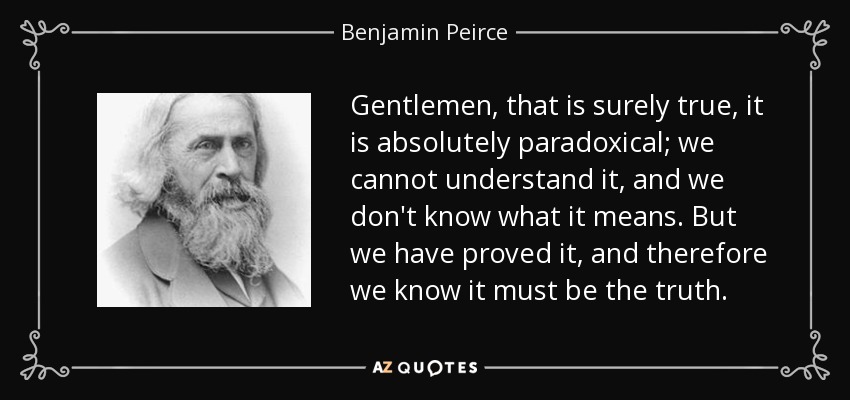
Benjamin Peirce
b. 4.4.1809 Salem, Massachusetts
d. 10.6.1880 Cambridge, MA
Benjamin Peirce was an American mathematician who taught at Harvard University for approximately 50 years. He became a major figure in mathematics and the physical sciences during a period when the U.S. was still a minor country in these areas.
He saw mathematics as a study of creation in recognition of the creatures. He identified himself as a Christian, but he was an apologist for slavery. He thought that it should be condoned if it was used to allow an elite to pursue scientific enquiry.
The theology was more Stoic than it was Christian. Materialism was the philosophical justification for enslavement.
The observation of evidence as limited to the world pressed argument into a pressurized containment for the victory of the will over nature. What was 'known' was subordinated to that which could be controlled.
He became known for the statement that "Mathematics is the science that draws necessary conclusions". He is often regarded as the earliest American scientist whose research was recognized as world class.
He was director of the U.S. Coast Survey from 1867 to 1874. The survey drew maps.
Benjamin Peirce had interests in celestial mechanics, applications of plane and spherical trigonometry to navigation, number theory and algebra as a professor at Harvard.
Salem, Massachusetts

Puritans had settled in the location to base their settlement on religious freedom. They were ruled by their ascetic inclinations as their political view ruled out most of biblical history except for the support for local councils.
One of the most widely known aspects of Salem is its history of allegations about witchcraft. Witchcraft was defined as a sin that was punishable by death in the Babylonian empire.
Just as the advocates for the one God argued for refinement of the belief in the God of gods, the Babylonians were pressing for an advance in polytheism that ruled out more primitive forms of belief.
These primitive forms were viewed as a form of treason. They argued for reformation that accepted the god of gods as a justification for the ascription of divine status to their leadership. The Puritans were a branch of Calvinists who held that the monarchy was corrupt.
They left England to test their reduced ascetic form of political order in the new world. Every man would get to be part of the government through church in the original plans for the government of the settlement.
William Hathorne was a prosperous businessman in early Salem. He became one of its leading citizens. He led troops to victory in King Philip's War (1675-1678) against the natives.
He had served as a magistrate on the highest court and was chosen as the first speaker of the House of Deputies. He was a zealous advocate of the personal rights of freemen against royal emissaries and agents.
His son Judge John Hathorne came to prominence in the late 17th century when witchcraft was a serious felony.
The accusations started when Abigail Williams, Betty Parris and their friends were observed playing with a Venus glass (mirror) and egg. The infamous witch trials began in 1692. It was reported that 19 people were executed by hanging as a result of the false accusations.
Judge Hathorne was the best known of the witch trial judges. He became known as the "Hanging Judge" for sentencing accused witches to death.
The town became a center for privateers during the American Revolutionary War. About 1,700 Letters of Marque were granted during that time.
A lettre de marque was a government license in the Age of Sail (c.1550-c.1850) that authorized a private person, known as a privateer or corsair, to attack and capture vessels of a nation at war with the issuer.
The case for that prize could be brought before their own admiralty court for condemnation and transfer of ownership to the privateer once captured. A letter of marque and reprisal would include permission to cross an international border to conduct some action against an attack or injury.
Cruising for enemy prizes with a letter of marque was considered an honorable calling that combined patriotism and profit. Such privateering contrasted with attacks and captures of random ships.
Unlicensed attack was not authorized. It was known as piracy. Piracy was almost universally reviled.
Nearly 800 vessels were commissioned as privateers and are credited with capturing or destroying about 600 British ships during the Revolutionary War.
Many ships used as privateers were too large for short voyages in the coasting trade after the revolution. Their owners determined to open new avenues of trade to distant countries.
The Empress of China, formerly a privateer, was refitted as the first American ship to sail from New York to China starting in 1784.
Salem had become the sixth largest city in the country and a world-famous seaport by 1790.
Salem Seal

The China Trade, along with exporting codfish to Europe and the West Indies, importing sugar and molasses from the West Indies and the products depicted on the city seal from the East Indies was part of the global reach.
Salem ships also visited Zanzibar in Africa, Russia, Japan and Australia.
Benjamin Peirce
Benjamin was born in Salem, Massachusetts on April 4, 1809.
His father was also named Benjamin (1778-1831). His mother was Lydia Ropes Nichols Peirce (1781–1868). The elder Benjamin would later be appointed as the librarian for Harvard.
The younger became a student at that school. He was appointed tutor there in 1829. Two years later he became Professor of Mathematics at the University. The post was changed to include astronomy in 1842. He held it until his death in 1880.
He played a prominent role in the development of the science curriculum at the university. He also acted as the librarian for a time.
He wrote some introductory textbooks in mathematics and something more advanced in mechanics (Peirce 1855).
His definition of mechanics was anti-paradisiacal with respect for the occurence of perpetual motion in nature. If design had made providence purely perpetual without incident in destructiveness it would have proved destructive to human belief in the spiritual origin of force.
The First Cause was of necessity superior to matter. If everything were made for the perpetual production of providence for everyone, there would not have been any reason to appeal to authority for help in understanding benevolence in free will. Capriciousness in judgment would result as a consequence toward the functional application of mechanics.
'Ideality' connoted the 'ideal-ism' in the certain knowledge that served as the foundation for mathematics.
Berkeley had qualified idealism as a criticism of materialism. He warned against too much abstraction, but it was with the renunciation of it.
Peirce qualified idealism with respect for free will in the mechanics of necessity. He set the frame for the work in pragmatism that followed.
His son, Charles Sanders Peirce (1839–1914), became a remarkable though maverick polymath. He would become a mathematician, chemist, logician and historian with a strength of mind that reflected that of his father.
Opportunity was incentive to organize thought for the production of a product for the public.
The most important among Benjamin's other appointments was his post as the Director of the U.S. Coast Survey from 1867 to 1874. His son would work for him there in the production of maps to aid travelers.
Benjamin was like George Boole (1815-1864) in that he believed that mathematics could be used to study logic. These ideas were further developed by his son Charles. He noted that logic also includes the study of faulty reason.
Benjamin maintained that mathematics could be used to analyse logic. The analytical philosophy of Frege would (1848-1925) derive logic from arithmetic. Russell (1872-1970) would derive logic from all mathematics in the 1900's.
There is a chain of command implicit in the idealism of pragmatism. Ideals are firmly anchored in the production of providential value for the public in the market or government.
While there is great importance in the capital for production, organization has to order work with the understanding that disaster could destroy the means for production.
Endowment was not just for the arts. It is support for the means of production in the face of threat from the incidence of destructive crisis.
Support for slavery ran contrary to the operation of free will in society. It wasn't a necessity. It was an obstruction to the solicitation of voluntary cooperation in the management of labor. His support was conditioned by the spirit of the times.
Benjamin married Sarah Hunt Mills, the daughter of U.S. Senator Elijah Hunt Mills. They had 4 children. James Mills also taught mathematics at Harvard. He succeeded to his father's professorship.
Charles Sanders became a famous logician, polymath and philosopher. Benjamin Mills worked as a mining engineer. His death came early. Helen Huntington married William Roger Ellis. Herbert Henry Davis pursued a career in the Foreign Service.
His philosophy was characterized by his love for geometry. Geometry uses reason to establish proofs.
He argued that geometry provided more proof with reason than any other science. The world that has been alloted to us can be adapted by mind to promote intellectual progress.
Progress with the plan for defense against destruction requires functional respect for the public. The order for the world might have been otherwise transposed to a complicated system that our finite power could not unravel.
He died in Cambridge, Massachusetts on October 6, 1880.
Benjamin Peirce
S. 本杰明·普厄斯
T. 本傑明·普厄斯
本 Ben this 本 hon book Ben べん ベン Ben 벤 Ben
杰 jie jay 傑 ketsu greatness ja じゃ ジャ ja 자 character
明 ming bright 明 mei bright min みん ミン min 민 min
普 Pu general 普 fu universal Pu ぷ プ Pu 푸 fu
厄 e hey 厄 yaku unlucky ru る ル eo 어 uh
斯 si span 斯 shi this se せ セ
---------------------
Greatness in form is organized against the unlucky.
The ideal is made real when the form for function is plucky.
===============
wiki Benjamin Peirce
SOPE: BP
Salem's History
The Band Perry - If I Die Young
Music Video
Assimilation

Assimilation is a major feature in the acquisition of new knowledge. The attainment of one new fact or technology can drastically effect the existence of an industry.
The song that said, "Video killed the radio star" wasn't completely true, but there was a dramatic drop in the public perception of the importance of radio when tv and movies added the visual element to broadcasts.
Existing industry has historical justification for concern in the fear of being replaced. The public has a legitimate concern insofar as replacement presents itself as a costly consequence.
If the US were to jettison nuclear and hydro-power for the sake of other renewable sources, it would cost the public to have the former industries reduced to relative insignificance.
Solar power presents itself as an element which could be added to the network of services provided it isn't assumed to be the 'new' source of energy.
The solar industry currently stands as a pig in the poke. You could buy the apparatus to install in your yard in the hope that it will reduce the cost for the others in the result of a total decrease in cost, but if it doesn't work the buyer is left with what amounts to useless aparatus in the yard.
Chances are great that the new industry will charge the individual users for the cost of having risked the change in the larger industry. While the consumer may assume reasonable risk in the investment, the new industry may be assuming that the risk has to be transferred to the consumer in order to establish the industry.
The apparatus has to justify the cost for the risk in purchase, but lobbies for industry work their influence in the context of 'buyer beware' maxim.
C.S. Peirce
C.S. Peirce defined synechism in terms of what it does not say. A synechist cannot say, “I am altogether myself, and not at all you.” No one is an island.
Only the liberal solipsist that argues for him or herself as "the people" views self in terms of absolute individuality.
The Continuity of Being
Article: Synechism
Benjamin Peirce had argued against government as the source of paradise. He indicated that this was the source of delusion with respect for the expectation of perpetual motion in a socialist utopia.
His son, C.S. Peirce, argued that humankind cannot tolerate too much discontinuity in providence.
When good faith providers are treated as delusional it is a disincentive to the production of a service. This adversely effects industry in general.
Together the Peirces argued for pragmatism as a form of correction of the materialism in Stoic philosophy. Idealism had to be qualified by something observably beneficial in practical value.
This supported Berkeley's criticism of materialism with his advocacy for the immaterial operation of mind.
Insofar as leading non-conformist Protestants felt the compunction to provide the principles for conservative reform in monarchy to republican government there was a synechist type of agreement in the formation of reasonable expectation for cooperation with leadership.
---------------------
Humanity endures only so much discontinuity.
The elements are organized for functional unity.
The body is made with spirit and blood
for worship in the temple built with wood and hardened mud.
================