Mariel Hemingway
Idaho Valley
Find
Refuge
寻找避难所
Xúnzhǎo bìnàn suo
避難所を探す
Hinansho o sagasu
ps46
Find confugerunt
My house is my home.
Respect protects me when i roam.
Security is dependent upon defense.
The space between things is something sensed.
A thrust can be blocked, dodged or countered.
Standing your ground isn't locked, lodged or outwardly powered.
Light is my refuge when darkness is unsafe.
Darkness is better when being seen is a mistake.
Though the earth be moved to shake the tree,
we will hold faith in divine existence as our reason to be.
Though the mountains lose rocks that roll to the depths of the sea,
we will believe that God has a plan to work with that which can be seen.

Though the water rages while the land trembles with tumult,
we will rejoice in the One who helps us rebuild as a result.
The unity for existence holds diversity in unitary forms
Affordable production with quality as the norm
builds the economy to reconstruct that which was damaged by the storm.
There is an elevation whose streams make the river glad.
The flow of water is a reminder of the experience humanity had.
The water flows downward by the pull of gravity.
The city was built for the security of shelter's sanity.
The habitation of the Most High lies in the heart.
Adoration is the ardor that harbors the craft in any art.
God is in the midst of her.
The lonely heart hears the stir.
She will not be overthrown.
The break of day will renew the light as known.
We are not alone
though each is allowed his own.
Nations have made much ado
but they have been happy too.
Kingdoms have been shaken to the core.
Republic has to mind conservative reform.
When God had spoken, the earth seemed to melt away
to leave faith as the power to rebuild that which fell to the fray.
The fire of divine desire is with us.
Redemption with truth trusts in what's just.
Free will is the greatest gift
but it has to be managed with thrift.
Those who took payment for a service, but didn't provide one in return
are liable for the broken contract as the cause of the dispersion that burned.
The liberal claim to power over executive authority
has been used as a support for prejudice against the majority.
The accusation of corruption invoked the charge of tyranny
to punish the larger body as the cause of criminal conspiracy.
Look upon the works that are best
to see the awesome things that passed the test.
The divinity of deity has made war to cease.
It was this that let the falsely convicted captives free.
One criminal on the cross asked 'Are you not the Messiah?
Why do you hang there like a pariah?
'Save yourself and us!
Is this something we need to discuss?'
The other rebuked him and said,
'Do you not fear judgment from the living and dead?
'You are under the same sentence of condemnation
but you will be seen as guilty for generations.'
The thief who defended Jesus as Christ
was told that he would reside in paradise.
That the Son would hang on the cross is theology
that has been known to invoke controversial apology.
That One with the divine nature would die for our sins
was viewed as absurd monotheistic din.
The self sacrifice of the body of the divine person
was offered once for the cleansing from human incursion.
It was an expression of love for our conversion
that offered the promise of salvation with baptismal immersion.
May you be made strong with the glorious power
that prepares you to endue anything with patience beyond the trifling hours.
Give thanks to the Father who enabled you to share in the inheritance of the light.
He rescued us for redemption by faith from the darkness of power for sight.
His Son is the firstborn of all creation for our faith.
The Christ of Jesus is the image of the invisible God portrayed.
We have been advised to view Christ as the center of reality
to invest in a faith that promotes freedom in tactically factual actuality.
Religion was not meant to impose ascetic law on all people.
Devotion is an emotion to cultivate goodness for redemption from error or evil.
Be free and know the stillness of divinity.
The spirit of love will exalt the peace of infinity.
The fire of divine desire is with us.
Redemption in truth trusts in what's just.
---------------------
46 Deus noster refugium
Light is our refuge
1 God is our refuge and strength,
a very present help in trouble.
2 Therefore we will not fear, though the earth be moved,
and though the mountains be toppled into the depths of the sea;
3 Though its waters rage and foam,
and though the mountains tremble at its tumult.
4 The Lord of hosts is with us;
the God of Jacob is our stronghold.
5 There is a river whose streams make glad the city of God,
the holy habitation of the Most High.
6 God is in the midst of her;
she shall not be overthrown;
God shall help her at the break of day.
7 The nations make much ado, and the kingdoms are shaken;
God has spoken, and the earth shall melt away.
8 The Lord of hosts is with us;
the God of Jacob is our stronghold.
9 Come now and look upon the works of the Lord,
what awesome things he has done on earth.
10 It is he who makes war to cease in all the world;
he breaks the bow, and shatters the spear,
and burns the shields with fire.
11 "Be still, then, and know that I am God;
I will be exalted among the nations;
I will be exalted in the earth."
12 The Lord of hosts is with us;
the God of Jacob is our stronghold.
Psalm 46
The 46th psalm is addressed to the chief Musician for the Sons of Korah according to alamoth.
The note for alamoth is unique to this psalm. It may refer to a high pitched instrument. It could be a reference to the soprano voices of young girls who went out to dance in celebration of David's victory over the Philistines.
The Midrash Tehillim comments on the psalms. It parses the word alamot (Hebrew: עלמות) as referring to the "hidden things" that God does for his people.
The office for the chief Musician was established by David. He appointed a man named Heman as the main musician or singer.
Asaph was made Heman’s right hand assistant and the Merarites were at his left hand (1 Chron.6:39). The Asaphites were one of the guilds of musicians in the First Temple.
The Korahites were the sons of Moses' cousin. Korah had led a revolt against Moses. He died after a fire was sent from heaven to consume the entire force. It was reported that the children of Korah did not die. (Num. 26:11)
The Korahites were counted with the Kohathites among the Levites. Both groups are documented as having offered praise with volume. (2 Chron. 20:19)
The Kohathites cared for the vessels and objects within the sanctuary - the Ark of the Covenant, Menorah, Table of Showbread, etc.
Several psalms are described in their opening verses as being by the Sons of Korah. The numbers for these psalms are 42, 44–49, 84, 85, 87 and 88.
Some of the Korahites were also "porters" of the temple (1 Chron. 9:17–19). One of them was over "things that were made in the pans" (v31), i.e. the baking in pans for the meat-offering (Lev. 2:5).
There is a tradition that the prophet Samuel was descended from Korah.
Martin Luther wrote and composed a hymn which paraphrases Psalm 46. "Ein feste Burg ist unser Gott" translates as "A Mighty Fortress Is Our God." Johann Sebastian Bach based his chorale cantata Ein feste Burg ist unser Gott, BWV 80, on Luther's hymn.
=================
Eng. My house is my home.
Ch. 我的房子是我的家。
Wǒ de fángzi shì wǒ de jiā.
Jpn. 私の家は私の家です。
Watashinoie wa watashinoiedesu.
Krn. 내 집은 내 집이야
nae jib-eun nae jib-iya
Ltn. Mea domus mea est in domum suam.
Itln. La mia casa è la mia casa.
Spn. Mi casa es mi hoga
Frn. Ma maison est ma maison.
Grk. Το σπίτι μου είναι το σπίτι μου.
To spíti mou eínai to spíti mou.
Rsn. Мой дом мой дом.
Moy dom moy dom.
Gmn. Mein Haus ist mein Zuhause.
Trk. Benim evim benim evim.
------------------------
Pastors
Jeremiah (650-570 BCE)

Jeremiah was the son of Hilkiah, a kohen from the Benjamite village of Anathoth.
Kohen is the Hebrew word for "priest". It is used in reference to the Aaronic priesthood. Levitical priests or kohanim were in direct patrilineal descent from the biblical Aaron, brother of Moses.
Kohanim performed the daily and holiday (Yom Tov) duties of sacrificial offerings during the existence of the Temple in Jerusalem.
The sacrifices were not limited to the offering of animals.
Hygenic kosher practice in the preparation of food products for market still fall under the province of kohanim.
Anathoth is the name of one of the Levitical cities given to "the children of Aaron" in the tribe of Benjamin (Josh. 21:13–18; 1 Chron. 6:54–60).
The Israelites often did not change the names of the towns they found in Canaan, the name of this town may be derived from a Canaanite goddess, `Anat.
Anathoth seems to be a plural form of the name. It could be the shortened form for bêt ‘anātôt 'House of the ‘Anats'. This was either a reference to many shrines of the goddess or a plural of intensification.
‘Anat is a war-goddess in the Ugaritic Baal cycle. She is the maiden sister to Ba'al Hadad, the maker of storms. Ba‘al is usually called the son of Dagan, the father of fertility. Ba'al is also named as the son of El at times.
The name El is a general form that indicated the highest rank. It is a Northwest Semitic word meaning "god". It was attached to a proper name as a title that indicated the supreme status for a deity.
Ugarit map

Ugarit is a city of ruins located near Ras Shamra, Syria. Ugaritic is the western form for the extinct Amorite language. It is the only Amorite dialect known to be preserved as written. The Ugaritic texts discovered by French archaeologists in 1929.
The Book of Jeremiah is the second of the Latter Prophets in the Hebrew Bible and the second of the Prophets in the Christian Old Testament. His book is intended as a message to the Jews in exile in Babylon. It explains the disaster of exile as God's response to Israel's pagan worship.
The people are described as an unfaithful wife and rebellious children. Their infidelity and rebelliousness made judgement inevitable. Restoration and a new covenant are foreshadowed to perpetuate the promise of reward for fidelity.
Judgment had been pronounced against a number of the kings of Judah in the previous chapter. Other leaders were included in the judgment with the use of the term 'shepherds.'
There was the distinct implication of argument against what had been done to Israel and what was threatened against Judah. Priests were implicated in the perpetuation of harmful primitive practice as associated with polytheism.
Jeremiah 23:1
Woe to the shepherds who destroy and scatter the sheep of my pasture! says the LORD.
-------------------------
Those who take payment for a service, but don't provide one
are liable for the broken contract as the cause of dispersion.
The liberal claim to power over executive authority
has been used as a support for prejudice against the majority.
==================
Colossians 1:15
The epistle to the Colossians was addressed to the Christians in Colossae.
Colossae map
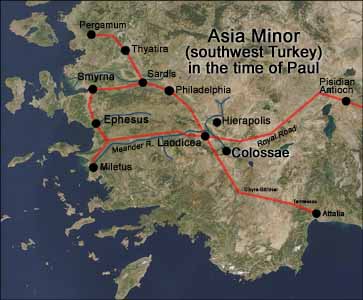
Colossae was one of the most celebrated cities of southern Anatolia (modern Turkey). It was located in Phyrgia in Asia Minor.
It was an ancient city about 161 km (100 mi.) east of the cosmopolitan capital city of Ephesus, located in the Roman province of Asia.
It was 15 km (9.3 mi.) southeast of Laodicea on the road through the valley near the Lycus River at the foot of Mt. Cadmus, the highest mountain in Turkey's western Aegean Region.
It was between the cities Sardeis and Celaenae southeast of the ancient city of Hierapolis.
The 5th Century geographer Herodotus first mentioned Colossae by name and as a "great city in Phrygia" which accommodated the Persian King Xerxes I en route to wage war against the Greeks.
The city had already reached a certain level of wealth and size by this time. Xenophon refered to Colossae as a populous and wealthy city of considerable magnitude in the 5th century (Anabasis).
Strabo (63 BCE-24 CE) was a historian who lived in Asia Minor during the period of transition from the Roman republic to the empire. He noted that the city drew revenue from the flocks in the wool trade. The wool of Colossae gave its name to the color colossinus.
The location had importance as a mercantile center in the Hellenistic period, but it had diminished in size by the 1st century CE. It was known for its fusion of religious influences (syncretism). It included Jewish and Gnostic groups.
There was also an angel-cult in the pagan tradition. The unorthodox cult venerated the archangel Michael who is said to have caused a curative spring to gush from a fissure in the Earth.
Epaphras seems to have been a person of some importance in the Christian community in Colossae (Col. 1:7; 4:12). Tradition presents him as its first bishop.
The epistle speaks of Paul as having "heard" of the Colossians' faith (Col. 1:4). The letter to Philemon speaks of Paul's hope to visit Colossae upon being freed from prison (Philemon 1:22). Philemon was the second bishop of the see according to tradition.
The Colossians were encouraged to see Jesus as the center of reality in order to avoid the pressures from other religions. The problems of the Church were described. Believers were encouraged to remain devoted to Jesus as Christ.
Colossians 1:11-15
May you be made strong with all the strength that comes from his glorious power and may you be prepared to endure everything with patience while joyfully giving thanks to the Father who has enabled you to share in the inheritance of the saints in the light. He has rescued us from the power of darkness and transferred us into the kingdom of his beloved Son in whom we have redemption, the forgiveness of sins.
He is the image of the invisible God, the firstborn of all creation.
-------------------------
May you be made strong with the glorious power
that prepares you to endue anything with patience beyond the trifling hours.
Give thanks to the Father who enabled you to share in the inheritance of the light.
He rescued us for redemption by faith from the darkness of power for sight.
His Son is the firstborn of all creation for our faith.
The Christ of Jesus is the image of the invisible God portrayed.
==================
The Criminal on the Cross
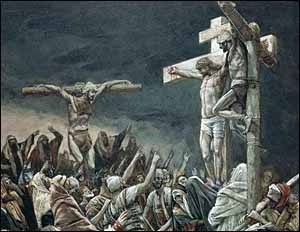
The priests and teachers of the law had been made the council of the elders for the people of Judah with the approval of the Roman government.
Jesus was questioned by this body about his instruction about the Messiah. His testimony was used to send him to Pontius Pilate.
He was questioned by Pilate as the Roman governor. When the governor found that he was a Galilean, he was sent to Herod as the tetrarch of Galilee. The tetrarch returned Jesus to the governor.
Pilate convened an assembly of the chief priests, the rulers and people to release Jesus from conviction for the death penalty. He said that he would chastise and release him as the prisoner to satisfy the offering at the time of the feast for the Passover.
The governor was confronted with angry cries when the outspoken yelled for crucifixion. They insisted that Barabbas be released instead. Pilate said that he would chastise Jesus two more times. The angry voices that threatened riot would not relent.
He released Barabbas who had been imprisoned for sedition and murder, but delivered Jesus to their will. He was nailed to the cross with two others who had been convicted of crime.
Luke 23:35
One of the criminals who were hanged there kept deriding him and saying, 'Are you not the Messiah? Save yourself and us! The other rebuked him, saying, 'Do you not fear God since you are under the same sentence of condemnation?'
-------------------------
The criminal asked 'Are you not the Messiah?
Why do you hang there like a pariah?
'Save yourself and us!
Is this something we need to discuss?'
The other rebuked him and said,
'Do you not fear judgment from the living and dead?
'You are under the same sentence of condemnation
but you will be seen as guilty by following generations.'
The thief who defended Jesus as Christ
was told that he would reside in paradise.
That the Son would hang on the cross is theology
that has been known to invoke great controversy.
That One with the divine nature would die for our sins
was viewed as absurd monotheistic din.
The self sacrifice of the body of the divine person
was offered once for the cleansing from human incursion.
It was an expression of love for our conversion
that offered the promise of salvation with baptismal immersion.
==================
Cicero (106-43 BCE)

Rebellion
Legend has it that in the city-state's earliest days, Romulus, the founder and first king of Rome, picked the 100 best men, or patricians, in the city to be members of his Senate for as long as they lived.
While the seven kings of the monarchy ruled, the Roman Senate made the laws and elected the kings. The last king was an Etruscan who had a reputation for severity.
His son, Sextus Tarquinius, reportedly raped the wives and daughters of powerful Roman nobles. A group of nobles led by Lucius Junius Brutus, with the support of the Roman Army, expelled Tarquinius and his family from Rome in 509 BCE.
When the Roman Kingdom, which lasted from 759-509 BC, came to an end, Rome transitioned into a republic with executive offices who served as generals and judges and built public works.
The Roman constitution was not a single written document. It was the system of government that had evolved from the kingdom and a senate of patricians without term limits into a republic.
The Romans referred to Greek culture with respect for written expression on matters of importance.
Constitutional Traditions in the Republic
Two consuls always served together at any one time after Rome became a republic. They were the chairmen of the Senate.
Both had to agree to enact a proposed action. Each was able to overrule the other. They had to request any money from the Senate for their office.
They commanded the Roman army. Both had two legions. They came to exercise the highest juridical power. The two consuls had to belong to the Patriciate, the Roman aristocracy. The office was opened for plebeians in the 360's.
The Lex Licinia Sextia provided that at least one consul each year should be plebeian in 367 BCE. Lucius Sextius was elected as the first plebian consul the following year.
Only fifteen novi homines, "new men" with no consular background, were elected to the consulship until the election of Cicero in 63 BCE.
The Comitia centuriata was an assembly of the richest Romans. The comitia elected the consuls. The term was 1 year in length.
Once elected, they took orders from the Roman Senate. When their terms were up, both consuls were given governorships of provinces outside of Italy.
The comitia became more powerful after the Conflict of the Orders. This conflict was a class struggle between the wealthy patricians and the poor plebeians that lasted from 494-287 BCE.
The Plebians forced the patricians to accept a new office that was independent of the consuls and the Senate during the dispute. The office was named the Tribune of the People. The comitia acquired the power to make laws, ratify treaties and declare war as a result of a series of laws.
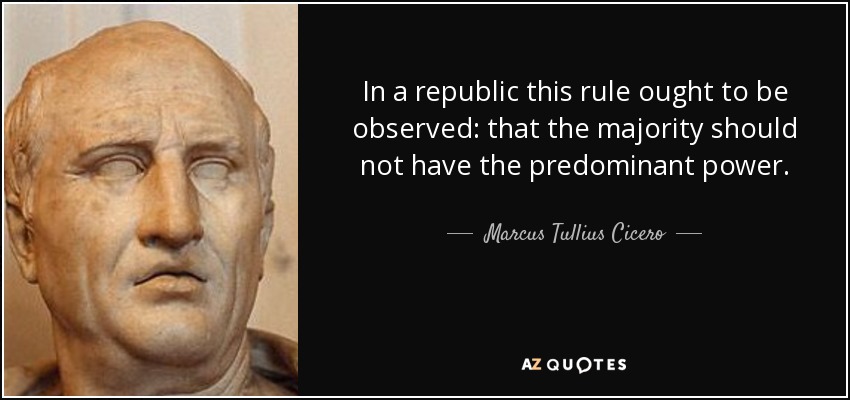
Cicero argued that the constitution was a law that was written on our hearts. The unwritten law alluded to the state of the social contract as a development beyond tribal organization with respect for primitive concepts of freedom in nature. There was a question regarding the benefit of the state of society as preferable to local council alone.
Cicero's contribution to Rome as a consul was to override due process of law in order to put down a 'rebellion.' It was reported to the public that the rebels who threatened the peace of Rome were executed without a trial.
The idea that the majority should not rule has been used to undermine the legal authority of the social contract. Consider the 'protection' proposed for undocumented immigrants by liberals.
Liberals want to subsidize living expense for the undocumented. They want to give them the right to vote. These two proposals give those who refuse to register favor over citizens and documented immigrants.
J.S. Mill also expressed a warning about the tyranny of the majority. Too much of this type of concern promotes the tyranny of the undocumented.
Not Majority Rule
I have investigated the civil rights movement with particular interest for the claim of majority prejudice in the south.
I found that Rawls' argument against the Utilitarian principle of the greatest happiness for the greatest number was an endorsement for partial judgment as the veil of ignorance.
He had argued that limited participation in organized politics would induce objectivity as the necessary standard for judgement regarding observable events.
The Clintons have used ignorance to promote decisions against the majority interest with the endorsement of socialism and radical feminism.
If you didn't directly perceive a case of sexual assault, how are you to form a judgment on a claim to the same that was reported to have happened over a decade ago? Do you rely on the testimony of the accuser or the accused?
Their media reports supported the testimony of the accuser with the defamation of character against the accused. LBJ did a similar sort of thing with Dr. King.
Mohammad Ali was loud in his endless self-promotion. He explicitly complained about the racism of white people. He stated that he would not fight in a war against people who had not done anything to him. He had the right to refuse the draft, but it was reported that he served time for it.
Dr. King was more aggressive in the promotion that white people were prejudiced against the employment of black people in industry. Civil rights were reduced to the state of affairs for black people in his negotiation with the US government.
Ali used religion for his success in sport. King used socialism for his success in political intervention. King's argument was dependent upon the reports of prejudice against blacks in the South.
Rawls wasn't the only Harvard professor who helped to promote the belief that majority prejudice was the only real social problem in institutional form. Cavell was a participant as well.
Roman Constitution
Freedom

Baruch Spinoza
b. 11.24.1632 Amsterdam, Netherlands
d. 2.21.1677 The Hague, Netherlands
Independence has to be guided by responsibility or it is not being led to productive value.
Nature is the expression of the universe. The universe is the product of the Creator.
Causality regulates change. Chance is irregularity in causality.
Spinoza

Philosophy
Ethics
wiki Baruch Spinoza philosophy
Spinoza's philosophy held an attraction for late 18th-century Europeans. It provided an alternative to materialism, atheism and deism. He provided a conceptual frame for the Enlightenment philosophy as it related to the government of law.
Three of Spinoza's ideas held a strong appeal.
The unity of all exists.
Regularity is a function of the unity.
The energy of nature expresses the spirit for the identity of the unity.
Both Descartes and Spinoza lived in the Dutch Republic (1581-1795). Descartes (31 March 1596 – 11 February 1650) preceded Spinoza (24 November 1632 – 21 February 1677).
Kingdom of the Netherlands
wiki
The current Kingdom of the Netherlands is a constitutional monarchy. Spinoza had proposed this form of government as best with his Tractatus Theologico-Politicus.
Constitutional monarchy has the potential to exceed a constitutional republic in democracy by virtue of the conservatism in the dynastic succession.
The resurrection of republic as a form of government required the application of reason to define the purpose of government, commerce and society.
Rosseau's ideas of education are limited according to contemporary standards, but his social contract provided the essential factor for the determination of law. The government is obliged to serve the people who pay for functional operations.
If the US does not limit commerce to a legal free market, it has lost ground in terms of using reason to reflect on the history of the republic.
The people have risen up repeatedly to define republic as a democratic institution, but socialists have used their advantage in influencing government with knowledge about campaign finance, lobbying and media expression to institute policy that claimed to be for the people, but was for liberal officials in fact.
Law is being defined as an exercise in using the state to act as a criminal force that regulates the existence of threat from outside the sphere of influence for the accumulation of wealth by state officials.
This doesn't mean that law has to be rejected as though that leaves only grace. It means that grace provides sanction for amending the law.
Dutch Republic
17th Century
The Dutch rebelled against Philip II of Spain and his successors in the 16th century. The main reasons for the uprising were the imposition of new taxes, the tenth penny and the religious persecution of Protestants by the newly introduced Inquisition.
The revolt escalated into the Eighty Years' War. The protracted conflict ultimately led to Dutch independence.
The Dutch Republic was officially known as the Republic of the Seven United Netherlands. It was a a confederal republic formally established by the formal creation of a confederacy in 1581 by several Dutch provinces that seceded from Spanish rule. The republic lasted until the Batavian Revolution of 1795.
The small republic of around 1.5 million inhabitants distinguished itself by world trade through the Dutch East India Company (VOC) and the Dutch West India Company (WIC). The state sustained military success against larger and presumably stronger nations such as Spain and England.
The naval fleet of 2,000 ships was larger than that of England and France combined. The fleet was assembled with the shipping industry with respect for the knowledge of the size of the competitive nations.
The organization of production for the culture was managed in the arts and sciences. Painters such as Rembrandt (1606-1669), Johannes Vermeer (1632-1675) and others achieved widespread recognition.
Hugo Grotius (1583-1645) built the conceptual frame for political science with the foundations for international relations based on natural law.
Antonie van Leeuwenhoek (1632-1723) used the relatively new development of the microscope to study biological microbes. This made him the first recognized micro-biologist.
Jan Swammerdam (1637-1680) used the microscope to study insects. He made important discoveries regarding the life of bees.
He demonstrated that there are various phases in the life of an insect. The egg, larva, pupa and adult stages are different forms of the same animal.
He also carried out experiments on muscle contraction as part of his anatomical research. He used dissections for examination. He observed and described red blood cells.
The relatively tolerant atmosphere towards different religions and ideas contributed to the success of free thought in establishing republic as a competitive form to monarchy in Europe.
The Union of Utrecht in 1579 is regarded as the foundation of the Republic of the Seven United Provinces, which was not recognized by the Spanish Empire until the Peace of Westphalia in 1648.
Holland and Zeeland were granted the right to accept Calvinism as the one religion in practice. Every other province had the freedom to regulate the religious question as it wished.
The Republic dominated world trade, conquered a vast colonial empire and operated the largest fleet of merchantmen of any nation during the late 16th and 17th centuries.
Slavery was included in the competition for global expansion, but Spinoza would question whether a state that allowed slavery could be regarded as free.
Amsterdam
Amsterdam flourished, largely from trade with the Hanseatic League from the 14th century.
The 17th century is considered Amsterdam's Golden Age.
It became the wealthiest city in the western world. Ships sailed from the port to the Baltic Sea, North America, Africa, present-day Indonesia, India, Sri Lanka and Brazil.
It was the central hub for a worldwide trading network. Amsterdam's merchants had the largest share in both the Dutch East India Company and the Dutch West India Company. These companies acquired overseas possessions that later became Dutch colonies.
Amsterdam was Europe's most important point for the shipment of goods. It was the leading Financial center of the western world.
The Amsterdam office of the international trading Dutch East India Company became the world's first stock exchange by trading in its own shares in 1602.
The Bank of Amsterdam started operations in 1609. It acted as a full service bank for Dutch merchant bankers and as a reserve bank.
Peace is a virtue

Jewish Philosophy
When the Romans conquered the Jewish nation in 70 CE, much of the Jewish population was sent into exile throughout the Roman Empire. Many were sent to the Iberian Peninsula.
The approximately 750,000 Jews living in Spain in the year 1492 were banished from the country by royal decree of Ferdinand and Isabella. The Jews of Portugal, were banished several years later.
Spinoza's ancestors were of Sephardic Jewish descent. They were a part of the community of Portuguese Jews that had settled in the city of Amsterdam in the wake of the Portuguese Inquisition (1536). The Inquisition had resulted in forced conversions and expulsions from the Iberian Peninsula
Baruch Spinoza (1632-1677) argued that people would not be superstitious if they could govern their circumstances with set rules or if they were always favored by fortune.
Humans are driven into circumstances where rules are useless. The fluctuation between hope and fear is driven by the uncertainty of fortune. The variability of chance leaves them with the consideration of credulity.
He wrote, "The human mind is readily swayed this way or that in times of doubt, especially when hope and fear are struggling for the mastery, though usually it is boastful, over-confident, and vain." (Tractatus Theologico-Politicus)
The chief victims of superstition are those who covet temporal advantage too aggressively. Superstition is engendered, preserved and fostered by fear.
The essential mystery of despotic statecraft is to hoodwink the citizens into subservience to the credulity of cause that men may fight as bravely for slavery as for safety and count it not as shame but the highest honor to risk their blood and their lives for the vainglory of tyranny.
No such expedient could be planned or attempted in a free state.
The habits of mind differ. Some more readily embrace one form of faith, some another. What moves one to pray may move another to scoff,
Everyone should be free to choose for himself the foundations of his creed. Faith should be judged only by its fruits. Each would then obey God freely with his whole heart. Nothing would be publicly honored save justice and charity.
The ultimate aim of government is not to rule by fear nor to exact obedience. The purpose is to free each from fear for all possible security. Law is to be legislated to strengthen the natural right to exist and work without injury to self or others.
Tractatus Theologica-Politicus
Spinoza put forth his most systematic critique of religion in the treatise Tractatus Theologica-Politicus. He argued that reason should not be subordinated to scripture. Reason should reflect upon scripture for the consideration of Constitutional law.
When reason has been made subservient to scripture, then, Spinoza argued, "the prejudices of a common people of long ago... will gain a hold on his understanding and darken it."
He reinterpreted the belief that there were occurrences of objective miracles or supernatural events. He argued that God acts solely by the law of "his own nature". He rejected the view that the divine nature has a predetermined course of events.
Spinoza was not only the real father of modern metaphysics and moral philosophy for politics, but also of the higher criticism of the Bible.
His Tractatus Theologico-Politicus undertook to show that Scripture gave no authority for those who sought to impose the rule of law with cruelty in punishment or violent aggression.
Spinoza had to show what was meant by a proper understanding of the Bible to achieve this object. This gave him occasion to apply criticism to interpretation.
There have been cases where the scientific use of DNA evidence has exonerated someone convicted of the charge of murder. It was demonstrated that the rape associated with the murder was not done by the one who had been convicted for the crime.
This type of exoneration justifies the application of a life sentence in cases where the evidence was strong, but not conclusive. The convict could be released from his sentence prior to his death.
It is reasonable to assume that if some were released from the death sentence, there were others who have been wrongly put to death. This is another form of murder.
The state isn't put to death for the error, but it suffers a loss of credibility among the taxpayers who pay for the legal system to form judgments for justice.
When the story of Jesus with the woman accused of adultery is considered, it can be seen that the legal system has been right to shift standards of punishment to decrease the incidence of cruelty due to false conviction. The death penalty used to be applied to those convicted of a number of crimes lesser in severity than murder.
The act of adultery is not in itself life threatening. There have been adulterers who have sought to kill their spouses.
There have also been those who were seeking sexual gratification outside of the marriage without homicidal intent. The punishment for adultery then should not include the death penalty unless the spouse was murdered by the adulterer.
Jesus told those who asked him about what to do with respect for the woman to examine their conscience. He said, "Let him who is without sin cast the first stone."
Justice in the legal system was not regarded as something that was open to debate for those who were not in line to become a magistrate in the kingdom or Roman republic. The Romans didn't have a public system for education.
Spinoza saw the importance of introducing his metaphysics for ethics in order to raise the thought of the common citizen to reasonable application in the new republic. This included the tract on the theology associated with politics.
Tractatus Theologico-Politicus
wiki quotes
Spinoza was a sephardic Jew. His family moved to the Dutch Republic to escape persecution from the Inquisition in Spain. He was a rational philosopher. He was one of the most important and radical thinkers of the early modern period.
His thought combines a commitment to a number of Cartesian metaphysical and epistemological principles with elements from Euclidean geometry, ancient Stoicism, Hobbes and medieval Jewish rationalism. The respective principles are grafted into an original system.
His naturalistic view on God, the world, human being and knowledge served to ground a moral philosophy centered on the control of the passions. Self-control was the leading virtue in the pursuit of happiness.
These principles also lay the foundations for democratic political thought. Pretensions regarding the dogmatic interpretation of Scripture and sectarian religion were criticized.
Spinoza was issued the harshest writ of herem or excommunication ever pronounced by the Sephardic community of Amsterdam on July 27, 1656.
It was never rescinded. We do not know for certain what Spinoza’s “monstrous deeds” and “abominable heresies” were alleged to have been. An educated guess comes quite easily.
He was expressing those ideas that would soon appear in his philosophical treatises. He denies the immortality of the soul; rejects the notion of deity as having an existence completely distinct from creation and claims that the Law was not specifically given to the Jews nor was it binding in every aspect of the ancient expression.
It has since been shown that the Hebrew texts contain elements from the ancient codes of law in the Middle East. The law against murder as expressed in the second commandment was in the code of Ur Nammu.
The law that punished killing with a lesser penalty than death was expressed in the story of Cain and Abel. The code of Hammurabi punished killing with a fine if the killer said that he killed without malice.
Spinoza was banished from his community. He was content to have an excuse to depart. His community and religious commitment were gone by this point.
He was interested in writing something modern. He wanted it to have an impact on the European world. He left Amsterdam altogether within a few years.
He began writing in 1661. He was living in Rijnsburg, not far from Leiden. He worked on the “Treatise on the Emendation of the Intellect,” an essay on philosophical method.
He also wrote the “Short Treatise on God, Man and His Well-Being.” This was an initial but aborted effort to lay out his metaphysical, epistemological and moral views.
His critical exposition of Descartes’s “Principles of Philosophy” was the only work he published under his own name in his lifetime. It was completed in 1663 after he had moved to Voorburg outside the Hague.
He was also working on what would eventually be called “The Ethics” by this time. This was his philosophical masterpiece.
When he saw the principles of toleration in Holland being threatened by reactionary forces however, he put it aside to complete his scandalous “Theological-Political Treatise.”
This was published anonymously and to great alarm in 1670. One overwrought critic called it “a book forged in hell by the devil himself”.
When Spinoza died in 1677, he was still at work on his “Political Treatise’” This was soon published by his friends along with his other unpublished writing which included a “Compendium to Hebrew Grammar.”
“The Ethics” was written in the form of a geometric proof. It was modeled on Euclid’s “Elements.” The basic definition for a point is a location. It has no length or extension.
It is used as a metaphor for the “self” as the “essence of existence” in “The Ethics.” A line is a continuity of points. It has length. It extends in space. It is comparable to what Descartes identifies as thought.
The proof is written to prove the existence of goodness as the cause for ethics. God is posited as the absolute infinite. Divine existence is the essence of substance. This substance permeates existence. Infinity is used to contrast the finite.
The finite contains the substance of matter. Substance has attributes. The extension of substance however does not pertain to the essence of deity. This denies the notion of Platonic ideals with respect for destructiveness as an extension of the divine will through the elements.
Will is a particular mode of thought. It is a necessary cause. It is the search to draw function from purpose. Knowledge is the awareness of the cause of change.
Freedom is the image. Creativity is the likeness. Each person is the agent of personal will. Ethics is the discovery of functional benefit. It does not conflict with the law of causation.
Free Will
The Likeness of Accomplishment
American Philosophy in the 20th Century
Spinoza's influence found its way to the US through the French philosophy that agreed with his proposal for Constitutional law.
The Constitution was largely composed by James Madison. He borrowed from Locke, but he had to re-write a considerable amount of the material to make it apply to the whole public. It was an anticipation of a future republic in important respects.
The Bill of Rights was added to show the ability to amend law for the people.
Education in the country was not necessarily aimed toward this purpose. Institutions for higher education were organized to promote interest among the general population.
Only a few seminaries like Andover or Union offered post-graduate education before 1860. Yale awarded the first Ph.D. degree in 1861. Pennsylvania (1870); Harvard (1872); Johns Hopkins (1878); Princeton (1879) and Cornell (1880) followed.
Johns Hopkins was founded for graduate students in 1876. The first true professors of philosophy holding an American PhD were G. Stanley Hall (Harvard 1878) and Josiah Royce (Johns Hopkins 1878). Both of them had German educations.
Philosophers were scattered across the landscape during the Reconstruction era and the beginnings of the Gilded age. They were found only at the best colleges. Most of those granted the title of Professor of Philosophy were presidents of their colleges.
Not all of them had doctorates. Some held a bachelors of divinity degree. They taught the senior classes in denominational theology and religious ethics.
G. Stanley Hall reported that perhaps 40 of these professors actually had serious philosophical training in "Philosophy in the United States" in 1879.
Much of the important philosophical creativity was still generated by theologians. Those who responded to the issues of workers' rights or to the challenge of evolution were especially instrumental in shifting the focus from theology to political and social policy.
Social Science provided another fertile source for philosophical thinking. Thought was valued in the identification of social problems for cure.
Hundreds of scholars attended German universities during 1870-1900 for their higher prestige and lower cost. That trend would reverse by 1900. American universities would come to swell with graduate students.
The Calvinist tradition continued at Princeton, Yale, Union and innumerable smaller colleges. There was special attention to the history of religion in the US. Unitarian Harvard, Liberal Andover, Humanist Chicago and Personalist Boston had strong counter-balancing theological movements. Historicism, biblical hermeneutics and evolution became acceptable.
American theology was also re-energized by the new holiness churches. The Third Great Awakening would seek to make an impact on the 1880’s and 90’s.
Everyone was called to take notice of the Social Gospel and Christian Progressive movements that demanded new religious activism.
The focus for the awakening was on the consequences of unrestrained capitalism, industrialism and immigration. The religious movement had a strong association with socialist doctrine.
Evolution was accepted before Darwin even by clergy, but only as a theory of divine providence aiming at the eventual productivity of mankind.
Only a few daring thinkers embraced the theory of natural selection by random mutation after the publication of Darwin's Origin of the Species, (1859). Some applied evolution to metaphysics and cosmology. Others applied evolution to the human mind.
The philosophical category of "mental science" popularized by the Scottish realists was the original home to those who called themselves psychologists. Experiments for nerve and brain physiology trained subjects to track mental processes.
Some were eager to apply the new biological theories of evolution. The Scottish realist James McCosh, pragmatists Charles Peirce and William James belong to the early evolutionary philosophers.
The contrast between evolution and fundamentalism could not have been sharper than at Princeton in the 1860’s and 70’s. McCosh taught an evolutionary philosophy and Charles Hodge taught anti-Darwinian fundamentalism.
Many universities harbored such conflict during this period. The relations between philosophy and psychology were similarly contentious. Physiological and experimental methods challenged traditional introspection into the mind's operations.
Transcendentalism was evolving into Pragmatism's commitment to the notion that an idea is true if it a makes a practical difference in the life of the person who thinks it. Truth is not some abstract certainty that exists outside of human experience. It is a manifestation of practical reason.
The Cambridge Metaphysical club had its origins in James's 1868 proposal to Oliver Wendell Holmes Jr. (1841-1935). He proposed that they establish 'a philosophical society to have regular meetings and discuss none but the very tallest and broadest questions' (Kuklick 1974: 47).
The club was underway by 1871. It centered around six men with Harvard degrees: James, Holmes, Charles Peirce (1839-1914), Chauncey Wright (1830-75), Nicholas St. John Green and Joseph Bangs Warner.
Green, a Boston attorney, introduced the thought of the British psychologist and philosopher Alexander Bain (1818-1903) to the group. Bain’s definition of belief as 'that upon which a man is prepared to act' was highlighted.
Wright was a mathematician employed by the Nautical Almanac as a 'calculator.' He was also an occasional lecturer in psychology and physics at Harvard.
He applied Darwin's evolutionary theory to the development of consciousness in such publications as the “Evolution of Consciousness” (1873).
He maintained that consciousness comes about not from anything new but from the use of an old capacity. The forming of images in a new way shapes the structure of thought.
Josiah Royce
b. 11.20.1855 Grass Valley, CA
d. 9.14.1916 Cambridge, MA
Josiah Royce (1855-1916) was raised in the California gold rush town of Grass Mountain. He studied English at the University of California at Berkeley. He explored philosophy in Germany.
He studied with George Sylvester Morris at Johns Hopkins from 1876-8. Morris was a scholar of German philosophy and a proponent T. H. Green. Royce received his Ph. D. in 1878.
Royce taught English at Berkeley. Then he moved to Harvard to teach philosophy. He became a mainstay of the department. Royce introduced formal logic into the curriculum. He was a respected idealist opponent of James's more naturalistic, open-ended pragmatism.
Royce's early philosophical writing is in accord with his lifelong interests both in the history of philosophy and in developing his own version of metaphysical idealism.
His first book,”The Religious Aspect of Philosophy” (1885) argued for an Absolute Mind that contains all thoughts and their objects.
He traced 'the rediscovery of the inner life' from Spinoza to Kant in “The Spirit of Modern Philosophy: An Essay in the Form of Lectures” (1892). Special emphasis was given to Fichte for his 'beautiful waywardness,'
He revisited the Romantic School including Goethe, Novalis, Schelling and Hegel. Royce argued, however, that the inner life is essentially public. We live in the coherence of our relationships with other people.
Dewey's educational philosophy took shape in the 1890’s. He was a professor not only of philosophy, but of psychology and pedagogy. He also learned from German idealism.
He worked with high school faculty in Michigan and with the Laboratory School at Chicago. He argued that interest is a complex of felt worth and incipient action in 'Interest in Relation to the Training of the Will.'
When we are genuinely interested in something, we don't have to will to do it. It becomes automated in action. Only genuine interest 'marks the annihilation of the distance between the person and the materials and results of his action.'
The will is effectively trained by interest. (Dewey 1896: 122). He maintained that education is 'a process of living and not a preparation for future living,' in 'My Pedagogic Creed' (1897). Therefore inquiry must seek 'forms of life that are worth living for their own sake' (Dewey 1897: 87).
Materialism
American Materialism
The threats of scientific evolution and materialistic psychology had encouraged many scholars to study Kant and Hegel after the Civil War. Many took refuge in some form of idealism.
Idealism ranged from personal to the absolute. The comfortable alliance with Christianity put many idealists in charge of philosophy.
College presidents were fearful of evolution and materialism.
Idealism had dominated American philosophy and its professionalization from 1880 to 1920. The Hegelian and personalist themes for idealism were nearly extinguished during the second half of the 20th Century. The themes have been continued by some pragmatists, phenomenologists and pantheists.
Psychology departments had mostly split off from philosophy by 1920. Dewey's social behaviorism and Watson's reductionist behaviorism ensured evolution's dominance in philosophy.
Mid to late Victorian-age philosophy had its wild side also. It supplied many members for the American Society for Psychical Research.
Philosophers had been trained almost exclusively as ministers and theologians until 1880. Theological seminaries and their journals were still the center of philosophical energy.
The influence of denominational colleges and theological seminaries declined in prominence. The next generation of academic philosophers like Dewey, Baldwin, Royce, Santayana found their positions in the 1880's and 90's without a theological degree.
Their degrees were from German universities or from a handful of American universities like Harvard, Princeton, Cornell (founded 1865) and Johns Hopkins (founded 1876). These offered the new Ph.D.
The professionalization of philosophy was swiftly achieved in the 1890’s and early 1900’s. Enlarged universities separated the various social sciences and psychology from philosophy.
The philosophy departments were inflated by hiring the new graduates from Harvard, Princeton, Yale, Cornell, Columbia and Johns Hopkins.
Royce had formulated an American form of idealism. While continental Europeans were anti-capitalists, he was for industry broadly understood as the willful expression of community.
He wasn't as limited in terms of organization as the Calvinists. He had agreement with the pragmatists, but didn't identify himself as such. His philosophy expressed favor for practical idealism.
Dewey was the lone giant of pragmatism by 1920. He was supported in the next decades by second and third generation thinkers across the social sciences. The philosophy provided a forum for reconciliation in the conflict between ideals.
Pragmatism would not be eclipsed until the 1950’s. Philosophy departments would come to be consumed by reductive materialism and language analysis.
Theory of Justice

The moral philosophy of John Rawls looks inspired at first, but it results in a socialist form of materialism.
His philosophy was that which spoke most highly of the American experience during the Clinton presidency.
There was something about the experience of democracy in action that spoke volumes about potential. His looked like a true integration of moral and political philosophy.
The summation of the different ideas in his work however represents the monstrosity of the neo-liberalism that is being inflicted upon the world and the nation.
The two elements that contribute to the deviant abstraction are the doctrines of destruction and total depravity.
It is a mixture of the deviant elements from Locke and Calvin that we are given the basis for a foreign policy that uses the claim of human rights abuse as the justification for the greater abuse of human rights.
This is where the philosophy of Spinoza comes into play in the modern world. Here we find criticism of the deviant norms that have plagued the development of civilization since the inception.
Rawls is the optimist that requires the pessimism of the others. It is the abuse of great potential that inhibits our development more than the criticism of societal failure.
Spinoza may look like the father of neo-liberalism, but his philosophy promotes a conservatism for government intervention. Government is limited by the rights that are extended to the people by the social contract.
Look at all the amendments to the US except for the term limits for the president. Authority in the organization of political power is defined by representation for civil rights.
Conservatism in spending tax money is that which allows business and social organization to develop in relation to the free market. The free market is defined as legal commerce that isn't directed toward the continual increase in benefit for government officials.
SEP John Rawls
IEP Rawls